Category: Blogs

  • Lightstep Delivers Next Generation Observability Platform

    Lightstep Delivers Next Generation Observability Platform

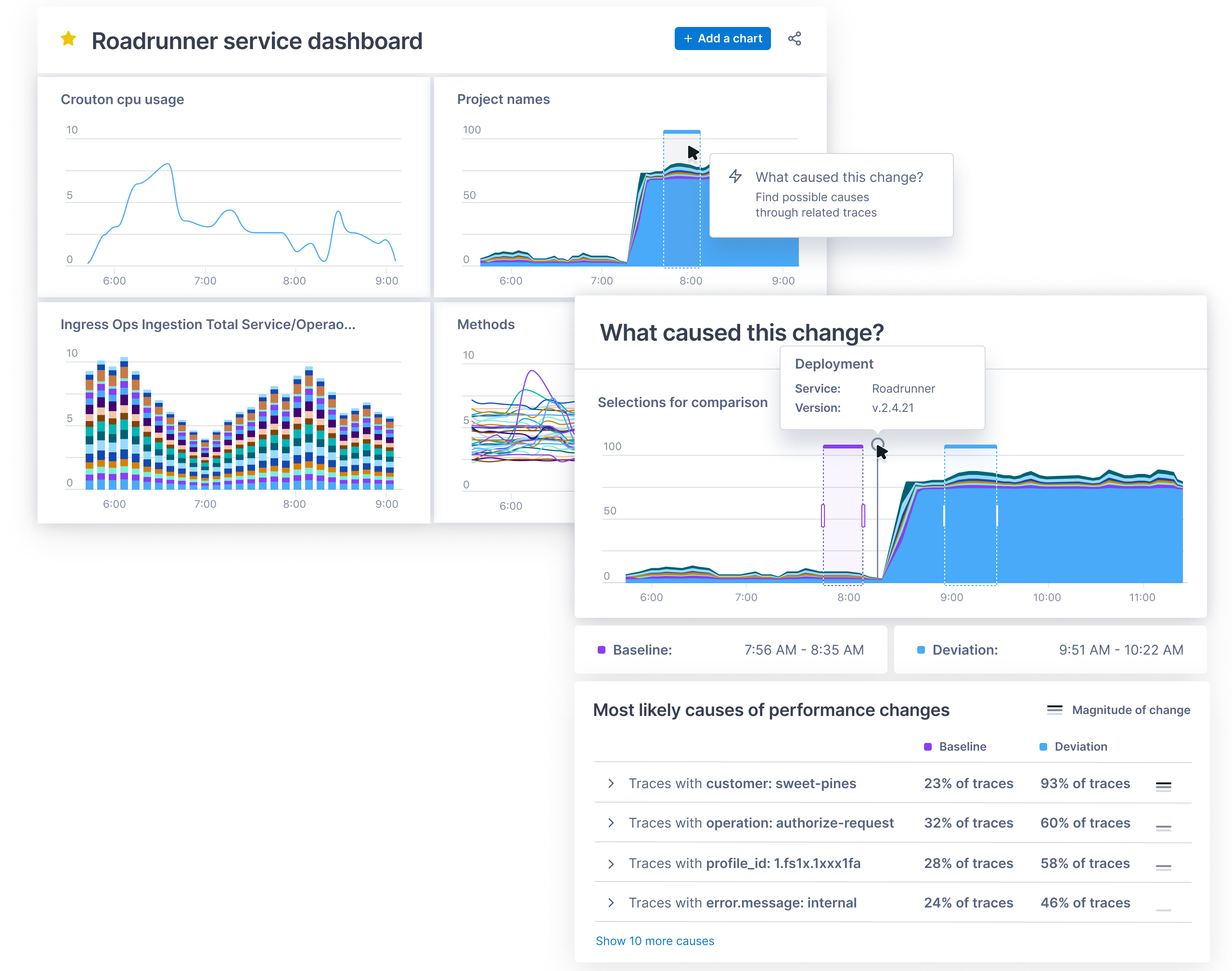
    Lightstep this week announced general availability of a Change Intelligence observability platform based on a time-series database that is capable of processing a trillion events each day.

    Ben Sigelman, Lightstep’s CEO, said as IT environments become more complex, thanks to the rise of microservices and cloud-native computing platforms, existing monitoring and observability tools will not be able to keep pace with the rate of change in what have become highly dynamic IT environments.

    While AIOps promises to address that complexity by employing machine learning algorithms to analyze IT environments and surface recommendations, Sigelman said there will always be the need for observability platforms that enable IT teams to discover the root cause of an issue in a way that surfaces the insights needed to fix the problem in real-time.

    The Lightstep database was built by the same team that created Monarch, the globally-distributed in-memory time series database system that Google employs to monitor its applications and systems. Lightstep’s database makes it possible to collect metrics, in the form of distributed traces, at a level of scale that allows IT teams to analyze events across a distributed IT environment made up of both monolithic and microservices-based applications, said Sigelman.

    Lightstep is the latest entrant in an already crowded field of observability platforms, all seeking to consolidate the wide range of monitoring tools IT teams have used for decades.

    The challenge IT teams face is that each of those monitoring tools is focused on a narrow range of platforms. IT teams often lack context when an issue arises, and wind up trying to correlate reports from multiple monitoring tools in the hopes of discovering the root cause of an issue. Observability platform providers are making the case for a single platform that correlates application and infrastructure events in a way that makes it easier for IT to fix issues faster.

    Observability, of course, has been a core tenet of DevOps for years. The tools for achieving that goal, however, have been cumbersome to implement and maintain using legacy application performance management (APM) platforms. Most of those platform providers, have rolled out what are positioned as next-generation observability platforms. Now, IT organizations will need to decide if they want to maintain investments in existing platforms versus moving to one of the raft of upstarts looking to dethrone APM incumbents.

    The startups are counting on a massive expansion in demand for observability platforms. IT organizations have tended to limit their usage of APM platforms to mission-critical applications due to cost and the challenges associated with maintaining the agent software needed to collect metrics from each application. Modern observability platforms have automated much of the metrics collection process, while open source software promises to make metrics collection more affordable..

    The challenge, of course, is that many organizations are already struggling to manage complex IT environments, and can’t necessarily wait for that open source software to mature.

  • Hybrid Low-Code: The Next Step in App Development

    Hybrid Low-Code: The Next Step in App Development

    The promise of low-code development has long been the ability to develop business-critical applications by humans with little programming experience. In fact, over the past year or two, the lines between low-code and no-code have become increasingly blurred. Low-code platforms have incorporated more and more functional no-code features to increase the efficiency of the developer even further. Some of these platforms have become so intuitive to use, the idea that anyone can create an app has evolved into the idea of citizen developers. But is low-code really the be-all and end-all when it comes to app development? Seems the answer to that is, “It depends.”

    It has become glaringly obvious that exclusively no-code platforms can’t create complex applications. But then again, these platforms were never really designed with that kind of functionality in mind. No-code can be a highly valuable, rapid prototyping tool as well as a decent tool for very small, very specific apps. These apps would be best suited for intradepartmental use or to extend the functionality of very specific SaaS tools. No-code is not going to power your business-critical applications, and a not-quite-a-developer is not going to lighten your IT load.

    But what about low-code? Can low-code be the bridge between citizen developers and the ever-growing list of backlogged apps? Maybe. Using citizen developers comes with a whole heap of issues that need to be addressed. While this topic can be the subject of an entire blog in its own right, I can quickly highlight the major issues to consider. How much of a citizen developer’s time should be dedicated to app development? Is using citizen developers going to create backlog issues in their primary departments? Who is going to train and support citizen developers? How is IT ensuring that citizen developer-created apps are secure, scalable and extendable? As great as citizen developers sound, they still are not a definitive solution.

    A realization has dawned in the low-code industry. Low-code can’t be and do everything, but it can be a useful development tool to speed up application development. However, most low-code platforms are in their own development silos, separated from other development tools with their own IDEs. Instead, one idea is to create a quick and easy-to-use user interface, drag and drop some app functionality, and then finish complex apps in a language the low-code platform can integrate with, such as Java, or via a Visual Studio plug-in. Even the biggest and best low-code vendors admit that just using low-code isn’t going to power your business.

    Low-code can’t be everything, but it can be a major part of everything. It just needs to look different from how most low-code platforms are designed. Using a hybrid low-code approach will allow organizations to truly use low-code from start to finish in the app development process. Rather than looking at low-code as a separate tool in the development process, a hybrid low-code approach brings low-code inside an IDE where traditional coding methods are still used.

    Is hybrid low-code the future of app development? I would say hybrid low-code is a next step in the evolution of app development. Low-code development tools shouldn’t be isolated in their own IDEs. It can be frustrating to leave a low-code IDE to finish the app in another IDE, and then have to connect the different elements into one cohesive app. As you can see, efficiency is reduced every time a developer leaves one IDE for another. Hybrid low-code views low-code as a tool inside a bigger development toolbox. It is there when convenient, but a developer isn’t forced to use just low-code. They can import already created assets from other languages, hand-code complex solutions, drag-and-drop when it makes sense, and create all the necessary components of a progressive web app with a click of a button.

    While there might be a profound realization that “traditional” low-code can’t do everything it originally promised, hybrid low-code could, instead, fulfill that promise.

  • CloudBolt Software Aims to Bridge DevOps and IT Divide

    CloudBolt Software Aims to Bridge DevOps and IT Divide

    CloudBolt Software today released a Winter update to its cloud management platform that aims to bridge the divide between DevOps teams and traditional IT administrators.

    IT administrators can now employ the CloudBolt platform to invoke the open source Ansible framework for automating IT processes and workflows using a graphical user interface (GUI) surfaced via a OneFuse Ansible Tower module.

    Additionally, the OneFuse Scripting module will now make it possible to automate script creation for anyone who creates a script using, for example, Terraform, and package that script in a way that IT administrators can invoke via a graphical tool.

    Jeff Kukowski, CEO of CloudBolt Software, said the goal is to make it easier for IT teams across the organization to reuse code created by a DevOps team. OneFuse provides IT with a codeless integration tool. In addition to the core cloud management platform, CloudBolt Software also provides access to a Kumolus service that enables IT teams to optimize cloud costs and provides additional governance capabilities such a generating an audit trail.

    Other capabilities added in the Winter release include deeper cost optimization analysis for VMware vCenter and Microsoft Azure environments, support for the latest release of VMware vRealize and additional C-level dashboards and reports.

    As the number of workloads deployed in production environments increases, there is going to be a greater need for some form of détente between DevOps teams and traditional IT administrators. Site reliability engineers (SREs) can typically manage a much wider range of workloads than an IT administrator. However, SREs are both expensive and hard to find and retain. IT organizations will need to find a way for IT administrators that, at best, have limited programming skills, to pick up some of the slack.

    Those IT administrators can play a critical role in minimizing the number of misconfigurations arising from provisioning IT infrastructure as code. Misconfigurations as a result of developer mistakes are rife across the cloud, and IT administrators are more inclined to check for these than are developers who are racing to deliver their next application.

    The truth is, there are a wide range of tasks that DevOps teams would just as soon see managed by IT administrators, especially if a script or runbook that addresses common issues has already been created. The trick is making that script or runbook easily accessible.

    In the meantime, IT organizations are racing to keep up with complexity in IT environments, often by applying automation at scale in a way that is both repeatable and well-documented. Whether IT professionals like it or not, the days of writing automation scripts and failing to document them are coming to an end. The real issue is ensuring that what does get automated actually works as expected, each and every time a script is applied.

  • AppDynamics Partners With Cisco to Secure Application Runtimes

    AppDynamics Partners With Cisco to Secure Application Runtimes

    AppDynamics today announced its agent software, which it provides as part of its observability platform, now has the ability to enforce application security policies.

    Developed in collaboration with the security business unit of parent company Cisco, the Cisco Secure Application offering, available from AppDynamics, can detect attacks, identify deviations in application behavior and block attacks automatically.

    Gregg Ostrowski, a regional CTO for AppDynamics, said the goal is to make it simpler for IT teams that employ AppDynamics for monitoring and observing their IT environments to also embrace DevSecOps best practices. In effect, IT teams can now piggyback security for application runtimes on their existing investment in AppDynamics, Ostrowski said.

    The AppDynamics approach provides the added benefit of easy integration with the Cisco security tools to improve collaboration between DevOps and cybersecurity teams, Ostrowski said. Security details correlated with the application topology make it easier to share context in a way that identifies the actual business relevance of any security event, he added.

    As organizations accelerate digital business transformation initiatives, Ostrowski said the need to embrace DevSecOps best practices is becoming more urgent. The level of risk attached to these types of projects is significantly higher than with previous generations of applications, Ostrowski said.

    While most organizations appreciate the need for greater application security, there’s a debate about how best to achieve that goal. There’s general agreement that developers need to be more involved. However, shifting responsibility for application security to the proverbial left often comes at the expense of developer productivity. AppDynamics is making a case for enabling IT teams, that may already rely on its application performance management (APM) platform, to enforce policies defined by the cybersecurity team.

    Of course, there’s still a need to provide developers with the tools required to write more secure code in the first place. The debate is over how involved in the cybersecurity management process developers need to be after applications are deployed in a production environment.

    Arguably, the goal should be to enable both teams to accomplish their respective tasks in a way that doesn’t require a constant stream of meetings and updates. In the event a vulnerability is discovered, it’s critical for security teams to determine the threat level that vulnerability represents. Otherwise, remediation of that vulnerability will be just one more item in a long list of patches that developers are already working on.

    Regardless of approach, there are now myriad ways to improve overall application security. In effect, the same defense-in-depth approach that IT organizations have relied on to secure network perimeters can now be applied to application security as applications are both constructed and deployed. The most significant challenge is not so much finding the tools required to improve application security, as defining the processes through which best practices can be consistently applied.

  • Accelerating AIOps with the Mainframe

    Accelerating AIOps with the Mainframe

    AIOps uses artificial intelligence by combining big data, analytics and machine learning to enhance IT operations. To successfully adopt and scale AIOps, it is critical for enterprises to add the mainframe to the equation. Adopting AIOps requires a holistic approach focused on business processes and workflows. The resiliency of a workflow depends on the health of every link in the chain. In order to be successful, you need visibility and insight throughout the entirety of the workflow.

    In this interview, Maneesh Goyal, AIOps Offering Management program director at IBM, explains how AIOps is changing IT operations and why the mainframe is so critical to the success of AIOps adoption.

    Maneesh is a DevOps expert with over 24 years of experience leading operations and management across hybrid and public cloud environments, including IBM Z. He is also one of the distinguished speakers presenting at Open Mainframe Virtual Summit, along with Mürsel Taşgın, mainframe systems manager at Credit Bureau of Turkey. During their session, Maneesh and Mürsel will discuss how organizations such as Credit Bureau of Turkey are accelerating AIOps by leveraging the wealth of operational data on IBM Z to make quick and accurate decisions in order to improve resiliency.

    Learn more about IBM’s AIOps framework and assessment to determine the next step for your business by attending Maneesh and Mürsel’s session at Open Mainframe Virtual Summit on Feb. 11. To check out the full agenda or to register for free, visit the Open Mainframe website.

  • OpenAPI Specification: Perception vs. Reality

    OpenAPI Specification: Perception vs. Reality

    The OpenAPI Specification (OAS) (formerly known as the Swagger specification) provides a way to describe and document REST APIs and their components. It includes details on endpoints, their operations, parameters needed for the operations, expected responses for every operation, authentication methods and even annotations. OAS is an easy format to learn and read, and can be understood by both humans and machines. As you might imagine, this kind of “accessible” documentation is useful and beneficial in a number of different use cases for both development and security teams.

    Developer Relationships With OAS

    For developers, OAS can be used to generate documentation for APIs. Proper documentation can help other developers figure out how best to integrate and use these APIs with their own application.

    Even so, many developers have a love/hate relationship with OAS. Let’s face it, documenting is a far cry from developing. Although it is easy to learn, the actual act of documenting is tedious, manual and time consuming. Frankly, it’s probably one of the least glamorous parts of a developer’s job, and, therefore, many developers only do the absolute minimum. As a result, OAS can be incomplete or, in some cases, missing entirely. Not to mention, when the API is updated, how often is the OAS updated, too?

    In the case of incomplete or nonexistent documentation, developers will muddle through with trial and error, even though this can slow down the development process.

    If out-of-date OAS proves an annoyance for dev teams, what’s the impact on security?

    Security’s Relationship With OAS

    OAS can be consumed by both humans and machines, and both are critical for security’s use of OAS.

    OAS helps security teams (humans) become aware that the API exists, since its documentation is often part of the CI/CD process.

    By examining an OAS file, a security team can understand what the API is supposed to do and, from that, determine if it conforms to or violates the organization’s security policy. As an example, security teams might use the OAS to make sure that authentication and authorization are being implemented correctly, and that sensitive data, like PII, is not being exposed.

    Security teams might also deploy tools (machines) that use the OAS to enforce policy based on what’s in the documentation. As an example, the OAS may specify that, for a particular parameter, a string should be expected; it should be no more than four characters and it should contain only letters and numbers with no special characters. By validating input based on what is defined in the OAS, security tools can check that the API does what developers intend it to do.

    This plan sounds great on paper, but …

    Perception versus Reality

    Imagine a perfect world, in which every API is well-documented as part of the development process. As that API makes its way through the development pipeline, it does so hand-in-hand with an associated OAS. At the appropriate time, before production, security is made aware of the API and the OAS, the team evaluates the details, validates that the API matches policy, gives the thumbs up and the API goes into production. Security and development teams live in harmony and everyone is happy.

    We don’t live in a perfect world. Instead, we must deal with questions such as:

    • Does the OAS exist? In the most extreme cases, the OAS doesn’t even exist. It was never created as part of the development process, so it can’t be used for any sort of awareness. These misses happen more often than you think, giving rise to the problem known as shadow APIs. These APIs slip through the cracks, and make it into production with no documentation at all. While you might be saying to yourself, “Our company would never let this happen!” you should also consider that numerous APIs are stood up by development teams as a test, as part of a beta or as a quick-and-dirty way to get something done. There are more of them than you think, and these shadow APIs create unrealized risk.
    • Is the OAS complete? In slightly less-scary territory, let’s consider an incomplete OAS. You might be saying to yourself, “We have a top-notch development team, well-defined development processes and strict policies around documentation. No API makes it into production without an OAS!” Perhaps, but the devil is in the details, and those details are often missed. I’ve worked with countless customers who have happily and confidently produced an OAS in which critical details don’t match the reality of the API. Sometimes they’re not complete. Sometimes they’re missing all together. The industry calls these missing details shadow endpoints. Yes, someone did produce an OAS, and security was aware of the API, but a lot of critical detail is missing.
    • Is it being kept up-to-date? Development cycles seem to be moving faster and faster, and as documentation is one of the least glamorous parts of a developer’s job, updates can be missed, dismissed or, at the very least, lag behind. We commonly see multiple versions of an API, and the OAS does not reflect the new capabilities of the latest version.

    While a non-existent or outdated OAS presents a modest concern for API visibility, it creates a substantial concern when trying to serve as the foundation for API security.

    You take a huge risk if you depend solely on OAS for security. More often than not, an OAS is not accurate, lacks critical details and is only as useful as the data you feed into it. Gaps, including shadow APIs, leave out critical details, making enforcement impractical.

    The inaccuracy of OAS leaves customers with two choices. You can either enforce security policies based on strict adherence, and risk blocking legitimate traffic, or you can enforce based on loose adherence and risk letting attacks through. In either scenario, your organization is unduly vulnerable, and significantly less secure than your dev teams intended or your security teams would like.

    OAS is Only a Starting Point

    OAS provides a great starting point for documenting your APIs. Don’t make the mistake, however, of basing your API security strategy on what’s in your OAS. It’s simply not accurate enough. Taking that approach will leave your company’s vital data and services at the mercy of API attackers who will quickly know more about your APIs and what they expose than your OAS does.

  • Using Automation to go All-Digital, Fast

    Using Automation to go All-Digital, Fast

    Before the pandemic, digital transformation was a five-year plan for many companies — or in some cases, a distant vision that kept getting kicked down the road. Now, companies in every industry face an urgent imperative to adapt to an increasingly online-first world: If you don’t go digital, fast, you’re simply out of the game.

    Increasing productivity has been critical for companies as they make this shift. But too often, speed is hindered by time-consuming and repetitive processes that companies can and should easily automate. By automating mundane tasks, employees and businesses can focus on what really matters — increasing scale in today’s work-from-anywhere world, and improving experiences for both employees and customers.

    The Benefits of Automation

    Fundamentally, automation is about digitizing existing business processes to streamline results, and it will be a key element in helping businesses survive and get back to growth. Until now, many companies have focused on applying these tools to the front office: sales, marketing, commerce and supply chains. With most employees now working remotely, it’s harder than ever for team members to do their jobs efficiently. Automating the back office and improving the employee experience is key for businesses to achieve the speed they need to thrive right now.

    Here are three key advantages of bringing automation to the back office:

    1. It improves productivity.In virtually every industry and role, employees are still spending hours every week on mundane and labor-intensive tasks, such as data entry. Automation can speed up these repetitive tasks and streamline lengthy processes, freeing employees up to focus on the “human” aspects of their jobs, like interacting with customers, planning ahead, making decisions or learning new skills. By taking over routine tasks and allowing employees to concentrate on what matters most, automation makes workers more efficient and productive.
    2. It increases scale.There’s only so much an employee can do manually. The time-consuming processes that worked yesterday can’t scale to meet the demands of an all-digital environment.  Automating repetitive tasks means that employees can achieve more in the same amount of time, allowing them to scale their workloads. With time-consuming tasks being taken care of in the background, workers can spend their time on more meaningful work and customer relationships.
    3. It enhances employee experience.Nobody enjoys entering numbers into a spreadsheet. An often overlooked aspect of automation is that it leaves employees more satisfied and engaged with their companies and their jobs. Having fewer tedious tasks on their plates gives employees the chance to tap the skills that machines aren’t as good at, like creativity, communication and decision-making. This is especially beneficial at a time when most employees are juggling more responsibilities at work and at home. Making a more valuable contribution and more meaningful connections is not only rewarding for employees, but also translates to higher satisfaction among the customers they interact with.

    Real-World Examples

    Not everything can be automated, but there’s a lot of room to take the drudgery out of most roles. Take onboarding, for example. Traditionally, when a new hire started, everything happened in person: They attended an orientation, picked up their laptops at the tech bar, met with benefit providers — all of which required orchestration on the part of human resources. With automation, all of this manual coordination can be replicated with an intelligent workflow capable of guiding employees through an onboarding process customized to their specific role and location.

    In another example, HR departments are facing an unprecedented volume of queries about policies around caring for children and other dependents. Using low-code development, companies can easily set up automated, online bots to handle frequently asked questions and guide employees through processes needed to enroll in new services. Automating these queries with bots not only makes the employees themselves more productive, but it also delivers better experiences for both the HR team and the employees seeking answers.

    Automation is Here to Stay

    In today’s world, there is no alternative to a digital business model. Automation is the recipe that will help companies achieve the speed they need to survive now and the edge they need to thrive in the future.

    And there is no turning back — automation is here to stay, regardless of the trajectory of the pandemic. The process of change is never easy, but done right, automation not only leads to a more agile workforce, but also to a happier one.

  • Oracle Includes GraalVM Support in Java SE Subscription

    Oracle Includes GraalVM Support in Java SE Subscription

    Oracle announced today it is adding a GraalVM Enterprise virtual machine for building Java applications to Java SE Subscription at no additional cost.

    Donald Smith, senior director of product management from the Java Platform Group at Oracle, said GraalVM Enterprise provides developers with a high-performance application runtime, built on Oracle Java SE, that includes a compiler that accelerates Java application execution. That’s critical as developers look to build microservices-based applications employing microservices that tend to be latency sensitive, Smith said.

    The first stable release of GraalVM arrived last fall. It consumes less memory, and enables Java applications to spin up faster by taking advantage of capabilities such as a just-in-time compiler. GraalVM Enterprise adds a native image utility that compiles Java and JVM-based applications ahead-of-time (AOT) into self-contained native executables. That approach only includes the classes and libraries needed to run the application, which reduces the size of the binary that gets generated.
    Including GraalVM Enterprise in the Java SE Subscription make it easier for Java developers to switch to that Java virtual machine (JVM) to build microservices rather than having to learn another language, Smith said.

    Smith said most organizations will continue to build monolithic applications at the same time they’re attempting to construct microservices. The Java SE Subscription makes it possible for developers to employ different JVMs depending on the type of application being constructed or updated, Smith said. A survey of 560 developers conducted by Oracle last month finds nearly half (48%) are already employing GraalVM to build microservices using Java.

    How much will organizations rely on Java to build microservices, given all the other programming language options available? That’s up for debate. However, being employed in the enterprise for more than 25 years, the number of developers that know Java well is substantial. Rather than waiting for those developers to become proficient in another programming language, there’s a natural tendency for organizations to want to stick with a familiar language. Each additional language introduced to build applications also tends to complicate DevOps processes in a way that can increase the total cost of IT.

    At the same time, however, the number of developers that know how to develop applications using everything from JavaScript to Go is also increasing. Oracle, via ongoing investments made in the OpenJDK project, is moving to make sure Java stays relevant at a time when the number of programming languages being employed has never been greater. For what it’s worth, GraalVM is designed to support multiple programming languages, including JavaScript.

    It’s unlikely Java will fade into obscurity any time soon. IT organizations have a vested interest in embracing next-generation JVMs, if for no other reason than making Java applications more efficient, regardless of how they are built.

    It’s also worth mentioning that frameworks – such as Quarkus from Red Hat – that enable Java-based microservices to run natively on Kubernetes clusters already rely on GraalVM. In some cases, developers may wind up employing such a framework without realizing it relies on GraalVM. In other cases, the challenge will be getting developers to opt for GraalVM as their JVM of choice when so many of them have routinely used the same JVM for more years than they care to admit.

  • CloudBees Appoints New CEO to Drive Next Level of DevOps Growth

    CloudBees Appoints New CEO to Drive Next Level of DevOps Growth

    CloudBees announced today the appointment of Stephen DeWitt as its new CEO, taking over from Sacha Labourey, who will become chief strategy officer.

    Labrourey said after leading the company for the past 10 years, and after a banner year that saw the company generate more than $100 million in revenue, the time was right to appoint a new CEO to take the company to next level. The move also allows Labourey more time to focus on product development.

    Stephen DeWitt
    Stephen DeWitt, CloudBees CEO

    DeWitt most recently served as chief strategy officer for Automation Anywhere, a provider of a robotic process automation (RPA) platform. DeWitt previously served as the CEO of WorkMarket, a labor automation platform for enterprises, Azul Systems, a provider of platform for running Java applications and Cobalt Networks, a provider of Linux servers.

    Without committing to a specific initial public offering (IPO) date, DeWitt said the ultimate goal is to put the processes in place that will enable CloudBees to grow to $200 million in revenues and beyond.

    Achieving that goal will also require tighter integration across what has become a diverse portfolio of DevOps platforms, DeWitt said. The challenge is providing IT organizations with all the benefits of that integration without locking them into any specific component, DeWitt added.

    Going forward, DeWitt said IT teams should expect to see CloudBees invest more in artificial intelligence (AI) to further automate DevOps processes. There are many low-level DevOps tasks that could be automated using machine learning algorithms to reduce the level of friction DevOps teams often encounter.

    Becoming a $200 million company, however, is more difficult than becoming a $100 million company, DeWitt said. Not only does the company have to put the processes in place to grow, but CloudBees today faces more viable competition than it did when it first pioneered the adoption of DevOps best practices.

    The number of organizations adopting DevOps best practices is not only increasing, but organizations that have implemented continuous integration/continuous delivery (CI/CD) platforms also are employing them more widely. Instead of only being employed by pockets of development teams, entire enterprises are now using DevOps best practices and standardizing on a CI/CD platform. Many of those decisions are being driven by the need to accelerate digital business transformation initiatives in the wake of the economic downturn brought on by the COVID-19 pandemic.

    As the application development stakes rise, C-level executives are also getting more involved in application development and deployment decisions, DeWitt said. Those executives not only want to accelerate the rate at which applications are built and deployed, they also want greater visibility into processes that now have a direct impact on revenue streams, DeWitt said.

    It remains to be seen just how quickly DevOps platform providers, as a whole, will grow, but with more venture capital pouring into the sector by the day, there is no shortage of fuel to throw on the proverbial DevOps fire.