Category: Blogs

  • Cortex Expands Microservices Catalog to Improve Collaboration

    Cortex Expands Microservices Catalog to Improve Collaboration

    Cortex, a provider of a catalog for tracking the ownership of microservices, today announced it has added a service creation capability that enables developers to use templates to scaffold new services in five minutes.

    In addition, the company has added a Cortex Teams offering that improves collaboration across teams of developers working on interdependent microservices.

    Fresh from raising an additional $2.5 million in funding, Cortex claimed it has increased its customer base by a factor of 10 since initially launching last May. Those customers include Rappi, Grammarly and 8×8.

    Cortex CTO Ganesh Datta said the company’s microservices catalog makes it simpler for teams of developers, DevOps engineers and security professionals to collaborate at a time when software development is becoming more complex. While microservices-based applications are easier to update and generally more resilient than monolithic applications, composing an application based on interdependent microservices created by different development teams can be more challenging to build and maintain.

    In some cases, organizations can even discover that different teams within their organization have built redundant microservices. Part of the reason that occurs is many IT teams still rely on spreadsheets to keep track of what microservices are being built and which ones are already deployed in a production environment.

    Cortex, in contrast, automatically imports data residing in developer tools to surface who within an organization is responsible for maintaining which microservices. A Cortex dashboard also enables DevOps teams to see which developers are on-call in the event of an unexpected incident as well as monitor and track the latency rate microservices are experiencing and which vulnerabilities have yet to be remediated.

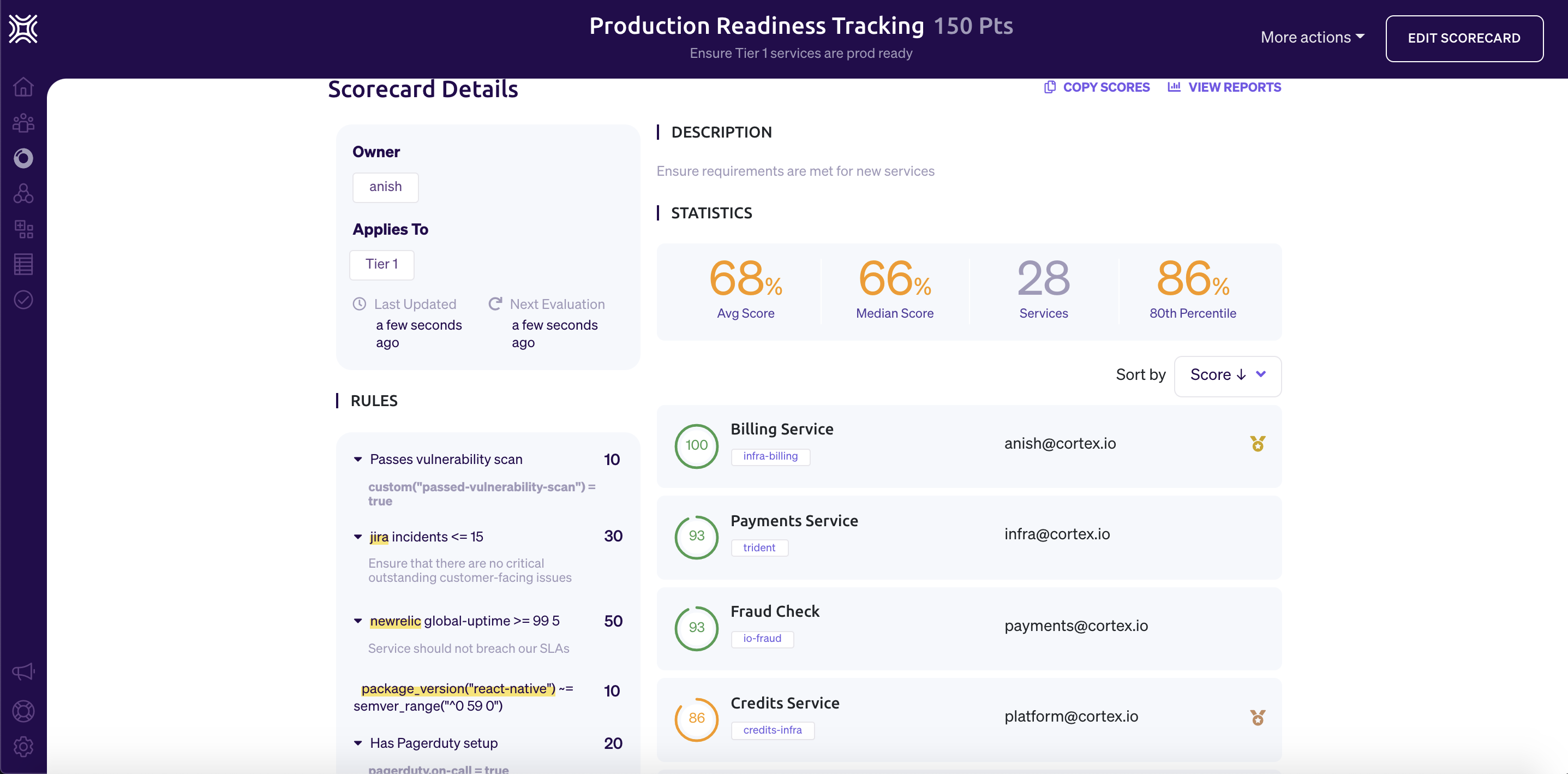
    At the core of the platform is Cortex Query Language (CQL), a domain-specific language that allows DevOps teams to define granular rules that can be applied to, for example, on-call rotations, security vulnerabilities, package versions, service level objectives (SLOs) and the overall health of the microservice. Engineers can employ code in the form of YAML files to set reliability standards across teams and types of services.

    Grades can also be assigned to specific microservices based on associated metrics. That approach allows DevOps teams to apply gamification techniques using a scorecard to encourage developers to continuously improve their microservices. That capability makes it apparent to other developers which microservices can be most reliably employed.

    It may be a while before microservices-based applications dominate the enterprise landscape. Monolithic applications will be running in production environments well into the next decade. However, many of those monolithic applications are essentially being converted into a larger microservice that other applications can invoke via application programming interfaces (APIs) before being eventually being re-engineered into a set of logically connected microservices.

    The one thing that is clear, however, is that as the number of microservices expands, it becomes more difficult to determine precisely what capabilities are already available to highly distributed application development teams.

  • Are You Feeling the Hiring Crunch?

    Are You Feeling the Hiring Crunch?

    After years of experience, we can now definitively say one thing about information technology: There is always a hiring crunch, and it will always be better soon.

    I first noticed this trend in InfoSec years ago. Everyone was short-staffed and looking for available candidates. Everyone wrote their recruitment text like there was no shortage and they could ask for the moon and everyone was certain that this temporary staffing shortage would end soon.

    It didn’t. It still hasn’t. And it has spread. DevOps in general, development in particular are acting exactly the same these days. And it’s not going to get better.

    So, my advice? If you absolutely must have a person, write your recruitment copy to reflect the actual skills you must have. No bells and whistles, no “We always include…” no “But what if we…” Hire for what you need. Or hire with an eye to training what you need. And offer competitive pay. No one here will argue that IT is underpaid, but when there is a shortage of people, or more are leaving than coming in, then the cost of employees goes up. That’s just the way it is. If you are only hiring the ones you must have, then you can afford to pay them a bit more.

    Meanwhile, invest in even more automation. Let’s face it; again, we can learn from InfoSec. They are doing more with less staff—even if “more” is not “everything that everyone wishes they could”.  They have at least partially conquered their staffing woes by increasing the use of automation. DevSecOps is automating even more of the space, so we really will eventually get over the InfoSec staffing shortage.

    We can do this for all of IT, too—just follow their lead. Invest in automation, take the risk and turn on automated actions. Start small, but get started. Relatively high turnover and lower qualified applicant counts are likely to be the status quo for the foreseeable future, so automating processes as much as possible is not taking away jobs at this point, it is improving response in light of a lack of people for the available jobs.

    So, to sum up:

    • Hire when you can, but be focused. Don’t ask for experience in all three big cloud providers if you’re looking for an Azure person. Don’t ask for fifteen years of experience in Go for that entry-level position. Be realistic, be laser-focused and get the person you need in.
    • Train when you can’t hire. Let’s face it, there are going to be people who are massively familiar with application security but who have never done DevSecOps specifically or never used your DevSecOps solution. Train them—whether they are internal or hired with an eye toward training.
    • For non-critical, long-term needs, explore automation options. That includes both things that are being done manually today and things that are not being done at all. Find a way to get it done in the absence of hiring someone.

    And keep rocking it. You are already getting the job done—I’m just recommending ways to stay on top of it and deliver more while you try to find the additional people you need. A balance of automation and hiring will help you sleep at night and make the rest of the org certain that IT is on the ball.

  • Managing GraphQL at Scale

    Managing GraphQL at Scale

    GraphQL, the query language invented by Facebook, has attracted a lot of interest as a means to conveniently access data programmatically. GraphQL structures internal services with a unified schema for data, empowering product engineers to easily grab what they want from many microservices to populate the user interfaces (UIs) they’re creating. By unifying company data into a single graph, GraphQL combines the benefits of SQL with the ubiquity of API access.

    However, GraphQL does introduce some challenges when you’re trying to scale it across a large enterprise and partner ecosystem. For example, since GraphQL channels all requests through a single endpoint, security must carefully segment access to all the underlying infrastructure to avoid data overexposure. Matt DeBergalis, Apollo’s co-founder and CTO, also identified potential issues around changeability and performance when adopting a graph at scale.

    As the use of GraphQL within large organizations grows, development teams will have to overcome these obstacles—especially if companies intend to productize public APIs and reuse the same single graph company-wide. I recently met with DeBergalis for an update on managing GraphQL at scale. According to DeBergalis, we’re still in the early days of the graph revolution. And, future GraphQL maturity will require more rules-based declarative architecture, efficiency improvements and the adaptability to enact agile iteration of graph schemas.

    State of GraphQL Adoption

    So, what is driving the rise of GraphQL? Well, DeBergalis noted three key contributing factors:

    1. Many many microservices. In recent years, there has been an explosion of microservices. These modular services can be challenging to wrangle and are often exposed inconsistently throughout a software ecosystem.
    2. The rise of omnichannel platforms. Product engineers must now port the same data across disparate devices, whether streaming in a browser or on a Peloton screen.
    3. Users expect a hefty, data-rich experience. Expectations are at an all-time high. It’s now expected that an e-commerce shop, for example, will include product recommendations, auto-fill keyword search, pricing by geography and many more advanced features.

    Juggling all these factors creates a “complexity bottleneck,” DeBergalis explained.

    GraphQL responds to such complexity, helping unify the backend to enable product developers to fetch precisely what their client applications require. And, GraphQL adoption took off pretty quickly, particularly among product engineering teams, DeBergalis added. GaphQL plays nicely with familiar languages and frameworks like JavaScript, React and Relay. It’s also a bit different than previous trends, with demand being driven more by the database folks; “query people are really leading the charge,” he said.

    With the right technology stack, developers can add a graph layer between the underlying core APIs and the UI they are building, creating a universal API with a self-documenting schema. “For the developer, the amazing thing about GraphQL is throwing away all this boiler code,” DeBargalis said. GraphQL acts as “a foundation for tomorrow” to help deliver future business requirements, he said.

    With regard to architectural styles for APIs, 94% still use REST and 31% use GraphQL, according to the 2021 State of API Report from Postman. Though this percentage may seem small now, GraphQL adoption is steadily growing among large companies, such as PayPal, Netflix, Shopify, GitHub and Airbnb.

    Three Issues When Scaling GraphQL

    Using GraphQL is like using a mobile phone. You wouldn’t want to use a different phone every time you called a different number, would you? You would rather have all your contacts accessible from the same device. Similarly, GraphQL excels the more functionality is added.

    “Due to the network effect, a graph becomes more interesting as we publish more into it,” said DeBergalis. “What we have found is that GraphQL is most interesting and valuable at scale.” So, what are some inevitable consequences of GraphQL at scale? DeBergalis outlines three main architectural issues.

    Performance

    Performance downsides are one disadvantage that developers often cite when considering GraphQL. GraphQL has no built-in caching features, and the payload query could introduce additional latencies. Mitigating lower-level issues around throughput and reliability will likely require additional tooling from the community, DeBargalis said. This is partially why the Apollo team has begun to embrace Rust in new attempts to make infrastructure for GraphQL routing hyperefficient.

    Changeability

    A second problem enterprises may encounter when scaling GraphQL is embracing agility for such an all-encompassing fabric. “The companies that do GraphQL really well change it all the time—they treat it like a product,” said DeBergalis. This agility is at odds with the traditional REST API approach of building for longevity, which makes that approach extremely averse to breaking change.

    The reality is that when a company embraces a single graph, it may be pushing hundreds of schema changes every day. Different internal teams may maintain their own slice of the graph, defining it differently. Plus, maintenance roles may shift from team to team over time, noted DeBergalis. “If you try to waterfall what your inventory model should look like, you won’t get anywhere,” he said.

    Balancing change and stability will likely require a two-pronged approach to GraphQL. You want to continually iterate the graph with experimental features but also depend on certain functionality to preserve backward compatibility for client integrations. Satisfying both sides will likely require a change management strategy for iterating quickly, as well as enterprise-grade service level agreements (SLAs) to retain a firm bedrock on which to build more permanent data models.

    DeBergalis also described how observability is important for obtaining a clear picture of graph environments. This is one area where GraphQL shines—since clients request precisely what they need, you are never left wondering which methods are fetched but not implemented in production, as could happen with REST API management. According to DeBargalis, tracking fine-grained GraphQL usage with KPIs can help direct how the data model should evolve over time.

    Authorization

    Finally, perhaps the most significant concern surrounding GraphQL at scale is apportioning the appropriate access to users and devices. As a single unified endpoint can connect to a vast array of data behind the scenes, large GraphQL implementations will require a strategy for how that one unified graph can be implemented in parts.

    Without the proper access control, GraphQL could improperly expose personally identifiable information (PII). For example, a FinTech company may have a rule that requires a customer service representative to only have visibility into a customer’s transaction history if the customer has filed a support ticket in the last few days. Or consider data custody—a business working in the EU must comply with regulations on where data can and can’t live.

    Safeguarding GraphQL will require a declarative setting that integrates authorization control and context into GraphQL queries. To implement this, DeBergalis advocated for a command-and-control style. First, you build the schema around the data and problem statement. Next, you integrate rules field-by-field, marking sensitive touchpoints as PII.

    With rules baked into the query, you can have a more solid understanding of the surrounding context. “Authorization is actually a lot better at graph level,” said DeBergalis. “It’s the layer that has semantic understanding.”

    Future of GraphQL Scalability

    “Once you have a graph, you want to use it for everything,” said DeBergalis. The heritage of GraphQL is JavaScript, the language of the product world. And, the graph approach delivers an excellent experience for product engineers. The sheer usability and productivity benefits of GraphQL indicate incredible potential for projected use in the years to come.

    As we’ve discussed, scaling GraphQL across an enterprise will likely require performance improvements, a path for schema adaptability, policies to handle authorization for queries and greater accountability for business metrics. While GraphQL certainly has existing momentum among a subgroup of engineers, there are plenty of opportunities to introduce more training and educational curriculum to spread greater awareness.

    Furthermore, for those coming from a traditional REST API mindset, GraphQL is a bit of a new paradigm that will require some massaging to expose graph endpoints as a productized API. Doing so will likely involve marking select parts of the larger graph to expose to partners. “Starting with an internal GraphQL use case works really well, but productization around GraphQL is coming,” said DeBergalis.

    The value of a unified graph is so strong, and the bottom-up hunger for a graph environment is so intense that increased GraphQL adoption feels like a given. “At this stage, the focus is on expansion,” said DeBergalis. “How do we roll this out to more teams?”

    “We know there’s going to be a graph in every company—not a lot of little ones,” said DeBergalis. “Every company’s going to need a graph.” When that day comes, the architectural challenge will be breaking apart the graph into pieces. “That’s the next big frontier.”

  • LogicMonitor Introduces Unlimited Log Data Retention

    LogicMonitor Introduces Unlimited Log Data Retention

    LogicMonitor today announced it will provide an option that allows IT organizations to retain an unlimited amount of log data on its software-as-a-service (SaaS) platform.

    Tej Redkar, chief product officer at LogicMonitor, said one of the issues that is holding back advances in observability is the cost of storing log data. LogicMonitor has decided to remove that issue by allowing IT teams to store log data on its LM Logs service for as long as they require, Redkar said.

    That data will also always be readily available as hot storage with no need to wait for data that has been stored offline to be rehydrated, he noted. Instead, that data is readily accessible alongside the metrics and distributed tracing data that LogicMonitor also collects, said Redkar.

    In general, LogicMonitor is making a case for centralizing observability for the entire IT organization via a SaaS platform infused with machine learning algorithms that automatically surface anomalies in real-time based on millions of events captured via log data. The issue many organizations encounter today is silos of decentralized observability data that are more complex to maintain while providing less visibility at a higher total cost, said Redkar.

    The LogicMonitor platform, in contrast, is designed to be equally accessible to, for example, a network operations team as it is to a DevOps team, he noted.

    Not every organization needs to store log data forever, but Redkar said as IT management continues to evolve, more organizations are moving toward storing metrics, traces and logs for longer periods of time. The rise of open source agent software is also making it less costly for organizations to capture that data in the first place.

    It’s not clear to what degree other providers of observability platforms will provide unlimited retention of data, but as the cost of storing data in the cloud continues to drop it’s apparent that billing IT organizations for storage costs is becoming untenable. There is always going to be some cost associated with storage, but it’s not enough to charge extra beyond the core cost of the service. The only thing accomplished by billing separately for storage is discouraging IT teams from storing the data required to both attain observability and better train the machine learning algorithms that surface anomalies.

    Observability, in one form or another, has been a core tenet of DevOps best practices for years. Initially, DevOps teams focused on continuous monitoring as the most effective way to proactively manage application environments. Observability platforms infused with machine learning algorithms make it possible to correlate events so that analytics tools can more easily identify anomalous behavior in real-time. Armed with those insights, it becomes a lot simpler for IT teams to resolve issues faster.

    In fact, there may even come a day when the so-called “war room” meetings that are convened to identify the cause of an IT issue via a painstaking process of elimination are no longer required. In the meantime, however, the total number of IT incidents that actually lead to disruption should steadily decline, even as IT environments become more complex.

  • DevOps Dozen² 2021 Finalists Announced

    DevOps Dozen² 2021 Finalists Announced

    Today, we are delighted to announce the finalists of the DevOps Dozen² Awards 2021, celebrating the greatest innovators and their achievements in the DevOps space. Despite the many challenges of the past year, these individuals and companies have taken an active role in the DevOps community, demonstrating their leadership and commitment to the improvement of our industry. We had a record number of nominations this year which was terrific to see. It means even through the challenges of the last two years, the DevOps community has remained robust and active.

    Congratulations to every one of the finalists—it is quite an honor to make it this far. All of your hard work and dedication is greatly appreciated.

    Without further ado, here are the finalists for the DevOps Dozen² Awards 2021:

    DevOps Dozen Community Awards

    1. Best DevOps Industry Implementation

    2. Best DevOps Survey/Analysis/Research

    3. Best DevOps-Related Video Series (video)

    4. Best DevOps-Related Audio Podcast Series

    5. Best DevOps Book/eBook of the Year

    6. Top DevOps Evangelist

    7. Best DevOps Transformation (non-vendor)

    8. Best DevOps Virtual Event of the Year

    9. Most Innovative DevOps Open Source Project

    10. DevOps Executive of the Year (non-vendor)

    11. Best DevOps Presentation of the Year

    12. Best DevOps.com Article of the Year

    DevOps Dozen Tools and Services Awards

    1. Best End-to-End DevOps Tool/Service

    2. Best DevOps Repo/GitOps Tool/Service

    3. Best CI/CD Tool

    4. Best Value Stream Management Tool

    5. Best Observability Solution

    6. Best DevSecOps Solution

    7. Best Testing Service/Tool

    8. Best Kubernetes Platform/Service

    9. Best Cloud-Native Security Solution/Service

    10. Best DevOps for Mainframe Solution

    11. Best DevOps for DataOps/Database Solution

    12. Best New DevOps Tool/Service Provider

    Finalists were picked by the judges and also based on which entry had the most nominations. Every single finalist will receive a badge to display on their website and social media with a link to the voting/survey site.

    Voting for the winners in all 24 categories is now open to the public. To vote for the leaders, tools and companies you think are truly deserving of an award for their exceptional service to the DevOps community, please visit the DevOps Dozen² website.

    Winners will be chosen from among the finalists, with general public voting weighted for 40% of the final score and our judges’ selections for 60% of the final score. The deadline for public voting is Dec. 31 and the judges’ determinations will follow shortly thereafter.

    The winners will be announced at the Predict 2022 Virtual Summit Jan. 20 and will receive both digital badges and physical trophies celebrating their achievements.

    Thanks to everyone who has supported the DevOps Dozen² Awards by nominating candidates and voting. Good luck to all the finalists!

  • 4 Keys to Developing Ethical AI

    4 Keys to Developing Ethical AI

    Companies continue to grapple with how to use artificial intelligence (AI) technology in a way that doesn’t compromise privacy and that takes into account other key ethical considerations. It is undeniable that AI is one of the fastest-growing categories today. But if we are unable to build tools that live up to high ethical standards, not only are we doing end users a disservice, but we are failing to deliver on the promise of this technology as a force for good.

    AI and ethics has been one of the hottest topics within the technology community for decades. However, as an industry, we are still finding it hard to put our best foot forward in terms of ensuring ethical use—let alone solving the problems these systems were meant to address. Fortunately, there is one group that could be the guiding force we need: Developers.

    From the ideation process to implementation, the developer community is by far the group with the most intimate knowledge of how AI products actually work; therefore, they can have a tremendous influence on what these tools actually do and how ethical they are—and they need to be empowered to make these calls.

    With that in mind, here are four key questions that companies and their developer teams should ask as they work to build the ethical AI solutions of the future. 

    Is This Transparent in Every Way?

    If a developer ever finds themselves saying, “I don’t know,” when asked about how a product works or how the product is ultimately going to be used, production should stop immediately. The power of automation is tremendous. But given how quickly it can morph and learn, making sure that oversight and explainability are ingrained in its functionality is imperative to ensure ethical use. If this can’t be guaranteed, developers should be empowered to flag their concerns and look for ways to remedy them before continuing production.

    As AI continues to evolve, designing and developing AI systems will likely continue to lead us into areas where no clear legal, social or policy guidelines address many of the potential uses—and misuses. So, now is the time for developers to establish a transparent and clear channel of communication where they can actively raise concerns, discuss and deliberate on ethical dilemmas with diverse stakeholders. This is crucial in reducing or eliminating any negative effects of AI. Otherwise, we will continue to see the current faux pas around AI ethics continue.

    Have we Accounted for Risk or Exceeded Regulatory Boundaries?

    Virtually any big idea has its risks. Unfortunately, when it comes to AI, these risks generally involve unethical use or unintended consequences. The ongoing debate around facial recognition and AI is a perfect example of this. While this use case is intended to improve security and may have other benefits, facial recognition software comes with significant privacy risks and fears over misuse and misapplication. Moreover, because the regulatory landscape around AI is still taking shape, companies can fall into a trap of looking to exploit these gray areas in exchange for being the first to market or gaining a competitive edge. This is why companies that are not using ethical privacy-preserving AI in facial recognition implementations, for example, are having to walk back their products.

    Simply put, acting in this manner can have terrible consequences for the ethics around an AI product. But there is good news; the fix for this mistake is relatively straightforward: Instead of just making sure that products barely comply with regulatory gray areas, make sure they exceed them. Granted, this can lead to increased go-to-market time and significant leg work. However, this is the only way to realistically “future-proof” products against potential unethical use cases.

    Is This System Adaptable?

    Even the best preparation and forethought does not guarantee that a tool will operate exactly as it was intended. This is why it is so important for developers to have the ability to plan for contingencies and build adaptability into their tools so that adjustments can be made periodically if any ethical questions arise. This can be particularly helpful when it comes to addressing bias concerns that may occur as AI products learn and expand.

    Technology is a dynamic and rapidly evolving category. And as such, developers are often working on very compressed timelines. But to get AI right, developers need time to suss out the bigger picture around their products and bake in everything possible to make sure products are set up for ethical use in the short, medium and long term. If they don’t, not only will reputational damage be done to a company, but a company’s entire product pipeline could be stunted indefinitely as products need to be pulled offline entirely.

    Are Developer Teams Actually Prepared to Build Ethically?

    Setting a concrete mission statement that is centered around ethics is a great start for any technology company. But without a more systematic approach to instilling principled behavior in developer teams, companies will struggle to drive tangible results in their pursuit of building ethical products. Additionally, given how complex ethical AI development has become—thanks to innovations in quantum computing, among other things—even the most seasoned developers will have trouble keeping up with the developments and desired standards relating to a company’s ethical AI goals.

    Therefore, beyond just laying out overarching messaging, companies need to codify their ethical intentions by building an entire infrastructure that equips developers with the ongoing training and resources they need to constantly keep ethical standards in mind. If not, confusion will almost certainly ensue, missteps will occur and ethical standards will slip as a result.

    Unfortunately, despite the promise, the AI world has fallen short of meeting the ethical frameworks we need to have in place to both solve the problems of tomorrow while also serving the public good. But this doesn’t have to be the case. By asking these few simple questions, companies can empower developers and build the ethical development infrastructure that is needed for AI to achieve its full potential.

  • Mastering the Shared Responsibility Model

    Mastering the Shared Responsibility Model

    It’s no secret that cloud-native application development is growing exponentially, with Agile development, IaaS and PaaS from providers like Amazon, Microsoft and Google, enabling innovation at a pace that is challenging for security to keep up with. 

    A global pandemic and the resulting remote work mandates have only accelerated this movement. And with this change in distributed work and agile application development comes greater security considerations—and a higher degree of risk to the business. Security in the cloud is a shared responsibility, but too many organizations find it difficult to fully understand their role in the security of their applications. There are many elements of securing cloud-native applications that cannot be delegated. They require careful attention as part of a risk-based application security program that extends from design to development throughout their application development life cycle.

    With the appropriate visibility, risk-based thinking and automation, cloud-native applications have the ability to be more secure than ever, while enabling faster development and delivery at the same time. But to get to this point, organizations need to understand their responsibilities. 

    Cloud infrastructure security and compliance are necessities for ensuring how applications and data are deployed and operated in the cloud. But what about what is in those applications? Applications are made up of lines of application/infrastructure code and open source libraries built by developers, DevOps, product managers, security champions and other roles. 

    How do we know the components that make up the application are effectively secured? It is too late and not enough to solely rely on a secure cloud posture. Reducing risk early in the development lifecycle will dramatically reduce costs and business risk. Some sources have assessed the cost impact of fixing a risk in early production to be four to five times as much as one uncovered during design, and up to 100 times more than one identified in the maintenance phase.

    Modern applications are delivered through sophisticated “plumbing” of secure cloud infrastructure to our device interfaces. Just as we require clean and safe water to transit the physical plumbing into our homes, we need our applications to remain secure and high-quality as they transit cloud services.

    The IaaS/PaaS Shared Responsibility Model

    The best way to think about security in this cloud-native world is by using a shared responsibility model, with IaaS customers only responsible for certain elements of the security of an application that lies on top of the infrastructure. 

    In the traditional shared responsibility model, IaaS vendors are responsible for the configuration, management and security of infrastructure elements such as networking, databases and compute engines, in addition to physical security, redundancy and more. But each of their customers is responsible for the security and privacy of everything on top of that, from design to code to deployment.

    The Traditional IaaS/PaaS Shared Responsibility Model

    The Customer Side of the Shared Responsibility Model

    What’s missing from this model are software design, code risk and CI/CD security and integrity—and these areas are the most difficult, time-consuming and require a well-thought-out and comprehensive application security program.

    With new approaches to application security, organizations can better understand the risk of their cloud-native applications and automate a significant amount of risk remediation activities at the design or coding phases before deploying to the cloud. This requires taking a broad but contextual view of AppSec across the entire SDLC—and the modern nature of attacks requires a complete view of the SDLC to understand where the most impactful business risk lies.

    Organizations must evaluate the full picture of their risk—from design to code to cloud:

    1. Visibility—Understanding your risk starts with visibility into your security and compliance risks with a real-time inventory of assets, application and infrastructure code behavior, developer knowledge, third-party security alerts, sensitive data and business impact.
    2. Secure by Design—You need to make sure that security is addressed at the design stage—before any code has been written or committed.
    3. Change Management—Organizations need to focus on the risks that matter early in the development process and based on business impact. Material changes to the applications and infrastructure should be carefully evaluated while other changes can be approved more quickly or ignored, thereby accelerating product delivery.
    4. CI/CD Security and Integrity—As an ever-running, highly-trusted and sensitive process, CI/CD is often overlooked. Many attacks in the recent past exploited this Achilles’ heel of the development cycle by embedding attackers’ code within native code commits or other automatic CI/CD processes. Organizations should ensure CI/CD operations are secure with integrity and security checks in place.
    5. App & Infra Risks Together—To properly secure your applications, you must correlate the risks of your applications and infrastructure in one platform.
    6. Automation—Automation must also be employed to limit mistakes caused by human error, ensure consistency in enforcement of policies and increase the speed of the DevSecOps process. Organizations must carefully manage this process, because automation can also introduce a new category of issues, such as race conditions, untimely triggering, incomplete state validation for edge cases, etc.

    Infrastructure-as-Code (IaC)

    The human element of risk has changed with IaaS and PaaS due to the power that cloud administrators now have. Instead of purchasing, configuring and deploying servers over a period of months, an admin can spin up a Kubernetes cluster or an S3 storage bucket, load customer data and expose it to the Internet with relevant identity and access management (IAM) policies in record time via infrastructure-as-code (IaC) using GitOps instead of ClickOps.

    The rise of IaC has enabled us to view, evaluate and respond to infrastructure changes in the same way we would any application code change. Organizations must apply the same governance rules and automation to review changes in infrastructure before they reach production, along with real-time analysis of cloud misconfiguration. 

    The main challenge is context! All IaC tools in the market today are looking at security misconfiguration as a single dimension (for example, an S3 bucket missing encryption; a cloud database missing SSL for incoming connections, etc.) and this creates a lot of noisy alerts. The risks of cloud infrastructure and the applications that run on top of it are inherently connected—it is harder to connect the dots and understand the true risk of changes than it is to accept alerts at face value!

    When securing your applications in the cloud, don’t rely on traditional tools and processes. Today’s technologies enable new approaches that help you understand and remediate risk in entirely new ways and make cloud-native applications more secure than ever.

  • Plutora Enhances VSM Platform with Release Insights

    Plutora Enhances VSM Platform with Release Insights

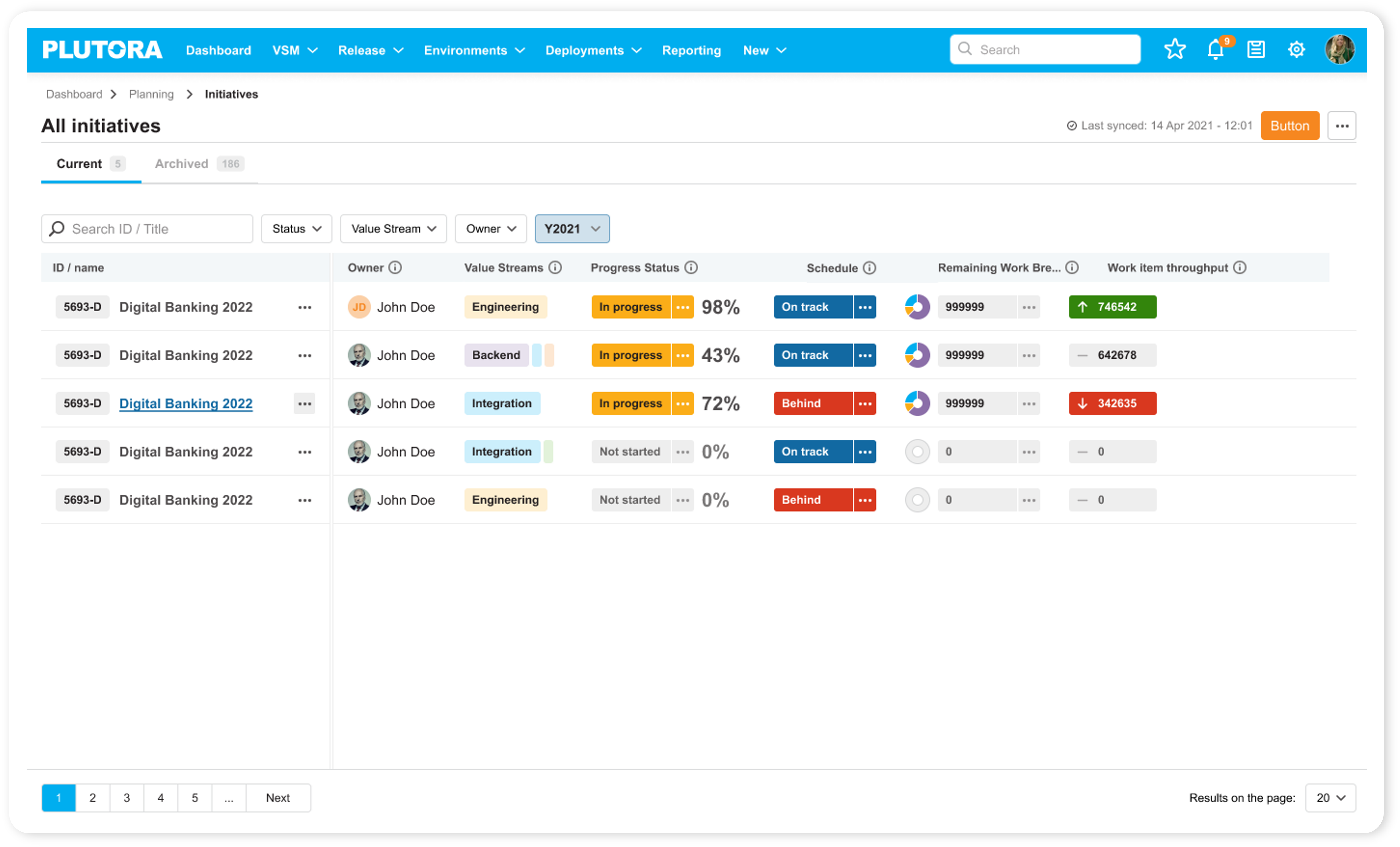
    Plutora has enhanced its value stream management (VSM) platform to provide dashboards that enable DevOps teams to better optimize application delivery.

    Jeff Keyes, vice president of product marketing and strategy for Plutora, said dashboards added to the platform will make it possible for application release managers to leverage predictive analytics to manage application delivery in a more progressive way rather than always having to react to an unexpected event.

    To enable that approach, Plutora has revamped its release insights dashboard that surfaces problem areas and hot spots in addition to adding analytics that track both software builds and larger project initiatives.

    That latter capability is especially critical for executives that currently find it challenging to keep track of multiple software development initiatives, especially those that may have fallen behind schedule without senior leaders being aware of the implications, said Keyes.

    While VSM platforms are typically used by senior IT and business leaders to keep track of how software deadlines are impacting key performance indicators (KPIs) for the business, Keyes said it’s become apparent that application release managers need access to more advanced analytics to optimize application deployment schedules. The Progressive Release Management capability surfaces insights via dashboards in the Plutora platform; that makes it simpler for application delivery managers to optimally orchestrate allocation of resources.

    Release managers, of course, already have access to a wide range of platforms for automating the application delivery process. However, Keyes said, those platforms don’t provide enough insights into how to optimize application delivery across a DevOps workflow made up of disparate tools and platforms. Plutora enables release managers to employ value stream flow metrics and more traditional DevOps metrics to reduce cycle times and improve overall DevOps throughput.

    Keyes said once organizations are provided with that insight, they should also be able to reduce the overall fatigue level many DevOps teams currently experience by removing friction within those workflows. In fact, that fatigue level is a major reason why there is so much turnover in many DevOps teams, he noted.

    It’s not clear how many organizations have a dedicated application release team, but optimizing the software delivery process is a major challenge for almost every DevOps team. While many organizations routinely make use of continuous integration (CI) tools to build applications faster, continuous delivery of applications has proven to be a more elusive goal. This is largely because each platform on which applications are deployed tends to be unique. As a result, many DevOps teams still rely on spreadsheets to manually manage application deployments.

    However, as the pace at which applications are being built continues to accelerate, it’s clear that application delivery is becoming a bottleneck. VSM platforms provide a means of applying analytics to optimize a process that can then be used to make better-informed decisions that might convince more organizations to automate application delivery. That assumes, of course, that the organization had the foresight to invest in a VSM platform capable of surfacing those insights in the first place.

  • Nobl9 Adds Hydrogen Platform to Surface Technical Debt Issues

    Nobl9 Adds Hydrogen Platform to Surface Technical Debt Issues

    Nobl9 today unveiled a Hydrogen platform that makes it simpler for DevOps teams to identify technical debt issues as they manage service level objectives (SLOs) as code.

    Hydrogen enables DevOps teams to define SLOs using a simple wizard or by embedding code within their application as part of a DevOps workflow. That code is then used to automatically collect data from platforms such as Datadog, New Relic, Prometheus, Splunk and others with requiring any additional instrumentation.

    Nobl9 COO Kit Merker said that approach also makes it possible to surface technical debt that inhibits achieving those goals via the Hydrogen platform. Armed with those insights, it then becomes easier for DevOps teams to focus on reducing or eliminating that technical debt because Hydrogen automatically generates a ticket in the Jira project management application—widely used by DevOps teams—to make sure the issue is addressed. Otherwise, in the heat of a DevOps sprint, the issue is likely to be forgotten as the application development project continues to move forward, noted Merker.

    The ability to identify that technical debt is an outgrowth of the ability to manage SLOs as code that is enabled by the core Nobl9 software-as-a-service (SaaS) platform. Hydrogen extends that capability by automating workflows whenever a specific service shows indications that it cannot meet objectives because of a dependency on a legacy platform that needs to be upgraded, added Merker.

    There is also a service health dashboard that organizes SLOs into logical groups that are mapped to features via labels, which Merker noted makes it possible for multiple stakeholders to easily identify which issues affect a particular service most. Hydrogen can also trigger a variety of automated workflows to prompt additional investigations that escalate as services worsen.

    Overall, Hydrogen is designed to provide engineering teams with more accurate context that can be used to prioritize which issues should be addressed first during any technical debt planning cycle, said Merker. Hydrogen can enforce code release policies based on technical debt budgets that are enforced via integrations with continuous integration/continuous delivery (CI/CD) platforms.

    Technical debt generally refers to any code change that is required to optimize a service that is not immediately addressed. The more legacy platforms there are in an IT environment, the higher that technical debt tends to become. At a time when more organizations are building and deploying microservices-based applications, that technical debt, over time, tends to adversely affect applications that are much more dependent on external services than a traditional monolithic application. A single technical debt issue can have a cascading impact on multiple microservices-based applications that would, otherwise, would be difficult to detect.

    The challenge, of course, is that technical debt doesn’t always get the attention it deserves when most of the IT team is focused on rolling out the next great application. However, as application environments become more complex it may only be a matter of time before all the technical debt that is being accumulated becomes unsustainable.