Category: Blogs

  • Logz.io Extends Open Source Observability Platform

    Logz.io Extends Open Source Observability Platform

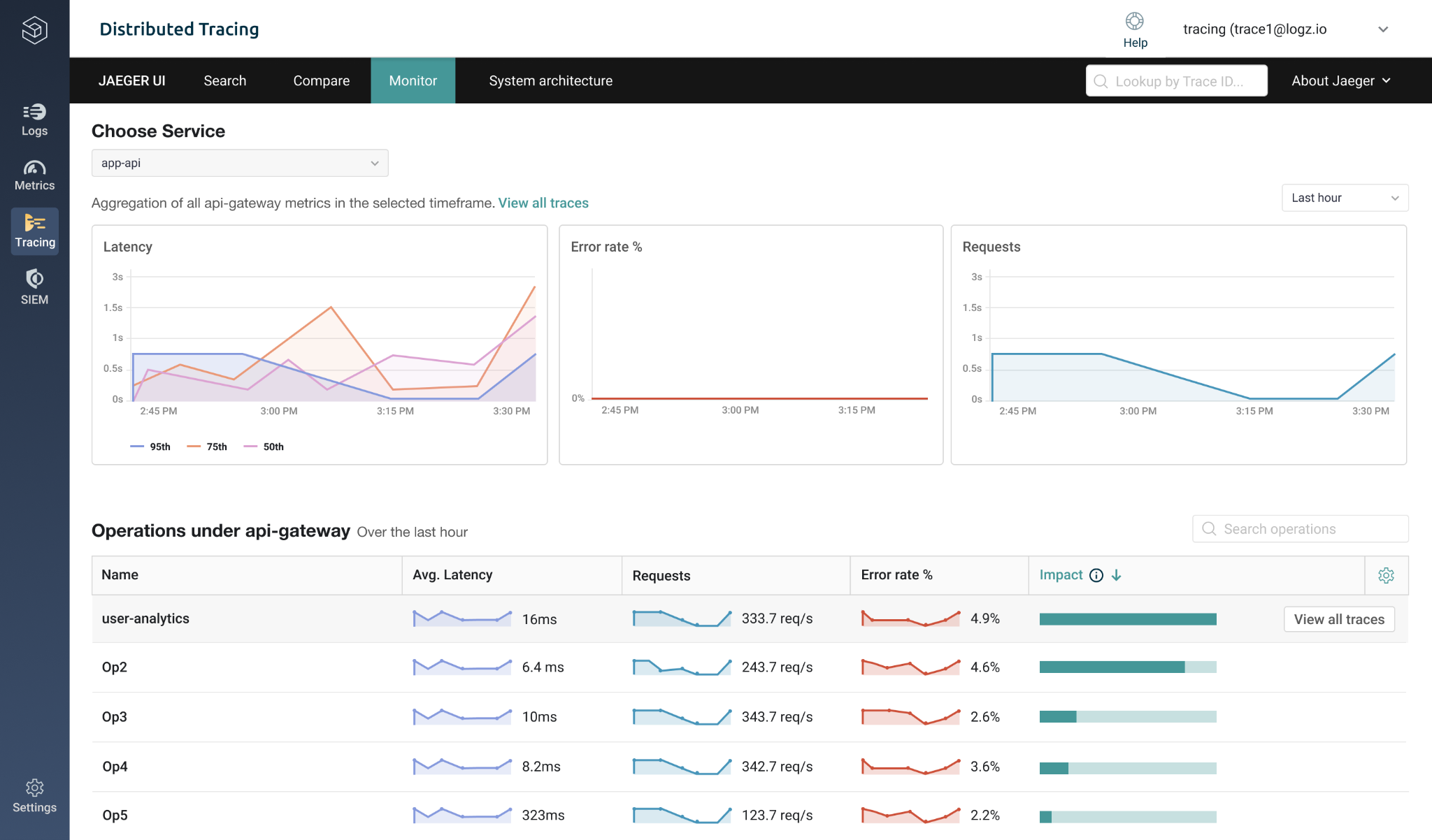
    Logz.io has enhanced its observability platform to include both unified dashboards and support for distributed tracing to monitor service performance enabled by the open source Jaeger agent software being advanced under the auspices of the Cloud Native Computing Foundation (CNCF).

    At the same time, Logz.io is making available a preview of an anomaly detection capability that leverages machine learning algorithms to build an artificial intelligence (AI) model to monitor data.

    The company has also added support for OpenSearch, a fork of the open source ElasticSearch software project that is no longer available via an Apache license. OpenSearch was created by Amazon Web Services (AWS) and Logz.io as an alternative search engine.

    Finally, Logz.io has added a security event management capability that makes it easier to classify, prioritize and collaborate on mitigation of cyberattacks as they are discovered.

    The Logz.io observability platform is entirely based on open source software. In addition, the company has made contributions to enhance both Jaeger and the OpenTelemetry project, including contributing an OTEL Span Metrics Processor that makes it easier to aggregate metrics.

    Logz.io CEO Tomer Levy said that, in general, it’s still early days as far as observability is concerned. As a concept, observability traces its lineage to linear dynamic systems. Observability at its most basic level measures how well internal states of a system can be inferred from knowledge of its external outputs. The overall goal is to make it easier to query machine data in a way that enables DevOps teams to proactively discover the root cause of issues before they cause further disruption. That’s a major advance over monitoring platforms that typically only provide predefined metrics to identify when a specific platform or application is performing within expectations. The issue, however, is most IT teams really don’t know what questions to ask to take full advantage of an observability platform, said Levy.

    However, as more organizations are exposed to observability platforms, it will become easier to advance both DevOps and DevSecOps as more platforms continue to leverage AI to provide remediation capabilities and automate processes based on the massive amounts of data collected via these platforms, said Levy. There is simply no way the average IT team will be able to manage all the microservices being strewn across a distributed computing environment without the aid of an AI model trained using observability data, he added.

    As DevOps continues to evolve, it’s more than likely that the best DevOps engineers are not going to want to work for organizations that have not invested in some form of observability. The odds of being consistently successful as a DevOps engineer decline sharply as IT environments become more complex.

    On the plus side, it should soon become a lot easier as the overall level of application instrumentation increases to manage those complex environments and to do so at a level of scale that doesn’t require a small army of DevOps engineers.

  • Top 10 DevOps Things to Be Thankful for in 2021

    Top 10 DevOps Things to Be Thankful for in 2021

    Thanksgiving has been observed in the U.S. since 1861 and was officially designated as an official holiday in 1863 by president Lincoln. Of course, the tradition itself traces its lineage to the early days of the Pilgrims.

    This past year, of course, has been one of recovery from a pandemic that caused the deaths of millions of people around the world. Vaccines have saved the lives of countless more, so there is much to be thankful for despite all our recent trials and tribulations. In that spirit, there are more than a few things for DevOps professionals, in particular, to be thankful for this year starting with:

    Digital business transformation: Organizations of all sizes have had to adjust their business models because of both major changes in buyer behavior and an ongoing supply chain crisis. DevOps teams are at the core of any major digital business transformation initiative, so the demand for DevOps expertise continues to outstrip the available supply. Going forward, it’s been predicted we’ll see more digital transformation in the next 10 years than in all the last 40 years combined. The vast majority of those initiatives would never see the light of day if it were not for the expertise of developers and engineers working hand-in-hand to build and deploy applications faster than ever.

    Low-code platforms: As the demand for applications to drive digital workflows spiked in the wake of the pandemic, professional developers relied more on low-code platforms to decrease the time required to build an application. While many complex applications will still be built using procedural code, it’s clear not nearly as many applications could have been deployed without relying on low-code platforms to build them. It remains to be seen how many of the next generations of low-code applications will be built by so-called citizen developers that may soon be flooding DevOps pipelines with application code.

    Microservices: As an architecture for building applications the core concept of employing loosely coupled services together to construct an application goes all the way back to when service-oriented applications (SOA) were expected to be the next big thing in the 1990s. Microservices have, of course, been around for several years themselves. However, with the rise of containers as a software artifact for building microservices, it’s only now becoming apparent that building an application constructed using microservices not only takes less time but is easier to maintain and also more resilient.

    Observability: As a concept, observability traces its lineage to linear dynamic systems. Observability in its most basic form measures how well the internal states of a system can be inferred based on knowledge of its external outputs. In the past year, a wide range of IT vendors introduced various types of observability platforms. These make it easier for DevOps teams to query machine data in a way that enables them to proactively discover the root cause of issues before they cause further disruption. That’s a major advance over monitoring platforms that typically only provide predefined metrics to identify when a specific platform or application is performing within expectations.

    Biden’s executive order: In the wake of a pernicious attack against IT service management software from SolarWinds, the Biden administration published a sweeping executive order that requires federal agencies to implement a wide range of security best practices. Foremost among them is guidance concerning the security of software supply chains; which resulted in many organizations reviewing their entire software supply chain to make sure similar breaches will not occur.

    DevSecOps: As an extension of any DevOps best practice, DevSecOps generally describes an overall shift left in terms of making developers more responsible for application security. While still in its relative infancy, DevSecOps is starting to gain traction as DevOps and cybersecurity teams look to bridge a cultural divide that is as wide as any in IT. The ultimate goal is to deliver more secure applications without reducing the speed at which they are being built and deployed.

    GitOps: At its core, GitOps is an operational framework that takes DevOps best practices used to automate application development and extends them to infrastructure. The basic idea is that the configuration software created to manage infrastructure-as-code is just another software artifact to be stored in a Git repository. The approach provides a means for IT teams to achieve a continuous delivery goal that, more than a decade after DevOps best practices were defined, remains elusive. It’s still early days as far as GitOps best practices are concerned, but this has been the year when GitOps become part of the mainstream DevOps conversation.

    Kubernetes: Simultaneously one the most powerful and most complex IT platforms ever to come down the proverbial enterprise IT pike, Kubernetes has emerged as a de facto standard for building and deploying container applications that can more efficiently scale up and down as required to consume IT infrastructure. The challenge (and the opportunity) now is to make Kubernetes much more accessible to mere mortal IT administrators that typically don’t have the programming skills of a site reliability engineer (SRE) and which are both hard to find and retain.

    GraphQL: Employed as a query language for application programming interfaces (APIs), GraphQL provides a more efficient means of accessing data than the REST APIs that have been employed by developers in the past. Originally developed by Facebook, GraphQL adoption is still in its infancy but it’s clear APIs based on GrapQL will one day be as plentiful as REST APIs. That’s especially critical for microservices-based applications that rely on APIs to access data across a highly distributed computing environment that requires a more efficient means for transferring data.

    Venture and Wall Street capital investments: Investment firms are helping fuel DevOps advances as they continue to make capital available for companies vying for their share of a market that is expected to see compound annual growth rates of 24.7% through 2026. There will, of course, eventually be a wave of consolidation as merger and acquisition activity inevitably ensues. In the meantime, however, there is a wide range of DevOps technologies that might not otherwise be as broadly adopted if it were not for all the cash being poured into DevOps companies.

    The most important thing, of course, is that so many DevOps professionals are still here to build and deploy applications. It’s been a trying year for all concerned; however, as the pandemic crisis continues to recede, we can all be thankful for the opportunities that lie ahead.

  • Ensuring Network Connectivity With SD-WAN and AIOps

    Ensuring Network Connectivity With SD-WAN and AIOps

    Recently, Facebook experienced an outage. If companies relied on that app to do business, their IT teams were likely swamped with end-user complaint calls. 

    How would teams traditionally respond? They’d dive deep into the rabbit hole, analyzing issues on a case-by-case basis, asking countless questions, including: 

    • Could there be a problem with the enterprise network?
    • Is the service provider experiencing issues?
    • Are just a few users affected or is the issue more systemic?

    Traditionally, this manual process requires significant knowledge sharing and time to complete as teams break the problem into smaller pieces to triangulate an issue’s root cause.

    Oftentimes, it’s an enterprise network that experiences connectivity issues—not apps like Facebook. 

    Some companies pay an arm and a leg to leverage highly reliable WAN links, such as MPLS, for connecting to the internet and connecting branches to their data centers. Conversely, they may save a buck or two by using commodity links, like cable or DSL, which deliver less reliability. Both choices introduce tough tradeoffs—could there be a better way to ensure enterprise-wide connectivity?

    Enter SD-WAN. 

    Combining the same service-level agreement (SLA) as a dependable WAN link with the affordability of a commodity link, SD-WAN specializes in handling brownout situations, rerouting link traffic to maintain network connectivity — ensuring users’ access to their must-have apps. 

    And by incorporating artificial intelligence for IT operations (AIOps), teams can harness the power of analytics to radically reduce their response time, ensuring that if problems do happen, they get fixed fast. In fact, 90% of IT professionals acknowledge that powering network management with AIOps will improve their companies’ business outcomes.

    Drowning in Data: Understanding Traditional Network Issue Investigation Headaches

    To determine the root cause of a service disruption, teams spend considerable time assessing the landscape of all the different apps that people use and the links they follow to use them. These apps could be located anywhere—forcing teams to find needles across vast haystacks of data to determine what went wrong.

    And this data is exploding at such an extraordinarily high rate that it’s practically impossible for anyone to keep track of it all. Only by leveraging an advanced analytics system like AIOps can teams gain the necessary insights to swiftly solve problems. 

    SD-WAN and AIOps: A Problem-Solving Dream Team

    How do SD-WAN and AIOps work together to enable a highly reliable, always-connected network?

    SD-WAN quickly addresses all potential local issues and optimizes performance and connectivity across multiple WAN links—or even just a single WAN link that may be unreliable. SD-WAN also ensures that business-critical apps are prioritized correctly and are offered the precise amount of error correction that avoids any issues or disruptions as much as possible over the WAN. 

    Where does AIOps come into play? It analyzes data at a far more granular level for extended periods over a global topology. What is it looking for? Everything. It’s examining emerging patterns that are impacting individual apps. It’s searching for systemic issues that affect multiple SD-WAN edge devices simultaneously, worldwide. It could also be investigating how edges or apps are being affected over a particular time period. 

    By surfacing all that data, AIOps analyzes much more than SD-WAN can. And by deriving insights from that data, it highlights issues affecting everything from a lone user on a single application to a systemic issue that’s impacting an app across a far broader cohort of users. In certain cases, AIOps can cue the SD-WAN to heal itself and automatically fix the problem, then verify that the issue was fixed. As a result, end-users remain connected to their network.

    Inside a Wholly Adopted SD-WAN/AIOps Environment

    Imagine you’re an IT admin, supporting an extremely complex enterprise network, spanning thousands of different sites that use diverse security services for connecting to apps. Even if you’re on a huge team that’s charged with monitoring the network, it would be nearly impossible to have full visibility across the network to solve problems as they occur.

    By adopting SD-WAN together with AIOps, you gain a superpower. No, you won’t be able to fly or become invisible, but AIOps will make you omniscient, enabling you to:

    • Harness powerful analytics firepower to find and fix network trouble spots instantly and precisely before users complain—in some cases before they even notice
    • Understand which sites perform better than others to pinpoint where improvements can be made
    • Propose configuration changes that help the network self-optimize and self-heal
    • Detect and optimize degraded links to boost user experience

    And if issues ever do arise, AIOps advises you immediately as it monitors the network 24/7, providing you with full situational awareness and insights, solving problems as they occur.

    SD-WAN & AIOps: Maintaining Connectivity by Self-Healing

    The Facebook event was unusual in that it globally impacted the world’s users, who couldn’t access the app through any Facebook data center. In that scenario, AIOps simply identified the app disruption and noted the root cause.

    But what if the situation had been different? For example, imagine if Facebook’s U.S. west coast datacenters were deemed unavailable but its east coast datacenters were operational. By combining SD-WAN with AIOps, a similarly affected company could have performed diagnosis and ensured app connectivity. 

    How could that have played out? 

    First, AIOps would have detected the issue and its root cause. It would have reported that the application was unreachable to users on the west coast but available to users on the east coast. Finally, SD-WAN would have self-healed by rerouting end-user application traffic to the eastern data centers to maintain app connectivity.

    Using the old-school method of manually monitoring and troubleshooting networks is nearly impossible for most IT teams. Instead, teams are relying on SD-WAN and AIOps. This combined capability gives teams an unbeatable superpower, enabling them to substantially improve connectivity across the enterprise and rapidly respond to issues as they occur.

  • Rethinking Programmer Education for Today’s Coders

    Rethinking Programmer Education for Today’s Coders

    The proliferation of low-code and no-code applications are changing the landscape for software. In the past decade, growth in these areas has empowered employees to generate solutions at the speed of a digital world, regardless of their technical background.

    This raises several questions: What kind of programmers do businesses really need? Should they still rely on programmers formally trained at four-year universities—what you might call “white-collar” programmers? Or, instead, are blue-collar programmers with self-taught skills or those who learned from a bootcamp more valuable? What will get organizations the right mix of programming skills?

    The short answer is that all programmers can be of great value. In general, blue-collar programmers, after all, connect things within the computing environment, while white-collar programmers create the things that are connected. The essence of low-code is that it allows more people to connect things and use their creativity to become more productive. But it doesn’t eliminate the need for professional programming and tools at its foundation.

    At their core, low-code and no-code are about democratization. They allow people without technical skills to work creatively in ways that essentially make everyone a programmer. A parallel from an earlier computing generation is the Excel spreadsheet, which lets people with no programming background perform computational tasks and eventually work their way up from simple formatting to full-fledged programming. But at some point, polished programming skills are still necessary, no matter how easy no-code or low-code can make some of those elements.

    In the breakneck pace of cloud-based computing environments with new services constantly being developed and deployed to the edge, it’s worth considering the distinctions between the white- and blue-collar programmers and what kinds of education are appropriate for each.

    Four-Year Colleges Vs. Boot Camps

    A career as a programmer can seem intimidating for onlookers. This is particularly true when these jobs involve complex languages such as C++ and Java, which are often used in large projects that can take years to develop and involve millions of lines of code. Some of that is still true, but the evolution of programming over the years toward languages that require less code, such as Python, and to domain-specific languages (DSLs), has also started to lower the barriers to entry for programming.

    It’s true that you’ve never needed a four-year computer science degree to be a programmer. In fact, many that have dropped out of college—or never attended at all—have made significant contributions to the industry. However, universities do provide a foundation in theory and algorithms that have always served programmers well and enable them to branch out into new areas, such as artificial intelligence or other disciplines, such as bioinformatics. Coding bootcamps, for their part, can provide intensive training on DSLs or frameworks like Rails or React.js that can benefit companies’ plans, giving blue-collar programmers the practical skills that white-collar programmers may not have. They also attract career-changing attendees with four-year degrees in other subjects, including the humanities and the sciences, which brings badly needed new ways of thinking into the profession.

    While each method is valid, both four-year institutions and bootcamps also have their shortcomings. Universities delve deep into software development theory but often don’t emphasize critical aspects of doing the job, such as teamwork, testing and agile processes. Nor do they focus much on core areas of businesses today, like cloud computing. Boot camps, by targeting specific areas and emerging technologies and languages, can help people get internships or entry-level jobs, but don’t provide a broader theoretical knowledge of programming. And they can be hit-or-miss, with some of them using sketchy practices for payments and job placement.

    The inherent weaknesses in both white- and blue-collar training can be addressed through apprenticeships and internships, but only to a point. The question remains: Who will train low-code programmers on modern development and coding practices? A lot of companies throw around terms like Agile and CI/CD, but they’re often just new labels on old, inefficient practices. Companies will need white-collar programmers to bring blue-collar programmers up to speed.

    Programming for the Masses

    No-code software is a great enabler, allowing people with no formal education or experience to become proficient in a programming environment. On the other hand, for people who do have formal training—whether a formal education or boot camp experience—low-code simplifies their work, leaving time to focus on more complex projects. But programmer or not, users of no-code and low-code solutions need to understand more than just deployment and testing if they want their software to be reliable and useful.

    Professional developers can make a difference by creating and maintaining the pipelines used to build, test, archive and deploy low-code software; they will need to build new tools to accommodate low-code frameworks. And while familiarizing themselves with current development techniques, they could become the teachers of essential computing practices that don’t involve coding.

    A cooperative, productive relationship between white-collar and blue-collar programmers is essential to moving forward with software development, as it will allow both to continue acquiring new skills and experience outside of low-code, which is only a product of programming, no matter how ubiquitous it may be.

    Making the Connection

    Today, we’re entering a business world where practically everyone will need to code, making low-code and no-code frameworks necessary, especially for users without formal training. However, the importance of professional programmers will remain, too.

    We’re likely to see a proliferation of DSLs created to solve specific problems, which will eventually evolve toward general-purpose programming languages. Programmers will need to build web frameworks, cloud capabilities and more, including everything from web widgets to the high-level tools that let users work. That may be the only way we can begin to meet the demand for more people who can program as more devices come online, more connections are made and the world becomes increasingly reliant on automation.

  • How to Build Healthy Engineering Teams

    How to Build Healthy Engineering Teams

    A common challenge today for engineering teams is the increasing complexity of their jobs and figuring out how to make it both productive and enjoyable without burning out.

    Over the last 10 years, the role of a software engineer has evolved drastically. Software continues to reach unprecedented scale, it is becoming more complex and customer expectations are higher than ever. Organizations from all industries are now becoming software companies and, with the pandemic, everyone is feeling the effects of burnout.

    There are close to a million unfilled IT jobs in the United States. To ensure organizations are able to continue innovating, the industry needs the tools, state of mind and reliable practices to make this career sustainable.

    Creating an industry with healthy productivity is paramount. But too much of a focus on going faster without addressing burnout is a recipe for disaster. Engineering managers need to constantly balance both. Here are some things they should keep in mind:

    Invest in Engineering Productivity

    Companies are increasingly hiring for roles focused on engineering productivity—there are currently hundreds of open job postings from organizations looking for these skills. These jobs are aimed at making developers and engineers’ lives and work easier by focusing on streamlining how things are done within the engineering organization—including improving developer workflow processes, execution efficiency and product quality. They are often responsible for building internal tools that support cross-functional and developer workflows. Even with a relatively small engineering team, organizations can start thinking about bringing on a team member dedicated to making engineers’ roles within the company easier.

    Focusing on Healthy Productivity

    Productivity is, and will always be, extremely important, but potential burnout should also be seriously considered in the process. Remote work during the quarantine and the pandemic has brought this front and center. When people don’t have enough deep work time, they often work longer hours which can eventually lead to burnout. An average employee has 11 minutes to focus between distractions at work and then, after an interruption, it can take around 23 minutes to return to the original task. In addition, the average worker attends 15 meetings per week.

    There are many questions about how workers’ productivity has been impacted since early 2020, and research has found that developer productivity isn’t a problem—but burnout is. From March to December 2020 the study found:

    • Deep work time—a two-hour period of uninterrupted work—decreased by 22% between March and December 2020.
    • Average time in meetings went up by 67% from March to December 2020.
    • Pre-pandemic, 10% of developers were showing “always-on” behaviors at work, but that percentage went up to 15% and then to 20% by the end of the year.

    Focusing on driving healthy productivity—where developers are productive but not overworked—is key to keeping your employees.

    Strengthening Engineering Managers

    Managers play a key role in keeping engineering burnout in check. Ensuring that managers ‘manage well’ is not a new idea, but today there are particular complexities that make the engineering manager role both uniquely challenging and especially important.

    It is now widely acknowledged that culture is a considerable part of what gets employees to stick around. But culture isn’t only employee benefits like trendy offices, great snacks and other relatively superficial—though still important—benefits. What really matters is identifying and building teams that really care about one another on a personal level and making sure that incoming employees feel the same.

    With engineering teams, there is a tendency to focus primarily on the technology being created rather than the people who are creating it. While this approach can absolutely result in successful products, it is often the default management style for managers who don’t have the tools to do otherwise. Moving from software engineer to manager requires a whole new skill set that involves different communication styles, time management, organization, tools and software, scoping work, learning how to effectively delegate and identifying the right people to complete the team.

    As challenges continue to evolve, organizations need to ensure that engineering managers are able to support each individual on their team. It is so important to make sure that people feel aligned with a mission they care about and that their career interests and goals are being met. Not all of those can be measured with data, so managers have an all-important role in keeping up with the pulse of the team.

    Building Helpful Tools and Growing Developer Communities

    In the last decade, the speed of innovation in enterprise technology has skyrocketed and the amount of code and tools developers need to master has increased. At the same time, the number of unfilled job openings continues to grow. There are a lot of great trends that are helping to close this gap including low-code and no-code tools as well as a massive increase in community resources.

    No-code/low-code tools: As both technical and non-technical organizations hire an increasing number of developers, low-code and no-code have become more prevalent. With frameworks that allow even those without a technical background to deploy software, no-code tools open development capabilities to an increasingly diverse subset of people. While these tools will not replace developers, they will make it possible for more people to enter the field of software development and help companies continue to innovate.

    Developer community: The amount of resources available to new and existing developers has also skyrocketed in the last several years from open source communities to Stack Overflow to the ability to simply Google how to do something in code. The Linux Foundation’s extensive training catalog is one example; even Medium has a wealth of basic technical info, how-tos and deep dives available. If you’re looking to adopt a new tool, one of your main priorities should be to look at the size of the community so that you can easily troubleshoot problems if they arise. Having access to resources from community members that have gone through the exact same problems you encounter is priceless.

    The above are all just a start. Teams can go even further by finding and adopting analytics tools to dive deeper into specific productivity metrics. These can give managers and executive teams the hard data they need to make educated decisions that will help them keep their teams and drive innovation. It is worth investing the time and the tools to maintain your engineering resources. By doing these things, organizations can reach and maintain healthy productivity.

  • SAP Extends Developer Tool Portfolio

    SAP Extends Developer Tool Portfolio

    At an online SAP TechEd conference this week, SAP announced it has added additional low-code/no-code tools to the SAP Business Technology Platform (BTP) to enable both professional and citizen developers to build applications that invoke application services provided via the company’s cloud platform.

    The effort to increase the number of custom applications invoking those services revolves around a no-code development and automation platform dubbed SAP AppGyver, launched this week, and an existing set of low-code tools dubbed SAP Business Application Studio that the company also enhanced. SAP Process Automation, a robotic process automation (RPA) platform for automating workflows, is also being previewed.

    JG Chirapurath, chief marketing and solutions officer for SAP BTP, said the goal is to make it easier for organizations to build applications faster using tools that provide higher layers of abstraction through which they can invoke, for example, backend RPA and AI services via an application programming interface (API). SAP makes it possible to achieve that goal via an SAP BTP platform it provides to IT teams. The BTP platform allows teams to build applications that can be integrated with SAP application services running on a public cloud or managed by SAP on behalf of the customer. In either case, the goal is to make it possible for developers to spend more time building business logic versus building and maintaining integrations, he said.

    As part of the effort, new capabilities were also added to the SAP Conversational AI service and the company has promised to launch a personalized recommendation service based on a neural network.

    At the same time, the company also revealed it has updated the SAP Integration Suite for SAP BTP to provide access to additional prepacked integrations that are available on the SAP API Business Hub.

    In addition, the company said by the end of this year it plans to make the SAP Integration Suite available on the Google Cloud Platform alongside support it provides for other public clouds.

    Finally, a revamped training site, dubbed SAP Learning, will make it simpler for developers to advance their skills.

    The challenge SAP application developers are trying to navigate is determining which business processes are best served using packaged cloud applications versus ones that require actual customer code. The number of processes packaged in a suite of enterprise resource planning (ERP) applications has greatly expanded over time. With each successive update, ERP platform providers such as SAP identify new processes that could be beneficial to the bulk of their customers. For example, the processes that organizations use to track invoices and issue payments are all pretty much the same. It doesn’t make a lot of sense to write a custom application to manage a set of tasks that are already well-defined within a packaged application.

    Custom application development is typically where organizations have an opportunity to differentiate themselves. After all, if every organization is relying on the same core processes provided by a packaged application vendor, there is no real difference from one organization to the next. Custom applications, on the other hand, built using no-code or low-code tools or procedural code written by developers, should either be used to extend a workflow in some way an application doesn’t or should be used to create an application that provides a sustainable competitive advantage. That challenge—and the opportunity—is first identifying those processes and then finding the simplest way to build and maintain the applications that drive them.

  • Netlify Acquires OneGraph to Integrate GraphQL APIs

    Netlify Acquires OneGraph to Integrate GraphQL APIs

    Netlify this week announced it has acquired OneGraph, a provider of a platform that simplifies the integration and management of application programming interfaces (APIs) based on the GraphQL query language.

    At the same time, the company is committing $1 million to sponsor open source projects and setting aside $10 million for a Netlify Jamstack Innovation Fund that will help drive the development of emerging technologies. Those technologies will be consumed via the platform the company created based on Javascript, APIs and a markup language (referred to as Jamstack) to accelerate web application and website development. Rather than becoming investors in those companies, Netlify intends to make those funds available to advance the development of technologies that benefit the overall community.

    Fresh from raising an additional $105 million in funding, Netlify CEO Matt Biilmann said Netlify is committed to an ecosystem through which developers will be able to consume a wider range of services via both REST and GraphQL-based APIs. OneGraph will provide the core foundation for adding support for GraphQL to the Netlify platform, he noted.

    Overall, Netlify is trying to reduce the friction that developers encounter building web applications and the sites they run on, added Biilmann. That’s becoming especially critical as developers increasingly build microservices-based applications that invoke APIs to consume backend services that are made available via the Netlify platform, he added.

    Earlier this year, the company made available Netlify Build Plugins that provide DevOps teams with a set of continuous integration/continuous delivery (CI/CD) workflows for building websites and web applications. Designed to be launched from within a Netlify platform, those plugin makes it possible to build a web application or website that can be launched directly from within a Git repository.

    The overall Jamstack philosophy enables DevOps teams to separate the development of frontends and backends of websites and applications. That approach is agnostic as far as any specific JavaScript framework is concerned, but it does define a way to automate the build process for a web application or website.

    A recent survey of more than 3,000 Jamstack developers published by Netlify finds one-third of survey respondents have worked on sites serving millions of users over the last year. Nearly two-thirds of survey respondents (62%) work outside the tech industry, including in advertising and marketing (21%), media and publishing (14%), education (14%), financial services (13%) and business support and logistics (13%). Well over a third (38%) work for a technology company. About a quarter (26%) have more than 10 years of experience. Top Jamstack benefits cited by all types of developers are performance, uptime, speed of development, security, compliance and avoiding vendor lock-in, the survey found.

    Jamstack is, of course, not the only framework for building web applications and the sites they run on. DevOps teams are increasingly being tasked with building a much wider range of external applications to drive digital transformation initiatives that are typically built using some type of JavaScript framework. The next big DevOps challenge, of course, is that as the number of applications being built continues to increase, so does the number of applications that need to be maintained and continuously updated.

  • Kyndryl Aligns with Microsoft in the Cloud

    Kyndryl Aligns with Microsoft in the Cloud

    Following its spinout from IBM, Kyndryl has allied with Microsoft to increase the scope of IT services it provides on the Azure public cloud.

    Stephen Leonard, leader of global alliances and partnerships for Kyndryl, said that as part of this initiative, Kyndryl will be expanding the scope of the services it provides to both organizations building and deploying applications as well as those looking to migrate existing applications to the Microsoft Azure cloud.

    Over time, Kyndryl will expand its cloud services to include additional public clouds as part of a larger effort to enable organizations to embrace a hybrid cloud approach to enterprise IT that spans multiple on-premises and cloud computing environments.

    In the meantime, as part of the first partnership established by Kyndryl, the two companies are committing to providing services to address data modernization and governance, security and application workloads infused with artificial intelligence (AI) capabilities. The two companies also plan to establish a co-innovation lab. Microsoft is also committing to establishing a Kyndryl University for Microsoft.

    Leonard said given the overall shortage of IT expertise, more organizations than ever are relying on external IT services to, for example, accelerate application development. Kyndryl plans to work with those organizations to best evaluate where specific classes of application workloads might best be deployed, he noted.

    It’s become increasingly clear that more organizations are attempting to integrate third-party IT services within DevOps workflows. In some cases, that means standardizing on an opinionated DevOps workflow defined by the IT services provider. In other cases, the IT services provider is focused on a specific task such as securely provisioning infrastructure on behalf of developers.

    Regardless of the approach, however, DevOps workflows are evolving into a team sport made up of both internal and external IT professionals that are trying to bridge the cultural divide that always exists between different organizations. Which IT services provider organizations ultimately select often has as much to do with how flexible they are from a cultural perspective as much as it does their technical expertise.

    For its part, Microsoft is counting on IT services providers such as Kyndryl to increase the total number of workloads running on its cloud. Now that Kyndryl is independent of IBM, it is free to establish partnerships that previously would have been more complex to navigate.

    Of course, it’s up to each organization to determine the degree to which they prefer to work with a larger IT services provider versus a smaller rival that may specialize in one specific area or that is simply a better fit for a smaller company. The one thing that is certain is that as IT continues to become more complex, it’s not feasible for organizations to hire all the IT talent they require on a full-time basis. Organizations will need to carefully evaluate when it makes more sense to consume certain IT services as a function provided by someone else versus attempting to hire and retain talent to maintain that service themselves.

  • Nvidia/ARM Wavering | Google Outage Outrage | Backblaze IPO on Fire

    Nvidia/ARM Wavering | Google Outage Outrage | Backblaze IPO on Fire

    Welcome to The Long View—where we peruse the news of the week and strip it to the essentials. Let’s work out what really matters.

    Nvidia Can’t be Allowed to Buy Arm

    First up this week: Nvidia’s faltering attempt to buy Arm: Regulators around the world are alarmed by the idea. And now the UK—the legal home of the company—has taken the next step, which could nix the deal.

    Analysis: RISCy home for ARM

    This matters because ownership of the ARM ISA and the core designs would be a huge strategic stick to beat Nvidia’s competition with. Arm doesn’t make chips—it licenses technology to Nvidia and many of its competitors—AMD, Apple, Broadcom, Samsung and Qualcomm, to name but five. So this deal really shouldn’t go through, regardless of Nvidia’s fluffy PR reassurances.

    ARM chips aren’t just found in 99% of smartphones, but are an increasing fixture in the datacenter—especially where “performance per Watt” is important. They’re even found in exascale iron, including the Riken Fugaku, the world’s fastest supercomputer.

    Helen Thomas: Nvidia faces tough Arm wrestle

    It is one thing for a regulator to give your deal a thorough going-over. It is another for it to imply publicly that your assurances [aren’t] credible. … Nvidia got both from the UK’s Competition and Markets Authority. … The CMA’s full phase 1 report doesn’t make for easy reading.
    …
    The transaction, which was announced in September 2020, is bogged down in regulatory reviews around the world: … Arm’s “neutral” business model has always made it a difficult acquisition. … Arm licenses its designs to other chipmakers, providing scope to restrict rivals’ access.
    …
    Arm was a political talking point in 2016, when its sale to SoftBank … was waved through with embarrassing ease. There is now a much more muscular political take on UK national security concerns with a particular focus on tech.


    But if it’s owned by a Japanese company, why is the UK getting involved? Glad you asked—Aighearach answers:

    What did they buy? Shares of a UK company. … Then it is a UK company! … Buying shares is buying ownership, but it doesn’t move the company to another jurisdiction.
    …
    This blathering about “sold to a Japanese firm” is getting old.


    Nvidia claims, “The transaction will … boost competition and innovation.” Falmari finds that hilarious:

    Did Nvidia’s spokesperson previously work as a stand-up comedian? Because as jokes go, “boost competition” is a whopper. [Do you think] that’s what a company like Nvidia wants—to boost the competition?


    Google Cloud Outage has Ripple Effect

    Google’s load balancers all went offline for two hours on Tuesday. Aside from the knock-on Google Cloud failures, DevOps tools such as BigCommerce, Datadog, Deno, Discord, Egnyte, Evernote, Linear, Netlify and Toggl were reported to be affected. But perhaps the worst impact was felt by the poor, unfortunate users of Pokémon GO.

    Analysis: Paralysis

    In theory, putting all your eggs in one basket is okay—so long as that basket can reliably stop your eggs smashing on the pavement. But this isn’t the first time we’ve seen Google Cloud issues such as this; I can’t imagine it’s the last.

    Steven J. Vaughan-Nichols: Google glitch triggers major internet outage

    The result? Many of us have seen 404 errors when trying to get to some of our favorite web pages. … There appears to be more major sites having problems than not.
    …
    The specific problem seems to be with the GCP load balancers. These, working with Google’s Cloud Delivery Network (CDN) [are] designed to stop website failures and Distributed Denial of Service (DDoS) attacks by putting your website behind a single anycast IP.


    Are you feeling a touch of déjà vu? jeffbee, too:

    This is a sort of repetitive outage for Google. They’ve wiped out the GSLB configs before.

    A year ago there was also that big outage where they blanked out the whole Gmail delivery config and started rejecting all mail. … Config safety is not their strong suit.


    The #3 IaaS provider won’t get to #2 if it keeps this up. Here’s u/totopapa:

    I’m trying to convince my company to switch from AWS to GCP but an outage like this one is definitely a showstopper.


    Backblaze IPO Burns Brightly

    Backblaze is now NAS:BLZE. In its first week, the stock jumped 60%.

    Backblaze is well known for its tiny-margin consumer backup product and its open-source “storage pod” hardware—but is less well known for its DevOps-focused “B2” cloud storage service.

    Analysis: Can it Avoid Death-by-Packrats?

    Backblaze is trying to grow this newer DevOps business, without losing its classic consumer chops. But many of its former competitors have essentially dumped their “unlimited” offerings—it’s the old tragedy-of-the-commons problem.

    Jordan Novet: Backblaze [goes] public on small valuation and minimal funding

    In an era of blockbuster market debuts preceded by astronomical private financing rounds, Backblaze … a cloud service for backing up data … is a throwback to a time when sub-billion-dollar companies routinely went public to raise capital and build their profile … to win the trust of customers.
    …
    Backblaze shares climbed 24% in their debut on Thursday and another 12% on Friday, lifting the price to $22.31 and giving the company a market cap of around $650 million. … By the standards of its peers, Backblaze is a micro-cap.
    …
    One of Backblaze’s competitors is Amazon, the world’s fourth most valuable U.S. company. … Backblaze currently stores two exabytes of data — that’s 2 million terabytes — and has a half-million paying customers.


    Donovan Jones: Backblaze Targets $100 Million IPO

    The firm provides cloud-based storage services to small businesses and individuals worldwide. BLZE has grown revenue and gross profit impressively through the 2020 pandemic period and the IPO appears fairly valued, so is worth a close look.
    …
    The firm’s financials show strong revenue and gross profit growth. … The firm’s dollar-based net revenue retention rate for 2020 was 114%—a solid result. … The market opportunity for providing cloud-based storage services to small businesses and individuals is large and expected to grow at a material rate. … As for valuation, compared to partial competitor Dropbox, management is seeking the same Enterprise Value/Revenue multiple. [However] the combined revenue growth rate and EBITDA percentage rate … was 3% as of June 30, 2021, so the firm needs improvement in this regard.


    But there’s a long way to go, opines John Kozubik (aka rsync):

    Of the ~500,000 customers, 70,000 are B2 customers and 430,000 are “backup” customers—which are flat-rate “unlimited” users. … Roughly 85% of the user-base are paying $7/mo for “unlimited backup.”
    …
    These flat-rate users are very fickle and price-sensitive. … Roughly 85% of the user-base are paying $7/mo for “unlimited backup.” … It’s a fools errand to pursue this market and I assume the pivot to B2 was to build something more sustainable with a much higher price and usage ceiling.


    The Moral of the Story: Success is a journey, not a destination


    You have been reading The Long View by Richi Jennings. You can contact him at @RiCHi or tlv@richi.uk.

    Image: Kristin Wilson (via Unsplash)