Category: IT Security

  • GrammaTech Allies with GitLab to Advance DevSecOps

    GrammaTech Allies with GitLab to Advance DevSecOps

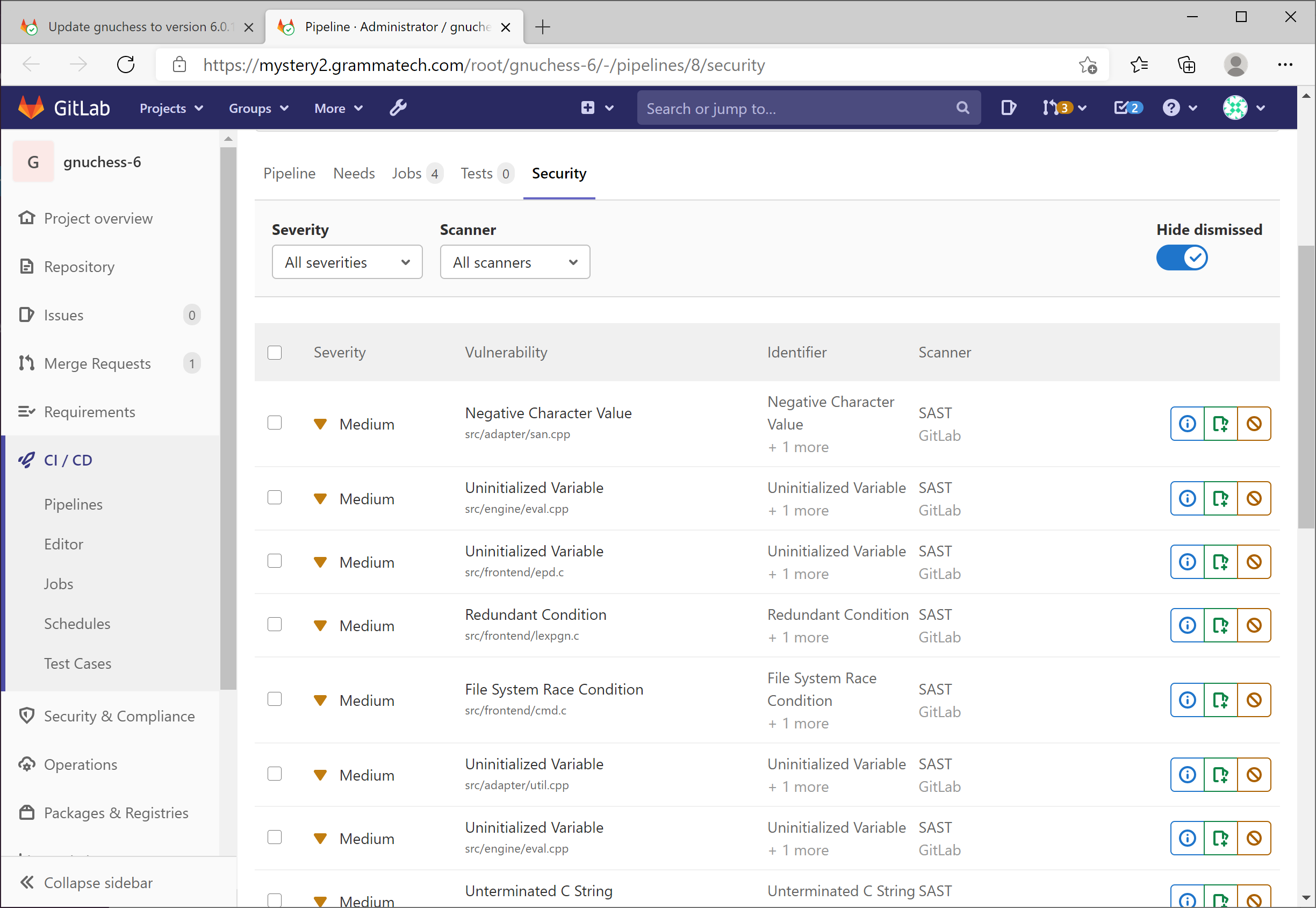
    GrammaTech announced today it has partnered with GitLab to integrate its GrammaTech CodeSonar static application security testing (SAST) tools with the GitLab Ultimate DevSecOps platform.

    Vince Arneja, chief product officer at GrammaTech, said integration with continuous integration/continuous delivery (CI/CD) platforms such as GitLab is critical because it enables security scans to run automatically any time code is merged. That capability reduces the amount of code that is scanned at any one time, Arneja said.

    GrammaTech is partnering with multiple CI/CD platforms and integrated development environment (IDE) providers to make it simpler to create multiple points for scanning code during the application development process, Arneja noted.

    GitLab, meanwhile, is providing its own tools for analyzing artifacts as they move through the software development life cycle. The GrammaTech tools, available via the highest tier level made available by GitLab, analyze code at a deeper level, said Arneja.

    Ultimately, the goal is to enable developers to discover security flaws as early as possible in the application development life cycle. The later those flaws are discovered, the more expensive they become to fix, Arneja said.

    Developers, naturally, tend to postpone security scans as they race to meet an application deadline. That practice creates issues; the more code there is to analyze, the longer such scans take. It’s generally more efficient to scan smaller amounts of code more frequently. Otherwise, developers can become overwhelmed by the number of security bug fixes that need to be addressed at the back end of the application development process. Automating security scans allows an organization to move toward embracing DevSecOps best practices in a way that doesn’t rely on a developer remembering to initiate a scan.

    Most developers are not deliberately ignoring security issues – it’s just that the existing, manual processes for discovering those flaws is inefficient.

    Automated scans also provide the added benefit of simplifying discovery of common security flaws long before a code review, creating more time to address significantly more complex issues.

    Application development teams are also under pressure to reduce the total number of bugs that need to be fixed after an application is deployed. As the number of applications being deployed steadily increases, developers can find themselves spending more time fixing bugs than writing new application code.

    Most organizations are not very far along in their journey toward embracing DevSecOps. However, as it becomes easier to integrate a variety of scanning tools within DevOps workflows, the number of organizations moving up the DevSecOps maturity curve should increase. In the wake of some recent, high-profile attacks on software supply chains, the sense of urgency surrounding the adoption of DevSecOps best processes has undoubtedly increased.

    In the longer term, there may soon come a day when security is viewed as just one of many quality assurance gates that code needs to pass through before it’s allowed to be promoted. In the meantime, an ounce of cybersecurity prevention at the front end of any application development is most certainly going to be worth more than several pounds of cybersecurity cure applied too late.

  • Cloud Migrations Demand Risk and Compliance Maturity

    Cloud Migrations Demand Risk and Compliance Maturity

    The COVID-19 pandemic brought undeniable disruptions for organizations and their employees whether business, personal or otherwise. Across the globe, businesses and governments alike were forced to try and manage these disruptions. For nearly all organizations, digitization initiatives were accelerated in a short period of time, from implementing work-from-home policies and launching new applications to support a distributed workforce to adopting artificial intelligence (AI) to adapt supply chain processes and more.

    According to Gartner, by 2022, 30% of all security teams will have increased the number of employees working remotely on a permanent basis and by 2023, 40% of all enterprise workloads will be deployed in cloud infrastructure and platform services. The distributed cloud enables organizations to provide products and services when they’re needed in this era of work-from-anywhere, whether to their employees or customers.

    Even in sectors such as energy and utilities, which are historically heavily reliant on standard on-premises installations and had often avoided cloud adoption, business leaders are realizing the value of migration, especially in light of the global pandemic. These businesses are able to deliver digital products with speed, experiment with tools such as artificial intelligence (AI) and robotic process automation (RPA) to increase productivity and to lower the total cost of ownership (TCO) across assets, among other benefits. Still, cloud migration risks abound, and new challenges may arise. A risk that cannot be ignored is the cybersecurity risk. Meeting regulatory IT compliance and managing risks involved with cloud computing are top challenges facing those migrating their workloads to the cloud.

    Cloud Migrations and Security: Clear Risk and Compliance Gaps

    Many cloud providers such as Microsoft Azure, AWS, Google Cloud and others have a global network of service models that include compliance teams and consulting organizations that help with risk and compliance for their cloud instances, whether public, private or hybrid cloud. Many of them have even built tools for customers to use to implement basic risk and compliance management in-house, leveraging relevant data and applications. However, monitoring and meeting security and compliance controls that span people, processes and technology for cloud environments, and in the broader context of the enterprise, is complex. This is one cause of cloud migration risk, and is a challenge for many other reasons; lack of measurement, visibility and accuracy are three of the greatest risks when migrating to the cloud. The point solutions that currently support most cloud instances don’t elevate the posture of cloud environments to that of the enterprise risk posture, and the majority of assessments still remain point-in-time and qualitative. Metrics are fractured and far from holistic, and very few, if any, solutions can provide insight beyond compliance and into real-time risk management.

    IT and security regulations and standards are filled with requirements that were created before the cloud became a commodity. In the energy sector, for example, cloud security isn’t taken into account because regulators and industry leaders couldn’t fathom those platforms becoming as pervasive as they have, because on-premises installations were standard to the industry. On-premises installations are still a mainstay in energy, power and utilities, and for those who have become more comfortable with cloud migration processes, there is a clear and pressing need to leverage their human capital, processes and technologies to implement robust risk management practices.

    Beyond regulatory compliance lags, many distributed organizations opt to have multiple providers in place, requiring a multi-cloud approach to compliance requirements and risk assessment. As more organizations consider cloud migration risks and begin shaping their cloud migration strategies, there are some innovations that address risk management and compliance in the cloud, but not many. Measuring, managing and reporting on compliance frameworks, making the shared responsibility model actionable, and getting a view into risk are all serious challenges. Cloud providers will continue to mature and bring new innovations to their services, but, to date, there hasn’t been a lot of anticipatory work done in this area. The focus has largely been on creating reactive solutions. In heavily regulated countries, the challenges only become greater.

    Leverage AI Automation for Compliance and Risk Management

    There is a shift occurring in cybersecurity and IT risk management, calling for the dramatic disruption of the legacy IT governance, risk and compliance (GRC) space and demanding a reevaluation of how we manage compliance and risk in the digital age. For years, data has been aggregated manually and analyses performed on out-of-date information. With the increasing availability of automation, the five functions of the NIST Cybersecurity Framework – identify, protect, detect, respond and recover – are becoming more continuous in nature and shifting into real-time management, from assessment to reporting and more.

    Leveraging this technology in the cloud is no exception, but those who look to reinvent their approach must look for solutions that go beyond the siloed capabilities of cloud security posture management solutions and similar markets.

    Ultimately, the true test of this next-generation approach comes when organizations are able to roll all of this data up to risk. With risk metrics that are supported by drill-downs, trend reports and risk profiles, executives can get the visibility they need into their posture with the most up-to-date data, informing their key business decisions. Using this next-generation approach to risk will inform global expansion, allow executives to evaluate risk across lines of business, and increase cyber maturity in any cloud-based organization.

  • Security Policy Management and Hybrid Cloud with Tufin

    Security Policy Management and Hybrid Cloud with Tufin

    In this TechStrong TV / DevOps Chats interview, Colby Dyess, director of cloud product management at Tufin, joins Mitch Ashley to discuss security policy management across hybrid cloud, multi-cloud and cloud-native security. Recorded in late 2020, Colby shares some experience from working with customers during the rapid migration to the cloud in 2020.

    The video and podcast audio of the conversation is below, followed by the transcript. Enjoy!

    TechStrong TV Video

    DevOps Chats Podcast Audio

    Transcript

    Mitch Ashley: I’m joined today by Colby Dyess who is director of cloud product management at Tufin. Welcome, Colby. Welcome, it’s good to be talking with you. Would you introduce yourself, tell us a little bit about you and of course, tell us about Tufin.

    Dyess: Yeah, well, you’ve got my name and my title, so I’m dialing in here from beautiful Southern New Hampshire where it’s fantastic weather. So, I’ve worked for Tufin Technologies, Tufin is really well known in the industry for providing security policy management, mostly in the organizations like the Global 2000 complex environments where you need to make changes to the network environment and you need to be able to do it quickly, safely, ideally you do it automatically and it’s secure. The Tufin product suite helps organizations do that and we’ve done that in the traditional space. Of course, our customers have adopted cloud, cloud native platforms, Kubernetes, and we’ve been taking these same capabilities for securing the environments and bringing them into the cloud, so no matter where you put your workloads, we can help you, and that’s mostly what we’ve been focused on.

    Ashley: Good stuff. Boy, the center for the universe for a lot of folks. Kinda speaking of that and just thinking about the timing of where we all are, you know, there’s a lot of statistics. I run an analyst firm as part of MediaOps organization called Accelerated Strategies Group. Anyway, we have a lot of data showing some of the acceleration that’s happened, both in digital transformation and also move to the cloud, just in the last six to nine months. I don’t think that’s news to anybody, right? I don’t know if you need data to say that, because it’s happening probably in most people’s organizations.

    Dyess: Right.

    Ashley: If I put on my security hat for a moment, we always get plenty of notice when we’re making changes and doing new projects and accelerating stuff—sarcasm—so, I’m sure there’s a lot of security folks who are scrambling still just to not only keep pace, but make sure we’re all doing a good job of securing environments that our developers are taking this into, making sure we’re understanding the services we might be using now that we weren’t before, cloud services that we’ve been in. I’m sure you’ve seen a ton of that happening with your customers.

    Dyess: Yeah. It’s no surprise. Organizations have been moving to public cloud environments for a long, long time, at least, technically, for the past 15 years, they’ve been doing it, but it hasn’t always been sanctioned, right? Let’s say over the past five or eight years, organizations have really begun to intentionally adopt the cloud. And now this year, of course, everybody’s moved to the cloud about as quickly as they could.

    What we’re seeing, at least what I’ve seen a lot is, security is now scrambling to try and get ahold of some visibility—what’s really going on inside these cloud environments—and trying to put some sort of guardrails around the services that the Dev teams are using. That’s a real challenge because they’ve been focused so much on how to secure most of the on prem environment or use firewalls to protect the cloud space, but now they realize they’ve got to go a bit deeper, because the threats are pretty real out there and they’re really dynamic. And if you’re not sure how to secure the cloud environment, you’re going to leave yourself open to threats.

    So, security has really been spending a lot of time trying to learn more about cloud and cloud native security controls. We spend a lot of time helping customers figure out the difference between cloud native security controls and on prem stuff and then how to combine them so they can be assured it’s all secured. We see that a lot, yeah.

    Ashley: Well, you know, I mean, we’ve all been doing firewalls and intrusion prevention and access controls and the list goes on.

    Dyess: Yeah.

    Ashley: So, the topics aren’t new, but the environments are different and the services. It’s not like you can go into the cloud—no, let’s use all the things I’m normally using in my on prem environment. Maybe you can get some software versions of that. Sometimes it’s just better to use because it’s better integrated, you spend less time making the environment work by using what’s provided by the cloud provider.

    Dyess: Yeah. That pattern is the same everywhere. I’ve seen that you’re gonna go to a new environment, you wanna take some of the things that have worked for you in the past and carry them forward. And a lot of times, that makes sense as you try to move quickly into the cloud. If you’re not familiar with cloud native security controls, you probably think, “I’ll just use firewalls and the process for managing firewalls in the cloud.” And there are a lot of options to do that, a lot of the traditional vendors in that space have tried to make a pivot to offer their same services, same capabilities in the cloud environment. So, it’s no surprise that we see a ton of that.

    At the same time, those processes around managing all that stuff still takes too long. If you moved to the cloud, you went there for agility, right? You want to rapidly build applications and get them out into the market as quickly as possible. But if you’ve got to fill out a ticket to get a firewall changed and it takes three days for that stuff to be processed, you’re no longer as agile as you used to be when you could twiddle a little configuration in a Terraform template, redeploy, and—poof, you’re up and running all over again. That’s something that security teams—

    Ashley: If you take another two days to answer that ticket, you’re probably gonna have a fourth after your third _____ while you’re add it to the mix, right? Some developers are gonna be like, “I’m outta here, let me go set up the next environment.”

    Dyess: Yeah, it’s too difficult. You can’t wait. You don’t want to see shadow IT any longer, because IT was taking too long to respond, but you’ve got to respect that IT’s there, the security site of IT is just really trying to help protect the business.

    But you know, you also saw Amazon and AWS, they both announced their own firewalls, right? Azure did a little bit back and AWS just did within the past month. And I think that’s really just paying homage to the fact that those are really good technologies. Firewall technologies really are good stuff and it’s more than security groups or NSGs, it goes beyond that, and the businesses really need these. These do address customer problems. So, we’re seeing a lot of folks ask about how do they adopt those new to the cloud provider, new technology, and how do they integrate them into the very agile processes? And I expect we’ll see a lot more of that.

    In fact, what we are finding that we do often is try to help organizations see how they can get the most value out of the cloud native security controls, because these cloud environments are really, they’re pretty solid. And like you pointed out, the security controls are integrated into the services. So, it makes a lot of sense to use the services, they’re there to protect your assets and they’re so integrated in the services, you really should be trying to use them, but it’s a learning curve for security, so it means a lot to try and help them get the visibility and then start to affect control over that, so that they don’t have to slow down the rest of the business, swapping out, let’s say, a cloud native control with a legacy control [Cross talk].

    Ashley: Mm-hmm. It is that tradeoff, and I think that’s one of those where it’s sort of, I think it puts security teams in a position where, are we gonna stick to our guns of this is the environment we’re gonna have consistent across all of the environments we operate in, or for sake of speed but not sacrificing security, maybe we do look at some other options and can those integrate into the monitoring and management systems as opposed to using the same firewall in every environment that we take with us there, right?

    Dyess: Yeah, yeah.

    Ashley: Easier said than done. I appreciate it’s not an easy job.

    Dyess: Right. You know, whether you decide to use the cloud native security controls or use the traditional kinda controls, the virtualized versions of those or a combination of them, one thing I think we’re sharing is, we see a lot of conversations around how—which technologies to adopt and then how to actually manage those technologies.

    And from my point of view, it seems like we’re almost too focused on getting down into the weeds about the specific security control and, as a security person, I think it makes a lot of sense to step back a little bit and try and focus on what’s the overall security policy. Instead of thinking what firewall should I use, should I use one from the cloud or should I use from my traditional vendor, maybe a better question to help organizations remain agile is for security to be able to focus on what the security policies are, what the guardrails should be, and then begin to get the practice of checking cloud environments against those guardrails, against these policies as part of your CI/CD pipeline, the whole buzzword of shift left.

    That’s a real thing, right? That’s really important. That security can focus on defining security policies where they have the strength, but the actual implementation of enforcing the security policy is probably handled by the cloud operations or whoever actually twiddles the bits on the security controls. Like, if you can marry those two things together and you can do it in the CI/CD pipeline, then that’s a huge win.

    We’ve seen organizations move a lot faster because security focuses on what they do and they get it codified in a way that can play in a pipeline, and now the app teams, they can make changes to an application or a cloud Ops can change the configuration of an environment and get an alert saying it doesn’t comply with the security policy. That’s great. To step away from choosing which sort of security device you want to use and focus on do things comply with the security policy? That’s a major shift, and one that seems to be really hard for organizations to do. I think to kinda get away from security being hands on with the control and now focused on the policy—it’s trust but verify, I think.

    Ashley: [Laughter] Back to that old saying, right?

    Dyess: Yeah.

    Ashley: You know, in a way, it also comes down—you know, we’re used to, let’s first take an inventory and make sure we know what’s all out there that we’re trying to secure.

    Dyess: Sure, of course.

    Ashley: But it’s equally just as important to have, whether it’s change management practices or software that can help you with notifying when changes occur or understanding, so when a change occurs, how does that map back to policies that we have in place and are we still in alignment, are there gaps that we have to take care of? Because the environment isn’t—it isn’t an environment we control everything in any more. It changes by itself, because other people are changing it along with us. So, it seems like it’s a more dynamic environment than maybe what we had 10 years ago, if you reflect back a bit.

    Dyess: Intentionally more dynamic, right? Businesses have to move faster, we also have to react more quickly to customer demand or competitive threats or whatever. So, the fact that we’ve got these dynamic environments is just a reflection of what we actually needed to have built, anyway. And now, we need to find a way to incorporate that back into our regular practices.

    So, you made the comment about being able to track what’s changed and when and all that, but if you adopt more of an infrastructure as code model, you already have that. You don’t need a CMDB—maybe you do, but you don’t have to have a CMDB in place when you could go back to your Git logs and see, oh, here’s the pull request for the change that we made that allowed for this security group to be open or for this Azure firewall to have this particular rule. You can actually see that information, but these are, on the security side, these are new tools. As a security person, when was the last time you looked into a Git repo to see what the configurations were? [Laughter]

    Ashley: The repo—right, GitOps and security, right?

    Dyess: Right. Right, but we’ve got to get somewhere around there, as a group collectively, whether we’re writing the code or we’re managing the operations or we’re managing the security collectively, we’ve got to be able to collaborate and use these tools that I can’t say are merging, they’ve been around a long time. Terraform and Helm, Ansible, Chef, Puppet, the whole bit—these things have been around for a while, but to incorporate them now into our security practices is a pretty big leap for folks.

    Ashley: Mm-hmm.

    Dyess: So, we really try to encourage that the security team gets the visibility that they need, that’s the first thing, as you pointed out, right? You absolutely need to understand what’s deployed, what’s talking to what and whether or not things are properly segmented.

    You’ve got to first get that visibility, but I think before you start jumping into let’s throw a bunch of other control points in there, consider what resources are there and how can you, on the security side, participate in automation, participate in these flows that your CloudOps, DevOps, SRE, whomever had set up. Because there’s a really good opportunity now on security to be part of this agile process and to allow the business to be secure, but to do so in a way that won’t break the developer productivity.

    Ashley: Mm-hmm.

    Dyess: And that’s, it’s uncomfortable, because it’s a big change, but it’s a change that I know it can be done successfully. We’ve worked with companies that have done that, you know, make the conscious decision.

    Ashley: I almost wish we had stepped back and redefined shift left, because if, you know, I were king of the world for a nanosecond, I would think about it as, it’s not just about getting security people to work with the software teams earlier in the life cycle of software—yes, it’s that. But think about it this way of, the old world was, set the policies and then how do we implement the enforcement mechanisms, right, to make sure that those are being followed.

    Dyess: Mm-hmm.

    Ashley: I think in the world we’re in now, it’s, security people are, if you were gonna set up a security practice in an organization today, what I would do is, let’s start with how software is created, let’s work with the team about how the entire tool chain is set up, how that flow happens, both for application software, but also for the infrastructure and how that gets created where we’re talking about test environments and production environments and maybe you’re stepping into infrastructure as code if it really, truly is kinda dynamic Terraform or whatever kind of environment.

    But start there, because if you understand how that’s done, now you know how to secure it. You know how to work with teams to help them secure it, then the next layer would be getting into the software architecture itself around microservices and things that are more porous than we’re used to, kinda the hard outer shell of monolith applications of the past.

    That, to me, is the mental shift, the big mental shift for a security team to not necessarily be an expert at all that stuff, but understanding that’s what you’re really securing now.

    Dyess: So, two things that stand out, like responses I can imagine people having right now and that’s, I don’t have time to go and learn all that stuff. [Laughter] I’ve already got 20 other tickets for all high priority things. I’ve gotta get on that right now, so I can’t go and learn all that stuff. Valid, that’s definitely the case in a lot of organizations, yeah.

    And another problem related to this is security teams who maybe do want to know, maybe have some time to do that, but struggle that the application teams themselves don’t even know what makes up the application and what connections do they need. So, even the folks who you think would know because they built it, you’d think they would know the answers to some of these questions, but it turns out that they don’t—in a shockingly large number of scenarios, that’s the case.

    Ashley: Mm-hmm.

    Dyess: And so, if you’re gonna shift left, you’ve got to address not just the problem of the security team getting visibility in this—or maybe, actually, it’s the same thing. The application teams have to be able to come to the table to say, “This is what the application looks like. Here’s how it’s put together. Here are the resources it needs and here are the services that will rely upon it.”

    Ashley: Mm-hmm.

    Dyess: And so, if application groups can come to the table with that, then a security team can look at it usually very quickly, look at a map and say, oh, I can see where it needs to be segmented this way. I can see where he’s a resource that has too close of an access to PII, PCI, right? And so, that conversation could start a lot sooner if it’s part of your normal bill practices, you were generating these views, you had some way to produce an item that a network team or security team could look at, right? They don’t need to look at the source code, they need to look at your network topology, they need to understand what you’re connecting to.

    So, if you can bridge that gap, that goes a long way. So, to your point, it’s not just like, “I just need to check if it doesn’t comply with the policy.” Sometimes, it’s even just trying to define the policy at the outset.

    Ashley: Yeah, on what you’re trying to secure.

    Dyess: Yeah, but also, while security never seems to get the heads up about the things that are coming down, the joke that you made at the beginning, it’s also the case that when the application team is building something that they don’t really have all the rules, they’re not sure what all the restrictions are, and there are certainly plenty of guardrails, guidelines that they could have if you give them access that they could pull from an API to do their own checks.

    So, you know, there’s a model. We’ve done this before in the industry, back when I wrote code, we had a separate QA team, so we’d write code, we’d do a little bit of testing, but just enough, frankly, to get us through the build, right? And then we throw it over the wall and it went over to QA. And then thankfully, our development practices matured to a point where we realize we actually need to integrate testing as part of what we do. So, as developers, we had to own some of that testing, some more of the testing, but also importantly, the test team got involved earlier in the application life cycle, the model you were talking about. So, the QA teams could come in and learn a bit more and begin to set up some of the additional tests and participate in the build process, so what they did showed up in NMake.

    So, I think security is on a path like that as well. I think security, instead of app teams just throwing it over the wall and asking security to figure out how to lock it all down, I think we’re going to, and in some places, some customers for sure are moving to a place where security is part of the process earlier, and if they can say, “Here’s some of the tests,” so now the guardrails, they can contribute some of that and they can go into this build process, then now you’ve really begun to get that shift left.

    But I know this can happen. We’ve seen it happen before. Now QA is just integral to what we do. You can’t even imagine putting a product out without some part of QA being part of the build process and tests happening really early on, test planning happening early on. I imagine security just going in that same sort of loop.

    Ashley: Yeah, of course Tufin’s been in this space for a while, has built up, I’m assuming, a body of knowledge about this. If you were gonna advise maybe a new customer or an existing customer on—okay, we’re always playing catch up, we’re really playing catch up now with how much more cloud services that organizations are using in such a short period of time, what are some of the sort of best practices or recommendations of, “Here’s to sort of get the first thing established, here’s the next thing to work on, here’s the next thing to work on.”

    Dyess: Yeah.

    Ashley: Any suggestions about that?

    Dyess: Sure. We have this whole crawl, walk, run methodology, and it’s designed to help organizations take these small steps towards getting to really secured environments. And the first step right away is just to get visibility, which is kind of a “no, duh” statement, but it’s actually one of the big problems that orgs have. You’ve got to be able to see what’s deployed inside your cloud, what’s deployed inside your cluster, and which resources are communicating with each other, where are the dependencies.

    So, understanding that is a really major first step. It’s true for the application teams, but for the security, it’s to know are things properly segmented, where are the biggest risks? So, getting that awareness, that’s really the crawl phase. And in the walk phase, that’s where you take what you’ve learned about what’s deployed, what talks to what, and whether or not things are segmented properly and then you begin to isolate. Here are specific accounts that we need to tackle or here are clusters that we need to tackle—like, hone in on the higher priority items and begin to define a security policy for those cloud native environments.

    And as you develop the cloud native policies, which you then share with the application teams or the cloud operators, whoever’s responsible for configuring it. As you develop that sort of, that skill, you’ve gotta get to the run phase, and the run phase is when you begin to automate this. You automate generating security policies, you automate validating security policies, but at the very beginning, where most organizations are at right now is, first get the visibility and then the second step of defining a security policy. Not defining what is my security group definition, not defining what is my AWS firewall definition, but what is my security policy? What are the rules that should govern access to applications, assets, resources of certain categories? Those are two big steps to take right away.

    Ashley: I think that’s some great advice. I’m curious, any thoughts as we—I think we all want to turn the page on 2020 and kinda get to 2021, and hopefully, we’re looking at a different kind of a year. But one of the things about 2020 is, we’re not gonna go back, I don’t think. We’re not gonna go back to, let’s rewind to January and start working in that environment again, right? Everything is changed with remote work or how much we’re using the cloud.

    What are some things that you’re anticipating for 2021 as you look forward in the next 6 to 12 months. Do you kinda think it will be topics maybe not as talked about yet but will be more topical in 2021? I’m just kinda asking you—

    Dyess: Are you asking for predictions of 2021?

    Ashley: You know, I don’t see it, but I’m pretty sure, there might be a crystal ball right behind your chair, just look back a little bit there and kinda check back. [Laughter]

    Dyess: [Laughter] Well, I think, given the maturity of the market adoption of public cloud environments, I think we’re going to see more security teams getting their arms around how to help in securing these cloud environments without necessarily always relying on the traditional devices. We’re already starting to see that even now. So, I think we’ll see more of the cloud native security control adoption. I know organizations have seen the benefits of doing that to lower cost of operations, just total lower cost of ownership, plus the benefit of being able to say when there’s a problem, I can call my cloud vendor, I don’t have to worry about vendors poking at each other. So, I think we’ll see more of that.

    I think it’s the Kubernetes space that’s probably the most interesting, because it’s the least well known for most folks on the security side.

    Ashley: Mm-hmm.

    Dyess: So, I’d say maybe over the past year, there’s been a lot of emphasis, just like with cloud, slap a firewall on it and we’ll solve the problems of micro-segmentation later, but later is gonna happen real quick, and I’d expect in 2021, you’ll see securities start to get more involved in getting visibility into the clusters and then looking to define the security policies.

    And not—again, not to try and define the policy of an individual cluster, but just the general rules, because there’s no way we can keep up with what will really be thousands of services running inside of a cluster.

    Ashley: Yeah.

    Dyess: So, we’ll see that. I think we’ll see more organizations at the security side have to deal with the scale and the rate of change and begin to participate in the automation processes that the Dev teams are using to manage it.

    Ashley: Maybe that’s something we’ll hear more frequently. I wouldn’t be surprised if the—let’s think of it as cloud native security, not just as security, sort of think about it as one of you architectural approaches to how you do security.

    Dyess: Cloud native. The native controls of the cloud provider—yeah, that’s a big shift for folks, I think.

    Ashley: It is. We’ll see if something like that happens. And I think the things you said made a lot of sense. Well, it’s been great talking with you, it’s the first chance you and I have had to talk before, and—

    Dyess: Yeah, it was good to talk to you, Mitch.

    Ashley: – a lot of fun. Tell us a little bit about where folks can learn more about Tufin.

    Dyess: Yeah, of course, you can go to Tufin.com, that’s T-U-F-I-N dot com. On the cloud side, like what’s really relevant to what we’re doing here, we’ve got a lot of resources at Tufin.com/try-securecloud. It’s cloud native security controls. It’s really designed to help you get visibility and control the cloud native security components. Great stuff there, free to use product. There’s a great trial for people to give a go. Tufin.com would be the place.

    Ashley: Great. Perfect. Thanks. Well, we wish you the best and a even better 2021, we’ll look forward to that.

    Dyess: Yeah. From your lips, man.

    Ashley: [Laughter]

    Dyess: Good luck in 2021, everybody.

    Ashley: There you go. Hang onto that, hang onto that. Alright, well, take care. It was very nice talking with you, Colby—Colby Dyess from Tufin.

  • Building Trust Into Your Product by Design

    Building Trust Into Your Product by Design

    In today’s world, every tool, every solution and every technology has the potential to do both good and bad. Good, if used according to the way it was designed, but bad if it falls into the wrong hands, or is manipulated or abused. As the ‘Peter Parker’ principle says, “With great power comes great responsibility.”

    As the COVID-19 pandemic continues and consumers look to digital communications to maintain some sense of normalcy and connectedness during these desolate times, the onus is on us, industry leaders, to ensure that the products and services being developed to connect and communicate with disparate employees, customers, and partners aren’t weaponized by bad actors.

    The best way to do this? By building trust into your design.

    You Have to Define Trust to Know How to Build Trust

    According to Merriam-Webster, the dictionary definition of trust is “one in which confidence is placed.” But the reality is that in today’s world, there are many ways trust can be perceived.

    Think of the automotive industry, where trust can be tangibly seen in the growth and success of certain car brands over decades. There, trust can be seen as ‘brand loyalty,’ or customers who repeatedly purchase from the same brand because they trust the company and trust the product.

    Trust in technology is the same. It has to be engineered and cultivated, but at the end of the day trust in the product must be mirrored by consumer trust in the organization. The two go hand in hand.

    The best way to approach building and sustaining trust when developing new products boils down to three key things: integrity, third-party accountability and consistency. Integrity stems from delivering high grade products and solutions, in conjunction with demonstrating accountable, transparent communications at the organizational level. Third-party validation further underscores that integrity, and restates the quality of products and services being delivered from a third-party perspective. And finally, consistency; being able to deliver exemplary products and solutions on a continual, consistent basis – the most essential ingredient in maintaining and bolstering trust among customers.

    Transparent Communication is Key

    As we enter 2021, the threat landscape is fraught with bad actors looking to take advantage of the latest threat vectors and emerging technology. As our lives continue to transition from physical to digital, and as more personal information is stored online, companies have to prioritize proper and timely communication about cybersecurity incidents.

    This brings us back to organizational trust being foundational for trust in a product. If you’ve seen the Netflix documentary ‘The Social Dilemma’ you know that social media is an oft-cited example of technology being misused or manipulated by bad actors. But after Twitter suffered a social engineering attack in July, the platform issued a swift update to its users. They were open, prompt and transparent in their analysis of the event, and highlighted not only the updated safety precautions put in place in response to the breach, but also underscored their ongoing commitment to trust and transparency within the Twitter community.

    Incidents like these, though harmful in the short term, can be less detrimental if addressed and communicated in a timely, transparent manner. There’s a saying, ‘It’s not what happens to you, but how you react to it that matters.’ The same goes for proper breach disclosure within the tech industry as a whole.

    Trust has Never Been More Foundational to the Business of Building

    As we enter 2021 and the COVID-19 pandemic rages on, more companies than ever are finding themselves in the business of building. Healthcare providers are drumming up new ways to digitally engage with patients and providers outside the physical confines of a hospital. Financial services organizations are adding more immediate, personalized ways to engage with customers when, where and how they need it. Educators are creating new digital solutions to keep millions of children, learning from home for the foreseeable future, engaged. And retailers are rebuilding the in-store experience for customers entirely online.

    With so much building going on around us, it’s important to keep in mind that the building process today requires not only outlining what you’re trying to build and defining how you intend to use it, but also analyzing how it can potentially be abused, manipulated or rendered ineffective.

    Consistently running your products and solutions against the latest threat models is one way to ensure your products’ security posture is up to date with the latest attack vectors. Another idea is to incorporate ‘security champions’ into your product development process and teams, to act as mini consultants who evaluate potential cybersecurity vulnerabilities. Once you’ve incorporated methods like these, turning to a third party to assess and sign off on your product’s cybersecurity resiliency is a good way to validate your products’ security adherence and effectiveness in the face of ever-evolving threats.

    Trust and Development Should go Hand in Hand

    At its core, trust and development should go hand in hand. Developers don’t need to recreate the wheel every time – there are plenty of libraries available online to leverage and pull from. What’s most important is for developers to understand the libraries they’re using to build, and ensuring that proper security protocols are built in from the start.

    Trust can seem like a huge lift, or an unnecessary distraction on the way to an MVP, product launch or update. I assure you, this is not the case. No matter how big the effort may appear, investing in trust – and the various methods, ways and changes that harden your products and services against abuse – will pay dividends down the line. Customers will trust your product and your company, and will, therefore, be more likely to remain loyal. If nothing else, keep in mind that building trust takes time, effort and consistency, while losing trust can happen in the blink of an eye.

  • ZeroNorth Adds Analytics App to Advance DevSecOps

    ZeroNorth Adds Analytics App to Advance DevSecOps

    ZeroNorth today added an Advanced AppSec Risk Analytics module to its platform for orchestrating DevSecOps processes.

    John Worrall, ZeroNorth CEO, said the analytics tool pulls vulnerability data generated by a variety of security tools to provide both DevOps and cybersecurity professionals with a single source of truth for assessing security within an application environment.

    The ZeroNorth platform is designed to enable IT organizations to orchestrate multiple vulnerability scanning tools within the context of a larger DevSecOps workflow, and can apply analytics to a large pool of security data. That data can be viewed in the context of specific groups, such as a business unit or specific application development and deployment team, or within the context of whichever application generates the most revenue for the business, Worral said.

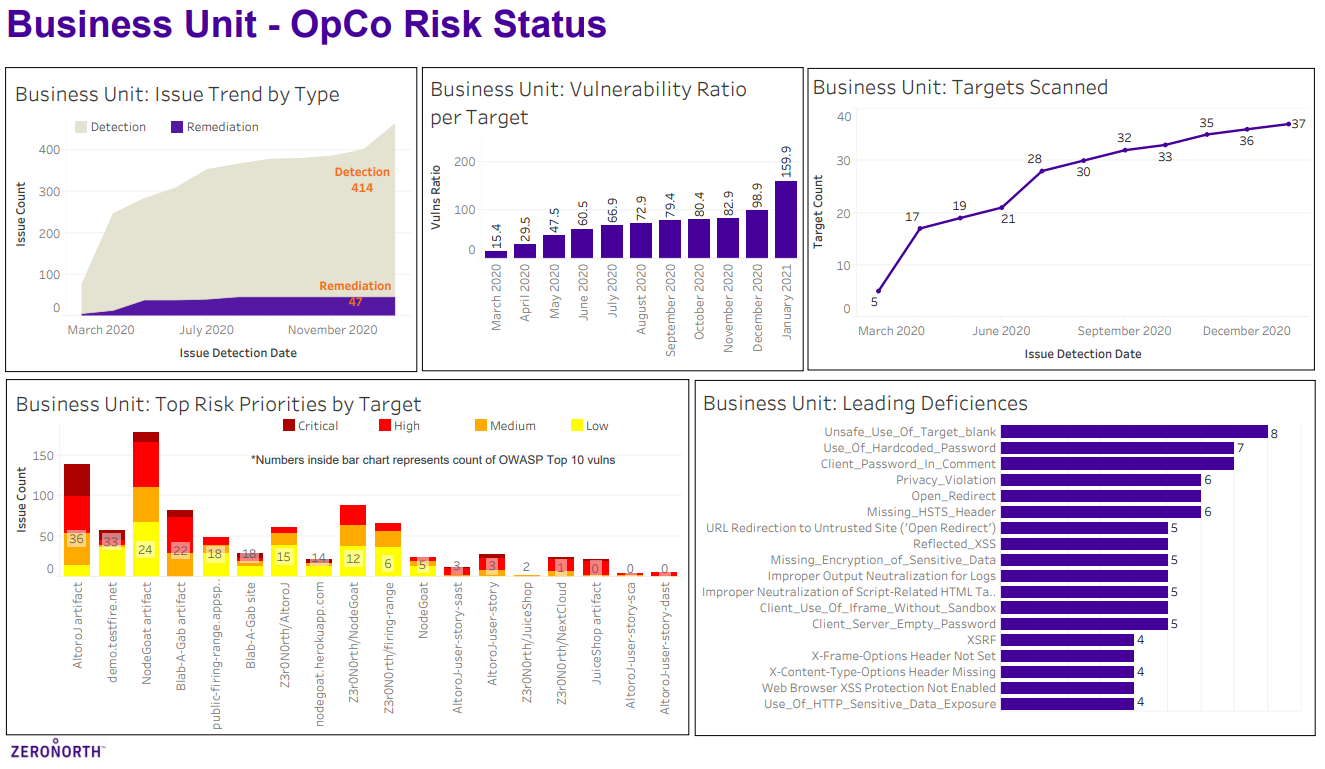
    Additionally, the Advanced AppSec Risk Analytics module will surface types of vulnerabilities detected and the vulnerabilities most encountered, ranked by criticality, along with other trends in types and number of vulnerabilities detected/remediated, such as the number and criticality of vulnerability findings per specific scanner. It also tracks the applications and entities scanned, number of vulnerabilities detected per application/entity and the applications/entities that have the highest risk.

    ZeroNorth

    Armed with that analytics data, Worral said it becomes easier for IT teams to prioritize and focus their efforts, in addition to identifying areas of the business that may need additional cybersecurity resources and training. IT leaders can also get a snapshot view of the top application security risks to better assess the organization’s overall security posture, Worral noted.

    The Advanced AppSec Risk Analytics module will also surface vulnerability remediation bottlenecks spanning multiple applications within the context of a software development life cycle (SDLC), Worral added. Longer term, Worral said the data collected by the ZeroNorth analytics application will also create an opportunity for the company to apply machine learning algorithms to DevSecOps.

    In general, Worral said the only viable path toward achieving DevSecOps is to foster more collaboration between developers and cybersecurity teams. Getting those teams on the same page in terms of the security data that needs to be analyzed is a crucial first step, Worral said.

    It’s still early on in the adoption of DevSecOps best practices within organizations, however, it’s apparent a lack of cohesion between software developers and cybersecurity teams about which vulnerabilities to prioritize is a major source of dysfunction. Cybersecurity teams tend to create long lists of vulnerabilities discovered within applications without providing much context. Developers are then left to weigh, on their own, when to address a vulnerability versus focusing on writing additional code needed to make an application delivery deadline. Developers take potential vulnerabilities seriously, but there are only so many hours in a day to write code.

    Unfairly or not, developers are being held more accountable for application security. The challenge – and the opportunity – is to find a way to make the entire DevSecOps workflow a whole lot less contentious by helping DevOps and DevSecOps teams more aware of which tasks should be prioritized when.

  • Understanding Data Storage: Lakes vs. Warehouses

    Understanding Data Storage: Lakes vs. Warehouses

    Now more than ever, companies are looking for new ways to incorporate data analytics into their daily operations and leverage data-driven insights to improve business functions. They are frequently turning to complex data for tasks like machine learning and artificial intelligence, which are becoming necessary to understand and reach customer segments across industries. However, understanding data storage is a key factor in developing a successful strategy. The two most common storage formats are data lakes and data warehouses – but there are benefits and pitfalls to each that organizations must understand in order to properly capitalize on them.

    Data Lakes vs. Data Warehouses Use Cases

    One effective way to better understand the different functions of data lakes and data warehouses is to focus on the end use case. Typically, there are three types of data consumers: farmers, explorers and executives.

    • Farmers need data and information to execute their day-to-day activities. They must report on the key performance indicators (KPIs) required to execute their job by providing data in a structured format.
    • Explorers are users who want to experiment with data, look at new types of data pools and gather specific insights. If data is presented in a fixed format, it hinders their progress, as they seek data that doesn’t have a pre-defined structure.
    • Executives are responsible for making business decisions, and often require information presented at different aggregates, with the ability to narrow in on data subsets as needed. However, they require information that is somewhat structured, and speed is critical for them.

    If we look at these perspectives more broadly, they essentially boil down to two key types of data usage – the exact needs that data warehouses and data lakes are designed for. Farmers and executives are largely served through data warehouses, which require information to be timely and structured. Some of the main use cases for data warehouses include operational analytics, business intelligence and predictive analytics for data science and machine learning applications. Explorers are best served through data lakes, since the data formats are not predetermined. Data lakes are often most effective for use cases like a centralized data catalogue that enables organizations to view all sources of data in a single place, or recent advances in AI application development that require the processing of unstructured data, such as text, images, video and audio.

    Challenges and Convergence of Storage Formats

    Despite the differences, most companies can use both data lakes and data warehouses for their various analytics needs. However, to successfully capitalize on the benefits, it is also important to understand the challenges. In particular, data lakes present difficulties when it comes to parsing data. They were initially designed to capture data across the enterprise in its natural format, without enforcing schema, so that users could garner more insights; a fundamental aspect in creating a data-driven culture across the organization. However, without a predetermined use case, data lakes can quickly become data swamps. End users were historically unable to figure out whether the data was stale, and ownership was not well established. This has been remedied by taking a use case-driven approach and only including data that has defined use cases or ownership.

    Now that many of the issues surrounding data lakes have been resolved, the two storage formats must complement each other to meet the varying needs of the customer. This has contributed to blurred lines between data lakes and data warehouses. Data lakes are now capable of schema enforcement and answering rapid business intelligence queries, which were traditionally qualities of data warehouses. Data warehouses have separated compute and storage and can read directly from big data file systems, enabling users to read semi-structured data. As such, we are rapidly moving toward integrated data environments and the convergence of data lakes and data warehouses.

    Supporting Data-Driven Initiatives

    For initiatives like artificial intelligence and machine learning to succeed, data must be presented as an immutable entity that can be used for experimentation. With data lakes, it is crucial to separate the data into different zones and maintain a refined zone after transformation. Then, in the refined zone, companies can enforce schema and allow the schema to evolve to ensure the data is ready for machine learning and data science needs. Most importantly, they must catalog the data and enforce metadata management, data quality and governance. Data warehouses, on the other hand, excel in providing data sets ready for discovery and consumption. Companies should integrate these data sets with an interactive data catalog so they are discoverable – this is the most important step in making artificial intelligence and machine learning possible.

    If organizations can learn how to best capitalize on data warehouses and data lakes for their intended purposes, they will be well equipped to uncover key data-driven insights to help guide their business strategy. This will help enable use of other advanced technologies and help transforming them into data-driven companies.

  • AppDynamics Partners With Cisco to Secure Application Runtimes

    AppDynamics Partners With Cisco to Secure Application Runtimes

    AppDynamics today announced its agent software, which it provides as part of its observability platform, now has the ability to enforce application security policies.

    Developed in collaboration with the security business unit of parent company Cisco, the Cisco Secure Application offering, available from AppDynamics, can detect attacks, identify deviations in application behavior and block attacks automatically.

    Gregg Ostrowski, a regional CTO for AppDynamics, said the goal is to make it simpler for IT teams that employ AppDynamics for monitoring and observing their IT environments to also embrace DevSecOps best practices. In effect, IT teams can now piggyback security for application runtimes on their existing investment in AppDynamics, Ostrowski said.

    The AppDynamics approach provides the added benefit of easy integration with the Cisco security tools to improve collaboration between DevOps and cybersecurity teams, Ostrowski said. Security details correlated with the application topology make it easier to share context in a way that identifies the actual business relevance of any security event, he added.

    As organizations accelerate digital business transformation initiatives, Ostrowski said the need to embrace DevSecOps best practices is becoming more urgent. The level of risk attached to these types of projects is significantly higher than with previous generations of applications, Ostrowski said.

    While most organizations appreciate the need for greater application security, there’s a debate about how best to achieve that goal. There’s general agreement that developers need to be more involved. However, shifting responsibility for application security to the proverbial left often comes at the expense of developer productivity. AppDynamics is making a case for enabling IT teams, that may already rely on its application performance management (APM) platform, to enforce policies defined by the cybersecurity team.

    Of course, there’s still a need to provide developers with the tools required to write more secure code in the first place. The debate is over how involved in the cybersecurity management process developers need to be after applications are deployed in a production environment.

    Arguably, the goal should be to enable both teams to accomplish their respective tasks in a way that doesn’t require a constant stream of meetings and updates. In the event a vulnerability is discovered, it’s critical for security teams to determine the threat level that vulnerability represents. Otherwise, remediation of that vulnerability will be just one more item in a long list of patches that developers are already working on.

    Regardless of approach, there are now myriad ways to improve overall application security. In effect, the same defense-in-depth approach that IT organizations have relied on to secure network perimeters can now be applied to application security as applications are both constructed and deployed. The most significant challenge is not so much finding the tools required to improve application security, as defining the processes through which best practices can be consistently applied.

  • OpenAPI Specification: Perception vs. Reality

    OpenAPI Specification: Perception vs. Reality

    The OpenAPI Specification (OAS) (formerly known as the Swagger specification) provides a way to describe and document REST APIs and their components. It includes details on endpoints, their operations, parameters needed for the operations, expected responses for every operation, authentication methods and even annotations. OAS is an easy format to learn and read, and can be understood by both humans and machines. As you might imagine, this kind of “accessible” documentation is useful and beneficial in a number of different use cases for both development and security teams.

    Developer Relationships With OAS

    For developers, OAS can be used to generate documentation for APIs. Proper documentation can help other developers figure out how best to integrate and use these APIs with their own application.

    Even so, many developers have a love/hate relationship with OAS. Let’s face it, documenting is a far cry from developing. Although it is easy to learn, the actual act of documenting is tedious, manual and time consuming. Frankly, it’s probably one of the least glamorous parts of a developer’s job, and, therefore, many developers only do the absolute minimum. As a result, OAS can be incomplete or, in some cases, missing entirely. Not to mention, when the API is updated, how often is the OAS updated, too?

    In the case of incomplete or nonexistent documentation, developers will muddle through with trial and error, even though this can slow down the development process.

    If out-of-date OAS proves an annoyance for dev teams, what’s the impact on security?

    Security’s Relationship With OAS

    OAS can be consumed by both humans and machines, and both are critical for security’s use of OAS.

    OAS helps security teams (humans) become aware that the API exists, since its documentation is often part of the CI/CD process.

    By examining an OAS file, a security team can understand what the API is supposed to do and, from that, determine if it conforms to or violates the organization’s security policy. As an example, security teams might use the OAS to make sure that authentication and authorization are being implemented correctly, and that sensitive data, like PII, is not being exposed.

    Security teams might also deploy tools (machines) that use the OAS to enforce policy based on what’s in the documentation. As an example, the OAS may specify that, for a particular parameter, a string should be expected; it should be no more than four characters and it should contain only letters and numbers with no special characters. By validating input based on what is defined in the OAS, security tools can check that the API does what developers intend it to do.

    This plan sounds great on paper, but …

    Perception versus Reality

    Imagine a perfect world, in which every API is well-documented as part of the development process. As that API makes its way through the development pipeline, it does so hand-in-hand with an associated OAS. At the appropriate time, before production, security is made aware of the API and the OAS, the team evaluates the details, validates that the API matches policy, gives the thumbs up and the API goes into production. Security and development teams live in harmony and everyone is happy.

    We don’t live in a perfect world. Instead, we must deal with questions such as:

    • Does the OAS exist? In the most extreme cases, the OAS doesn’t even exist. It was never created as part of the development process, so it can’t be used for any sort of awareness. These misses happen more often than you think, giving rise to the problem known as shadow APIs. These APIs slip through the cracks, and make it into production with no documentation at all. While you might be saying to yourself, “Our company would never let this happen!” you should also consider that numerous APIs are stood up by development teams as a test, as part of a beta or as a quick-and-dirty way to get something done. There are more of them than you think, and these shadow APIs create unrealized risk.
    • Is the OAS complete? In slightly less-scary territory, let’s consider an incomplete OAS. You might be saying to yourself, “We have a top-notch development team, well-defined development processes and strict policies around documentation. No API makes it into production without an OAS!” Perhaps, but the devil is in the details, and those details are often missed. I’ve worked with countless customers who have happily and confidently produced an OAS in which critical details don’t match the reality of the API. Sometimes they’re not complete. Sometimes they’re missing all together. The industry calls these missing details shadow endpoints. Yes, someone did produce an OAS, and security was aware of the API, but a lot of critical detail is missing.
    • Is it being kept up-to-date? Development cycles seem to be moving faster and faster, and as documentation is one of the least glamorous parts of a developer’s job, updates can be missed, dismissed or, at the very least, lag behind. We commonly see multiple versions of an API, and the OAS does not reflect the new capabilities of the latest version.

    While a non-existent or outdated OAS presents a modest concern for API visibility, it creates a substantial concern when trying to serve as the foundation for API security.

    You take a huge risk if you depend solely on OAS for security. More often than not, an OAS is not accurate, lacks critical details and is only as useful as the data you feed into it. Gaps, including shadow APIs, leave out critical details, making enforcement impractical.

    The inaccuracy of OAS leaves customers with two choices. You can either enforce security policies based on strict adherence, and risk blocking legitimate traffic, or you can enforce based on loose adherence and risk letting attacks through. In either scenario, your organization is unduly vulnerable, and significantly less secure than your dev teams intended or your security teams would like.

    OAS is Only a Starting Point

    OAS provides a great starting point for documenting your APIs. Don’t make the mistake, however, of basing your API security strategy on what’s in your OAS. It’s simply not accurate enough. Taking that approach will leave your company’s vital data and services at the mercy of API attackers who will quickly know more about your APIs and what they expose than your OAS does.

  • ARMO Aims to Simplify Microservices Security

    ARMO Aims to Simplify Microservices Security

    ARMO this week emerged from stealth to launch a platform to secure cloud-native workloads and improve visibility. The ARMO Workload Fabric technology attaches code within the memory invoked by a microservice to enable cybersecurity policies to be applied via a cloud service.

    Company CEO Shauli Rozen said the ARMO Workload Fabric is designed to enable IT organizations to implement a zero-trust architecture more easily within the context of a DevSecOps workflow.

    Fresh from raising $4.5 million in seed funding, Rozen said ARMO’s approach eliminates the need to deploy and manage agent software, container sidecars or runtime application self-protection (RASP) software to enforce security policies across what inevitably will become thousands of microservices distributed across an enterprise IT environment.

    That leaner approach then allows for a centralized management platform that can be deployed on a cloud or on-premises IT environment to apply policies that restrict which microservices can communicate with one another, Rozen said. The approach would ensure that only microservices developed using a continuous integration/continuous delivery (CI/CD) platform are allowed to communicate with other microservices, Rozen said.

    Integration with multiple CI/CD platforms is already provided, added Rozen.

    That approach allows policies to be applied to microservices regardless of how they are constructed, Rozen said. That capability is critical, because developers are building microservices using everything from Python and Java to containers, he said. Many of those microservices are also frequently replaced, Rozen said, which can make updating any associated agent software a significant DevOps challenge. Given all the existing dependencies between microservices, overall application environment security is only as strong as the proverbial weakest link. The ARMO Workload Fabric enables developers to add a small amount of code to implement security policies each time a microservice is rolled out into a production environment.

    As part of an effort to make it simpler for IT organizations to apply those policies, ARMO provides a pre-built set of policies that organizations can immediately apply, in addition to creating their own polices over time, Rozen said. In many cases, IT teams simply don’t have the time or expertise required to build those policies, Rozen added.

    Microservices are being built and deployed at such a breakneck pace that it’s nearly impossible for cybersecurity teams to keep up. The ARMO Workload Fabric provides cybersecurity teams a means to centrally manage security policies that would otherwise be implemented as code by developers. It provides a level of observability for how those cybersecurity policies are being implemented across microservices that typically have a lot of dependencies on one another, Rozen said.

    Most organizations today recognize there is a clear need to shift responsibility for application security further left toward developers. The challenge is finding a practical way to achieve that goal, and in a way that doesn’t adversely impact the rate at which applications are being developed. The key to achieving that goal is finding a way to apply microservice security polices that causes the least amount of friction possible to existing DevOps workflows.

  • Overcoming Cloud Asset Management Challenges

    Overcoming Cloud Asset Management Challenges

    Twenty years ago, no one in IT could have predicted the monumental role that cloud computing would play in our everyday lives. To play off the words of Back to the Future‘s Doc Brown: “On-premises? Where we’re going, we don’t need on-premises.” As technology continues to evolve, though, security teams face greater challenges.

    Infrastructure is no longer server rooms and boxes; it is dynamic, changing constantly to support fluctuations in demand. And moving to the cloud introduces new third parties into the digital mix. Although AWS, Google, and other cloud providers have a lot at stake when it comes to protecting customer data, security responsibility is never completely out of an organization’s hands. Compliance considerations are yet another complicating factor. In many cases, regulations around data access, privacy and residence were created for an on-premises world.

    Looking to the future, companies want to maximize their investments in the cloud, while better addressing these security challenges. However, the rapidly changing nature of the cloud makes it difficult for security teams to fully understand the scope of assets they are responsible for at any given point in time, which is an absolute necessity in order for companies to truly be secure. After all, how can a company make sure it has no gaps in its cloud security if it can’t account for all cloud assets – especially when working with multiple cloud providers?

    Security teams need to inventory their entire cloud infrastructure, understand what controls are in place and find ways to detect and mitigate any vulnerabilities or misconfigurations in a timely manner.

    Understanding Cloud Workloads

    When moving assets to the cloud, it can be incredibly difficult to try to inventory devices with dynamic IP addresses, which constantly change, compared with more static devices. The mass adoption of containers and microservices, some of which exist for just seconds before disappearing, make dynamic systems even harder to track.

    One of the most important improvements that have come out of cloud growth is that everything has an API, which can be a massive advantage when inventorying assets. Because each cloud provider is self-contained, finding out when a new bucket or instance is created is certainly possible. Organizations that have advanced development capabilities can write and maintain their own applications to identify every new cloud instance for each provider – but doing this for multiple cloud providers and correlating cloud asset inventories with other security control data becomes a major investment of resources. The ability to access all resources in the cloud makes asset management a more achievable goal.

    Security Controls

    It is essential for organizations to carefully manage their assets and understand the security controls in place to know exactly what they cover. By categorizing their resources, companies not only better understand what they have, but can make informed decisions about exactly what additional security measures need to be taken. For example, vulnerability scanners may not be scanning critical workloads – or perhaps dedicated cloud workload protection platforms need to be deployed for certain cloud assets. It can be incredibly difficult for security systems to keep up; since cloud assets can be created so quickly, they need security systems tailored specifically to keeping them safe.

    A security tool can only secure devices that it knows exist. Once an organization understands the assets it has, it can expand the coverage of any existing tools to devices that were previously unknown. When that coverage is fully adopted, asset management can help the organization find gaps in its coverage to identify areas for additional protection and the right tools to secure them.

    Addressing Vulnerabilities and Misconfigurations

    Once an organization establishes a comprehensive asset inventory and visibility, the next step is to address vulnerabilities, gaps in coverage or misconfigurations that are found. With the ability to spin cloud instances up or down at will, it is inevitable that instances may be forgotten and inadvertantly left unprotected. Since cybercriminals automatically scan public cloud infrastructure to exploit these types of vulnerabilities, public-facing cloud workloads are especially at risk.

    Similarly, finding and addressing misconfigurations in cloud workloads becomes more complex. With the highly configurable nature of the cloud, mistakes happen often, and without proper security controls in place to detect these misconfigurations, attackers can easily access and steal data. Organizations must implement a process to continuously detect cloud workload misconfigurations.

    A great place to start is the Center for Internet Security (CIS) Benchmarks, which provides objective security guidelines. By comparing data from each cloud provider with the rules in the CIS Benchmarks, security teams will be able to identify assets that don’t adhere to best practices.

    The key to maintaining security in a modern cloud environment is to implement continuous discovery and interrogation, which requires automation. This includes the ability to create tailored alerts when certain conditions are met, and automatically deploy and change security controls as needed. Teams should set restrictive access controls by default so that non-approved users don’t have access to sensitive data. Any time a cloud workload deviates from policy, there should be a plan in place to automate the corrective action.

    Computing technologies continue to evolve at a staggering pace. The computing environment 20 years from now won’t resemble even the most far-fetched, futuristic ideas today. The evolution of cloud adoption from justified skepticism to ubiquity taught us an important lesson: change is constant. It is incumbent upon technology and security professionals to  constantly challenge the expectations of security solution coverage and adherence to controls to keep data and systems protected.