
Category: IT Help Desk
-

SREs Say There’s Plenty of Room to Improve Incident Management
A global survey of 423 site reliability engineers (SREs) found diagnosing issues is the most difficult aspect of incident management for more than half of respondents (53%).
Conducted by Catchpoint, a provider of a network monitoring platform, the survey found SREs respond to hundreds of ticketed (84%) and non-ticketed incidents (71%) per month. However, 42% also admitted their organization is not spending as much time as they should learning from major incidents, the survey found. Nearly half (47%) said learning from incidents has the most room for improvement in overall incident management activities. More than half of respondents (55%) are included in on-call rotations, but only 42% of SREs actually lead post-incident efforts.
Leo Vasiliou, director of product marketing for Catchpoint, said the survey makes it clear that SREs still don’t have enough visibility into their IT environments. In fact, 64% of respondents said they should be monitoring endpoints that, despite being beyond their control, could impact application environments.
Overall, two-thirds of respondents (66%) are using between two to five monitoring or observability tools to manage their IT environments. The most widely tracked metrics are uptime/availability (78%), followed by performance/response times (71%), latency (64%) and error rates (64%). A full 81% of respondents had two or more types of telemetry feeding their observability frameworks, with 43% having four or more.
Just under a quarter (24%), however, also acknowledged their organization breached a contractual service level agreement (SLA) in the last 12 months.
On the plus side, just over half (53%) anticipated advances in artificial intelligence (AI) would make their work easier, with only 4% believing AI will replace them.
There is no doubt organizations of all sizes are more dependent on IT than ever, but as application environments become increasingly complex, the probability an IT issue will disrupt business processes only increases. Hopefully, AI will soon make it simpler to respond to incidents by, for example, providing summarizations of incidents that make it easier to onboard new members to the response team as an incident escalates.
In the meantime, Murphy’s Law will continue to dictate that if something can go wrong, it will. At this point, it’s not possible to prevent every incident, so the focus needs to be on discovery and containment. The only way to achieve that goal is to provide IT teams with the tools needed to mitigate issues before they become catastrophic events. Achieving that goal requires having an incident management plan in place that enables the IT teams to respond adroitly versus, for example, wasting time trying to figure out who on the IT team might be needed to address it.
Clearly, SREs can play a bigger role in incident management. Most of their focus is rightly on preventing issues from occurring in the first place. After all, an ounce of prevention is still worth more than a pound of cure. The challenge, as always, is finding the time needed to prevent issues from occurring when so much of it is being consumed resolving incidents that, unfortunately, often continue to occur at a pace that is too fast and furious for IT teams to manage effectively.
-

PagerDuty Previews Generative AI Copilot for ITSM
Under an early access program, PagerDuty, Inc. is making available a tool that brings generative artificial intelligence (AI) capabilities to its IT service management (ITSM) platform.
Jonathan Rende, senior vice president of products for PagerDuty, said PagerDuty Copilot for the PagerDuty Operations Cloud extends previous investments in machine learning algorithms the company has made as part of an ongoing effort to apply AI to ITSM.
Designed to be invoked via Slack, PagerDuty Copilot makes use of multiple large language models (LLMs) to automate tasks ranging from providing summarization of IT incidents to creating code to automate workflows. PagerDuty plans to transparently swap LLMs in and out of its platforms as AI advances continue to be rapidly made, noted Rende.
PagerDuty Copilot provides a level of abstraction for invoking AI models along with appropriate guardrails that make it simpler to manage IT operations without IT teams needing to have AI expertise, said Rende.
The overall goal is to boost the productivity of IT operations teams by eliminating much of the drudgery and toil that conspires to make working in IT tedious, noted Rende. AI technologies are not likely to replace the need for IT personnel as much as they will enable IT teams to focus on tasks that add more value to the business, he added.
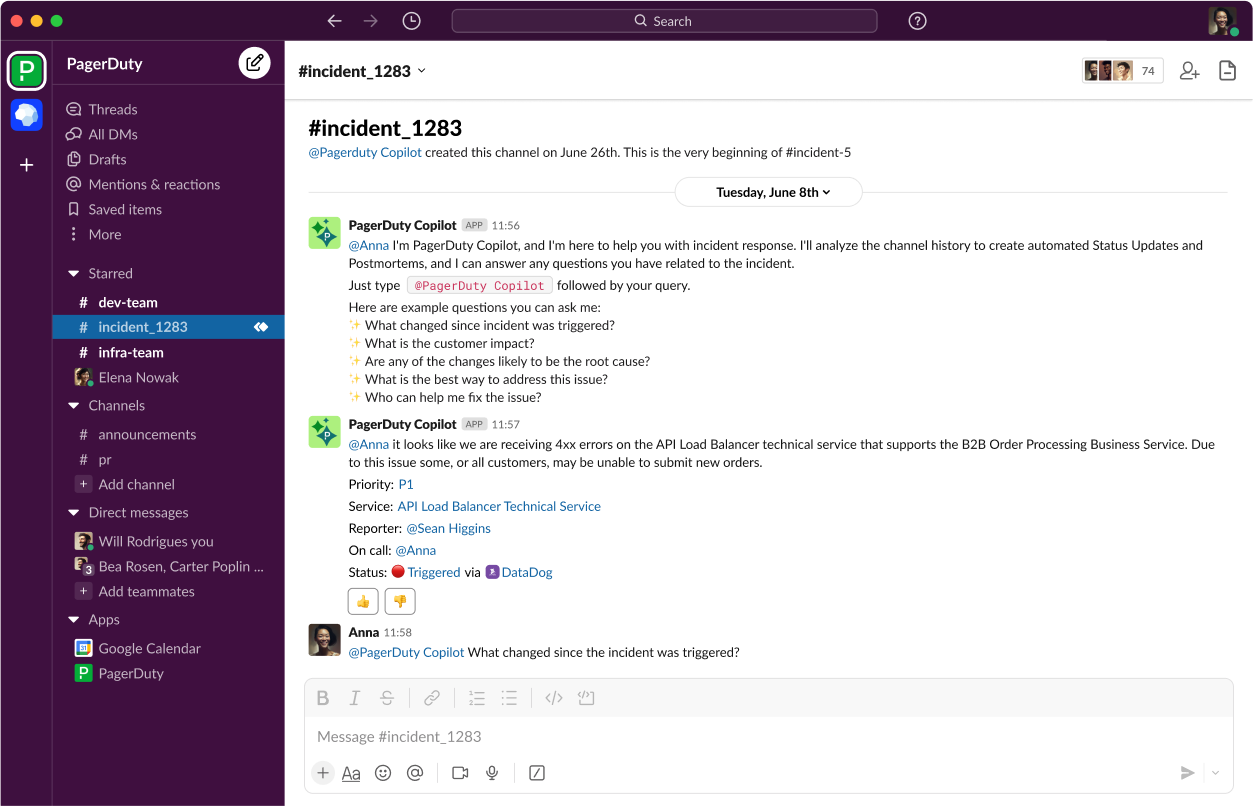
It’s now only a matter of time before generative AI capabilities are pervasively applied across both ITSM and DevOps workflows. Less clear is the impact those capabilities will have on the best practices currently relied on to manage those workflows as more tasks are automated. Ultimately, however, AI should make it easier for more organizations to embrace those best practices as the level of skill and expertise required to manage IT at scale is reduced.
In addition, the whole concept of issuing tickets to manage tasks tracked by a central system of record may need to evolve simply because AI has automated requests for service. There will naturally need to be some system of record for tracking requests. Still, ultimately that process will be managed via copilots rather than by a ticket created by an end user that is then tracked via an ITSM platform.
Savvy IT teams, in the meantime, are already moving to determine which tasks and workflows will be automated in anticipation of AI becoming more widely embedded in ITSM and DevOps platforms. Roles and responsibilities within IT teams will inevitably evolve as AI increasingly automates mainly mundane tasks, such as creating reports that many IT professionals would rather not spend time writing.
The biggest IT management platform challenge in the future might not necessarily be adjusting to AI as much as it will be orchestrating requests that are likely to be generated by multiple types of copilots that have been embedded into almost every application.
One way or another, AI is about to transform how IT operations are managed. As disruptive as those advances will be, AI, more importantly, will also enable organizations to manage IT at levels of scale that were previously unimaginable.
-

IT Service Incidents Are Becoming More Frequent, Survey Says
A survey of 1,000 IT operations, DevOps, site reliability engineering (SRE) and platform engineering professionals in the U.S. conducted by Transposit, a provider of an incident management platform, found more than two-thirds (67%) have seen an increase in the frequency of service incidents that have affected their customers over the past 12 months.
Announced at the Kubecon + CloudNative conference today, the survey found 62% of respondents have also seen an increase in the amount of time it takes to resolve incidents over the course of the last year, with 80% reporting it takes up to six hours on average to resolve incidents from the first alert to mitigating the issue.
Paradoxically, however, 71% of respondents also claim to have automated incident management to their satisfaction, with 59% having a defined incident management process in place. One-third (33%) said only 11-25% of their incident management tasks or workflows are automated.
Transposit CEO Divanny Lamas said despite that level of comfort it’s clear the number of incidents that need to be addressed are continuing to increase as IT environments become more complex. In fact, in the next 12 months, 72% expected their organization to expand its IT stack.
At the same time, costs per incident are rising, with organizations at risk of losing up to $499,999 per hour on average, according to 63% of respondents. Nearly half (47%) said downtime can cost anywhere from $100,000 to $2 million.
A full 85% of respondents are hopeful that generative artificial intelligence (AI) will help further streamline incident management processes, with 80% having already embraced AI to varying degrees. More than half (51%) feel AI is making their job better, with 65% using it to improve the accuracy and quality of data. Just over half (51%) reported faster time to incident resolution, with 50% using it to more quickly and easily identify the root cause of issues, potential threats and vulnerabilities. Just under half (48%) use it to automate repetitive tasks or processes, streamlining their operations effectively.
A full 90% of respondents said integrating generative AI capabilities into incident management tools or platforms decreased the time it takes to create new automations.
Overall, 43% reported current incident management processes are not effective or are only being used by some team members due to confusing documentation (41%), limited access to tools (40%) and reliance on institutional knowledge (40%). Well over a third (37%) reported that only select team members have a comprehensive understanding of the defined incident management process and that they are adhered to consistently.
A full 96% said they believed it would be beneficial if all the tools their organization used to manage incidents were integrated through one tool or platform, the survey finds.
Top challenges cited included not enough buy-in from leadership or management (57%), not enough sharing of knowledge (54%), inadequate documentation of institutional knowledge and existing processes (54%) and a lack of clarity about what to automate (52%).
Respondents reported they expected to embrace technologies including AI or tools that employ machine learning algorithms (60%), automation tools or applications (53%) and communication/collaboration tools or applications (48%).
In addition, over the past year, 62% of respondents have increased their focus on SRE practices, with 58% planning to increase adoption of platform engineering as a methodology for centralizing the management of DevOps workflows.
Ultimately, automation should reduce incident management stress for all concerned, said Lamas. The challenge, as always, is making it simpler to achieve that goal in a way that doesn’t rely on a complex mix of custom scripts that don’t scale, she added.
One way or another, it’s clear that when it comes to incident management, there is still plenty of room for improvement. -

Atlassian Brings Generative AI to ITSM
Atlassian today added generative artificial intelligence (AI) capabilities to Jira Service Management, an IT service management (ITSM) platform built on top of Jira project management software already used widely by DevOps teams.
Generative AI is at the core of a virtual agent that analyzes and understands intent, sentiment, context and profile information to personalize interactions. Based on the same natural language processing (NLP) engine that Atlassian is embedding across its portfolio, the virtual agent dynamically generates answers from sources such as knowledge base articles, onboarding guides and frequently asked questions (FAQs) documents.
In addition, it can facilitate conversations with human experts any time additional expertise is required to respond to more complex inquiries.
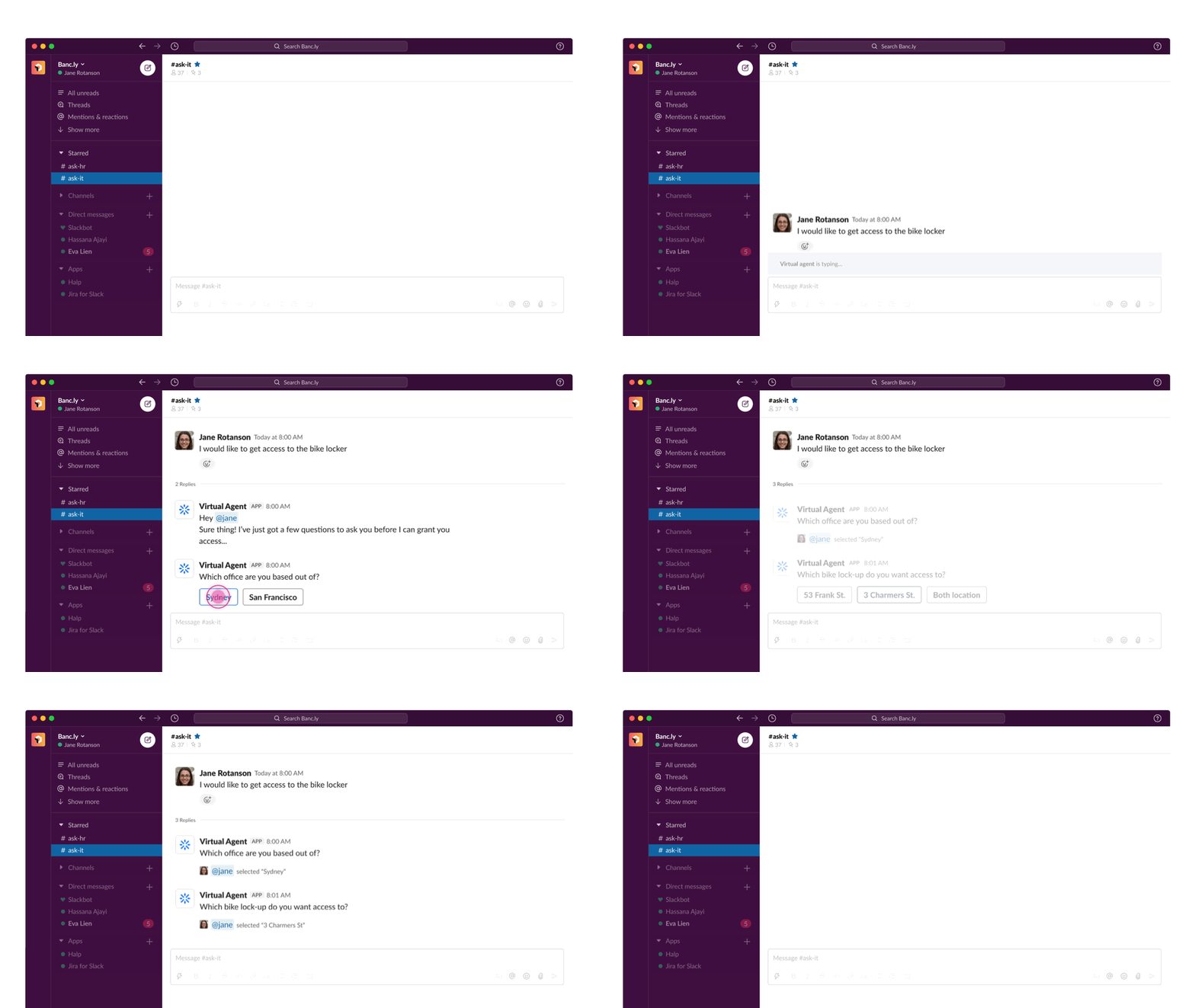
Atlassian is also extending the reach of Atlassian Intelligence, a generative AI solution launched earlier this year, to provide concise summaries of all conversations, knowledge base articles and other resolution paths recommended by previous agents that have handled similar issues. It will also help IT staff craft better responses and adjust their tone to be more professional or empathetic if needed.
During setup, support teams can easily configure the virtual agent experiences to match how they deliver service without writing a single line of code.
Edwin Wong, head of product for IT solutions at Atlassian, said these additions are part of a larger commitment Atlassian is making to unify the helpdesk experience. The company plans to leverage Atlassian Intelligence to coordinate routing of all employee requests to the right tools as it aggregates requests from multiple communications channels such as web portals, email, chat and from within third-party applications, he noted.
The overall goal is to reduce the number of tickets generated by leveraging AI as much as possible to handle service requests in a way that costs less to implement and maintain, Wong said.
In the longer term, Atlassian will also apply generative AI to enable organizations to automate IT asset management further, he added.
There is little doubt at this juncture that AI will be pervasively applied across both ITSM and DevOps workflows. As those advances are made, it should also become easier to address issues that arrive either programmatically or by generating a ticket for a service request that is then processed by an ITSM platform such as Jira Service Management.
Each organization will need to decide how quickly to incorporate AI into ITSM, but hopefully, the level of burnout experienced by IT personnel will be sharply reduced as more tasks are automated. Less clear is the impact AI will have on the size of IT teams required to provide those services, but for the foreseeable future, there will always be a need for some level of human supervision.
In the meantime, IT teams should take an inventory of the processes that are likely to be automated by AI today with an eye toward restructuring teams as more tasks are automated. Ultimately, the goal should be to let machines handle the tasks they do best so humans can provide higher levels of service that deliver more value to the business.
-

BigPanda Extends AIOps Platform to Embrace Generative AI
BigPanda today added generative artificial intelligence (AI) capabilities to analyze incidents surfaced by its AI for IT operations (AIOps) platform.
Blair Sibille, field CTO for BigPanda, said Generative AI for Automated Incident Analysis leverages generative AI platforms based on the general-purpose large language models (LLMs) created by OpenAI.
The goal is to make it simpler for IT teams to discern the root cause of an issue by, for example, taking advantage of summaries of alerts enabled by generative AI to make it simpler for IT professionals of any skill level to understand what requires their most immediate attention, he added. Today, insights are lost in the sea of alerts that often inundate IT teams, Sibille noted.

BigPanda has been at the forefront of applying machine learning algorithms to automate IT operations management. Now, the company is incorporating external general-purpose LLMs to further augment IT teams, said Sibille.
As IT environments continue to be more complex, it’s becoming essentially impossible for IT teams to manage them at scale without relying more on automation. AI technologies take automation to another level, but they won’t eliminate the need for DevOps teams to manage IT environments, added Sibille.
BigPanda claimed generative AI capabilities will make it possible to reduce the amount of time required to resolve tickets by seven minutes each, with an accuracy rate of 95% during beta testing. Over time, those capabilities not only reduce mean-time-to-resolution but also reduce the level of toil that often conspires to burn out DevOps teams, said Sibille.
At the core of the BigPanda AIOps platform is a data lake capable of consuming data generated by multiple applications and systems. That data then provides the foundation on which machine learning algorithms are applied to surface insights.
It’s not clear how much generative AI will automate DevOps workflows, but in effect, more IT teams will be able to take advantage of having the equivalent of a DevOps engineer that they can query any time an issue arises using natural language, noted Sibille.
AI doesn’t mean that IT outages will be completely eliminated, but it does mean they will become a lot less stressful, he added.
Naturally, there’s a lot of speculation concerning the impact AI will have on DevOps. Some contend it’s only a matter of time before the entire software engineering process is automated. As those advances are made, the cost of building applications will effectively drop to zero. Others argue that AI will simply augment DevOps teams in a way that makes it simpler to manage IT at scale using either the same number or possibly even fewer engineers.
The one thing that is clear is that AI will soon be pervasive. DevOps teams should start evaluating today which tasks will be automated with an eye toward planning how DevOps roles will evolve as AI advances accelerate.
-
Blameless Integrates Incident Management Platform With Opsgenie
Blameless this week announced it has integrated its namesake incident management solution with the Opsgenie alerting platform from Atlassian.
Aaron Lober, director of product marketing for Blameless, said the Blameless platform is now integrated with both Opsgenie and PagerDuty, the two most widely used platforms for managing alerts.
Blameless provides an incident management platform that normalizes data collected from a wide range of DevOps tools and platforms to determine how best to respond to different incident classes. Armed with those insights, it then becomes possible to quickly assemble the best team to respond to an event, said Lober.
That capability reduces stress because Blameless also surfaces recommendations for resolving incidents based on the data it has collected, he added.
The Blameless platform is tailored to organizations that have hired site reliability engineers (SREs) to manage IT operations using DevOps best practices, noted Lober. The overarching goal is to eliminate rote processes that, over time, conspire to burn out incident management teams that often experience high turnover rates, he added.
Opsgenie has been connected to the Blameless platform via the service catalog and alerting functions. Blameless users responding to or managing an incident can escalate issues to any teams defined within Opsgenie. The service catalog and alerting data generated throughout the life cycle of an incident is automatically captured and stored on the Blameless Incident Timeline. That capability makes it possible to identify appropriate service owners and the escalation protocol that was followed by that team. Blameless can also display the actual user name of each responder that has been notified.
When accessing Blameless via Slack or Microsoft Teams, Opsgenie can automate both when an incident channel is created and pre-select relevant services that should be made available. Alerts can also be manually triggered using commands from the Blameless chatbot for those who prefer to trigger alerts from within Slack or Teams themselves.
As IT environments become increasingly more complex, more organizations are making a concerted effort to apply DevOps best practices to incident management. The goal is to reduce downtime and increase overall resiliency at a time when organizations are more dependent on software than ever. As part of that effort, IT teams should identify the repetitive processes that span multiple incidents and then move to automate as many as possible.
In the longer term, it’s not clear what impact artificial intelligence (AI) will have on incident management. At some point, though, IT teams should expect their efforts to be augmented by machine learning algorithms capable of identifying issues before they balloon into a major crisis. However, there will always be some human intervention required to manage incidents for the foreseeable future, noted Lober.
In the meantime, most IT teams should continue to expect the unexpected at a time when IT environments have never been more dynamic and change multiple times a day.
-

Microsoft Outage Outrage: Was it BGP or DNS?
Welcome to
The Long View—where we peruse the news of the week and strip it to the essentials. Let’s work out what really matters.
This week: All of Microsoft’s cloud services go down, everywhere except China. Redmond’s IaaS, PaaS and SaaS—including GitHub—were dead for several hours, and are still running unreliably—despite Microsoft saying it’s fixed the problem. (more…)
-

Five Great DevOps Job Opportunities
devopsy.kinsta.cloud is now providing a weekly DevOps jobs report through which opportunities for DevOps professionals will be highlighted as part of an effort to better serve our audience.
Our goal in these challenging economic times is to make it just that much easier for DevOps professionals to advance their careers.
Of course, the pool of available DevOps talent is still relatively constrained, so when one DevOps professional takes on a new role it tends to create an opportunity for others.
The five job postings shared this week are selected based on the company looking to hire, the vertical industry segment and naturally, the pay scale being offered.
We’re also committed to providing additional insights into the state of the DevOps job market. In the meantime, for your consideration:
Dice.com
Oscar Technology
Remote
DevOps Engineer- Go Language
$120,000 to $180,000LinkedIn
Proprio
Seattle, Wash
Senior ML-DevOps Engineer
$120,000 to $170,000SimplyHired
DISH
Littleton, Col.
Senior DevOps Engineer
$106,210 to $143,750.Indeed.com
RumbleOn
Irving, Tex.
DevOps Engineer
$115,000 to $135,000Monster.com
PROLIM Corp.
Washington, D.C.
AWS DevOps Engineer
$90,000 to $110,000 -

Forget Automation: Why IT Should Take UX Cues From Fine Dining
As a college student, I worked at a five-star Italian restaurant where I learned the discipline and practice of customer service. The general manager knew exactly which corner to stand in to get a view of every single table during service. They would gauge diners’ experience according to how they were interacting, their microsignals, how much food was left on their plate and the way they glanced around the restaurant. What does this intense attention to detail and individual customer experience have to do with running a service-oriented technology business? Everything.
The tech industry is notorious for automating processes at the expense of personalization, and that aversion can extend to building the relationships necessary to produce a successful end product. Understandably, some companies and their developers prefer to keep relationships with their clients strictly functional because these connections are messy, people are unpredictable and nothing ever goes completely according to plan. It’s a dance we have to do over and again with every new client and project.
For those of us who wish to function as service-oriented tech companies, keeping on top of client and customer experiences requires us to stay attentive and listen with active care. Just like the veteran restaurant manager, we have to constantly scan our environment for cues of satisfaction and dissatisfaction.
Service is More Than an End Product
Before opening every night, the general manager would make staff hold long pieces of string to measure the angles and distance between tables to ensure they were straight and the edges perfectly aligned. Then, after telling staff the evening specials, he would randomly quiz them about the menu. What color is a fava bean?
Seeing the value of such old-school standards left a deep impression and helped me embed attention to detail as a foundational practice across the board, from designing good UX to cultivating relationships. Creating a desirable environment is about successfully orchestrating a million tiny details and always looking for tweaks to make the customer experience better.
That seemingly omniscient Italian from my earliest experience in the restaurant industry also taught me that being empathic goes hand-in-hand with the hard-nosed realities of running a service-oriented business. They showed me how to take care of people, how to make them feel good and how to read body language.
It might be easy to stereotype tech companies as impersonal dispensers of products (and their developers as cogs in the machinery), but we don’t want to just take orders. Our job is to become strategic partners from the ground up for long-term success, and that requires constant care and continual adaptation.
Mapping the Client Experience
We must be willing to redesign how we work with customers and end users over and over again—it’s always changing because expectations are always changing, and market norms are always changing. The moment that we stop trying to get better through small incremental improvements is the moment we stop being service-oriented.
In the same way that a restaurant has a sequence of service that maps a diner’s journey from the moment they enter the door, we can architect a customer experience from every touchpoint.
In the sales process, it’s valuable to layer in different people to create more relationship touchpoints throughout an organization, so, in our case, a new client meets a member of our operations team and then somebody from our engineering team in order to ensure that they feel fully supported. Then, we set expectations in terms of communication as part of a scripted onboarding experience. In our review meetings, we seek feedback to determine whether we have under-delivered and course correct if necessary.
The other thing I learned from that Italian restaurant is that no mistake is irredeemable. It doesn’t really matter if you get it right or wrong the first time, it is how you respond when the unexpected happens that matters. Turning a situation around after making a horrible mistake—even sending out a cold steak—can breed even more loyal customers because it demonstrates that you really care.
The Creative Heart of Service
Despite the image of tech as cold and distant, it’s important to recognize that coding and development itself is creative and we should seek to nurture a healthy environment so that people can perform at their best. To that end, it makes sense to think of your responsibility as running the entire length of the chain, from employees to clients and, finally, to end users. Finding humanity in the work along each link is key to building successful partnerships.
In the context of building products, we must be creative to design seamless, curated experiences for end users. There are plenty of apps that sit on someone’s phone unused before ultimately being deleted. The only way to grab the attention of people that share the same interests and problems is by understanding their needs.
To that end, we must always be asking our clients: What is the easiest point of entry for the user? Creating a low barrier is a quick win that in and of itself is an onboarding experience and an opportunity to build trust.
Equally, what may make one customer happy may not actually have any resonance in the wider market. If customers were only hiring us to write code, we would only be interested in meeting their expectations. The goal is not just to build products, but successful products that establish or reinforce a client’s reputable presence in the marketplace.
Adding Value Through Relationships
When we stand in our metaphorical corner of the room to observe the customer experience, we are consolidating data from products that have millions of users and harvesting insight. We are not interested in quick fixes. Customer service and a focus on the end-user experience means being oriented to what the market wants, not designing in a vacuum. We can then continue to build value over time.
In the restaurant business, the little surprise at the end of dinner adds value because it is unexpected. A complimentary after-dinner liqueur with a pithy origin story is a point of detail at its finest. Creating a richer, fuller customer experience can set a tech business apart in an exploding marketplace. For my old mentors, paying attention to every nuance from the beginning to the end is what defines five-star service.