Category: Cloud Management

  • AWS Makes Economic Case for Graviton Processors

    AWS Makes Economic Case for Graviton Processors

    Amazon Web Services (AWS) is making available in preview a C7gn instance on the Amazon Elastic Compute Cloud (Amazon EC2) based on AWS Graviton processors. The C7gn instances provide up to 200 Gbps network bandwidth and as much as 50% higher packet-processing performance compared to previous-generation C6gn instances.

    Announced at the AWS re:Invent 2022 conference, these instances are based on Arm processor architecture that AWS provides as an alternative to x86 processors.

    Rahul Kulkarni, director of product management for Amazon EC2, said interest in more efficient AWS Graviton processors has spiked sharply as the overall economic outlook softened. More IT teams than ever are being tasked with finding ways to reduce costs as the overall number of applications being deployed in the cloud continues to grow, he added.

    While it’s not clear how many applications are being developed to run natively on Arm processors, Kulkarni noted that the process of refactoring existing applications to run on Arm processors is not as intensive for most applications as it was when previously moving applications from one class of processors to another.

    Overall, AWS now offers more than 600 types virtual machine instances on its cloud platform, including a set of Inf2 instances, available in preview, based on custom AWS processors that are optimized for processing workloads that include machine learning algorithms that drive artificial intelligence (AI) models.

    Every AWS instance takes advantage of a set of AWS Nitro Cards that offload the overhead virtualization creates so IT organizations can take full advantage of compute resources without having to allocate any resources to run virtualization software, noted Kulkarni. That virtualization tax is instead absorbed by AWS to reduce total cloud costs for the customer, he added.

    In addition, more customers are taking advantage of tools such as AWS Cost Optimizer and AWS Karpenter for Kubernetes clusters that employ machine learning algorithms to identify opportunities to reduce the cost of cloud infrastructure by, for example, shifting workloads to different classes of services.

    There are, of course, multiple strategies for containing cloud costs that range from committing to consuming a specified amount of compute resources annually at discounted rates to relying more on spot instances that are available for limited amounts of time. Less effective is moving workloads from one cloud provider to another simply because the total cost migrating workloads can be substantial depending on the number of proprietary application programming interfaces (APIs) that have been invoked.

    Regardless of approach, the days when developers were allowed to invoke cloud resources at will appear to have come to an end. Enterprise IT organizations are a lot more conscious of the total cost of IT in the cloud era. As a result, many of them are adopting financial operations (FinOps) best practices to maximize utilization of cloud infrastructure resources.

    It’s not clear how readily IT organizations will embrace AWS Graviton alongside other classes of Arm processors to achieve that goal, but as the economic outlook continues to remain uncertain, there is no doubt all options are now on the table.

  • GitLab Unfurls Dedicated SaaS Edition in the Cloud

    GitLab Unfurls Dedicated SaaS Edition in the Cloud

    GitLab today made available to a limited number of customers a single-tenant version of the software-as-a-service (SaaS) edition of its continuous integration/continuous delivery (CI/CD) platform.

    David DeSanto, vice president of product at GitLab, said the GitLab Dedicated option provides all the benefits of a cloud platform without running afoul of any potential compliance issues.

    Designed to be deployed on a cloud platform selected by the customer, DeSanto said the single-tenant edition of the platform makes sure that all the data stored in the cloud is isolated. In addition, the access to GitLab Dedicated is provided via a private network connection, he added.

    Initially, GitLab Dedicated is being made available on the Amazon Web Services (AWS) cloud with support for other cloud platforms planned for 2023 once it becomes generally available.

    GitLab is, in effect, trying to strike a balance between a lower-cost multitenant edition of the platform or, alternatively, requiring organizations to deploy an on-premises edition of the platform themselves, DeSanto said.

    In general, GitLab expects this latest version of the platform to appeal most to organizations that operate in highly regulated industries. However, the number of organizations looking to isolate their data in a private cloud to better protect their software supply chains is expanding, he noted.

    In the wake of a series of high-profile breaches and vulnerability disclosures, the number of organizations that are reviewing their software supply chains has increased. Less clear is the degree to which organizations will look to lock down their existing CI/CD platform versus replacing it with a more secure modern alternative that can be more easily accessed via the cloud.

    The challenge, of course, is replacing a CI/CD environment is not trivial, so organizations will need to consider the time and effort made over the years to customize their CI/CD environment. In some instances, that customization provides a meaningful competitive advantage. In other cases, however, the weight of maintaining all those customizations has become more troublesome than it’s worth.

    Each individual organization will need to decide to what degree they will want to manage the DevOps platforms used to construct applications. More organizations are deciding they prefer to devote as much of their resources as possible to writing code instead of managing the underlying CI/CD platform used to create their applications, said DeSanto.

    Regardless of approach, the number of organizations adopting DevOps best practices to build and deploy applications faster continues to increase. A CI/CD platform accessed via the cloud lowers the barrier to entry for smaller organizations that typically don’t have the skills and resources required to manage DevOps platforms.

    In the meantime, SaaS-based approaches should significantly increase the number of applications being constructed using DevOps workflows. The level of DevOps adoption will naturally vary by organization. However, the total number of custom applications being used to drive, for example, digital business transformation initiatives should considerably expand in the months and years ahead as more applications are built and deployed at incredible speed.

  • Datadog Dives Into Universal Service Monitoring

    Datadog Dives Into Universal Service Monitoring

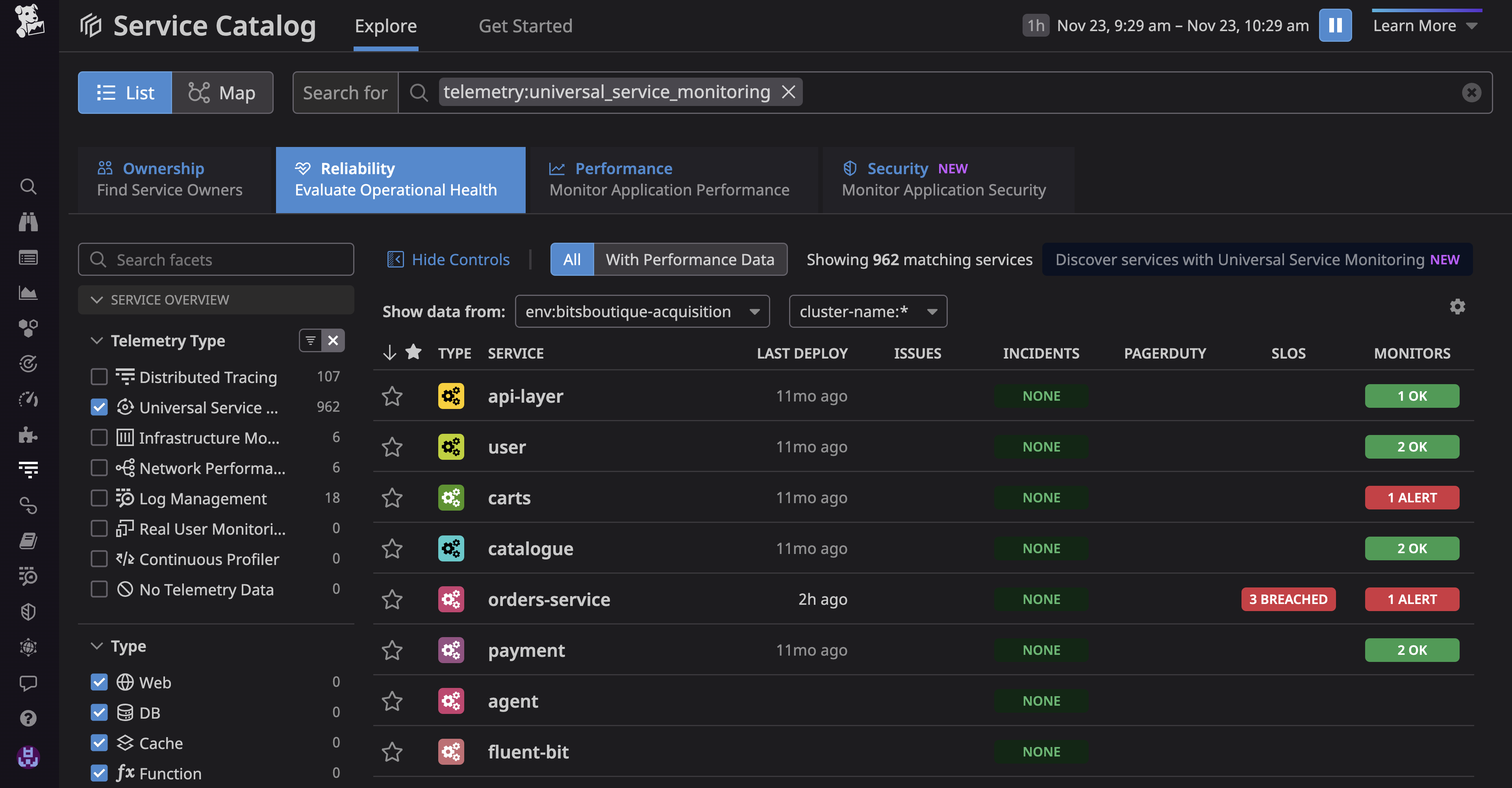
    Datadog, Inc. today made generally available a Universal Service Monitoring service that takes advantage of the extended Berkeley Packet Filtering (eBPF) microkernel in a Linux operating system to automatically detect all the services that make up an application environment without changes to the code used to construct them.

    Yrieix Garnier, vice president of product at Datadog, said as application environments continue to evolve IT teams are now trying to track not just individual microservices but also entire business processes such as order-to-cash. Before those services can be instrumented, however, DevOps teams need a simple way to discover them, he noted.

    Within the Linux operating system, eBPF makes it possible to employ a sandbox environment to identify and map the services that make up an application environment, including both internally developed and third-party services regardless of what programming languages were used to build them, added Garnier.

    DevOps teams also gain visibility into the health of every service and deployment through real-time request rate, error and duration (RED) metrics and correlated infrastructure metrics and application logs. They can then expand monitoring capabilities provided via Datadog agent software to employ distributed traces that can be correlated with observability data.

    The Datadog Universal Service Monitoring service is also integrated with the Service Catalog that Datadog makes available to determine which development team created a specific service.

    The goal is to close a visibility gap that has emerged as more IT organizations align their management efforts around specific application services in the age of digital transformation rather than the components that make up a service, noted Garnier.

    DevOps teams today are simultaneously being tasked with diving deeper into application environments to discover issues before services are disrupted and also tracking the services that span multiple application components. Collectively, the expectation is that DevOps teams will be able to ensure that application services are not just available but also consistently delivered. Ultimately, IT organizations are being tasked with removing much of the guesswork that has historically characterized the management of IT.

    Less clear is how much those shifts will ultimately drive the reorganization of IT teams that are still mostly organized around the platforms they support versus the services being delivered. However, as business leaders increasingly appreciate how dependent the overall organization is on application services, the need to manage them in a more comprehensive manner becomes apparent.

    In the meantime, DevOps teams are evaluating whether their existing tools and platforms enable them to accomplish that goal. Datadog is making a case for employing a service it manages on behalf of DevOps teams versus each DevOps team having to construct and maintain its own observability platform. Datadog, most recently, extended the reach of its namesake cloud-delivered monitoring and observability platform to address continuous testing, application security and cost management.

    It will be up to each organization to decide how best to achieve their observability goals. One thing that is certain is the current level of visibility they have into application environments is not nearly sufficient.

  • IBM Adds Fully Managed VMware Service to Cloud Portfolio

    IBM Adds Fully Managed VMware Service to Cloud Portfolio

    At the VMware Explore 2022 Europe conference, IBM this week announced an IBM Cloud for VMware-as-a-Service offering that integrates instances of VMware Cloud with the infrastructure-as-a-service (IaaS) platform managed by IBM in the cloud.

    Rohit Badlaney, vice president of product management and strategy for IBM Cloud, said now that VMware Cloud can be consumed as a subscription service, it’s now possible for IBM to integrate it with its cloud platform to create a fully managed service. Previously, IT organizations would have had to separately license VMware Cloud and deploy it on IBM Cloud themselves, he noted.

    In general, Badlaney said IBM is focused on working with organizations in highly regulated industries that need to run complex workloads in the cloud. IBM is not interested in competing against other cloud service providers to run workloads on commodity infrastructure, he added.

    The majority of applications that run in the cloud today consume a narrow range of memory and storage resources. The IBM cloud is clearly more focused on providing higher-margin services to complement the cloud infrastructure it makes available via its data centers. Less clear is to what degree monolithic applications running in on-premises IT environments are being lifted and shifted to the cloud. While there is clearly a segment of organizations that no longer want to operate their own data centers, the bulk of applications continue to run in on-premises IT environments. The reasons for this include everything from performance requirements and security concerns to regulatory compliance issues.

    However, since most on-premises applications run on VMware virtual machines, much of the focus on cloud migration has revolved around platforms that would not require IT teams to refactor applications to run on a different virtual machine platform. IBM is also betting that, given the current state of the global economy, more organizations will soon be opting to not manage their own data centers. Cloud platforms managed by a third party would enable those organizations to focus more of their own internal IT efforts on application development and deployment.

    Each organization will need to determine for itself whether to treat IT as an operating versus a capital expense, depending on which approach makes the most economic sense. Organizations that have embraced DevOps workflows would need to align the way they build and deploy applications to a managed service.

    In theory, of course, a managed cloud computing service makes IT teams more agile and efficient. Less IT infrastructure winds up being overprovisioned by developers that can programmatically spin up resources on demand. Of course, there are a lot of IT stacks other than VMware Cloud that can be deployed in the cloud. IBM, for example, makes available the Red Hat OpenShift platform to run cloud-native applications on Kubernetes clusters. IBM has not yet committed to offering the VMware Tanzu platform for running those types of applications.

    Not every application is going to wind up running in the cloud, but what is certain is that application environments are becoming more complex to manage in the next era of cloud computing.

  • A DevOps Reset for a Multi-Cloud World

    A DevOps Reset for a Multi-Cloud World

    In the world of DevOps, only two things really matter: 

    • To release applications and updates as quickly as possible
    • To have access to resources (processing, storage, networks) able to run those apps, as cost-effectively as possible. 

    The measures used to achieve these twin goals should work together seamlessly–otherwise, you’re inefficient. But software development and IT operations have been on separate journeys, and it now takes layers of tools, specialized expertise and lots of precious time to distribute and manage applications where they need to run. Organizations tolerate all this complexity (and the delays and costs that come with it) since they see no alternative. But what if there was an easier way?  I’ll examine the two fundamental shifts driving software development and IT operations and see why current processes are so cumbersome.  

    Shift One: From Monolithic Applications to Microservices

    In the beginning, applications were monolithic, with all functions and code packaged together. That approach was manageable when apps were updated once or twice a year, but not when updates are expected multiple times each day. Finally someone realized that applications would be much easier to build, improve and maintain if they were divided into smaller units called microservices—independent, loosely coupled, individually deployable services, each one addressing a specific function. 

    To support microservices, a technology stack has emerged, similar to steps on a ladder:

    • To make them portable, microservices are packaged in containers—a lightweight, standard way for applications to move between environments and run independently. Everything needed to run the microservice such as settings, system tools, libraries and dependencies is packaged inside the container.
    • A single application could have hundreds of containers associated with it. How do you manage them? Along came Kubernetes (aka K8s), open source software for deploying and orchestrating containers within a cluster of virtual machines. (Note the word cluster—the significance will be discussed momentarily.)
    • Since microservices are updated constantly, how do you make sure the correct version is running? Along came GitOps to provide version control for all updates to all those microservices. Git repositories provide a single source of truth for the desired application state, as well as a record of every code change.

    Finally, we need to set up continuous integration/continuous delivery (CI/CD) for rolling out application improvements and new features. Along came ArgoCD, a GitOps continuous delivery tool for Kubernetes that continuously monitors running applications, compares the current, live state against the target state specified in a Git repository, and resolves discrepancies.

    Shift Two:  From On-Premises to Multi-Cloud 

    Not long ago, IT departments were having hot debates about this strange new concept called the public cloud and whether it could possibly play a role in their operations. But once they discovered how easy it was to spin up resources, the floodgates opened.

    The first tentative steps typically involved hybrid clouds combining an on-site private cloud with spillover into a public cloud for workload spikes. These initial forays mushroomed to dozens or hundreds of clouds, in different locations and with different providers. It’s a mind shift happening in enterprises globally—where they once had a small number of clouds, now their cloud operations are huge, growing and boundless. Companies are also discovering that the cloud is not just an easier, more cost-effective way to run their applications, it unlocks new opportunities.

    Now there are core clouds, edge clouds for hyper-local applications, regional clouds, clouds for high availability and resilience and more. Edge computing is another option, where low latency is required for operations at the customer-facing frontend cloud while backend processing happens in the primary cloud. But this is just the beginning.

    Continuous Delivery is Now Way Too Complicated

    Today, an application may have dozens of microservices distributed across different clouds that need to work together—perhaps some in cloud one, a few in cloud two, others in cloud 40, etc. The scale gets huge very quickly; for example, if 100 microservices are being delivered to 100 clouds, there are 10,000 mutations that have to be configured and managed. 

    This is the new normal, and DevOps needs to adapt to it. Processes should mesh transparently, but connecting microservices across multiple clouds and cloud instances requires inter-cluster communication, which Kubernetes (and GitOps/ArgoCD on top of it) does not natively support.

    To make all this work requires specialized skill sets, so organizations hire teams with expertise in continuous delivery, multi-cloud, networking, security and automation. The first step involves distributing K8s containers to clouds where the microservices are going to run. Some enterprises create their own distribution system, others choose to download, install, and manage third-party software such as open source ArgoCD.

    The second step is more complex: Securely connecting those microservices across different clouds and K8s clusters. This involves integrating complex service meshes, load balancers, API gateways and network/firewall automation tools, all feeding into a centralized console for configuration and monitoring.

    The result is inevitable: Lots of extra costs, inefficiency, potential security risk and delayed time to market with resulting risks to the business. Development teams update microservices daily but depend on CloudOps, NetOps, SecOps and other flavors of Ops to deliver them to the different clouds and clusters where they need to run. 

    Despite the best efforts of these different stakeholders, it can take days or weeks to update cloud networks and security for each change.

    Simplifying Multi-Cloud Operations With an Overlay Network

    When hundreds of microservices are being distributed across more and more clouds and updated constantly, you need an alternative—one that streamlines current operations without sacrificing security or application performance. Let’s set aside traditional methods and think about how it should be done.

    First, the solution should be easy to use, so DevOps people don’t have to be proficient with the underlying technology or be dependent on NetOps, SecOps and/or CloudOps people who are. Instead, just provide some basic information about the Git repository and the clouds where you want the microservices to run, and an overlay network handles the rest.

    It should be comprehensive—integrating ArgoCD, the service mesh, the K8s ingress gateway, zero-trust security, resilience/failover, load balancing and multi-cloud networking — all those elements that normally require assembling and configuring individual tools.

    It should make multi-cloud Kubernetes application operations easy to manage, with a single dashboard where you can securely deploy, connect and monitor microservices in all your clouds and clusters.

    Finally, the solution should be available as a service, rather than having to install an ArgoCD server and try to manage it yourself (or hire a team to support it). And if you have questions or need help, competent people should be available to give you a hand.

    Disruptive – In a Good Way

    Get ready for self-service multi-cloud Kubernetes decoupled from the underlying networking and security details. It’s an approach that’s about to upend how microservices are deployed and managed, so DevOps can get back to what really matters:  Delivering applications as fast as possible, on the resources where they need to run. The ability to deliver new features in a fraction of the previous times while significantly reducing costs and without compromising security will mean a competitive advantage and a stronger bottom line. 

  • VMware Extends Equinix Alliance to Drive Managed Hosting Service

    VMware Extends Equinix Alliance to Drive Managed Hosting Service

    VMware today announced it has extended its alliance with Equinix to launch a managed distributed cloud service that runs instances of its cloud computing platform in hosted IT environments.

    Announced at the VMware Explore 2022 Europe conference, the VMware Cloud on Equinix Metal service takes advantage of more than 240 Equinix data centers in 71 major metro areas around the world to deploy instances of the VMware Cloud platform running atop the company’s virtual machine software.

    Narayan Bharadwaj, vice president of cloud solutions at VMware, said this VMware service extends the scope and reach of the company’s multi-cloud computing strategy beyond the scope of the major hyperscalers and traditional on-premises IT environments.

    The goal is to provide a managed IT environment that provides an alternative for deploying latency-sensitive applications closer to the network edge where data can be processed and analyzed in near-real-time, he noted. In addition, Equinix’s hosted IT environment also makes it possible for IT teams to more easily comply with requirements in highly regulated industries.

    It’s not clear what percentage of applications today are running in managed hosted environments versus a public cloud or local data center. But as more organizations decide not to operate data centers themselves, many of them are discovering managed hosting services are preferable to the cloud for reasons spanning everything from application performance and cost and security to compliance.

    In some cases, organizations are determining that certain classes of longer-running applications initially deployed in the cloud are actually less expensive to run in an on-premises IT environment, noted Bharadwaj. A managed hosting option often provides the flexibility benefits of the cloud at a lower cost for those applications, he added.

    As cloud computing evolves, it’s become apparent that IT is becoming more distributed than ever. Many organizations are finding they now have a mix of applications running on public clouds, in co-location facilities and traditional on-premises IT environments. The challenge is that with each new platform employed to run applications, the total cost of managing IT increases. Regardless of any potential infrastructure cost savings, each platform typically requires a set of dedicated specialists to master the frameworks need to manage it. In fact, the single biggest IT expense remains the cost of labor. VMware is making a case for a familiar IT framework that can be deployed anywhere to rein in those costs.

    DevOps, of course, was created to provide a new approach to automating the management of IT at scale. However, DevOps continues to be employed unevenly, largely because there are not enough IT professionals with the programming skills required to successfully manage IT-as-code. Managed services are gaining traction because, in most cases, they shift the responsibility for managing DevOps workflows onto a vendor such as VMware.

    It remains to be seen just how automated the management of IT will become in the months and years ahead. However, it’s apparent that, in the era of the cloud, more organizations are opting to rely on third parties to manage infrastructure so they can devote more resources to building and deploying applications.

  • Cloud Disaster Recovery Best Practices

    Cloud Disaster Recovery Best Practices

    It’s increasingly common for companies in all sectors to use the cloud to store their data. The cloud provides scalability, security and flexibility that was often inaccessible to businesses only a few years ago. But just like any other technology, it has its limits.

    What happens if a severe thunderstorm knocks out power to a data center or if an employee accidentally deletes critical files? These are the types of scenarios that, however unlikely, can still happen and cause significant disruptions to a company if they’re not prepared.

    That’s where cloud disaster recovery comes in. In this article, we’ll discuss why cloud disaster recovery is critical for businesses and the different strategies you can implement to ensure your data is always safe and accessible.

    What Is Cloud Disaster Recovery?

    Cloud disaster recovery (CDR) is a strategy that helps businesses keep their data safe in the event of an unforeseen disaster. This can be anything from a natural disaster like a flood or earthquake to a man-made disaster like a power outage, fire or cyberattack.

    There are many different cloud disaster recovery strategies that businesses can implement, but the most important thing is to have a plan in place so that you know what to do if and when something goes wrong.

    One Company’s Story of Cloud Impact: OVHCloud

    Before providing strategies, we wanted to give you a real-life example of a cloud disaster that impacted multiple businesses, big and small.

    In 2021, OVHCloud, one of the world’s largest cloud service providers, suffered a catastrophic fire at one of its data centers in Strasbourg, France. The fire destroyed the facility, causing widespread damage and leaving many businesses without access to their critical data.

    In the aftermath of the fire, it quickly became apparent that OVHCloud did not have a solid cloud disaster recovery plan. As a result, many businesses were left scrambling to find alternative solutions for their data storage and backup needs.

    The moral of the story is that even the biggest and most well-known companies can be caught off guard by a disaster. This is why it’s so important for businesses of all sizes to have a cloud disaster recovery plan.

    Now that we’ve seen the importance of cloud disaster recovery, let’s look at strategies you can implement to keep your data safe.

    Cloud Disaster Recovery Strategies

    When discussing cloud disaster recovery strategies, many options are available, but not all of them will be right for every business. The key is to find the strategy or combination of strategies that work best for you and your company.

    Here are some of the most common cloud disaster recovery strategies:

    1. Know Your Infrastructure

    The first step in any cloud disaster recovery strategy is to understand your current infrastructure and what assets and data you have. Your assets can include everything from physical servers and hard drives to cloud-based applications and data. 

    Do the homework necessary to understand what you have and where it’s located. For example, take inventory of all of your assets and determine which ones are critical to your business operations. 

    Once you know what you have, you can start to develop a plan for how to protect it. Yes, this may take some time, but it’s an essential step in protecting your data.

    2. Conduct a Business Analysis

    Data breaches within the cloud can come in many different forms. From unexpected data loss to malicious cyberattacks, it’s important to understand the different ways your data could be compromised. This is where conducting a business impact analysis comes in.

    A business impact analysis (BIA) is a process that focuses on identifying and evaluating the potential risks to your business. Rather than focusing on the causes of the breakdown, a BIA focuses on the potential impact of the disruption. The impact can include things like loss of income, damage to reputation and compliance issues.

    By conducting a BIA, you can better understand the risks your business faces and what steps to take to protect against them. For example, using endpoint security vendors can help protect your data by preventing attacks on endpoints on or off the network.

    3. Draft a Disaster Recovery Plan Based on RPO and RTO

    Once you’ve conducted a BIA and clearly understand the risks your business faces, you can start to draft a disaster recovery plan, specifically around the recovery point objective (RPO) and recovery time objective (RTO).

    Your RPO measures how much data is lost during a disruption, while your RTO measures how long it takes to recover from it. By understanding these two factors, you can start putting together a plan that meets the specific needs of your business.

    It’s important to note that your RPO and RTO will likely differ based on the type of data you’re working with. For example, if you’re working with data that can be easily recreated, your RPO may be relatively low. However, if you’re working with mission-critical data that can’t be easily replaced, your RPO will be much higher. The same is true for RTO.

    Regardless, you want to ensure that your disaster recovery plan is based on your specific RPO and RTO so you can recover from a disruption promptly and with minimal data losses.

    4. Have a Strong Cloud Backup Solution

    No matter what cloud disaster recovery strategy you implement, it’s essential to have a strong backup solution in place. It will ensure that you can quickly pivot to a different strategy and dodge the hefty price tag that often comes with data loss and encrypted files when there’s no backup.

    There are several different backup solutions available, so you must find one that meets the specific needs of your business based on the type of data you have and how often it changes.

    5. Test Out Your Disaster Recovery Plan Regularly

    Once you have your disaster recovery plan in place, it’s important to test it out regularly. Testing will ensure that your plan works as intended and that you can recover from a disruption quickly. Things to test for include data backups, file restores and application availability.

    You should also involve your entire team in the testing process so everyone knows what to do in the event of a disruption. Look for collaboration software that comes with important tools such as chat, video conferencing and task management so your team can easily communicate and work together, even when they’re not in the same place.

    Final Thoughts

    There you have it! These five cloud disaster recovery strategies can protect your business from data loss and keep your operations running smoothly. We suggest starting this process as soon as possible so you can be well-prepared for whatever comes your way.

  • Momento Launches Elastic Cloud Caching Service

    Momento Launches Elastic Cloud Caching Service

    Momento this week emerged from stealth to launch an elastic Serverless Cache platform that promises to improve the performance of applications running on databases deployed in the cloud while simultaneously reducing costs.

    Fresh from raising $15 million in seed funding, Momento CEO and co-founder Khawaja Shams said Serverless Cache gives IT teams access to a serverless computing framework for accessing cache memory that can be used to improve the interactivity of applications.

    Cache is, of course, already widely employed to improve the performance of applications running on databases in the cloud. However, organizations today are required to provision excess cache memory to address performance workload peaks. That approach, over time, conspires to increase the total cost of cloud computing, he noted.

    A serverless cache makes it possible to more easily share an elastic pool of memory that can be invoked in seconds via an application programming interface (API) that is itself invoked by adding five lines of code to an application. The Momento cache service can then handle millions of transactions per second that can be spread across multiple applications, said Shams.

    The Momento Serverless Cache service also automatically manages hot-keys, maintains high cache hit rates and keeps tail latencies low.

    Organizations that are already using Momento on either the Amazon Web Services (AWS) or Google Cloud Platform (GCP) include CBS, NTT Docomo and Wyze Labs, Shams said.

    In general, there’s a lot more scrutiny of cloud costs in the wake of the economic downturn, noted Shams. More IT teams are starting to take note of the fact that various cloud-native platforms enable them to more efficiently consume cloud resources, he added.

    The simple truth is that far too many organizations are managing cloud resources in much the same way they managed on-premises IT environments. Capacity is being dedicated to virtual machines to ensure application availability with even less regard for cost because the perception is that the cloud makes it easy to throw hardware resources at any issue. The challenge is the bill for those cloud resources tends to add up at the end of every month. Cloud database services, in fact, are among the most expensive to consume, noted Shams.

    It’s not clear how much organizations will optimize the consumption of cloud resources in the weeks and months ahead, but it’s clear more supervision is going to be required. Organizations have historically let developers provision resources in the name of agility with little to no regard for cost. Now that finance teams are looking to, at the very least, make sure cloud resources are optimally consumed, there will undoubtedly be more reviews of cloud spending patterns.

    In the meantime, many organizations may also decide to accelerate the rate at which they are embracing cloud-native technologies to optimize that spending. One of the more compelling attributes of Kubernetes clusters and serverless computing is they make it easier to scale compute resources up and down as required to eliminate the need to overprovision cloud infrastructure. The challenge, of course, is that the cost of acquiring and mastering those technologies remains significant.

  • Gitpod Looks to Drive Application Development Into the Cloud

    Gitpod Looks to Drive Application Development Into the Cloud

    Gitpod today revealed it will add an application programming interface (API) to make cloud development environments (CDEs) more extensible. Gitpod also said Johannes Landgraf assumed the role of single CEO for Gitpod, as the previous co-CEO, Sven Efftinge, becomes the company’s first technical fellow.

    Fresh from raising an additional $25 million in funding, Gitpod’s Landgraf said that API will make it easier to build plug-ins for CDEs. In time, Landgraf said, CDEs will become as accessible as any development environment running on a local desktop.

    Software engineers typically waste five hours a week maintaining application environments, noted Landgraf. Via an open source development platform, Gitpod automates the provisioning of secure workspaces in the cloud that provide the added benefit of making it easier for multiple developers to collaborate, he added.

    Capabilities added to the GitPod product roadmap include dramatically faster startup times, improved resiliency and a Gitpod Cloud offering for larger companies as well as a preview environment and workflows that foster collaboration. Gitpod also announced it passed a SOC2 Type II security audit.

    Today, the Gitpod platform is being used by more than 750,000 developers at organizations such as Shopify, Stripe and Slack, noted Landgraf.

    One of the longstanding issues that has always been problematic when building software is that code that runs on a local desktop doesn’t always work when deployed in a production environment. The Gitpod API will make it simpler to spin up various platforms and tools whenever a developer accesses a CDE. The goal is to make it possible to more closely replicate the production environments on which developers will ultimately deploy their applications, noted Landgraf.

    In addition, a CDE should reduce the amount of data that developers routinely move between laptops and cloud computing environments as they build more complex applications, he added.

    In the wake of the economic downturn, there is a lot more focus on developer productivity these days, especially as organizations look to accelerate their of digital business transformations. DevOps teams are also keen to find ways to centrally manage developer experience at a time when many of those developers continue to work from home, said Landgraf.

    It’s not clear to what degree CDE will replace integrated development environments (IDEs) running on a local machine, but all the major cloud service providers are encouraging developers to build applications in the cloud where their applications will run. The challenge is that many of those offerings tend to lock developers into a specific cloud platform, noted Landgraf. Most developers today are building applications that need to be deployed across multiple clouds, he added.

    One way or another, software development is increasingly shifting to the cloud. Most organizations will likely try to find a balance between the amount of code developed on a local machine that developers can just fire up when the mood strikes and the amount of code developed in the cloud. The most immediate challenge is to make sure the CDE experience is every bit as good as the existing local IDE.

  • Fermyon Adds Managed PaaS for Building Wasm Applications

    Fermyon Adds Managed PaaS for Building Wasm Applications

    Fermyon Technologies this week launched a hosted platform-as-a-service (PaaS) environment, dubbed Fermyon Cloud, that promises to make it simpler to build WebAssembly (Wasm) applications.

    Announced during the Cloud Native Wasm Day event during the KubeCon + CloudNativeCon North America conference, Fermyon Cloud is now available in open beta.

    Fresh from raising $20 million in funding, Fermyon CEO Matt Butcher said IT teams can quickly build and deploy Wasm applications using a Fermyon Spin development tool and a Fermyon Platform the company launched earlier this year.

    Fermyon Cloud adds an opinionated PaaS environment managed by Fermyon that can start up Spin applications in less than a millisecond. It uses a serverless application programming interface (API) that makes it possible to cache and optimize applications as they are loaded, noted Butcher.

    Originally developed more than five years ago by the World Wide Web Consortium (W3C) to create a common format for browsers executing JavaScript code, Wasm is now used to rapidly build lighter-weight applications that can be deployed on any server platform. In effect, the promise of being able to write an application once and deploy it anywhere is finally being realized some 25 years after the initial introduction of the Java programming language.

    Wasm isn’t necessarily going to replace existing approaches for building applications, at least not any time soon, but it does provide an alternative to serverless computing frameworks for developing lighter-weight applications that run faster.

    In addition, at a time when organizations are becoming more concerned about application security, the appeal of Wasm is clear. Existing approaches to building applications rely on the aggregation of software components that tend to lack distinct boundaries between them. As a result, it becomes relatively simple for malware to infect all the components of an application. In contrast, Wasm code runs in a sandboxed environment that isolates execution environments to eliminate the ability of malware to laterally move across an application environment.

    Wasm is especially well-suited for building lightweight applications that previously might have been deployed on a serverless computing framework, noted Butcher. The issue developers are encountering when using a serverless computing framework is that those frameworks are based on containers that have comparatively slow startup times, he added.

    It remains to be seen how much traction Wasm gains in the months ahead, but Butcher said he expects most backend services, such as databases, will continue to be built using containers. Fermyon is betting, however, that many future cloud-native applications built by the average developer will be constructed using Wasm. In the longer term, Wasm will also soon be used to build applications infused with machine learning algorithms, said Butcher.

    In the meantime, DevOps teams should get ready for more Wasm code to move through continuous integration/continuous delivery (CI/CD) pipelines. The challenge, of course, is that code will need to be managed alongside all the other software artifacts moving through those pipelines, as well.