Category: Features

  • AWS Makes Economic Case for Graviton Processors

    AWS Makes Economic Case for Graviton Processors

    Amazon Web Services (AWS) is making available in preview a C7gn instance on the Amazon Elastic Compute Cloud (Amazon EC2) based on AWS Graviton processors. The C7gn instances provide up to 200 Gbps network bandwidth and as much as 50% higher packet-processing performance compared to previous-generation C6gn instances.

    Announced at the AWS re:Invent 2022 conference, these instances are based on Arm processor architecture that AWS provides as an alternative to x86 processors.

    Rahul Kulkarni, director of product management for Amazon EC2, said interest in more efficient AWS Graviton processors has spiked sharply as the overall economic outlook softened. More IT teams than ever are being tasked with finding ways to reduce costs as the overall number of applications being deployed in the cloud continues to grow, he added.

    While it’s not clear how many applications are being developed to run natively on Arm processors, Kulkarni noted that the process of refactoring existing applications to run on Arm processors is not as intensive for most applications as it was when previously moving applications from one class of processors to another.

    Overall, AWS now offers more than 600 types virtual machine instances on its cloud platform, including a set of Inf2 instances, available in preview, based on custom AWS processors that are optimized for processing workloads that include machine learning algorithms that drive artificial intelligence (AI) models.

    Every AWS instance takes advantage of a set of AWS Nitro Cards that offload the overhead virtualization creates so IT organizations can take full advantage of compute resources without having to allocate any resources to run virtualization software, noted Kulkarni. That virtualization tax is instead absorbed by AWS to reduce total cloud costs for the customer, he added.

    In addition, more customers are taking advantage of tools such as AWS Cost Optimizer and AWS Karpenter for Kubernetes clusters that employ machine learning algorithms to identify opportunities to reduce the cost of cloud infrastructure by, for example, shifting workloads to different classes of services.

    There are, of course, multiple strategies for containing cloud costs that range from committing to consuming a specified amount of compute resources annually at discounted rates to relying more on spot instances that are available for limited amounts of time. Less effective is moving workloads from one cloud provider to another simply because the total cost migrating workloads can be substantial depending on the number of proprietary application programming interfaces (APIs) that have been invoked.

    Regardless of approach, the days when developers were allowed to invoke cloud resources at will appear to have come to an end. Enterprise IT organizations are a lot more conscious of the total cost of IT in the cloud era. As a result, many of them are adopting financial operations (FinOps) best practices to maximize utilization of cloud infrastructure resources.

    It’s not clear how readily IT organizations will embrace AWS Graviton alongside other classes of Arm processors to achieve that goal, but as the economic outlook continues to remain uncertain, there is no doubt all options are now on the table.

  • Five Great DevOps Job Opportunities

    Five Great DevOps Job Opportunities

    DevOps.com is now providing a weekly DevOps jobs report through which opportunities for DevOps professionals will be highlighted to serve our audience better.

    Our goal in these challenging economic times is to make it easier for DevOps professionals to advance their careers. Of course, the pool of available DevOps talent is still relatively constrained, so when one DevOps professional takes on a new role, it creates an opportunity for others.

    The five job postings shared this week are selected based on the company looking to hire, the vertical industry segment and, naturally, the pay scale offered.

    We’re also committed to providing additional insights into the state of the DevOps job market. In the meantime, for your consideration:

    LinkedIn

    Kforce
    McLean, VA
    Senior DevOps Capability Engineer
    $135,000 to $145,000

    Dice.com

    Emids
    Remote
    Technical Product Owner – DevOps
    $120,000 to $140,000

    ZipRecruiter

    Progressive Insurance
    Carmel, IN.
    Azure IT DevOps Engineer Lead
    $120,000 to $135,000

    Indeed.com

    Amazee.io
    Remote
    DevOps Engineer
    $106,000 to $134,000

    SimplyHired

    Starbucks
    Remote
    DevOps Engineer II
    $94,000 to $166,000

  • AWS Previews Amazon CodeCatalyst to Automatically Create Dev Environments

    AWS Previews Amazon CodeCatalyst to Automatically Create Dev Environments

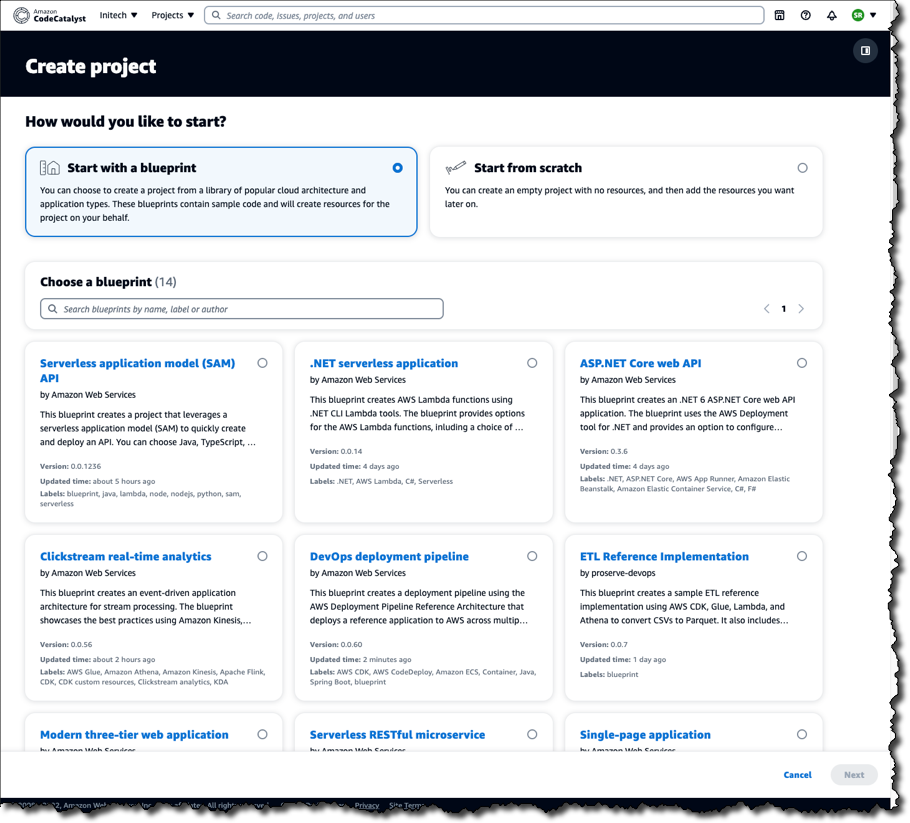
    Amazon Web Services (AWS) this week launched a preview release of the Amazon CodeCatalyst framework that leverages blueprints to automatically provision and configure developer environments in its cloud.

    Announced at the AWS re:Invent 2022 conference, Amazon CodeCatalyst takes advantage of a Project Blueprints tool to launch a source code repository and a project management tracker that are then used to create build and release pipelines. DevOps teams can use either the tools provided by AWS or substitute an instance of, for example, GitHub or the Jira project management software.

    Amazon CTO Werner Vogels told conference attendees the goal is to reduce the friction that developers currently encounter whenever they need to launch a new development project. As part of that effort, Amazon CodeCatalyst promises to make it simpler to consistently replicate development environments using scaffolds in addition to providing dashboards and search capabilities for tracking changes across commits, pull requests and deployments.

    Amazon CodeCatalyst uses a devfile to define the configuration of an environment that comes in four resizable instance options made up of two, four, eight or 16 virtual CPUs. The devfile defines and configures all the resources needed to code, test and debug a project. Devfiles, which are added to the source code repository by the selected blueprint, can also be modified.

    Collectively, those capabilities make it possible to deploy sample TypeScript, Python, Java, .NET, JavaScript, React, Angular and Vue code running in a few minutes. Developers can work with the AWS Cloud9 integrated development environment (IDE) or use tools such as JetBrains IntelliJ IDEA Ultimate, PyCharm Pro, GoLand and Visual Studio Code on their local machine. Developers, as a result, can simply switch between multiple codebases or collaborate with other developers as needed.

    The pipelines can be run on pre-provisioned builds in the cloud or organizations can opt to deploy their own container environments. Developers can incorporate build actions that are built in or provided by AWS partners in addition to incorporating GitHub Actions to compose fully automated pipelines that can be configured using either a visual editor or YAML files. Build and release pipelines enable deployment on Amazon Elastic Container Service (Amazon ECS), AWS Lambda and Amazon Elastic Compute Cloud (Amazon EC2) services.

    In general, Vogels advocated that IT teams should build event-driven applications that are loosely coupled to make it simpler to add new capabilities to existing applications running at scale without impacting the entire codebase. To make it simpler to build those types of applications, AWS added an Amazon EventBridge Pipes tool that creates point-to-point integrations between event producers and consumers in a way that eliminates the need to write that code. AWS also made available in preview a graphical AWS Application Composer tool that makes it simpler to design, configure and build serverless applications using infrastructure-as-code (IaC) definitions.

    It’s not clear to what degree developers will be embracing event-driven applications. As a programming model, event-driven architectures have been around for decades. The issue has been those applications also have tended to be among the most challenging to build and maintain. AWS is now clearly signaling its intent to make building those applications a lot easier.

  • AWS re:Invent — Top 4 Things We Learned This Week

    AWS re:Invent — Top 4 Things We Learned This Week

    Welcome to The Long View—where we peruse the news of the week and strip it to the essentials. Let’s work out what really matters.

    This week, four things that caught my eye from Amazon Web Services’ re:Invent 2022 conference: SnapStart turbocharges Lambda, Graviton3E ARM HPC SoC, AWS continues hiring, and AWS’s origin story. (more…)

  • Nobl9 Adds Free Tier to SaaS Platform for Managing SLOs

    Nobl9 Adds Free Tier to SaaS Platform for Managing SLOs

    Nobl9 this week announced it is making available a perpetual free tier of its software-as-a-service (SaaS) platform for managing service level objectives (SLOs).

    The free tier was announced at the AWS re:Invent 2022 conference and the company also revamped its pricing. Nobl9 Teams Edition (formerly Nobl9 Hydrogen) now includes 50 SLOs, up from 25, for $850/month. Nobl9 Enterprise Edition also has doubled the included SLOs from 75 to 150.

    Finally, Nobl9 also launched SLOcademy to help educate IT teams on how best to create and manage SLOs.

    The Nobl9 platform simplifies the creation and tracking of SLOs using metrics and observability data collected from more than 24 widely used DevOps tools including Prometheus as well as services provided by Datadog, New Relic, Dynatrace, Google, Amazon Web Services (AWS) and Splunk.

    Kit Merker, chief growth officer for Nobl9, said the company’s platform collects signals from logs, metrics and traces to define what normal should look like for any given service. The free tier of the platform has some limitations, but it does provide access to the full-featured platform to enable IT teams to get started managing SLOs.

    SLOs, of course, are not a new idea. They have been used as a metric to track the performance of IT services for decades. It’s not clear whether reliance on SLOs has waned over the years or if application environments simply became too complex to track meaningful metrics. However, as applications are increasingly viewed as services, it’s now only a matter of time before SLOs become more widely adopted across a modern application environment. The challenge, of course, is that defining an SLO is a lot easier than maintaining it—especially within today’s highly dynamic cloud-native application environments where services with lots of dependencies tend to come, change and go unexpectedly.

    Nobl9 is making a case for an SLO-as-code approach that makes it simpler to track service levels. A recent survey of more than 300 IT managers and executives conducted by Dimensional Research on behalf of Nobl9 found only 29% of respondents had no plans to implement SLOs. A full 94% of respondents that have or plan to implement SLOs intend to map them directly to business operations, with 91% reporting that they expect that effort to improve decision-making. More than 80% also said their organizations are planning to increase the use of SLOs, with 87% indicating SLOs should improve overall microservices performance.

    The challenge is that most organizations have limited visibility into their IT environments. The survey, for example, found less than half of respondents (46%) had visibility into all their IT environments. Only 45% and 35% claim to have visibility into containers and microservices, respectively. More than three-quarters (78%) said hybrid clouds make observability more difficult. Ironically, 45% of companies reported they already employed 11 or more observability and monitoring tools. On the plus side, 31% have hired site reliability engineers (SREs) while nearly half (46%) planned to create that role.

    It may be a while before most IT teams are organized around the concept of applications as services but as the management of IT continues to evolve it’s now just a matter of time before that approach becomes more the rule than the exception.

  • Key Findings From the 2022 State of GraphQL Report

    Key Findings From the 2022 State of GraphQL Report

    GraphQL, the open source query language, has been steadily growing in popularity over the past few years. The language is excellent for frontend development, as it creates a usable interface to fetch precisely the data required for the specific client at hand. You can also use it to aggregate multiple backend services and data sources.

    Studies show that the ecosystem around GraphQL is maturing—it has a very global user base and a growing number of tools exist to aid in its adoption. The 2022 State of GraphQL Report found that 61.8% of developers are happy with the overall state of the ecosystem. Yet many native GraphQL features go unused by developers, which suggests there is a wide range of experience levels, from novice to advanced users, working with the technology. This indicates there is plenty of room for growth and knowledge sharing.

    Below, I’ll review the key takeaways from the 2022 State of GraphQL Report, considering overall usage data and focusing on the popularity of specific features. We’ll also highlight the state of standard tools used in conjunction with GraphQL to get the job done.

    Analyzing Overall Usage Statistics

    First off, there is a wide variance in the types of GraphQL APIs in production today, ranging from private to public endpoints. The report found 47.9% of developers use GraphQL for exposing an API intended for a personal website or app, 40.4% use it for private unexposed APIs for internal usage and 19.5% use GraphQL for publicly available APIs intended for third-party developer consumption. This demonstrates its flexibility to cater to multiple scenarios. And while the majority of clients that connect to GraphQL APIs include browsers (62.3%), it’s commonly consumed by other client types such as native mobile apps, other servers and desktop apps.

    Previously, we discussed using GraphQL as a composition layer to combine underlying APIs and services. And the report backs up this idea that developers commonly use it to aggregate various data sources: 55.4% of GraphQL APIs hit databases, while 35% consume REST APIs and 14.6% eat other GraphQL endpoints.

    In terms of benefits, one strong point is the ability to enforce and validate types for every object in the API. Users find other top benefits to be avoiding overfetching and aggregating requests. Yet, some hurdles still present themselves. These top drawbacks include error handling, performance issues, client-side caching and security woes.

    Regarding user base statistics, most users have been working with GraphQL for less than five years. If we look at the type of sector utilizing GraphQL, we see it primarily leveraged in the programming and technology sector. This is followed by e-commerce and retail (16.4%), finance (8.9%) and news, media and blogging (7.2%).

    Many Advanced Features Go Unused

    Many of the more advanced GraphQL features still go unnoticed by the majority of users. For example, live queries is a feature that helps obtain live data from a GraphQL server, yet only 25% who know about it have used it. Over half of respondents had never heard of @skip, a directive that skips a field based on a value passed to it. Similarly, other directives like @specifiedBy, @defer and @stream also share little-to-no awareness or use.

    Analyzing feature usage becomes a bit more serious if we consider the unadopted security and performance features. For example, only 43.2% of respondents have disabled query introspection. Disabling query introspection is a suggested security best practice to limit a hacker’s ability to perform surveillance. But as we’ve previously covered, security by obscurity isn’t enough to protect GraphQL, and an additional security emphasis is often needed.

    As most GraphQL APIs are intended for personal or private scenarios, you would think that more security features would be leveraged to limit the threat of introspection and denial-of-service attacks. Yet, the report discovered low usage and awareness of security and performance features like query timeouts, query rate limiting and query cost analysis, all of which could be turned on to curb malicious behaviors.

    Tools Used In Conjunction With GraphQL

    Developers often seek to combine, aggregate or merge GraphQL schemas from different APIs. To do so, Apollo Federation is the most common solution, used by 22.5% of respondents. This is followed by Schema Stitching (16.9%), GraphQL Modules (4.4%), and GraphQL Mesh (2.9%).

    Looking at other technologies used in connection, Next.js is the most popular framework and PostgreSQL is the most common database used. TypeScript and JavaScript comprise the most common languages used to write a GraphQL backend. Developers also use a balanced mix of IDEs to query and test endpoints, including GraphiQL, GraphQL Playground, Postman, Apollo Studio, and Insomnia.

    The report also found relatively high usage and retention for tools like the GraphQL Code Generator schema builder, Apollo Client and Apollo Server. The data shows a crowded solution market with Apollo as an industry-leading outlier—many other clients, servers, API generators and schema builders have medium-to-high retention rates yet experience far less use.

    Final Thoughts

    The 2022 State of GraphQL Report sheds some interesting light on the state of GraphQL, validating a lot of the interest and trends we’ve covered lately on the blog. Of course, there is more to be said about many areas, such as smoothing the transition to GraphQL.

    One key finding is the low number of security features being leveraged by developers. A greater emphasis on API security is required to avoid incidents and retain a zero-trust approach. This emphasis is part and parcel of responding to ongoing software supply chain threats and will require more awareness and thought leadership around GraphQL security best practices.

    The 2022 State of GraphQL survey ran from June 15, 2022, to July 15, 2022, and collected 3,094 responses. The above analysis only scratched the surface and there are many other insights. For more findings, you can read the full results here.

  • GitLab Unfurls Dedicated SaaS Edition in the Cloud

    GitLab Unfurls Dedicated SaaS Edition in the Cloud

    GitLab today made available to a limited number of customers a single-tenant version of the software-as-a-service (SaaS) edition of its continuous integration/continuous delivery (CI/CD) platform.

    David DeSanto, vice president of product at GitLab, said the GitLab Dedicated option provides all the benefits of a cloud platform without running afoul of any potential compliance issues.

    Designed to be deployed on a cloud platform selected by the customer, DeSanto said the single-tenant edition of the platform makes sure that all the data stored in the cloud is isolated. In addition, the access to GitLab Dedicated is provided via a private network connection, he added.

    Initially, GitLab Dedicated is being made available on the Amazon Web Services (AWS) cloud with support for other cloud platforms planned for 2023 once it becomes generally available.

    GitLab is, in effect, trying to strike a balance between a lower-cost multitenant edition of the platform or, alternatively, requiring organizations to deploy an on-premises edition of the platform themselves, DeSanto said.

    In general, GitLab expects this latest version of the platform to appeal most to organizations that operate in highly regulated industries. However, the number of organizations looking to isolate their data in a private cloud to better protect their software supply chains is expanding, he noted.

    In the wake of a series of high-profile breaches and vulnerability disclosures, the number of organizations that are reviewing their software supply chains has increased. Less clear is the degree to which organizations will look to lock down their existing CI/CD platform versus replacing it with a more secure modern alternative that can be more easily accessed via the cloud.

    The challenge, of course, is replacing a CI/CD environment is not trivial, so organizations will need to consider the time and effort made over the years to customize their CI/CD environment. In some instances, that customization provides a meaningful competitive advantage. In other cases, however, the weight of maintaining all those customizations has become more troublesome than it’s worth.

    Each individual organization will need to decide to what degree they will want to manage the DevOps platforms used to construct applications. More organizations are deciding they prefer to devote as much of their resources as possible to writing code instead of managing the underlying CI/CD platform used to create their applications, said DeSanto.

    Regardless of approach, the number of organizations adopting DevOps best practices to build and deploy applications faster continues to increase. A CI/CD platform accessed via the cloud lowers the barrier to entry for smaller organizations that typically don’t have the skills and resources required to manage DevOps platforms.

    In the meantime, SaaS-based approaches should significantly increase the number of applications being constructed using DevOps workflows. The level of DevOps adoption will naturally vary by organization. However, the total number of custom applications being used to drive, for example, digital business transformation initiatives should considerably expand in the months and years ahead as more applications are built and deployed at incredible speed.

  • Datadog Dives Into Universal Service Monitoring

    Datadog Dives Into Universal Service Monitoring

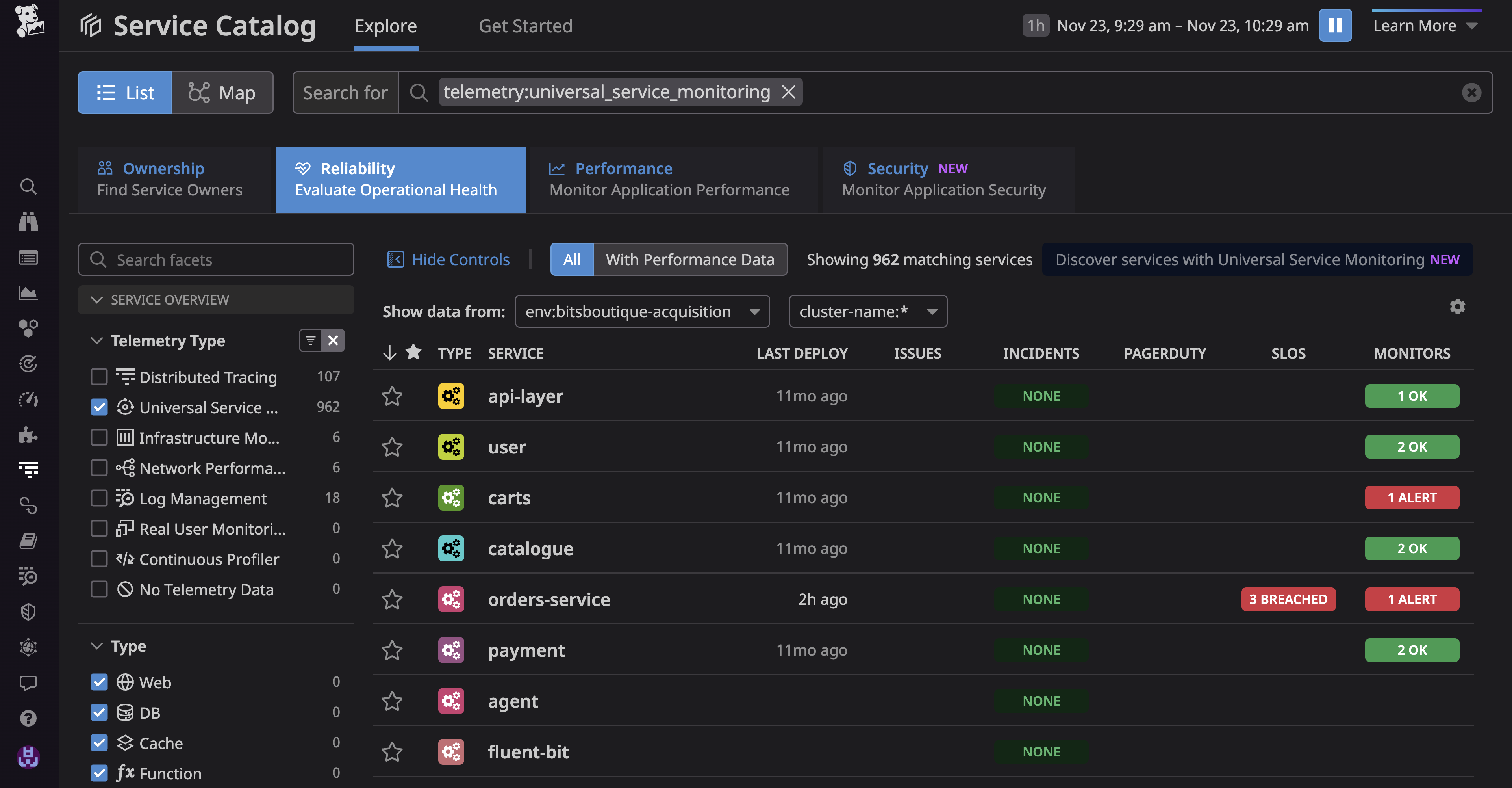
    Datadog, Inc. today made generally available a Universal Service Monitoring service that takes advantage of the extended Berkeley Packet Filtering (eBPF) microkernel in a Linux operating system to automatically detect all the services that make up an application environment without changes to the code used to construct them.

    Yrieix Garnier, vice president of product at Datadog, said as application environments continue to evolve IT teams are now trying to track not just individual microservices but also entire business processes such as order-to-cash. Before those services can be instrumented, however, DevOps teams need a simple way to discover them, he noted.

    Within the Linux operating system, eBPF makes it possible to employ a sandbox environment to identify and map the services that make up an application environment, including both internally developed and third-party services regardless of what programming languages were used to build them, added Garnier.

    DevOps teams also gain visibility into the health of every service and deployment through real-time request rate, error and duration (RED) metrics and correlated infrastructure metrics and application logs. They can then expand monitoring capabilities provided via Datadog agent software to employ distributed traces that can be correlated with observability data.

    The Datadog Universal Service Monitoring service is also integrated with the Service Catalog that Datadog makes available to determine which development team created a specific service.

    The goal is to close a visibility gap that has emerged as more IT organizations align their management efforts around specific application services in the age of digital transformation rather than the components that make up a service, noted Garnier.

    DevOps teams today are simultaneously being tasked with diving deeper into application environments to discover issues before services are disrupted and also tracking the services that span multiple application components. Collectively, the expectation is that DevOps teams will be able to ensure that application services are not just available but also consistently delivered. Ultimately, IT organizations are being tasked with removing much of the guesswork that has historically characterized the management of IT.

    Less clear is how much those shifts will ultimately drive the reorganization of IT teams that are still mostly organized around the platforms they support versus the services being delivered. However, as business leaders increasingly appreciate how dependent the overall organization is on application services, the need to manage them in a more comprehensive manner becomes apparent.

    In the meantime, DevOps teams are evaluating whether their existing tools and platforms enable them to accomplish that goal. Datadog is making a case for employing a service it manages on behalf of DevOps teams versus each DevOps team having to construct and maintain its own observability platform. Datadog, most recently, extended the reach of its namesake cloud-delivered monitoring and observability platform to address continuous testing, application security and cost management.

    It will be up to each organization to decide how best to achieve their observability goals. One thing that is certain is the current level of visibility they have into application environments is not nearly sufficient.

  • Logz.io Unveils Managed Open 360 Observability Platform

    Logz.io Unveils Managed Open 360 Observability Platform

    At the AWS re:Invent 2022 conference, Logz.io launched an Open 360 platform that combines multiple open source technologies to provide observability across both existing monolithic and emerging cloud-native application environments.

    Existing Logz.io offerings included in the Open 360 platform are Logz.io Kubernetes 360, a managed observability platform based on open source tools such as OpenSearch analytics software, Prometheus monitoring tools and Jaeger distributed tracing agents.

    In addition, Open 360 includes Logz.io Telemetry Collector agent software, Logz.io Data Optimization Hub dashboard, Logz.io LogMetrics Index for converting log data into metrics and the Logz.io Trace Sampling Wizard tool for configuring open source OpenTelemetry Collector agent software.

    Logz.io CEO Tomer Levy said rather than requiring organizations to combine a set of disjointed open software tools to create an observability platform, instances of open source tools have been curated by Logz.io. The goal is to streamline the number of tools and platforms that DevOps teams will need to observe multiple classes of applications, he noted.

    It’s still early days as far as the adoption of observability platforms is concerned, but it’s apparent that as application environments become more complex the monitoring tools DevOps teams rely on today will need to evolve. Observability platforms, in general, promise to unify logs, metrics and traces in a way that makes it simpler to launch queries to identify the root cause of an issue rather than simply tracking a set of pre-defined metrics.

    The rate at which DevOps teams will embrace observability will naturally vary, but the choice many DevOps teams are trying to navigate is how much to rely on proprietary observability platforms rather than using open source software to construct their own. Logz.io is making a case for finding a middle ground between those two extremes by relying on a managed service based on open source tools.

    Observability has always been a core DevOps tenet, but achieving and maintaining it is challenging. Most DevOps teams today aspire to maintain some level of continuous monitoring. However, as it becomes easier and less costly to instrument applications, interest is rising in observability platforms that simplify the investigation of anomalies indicative of an issue that could disrupt a distributed application environment.

    More challenging still, DevOps teams are also now managing a much wider range of application types as cloud-native applications based on microservices deployed on Kubernetes clusters are deployed alongside legacy monolithic applications running in the cloud and on-premises IT environments. The Logz.io approach enables DevOps teams to manage those applications at a lower total cost, noted Levy.

    Regardless of the approach to observability, the increasing complexity of application environments has become a major challenge for organizations that are increasingly sensitive to costs. Many of them can’t afford to hire additional DevOps engineers. Instead, the focus is on increasing the productivity of existing DevOps teams using a new generation of observability platforms that should cost less to acquire and deploy than to expand existing teams of DevOps engineers. That may not necessarily eliminate the need to hire additional DevOps engineers, but it should ensure organizations are getting the most out of the DevOps teams they already have.

  • Zilliz Unfurls Managed Vector Database Service

    Zilliz Unfurls Managed Vector Database Service

    Zilliz this week made generally available a managed cloud service that can now be spun up in less than five minutes. The service is based on the company’s open source Milvus vector database.

    Frank Liu, director of operations for Zilliz, said the managed Zilliz Cloud service running on the Amazon Web Services (AWS) cloud will make vector databases much more accessible to a wider range of application developers.

    Vector databases are gaining traction because they provide artificial intelligence (AI) application developers with a more efficient method for managing the unstructured data need to train AI models. Currently, many of those teams are relying on labels and tags to classify and manage data. The Milvus vector database employs deep learning algorithms and its own AI model to create and store, index and manage vectors to more efficiently classify data, said Liu.

    Based on a cloud-native architecture that, for example, employs Kubernetes to scale consumption of cloud resources more efficiently, Zilliz Cloud can also scale to process tens of billions of high-dimensional vector data for data-intensive applications, he added. The company claims Zilliz Cloud delivers up to 10 times greater throughput and five times lower latency for read and write operations for data-intensive workloads.

    Other attributes of the managed Zilliz Cloud include support for multi-language software development kits (SDKs), a web-based graphical user interface to search and explore data, SOC 2 compliance, network isolation using IP whitelists and full data encryption in transit (TLS).

    In the future, Zilliz also plans to add support for Microsoft Azure Cloud and Google Cloud Platform in addition to graphical processor units (GPUs) to optimize the performance of its deep learning algorithms.

    Potential use cases for a vector database span everything from image retrieval and video analysis to fraud detection to drug discovery. Organizations that already use Milvus, which is being advanced under the auspices of the LF AI & Data Foundation, include eBay, Shopee and SmartNews.

    In general, the rise of data-intensive workloads is driving more organizations to embrace DataOps best practices to optimize the management of massive amounts of data. Organizations that build AI models are typically at the forefront of those efforts given the massive amounts of data typically required to train AI models. The challenge organizations have historically faced is not many have the internal expertise required to manage a vector database. The Zilliz Cloud eliminates the requirement by relying on the expertise of a team of database administrators trained by Zilliz to operate a managed service.

    It’s not clear at what rate organizations are embracing vector databases to build AI models. As the next era of applications are constructed, it’s only a matter of time before the machine learning operations (MLOps) practices used to build AI models converge with DevOps practices used to build the applications in which those models will be embedded. The challenge is the data science teams that build AI models tend to also have a distinct DataOps culture all their own; DevOps teams will need to find a way to embrace and extend that.

    In the meantime, the number of types of databases being used to build applications will only continue to expand so it will be up to each DevOps team to know when to manage each one themselves versus relying on a managed service.