Category: Features

  • Day in the Life of a Chief Developer Experience Officer (CDXO)

    Day in the Life of a Chief Developer Experience Officer (CDXO)

    Developer experience (DX) has become essential to modern enterprise software development. As more companies become software companies, more are opening up their software both for internal reuse and externalized consumption. As part of this process, making developer-facing tools consumable and friction-free becomes more necessary to both perform well and stand out in the market.

    To oversee developer experience quality within an organization, an entire new role is beginning to emerge — the chief developer experience officer (CDXO). A CDXO is in charge of ensuring the intuitiveness of developer-facing toolsets and being an advocate for engineering needs. Such a focus could improve internal platform usability, like within platform engineering initiatives. Or, it may involve improving the developer experience for public or partner APIs through quality documentation, SDKs, libraries, forums, tutorials and more. A CDXO might interface with many departments to monitor and improve DX across the organization.

    Since the role is in its very early stages, few CDXOs exist. But I tracked down a few to gather insights on the emerging position—I had the unique opportunity to sync with Alessandro Cauduro, chief developer experience officer at Azion and Ivan Burazin, chief developer experience officer at Infobip. They both shared some fantastic insights on why DX is so important these days and what qualities make a good developer experience leader. Below, I’ll distill their wisdom and take a peek into the life of a CDXO.

    Why DX is Important

    First, it’s good to reiterate that developer experience is increasingly important for several reasons. Organizations want to build and ship applications faster and more securely. Yet, it can be difficult for programmers to keep up with new technology trends. “Technology is always changing, and developers are always having to try new things,” said Cauduro. “As a result, you rarely become an expert on a single platform.”

    Developer experience helps you get up and running quickly with new tools. The mindset is similar to user experience (UX) but more applicable to different interaction points like APIs, CLIs, SDKs, VSCode plugins, libraries or other developer-facing technologies. Improving usability for these packages helps ease the daily grind, increases productivity and can be a competitive advantage, said Cauduro. He added that a benchmark of great developer experience is when you don’t even have to read the documentation to understand what you have to do.

    “I think that developers are the lifeblood of innovation,” said Burazin. “They are the ones creating solutions and implementing transformative technologies. Yet, they are often let down when it comes to the tools they use to achieve this innovation, so providing a great developer experience is paramount if we want to foster that innovation as much as possible.”

    CDXO Roles and Activities

    So, what does a day in the life of a CDXO officer look like? What are some of their roles and responsibilities? According to Cauduro, the overarching goal is to put himself in the developer’s shoes—he constantly thinks about common developer workflows and considers how to create a seamless experience throughout the entire development life cycle.

    Next is spreading awareness throughout the company about DX principles and how to increase DX within their offerings. A CDXO will likely answer directly to executive leadership but might interface with many departments. A CDXO may direct teams to construct developer-specific tools, like libraries, documentation, SDKs and self-service environments. “DX is a mindset,” said Cauduro. “The whole company needs to be engaged in it.”

    “As with any C-level position, your job is on the one hand to make your team’s life easier in any way you can,” said Burazin. “And on the other to convey the developers’ issues or ideas to the company in hopes of nudging the company in the correct direction.”

    A CDXO may also oversee developer relations efforts, which focus on fostering a developer community. There are many ways to interface with partners and clients to exchange ideas on how to build against the platform, Cauduro explained. This includes promoting open source projects, encouraging user meetings or interacting on Discord and forums to provide answers to community questions.

    Qualities That Make a Good CDXO

    The CDXO position isn’t for everyone. So, what personality traits make a good candidate for the role? Here are some of the necessary qualifications for the type of work:

    • Experience as a programmer. A CDXO should have past experience as a professional developer. Engineering knowledge will help them understand the persona and empathize with their needs.
    • Leadership qualities. The role also requires leadership expertise, as a CDXO must have the ability to coordinate and influence many different areas of the company.
    • Creativity. Since the role is pretty nascent without a written path, it will require creativity. Having the ability to experiment, accept feedback and reiterate is also important, said Cauduro.
    • Empathy. Communication skills and empathy also go a long way. “Deep engineering knowledge crossed with great people skills is the mix you would need for such a task,” said Burazin.

    Developer Experience in Practice

    At Azion, Cauduro is interested in how its tools can help developers move solutions from the cloud to the edge more seamlessly. To that end, they’ve found that Jamstack fits well with the needs of edge computing. Thus, some of his efforts focus on making the process of deploying a Jamstack app to the edge as seamless as possible for engineers.

    While DX efforts have helped address development bottlenecks at Azion, the role of CDXO may not be necessary within all companies, admitted Cauduro. It’s more of a fit for API-first or SaaS companies that target developers as a primary consumer base. That being said, other companies can still benefit from a developer experience focus to enhance their internal IT platforms.

    At InfoBip, Burazin explained that developer experience efforts center around helping external developers consume the InfoBip API, an API for all communication channels, such as SMS, voice, WebRTC and more. Sitting under the CTO, Burazin helps run three teams and DX has its own department. Impressively, he reports revenue on self-service APIs has increased fivefold in the past two years.

    Burazin, also the co-founder of Codeanywhere, explained that his role is to “convey the worries or needs of the developer customers to management and help steer the ship in the right direction.” To discover those needs, he recommends ‘dogfooding’ what the customer is experiencing and streamlining the onboarding process to be as self-service as possible. He also recommends having measurable insights on metrics you can directly impact, like decreasing time from discovery to ‘hello world.’

    Final Thoughts

    Developer experience is becoming a unique selling point for technology companies—so much so that it’s entered the C-suite. “Whoever has the better DX will have the leading edge,” said Cauduro. For him, it’s about finding small things to optimize that remove pain points from the developer’s process.

    To summarize, the role of CDXO is still evolving and not set in stone. And, granted, many different labels are being applied to describe similar objectives. But to get an idea of what the CDXO role entails, some common activities include:

    • Considering the perspective of the developer.
    • Engaging the entire company to prioritize DX.
    • Overseeing the construction of DX-related assets and resources such as tutorials, documentation and guides.
    • Collecting feedback and reiterating platforms.
    • Overseeing developer relations and advocacy teams.

    Looking to the future, developer experience will likely become more of a necessity as developer-driven purchasing habits become a real revenue driver. “This bottom-up go-to-market motion will help awareness and increase sales,” said Burazin. And, to helm this movement, more companies may adopt DX within a C-suite title. But of course, the role may look different from company to company as DX is applied in different ways.

    “If we look at the largest technology companies, almost all of them have a developer experience department in their organization. And this is due to the fact that so much of a developer’s productivity is directly linked to their experience while working,” said Burazin. Things like internal developer portals and standard cloud deployments will help improve developer experience and help them focus on what they do best, which is coding, he said.

  • Five Great DevOps Job Opportunities

    Five Great DevOps Job Opportunities

    DevOps.com is now providing a weekly DevOps jobs report through which opportunities for DevOps professionals will be highlighted as part of an effort to better serve our audience.

    Our goal in these challenging economic times is to make it easier for DevOps professionals to advance their careers. Of course, the pool of available DevOps talent is still relatively constrained, so when one DevOps professional takes on a new role, it creates an opportunity for others.

    The five job postings shared this week are selected based on the company looking to hire, the vertical industry segment and, naturally, the pay scale offered.

    We’re also committed to providing additional insights into the state of the DevOps job market. In the meantime, for your consideration:

    Monster.com

    LongTail Ad Solutions
    New York, New York
    Senior DevOps Engineer
    $170,000

    LinkedIn

    TuneIn
    New York, New York
    Staff Infrastructure Automation Engineer
    $166,000 to $249,500

    SimplyHired

    The Hartford
    Remote
    Senior Staff Software Engineer
    $123,120 to $184,680

    Indeed.com

    Volunteer Corporate Credit Union
    Nashville, Tennessee
    Senior DevOps Engineer
    $109,000 to $139,000

    Dice.com

    MRoads
    Phoenix, Arizona
    DevOps Engineer- Associate
    $100,000 to $120,000

  • WTH? WFH is 6× Pre-Covid ¦ Plus: Agile Sucks (Redux)

    WTH? WFH is 6× Pre-Covid ¦ Plus: Agile Sucks (Redux)

    Welcome to The Long View—where we peruse the news of the week and strip it to the essentials. Let’s work out what really matters.

    This week: Working from home is here to stay, and Agile is still a failure. (more…)

  • Strategies To Consider When Adopting Platform Engineering

    Strategies To Consider When Adopting Platform Engineering

    Platform engineering helps centralize the responsibilities associated with maintaining internal infrastructure. And it continues to be an emerging discipline—according to the 2023 State of DevOps Report, 51% of organizations have already adopted platform engineering within the last three years, and 93% said it’s a step in the right direction.

    I recently met with Hope Lynch, senior director of platform at Cloudbees, to gain some insights on implementing platform engineering. According to Lynch, platform engineering has emerged at a critical juncture. Developers are overloaded, burnout is on the rise and tooling sprawl is starting to rear its ugly head. To respond to these trends, platform engineering has emerged to take the heavy load off internal software infrastructure management. But the practice requires keenly balancing responsibility with control and treating the platform as a product.

    Interestingly, Lynch believes that many IT departments—whether they know it or not—are already implementing some form of platform engineering. They might just need to work out the kinks. Below, we’ll define platform engineering as it relates to DevOps and share some best practices to consider when rolling out (or reiterating) a platform engineering plan within your organization.

    State of DevOps and Platform Engineering

    So, what is the state of platform engineering and DevOps? Contrary to the salacious ‘DevOps is dead,’ headlines, Lynch doesn’t believe DevOps is going anywhere. Instead, platform engineering is helping overburdened developers, having emerged at a time when developers and operations seem to be at a crossroads.

    Developers are now responsible for coding, security, deployment and infrastructure maintenance. “Developers are talented and creative, but everyone has only so much capacity,” said Lynch. She believes platform teams can relieve some of these pressures by creating standard builds and common CI/CD pipelines. “I see it as a partnership between the DevOps teams and platform operations teams.”

    Lynch views DevOps as more of a practice than a specific job title. And although developers should have control over their DevOps toolchain, she believes they were granted too much responsibility. For example, the amount of effort required to search the market, talk to vendors, and try out tools can all add up significantly.

    By creating proven patterns and managing tools, platform engineering teams can help narrow down the options, working behind the scenes to ensure the platform is self-serviceable and continually updated. Of course, this partnership requires regularly collecting feedback to ensure platform teams are enhancing development workflows, not hindering them.

    Best Practices for Platform Engineering Adoption

    So, what are some best practices that enterprises can apply to their internal DevOps platforms? Lynch shared some areas platform engineering teams should focus on to improve their process. By following these tips, a platform can enhance DevOps principles within a company.

    • Be open to feedback from developers. As previously mentioned, platform engineering and development should be partners. Platform engineers should seek to gather as much feedback as possible from developers to improve their experiences and ensure the right DevOps tools are acquired.
    • Don’t control everything. As such, a degree of flexibility should be granted—you don’t want to mandate standardized adoption of all tools. Yet, you do want to decrease rogue tooling and sprawl. The platform team should thus work to find a balance and build trust.
    • Maintain a DevOps culture. When people discuss DevOps, they often talk about the tools and technology, not why DevOps came to be. “DevOps is here because we were trying to find a way to allow teams to work better together and be high-performing,” said Lynch. As such, we shouldn’t forget to include the people element here. Platform engineering should reinforce a healthy culture with positive dialogues and ensure work is “a fantastic place to be.”
    • Treat the platform as a product. When delivering internal-facing tools, your developers are your consumers. Thus, it’s a good practice to treat the platform as a product in its own right. This includes publishing roadmaps and eliciting feedback. “The platform team really needs to win the business of their internal customers, or else they’ll buy or use something else, which could cause shadow IT.”
    • Focus on increasing developer experience. As part of viewing internal developers as customers, platform teams should invest in improving the developer experience associated with using the platform. This means reducing friction and integrating new capabilities into preexisting workflows whenever possible.

    Goalposts For Platform Engineering Success

    For any new initiative to be successful, it must have goalposts and be measured in some capacity. The same is true for platform engineering. So, what are some goalposts that IT leaders should have in mind when introducing platform engineering? According to Lynch, some positive end results include collaboration and efficiency, cost analysis, cybersecurity and tooling centralization.

    • Collaboration and efficiency: First, platform engineering should improve work in the best way for everyone, says Lynch. “The people component is always there and should always be a priority,” said Lynch. To reach these goals, she recommends having the right conversations to co-discover bottlenecks in the value stream management of software development.
    • Cost optimizations: Secondly, platform engineering is an opportunity for garnering insight into usage rates, which could inform cloud cost analysis. Platform teams can implement specific policies, such as spinning resources up or down to reduce expenses.
    • Improved security: Platform engineering teams can be the first to test new products, giving them a unique opportunity to synchronize requirements with security teams. They can also take the reins of continually patching dependencies to reduce vulnerabilities.
    • Increasing consistency. In general, another benefit is centralizing tooling control. Because when tens and thousands of developers are each using their own tool, it becomes harder for teams to work together. While some cutting-edge technology organizations may seek to give developers control over the full cycle to increase agility, most will benefit from centralizing procurement and oversight, said Lynch.

    The Human Side of Platform Engineering

    “Platform engineering, when done right, furthers the principles of DevOps,” said Lynch. And interestingly, it may be the case that teams don’t even realize they are already doing platform engineering. Once they realize they are gravitating toward these ideals, it will be an even greater reinforcer for DevOps and DevOps principles, she said.

    Currently, the tech space is in a tricky spot, with rising layoffs and tightening budgets. At many organizations, fewer people are now expected to perform the same high caliber of work. As a result, we need to place more emphasis on retaining the remaining talent and boosting morale. This means caring about what the developer’s experience is like throughout the day and supporting the human side of DevOps. According to Lynch, platform engineering is a natural choice in these circumstances.

  • Tabnine Extends Generative AI Platform Reach to Testing

    Tabnine Extends Generative AI Platform Reach to Testing

    Tabnine today announced it extended its generative artificial intelligence (AI) platform that enables developers to write code faster to now include the ability to automatically generate tests for that code.

    Available in beta, this capability promises to make it easier for developers to test code at the time it is being developed. That approach should make it simpler for developers to address issues without losing any context.

    Brandon Jung, vice president of ecosystems and business development at Tabnine, said this latest addition to the Tabnine platform is part of a larger effort to extend the reach of the Tabnine generative AI platform across the entire software development life cycle. The testing capability is expected to be generally available in the third quarter, and Tabnine expects to also employ generative AI to automate a much wider range of tasks across the software development life cycle within the next 12 months.

    The Tabnine platform supports multiple programming languages including Python, Java and JavaScript and is designed to be integrated with integrated development environments (IDEs) such as Visual Studio Code and Jetbrains. The company has also previously integrated its code completion tool with the GitLab continuous integration/continuous delivery (CI/CD) platform. The overall goal is to make it easier for developers to automatically write code based on custom models using approved source code hosted in a secure private repository, said Jung.

    Generative AI creates a large language model that assesses the probability of what the next line of code will be based on what has preceded it. Tabnine is now extending the model it created to also generate tests for the code its platform helped a developer write. It’s not clear what impact this ability to automate test creation will have on the need for dedicated testing teams, but it is about to become considerably easier to shift more responsibility for testing further left toward developers.

    It’s not likely DevOps teams will be replaced as generative AI is extended across workflows, but the overall size of those teams might shrink, noted Jung. DevOps teams will soon be able to do far more with fewer people, he noted. At the same time, the barrier to DevOps adoption will also fall as AI platforms make it simpler for more organizations to embrace DevOps best practices, added Jung.

    The challenge will be making sure the data collected to train AI models is of a high enough quality to ensure the desired outcome, noted Jung.

    One way or another, it’s now only a matter of time before generative AI capabilities are applied more broadly. Platforms such as ChatGPT developed by OpenAI are only the tip of the iceberg that impacts almost every manual process, including software development and deployment. The issue will be determining at what rate those innovations will become practical to employ. In the meantime, it is already apparent generative AI platforms are having a significant impact on the rate at which code can be developed. Inevitably, that means the amount of code moving through DevOps pipelines at any one time is about to increase significantly.

  • Nobl9 Adds Service Level Analyzer to SLO Management Platform

    Nobl9 Adds Service Level Analyzer to SLO Management Platform

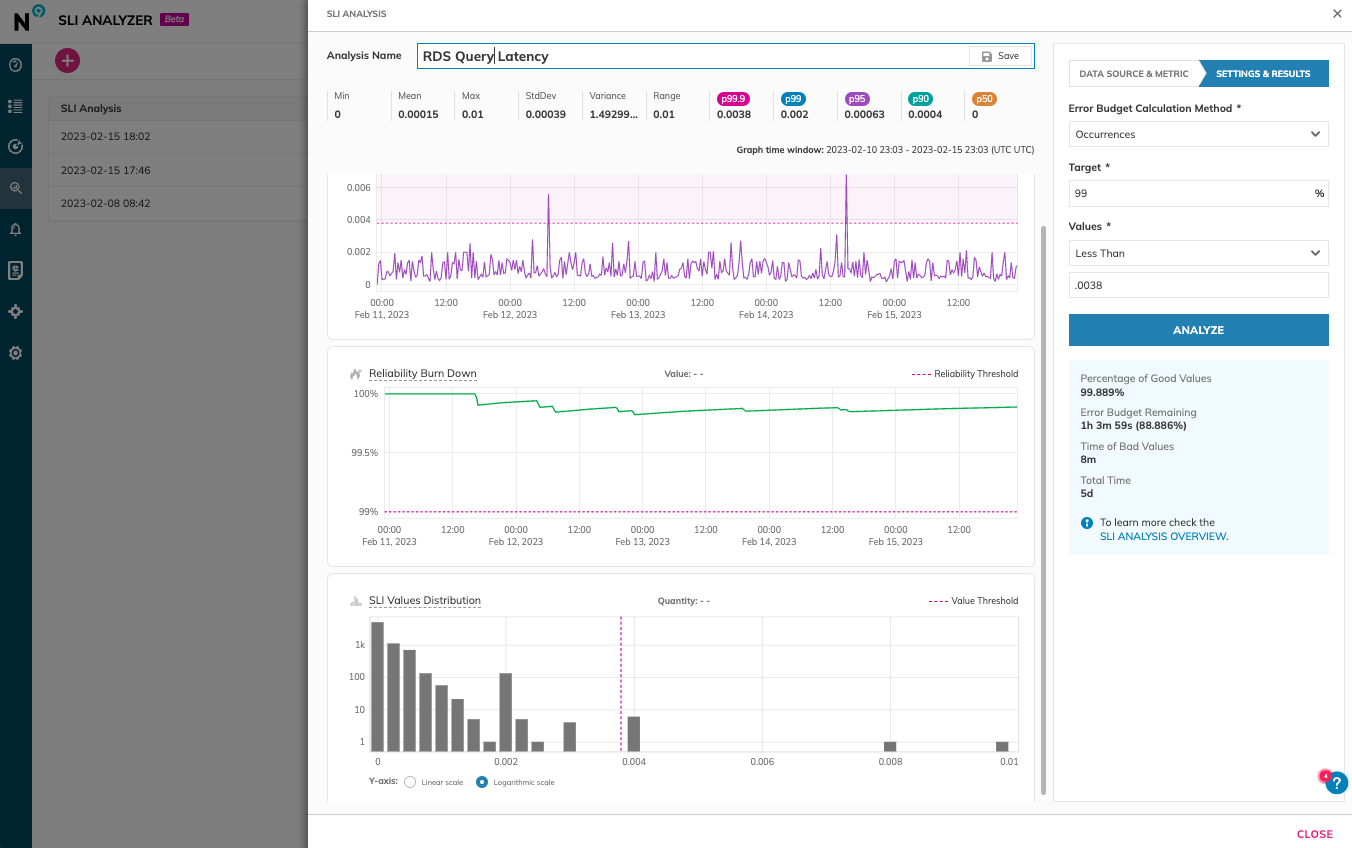
    Nobl9 today added a free tool for analyzing service level objectives (SLOs) to its platform to enable DevOps team to more accurately set reliability goals.

    Brian Singer, chief product officer for Nobl9, said Service Level Analyzer collects metrics and observability data from more than 24 DevOps tools and platforms that can then be used to create an SLO via a single click.

    Included as part of the free tier of the Nobl9 service, Service Level Analyzer also enables DevOps teams to more easily update SLOs as error budgets and error budget burn rates change over time based on actual incidents that have occurred, added Singer.

    DevOps teams can also perform “what-if” analysis to test out the impact of different targets and thresholds on error budgets, he added. That capability ultimately reduces costs because DevOps teams become less likely to overprovision resources to ensure application performance and resiliency, noted Singer. In effect, Service Level Analyzer is providing DevOps teams with an observability tool that spans the entire software development life cycle, said Singer.

    Nobl9 is trying to spur greater adoption of SLOs by making available an open source SLO specification that defines a common interface for constructing SLOs across a DevOps workflow. SLOs, of course, are not a new idea. They have been employed as a metric to track the performance of IT services for decades. However, as more microservices-based applications are built and deployed, it’s becoming more challenging to maintain SLOs across applications because they have many more dependencies than legacy monolithic applications.

    Ultimately, each DevOps team needs to provide some sort of objective benchmark that assesses their overall effectiveness at delivering application services. SLO-as-code is intended to make it simpler to gather the metrics that confirm whether service levels are being achieved. As organizations become more dependent on software to drive digital processes, those SLOs are then tracked across everything from financial services to supply chains.

    In general, DevOps teams are more comfortable with the SLO concept, said Singer. The biggest challenge is making them simpler to implement, he added. The Service Level Analyzer lowers the bar for implementing an SLO by making historical data stored in DevOps tools and platforms more accessible, noted Singer. Rather than having to manually collect that data and then normalize it in an external repository, Nobl9’s Service Level Analyzer automates that process on behalf of a DevOps team using actual data versus relying on less precise statistical analysis, said Singer.

    As IT environments become more distributed, the number of dependencies that exist across application environments only continues to expand. IT teams can spend weeks trying to discover the root cause of issues that are negatively impacting application performance, only to discover that, for example, calls to an application performance interface (API) are being rerouted in a way that significantly increases latency. Tools that enable DevOps teams to more easily understand the relationships between all the services that make up an application environment are more crucial than ever.

  • Tricentis Extends Mobile Testing Reach

    Tricentis Extends Mobile Testing Reach

    Tricentis has added the ability to test native iOS and Android applications to its Testim software-as-a-service (SaaS) platform.

    Previously, the Testim platform was designed to test web applications, but is now being extended as organizations build and deploy more native mobile applications. Capabilities of the Testim Mobile platform include codeless authoring of mobile tests to eliminate the need to write and maintain Appium, Espresso or XCUITest scripts and the ability to set up, configure and manage mobile devices in minutes using the Tricentis Mobile Agent.

    Additionally, applications can be uploaded to the cloud to enable collaboration across testing teams as they opt to run tests on real or virtual devices. DevOps team can also customize tests with JavaScript, branch tests, and run tests from a scheduler or continuous integration (CI) build.

    Tricentis CTO Mav Turner said Tricentis is moving to implement a consistent set of mobile testing services across its entire portfolio of testing platforms now that mobile applications are equal, first-class citizens alongside web applications. The primary driver of that shift has been the COVID-19 pandemic, which saw more organizations relying on external-facing mobile applications to engage customers, partners and employees working remotely, he added.

    Testing those applications is more critical than ever because the cost of failure—in terms of impact to the business—is now much higher as more organizations depend on software to drive business processes, noted Turner.

    The goal is to make it simpler to test these applications as they are being developed to ensure quality, he added. The challenge is that many developers don’t have a software engineering mindset. Hence, they need to rely more on testing platforms infused with artificial intelligence to discover issues relating to, for example, scalability and security, said Turner.

    Most organizations are trying to shift more responsibility for testing toward developers as part of an effort to remediate issues earlier in the software development life cycle. It’s more challenging for developers to remediate issues after an application has been developed simply because they have lost context. Testing platforms infused with AI capabilities make it easier for developers to identify issues at the time they are writing code. In the future, Tricentis expects to take advantage of generative AI platforms to make it easier to author tests using a set of best practices that can be easily reused, noted Turner.

    That approach doesn’t necessarily eliminate the need for a dedicated quality assessment review, but it does allow testing teams to focus more of their time and effort on testing the application experience versus identifying lower-level errors that many developers routinely make.

    Over time, the quality of applications should steadily improve as many of the low-level mistakes that developers make are eliminated. That should improve everything from application security to the user experience as applications are continuously updated. In the meantime, organizations that embed testing within DevOps workflows are steadily reducing the number of issues that need to be addressed just before applications are supposed to be deployed.

  • How Will Low-Code and AI Coexist?

    How Will Low-Code and AI Coexist?

    Over the last few years, low-code solutions have become important to help organizations widen programming accessibility to a broader base of users and help fill development gaps. And these technologies are still gathering steam—Gartner estimated the market for low-code development technologies would grow to a total of $26.9 billion in 2023 and that 65% of applications would be developed using low-code by 2024.

    However, AI-based code generation is set to further level the playing field with advanced auto-completion and AI coding assistants. Take GitHub’s Copilot, a helpful AI pair programmer, or OpenAI’s ChatGPT, which can generate complex functions given natural language prompts. Other AI tools trained on UIs, like Galileo, can derive frontends for any project in a matter of seconds. So, are low-code development platforms still relevant in this new paradigm of AI-driven software development? If so, how will low-code solutions and AI coexist?

    Well, generic algorithms can only go so far in creating truly unique and innovative experiences that solve real-world business cases. And since most programmers don’t have the skills to train machine learning or deep learning models from their own datasets, this is one area where low-code solutions could lower the barrier, enabling users to tag unstructured data, generate models, run simulations and share reusable AI across departments.

    I recently chatted with Johanna Pingel, MathWorks AI product marketing manager, to discuss the role of AI in low-code programming. According to Pingel, low-code solutions can lower the barrier to AI functionality, both in quickly integrating AI-driven functionality into applications and seamlessly generating new AI algorithms based on unique datasets. Below, we’ll consider some additional use cases for AI and how low-code platforms may work alongside it.

    Use Cases For AI

    First off, what are application developers using AI for these days? Well, AI has an increasingly wide range of uses. It began with computer image and processing, such as identifying cats and dogs or postal codes. Now, voice recognition, voice-to-text and text-to-voice are commonplace, and AI is being used to create ever more sophisticated applications. One area that Pingel is excited about is applying AI to help with battery life management, predicting the lifespan of batteries for electric vehicles and consumer electronics.

    “Anywhere there’s data, there’s an opportunity to create models and make predictions based on that data,” said Pingel. This especially rings true for scenarios involving data and visualization. For example, consider visual inspection in a pharmaceutical production line to ensure there are no defects with any pills. Another use case is visual inspections of parts in automotive assembly lines. Applied to these scenarios, AI can remove grunt work and make production safer and more efficient.

    ChatGPT is another example of an AI application quickly becoming mainstream, not only for content creators but for scientific research. For example, ChatGPT can spin up MATLAB code and create functions and unit tests, which can be copied and pasted into IDEs. However, code written by ChatGPT should still be checked and verified by engineers and scientists to ensure its accuracy, said Pingel.

    How Low-Code Lowers the Barrier to Bespoke AI

    Low-code solutions can bring many benefits—these platforms help to speed up tedious tasks and level the playing field for those with different coding abilities and desires, said Pingel. Low-code platforms can also be a great tool for engineers looking to incorporate AI into their business systems. For example, having a low-code method could be helpful in generating code for machine learning algorithms and new models, which can help companies create their own algorithms and incorporate them into their own platforms.

    More people are interested in incorporating AI into their applications, but the use cases are growing increasingly more sophisticated. Businesses may start with simple needs, such as identifying faces or identifying text from handwritten letters. These rely on simple datasets, and algorithms already exist to accomplish most of these tasks. Off-the-shelf AI is helpful at the start, but eventually, companies tend to want to use their own data and settings far more specific to their applications, said Pingel.

    For example, a more niche case could be as specific as identifying cracks in a windshield. Or, in a financial industry, it might be analyzing mass amounts of loan applications to determine approval rates. In these situations, using your own internal data becomes necessary to create AI that understands the situation at hand. Yet, the hard part is assembling this data in a way that is accessible for a model to comprehend. Analysts estimate that upwards of 90% of data held within enterprises is unstructured, meaning it requires a heavy amount of tagging to become usable for AI/ML.

    Low-code is a perfect solution to avoid the point-and-click aspects of cleaning, cropping and structuring this data, said Pingel. This can introduce automation into the process of labeling data while still involving some human intervention to fix mistakes. Machine learning models can take a while to train and simulate, underlining the need for a fast way of iterating on models. A common platform could help companies develop custom machine learning algorithms and models and keep track of experiments. This helps to ensure that the most effective model is used for the final application.

    End Benefits of Democratized AI With Low-Code

    Overall, low-code platforms can provide a number of benefits that lower the barrier to unique AI creations. Low-code platforms like MATLAB and Simulink are useful for structuring and labeling data and quickly generating ML models. Low-code also makes it easier to bridge different programming languages and quickly generate code for a variety of different languages, such as C, C++ and Java.

    Additionally, low-code platforms enable users to collaborate easily with other users. But low-code doesn’t mean no-code, Pingel explained. In fact, “you can learn to be a better programming through low-code tools, too,” she said. For example, it could enhance understanding of the structure and syntax of code.

    In general, democratized AI is an important capability for businesses to take advantage of. Although AI-based solutions are coming to market to displace old tools and processes, there is still an argument to be made for low-code—namely in empowering non-technical users and lowering the barrier to creating custom AI-driven functionality.

  • Logz.io Integrates ChatGPT With Observability Platform

    Logz.io Integrates ChatGPT With Observability Platform

    Logz.io has integrated the ChatGPT generative artificial intelligence (AI) platform with its Open 360 observability platform to extend its automated recommendation capabilities to reduce mean-time-to-remediation.

    ChatGPT, developed by OpenAI, is based on a large language model that Logz.io uses to enrich crowdsourced data. That approach enables ChatGPT to surface links to related information and best practices for resolving IT issues.

    Logz.io CTO Asaf Yigal said the company has integrated ChatGPT with its existing AI engine, dubbed Cognitive Insights, that applies machine learning algorithms to identify anomalies indicative of potentially critical IT issues. The company expects to be able to add other generative AI capabilities as additional advances are made, he added.

    The Logz.io Open 360 platform is based on open source OpenSearch, Prometheus and Jaeger software that the company has infused with machine learning algorithms. The integration with ChatGPT is enabled via an application programming interface (API) that OpenAI has provided.

    The overall goal is to employ AI to surface the most relevant issues a DevOps team needs to focus on without having to search huge volume of logs, tracing and metrics data, said Yigal. Generative AI platforms solve a fundamental cognitive load problem created today as DevOps teams collect more data, noted Yial. The more data a DevOps team collects, the harder it becomes to determine what’s going on in an IT environment, said Yigal. He added that generative AI platforms make it possible to analyze massive amounts of data at a scale that isn’t otherwise achievable.

    AI tools should make it possible to manage IT at a level of scale that eliminates many of the low-level data engineering and analytics tasks that previously required manual effort from a DevOps engineering team. It’s not clear how many other DevOps tools and platforms will be invoking generative AI capabilities in the months ahead, but DevOps teams should assume that large language models will soon be augmenting DevOps teams in ways that previously would have been thought unlikely.

    For example, discovering vulnerabilities in software running in production environments is about to become trivial as artificial intelligence (AI) platforms such as ChatGPT evolve. A generative AI platform can identify code vulnerabilities in much the same way as a traditional scanning tool. An AI platform, however, could theoretically monitor code repositories and scan them for vulnerabilities as updates and commits are being made in real-time. DevOps teams should be able to use generative AI platforms to discover and remediate these issues before code is deployed in a production environment.

    It’s just as probable bad actors will use the same platform to achieve the same goal, so from that perspective, many DevOps teams will now find themselves in an AI arms race to improve DevSecOps workflows.

    There are still lots of issues to be worked out in terms of the overall accuracy of generative AI platforms, but they will only become more intelligent as processors continue to advance. The issue now will be determining precisely where the man-machine interface for DevOps teams is today and in the future.

  • Five Great DevOps Job Opportunities

    Five Great DevOps Job Opportunities

    DevOps.com is now providing a weekly DevOps jobs report through which opportunities for DevOps professionals will be highlighted as part of an effort to better serve our audience.

    Our goal in these challenging economic times is to make it easier for DevOps professionals to advance their careers. Of course, the pool of available DevOps talent is still relatively constrained, so when one DevOps professional takes on a new role, it creates an opportunity for others.

    The five job postings shared this week are selected based on the company looking to hire, the vertical industry segment and, naturally, the pay scale offered.

    We’re also committed to providing additional insights into the state of the DevOps job market. In the meantime, for your consideration:

    Dice.com

    Pyramid Systems
    Remote
    AWS Cloud DevOps Platform Engineer
    $160,000 to $200,000

    Monster.com

    Apidel Technologies
    Los Angeles, California
    Software engineer
    $140,000 to $160,000

    SimplyHired

    Cox Communications
    Atlanta, Georgia
    Senior DevSecOps Cybersecurity Architect
    $120,000 to $150,000

    LinkedIn

    EdgeLink
    Beaverton, Oregon
    DevOps Engineer
    $110,000 to $120,000

    Indeed.com

    CrowdStrike
    Remote
    DevOps engineer
    $105,000 to $195,000