Category: Enterprise DevOps

  • Turbocharge Enterprise Apps With Contextual Analytics

    Turbocharge Enterprise Apps With Contextual Analytics

    Software product managers and developers typically treat analytics as a standalone capability—something to be integrated into their application’s dashboard or reporting module. As a product feature, analytics is undoubtedly a valuable tool. But offering it merely as a tacked-on function is an approach that lags behind where your users are today.

    When data analytics is limited to dashboards, users must switch away from their transactional environment whenever they need to interrogate data or derive insight. This disrupts workflows and interrupts trains of thought, creating friction for the user. Moreover, a standalone analytics capability doesn’t provide context or guided analysis. Users must look for anomalies or trends manually. As a result they’re less likely to dive into analytics to support good business decision making.

    Contextual analytics, on the other hand, gives users a powerful tool right at the point of their daily work. Contextual analytics is defined as any analytics solution that is integrated directly into an application’s core workflows. This approach delivers the benefits of analytics in the situational framework where decisions must be made.

    Embedding analytics in this fashion creates significant value for the user. Charts, tables and metrics sit side-by-side on the screen, alongside the application’s central functions. With one click, the user gains instant, guided and dynamic insight.

    Such an improvement is helpful for all kinds of business activity. Retail store managers can instantly access demand forecasts while creating weekly work schedules. Inventory managers can view trends and analyze stock without leaving their ordering screen. Supply chain, finance, logistics, sales and marketing, manufacturing—any process involving routine data processing can profit from contextual analytics.

    A Rich Workflow Asset

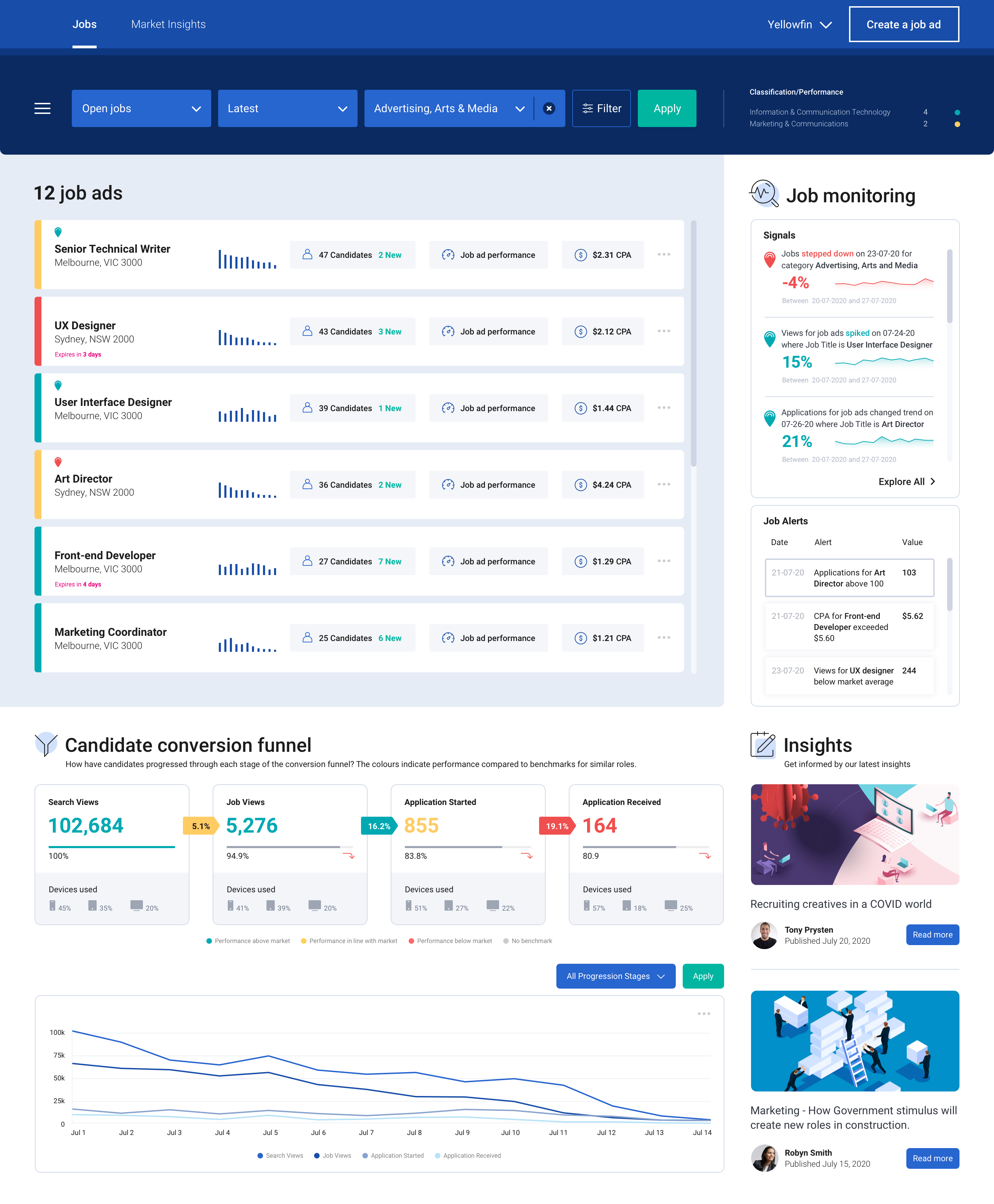
    When embedded into transactional workflows, contextual analytics can deliver two forms of understanding. The first comes from predefined visualizations, ranging from simple KPI numbers to line and bar charts and even contextual dashboards. These visualizations are presented based on user action; a customer’s purchase history, for example, can pop up in chart format while viewing the account record, enabling the user to make decisions about sales incentives or priorities for service.

    Second are dynamic analyses and alerts. These indicate that either thresholds have been crossed or anomalies in a record have been discovered, prompting the user to explore and take further action. Pop-up alerts can be invaluable in sales, production, finance or many other disciplines.

    For both predefined and dynamic contextual analytics, outcomes can be based on simple aggregations of transactional data or as the result of sophisticated data science modeling (e.g., propensity to purchase). Specific outcomes can be set by either the product manager or the user to maximize utility.

    Contextual analysis is ideal for supporting or triggering actions according to any business need. The capability enhances transactional workflows by providing metrics pertaining to a particular transaction; it will also trigger a new workflow via an alert or suggestion for action, based on the output of a data science model.
    contextual analytics

    Of course, none of this means that dashboard-based analytics aren’t still important. Users will always need to conduct broad data analysis. Dashboards and/or report analytics allow users to monitor overall business performance, drilling down when necessary into the details behind the numbers.

    With the secondary addition of contextual analytics, however, users can be continually guided in their decision making as they work. They receive a constant flow of deeper insight, supporting management tasks intuitively at a granular level.

    Deployment Framework for Developers

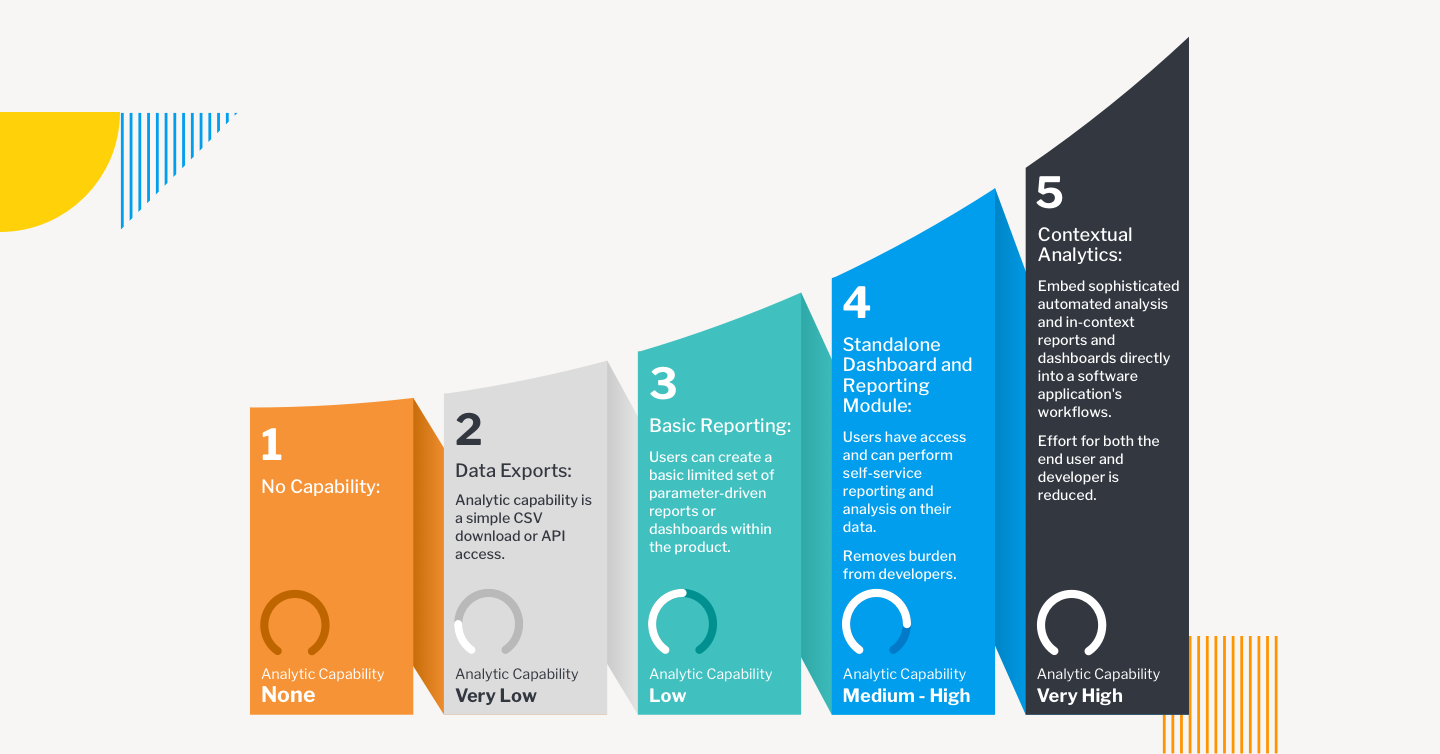
    Embedding transactional analytics into enterprise applications can be directed according to a maturity model. There are five possible stages of product development:

    • Stage One: No Capability. The main engineering focus is on bringing a new application to market. Minimal Viable Product (MVP) attributes lead development, and reporting capabilities are rarely included.
    • Stage Two: Data Exports. Analytics are provided based on customer feedback, but only through a CSV download or API access that allows the end user to analyze data in their preferred tool. The burden of building analyses rests with the customer.
    • Stage Three: Basic Reporting. A limited set of reports are supported by analytics, and in-house developers are tasked with creating the capability, often to the detriment of new features for the core product.
    • Stage Four: Standalone Dashboard and Reporting Module. This is often the end journey for most enterprise applications. Self-service reporting and analysis are available via out-of-the-box dashboards and reports.
    • Stage Five: Contextual Analytics. Sophisticated, automated analysis is available as part of the application’s core workflows, as well as at the dashboard. Users are guided to optimal decision-making at both the transactional and reporting level.

    These stages are not mutually exclusive. Especially for stages four and five they can be additive, so that end users will have a variety of mechanisms to access the data they need, at the time they need it.
    contextual analytics

    Accelerating Implementation

    Elevating the end user analytics experience is easier to achieve than it once was, thanks to BI vendors that specialize in embedded and contextual analytics built on an open platform. The best vendors are able to adapt quickly and easily to product development roadmaps, aligning features to meet specific needs and following up with administrative tools and automation processed to support the lowest possible cost of ownership.

    Working with an analytics vendor means development teams will have maximum support from prototype and design to integration, deployment and subsequent iteration. Options for Windows and Linux, on-premises or cloud will ensure the versatility, security and scalability required for highly marketable offerings.

    How Customers View Analytics

    As a product feature, analytics can often be dismissed as an afterthought—but your users don’t see it that way. BI analytics is increasingly seen as critical to business governance. Users want to glean as much insight as possible from the data they’re collecting—and on multiple levels. This means your users want to get more from your product, even in ways they haven’t yet imagined. Contextual analytics can provide that enhanced appeal for your application, putting your product out in front at a time when enterprise applications are more essential—and more competitive—than ever before.

  • 7 Step Transformation Blueprint for SecDevOps

    7 Step Transformation Blueprint for SecDevOps

    The struggle for continuous software security is obvious, but the solutions are not.

    As I indicated in my prior blog, SecDevOps is the Solution to Cybersecurity, a security-first mindset, coupled with SecDevOps-specific practices, provides an opportunity to achieve true continuous security. But, in reality, how can an organization accomplish SecDevOps?

    This blog explains how to apply my 7 Step Transformation Blueprint to SecDevOps.

    Leadership and engineering solutions require the persistent, methodical application of skills and practices toward leading and designing solutions that achieve business and team goals, including continuous security. While driven by visionary ideals, engineering requires practical, disciplined, progressively refined implementations using carefully chosen dimensions of people, process and technology solutions. At any point in the engineering life cycle, the goal is to achieve a balanced solution while evolving practices towards maturity.

    The seven step transformation engineering blueprint prescribes seven steps for achieving and continuously refining digital transformation methodically, no matter what the goals or current level of maturity are. The seven steps are visioning, alignment, assessment, solution, realize, operationalize and expansion. Each step considers the people, process and technology aspects of the transformation.

    Step One – Visioning

    Top leaders define a strategic vision for the digital transformation for the organization including a motivating vision statement, measurable goals, team values, and major implementation tactics. Identify senior sponsors that will own the transformation at the strategic level. Include key partner organizations that need to be strategically aligned to the transformation. In a SecDevOps transformation, a vision for a security-first mindset and associated SecDevOps practices are called out as the highest priority for implementation tactics supporting the vision.

    Step Two – Alignment

    Leaders and key team members who are most important to the implementation of the transformation align specific measurable goals and tactics for selected “model” applications. Specific measurable goals around continuous security are set in this step.

    Step Three – Assessment

    For the current state of selected applications, capabilities are discovered and assessed, deep-dive assessments are conducted for specific topics, and a current state value stream map is created relative to the organization’s goals. My earlier blog, DevSecOps Practices Gap Assessment, explains my recommended approach for conducting an assessment for security.

    Step Four – Solution

    An expert team performs analysis of assessment data and formulates a future state value stream roadmap including themes, epics and user stories and obtains alignment with key stakeholders. My earlier blog, 9 Pillars of Continuous Security Best Practices, outlines a comprehensive set of practices to consider when building a roadmap for any continuous security solution.

    Step Five – Realize

    Proof of concept (POC) trials are conducted to validate solution choices. Trials of security tools and integrations of those tools into the SecDevOps platforms also would be conducted during this step. The solution is validated with selected applications and use cases. Training is conducted as the solution is deployed to production. Governance practices for the new solution are activated.

    Step Six – Operationalize

    Deployed improvements are monitored and controlled with metrics. Retrospectives are conducted to create actionable prioritized lessons learned for continuous improvement. Chris Tozzi’s article 6 DevSecOps Metrics for DevOps and Security Teams to Share suggested metrics that can be developed and leveraged, both for this step and to drive ongoing improvements as the use of SecDevOps practices expand.

    Step Seven – Expansion

    Once continuous flow (the first way of DevOps) is realized for a select set of applications, the organization can safely expand the solution(s) to other applications across the organization. Further transformation cycles will lead to realization of continuous feedback (the second way of DevOps) and continuous improvement (the third way of DevOps) and apply it to SecDevOps.

    What This Means

    SecDevOps strategies and solutions are complex. The seven step transformation blueprint described in this blog can help organizations build a strategy and implement SecDevOps as an important part of their digital transformation. To learn more about how to apply the blueprint to continuous security (and other key elements of digital transformation) refer to my book Engineering DevOps.

  • Serverless Computing Brings New Security Risks

    Serverless Computing Brings New Security Risks

    Attracted by lower costs and less operational overhead, serverless computing is an unmistakable undercurrent in the world of DevOps. Developers are drawn to the innovation because it requires no architecture to manage while offering continuous scaling for anything from a few requests per day to hundreds of thousands of requests per second.

    More than 50% of the developers using serverless functions today started using the computing model in the last three years. By some estimates, serverless computing is the fastest-growing segment in the cloud services market.

    While businesses are drawn by the opportunity to extend and integrate cloud applications at greater scale, there’s a dark underbelly to this DevOps phenomenon: security. In fact, organizations cite security concerns as the leading reason why they haven’t yet adopted serverless computing. For good reason!

    Serverless functions are introducing a new breed of threats – misconfigurations, code-level risks, injections and weaknesses – many of which are the underlying risk factors for a software supply chain attack. With adoption of this technology accelerating, organizations need security that delivers more than just visibility into these dynamic environments. They also need the ability to detect and block code-level vulnerabilities and misconfigurations that occur during development and through to production. Most importantly, this needs to happen seamlessly and with little to no impact on DevOps.

    Dynamic Environments Create Complex Security Risks

    The nature of applications has evolved, creating a new paradigm of security risk. In serverless environments, code sprawl makes it harder to identify vulnerabilities and patch them before they become business-level risks.

    In a monolithic application environment, an identified vulnerability could be efficiently patched by the developer through upgrading a single package, pushing a deployment and then testing and deploying the app.

    In a serverless computing model, patching and resolving vulnerabilities becomes a lot more complicated, given that there may be several hundred (or more) environments across different providers and regions. So, instead of having to patch a single application, developers will need to patch, deploy and test hundreds of individual functions that rely on that library.

    With 39% of developers saying they’re now fully responsible for security, it means they’ll carry the burden of having to patch an identified vulnerability – often taking them away from development work.

    With Serverless, You Need to Rethink Your Approach to Security

    Given the distributed nature of serverless functions – essentially, the reason for its flexibility and scalability – many existing security tools will provide little to no visibility, nor the control capabilities, for these computing environments. Many of the security attacks that will occur in serverless functions will be a result of misconfigurations and mistakes that happen outside the purview of the security team and due to legacy solutions which don’t translate to serverless architectures. Further, because abstracted workloads create blind spots, attackers will have more room to maneuver undetected.

    Serverless functions will even render some traditional DevSecOps tools less useful. Scanning tools must monitor hundreds of individual repositories instead of a single monolithic repository, while application performance monitoring (APM) tools lack security proficiency and cannot protect from the OWASP Serverless Top 10 risks.

    The challenge for security teams will be implementing solutions in a way that does not modify workloads or require changing business logic — both of which slow development. When applying security to serverless functions, it’ll be critical that the solution can do the following:

    • Go beyond monitoring and actually detect and block vulnerabilities without elaborate or manual steps involved. The scale of serverless functions will make it nearly impossible for security analysts to manage and keep up with every alert they receive. Instead, they need a tool that delivers actual security and can help them block malicious activity without stopping development altogether.
    • Enable a positive security model that provides protection against malicious changes, like zero-day exploits, within the function. This approach gives security teams more control by automatically detecting and blocking anything that isn’t explicitly allowed in a given function.
    • Provide forensic detail from log-level information so security analysts can fully understand the context of every attack with virtually no impact on latency. Further, with the risk of supply chain attacks soaring, security teams need the ability to identify and map third-party dependencies used during runtime.

    For many organizations, serverless architecture is a very different and unique computing environment – unlike anything they’ve experienced or had to protect before now. That reality means that organizations need a fresh approach to securing these environments and will need to look beyond the traditional tools they have in their tech stack today.

    Above all, developers and security teams will need to work together to ensure security is built-in from the start. Otherwise, serverless functions will quickly become a playground for cybercriminals.

  • Cattle, Not Kittens – Revisited

    Cattle, Not Kittens – Revisited

    The early days of DevOps were filled with pronouncements that we needed to treat our servers as cattle, not pets (kittens). For a year or so, the refrain was everywhere. And we did. We detached servers from dedicated hardware, we made spin up and spin down so easy that we just replaced malfunctioning servers (which has caused its own problems), we have even made servers designed to spin up, do one thing well, then spin back down until needed again – something unthinkable even a decade ago.

    And we’ve reaped benefits. Servers suck up less attention from the DevOPS side, and standardization has made it easier to code for them, moving things along and allowing members of another team to pitch in when there is a crunch because of familiarity.

    But IT is filled with people, and something happened in the transition. In hindsight, we should have seen it as a possibility, but things changed so much, so fast that I don’t think anyone was considering this possibility.

    Our DevOps tools/toolchains/processes became our pets (kittens).

    Now the special snowflake that requires specific knowledge and has to be treated with kid gloves is the DevOps step, not the servers it uses. Like pet servers, a fragile step that is working is avoided like the plague, when it should be shored up. Like pet servers, a process that is locked into a specific tool, OS, or platform is left that way, even when other options are a better solution. Like pet servers, the person who “knows all about” that is left to manage the step that should, by all rights, be easily understandable by anyone on the DevOps team.

    It’s time to start treating DevOps like cattle, not kittens. Some steps (like some servers) will be more difficult to make less pet-like and more cattle-like, but if history is any gauge, the payoff is worth the investment.

    We don’t have a cross-toolset language, other than doing things in the various shells and calling the shell scripts from a given toolset (not the best solution, just an example of where we’re at), but that shouldn’t stop us from standardizing and genericizing as much as possible. Less fragility, more reusability and a broader support team is good for everyone.

    You all are knocking it out of the park. We – all of us – are spending more time at work and at home in the digital space than ever before, and, generally speaking, the tools “just work.” That’s all on you. Keep kicking it. But standardizing to keep things running smoothly just makes sense. You know your org; it is possible that the easiest route to cattle is to standardize on a single toolchain (perhaps one or two toolchains with reusability documented) possibly to shove a bunch of steps into scripts and share amongst whatever tools each team chooses (I, and history, strongly discourage this approach, but neither I, nor history, has to live in your environment. There might be a good reason for this, so I include it here).

    All I’m saying is, don’t re-implement every step over and over if you can avoid it, and don’t make steps so arcane that you need a specialist (not internal, and definitely not external). Keep rocking it, and get those cattle moving!

  • Oracle and Allies Launch ARM-Based Cloud Service

    Oracle and Allies Launch ARM-Based Cloud Service

    Oracle announced today it will make available for the first time ARM-based processors on the Oracle Cloud Infrastructure (OCI) that will also be supported as targets for deploying applications using GitHub, GitLab or Jenkins platforms. The latest Oracle service is based on processors from Ampere Computing.

    The company also revealed today it has joined the Continuous Delivery Foundation (CDF), an arm of the Linux Foundation that oversees the development of open source DevOps platforms and tools such as Jenkins and Spinnaker.

    Matt Leonard, vice president of compute for OCI, said the OCI Ampere A1 Compute provides an alternative to existing support for the x86-based processors that Oracle provides. That service will be offered at a cost of one cent per core hour with virtual machine sizes ranging from one to 80 OCPUs configured with one to 64 GB of memory per core or as a bare-metal service with 160 core and 1 TB of memory. Pricing per GB of RAM per hour is $0.0015. At that price point, Leonard said Oracle is now offering the lowest price per core of any cloud service provider.

    The growing availability of ARM-based processors is starting to have an impact on cloud economics at a time when organizations are significantly increasing the number of applications being built and deployed on public clouds. Many of those organizations, to reduce overall costs, are now actively evaluating ARM-based services, noted Leonard.

    To help jumpstart application development on the platform, Oracle is providing organizations with three classes of OCI Ampere A1 Compute services. An Oracle Cloud Free Tier gives developers $300 in free credits for 30 days. The Always Free ARM option gives developers four A1 cores and 24 GB memory, while an ARM Accelerator option provides open source developers, independent software vendors (ISV) partners, customers and universities with ARM-based development projects that need additional resources beyond what the Oracle Cloud Free Tier provides with credits for a 12-month period.

    Oracle Linux, Java, MySQL, GraalVM and the Oracle Container Engine for Kubernetes (OKE) service are also all available on the OCI Ampere A1 Compute along with integrations with DevOps platforms from GitHub, GitLab and/or Jenkins. Other vendors providing support for OCI Ampere A1 Compute include SUSE, Datadog, OnSpecta, NGINX and Genymobile.

    Oracle has also made available an Oracle Linux Cloud Developer image that enables DevOps teams to install, configure and launch a development environment via an OCI console that includes OCI client tools, utilities and common programming languages such as Java, GraalVM, Python, PHP, Node.js, Go and C/C++.

    Finally, each Ampere core is single threaded by design with its own 64 KB L1 I-cache, 64 KB L1 D-cache and a huge one MB L2 D-cache to eliminate any ‘noisy neighbor’ issues that IT organizations might otherwise encounter.

    Oracle is clearly betting that ARM-based processors will present the company with an opportunity to gain share at the expense of larger infrastructure-as-a-service (IaaS) rivals such as Amazon Web Services (AWS) and Microsoft Azure. It’s not clear to what degree IT teams might employ a different cloud service just to access ARM-based processors. However, in a world where IT teams now routinely employ multiple clouds, as far as Oracle is concerned, the playing field has never been more level.

  • Le Morte d’Arthur— A DevOps Engineering Journey

    Le Morte d’Arthur— A DevOps Engineering Journey

    The stories of King Arthur have fascinated me from the time I was young. Now that I am old DevOps_the_Gray, I enjoy relating the story of King Arthur to my experiences with DevOps. I hope you find this blog interesting and relevant too.

    Imagine a boy raised in Britain by the wizard Merlin who becomes king because he can pull the magic sword Excalibur from a stone. Once king, he unites warring tribes, forms a brotherhood of knights and creates a round table to be sure everyone who sits around it has equal status as they pursue the quest for the Grail.

    DevOps as the Grail of Software Creation and Delivery

    To engineer DevOps, even the first way of DevOps—continuous flow (harmony)—requires faithful employment of leadership (King Arthur), collaborative team culture (the Knights of the Round Table), disciplined engineering processes (laws of Camelot), technology (Excalibur) and automation (the magic of Merlin, Archimedes and Nimue). The ultimate pursuit of the third way of DevOps—continuous improvement (quest for the lost Grail)—requires persistent commitment to engineering discipline and noble practices.

    DevOps also requires a persistent evangelist (Nimue, the Lady of Avalon) and leadership (Morte d’Arthur) to be forever vigilant and ready to lead DevOps’ evolution into the future (King Arthur is forever ready to rise again with Excalibur).

    Both King Arthur and DevOps depend on the virtuous tenets of chivalry/culture, laws/ processes and use of Excalibur/technology.

    Arthurian tales represent a masterful integration of historical events with misty, imagined magical episodes and, like DevOps, embody tenets of chivalry and respectful moral leadership. While the means can be elusive, the results can be magical. The sword Excalibur and the search for the Grail are powerful symbols that remind me to always try to engineer technology for good and noble purposes.

    The Arthurian Analogy Expresses the Importance of DevOps

    “Then there entered into the hall the Holy Grail covered with white samite, but there was none might see it, nor who bare it.” —Le Morte d’Arthur, BOOK XIII CHAPTER VII

    “…said Sir Gawaine, we have been served this day of what meats and drinks we thought on; but one thing beguiled us, we might not see the Holy Grail, it was so preciously covered. Wherefore I will make here avow, that to-morn, without longer abiding, I shall labour in the quest of the Sangreal.” —Le Morte d’Arthur, BOOK XIII CHAPTER VII

    Like the Grail, DevOps is too often regarded as an ethereal thing, earnestly sought after and pursued. To do DevOps well means treasures and miraculous benefits; satisfying, harmonious production; and competitive advantages in abundance.

    Like Arthur’s battles, hard work and skills are required for success with DevOps.

    “King Arthur rode in the battle exhorting his knights to do well, and himself did as nobly with his hands as was possible a man to do; he drew out Excalibur his sword, and awaited ever whereas the Romans were thickest and most grieved his people, and anon he addressed him on that part, and hew and slew down right, and rescued his people; and he slew a great giant named Galapas, which was a man of an huge quantity and height, he shorted him and smote off both his legs by the knees, saying, Now art thou better of a size to deal with than thou were, and after smote off his head. There Sir Gawaine fought nobly and slew three admirals in that battle. And so did all the knights of the Round Table.” —Le Morte d’Arthur, BOOK V CHAPTER XII

    DevOps, At its Best, is Engineering Greatness

    In my experience, well-engineered DevOps always starts by defining a great goal. Greatness is won by careful, inspirational leadership, measured tactics, superior technology, a culture of collaboration, courage and unwavering persistence in applying skills to the task until the goal is attained. To engineer is to do the noble work of engineering. DevOps engineering requires the skills of elite leaders and engineers that have a profound understanding of DevOps practices.

    DevOps’ Enduring Legacy and Future

    “Yet some men say in many parts of England that King Arthur is not dead, but had by the will of our Lord Jesu into another place; and men say that he shall come again, and he shall win the holy cross.” —Le Morte d’Arthur, BOOK XXI CHAPTER V-VII

    DevOps implementations – and DevOps itself – are not immortal.

    As DevOps leaders, experts, and evangelists come and go, the perceived value of DevOps may wax and wane. The fame of innovative new technologies expires ever more quickly with the acceleration of technological systems facilitated by stacking technologies higher and higher.

    Epilogue

    The stories of King Arthur teach us to lead passionately when needed to triumph against DevOps challenges and to continue the pursuit of perfection. I hope you find this Arthurian DevOps analogy as relevant and interesting as I do, and I hope that it adds a little uniqueness and fun to your DevOps understanding. If you would like to see more on this analogy, I refer you to the only DevOps book with the sword Excalibur on the cover. Now, on with the quest of engineering DevOps!

    Marc Hornbeek – DevOps_the_Gray, esq.

  • Our API Mess is Coming

    Our API Mess is Coming

    APIs are the satisfaction of a long and deep need to be able to create consistent and reliable integrations between disparate systems, operating systems and datasets. As we started to use REST-based APIs, we also realized they fulfilled a previously little-addressed gap in automation. Frankly, they are a force multiplier in DevOps delivery.

    Early efforts at system-independent APIs were not great, but we learned lessons and are steadily getting better. While REST is the default solution for APIs, it probably isn’t the end of the road, as we continue to learn and improve. That’s what we in tech do – get excited about an idea, drive it to broad use and then iteratively improve it.

    And that’s the root of the problem. We have been, and are, saturating our applications with APIs. Internal, external, external-that-rely-on-another-external. The thing that comes to mind every single time I look at an API dependency map for even a medium-sized application is “spaghetti code.” Those lines are going all over, quite frequently returning to themselves.

    And we’re going to have to maintain this creation. Maybe not us, individually, but us as in IT and DevOps teams. The only constant is change, and far too many of us are not only failing to plan for API changes, but failing to even think about them. Because things are generally going swimmingly and most IT managers and DevOps teams have more urgent things to think about.

    But risk management – particularly broad risk – is an essential part of future planning. If you lose access to external API X, what will you do to keep your application running? If you lose an entire internal system that hosts API Y, how can you recover in a timely manner? While most organizations will identify and repair single points of failure, the solution is a pool, and the impact of losing Z servers in the pool needs to be understood, if nothing else – questions like, “At what point would user experience be impacted?” need to be asked, and a plan formulated to keep that from happening.

    We are already seeing issues created by using external APIs. All of them are predictable – an API going offline, or even disappearing completely; an API interface or attendant data format change; a change to the algorithms underlying the API, causing a change in data results, etc.

    API usage is far easier than it has historically been – and companies are working hard to make it easier to access APIs, both yours and others’. This is a good thing, as it means less time spent figuring out and tweaking API calls and request data. But it means our API dependence will only grow, and the number of lines in our dependency graphs – each representing some amount of risk – will only grow.

    “But we’re doing things in the cloud, so we can auto-scale, and failures are no longer and issue for us!” some shout. While that can help some scenarios, it doesn’t help others – if a vendor goes under and takes an API you use with it, or a preferred vendor (or inside component) becomes a security risk, you’ll still need to take steps. Knowing what and where your weaknesses are before they become issues is important, and worth your time.

    Most of you are killing it, cranking out solutions faster, iterating to make them better, using APIs to extend functionality and reduce delivery times. I’m just saying, stay aware of the technical debt you’re creating, because debts always come due, and risks eventually become issues. So know what’s a risk in your infrastructure, and have a plan to react when it does cause problems.

  • Despite Cloud Adoption, Enterprises Demand On-Premises Software

    Despite Cloud Adoption, Enterprises Demand On-Premises Software

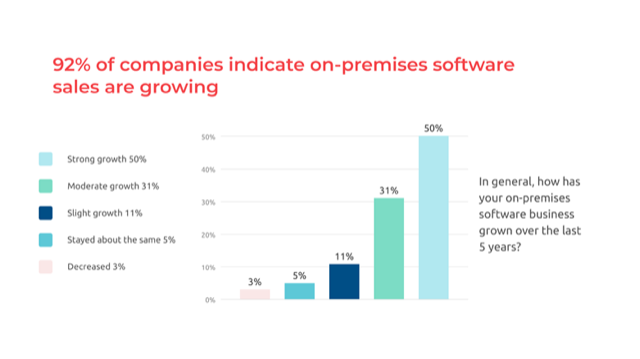
    A recent report from Dimensional Research reveals that the demand for on-premises software is equal to that of public cloud. The report, which was commissioned by Replicated, a company specializing in on-premises software modernization, queried 405 participants in software development, executive, product management, sales and services roles to determine the needs, usage and challenges of on-premises software.

    The report revealed that some 90% of companies surveyed said their on-premises sales of software solutions continue to rise, while 70% that do not currently offer on-premises solutions intend to in the near future. 

    “In the past few years we’ve experienced a steady increase in interest from leading global companies who see that modern on-prem software delivery through containers and Kubernetes can make data protection and security much easier,” said Grant Miller, co-founder and CEO of Replicated. “Coupled with growing customer demand, it’s a win-win scenario for any industry.”

    While Miller’s view may be optimistic, the survey also revealed that the majority (65%) of companies cited privacy compliance as the top reason for using on-premises software delivery; an indication that the market is being influenced by cybersecurity issues more than any other factor. However, 54% also stated uptime and reliability were a primary driver for on-premises solutions, while 45% noted the importance of integration.

    The report indicates that enterprises, which have cited digital transformation and a movement towards the cloud as critical factors over the last two years, may also be thinking more about on-premises solutions in light of cybersecurity and compliance concerns. This, in turn, means that DevOps has the potential to gain even more traction in the enterprise. 

    While the report mentions the merits of an on-premises software strategy, it does raise the question of why more enterprises have not moved in that direction already. That hesitation to re-embrace on-premises software can mostly be attributed to perceived complexity, time commitments and the cost of engineering resources to make it happen. 

    Complexity is further highlighted by 74% of survey respondents reporting that it would take more than a week to install and configure on-premises software, and 29% stated an install could take over two months. For the 16% that claim they can rapidly install and configure on-premises software in less than a week, the potential for growth in the market is notable. 

    While the future remains somewhat uncertain, the report from Dimensional Research runs counter to other reports, such as a Synergy Research Group report that revealed in 2019, spending on cloud platforms edged past the resources spent on acquiring servers and software for on-premises data centers. “60% of the servers now being sold are going into cloud providers’ data centers and not those of enterprises,” said John Dinsdale, a chief analyst at Synergy Research Group, confirming the trend. “Clearly, companies have been voting with their wallets on what makes the most sense for them.”  Dinsdale said the growth of cloud infrastructure will continue to accelerate aggressively over the next five years. 

    Although conflicting observations tend to add to the market confusion, one thing is certain – DevOps shops have market opportunities to service customers deploying both to the cloud and on-premises software.

    on-premises

  • Dear Vendor: Letter to Technology Vendors

    Dear Vendor: Letter to Technology Vendors

    While I was writing my “Dear Management …” post, something was going on behind the scenes that inspired me to write another. We all have things we wish to say to vendors; this open letter picks some of the big points that they seem to invariably struggle with.

    Dear Vendor,

    We want to use your products, otherwise we wouldn’t even be writing to you. But depending upon who you are, and what year it is, you are struggling to meet our needs.

    We understand that your insistence that your new product or acquisition will solve all of the problems we don’t have is probably executive-driven, but give us the benefit of the doubt. We know our environment, and just because we use you for one thing does not automatically imply we want you to constantly push this other thing at us. By all means, tell us about your entire product line, but then back off. We will let you know if anything appears to fulfill a need.

    While we’re chatting, can we discuss pricing? Not just cost, but the byzantine structures you create, time after time? If you are going to use 15 different charges and fees to jack up the price there, we’re paying the bill – we’ll see it. You’re far better served by being forthright. Do you have any idea how many stories like, “I am not funding your Ferrari with your commission,” stories (this was actually said; it was hilarious – we went with a competitor) are out there? And they keep occurring. Just this week, the phrase “Your pricing is bonkers!” was submitted to a company. We want a good product at a fair price, not a cheap price up front that will drain all of our budget over time.

    Speaking of good products, let’s talk about security. Security issues with your product are our issues more urgently than they are yours. Don’t mess around; when notified, quantify the threat and notify us immediately, with suggested remediations until you can get a patch ready. Holding off until you can patch puts us in the unenviable position of being vulnerable and, worse, not even knowing we’re vulnerable. Use good coding practices so we’re not all caught off guard, and waive those secure coding requirements for no one. Interns and C-level execs are not professional coders (interns aren’t yet, and C-levels no longer are), and any code by these two groups needs to be reviewed by someone that knows your systems before they are sent to us for deployment. Don’t force bad updates on us. Do your best not to give us bad updates at all.

    Finally, on the topic of forcing things on us – guess what? We have a need for a specific tool in a specific environment. Telling us that starting next month your services are all “moving to the cloud” does not suit all of our needs. We get it, you want that data. It’s all the rage right now. You should understand that, if you stop serving our needs in your quest for our data, we’ll go elsewhere, eventually, no matter how reluctantly. Cloud is a great platform, but most IT tools need the versatility to run where we need them, not just on one platform out of many.

    And, as a side note, your AIOps generally isn’t. We know it’s the buzzword du jour, but honestly, if it’s basically the same product with some logic or a dashboard strapped on, that’s not AIOps, it’s normal product improvement. When you have deep data collection and analysis that uses trained algorithms, then you can join the crowd screaming AIOps. Until then, hush. You sound silly, and it undermines the rest of your messaging.

    Just to reiterate: We have a need, show us how you fill it, and let us decide if that suits our requirements. Then tell us about your other offerings and back off. We’re smart enough to smell vaporware, stubborn enough to resist your desire to collect all of our data and wise enough to judge whether or not you and the product you’re pushing this week will be around in a year or two. You serve a purpose, and we’re grateful you are doing this stuff so we can focus on our business. But please, make life easier on us, not harder. And if one more of you sells a product we don’t need to the C-suite, we may explode. That Sword of Damocles that you raised over us will inevitably fall, and your company’s reputation will suffer for it. But we’ll pay the price for trying to implement something we didn’t need in the first place.

  • The Role of APIs In Digital Transformation

    The Role of APIs In Digital Transformation

    Digital transformation is increasingly propelled by rapidly changing user expectations. Release frequency is increasing, as is the need to connect a growing number of applications and digital experiences. As a result, 83% of IT specialists consider API integration critical to their business, found the State of API Integration Report.

    Application programming interfaces (APIs) hold powerful sway in tech discussions of late. Building API-first could increase internal reusability. APIs have become a standardized machine-readable mechanism for connecting partners. There is also a hot market for API startups, meaning APIs are becoming products in their own right.

    APIs are also enabling change for large enterprises. I recently connected with Bernd Gross, CTO at Software AG, to get his perspective on the role APIs and integrations are playing within the new wave of enterprise digital transformation. Below, we’ll see how connected customer experiences, digital business excellence and a new ecosystem-driven economy are driving the emergence of more API-based strategies.

    Three Drivers of the Connected Enterprise

    Businesses continue to transform into more connected enterprises. Once relegated solely to improving back-office efficiency, digitalization efforts are being applied across the board — to employee management, assets, machines, partners and the supply chain at large, said Gross.

    Amid rising digitalization, connectivity is the glue that unites disparate elements and tools. A fully connected world is “the new flavor of digitalization,” said Gross. To his point, ‘connected experiences’ is a crucial driver for 68% of platform providers, The State of API Integration Report found.

    So, how are APIs fueling the new connected enterprise? Gross identified three key reasons why integration is now fundamental to enterprise digitalization initiatives.

    Software AG Marketecture, used with permission.

    1. Connected Customer Experience

    Many organizations “want to transform into a technology and software company,” said Gross. To participate in the connected digital economy, organizations are striving to create advanced 360-degree customer experiences. Today’s technology needs to “look beyond a PC application,” Gross said. These experiences must cater not only to desktops and smartphones but also to IoT devices and physical assets.

    For example, he explains how one large elevator company architected an embedded connected experience, incorporating digital touchpoints within elevators to showcase signage, entertainment and ads, opening new monetization possibilities. This change was so radical that the mechanical engineering company pivoted its mission statement, reimagining itself as a “vertical transportation company.” Soon, their AI-enabled elevators will predict behaviors and optimize travel times, so they are always on the right floor, waiting for human riders.

    Intelligent building technology is similarly being applied by digital-savvy hotels, Gross explained, which is especially important for contactless visits during the pandemic. A fully digitalized customer experience could involve automated check-in, a room access code sent to a smartphone, an online billing system, physical sensors and more. Enabling a seamless digital hotel experience sounds easy, but it’s technically quite challenging — there are endless integration requirements to connect. In some cases, it would take 24 integration points, noted Gross.

    2. Digital Business Excellence

    Gross recognized the high expectations for modern digital experiences. He described a “new trend of business excellence in delivering more of an end-to-end digital experience.” This means data can no longer be locked up; even traditional companies must transition to platforms to offer software and data to their end users. In the process, interesting things may occur — your customers could become partners, Gross adds.

    He described how one medical company, a leading centrifuge producer, sought to build more digital experiences to complement their hardware. Though the machine functioned seamlessly, there was no easy way to port data results to other applications. This inhibited initiating the fully digitalized workflow required for a smart lab experience.

    In this case, APIs were imperative to opening up back end cloud services to enable smooth user interfaces and end-to-end workflow automation. “Intuitive user interfaces must integrate all services, including cloud and on-premises services, to create and automate workflows,” Gross explained. “To do this, you need integration.”

    3. Ecosystem-Driven Economy

    The network effect of platforms is that they enable an ecosystem to form. And, according to Gross, involving partners in this new digital experience matrix is imperative for success. For example, the API gateway is one area where partnerships help an integration strategy; “You need an API gateway for security and governance reasons,” he stated.

    Throughout his experience overseeing APIs on many projects, Gross often noticed a naïveté associated with defining the ecosystem. “When [clients] engage in the first phase of these projects, they think they know how to do it, but they typically don’t,” he said. Potential API providers often don’t fully realize their monetization strategy, the security implications or the complementary software providers necessary to support a working model. “Partnerships often facilitate a value-add to customers — they enrich the total offering through APIs and ecosystems,” said Gross.

    Similar to how a machinery company may embed a bill of materials into the product they sell, digital partnership ecosystems can open up data so partners can access and innovate with it, Gross said. Frequently, ecosystem partnerships make a lot of sense, as they can better meet consumer expectations. For example, Gross suggested that integrating a ticketing system into a conditional monitoring system would bring compelling value.

    The Next Stage: Self-Service Integration With APIs

    According to the report, 40% of companies said that digital transformation is driving their need for app integration. Truly connected enterprises must embrace digitalization and integration across all aspects of the business. As a result, this is forcing a business shift toward more open ecosystems.

    But building these systems will require newfound knowledge dissemination around developer experience and self-service capabilities. “Self-service has become fundamentally important,” said Gross. It’s not enough to simply open interfaces — you have to also add self-service capabilities to integration tools, he added. This could mean offering low-code options alongside APIs — such drag-and-drop UIs would help facilitate integrations for more citizen developers. A self-service approach to digital platformification is an emerging trend, yet one that’s “not fully at mass market,” described Gross; it’s still in its early stages.

    Open ecosystems are guided by consumers, who often desire connections between your tool and external partners. But, opening up data isn’t just helpful for partner integration; it could also benefit internal use. As Gross described, time-series industrial analytics could empower operators on the shop floor or production facility to make sense of local data. “You need self-service analytics tools to give them that ability,” Gross said.

    Building new customer experiences to cater to various devices and platforms is a big driver for API adoption. As a result, headless styles are emerging to address multi-platform requirements. For these reasons and many more, APIs are fueling new digital transformations across enterprises, powering innovative customer experiences and hiding complexity in the back end. With APIs, smart processes, smart machines and smart partners can all come together.