Category: Enterprise DevOps

  • Best of 2021 – The ‘Great Resignation’ in DevOps? Bah, Humbug

    As we close out 2021, we at DevOps.com wanted to highlight the most popular articles of the year. Following is the tenth in our series of the Best of 2021.

    Like me, you have probably heard a lot about the “Great Resignation” lately. I’ll admit—at first I did not think it had anything to with tech jobs, especially not DevOps or cybersecurity jobs. After all, there aren’t many workers in those fields who aren’t well-paid (though, of course, when it comes to pay, it’s all relative). 

    When I first heard about the Great Resignation, I assumed it referred specifically to fast food workers or, perhaps, other restaurant, hospitality and retail industry jobs. You know—the kind in which people struggle to make $15 an hour. But then I began to hear it applied to better-paying tech jobs. Finally, I interviewed several executives who cited the Great Resignation as one reason that they were undermanned in key development, DevOps and cybersecurity positions.

    I know what you are thinking: Tech execs will latch on to any excuse to explain why they are short-handed in these skilled positions. I agree with you, to a point. But I have had the chance to speak with several folks at some in-person conferences I’ve attended recently (It’s just not the same online!) and I began to see a trend. The almost mythical work-life balance/quality of life trend was back with a vengeance.

    During the COVID-19 pandemic, many workers—even in highly compensated, challenging jobs like software development, DevOps, QA and cybersecurity—had actually changed their perspective as a result of working from home all those months. True, many of them had already been working from home. But they still had a “mothership” that they went to; however occasionally. They still gathered with coworkers at conferences or off-site meetings; they still were part of the “culture”.  With COVID-19, despite the best efforts of HR teams and managers to foster and nourish that “culture”, it just wasn’t the same. Much the same way we fooled ourselves into thinking Zoom and Teams were as good as in-person, we thought that we could keep our teams tightly bound and drinking the company culture Kool-Aid. 

    In place of that corporate culture, when workers weren’t working (and it did take some time for many of them to learn how to use the on/off switch), they began to actually do other things. They spent time with their immediate families. They tried new hobbies, they started (and completed!) DIY projects and more. Lo and behold, they found there was life beyond code. 

    This radical notion of doing things that were not work-related was not solely due to a failure to pay these people enough money. It was not about letting them work with the tools of their choice. It wasn’t even about who they worked with. At the end of the day, it was because they discovered they had a life, and that they enjoyed that life.

    I welcome this trend. I think it will mean less burnout and more productive humans, at the end of the day. Heck, we may even see birth rates rise and divorce rates fall. We may all live happily ever after. 

    When it comes to the Great Resignation, in the immortal words of John Belushi, “Bu-uut nooo.” Notwithstanding all of the above being true, I don’t think this is what’s leading developers, DevOps or cybersecurity folks to leave their jobs in droves. They are setting boundaries, yes, but they aren’t quitting just because of pay. No—they are leaving for the same reasons they did before. No sooner do they settle into their new jobs than they are being contacted by the ever-present recruiters offering them more money, more benefits and now more work-life balance. Add to this the growth in demand for these positions worsening an already understaffed market and there you have it. A shortage of workers to fill open positions. This convergence of circumstances makes it easier for them to hop from one job to the next, as well.

    At the end of the day, we still don’t have enough software developers, DevOps folks, QA or cybersecurity talent. This is driving the market. But Great Resignation? Bah, humbug!

  • Best of 2021 – 11 Open Source DevOps Tools We Love For 2021

    Best of 2021 – 11 Open Source DevOps Tools We Love For 2021

    As we close out 2021, we at DevOps.com wanted to highlight the most popular articles of the year. Following is the eighth in our series of the Best of 2021.

    DevOps isn’t just a cultural shift — it requires great tools to come to fruition. Below, we’ve pulled together a list of some of the most well-loved DevOps tools available today. But, throwing loads of money into fancy SaaS solutions can quickly gobble up the cloud budget. These DevOps tools all are open source, and enable everything from container builds and orchestration to microservices networking, configuration management, CI/CD automation, full-stack monitoring and more. Here are some of our favorite open source DevOps tools for 2021.

    1. Kubernetes

    With the ubiquity of microservices and container-based software, it’s no surprise that Kubernetes tops this year’s list of open source DevOps tools. Kubernetes, adoption of which rose by 48% in 2020, is used to orchestrate containers. Instead of releasing microservices manually, Kubernetes can automate deployment, maintenance and scaling of groups of containers in production. Kubernetes, sometimes written as K8s, is hosted by the Cloud-Native Computing Foundation (CNCF).

    2. Docker

    Docker, the software, is a free and open source platform used to build, ship and run an application as a lightweight container. Containers package up the binaries, libraries, configuration files and dependencies required for a program to run. Over the past decade, containers have played a key role in agile development, and Docker containers led the revolution. At its core is the Docker Engine. Docker Hub is also an excellent resource for finding and sharing prepackaged functions as containers. Also, to plug container vulnerabilities, it may be helpful to use open source container auditing tools like Docker Bench or Anchore.

    3. Istio

    Microservices are a handy development style, yet they bring new development and architecture concerns. Namely, how do we apply networking policies like security, encryption, observability and telemetry elements consistently across all our services? Well, service mesh is one answer. Service mesh places a sidecar proxy next to each container and abstracts these networking capabilities to a control plane. Istio is one such open source service mesh that has seen widespread adoption. Istio is built on Envoy, opening it up to plugins and extensibility options. We should also mention Linkerd and Kuma as viable open source service mesh alternatives.

    4. GitHub Actions

    GitHub is arguably the most popular source control and software collaboration platform on the planet. The GitHub platform itself, based on Git, has seen some significant updates in the past few years. Most notable is the GitHub Actions capability. GitHub Actions enable software packages hosted on GitHub to accept inputs and trigger other processes. This could help automate some cool DevOps workflows within GitHub, such as code reviews, branch management or CI/CD processes — the combinations of possibilities here are endless. GitHub Actions are, essentially, YAML files hosted in GitHub repositories that leverage GitHub webhooks. Though this is more of a feature than an open-source tool, we feel it’s important to include here. Actions is free for public repositories with a limit of 100 actions.

    5. Jenkins

    A big part of the DevOps philosophy is finding ways to automate and deploy new iterations more efficiently. Part of this goal is creating a streamlined continuous integration and continuous delivery (CI/CD) pipeline. Jenkins is an open source automation server with hundreds of plugins to automate the building, deployment and testing of software projects. Although GitHub Actions could theoretically replace a CI server in the future, CI tools like Jenkins, CircleCI, TravisCI and GitLab Community Edition still are preferred by many DevOps teams.

    6. Prometheus

    Metrics and alerting systems are crucial for site reliability engineers to visualize applications and react to issues. Prometheus, a graduated CNCF project, is a well-loved open source monitoring solution. A Prometheus server collects time-series metrics by scraping HTTP endpoints and generates a system to interact with this data, offering deep querying, visualization, storage and other capabilities. Check out this Awesome Prometheus list for Prometheus introductions and additional resources.

    7. Ansible

    Ansible is all about automation. Ansible, an open source project sponsored by Red Hat, can be used to automate things like cloud provisioning, networking, deployment, configuration management and other tasks. Ansible has a simple yet effective architecture that is relatively easy to assemble — all you need is a text editor and command line. You describe your infrastructure in a text document and organize your desired states in a playbook. For an example in practice, see how OpenIO uses Ansible. “Ansible is our standard tool not only to deploy the OpenIO core, but also our WebUI, OIO-FS and all upcoming options,” writes Cédric Delgehier, Ops at OpenIO.

    8. Chef

    Chef is another infrastructure-as-code (IaC) solution for automating your configuration management. Chef uses Ruby to automate server configurations and works well with all major cloud service providers (CSPs). This can be very useful when creating and provisioning large quantities of machines. Like other automation tools on this list, the user describes their components and their states in a declarative format. In Chef, these are known as “recipes,” which can be grouped together into “cookbooks.” You can’t diss Chef for not being on-theme!

    9. Terraform

    Terraform is another IaC tool that can be used for initiation of building, versioning and further automation using configuration files. “Terraform is a tool for building, changing and versioning infrastructure safely and efficiently,” as it is described on GitHub. Terraform follows an “execution plan” that a user creates with high-level syntax. One unique aspect of Terraform is its emphasis on versioning — this allows you to version the blueprint of your service just as you would your software.

    10. JAMStack

    As I’ve covered before, JAMStack combines JavaScript, APIs and markdown for constructing web-based applications. While more of a “headless development” methodology than a single open source tool, JAMStack projects are often built using open source components. For example, JAMStack often leverages open source headless content management systems such as Ghost, Strapi and/or Netlify CMS.

    11. ELK Stack

    ELK Stack is the union of three open source projects maintained by Elastic: Elasticsearch, Logstash and Kibana. With these three components, developers can take in and log data from any source and create helpful visualizations. This centralized logging is enabled with a NoSQL database for storage with Elasticsearch, processing and data collection with Logstash and visualization with Kibana. Increased visibility is vital for data analysis and helps identify errors to reduce mean time to recovery (MTTR).

    Rounding Out The DevOps Toolchain for 2021

    Programming isn’t only about shipping quality code, it’s about efficient execution. This drive to improve operations across the board is truly putting Ops into everything. With awesome open source DevOps tooling, it means more and more architects can adopt a DevOps approach within their deployment models.

    DevOps as a practice, as well as its underlying technology, is always evolving. In 2021, a lot of effort is being placed on wrangling the effects of introducing a microservices development style. We’ve noticed the maturation of container orchestrators and service mesh, as a result. Blueprinting infrastructure-as-code and creating automated, repeatable configurations is another must-have for implementing automated build and release pipelines. Not to mention, many no-code and low-code platforms are opening up DevOps capabilities to non-programmers, albeit from a proprietary perspective.

    It’s also helpful to note that some popular open source DevOps tools have been acquired — like Docker and Chef — blurring the lines between their business and their open source roots. When it comes to open source tools, it’s a good practice to adopt vendor-neutral tools with solid community support representing diverse stakeholders. This will help future-proof your project. Even though open source is “free,” users must ensure the benefits outweigh the time-to-onboard as well as the operational overhead of self-hosting.

    DevOps tools are beneficial to automate software deployment. Here, we’ve attempted to list some of the most exciting tools to help automate that process. Of course, many new tools are emerging in the DevOps space, and we have hardly scratched the surface. Do you have a favorite DevOps tool that’s not mentioned above? Let us know in the comments below!

  • Best of 2021 – Programming Languages: Choose Wisely?

    Best of 2021 – Programming Languages: Choose Wisely?

    As we close out 2021, we at DevOps.com wanted to highlight the most popular articles of the year. Following is the first in our series of the Best of 2021.

    We’ve got decades of experience in programming and language adoption under our belt at this point, and there are a few things we can say definitively that developers in general (and DevOps engineers specifically) should be aware of.

    First, it doesn’t matter as much as you think. It really doesn’t. Most developers don’t choose programming languages based on important things like optimization or general applicability. They choose a language based on ease of use, availability of third-party libraries and simplification of things like UI. Open source version availability helps, but only insofar as it spawns more third-party libraries. So, use the language that works best for the project, and don’t get too hung up on whether or not it’s the newest shiny one.

    Second, the changes in use and adoption that matter–the top five to 10 languages that make up the vast majority of all professional programming activity–don’t happen overnight. Both JavaScript and Python are considered “rapid ascent” in terms of uptake when they took off … but both were around for years before that spike in adoption occurred. So, learning any of the top few languages is a far better long-term investment than learning the hottest new language.

    Third, those top languages actually don’t change much. They were written to fulfill a need, and that doesn’t change much over time. Indeed, the only language I can think of that has fundamentally changed in its lifetime is C++, which seems to want to keep up with the times rather than keep serving its original niche. Python? Java? Still pretty much the same as when they became popular back in the day. And that’s a good thing. But that means if you want to try something new and engaging, you need to look to up-and-coming languages. At the time of this writing, specialist languages like R and Kafka are having their day, and that’s a good thing. After all, we know that different applications have different needs and different platforms have different needs–and have been trying to address that second one forever, currently with languages like Flutter. All of these will offer new ways of doing things, which is good exposure.

    Fourth, (though we briefly toyed with eliminating this one) organizations do determine the pool of available languages. Frankly, allowing each team to build a separate architecture was never a good idea from a long-term maintenance point of view … but a fairly large number of organizations played with the idea and learned the lessons about technical debt all over again. Now we’re back to “We use these languages, pick one,” which is better than “We’re an X shop,” and offers maintainability over time without burning a ton of man-hours.

    And finally, you can do anything with those languages your organization makes available. I’ve seen object-oriented assembler, I’ve seen entire websites served in C; the list goes on. The language you choose makes certain things easier or harder, but if you need to get it done, you’ll either get an exception to the language list, or you’ll figure out how to get it done with what’s available. But you can … But as my father used to love to say, “Just because you can, doesn’t mean you should.” He had nothing to do with programming and as little as possible to do with computers, but his logic still applies perfectly.

    So, grab an approved language, and crank out solutions. Just keep driving it home; you’re rocking it. Don’t stop, and don’t worry too much about which language you’re using, just focus on the language and do what needs doing–like you’ve done all along.  And spin us up even more cool apps.


  • Red Hat Adds Service to Customize RHEL Images

    Red Hat Adds Service to Customize RHEL Images

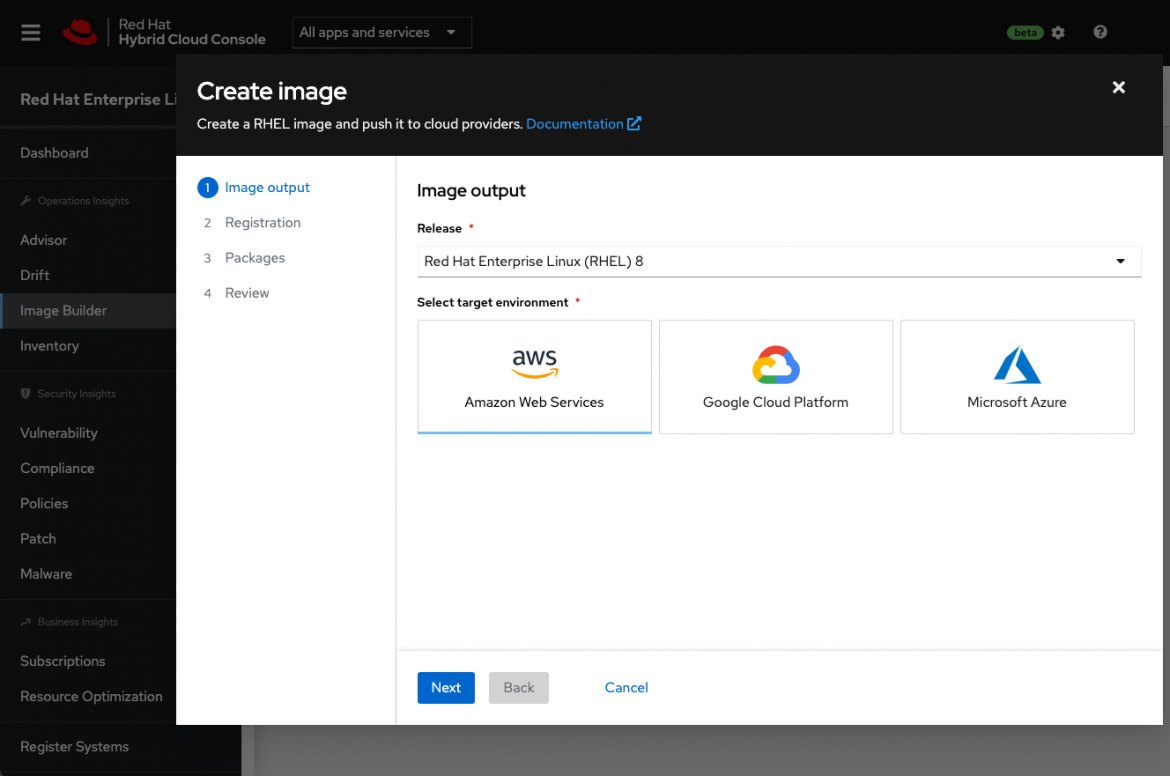
    Red Hat this week announced a public beta of an Image Builder service that streamlines the process of building customized instances of the Red Hat Enterprise Linux (RHEL) operating system.

    Scott Herold, director of product management for RHEL at Red Hat, said the Image Builder service enables an IT team to define a “gold” template for each target deployment environment that only contains the RHEL code required. Initially, Image Builder is configured to default to build a minimal, recommended RHEL server image for Amazon EC2, Microsoft Azure and Google Cloud Platform (GCP) cloud services.

    Future updates to the service will add support for VMware vSphere platforms as well as downloadable images and installation media for physical servers, customized filesystem layouts and versions 9.0, 8.5, 8.4 and 7.9 of RHEL. The service itself is accessed via the Red Hat Hybrid Cloud Console that is currently being made available in beta.

    Herold said building or installing operating systems is often a slow, tedious and error-prone process that needs to be manually performed in a slightly different way for each platform. Each physical server or edge computing platform requires different configurations and workflows. As a result, the chances mistakes will be made is high; Image Builder can greatly reduce the possibility of mistakes because there is no guesswork required, noted Herold.

    IT teams can also opt to include additional content from Red Hat in those builds to further streamline deployment processes, noted Herold. Those images can then be automatically registered with Red Hat to ensure future updates are received.

    The ability to customize those images also serves to reduce the overall size of the codebase that needs to be secured, added Herold. At a time when there is increased focus on software supply chains in the wake of a series of high-profile security breaches, many IT teams are revisiting their software deployment processes, he noted.

    Ultimately, Herold said Red Hat is moving toward providing IT teams with a more cloud-like experience regardless of where they deploy Red Hat’s curated open source software. The goal is to reduce as much friction as possible so that IT teams can more easily manage infrastructure at scale, he added.

    One way or another, the entiree software deployment process is becoming more automated. Much of the drudgery that has historically made it challenging to deploy and manage IT platforms at scale can be traced back to manual processes created when organizations ran a much smaller number of applications in on-premises IT environments. As IT teams increasingly deploy more applications in the cloud and at the network edge, it’s become more apparent that manual legacy processes won’t scale—especially when it’s already challenging to hire and retain IT personnel.

    It’s not clear how quickly IT teams will modernize software deployment processes using automated DevOps processes. Simple inertia is often a powerful force to overcome; however, most IT professionals can easily find something more compelling to do with their time that doesn’t involve using manually customizing operating system images.

  • Log4j: It’s All About the Supply Chain, Baby!

    Log4j: It’s All About the Supply Chain, Baby!

    In 2021, the security story in DevOps and DevSecOps has been the supply chain. So, it’s only fitting that we are currently experiencing the mother of all supply chain issues with the Log4j Log4Shell RCE vulnerability to close out the year.

    I won’t waste your time rehashing what Log4j is, why it’s so dangerous and warning you to test all of your own and third-party apps to make sure you’re insulated against this. I will say, though, that I don’t think Log4j is a bug—I think it is a defect in design. Worse, as we are seeing, there are multiple defects in design. All of you Java haters out there—back in the box. Java is no worse or better than any other language that we regularly use to build applications.

    So, what exactly is so special about supply chain security? Why do DevSecOps teams, developers and our security incident management teams have to interpret this as a warning and stay at the top of their game from now on? It’s simple. In the age of SaaSOps; in a world where we Frankenstein applications by cobbling and stitching together numerous third-party components (some open source, some not), we are increasingly reliant on code, even in our own applications, that we did not write. We probably didn’t test it, either. We rely more than ever on the “community” and on unknown third-party suppliers. It has always been a leap of faith with these apps and components, and this year some of those chickens have come home to roost.

    The White House executive order on improving the nation’s cybersecurity calls for a software bill of materials (SBOM) for applications; that is, as they say at the tables in Las Vegas, a fine start, but we need more. If we really had a BOM included with the apps we use (and that includes SaaS apps), how many of you are actually going to read it and act on that information? And besides including all these components in a BOM, what further obligations do suppliers have to ensure that they are replacing and updating vulnerable code?

    This issue becomes increasingly acute with open source. My partner and colleague Mitchell Ashley recently asked if too much open source was a bad thing. I don’t know if I would go that far; the more the better, as far as I am concerned. But we do need better monitoring and management of the open source code that’s out there. More testing before it goes GA, maybe? Yeah, the Cadillac open source projects might have the money and time to do that, maybe, but take Log4j as a perfect example: It’s two guys maintaining it in their free time and trying to do right by the community. How can they possibly keep up?

    I used to think that the answer was in the repos. My friends at Sonatype had a component firewall that would not let you download an old or vulnerable version of code without warning. That was fine if you were downloading it for the first time. But if it was already embedded—then what? Can we scan for older components in an app? My friends at JFrog can do something similar and more with Xray. And Sonatype’s Nexus platform also allows current and prospective users to scan older apps for vulnerabilities—including scanning for Log4j, absolutely free. But is that enough?

    All of these questions involve open source components. What about third-party SaaS apps? Often, we don’t even know what components or code are in those SaaS apps. Again, it is a leap of faith we are making when using them. 

    These supply chain security issues are a problem that we are just beginning to grasp. And while 2021 has been the year the stuff hit the fan and Log4j may be remembered as the biggest of the first, I, for one, am afraid to think about what else is coming. 

    I do know that the only way to tackle this and any future supply chain issues is if developers, DevSecOps, DevOps, SREs and our security incident response teams all work together. Just like most security issues, supply chain security is all of our responsibility.  I hope Log4j hasn’t bitten you too hard, and that you are on top of your exposure. But let’s start thinking about the next one and how we can better prepare for it.

  • Speedscale Makes Free API Observability Tool Available

    Speedscale Makes Free API Observability Tool Available

    Speedscale today announced it is making a free edition of its observability tool for application programming interfaces (APIs) available to developers.

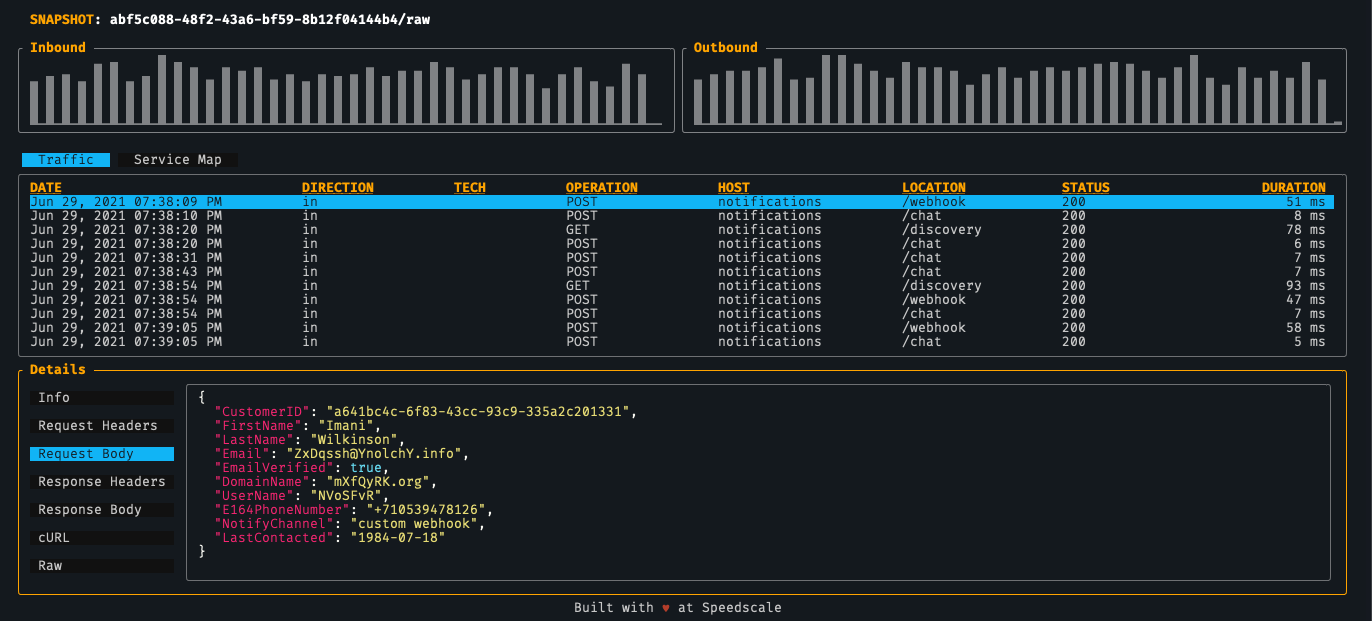
    Ken Ahrens, Speedscale CEO, said the goal is to expose more developers to the company’s API testing tool that can be accessed on their local machine via a command line interface (CLI). Dubbed Speedscale CLI, it is designed to enable individual developers to inspect, detect and map API calls on local applications or containers rather than having to subscribe to the company’s current API testing platform via a software-as-a-service (SaaS) model.

    That approach should reduce the number of disruptions DevOps teams are likely to encounter after an application is deployed in a production environment, noted Ahrens.

    Speedscale CLI features include service mapping, which enables developers to auto-detect and map external dependencies that could break, a traffic viewer for logging and tracing API calls and latency detection tools that show how code changes are impacting performance. In a forthcoming update, Speedscale also plans to include load generation capability to enable developers to run tests locally. The overall goal is to enable IT organizations to shift more responsibility for the management of APIs further left toward the developers that create them, said Ahrens.

    Naturally, Speedscale is also hoping that, as more developers are exposed to its observability platform for APIs, there will be increased demand for its SaaS platform among DevOps teams that need to manage and maintain APIs in production environments within their existing workflows. Speedscale exposes a set of APIs of its own to enable that integration, noted Ahrens.

    At its core, the Speedscale SaaS platform is designed to enable DevOps teams to replay how calls are made between APIs and external mock services to make it easier to diagnose issues.

    In general, there’s a lot more focus these days on APIs, thanks to digital business transformation initiatives that are dependent on APIs to integrate processes. The challenge organizations face is many of those APIs are built by separate development teams. In some instances, organizations can find themselves deploying redundant APIs. Other organizations will create APIs that, over time, are simply forgotten about or that go dormant when the developers that created them leave the organization. These “zombie APIs” often represent a security risk because cybercriminals now routinely scan IT environments for unattended APIs through which they can exfiltrate data without anyone noticing.

    One way or another, the management of APIs is becoming a distinct discipline within many organizations as they come to appreciate the level of IT flexibility they enable. Replacing backend services is a lot simpler when the APIs calls that invoke them both internally and externally remain relatively simple. The challenge is that building and maintaining microservices-based applications based on APIs is a more complex endeavor than building a monolithic application. The first step toward reducing that complexity is, of course, to provide more visibility into the application environment for all concerned.

  • Log4j: Is There Such a Thing as ‘Too Much’ Open Source?

    Log4j: Is There Such a Thing as ‘Too Much’ Open Source?

    The Log4j vulnerability got me thinking: Is there such a thing as too much open source?

    Before anyone immediately fires off a flaming email, rage tweet or scathing blog post, hear me out for a moment. If you know me, you know that I am an open source fanatic. I’ve been asked many times, “Should we use open source software and, if so, how much?” My response was (and still is) that open source software is a massive source of innovation and I can promise you, whether or not you use it, know that your competitors certainly are!

    I could go on and on extolling the virtues of open source and how it enabled the cloud, reshaped software architectures, created new product categories and gave us valuable tools like telemetry and increased visibility into cloud-native apps, infrastructure and beyond.

    When I first heard about the Log4j vulnerability on December 9, like many others, I quickly informed the tech leaders, engineers and SREs in my network about the serious potential risks such a zero-day vulnerability in the widely-used Log4j tool represented. In one way—probably the only way—the Log4j exploit shared a very important characteristic with the SolarWinds supply chain attack of late 2020: The widespread distribution and ubiquitous use of the software across applications, systems and organizations. Arguably, Log4j is used much more widely.

    This similarity raised questions I hadn’t fully considered in the context of such widely used software. Can we use too much open source software? Is Log4j too prevalent in its use and, therefore, a single point of failure? How bad would the Log4j situation be if a fix wasn’t immediately available or if one wasn’t forthcoming?

    The answer I kept coming back to is a resounding ‘no’. I still don’t think there’s such a thing as using too much (insert any open source project name) software. Log4j—and so many other open source software projects—are massively beneficial to us, and we virtually couldn’t function without these systems, tools and solutions in today’s age of ubiquitous software.

    What the current Log4j vulnerability, recent software supply chain attacks and other cybersecurity incidents with widespread impact highlight is our need to quickly respond to security incidents and take remediation steps anywhere they are found in the software stack. And that includes open source software. High-impact security vulnerabilities can occur anywhere across the numerous software stacks and services we use, though they have even greater impact when they occur in widely-used infrastructure, reusable components and microservices.

    In a world of infrastructure-as-code (IaC), it’s no longer a matter of patching a particular set of routers or servers. Unfortunately, much of the software stack is not containerized or built using smaller, easily replaceable containers and microservices—at least not yet. Our mindset and processes going forward from this incident must change, and we have to be prepared to respond to and remediate vulnerabilities both horizontally and vertically across the software stack. In certain circumstances, we have to do this on a large scale.

    As is common with active open source projects, Log4j contributors responded quickly with a readily available fix. The real answer to my original question above is that few are as prepared to respond to an important security vulnerability as those incredible, hard-working, active and engaged open source software developers.

  • The Graph Donates $48M to Advance GraphQL Platforms

    The Graph Donates $48M to Advance GraphQL Platforms

    The Graph, a provider of indexing and query tools based on the GraphQL language designed for blockchain platforms, today announced it has given $48 million to The Guild, a group of developers advancing an open source application programming interface (API) platform to further development of GraphQL-based technologies.

    Administered via The Graph Foundation, a nonprofit consortium that oversees the development of an open source graph database dubbed ONgDB, the agreement also calls for members of The Guild to contribute to the development of indexing and query tools being advanced by The Graph over the next four years.

    Eva Beylin, director of The Graph Foundation, said the goal is to fund the development of projects that leverage GraphQL, an open source data query and manipulation language for application programming interfaces (APIs) originally developed by Facebook, to create subgraphs used on blockchain platforms like Ethereum to index data in a way that is more accessible to developers.

    The open source community that is starting to evolve around blockchain platforms, also known as Web3, is now a major contributor to a range of GraphQL projects, noted Beylin. Those blockchain platforms are now being used to drive decentralized finance (DeFi) applications that do not rely on any single platform to process transactions. Those platforms are being employed by both startup and incumbent providers for financial services around the globe.

    It remains to be seen, however, how the GraphQL community will address security concerns. GraphQL APIs can easily suffer from broken object-level authentication issues just like any other API. The issue is a single GraphQL query could exfiltrate much more information than a typical API request. If the GraphQL provider does not have granular authorization checks for each particular method and resource, a GraphQL endpoint could become a major vulnerability.

    Cybercriminals also tend to launch brute-force attacks against APIs. With REST APIs, that malicious behavior is easier to catch with standard web application firewalls (WAFs) because it’s easier to notice hundreds of peculiar malformed requests. However, with GraphQL, a brute-force attack is harder to detect. It’s easier to limit this type of nefarious traffic with REST APIs by assigning access parameters to each resource and handling authorization checks one at a time.

    It’s not likely GraphQL APIs will replace REST APIs overnight. However, as the backend platforms for managing GraphQL APIs become more robust, the number of these APIs being used in a production environment by DevOps teams will dramatically increase—assuming there are no objections from cybersecurity teams.

    In the meantime, the open source community is clearly starting to rally around GraphQL, which should result in innovations applicable across a wide range of use cases. The challenge now is not only determining which type of API to employ and when, but also deciding whether any existing legacy APIs need to be replaced. One way or the other, however, the managing and securing of APIs—like it or not—is only going to become that much more challenging in 2022.

  • Log4j Puts Effective IT Operations at Center Stage

    Log4j Puts Effective IT Operations at Center Stage

    News of the Apache Log4j vulnerability exploit is striking fear into the hearts of both software makers and users. Log4j is the most popular Java logging service used today, with over 400,000 GitHub downloads and has been embedded in most internet services and products from companies all over the world, including Apple, Amazon, Cloudflare, Steam, Tesla, Twitter and Baidu, just to name a few.

    Exploiting this vulnerability is simple and allows threat actors to control Java-based web servers and launch remote code execution (RCE) attacks. New variations of the original exploit are being introduced rapidly—over 60 in less than 24 hours. The attack surface grows by the minute. Good credential management and advanced authentication will not help as this exploit is pre-authentication, which means an attacker doesn’t need to authenticate to your web applications to attack. Your web server is vulnerable.

    The good news is your organization likely has a team of seasoned IT operations pros that can help protect against the worst of Log4j’s devastation.

    How IT Operations Can Protect Against Log4j Vulnerabilities

    Step One: Find Log4j Wherever it Exists

    You need to investigate every internet-facing application, website and system that you own or use. This includes self-hosted installations of vendor products and cloud-based services. Focus on systems that are internet-facing that contain sensitive data. Once you’ve completed assessing your hosted apps and vendor systems, move on to endpoint applications. Java-based apps like WebEx, Minecraft, Citrix and many more.

    Step Two: Patch, Patch, Patch

    Patch in the same order as above: Internet-facing applications, websites and systems. If no patch is yet available for your apps and systems, uninstall.

    The pandemic has forced many endpoints into workers’ home environments, which creates extra challenges for patching those endpoints and keeping them compliant. Operations teams can’t rely on work-from-home folks to patch their own systems, even if they’re given clear instructions. Many of them will just ignore those directions, so you need to adopt systems that enforce continuous compliance.

    Step Three: IT Operations is Essential

    Communicate with your senior leaders. They should be in the know about this one! Senior leadership needs to position their IT operations teams among their most vital employees. Don’t think this is going to go away any time soon—we’re just starting to get a glimpse of what is being tried out there in the wild. Buckle up. 


  • U.S. Govt. CX EO | Mozilla Revenue | Log4j Latest

    U.S. Govt. CX EO | Mozilla Revenue | Log4j Latest

    Welcome to The Long View—where we peruse the news of the week and strip it to the essentials. Let’s work out what really matters.

    This week: Improving U.S. government CX, how much money Mozilla makes, and the latest on the Log4j/Log4Shell débâcle.

    EO: “Transforming Federal Customer Experience”

    First up this week: The Biden–Harris administration makes an executive order directing its Federal agencies to make 36 specific customer experience (CX) improvement commitments. Much of this involves using technology to improve what DevOps teams would call UX—but government doesn’t like the language of “users.”

    Analysis: Customer-centricity FTW

    Remarkably, a lot of interaction with government still involves paper forms. But this EO shouldn’t merely be about putting existing processes online. Work also needs to be done to solve the underlying complexity and fragmentation of services: Focusing on CX is a helpful frame.

    Brett Samuels: Biden to sign order to streamline government services

    [The] executive order [is] intended to cut back on the bureaucracy around government services for the public such as renewing passports, applying for loans or changing names. [It] affects 36 “customer experience improvement commitments” across 17 federal agencies, [targeting] travel, retirement, business, health and updating personal information.
    …
    For example … to renew their passports online rather than dealing with print forms. [It] will create a single portal for … student loan debt, and small-business owners will have a more streamlined process for … loans, grants and certifications.
    …
    Survivors of natural disasters will also no longer be required to complete forms with several agencies when applying for assistance … and they will be able to file smartphone photos and use virtual inspections when filing claims. [That] could be critical as natural disasters become increasingly devastating, as evidenced by the tornadoes that ravaged Kentucky over the weekend, killing dozens of people and destroying communities.


    Is this a technology problem? Yes, in part—but it’s also a government problem, argues Jennifer Pahlka:

    Surely laws like the 21st Century IDEA Act … which required agencies to … “eliminate or consolidate websites or web pages that are duplicative or overlapping … and ensure that each website or digital service is designed around user needs,” made life easier for the customers of those agencies? What’s that you say? You’re not sure you’ve noticed that? Turns out you’re not alone.
    …
    An EO is one of the many mechanisms our government has at its disposal for what I like to call “magic words.” [But there’s a] gap between magic words and the changes they are supposed to compel. [Failures] happen at such a staggering scale they have become entirely expected.
    …
    We tend to assign the blame … to government technology [but] at some point, you can only improve the customer experience by addressing [underlying] complexity. … Most of the Kafka-esque nightmares people get stuck in happen because each service sees only the burden they impose, and not [what] the customer experiences.


    If, like me, you’re inherently cynical about government efficiency, you’d expect this effort to be a huge failure. But let’s not be too cynical: Warning of “the hazards of selection bias,” here’s ShanghaiBill:

    In the olden days, I took half a day off work to go to DMV and renew my DL. Now I can do it online in 5 minutes. … I pay my property tax online. I renew my business licenses online. I incorporated online.


    $500 Million per Year—But for How Long?

    The Mozilla Foundation has unveiled its revenue forecasts for this year. As in previous years, Mozilla makes the lion’s share of its cash from Google—by making it the default search engine. But there are new revenue sources.

    Analysis: And not a moment too soon

    The future of the browser market should be a strategic focus for DevOps teams. Mozilla’s Googley cash cow might not last. It’s often assumed the maker of Chrome keeps Mozilla alive so it can point to Firefox as “competition.” But with Microsoft’s browser Edging up the usage charts, that might no longer be true.

    Frederic Lardinois: Mozilla expects to generate more than $500M in revenue

    For 2021, the organization forecasts revenue of more than $500 million. What’s maybe most important, though, is that Mozilla’s new products like its Mozilla VPN service, Firefox Relay Premium, Pocket and other commercial initiatives are slowly but surely starting to pay off.
    …
    But for all intents and purposes, Mozilla remains fully dependent on Google for the time being. Diversifying its revenue sources is really the only way for Mozilla to decrease its reliance on a search deal with a company that is both a competitor, thanks to its dominant Chrome browser, and is increasingly out of alignment with Mozilla’s overall philosophy.
    …
    There is a window here for a non-Chrome browser, with users increasingly skeptical about Google’s motivations and Microsoft’s Edge team making a few missteps in recent months. Yet at the same time, Mozilla’s efforts to bring sponsored suggestions and ads to Firefox haven’t necessarily endeared the organization to its own users either.


    Why is Google funding its competitor? u/SerAaron:

    Google is Mozilla’s biggest donor. … It’s basically to avoid any monopoly allegations—so they can point to Firefox and say “look, we have competition”.

    Mozilla takes their money, sure, but … they don’t sell data, and they aren’t beholden to Google.


    But don’t count on that cash continuing to flow, says Maelwryth:

    That money is probably under threat now with Edge going for the market. Why give Mozilla hundreds of millions to show competition when you have actual competition from Microsoft?


    Log4j/Log4Shell Seems Worse Every Time We Look

    The list of popular DevOps tools vulnerable to Log4Shell grows by the hour. Merely finding your exploitable services can be an impossible task—let alone patching them.

    Analysis: Defense in depth is key

    Searching for and patching your vulnerable code is not enough. You’re also going to need to shore up your network defenses, by auditing internet-visible services and by tightening your application firewall rules. And—ironically—keep a close eye on your logs for signs of attempted exploits and IoCs.

    Steven J. Vaughan-Nichols: We Are in So Much Trouble

    Log4j is used a lot. And, when I say a lot, I mean it’s used in hundreds of applications [including] Druid, Dubbo, Flink, Flume, Hadoop, Kafka, Solr, Spark, Struts, Apple iCloud, … LogStash, GrayLog2, … Steam, Twitter, and … VMware.
    …
    Log4Shell is both easy to exploit and can be used to grab complete control of vulnerable servers. … Even as you’re reading this, odds are decent you’re being attacked. [But] even if you patch it in your systems, it’s all too likely to be hiding in other applications.
    …
    Log4Shell may be the worst security problem in a generation. … This is going to be a long, hard ride.


    Hyperbole? Even December 25 isn’t close enough for government work. Catalin Cimpanu:

    The US Cybersecurity and Infrastructure Security Agency has told federal civilian agencies to patch systems affected by the Log4Shell vulnerability by Christmas Eve. … Federal agencies have ten days … to test which of their internal apps and servers utilize the Log4j Java library, check if systems are vulnerable to the Log4Shell exploit, and patch affected servers.
    …
    Despite being a recent vulnerability, it is already considered one of the worst security flaws ever discovered, primarily due to its near-ubiquitous use among enterprise software makers, its simple and easy-to-use exploit, and the ability to hijack systems remotely. … Days after being disclosed, the vulnerability has been massively abused. … The first attacks were seen on December 1.


    There’s always another shoe. Here’s Teri Robinson:

    Maybe Log4j vulnerabilities are like rats—for every one that’s visible, multiple others scurry beneath the surface. … Apache said the fix addressing “CVE-2021-44228 in Apache Log4j 2.15.0 was incomplete in certain non-default configurations,” according to … CVE 2021-45046.


    The Moral of the Story: In the end, the love you take is equal to the love you make.


    You have been reading The Long View by Richi Jennings. You can contact him at @RiCHi or tlv@richi.uk.

    Image: Bernd Dittrich (via Unsplash)