Category: DevSecOps

  • DevOps Chat: Splunk Moves Into Microservices With Omnition Buy

    DevOps Chat: Splunk Moves Into Microservices With Omnition Buy

    Swiftly after announcing its acquisition of SignalFx, Splunk is vaulting into microservices tracing by announcing its intention to acquire Omnition. Tech companies are rapidly making acquisitions to strengthen their position in the DevOps and contemporary cloud-native software stack.

    Rick Fitz, SVP and GM of Splunk’s IT Markets Group, joins DevOps Chat to share with us the drivers behind Splunk’s move into microservices and service mesh tracing. Information about Omnition is in short supply as Omnition’s been in stealth, racing to develop a product to address the observability needs of DevOps teams. Omnition has received some notice through its contributions to OpenCensus open source, now being merged into OpenTracing.

    In addition to this episode of DevOps Chat, check out Mike Vizard’s article about the Omnition announcement.

    As usual, the streaming audio is immediately below, followed by the transcript of our conversation.

    Transcript

    Mitch Ashley: Hi, everyone, this is Mitch Ashley with devopsy.kinsta.cloud and you’re listening to another DevOps Chat podcast. Today, I’m joined by Rick Fitz, SVP and GM of the IT Markets Group at Splunk. And tailoring onto some recent news, the topic is about Splunk’s intention to acquire Omnition. They announced that on September 4th. Rick, welcome to DevOps Chat.

    Rick Fitz: Thanks, Mitch. Happy to be here.

    Ashley: Great to have you on. Would you start just by introducing yourself, tell us a little bit about what you do? And I’m sure most people know Splunk, but maybe a sentence or two about Splunk.

    Fitz:  Sure. A little bit about me, I’ve been building commercial software my entire career, and started out as a developer working for companies that were development oriented, and then the last 15 or 20 years, I’ve been working on just developing software for IT operations and application development teams in a commercial fashion.

    And in my new role now, I’m here as a General Manager, so I’m an executive here at Splunk, responsible for our strategy and vision of what we’re doing in the company. For those who don’t know Splunk—shame on you, darn it.

    Ashley: [Laughter]

    Fitz:  [Laughter] But let me tell you a little bit about the company. We are the company that actually built and invented, if you will, the ability to index logs at scale. And it made it really easy for the IT practitioners of the world to search that data and find, through an investigative lens, find the actual answer to those murky problems that are always out there. And so, the company is roughly 5,000 employees now, and growing very rapidly. So, we’re headquartered in California.

    Ashley: Well, just a little bit of trivia. I can’t claim credit for this, but I came across Splunk in probably 2006 or so at, I think it was an RSA conference. Tiny little booth, great ideas. Like, this is a cool idea. And of course, the company’s done really well, and I later became a customer of Splunk. So, congratulations on all the success and glad to see that you’re there, too, of course. Well, let’s talk—

    Fitz: Well, I thank you for being a customer.

    Ashley: Oh, absolutely, absolutely. [Laughter] So, let’s talk about Omnition. A lot of people may not know about them. Maybe they do, if they’re open in the—or involved in the OpenCensus, OpenTracing, OpenTelemetry projects, if I can say that right.

    Fitz: Mm-hmm.

    Ashley: They may know them from that, but they’re in ________ so there hasn’t been too much about Omnition. Tell us about that company.

    Fitz: Yeah. The—first, I’ll back up a little bit and kind of let you know why we even picked up a company called Omnition that no one really knows about. [Laughter]

    Ashley: Sure, that’s a good question, too.

    Fitz: The reality is that, in these large, cloud native worlds that a lot of us are starting to develop in, all kinds of things are changing. The things that we build on, the infrastructure we build on, the compute surface, the storage surface, there’s all these things that are now services that are available to us to leverage as application developers.

    And the other thing that’s changing pretty dramatically is just the way we actually build applications. The way we try to attempt to continuously integrate them, continuously deliver them. And perhaps one of the most profound things that’s occurred is that developers are now being asked to kinda own their code and they’re being asked to be on call or being asked to resolve issues.

    And so, if you will, they’re starting to become, as your website suggests, DevOps professionals.

    Ashley: A la DevOps.

    Fitz: Yeah. [Laughter] These trends start to kind of cause a paradigm shift—well, they have, actually, created a paradigm shift in the way you monitor. So much so that, probably over the last couple of years, DevOps practitioners have been talking about monitoring as—they’ve labeled it as a new world called observability.

    Ashley: Mm-hmm.

    Fitz: You know, I’ve been here around enough to know it’s simply monitoring. But I think what they’re trying to point out is that you need to observe the behavior of the data from the systems in order to make your lives easier. And that data comes in the form of logs, which is what Splunk has been known for a long time. It comes in the form of digital exhaust coming from monitoring tools in the form of metrics, which is really important.

    And then the last thing—and if you’re an application developer, I think we can all kinda relate to this—is the traces, the traces that actually come from the application code itself being executed are really great uses of good information.

    But all three of those things combined, the logs tell you kinda the root cause, the metrics tell you kind of what’s going on—is there a measurement that’s out of whack? Do I need to do something proactively to cause something to remove an error?

    And then the traces are really good for that logical layer—that logical layer telling you where to look. Do I have a backing problem? Do I have a code problem? Is it my problem, or is it a front end problem? And that kind of isolation is really important to trace it.

    So, that leads me to answer your question is that, you know, Omnition. Omnition was actually founded in 2018. The team is very small. They were in stealth mode, meaning they were building an application that was focused on tracing, and very specifically, they had a couple tenets in mind when they wanted to do this. They wanted to leverage open source. So, you mentioned that they’re big open source contributors, specifically to the OpenTelemetry project.

    And the other thing that they wanted to do is, they wanted to build this logical topology model that would allow you as a practitioner to isolate where a problem resides. And that was a pretty—it is a pretty novel way of looking at this particular problem. And it’s important, because having a thousand traces isn’t terribly intuitive or useful for a developer.

    Ashley: [Laughter]

    Fitz: But being able to isolate that it’s a front end problem so I can go talk to the guys that are in charge of that—or maybe it’s my logic that’s causing it, but maybe it’s a network issue, firewall issue or something like that. Or maybe it’s outside my firewall and I’m dealing with some latency issues from the world around us.

    Ashley: Mm-hmm.

    Fitz: But you need to be able to isolate that problem so you can solve it. So, long winded answer is, these guys, this team really figured out how to build this logical topology sitting on top of this trace data, leveraging open source—so, pretty darn powerful.

    Ashley: What I was really excited about with this announcement is, one of the things that I talk with companies about and work with them oftentimes is what DevOps, in this fundamental way that we’re creating more cloud native applications, how this really changed the way organizations work as well as how we create software, which I know you speak a lot about.

    And in some ways, what we’re doing is through this kinda granularization of functionality into containers, microservices, mesh—service mesh—it’s very interesting, because you can do lots of great things with it. But it makes the complexity of operating and monitoring—as you say, observability—even more difficult. So, that’s created this whole new cottage area, if you will, which is what Omnition went about, and actually some of the, they’ve had some developers who came over from Lyft, I think, went over to Omnition to help solve this problem.

    So, it’s fascinating to me to see Splunk bring this, this quickly, into your kinda product portfolio of companies, or at least that’s what we expect to happen with the acquisition, that you’re jumping right into service mesh, microservices, and observability, the monitoring of that. So, it seems like it’s a natural fit—maybe, you know, sooner than I expected it to happen, actually.

    Fitz: Here’s what’s interesting. I mean, we have the luxury of a lot of—you know, being around for a while and talking to a lot of our large enterprise customers that are going through this digital experience. You know, they’ve done their lift and shift, they’ve moved to kinda the lift, shift, and augment, and now they’re building a whole new series of cloud native digital services. So, they’re building in this new cloud native way. And when you start to talk to them, they recognize the problems, and they realize there has to be a way of doing this.

    And what we’ve found was, a number of them were trying to build it on their own, or they cobbled together a prototype that actually would kind of get ‘em there, give them some visibility. And then having a lot of those customers kind of advise us—because they’re very large customers at Splunk because of the fact that logs are a critical component of this strategy. But they were building the rest on the side, and in some cases, you know, using other companies to try to do it.

    And we just quickly realized that this is an opportunity for some of our largest customers, for us to come in and help them with this very critical issue and build alongside them as we move forward.

    So, yeah, we recognize that certainly the tracing part of this world is pretty new, but we think it’s the right approach, it’s the right answer to a long-standing problem, and I think the application architectures are at a stage in this cloud native world where this is perhaps the only way that this is gonna be accomplished. So, that’s why it was so strategic for us to do this.

    Ashley: You know, like, observability kind of being replaced for the term monitoring, tracing is also used—you used the word “also”—as kind of a new term in this service mesh, microservice world. Does it have a fundamentally different meaning to you as to what log analysis and things like that—is it substantially different or is it just an extension of what we’ve been doing in a non-container, non-microservice world?

    Fitz: Well, the only analogy is, it tends to be text, [Laughter] and you have to put it somewhere. And actually, some of our customers were putting it in the log and then extracting it, but that’s useful if you’re looking for one specific trace, but if you can imagine some of these applications are throwing up hundreds of thousands of traces a second, and sifting through that, while you can search through it, it’s great, but you really do need some analytics on top of it to organize it in a way that creates useful information. And that, I think, is again what Omnition has done.

    You know, answering the question, “Is this different from the old approach?” You know, I had the opportunity to work with an early Wily team. They had been acquired by CA Technologies, and I got to work with the team, which is an APM company. And the team actually invented bicode instrumentation, which is a way of doing instrumentation of the application on the fly. And it was very novel, because at the time, the operations teams were responsible for monitoring and the developers weren’t. So, the only way they could get their developer team to get visibility into the application—because they couldn’t tell their developers to actually put stuff into the logs.

    Ashley: Mm-hmm.

    Fitz: Well, they could ask. [Laughter]

    Ashley: [Laughter]

    Fitz: But they just couldn’t demand.

    Ashley: They might have ________.

    Fitz: Exactly. [Laughter] You know, us developers, how we are. And so the funny, interesting thing about that is, we tended to sell to the operations teams, so they could get that visibility into their application. In the open tracing world, because the onus, and it gets back to this DevOps ________, the onus is actually upon either an SRE function or, if you will, a DevOps function to establish the standards and policies. Those policies have been enforced by that team, and therefore, the developers, before they can actually bring product into production or bring code into production, there’s ________. And now, all of a sudden, you’re getting a lot more visibility and a lot more fidelity inside the code by that enforcement.

    And then, of course, open tracing is now on to its own standard, so you’ve got a standard to kinda drive. Before, there was no real standard, so you were just putting stuff into a log. And therefore, it’s hard for a vendor to look at it and develop an application to give you visibility into it.

    So, that’s definitely some of the big shifts that have caused this new paradigm to actually emerge, which is pretty awesome.

    Ashley: I think I saw in a blog post either on your site or Omnition’s that their investment and contributions to OpenTracing is something you’re likely to continue and support and want that to continue, is that correct?

    Fitz: Oh, absolutely. Absolutely. We’ve actually been, at Splunk, probably for the last four or five years, pretty definitely contributing to open source more, leveraging open source. We’ve been kind of on that bandwagon for quite some time. But this one, it makes a ton of sense. Both the OpenCensus and OpenTracing have now converged into OpenTelemetry. It makes a lot of sense. And I think that this is definitely where the world is—where it’s headed. I think it’s long overdue, actually. [Laughter] I’m glad to see these things kinda moving forward.

    Ashley: Given the players involved, I think if I recall right, OpenCensus was started by Google, but quickly followed by Microsoft and Dynatrace and Omnition—

    Fitz: Yeah.

    Ashley: – I think was part of this effort, too. So, it’s got some important names behind it.

    Fitz: Yeah, and most of the monitoring companies out there that are touching on applications are participating. So, I firmly believe it will take on as a standard. I think that’s pretty clear.

    Ashley: As you were considering an acquisition like Omnition, what were you hearing from your customers that led you to say, “We need to go find a company” or, “We found somebody like this. This would be a great fit for some of the problems and needs requirements that’s awesome we’re hearing from customers”? What was it that’s behind that, what you’re hearing from customers?

    Fitz: Well, there’s the big part of kind of the equation was this idea that we can use OpenTelemetry and spit this data into a log. But that’s good. I mean, that’s a great first step. I can search for something and that’s a fantastic, great step.

     But very quickly, the customers that we were dealing with at scale, they were saying, “You know, what’s interesting is that all this data—I have the data, but I can’t find any useful information out of the data, you know? I’m struggling with that.” And so, you know, we were in there building, on top of Splunk, the ability to model it and do different things. And we realized there’s the answer. The answer is to develop some form of analytics on top of this big, rich set of data that provides you really useful insight.

    And then, from my APM experience and FHIR experience, you know, the whole idea was having kind of a logical topology that represents the application, and I mentioned some of those words meaning back ends and front ends on the application itself. So, once you have that meta model in your mind and can decorate it with trace information, it becomes incredibly powerful. And that’s—when I broach the subject with our customer and said, “Is that really what you’re looking for?” they said yes.

    And so, we’re surveying the market and seeing is there anything out there, and then Omnition popped up, and it was like—wow, it’s a good day. [Laughter] It’s a perfect day for us, because we would’ve had to build this, and I think this team, with the expertise they have and the smarts they have is gonna be a welcome addition to the team and help us do it for us.

    Ashley: They do. They do have some great people. Now, Omnition, as I understand it, they describe themselves as a SaaS company. I assume this is a SaaS service that they’ve been building. Is it something new for Splunk in terms of a SaaS offering, or does this fit in well with other things that you’re doing?

    Fitz: No, it fits in very well. You know, SaaS grows from a business perspective as a very high growth business for us. We tend to, because data has gravity, [Laughter] we tend to have our software where the data resides. But more of that data is starting to reside in the cloud, so you know you’re starting to see people, as I mentioned, lift and shift or lift and shift and augment or building kind of in a cloud native way.

    So, we’re definitely—we’re part of that trend as well, and we think it’s the smart thing for all of us to get there. So, yeah, we are definitely gonna be SaaS on this particular offer, for sure.

    Ashley: Well, that makes sense, too, doing cloud native if you’re doing microservices, service mesh—more than likely, that’s gonna be stuff in the cloud. So, having Omnition there as well, that seems like the place to be, the right place to be.

    Fitz: Yeah. You know, it’s interesting, I was telling some sales reps yesterday, we were talking and I said, “You know, I contrast the conversation that I had with somebody who owns the data center with somebody who’s working in a cloud native way, and the vocabulary is completely different.” [Laughter] You know?

    Ashley: [Laughter]

    Fitz: Nobody says on premise or cloud—they just don’t think that way. They just assume that it is all cloud, you know? Whereas if you talk to somebody that’s still in a data center, they wanna know where the data is, where do I stack it, where do I rack it, where do I plug it in?

    And so, there’s definitely a difference in that cloud native world, the way people think.

    Ashley: Well, I’ve often had to believe, maybe learned over time, is that you can tell who drew the picture of a diagram on the whiteboard. Whatever is at the center is the data—if it’s the data center people who drew it, if it’s the cloud, it’s the cloud people.

    Fitz: Yeah.

    Ashley: But it’s interesting the transition we’re making with multiple companies investing in cloud management platforms, even down to storage providers and VMware and others. You know, I think eventually we’ll stop talking about hybrid. Everything’s a cloud, whether it’s just in your cloud or somebody else’s cloud and it’ll be managed much the same way. That’s where we’re headed, anyway.

    Fitz: Yeah, and I kinda share that point of view. I think, organizationally, we have to kind of force some of that standardization of vocabulary just to make our lives work. [Laughter] I think it’s gonna get—

    Ashley: Well, it’s also—yeah. [Laughter] I also think you have to do it from a cost standpoint, right? Complexity, managing a physical data center one way and then all these different clouds a different way. So, anyway, a whole ‘nother topic for another time.

    Fitz: Yeah.

    Ashley: We have just a little bit of time left—is there any message that you wanna make sure that gets out to listeners, to customers, future customers about the path that Omnition sets you down or other things about this pending acquisition that we wanna make sure folks know?

    Fitz: Yeah, let me just kinda share a couple things. One is, as I opened with, I think this world of observability is certainly all about having logs as well as metrics as well as traces. Just a couple weeks ago, we actually also announced our intent to acquire SignalFx, so we’re bringing in some of that metric capability. We’ve been known for years to be the log company, and then of course, Omnition is helping us with our tracing capability.

    And so, I think the combo is gonna be pretty darn powerful. I’d encourage your listeners, if they get a chance, if they wanna join us in Las Vegas this year at our .conf, which is our conference. We’ll be talking a lot about what we’re doing there and getting everybody up to speed. And if you can’t attend, all that stuff is posted online, too. You can check us out there, as well.

    Ashley: Yeah, there are definitely some great videos out there, too. Well, I wish you all the best with the acquisition and future business with Splunk. I just want to say thank you—Splunk is a great product, and when I had the opportunity to introduce it in organizations that I was running, all positives. So, it made a big difference in our world, and I think your move into observability around microservices, et cetera, is fantastic, and we appreciate you taking those steps.

    Fitz: Well, thank you. Thank you, Mitch, and thank you to all the listeners for your kind words. I’m sure you’re gonna share with me online later on.

    Ashley: Well, thank you, Rick—Rick Fitz, SAP and GM of the IT Markets Group at Splunk for joining us on the podcast today. And, of course, I’d like to thank you, our listeners, for joining us as well. This is Mitch Ashley with devopsy.kinsta.cloud, and you’ve listened to another DevOps Chat. Be careful out there.

    — Mitchell Ashley

  • Cloud Security: Self-Healing Infrastructure With Fugue

    Cloud Security: Self-Healing Infrastructure With Fugue

    Misconfiguration is the No. 1 cause for data breach in the cloud. Fugue helps to eliminate data breaches, as it fixes anything that gets drifted by providing baseline drift detection and automated remediation. Fugue is all about cloud security. It identifies security risks and compliance violations and ensures they’re never repeated.

    During this interview, Josh Stella, co-founder and CTO of Fugue, explained how his company offers developer-friendly tools that tell you if you are “breaking a rule and how to fix it,” providing visibility and control for all DevSecOps teams. With the self-healing cloud infrastructure, Fugue corrects misconfiguration and works on a whole configuration without having to write code or automation scripts.

    Check out the interview below, which also includes a demo of how the technology works by Stella himself.

    — Alan Shimel

  • From DevOps to DevSecOps: Owning Cloud Security

    From DevOps to DevSecOps: Owning Cloud Security

    The cloud is a complex environment, with different groups managing different cloud services and environments. The most basic division is between the cloud provider, who provides the core infrastructure, and the customer, who leverages services or builds their applications using resources leased from the provider. Within larger organizations, different cloud resources, data and applications may be owned by various lines of business, each with their own budget and development resources.

    From a security perspective, this sort of divided ownership of the cloud can create severe challenges in terms of end-to-end visibility, control and compliance. Of course, the cloud is a shared infrastructure, and when it comes to security events, there will likely always be some shared responsibility. But the lack of a centralized security strategy and inconsistent security policies and standards leading to potential grey areas of responsibility can create serious security gaps, and put critical data and other digital resources at risk.

    Cloud Provider vs. Customer Responsibility

    When respondents to a recent survey by IHS Markit were asked, “who is truly responsible when there is a vulnerability or security event in their cloud deployment?” the answer reflected a lack of understanding of the basic division of responsibility. Even in the best-case scenario, where it should be clear as to who is responsible for a security event (such as a vulnerability in the cloud platform), only about half of respondents were able to identify the root cause and responsibility.

    Complicating things further, there is yet another set of tools as to which responsibility should be clear. The list of security vendors available as add-ons through a cloud provider’s marketplace is exhaustive. The cloud providers themselves also offer a range of security solutions (built into their platforms as services). And many of the cloud management platforms, hypervisors, orchestration tools and other bits of cloud infrastructure have various levels of security available.

    However, the truth is adhering to the shared responsibility model, whenever the customer applies any configuration to these tools, they become his responsibility. Nonetheless, divisions of responsibilities are not always clear for different events.

    The best course of action is to identify and apply best practices to any resource and service consumed in the cloud. A root cause analysis (RCA) playbook should identify possible threats and plot actions where possible, and plot strategies for determining the root cause of an event. This includes identifying all key stakeholders, determining which investigation tools are available for threat analysis, establishing processes for orchestrating responses and resources between all parties and digitize and map those details to actual cloud technologies. Further, any response should be automated as much as possible.

    Security Responsibilities Within the Customer Domain

    Once the primary divisions of responsibility for a dealing with a security event is worked out between providers, vendors and customers–such as determining if a security breach is the result of a corrupted service or a misconfigured system–most cloud customers still have to address the divisions of responsibility within their own organization.

    The challenge is, when it comes to cloud security, too many companies don’t have a good handle on who is responsible for what. Part of the challenge is many organizations have taken an ad hoc approach to cloud development. As a result, today’s organizations, with an average of five different cloud environments in place and two or more in development, may be hamstrung by the challenge that each cloud instance might be owned by different lines of business.

    For many reasons, these groups may be reluctant to turn over the security of their individual cloud environment to the central security team. For example, speed is a critical component of DevOps efforts, so any security implementation that interferes with their primary objective of delivering applications is going to be a problem.

    Part of the reason is traditional IT security teams rarely know much about cloud environments, and the security tools they recommend often bottleneck development. However, handing over to the DevOps teams building out cloud applications and environments is problematic as they have little to no expertise when it comes to security.

    For example, one of the biggest challenges of many cloud-based security tools is the time and skill required to properly configure and manage them, let alone adjusting those configurations to eliminate false positives, or to ensure they don’t miss critical events or drop legitimate traffic. All that requires expertise most DevOps teams don’t have.

    Shifting from DevOps to DevSecOps

    Resolving this challenge can be as simple as adding a cybersecurity specialist to each of the various DevOps teams. Once integrated, DevSecOps can help navigate the fine line of the shared responsibility model to ensure both development and security requirements are met. They can negotiate between the customer/vendor/provider responsibility model, provide strategies for ensuring consistent security across and between cloud instances, and balance protection with performance.

    Part of that is achieved through the selection, deployment and management of tools designed to meet the twin challenges of speed and security. For example, many SaaS-based security solutions, such as web application firewalls, are self-scalable, allowing web applications to grow as needed without compromising protection. Choosing the right tool can also ensure it can be easily stitched into an application transaction with minimal effort. Some of them even have the advantage of having already included deployment, maintenance, scaling and fine-tuning functions.

    The proper application of automation plays an equally critical role in this process. Checking configurations and scanning objects for malware are time-consuming activities that can get pushed to the side when other issues arise. Automated cloud security solution selected and designed by the DevSecOps team can provide comprehensive configuration assessments, dynamically secure stored data, automatically scan for public cloud vulnerabilities, identify misconfigurations that put data at risk, scan files stored in the cloud and prevent the unauthorized downloading of sensitive information.

    Building a DevSecOps Team Requires Executive Support

    DevOps has become part of C-suite and board-level discussions, attesting to the growing critical value of web applications and digital transformation as part of the broader business strategy. However, if the frequency of breaches and the growing concerns of CISOs are any indication, executives aggressively pushing for cloud solutions often have a mistaken understanding of the nature of the security risks that cloud adoption and careless DevOps programs can introduce into their organization.

    Therefore, it is critical executive leadership is educated on the risks associated with expanding an organization’s digital footprint, and as a result, its new potential attack surface. Expanding DevOps to DevSecOps enables the integration of security into new cloud environments on day one. It can also ensure RCA cloud security playbooks are developed and followed, and help introduce and manage security solutions designed to protect critical digital resources without introducing unreasonable risks. Finally, it can provide a much-needed buffer against fines and penalties associated with regulatory requirement violations should their cloud deployment become a conduit for a severe system breach.

    — Lior Cohen

  • VMware Starts to Make DevSecOps Case

    VMware Starts to Make DevSecOps Case

    VMware, at the VMworld 2019 conference this week, strengthened its case for an application-centric approach to cybersecurity via updates to VMware AppDefense along with acquiring Intrinsic, a provider of a set of tools for securing serverless computing frameworks.

    VMware AppDefense layers a distributed service layered on top of the Platinum Edition of VMware Sphere platform that enables organizations to create a framework for whitelisting interactions between applications. Updates to the VMware AppDefense now enable organizations to run vulnerability reports across an entire application and virtual infrastructure stack along with support for integrity checks for the Windows operating system kernel.

    At the same time, VMware vSphere Platinum has now gained visibility and anomaly detection with automated reputation analysis for processes and network behaviors on a per-virtual machine basis. That capability is enabled by a collaboration with Kenna Security to feed risk-based data vulnerability metrics into the VMware AppDefense App Verification Cloud service.

    Additional capabilities include being able to initiate remediation actions based on the potential severity of a vulnerability, such as killing processes and network connections, and the ability to initiate remediation actions via the VMware NSX network virtualization overlay.

    At the same time, VMware also revealed that a future version of VMware AppDefense would also incorporate the technology that Intrinsic developed for securing serverless computing frameworks.

    Tom Corn, senior vice president and general manager for security products, said that move represents the first effort to extend the reach of AppDefense to include cloud-native computing environments. VMware AppDefense, coupled with an endpoint security service VMware is about to gain with the acquisition of Carbon Black, are at the core of its DevSecOps strategy, and rather than thinking in terms of endpoints at devices, the company will employ Carbon Black to secure applications as though they are the endpoint, he said.

    In some cases, Corn noted, that will require organizations to embed a lightweight agent within their applications. However, in many cases, platforms such as vSphere or Workspace ONE software will serve as the enforcement point because they already will have the Carbon Black agent software embedded. The Carbon Black agent also will be integrated with VMware Secure State, a real-time security and configuration monitoring service.

    The goal is to reduce the number of conflicting agent software strewn across an enterprise by various silos of cybersecurity technologies that don’t do much more than increase the operational cost of cybersecurity, said Corn. VMware is pursuing a more proactive approach focused on securing the entire application environment. That approach includes the web application firewall the company gained by acquiring Avi Networks earlier this year, he said.

    VMware already had a multiyear technology alliance with Carbon Black, so it has a good chance of achieving this goal soon once the acquisition is completed. In addition, as part of its DevSecOps strategy, AppDefense is already integrated with a variety of continuous integration/continuous deployment (CI/CD) platforms, Corn said.

    It may be a while before VMware fully delivers on that DevSecOps promise, but at the very least the DevSecOps dialogue in the enterprise is about to be elevated significantly.

    — Mike Vizard

  • Weighing the Cost of Improper DevSecOps

    Weighing the Cost of Improper DevSecOps

    Simply put, data breaches are terrible news for companies. And, the costs associated with such attacks continue to escalate. A recent IBM-sponsored report found an average price of 3.92 million per breach.

    Not adapting security automation and vulnerability scanning into development pipelines could have a drastic effect not only on cost but workload efficiency and team morale. With these sorts of headaches, it’s vital to consider the repercussions for not adopting secure (and lean) armaments and auditing procedures.

    Can organizations adopt DevSecOps beyond the buzzword it has become? In this article, we’ll uncover some startling evidence on the state of Kubernetes vulnerabilities and discuss what companies can do to rectify.

    Trends in Kubernetes and Istio Vulnerabilities

    It’s astounding how much in DevOps is left exploitable. Secrets are routinely unknowingly left in the open due to human error. These are the most common gateways for attackers. Plugging these gaps is the first, albeit obvious, step.

    There’s proof of an epidemic, too. A recent study conducted by Alcide ran a live production analysis of over 500 cloud-native environments across the globe. According to their findings, “89% of deployment scans show companies are not using Kubernetes’ secrets resources, with secrets wired in the open.”

    This means the majority of Kubernetes environments share susceptible to data breaches in some form. Among the 5,000 scans run, the Alcide report found secrets are commonly left open in a few areas, including:

    • Workloads that had to connect to cloud resources that exist outside the cluster
    • AWS access keys to connect to those resources
    • Tokens for workloads that require API access to external databases
    • Credentials for S3 buckets

    Gaps in Best Practices for Kubernetes and Istio

    Kubernetes brings many nuances to the table. It’s a sophisticated system, with a wide range of use cases and cloud-native experiences. These require extensive auditing and compliance checks to safeguard deployment.

    According to Gadi Naor, CTO and co-founder of Alcide, Kubernetes requires a good level of expertise. However, “there is a knowledge gap that DevOps doesn’t have,“ said Naor.

    Much of this gap lies in Kubernetes secrets handling and network policies. On top of Kubernetes, service meshes are a next evolutionary leap. Istio, an architecture layer for creating network policies is ten-fold more complex, according to Naor.

    On network policy creation, “75% of the scanned deployments use workloads, which mount high vulnerability host file systems; while none of the surveyed environments show segmentation implementation using Kubernetes’ network policies,” stated the Alcide study.

    These are compelling platforms, but best practices must meet the growing number of potential attack vectors.

    Why You Should Approach CI and CD Security Separately

    Many pundits now link continuous integration (CI) and continuous deployment (CD) together as if they’re synonymous. However, they are separate concepts. Securing them, in the same manner, could decrease overall efficiency.

    Scanning all resources created in the CI phase against security auditing could waste time and resources. For example, if you’re standing images for CVEs and only deploy 20% of those images, that is a lot of wasted exercises.

    Rather than scanning all environments in the CI phase, Naor believes you should focus on scanning 100% of images for CD. Therefore, security tooling is leaner, and anything deployed will be assuredly safe.

    Takeaways on the Cost of Poor DevSecOps

    Infrastructure components such as Kubernetes and Istio are powerful allies to the DevOps minded teams. These environments do come with their nuanced security concerns, which must be addressed. Otherwise, the data breach price tag is high.

    To intercept system frailties before the black hats do, you must consider the following:

    • Scan for the Obvious: Utilize automation to discover secrets, keys, tokens, left in public repositories.
    • Scan in a Lean Way: Maintain a lean security environment that retains your engineer’s attention.
    • CI vs CD: Recognize the security nuances between integration versus deployment.
    • Add Auditing Tooling Strategically: Adopt compliance and auditing tooling that doesn’t create friction with existing developer workflows.

    As Naor said, “Don’t ignore the obvious stuff.”

    — Bill Doerrfeld

  • Puppet Aims to Automate Vulnerability Remediation

    Puppet Aims to Automate Vulnerability Remediation

    Puppet today unveiled Puppet Remediate software, which makes it easier to prioritize and remediate software vulnerabilities automatically.

    Matt Waxman, vice president of products for Puppet, said Puppet Remediate builds on existing automation capabilities in the Puppet platform to make it easier for DevOps teams to focus on addressing vulnerabilities. Most existing approaches to addressing vulnerabilities rely on manual processes that often result in vulnerabilities not being addressed in an especially timely manner, he said.

    To accelerate that process, Puppet Remediate identifies vulnerabilities based on their potential severity and then gives DevOps teams the option to automatically remediate all known instances of that vulnerability, said Waxman. Puppet Remediate combines infrastructure data with vulnerability data gathered in real-time from Tenable, Qualys and Rapid7 to prioritize vulnerabilities.

    Puppet Remediate will not automatically remediate a vulnerability without the express approval of the DevOps team. That’s critical because in many instances the patch being applied still needs to be tested and vetted by the DevOps team, noted Waxman. Once approved, Puppet Remediate includes four pre-built tasks that allow DevOps teams to address more than 80% of the typical remediation workloads—importance because once a vulnerability is discovered, it’s not uncommon to find that same mistake has been made across many other software modules that have already been built and deployed.

    Deployed using Docker containers, Puppet Remediate relies on an agentless approach to vulnerability remediation that adds minimal overhead to either a Linux or Windows application environment, Waxman said. He added the goal is to make it easier for developers or cybersecurity teams to deploy Puppet Remediate on any platform.

    Waxman said the primary goal is to help organizations embrace best DevSecOps processes. In the absence of automation, the amount of time allocated to addressing vulnerabilities manually within existing applications often gets short shrift as developers race to meet deadlines for new applications. The irony, of course, is that each new application only serves to increase the number of potential vulnerabilities that need to be addressed. To restore order to vulnerability remediation process, Puppet is making the case for applying a proven IT automation framework to application security management.

    It may take a while for organizations to fully embrace automated application vulnerability remediation, but it would seem that, given the chronic shortage of cybersecurity professionals, adoption of these types of platforms is all but inevitable. There simply are not enough skilled cybersecurity professionals available to participate in every aspect of the application development and deployment process.

    At the very least, automated vulnerability remediation tools should inform developers of the mistakes being made most often. Over time, the number of instances of those vulnerabilities being discovered should decline as developers realize they are addressing the same issue repeatedly. Once that becomes obvious, hopefully that long-awaited teachable moment that eliminates that particular vulnerability from the application environment is finally at hand.

    — Mike Vizard

  • CircleCI Adds Security Orbs to CI/CD Platform

    CircleCI Adds Security Orbs to CI/CD Platform

    CircleCI has extended the reach of its automated package manager, known as orbs, to cybersecurity software that can be integrated into a pipeline constructed within the company’s namesake continuous integration/continuous deployment (CI/CD) platform.

    Mike Stahnke, vice president of engineering for CircleCI, said extending orbs into the realm of cybersecurity will make it much easier for organizations to embrace best DevSecOps processes.

    Designed to run on Amazon Web Services (AWS) and Google Cloud, the first set of orbs are being created by seven third-party cybersecurity vendors, including Alcide.io, NeuVector, Snyk, WhiteSource, Aqua Security, Anchore, Contrast Security, Probely and Twistlock, which is now part of Palo Alto Networks.

    CircleCI has been making use of orb package managers to make it easier to integrate a wide variety of functions within a CI/CD pipeline. Thus far, approximately 900 orbs have been developed for the CircleCI platform. Stahnke said the goal is to give DevOps teams the option of employing orbs instead of having to manually implement tasks such as secrets management, vulnerability scanning or policy enforcement into DevOps workflows.

    Stahnke said CircleCI doesn’t envision every element of a pipeline will become an orb; there will be instances where DevOps teams will want to exercise more granular control over some aspect of the pipeline. There are, however, going to be many situations in which DevOps teams won’t want to integrate the same functions manually over and over again.

    CircleCI expects orbs will prove especially useful in advancing the adoption of best DevSecOps processes because many of the controls that need to be implemented are the same across multiple pipelines, said Stahnke. By making it easier to incorporate cybersecurity software within a pipeline, DevOps teams will not have to sacrifice speed and agility to ensure security.

    CircleCI orbs

    Most organizations today are just starting down the DevSecOps path. Adoption of DevOps processes in many cases has been uneven at best. Trying to incorporate cybersecurity teams within those processes to ensure higher levels of security is the next great challenge. However, given the chronic shortage of cybersecurity professionals, cybersecurity functions within a DevOps pipeline somehow must be included automatically. In most cases, cybersecurity teams will continue to define policies and controls that increasingly are implemented by developers. Cybersecurity teams, however, still will need to validate that those controls have been implemented and tested before an application gets deployed in a production environment. Cybersecurity teams will then make developers aware of any vulnerabilities they’ve discovered and teams can decide to address them at whatever next stage of the development process they deem appropriate.

    Of course, DevSecOps also means cybersecurity teams will have to learn to trust developers. Historically, that’s been problematic because many cybersecurity professionals have tended to view developers as the primary source of the cybersecurity problem. Nevertheless, the more vulnerabilities that get addressed before an application is deployed in a production environment, the better off everyone involved in building, deploying and securing that application will be.

    — Mike Vizard

  • Why Modernizing Security is Like Visiting a Fast-Food Restaurant

    Why Modernizing Security is Like Visiting a Fast-Food Restaurant

    Fast casual restaurants are taking over the food industry. Today’s consumers want quality and speed, and the brick-and-mortar model offering immediate service paired with quality ingredients perfectly fits the bill. It’s the new, modernized dining experience. You can also argue that the same modernization taking the food industry by storm is happening in the security sector.

    Simply put, fast-food restaurants know what their customers want: food that’s served hot, fresh and quickly–all while being made to order. And while the needs of a fast-food customer may seem far from the security needs of an organization, it isn’t too far off. Just like a fast-food customer, DevOps teams are hungry for a streamlined process. However, in their case, this doesn’t come in the form of a fried chicken sandwich; rather, an app infrastructure that is low-latency, secure and brings visibility.

    According to the 2018 Verizon Data Breach Investigations Report, web application attacks are the leading source of data breaches. This suggests security procedures are not keeping up with modern systems and vice versa, which means they’re not keeping up with the modern customer, who has increased security needs due to demands for fast, interactive, web-based experiences with vendors. From food service to security, many industries are learning that, to succeed today, you’ve got to combine the old with the new.

    As technology evolves, systems must as well. When it comes to security, it does not make sense to continue using a legacy WAF built for a decades-old line of defense. Today’s technology and applications require next-gen WAF systems that can keep up with the changing infrastructures and the evolving threat landscape. The risk is too great to sit back and do nothing.

    Security teams today often find themselves either supporting new infrastructure initiatives or inheriting legacy applications and systems. Determining where an application is running can be a challenge. Rather than simply pointing to a rack of servers to locate an app, security professionals now must look to the cloud. However, this presents another obstacle: container orchestration. Kubernetes or otherwise, the options are not always clear-cut.

    A modern infrastructure mix is made up of many parts (much like a layered chicken sandwich): cloud, containers, hardware, platforms—and sometimes serverless. Flexibility and deployment options are essential to defending applications and APIs across multiple components and delivery stacks. Typically, security teams end up in a balancing act of supporting new infrastructure plans while taking over existing legacy systems and applications.

    To be adequately protected, security teams must evaluate defensive tools, open source or commercial, for use in:

    • Major cloud providers (e.g. AWS, Azure, IBM, GCE)
    • Container platforms (e.g. Kubernetes, Docker)
    • Hardware and web servers (e.g. load balancers, NGINX+)
    • Serverless options (e.g. API gateways)
    • Platform services (e.g. Heroku, language plugins)
    • Cloud-based deployment models (e.g. hosted cloud WAF)

    The modern world is ever-evolving and the definition of “modern” changes as new technology is introduced. Fast-food chains have evolved over the years and, in turn, moved the food industry forward with the introduction of fast, casual and reliable options. The companies continue to evolve to meet the customers’ demands by introducing delivery services, unique rewards programs and leading mobile apps.

    The security world can learn a thing or two from the fast-food chains’ commitment to continued business evolution. Much like the way fast-food customers are quick to jump ship if they don’t see the selection they want, legacy WAF customers are learning they can make a change to other security solutions if features and infrastructure aren’t evolving.

    The simple truth is legacy WAF solutions can’t accommodate today’s technology and applications, exactly how traditional fast-food can’t keep up with customers’ growing demand for tasty yet quick meal options. This leaves proprietary data exposed and vulnerable to attacks. It’s time for security leaders to take action and upgrade their systems while getting their teams up to speed without sacrificing security of their vital assets.

    — Jonathan DiVincenzo

  • Helping Developers Win in the Shift-Left Revolution

    Helping Developers Win in the Shift-Left Revolution

    The shift-left revolution is upon us. Just because it’s a cliche, doesn’t mean it’s not true. As software development organizations continue to implement DevOps culture, processes, and tools, developers are adopting the practice of testing and ensuring the security of their applications as early as possible in the DevOps pipeline.

    This is quite a change from the traditional waterfall method. There, developers dealt with the design and creation of a product or application and security professionals came in after they were finished, to review and test security, flagging any possible issues and sending them back to the software teams to figure it out.

    This fundamental change in the way companies are addressing application security affects many of the moving parts in a software outfit. It requires a new set of processes, practices and tools all to be implemented, all while keeping up with today’s fast-paced release cycles.

    To gain an understanding and insight on how developers are handling this hefty challenge, we polled more than 600 developers in software organizations and asked them about how security figures into their day-to-day tasks and processes, and the tools that help them to address their evolving roles.

    Developers: Owning Their Shift Left

    The first thing that we wanted to learn is whether developers are on board with the shift-left approach that most organizations have adopted for security testing. Our findings showed that, for the most part, developers are taking ownership of the day-to-day operational responsibility for AppSec in their organizations, playing a more significant role on this front to secure their products.

    When asked who owns the day-to-day operational responsibility for AppSec in their organizations, 23% answered that developers own those responsibilities, 21% said DevOps, 28% said software development team leaders owned it and only 29% said security teams in their organizations are the owners.

    developers shift-left chart 1The fact that a whopping 71% of developers put the ownership of AppSec squarely on the shoulders of software development and DevOps folks means that developers are very much on board with the shift-left movement and have taken on the new security tasks that come along with that.

    Breaking it down, we also found that in smaller organizations, more developers and DevOps professionals feel that they own their AppSec responsibilities, while those percentages go down with larger organizations. This can be explained by the fact that often smaller companies have less specialization, requiring developers to branch out of their professional comfort zone. Smaller organizations also tend to allow developers more freedom and flexibility to define their own processes.

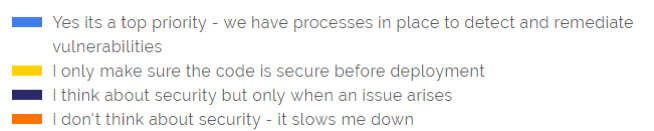
    developers shift-left chart 2Do these responses mean that in addition to their focus on innovation, functionality and quality, developers have also added security into their considerations when they are in the process of creating and building projects?

    The answer would appear to be yes, according to 58% of developers in our survey, with an additional 39% saying that security figures into their consideration when issues arise (14%) or that they validate security before deployment (25%). Only 3% of developers said that security is none of their concern since it slows them down.

    Are you taking security into consideration when developing software?

    developers shift-left chart 3

    While their responses show that there is still a ways to go before security is completely baked into development processes, it’s clear that most developers are already in the right direction, making security a priority within their tight schedules.

    The AppSec Process: Who’s On First?

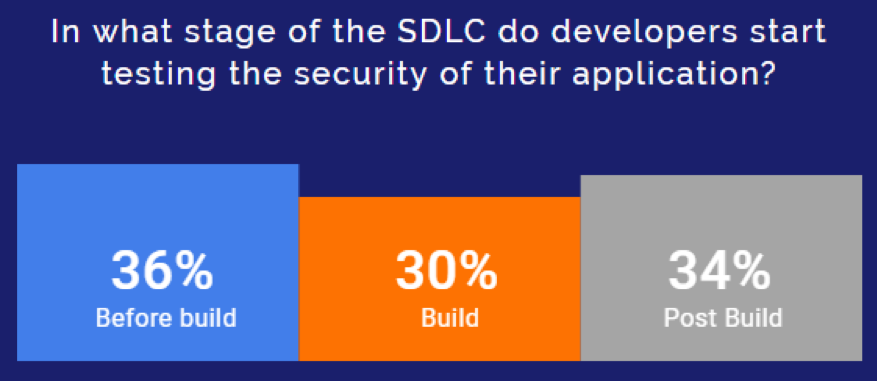
    How does making security a top priority or at least a consideration figure into the different phases in the DevOps pipeline? Practically, where is it being applied? We asked developers at which phase in the software development life cycle (SDLC) they started testing their AppSec.

    Their answers showed once again that developers are taking on security where it traditionally was not a part of their workflow. In fact, many replied that they are integrating security testing tools as early as the pre-build stage, with 36% of the respondents saying that they are testing in their IDE and repositories.

    developers shift-left chart 4Survey results also showed that along with the DevOps processes, they are also adopting tools that help them to shift security further left. 68% of developers report using at least one AppSec technology such as SAST, DAST, SCA, IAST or RASP. All of these automated solutions help security teams and developers detect potential security issues in their products, providing software teams with visibility and control over their AppSec.

    A Question of Remediation

    Until now, survey results show that developers have taken their place on the front lines of AppSec and the shift-left revolution, arming themselves with an impressive collection of automated detection tools. However, these solutions are creating a new set of issues that should worry stakeholders.

    It appears that the much-needed security testing tools are threatening to bury development teams under a mountain of alerts, which they are now required to research and remediate while keeping up with their deadlines. It’s impossible for developers to keep up with all of the security alerts in their inbox, especially considering that many AppSec tools were developed for security teams and focused on widespread coverage (detecting all potential issues), rather than accuracy and prioritization.

    This poses quite a challenge for developers, who say that they are spending a substantial chunk of their very valuable time dealing with remediation-related tasks. A full 42% of the respondents reported that they spend between two and 12 hours each month on these tasks, while another 33% said that they spend 12 to 36 monthly hours on them.

    In light of these time-heavy statistics, it is clear that developers need new technologies and practices that will allow them to prioritize security without slowing down the development life cycle and costing them so many valuable work hours.

    Helping Developers Win the Race to Remediation

    The survey results showed that developers today are required to take the lead when it comes to application security, but need more backup to do so. Detection tools can take developers part of the way, but to empower them through to remediation, organizations must provide them with developer-focused solutions that can help them to close the loop from detection to remediation.

    Once developers are alerted to a newly detected security vulnerability in their project, they need to validate it, assess its impact, research remediation options and perform the remediation path chosen. Currently, these are all time-consuming manual processes that require a level of skill and proficiency.

    With developers poised to face security head-on, organizations expecting them to fully address AppSec need to provide them with the tools that will easily integrate into their native environments and help them take vulnerability management one step further, enabling them to prioritize security alerts so that they can get to the most burning issues first and even automate their remediation process.

    — Ayala Goldstein

  • Top 5 AWS Security Mistakes: Leaky S3 Buckets

    Top 5 AWS Security Mistakes: Leaky S3 Buckets

    As we get ready to discuss our list of the Top 5 AWS Security Mistakes in the upcoming devopsy.kinsta.cloud webinar, we wanted to provide a preview of the type and depth of information we’ll be discussing. Since the most-talked about, and likely the most vulnerable, aspect of AWS security is inevitably those leaky S3 buckets, it’s a given we’ll tackle S3 first.

    In this article, we’ll dig into S3 buckets, explain how they become vulnerable, cover eight different ways they can inherently become open to the public and how to find and protect any public facing S3 data.

    The S3 Bucket

    S3 is one of the oldest services in AWS—so old that parts of it still support XML-based policies instead of the JSON you see everywhere else. S3 also has a lot of features that aren’t as commonly known or used anymore, such as allowing someone else to host put objects in your bucket yet still maintain ownership of them.

    Think of an S3 bucket as a server that can have subdirectories and files. Because S3 buckets can have a different root url (e.g. “dops.s3.amazonaws.com”) and have their own life cycle and settings, we tend to think of buckets as servers, not directories. Also, directories in S3 allow you to organize objects, but don’t have any distinct settings of their own, other than a name.

    AWS has a wide range of use cases it needs to support, which is why we have all these mechanisms. Sharing publicly, within an account, between accounts, hosting websites and so on, creates complexity. The good news is S3 always defaults to secure and private. The bad news is AWS allows human beings to use it (and therefore weaken security) and can be confusing to manage. For example, S3 supports both read and write permissions (and list, for buckets). It’s possible to have no public read but public write permissions, which could lead to people placing bad files in your directories.

    8 Ways AWS Data Becomes Public

    There are at least eight different ways an AWS S3 bucket can inadvertently become open to the public and be exposed to a data breach.

    • Bucket ACLs (Access Control Lists): This is an XML document that defines the first layer of access. By default, only the account owner has access, but this can be opened up to other AWS accounts or the public at large. Amazon recommends against using these at all, but it’s also the easiest way to make something public quickly, so we see it all the time.
    • Bucket Policies: These are super-flexible JSON policies that allow you to set things such as IP-based and other conditional permissions on a bucket. While this should be the primary way for managing public access, ACLs are the first tab and about three clicks to make something public. It’s this flexibility that leads to mistakes such as opening up to a wider range of IP addresses than intended or using a negative to block access to some IPs but inadvertently granting access to everyone else.
    • IAM Policies: These are the normal IAM permissions you use to control access throughout your AWS account. You can’t make a bucket public with them, since they only govern AWS users, but you can open up access to the bucket by authorizing another AWS service access, and then that service exposes the content.
    • Object ACLs: These are the primary object-level controls. It’s just like a bucket ACL and uses XML to allow access from other accounts or the public. Objects do not necessarily inherit bucket ACLs. You can totally make an object public even if the bucket is private.
    • Explicit IAM or Bucket Policy Statements: IAM policies and bucket policies can have explicit statements referencing the object, which will override the object ACL (if you own the object), since they are evaluated first.
    • Pre-Signed URLs: These object-level policies must be created using code (not the console) and provide temporary access for anyone with the URL. It’s used, for example, to share files for a few minutes or an hour for someone using your app to download a media file.
    • CloudFront Origin Access Identity: CloudFront is the AWS content delivery network and can serve as the front end to S3. You can create something called a CloudFront origin access identity to write an IAM policy that allows CloudFront to access the S3 content. If the CloudFront allows public access, it can access the S3 content and that won’t show in a bucket policy or ACL.
    • Cross Origin Resource Sharing (CORS) Policies: CORS is required if you use S3 in a website and don’t want the browser to break due to same site security settings. CORS in S3 won’t override an ACL or bucket policy but could mask public access in limited situations where the data is exposed in the web code through the authorized site.

    All put together, AWS evaluates IAM permissions first. Within those, the only one to make a bucket public over the web is the CloudFront Origin Access Identity. AWS then turns to the bucket ACLs and policies for any explicit deny statements. Then it looks at the object ACLs for public access. If you make an object public and the bucket policy doesn’t have an explicit deny, it is still public, but otherwise a good bucket policy will block everything. Besides, a lot of the problems are open bucket ACLs, not object ACLs.

    4 Ways to Find Your Public S3 Buckets and Protect Your Data

    What’s the best way to find public buckets? It’s relatively easy.

    1. Log into the console, click on S3 and look for the Public tag. AWS uses some advanced back-end math to evaluate all the bucket policies to figure out if something is public, which catches most of the fringe cases, but it does not show if the bucket is private and objects in it are public.
    2. Check CloudFront to see if you use any origin access identities. It’s easier to look here than in all your bucket policies (usually). This saves you from looking through object ACLs as well.
    3. Check any CORS policies, if you use them. This is the least common situation and I even hesitated to complicate this post by mentioning them.
    4. The bad news … there is no easy way to find public objects. Even finding them programmatically can be difficult if you have a large number. Also, changing a bucket ACL doesn’t cascade to the object ACLs so you need to run through and fix them one by one. However, if the bucket is locked down the attacker would need to know the full URL/name of the object to find it. It’s not perfect, but it’s better than nothing.

    That’s it. Although, if you know of any other fringe cases, please don’t hesitate to let us know. While conducting assessments, we find well over 90% of the problems are just basic bucket ACL and policy mistakes. Object ACLs are also an issue, but slightly lower risk since you need the exact URL to find them if your bucket is otherwise secured properly.

    If you are curious about the other 4 Top AWS Security Mistakes, sign up for the Aug 14 webinar.

    — Mike Rothman