Category: DevOps Toolbox

  • VMware Brings Java 17 Support to Spring Boot Framework

    VMware Brings Java 17 Support to Spring Boot Framework

    VMware this week made a Spring Boot 3.0 update for building microservices-based Java applications that is based on the latest long-term support release for the Java Standard Edition (SE) platform.

    Michael Minella, senior director of software engineering at VMware, said the latest edition of the framework supports Java 17. The hope is that adding this support will encourage organizations to move from Java 8 to the latest long-term release of the platform without requiring multiple upgrades to other previously released editions of Java SE.

    In addition, Spring Boot 3.0 now also natively supports a high-performance Java development kit (JDK) known as GraalVM along with version 6.0 of the Spring framework for building Java applications using OpenJDK, an open source version of Java SE that VMware made available earlier this month.

    VMware added support for Micrometer and Micrometer Tracing to improve the observability of Spring applications that will increasingly include multiple microservices dependencies.

    Finally, VMware also added support for Jakarta Enterprise Edition (EE) 10, an open source extension of Java SE that is being advanced under the auspices of the Eclipse Foundation.

    Minella said support for Java 17 coupled with GraalVM provides a stable foundation for building Java applications that are significantly faster than applications that rely on Java 8—still the most widely used edition of the platform. DevOps teams should begin to adopt a new standard for building and deploying the Java applications that still dominate enterprise IT environments, Minella said.

    There is, of course, no shortage of programming languages being used to build enterprise applications. After three decades, however, Java continues to dominate, in large part because of the sheer number of developers that have Java programming skills.

    It’s less clear how quickly legacy Java applications will be updated to run on Java 17 and the GraalVM. Now that Java 17 is supported in Spring Boot—the most widely used framework for building Java applications—the pace of adoption for the latest long-term release of the Java SE platform should accelerate in 2023.

    In addition, Minella noted the latest edition of the Spring framework will put organizations in a better position to take advantage of forthcoming advances such as Project Loom, an OpenJDK effort to replace threads with a lighter-weight concurrency model based on fibers that are managed via the Java runtime rather than the underlying operating system.

    Collectively, these and other technologies will make it less expensive to run Java applications that are significantly faster than previous generations of applications, he added.

    Most DevOps teams will find themselves managing a mix of Java applications—constructed using multiple variants of the core Java SE platform—for many years to come. However, it’s probable most new Java applications will be based on Java 17. In addition, there will be efforts to modernize legacy applications based on previous iterations of Java SE. As a result, most DevOps teams working in enterprise IT environments should expect to see an increase in the overall number of Java-based projects using microservices moving through their pipelines in the months ahead.

  • DevOps, Drought and Climate | Meta❤️PTP

    DevOps, Drought and Climate | Meta❤️PTP

    Welcome to The Long View—where we peruse the news of the week and strip it to the essentials. Let’s work out what really matters.

    This week: Data centers cause climate change, and Meta is rolling out Precision Time Protocol. (more…)

  • Palo Alto Networks Buys Cider Security to Lock Down Pipelines

    Palo Alto Networks Buys Cider Security to Lock Down Pipelines

    Palo Alto Networks this week extended its efforts to secure application environments by agreeing to acquire Cider Security, a provider of a platform for securing continuous integration/continuous delivery (CI/CD) platforms, for approximately $195 million in cash.

    The acquisition of Cider Security, scheduled to close this quarter, will extend the reach of the company’s Prisma Cloud platform that was updated last year to include a set of tools for securing infrastructure-as-code (IaC) used to provision IT infrastructure. Palo Alto Networks previously acquired Bridgecrew, which had developed an open source Checkov policy-as-code tool. Last month, Palo Alto Networks added software composition analysis tools to Prisma Cloud, as well.

    Cider Security developed what it described as an operating system for application security. The solution creates a graph that enables DevOps teams to visualize the relationships between all elements that make up a software development environment, including code. It then makes it possible to apply a set of controls to remediate any vulnerabilities and attack paths that might be identified using any number of third-party scanning tools.

    Palo Alto Networks CEO Nikesh Arora told industry analysts the acquisition is an example of the company doubling down on securing software supply chains alongside its existing portfolio of platforms and services for securing production environments.

    It’s not yet clear who is in charge of DevOps platform security, but increasingly there will be some type of central security function that works with application development teams to lock down software supply chains, said Mike Rothman, general manager for Techstrong Research, an arm of the parent company of devopsy.kinsta.cloud. “There’s going to be a central security group focused on securing the pipeline,” he said.

    As Palo Alto Networks continues to extend the reach of Prisma Cloud left, it continues to make a case for centralizing the management of cybersecurity through a portfolio of platforms that can be centrally managed via the cloud. It’s not clear how much organizations are centralizing management of security across their software supply chains and production environments, but Arora noted that interest in consolidating security vendors is high as organizations look to reduce the total cost of cybersecurity.

    In the meantime, organizations of all sizes are looking to employ DevSecOps best practices to better secure software supply chains in the wake of a series of recent high-profile breaches. In addition to scanning code for vulnerabilities, many of those organizations are starting to realize the tools and platforms used to build applications are also vulnerable to cyberattacks. The goal of those attacks is to insert malware that will manifest itself in any number of downstream applications that are eventually deployed in a production environment.

    It’s not yet apparent just how compromised those tools and platforms may be, but it’s clear software consumers are moving toward holding developers more accountable for vulnerabilities. The best-known example of those requirements is an executive order issued by the Biden administration that will require federal agencies to include software bills of materials (SBOMs) that list known vulnerabilities. Many enterprise IT organizations are expected to adopt similar requirements.

    One way or another, however, the tools and platforms that make up a software supply chain, along with the code they produce, are going to be subject to much greater scrutiny than ever before.

  • Data Centers IN SPAAACE | Discord GDPR Fine | AWS Fires Dead Wood

    Data Centers IN SPAAACE | Discord GDPR Fine | AWS Fires Dead Wood

    Welcome to The Long View—where we peruse the news of the week and strip it to the essentials. Let’s work out what really matters.

    This week: The EU wants to put servers in orbit, a GDPR penalty for Discord, and Amazon has the hatchet out. (more…)

  • Infrastructure Abstraction Will Be Key to Managing Multi-Cloud

    Infrastructure Abstraction Will Be Key to Managing Multi-Cloud

    There’s no doubt we’re now living in a hybrid multi-cloud age. Companies are using major cloud providers like AWS, Azure and GCP with niche cloud computing providers emerging within the market. Simultaneously, many organizations still retain workloads in on-premises data centers or embrace colocation. Regardless of deployment pattern, DevOps teams desire the same elasticity as the cloud, but it’s becoming increasingly difficult to consistently manage the nuances of each service provider.

    To support today’s distributed polyglot architectures, a common layer could ease issues when deploying applications and provisioning various servers. By decoupling the infrastructure control plane from specific cloud providers, a unified management console could bring visibility into cost and performance, empowering CloudOps with knowledge before they commit. But engineering such an outcome would rely on plugins for each environment and a robust set of APIs to enable programmatic control.

    I recently met with Jake Warner, Cycle.io, to explore how increased infrastructure abstraction can solve the above problems. According to Warner, a standard layer for computing management is needed to enable consistent control over multi-cloud and bespoke on-premise environments. Below, we’ll define this concept and consider the benefits infrastructure abstraction could bring to modern enterprise software development.

    The Problems Facing Infrastructure Management

    We like to think that the cloud is pervasive and that everyone’s on board with a similar computing style. However, this is far from the truth. Multi-cloud is rising, and 95% of businesses are making multi-cloud a strategic priority in 2022, a Valtix study found. Yet only about half of respondents felt they had the appropriate tools and skills required to execute a multi-cloud strategy.

    “There’s a lot of value in multi-cloud, including reducing risk, ensuring better uptime and the flexibility to select the best hardware for the use case,” said Warner. “But multi-cloud is extremely complex.” Using multiple clouds means supporting increasingly variable operational processes for each environment. Whether it’s AWS, GCP, Azure, Equinix or Vultr, operators also require a deep level of visibility into telemetry data. This becomes complicated to track as software is increasingly modular and distributed across multiple computing regions.

    Furthermore, on-premises data centers are far from dead—surprisingly, a Spiceworks study found that 98% of enterprises still used on-premises servers. Traditional servers are often preferred due to corporate restrictions or to meet security compliance mandates. It could also be a cultural case of “if it works, don’t fix it.” The dilemma is that you can’t easily obtain common cloud features like auto-scaling and load balancing while on your own infrastructure.

    Another issue Warner described is that traditional platform-as-a-service (PaaS) companies present inherent limitations if you aim to build substantive applications and services. “Many of these PaaS offerings make it really easy to get started but, more often than not, developers are quickly forced to make compromises with their approach. These compromises can create long-term technical issues, especially when it’s time to scale,” he said. “Need a server with a specific hardware configuration in a targeted region? Good luck. For most PaaS companies, their exit ramp is just as defined as their on-ramp.”

    Movements Toward Infrastructure Abstraction

    We’re already seeing movement within the market to manage the operational burdens of multi-cloud. One example is the Infrastructure Abstraction Layer (IAL), open sourced by Cycle.io, which Warner explained can act as a standardized system for deployments. With the specification, an infrastructure provider can generate an API endpoint to enable the provisioning of infrastructure without requiring a deep integration between both services. With this endpoint live, an application development platform or orchestrator gains the ability to send standardized JSON payloads to provision servers, allocate IPs, configure regions and a number of other requests. The response, another JSON payload, confirms that the desired request has been completed and includes a unique ID.

    With more programmatic control over infrastructure, an engineer could interface with a standardized list of all the servers, across a number of providers, to deploy to and act upon this information in one unified console. This layer is an opportune location to help compare costs and server configurations for different regions too. It’s also an advantageous spot to filter by proximity to showcase the closest available servers to optimize delivery.

    Benefits of Unifying Multi-Cloud Deployment

    Decoupling the infrastructure management layer from service providers can bring potential benefits to DevOps, said Warner. For one, it enables operators to extend infrastructure automation into their private data centers, helping them achieve the same programmability they would have in the cloud. A degree of standardization can remove many of the cons of multi-cloud, too—”Developers can move from one provider to another provider without any major changes along the way,” he said.

    Of course, IT doesn’t want an added burden. This is why an API-based solution is required to enable programmability, said Warner. By taking a RESTful API approach to managing a hybrid infrastructure, operators could create custom flows based on fine-grained environmental characteristics that change over time, like latency, expense or location. “One of the neat things is it allows infrastructure providers to constantly make tweaks and improvements without having to resubmit their integration with an underlying platform,” said Warner.

    The Flexibility of LowOps

    Today’s software deployment is increasingly wide and varied—a recent HashiCorp report found that 76% of organizations are already multi-cloud. Multi-cloud brings many advantages, yet it also multiplies the number of operational tasks required. At the same time, organizations want to leverage investments into on-premises data centers for as long as they are economically viable. Automating DevOps for such a varied infrastructure can be difficult without a unified layer decoupled from each niche computing area.

    According to Warner, companies require a LowOps platform and the flexibility to abstract this automation on their own infrastructure when appropriate, which can vary widely. For example, operators may be working with a fleet of tens of thousands of IoT devices. Furthermore, as we’ve covered previously, a LowOps method can be beneficial to small-to-medium-sized companies that may lack the resources to support complex infrastructure like Kubernetes.

    Could something like IAL ever become an open standard? Well, at the time of writing, the IAL specification has only been implemented by Cycle.io and a few of its infrastructure partners, but there’s no reason it couldn’t be extrapolated into a common specification down the line, said Warner. He even foresees a community marketplace or shared registry for infrastructure abstractions, enabling platforms to support hundreds of cloud providers.

    In conclusion, the need for LowOps, combined with the rise of multi-cloud and the staying power of on-premises data centers, is fueling a requirement for a decoupled management center. Infrastructure abstraction could enable the convenience of a PaaS while empowering operators with custom infrastructure choices.

  • Atlassian Extends Jira’s Reach Into DevOps Workflows

    Atlassian Extends Jira’s Reach Into DevOps Workflows

    Atlassian today added a range of capabilities to its Jira project management application that make it easier to manage software development projects, including a toolchain page that simplifies tool discovery for any given project.

    In addition, Atlassian is including a Discover tab on that page that makes it possible to track activities and set priorities by providing more context around the goals for any given project.

    Atlassian said it also plans to add scope change insights later this month and, in the first quarter of 2023, auto-detection of stuck issues will be added to an existing ability to predict when application development projects will be completed.

    The company has also added a pull request activities feed to the Code tab in Jira to make it easier to compare and contrast issues, identify anomalies and discover opportunities to move work forward along with a Code insights view for tracking branch, commit, pull request and deploy activities.

    The Releases tab in Jira now surfaces feature flag status alongside development, build and deployment statuses. There’s also an ability to automatically generate release notes in the Confluence wiki application provided by Atlassian. Finally, in 2023, Atlassian is committing to making available a dark mode option for running Jira that some DevOps teams prefer.

    Suzie Prince, head of product for DevOps at Atlassian, said all these Jira updates are extensions of an Open DevOps initiative the company launched earlier this year that integrated Jira with a wide range of DevOps tools. The goal is to make it simpler for DevOps teams to track project progress without necessarily having to deploy, for example, a separate analytics application. As part of that effort, Atlassian also revealed Jira has been integrated with Compass, an extensible catalog launched earlier this year for tracking software components and is available in beta.

    In effect, Atlassian is making a case for Jira to become a software development project tracking hub by automatically pulling data from various other DevOps tools. Rather than requiring a project manager to send multiple requests for updates to individual developers and manually enter data, Jira’s integrations with various tools can both pull relevant data and apply analytics in a way that makes it simpler to identify issues that are adversely impacting deadlines.

    Those insights can then be shared more easily with both development teams and other stakeholders in the business that have a vested interest in making sure project deadlines are met. It can also make it simpler for application development teams to justify the need for additional resources.

    Project management is, of course, one of those thankless tasks that doesn’t always get the appreciation it deserves. However, as it becomes easier to automatically collect data about the status of any given project, the task itself should become less intrusive. Hopefully, as those tasks become more automated, the friction that often exists between application development teams and project managers will also subside.

  • SAP Adds Low-Code Platform to Build Custom Apps Faster

    SAP Adds Low-Code Platform to Build Custom Apps Faster

    At the SAP TechEd 2022 conference, SAP SE today announced it has added a low-code platform, dubbed SAP Build, to its portfolio to make it simpler for organizations to build custom applications.

    Sebastian Schrötel, vice president and head of low-code/no-code solutions for SAP, said SAP Build is designed to make the company’s low-code tools more accessible to a wider range of developers, including so-called citizen developers that generally don’t have a lot of programming expertise.

    The goal is to make it possible to monitor, analyze and automate processes by leveraging more than 500 templates available within SAP Build. The goal is to make it possible to not only build applications faster but also deploy them via a single click, said Schrötel.

    The company’s approach to building custom applications separates its core applications from code developed by others by running pristine instances of SAP enterprise resource planning (ERP) applications in a separate cloud, known as the SAP digital core. A custom application is then deployed in a separate cloud and accesses SAP data via application programming interface (API). That approach enables SAP to update its ERP environment without worrying about breaking custom extensions.

    Of course, not every organization has transitioned to that model, so there are still plenty of instances of SAP software running in on-premises IT environments extended using code written in Java or the proprietary ABAP programming language. Over time, SAP is hoping that custom code will either be retired in favor of a process it has added to its ERP platform or by a more modern instance of that process running with a custom application deployed on a separate SAP cloud platform.

    SAP also has partnerships with providers of low-code platforms like Mendix and OutSystems that organizations can employ to build applications, but with the launch of SAP Build, the company is making a more concerted effort to encourage organizations to adopt the low-code platform it developed.

    While it’s not clear how eagerly low-code tools are embraced by citizen developers versus professional developers, the one thing that is certain is the pace of application development is accelerating. In many instances, professional developers are embracing low-code platforms as an alternative to procedural code to reduce expanding application development backlogs brought on by digital business transformation initiatives. In other instances, professional developers are employing low-code tools to collaborate more easily with end users as they build and deploy the applications that drive those processes.

    Regardless of the motivation, the impact this accelerated rate of application development will have on DevOps teams is profound. Not only do these applications have to be deployed in production environments, but DevOps teams must also secure and maintain a much larger application portfolio. As a result, the need to automate DevOps workflows will become more pronounced than it already is.

  • HPE Adds VMware Cloud Platform to Managed GreenLake Service

    HPE Adds VMware Cloud Platform to Managed GreenLake Service

    At the VMware Explore 2022 Europe conference, Hewlett Packard Enterprise and VMware, Inc. this week extended their alliance to integrate instances of the VMware Cloud platform into the managed HPE GreenLake service.

    Hang Tan, chief strategy officer for HPE, said for the first time HPE is managing the entire VMware Cloud stack in addition to its servers and storage platforms via a service that is based on a consumption pricing model. The goal is to reduce the total cost of IT by not requiring IT teams to overprovision IT infrastructure resources to run VMware Cloud, he said.

    Previously, IT teams could have deployed VMware Cloud on the HPE GreenLake service in a more disaggregated fashion, but that would have required separate billing processes, added Tan.

    Many organizations are currently revisiting their IT strategies during increasingly challenging economic times, noted Tan. The managed HPE GreenLake service enables IT teams to devote more of their internal IT resources to building and deploying applications rather than managing IT infrastructure, he added.

    It’s not clear how many organizations are transitioning toward a subscription model for consuming on-premises IT infrastructure, but in the cloud era it’s apparent that more of them are comfortable consuming IT as a service. HPE reported that the HPE GreenLake service supports more than 120,000 users accessing more than one exabyte of data worldwide. Among the top 100 HPE customers, nearly 80% have already adopted the HPE GreenLake platform, the company claims.

    The challenge many organizations face is they still need to deploy and update application workloads in on-premises IT environments for both performance reasons and to meet various compliance mandates. The HPE GreenLake service is an effort to bring a cloud operating model to on-premises IT environments running not just VMware Cloud but also a wide range of other rival software stacks that HPE already supports.

    Naturally, organizations that have embraced DevOps workflows would need to align the way they build and deploy applications to a managed service. IT teams that find that challenging, however, could opt for a self-service edition of the HPE GreenLake service that provides IT teams with more control over the underlying infrastructure being consumed as a service, noted Tan.

    Regardless of approach, it’s apparent that some type of as-a-service approach to consuming IT infrastructure is being more widely employed across what are becoming highly distributed computing environments. Each organization will need to determine for itself to what degree treating IT more as an operating versus capital expense makes the most economic sense.

    However, there’s no doubt that infrastructure cycles are generally going to be less disruptive when they are included as part of a multi-year services agreement. IT teams may also find it easier to take advantage of ongoing artificial intelligence (AI) advances when IT environments are managed on their behalf by a vendor.

    One way or another, the way IT infrastructure is managed is continuing to evolve at a time when organizations are starting to focus more of their efforts on applications that are becoming more difficult to build, deploy, secure and maintain.

  • Open Banking Shouldn’t Be Open Season on Your APIs

    Open Banking Shouldn’t Be Open Season on Your APIs

    Open banking has become the latest technological advancement for financial services applications that’s modernizing the industry. For instance, Mastercard recently began its Start Path Open Banking program, which provides select startups the opportunity to use Mastercard’s expertise while learning how to apply open banking to their own business. Open banking is creating new opportunities for revenue sharing and reducing data licensing and transaction fees between financial institutions and their partners. 

    Customers who take advantage of open banking also gain a more comprehensive, holistic view of their finances so they can be in a stronger position to manage their wealth. Just as importantly, open banking will provide more opportunities to use data for products and loyalty programs across the full spectrum of their organization’s offerings. Financial services companies like Mastercard also believe that open banking programs improve inclusiveness and financial literacy. With greater financial literacy, customers can work to lessen the chances of fraud in their accounts. 

    This follows an overall trend of breaking down barriers when it comes to connecting financial organizations with consumers through new, innovative financial technologies. In fact, 96% of consumers globally are aware of fintech services, including at least one money transfer and payment. Additionally, U.S. consumers are steadily adopting new fintech, including peer-to-peer payments. 

    While open banking has the potential to shake up the foundations of the banking industry, there is also the possibility of it becoming a target for threat actors and cybercriminals alike. The reason: application programming interfaces (APIs) that power open banking are being targeted.

    Hazards Associated With Open Banking 

    Open banking uses APIs to connect financial institutions with third-party applications. The Open Banking Project is one of the leaders in providing open source APIs for banking and relies on an open source system for financial services providers to access consumer banking and financial data.

    Yet, the more financial services organizations rely on APIs, the greater their attack surface becomes. APIs, as the building blocks of today’s modern web applications, are already a big target for threat actors and a primary attack vector. Banks, and the financial services industry as a whole, are also targets for cybercriminals. 

    IBM’s X-Force Threat Intelligence Index 2022 noted that finance and insurance organizations were the second-most targeted industries. Further, IBM also found that among those attacks, 70% were against banks and 14% were against other financial organizations. This tells us that while other organizations might make the data breach headlines,  banks and financial institutions are most often under attack by threat actors and cybercriminals. While one of the major drivers for this is financial gain, there is also a wealth of data in banking, including personal identifiable information (PII), payment card industry (PCI) data, account and payment information. Much of this can be leveraged on the dark web for financial gain. 

    Unfortunately, attacks on financial institutions and the APIs that drive much of our engagement won’t change anytime soon. The problem associated with APIs is that, if left unsecured, they can provide threat actors a foothold into sensitive data that can be  exploited. Additionally, many organizations don’t have a true understanding of how many APIs they have (many are interconnected) or how these vulnerable endpoints are being protected. It is incredibly difficult to protect something that you don’t even know exists! Adding an additional layer of complexity to the API conundrum is how third-party APIs are often relied upon. Using these sources, while potentially a time-saving strategy, can leave your networks open to attack. 

    Secure Open Banking Means Protected APIs

    If you’re a company that plans to start taking advantage of open banking, it’s important to mitigate some of these threats by establishing sound API protection strategies. First, gain visibility into your entire attack surface. After all, knowing yourself, including your APIs and web apps, along with understanding your enemy, will lead to success on the battlefield (to paraphrase Sun Tzu). Once you have a comprehensive view of your endpoints, including those older and deprovisioned APIs, you can be in a better position to protect against the multitude of threats that they face. Ideally, you will be able to get real-time analysis of traffic hitting your endpoints so you can get a more holistic view of a surface that is always changing. 

    It should also be emphasized that sophisticated attacks consist of bot armies generating API traffic and attacks. Malicious bots are being leveraged on an ever-growing basis in attacks, including DDoS attacks and account takeovers. While many bot attacks are automated, being able to detect and block them in real-time, when combined with continuous monitoring, can help to lessen the threat posed by bots.  

    A future with open banking is an exciting prospect due to the fact that it will put financial control back in the hands of businesses and consumers. While there should be a reasonable amount of caution placed in many of the API-centric open banking solutions, there are ways to alleviate these concerns. Strong API security, along with bot blocking and detection, can go a long way toward protecting against modern threats.

  • Fastly Adds Observability Tools for Edge Computing Environments

    Fastly Adds Observability Tools for Edge Computing Environments

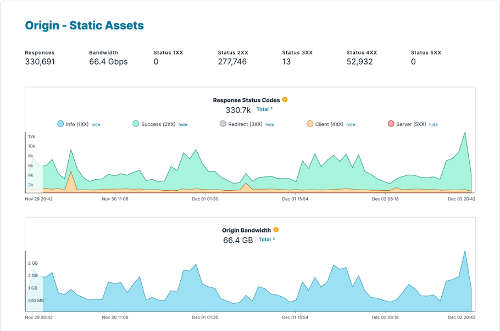
    Fastly, Inc. this week added a set of observability tools to its portfolio that are optimized for edge computing platforms connected to its content delivery network (CDN).

    Laura Thomson, senior vice president of engineering at Fastly, said the company is now providing a set of tools that enable DevOps teams to capture logging data and metrics in real-time via a single console.

    The first two available tools are Origin Inspector—to observe network traffic flows including HTTPS response codes—and Domain Inspector—to access metrics based on both historical and real-time data. In total, Fastly is now providing access to more than 200 metrics spanning client, origin, cache, web application firewall (WAF), Compute@Edge, Image Optimization services and others that cover 100% of the data generated since the service was spun up.

    There is no sampling of data, and the company is also providing integrations with 33 storage and analysis services provided by either Fastly or a third party, noted Thomson. IT teams can now log any aspect of HTTP requests and responses through a large variety of logging formats, including the Common Log Format, JSON or as a key/value store. IT teams can also store their own logs to make sure they retain complete control over access.

    Over the next several months, Fastly will continue to expand this portfolio of observability tools, including an Edge Observer dashboard it is providing to customers that are deploying applications at the edge, added Thomson.

    In general, observability tools are being used to not only improve processes and overall customer experience but also identify and block suspicious activity. Fastly is making a case for observability tools that enable DevOps teams to achieve those goals without necessarily having to deploy a separate observability platform.

    Of course, most DevOps teams have been continuously tracking various pre-defined metrics for years. Observability tools, in contrast, are designed to make it feasible to interrogate logs, metrics and traces so that IT teams can discover issues before there is a disruption to services. The challenge, of course, is that not every IT team necessarily knows how to shape the queries required to discover the root cause of a potential issue.

    One way or another, DevOps teams will need to be able to remotely diagnose edge computing issues as the number of workloads deployed on these platforms expands. IT teams are not going to be able to travel to the physical location of every edge computing platform every time an issue arises. In many ways, the rise of edge computing will force a transition to observability tools that will enable IT teams to more proactively manage IT environments rather than respond after a metric has already exceeded its threshold.

    It’s not clear to what degree that approach will prevent IT issues from occurring, but the amount of time required to detect and remediate issues should dramatically decline as more visibility into IT environments, including edge computing platforms, is gained.