Welcome to The Long View—where we peruse the news of the week and strip it to the essentials. Let’s work out what really matters.
This week: Alleged theft of GPL code, and Amazon will run its data centers on gas. (more…)

Welcome to The Long View—where we peruse the news of the week and strip it to the essentials. Let’s work out what really matters.
This week: Alleged theft of GPL code, and Amazon will run its data centers on gas. (more…)

Blameless this week announced it has integrated its namesake incident management solution with the Opsgenie alerting platform from Atlassian.
Aaron Lober, director of product marketing for Blameless, said the Blameless platform is now integrated with both Opsgenie and PagerDuty, the two most widely used platforms for managing alerts.
Blameless provides an incident management platform that normalizes data collected from a wide range of DevOps tools and platforms to determine how best to respond to different incident classes. Armed with those insights, it then becomes possible to quickly assemble the best team to respond to an event, said Lober.
That capability reduces stress because Blameless also surfaces recommendations for resolving incidents based on the data it has collected, he added.
The Blameless platform is tailored to organizations that have hired site reliability engineers (SREs) to manage IT operations using DevOps best practices, noted Lober. The overarching goal is to eliminate rote processes that, over time, conspire to burn out incident management teams that often experience high turnover rates, he added.
Opsgenie has been connected to the Blameless platform via the service catalog and alerting functions. Blameless users responding to or managing an incident can escalate issues to any teams defined within Opsgenie. The service catalog and alerting data generated throughout the life cycle of an incident is automatically captured and stored on the Blameless Incident Timeline. That capability makes it possible to identify appropriate service owners and the escalation protocol that was followed by that team. Blameless can also display the actual user name of each responder that has been notified.
When accessing Blameless via Slack or Microsoft Teams, Opsgenie can automate both when an incident channel is created and pre-select relevant services that should be made available. Alerts can also be manually triggered using commands from the Blameless chatbot for those who prefer to trigger alerts from within Slack or Teams themselves.
As IT environments become increasingly more complex, more organizations are making a concerted effort to apply DevOps best practices to incident management. The goal is to reduce downtime and increase overall resiliency at a time when organizations are more dependent on software than ever. As part of that effort, IT teams should identify the repetitive processes that span multiple incidents and then move to automate as many as possible.
In the longer term, it’s not clear what impact artificial intelligence (AI) will have on incident management. At some point, though, IT teams should expect their efforts to be augmented by machine learning algorithms capable of identifying issues before they balloon into a major crisis. However, there will always be some human intervention required to manage incidents for the foreseeable future, noted Lober.
In the meantime, most IT teams should continue to expect the unexpected at a time when IT environments have never been more dynamic and change multiple times a day.

New Relic has updated its observability platform to include the ability to better detect and track errors in addition to monitoring vulnerabilities.
At the same time, an instance of the New Relic observability platform that runs natively on the Microsoft Azure cloud platform is now also generally available.
Manav Khurana, general manager for observability product and chief growth office for New Relic, said the alliance will enable Microsoft Azure customers to consume New Relic as part of their existing Microsoft Azure services contract.
New Relic already provides an errors inbox to track issues, but is now adding a tool to track the impact an error might have by correlating data across traces and logs. The company has also integrated its platform with Slack to make it simpler for IT teams to generate alerts when vulnerabilities are introduced into codebases and manage errors more collaboratively.
Similarly, New Relic is also looking to foster greater collaboration between software engineering and cybersecurity teams. A New Relic Vulnerability Management tool with no additional configuration required captures security signals generated via the company’s Telemetry Data Platform in a way that can be analyzed using an interactive application security testing (IAST) tool that New Relic gained with its acquisition of K2 Cyber Security. Additional IAST capabilities available in preview include the ability to leverage a patented deterministic technique to identify and provide automated vulnerability validation that highlights a proof-of-exploit.
The overall goal is to provide more visibility and context for organizations that are implementing best DevSecOps practices, said Khurana.

It’s still relatively early days as far as the integration of observability platforms into DevOps workflows is concerned. A recent survey conducted by New Relic found most organizations don’t expect to have robust observability practices in place by 2025. While most organizations have tools to monitor predefined metrics today, there is a significant gap between observability platforms that enable IT teams to determine the root cause of an IT issue and monitoring platforms that generate an alert whenever a threshold is exceeded.
In fact, many organizations have too many monitoring tools that often surface conflicting or redundant alerts, noted Khurana.
One way or another, more codebases are being instrumented. As that process continues to evolve, the agents embedded in that code make it simpler to collect the logs and traces needed to advance observability. The challenge, as always, is that it takes time for the number of fully instrumented applications to exceed the number of legacy applications that are either partially instrumented or not instrumented at all.
As IT environments become more complex, the need for observability is becoming much more pressing at a time when most IT teams are more short-handed than ever, noted Khurana.
Regardless of approach, there’s no doubt that observability, with patience, will impact the management of IT for the better.

devopsy.kinsta.cloud is now providing a weekly DevOps jobs report through which opportunities for DevOps professionals will be highlighted as part of an effort to better serve our audience.
Our goal in these challenging economic times is to make it easier for DevOps professionals to advance their careers.
Of course, the pool of available DevOps talent is still relatively constrained, so when one DevOps professional takes on a new role it tends to create an opportunity for others.
The five job postings shared this week are selected based on the company looking to hire, the vertical industry segment and, naturally, the pay scale being offered.
We’re also committed to providing additional insights into the state of the DevOps job market. In the meantime, for your consideration:
SiriusXM
Washington, D.C.
Director – Client Build and Release Management
$166,000 to $300,000
SimplyHired
Dataflix
Remote
DevOps Engineer
$140,000 to $190,000
ZipRecruiter
Bay Systems
Mountain View, California
Senior Full Stack Developer
$120,000 to $174,000
Monster.com
GlobalLogic
Remote
Senior DevOps Engineer
$120,000 to $130,000
Indeed.com
Leidos
Ashburn, Virginia
DevSecOps Engineer
$97,000 to $202,000

Welcome to The Long View—where we peruse the news of the week and strip it to the essentials. Let’s work out what really matters.
This week: All of Microsoft’s cloud services go down, everywhere except China. Redmond’s IaaS, PaaS and SaaS—including GitHub—were dead for several hours, and are still running unreliably—despite Microsoft saying it’s fixed the problem. (more…)

The database of the future will be more than just a database. Instead, it will be a platform that focuses on the user experience and abstracts the technology. Looking at the evolution of application development, an enormous amount of effort has made it easier to build and deploy applications. Similarly, databases need to evolve for ease of use with a delightful developer experience and an exemplary user interface that surfaces features and functionalities that engineers will actually use.
Here are seven principal features needed to chart the development of the future database.
Serverless is unquestionably the most significant paradigm shift in software engineering in the last five years and the one that’s been realized the least. There aren’t that many people at this point that are all in on serverless. It’s the shift away from buying a server to a service that does what you need and scales with your growth.
Serverless by default is the only way to ensure the database of the future will be easy to operate while being consistently reliable. Serverless is evolving from running functions in the cloud to becoming the standard for fast-paced development teams that don’t want to worry about vCPUs or node pools but focus on outcomes.
The companies that are doing it the best still deploy servers, but they are leveraging products that scale independently, regardless of how many servers they have. Their component vendors can increase the number of resources allotted to them, and they only pay for what they use, and the architecture of the solution scales in that way. They’re not buying a single server and pushing it as hard as they can. They’re telling one platform, ‘here’s my code,’ they’re telling another, ‘here’s my data,’ and then that scales up based on usage much, much farther than buying a single server.
When people think serverless, they think JavaScript and Lambda, but there’s serverless PHP out there, too. It’s not just the JavaScript community. Other software paradigms are going for this. We will see more and more people pulling this out when they need to do some quick code and they want to ship to production as quickly as possible and scale as quickly as possible.
The most significant advancements in DevOps have been freeing developers from complex operations that overwhelm their day-to-day operations. Engineering teams today are organized around product and business goals, not maintenance and servicing. But databases have yet to catch up. Product teams still rely on experts to perform overly complicated database operations tasks.
The database of the future must fit into everyone’s DevOps workflows. It must be usable for any developer and leveraged by every team within a technical organization. The database needs to be operable by everyone and no longer require database admins to manage backups and capacity planning or worry about disaster recovery.
Developer-centric features like database branching, database developer environments, autoscaling and usage-based billing will be commonplace.
Reliable simply means it’s harder to hit the scaling limits. Not only does it mean that the database is there, but that you get the right information when something is going wrong, and you can collaboratively help scale.
Nothing scales infinitely. There are not enough computers in the world to scale something to infinity. You’ll always be able to query a database and pull too much information out of it too fast. No matter how many cars you get or how much horsepower you have, you can’t go a million miles an hour. A good database must let you know when you’re hitting those limitations and help you move past them, whether at a small scale, medium scale or large scale.
Future databases will be accessible to every imaginable client–from smart refrigerators to fleets of autonomous delivery vehicles. But this client-agnostic approach requires planning for many more transactions and connections than most current databases could ever manage simultaneously.
In the future, databases can handle unlimited connections through smart connection pooling, query replication and intelligent query routing. Databases will also need to serve a wide set of connections and clients. Although we are already seeing many databases offering web APIs and new connection types, as these get tested at scale, we will begin to see them adopted and used to power the next generation of applications.
Today, most businesses and applications don’t need a global database, which often introduces unnecessary complexity and operating costs. However, there are many reasons the future database will need to be globally distributed, as they must be located where you need them the most.
The key to this is knowing what your requirements are. Many people look at multi-region and think it’s faster reads, failover, scaling and breaking the speed of light. Ultimately, it’s all a series of tradeoffs. For example, when you read from a local replica, you trade off consistency because you have asynchronous replication. But this is really leveraging the global internet to deliver a better outcome where it’s necessary.
Being compliance-ready with regionally stored data enables you to scale rapidly to a new region and provides a great user experience by quickly serving locally available data. High-transaction, low-latency applications such as mobile games already need this capability.
But there’s one caveat: Global data distribution cannot break principle number two—being easy to operate. Tools will need to be elegant and have straightforward interfaces as their main goal is to make operations easier, not harder.
The future database is intended to be used by people and will be able to tell them how it needs to be used and how to make it better. All the tools you buy today can only give you the data you need to make some educated guesses. The future database will replace that with concrete recommendations, then self-healing actions.
This starts with basic data collection and observability and moves to, “let’s record every query that someone makes and use some decision engines and some AI and recommend how they can shard automatically.” It will be able to say, “I’ve recorded your database use for the last 30 days; this is how you should shard for optimal performance. Click the button, and we’ll do it.”
The future database will say, “You’re scaling too far for the single machine at a per-user level. You must break it down into two or break it down into four, and we figured out how to do it for you, so you don’t have to figure that out. We’ve sharded your data on your behalf.”
Future databases will also need to be designed for future scale. Only a handful of companies on the planet have hit a scale that tests the limits of current technologies, but as information grows, more companies will get there. The next databases will do that by automatically scaling both vertically and horizontally within seconds. Many existing databases require a maintenance window, replication and a failover before they can be scaled up or out. But downtime is unacceptable, and scale should not come at the cost of performance. And it doesn’t have to. The database of the future will scale intelligently and without a blip on the status page.
In short, the consumer should be able to get what they need when they need it, with no risks. It should be easy to say, “I’ve doubled the number of servers, I’ve doubled the amount of throughput. I’ve quadrupled the number of servers and the amount of throughput.” This is what sharding provides. Good sharding happens automatically at a super high scale, and you’ll only pay for what you use as you go along. The future database will do all of this without users having to turn a knob.
It will take the entire database industry to agree on these principal features, adopt a user-focused approach and build future database platforms designed to make engineers more successful by delivering superior products and services to their customers. I envision a day where every company no longer worries about its infrastructure and can simply focus on its business. I want development teams to take back control over their development workflow. Using a database should be as easy as writing code.

Harness this week announced it has acquired Propelo, a provider of an analytics tool that identifies bottlenecks in software engineering processes. Terms of the acquisition were not disclosed.
The Propelo offering will be made available as a module, dubbed Harness Software Engineering Insights, that organizations can choose within the company’s overall continuous integration/continuous delivery (CI/CD) platform.
Scott Sanchez, chief marketing officer for Harness, said Propelo is unique in that all the integration required to collect data from a wide range of DevOps platforms is already baked into the tool. As a result, DevOps teams can instantly collect telemetry data from not just the Harness platform but also CI/CD platforms such as Jenkins, GitLab and Azure. In addition, there are integrations with more than 40 third-party tools, such as the Jira project management software from Atlassian.
Those integrations enable the Harness Software Engineering Insights module to surface insights aligned with the DevOps Readiness Assessment (DORA) metrics from Google and the satisfaction, performance, activity, communication and efficiency (SPACE) frameworks.
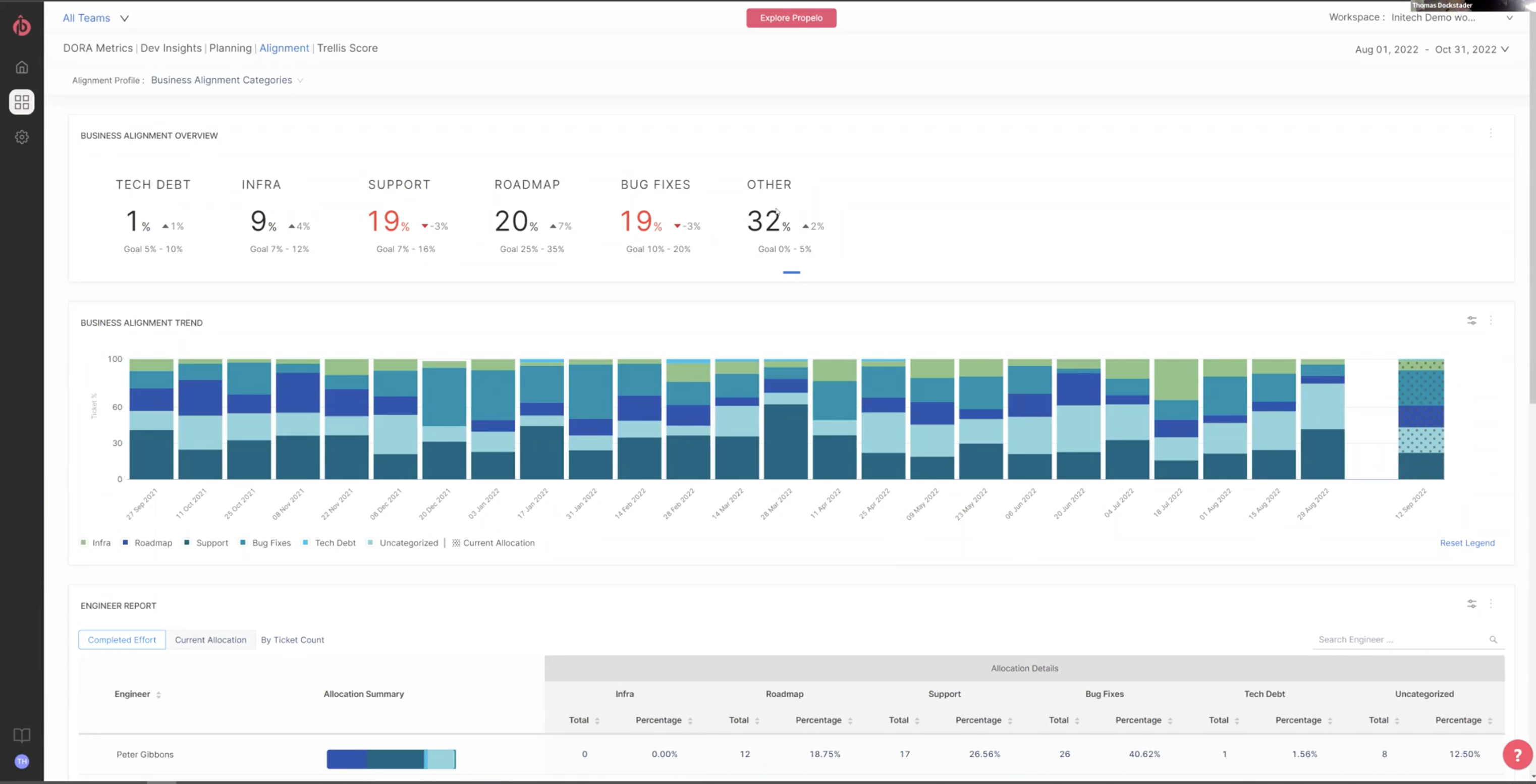
In an uncertain global economy, there is more focus than ever on increasing the productivity of DevOps teams, noted Sanchez. More organizations are going to be reluctant to hire as many full-time employees as they once did, so more attention is being paid to getting the most out of existing investments, he added.
That focus on productivity will naturally lead to a re-examination of workflows to identify bottlenecks in DevOps workflows that, if eliminated, would help increase the pace at which software is being developed, said Sanchez. In some instances, the software development life cycle (SDLC) processes companies are using are as much as 20 years old, he noted.
The acquisition of Propelo is the latest addition to a portfolio of DevOps tools designed to be deployed alongside existing platforms, noted Sanchez. Organizations that have been using platforms such as Jenkins are not going to rip and replace overnight, he added. The Harness portfolio is designed to be deployed alongside existing platforms to enable organizations to modernize their DevOps workflows in a much less disruptive way than rival DevOps platforms, said Sanchez.
Harness initially developed a CD platform before acquiring Drone to add a complementary CI capability. It then acquired ChaosNative to add a chaos engineering tool, based on the LitmusChaos open source tool, that is now being advanced under the auspices of the Cloud Native Computing Foundation (CNCF).
It’s not clear how quickly organizations will modernize legacy DevOps platforms. Still, in many cases, workflows and pipelines that were designed for a different era of application development are not able to support the pace at which modern cloud-native applications are being developed. It will, of course, be up to each DevOps team to determine whether adding additional DevOps tools and platforms makes economic sense; application developers tend to naturally gravitate toward organizations that reduce as much development friction as possible.
In an era where organizations are counting on developers to drive digital transformation initiatives, the underlying DevOps tools and platforms employed to build applications can easily make the difference between success and failure.

OpenAI’s generative pre-trained transformers (GPTs) bring powerful AI language models to every IT community. Within the past few months, ChatGPT has become an incredibly popular derivative of GPT. GPT also has the potential to shake up the DevOps and DevSecOps communities. This article will provide an overview of GPT, its history, current status and future effects on IT, especially DevOps.
Understanding the difference between supervised and unsupervised learning is essential before understanding GPT. Machine learning and artificial intelligence (AI) use unsupervised and supervised learning approaches. A supervised model uses labeled data to predict outcomes, while an unsupervised model does not. In general, supervised models have some limitations. They need a large amount of annotated data to learn a particular task, which is often unavailable, and they also need to generalize beyond the task for which they were trained.
A generative language model is a class of statistical models that differ from discriminative models. You can, for example, generate photos of animals that look like real ones using a generative model. Whereas with a discriminative model, you can determine whether an animal is a dog or a cat. Generative models can assign probabilities to a series of words, such as those that predict the next word or sentence. A generative pre-trained transformer is unique because it uses both unsupervised and supervised learning from unsupervised unlabeled text and follows up with discriminative supervised fine-tuning.
GPT-based models—ChatGPT, for example—always return the text “I am” when asked, “I think, therefore …” On the other hand, if you ask ChatGPT, “Why did the rabbit cross the road?” it may respond thusly:
“The age-old riddle still awaits an answer: Why did the rabbit cross the road? It’s a mystery that has stumped people for centuries and will likely remain an enigma for years to come.”
In this way, we can better understand how GPT-3 works. When asked, “Why did the rabbit cross the road?” most humans will answer, “To get to the other side.” A Google search for “Why did the rabbit cross the road?” mainly yields joke punchlines on the first page of the results. GPT doesn’t differentiate between humorous or cynical answers or specific matter-of-fact answers. The model makes only guesses based on the data. Since, in this example, most of the highest-ranked answers are jokes, GPT’s answer is enigmatic at best. GPT is not pixie dust; it doesn’t have a sense of humor, is not sentient, doesn’t understand juxtapositions and, most importantly, doesn’t evaluate context. As another example, I asked a GPT-3 tool to provide biographical information about two individuals. Abraham Lincon was the first. Approximately ten paragraphs of accurate facts were generated by the GPT-3 tool. Second, I used Gene Kim, the author of The Phoenix Project and The DevOps Handbook. GPT-3 began inventing facts about the companies he worked for by the second paragraph. Additionally, it suggested that he had spoken at TEDx. While a Dr. Gene Kim has spoken at TEDx, that Dr. Kim is an opthamologist.
GPT was released for the first time on June 11, 2018. Sometimes it is referred to as the GPT-1 model. A large dataset of online books was used to train it. A database called BookCorpus also was used for training. There were 7,000 unpublished books in the original BookCorpus dataset at the time of training.
OpenAI’s GPT-2 model was created in 2019 as a direct scale-up of the original GPT model. There were ten times as many parameters and ten times as much data in that training set. The GPT-2 dataset was based on an internal OpenAI dataset called WebText. A focus was placed on the quality of the documents when scraping web pages for this tool. The authors scraped all Reddit outbound links receiving at least three upvotes. GPT-2 used about 40GB of Internet text, 8 million web pages, and 1.5 billion parameters. In neural networks, parameters are often used as synonyms for weights (found more often in statistics literature). Parameters in GPT are the weights and biases of the dataset and generally indicate the power.
As the third-generation language model, GPT-3 was introduced in May 2020. It has 175 billion parameters, making it more accurate than its predecessors—an increase of tenfold in capacity over the next largest NLP model available. Sixty percent of GPT-3’s weighted pre-training dataset is filtered Common Crawl. Common Crawl is a nonprofit organization that crawls the web and makes its archives and datasets freely available. Since 2011, Common Crawl has collected petabytes of data. About 37% of the GPT-3 sources were WebText2 and other sources, while about 3% came from Wikipedia. OpenAI Codex was also included with GPT-3, which generated code and served as the basis for GitHub’s Copilot.
As part of its training, GPT-3 used data available until November 2019. Thus, GPT-3 was unaware of events beyond January 2020. COVID-19, for instance, was unknown to it. Even so, it did have extensive knowledge of coronaviruses, pandemics, Wuhan and SARS. As of September 22, 2020, Microsoft, through a considerable investment, received exclusive permission to use GPT-3; others can still access GPT-3’s public API, but Microsoft is the only one with access to the underlying model. OpenAI developed DALL-E in January 2021, which generated images using GPT-3. OpenAI introduced models in the “GPT-3.5” series on November 30, 2022, including the now-famous ChatGPT, derived from a model from the GPT-3.5 series. Unlike GPT-3, GPT-3.5 includes data up until November 2022.
I have used several AI language model tools in the past few years based on GPT-3. It is used by Grammarly and by some useful writing tools like Jasper.ai and Wordtune. I also have had great success with GPT-3 research tools like Frase.io and Genei.io. One of my more recent go-to tools is called QuillBot. In my experience, these tools are aids, not replacements for writing. When I first started using these tools, I was writing a book about Dr. W. Edwards Deming. I would get inaccurate information about Dr. Deming’s childhood from a GPT-3-based tool. One time, it said he had six siblings. In fact-checking, GPT-3 confused Dr. Edwards Deming with Dr. Richard Deming. With surgically precise input, the results could be more accurate. One of my findings was that if I used a GPT-3 on a well-known subject, the information was primarily precise; however, lesser-known topics produce fewer facts. Furthermore, I learned from the documentation that when people talk about training GPT-3 models, what they really mean is that you can input a maximum of 2,048 linguistic tokens, which is about 1,500 words. In GPT-3, content is predicted by analyzing past context, one word at a time. The content you input to GPT-3 significantly impacts its output. As a result, it pulls words from a shortlist and calculates their probability of being used. A great set of tutorials on using GPT-3 can be found on Jasper.ai. This figure shows how Jasper (which is based on GPT-3) word prediction works.

People have accomplished some remarkable things by using the 2,048 tokens creatively, but complex training still needs to be improved. Due to the Microsoft deal, the original GPT models were close sourced, and robust training of GPT-3 models is unlikely to happen any time soon.
Where does all the hype come from? Despite its limitations, GPT-3 has created some unique industry artifacts. DALL-E and Copilot by Github are excellent tools. On September 8, 2020, the Guardian published an article titled, “A robot wrote this entire article. Are you scared yet, human?” This article was written by GPT-3. Using GPT-3, some full-blown novels have also been written; they’re not horrible, but they could have been better. According to a study conducted by Drexel University in 2022, systems based on GPT-3 could be used to screen for Alzheimer’s disease at an early stage. Just five days after its launch, ChatGPT surpassed one million users. It took 41 months for Netflix to reach one million users and 10 months for Facebook to reach one million users. By the end of the first quarter of 2023, ChatGPT will have over one billion users. Based on GPT-3.5, ChatGPT is more robust and up-to-date.
How smart is ChatGPT? Using a verbal-linguistic IQ test and Raven’s ability test, ChatGPT has an IQ of 147. GPT-3.5 has passed the United States bar exam, CPA exam and U.S. medical licensing exam. People often ask if it is plagiarism to use GPT-3. Technically, the answer is no. The GPT datasets are estimated to represent 300 years of pre-training with a connection of trillions of words. However, using these tools for rewriting other people’s work is, from an ethical viewpoint, plain and straightforward plagiarism. A recent set of tweets by Greg Brockman, president and co-founder of OpenAI and Sam Altman, CEO of OpenAI, sums up the current status of ChatGPT.

AI learning models based on GPT-3 are here to stay. From grammar correction to proposal writing to code generation, GPT-3 has revolutionized everything. In my opinion, GPT-3 still needs to solve some challenges before it is of actual value to DevOps and DevSecOps patterns and practices. For example, a great use case for GPT-3 is training it to deal with organizational incidents. If a GPT model could be trained this way, it would become an excellent tool for providing adaptive diagnostics. Based on the current GPT implementation, this is very difficult or impossible. Another example would be to train the model with the organization’s IT risk policies and enable predictive solutions. The opportunities are endless.
An alternative to GPT-3 is InstructGPT, which OpenAI describes as more truthful and less toxic. It has also been noted that GPT-3 can generate untruthful outputs. GPT models aren’t generally aligned with their users. InstructGPT models follow instructions much better than GPT-3. Furthermore, InstructGPT produces more truthful and less toxic outputs. Therefore, they generate fewer harmful outputs and more facts. The InstructGPT models use human feedback as part of the training model. Some of the real power behind ChatGPT is that it uses InstructGPT along with GPT-3.5. Some of my upcoming research will focus on prototyping some of the complex opportunities DevOps and DevSecOps practitioners currently face using InstructGPT.

Node.js is an open source development platform for running JavaScript code on the server side. Node is useful for developing applications that require a persistent browser-server connection and is often used for real-time applications such as chat, social applications, or news feeds.
DevSecOps is a way for development, security, and operations teams to work together throughout the project life cycle. It is often implemented by adding security to existing DevOps teams and agile processes.
The idea behind this collaboration is to incorporate security early in the development process. This is called shifting security left. As security moves to the “left” of the development process, application vulnerabilities and bugs are discovered and addressed faster. This leads to more secure product releases with a reduced need to apply patches and troubleshoot in production. Applying DevSecOps to Node.js development can improve both the efficiency and security of Node.js projects.
Here are a few cyber threats that affect many Node.js applications.
XSS attacks inject manipulated client-side JavaScript code. Web apps are vulnerable to XSS if they don’t validate inputted hostnames from the DNS. Attackers can use forms to enter malicious scripts and hack into the system. In some cases, entering code into the filename can trigger cross-site scripting in the target browser.
A hacker can use your file upload form to hack into your system. There are many ways for this vulnerability to lead to a system compromise. Though usually mitigated by modern front-end frameworks, in some cases it may happen that putting javascript into the filename will trigger XSS in a user’s browser, allowing the theft of session IDs. In other cases, an attacker might get sensitive server information by uploading a file to the Node.js server and running it by exploiting a path traversal vulnerability.
Developers are responsible for writing secure application code, but it’s impossible to fully guarantee the code’s security when using open source components. A code injection attack involves injecting malicious code into the target system and forcing the application to execute it, allowing attackers to access the codebase. Inadequate data validation often results in code injection vulnerabilities.
Cookies help web apps identify specific users by storing user actions in the underlying infrastructure (e.g., an eCommerce shopping cart that remembers the items a customer selects).
Developers should use custom names for cookies (rather than defaults) to prevent attackers from identifying and targeting cookies and extracting data.
Brute force attacks often affect Node.js applications. An attacker randomly generates millions of passwords to find one that works, logging in to the application. You can prevent brute force attacks by strengthening the authentication mechanisms, limiting the number of permitted login attempts from a single IP, and encrypting stored passwords (using bcrypt.js).
This type of session hijacking forces an authenticated user to execute malicious actions on the target web application. The attacker hijacks a legitimate user’s session to bypass security controls and change the application’s state. CSRF can force users to transfer funds or change their account details, potentially compromising the web application’s security.
A compromised, weak, or incomplete authentication mechanism is a common vulnerability. Many developers think of authentication as something that “just works”. However, authentication can easily be bypassed by attackers if not implemented correctly.
In Node.js, you have the option of using the default Node.js authentication solution. There are a few things to keep in mind:
Alternatively, use one of many third-party solutions available for application authentication, which may be superior to built-in Node.js functionality.
There are many things to consider when building error handling functionality:
Code linters help identify various issues in code before compiling. They let you detect the most common issues and ensure you follow best practices.
Code linters have their own rules, which you can customize according to your requirements. Before using a linter, make sure you enable rules related to security vulnerability detection in the linter configuration.
A good logging library provides developers with powerful troubleshooting and monitoring capabilities. On the other hand, unnecessary or excessive logging affects application performance and consumes more resources. Therefore, you should only use reasonable log levels when deploying applications to production environments.
When constructing log messages, they must be in a format that can be read and understood by humans and machines. Logging ambiguous messages can lead to misunderstandings among developers. An error message must not only describe the problem but also advise what the user can or should do to fix it.
It is also important to ensure that your logging mechanism captures all relevant information such as IP addresses, usernames, and actions taken.
Never retrieve or store sensitive information in application logs. This violates compliance standards such as PCI and GDPR. However, there are times when you need to record this information for troubleshooting – in this case, it is recommended to mask or anonymize sensitive information before writing it to the log.
Node.js security best practices are well known and security awareness is growing among Node.js developers. However, many organizations don’t have a clear organizational structure for implementing development best practices. Here are a few steps your organization can take to transition a Node.js development team to a full DevOps model:
For example, adding static application security testing (SAST) within the IDE and on every commit. Linters should be deployed centrally with a consistent configuration for all developers in the team.
During the CI/CD process, when a Node.js application is deployed to a staging environment, there should be automated tests that can identify security misconfigurations and integration-related vulnerabilities. Dynamic application security testing (DAST) tools are ideal for this purpose.
No DevSecOps process is complete without a safety net to identify security issues in production. This requires the use of tools like web application firewalls (WAFs), which can detect and block malicious traffic, and runtime application self-protection (RASP), which can proactively respond to attacks. Both these tools provide feedback to DevOps teams to help them identify and remediate vulnerabilities in the underlying application.
By implementing these three stages, you can be sure that Node.js security is not just an ad-hoc practice but a formalized, coordinated process involving developers, operations teams and security experts.
In this article, I explained the basics of DevSecOps and how to secure Node.js:
I hope this will be useful as you implement Node.js security in your DevSecOps organization.

Welcome to The Long View—where we peruse the news of the week and strip it to the essentials. Let’s work out what really matters.
This week: New ideas bring low-power ML inference, and more big-tech jobs are going. (more…)