Category: DevOps Toolbox

  • Atlassian Strengthens Jira Navigation and Integration

    Atlassian Strengthens Jira Navigation and Integration

    Atlassian today made it simpler to navigate the Jira Software and Jira Work Management project management applications as part of an ongoing effort to make it simpler for DevOps teams to collaborate with other stakeholders of application development projects.

    Megan Cook, head of product for Atlassian, said the ability to share release dates across multiple calendars, overviews that aggregate views of and summarize multiple projects along with command palette and importer tools make it simpler for, for example, marketing teams and other individuals outside of a DevOps team to keep track of application delivery schedules.

    In addition, Atlassian has tightened integration between Jira and Confluence, a wiki-based collaboration application, and a previously launched Atlassian Intelligence capability that infuses generative artificial intelligence (AI) capabilities will also soon be added to Jira Work Management alongside existing support for Jira. There will also be connectors for Jira Work Management to integrate with Atlassian Admin, Atlassian Analytics, Access and Data Lake offerings, along with advanced security features.

    Finally, Atlassian is adding support for a design tool developed by Figma that can now be directly installed in Jira.
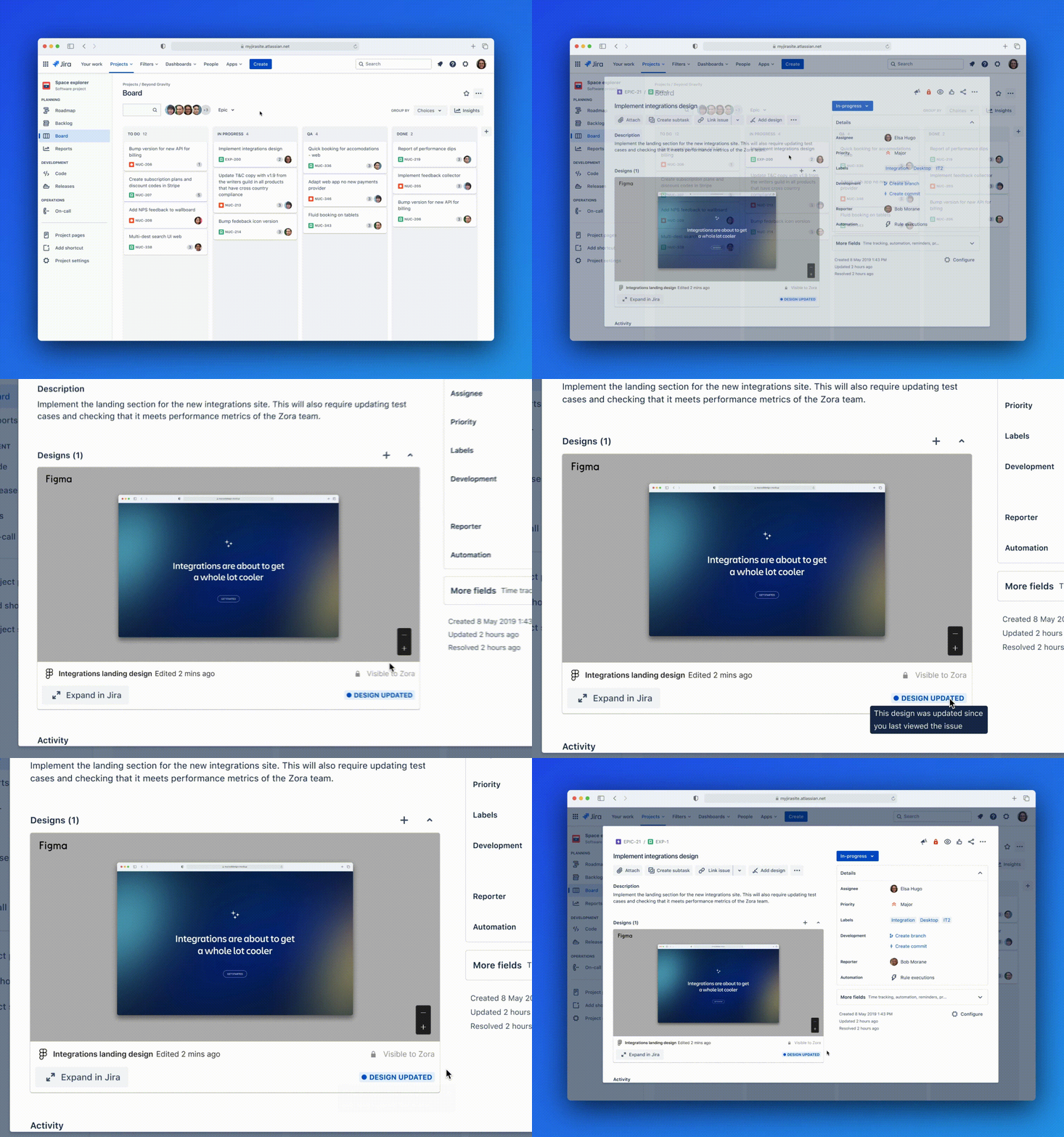
    Collaboration between application development teams and the rest of the business is becoming more crucial as organizations increasingly realize how much they depend on software to drive revenue. One of the primary reasons Atlassian is investing in generative AI is to make it simpler for anyone to understand the status of any given project and the downstream impact any change to a delivery schedule is likely to have.

    Generative AI, of course, has already moved from being considered advanced technology to a set of capabilities that most end users will soon expect to be embedded within every application. One of the primary benefits generative AI provides is it makes a range of applications originally designed for specialists, such as a software engineering team, more accessible to a wider range of end users.

    It’s not clear how much generative AI will change the relationship between DevOps teams and the rest of the business, but with increased visibility, there should be a greater appreciation for the challenges developers and DevOps teams face. Any member of an organization should be able to plainly see, for example, why more resources need to be allocated to a specific project to ensure that an application is delivered on time.

    At the same time, application developers will find project management processes are about to become less disruptive as it becomes simpler to automatically import relevant data from the tools and platforms they use directly into a project management application such as Jira.

    One way or another, software engineers should expect that as generative AI continues to evolve, the divide between them and the rest of the business will narrow. There may be times when that level of additional scrutiny may feel burdensome, but on the whole, it should make it easier for DevOps teams to get the resources required to achieve any given goal. After all, the root cause of any given delay to a project will soon be plain for anyone to see.

  • Digma Leverages ML to Bring Observability Insights to IDEs

    Digma Leverages ML to Bring Observability Insights to IDEs

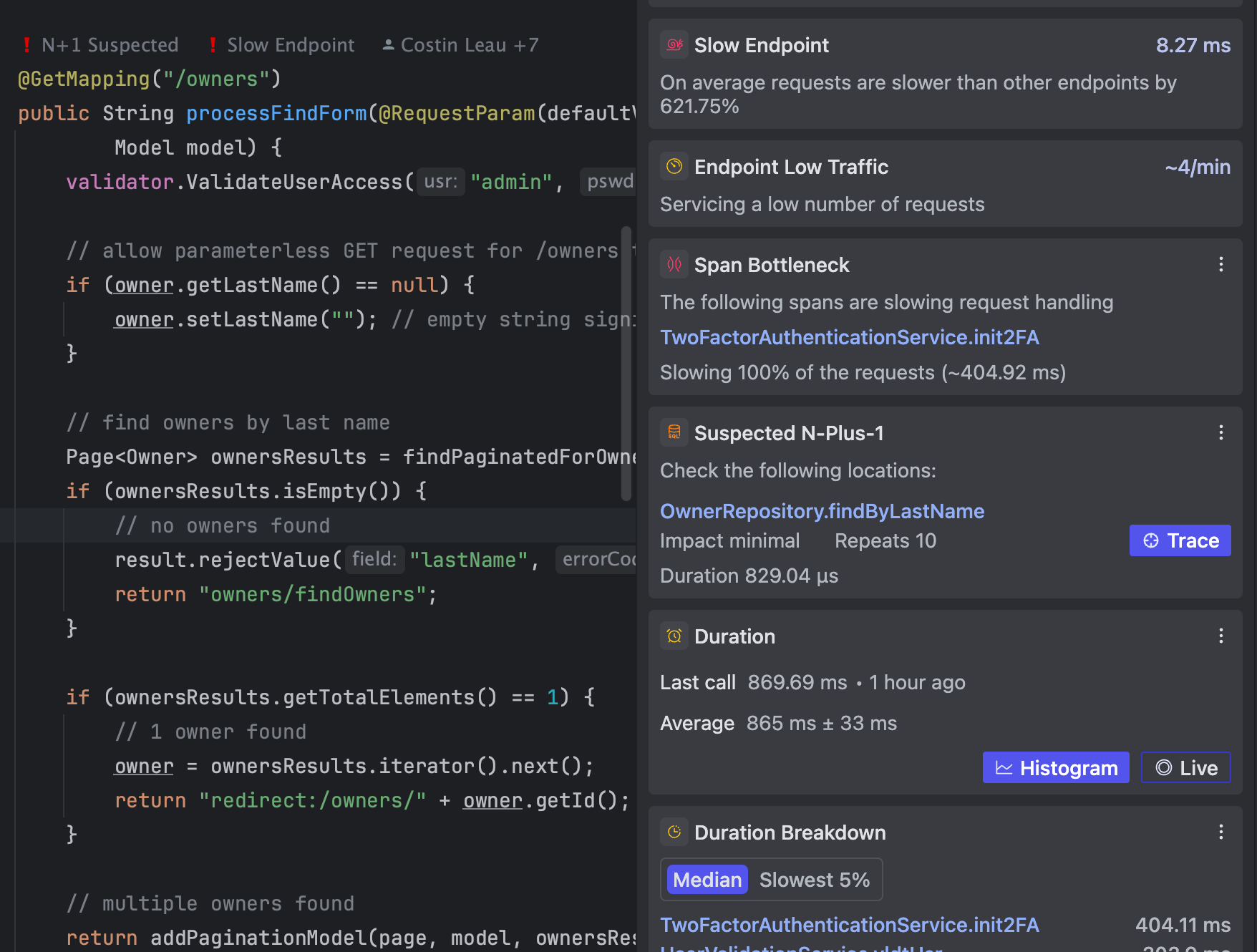
    Digma has launched a namesake platform the provides developers with continuous feedback from observability data that surfaces directly within their integrated development environment (IDE).

    Digma CTO Roni Dover said the Digma Continuous Feedback platform leverages machine learning algorithms to enable developers to easily analyze their code at runtime to identify issues, anomalies and regressions. Digma Continuous Feedback removes the need to consult a separate dashboard that requires developers to log into an observability platform.

    In fact, the reason developers often don’t make use of the data that observability platforms provide to write better code is that it’s not readily accessible at the time they are writing code, noted Dover.

    In general, it’s become much easier to collect logs, metrics and traces by using open source OpenTelemetry agents that can be embedded within software libraries. The Digma Continuous Feedback platform applies machine learning algorithms to that data to provide developers with insights on improving code in real-time, said Dover.

    The ultimate goal is to make it simpler for IT teams to distinguish when, for example, a software component actually needs more memory or is simply inefficient, he added. Those insights can be applied to code written by developers or code generated by an AI platform.

    Whether code is written by a human or generated by a machine, quality is often in question. Developers with varying levels of experience will naturally write code that can differ substantially in quality and efficiency. At the same time, developers may be asked to fix code someone else wrote; the original author no longer works for the organization, noted Dover. In either use case, the Digma Continuous Feedback platform immediately surfaces issues that will enable organizations to set higher baselines for code quality, he added.

    That baseline is especially critical as more code starts to be generated by generative AI platforms based on general-purpose large language models (LLMs) trained using code samples of varying quality collected from across the web. Developers will be able to immediately determine any issues that may arise should they choose to incorporate that code within an application.

    Developers, of course, don’t deliberately set out to write bad code, but the tools that enable them to identify issues are not easily accessible. In fact, too many developers tend to view observability platforms designed for IT operations teams as being overly complex, noted Dover. The Digma Continuous Feedback platform takes that issue off the table by identifying issues without increasing the level of cognitive load developers are expected to carry, he added.

    Eventually, thanks to the rise of machine learning algorithms and generative AI platforms designed specifically to write high-quality code, the overall state of software engineering will improve. The issue is determining the best way to get the benefits these technologies provide directly to the developers who write code—an issue that is at the heart of so many DevOps challenges.

  • Tray.io Automation Framework Leverages AI to Build Integrations

    Tray.io Automation Framework Leverages AI to Build Integrations

    Tray.io today added an automation framework to an integrated platform-as-a-service (iPaaS) service that leverages an existing Merlin artificial intelligence (AI) engine to identify the most efficient way to automate a workflow.

    The Tray Universal Automation Cloud service can be invoked via three distinct application programming interfaces (APIs) to programmatically create those workflows using a Tray Code low-code or Tray Build no-code tool or via a Tray Chat natural language interface. A Connectivity API provides access to more than 600 connectors, while a Trigger API enables developers to drive event-driven processes. An Authentication API provides a method for managing authorizations. The platform also provides access to testing, error handling and debugging tools.

    Tray.io CEO Richard Waldron said that approach provides IT teams with a composable framework for building integrations that leverages a set of large language models (LLMs) that the company has embedded within its Merlin AI engine to enable IT teams to optimize workflows.

    In addition, the underlying platform takes advantage of Kubernetes, Docker containers and serverless computing frameworks to dynamically scale as required, he added. In contrast, rival legacy iPaaS environments are not as elastic, which enables Tray.io to base its pricing on actual usage of a modern IT platform, noted Waldron.

    The overall goal is to provide a single platform that any type of developer, including business professionals, can invoke to automate workflows, said Waldron.

    As the overall codebase that DevOps teams manage continues to increase, the number of required integrations between applications and processes continues to increase exponentially. Rather than relying on lower-level code to create those integrations, an iPaaS provides the means to automate and simplify building integrations and enable developers to spend more time writing the business logic that will drive a new application. Historically, most of the integrations required to drive, for example, a digital business transformation initiative required a significant amount of low-level code to be developed and maintained.

    Tray.io is now making a case for an iPaaS that takes advantage of AI to more easily invoke generative AI capabilities to optimally create those integrations based on workflow attributes.

    Each organization will need to determine how heavily to rely on AI platforms to build integrations, but these advances—alongside generative AI tools that developers have already embraced to build software—are making developers more productive than ever. That accelerated pace of application development will require DevOps teams to automate as many processes as possible. One option for achieving that goal is for organizations to rely more on an iPaaS to enable developers to build integrations in a way that doesn’t necessarily always have to flow through a DevOps pipeline.

    One way or another, thanks to the rise of AI, the way software is built is about to change drastically. The challenge and the opportunity now is to determine how best to reengineer workflows in a way that best aligns with the goals of the organization.

  • Cisco Acquires Splunk to Create Observability Powerhouse

    Cisco Acquires Splunk to Create Observability Powerhouse

    Cisco today revealed it has signed a definitive agreement to acquire Splunk for $28 billion in cash. The deal will add Splunk, one of the most widely-used platforms for managing IT operations, to Cisco’s portfolio, joining the AppDynamics observability platform in addition to a wide range of IT infrastructure equipment.

    Chuck Robbins, CEO of Cisco, told industry analysts the combined entity will be one of the largest software companies in the world. The Splunk and AppDynamics platform creates a comprehensive observability platform spanning applications, networks and hybrid cloud computing environments, Robbins added.

    By combining AppDynamics with the data collected by the Splunk platform, the combined company will be able to provide greater insights into IT operations than any other company, added Robbins.

    Splunk CEO Gary Steele said the acquisition represents the next natural, logical step for Splunk and furthers its long-term partnership with Cisco to keep IT environments secure and resilient. The two companies will also be able to apply artificial intelligence (AI) more effectively to IT operations, he added.

    In its most recent quarter, Splunk reported revenues of $911 million, with cloud revenue accounting for $445 million, or 29%, of the total. Total Splunk revenues are forecasted to be between $3.925 billion and $3.95 billion for fiscal 2024.

    Splunk previously acquired SignalFX, a provider of an observability platform, in 2019. It’s not yet clear how the platform might be integrated into the AppDynamics platform, but Robbins said there is little overlap between the observability platforms the two companies currently provide.

    The Splunk acquisition comes at a time when it’s becoming more apparent that the need for observability extends well beyond DevOps workflows as organizations become more dependent on software.

    Each IT organization will need to determine how long it will wait for the Splunk acquisition to close before investing further in observability. Historically, acquisitions of this scale have been accompanied by price hikes to help fund the merger once the deal is concluded.

    In the meantime, IT and DevOps leaders will likely revisit the way IT is managed in the months ahead. Splunk came to prominence at a time when most workloads were running in on-premises IT environments. While the bulk of workloads continue to run in those environments, many workloads deployed in the cloud are being managed using platforms designed specifically for those environments. Splunk has been making a case for a hybrid cloud computing approach that assumes the management of on-premises and cloud computing environments will become more unified.

    In theory, economic headwinds are driving more organizations in that direction to reduce the total cost of managing IT. But it’s just as feasible to extend cloud tools to on-premises IT environments as it is to extend legacy tools to the cloud. Despite the inevitable outcome, Splunk rivals will spend the better part of the next year coming up with offers to switch platforms both before and after the deal eventually closes.

  • Nobl9 Unfurls Reliability Center for Managing SLOs

    Nobl9 Unfurls Reliability Center for Managing SLOs

    Nobl9 today launched a next-generation platform for managing service level objectives (SLOs) in a way that promised to improve overall reliability.

    Brian Singer, chief product officer for Nobl9, said in addition to enabling DevOps teams to meet SLOs, the Nobl9 Reliability Center also now provides a single source of truth about the state of reliability in an application environment.

    That capability is critical because as DevOps teams add new features to applications, they need insights into how they are impacting the reliability of the software environment, said Singer. No matter how great any new capabilities might be, it won’t matter much if the application environment slows to a crawl or outright crashes, he added.

    Nobl9 Reliability Center addresses that need by providing dashboards and reports to assign reliability scores based on the metrics collected from the SLOs defined. Those scores can then be shared with senior business and IT leaders so they can better understand the actual state of an application environment, noted Singer.

    In addition, the platform will recommend SLOs and policies and can be used to automate runbooks to improve reliability. The goal is to enable DevOps teams to continuously monitor and manage using SLOs via alerts that are received in a way that is timely enough to act on, added Singer.

    That approach enables DevOps teams to make sense of conflicting alerts generated today by multiple monitoring and management tools. A recent survey published by Nobl9 found 72% of respondents are using six or more monitoring and observability tools.

    The Nobl9 platform collects SLOs by tracking workflows through more than 50 integrations with various DevOps tools and platforms.

    SLOs, of course, are not a new idea. They have been used as a metric to track the performance of IT services for decades.

    However, as more microservices-based applications are built and deployed, it’s becoming more challenging to maintain SLOs across applications that have many more dependencies than legacy monolithic applications. Ultimately, each IT team needs to provide some sort of objective benchmark that assesses their overall effectiveness at delivering application services. The Nobl9 platform makes it simpler to track whether SLOs are achieved and maintained.

    That’s crucial because as more organizations depend on software to deliver digital services, any disruption is likely to have a direct impact on profit and revenue. As such, the reliability of application environments has become a major concern. The issue, of course, is that many of those application environments have dependencies on legacy platforms that, in some cases, have been running for years. Each feature and application programming interface (API) added over time conspires to adversely impact performance. In an era where IT teams are now trying to manage distinct services rather than individual applications, latency can significantly slow down response times.

    Each organization will need to determine for themselves how aggressively they need to manage SLOs. But thanks to the rise of digital business transformation, more senior IT and business leaders are focused on them than ever.

  • Harness Launches Open Source Gitness Platform

    Harness Launches Open Source Gitness Platform

    At its unscripted conference today, Harness unveiled a streamlined open source git platform, dubbed Gitness, that is significantly lighter weight than the platforms DevOps teams traditionally rely on to build increasingly complex applications.

    At the same time, the company is adding four additional modules to its continuous integration/continuous delivery (CI/CD) platform to improve developer productivity and make it simple to build and deploy secure applications.

    Finally, Harness is launching an Engineering Excellence Collective, a consortium of 300 senior engineering leaders. The collective is developing a maturity model based on 11 pillars for achieving software engineering excellence; a FinOps Excellence community initiative was also announced to advance best practices for controlling cloud computing costs.

    Harness CEO Jyoti Bansal said the need for a modern open source Git platform—as an alternative to legacy platforms developed a decade ago—has never been more apparent. Gitness provides all the collaborations, performance, analytics and security capabilities DevOps teams require in a streamlined platform that reduces overall bloat by seamlessly integrating, for example, code hosting and automated pipelines, he added.

    Other core capabilities include automated status checks and mandatory reviews, branch protection rules, user access management tools and a semantic search engine that has been infused with generative artificial intelligence (AI) capabilities that invoke multiple large language models (LLMs).

    Collectively, the approach reduces the amount of time spent when attempting to integrate and manage disparate tools on legacy platforms that inevitably lead to the creation of additional bottlenecks, said Bansal. Rather than bolting on additional tools, the time has come to simplify software engineering by migrating to a platform specifically designed to address modern software engineering requirements, he added.

    Designed to be installed using Docker contains in a matter of minutes, DevOps teams can also take advantage of tools to automatically migrate their existing repositories and pipelines from platforms such as GitHub and GitLab.

    Gitness is also at the core of one of the four additional modules that Harness is adding to its portfolio. The Harness Repository is a premium tool, available in beta, that provides governance and compliance-as-code capabilities embedded within the repository.

    The three other modules being added are a Harness Internal Developer Portal based on open source Backstage software, Harness Infrastructure as Code Management that makes it simpler to implement GitOps workflows at scale and Harness Software Supply Chain Assurance to provide visibility into open source software components and manage the creation of software bills of materials (SBOMs).

    It’s not clear whether DevOps teams are ready to rip and replace existing platforms, but the pressure to improve developer productivity has never been higher. Organizations increasingly realize that developers are spending the bulk of their time managing development environments tied to legacy platforms that create bottlenecks and are becoming more costly to manage and sustain.

    Harness, in effect, is now calling for the establishment of an alternative approach based on open source software that promises to streamline software engineering workflows. As applications incorporate microservices, security controls and AI models, they are only going to become more challenging to build and deploy at scale.

  • Oracle Previews Latest Java 21 Innovations

    Oracle Previews Latest Java 21 Innovations

    Oracle today made generally available a Java 21 edition and provided early access to more than 15 proposed enhancements to the Java development kit (JDK).

    Those enhancements were announced at an Oracle CloudWorld 2023 conference, including support for virtual threads to improve overall throughput and adding support for a vector application programming interface (API) that makes it simpler to build Java applications that involve artificial intelligence (AI) models.

    Georges Saab, senior vice president of Oracle Java Platform and chair of the OpenJDK governing board, said the goal is to streamline access to the latest innovations that will be added to future versions of Java.

    Specifically, via Project Amber, JDK 21 delivers improvements such as support for string Templates, record Patterns, pattern Matching for switch, unnamed Patterns and variables and unnamed classes and instance main methods.

    In addition to the Vector API, Project Panama adds a Foreign Function & Memory API. Project Loom, in addition to virtual threads, adds scoped values and structured concurrency support.

    There is also a more efficient garbage collection mechanism being proposed.

    Oracle is committing to offering long-term support for Java 21 for at least eight years to encourage organizations to start working with this version of Java today. Oracle is also making available a Java Playground, an online sandbox on the Oracle Cloud Infrastructure (OCI) service where developers can create Java code using this edition without needing a local runtime or integrated development environment (IDE).

    In general, Java has been experiencing a renaissance after more organizations began contributing to projects once the core platform became available under an open source OpenJDK license. In fact, the Java community is now adopting many concepts pioneered in other programming languages. That enables organizations to, for example, drive digital business transformation initiatives that depend on the modernization of legacy applications. As part of those efforts, the rate at which Java applications are being deployed in the cloud has substantially increased.

    Despite the number of alternative programming languages, many enterprise IT organizations remain committed to Java. Rather than opting to retrain developers, it’s simply been more cost-effective to enable developers to continue to build applications using a programming language they already know.

    Many organizations are currently in the process of shifting to Java 17. It’s not clear how many organizations will skip Java 17 and jump to Java 21 from previous versions of Java, but it’s clear Oracle is committed to making the lag time between moving from previous versions of Java to Java 21 much shorter.

    Most organizations will find themselves continuing to deploy Java applications everywhere from the network edge to the cloud. These applications will be written in a programming language that has persevered for more than two decades and continues to evolve and mature for the next era of application development.

  • Buildkite Acquires Packagecloud to Streamline DevOps Workflows

    Buildkite Acquires Packagecloud to Streamline DevOps Workflows

    Buildkite Pty Ltd today revealed it has acquired Packagecloud as part of an effort to tightly integrate package management tools with its continuous integration/continuous delivery (CI/CD) platform.

    Buildkite CEO Keith Pitt said the goal is to reduce the level of friction that exists between providers of third-party package management tools and CI/CD platforms that DevOps teams are today required to address themselves.

    There is no shortage of package management tools used to configure, install and update software, but the level of integration between these tools and CI/CD platforms has not historically been very high. The acquisition of Packagecloud will result in a package manager becoming a first-class citizen within the context of a CI/CD platform, said Pitt.

    Buildkite will maintain the existing support Packagecloud provides for platforms such as Jenkins, but the acquisition will streamline DevOps workflows and improve overall developer productivity, he added.

    In the months ahead, Buildkite will also add a range of tools to better enable DevOps teams to achieve that goal, said Pitt. In addition, the company plans to add tools to streamline the management of compliance processes as regulations pertaining to application development are becoming more stringent, he added.

    It’s not clear how much IT organizations are reevaluating their CI/CD platforms to improve developer productivity, but platform engineering as a methodology to centralize the management of DevOps workflows is gaining traction. Those efforts promise to reduce the total cost of implementing DevOps at scale and improve developer productivity by making the scaffolding required to build applications more readily accessible. Today, too many developers are spending time managing developer environments rather than writing actual code.

    The challenge, of course, is convincing developers—who tend to jealously guard their tool prerogatives—to embrace a platform engineering methodology and cede control over the development environment to a centralized team.

    One way or another, developer productivity needs to improve as more organizations encounter economic headwinds. Developers are the most expensive resource any organization has, so improving the rate at which high-quality code is created will always be imperative, noted Pitt.

    Today, organizations depend on software to drive revenue. Investors are assessing senior leaders within those organizations on their ability to deliver quality software in a timely fashion. Each new application and subsequent software update now has a direct impact on the profitability of the organization. As such, tolerance for legacy approaches to building software that require more time and effort is dropping.

    The issue, as always, is that switching from one software development platform to another is an expensive proposition, so many organizations may find themselves supporting a mix of legacy and modern platforms. The challenge becomes defining the pace at which that migration occurs as new applications are created and legacy applications are continuously updated.

  • JFrog swampUP: Addressing the Advent of AI

    JFrog swampUP: Addressing the Advent of AI

    At JFrog SwampUp 2023, the buzz with all about AI, especially with JFrog’s announcement of Machine Learning (ML) Model Management capabilities. These conversations around AI and ML reflected these technologies’ growing influence and importance in the DevOps world. How much of the generative AI conversation is just hype, though? And what does that mean for AI and ML as a whole? Alan Shimel, CEO of Techstrong Group, and I sat down with Stephen Chin, VP of DevRel at JFrog, to find out.

    As far as Chin is concerned, even as more companies create and leverage AI models, these models must be managed like any other software component. Chin said JFrog Artifactory acts as a staging ground to operationalize models using DevSecOps best practices. Algorithms and models will continue to grow in size and complexity, and they will require robust processes around deployment and management – just like any other software artifact. The key, Chin said, is to think of ML as just another development language and leverage tools that standardize and streamline working with it. Compared to traditional enterprise applications, though, DevOps workflows for AI/ML are still relatively immature, but Chin said JFrog’s new model management capabilities aim to provide that missing automation and governance using DevSecOps best practices for governance, security, and licensing compliance.

    Additionally, Chin noted that AI/ML have become essential for development teams to keep up with the explosive demand for code. At this point, AI has become table stakes. In the AI arms race, the winners are those who understand AI has become a vital development tool to enhance productivity. In terms of job security, the losers are the ones who can’t keep up with the volume of code. According to Chin, you are out of the running if you don’t embrace AI.

    Looking ahead, AI will not make developers obsolete, though – quite the opposite. Given the quasi-unlimited appetite for new code, Chin emphasized that developers who embrace AI will have more work than ever. One way to think of it is that AI provides a new form of “outsourcing” to boost human productivity, much like previous waves of innovation in computer science.

    When it comes to security, there are still challenges that need to be addressed; code generated by today’s AI solutions still has significant drawbacks like potential data bias, lack of explainability and simple errors. In the long term, though, Chin believes AI itself will provide the solution to secure an exponentially growing codebase, given its superior scale. Just as AI will make individual developers more productive, it can also supercharge security teams – but it can also empower bad actors. The key will be continuing to democratize the benefits to even the playing field. AI promises to be a transformative technology on the scale of the Bronze Age or Quantum computing, Chin said, but the path forward will require humans and machines working together to ensure it’s used for good.

    It’s clear that the pace of innovation in AI and ML is rapidly accelerating. As these technologies become further democratized and integrated into developer workflows, they promise to transform how software is built and secured, Chin said. Companies must take advantage of this technology innovation by providing the pipelines and governance for this software revolution, he added. Chin believes the future will likely see a more symbiotic relationship between humans and AI assistants collaborating to generate, refine and safeguard code. By proactively shaping the responsible use of these technologies, it’s possible to maximize the benefits while minimizing the risks. While this journey has only just begun, the destination is an exciting new era of human potential unlocked by AI, Chin said.

  • Daytona Unfurls Developer Environment for On-Premises IT

    Daytona Unfurls Developer Environment for On-Premises IT

    Daytona has launched a development environment for on-premises IT environments that provides all the benefits of a cloud-based alternative.

    Ivan Burazin, CEO of Daytona, said the company’s namesake alternative to platforms such as GitHub Codespaces enables DevOps teams to retain control and better secure the intellectual property created by developers while simultaneously making them more productive.

    The Daytona platform enables developers to instantly start coding by accessing a development environment based on a set of preferred tools and frameworks, he added. Platform engineering teams looking to scale DevOps workflows can then take advantage of fine-grained access controls and advanced security features across developer environments spanning hybrid IT environments, said Burazin.

    He added that the ability to centrally manage development environments is designed to appeal to organizations attempting to improve developer productivity in highly regulated industries that are now allowed to use cloud-based alternatives. This is becoming a more pressing issue because as regulations become more stringent, organizations are trying to move source code off developers’ individual laptops that are more easily breached than a server environment, noted Burazin. The challenge is striking the right balance between enabling flexibility and centralizing the management of developer environments, he added.

    Of course, many of those organizations could opt to construct their own internal developer portal (IDP) to accomplish the same goal, but in most cases, that would prove expensive to both construct and maintain, noted Burazin.

    The same core team that created Codeanywhere, a cloud-based integrated development environment (IDE), is also behind the development of Daytona. The issue that organizations previously encountered when attempting to shift development to the cloud is that, in addition to regulations that forbid it, developers could not easily customize their environments. The Daytona platform is designed to enable more flexibility without sacrificing control, said Burazin.

    Arguably, organizations are more focused on developer productivity today than at any time in recent memory. Developers typically spend as much as 70% of their time maintaining environments versus writing code, so there is a clear need to reduce the level of toil. Reducing that toil doesn’t guarantee developers will spend more time writing code, but it does create the opportunity. DevOps teams are, as a consequence, being asked to eliminate as many of the bottlenecks that conspire to reduce developer productivity as possible in furtherance of that overall effort.

    Developer productivity issues are not going to be resolved overnight. Developers will not always be immediately inclined to give up control unless it’s conclusively proven that a platform engineering team will be responsive to their needs. The cultural challenge is finding that fine line between reducing friction while still giving the developer the sense that they can add a tool to a workflow that enables them to innovate.

    One way or another, change is coming to DevOps workflows. Each organization will need to determine how quickly that change will occur, but in the absence of any meaningful change, it’s clear they won’t be able to compete against rivals capable of producing higher-quality code faster.