Stefan Thies is DevOps evangelist Sematext Group. I recently spoke with him about Docker’s use of Sematext Logsene logging, anomaly detecting and alerting software and SPM monitoring software. Read on for part one of our conversation.
David Geer: Technically speaking, for the purposes of this article, what is logging?
Thies: Logging means to store the output of programs (applications, servers) running on a computer. Typically, log messages that software applications produce are stored in log files. However, software running in Docker containers writes its log messages to a virtual terminal (console). The Docker Daemon (the server process managing the containers) has several facilities to forward log messages via log drivers or the Docker API to external applications, which are responsible for storing the log messages. This is not the traditional way of working with log data. This changes the log collection and storage mechanisms and forces many organizations to change their workflows for log management by introducing new tools.
Typically, you would use a service called syslog to receive and store log messages on servers, but this requires special configuration for all Docker containers. While Docker made it easier to deploy applications, the new technology made logging and monitoring much harder as you could not use the traditional tools apart from integration with Docker.
This is where companies like Sematext provide added value, by enabling:
Integration into the Docker Ecosystem
Cloud storage for log files
Indexing for full text search, analytics, visualization and alerting on log data
Geer: What has Sematext Logsene contributed to logging, technically?
Thies: Logsene Log Management includes all required workflows and security procedures to handle log data. Logsene provides role-based access controls for access to log data. Logs are collected and shipped to Logsene servers (running in the cloud or on premises) where the data gets stored and analyzed.
Other important features are:
• Full text search
• Analytics
• Alerts
• Anomaly detection
Geer: In what way is Logsene/Sematext available to users and organizations that seek solutions to capture logging for monitoring their Dockerized distributed applications?
Thies: Logsene is available on premises and as SaaS in the cloud. It fits in hybrid environments as well such as running the Dockerized application in-house on bare metal while shipping logs to Logsene SaaS. In this case, only Sematext Agent for Docker runs on premises.
Sematext Docker Agent automatically detects running Docker containers and automatically collects logs from the containers. The Sematext Docker Agent can transform unstructured log messages into structured data for analytics. We do this with integrated parsers and a pattern library, which detects log formats to structure logs. The final task of Sematext Docker Agent is to ship the structured logs from all containers securely to Logsene, where indexing for full text search and analytics queries takes place. The Logsene user interface provides all tools for search, visualization, anomaly detection and alerts on log data.
Geer: What is SPM for Docker? What role does it play?
Thies: Both Logsene and SPM collect data via the Sematext Docker Agent. SPM is a performance monitoring, anomaly detection and alerting solution for many server applications like Web servers (e.g., Apache, Nginx), databases (e.g., Cassandra, MongoDB, HBase, MySQL, etc.), big data engines (e.g., Spark, Storm, Hadoop, etc.) and full text search engines (e.g., Elasticsearch, Solr). Sematext Agent for Docker collects not only container logs but also performance metrics of all containers at the same time, plus Docker events.
SPM for Docker provides operational insights into application performance on the Docker platform. It is not limited to performance monitoring—it integrates with Logsene for log management in a single user interface. DevOps teams can find log messages in correlation with potential performance bottlenecks. Most organizations use different tools for performance monitoring and logging. Sematext has recognized that metrics and logs must be available in a single platform to provide detailed operational insights without having to switch between different tools and without overhead for things like integration of multiple tools, multiple user interfaces, logins managing access permissions for multiple tools, and billing or licensing from multiple vendors such as NewRelic or Splunk.
Watch this space for part two of my conversation with Stefan Thies of Sematext.
Staying up with the latest IT management tools is akin to keeping up on the latest Starbucks drink options. We simplify it here through a look at the most useful tools, from monitoring to DevOps orchestration and APM.
IT management tools have entered a new heyday, thanks to the advent of cloud, DevOps and mobile computing. With all of the new types of infrastructure, software and development methods, developers and IT managers need simple automation to get through the day. But with hundreds of IT management and DevOps tools on the marketplace today, both open source and commercial, it’s hard to know where to start.
The global DevOps tools market alone is expected to be worth $3 billion by 2019, according to Technavio. While there are many applications to choose from, we have compiled a list of our favorites below. Some of these are tried and true, while others are newfangled and still in their early days of experimentation.
Microsoft System Center Operations Manager (SCOM)
IT Operations Management and IT Service Management
Microsoft SCOM is a legacy enterprise infrastructure monitoring and management tool that delivers comprehensive coverage for the Microsoft ecosystem of assets and devices, whether they are installed on internal data centers or in the cloud. SCOM has evolved over the years to monitor network and storage along with Unix-based systems.
Cautions: Since SCOM is a deep monitoring tool that collects data from many different systems, it generates a large volume of data and alerts that can overwhelm systems administrators and IT managers.
Vistara
IT Operations Management and IT Service Management
Vistara is a comprehensive tool for monitoring heterogeneous multivendor assets and devices, whether installed on-premise or in the cloud. It covers a wide swath of Microsoft and Unix applications and systems, major enterprise vendors such as Oracle and Symantec, and top storage and networking technologies. Vistara also integrates well with other monitoring tools. A unique feature of Vistara is that it records all user sessions, which provides an audit trail for tracing system changes and other events.
Cautions: Vistara is a powerful, multifunctional tool and needs to be set up properly to derive the maximum benefits.
SolarWinds
Network Monitoring
SolarWinds is a leading tool for managing and monitoring performance of a multivendor distributed network environment. The tool delivers a lot of useful metrics, including performance, capacity and downtime. It is particularly useful in companies with many locations, such as a retail brand, or a national or multinational company with a large number of branch offices and locations.
Cautions: SolarWinds does not provide comprehensive monitoring for servers or storage systems.
(Editor’s Note: SolarWinds reached out to devopsy.kinsta.cloud to clarify that it does offer comprehensive monitoring for servers and storage systems through its Server & Application Monitor and Storage Resource Monitor tools.)
Nimsoft (CA)
Network Monitoring
Nimsoft is another excellent network monitoring tool, but is best-suited for an on-premise (internal data center) environment that has standardized on a few types of equipment and has a low rate of change. A company that is adding new technologies and devices frequently won’t find the tool to be flexible enough to adapt to evolving needs.
Cautions: This legacy tool is not ideal for diverse and fast-changing IT environments.
ServiceNow
IT Service Management
ServiceNow is well-known in the industry for comprehensive service management, including service level management, financial management, incident management, availability management, change and release management and more. ServiceNow has the broadest coverage for all ITIL activities, making it the de facto standard for service management and suitable for use in small companies up to the enterprise.
Cautions: Because this tool is so flexible, you can easily customize it to meet your organization’s specific needs. Beware that by doing so, you’ll need a full-time administrator to manage the customized system.
Chef/Puppet
DevOps Automation and Management
When it comes to tools for managing cloud application development and deployment, Chef and Puppet have near-cult status among developers. Companies occasionally use them both, but there is overlap between the tools. Chef is ideal for DevOps provisioning, orchestration and configuration management and is a more flexible platform overall, featuring auto rollback to previous versions. Chef also provides real-time visibility into metrics and messages. Puppet is best for DevOps automation and administration and is a highly prescriptive, process-driven platform that does not allow shortcuts, which should make IT Operations people happy.
Cautions: Chef and Puppet are used primarily by developers, not IT Ops, and therefore raise some level of caution if developers are spending too much time managing the tools vs. writing code.
Docker
DevOps/Containerization
Docker is the industry-leading tool for DevOps automation of application deployment inside software containers. It can be used for nearly any software project and infrastructure environment, and is especially helpful for managing dependencies and version inconsistencies. The application is a game-changer for simplifying the complexities of deployment. Docker containers wrap up a piece of software in a single, portable unit that contains everything it needs to run: code, runtime, system tools, system libraries and so on.
Cautions: Docker’s approach to security is still unproven, and some believe it is not up to enterprise security standards.
Apache Mesos/Google Kubernetes
DevOps/Clustering
Apache Mesos is best for cluster management and utilization for distributed applications in a DevOps world, while Google Kubernetes is ideal for automating deployment, scaling, and operations of application containers across clusters of hosts. Clustering tools sit on top of hardware and increase utilization through effective workload management and resource-sharing. They work in both public and private cloud infrastructure environments, across many different platforms, and allow IT organizations to run more workloads on the same hardware. While both of these tools are fairly new, Mesos has been around longer and is more appropriate for large environments with heavy management and scale needs.
Cautions: When looking at small clusters of say, fewer than a dozen nodes, Mesos may be an overly complex solution.
New Relic
Application Monitoring
New Relic is well-known for its real-time capabilities in monitoring and managing web and mobile applications within cloud, hybrid and on-premise infrastructure. For an APM tool, New Relic is strong at identifying server-based performance issues. It also allows for real user page performance tracking so you can see if certain classes of users (for instance, by region) are having worse performance than others.
Cautions: New Relic does not capture 100 percent of transactions, but does a sampling. This may or may not be important depending upon your business needs. It is also somewhat rigid, and may not be too flexible in an environment that has a lot of microservices.
Graphite/Grafana
Dashboards
Graphite and Grafana are two leading graph and dashboard builder for visualizing time series metrics. The tools are particularly useful for analyzing metrics and other types of data from on-premise systems, public cloud, private cloud and IoT systems.
Grafana is most commonly used for visualizing time series data for Internet infrastructure and application analytics but is also used in domains including industrial sensors, home automation, weather and process control.
Graphite is excellent at visualizing data and metrics.
Cautions: You will need a complex and elaborate configuration of databases to gather the data and a compute engine to generate the dashboard.
About the Author/Ravikumar Raghavenderrao
Ravi RRK, as he is known, is the Vice President – Service Delivery at NetEnrich. Ravi’s responsibilities include service delivery management, customer satisfaction, and new service introduction. Ravi’s team also has the responsibility to ensure and enforce quality and policy standards across the NetEnrich organization.
Ravi has over two decades of experience in the IT industry in the areas of remote infrastructure management, delivery and large account management. Prior to joining NetEnrich, Ravi spent over 20 years at Wipro Technologies in various positions. Ravi holds a Bachelor of Engineering (Mechanical) degree from Osmania University and a Master of Engineering (Mechanical) degree from the Indian Institute of Science.
It seems IT practitioners haven’t realized yet the scale of digital disruption. Mired in the old IT thinking, they firmly believe that sophisticated tools are all businesses need to survive the ongoing digital disruption waves. Most of them warn, “Digital transformation is changing the way we do business, the way we deliver IT services must change, businesses need to adapt the way they work.” The problem is, there’s nothing new in what they offer to help businesses work the “right” way.
Indeed, the same old IT thinking’s practices are still applied with the illusion that deployment automation and configuration management tools on their own will make businesses agile, responsive to market opportunities, and therefore in line with the digital economy’s competitive challenges. That belief misses the point for two reasons: First, it’s an incorrect understanding of what business agility is, and second, it’s a misunderstanding of the global competitive environment’s transformation.
Turning your IT organization lean and agile is the competitive differentiator your business lines desperately have been calling for. Authentic DevOps implementation is the way to go. That’s the price to pay to keep up with the pace imposed by new leading-edge companies such as Google, Apple, Uber and the like.
The changing competitive environment forces businesses to focus on innovation, market responsiveness and timely revenue
A digital economy threatens the existence of all businesses. Yes, you read it right, their existence is at stake. And that fact is underestimated by IT vendors and consulting firms.
As illustrated, we’re shifting from business environments where established businesses (incumbents) control a large percentage of market segments to competitive contexts where, attracted by the amazing digital opportunities and the adoption of cloud which significantly reduces infrastructure expenses, a growing number of startups disrupt entire industries:
The proliferation of startups created by highly qualified unemployed seniors and creative entrepreneurs, coupled with the propagation of highly innovative digital services (e.g., Internet of Things [IoT] applications) substituting traditional services, have been disrupting the vast majority of industries.
Several examples substantiate that fact: the taxi industry shaken by the emergence of technology-driven companies such as Uber, the banking industry facing new breed of competitors including PayPal, Google and Apple; and the healthcare industry increasingly disrupted by companies such as GlowCap.
To grow and prosper in the digital era, your scale, brand equity or market capitalization aren’t enough anymore. To succeed, your business lines must be on top of the digital economy’s competitive standards: competitive innovation (the ability to continuously improve customer experience), market responsiveness (the ability to deliver added-value services to the right market segments at the right moment) and timely revenue (the ability to continuously increase customer value).
The digital economy has taken IT to an inflection point—deploying sophisticated tools isn’t enough; being lean and agile is the way to go
The obligation for business lines to focus on innovation, market responsiveness and timely revenue is unprecedented for techies; it forces them to think beyond tools and address issues as unusual as organizational and operational effectiveness.
Indeed, innovation, market responsiveness and timely revenue assume greater cross-functional collaboration, IT focus on business priorities, organizational flexibility and accelerated time to market. Make no mistake, you’ll never achieve them by only deploying tools, but by also making your IT operating model flexible through proactively eliminating the organizational and operational dysfunctions that prevent cross-functional collaboration, fast problem-solving and decision-making.
That’s what is meant by making the business agile.
The new IT thinking is summarized in that simple arithmetic: Digital Competitiveness = Lean and Agile Operating Model + Effective and Efficient Tools. Without the lean and agile operating model, innovation and timely revenue are wishful thinking. Without effective and efficient tools, innovation and market responsiveness are wishful thinking as well.
DevOps is the IT asset businesses need to succeed in the digital economy
Contrary to a now (unfortunately) established belief, DevOps isn’t a technology; Chef, Puppet, Jenkins, OpsWorks, alike aren’t DevOps, they’re only pieces of it. It’s important to be clear about it.
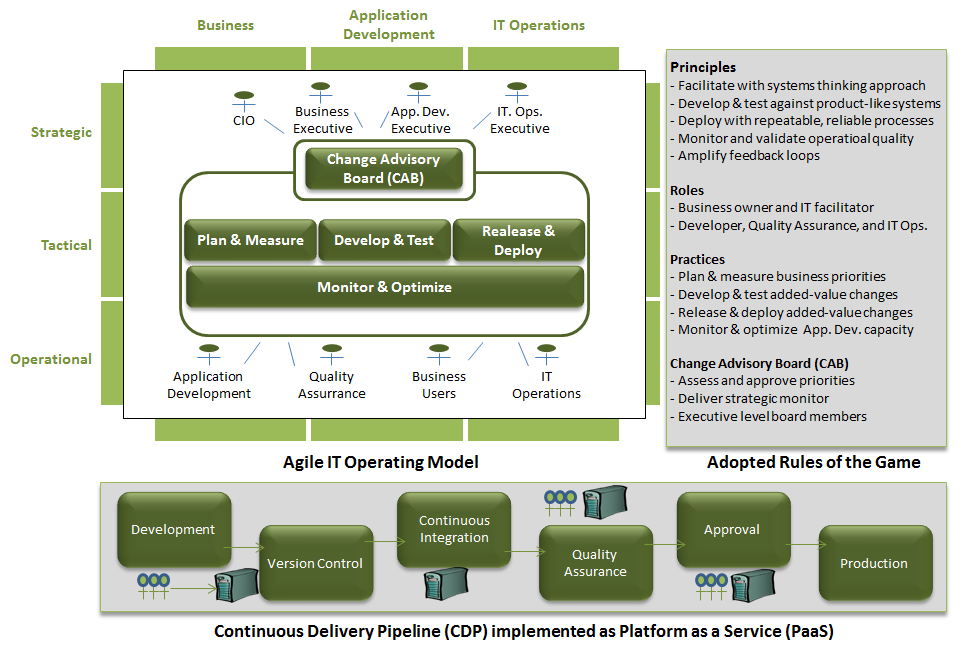
As I’ve been implementing it, DevOps is a system of principles, practices, roles and responsibilities, governance structure and tools purposely arranged to establish cross-functional collaboration, enable accelerated applications delivery and, in turn, make the business responsive to market opportunities:
As illustrated, DevOps as a business capability is made up of three components: the Rules of the Game, the IT Operating Model and the Continuous Delivery Pipeline (CDP). Let’s explore them.
DevOps Rules of the Game create the conditions for lean and agile IT environments
Rules of the Game are a fundamental dimension of DevOps: They enable the establishment of lean and agile environments. I refer to them as the DevOps non-technological piece.
In practical terms, they’re a set of principles, practices, roles and responsibilities and tools institutionalized to ensure accelerated applications delivery.
They serve as catalysts to specific organizational and operational effective practices. Let’s take the principle, “Facilitate with system thinking (involvement of all relevant stakeholders)”—it forces application development stakeholders to adopt a collaborative mindset, which in turn breaks down organizational silos to eliminate the impediments to operational flexibility and institutionalize cross-functional collaboration.
They’re the poor cousin of today’s DevOps practices, which ignore them in favor of more technical and technology issues. That’s a terrible mistake that reduces DevOps influence vs. the digital economy’s challenges.
The agile IT Operating Model establishes the lean and agile work environment
The IT Operating Model reflects the interactions that take place across your application development value stream. In practical terms it represents the work environment derived from the application of DevOps’ rules of the game.
I always remind my clients that DevOps’ rules of the game aren’t theories, they’re the foundations of a tangible strategic capability: the lean and agile IT environment. They demand a thorough transformation of your application development work space to put together business, application development, and operations:
The lean and agile IT work space for the digital era illustrated (Credit: O.C. Tanner)
The picture illustrates what’s meant by lean and agile IT environment, it substantiates Adam Jacob’s point that “Fundamentally DevOps is about taking the behaviors and beliefs that draw us together as people, combining them with a deep understanding of our customers’ needs, and using that knowledge to ship better products to our customers.”
The IT operating model is the poor cousin of today’s DevOps practices which ignore it in favor of more technical and technology issues. Once again, it’s a terrible mistake that reduces DevOps influence vs. the digital economy’s challenges.
Make no mistake, technology matters, the CDP helps to meet digital technologies challenges
The importance of the rules of the game and the resulting IT operating model don’t suggest at all that technology doesn’t matter. Make no mistake about it, the CDP is essential; I refer to it as the DevOps technological piece. Through deployment automation and configuration management tools, it significantly accelerates application development, testing, resources provisioning and deployment.
However, one thing to be aware of is, digital economy raises technological challenges that transcend speedy delivery issues. They include:
The importance of IoT
The pivotal role of predictive analytics
The increasing importance of APIs
As a matter of fact, IoT devices generate massive data and making use of it to generate revenue requires big data technologies to integrate, automate and analyze them.
On the other hand, this ocean of IoT data has generated an API business; the idea is, to monetize their data and generate revenue, businesses must provide their customers and partners with APIs that easily give access to their systems.
Implementing the CDP as part of PaaS cloud services can help to prosper in the digital economy; it allows businesses to benefit the cheap and on-demand computing, storage and network resources provided by the cloud.
Takeaway
In hindsight, with a business-oriented perspective, the ITaaS delivery model and DevOps follow the same goal: Provide business lines with the lean and agile IT environments they need to be flexible enough and responsive to meet the competitive challenges of digital economy:
Like DevOps, the ITaaS delivery model (…) takes advantage of an agile IT operating model to help businesses succeed in the digital era. It implements consumer-provider relationships across the IT value stream to ensure organizational flexibility and operational agility.
CIOs must realize that what matters to the business is to continuously generate revenue through improving customer experience and increasing customer value. Deploying applications at the speed of light for the sake of speed doesn’t make sense from a business perspective; as long as expected business benefits aren’t achieved, speed is a useless gadget.
Implement DevOps as what it is: a three-dimension IT capability including rules of the game, IT operating model and, of course, continuous delivery pipeline.
I am always amazed at how many practitioners (or, rather, managers of) tout the benefits of test-driven development (TDD). This inherently changes the role of the traditional developer to one of developer and tester. But it would appear that as long as I am able to construct a test for the innovation I wish to create, all is well in the universe, and I can proclaim the full success of automated test integration with my DevOps processes, sleeping quite well at night from then on.
But in the world before yesterday, testers tend to think differently than developers do. They evolved differently, bearing the scars of applications that tested just fine on the developer’s laptop but somehow died under the myriad circumstances that occurred in the world beyond that original safe harbor. In point of fact, human testers with a variety of automated tools tended to very often “prove” to developers that their sanctified code was not in fact so pious, but actually more “holy” (that is, containing holes) than they thought. Thus, remained the cycle of code/test/code again until the gauntlet to production is navigated successfully.
There is also a certain reality about testing that developers cannot easily overcome. The only category of testing than can easily accompany a new feature or function is primarily functional testing. “Did the function work?” would appear to be the kind of testing a developer could construct to accompany his/her code. Notwithstanding the fox-in-the-hen-house analogy, there are quite a few other kinds of tests that are equally valid in that code moving forward to production. Most of these tests are not easily constructed by the original developers.
One might consider performance testing a bit important. In this instance, I am not only concerned with the validity of my new feature, I am also concerned with its performance (timing) relative to how a user would experience it, and inclusive of the conditions of my production environment. For this to be rightly measured, I may need to ensure all integration testing also has has been completed successfully. And assuming all of this completes as expected, I may still want users to test my app—you know, to see if it is actually what they wanted in reality (after decrypting the requirements from the ancient Egyptian notes of the stories they submitted). Beyond this, some functions appear largely in a batch context, or perhaps only when proximity is achieved in a mobile app, so context is equally important to testing.
The Nuances of Integrated Testing
But getting back to our original question, let us assume I can test something, and let us assume I have tested it. Where do we go from here? Once the validity of my new feature has been tested, should I decouple the test execution from the build automation and move it to a list of regression tests I only execute periodically? That would seem logical, as this test might need to be run again during post-integration testing (particularly if it manipulates data with upstream dependencies). What is the “value” of my test past that first successful occurrence? If it has value, then I must begin to look at all of my testing in the same way I look at code: It needs to be version-controlled.
Pairing functional tests to the versions of the code they validate will allow me to roll test automation forward or backwards to match the version of code in the target testing environment. So, for example, if coding build version 1.5 is in my integration environment and it fails, I can roll it back to version 1.4 and concurrently roll back the tests that were valid for the older version as well. That’s better than using tests designed for version 1.5 of my code, as testing new feature validity against old code is sure to generate errors.
But treating test scripts (or entities) the same way you treat code with version controls is something most organizations have yet to get their heads around. Deploying testing as a part of the post-build deployment automation is equally daunting.
And, of course, none of this addresses the more fundamental question: Does my test have value at all? Because I can test a feature or function, should I test it? Is this feature or function critical to the user experience? Am I testing it in such a way that the user experience will be evaluated? Testing whether a date field allows only valid data to be entered into it seems important the first time we do it. But once the characteristics of a date field have been so ubiquitously defined by software libraries, advanced programming languages or database structures, perhaps continuing to validate that input is excessive and provides diminishing value. Testing the right thing matters as much as testing at all.
Then let us assume we have found the Rosetta stone of items to test and we have created an ability to test this feature with scripts passed down from Olympus. If the continued validity or performance characteristics of this feature remain important to the user experience, perhaps we have not found only something to test but also something to monitor. Here is where we begin to think two years into the future. If part of my DevOps continuum is an ability to integrate version-controlled testing as a capability, why not integrate version-controlled monitoring, as well? (Here’s where the Ops guys of DevOps finally get interested.)
Instead of examining testing from only the perspective of the developer chained to the dictate of TDD, why not examine the life cycle of “evaluation” from a more holistic perspective of coding, integration, performance, users and, ultimately, a monitoring point of view. If my monitoring tools are capable of configuration adjustment, parameter adjustment and ceiling- and basement-level adjustment, then through reading external files or by exploiting API’s shouldn’t we be looking to pair our monitoring profiles with the version of applications we deploy into production discreetly by version? Perhaps a less useful test simply gets retired and a more useful test evolves into a program characteristic that we monitor until the feature itself gets retired.
Integrating the Ops team into discussions about automated monitoring is sure to pique their attention. If nothing else, the ability to turn off monitoring tools during deployments and turn them on again afterward will cut down on “noise,” and help to focus resources only where they are truly needed when alerts emerge. Understanding the difference between how production is monitored vs. the unique needs of the test environments—with the ability to incorporate both into the automation of DevOps—is equally appealing.
In any case, the evaluation of an application includes not only the original tests to ensure validity, but also the monitoring that occurs to ensure continued performance as expected. Thinking about where tests begin and where monitoring is more effective or needed can help to keep both disciplines modest and focused only on what is critical, rather than both attempting to take on the weight of the world. The goal of DevOps is not to increase the frequency and duration of headaches, it is to eliminate them.
To continue the conversation, feel free to contact me.
How Project Onboarding Can Undermine DevOps Efforts at Large Organizations
A “hello world” application is the most basic program a developer, typically a beginner, will write to learn a new language. It’s a sort of “everything works”—a stack-checker app to kick off a project quickly and see its results.
The resulting hello world program is typically a message printed to your screen: “Hello world.” That’s it. No microservices, REST API or class factories, but very satisfying, nonetheless. The stack works; you built it and ran it from scratch.
The average time for a programmer to write a hello world application code is probably a few minutes, or even seconds. The average time to set up the developer’s computer or workstation and servers to be able to compile/build and run a hello world app may take a while longer, maybe a few hours to set up. And I’m thinking cloud server or container. Publishing a hello world app to Google Play, including setup, build and deployment, takes around a few hours for the first-timer. That’s not too bad. But here’s the deal: It’s a few minutes for your first program to run vs. a few hours for your first deployment.
That’s a 60:1 ratio.
Let’s raise the bar a little: Take a large corporation with an IT department of 1,200-plus employees, for example. In that environment the average time to publish a brand new hello world application increases by at least an order of magnitude—even more if the developer is not just onboarding an application but also herself or her team into the organization.
Cutting through IT red tape is a great distraction as epics, user stories and customer requirements pile up. These tasks can be simple to complex, such as setting up your code repository and development stack; identity, security, disk, network and other stack provisions; boilerplate artifacts and following testing and release policies. That’s a considerable chain of requests and wait periods—enough to make that hello world program loop around for months before it reaches production.
DevOps for the Hello World
The ability of a business to respond to market changes start by a quick new-project ramp-up. And in a microservices world that’s often the case. But that’s mostly at the architecture level. How easy is it to provision and manage the external environments beyond microservices? Or, how easy is it to provision and manage the full Dev to Ops stack at your organization, period?
A good way to tackle this is to offer a menu of automated tasks through a help desk-like setup, a configuration catalog if you may. A configuration catalog holds tasks à la carte for every need in the DevOps cycle. Call it the IT user interface for teams requesting or delivering changes to the organization.
This is nothing new. ITIL talks about it everywhere. It’s called a service desk. In a DevOps culture, however, traditional service catalogs do not cope well with continuous deployment and infrastructure-as-code approaches. And vice versa. The reason is that there are plenty of needs that tend to fall outside the common service desk and configuration management automation realms, so they end up in an issue tracker, service ticket or, worst case, plain emails, chat and phone call requests.
From Zero-to-Deploy
A catalog of configuration services can be application or project-oriented and should keep state, knowing what has been requested and delivered in the past to enable future interactions. Every task offered by the catalog has one or more rules associated with it. These rules, or recipes, do the dirty work and automate provisioning, emails, boilerplate setup and other tasks that antecede or surround most of the core DevOps delivery automation.
Think of it as your classic service desk catalog and configuration management tool set combined.
Building a configuration management front end can greatly mitigate and simplify the effort of onboarding applications. Here are some of the features and strategies to consider:
Baseline Templates: Offer teams a set of baseline configurations, tasks and services that can be provisioned around project typologies, such as “Mobile App,” “Python-Django-Postgres” or “Java-Spring-AngularJS-Oracle DB.” That means that on Day 1 the developer only has to select the preapproved application type to get started. Push-button onboarding should include straightforward guidelines that guarantee that the project starts on the right foot, including committing boilerplate source code to the repository and directory verification.
Incremental Services: Make the catalog offering incremental, providing development teams only the options they should have at a given time for each project at its given stage. A good configuration system will keep track of what every application has installed at a given point in each environment, so progressive options will be offered.
Broaden Your Scope: Automate all provisioning tasks in sight. Just because your application is containerized or configuration management is automated it doesn’t mean it’s a push button from start to finish. Reasonably sized applications have many dependencies, approvals and setup steps that are don’t have a place in typical scripted recipes.
Manual Tasks: Make the work flow by bringing every manual process into the onboarding pipeline and avoid the need for emails. Make sure to cater to non-standard requests also, as that will help keep everything in one place.
Draft and Versioned Provisioning: Allow provisioning plans to be built along with the code, be it infrastructure-as-code or catalog requests. As new requirements come into play, revise provision drafts accordingly.
Scale to Environment: For every new environment in the onboarding chain just reapply the previous requests and configurations, but adjust them to that particular stage. For example, a preproduction environment template will probably need to scale CPU, network and memory to closely mimic production.
Just-in-time: Make sure provisioning happens before code is delivered. If before means just-in-time, great. Maybe it’s just a matter of putting provisioning before deployment in the automation pipeline. Or maybe it’s a non-standard request that needs human intervention and holds up a release for a short time. The closer provisioning looks like continuous deployment, the better.
The next generation of configuration management tools must tackle many different aspects of onboarding applications and services to become an effective DevOps front end. This is not just giving developers a “Request Cloud VM” button but the full how, why and where chain that assists teams with writing boilerplate application and infrastructure code, passing the first build or scaling environments correctly. And moving forward, ChatOps and machine learning are replacing the classic request workflow, adding needed insight and foresight to manage project deliveries from zero-to-deploy.
DevOps practices should start early on in the cycle and offer a great user experience all the way through. A good delivery chain needs to tackle the newcomer workflow, just like the application interfaces of today tend to target first-time users. A friendly and capable DevOps front end is what separates mature organizations from the rest, helping them smoke the from-hello-world-to-deploy test suite gracefully.
About the Author/Rodrigo González
Rodrigo Gonzalez is the CEO and co-founder of Clarive. Besides running the day-to-day operations, Rodrigo oversees the overall strategy for the company. Rodrigo, originally from Brazil, holds a B.S. in Computer Science from Texas Tech University and has nearly 20 years experience working at tech companies in the United States, Brazil and across Europe, including Lucent Technologies and CA Inc.
Back in late February we launched our latest survey in partnership with Automic. The survey sought to understand how developer tools are selected and used within organizations. We wanted to have some insight into how prevalent Shadow IT was. Well thanks to the hundreds of you who responded, we have been busy working with Automic analyzing the results. Frankly in some areas the responses bore out our original hypothesis, but in other ones the results were pretty surprising.
Not to be a tease, I should tell you we are not releasing the full report and results until our webinar on this on May 4th. You can register for that one here. But let me give you some insight into some of the results:
A big difference between DevOps empowered organizations versus traditional IT shops. We actually ran the survey to both our devopsy.kinsta.cloud audience and then to a general IT control group and had a look at the differences. DevOps empowered groups had far greater insight into what tools were being used, generally used more tools, more open source tools and generally had greater diversity (that they knew about anyway).
The large majority of respondents reported that their organization use tools besides those on the “approved list”. This is a form of Shadow IT and shows how new software tools are sneaked in under the radar of the official IT.
Many times these tools that snuck in the back door were eventually adopted as official tools, showing that this is a viable method of introducing new tools into the organization.
Another insight was whether entire dev teams were using the same toolset. This answer as you might imagine was different when you compared organization sizes. However, overall the message is that developers like to use their chosen tools.
These are just some of the insights we will be discussing at the webinar. Also all attendees will receive a full copy of the report with analysis. So mark your calendars now and register for the webinar where we will discuss these results and more.
BTW, the webinar will feature myself and Kerry Lebel, senior director of community for Automic.
Scott Willson
Scott Willson is Product Marketing Director, Release Automation at Automic Software. He has over 20 years of technology experience that spans software development, pre-sales, post sales, and marketing. Scott is passionate about technology and helping business achieve value through technology and was leading DevOps at organizations before it was coined DevOps.
The era of mobile and web is upon us, which has caused nearly every business decision-maker to ask the question, Is now the time to hire a developer to build our app or website? In 2016, businesses are going to be looking for the best developers to join their team and help scale their business. We’ve already started to see this trend, as a recent Harvey Nash Technology Survey 2016 found that developers are the most sought-after of all technology personnel.
To stand out from the pack, developers must master the critical skills businesses are looking for. The most valuable developers will be those who can adapt to the changing technology landscape and further hone their craft to help companies scale and solve specific business challenges.
To stay competitive in today’s market, developers need to invest in these three skills to be relevant in 2016 and beyond.
Master the Skills to Scale a Product or Service
Startups increasingly are evolving from early stage concepts to building a growth model to take their business to the next level. To be an asset today, developers need to master and specialize in scaling technologies that are key for businesses looking to expand their customer base and focus on technological innovation.
There is a demand for developers that have not only a breadth of experience in bringing an organization up to scale but also depth in their technical skill set. Having the ability to work on major systems, support large amounts of traffic and customers and maintain the system for several years are critical competencies that companies will be looking for.
Also, having a data model or database experience is very important—NoSQL solutions such as Cassandra, CouchDB or Riak, as well as traditional data sources such as MySQL, are in high demand. Middleware languages such as Java and Golang also are an important part of a developer skill set when building services and APIs.
Understand the Customer Perspective
When building a technology solution, an engineer must be able to look at the product from a customer’s perspective to understand what problem the product is fixing. While technical skills in developing a product and user experience (UX) are very important, the ability for a developer to understand and create a product that solves a customer challenge far outweighs the focus on building the most elegant software.
Engineers who are able to demonstrate project management skills and have experience around scaling infrastructure and ensuring the platform is robust will be in high demand. Businesses increasingly are seeing a need to support growing customer bases and traffic with utmost end-user reliability.
Become a Subject Matter Expert
There is a gradual shift in the developer community, in which engineers are focusing on specializations and becoming subject matter experts. There is an opportunity for developers to create career highlights by merging their talent and passion with opportunities.
Developers are encouraged to identify an area they are passionate about and focus on refining those skills. By being able to find these opportunities that build on their passion, these developers can demonstrate they are able to solve a challenging problem for a large number of users—a competitive skill in high demand across the industry.
The overarching strategy of a successful developer career is to invest in learning how to scale a product or service, understanding the customer perspective and becoming a subject matter expert. Investing in your skills as a developer in 2016 can lead to a longer, more fulfilling career.
About the Author/Sha Ma
Sha Ma is the senior director, Software Engineering at SendGrid. She led development teams at both startups and Fortune 500 companies prior to joining SendGrid. In her current role, she drives strategic planning, development and management of large scale projects. Ma is a graduate of MIT where she earned both her bachelor’s and master’s degrees.
In part one, we discussed how education content publisher Pearson applied ThreadFix to its AppSec request workflow needs. Here’s the rest of the story.
The ThreadFix Implementation
Senior software security engineer Matt Tesauro added ThreadFix to Pearson’s workflow in the following steps:
Using FPM, Tesauro created a Debian Linux package internally to deploy the ThreadFix Tomcat Package (ThreadFix also offers its own Debian package for this).
Tesauro hooked ThreadFix into each of Pearson’s toolsets using the tool scanner file formats ThreadFix understands.
To make that happen, Tesauro pointed ThreadFix to an API.
Tesauro then set up an API key.
The system was then set to fetch the test results.
If necessary, Tesauro wrote glue code to upload the results to ThreadFix.
Pearson used ThreadFix to normalize and de-dupe what had proceeded from manual assessments, dynamic scans on applications and static code analyses of source code, directing those outputs into ThreadFix. “So if a static tool and a dynamic tool both found the same cross-site scripting issue, we fed those into ThreadFix, which de-duped those and gave us just one issue to report so that we didn’t bury two teams with fixing the same single coding error,” says Tesauro.
“ThreadFix became the one source of knowledge for all of the output of our team, which for us is the security vulnerabilities we find in the applications that we either created, bought or had a third party create,” says Tesauro. That enabled Pearson’s AppSec team to feed tickets into JIRA of backlogs from development teams, which made it easier to produce metrics and do reporting. ThreadFix made it easier to feed data into governance, risk, and compliance tools such as RSA Archer. “That enables visibility into work in progress and workflow and into areas of the business that affect AppSec’s work,” Tesauro notes.
Additional Capabilities with ThreadFix
Tesauro eventually expanded ThreadFix to other departments beyond AppSec to benefit from its capabilities and the metrics it could produce regarding app progress.
Tesauro notes a point between the “Bag of Holding” and ThreadFix in the AppSec pipeline that required some work. He used a StackStorm orchestration and layered ChatOps on top to enable new developer capabilities at that point in the process.
“Now you can go into our private channel and use HipChat to ask the system, for example, to set up Checkmarx for a particular application in a particular business unit. You give it the URL pointer to that unit’s Git repository and off the system goes, setting up the application profile in the Bag of Holding and in ThreadFix and then talking to Checkmarx to set up weekly scans of the code that sits on the master branch. It set that all up in a minute,” says Tesauro.
HigherEd was the first additional group inside Pearson to benefit from ThreadFix metrics. One such metric was a 44 percent decrease in time-to-fix after adding a JIRA integration into the mix, according to Tesauro. “Once we started producing those numbers, we had a lot of other business units ask, ‘Hey, why does HigherEd get these great time-to-fix numbers? We want them too for our apps.’ It was a great way to get buy-in,” says Tesauro.
Further Results
AppSec saw a 5x increase in throughput for the request workflow and went from 44 application assessments in 2014 to fewer than 200 in 2015, Tesauro notes.
“In 2015, we lost two and a half people and still sped up the process,” he says.
Pearson is a publisher of education industry content to meet the needs of teachers and students from kindergarten/early learning through higher education and continuing education (for professionals). The company uses a mix of software, from legacy third-party software and “classic ASP apps that are on life support to auto-scaling systems on Amazon,” says Matt Tesauro, senior software security engineer at Pearson. “It’s a very diverse development environment.” Which meant it was no easy task keeping it secure.
Pearson Before DevOps
Prior to adopting DevOps, Pearson was bogged down by manual processes, especially in application security. “People sent requests buried in email or, if you were lucky, in a Google spreadsheet. There were very few clear lines and hand-offs between the different activities that were the responsibility of the AppSec group,” explains Tesauro. It was a very manual, custom approach in terms of request handling: someone would respond to a request with an activity, which would require a report that was then emailed.
At the time, Pearson had no single, well-established methodology or workflow for these activities. There was no particular look and feel or design for creating dynamic, manual or static assessments. There was no list of inputs into the process or outputs to expect at the end of the process. “At best, everything flowed in an ad hoc fashion,” says Tesauro.
Then, about two years ago, Tesauro and a senior-level peer at Pearson attempted to prioritize those apps the company most needed to assess for security and related issues. They had hoped and planned it would be about 10 apps, to keep the number and the workload manageable. For political reasons, they were able to settle on no fewer than 64 apps that needed appraisal. “We ended up being able to assess only 44 out of the 64 top apps. There are 2,000 and some-odd apps at Pearson, in rough numbers. Just the scale told us we were going to fail in the long run,” says Tesauro.
Ramping Up to Change
To resolve this app assessment challenge, Tesauro looked to institute DevOps and Build Pipeline approaches to lay the groundwork for eventually integrating security into the various development teams at Pearson. “I made equivalents of DevOps and Build Pipeline approaches for how we did work in the AppSec program at Pearson,” says Tesauro. These included standard methods of input and intake of service requests similar to how the business produces software development targets for a DevOps shop to hit. That’s when Pearson began to work on instituting and leveraging ThreadFix.
“ThreadFix was one of the first two parts of that pipeline,” he says. The other part of the AppSec pipeline solution was what Tesauro calls the “Bag of Holding,” a mechanism and repository for tracking all the team-to-team interactions and work assignments. That feeds into ThreadFix.
During that time, and for about the first half of 2015, Tesauro and a teammate automated a number of manual steps by creating code to perform the “mindless work” so developers could concentrate on their core business instead. “Now when the static code analysis tool Checkmarx finishes its analysis, it generates a report, washes the directory and pushes the report into ThreadFix,” says Tesauro. He also automated a number of other test applications and tools.
Stay tuned for part two of this case study, coming soon.
It is no secret that DevOps and continuous delivery goes hand in hand in the enterprise, but how do processes such as performance testing fit in to the equation?
Many enterprises still harbor the traditional way of thinking—that the QA and performance testing group is completely separate from the development group. A widely held myth is that each has different roles, responsibilities, backgrounds and areas of expertise. However, with DevOps gaining popularity in the enterprise, the distinct separation between testing, development and operations is no longer. In fact, to successfully implement performance testing, the once-siloed departments must work together.
Creating a Culture for DevOps
The most common purpose of DevOps is to have an automated pipeline of software and application deployment updates. An enterprise cannot implement DevOps unless all are on board, from the top down. To do this, there must be buy-in from not only the software engineers and technology buyers, but also the C-suite. This ensures DevOps processes and strategies are being implemented appropriately.
However, it’s not just about getting the tools needed for DevOps; there must be a culture shift toward collaboration for it to be effective. That is when an enterprise gets the most from the shift to DevOps and becomes the most agile.
Once DevOps is embraced, experts and power users can help facilitate how it is being used to drive maximum benefit and help the organization get more from it. The key way to determine and evaluate this maximum benefit is through continuously testing throughout the development process. While the first thought may be for “functional” testing (to ensure code operates without errors and to provide fast feedback to developers when things go wrong), no organization can afford to release applications that deliver slow user experiences, and so “performance” testing with fast feedback is equally critical. Continuous testing is only scalable and sustainable if it is automated.
DevOps Makes Load Testing Easier
A key benefit of DevOps is that automation makes everything—from implementation to functional and performance testing—faster and more predictable. Tool chains ensure that the “right things” are done with every code push. A concern commonly cited by those who have not yet implemented performance testing is that it is “too time consuming” and they will be unable to facilitate different tests at the rate they need to be done to be effective. But surprise! Organizations that already practice DevOps are in a better position to add performance testing to the mix, in a fully automated fashion. A solution like BlazeMeter takes just minutes to get API tests up and running, by just adding the HTTP transaction for specific pages or endpoints to test. Once set up, these tests will continuously run automatically and will notify the team when there are any problems or potential problem areas. When there are known surges in website traffic, more Uniform Resource Identifiers (URIs) can be added to the test, but this will not impact the autonomy of it.
Another key function of DevOps is scalability through the enterprise, and scalability of user traffic is extremely important. While performance testing would still scale without DevOps, operating on the same principles makes each concept more relevant to the folks who are analyzing the outcome of both. The key is to integrate performance testing directly with an already existing continuous delivery or integration pipeline, such as Jenkins or CircleCI. Here, fast, small-scoped performance tests are able to run in parallel to ensure performance is as expected before promoting a build to the next stage. Tests run in staging or QA environments, such as IBM BlueMix or Chef, can also be automated and integrated.
Performance testing is also important not just because of its easy integration into DevOps practices and how it fits into the CD pipeline, but the overall customer experience as well. A properly functioning webpage or mobile application is the connection between your brand and your target customer, and if it doesn’t load properly or in a timely manner, you may lose a customer to a competitor. Performance testing ensures the user doesn’t experience slowdowns or the dreaded downtime, which is often the result of a poorly functioning back-end system. Incorporating performance testing into workflows creates a centralized environment where all team members have what they need to design, run or analyze tests, while communicating quickly and clearly with each other and everybody in the enterprise.
Performance testing and DevOps are not opposing forces; and performance tests run automatically within the tool chain save time, rather than consuming more. The reality is that during this age of rapid software delivery, testing is the glue that keeps the development process on track and high quality. Performance testing should be part of every software delivery workflow, and DevOps is allowing that to happen.
About the Author/Michael Sage, Chief Evangelist
Michael Sage brings a 15-year career of enterprise software pedigree and customer success to BlazeMeter. Prior to BlazeMeter, Michael (better known as “Sage”) was a solutions architect and consultant in software delivery and performance management. He has worked with industry-leading companies including Mercury Interactive, Hewlett-Packard and New Relic, helping teams implement integrated solutions that enhanced the performance and experience of their customers. A self-taught hacker and open source evangelist, Sage always has the pulse on the cultural zeitgeist inflected with a heathy dose of humor.


 Ravi RRK, as he is known, is the Vice President – Service Delivery at NetEnrich. Ravi’s responsibilities include service delivery management, customer satisfaction, and new service introduction. Ravi’s team also has the responsibility to ensure and enforce quality and policy standards across the NetEnrich organization.




 Rodrigo Gonzalez is the CEO and co-founder of


 Sha Ma is the senior director, Software Engineering at SendGrid. She led development teams at both startups and Fortune 500 companies prior to joining SendGrid. In her current role, she drives strategic planning, development and management of large scale projects. Ma is a graduate of MIT where she earned both her bachelor’s and master’s degrees.

 Michael Sage brings a 15-year career of enterprise software pedigree and customer success to BlazeMeter. Prior to BlazeMeter, Michael (better known as “Sage”) was a solutions architect and consultant in software delivery and performance management. He has worked with industry-leading companies including Mercury Interactive, Hewlett-Packard and New Relic, helping teams implement integrated solutions that enhanced the performance and experience of their customers. A self-taught hacker and open source evangelist, Sage always has the pulse on the cultural zeitgeist inflected with a heathy dose of humor.