Category: DevOps Practice

  • Five Great DevOps Job Opportunities

    Five Great DevOps Job Opportunities

    DevOps.com is now providing a weekly DevOps jobs report through which opportunities for DevOps professionals will be highlighted to better serve our audience.

    Our goal in these challenging economic times is to make it easier for DevOps professionals to advance their careers.

    Of course, the pool of available DevOps talent is still relatively constrained, so when one DevOps professional takes on a new role it tends to create an opportunity for others.

    The five job postings shared this week are selected based on the company looking to hire, the vertical industry segment and, naturally, the pay scale being offered.

    We’re also committed to providing additional insights into the state of the DevOps job market. In the meantime, for your consideration:

    Indeed.com

    Intel
    Chandler, Arizona
    Cloud Software DevOps Engineer
    $156,410 to $250,410

    LinkedIn

    General Dynamics Information Technology
    Remote
    Cloud FinOps Analyst
    $122,336 to $204,360

    CareerBuilder.com

    Infoway Software
    Doral, Florida
    DevOps Lead
    $120,000 to $190,000

    SimplyHired

    Peraton
    Herndon, Virginia
    DevOps Systems Engineer
    $112,000 to $179,000

    Dice.com

    University of Virginia
    Charlottesville, Virginia
    DevOps Developer
    $95,000 to $125,000

  • Building Scalable Cloud Applications With MySQL

    Building Scalable Cloud Applications With MySQL

    Relational database systems such as MySQL have long been the go-to choice for handling large and complex data handling tasks. But, with the introduction of new technologies like NoSQL, many developers started to question whether traditional relational databases still have the upper hand. However, when building high-scalability cloud applications, relational databases like MySQL still have the edge over NoSQL. Here are five reasons MySQL remains superior to NoSQL in supporting developers of high-scale cloud applications.

    1. Enablement of Complex Queries

    Structured query language (SQL) is the most widely adopted language for relational databases, and MySQL is no different. SQL gives developers a powerful platform for creating complex queries and ad hoc reports, efficiently managing large datasets and creating tables and indexes for data optimization. By contrast, NoSQL usually offers only rudimentary query and data manipulation capabilities, often proving inefficient when handling complex data sets. Most data analysts are also familiar with SQL, so it’s a drop-in tool they can use to help gain insights.

    2. Scalability and Reliability

    MySQL is noted for its scalability when handling massive data loads and is particularly well suited to cloud-based applications that require consistently high performance. MySQL ensures that the consistency of data is maintained. MySQL is the go-to option for scalability and reliability for larger cloud applications. Companies such as Facebook, GitHub and WordPress have built billion-dollar businesses on MySQL, and it’s been tested and validated in some of the harshest and most demanding workloads of any database.

    3. High-Performance Replication at Scale

    MySQL replication offers a reliable solution for cloud applications that need to scale. Unlike other databases, MySQL’s replication capabilities provide effective data safety, making it a robust choice for applications that require high availability and durability. Additionally, MySQL enables seamless version upgrades without disrupting operations, ensuring the system always has the latest features and security patches. The read scaling feature of MySQL improves performance by distributing the read load across multiple instances, making it ideal for large-scale cloud applications. With a proven track record at scale, MySQL replication is the optimal choice for applications that want to grow and scale efficiently.

    4. High Availability and Durability

    MySQL provides enhanced high availability and durability, ensuring that critical data is always available even during maintenance and disaster recovery. This is because MySQL is fully ACID-compliant (atomicity, consistency, isolation, durability) and provides full support for transactions. Even when the system fails, the transaction can be rolled back and the data is not lost. With NoSQL databases, data is primarily written in memory and doesn’t provide the same degree of durability or consistency.

    5. Ease of Implementation and Debugging

    MySQL is easy to install, implement and debug compared to NoSQL. MySQL is supported by a large community of developers and database administrators who use it for a diverse range of applications. MySQL is also open-source and free to use, making it a great choice for businesses of all sizes. NoSQL systems require the installation of additional tools, libraries, and other components for implementation, making it more complex and time-consuming.

    MySQL provides many benefits for developers of high-scale cloud applications, ranging from its powerful SQL language for complex querying to its high availability and flexibility for managing multi-table joins. NoSQL remains a viable option in some cases, but developers who are building high-scale cloud applications are mainly sticking with MySQL due to its scalable and reliable nature, easy implementation and flexible query-handling capabilities. Choosing the right database engine is critical for any organization that relies heavily on large and data-heavy applications. MySQL continues to stand the test of time when it comes to ensuring performance and getting consistent results.

  • Observe Inc. Brings Generative AI to Observability

    Observe Inc. Brings Generative AI to Observability

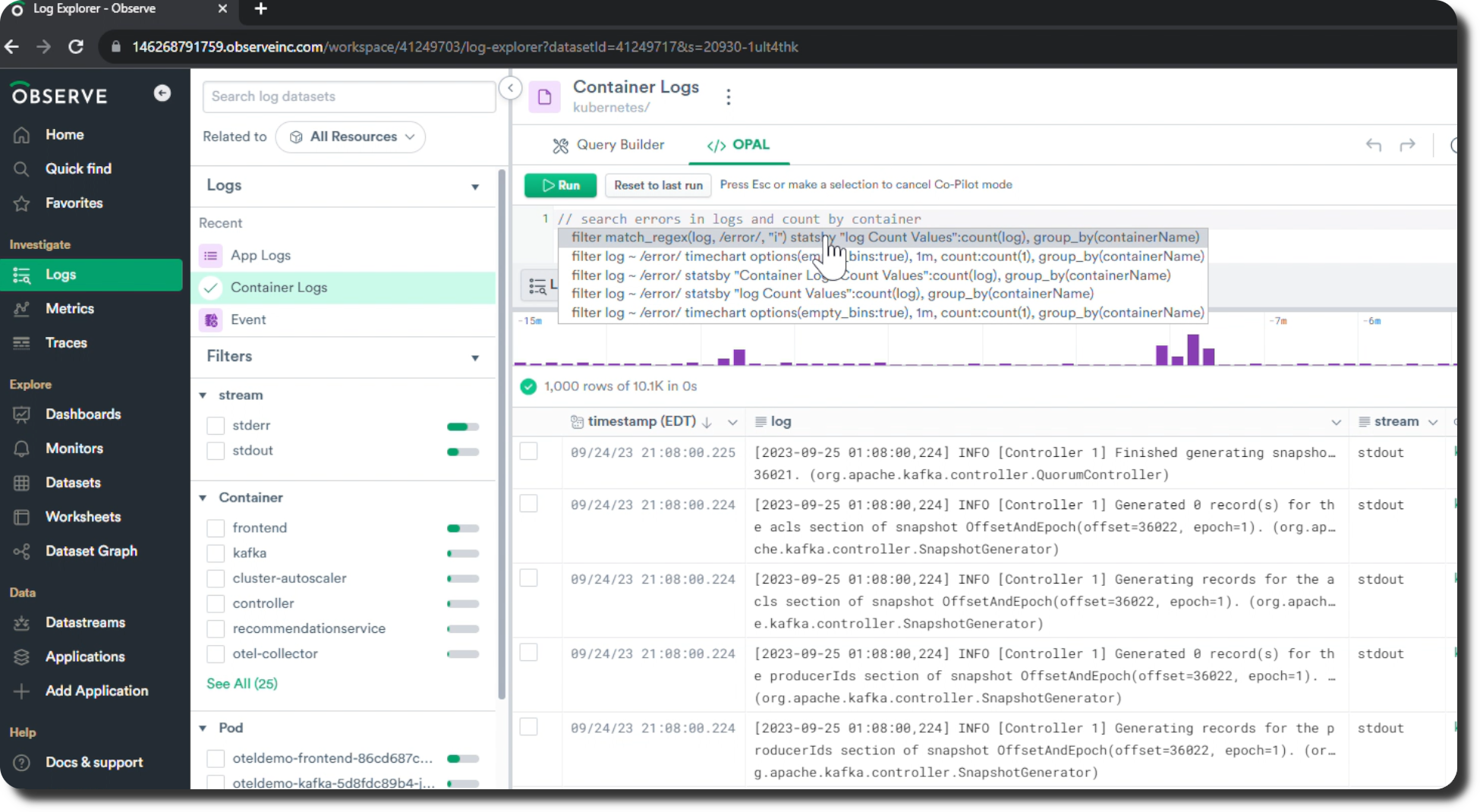
    Observe, Inc. today revamped the Hubble user interface to its observability platform that has been infused with generative artificial intelligence (AI).

    Fresh from raising an additional $50 million in funding, Observe CEO Jeremy Burton said as the company’s software-as-a-service (SaaS) platform continues to be infused with AI using multiple large language models (LLMs), it’s becoming apparent that observability is rapidly becoming democratized.

    Most IT organizations still rely primarily on legacy monitoring tools to track a set of predefined metrics. Observability platforms have arisen to aggregate metrics, logs and traces to enable DevOps teams to launch queries and surface the root cause of performance issues or IT incidents. The challenge is that most observability platforms have required IT teams to master a proprietary query language such as Observe’s RegEx.

    However, with the rise of generative AI tools, it is now possible for IT professionals of all skill levels to employ a natural language chatbot to generate a RedEx query, noted Burton. A RegEx generation tool also parses data to add structure to logs on-the-fly, and there is also an OPAL Co-Pilot that generates OPAL code in response to natural language inputs.

    Observe

    The Hubble interface furthers those capabilities by simplifying the onboarding experience anytime there is a new member added to an IT team, he added. Hubble also expands the range of data access options available, including a public application programming interface (API), a command line interface (CLI), export to CSV and data sharing to the Snowflake cloud platform.

    IT teams are also coping with an explosion of telemetry data generated by modern distributed applications based on microservices architectures. Legacy observability and monitoring tools were not designed for these data volumes, so when there is an incident, the mean-time-to-resolution (MTTR) is increasingly extended. In contrast, the Observe platform now features a ‘Live’ mode that enables data to be queried in 20 seconds or less from when it was created.

    Other capabilities include an assistant embedded in Slack to help users troubleshoot issues and summarize threads for incident response.

    While it’s still early days as far as the adoption of observability platforms are concerned, there is already no shortage of options. The pending acquisition of Splunk by Cisco next year will cause more organizations to reevaluate their IT management options, so the pace at which organizations are transitioning to cloud-hosted observability platforms should increase, noted Burton. Even after the merger is completed, it might be several more months before Cisco integrates its AppDynamics platform with the observability platforms that Splunk added to its IT operational analytics platform, he added.

    In the meantime, IT environments are only going to become more complex. It won’t be feasible for most IT teams to manage highly distributed computing environments without some help from AI. The challenge, as always, will be finding the budget dollars needed to deploy an observability platform before the number of increased IT incidents makes the need for one painfully obvious.

  • GraphQL API Visibility Ensures Enterprises Can Escape Lock-In

    GraphQL API Visibility Ensures Enterprises Can Escape Lock-In

    While GraphQL is still early in its enterprise adoption curve, the runtime query language (and replacement for REST APIs) has already built an impressively robust ecosystem for jumpstarting major enterprise-grade deployments. Among the appeals of GraphQL are its open source implementations and breadth of available server types, which combine to offer enterprises flexibility and the benefits of best-fit solutions.

    However, operating GraphQL in production, maintaining GraphQL APIs at enterprise scale and achieving the requisite GraphQL visibility and security require complementary tools and services. This is where enterprises can fall prey to vendor lock-in and lose the flexibility to change and control their own deployments if they aren’t careful.

    Enterprises need vendor partners to manage their GraphQL deployments effectively, and vendors are glad to offer comprehensive SaaS solutions. But enterprises must understand that a vendor can seek to capture their long-term business by coercion—straitjacketing customers by hosting their entire GraphQL infrastructure and GraphQL gateway and making it, well, not exactly easy to let go. They can unleash particularly nefarious practices, using proprietary features to force customers to migrate to certain technologies or purchase expensive upgrades to keep their crucial GraphQL deployments afloat. Enterprises must be wary of allowing this vendor lock-in to happen for their own good.

    Knowledge is essential to maintaining the balance of power in vendor relationships. Enterprises must understand their GraphQL graph and key measures to correctly assess current vendors and maintain agility and control over deployments by not entrusting their entire fate to any one partner.

    These are the specific areas where enterprises should seek out intelligence and reliable metrics in order to choose their own future with GraphQL:

    Understand Your Overall Graph (and Subgraph) Utilization

    Establishing an accurate overview of your graph utilization—and harnessing actionable insights—are crucial, foundational steps that lay the groundwork for deeper analysis and better decision-making. You need to know what graph and subgraph objects and operations your most important API users heavily engage with and which objects and operations are underused or not used at all. You need visibility into who is using GraphQL APIs and how. Getting to actionable intelligence should also tell you where errors are most likely to occur and what’s causing them, as well as where major performance bottlenecks pop up during heavy load events.

    With this overview available, the next steps call for building a depth of knowledge in each of these five areas:

    1) Understand areas of heavy graph and subgraph usage

    Knowing exactly where heavy usage occurs in your graph puts you in a position to upgrade or migrate your GraphQL API server or gateway on your terms while mitigating outage and error risks. Specifically, you want to know which operations in your graph are executed most and how often, which graph objects and fields are consumed most often, and which subgraphs support those most heavily burdened areas in your supergraph. This knowledge and some careful planning help to put successful GraphQL server or gateway changes within your power and also reduce risk when introducing changes to areas of the graph under heavy consumption.

    2) Understand where your graph is underused

    GraphQL migration and modernization efforts are simpler—and carry less risk—when you first remove any unused functionality and reduce your scope as much as possible. To do so, you need visibility into your graph’s least executed operations, objects and fields, and subgraphs, as well as any operations with zero recent usage. Then, flag low-use graph areas you can deprecate, replace or just remove to simplify your deployment before making changes.

    3) Understand your GraphQL API users and usage

    You want a seamless experience for your GraphQL API users throughout any changes you make, especially for the users and graph-usage patterns most crucial to your business. That means knowing the frequent users of the areas of your graph under the most heavy usage. You also want to recognize and bolster any GraphQL operations that your most important users frequently call, in addition to the objects and fields those users consume.

    4) Understand graph errors and potential error hotspots

    The right actionable intelligence will prepare enterprise teams to anticipate and address graph errors. This requires visibility into where, when, why, and how often graph errors occur and error hotspots (for example, high P95 latencies indicative of potential timeouts). Insights into which users feel the brunt of graph errors are also valuable in shaping mitigation strategies.

    5) Understand graph performance bottlenecks

    Bottlenecks caused by your GraphQL server or gateway itself may call for a shift in your graph’s underpinnings. Bottlenecks can also arise from costly queries of substantial depth and height, especially when these queries see intensive use.

    To foresee and address bottlenecks, actionable insights include the average and P95 latencies of your graph’s most-called operations and the heights and depths of your graph queries with the worst performance metrics. You also want to know the number of times that bottlenecked operations get called each day, the subgraphs at the root of bottlenecks, the latency added by supergraph query planning, and which users are impacted the most by bottlenecks.

    Graph Knowledge = The Power to Avoid Vendor Lock-In

    Implementing the GraphQL API visibility and actionable intelligence strategies covered here help ensure that an enterprise has the means to modernize or migrate as necessary to preserve its strategic independence. Those unfortunate organizations already in the grip of vendor lock-in may need to bide their time but should still use these same techniques to improve and decouple their fundamental GraphQL services from their vendor-controlled GraphQL technology. There’s no acceptable reason why organizations relying on free and open source GraphQL servers and gateways should find themselves stuck in proprietary software arrangements. Thankfully, the right knowledge can deliver enterprises a more flexible future as they modernize API development with GraphQL.