Category: DevOps Practice

  • Code Quality Doesn’t Have to Be Like the Weather

    Code Quality Doesn’t Have to Be Like the Weather

    Sometimes code quality feels like the weather: everyone talks about it, but no one ever does anything. Of course, that’s not from a lack of good will; most folks would love to have a week or two set aside to just clean things up. Unfortunately, that’s not how the world works. The best course of action is to sneak in a little clean up here, and a little there as part of normal work. Fortunately, that’s actually the best way to go about it. At SonarSource, we call it the Clean as You Code methodology, and we’ve found that this behavioral approach to code quality is as important as the tools developers use to track it. 

    The idea behind Clean as You Code is to ignore the quality of old code and focus exclusively on the quality of new changes. This may sound radical, but bear with me. Why focus exclusively on today’s changes? Because dredging up legacy code for the sole purpose of addressing code quality likely requires layers of approvals and perhaps business testing that may be difficult to get. But developers have absolute control over the quality of the code they’re writing now, and they’ll take pride in setting and enforcing high standards for that code. Focusing exclusively on the quality of new code works in both legacy and greenfield projects, and for all quality axes. 

    Let’s take test coverage as an example. Many developers are on projects that have lower test coverage than they would like. But stealing an hour here and there to add tests for random methods is generally a frustrating and ultimately futile endeavor. Instead, start with today’s changes. Make sure they’re fully covered and don’t release until they are. That’s it, that’s all that’s required. Covering those one or two methods — or even one or two lines — may feel like a drop in the bucket, but over time it will have a real impact. In fact, that’s been exactly our experience.

    Since the early days of my company’s flagship product, we’ve had an internal standard of 80% unit test coverage. And yet in those early days, we routinely released with coverage in the ’60s. There was always the intent to write unit tests, but inevitably it was left to just before release. And then it became a scramble to find the biggest uncovered files and slog through their unfamiliar code to write tests. Among the problems with this approach was the fact that the developer who wrote the code often wasn’t the one who wrote its tests, and thus could never be quite sure of testing the right behavior. And of course, no one likes cleaning up after someone else.

    In the end, it was a painful and ultimately ineffective routine; coverage didn’t break 80% until July 2014 — approximately seven years after the project started, and about a year and a half after we first formulated and adopted Clean as You code. You can see the October 2012 inflection point in this graph of project coverage (yes, the first few years of data are missing; victim of an early structural refactoring):
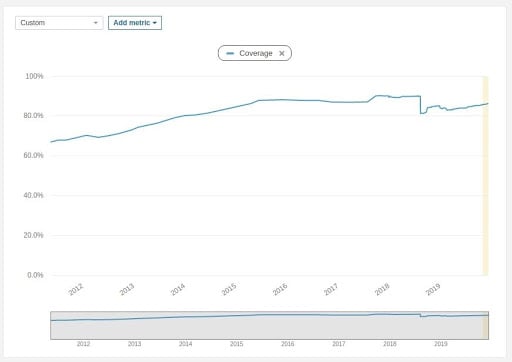
    On November 9, 2011 test coverage was at 66.9%. After rising to 70.3% on July 23, 2012 it fell to 69.3% by that October. From that October 2012 inflection point, it climbed steadily for more than three years, crossing the 80% threshold in July 2014. Coverage today is at 86.2%, comfortably above the 80% goal.

    Today, we’re at 86% coverage and rising. The formula for getting there was simple: 

    • Set standards on the quality of New Code. Here “new” means anything added or updated in the New Code period.
    • Define the New Code period. This is the scope of concern, i.e., how far back to go for the purposes of applying your New Code standards. We set it to since the last release. 
    • Don’t release unless your standards are met.

    Of course, the first two steps are a lot easier than the last one, especially if meeting the standards is left to just before release. Every developer has likely felt pressure to push business changes into production sooner rather than later. That’s why this strategy is most effective when it’s applied as granularly as possible. Meeting the standards before release is the bare minimum, but it should also be a non-event.

    We’ve found Clean as You Code to be most effective when applied:

    • At the individual level — Good developers want to write good code. When developers take personal responsibility for the code they write today, it saves time in the long run and no one has to clean up after anyone else.
    • At the pull request — If each individual PR meets your standards, sub-standard code will never be merged. That means no one will ever be pressed by management to release sub-standard code, because it simply won’t exist in the main code base.

    But what about the crufty old code that exists in every project? You’re probably thinking that it doesn’t just magically disappear. But actually — gradually — it does. The graph above is the graph of overall code coverage on the project. By focusing on the coverage of New Code, we organically and automatically raised coverage on all code. This is not a one-off; your results will be the same. Over the course of a few years, normal change requests will lead you throughout the code base. Make sure the code you write for those changes is clean, and the rest will take care of itself.


  • 5 Ways Traceability Is Changing to Bolster the Remote Workforce

    5 Ways Traceability Is Changing to Bolster the Remote Workforce

    Traceability has always been a useful tool in the development process, but it has become especially important since the COVID-19 outbreak and the increased remote workforce. 

    Where developers and engineers were once working side-by-side, with the ability to discuss their process and keep their team informed, they are now navigating a remote collaboration landscape. According to a 2017 study done by Stack Overflow, there is a correlation for developers between remote work and job satisfaction, and the highest job satisfaction ratings are seen from developers who work remote full time. As technology has grown to make this process easier, remote working is expected to become a norm. 

    Advanced traceability has the potential to hold teams together by allowing increased visibility into each move throughout an entire project. Without traceability, it would be nearly impossible to keep remote teams aligned and on schedule.

    Product development tools have continuously been forced to evolve to keep up with the multi-dimensional nature of requirement, test and risk management. For these processes to be successful, all related variables must work together continuously, at scale, and across teams. 

    We’ve only just started to see how traceability tools can use updated capabilities to streamline the product development process, but we know enough to discuss two things: what’s happening now and what the future may hold.

    Traditionally, traceability could be compared to a map. While not limited to a single view, maps exist to help you navigate your way to a destination. Similarly, traceability leads product developers through every step of their processes, eventually helping them reach their goal. If your map was constantly changing you’d never be able to figure out where you were going, but what if people ahead of you could update it as they went along? This would keep you in the loop of the upcoming twists and turns, and no one would feel blindsided. Traceability makes it easy to share similar production changes with your entire team, all at once.

    In the traceability process, links are built automatically which lets major decision points, reviews and approvals be captured in final documents and reports. This allows for faster and more informed decision making and these live references can exist across versions. 

    With the switch to remote work across the globe, and no immediate end in sight, developers don’t have the option of working side-by-side with their colleagues. Because of this, it is pertinent that they are able to streamline their work in every way possible, and increased traceability is expected to be a pillar of that transition. 

    At the end of the day, connecting the dots is all about making sense of everyone’s decisions. Why did they follow that process, and what factors led them to make the choices they made? 

    In the early days of traceability there wasn’t always room to include every piece of information that you might find relevant down the line. Legacy tools such as the act of manual reporting through Word documents left much to be desired. Today, that’s becoming less of an issue, as developers are allowed more meaningful accountability and insight into interconnections as they happen.

    As we look ahead, we can expect to see these capabilities grow in five different ways.

    Less Manual Effort

    Updating your traceability reports with as little manual effort as possible will be essential to a streamlined, remote workforce. As traceability becomes more advanced, the work to create and maintain it should not become more difficult. 

    More Nuance Captured, Related and Parsed for Meaning

    Improvements in software will make data gathering more precise, and increase the number of items a team can consider relevant, traceable information. This will take additional workloads off of the developers as more items are automatically traced and easily accessible.

    More Attributes Can Define and Predict a Project’s Success 

    If you have a more data-rich, detailed record of activities, it is possible to understand the past with more context and less reliance on costly manual documentation or memory. 

    Dispersed Systems Holding Relevant Information Will Start to Feel Closer and More Interconnected

    Through more dense integration and aligned processes, systems feel more controlled and connected, giving users a more seamless experience.

    Expansion of Communication and Review Capabilities for Stakeholders Who May Be Impacted by Changes

    The availability of a full audit trail of participation will make a big difference in the ease of the review process. The ability to easily see who is impacted by changes will allow teams to proactively manage the effects of said changes.

    In response to the COVID-19 pandemic, and the number of companies who are maintaining their remote work policies, we can expect to see more innovations related to product development workflows. These innovations will enable easier remote collaboration between colleagues and across teams, overall streamlining the product development process.

  • The Secret to Winning at DevOps: Are You Up for the Challenge?

    The Secret to Winning at DevOps: Are You Up for the Challenge?

    The main idea behind DevOps is to enable companies to keep up with the increased software velocity and advancements in agile culture for a smoother end-to-end software delivery cycle.

    The main goal of DevOps is to accomplish integration and automation, which is why implementing this philosophy can be challenging. Not only do you need to replace older methods and practices, but you’ll also have to change the mindset of the developers and the operations team to ensure they work in sync.

    Several IT operations teams and software teams have adopted DevOps practices into their work culture for faster evolvement and improved innovations. The pipeline comprises continuous integration, testing, deployment, as well as monitoring application and system performance.

    Introducing new DevOps tools and changing the mindset to prepare teams for the fast-paced world remains crucial for a successful implementation.

    Despite the revolution that this philosophy brings to software development, several enterprises find themselves taking DevOps to an unproductive extreme. To remain productive, one of the aspects that teams need to work on is reducing rework, and the best way to ensure this is automation.

    Understand How DevOps Works

    Under a DevOps model, the development and operations teams are integrated into one to prevent them from getting siloed. This also improves collaboration and productivity.

    You see, it brings alive the possibility of both the teams thinking more alike, working together and sharing responsibilities. This is done by automating code testing and workflows, automating infrastructure and continuously measuring application performance.

    In some models, even the QA and security teams merge with the dev and ops. In cases where security becomes the primary focus, the name gets modified to DevSecOps.

    In essence, the focus of DevOps is on automating processes that were otherwise manual and slow. Teams use a technology stack and tooling that can operate and evolve applications more reliably and swiftly. As engineers will be able to accomplish tasks such as deploying code and provisioning infrastructure faster with reduced issues, teams can reach testing and maintenance stages quicker.

    Balance Between Standardization and Adaptability

    Software products are mostly developed from the customers’ perspective, and if not, from end-user experience. Often, developers work backward to identify customer needs and wants for ascertaining successful innovation.

    One of the biggest challenges when developing a software development life cycle (SDLC) strategy for organizations is to consider dynamic customer needs, strict compliance policies, unpredictable market trends and company goals. To ensure a consistent workflow, DevOps teams need to adopt standardization. In fact, workflows, technologies, processes, protocols and metrics need to be standardized before they can be automated.

    This is also the main reason why organizations adopting DevOps need to strike a balance between standardization and adaptability. One industry that has excelled at this has been the financial industry, which has been leading the charge when it comes to adopting the latest software delivery practices and technologies, including DevOps. Financial executives view DevOps as being a way to improve security and risk and governance strategies. 

    The result is that cloud-based financial services are now automating virtually all of their processes through their software delivering pipelines, which makes tasks such as scanning receipts, sending invoices, tracking expenses or making payments seamless as they sync to your account. This simpler process is beneficial for boosting developer productivity and resource utilization, and for enabling enterprise scale management. If anything automating processes is becoming necessary for achieving higher product quality, compliance and scalability. 

    As mentioned above, new DevOps tools need to be introduced to team members to keep up with the constantly evolving strategies and implementation. But to prevent the creation of silos between teams, mechanisms need to be developed to make the adoption of new technologies easier. 

    Achieving the delicate balance between standardization and automation will help eliminate communication gaps, performance bottlenecks and silos between the different teams.

    Benefits of Automation in the DevOps Landscape

    The following are the advantages of adopting a DevOps philosophy:

    • Code Development. Source control will keep everyone in the loop by managing, tracking and documenting any changes in code. This can be time-saving, and reduce the complexity of software projects.
    • Smoother Testing. Testing is a continuous process in DevOps frameworks that includes system communication, several test integrations, predicting and tracking issues, and integrating approved automated builds. In the absence of automation, executing and managing continuous testing could be a rather tedious job that might cause problems between developers and the operations team.
    • Better Visibility. The main job of the ops teams is to be aware of the code changes, ongoing problems and the impact of a specific code on the end goals. Plus, when they operate in a DevOps environment, they need to keep the developers in the loop as well.
      For example, if a system administrator from the ops team identifies code issues weeks after submission, it puts more pressure on developers. Now, the developers have two jobs: solve the problem in the previous code, and simultaneously work on making progress with the new code. This is what gets time-consuming, which can harm the company’s market standing. To remain ahead in the competition, innovation needs to be frequent and accurate.
      When there is a constant feedback loop between the dev, ops and QA, bottlenecks, and silos are eliminated, productivity is improved and customers are happier due to quicker innovation.
    • Continuous Integration and Delivery. Automation can help deliver appropriate software built, data, code changes and tests to target environments. An example is how web hosts for e-commerce businesses need to be updated frequently for robust deployments. Automated testing will help ensure that code is delivered properly and doesn’t introduce new bugs, thus creating a platform with a superior user experience.
      This, in turn, helps DevOps teams to introduce frequent software changes by deploying error-free codes and continuous testing.
    • Data Processing and Monitoring. The teams also need to measure and monitor the performance of their environment, which can be done by reading and analyzing system logs. But the existence of hundreds or thousands of servers in the environment can make it complicated.
      Automation will allow the teams to make sense of all the data and let them know how an application is performing and whether there are any bottlenecks.

    Getting the Balance Right

    Organizations need to realize that automation involves placing technologies around once-manual processes. The catch here is as the processes will become inherently repeatable, they need to be correct. Otherwise, organizations will only have flawed processes running faster, which will ultimately defeat the purpose of adopting DevOps in the first place.

    Companies need to understand adaptability as well. This can be done by mixing both the old as well as new systems. For this purpose, an inventory of all applications, data stores and development processes for promoting meta development processes that include design, development, testing, deployment, configuration management and so on can be made.

    In the end, the secret to winning DevOps is aligning DevOps tools with your organization’s goals – not following the footsteps of other organizations.

  • COVID-19 Long Tail Budget Impact

    COVID-19 Long Tail Budget Impact

    Technology budgets have shifted dramatically since the beginning of the COVID-19 pandemic, according to a recent study from online CIO networking and information hub, Pulse. The pandemic, and its resulting shutdown, will likely continue to have a substantial impact on technology budgets for some time.

    The initial budgetary impact was substantial. When COVID-19 first arrived, many technology budgets were frozen in place. Today, 23% of CIOs report that their budgets are still frozen with 49% reporting a decline in their technology budgets. Seventeen percent said that they expect to decrease their budgets by more than 10% in the next two months.

    Fortunately, it’s not all bad news. Many respondents, 24% of them, predict that within the next two months their budgets will rise, including 9% of respondents who believe their budgets will increase more than 10%. However, most CIOs (27%) say that their IT budget won’t change in the near future.

    “And an additional 6% anticipate their budget will become frozen in the next two months — though, on a positive note, this figure is down from 23% two months ago,” stated the report.

    Surprisingly, there hasn’t been a change in business-technology priorities over the past two months for 79% of respondents, while 21% said that they now have different priorities than from the beginning of the pandemic.

    The priorities of those surveyed include focusing on internal communication and collaboration tools (45%), mobile security (39%), customer communication and collaboration tools (37%), password management tools (28%), virtual private networks (28%), security awareness training (24%), remote desktop tools (23%), encrypted communication tools (23%), and data security tools (15%).

    “Many companies are going to allow (or require) employees to work from home after the pandemic, due to health concerns and reduced overhead. The fact that CIOs are investing in security and end-user technology — even though budgets are decreasing — indicates this,” said Brian Sampietro, CIO at  TGI Office Automation, in the report.

    For those organizations who changed their priorities, the new budget items include virtual private networks (36%), password management (32%), remote desktop tools (30%), data security tools (27%), encrypted communication tools (26%) and mobile security (21%).

    How are CIOs making decisions when it comes to technology purchases? The majority said peer recommendations (69%) and industry analysts (52%). However, social media and email fared poorly as influencers, at 23% and 20% respectively. CIOs are determining needs, according to the survey, based on both executive and end-user requests. Only 10% said they depend upon user requests alone, and only 21% said executives solely drive decisions. Interestingly, 35% of CIOs make decisions quickly: Within one week they said they will decide on the right tool to acquire. The rest said they take more than a month (26%) or within four weeks (39%).

    When it comes to layoffs, there are still rough patches ahead, as a sizable number of organizations still have layoffs on the planning table. While 48% of organizations have maintained their headcount through the COVID-19 crises, 40% do plan to cut staff sizes in the next six months, with 25% not sure if they will cut staffs.

  • IT Modernization Yields Business Benefits Even in Early Stages

    IT Modernization Yields Business Benefits Even in Early Stages

    In recent years, with the emergence of newer technologies ranging from the cloud to machine learning, IT modernization has evolved from a replacement of end-of-life infrastructure to an enabler of innovation and business value. It is a complex process that can take months or even years, but a recent survey shows that the effort begins to deliver measurable results almost as soon as an organization executes the first steps on its roadmap.

    In The State of IT Modernization 2020, an IDG Research Services survey of 200 IT executives commissioned last December by Insight Enterprises’ Cloud + Data Center Transformation team, respondents that had completed 25% or less of their initial modernization objectives reported achieving business improvements in each of the eight categories measured. Sixty-five percent had already achieved better quality of service. Significant progress had also been made in improving customer experience/satisfaction (52%), cost savings (50%), uptime (44%) and the ability to create new revenue-generating products and services (42%). 

    Organizations that had completed their initial modernization objectives reported even better outcomes on all eight measures, notably including the ability to extract business value from data (56%) and faster time to market for new products and services (50%). 

    The findings clearly demonstrate that a modernized IT ecosystem is a core building block of business transformation. Whether it’s spinning up a new service or application quickly, doing a deep data dive to identify new market opportunities or using artificial intelligence to improve sales forecasts or warehouse operations, it’s essential to have the horsepower, agility and advanced data analysis capabilities to do the job.

    The survey of CIOs, CTOs, CSOs and IT directors working at organizations with an average of 29,294 employees also revealed a wide range of details about the status of IT modernization efforts. Let’s look at some examples.

    Progress Made

    Fifty-six percent of the enterprises surveyed have either achieved initial IT modernization objectives or have made significant progress toward doing so, while 19% have made moderate progress and 26% are in the beginning stages. Interestingly, even those in the earliest stages are pursuing emerging technologies such as AI, machine and/or deep learning (43%), automation to support scale-out and other cloud strategies (37%), cloud native application development (35%) and public cloud container services (35%). 

    Projects Derailed 

    Despite this progress, the road to IT modernization can be bumpy. Forty-one percent of survey respondents reported having delayed or abandoned some of their 2019 IT modernization initiatives. The top reasons cited were competing priorities (46%) and lack of a clear roadmap or strategy (45%). Other causes included data security concerns (39%), inadequate in-house expertise (38%), poor preparation (29%) and outdated processes or tools (27%). 

    Shifting Cloud Strategy

    Whether they have just embarked on their IT modernization journey or have made significant progress on their roadmap, organizations continue to grapple with optimizing their cloud strategy. The survey showed that:

    • Ninety-two percent of survey respondents increased workloads deployed in the public cloud and 91% in the private cloud in 2019, reflecting the ongoing increase in cloud adoption as well as migration from one platform to another.  
    • Eighty-nine percent switched or planned to switch from an all-private or all-public cloud strategy to a hybrid cloud approach – and 87% adopted a multicloud approach using more than one public cloud provider – as they attempted to find the right path for their cloud needs.
    • Eighty-four percent moved select workloads from a public cloud to an alternative cloud or non-cloud location, suggesting a failure to perform appropriate cost modeling, workload/platform alignment and other due diligence before the initial move.

    Poor Public Cloud Cost Controls

    More than two-thirds of survey respondents reported that public cloud costs exceeded their expectations, with cost overruns for roughly half that group ranging from 51% to 100%. Most of the causes can be traced to inadequate due diligence, governance or cloud optimization efforts, often due to a lack of in-house expertise in these areas. Examples include: unexpected data egress charges, subscribing to more cloud resources than required, failure to take advantage of vendor volume discounts, lack of knowledge to analyze monthly cloud costs and failure to optimize cloud workloads to extract maximum value from cloud platforms.

    Managed Services

    Adoption of managed services is widespread at every stage of the IT modernization journey, with an average of 95% of respondents outsourcing one or more IT operating environment functions to a managed services provider and 84% outsourcing cloud management. 

    Top Challenges Faced

    Governance is the number one modernization challenge in 2020, according to survey respondents, with new strategies and processes required to ensure control over areas ranging from cloud deployments to continuous integration and continuous delivery (CI/CD), automation and orchestration, and infrastructure as code. Optimizing and managing the centers of data that are replacing the traditional data center ranks as number two, with workloads located on-premises and in multiple clouds as well as on the edge.

    At the same time, most IT organizations have long-standing cultural and technological norms that need to change in order to move modernization initiatives forward. Hurdles cited elsewhere in the survey range from IT silos to outdated processes and tools, understaffed or underskilled DevOps teams and lack of enabling technology for containerization and automation.

    These challenges also need to be overcome in order to take full advantage of today’s technology to drive innovation, business transformation and the competitive edge that can help businesses both survive and thrive in today’s economy.

  • A Thousand Salutes to SREs: Unsung Heroes of the Pandemic

    A Thousand Salutes to SREs: Unsung Heroes of the Pandemic

    Applications are the lifeblood of a modern business, and uptime is crucial — even more so during a pandemic. The COVID-19 crisis has shown us that we can adapt to a new normal. It has also shown us that customers will take their business elsewhere if an application experience does not meet their expectations.

    The pandemic has put business-critical applications under unprecedented strain, and has forced organizations across all industries to rethink their business continuity plans when it comes to keeping their applications up and running. In these troubled times, it has often fallen on the humble site reliability engineers (SREs) to keep applications available and to ensure that they are delivering the best possible user experience. 

    SREs as First Responders: Paramedics for Your Applications

    When unforeseen events occur that cause issues with your applications, it’s the SREs who come to your aid. SREs are your first responders — the paramedics for your applications. They are the team on call to administer life-saving CPR to your applications to keep them alive.

    During outages, SREs know what to look for, how to interpret what they see and quickly understand what’s wrong. By monitoring your application’s vital signs, SREs can relay crucial information to your developers and infrastructure team so that they can decide which corrective surgery to perform to restore the application’s health.

    SREs are the sutures that connect the developers and infrastructure teams with the product team to ensure that your applications are available and provide the intended functionality for your end users — always.

    SREs as Wellness Coaches: Preventive Care Providers for Your Applications

    Thomas Edison said that genius is 1% inspiration and 99% perspiration. It’s the same for SREs: They don’t become the heroes of the hour without extensive preparation. SREs are not only the paramedics for your applications during sudden and unexpected events, but they are also the wellness coaches who take preventative healthcare seriously.

    Like wellness coaches, SREs define and develop strategies and action plans to improve the overall wellness of applications to prevent them from crashing. They set up regular application monitoring for early detection of issues so that they can proactively formulate a plan to restore application health.

    The skill of SREs lies in their ability to wear multiple hats and translate business goals into corresponding technical details. They understand the business risk of application failure and work tirelessly on models to quantify it. And then they work with developers and product teams to understand what should be measured as a precursor to failure. They set and maintain service-level objectives (SLOs) aligned with business needs and monitor them constantly to spot and analyze trends.

    SREs determine error budgets so that they will know how bad things can be before an issue becomes a problem. And, when something is trending out of scope, they help diagnose which services are causing the issue, define corrective actions and set the thresholds that enact auto-scaling to meet fluctuation in demand. 

    A Thousand Salutes in a Hundred Languages 

    SREs are, by definition, the proactive enforcers of business continuity. Their role is quite literally to prevent disasters from affecting the business by anticipating the unanticipated. They spend their days (and nights) looking at architectures and applications to assess what can go wrong and to determine how problems can be mitigated. In a pandemic, it is so often the emergency and preventive work of the SRE team that saves the business.

    SREs are, indeed, the unsung heroes, and we should salute them. So, SREs across the world — thank you, dankie, gracias, merci, danke, dhanyavād, grazie, Xièxiè, dziękuję, спасибо, ευχαριστώ, arigatô, obrigado, mulţumesc. Have you thanked your SRE today?

  • Pinpoint Dives Deeper into Software Delivery Analytics

    Pinpoint Dives Deeper into Software Delivery Analytics

    Pinpoint has extended its platform for managing software delivery to include the ability to analyze historical events to facility team reviews as well as more accurately predict where bottlenecks are likely to emerge based on the past performance of the DevOps team.

    Company CEO Jeff Haynie said the company’s namesake software is employed today mainly to identify existing software development bottlenecks. Pinpoint is now making greater use of machine learning algorithms and advanced analytics to surface additional insights and recommendations, he said.

    Designed to collect data from multiple tools and platforms spanning a DevOps process, Pinpoint automates most of the tedious tasks associated with collecting the metrics required to manage a distributed development team, Haynie said. With more developers working from home in the wake of the COVID-19 pandemic, that ability to collect metrics automatically also plays a key role in allowing application development managers to set more meaningful agendas for meetings that now occur via videoconference rather than in a physical conference room.

    In effect, the application development process can no longer be managed by simply walking around the office to find out what everyone is working on, he noted.

    The analytics should also serve to make events, otherwise known as ceremonies, more meaningful because they can include metrics detailing what was actually required to achieve a specific goal, he added.

    Ultimately, the goal for any DevOps team should not be to simply write more code faster. IT leaders need to make sure the right code is being delivered at the right time to ensure application development projects stay on track.

    Providers of various DevOps platforms have been investing in tools to manage the software delivery process. However, each of those offerings is optimized for a specific platform. The Pinpoint dashboard can be integrated with any platform, including Azure Team Foundation Server (TFS), GitLab, GitHub and Bitbucket. Assignments made in Pinpoint can also then be automatically reflected in these platforms as well as project management applications such as Jira, said Haynie.

    One of the biggest issues with software engineering is that, from a business perspective, it’s been a “black box” that has made it difficult to plan. The more dependent a business is on software, the more problematic that issue becomes. Many issues could be avoided if only there was more visibility into how software development resources are being applied when and where. In fact, as more organizations prioritize digital business transformation in the wake of the COVID-19 pandemic, the more critical it becomes to maximize use of limited software development resources.

    Of course, organizations have been trying to manage software development projects using spreadsheets and project management applications for decades. The tools are not likely to be replaced anytime soon simply because of the level of process inertia attached to them within most organizations. However, given the current state of application development, it should be apparent those tools are not enough to get the job done on time.

  • Rookout Extends Reach of Debugging Platform to On-Prem

    Rookout Extends Reach of Debugging Platform to On-Prem

    Rookout, a provider of a software-as-a-service (SaaS) platform designed to simplify the debugging of applications, has extended the reach of its tools into on-premises IT environments.

    Company CTO Liran Haimovitch said its new Data On-Prem capability extends the reach of a bytecode manipulation capability developed by Rookout to insert a snapshot capture of a specific line of code to an on-premises IT environment. This eliminates the need for DevOps teams to upload code and associated data to the Rookout platform manually.

    The Data On-Prem capability is made available via a software development kit (SDK) provided by Rookout, he said.

    Legacy approaches to debugging code are essentially broken because the processes employed to fix code are too cumbersome, said Haimovitch. Rookout is designed to collect full-stack data without requiring code to stop running or impact code execution. That approach allows developers to debug live code on the Rookout platform and then reinsert the code into their applications.

    Haimovitch said Rookout is making a case for transforming how application debugging is addressed within a DevOps process. Rather than relying on tools that need to be tightly integrated and maintained within a continuous integration/continuous deployment (CI/CD) pipeline, it will be easier for developers to debug live code on the Rookout platform, said Haimovitch.

    That approach will enable DevOps teams to go well beyond simple observability to embrace true understandability of how applications work down to individual lines of code, he added.

    Debugging applications has always been problematic. In an ideal world, developers would have a much better handle on what bugs need to be fixed earlier rather than later. By making it easier to debug live code, the number of issues that developers could address before an application is deployed in a production environment should increase. It may never be possible to address every issue before an application is deployed; however, the number of critical issues theoretically should decline. Many code issues go unaddressed simply because the effort required to debug that code is too great. Many developers too often put off fixing those issues until the next update usually because they are rushing to meet a delivery deadline.

    At the very least, developers should repeat the same mistakes less often as they work to debug live code.

    Regardless of how the debugging issue is addressed, issues within code in the age of microservices are starting to have a bigger impact. An issue within a line of code in a single microservice can have a cascading impact on all other elements of an application that depend on that microservice.

    Debugging application code is never going to be enjoyable. The challenge is finding a way to make the entire process less painful. There may come a day soon when machine and deep learning algorithms help automate much of the debugging process. In the meantime, DevOps teams might want to re-evaluate existing approaches to debugging code that clearly leave much to be desired.

  • Fostering Better Collaboration Between ITOps and Security Teams Should Be Top Priority

    Fostering Better Collaboration Between ITOps and Security Teams Should Be Top Priority

    Last year, the average business lost $13 million to cybercrime, which is 12% more than in 2017 and 72% more than in 2014. When Tanium recently asked IT decision makers how they planned to reduce that risk in 2020, they reported making multi-million dollar investments across operations and security. Over the last two years, they increased operations budgets by 11% and allocated 18% more funding to security teams.

    However, despite massive budget increases, both operations and security teams continue to struggle. Only half of the teams that Tanium surveyed said they had full visibility into their environments’ vulnerabilities and risks (51%), and less than half said they had full visibility into all of the hardware and software connected to their networks.

    Businesses are investing more in tools than ever before, but the issue isn’t more investment — it’s the right investment. “More tools” aren’t bringing siloed IT teams closer together, and aren’t achieving the kind of total visibility and control of all endpoints needed for effective risk mitigation.

    Here are some ways to reconsider the crucial collaboration between IT operations and security teams.

    Find Areas to Align

    While just 27% of the enterprises we consulted on these issues would describe their IT teams as “embedded,” as many as 67% said that coordination among teams is extremely challenging. Aligning the security and operations teams is one way to overcome this challenge. Different teams using different tools and receiving different data sets have little room for compromise, but teams united by a common toolset are not only more likely to collaborate; they are also better resourced to mitigate risk and protect valuable data. As teams do away with the point tools and invest in coordinated, platform-based solutions, their ability to easily verify the quality of their data, trust their vulnerability scans and remediate threats at scale will significantly improve.

    Prioritize Visibility Across the Environment

    While most IT decision makers (80%) believed they could instantly act on the results of their own vulnerability scans, fewer than half (49%) thought they had full visibility into all the hardware and software assets. But without full visibility, the vulnerability scans are merely good enough, and unable to account for areas managed by other teams. That false confidence is even worse in IT departments that have a rift between security and operations.

    If businesses fail to gain a view of the entire environment, it could take them two weeks longer to patch IT vulnerabilities (37 business days versus 27.8 business days for teams with a healthy relationship). By implementing an end-to-end view of the entire environment, both teams will be able to gain the visibility of the computing devices they need to protect organizational data.

    Reduce Complexity Between Teams

    More tools lead to a more complex environment. Tanium’s research showed that IT operations and security purchased an average of five new tools each within the last two years, and large organizations reported using as many as 40 to 50 point solutions. It’s no wonder why this happens: As new problems emerge, each team seeks a new solution based on that individual problem, ultimately creating an environment too difficult to manage. To keep an organization nimble and responsive, ITOps and security must work together to select solutions that are capable of solving the range of problems that both teams face, and agree on what data is most important.

    Create a Culture of Improved IT Hygiene

    As many as 80% of the organizations we spoke to said that maintaining IT hygiene was the most challenging task for IT operations and security teams. Once the entire department begins to prioritize the fundamentals, response times will improve and prevention and detection methods will sharpen.

    Conclusion

    Businesses that do not take these steps are vulnerable to disruption. It is essential that IT operations and security teams unite around a common set of actionable data and are empowered to ask questions about the state of every endpoint across the enterprise, retrieve data on their current and historical state, and execute change as necessary. These teams must come together from day one to maintain performance and security within their organizations — or continue to face the threat of cyberattacks, outages and other business-crippling disruptions.

  • How DevOps Can Save Your Business from COVID-19

    How DevOps Can Save Your Business from COVID-19

    COVID-19 drastically changed the landscape of the American workforce. Remote work went from something of a niche field to a way of life for millions of people. In fact, research shows that roughly half of all employed Americans began working from home as a result of the COVID-19 crisis. 

    While some employers struggle to adapt to this new way of life, others adapted quickly. Looking forward to the future, the ability to adapt in this way could mean life or death for many businesses. 

    It does not look like this trend will end once a vaccine is found for the disease. Many major companies, including Mondelez and Barclays, have said that working from home may become a permanent fixture of their business models. It is easy to see why. In such an advanced age of technology and communication, people can talk to each other over the phone or computer as easily as walking to someone’s desk. 

    Very soon, a business could utilize 1,000 home locations instead of just one. But all of this comes down to the abilities of IT departments nationwide.

    A recent report from GitHub came out focusing on new software development in the era of COVID-19. While there have inevitably been disruptions in numerous industries, IT professionals have more than met the challenge. The report’s author, Nicole Forsgren, was even quoted as saying, “Developers have continued to contribute and show resilience in the face of uncertainty.” So going into the future, what could be every organizational team’s best friend? 

    If you look at where the market is heading, then it certainly seems like DevOps is in for a massive boom. 

    The Resilience of DevOps

    The need for reliable software has only increased as more and more people attain smartphones and other essential pieces of technology. Five billion people now own mobile phones, which is going to result in speed problems across the globe. This is where DevOps steps in to pick up the pieces. 

    DevOps has the ability to sync, organize and automate the pace of new software releases. By design, it is made for remote operations. However, it also remains viable for operations that take place in the office or any other location. DevOps has the capability of adapting and changing along with the world around it. 

    In the era of COVID-19, that is an incredibly advantageous model as companies may want to work in an office building one week and from home the next. It is the software you need for the world you live in. 

    However, DevOps is only as good as the people utilizing it. It can be a challenge for individuals at companies, who already have so much on their plates, to adapt to the DevOps model. That is why the company has come out with the DevOps Institute. At this point, it just comes down to companies finding the right people who have the necessary technical prowess and soft skills to bring the benefits of DevOps to their workplaces. 

    According to data collected by DevOps, it certainly seems like many businesses face shortages of people skilled in information technology and other skills that could help them adapt to a more remote way of working. 

    The report shows that 48% of respondents were not entering the workforce with the skills needed to manage modern IT environments. Out of all of the people surveyed, only 28% said they believe new workers came in with essential skill sets. 

    These skills will only grow more vital as more businesses begin working from home. For example, the ability to communicate rapidly is essential when people are not in the same location. And it may not come down to human errors either. Faulty technology could result in people not seeing messages or emails on-time, delaying crucial projects. 

    The perfect DevOps engineer will be an individual who has the perfect balance of hard and soft skills. It is someone who knows how to correct a network error promptly but has the communication skills necessary to reach out when issues arise. The ideal DevOps engineer for a company is someone who understands how VPNs work inside and out but also communicates in a manner other people outside of the IT department can understand. 

    Additional Considerations for Implementing DevOps

    There are extra considerations that need to be brought to the table for companies interested in utilizing DevOps. For starters, people in a company need to get started pushing technology and DevOps toward the cloud. In a situation like the COVID-19 crisis, there is no clear timeline of when things will get back to normal. If your company is not already utilizing the cloud, then it is high time to get started. 

    Next, companies need to begin implementing automation as far as possible. Delays in communication can set back company timelines by weeks or even months. Plus, when people are aware, you are going to realize how much time is actually spent performing various tasks that could be done through software. 

    Instead of having a person check for malware, you can have everyone install malware scanners onto their computers so that their safety is being examined in the background as they focus on more important tasks. Detecting malware is only the beginning as businesses can also use automation to test functionalities and deploy to several environments simultaneously. 

    Lastly, as employers turn to DevOps to meet their companies’ obligations, it is critical to keep an eye on potential burnout. With more people working from home, they need to juggle work, family and other obligations in closer corners. 

    DevOps can be a huge lifesaver, but you want to make sure you give your employees sustainable workloads your team can handle. This time is also good to establish clear boundaries between people’s personal lives and work. It can be a good idea to set clear hours for when employees can communicate with each other. Outside of that time frame, it is important to let people relax and focus on other aspects of their lives. 

    Conclusion

    The COVID-19 crisis will pass, but the American workforce may never look the same. Many organizations may end up deciding there are more benefits to working from home than renting an office space. People will get through this, and DevOps will be there to lend a helping hand.