Category: DevOps Practice

  • What Should Business Owners Know About SSDs?

    What Should Business Owners Know About SSDs?

    Without a doubt, SSDs have become the latest trend in hardware storage, and you can expect their use to increase over time. Implementing SSDs in your business can improve productivity and make it more efficient by increasing the speed of your PC long enough to extend its useful life. Here is all you need to know about using an SSD for your business.

    What is an SSD Storage Device?

    An SSD is a storage device that functions similarly to an HDD. But instead of having moving parts, an SSD stores data on interconnected flash memory microchips that continue to store information even when there is no power flow. These microchips are known as NAND and are more reliable and faster than the HDD.

    SSDs are fast because they use the Non-Volatile Memory Express (NVMe), which allows high data exchange speeds of up to 2,600 MB/s, almost five times faster than a standard SSD. The NVMe SSDs are more recent than SATA SSDs and use the peripheral component interconnect express (PCIe).

    SSDs Vs. HDDs

    SSDs and HDDs differ in several ways, and you should understand the fundamental differences between the two. HDDs are mechanical and use magnetic heads to read and write data while spinning the platters. The number of rotations per minute determines the speed of an HDD.

    Meanwhile, SSDs are electronic and use flash memory chips, which makes them faster than HDDs. They also use NOR or NAND flash memory as their storage medium. The NAND is smaller and faster than NOR in read/write operations and can store data when off.

    What is the Lifespan of an SSD?

    Cells wear out faster when they write more data, and a standard SSD cell has a lifespan of around 3,000 write cycles, which may seem small at first glance. But the SSD uniformly distributes the write operations across all cells, reducing the chances of the cells dying and increasing the drive’s longevity.

    SSDs also have backup cells that regenerate dead cells. For this reason, large SSDs have an extended lifespan.

    How SSDs can Help Your Business: Speed, Longevity, Energy

    SSD is ideal for businesses that handle and store vast amounts of data due to its high performance, speed, and reliability. Here are more reasons why you should use an SSD for your business:

    1. Faster Read/Write Speeds
    SSDs are faster at accessing your business data, reducing the startup time for programs and operating systems. Compared to a traditional HDD, an SSD runs up to 30 times faster, allowing you to boot your PC in seconds instead of minutes.
    2. Longevity
    An SSD may be suitable for upgrading drives in a portable PC. It has no spinning drive, which means better durability and a lower likelihood of damage or losing data when you drop your business laptop.
    3. Energy Saving
    When it comes to going green and reducing energy consumption, SSD storage devices should be at the top of your list. SSDs usually generate less heat and energy since they don’t have moving parts. Therefore, you will save substantial power when using your PC, and more battery life means more productivity.

    Challenges of an SSD Storage Device

    It has always been expensive to store enterprise-level data on servers, with SSDs being slightly more expensive. As business storage capacity increases, SSDs become more expensive, and an HDD may be suitable if you want to archive a significant amount of data. Apart from archiving data, SSDs are generally the best option for storing and transferring data.

    Bottom Line: Speed, Reliability, Improved System Cooling

    Modern businesses cannot function without storage devices, and an SSD offers a unique solution that significantly increases productivity by reducing loading times. An SSD promises faster system performance, increased reliability, and improved system cooling. Due to these advantages, your business will save both time and money.

  • How to Select the Right Volume Type/Storage for Your Workload

    How to Select the Right Volume Type/Storage for Your Workload

    AWS services are at the top of the cloud services food chain, and a hot topic for nearly every business considering migrating to the cloud. Along any cloud migration journey, many hidden traps await the unprepared. The volumes you’ve already provisioned might seem like a perfect match—but are you sure they suit your workload and carry the best price for performance delivered? Today, we’ll make the difficult task of choosing a storage class for your workload a bit less complicated.

    In the World of EBS

    AWS EBS currently provides three categories of considerable storage: Hard disk drives, general purpose SSD, provisioned IOPS, and one that you will most likely never need to use—magnetic. Although I’ll provide brief descriptions of each, I’ll focus on the most widely used volume types—general purpose.

    GP Storage – the Common Choice

    This is the staple storage for pretty much all AWS users. It gives you the best bang for your buck and is commonly used for tasks that don’t require heavy lifting from a drive perspective. GP storage ranges from 1 gibibyte (GiB) to 16 tebibytes (TiB), providing from 128 to 1,000 mebibytes per second (MiB/s) of throughput, which will most probably fit your use case, unless the workload is significantly specific.

    There are multiple types of GP storage, each with different pricing and characteristics that I’ll provide a few details on below.

    GP2 – Old-Gen SSDs for the Masses

    GP2 is the typical solution for boot volumes of EC2 instances, development environments, and lighter/less important databases. This is one of the most popular options out there, although its popularity comes from old habits rather than actually being a perfect shot. GP2 volume performance scales with its size—the bigger they are, the faster they go. Still, these might seem a good option, but to be honest, they aren’t so perfect. And the biggest elephant in the room is the term you’ll have to remember – “burst credits.”

    Burst Credits – Math Homework for Your Business Work

    Provisioning a GP2 volume, you get a one-time grant of 5.4 million burst credits, which you can use to make it handle input/output better during spikes in demand. More of those tokens means you’ll be able to sustain bigger performance demand for longer, boosting your storage up to 3,000 IOPS as long as you have enough of them in your pocket.
    While depleted when you go “turbo,” they accumulate when you’re not using your disks at full speed—saving up unused performance for when you need it most. Burn them all, and your IOPS performance drops to base value and throughput falls to the baseline IOPS multiplied by max I/O size.

    The performance of GP2 storage volume can be calculated with this formula:
    Throughput in MiB/s = ((Volume size in GiB) × (3 IOPS per GiB) × (I/O size in KiB))

    Until you reach the point where your volume is so big that its base performance exceeds burstable, you’d have to learn them by heart. Where is this point? Quite high, at about 1.1 TB (1024 GiB)—a lot of disk, even for a medium-sized business, especially since those volumes can’t be mounted to multiple targets.

    Figure 1: Graph of Max IOPS available for certain volume sizes (Source: AWS documentation)

    Unless you’re deploying a disk-devouring monster such as an EC2 host instance for dozens or hundreds of Docker containers, or you plan to run an enormous Elasticsearch node for the next few years with no clean-up routines in place, you’re not likely to need this much space. Also, in either of the two cases mentioned, you’d probably run out of CPU and RAM first; there are better alternatives for these cases as well, not to mention that the lack of maintenance is definitely not a good practice.

    In addition, for practically every use case—web serving, web applications, databases, casual EC2 instances for use with Docker, and more—pretty much anything is better than GP2.

    Luckily, in 2014, the introduction of GP3 brought some great improvements.

    GP3 – The “Newcomer”

    While not really a “new” player, GP3 volumes are a welcome improvement after experiencing the inner workings of GP2. They perform better and cost less in comparison, allowing you to easily scale your operations according to your needs much easier. Gone are the days of burst credit balances.

    The golden rule of this storage class is “mix n’ match.” Baseline performance here is the maximum burst performance of a GP2 volume, 3,000 IOPS, and 125 MiB/s. If your business needs more, you can purchase additional amounts of either, paying extra only for what you’re interested in.

    The limits are quite generous. You can purchase up to 500 IOPS per GiB (for at least 32 GiB volumes, capping at 16,000 IOPS), or up to 0.25 MiB/s per GiB (for volumes of at least 8 GiB, 4,000 IOPS or more, capping at 1,000 MiB/s).

    If you were previously happy with your GP2 volume, it’s almost guaranteed your company will be just as happy with GP3, and you’ll save a decent percentage of the storage cost, even up to ~20%.

    Assuming that you don’t need more than what GP2 provided you with, make the switch. To make it even easier to cut those costs down, AWS is now automatically setting the IOPS and throughput of your new GP3 volume to the exact same as your GP2. Less guessing, less messing around, more good stuff. Just click a few buttons and save some cash, no strings attached.

    This is the storage class I would recommend for every “generic” or “typical” workload. It’s a good starting point for almost every business use case that doesn’t expect huge amounts of disk operations, but is ready to scale up when the dreaded flood of demand for disk power comes.

    GP3 can easily handle the role of boot volume for EC2 instances. It can host both simple and a bit more complex applications, databases such as MySQL and PostgreSQL, or a blend of those in a containerized environment, especially in a multi-node configuration or as part of a Kubernetes cluster. Zesty Disk for Kubernetes handles this switch automatically if you have the CSI driver installed

    When the time comes, it can scale in tandem with demand. In certain cases, it might even be cheaper to provision high-speed storage with GP3 than the IO1/IO2 types, which are dedicated to speed and next on our list.

    IO Storage Class – Need for Speed

    The IO storage class was introduced to cater to the needs of businesses based on extreme durability, high read/write speeds, and the lowest latency available. It requires certain criteria to be met to show its true potential and costs significantly more. But, in turn, it provides unmatched speeds and reliability, as well as some features you won’t find in any other storage type.

    This volume type is great if you seek a volume to provision for your high-speed disk-based database, for example, or to create a single MySQL database host for multiple large-scale e-commerce instances, although there are multiple options available for this from RDS to multi-instance DBs (e.g., MySQL Galera). It’s also a fit if you need to accept a lot of data fast to process with an ML algorithm.

    IO1/IO2 Vs. IO2 Block Express – Which Type of “Fastest” do you Need?

    IO2 Block Express is pretty much IO2 on extremely potent steroids. You get limits that are four times as high for IOPS and throughput, latency of less than milliseconds, and surprisingly, no additional fee. Yes, you read that right, they’re priced the same. Plus, provisioning additional IOPS/throughput above the limit of a standard IO2 instance actually costs less.

    If you decide to use IO2 and meet the requirements (a certain type of EC2 instance), you should definitely consider Block Express—if it’s not already running by default.

    And when would you run IO2 anyway? Well, with its power and hefty price tag, this class is dedicated to the most disk-dependent, throughput-hungry, and IOPS-dependent monstrosities. For example, a data-crunching machine for a stock exchange, a global log-ingestion mainframe, or a multi-pod Kubernetes node prepared for very demanding workloads—the titans of storage, no doubt. It’s a go-to when you need a single machine that’s going to pack as much punch as you can get.

    How about IO1 then? It’s a compromise between low latency, high IOPS, and price. A good choice when you need a bit more than general purpose, but still not enough to go for the fastest storage out there. Keep in mind there’s also one additional drawback—less durability. A 0.2% failure rate annually does not sound like a lot, but if you’re thinking about dozens or hundreds of drives, absolutely critical workloads, or both, it definitely makes a huge difference.

    So, Which Should I Choose for my Workloads?

    As you can see, the world of EBS is quite complex, to say the least. So, I made a chart that should ease the selection process for your use case:

    Fantastic Disks and How to Tame Them

    Choosing the right storage class is a tough decision to make—but the benefits are worth it. With just one shot, you can both improve the performance of your instances and save on costs as soon as your next invoice.


  • Five Great DevOps Job Opportunities

    Five Great DevOps Job Opportunities

    DevOps.com is now providing a weekly DevOps jobs report through which opportunities for DevOps professionals will be highlighted to serve our audience better.

    Our goal in these challenging economic times is to make it easier for DevOps professionals to advance their careers. Of course, the pool of available DevOps talent is still relatively constrained, so when one DevOps professional takes on a new role, it creates an opportunity for others.

    The five job postings shared this week are selected based on the company looking to hire, the vertical industry segment and, naturally, the pay scale offered.

    We’re also committed to providing additional insights into the state of the DevOps job market. In the meantime, for your consideration:

    LinkedIn

    Kforce
    McLean, VA
    Senior DevOps Capability Engineer
    $135,000 to $145,000

    Dice.com

    Emids
    Remote
    Technical Product Owner – DevOps
    $120,000 to $140,000

    ZipRecruiter

    Progressive Insurance
    Carmel, IN.
    Azure IT DevOps Engineer Lead
    $120,000 to $135,000

    Indeed.com

    Amazee.io
    Remote
    DevOps Engineer
    $106,000 to $134,000

    SimplyHired

    Starbucks
    Remote
    DevOps Engineer II
    $94,000 to $166,000

  • Securing Open Source Components in a World of Mixed Committer Motivations

    Securing Open Source Components in a World of Mixed Committer Motivations

    Our world runs on software that contains open source components. This places an increased burden on developers, as the primary consumers and deployers of those components, to use code that is fully up-to-date and secure. The vast majority of open source committers with write access to project repositories remain focused on maintaining and making positive improvements to that code, while also helping to benefit the open source community as a whole. However, the sheer complexity of many open source projects has opened the door to different, more insidious and concerted types of attacks which could cause widespread and serious harm.

    Developers Have to Move Fast and Reuse Gives Them That Speed

    One complicating factor is the prevalence of reuse of third-party open source elements across the majority of open source projects through two main types of dependencies. With direct dependencies, an open source component links straight to a third-party code library, while transitive dependencies occur when a component calls out to a library that is, in turn, communicating with another dependency.

    Dependencies enable developers, under ever-increasing corporate pressure to deliver new software rapidly, to move faster by building on top of existing work by their peers. The downside is that those dependency foundations are vulnerable to attack, with some libraries perhaps under the aegis of a single committer for whom the code collection may be a side project and perhaps not attended to on a regular basis.

    Sonatype research and that of other organizations tells us that developers working with a Java application may be dealing with a staggering 1,500 dependency changes every year, with the average Java application containing 148 dependencies and the average Java project being updated 10 times annually. While the number of open source projects isn’t ballooning, the amount of versions of those projects is skyrocketing. The majority of vulnerabilities today impacting open source projects result from transitive dependencies, the more complex type of dependency.

    In an area where multiple projects may exist effectively solving the same issues, developers need to be aware of which projects are being actively maintained versus those that are either poorly nurtured or no longer in operation. On the other hand, successful open source projects may have tens or hundreds of committers with write repository access, which address a whole different set of issues, including reaching agreement on what a vulnerability consists of and how to fix or patch it.

    Amid a Community for Good, Bad Actors and Incidents of Self-Sabotage Emerge

    The reasons why individuals choose to commit to open source software are wide-ranging; a strong desire to give back to the community to a passionate and, perhaps very single-minded, hobby to an integral and paid part of a developer’s role and responsibilities at work. A few years ago, the concept of a malicious open source committer was an abstract theory. The thought back then was that perhaps a handful of ‘bad apples’ might exist within a community of millions of developers. However, since 2019, researchers’ tools and those of other organizations have identified over 100,000 malicious, suspicious or proof-of-concept packages, pointing to a much higher degree of behavior by cybercriminals.

    Bad actors are deliberately taking advantage of the complexity of open source software to knowingly introduce exploitable vulnerabilities. These attacks are growing in sophistication particularly in relation to malicious code injections into the source code of an open source library. These attacks can often appear as harmless code changes and remain hidden before delivering a malware payload. There is the recent example of a crypto heist that stole over $3 million in cryptocurrency which leveraged compromised access to a private GitHub repository.

    Protestware, where a code maintainer chooses to self-sabotage their open source project often to draw attention to a cause, whether geopolitical or specific to that individual, has become an issue over the past year. In this case, although the stated goal is not malicious hacking, real harm, in terms of major disruption, to developers using that code can occur.

    To counter both the impact of bad actors and of self-sabotage on open source components, developers need to take advantage of release integrity features to help protect themselves and their organizations from harm. They must be able to have full visibility and control over the software they build and the open source components that they are sourcing as part of that development work. At the same time, governments around the world, including in the U.S., are weighing into issues related to the security of software supply chains, so increased regulations and penalties should also factor into how developers and their organizations behave moving forward.

    We’re only one step away from the next potential Log4j attack, and every developer and organization needs to up their game and be ready to move fast on vulnerability identification and remediation. The gathering and sharing of data is what will help to increase everyone’s safety.

  • AWS Previews Amazon CodeCatalyst to Automatically Create Dev Environments

    AWS Previews Amazon CodeCatalyst to Automatically Create Dev Environments

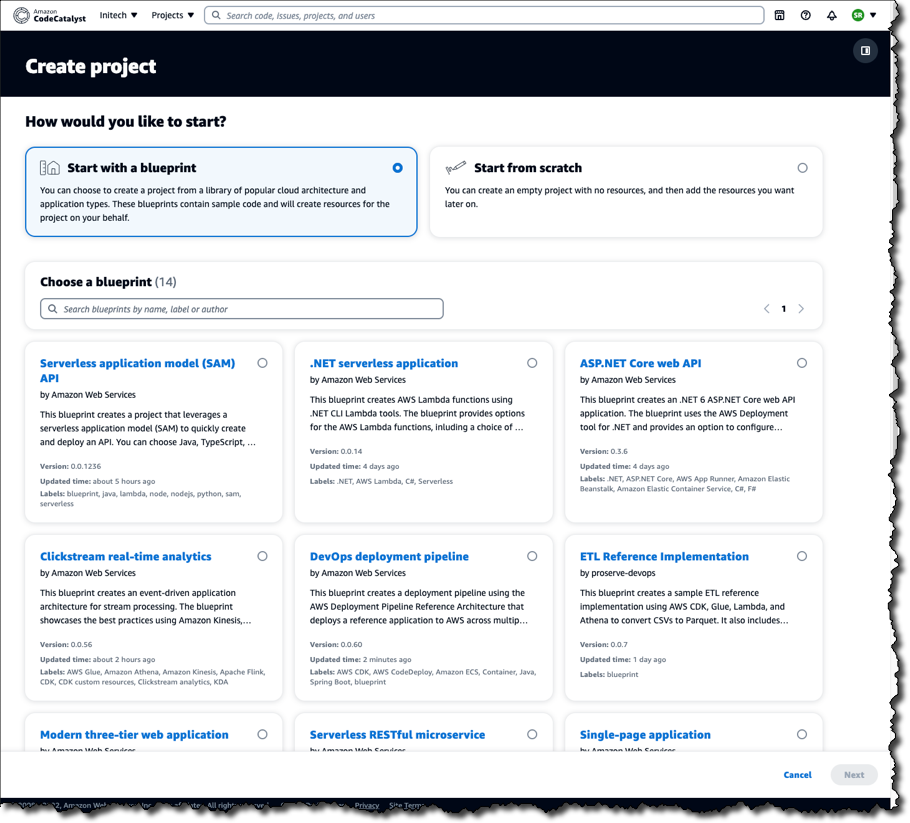
    Amazon Web Services (AWS) this week launched a preview release of the Amazon CodeCatalyst framework that leverages blueprints to automatically provision and configure developer environments in its cloud.

    Announced at the AWS re:Invent 2022 conference, Amazon CodeCatalyst takes advantage of a Project Blueprints tool to launch a source code repository and a project management tracker that are then used to create build and release pipelines. DevOps teams can use either the tools provided by AWS or substitute an instance of, for example, GitHub or the Jira project management software.

    Amazon CTO Werner Vogels told conference attendees the goal is to reduce the friction that developers currently encounter whenever they need to launch a new development project. As part of that effort, Amazon CodeCatalyst promises to make it simpler to consistently replicate development environments using scaffolds in addition to providing dashboards and search capabilities for tracking changes across commits, pull requests and deployments.

    Amazon CodeCatalyst uses a devfile to define the configuration of an environment that comes in four resizable instance options made up of two, four, eight or 16 virtual CPUs. The devfile defines and configures all the resources needed to code, test and debug a project. Devfiles, which are added to the source code repository by the selected blueprint, can also be modified.

    Collectively, those capabilities make it possible to deploy sample TypeScript, Python, Java, .NET, JavaScript, React, Angular and Vue code running in a few minutes. Developers can work with the AWS Cloud9 integrated development environment (IDE) or use tools such as JetBrains IntelliJ IDEA Ultimate, PyCharm Pro, GoLand and Visual Studio Code on their local machine. Developers, as a result, can simply switch between multiple codebases or collaborate with other developers as needed.

    The pipelines can be run on pre-provisioned builds in the cloud or organizations can opt to deploy their own container environments. Developers can incorporate build actions that are built in or provided by AWS partners in addition to incorporating GitHub Actions to compose fully automated pipelines that can be configured using either a visual editor or YAML files. Build and release pipelines enable deployment on Amazon Elastic Container Service (Amazon ECS), AWS Lambda and Amazon Elastic Compute Cloud (Amazon EC2) services.

    In general, Vogels advocated that IT teams should build event-driven applications that are loosely coupled to make it simpler to add new capabilities to existing applications running at scale without impacting the entire codebase. To make it simpler to build those types of applications, AWS added an Amazon EventBridge Pipes tool that creates point-to-point integrations between event producers and consumers in a way that eliminates the need to write that code. AWS also made available in preview a graphical AWS Application Composer tool that makes it simpler to design, configure and build serverless applications using infrastructure-as-code (IaC) definitions.

    It’s not clear to what degree developers will be embracing event-driven applications. As a programming model, event-driven architectures have been around for decades. The issue has been those applications also have tended to be among the most challenging to build and maintain. AWS is now clearly signaling its intent to make building those applications a lot easier.

  • AWS re:Invent — Top 4 Things We Learned This Week

    AWS re:Invent — Top 4 Things We Learned This Week

    Welcome to The Long View—where we peruse the news of the week and strip it to the essentials. Let’s work out what really matters.

    This week, four things that caught my eye from Amazon Web Services’ re:Invent 2022 conference: SnapStart turbocharges Lambda, Graviton3E ARM HPC SoC, AWS continues hiring, and AWS’s origin story. (more…)

  • Nobl9 Adds Free Tier to SaaS Platform for Managing SLOs

    Nobl9 Adds Free Tier to SaaS Platform for Managing SLOs

    Nobl9 this week announced it is making available a perpetual free tier of its software-as-a-service (SaaS) platform for managing service level objectives (SLOs).

    The free tier was announced at the AWS re:Invent 2022 conference and the company also revamped its pricing. Nobl9 Teams Edition (formerly Nobl9 Hydrogen) now includes 50 SLOs, up from 25, for $850/month. Nobl9 Enterprise Edition also has doubled the included SLOs from 75 to 150.

    Finally, Nobl9 also launched SLOcademy to help educate IT teams on how best to create and manage SLOs.

    The Nobl9 platform simplifies the creation and tracking of SLOs using metrics and observability data collected from more than 24 widely used DevOps tools including Prometheus as well as services provided by Datadog, New Relic, Dynatrace, Google, Amazon Web Services (AWS) and Splunk.

    Kit Merker, chief growth officer for Nobl9, said the company’s platform collects signals from logs, metrics and traces to define what normal should look like for any given service. The free tier of the platform has some limitations, but it does provide access to the full-featured platform to enable IT teams to get started managing SLOs.

    SLOs, of course, are not a new idea. They have been used as a metric to track the performance of IT services for decades. It’s not clear whether reliance on SLOs has waned over the years or if application environments simply became too complex to track meaningful metrics. However, as applications are increasingly viewed as services, it’s now only a matter of time before SLOs become more widely adopted across a modern application environment. The challenge, of course, is that defining an SLO is a lot easier than maintaining it—especially within today’s highly dynamic cloud-native application environments where services with lots of dependencies tend to come, change and go unexpectedly.

    Nobl9 is making a case for an SLO-as-code approach that makes it simpler to track service levels. A recent survey of more than 300 IT managers and executives conducted by Dimensional Research on behalf of Nobl9 found only 29% of respondents had no plans to implement SLOs. A full 94% of respondents that have or plan to implement SLOs intend to map them directly to business operations, with 91% reporting that they expect that effort to improve decision-making. More than 80% also said their organizations are planning to increase the use of SLOs, with 87% indicating SLOs should improve overall microservices performance.

    The challenge is that most organizations have limited visibility into their IT environments. The survey, for example, found less than half of respondents (46%) had visibility into all their IT environments. Only 45% and 35% claim to have visibility into containers and microservices, respectively. More than three-quarters (78%) said hybrid clouds make observability more difficult. Ironically, 45% of companies reported they already employed 11 or more observability and monitoring tools. On the plus side, 31% have hired site reliability engineers (SREs) while nearly half (46%) planned to create that role.

    It may be a while before most IT teams are organized around the concept of applications as services but as the management of IT continues to evolve it’s now just a matter of time before that approach becomes more the rule than the exception.

  • GraphQL Vulnerability Analysis: The Top Threats

    GraphQL Vulnerability Analysis: The Top Threats

    Publicly available vulnerability data can be a goldmine for insights into how DevOps and DevSecOps teams can prioritize threats and improve security across the pipeline. With this in mind, Inigo recently performed a deep-dive analysis of known vulnerabilities affecting GraphQL components—including GraphQL clients such as Relay and GraphQL servers such as Apollo, Graphene, Ariadne, GitLab Enterprise, Magento and others. Our main data sources for this investigation were the MITRE CVE database and the HackerOne Hacktivity portal.

    Analysis and Findings From the MITRE CVE Database

    First, a few caveats about the MITRE CVE database. While it’s considered the source of truth for CVEs and the best data source available for understanding these vulnerabilities, it has its limits. Not every vulnerability gets reported, and not every reported vulnerability gets an assigned CVE identifier. Vulnerabilities generally receive a CVE identifier when an impacted software vendor or researcher recognizes a vulnerability and files a CVE request with MITRE. Large software vendors including GitLab, GitHub, Adobe and many more also serve as CVE Numbering Authority (CNA) partners, authorizing them to issue CVE identifiers themselves (often only for the scope of their own software). All this is to say that the MITRE CVE database is a strong data source for our analysis, but it shouldn’t be considered comprehensive.

    Inigo started its investigation by searching the MITRA CVE database for the term “GraphQL,” revealing 45 CVE records (at the time of the research) relevant to GraphQL clients, servers, and other components. Interestingly, the first tracked GraphQL vulnerability was CVE-2019-1000011 from 2019: Most likely not the first vulnerability ever discovered in GraphQL software, but the oldest available in this database.

    Researchers were curious to know which classes of GraphQL vulnerabilities were most common, and which GraphQL software has the most known CVEs. The following chart displays the results of the analysis answering the first question.

    Authorization bypass vulnerabilities are far and away the most common vulnerability class, and a majority representing 54.8% of all GraphQL vulnerabilities. At 16.7%, denial-of-service (DoS) vulnerabilities stand out as the second most common vulnerability class, followed by information disclosure (9.5%), code execution (7.1%), cross-site request forgery (CSRF) (7.1%) and injection (4.8%).

    Analysis into which GraphQL software has the most CVEs revealed the following:

    To be clear, these findings don’t necessarily speak to how hardened or how safe a particular GraphQL component is. Popular GraphQL servers simply draw more attention and have more eyeballs searching for vulnerabilities, whether they belong to attackers or security personnel. While this fact skews these results, viewing this data at a glance remains interesting.

    Analysis and Findings From the HackerOne Vulnerability Database

    The HackerOne Hacktivity portal offers a robust database resource that collects information on vulnerabilities as reported by researchers. The analysis looked at public reports of GraphQL vulnerabilities, finding 74 results since 2018.

    As the graph shows, identified GraphQL vulnerabilities fell mostly into the authorization class (87%), with DoS (7%) a far second and race condition and session management vulnerabilities each coming in at 2.8%.

    Bug bounties offer an interesting and likely influential factor here. Over the 2018-2022 timeframe, bug bounties granted for these vulnerabilities ranged from $250 to more than $20,000. At the same time, authorization vulnerabilities carry a high risk to sensitive data such as personally identifiable information (PII). This drives organizations to place premium bounties on these authorization flaws and motivates security researchers to focus on earning those prizes. Therefore, white-hat hackers will naturally test for authorization flaws first, perhaps leading to their overrepresentation in the data. It’s also important to note that bug bounty programs tend to prohibit testing for DoS vulnerabilities for obvious reasons, possibly reducing their representation here.

    Open-Eyed GraphQL Security

    For developers, DevOps and security teams tasked with safeguarding GraphQL deployments, the first step is knowing what you’re up against. The findings above should serve as an eye-opener that helps teams to prioritize threats, whether they be authorization, DoS and other classes of GraphQL vulnerabilities. As more and more organizations rush into GraphQL (increasingly migrating from REST APIs), security cannot be put on the back burner. There’s too much at stake, and ensuring the security of GraphQL deployments isn’t nearly as difficult or time-consuming as many teams currently think.

  • Key Findings From the 2022 State of GraphQL Report

    Key Findings From the 2022 State of GraphQL Report

    GraphQL, the open source query language, has been steadily growing in popularity over the past few years. The language is excellent for frontend development, as it creates a usable interface to fetch precisely the data required for the specific client at hand. You can also use it to aggregate multiple backend services and data sources.

    Studies show that the ecosystem around GraphQL is maturing—it has a very global user base and a growing number of tools exist to aid in its adoption. The 2022 State of GraphQL Report found that 61.8% of developers are happy with the overall state of the ecosystem. Yet many native GraphQL features go unused by developers, which suggests there is a wide range of experience levels, from novice to advanced users, working with the technology. This indicates there is plenty of room for growth and knowledge sharing.

    Below, I’ll review the key takeaways from the 2022 State of GraphQL Report, considering overall usage data and focusing on the popularity of specific features. We’ll also highlight the state of standard tools used in conjunction with GraphQL to get the job done.

    Analyzing Overall Usage Statistics

    First off, there is a wide variance in the types of GraphQL APIs in production today, ranging from private to public endpoints. The report found 47.9% of developers use GraphQL for exposing an API intended for a personal website or app, 40.4% use it for private unexposed APIs for internal usage and 19.5% use GraphQL for publicly available APIs intended for third-party developer consumption. This demonstrates its flexibility to cater to multiple scenarios. And while the majority of clients that connect to GraphQL APIs include browsers (62.3%), it’s commonly consumed by other client types such as native mobile apps, other servers and desktop apps.

    Previously, we discussed using GraphQL as a composition layer to combine underlying APIs and services. And the report backs up this idea that developers commonly use it to aggregate various data sources: 55.4% of GraphQL APIs hit databases, while 35% consume REST APIs and 14.6% eat other GraphQL endpoints.

    In terms of benefits, one strong point is the ability to enforce and validate types for every object in the API. Users find other top benefits to be avoiding overfetching and aggregating requests. Yet, some hurdles still present themselves. These top drawbacks include error handling, performance issues, client-side caching and security woes.

    Regarding user base statistics, most users have been working with GraphQL for less than five years. If we look at the type of sector utilizing GraphQL, we see it primarily leveraged in the programming and technology sector. This is followed by e-commerce and retail (16.4%), finance (8.9%) and news, media and blogging (7.2%).

    Many Advanced Features Go Unused

    Many of the more advanced GraphQL features still go unnoticed by the majority of users. For example, live queries is a feature that helps obtain live data from a GraphQL server, yet only 25% who know about it have used it. Over half of respondents had never heard of @skip, a directive that skips a field based on a value passed to it. Similarly, other directives like @specifiedBy, @defer and @stream also share little-to-no awareness or use.

    Analyzing feature usage becomes a bit more serious if we consider the unadopted security and performance features. For example, only 43.2% of respondents have disabled query introspection. Disabling query introspection is a suggested security best practice to limit a hacker’s ability to perform surveillance. But as we’ve previously covered, security by obscurity isn’t enough to protect GraphQL, and an additional security emphasis is often needed.

    As most GraphQL APIs are intended for personal or private scenarios, you would think that more security features would be leveraged to limit the threat of introspection and denial-of-service attacks. Yet, the report discovered low usage and awareness of security and performance features like query timeouts, query rate limiting and query cost analysis, all of which could be turned on to curb malicious behaviors.

    Tools Used In Conjunction With GraphQL

    Developers often seek to combine, aggregate or merge GraphQL schemas from different APIs. To do so, Apollo Federation is the most common solution, used by 22.5% of respondents. This is followed by Schema Stitching (16.9%), GraphQL Modules (4.4%), and GraphQL Mesh (2.9%).

    Looking at other technologies used in connection, Next.js is the most popular framework and PostgreSQL is the most common database used. TypeScript and JavaScript comprise the most common languages used to write a GraphQL backend. Developers also use a balanced mix of IDEs to query and test endpoints, including GraphiQL, GraphQL Playground, Postman, Apollo Studio, and Insomnia.

    The report also found relatively high usage and retention for tools like the GraphQL Code Generator schema builder, Apollo Client and Apollo Server. The data shows a crowded solution market with Apollo as an industry-leading outlier—many other clients, servers, API generators and schema builders have medium-to-high retention rates yet experience far less use.

    Final Thoughts

    The 2022 State of GraphQL Report sheds some interesting light on the state of GraphQL, validating a lot of the interest and trends we’ve covered lately on the blog. Of course, there is more to be said about many areas, such as smoothing the transition to GraphQL.

    One key finding is the low number of security features being leveraged by developers. A greater emphasis on API security is required to avoid incidents and retain a zero-trust approach. This emphasis is part and parcel of responding to ongoing software supply chain threats and will require more awareness and thought leadership around GraphQL security best practices.

    The 2022 State of GraphQL survey ran from June 15, 2022, to July 15, 2022, and collected 3,094 responses. The above analysis only scratched the surface and there are many other insights. For more findings, you can read the full results here.

  • Implementing Shift Left Security in the Cloud

    Implementing Shift Left Security in the Cloud

    While ransomware has been the leading concern for enterprise security teams over the few past years, software vulnerabilities are nipping at its heels. The boom in cloud-based apps and services and increased digitization of work have been a boon for hackers, who are taking advantage of developers’ and DevOps teams’ attempts to work faster and smarter to keep up with demand. One estimate says that four out of 10 zero-day attacks carried out in the last decade happened in 2021 alone.

    Many things account for this increase. Developers are stretched and are reusing code, which allows for misconfigurations and vulnerabilities to reappear unexpectedly in different programs, and the use of multiple cloud services fragments security measures and reduces visibility into the code running many enterprise functions. This is why developers and security professionals alike are paying more attention to security throughout the software development life cycle (SDLC), particularly in the early stages.

    Shift Left Security Principles and Challenges

    The zero-day surge has led to an increased interest in shift left practices as a way to make security a priority in the development process. Shift left culture brings security into the equation much earlier in the software life cycle, before the software is deployed, rather than patch bugs after users report them. This preemptive approach helps head off vulnerabilities that can affect an application’s security posture unbeknown to its defenders.

    Shift left principles can also enhance security when developers build applications for cloud platforms—such as Amazon Web Services, Microsoft’s Azure or Google Cloud—where visibility into the proprietary code and security tools of the platform can be limited. In a shift left culture, DevOps embeds least privilege policies as part of the daily work on cloud workloads, to protect network infrastructure and avoid granting excess permissions on those workflows.

    For example, setting up role-based access control (RBAC) on Kubernetes containers enforces a least privilege model on those clusters and avoids excessive permissions that can lead to a breach, while removing admin credentials from continuous integration/continuous delivery (CI/CD) workstations shuts off hackers from using those pipelines as an attack vector.

    Shift left security is a great concept, but runs into hurdles in execution, mainly the internal conflict between development teams who want to move at the speed of business while security staff takes a more cautious approach. This leads to friction, with developers warning about access denials affecting their work and causing deployment delays, while the security analysts worry about data breaches caused by too many users with unchecked admin privileges.

    Working out this friction requires a mindset shift, where DevOps understands that security is part of the development process, and management can trust that developers have security in hand. This also requires tools and training to integrate shift left practices, such as platforms that can bridge the security needs of the CISO (by granting greater visibility into the network infrastructure code, for example) and the agility needs of the DevOps teams (by automating security guardrails and entitlements, for example). The ultimate goal is creating what is known as a DevSecOps model, bringing together development, security and operations into one agile, safe and efficient workflow.

    How to Adopt Shift Left Security on the Cloud

    Four best practices can help:

    ● Gain deep visibility: With enterprises often working in multiple cloud environments—and mixing public and private clouds into hybrid infrastructures—visibility into assets typically suffers, which makes getting a clear view of risk difficult. Being able to discover all identities, permissions, configurations and resources in the environment and all the access paths to specific resources can help build a contextual inventory of cloud assets to better manage them and carry out policy analysis.

    ● Prioritize risk: Risk management is a key practice of any security program, but the flood of alerts from multiple cloud providers and systems can overwhelm security operations centers, which are often short on talent and time. Automation tools can now search and prioritize risks across an entire cloud environment, from development to production, spotting problem combinations and alleviating the workload of sorting manually through alerts across multiple silos, freeing the staff to work on higher-priority mitigation and remediation tasks.

    ● Just-in-time access: Zero-trust architecture has become the standard to aspire for most security defenses, but it is often challenged by the difficulties of managing access privileges. Just-in-Time (JIT) access, granting limited-time revocable rights, is a useful tool for building a zero-trust security architecture and enforcing least privilege policies to maintain it. Technology tools that actively manage and monitor developer access to cloud environments, including a strong audit trail of privileged activity, give security a means to enforce JIT access and zero-trust in turn.

    ● Find and prevent vulnerabilities and misconfigurations: Infrastructure-as-code (IaC) has made software deployment in the cloud (much more agile and efficient with the use of virtual machines, containers, microservices, etc. However, security is often an afterthought both pre- and post-production when standing up cloud infrastructure. Organizations should scan code for security policy violations and other risks in order to mitigate flaws before they reach production and to detect and fix problems in production environments. With feedback and automated guardrails built into development workflows, DevOps and security teams can reduce security risks in their code.

    Like zero-trust, shift left is on its way to becoming a standard practice for cybersecurity assurance. But building a DevSecOps model takes more than good intentions. It requires practices, tools and training to execute that model, and a mindset of partnership across the enterprise and with outside cloud and security partners. Only a group effort will provide the cloud security assurance an agile business needs.