Category: Doin’ DevOps

  • Collaboration – A DevOps Tenet

    Collaboration – A DevOps Tenet

    You can’t turn around in the tech space without hearing about collaboration. Whether it has to do with the new economy being built around collaboration or the platforms designed to improve it or the various strategies one might implement to spur more of it on your team, collaboration is the hot new term, especially when it comes to DevOps.

    All that being said, what is collaboration exactly? And the deeper question…can you get to an answer to a problem faster if more viewpoints are involved? Can you cut through space and time to overcome physical barriers and find the specific knowledge someone on the team has that others do not? Can you make the practices of DevOps, which are already more nimble, even faster by getting more eyes on the situation?

    Here’s what we talk about when we talk about collaboration internally at VictorOps:

    • remote engagement – In order for collaboration to work, you need to be able to get folks involved no matter their physical location. Collaboration doesn’t happen just between 9-5 and doesn’t take place just in the office setting. Team members want to help out (especially during a firefight) but they may not want to give up everything in their life in order to do it.

    • real-time troubleshooting – As anyone who has used Salesforce or JIRA can attest, effective collaboration doesn’t happen in a ticketing system. If you want to work together, you need a communication channel that allows for synchronous discussion that keeps everyone on the same page, at the same time. Immediacy is a crucial factor in figuring out the cause of a problem and synchronous messaging, which closely resembles face-to-face conversation, is one of the best means of expressing that.

    • the right tools – These days, if you want your team to adopt a collaboration tool, you have to keep two things in mind: the tool must be mobile and the tool must feel natural to use. Without these two things, you’re going to have a hard time getting everyone on board. If a tool is clunky or requires a steep learning curve, no one will actually use it, making for very ineffective collaboration.

    • solving problems faster – The end result of effective collaboration is coming to a solution in a quicker manner. Whether it’s because you’re getting the right eyes on the problem, noticing data patterns or reducing new participant spool-up time, collaboration should help the entire team do their jobs better while achieving company objectives.

    Collaboration can become just another marketing term or vague business concept without any concrete examples of why it’s important. In our next post, we’ll talk about different types of collaboration (vertical vs. horizontal, asynchronous vs. synchronous) and why collaboration works best when it’s vertical.

  • Systems of Things

    Systems of Things

    What do Chevy V8s and DevOps have in common?  They’re both complex systems with many interactions between their moving parts.

    The first time I did minor surgery on a Chevy engine I learned a lot about systems.  The engine was a tired 283 cubic inch V8 in a 1966 Chevy Malibu  which my grandfather purchased new in 1966 and passed it on to my (much older) brother around 1980.  During my brother’s ownership it was driven hard and received a less than flattering paint job.  By the time it was passed to me it ran about as well as it looked, which is it say it was rough.  A buddy of mine who thought he knew something about engines convinced me to replace the valve train with parts from a junkyard.  The results were not good; we only succeeded in making it run worse.

    Interchangeable Parts

     The problem was that valve train components are not interchangeable after they wear-in.  Sure, when they’re brand new the parts are interchangeable.  But after a while the parts wear together and become fitted to their neighbor.  Had I better understood this complex system I wouldn’t have expected old valve-train parts to improve the engines performance.

    In “The Phoenix Project”, we are encouraged to think of DevOps as an interconnected system, in the same way “The Goal” taught us to think about manufacturing processes.  In an interconnected system, the parts have to work together with precision to achieve the goal.  In DevOps, we talk about shortening cycle-time and increasing release frequency, requiring Dev and Ops processes to work together with precision timing.

    Unexpected Results

    How many times have you made a change to something (anything) and afterwards thought to yourself, “That didn’t go as planned”?  I know I have had the experience on more than one occasion.    Taking the time to understand the system is hard, but it pays off over time.  Just as Erik in “The Phoenix Project” reminds us, “…Step 1 is to identify the constraint”.

    Be mindful of the system and seek to understand before suggesting improvements.  Failing fast and fixing twice makes sense when talking about features, but not so much when talking about system availability.

    Getting Better All the Time

    Embrace the system of things… seek to understand the interaction between the moving parts.  Try to be aware of processes that have become fitted to their neighbor and what will happen if just one of those processes is changed.  Avoid the urge to suggest changes without first understanding the system.

    I got better at rebuilding engines as I learned the underlying systems.  Knowing the systems allowed for changes that improved performance.  Understanding the tradeoffs in the system was also important; an engine tuned to develop maximum horsepower at full throttle will run rough at idle.

    Take the time to understand the interconnected systems we are attempting to improve.

  • My DevOps Bookshelf

    My DevOps Bookshelf

    Aside from the many technical manuals on our bookshelves, I bet everyone has a few that are more process or philosophically oriented which hold a special place in our hearts.   To me, these are the ones we continue to go back to and that have helped develop us as engineers, software, operations, quality assurance or otherwise.  In no particular order, the following are the top four, not strictly technical, books in my library.

    Web Operations by John Allspaw and Jesse Robbins

    Allspaw and Robbins cover many topics in this text ranging from monitoring and metrics to databases and operations development relations.  I appreciate this one so much it is required reading material for anyone who joins my operations teams.  In my opinion, it illustrates many best practices for an operations organization.

    Continuous Delivery by Dave Farley and Jez Humble

    This book bridges the gap between good software development practices and getting to continuous delivery.  It made me really think about testing and quality assurance, which in my opinion is one of the most difficult parts of a continuous delivery world to wrap your head around.  While there isn’t one right answer, you should really think about the role testing plays in the overall process.

    The Phoenix Project by Gene Kim, Kevin Behr and George Spafford

    “The Pheonix Project” is a relatively new addition to my library.  While it may sound strange, this book was an absolute page-turner and I really related to it.  It presents many Agile and DevOps concepts via a fictional story that doesn’t seem fictional because we have all been there.  Despite the fact that it is fictional, the concepts presented and techniques are applicable to each of our real-world situations.

    Etsy – Moving Fast at Scale

    While this isn’t actually a book, but a video, to me this is a pivotal piece of information has continued to guide my pursuit of DevOps methodologies and practices, so it holds a special place on my figurative bookshelf.  In the video, the guys at Esty discuss a number of topics including deployment processes, application toggles, metrics and more.  Most importantly, they not only discuss the why but also the how and I find myself frequently referencing this video.

    For me each one of these books or videos has played an important role in pursuit and real-world implementations of DevOps practices.  What are the texts digital or otherwise that you hold dear and/or have influenced you?

  • A Critical First Step in Bringing Dev and Ops Together

    A Critical First Step in Bringing Dev and Ops Together

    We all want to deliver excellent software to our customers. We now have a greater awareness than ever before of the interconnectedness of all the activities required to do so. The agile movement started this but it was not until the advent of DevOps that Ops was considered part of the full picture. In this article I will explain an effective first step that agile organizations can take to complete the picture and bring ops more completely into the product development process.

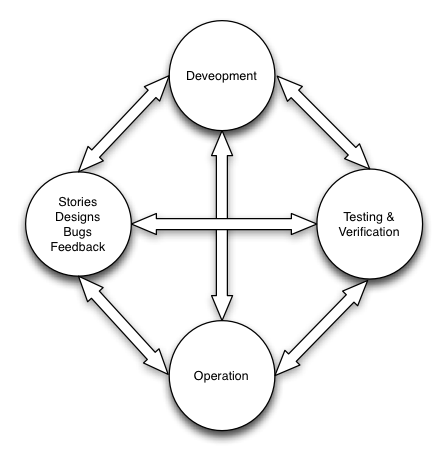
    Delivering excellent software starts with product definition and flows from those initial stories and designs, into dev, verification and testing, into production and then back again in the form of customer feedback and bugs. In reality the feedback paths represent a transitive closure of all activities just mentioned as you can see in the diagram below. Agile recognized the importance of feedback loops in good product development. Agile also realized that for the right information to flow, walls had to be broken down. The motto “Done means tested” arose and indicated that product owners were not done with a story, could not consider it closed, until it had been tested and they had verified it. This represented the integration of PM, development and QA functions. A huge step, but one step too short. Operations was still not viewed as a key part of building excellent software and there was not much insight into the fact that the feedback loop did not stop at testing. DevOps has recognized this shortfall and taken it to its logical conclusion – “Done means in production.”

    Operational Excellence Feedback Loop

    Product development is a cycle, a cycle that operations is a critical part of. In describing how all parts of the cycle can be integrated lets start at the most natural beginning; product definition. Product definition activities produce stories, designs, functional acceptance criteria (A.C.) and prioritization. In this phase we don’t produce all we need for the finished product but just enough to get us going. With popular agile methodologies like Scrum this is ideally not done solely by a product owner but instead in conjunction with dev and test at story grooming meetings, design reviews and sprint planning. In these meetings dev, QA and product communicate and negotiate stories, comment on designs, and flesh out acceptance criteria. In this way the stories, designs and acceptance criteria are improved and everyone gains an understanding of what is being built; they also become invested in it. A story may look something like this (abbreviated):

    Story: Blog administrator can change user roles SO THAT users can be managed effectively

    A.C: Given blog administrator is logged in
    And on a user profile
    When he selects a permission scheme from a permissions drop-down menu
    Then the users permissions are updated and stored in the DB

    This is a great start but it is not enough. If we are to be excellent we must modernize this just a bit and add in some DevOps spice.

    A first step towards bringing ops effectively into the cycle is to include someone responsible for actually operating the software in the story and acceptance criteria grooming sessions, design reviews, and sprint planning meetings. The critical aspect is that when the team negotiates the acceptance criteria associated with a story it will be ops responsibility to ensure we for each story or feature the team adds success and failure metrics, initial alarm values and any operational functionality such as a kill switch that will be needed in order to operate the functionality effectively. So a story will now contain things like the following in the A.C. (acceptance criteria).

    Given operation X fails
    Then the metric operation-x:failed will be sent through the metrics feed

    We will also alter our definition of done to make sure that a story will not be closed until we meet the ops driven acceptance criteria. For example: we can see the metrics we have defined in our A.C. show up on an ops dashboard. There are so many benefits to this such as folks that are unlucky enough to be on on-call will have participated in this story grooming and will know exactly what these metrics mean when they encounter an issue with them for the first time in production. Furthermore, they will know what operational levers they can pull or request to be pulled.

    This first step represents a connection from product definition to dev, to QA, to operations. This connection is perfectly natural and intuitive when you think about it. Being a true DevOps organization and developing operationally excellent products requires more but having connected product definition to operations as we have provides a nice toe hold from which to flesh things out further. Best of luck. If you have any questions leave them as comments and I will respond as best I can.

  • Enough with the DevOps already

    Enough with the DevOps already

    Ever say a word 10 times in a row and feel it start to lose its meaning? Try it, say the word “boat” ten times out loud and watch what happens – be sure you are a alone when you try this or you will get funny looks. When your done try it with the word “devops”.

    Writing and articles relating to DevOps heavily use the word DevOps, particularly in their titles.

    • What is DevOps
    • Getting started DevOps
    • DevOps culture
    • DevOps and continuous delivery

    etc…

    Take a look here at devopsy.kinsta.cloud for example, the majority of articles have “DevOps” in the title. This is the case across pretty much all DevOps related sites across the web.

    This suggests an immaturity in the space. There is not yet a strong consensus on what the term DevOps means and what its domain actually is. I suspect this is going to correct itself over time but how rapidly depends on the DevOps community and how much information we can get out there. So looks like we need to hear about DevOps as a term for a little while longer.

    I suspect in 6 months to a year we will start to see articles about specific technology and practices and it will just be obvious to us that this relates to DevOps. Ironically this article has 231 words and uses the term DevOps 14 times.

  • My Journey to the Land of DevOps

    My Journey to the Land of DevOps

    Welcome to my first installment in a series where I talk about my long transition as an engineer, first from a very traditional waterfall development methodology into a more Agile process, and finally into a true DevOps organization at my current gig at JumpCloud.

    Who Am I?

    First, a little background on me. I’m (almost) a lifelong coder, and by that I mean I started writing my first simple programs at 9 years old, on a HP 3000 MP/E host running MP/E BASIC. I got my first computer at home at 12, a Radio Shack TRS-80 with a whopping 16K of RAM, and a cassette drive for loading and saving programs. I’ve had computers in my house since then, and probably never in my life since have I gone more than a week without being in front of a computer.

    I love building software, but for a long time, I was resistant to changing how I did that in a professional environment. But, I try to be a guy who’s open to at least evaluating new stuff, even if I don’t dive into new things as a way of life. I tend to be one of those guys who does it (everything) the same way over and over until I see a way that is demonstrably better. I’m a creature of habit, but I’m also a creature of continuous improvement (as long as I can see the improvement).

    In college, I did a fair amount of system administration work on UNIX systems, including BSD and some System V R4 boxes. During that stint, I learned quite a bit about how not to destroy systems by running rm -rf /etc (every system admin does that on a production box at least once, don’t they? If you haven’t, I can’t really recommend the rush that comes from recognizing that you’ve just decided how you’re going to spend your night, instead of sleeping), and how to install, backup, maintain, and fix big (but by today’s standards laughably slow) mini-computers. I’ve always maintained UNIX/Linux system administration as a skill set, and it’s always come in handy.

    After that, I jumped into software development, in databases, security, and systems programming.

    You get the idea: I’ve been around awhile, and I’ve done enough to be able to gauge whether a new technology or process is valuable or not. And, because I’ve done dev, operations, and DBA work, I think I can offer a solid perspective on the transition to DevOps.

    The Waterfall Method, or, How Can We Fail Big?

    Looking back, Waterfall as we practiced it then was comparable to building a campfire, versus the subtlety and refinement of fireworks, and Agile methodologies.

    Waterfall is the place where we all started (for those of us joining the workforce in the early 90s). That was how software got built: no ifs, ands, or buts. We all “enjoyed” the many hours of building requirements with business analysts, the joint application design (JAD) sessions with clients, the weeks of first writing functional specifications, then moving to the design phase and building design specifications. In the midst of all that, iterating through many reviews with stakeholders under the watchful eye of our project manager.

    Once we got to coding (on my teams, at least) the docs were treated as an afterthought for the most part. Sure we’d open them up periodically to see if we’d missed a requirement, or if there was an argument about some previous decision we’d made. But, most of the time, most of us didn’t code with a document open in one window, and code in another. Sometimes we did, but inevitably we’d hit a section that literally or figuratively says, “magic happens here” (nerdspeak for, I have no idea how that’s going to work) and then go off the rails: the specs never to be seen again.

    When the coding was done, we’d package everything up, and throw it over the wall to QA. QA would start cranking through executing their test plans, doing ad hoc testing, rarely doing load testing, and eventually (through internal iteration – sounding a little like Agile?) would make our software look like the requirements spec, or at least what it was made to look like after the dev team spent a lot of hours and countless emails asking the client detailed questions about how a particular thing should work. QA would then pronounce that version good, and either we (the dev team) or an ops team would actually deploy our software to production.

    Oh, and by the way, I missed another step: the deployment documentation. This file goes here, reboot the system at this point, install this package, upgrade to this version of the database or OS. All that fun stuff got written into documents, and executed by humans, over and over again. And did I mention, that had to be tested, too? And maintained? And that inevitably would result in a developer getting a call in the middle of the night, or during a weekend change window to get things back on their feet?

    Oh, the joys of writing documentation that was out of date almost as soon as it was finished, the deviations from it that occurred when you were building real software to handle real world cases that you never considered during the specification phase. It was almost as if all the docs were completely useless. But, well-paid individuals spent countless hours to build them. They did look impressive, and it showed that we were doing things “professionally”, not just getting out and starting to code something, because that would be crazy.

    I should probably mention at this point that I’ve never been involved in building software for applications that could have life-threatening consequences, or that are one-chance things, where you spend years building the software, and if you don’t get it right, human lives, or millions or billions of dollars can be lost. I think the extreme levels of documentation, planning, and review cycles are still necessary for these types of applications, though I think both Agile and DevOps have benefits to offer parts of these projects, more on that later. In my view, these applications are not ones that lend themselves to lots of iteration, at least not externally: “Oh, I’m sorry, captain, the feature that lets you apply landing brakes is not part of this release. The team says that’s coming in the next sprint.”

    Microsoft Project: The Wrong Tool for the Job

    All this work took a long time, and managers were still under the illusion that project managers could predict the future. Management would say: you have 18 months to get this project done, and we’d open Microsoft Project (as though we were about to build a building or something), and start putting in development tasks. We’d estimate based on our prior experience how long a particular task was likely to take, and schedule it all out. We’d nearly always end up reducing scope at that point to make all our work fit into that short(!) 18-month schedule. I remember spending hours in Project trying to make all the dependencies work, and then seeing the schedule get changed over and over as we changed from one task to another based on what was logical at the time, not what was on the schedule.

    We’d go back to management, and say, this is what we think we can do in 18-months. The more astute project managers would give a best case, likely case, and worst case estimate, all of which would be wildly different. We’d play games like ensuring that the weakest members of the team never became part of the “critical path” (the path of tasks that was packed full from beginning to end, such that missing a deadline would delay the whole project). To try to reduce risk, we’d build risk mitigation documents that listed out all the stuff that could go wrong, and what we were going to do to fix it and get the project back on track.

    Management would take our project schedule, risk mitigation plans, and high level functional spec, look it over, ask some pointed and thoughtful questions, and send us away again to improve our plan. Nearly everyone in the process was competent, professional, and thoughtful. And, in the end, everyone in the process was horribly, brutally, wrong: repeatedly.

    Even if we met major milestones on schedule, it was very rare to actually hit a scheduled end date. Something new would pop up, something would go wrong, something would be harder than we thought, and these somethings would pop up more frequently the longer, larger, and more money we threw at a project. So, as the risk level increased, so did the likelihood of failure. It was almost a foregone conclusion that we’d have to cut scope before the end of the project to try to meet our original deadlines. Or, the team would end up in a death march for months on end to try to pull the schedule back. Or, we’d cut into the time set aside for QA. Or all of the above.

    We learned all too well the old project management axiom that you can have any two of: time, quality, or cost. That is, you can get something fast and of high quality if you want to spend a lot of money to get it. Or, you can go cheap and fast, at the cost of quality. Or, finally, you can get great quality and low cost, if you want to take more time. That was called out especially harshly when iterations were counted in years, rather than months or weeks.

    The funny thing was that we all fought with these problems daily, and we argued with management about how broken the process was, that all the specification and up front planning work (especially when building phone books or mailing lists) wasn’t useful, but in the end, we all just kind of continued down the same path, until the late 90s, when the ideas of Agile development first started taking root.

    Next time, I’ll focus on Agile, my initial reactions to it, and and how it started gaining traction.

  • Operational Overhead – or why hubris is bad.

    Operational Overhead – or why hubris is bad.

    Stop me if you’ve heard this one: A guy walks into a meeting and says “We need a system that does something”, and the engineer in the room replies “Oh, we can totally build that”. Most of the punchlines to this joke go “we can totally build it, and now we have to own its lifecycle and we have sacrificed valuable time and resources for something we should never have built.” ba-dum-ching

    I am guilty of playing my part in these conversations, as I’m sure many of you are. About two years ago, as our budding startup was really starting to take off, I was in one of those meetings. Some of the developers wanted to try a recommendation engine, and were going to use Mongo as part of it. Frankly, I thought they wanted to screw around with Mongo and needed an excuse as much as I thought they were going to really do something. At the time I was drowning – running our cloud systems, our LAN, facilities, purchasing, and I had just been tasked with bringing some sanity to the tech side of our video post-production process. I. Did. Not. Have. Time. For. A. Mongo. Setup.

    See, here’s the thing. Most of the time the system administrator in that conversation, trying to be a good devops partner, replies “oh sure I can stand up mongo”. But let’s be honest, it’s not just standing up Mongo. It’s handling upgrades, security, failover/HA, backups and restores. If this recommendation engine actually worked it was quickly going to become a key part of our infrastructure. I had just enough presence of mind to know that while I probably could find an hour to stand up mongo, I didn’t have the several other hours needed to do it well. And really, I didn’t have an hour. So I quipped a now-famous-and-often-used-to-troll-me response “Look guys, we need to reduce our operational overhead. Let’s find an outsource.”

    Ten minutes and a credit card later, we were setup with MongoLab. Two years later? The recommendation engine is awesome, and I have not cared one ounce about mongo. No upgrades. No middle-of-the-night pages. No architecture discussions. It just works. I’d like to spend a few words dealing with the standard objections:


    • OK we can try outsourcing, and if it works we’ll bring it in house. Right? Because you never run key pieces of the infrastructure out of your control. Right? Because, if you do… then… that’s bad. Right! Ye Olde World IT Wisdom is pretty clear on this point, you can only ever be sure that something is good if you’re running it in-house. In my experience however, you’re probably more likely to fumble a backup, fail an upgrade, or bungle a failover than an outfit whose sole job is to do those things.
    • But! it’s expensive! Right? Just about any *aaS provider has an entry level pricing structure that lets you screw around for less than the cost of that team lunch you’re buying on Friday. If you’re in production, and you are making money, or even better yet more money because of this infrastructure choice… justifying the cost is stupidly easy. As long as the cost of the service is less than the money you are bringing in, good job. If you aren’t actually making money, then what exactly are you doing?
    • We can’t trust Service Provider X. Guys, these companies are in business to provide 1 thing for you. They literally have 1 job. You probably have 14 jobs. Are you asking for a 15th? A 15th thing that you have to watch, and care for, and feed, and love, and hate? A thing that is not core to your actual business? Shouldn’t you make that 15th job something directly beneficial to your team/code/organization? Isn’t that what you’re here for?
    • OH GOD NO NOT VENDOR LOCK-IN. Hey genius, you know what? You have to write code, and whether you are writing code talking to a database in your environment, or a queuing system in someone else’s… it’s just code. I hope to spend most of the rest of my life writing about how utterly stupid this argument is. Yes! If you fire a vendor you have to refactor. You know what? If you upgrade your in-house stuff you probably have to refactor. If you change the in-house system you have to refactor. Anyone prescient enough to foresee all possible outcomes, and who can make perfect, refactor-free decisions can talk to me about vendor lock-in. The rest of you should move past this objection and get back to doing something productive.

    You know what my favorite operational overhead story is? Amazon SQS (Simple Queue Service). Different day, different developers, same idea. Wow, our little website is now processing enough orders that we need asynchronous fulfillment… I know! Let’s setup a queuing system! I used ActiveMQ once! Or RabbitMQ! Or… we can use the same queuing system that runs the largest ecommerce site on the planet. Where there is literally a horde of highly trained monkeys watching every teensy little thing that makes it work 24x7x365. Someone else has already thought of every imaginable permutation of scale/resiliency/security. And you know what? It costs 0.0000005 per request. I can process 14 million orders at a net cost of $7. Yeah, let’s totally spend time standing up something better and cheaper.

    Good engineers are good because they know they can build things. Even when they don’t know they can, they are pretty sure they can figure it out. DevOps should be about making smart decisions, and hubris is not smart. Use the best tool at hand. Rebuilding every wheel, administering every platform, doing everything yourself… is just adding to your operational overhead, and subtracting from your ability to be impactful to your business.

  • My Journey into DevOps

    My Journey into DevOps

    Like many developers, I started my career in a waterfall-based development environment. I was at a very large telecom, working on a product that had been around literally for decades. We’d spend weeks or months in the requirements phase before any code was written. We’d throw the code over the wall after our development period, and QA would file defects that would take weeks to prioritize and triage. It took about a year to ship a new version of this product. All progress came at a crawl, and I felt so disconnected from the customers that I would forget they even existed — the work I did was to get the project manager off my back, not to please users.

    Moving to a startup that practiced Agile development was a relief. Far less mature product, smart people contributing at every level, rapid development — and a rapid feedback loop, too. It felt so natural and right that I forgot there was ever another way of building software. We talked to real customers and heard about how they wanted the product to work. Our priorities were based on actual need, with estimates based in reality and with a focus on iterative improvements to functionality. My teams designed and implemented features and had it tested and accepted quickly… software development was thrilling again.

    However, it wasn’t perfect. While we could rapidly build features, and get those features right, we still had the problem of getting those features to customers rapidly. We’d design and implement and test great functionality in a matter of days, but that great stuff would sit on the shelf for weeks or even months before anyone would actually use it.

    The problem was this: we feared disrupting a working production environment. Every time we’d push to working systems, we’d bring in the operations team and the senior developers on a weekend, sit tensely while the new code was fired up, and then spend hours fixing things that had somehow crept in. Sometimes interactions between different new features hadn’t been properly vetted. Months of changes had accumulated so the changes were huge, and deployment was a nightmare. And because it was a nightmare, we didn’t want to do it often… so releases got bigger and bigger over time. It’s a vicious circle.

    I’m sure you know where this is headed — the answer to this problem is continuous deployment. Over time, we reduced our multi-month release cycles to weekly and finally daily, releases. The things that were most painful, we do more often — addressing the problems and automating the process. By releasing more often and in smaller chunks, we were able to clearly know what had changed if a problem occurred, and with that isolation of code changes, we started to fix problems much faster. Classic continuous deployment story.

    It wasn’t easy, of course. We struggled, for instance, with distributing the necessary keys to remote systems automatically — otherwise each deployment (and individual machine affected by that deployment) required hands-on interaction. We also wrestled with getting the ability to roll-back to prepare for the inevitable “bad release”. We tried redeploying the code from a tagged branch in the repository, but it was just too slow and led to several minutes of downtime. Ultimately we ended up duplicating almost the entire infrastructure in order to build a “Blue-Green” environment, letting us swap back to the last known good state as easily as re-pointing our load-balancer.

    In making that transition — in bringing that deployment pain forward – our development team needed to do a lot of tasks that were traditionally operational. We set up servers that mirrored our production environment. We learned that they needed to be reproducible, so we worked with the operations experts to make servers that could be spun up from scripts and effortlessly deployed to any environment. We felt the pain of manual installs and updates of our product, so we simplified it, hardened it, automated it – we did everything we could to make that part of our life simple. We learned firsthand the ugliness of needing to manually make changes to point to the correct database and roll the logs via cron jobs, so we made these things configurable. We uncovered the engineering assumptions and design decisions that made our product difficult to maintain and manage in production. We organically evolved into a DevOps organization. We learned to manage the servers and take on operational tasks, and we improved our process in order to make those tasks simpler.

    In retrospect, it was natural – just like the transition to Agile from waterfall. To me, this is the way software should be created. Agile allows us to quickly discover and develop the products that our customers really want. DevOps extends that concept, and teaches us how to take that product and get it into the hands of our customers more quickly, and how to maintain and support that product most effectively.

    I’m thrilled to be working in DevOps and can’t imagine ever going back.

  • DevOps Contrarian

    DevOps Contrarian

    I admire and appreciate the ideas of DevOps as a result of living through two decades of working in IT and experiencing the pain of what I would call the “failed state of IT”. The failed state of IT being something inherently broken, something that couldn’t survive on its own, something that eats its budget and provides no value and something where the people working in such a system don’t even see the worth of the system and stop challenging it all together. In order to correct or prevent these “failed states” I often apply my experiences learned through DevOps and Lean processes and values.

    DevOps to me has been about recognizing and pulling yourself out of this “failed state” concept of IT and doing so with a little bit of empathy, a little bit of common sense and a lot of science. I don’t necessarily mean pure science in trying to come up with an underlying law that describes and predicts your system of work, but the foundations of science – The ability to question everything, the ability to collect data, analyze data, measure data and develop analysis thereof. By thinking “DevOps Science” you choose to develop models that describe your work, define your flow, show the value of your system and tailor it to your business needs and to research the best models to achieve your end goal and strive to continually improve those models. DevOps is about putting this science to work, and doing so with collected intelligence & experimentation behind it.

    Where I find myself being a DevOps contrarian of sorts is in the often over simplified representation of DevOps as an applied model. I don’t have any issue whatsoever with the concepts described below by themselves; they create amazing discussions and speak to very core foundations of DevOps, but they’re often only spoken of superficially.

    DevOps is not just about Culture.

    I often see people speak of DevOps as an applied “Cultural Invention”, an innovation found to be useful to a group of people in their behavior. While that is a great description from a 30 foot view as if you’re looking from the outside, it really doesn’t help one understand culture in any sense to help foster it. DevOps culture isn’t about copying what others do and hoping for success, it’s about developing it within realizing that its affected by both forces encouraging change and forces resisting change and finding the balance there of is that is important. You can’t simply force DevOps on an organization and call that culture. The real power of  DevOps as a cultural invention is being able to develop DevOps values that directly apply to your organization so that it can be passed down generation to generation and survive on its own.  Thinking scientifically, we learn from these shared examples of cultural invention and their successes by experimenting with them to see how they fit our organization as there is no universal law of culture but merely models we can research and identify with. It’s great to build upon the success for others, but the only way to validate those successes is to test them yourself!

    Another danger of thinking applied culture is the development of cultural optimums, I parallel this to what Garret Hardin coined “The Tragedy of the commons”, whereby individuals, acting independently and rationally according to each one’s self-interest, behave contrary to the whole group’s long-term best interests by depleting some common resource. I won’t claim to define what your resource is that you’re depleting, but it’s something to keep in your mind as you think of culture because it’s important to understand culture external of yourself as much as it is within. The value of culture isn’t in how you rationalize it for your own goals, but how it operates on its own and if that culture is appropriate for the good of the entire system (business). The strongest metaphor in DevOps for depleting the wrong resource is wasted resources not working towards your common goal. Are you actively engaged on the right tasks? Right automation? Right flows? Are you merely creating more work or are you adding value? DevOps isn’t something you apply methodologically, its something you experiment with methodologically.

    DevOps is not just about automation.

    Automation is the process for operating with minimal or reduced human intervention.  If you’re focused on automating processes are you still improving that process or did you think to yourself “I automated that, now I’m free to work on other stuff”? Automation can tempt you into doing “more work” if not kept under control and that creates a real danger of losing focus, having too much work in progress and actually hurting your overall performance.

    Often times the best value in the systems we call “Systems Automation“ – the Chef, CFEngine, Puppet, Ansible & Saltstack systems  is not necessarily their amazing capability to automate processes but their ability to document processes. Those cookbooks, manifests, scripts and DSL’s you’re using are absolutely the best documentation of your system you can have. They provide a great resource when done in such a way to easily describe the processes that they’re automating so that they’re well enough documented for improving them. You can’t automate that which you don’t understand and the best way to understand them is to make sure the processes that describe them are easily readable, documented, tested, and validated. They should be part of your experiment, not just testing for failure but testing for improvement.

    Through the lens of science, we can look at automation more as standardizing on a process and applying the best resource to that process.  Sometimes it is compute power instead of human power  but don’t fall into the trap that the process is said and done (Automated all the things!) and time to move on! Science is a never ending process by where you build upon your conclusions!

    One conclusion I and many others have come across is that people are the most flexible resource you have! It may be a better value to your business to have the flexibility of a human resource if the process you’re trying to build requires flexibility. Even when planning for automation, requiring human intervention is a perfectly valid result and a justification you can sell to your business that has been proven through experimentation & data. Don’t ride the automation bandwagon when your data shows otherwise!

    DevOps is not just about measuring.

    What are you doing with the data you measure? What value does measuring give your organization? When you have the flu and you take your own temperature, what are you measuring for? Do you have the cultural aptitude in your organization to accept the ramifications of what you measured? Can your organization stop working when it’s “sick”, take the time to heal and start back up after taking corrective or remediation actions?

    Measuring is extremely important, but measuring isn’t what DevOps is.  Measuring is a part of what makes your organization responsive, culturally adept, and accountable for itself. It’s what allows you to convey value, to compare itself against and strive for improvement. If you’re not measuring, what are you improving against? Inversely, If all you’re doing is measuring, what is the value of your measurements? What are they the basis of? I like to think of biological systems when I start thinking of computing systems where there is a cost of energy to do something. Are you utilizing that cost the best way you can by measuring what you are or should you evolve the system to spend that energy elsewhere? Are you collecting the right metrics to even comprehend your systems? Do your metrics allow for capturing exaptation and evolution thereof? When you experiment, measure, rinse & repeat you get patterns; measuring helps identify those patterns. Creativity, experimentation and the process of science allow you to act upon those patterns and create value from those patterns. Some people call that innovation.

    DevOps is not just about sharing.

    There are people who believe that unless you are open source, have a GitHub repo and publish your code, you’re not really sharing and you’re not DevOps. I certainly hope we’re not going down this path and certainly hope we can appeal to the broader ideas of sharing. Sharing is about the joint use of a resource and sharing is knowledge charity. Sharing goes hand in hand with culture in not just expressing your needs and sharing your knowledge, but having the ability to listen, feel empathy and accept what others share as well.  When it comes to collaboration & sharing it’s much easier to accomplish if everyone sees it through the lens of science, not only do you speak to DevOps values more rationally but you can even accept opposing views and ideas much easier because you have evidence to them and aren’t emotionally tied to their success, you’re tied the process that challenges their success as a way to improve them!

    DevOps through the lens of Science.

    The beauty of DevOps through the lens of science is that science is about challenging ideas,  accepting failure, learning from history/prior experiments and having the strength to not only say those successes and  failures are a valid output of your experiments but also come up with a new experiment or new hypotheses and do the process all over again. This helps define your culture, this helps setup what you should automate, this helps you validate what to measure and this develops what you should share.  Through the lens of science you learn through experimentation, testing & verification what works for you, what creates value, what brings you closer to your goal. When honestly done you also learn what doesn’t work for you, where you failed, and how you can use those lessons in failure to continuously improve.  A failed hypothesis after all is still good data!

    Why so much focus on the sciences? Personally, I enjoy astrophysics not because there is direct monetary value in understanding the cosmos around us but because of the philosophical nature of being, the beauty of knowing and the questions it gets you asking as the more you know, the more you wonder. That wonder, is what makes DevOps so great to me. That wonder is what drives continuous improvement. That wonder is what drives the “what next…”. That wonder is what pushes “question everything”. That wonder is always what pushes me to accept and understand the science we do know and trust it because it’s based upon the values that are respected by thousands of scientists all over the world through peer review and consensus. That foundation is not the assumption that we think we know it all, but that we know enough to describe something and we trust that description good is enough that we challenge you to break it.  I would highly recommend that any DevOps practitioner cross pollinate their technology passion with the sciences as there is nothing more exciting than realizing commonalities of biology, physics, astrophysics and the laws of nature within your own thoughts and patterns as they’re applied to DevOps.

    So be a DevOps contrarian; for its not accepting DevOps as the answer, it’s the challenge there of that will make it aspire to bigger and better things. It’s not that Culture, Automation, Measuring and Sharing is wrong by any means, but they’re just scratching the surface of what you need to understand to make DevOps “Work” for your organization.

    I’m not only a DevOps contrarian, but I’m an OS contrarian, a Developer contrarian, a Systems Contrarian. I’ve made the best of running Windows, Oracle Linux, Oracle Database, eBusiness Suite, Weblogic and much more. Not because I’ve personally identified or I am idealistically aligned with any of these tools & systems, but because they solve the needs of the business; they create value, they operate and perform admirably and we have proven their worth. It’s no utopian system by any stretch of the imagination, but I find great reward in the continuous experimentation of making these systems work and improving upon them in a very DevOps way.

    After practicing DevOps & Lean principals and having  over two decades of IT experience, I’ve realized the “failed states of IT” and people who thrive in them are people who stopped critical thinking, stopped challenging the status quo and stopped experimenting.  They stopped having a contrarian.

  • DevOps and The Goal

    DevOps and The Goal

    Reading, “The Goal” was a pivotal event in my career.  More than a decade ago a friend of mine who was an operations professor at Georgia Tech told me it was his favorite book.  We were discussing the challenges of getting work done in a corporate environment.  I was grumbling about leading a web dev team in a company that did not embrace the software development discipline.  Already a fan of Tom DeMarco and Timothy Lister’s, “Peopleware”, and being very vocal about the lack of ability to focus whether due to environmental distractions or the constantly changing priorities and schedules, I was receptive to the message in “The Goal”.  It gave me a vocabulary and a roadmap for improving our throughput issues.

    Our throughput problems were a textbook case for development disaster.  When I joined the project, we had three source code repositories, from none of which could we build production and when we did produce a build it would work in pre-production environments but not production (this just slightly predates the widespread acceptance of continuous integration).  We also had the classic inconsistent release cycles that would lengthen based upon insistence by the business owners to include more features.  Looking back, it is not surprising in the least that we were not successful.

    Not surprisingly, these issues led to a lack of trust with the business.  Overcoming the technical problems was straightforward using brute-force tactics.  We addressed the source code problem by recruiting a senior developer and empowering him to make improvements.  We overcame the build quality issue by using a primitive form of agile and enforcing knowledge transfer; the operations engineer sat between two developers during the build and release process and he was the only one allowed touch the keyboard.  Our tactics were basic, and they worked.

    The bigger challenge facing us was getting our business owners to accept a different SDLC model.  We were saddled with a classic waterfall process, each phase being dependent upon the last with a lot of idle time built-in at each phase gate.  The shortcomings of the waterfall process were amplified because the business lacked confidence about when, if ever, they would get a feature released to production. This lack of confidence led to a constant rearranging of the priorities to get the most important feature du jour in the next release.  The constantly changing priorities created even more idle-time and a lot of work-in-progress (WIP) which Goldratt’s Theory of Constraints (TOC) tells us is at the root of inefficiency.

    Using TOC as a guide, we redefined our SDLC from requirements through QA.  We focused on developing a process that de-coupled the phases, reduced idle-time and work-in-progress (WIP).  De-coupling the phases meant the work could queue between each phase allowing the teams, (requirements, development, QA, and operations) to vary independently; they didn’t have to wait on the team before or after to complete their work which reduced idle-time.  We then focused on improving the slowest areas, which seemed to be requirements and deployments.

    We convinced our business owners to trial a monthly release cycle (this was a long time ago, even before continuous integration was widely accepted!).  The monthly release cycle helped give the business confidence that they would see their features in production at an expected pace and it allowed requirements to cycle on schedule independent of development and QA.  Some features would get done in a month and some would span several months.  Over a period of three months we got into a rhythm that worked for about 14 months until organizational focus changed and we focused elsewhere.

    Reading “The Phoenix Project” reminded me about those days and the challenges Goldratt helped us overcome.  I really liked “The Phoenix Project” and many of the situations rang true.  I have since moved from development to operations (twice!) which gives me a unique perspective as I see both sides.  I see DevOps as the embodiment of Goldratt’s ideas in IT; reducing work-in-progress, reducing cycle-time and always focusing on the most constrained processes.  Add a consistent release schedule and it looks a lot like DevOps.  Everyone has their own ideas about what is DevOps and how best to implement, I suggest we follow Goldratt’s advice and focus our efforts where they will have the most benefit.