Category: DevOps Culture

  • Cortex Taps GitLab to Help DevOps Teams Manage Microservices

    Cortex Taps GitLab to Help DevOps Teams Manage Microservices

    Cortex, a provider of a platform for tracking ownership of microservices, this week announced its platform can now import services from the GitLab continuous integration/continuous delivery (CI/CD) platform.

    Anish Dhar, Cortex CEO, said the company’s platform is now integrated with more than 30 tools that are regularly employed by DevOps teams, including offerings from GitLab, Datadog, Sonarqube, Snyk and PagerDuty, as well as open source platforms such as the Kubernetes container orchestration engine and the Istio service mesh.

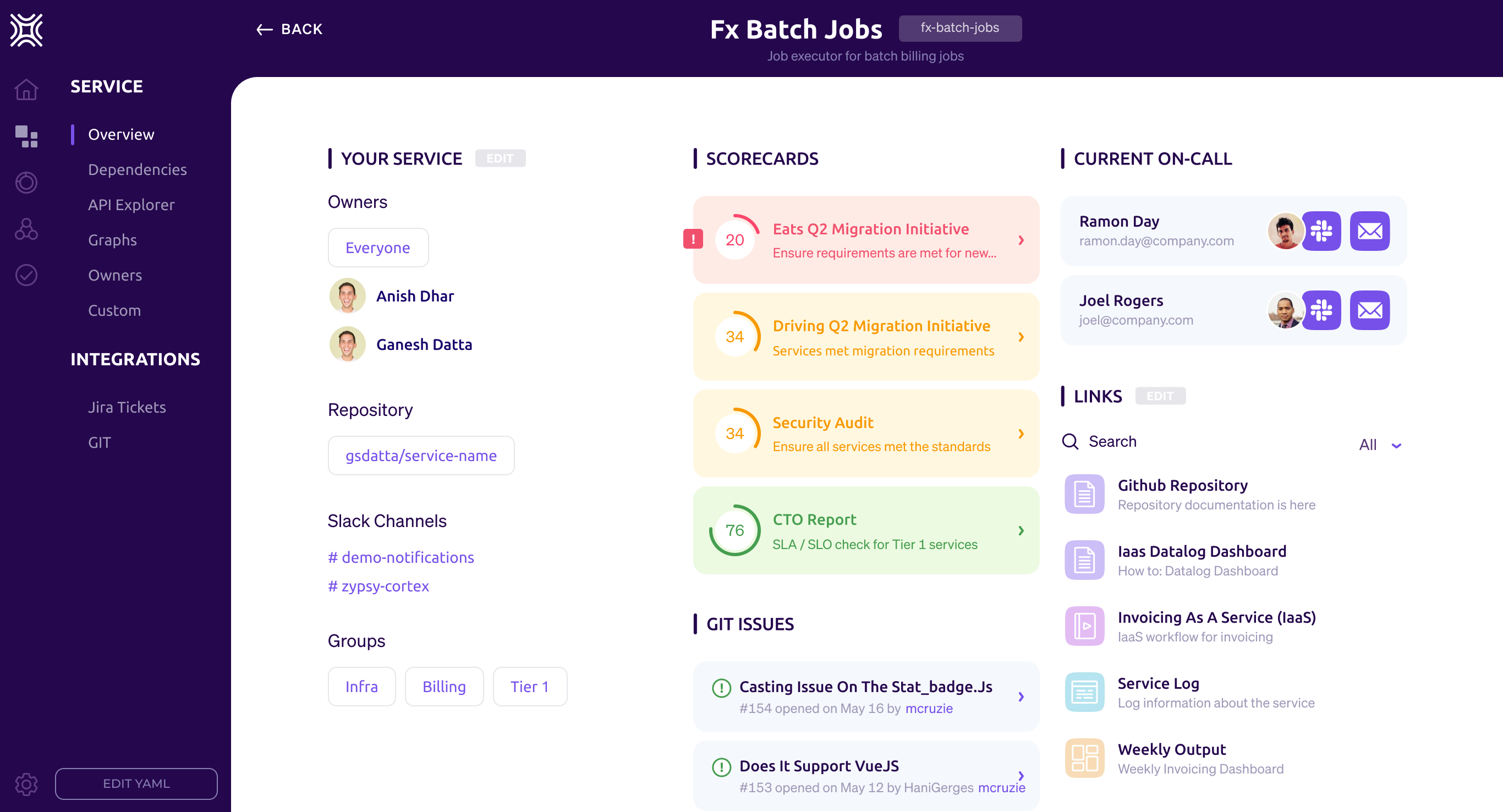
    Designed for site reliability engineers (SREs) and other DevOps professionals, the Cortex platform eliminates the need to rely on spreadsheets to manually track ownership of microservices. Instead, Cortex imports data residing within the tool employed by developers to surface who within an organization is responsible for maintaining which microservices.

    In addition, a Cortex dashboard enables DevOps teams to see which developers are on-call in the event of an unexpected incident, the latency rate microservices are experiencing and which vulnerabilities have yet to be remediated.

    Grades can also be assigned to specific microservices based on metrics that are associated with a specific microservice. That approach allows DevOps teams to apply gamification techniques using a scorecard to encourage developers to continuously improve their microservices, noted Dhar. That approach will also make it apparent to other developers which microservices running in a production environment can be most reliably employed, added Dhar.

    Cortex

    At the core of the platform is Cortex Query Language (CQL), a domain-specific language that allows DevOps teams to define granular rules that can be applied to, for example, on-call rotations, security vulnerabilities, package versions, service level objectives (SLOs) and the overall health of the microservice. Engineers can employ code in the form of YAML files to set reliability standards across teams and types of services through direct integrations with a variety of tools. In effect, Cortex provides a reliability-as-code platform, said Dhar.

    As responsibility for applications shifts further left, each development team is being held accountable for the life cycle of any microservice or application they create. The challenge enterprise DevOps teams are encountering is that when there are hundreds, even thousands, of microservices, it’s difficult to determine who on the development team is responsible for a specific microservice. Rather than trying to keep track of the relationship between development teams and microservices using a spreadsheet, Cortex is making a case for a tool that automates that discovery and tracking process.

    Most organizations today are embracing microservices to build and deploy more flexible applications at varying rates. However, it’s only a matter of time before they find themselves trying to navigate a web of interdependencies between microservices that can’t be managed using spreadsheets. DevOps teams, of course, might be inclined to use their skills to create their own tool for tracking microservices. However, given all the tasks at hand, maintaining a custom platform for discovering and tracking ownership of microservices is likely something better done by a vendor willing to maintain and support a purpose-built tool.

  • How to Gain Greater Value From DevOps

    How to Gain Greater Value From DevOps

    DevOps is more than just deployment and management. Fully leveraging the DevOps team and their activities can actually enhance operations and improve customer satisfaction.

    Be Proactive, Rather Than Reactive

    Say you deploy a new version, encounter some problems and then react. What if you could stay at least a step or two ahead by becoming more proactive?

    Check your metrics and look for trends. You can spot rises in error rates or latencies over time and identify problems just as they are bubbling up. Ideally, you’ll identify them when they are merely minor issues, not when you’re already required to hit the panic button or roll back. Looking ahead to see what’s around the corner puts you in a much better place.

    Use Feedback to Improve Operations

    While it’s true that investing time and resources to automate tasks, such as deployment, is a good thing, it’s even better to focus on another high-value DevOps activity—bringing insights from operations into your development pipeline.

    Incorporating feedback and ideas into your processes puts you in a much better place, especially because there are already tools out there to help you do those deployments and other tasks pretty easily. For example, once you’ve packaged your application into a container, you just need to push a few buttons to set up automatic scaling, load balancing and routing. With all of that automated, you can focus on what’s really important—your application.

    Track Customer Behavior

    Here are two gems—both easy to set up and use, from the same GitHub author—that you can use to track your customers’ behavior, monitor usage and get better insights to improve operations.

    Ahoy—Use this to track user visits to your web page to determine specific named events that you want to add to your code. You can do this from either the server side and a controller, from JavaScript, or via a simple API. It uses two tables that you can easily query, plus some smart built-in data visualization capabilities.
    Blazer—Use this to gain visibility to your database by just adding a mount point to your routes file so that you can access the web application. It provides an easy interface to do SQL queries and show the results.

    Check the Metrics Often

    Once you get these tools set up, don’t stop there. Check the metrics—weekly if possible—and see what the trends are. Ask questions. The cool thing about operations—unlike engineering and writing software where you’re trying to solve one problem—is it’s not always well defined. You may not even know what questions to ask at first. However, diving into the metrics and seeing what patterns emerge from the use and events will not just benefit your customers, but also feed back into your development cycle. This empowers you to go back and reevaluate decisions made earlier on and learn where you should direct your attention and energy going forward.

    Be sure to enhance your focus on where DevOps can actually take you. It’s not just about writing automation and deployment scripts. The synergy of analysis and software is the future of DevOps.

  • Get the Benefits of Low-Code Without the Risks

    Get the Benefits of Low-Code Without the Risks

    Today, more than 300 vendors and various platforms offer different flavors of low-code solutions. However, the majority of these low-code tools are really no-code tools that benefit individuals or groups trying to solve a specific program. The list of benefits of low-code tools in your environment is long and compelling; however, there are security risks that businesses should be aware of when working with these powerful tools.

    When evaluating or using a low-code tool, it’s important to remember that while low-code tools abstract the process of writing code, code is still being written. Applications created with low-code tools are susceptible to the same attacks as any other web application. However, companies don’t have control over the code generated by a low-code tool, so the burden of developing secure applications is largely shifted to the low-code tool vendor. Therefore, the best way to minimize risk when using a low-code vendor is to properly evaluate that vendor’s security practices and test applications created using these tools as vigorously as you would any application developed using a traditional/pro-code approach.

    Risks to consider include access control and authentication (permissions, multifactor authentication), data security (encryption in transit and at rest) and application security from vulnerabilities and attacks (network security and intrusion detection). Other risks to consider are risk mitigation covering areas such as DDOS (distributed denial of service) attacks, backup and disaster recovery, and security incident handling. Responsibility for management of these risks belongs to the low-code vendor, the hosting provider and the company using the low-code tool.

    The following tips should be considered when bringing new low-code tools into your environment to minimize security risk. Remember, it’s critical to perform due diligence of the vendor. Items to consider include:

    Hosting Platform: Be sure the vendor is using a reputable hosting provider, ideally Amazon Web Services (AWS), Google Cloud Platform, Salesforce or Microsoft Azure. Leading players will offer secure, highly available platforms that address the aforementioned risks and will have completed third-party audits and certifications demonstrating their commitment to security.

    Vendor Infrastructure Management: Low-code vendors typically have some level of responsibility for management of the upper tiers of the overall stack; this is generally referred to as the shared security model. Review the vendor to ensure they have solid controls and processes in place to properly manage and secure the infrastructure. Ideally, the vendor regularly submits to some form of recognized audit, such as a SOC 2 Type 2 or ISO-27001. This helps ensure controls and processes are in place in areas such as security, availability, confidentiality, privacy and processing integrity to address the aforementioned risks in the area of the hosting platform the vendor is responsible for.

    Formal SDLC: The vendor should follow a documented software development life cycle (SDLC) and change management process used for the development of their low-code tool. A good SDLC process includes using a source code management system, dependency checking process, static code analysis, automated unit and regression tests, peer code review, secure coding practices training, application vulnerability scanning, quality assurance testing process and third-party penetration testing.

    Policies and Processes: Documented policies and processes covering information security, business continuity, disaster recovery, security incident handling, infrastructure hardening and more should be in place at the vendor. This helps demonstrate that the vendor is committed to providing a secure, highly available and high-quality offering.

    The company adopting the low-code tool itself should also consider internal processes and how it’s using the low-code tools. Items to consider include:

    Formal SDLC: Even though the company uses a low-code tool, there’s still the need to follow a formalized SDLC. It’s important for the company to emphasize and embrace secure programming practices, even for low-code developers. Low-code tools have the ability to implement customer-developed code snippets or components and it is recommended companies follow programming standards and secure programming practices as outlined by the Open Web Application Security Project (OWASP) foundation. Another area of emphasis that can sometimes be overlooked is the need for testing, including functional and security-oriented testing.

    Security Testing: Consider performing a penetration test of the completed low-code application. While ideally, the vendor has performed these tests on the tools itself, it’s a good idea to also perform one on the completed low-code application.

    Access Control and Authentication: Configure access and permissions according to the least privilege model. Leverage advanced authentication mechanisms like multifactor authentication and single sign-on where possible. Ensure an access removal process is in place to remove access for terminated employees.

    Data Security: Verify the application is configured to use HTTPS and that all databases are encrypted. Low-code vendors may or may not provide a database, and either way, the company likely has some level of responsibility for securing the data, regardless of who is hosting it.

    Policies and Processes: Documented policies, processes and related training for team members helps mitigate risk. Some level of formality is recommended for documentation and training for the SDLC, business continuity planning, disaster recovery and security incident handling. For example, the team responsible for the low-code application needs to know how to handle a security incident if one occurs, whether it’s due to an issue in the low-code application, the low-code tool or the hosting infrastructure.

    The benefits of low-code tools far outweigh the risks of introducing these tools into your environment, but with a little effort up front, you can save a lot of headaches down the road.

  • What Biden’s Cybersecurity EO Means for DevOps Teams

    What Biden’s Cybersecurity EO Means for DevOps Teams

    On May 12, 2021 President Biden issued Executive Order 14028, also known as the Executive Order on Improving the Nation’s Cybersecurity. This EO covers a lot of ground, and like all executive orders, it instructs agencies of the U.S. Federal Government to perform specific actions. What it doesn’t do is appropriate funding or create industry mandates. That’ll come later, once some of the plenary stages of the EO are complete.

    Despite this, I’m confident that EO 14028 could be as impactful to cybersecurity as GDPR was to data privacy. I’m also confident that the EO has the attention of business leaders who are trying to figure out what it means to them and their teams—DevOps professionals. While the EO has no underlying mandate to private businesses or those located outside the U.S., it does outline a reasonable set of cybersecurity best practices that can be reasonably interpreted as a call to action for greater transparency.

    In this article I’m going to use the terms supplier and buyer, but I don’t mean to imply that money needs to change hands; only that there are producers of software (suppliers) and consumers of software (buyers). If there is one supplier and one buyer, the software supply chain has one link. If that supplier is also a buyer, the chain has two links. For most software, there are many suppliers; in these cases, the supply chain isn’t so much a length of links but more of a mesh of interconnected links.

    The 2021 Synopsys OSSRA report showed that the average audited application had over 500 dependencies, so that mesh is quite complex—to the point where the security practices used anywhere in the mesh are often obscure, at best. It’s this obscurity that attackers can exploit, which is why one of the key tenants of the EO is transparency.

    As anyone charged with operating a piece of software knows, the security testing performed by a supplier isn’t really obvious, but, as a buyer, you assume the supplier has done the right things when it comes to security. But how do you know? Do you know where the code originated from? Do you know what security targets were used by the supplier? If an attacker is actively compromising the application, how would you know?

    These are all very good questions that are reflected in the EO, to varying degrees. Those questions also belie the reality that suppliers test software. Suppliers do, of course, test their software, but what testing techniques did they use and how effective are/were their tools? And, more importantly, how can you confirm that the mitigations and fixes applied to address identified defects were effective for your deployment scenario? After all, it’s not like every supplier is going to provide you with full access to their source code.

    This is where things become quite actionable for DevOps teams that have embraced the principles of operational feedback mechanisms. For those needing a bit of a refresher, that’s the part of the DevOps mobius where lessons learned operating software are fed back into the next iteration of the development flow. Let’s look at two pieces of operational feedback that are mentioned in the EO: least privilege and log management.

    Log management features prominently in the EO in part because logs enable an understanding of how an application is operating. If a supplier provides detailed information about the log structure and flows, it then becomes possible to build alerts in log aggregation services and SIEMs as indications of unexpected operation. That’s the proactive model the EO embraces—as opposed to forensic postmortem log analysis following a breach—but this requires the supplier to provide insights into the log data indicating that the system became compromised. Of course, to provide that type of data, the supplier must have tested their system software in a manner that allows such a log template to be created.

    We’ve heard that software should be developed using principles of “least privilege” for years, but if you’ve ever been asked to run an application as root or had a supplier not detail the precise network ports required by the application, you know there is still work to be done there. The EO specifically calls out cybersecurity techniques like multifactor authentication and zero-trust network access as ways to achieve granular control over how applications operate.

    It is, however, the coverage of Software Bill of Materials (SBOM) that could have the greatest impact for DevOps teams. In effect, the EO stated that suppliers need to tell buyers the origin of all code within an application. While the EO doesn’t specify the elements of an appropriate SBOM, it does instruct NIST to publish the minimum elements of an acceptable SBOM within 45 days of the EO. When combined with the sections on how build environments are created and managed and the security transparency elements elsewhere in the EO, it’s clear that the EO intends to raise greater awareness of how software is created, patched and maintained.

    In the end, Executive Order 14028 sets a high bar for cybersecurity in general—one where everyone involved in the creation and operation of software will need to up their game. I’ve said for years that it’s impossible to patch something you don’t know you’re running, and that remains true. What must be added is that you also can’t reliably secure something when you don’t know how well each component was tested. The EO is prompting us all to take a step toward solving that problem.

  • Chicken Soup for the SLO

    Chicken Soup for the SLO

    Since time immemorial, humans have struggled to communicate. From myth to the modern era, our most memorable stories often involve individuals or groups seeking to be understood in order to avoid conflict. Be it the biblical allegory of Babel to the more recent Star Trek: The Next Generation episode of “Darmok,” a deep fascination with how people communicate seems to have collectively gripped our imaginations.

    It should come as no surprise, then, that communication between disparate teams and roles in the development of distributed software systems is a fascinating topic. There’s an almost primal struggle in the workplace—a dichotomy between “features” and “stability”—that teams have sought to overcome for decades. Indeed, much of the discipline of software engineering has implicitly evolved as a response to the needs of engineers to communicate with other parts of the business.

    How, then, do we improve this communication and build empathy toward our fellow developers, our coworkers, our PMs, our managers? We need a way to communicate with them, to express “how things are going,” how reliable our service or system is. Let’s step back, though, because this is only a small window we’re looking through—we need to communicate these desires and goals to a greater audience; Our bosses, their bosses, our customers, the entire world. Organizations rise and fall on their ability to communicate effectively.

    In the natural sciences, we observe that the tendency of a system is towards entropy; Energy tends to dissipate in the absence of a constraint. So, too, do human systems lose productivity as their scale and complexity increases. The rise in popularity of Agile methodologies and DevOps thinking tracks with this. They are, ultimately, designed to help us communicate better about needs and priorities. Site reliability engineering (SRE) is the latest in this line of disciplinary developments, providing rigor to the question of, “How do I operate very large scale systems in dynamic environments?”

    One of the more popularized elements of the SRE playbook is the concept of the service level objective, or SLO. To excerpt the excellent Implementing Service Level Objectives by Alex Hidalgo, a SLO is “a proper level of reliability targeted by a service,” a calculation of the amount of ‘bad’ events that can occur as part of the normal operation of a service. As Alex notes, the idea of SLOs and SRE have become almost inseparable in our collective consciousness—organizationally, it’s seen as strange to have one without the other.

    Let’s dive a bit deeper into what an SLO actually is. Again, I will excerpt and paraphrase from Alex’s book (it’s very good; you should read it if you’re interested in this topic). A SLO is simply a target, a set of defined criteria that represent some objective that you’re trying to reach. In a very general sense, the SLO expresses the threshold of ‘good’ to ‘bad’ events that you’re willing to tolerate over a time period. This simple ratio, however, unlocks a great deal of interesting and important ways of thinking about performance and reliability. It gives you, and your team, the ability to reason and communicate about reliability in a very quantitative and qualitative way.

    Now, you may be asking yourself what the qualitative component of a SLO is—after all, aren’t these measurements quantitative by definition? It’s in this dichotomy that I believe the true power and utility of SLOs lie; they’re not just a measurement of what you’re doing, they’re a communication vehicle for how you’re doing. Error budgets come out of this line of thinking—they represent the space between the current state of your SLO and its boundary.

    In plainer terms, it’s a measurement of how much you can miss your target before it becomes a problem. If my SLO targets 99% reliability, I have about three and a half days of unreliability a year to play with—or, about 14 and a half minutes a day. This way of measurement is certainly helpful in driving and determining engineering decisions, as it allows us to make snap judgements about how to prioritize the seemingly opposing buckets of “feature work” and “reliability work.” If we’re getting close to burning up our error budget for the month, do more reliability work. If we’ve got slack, do more feature work. Easy, right?

    How to Make Friends and Influence Budgets

    Reliability, SLOs, error budgets—these are all helpful ways to quantify performance and availability in software. There’s another way to consider them, though, and it’s through the lens of risk. If you’ve earned an MBA, you’re probably familiar with a ‘risk heat map.’

    SLO heatmap

    The x-axis on this quadrant represents the likelihood of a problem occurring; the y-axis represents the importance of that element. This is generally extensible to any element of a business—everything from your sales force to your customer success team to the availability of your data center or cloud resources.

    In many ways, this simple quadrant is responsible for many of the decisions that influence your work. While a business does many things, the business of operating a business can be thought of as an ongoing and unceasing process of risk management and abatement.

    The stuffy, MBA-fueled world of Six Sigma and process management doesn’t play terribly well in the more creative arenas of software development and maintenance, I’ve found. Much of this has to do with—you guessed it—risk. In manufacturing, the costs of failure or defects can be extremely high. Component defects can sideline million or billion dollar supply chains; projection and planning failures can disrupt just-in-time inventory and a single stuck ship or sudden winter storm can cause months or years of disruption to national or global economies. We should count ourselves fortunate that the actual costs of failure in a software system are so light; while us-east-1 going down for an hour would be bad, it probably wouldn’t wreck the global GDP for six months.

    The translation of ‘lower-level’ concerns, such as software system reliability or employee turnover, into ‘higher-level’ risk concerns acts as a curtain between the operational and the managerial aspects of a company. It is this curtain that we must consider when thinking about the true advantages, and the revolutionary potential, of SLOs. Remember, a SLO represents a ratio between ‘good’ and ‘bad’ and gives us a threshold value. These SLOs can be overlaid onto our risk maps extremely easily; SLOs for more critical services and processes rise to the top, newer services move to the right.

    In essence, we can give our SLOs a qualitative score with regard to overall business risk, and use this to shape the overall business direction. This is crucial, as in the absence of better qualitative measurements, businesses will often grasp at quantitative reliability measurements—“pages fired or tickets opened,” to quote Hidalgo. He continued, “[T]hese are prone to be inaccurate due to false positives or the whims of the people opening the tickets.” The types of measurements that we often rely on, such as categorization by severity or ‘mean time to x’ fail to accurately classify reliability or how it impacts the user experience.

    Let’s illustrate by example—a huge part of conversations about SLOs is talking about how they should be framed in terms of users; happier end users, happier engineers, happier managers and so forth. SLOs that correspond to user journeys—for instance, “Adding an item to the cart succeeds 99% of the time.”—are straightforward to understand from the perspective of an end user. We can discuss this in terms of risk by applying an importance and likelihood score to the SLO itself. If our site is an e-commerce platform, then the importance of the cart is very high. Since our threshold is very small (1%), then the likelihood of this risk is also very high—we don’t have a lot of wiggle room!

    A SLO for a targeted ad service might read, “A contextually appropriate display ad is served within 30ms 90% of the time.” In this case, our ad business might not be of high importance in terms of our business risk, so we should reduce the importance of the SLO. In addition, our threshold is very large, so we should reduce the likelihood of violation (since we have a lot more wiggle room). Over time, these positions and scores can (and should) change—perhaps the advertising segment of our business becomes more valuable, so we re-prioritize it on our risk maps.

    By speaking this language and quantifying our data in different ways, we can pull back the curtain between operational and managerial sectors and use it to influence things outside our immediate sphere.

    “Mommy, why is there a SLO in the house?”

    There’s an aphorism about war and fighting that goes, “Generals are always prepared to fight the last war.” I’ve seen this myself at every company I’ve worked for over the years—we tend to be reactive, rather than proactive, in planning and preparing for strategic business challenges. Some of this is due to the fact that none of us are oracles capable of divining the future, but much of it simply has to do with the aforementioned cycle of risk management that drives business planning and decision making. When introducing SLOs to a wider audience, you need to be able to plan for the pushback that executives and managers will almost certainly have to this new way of thinking.

    When you think about it, though, there’s not a lot of difference between what an SLO is trying to represent, and what an OKR or KPI or any other goal-oriented system is trying to represent. In each case, we’re creating some heuristic to sort events into ‘good’ and ‘bad’ cases, then creating a threshold of ‘Now there is a problem’ based on the ratio between them. In essence, this is, really, how you measure anything as a percentage.

    You could translate goals for your sales, marketing, customer success or people ops teams into SLOs. For example, “30% of POCs should convert into closed-won opportunities” is, basically, an SLO already, and is perhaps an existing goal for your salesforce. There are two big advantages to thinking about these as SLOs: consistent reporting and error budgets.

    Consistently reporting on SLOs means that you can express team and company goals in the same format and language across the entire organization. This brings teams together in a shared purpose, and allows for a shared language about how reliability benefits everyone. Being able to roll up reporting about how things are going not only encourages more shared ownership of goals, it helps you build connections and linkage between how different types of work align with each other towards a shared prosperity. More importantly, SLO reporting gives extremely clear signals about how teams—regardless of their function—should be addressing failure.

    If a consistent language around reliability is what builds empathy, error budgets are what unlocks creativity and problem solving for addressing issues in the business. In too many cases, organizations are loathe to give individual contributors, or even teams, the flexibility to experiment and measure the results of those experiments due to inertia, top-down command-and-control style processes or just the fear of screwing up.

    Let me give you an example—suppose your marketing team has a demo that generates a certain percentage of leads every month. Without a defined SLO for this demo’s performance, it becomes extremely difficult to change anything about how this demo works. Why? Because there’s a tendency for things to settle at their current state—we’re all so consumed with moment-to-moment crises or new work that evaluating the performance of existing things can be challenging.

    The work required to justify a change eventually outweighs the actual work being done to make the change, and so change withers on the vine and processes stagnate. Now, imagine that this demo flow had an SLO associated with it, something like “10% of clicks to our demo should result in a valid email capture.” Suddenly, we can report on this in a consistent fashion and, more importantly, we have a massive amount of headroom for experimentation. We can justify work being done to improve this flow in the context of not only its current status (are we running better or worse than our target?) but also in the context of our other goals (are we producing enough MQLs, in general, to support the sales funnel?) and prioritize appropriately.

    Ultimately, we can’t change the fact that there’s a bias towards dealing with the last thing that happened, but that’s not really the point. What we can change is how we think about expressing what’s happening now, and building a consistent language and verbiage around addressing these problems. SLOs are designed, broadly, as a way to communicate the reliability goals of complex distributed software systems. What is a business of people other than a complex distributed human system?

    As thinking, tooling, and processes around SLOs continue to mature (such as the recently announced OpenSLO specification), I’m excited to see what the future has in store for us. At the end of the day, we should be striving to reduce hierarchy, increase autonimity, and build collective ownership in the socio-technical systems that we rely on as human beings; SLOs are just another piece of this ever-evolving puzzle.

  • How to Build a People-First Engineering Team

    How to Build a People-First Engineering Team

    When we think about successful technology teams, there is a tendency to primarily focus on the technology being created rather than the people who are creating it. While both approaches can lead to successful products, a technology-first approach is often the default when software engineers become managers without necessarily having the right tools to manage effectively. Becoming an engineering manager requires an entirely new skill set that involves different communication styles, time management, organization, tools and software, scoping work, learning how to effectively delegate and identifying the right people to complete the team.

    As a CTO, and having gone through this transition, I have noticed that the more a manager is able to be in sync with the people on their team, the less burnout they experience, the higher the employee retention rates and the better work their employees will do.

    While most people won’t be entirely people- or technology-focused, here is a quick overview of the differences:

    • A team-oriented manager knows the personal and professional struggles their people are experiencing, and there’s a sense that the team they run is all working together on a mission toward the same goal. When you talk to this type of manager, they will naturally gravitate towards giving status updates on the wellbeing of individuals.
    • Managers who tend to see the team through a more technical lens will instead identify parts of the project or technological or strategic roadblocks that are impacting the team.

    The same issues will be dealt with very differently by these different types of managers. It can be beneficial to record yourself when you are talking about your team to identify where your focus is, and evaluate if that feels right for you.

    Building Effective 1:1 Communication with Team Members

    An individual contributor is normally accustomed to arriving at weekly 1:1s and working with their manager to solve any problems they may have. When they become a manager, it becomes their role to coach team members to solve their own problems, in addition to building trust. This role change takes preparation, and, if you are unsure how to do it well, you may find it helpful to draft out an agenda that you can follow if needed. You can also gain knowledge about this process by talking to more experienced managers.

    What do you talk about in your 1:1 meetings? Even if you are more a technology-oriented person, 1:1 meetings with your team should be less about the status of projects and more about how the person you are speaking to is doing and how you, as a manager, can help. Having started as a software engineer myself, and now as a CTO, I have found the below questions to be helpful as I navigate how best to help my team thrive in their roles.

    1. “How are you doing?” If you are speaking with a team manager, another great question is, “How is your team doing?” You want to genuinely understand the status of the individual outside of the technical aspects of the job.
    2. “Do you have any feedback for me?”
      I always ask for feedback. For a while, they may not have any; but I often find they start with a small one like “Better options for snacks.” This is an excellent opportunity to build trust by improving the work experience. The next time, they will probably share more until you receive really important feedback, while also improving the relationship. The important thing to remember, here, is to respond to the feedback.
    3. “On a scale of zero to 10, how much fun are you having at work?”
      I really want people to have fun at work. You can ask them to give you a number between zero and ten. When they respond with a number, say, six, a great follow-up question can be to ask what is needed to change the situation so that number becomes a seven. How can you help get them there? I have heard a wide spectrum of answers to this question, ranging from easy to complex; from things like permission to be unresponsive for an hour a day to the desire to learn the skills needed to do a different type of job.
    4. “Where do you see yourself in the next two years and 10 years?”
      Helping your team define both long and short term goals is a really important part of being a manager. Specifically for engineers, it is a great idea to think about if you want to continue moving up in an engineering role, or if making the switch to a managerial role is a better fit.
    5. “How can I help you get to the next level in your career?”
      It is common to get sidetracked when balancing your day-to-day work with your personal life. You can also use 1:1 meetings to help your team members identify what they can do to hit their short- and long-term goals, and how to maintain a better work-life balance.

    Supporting Colleagues

    This last year has been tough for most people, to varying degrees, which has solidified the idea that we need to be there for team members during difficult times; this goes beyond the pandemic. That can mean sending their favorite meal via delivery, sending a care package or simply making it very clear that when someone on your team needs to step out or take time off, that is fine – no questions asked. To be able to be offline and not need to do a long handoff is so important when you are going through a hard time.

    During this move to remote work, as in many leadership teams, my company has gone against the cultural norm of keeping life and work separate. We have acknowledged that it is too difficult to do that right now, and very publicly recognized that everyone is going through something. It has felt like mental bandwidth is filled up with things going on outside of work, so as team members, it is good to make sure work doesn’t add to that pressure.

    In a way, this pandemic period has broken down barriers between work and “life” that has made it almost obligatory to focus on people first. From my perspective, this has been a breakthrough in how we can do business moving forward. By thinking about each individual on your team, everyone can be uplifted and heard, which can be the impetus to more innovation. If you are operating at your max with no slack in your system and little support from managers and teammates, you lose creativity. As innovative teams, this experience has been a reminder to build people-first principles into our cultures to promote a healthy work-life balance that lends itself to innovative solutions and better results.

  • Then and Now: The Evolution of DevOps Culture

    Then and Now: The Evolution of DevOps Culture

    There are many available resources dedicated to delivering better business value faster. Based on this advice, many organizations and teams are adopting common software delivery practices — even outside the usual use case of providing software (take, for example, SpaceX teams using agile, or leadership teams that use scrum practices and have daily stand-up calls). This progression into faster, better, cheaper and easier – no matter what you’re delivering – is what makes incorporating DevOps into business practices critical to delivering unmatched value for end users.

    Then and Now

    A great perspective to consider when approaching the subject of DevOps is how technology has changed just about everything – how we build, connect, share and educate. Up until the 2000s, for example, the standard turnaround time for taking and sharing pictures was one to three weeks, if not longer. This process used to involve film cameras, darkrooms to process the photographs, photo finishing labs and hard copy, physical prints. Today, our mobile devices allow us to snap hundreds of professional-quality images and share them immediately online.

    culture evolution

    These earth-shattering changes don’t apply to photography alone, but to many other industries including financial services, banking and IT. Consistently, technology is finding new ways to disrupt industries, priming them to be more efficient to fit into our fast-moving lifestyles.

    The DevOps Life Cycle

    Now, let’s look at software delivery. In the past, the process of traditional software delivery was linear and sequential; waterfall methodologies offered little flexibility and did not succumb to the nature of change and demand for technology services we see today. What we’ve experienced with software delivery now uses DevOps to leverage new insights through people, processes and technology, giving organizations the ability to deliver continuous business value. Yes, that means businesses are adding value to our lives all the time, whether you see it or not. For technology organizations, this process for delivering business value is modeled through what we call the DevOps life cycle — understood through the graphic below.

    DevOps culture evolution

    Getting to a DevOps Culture

    Often, an organization’s challenges with DevOps do not lie in the technology or processes themselves, but in the people part of the equation – how we work together to deliver value via cross-functional teams. To understand what building a DevOps culture means, we need to look at what culture encompasses and how our people, process and technology work together to enable a successful DevOps life cycle.

    culture evolution layers

    This layered graphic features all the various components related to culture. Each layer encompasses the next.

    ·      Mindset

    ·      Values

    ·      Principles

    ·      Practices

    ·      Tooling

    Getting to a DevOps culture involves articulating change both from the bottom up and top down in our organizations and is, therefore, no easy feat. Before we can introduce or discuss tooling, we need to understand how our practices and principles help us achieve our outcomes. Each inner layer requires the outer layer to be successful before we can truly get to defining and strengthening a DevOps culture.

    Here are my tips for getting to a DevOps culture:

    ·      Learn from and develop skills from mistakes

    ·      Focus on the important priorities

    ·      Capture collaboration

    ·      Perfect your tooling

    The DevOps Principles

    DevOps is the collection and collaboration of people, processes and technology to deliver software value continuously. Here are some core DevOps principles you can use to guide you on your DevOps journey.

    Create With the End in Mind

    High-performing teams work best when leaders and individuals understand their role in the team. Therefore, creating with the end in mind involves reassessing and often asking big picture questions, like “Who is this delivery for?” and “Why are we doing it this way?” Keep the vision in mind and make adjustments along the way.

    Even the most famous photographs in history involved many adjustments and numerous attempts to get it right. Creating with the end in mind means knowing we may not have everything right the first time around. That’s okay! Similarly, life isn’t without its own distractions, conflicts and changes. Keeping the target outcomes in mind helps us align to initiatives and actions, and to question when they don’t align.

    Cross-Functional Teams

    Many products and deliveries involve multiple people. For example, some of the best Marvel cinematic universe (MCU) movies were made thanks to the help of multiple production teams and partner companies coming together to build the powerhouse we know today. Not to mention, in my opinion, some of the best superhero movies of our time. We succeed with software delivery in the same way: by having fully responsible cross-functional delivery teams.

    The best engineering teams I’ve been on are made up of independent and autonomous individuals who know how they can contribute to the work in progress. They’re also willing and unafraid to collaborate with others to get this work done.

    Commitment to the Journey

    “I am not here to be right. I am here to get it right.” – Brené Brown, from the book Dare to Lead.

    Even with cross-functional delivery teams and creating with the end in mind, our teams still may not get everything right the first time around. Committing to DevOps is about accepting any failures that come during the journey. Committing to the journey doesn’t mean you can’t define what it involves, even if it’s out of the ordinary. Experimentation is also a part of how we, as developers, adapt to change and adopt novel approaches to delivering faster, cheaper and better software.

    The DevOps Principles as Guides

    Use these principles as the foundation for how to work together, but also use the right tools, and define and improve processes along the way. In photography, there are three components that serve as building blocks to the final images we capture: aperture, shutter speed and ISO. In DevOps, it’s our people, processes and technologies. Achieving high performance with DevOps involves all of these components working together and adjusting to our environment, situation or team.

    The key to getting to the results you desire? Not getting blindsided by any single component of getting to that result.

    The DevOps Practices and Tools

    I like to consider this section the call to action; the one says to our teams and individuals, “Gear up!” No reasonable photographer would leave for a photoshoot without their camera and camera gear, right? Similarly, DevOps practitioners and teams need the right tools to get the desired results.

    Source Code Management

    Source code management is about allowing teams to collaborate, have version control, correct and revert software code. This is fundamental for many teams to increase not only visibility and collaboration, but also start automation workflows.

    If you are an individual just starting out with writing code, I recommend learning the basics of Git, such as how to add, commit, push, merge, branch and clone code. If you’re a team, I recommend discussing the practices and standards you want to use for collaborating. Always fit your Git structure and workflow to your codebase and team dynamics.

    Continuous Integration

    What continuous integration (CI) does is take code away from local machines to package it into a deployable artifact in a CI server. What this is designed to do is automate the integration of newly committed code changes. This process is often triggered by code changes pushed into your Git repository. Using checks and other tools, teams can version and release artifacts that have already been vetted for quality and security.

    Continuous Delivery

    Continuous delivery, on the other hand, takes artifact code to production environments. CD aims to deliver code changes of all kinds to users in a fast, repeatable and safe manner. CI/CD consists of both CI and CD pipelines working together to deliver code to users.

    Infrastructure-as-Code (IaC)

    Infrastructure-as-code allows users to define hardware through code. We can improve how we provision, configure and maintain hardware systems. Infrastructure provisioning tools like HashiCorp’s Terraform and AWS Cloud Formation, configuration automation tools like Ansible, Puppet and Chef and package managers like Helm allow teams to accomplish much more when software scales and demand increases.

    Secrets and Identity Management

    Security is everyone’s responsibility. Secrets management and identity management tools make accomplishing DevSecOps easier by securing and managing sensitive information. Teams should consider how they are handling secrets and users within their architecture. HashiCorp Vault, KeyCloak, KMS and other similar tools can help you achieve your goals around security.

    There are many other practices and tools DevOps teams and organizations can use to achieve their desired outcomes. What works for one team may not work for another — hence the need to innovate and experiment in a controlled and well-led manner. Other practices that can increase your team’s ability to deliver value include value stream mapping, progressive delivery, GitOps and chaos engineering.

    People, processes, and technology belong together in a DevOps culture. While practice makes perfect, what’s more important than perfection is gathering the right answers along the way. Everything doesn’t need to be right the first time around. Just remember that no leader, individual or team in DevOps is alone. We started by defining what it means to build a DevOps culture, change mindsets and set principles and practices, so now I ask you: What does DevOps mean to you?

  • 10 Actions IT Can Take to Curb Climate Impact

    10 Actions IT Can Take to Curb Climate Impact

    Digital technology is responsible for 3.7% of total CO emissions, according to estimates from The Shift Project. This could increase, as cryptocurrency mining is leaving a massive carbon footprint. With the world’s climate at stake, every percentage point matters.

    Thankfully, many tech companies have announced significant climate pledges to reduce emissions or offset their carbon footprint. For example, Microsoft states they will be carbon neutral by 2030. Amazon has committed to a deadline of 2040, and other companies such as Infosys have co-signed. Netflix’s climate commitment states they will reach net-zero greenhouse gas emissions by the end of 2022.

    Sustainability goals are vital long-term benchmarks, but on-the-ground technologists must make immediate optimizations to realize them. So, what exact steps can enterprise IT take to reduce their energy consumption and thereby reduce greenhouse gas emissions?

    I recently met with Anant Adya, Infosys, to explore the overall energy footprint of enterprise technology. Below, I’ll cover 10 ways IT can reduce its impact on the environment, including actions like auditing legacy infrastructure, optimizing cloud operations and moving toward renewable energy sources. Many of these energy optimizations bring the added benefits of cost savings and code consolidation.

    1. Reduce Resource-Heavy Legacy Infrastructure

    One potential cause of unnecessary energy consumption is legacy infrastructure. To reduce power consumption, Adya recommends going straight to a network compute storage setup. You may find energy consumption savings by porting resource-heavy legacy systems to the cloud. This will be especially effective if you’re running older end-of-life machines with less efficient processing.

    2. Reduce the Number of Clouds

    Next, look at the number of clouds your organization has adopted, Adya recommended. In recent years, companies have moved to multi-cloud setups for reasons like performance, cost or features. However, these movements could cause unnecessary duplication. For a large enterprise, refactoring your multi-cloud usage could mean reducing from five or six clouds to two or three, said Adya. With the right combination, you could very likely reach equivalent benefits with less reliance on multiple clouds.

    3. Reduce the Number of Core Data Centers

    Look at the number of sites in your core data centers and reduce the footprint, if possible. In his digital transformation work, Adya described working with a client to consolidate six large data centers into three essential locations — one for disaster recovery and two others to support American and European zones.

    4. Move Edge Locations to the Cloud

    Large organizations may be supporting a lot of edge infrastructure. Yet some locations, such as offices, don’t require that kind of infrastructure, Adya suggested. He recommended reducing local servers and embracing more cloud-based computing solutions, overall. He described one case in which an organization consolidated 600 edge sites to 350, thus reducing power consumption by 40%. Adya credited the cloud for delivering lower costs and greater scalability and resiliency.

    5. Embrace Cloud-Native Administrative Operations

    Cloud computing is arguably more energy efficient than traditional on-premises arrangements with its pay-per-use model and multi-tenant approach. To get the most out of the cloud, Adya recommended moving to the cloud, along with adopting cloud-native software. Most operational and administrative work can be processed in the cloud, he noted.

    6. Consolidate and Rationalize Resource Utilization

    Another way to stem energy consumption is to check for underused or forgotten assets. While the cloud can help optimize software, there is a good deal of unnecessary cloud spending on underused resources. In 2020, companies wasted $17.6 billion paying for idle resources and overprovisioned computing instances, reported ParkMyCloud. Adya thus recommended looking at the entire server and storage estate to calculate the server utilization and slimming down wherever possible.

    7. Increase Power Usage Effectiveness (PUE)

    Hardware is much more efficient these days — sometimes by as much as 10X more powerful with 10X less energy consumed. As storage technologies also are always improving, it could make sense to upgrade to new hardware to reduce overall power usage. It’s important to monitor power usage effectiveness (PUE) and check power ratings before and after migrations. Adapting your information life cycle management tiering practices for storage could also help optimize to reduce wasted power, Adya added.

    8. Meet Sustainability Goals on Campus

    Have you ever driven by an office park at night and seen thousands of empty rooms with all the lights on? This has got to change. Another way to reduce power is to limit a campus’s energy consumption, described Adya. Smart automation and remote monitoring could be used to manage power efficiency by turning off lights and heating and cooling to meeting rooms when empty, for example.

    9. Power the Business With Renewable Energy

    Run your campus with solar power. Adya described how Infosys is doing this by mounting 40MW solar panels at their corporate centers, in effect sourcing 43% of its energy from renewable sources. Another more passive way to invest in renewables is to choose a data center provider that commits, under contract, to using a high percentage of renewable energy.

    10. Purchase Carbon Offsets

    The previous goals are all active steps to reduce energy requirements. However, once an organization has attempted these optimizations, another option is carbon offsetting. This indirect method effectively cancels out a company’s emissions by funding green activities, such as tree planting.

    However, there is debate over the effectiveness of carbon offsetting, as trees take decades to become effective carbon consumers, and the practice doesn’t advocate for immediate change to harmful practices. “To be serious about tackling climate change, [organizations] need to stop carbon emissions from getting into the atmosphere in the first place,” wrote Alia al Ghussan for Greenpeace.

    IT’s Role In Curbing Climate Change

    Dire climate circumstances require quick action from all business units. In the process, organizations will likely consider many initiatives simultaneously to address their climate impact. However, as more companies become digital-first businesses, the onus falls on IT to support these changes.

    In addition to the above actions, there are undoubtedly other ways enterprise software architects can stimulate sustainability initiatives within their organization. This could include refactoring code into more lean iterations or eliminating unnecessary records storage. Tech leaders could also vocalize their support for global pledges, such as the Paris Climate Agreement, RE100 or Global Optimism.

    It would take a solar power plant covering 115,625 square miles, roughly the size of New Mexico, to power the world with solar energy! As you can see, it will take a lot of work to reverse our reliance on fossil fuels. But with scalable cloud computing and more intelligent infrastructure optimizations, IT can do its part to contribute to curbing climate change.

  • How to Build a Team That Embraces Metrics

    How to Build a Team That Embraces Metrics

    When we talk about metrics in software delivery, a lot of developers think of execution metrics — things like throughput, delivery and number of deploys. But in reality, those metrics don’t motivate anyone — at least not without connecting them to a bigger picture.

    I’ve worked in software for 23 years. I’m a three-time founder and four-time CTO, responsible for leading a 200+ member distributed engineering organization. I’m passionate about metrics because they can tell me a lot about where things are working and where they are not. On the other hand, there’s a risk that operating metrics become the focus, taking attention away from measures of business value.

    Getting your developers to embrace metrics isn’t about hand-selecting specific metrics to track. It’s about disseminating the bigger picture and sharing measures of business impact that allow your team to see progress against those larger, shared goals.

    When developers understand how their day-to-day work directly impacts the company’s goals and vision, they’re able to understand their impact, too, and will want to do better. When they want to do better, they want execution metrics to get them there.

    Clarify Your Goals

    If you want your developers to not only track their metrics but be excited to use them, there are a few things you need to do first:

    • Get clarity on the goals you’re trying to accomplish as a team and as an organization
    • Figure out how you’re executing against those goals
    • Find out what’s getting in the way

    Developers shouldn’t be obsessing over execution metrics. Rather, you need them to understand what the company is trying to achieve. What is the outcome you’re aiming to deliver to customers and for the business overall?

    If your developers have clarity on the company’s mission and vision, they understand how their work directly impacts the customer and the success of the organization, which is highly motivating.

    Individual contributors will start asking for access to more information so they can diagnose their own problems and improve their work.

    Are we spending too much time on technical investment? Does it feel like we have too many incidents, issues and escalations from customers? Are we far off on our estimates? By answering these questions, your team can determine which metrics to track.

    Don’t Make These Mistakes

    Using one metric to rule them all. A lot of engineering organizations try to rally entire departments around the same execution metrics. Velocity, or throughput, for example, is a great tool to expose other issues, but consistent velocity is not a guarantee of delivering business value. In fact, targeting consistent velocity is likely to result in tradeoffs you didn’t anticipate, like taking shortcuts to get things out the door.

    Treating the metric as the goal. Meeting a metric shouldn’t be the goal; rather, metrics should be viewed as a way to ensure your team is meeting their goals. Organizing around business value is what really helps your team understand the purpose of their work. If you’re just rallying around how many times you can deploy per day, then sure, you can be an amazing software-deploying machine — but you might be deploying changes all day that have nothing to do with the actual goals of the business.

    Being a blocker. Developers need autonomy and flexibility to do their jobs well. Give teams a high-level objective and let them determine which metrics they need to push, instead of giving everybody the same metrics and telling them to get better.

    If engineers don’t have the autonomy to make their own decisions, then they’re going to feel like they’re just part of the machine. As engineers, and as humans, problem solving is what motivates us, along with the knowledge that our skills are contributing to a larger, shared goal.

    A Team That Embraces Metrics: Putting it Into Practice

    There are three channels that are essential to communicating business-value metrics to teams. At the company level, executives will introduce their high-level goals at all-hands meetings — where the company is trying to go this year, how you differentiate in the market — the things that really matter to a business.

    One level down, during organizational or department meetings, is where to communicate how teams should think about the goals from a product and engineering perspective, while still thinking about them within that overall business context.

    It’s also important that this is understood down through the management chain. An engineering manager should be able to explain to their team the overall business goals with local-level reinforcement and how it all ties together.

    When you have that knowledge as a team, you know what you’re capable of executing because you understand what you’re trying to achieve for the company and the customer. That’s when developers start asking for more metrics because they want to understand how to get there faster.

    If You’re Not Hitting Your Goals, You Should be Asking for the Data

    The only real failure is not learning from failure. It should be okay to not hit your numbers. Set a bold target and push yourself, then learn something from your misses. Figure out what you didn’t understand, what got in your way and why.

    Estimation is hard. Trying to plan work is hard. But if you know how much you were able to deliver last quarter, you can focus on getting something similar done this quarter instead of assuming this will be the one quarter where there are no interruptions, your initiatives will all be perfectly defined and nobody will get sick.

    If you’re not hitting your business goals and you’re not looking at your historical data, then you’re missing your opportunity to improve.

    Your Team Embraces Metrics. Now, How Do You Get Them Excited?

    The first time I started using continuous deployment (CD), I was truly amazed at how quickly it allowed my team to put new functionality into the hands of our customers. We could instantly find out if they liked it, and if they didn’t, we would build another version tomorrow.

    As an engineer, CD is a great way to feel more connected to your customers because you get to put something you built in front of them the same day you complete it. You also become interested in a different form of metrics: usage and adoption.

    The connection between your work and the ultimate value to the user is much clearer when the feedback cycle is shorter. CD allows you to get that feedback from customers directly and really see the impact you have on them. That gets people excited.

    There’s no Shortcut

    You can try to drive an entire organization by execution metrics, but it simply won’t be fulfilling for anyone. If your team is aligned around what they’re trying to achieve, they will recognize the value of execution metrics and they will come looking for them.

    There’s no shortcut.

    If you start with the reason and you end with the numbers, you know you’re on the right track. You’ll know you’re getting there because you’ll see the numbers moving, your team will be excited by that, and they’ll be motivated to do even better.

  • API Security by Design

    API Security by Design

    “APIs are nothing new,” said Secure Code Warrior co-founder and CTO Matias Madou, but they have recently become more widely used.

    And where they were once a local mechanism, they are increasingly used in a distributed manner, partly because of changes to application architectures. Another reason is that users are increasingly likely to access systems from outside the organization, whether they are customers, suppliers or employees working at home.

    Potentially anyone and anything can access an API, so developers and architects should therefore assume that APIs are exposed, and treat requests accordingly.

    This means addressing issues such as authentication and authorization, and generally ensuring that the only data exposed by the API is the data that’s supposed to be exposed.

    So assume every API call is malicious, suggested Madou.

    Start at the Beginning

    Achieving API security starts with the design and architecture, so jumping in and writing code immediately is a mistake. Unfortunately, starting with a completely blank slate is unusual, and some code will likely already exist. In that case, it is especially important that the design makes provisions for possible weaknesses.

    If you want secure APIs, then ensure that everyone working on the project – architects, developers, testers and so on – are “very security savvy,” said Madou.

    The need to improve skills is often triggered when the company or one of its competitors experiences a problem.

    So teams should work to identify any existing problems, realize they need to proactively avoid the underlying issues, and undergo appropriate training, he says.

    The trouble is, “security and developers are not often the best of friends,” Madou said. So, developers tend to think that security is the responsibility of their security colleagues. But there should be a common goal: making reliable and secure software.

    “Security needs to help developers,” he said. One way of achieving this is to appoint a ‘security champion’ to act as a bridge between the security and development teams. An embedded security person can help developers realize that security is an enabler, not a blocker.

    Help When Help’s Needed

    Embedding communication from the security team into developers’ workflows is another part of the process. Slack is one possible conduit. Security people need to be wherever developers discuss issues. Then, they can take advantage of opportunities to say things like, “it looks like you’re having problems with SQL injection. Here’s some training material that might help.”

    Developers live in their IDE, so that’s where integration should occur. But design such systems to help developers, not to control them. “Developers are people, not robots controlled by machines,” Madou warned.

    Another consideration is that it’s important to avoid unnecessarily interrupting developers. Such systems should therefore predict what a developer is about to do and deliver appropriate guidance.

    For example, if someone codes a database connection, the system could offer the statements that securely retrieve information. Then, the developer can copy and paste them instead of starting from scratch each time. Using new code every time carries the risk of introducing vulnerabilities.

    “It’s tricky to make these systems,” Madou admited, but he predicted they will become increasingly common in the coming years.