Welcome to The Long View—where we peruse the news of the week and strip it to the essentials. Let’s work out what really matters.
This week: GitHub touts unbelievable AI stats, and Intel’s beautiful open source typeface. (more…)
Continuous testing is the process of executing automated tests as part of the software delivery pipeline to obtain immediate feedback on the business risks associated with a software release candidate.

Welcome to The Long View—where we peruse the news of the week and strip it to the essentials. Let’s work out what really matters.
This week: GitHub touts unbelievable AI stats, and Intel’s beautiful open source typeface. (more…)

Cycode today added a Cimon extension to its application security platform that uses extended Berkeley Packet Filtering (eBPF) to thwart cyberattacks against continuous integration/continuous delivery (CI/CD) pipelines.
Alex Ilgayev, head of security research for Cycode, said Cimon uses eBPF to inspect network connections, running processes and file modifications within a pipeline to learn standard behaviors. Armed with those insights, Cimon will then surface any anomaly in real-time, he added.
DevOps teams can then craft and embed security and compliance rules within their pipelines based on the severity of the anomalies discovered, said Ilgayev.
eBPF makes it possible to run sandbox programs at the kernel level without adversely impacting performance. In effect, eBPF bridges the boundary between kernel and user space by enabling developers to combine and apply logic across multiple subsystems that, historically, were completely independent of one another. That approach enables, for example, a security tool to scale to the point where it can identify threats at much higher levels of throughput to improve overall scale at a time when the volume of cybersecurity attacks continues to increase.
Cycode is taking advantage of eBPF to enable DevOps teams to not only defend against known attacks involving malicious package installation, typosquatting, repojacking, dependency confusion, dependency hijacking and other types of dependency attacks but also zero-day threats, noted Ilgayev.

Cycode provides a platform for mapping metadata and events using graph technology that makes it simpler for application development and cybersecurity to consolidate alerts generated by their DevSevOps tools. Most recently, Cycode added a Cycode Application Security Orchestration and Correlation (ASOC) module that will automatically discover all the tools that make up a DevSecOps workflow without requiring any integration effort.
The approach enables the Cycode platform to discover, for example, dependency issues that would otherwise be missed by software composition analysis (SCA) or static application security testing tools (SAST).
While a lot of progress has been made in terms of adopting DevSecOps best practices, many organizations are still struggling with securing their software supply chains. Most of the members of a DevOps team have limited cybersecurity expertise, so they need the help of a cybersecurity professional to determine what specific actions are required to remediate a vulnerability. Cybersecurity professionals, conversely, don’t have a lot of application development expertise.
As the number of regulations specifically focused on application security steadily increase, every organization that builds software will soon need to embrace DevSecOps to better secure software supply chains. Unfortunately, developers have too often viewed cybersecurity as an obstacle to deployment while cybersecurity teams have historically considered developers to be a primary cause of the breaches they are expected to clean up. The first step toward bridging that divide is, of course, to realize that application developers and cybersecurity teams need to be invested in each other’s success.

The DevOps industry is growing at an incredible pace, with its worth exceeding $8 billion in 2022. Analysts predict that the market will experience a five-fold increase and reach almost $40 billion by the end of the decade. But with this growth, there is a significant issue within the DevOps chain that continues to escalate: A widening talent gap. The U.S. Department of Labor predicted that by 2030, the global deficit of development engineers will exceed 85 million. Additionally, the demand for DevOps professionals is expected to increase by over 20% annually throughout the rest of the decade. These conflicting trends present significant challenges for software and application companies. While there is a substantial opportunity to generate revenue by creating new and better applications, the shortage of skilled personnel to develop these products is a significant roadblock. Integrating low-code and no-code tools into the DevOps process could be a viable solution to address the talent gap. These tools offer various benefits and efficiencies, including streamlining the work of existing DevOps professionals and enabling organizations to expand their teams beyond traditional personnel sources. Leveraging these tools could give companies in the DevOps industry a competitive advantage.
Traditional DevOps practices pose significant challenges for companies that hinder productivity and overall success. The first significant issue is the talent shortage. According to a report by the Manpower Group, 75% of employers consider finding tech talent their primary concern. As the demand for experienced DevOps professionals continues to grow, it is becoming increasingly difficult for companies to find the right personnel.
Another significant challenge in traditional DevOps practices is the high learning curve. The prediction by Gartner that 75% of DevOps initiatives would fail to meet expectations by 2023 highlights the severity of the learning curve and the challenges associated with adopting DevOps practices without proper training and experience.
To avoid delays, increased costs, and suboptimal productivity, companies should explore innovative solutions such as low-code and no-code platforms. This would enable citizen developers to contribute to the development process and streamline infrastructure management processes, enabling greater efficiency and scalability in their DevOps practices.
Low-code/no-code platforms are gaining widespread recognition for their potential to drive app development across organizations, as Gartner predicts that by 2024, 80% of apps will be developed by non-IT professionals. The adoption of these productivity tools can bring significant benefits to the DevOps landscape, particularly in the following ways.
Reducing Workloads and Stress
By using low-code and no-code software, organizations can distribute basic app-building and basic development tasks across the organization, freeing up skilled developers’ time and reducing their workload and stress. This significantly improves the workplace experience and enables developers to focus their time on delivering more complex, high-quality solutions.
Accelerating Innovation With Low-Code/No-Code Platforms
Low-code/no-code platforms can accelerate innovation by enabling developers to quickly spin up proofs-of-concept for more complex software development tasks that require coding expertise. Ideas and solutions can be tested before investing time and resources in full-scale development.
Creating New Roles and Opportunities
No-code platforms can create new roles and opportunities within the enterprise, such as no-code projects focused on optimizing processes and building solutions. Citizen developers without coding experience can pursue new career paths and opportunities to contribute to their companies’ success. One example is applying no-code technology to digitize paper forms across organizations. Employees without coding experience can create mobile apps that speed data collection, improve data accuracy and allow for instant digital data sharing and analysis.
Giving Developers a More Strategic Role
With tactical software development carried out within business units, developers can spend more of their time focused on cutting-edge technologies like mixed reality, quantum computing, and AI. This can give them a more strategic role in the enterprise and enable them to focus on the “next big thing.”
While low-code/no-code platforms have the potential to offer numerous benefits to DevOps teams, it’s important to be aware of challenges that have arisen when pairing the two successfully, and how to avoid them.
Poorly-Designed or Insecure Applications
With non-IT professionals developing applications, there is a higher risk of introducing vulnerabilities that could compromise the security of the application and the organization. Additionally, the lack of oversight and governance could lead to poor coding practices and technical debt. For instance, the use of new-generation iPaaS platforms by citizen integrators has made it difficult for security leaders to have full visibility into the organization’s valuable assets. Attackers are aware of this and have already taken advantage of improperly secured app-to-app connections in recent supply chain attacks, such as those experienced by Microsoft and GitHub.
Companies need to make sure IT staff carefully check how low-code and no-code technologies are adopted and how apps are reviewed in order to reduce vulnerabilities.
Limited Customization and Scalability
While low-code/no-code platforms can help speed up application development by up to ten times, their limitations can create hurdles when building large, complex applications. These platforms can be useful for basic application development, but they may not be suitable for complex or highly-customized applications. For example, if your app requires robust offline capability that handles conflict resolution and on-device offline storage, you’re better off selecting a low-code platform like Alpha Anywhere than a drag-and-drop app builder like Appypie, which is a fit for less complex apps.
Complex Integrations With Legacy Systems
As organizations try to integrate low-code and no-code applications with legacy systems or other third-party applications, technical challenges can arise. For example, if an organization wants to integrate a low-code application with an existing ERP system, it may face challenges in terms of data mapping and synchronization. Some low-code and no-code applications are built to export data and share it well, but when it comes to integrating event triggers, business logic, or workflows, these software solutions hit limits. Buyers need to consider their requirements carefully before making a purchase.
To address the potential challenges of low-code/no-code platforms, organizations must establish governance policies and procedures to ensure adherence to security and quality standards. This includes implementing proper access controls with zero-trust security, data privacy measures and vulnerability management processes. Organizations should work with their low-code/no-code platform providers to ensure seamless integration with other systems and scalability to support evolving needs. Along with this, regular assessments and audits of applications developed using low-code/no-code platforms can also help identify and address security risks before they turn into significant issues.
The integration of low-code/no-code platforms into DevOps practices represents a promising solution to address current challenges in the industry. By leveraging these platforms, organizations can expand their teams beyond traditional personnel sources and create a more inclusive environment for non-IT professionals to contribute to the development process. The rise of no-code is a win-win for everyone, and as early adopters seize this opportunity, they can gain a significant competitive advantage in the market. The future of DevOps is exciting, and the potential of low-code/no-code development is limitless, unlocking the innovation potential of all employees and empowering them to make a difference in their organizations.

An assessment of 1,600 DevOps teams involved in building and deploying mobile applications found that 62% were adversely impacted by manual processes that slowed the rate at which these applications were deployed and updated.
Based on the Mobile DevOps Assessment (MODAS) created by Bitrise, a provider of a continuous integration/continuous delivery (CI/CD) platform for building and deploying mobile applications, the metric measured the creation, testing, deployment, monitoring and collaboration phases of building and deploying applications.
The survey also found (44%) of respondents reported their release approval process is mostly or entirely manual, with only 9% having fully automated application releases. Only 22% of teams said they’ve been able to complete internal release processes in less than an hour.
The survey also found that nearly two-thirds of organizations (66%) have deployed applications that can’t be opened in two seconds or less, which is widely considered the accepted level of performance required.
In addition, three-quarters of organizations (75%) required more than two days to address bug fixes. Only 21% of teams said that they had implemented some form of app performance monitoring to keep track of bugs, the report found.
Daniel Balla, chief strategy officer for Bitrise, said MODAS applies many of the concepts from the DevOps Research and Assessment (DORA) metrics that Google now oversees. Those metrics, however, are not specifically designed to assess mobile application development initiatives, he noted.
It’s not clear what percentage of applications DevOps teams are building today are deployed on mobile devices. But given the emphasis on digital business transformation initiatives, many of these applications are increasingly mission-critical to organizations. The general expectation among mobile application end users is that apps will be regularly updated with new functionality. However, if release processes are largely manual, regularly improving the user experience can become problematic. In addition to the increased likelihood that mistakes will be made, manual processes are often the reason why a vulnerability was introduced into an application environment.
DevOps teams will also need to also consider the level of scale that will be required to support mobile app development, noted Balla. Many of the tools that developers rely on today to build applications were not necessarily designed to enable developers to build and deploy mobile applications at scale, he added.
Finally, most enterprise applications need to run on multiple devices, so the tools used to create these applications can’t focus on applications that can only run on one platform, said Balla.
Regardless of the approach to building and deploying mobile applications, the amount of focus on them within most organizations is high; any issues that arise are likely to be noticed by the highest echelons of an organization. That level of attention can easily put pressure on DevOps teams that frequently work on multiple projects. The challenge and the opportunity now is to create a set of DevOps workflows optimized for mobile applications that almost by definition require much more frequent updates than any other type of application.

Welcome to The Long View—where we peruse the news of the week and strip it to the essentials. Let’s work out what really matters.
This week: Redmond SaaS keeps failing, RISC-V is RISEing, and Meta is enforcing hybrid work. (more…)

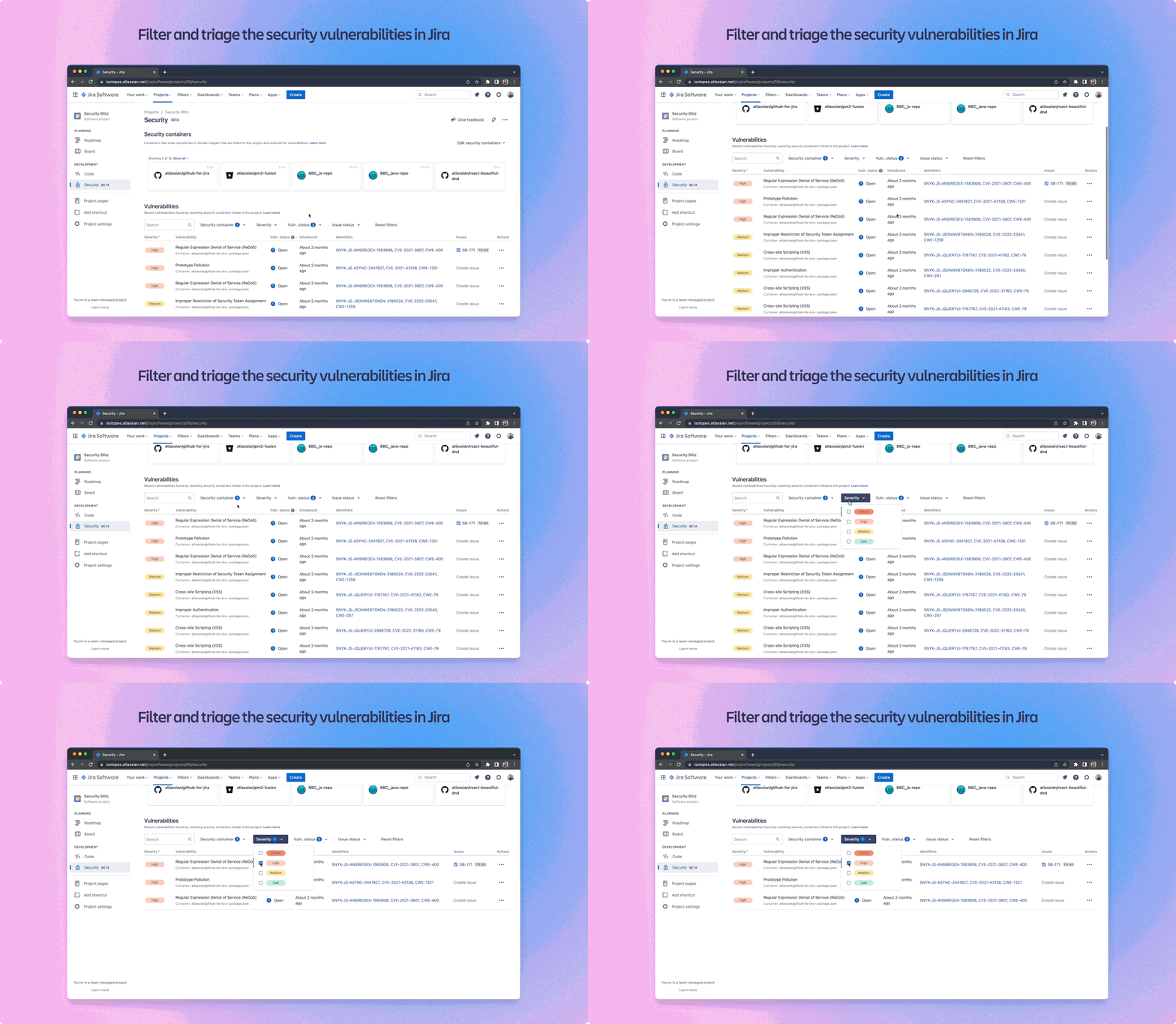
Atlassian announced today it has allied with Snyk, Mend, Lacework, Stackhawk and JFrog to make it simpler to aggregate vulnerability data within the Jira project management software that many organizations rely on to manage application development and deployment efforts.
Andrew Pankevicius, a senior product manager for Atlassian, said the collaborations will make it easier to prioritize a list of vulnerabilities that need to be addressed and for DevOps teams to automatically assign that work to a continuous integration/continuous delivery (CI/CD) pipeline. Atlassian provides those third-party integrations via an Open DevOps initiative.
These capabilities, accessible via the Security Tab in Jira, will make it simpler for DevOps teams to manage output from the multiple application security tools that have become part of a larger DevSecOps workflow, noted Pankevicius.
These additions to the Atlassian portfolio are arriving at a time when there is a lot more focus on securing software supply chains in the wake of a series of high-profile breaches. Those breaches have led to a wave of legislative proposals in the U.S. and Europe that will soon require organizations to embrace DevOps best practices to address increased potential liability that might stem from an application breach.
For example, a proposed Cyber Resilience Act being negotiated by the member states of the European Union seeks to require organizations that sell internet-connected hardware platforms to ensure that their devices—and the software that runs on them—comply with cybersecurity best practices.
In the U.S., meanwhile, a National Cybersecurity Strategy proposal put forward by the Biden administration seeks to hold organizations that collect data or build software more accountable for breaches.
While both proposals are a long way from becoming the law of the land anytime soon, they are indicative of changing attitudes. Governments around the world are concluding the only way to ensure better cybersecurity is to require it. Previous suggestions made by government agencies are going to soon give way to actual mandates. As such, DevOps teams would be well-advised to get ahead of this sea change by implementing the tools and processes that inevitably will be required. As a result, many organizations are now embracing DevSecOps best practices that shift more responsibility for application security further left toward developers.
The challenge is finding the right set of cybersecurity tools that surface vulnerabilities as code is being developed to make sure context isn’t lost, said Pankevicius. Historically, cybersecurity teams have discovered vulnerabilities long after an application has been deployed in a production environment. By then, however, most developers have moved on to other projects, so remembering how a specific piece of code was developed and by whom can be a significant challenge, he noted.
There’s no doubt that when it comes to application security, a lot of progress has been made, but there is still much work to be done. The issue now is finding the best way to organize those efforts at a time when more applications are being simultaneously developed within organizations than ever.

DigiCert today announced it has allied with ReversingLabs to integrate binary analysis and threat detection capabilities with a code signing service it provides.
Deepika Chauhan, chief product officer for DigiCert, said the addition of these capabilities to the DigiCert Software Trust Manager service would make it simpler for organizations to operationalize a methodology for securing their software supply chains. The capabilities are designed to be embedded within continuous integration/continuous delivery (CI/CD) pipelines.
In addition to being a certificate authority, DigiCert’s Software Trust Manager service automates code signing workflows. ReversingLabs, meanwhile, just added the ability to detect secrets exposed in application binaries to its Software Supply Chain Security (SSCS) platform. Those capabilities can identify secrets inadvertently left in applications as plain text, can identify secrets that can be discovered because of weak cryptography and also includes scripts that scan for malware and can generate software bills of materials (SBOMs).
Chauhan said when combined with DigiCert Software Trust Manager, it becomes possible for the two companies to provide a comprehensive approach to detecting malware, software tampering, inclusion of secrets and certificate misconfigurations in any type of software.

A recent ReversingLabs survey found 87% of respondents detected significant risks in their software supply chain in the last year, with software containing vulnerabilities (82%) followed by secrets leaked through source code (55%), malicious code (52%) and suspicious code (46%) posing the most serious risk to the business.
A full 88% said software supply chain security is an enterprise-wide risk, but only 60% said their software supply chain defenses were up to the task. Nearly two-thirds (65%) of respondents, however, acknowledged their organization’s software supply chain security program wasn’t as mature as it should be. As a result, 80% are currently focused on improving security for the software supply chain, with 96% noting a more comprehensive approach to software supply chain security that detects more than vulnerabilities is needed.
It’s not entirely clear just yet whether development teams or cybersecurity teams will be taking the lead in terms of driving the adoption of DevSecOps best practices to secure software supply chains. It is clear that securing software supply chains in the wake of a series of high-profile breaches is a much higher priority.
Erik Thoen, director of product management for ReversingLabs, said as a result, it’s only a matter of time before development teams and cybersecurity professionals are forced to work more closely together than they have in the past.
In the longer term, a wave of legislation in the U.S. and Europe will soon require organizations to embrace DevOps best practices to address increased potential liability that might stem from an application breach. A proposed Cyber Resilience Act currently being negotiated by the member states of the European Union seeks to require organizations that sell internet-connected hardware platforms to ensure both their devices and their software comply with cybersecurity best practices. In the U.S., meanwhile, a National Cybersecurity Strategy proposal put forward by the Biden administration seeks to hold organizations that collect data or build software more accountable for breaches.
While both proposals are a long way from becoming law, it’s clear governments around the world are concluding the only way to ensure better cybersecurity is to require it.

If you ever wonder why continuous testing is so important, think about the following: In the past, software testing was typically done after the code was written and sent to the QA department for independent testing. When bugs were discovered, the code was returned to the developers for correction. While this testing method worked, it was time-consuming. Nowadays, companies want to produce high-quality products quickly, so they need a faster and more efficient testing process. This is when continuous testing comes in.
In this article, we will explore continuous testing from its current state and its future in CI/CD to the emerging technologies and trends that will shape its development. We will also cover the importance of continuous testing for businesses and some of its challenges.
Continuous testing is a software testing approach in which tests are automated and run throughout the software development life cycle. It is a part of the continuous delivery (CD) process, in which software changes are delivered to customers continuously and iteratively.
Continuous testing aims to identify defects and issues as early as possible, reducing the cost and time of fixing them later. Continuous testing provides immediate feedback to the development team, helping them to detect and address potential problems quickly and efficiently.
According to the Reports and Data source survey, 21% of QA professionals have incorporated continuous testing, source code management and continuous integration into their DevOps process to speed up code release.
Here are several advantages of implementing continuous testing as a part of the software development process:
● Continuous testing enables teams to identify bugs earlier in the software development process;
● Continuous testing provides immediate feedback to developers on the quality of their code, enabling them to address any issues immediately;
● You can minimize business risks by assessing and identifying potential issues before they become real problems;
● Automating your test cases can reduce the time spent on testing;
● Accelerating the process of software delivery to production helps release the product faster;
● You can run performance tests in similitude, which can increase the speed of test execution.
While continuous testing has become an integral part of the software development process, it’s not without its challenges. As software development teams work to incorporate testing into their CI/CD pipelines, they may encounter obstacles that can hinder their progress.
● Continuous testing requires a different skillset than traditional testing, including expertise in DevOps, automation and CI/CD pipelines;
● Different tools and technologies are available for continuous testing, and choosing the right ones can be tough. Integrating these tools with other parts of the development process can also be challenging;
● To fully realize the benefits of continuous testing, you need to update your testing strategy by moving away from relying solely on traditional testing methods and adopting a well-defined approach to test data management;
● Failing to integrate code regularly can result in issues such as duplicated coding efforts and non-compatible code, leading to defects.
With the increasing demand for faster and more reliable software releases, emerging technologies such as AI/ML, automation and DevOps appeared in continuous testing. These technologies help teams to automate and streamline their testing processes, identify defects more quickly and improve overall software quality. Let’s examine some of them:
Artificial intelligence/machine learning (AI/ML). AI and ML refer to the field of computer science that deals with developing intelligent machines that can simulate human intelligence and learn from data.
One of the main benefits of AI and ML in continuous testing is the ability to automate test case generation, which reduces the need for manual testing and frees up time for other tasks. This enables testers to test applications more comprehensively and frequently, ensuring defects or issues are identified and addressed quickly. AI and ML increase testing accuracy by identifying patterns and anomalies in the testing data.
AI and ML techniques can efficiently and rapidly analyze extensive amounts of data, allowing them to recognize patterns and irregularities in testing data that human testers might overlook.
Automation: Automation in continuous testing refers to using automated tools and processes to execute software tests repeatedly and consistently. It involves automating various stages of the software testing life cycle, such as test planning, test case design, test execution and test reporting.
Automation can efficiently perform regression testing, ensuring that changes do not introduce new defects or issues in the software. Tests can be executed 24/7 without human intervention, reducing the time and cost required for testing.
DevOps: DevOps in continuous testing is the application of DevOps principles to continuous testing, focusing on integrating testing into the software development life cycle and enabling faster and more reliable delivery of software.
In the context of continuous testing, DevOps emphasizes testing integration into the development process, enabling developers to detect and fix defects early in the cycle. DevOps also promotes automation, collaboration and communication between development and operations teams, allowing faster and more efficient testing and deployment.
Blockchain: Blockchain technology has been gaining increasing attention in the software development and testing industry due to its ability to provide secure and tamper-proof data storage.
In continuous testing, blockchain stores testing results and data in a decentralized and transparent way, making it virtually impossible for anyone to modify or manipulate the data. This enhances the credibility of the testing process and outcomes and provides an added layer of security to ensure the integrity of the data.
Blockchain technology enables efficient and seamless data sharing between stakeholders involved in the testing process, enabling faster and more accurate decision-making.
Internet-of-Things (IoT): In continuous testing, IoT simulates many IoT devices and platforms, enabling testers to test their applications across multiple devices and platforms. This ensures that applications are compatible with various IoT devices and platforms and perform reliably and consistently in various environments.
For instance, when creating an application that needs to run on multiple devices, it is possible to use an emulator to test the app on your laptop without setting up a development environment for each type of device.
IoT-enabled continuous testing provides real-time feedback on the performance and functionality of applications, enabling organizations to identify and address issues quickly and effectively.
Continuous testing is rapidly evolving to meet the needs of modern software development practices, with new trends emerging to address the challenges development teams face. Three key trends currently gaining traction in continuous testing are cloud-based testing, shift-left testing and security testing. These trends are driven by the need to increase efficiency and speed in software development while ensuring the highest quality and security levels. Let’s take a closer look at these trends.
Cloud-Based Testing: Continuous testing is deployed through cloud-based computing, which provides multiple benefits like ease of deployment, mobile accessibility and quick setup time. Businesses are now adopting cloud-based services due to their availability, flexibility and cost-effectiveness. Cloud-based testing doesn’t require coding skills or setup time, which makes it a popular choice for businesses.
AI-Driven Testing: AI-driven continuous testing is often integrated into cloud-based testing platforms, providing end-to-end automation for web, mobile and API testing. AI and cloud-based testing allows for access to testing environments anywhere, anytime, and provides for regular automated testing using platforms like Selenium.
Shift-Left Testing: Shift-left testing is software testing that involves testing earlier in the development cycle rather than waiting until later stages, such as system or acceptance testing. The goal of shift-left testing is to identify and address defects as early as possible.
Delaying testing until the end of development often results in more complicated bug fixes since the software is already fully built. This can cause an increase in cost and time to market. Identifying and fixing bugs earlier in the software development life cycle is generally more cost-effective.
As IBM’s Systems Sciences Institute claimed, repairing a bug discovered during implementation costs roughly six times more than one found during design. If a mistake is detected after product release, the cost of fixing it is four to five times greater than one found during design and up to 100 times greater than one found during the maintenance phase. This suggests that a bug’s cost increases exponentially as the software progresses through the SDLC.
Low-Code/No-Code: Low- or no-code in continuous testing refers to using visual interfaces and pre-built elements or modules to create and execute automated tests instead of writing complex code. Low-code/no-code testing tools often provide drag-and-drop interfaces and pre-built components that can be combined to create tests, reducing the time and effort required to develop and maintain test scripts.
This type of testing provides several advantages, such as allowing non-technical business experts to run testing, speeding up test production and execution and enhancing product quality by enabling more thorough and efficient testing.
Generally, according to statistics, by 2025, around 70% of new business applications are predicted to use low-code or no-code technologies.
Security Testing: Due to the rising incidence of cybersecurity threats and data breaches, security testing has become a crucial aspect of software quality assurance. In the year 2023, the tech world anticipates that there will be a stronger focus on security testing, with the emergence of more advanced tools and methodologies aimed at detecting and resolving security weaknesses in software applications.

Under an early access program, Checkmarx today made available query builder and guided automation tools that take advantage of OpenAI’s generative artificial intelligence (AI) technologies to make it simpler for developers to resolve application security issues.
AI Guided Remediation surfaces actionable remediation recommendations for vulnerability issues such as misconfigurations directly from within integrated development environments (IDEs).
Meanwhile, AI Query Builder makes it possible to use natural language text to create a query for both the Checkmarx static application security testing (SAST) and the infrastructure-as-code (IaC) security tool that creates rules for scanning code. Those rules can be easily fine-tuned or modified and queries for other use cases can easily be added.
In addition to reducing the amount of time it takes to create a query by 65%, that approach also dramatically reduces the number of false positive alerts that arise based on rules created by a security administrator.
Checkmarx CEO Sandeep Johri said these additions to the Checkmarx One Application Security Platform are aimed at improving the application security experience for developers. Most developers don’t want to be inundated by alerts that lack any real context, nor do they want to be bothered with remediation details.

It’s not likely developers will be interested in how AI could help them write more secure code from the start, but the faster a reliable fix is surfaced, the sooner developers can return to writing code, noted Johri.
In the longer term, Checkmarx will add support for multiple large language models (LLMs) beyond those provided by OpenAI to provide other AI capabilities that are based on more domain security knowledge, said Johri.
However, despite these advances, vulnerability remediation will not become fully automated using AI any time soon, he added. Instead, it will become much simpler to identify code that has either inadvertently or deliberately introduced a vulnerability, said Johri.
In fact, generative AI tools such as GitHub Copilot can themselves introduce vulnerabilities into code. As a general-purpose AI platform, the recommendations surfaced are based on a mix of instances of clean and flawed code, Johri noted. There will also be instances where cybercriminals attempt to subvert an LLM that creates code by injecting snippets loaded with malware into the samples used to train a generative AI model.
On the plus side, however, generative AI tools should narrow the divide that currently exists between application developers and cybersecurity teams as more issues are discovered and remediated before applications are deployed in a production environment. The challenge has aways been surfacing application security issues at the time developers are writing code rather than sending them a list of vulnerabilities to address weeks (sometimes even months) after a developer has moved on to another project.
Naturally, there is a lot of trepidation when it comes to all things generative AI; one area of certainty is that the benefits far outweigh the risks—especially when it comes to developing secure-by-default applications.

GitLab this week delivered an update to its continuous integration/continuous delivery (CI/CD) platform that adds additional generative artificial intelligence (AI) and cybersecurity capabilities.
The GitLab 16 release included cybersecurity capabilities such as centralized policy management, expanded compliance reports and controls, compliance dashboards and default Level 3 attestation for the supply-chain levels for software artifacts (SLSA) framework.
At the same time, GitLab this week also made available an emergency patch for two modules that have a path traversal flaw, tracked as CVE-2023-2825, that could allow unauthenticated users to read arbitrary files on the server under certain circumstances.
In terms of generative AI, GitLab 16 added a value stream forecasting capability that automatically generates workflow summaries for senior managers. GitLab is also adding a code refactoring capability and the ability to automatically resolve vulnerabilities to an update to GitLab 16. Previously, GitLab made available a ‘suggested reviewers’ features, an ‘explain this code’ and an ‘explain this vulnerability’ capability that are all enabled by large language models (LLMs) developed by Google. GitLab has also partnered with Oracle to provide additional AI capabilities enabled by machine learning algorithms. In 2021, GitLab acquired UnReview, a provider of a tool that uses AI to identify which expert code reviewers to assign to a project based on the quality of their previous efforts and current workloads.
David DeSanto, chief product officer at GitLab, said with 10 AI capabilities GitLab is providing more of these types of capabilities than any other DevOps platform provider. In addition, those capabilities are distributed across the entire software development life cycle rather than being focused solely on making developers more productive, he noted.
That’s critical, because if AI capabilities are only focused on developer productivity, an imbalance is created; DevOps workflows will not be able to absorb the increased amount of code that will soon be moving simultaneously through pipelines, DeSanto added.
AI will also further fuel adoption of platform engineering as a means for centralizing DevOps management. It’s becoming more apparent that infusing these types of capabilities into DevOps platforms built and maintained by an internal IT team is going to be a major challenge, he added.
There is no doubt that generative AI capabilities will soon become widely integrated across DevOps workflows. That will enable developers to build more secure code faster while at the same time making it simpler for software engineers to maintain large codebases. Just about every job function imaginable will be impacted to varying degrees. In the case of DevOps teams, the ultimate impact should involve less drudgery as many of the manual tasks that conspire to make managing DevOps workflows tedious are eliminated. In fact, AI may ultimately make DevOps, as a methodology for managing IT, more accessible to a much wider range of organizations.
As AI advances, there should still be plenty of demand for human expertise. For better or worse, the nature of the expertise required, however, will undoubtedly be at a much higher level than it has previously been as more low-level tasks are automated. The challenge is determining how and where to refocus the efforts of the DevOps teams to add higher value.