Category: Continuous Delivery

Continuous delivery is a software engineering discipline that allows organizations to consistently develop and release quality software at a rapid pace. It is achieved by automating the software development lifecycle, enabling tasks such as development, testing and release to occur concurrently and continuously.

  • LinearB Aligns with Clubhouse to Advance Project Management

    LinearB Aligns with Clubhouse to Advance Project Management

    LinearB, a provider of an analytics application for software delivery projects, announced today it has allied with Clubhouse, a provider of a project management application that includes built in collaboration tools.

    LinearB’s analytics application uses code, Git logs and releases to automatically construct and visualize detailed timelines without requiring any manual input. That data can now also be automatically fed into the Clubhouse project management application.

    Dan Lines, COO, LinearB, said the goal is to make it possible for any project participant to keep track of updates without spending hours manually compiling and entering data into a project management application.

    In addition, DevOps teams can use both applications to gain visibility into every feature, bug and chore via a live feed of activity generated by branches, pull requests and releases for Clubhouse stories. Along with tools for tracking individual activity and collecting metrics, blockers, delays, high-risk code and branches merged without review for Clubhouse stories are also highlighted. There is also a shadow work detector that detects activity in a Git repository that is not attached to a Clubhouse story.

    Lines said one of the project management challenges organizations face today is the tools they employ only allow them to see segments of a DevOps pipeline. The LinearB analytics application unifies the data and metrics required to make an informed decision, without having to first collect and then normalize data residing in different tools. Instead, all the metrics required to make an informed decision about how best to allocate limited software development resources is automatically collected from the tools the DevOps team employs, Lines said.

    There is no need, then, for project managers to pester members of a DevOps team to enter data in a separate analytics or project management application, Lines added. Given the rate at which application development projects are now updated, much of the data manually entered into a project management application is usually outdated, anyway.

    LinearB employs the application programming interfaces (APIs) exposed by DevOps tools to gather the existing metadata about the status of any given project. LinearB then employs machine learning algorithms to construct and correlate that data to give DevOps leaders more accurate insights into the status of a project, instead of requiring that data to be entered manually.

    In fact, Lines said meetings should be shorter, too, because rather than the need to provide a status update, it will become apparent to everyone what the real status of a project is before a meeting even starts. That means more time can be allocated to determining how best to optimize limited application development resources, Lines said.

    In the wake of the COVID-19 pandemic, organizations have more application development initiatives underway than ever. Many of these projects are core to digital business transformation initiatives which a core group of developers are working on simultaneously. Being able to dynamically reallocate resources to a faster-moving project from one that is stalled is increasingly critical. The challenge has been that the more projects there are, the harder it becomes to collect data that accurately reflects their true status at any given time. The goal should be to eliminate the need to reenter data that, in one form or another, already exists in another tool.

  • BluBracket Community Edition of Secrets Discovery Tool now Available

    BluBracket Community Edition of Secrets Discovery Tool now Available

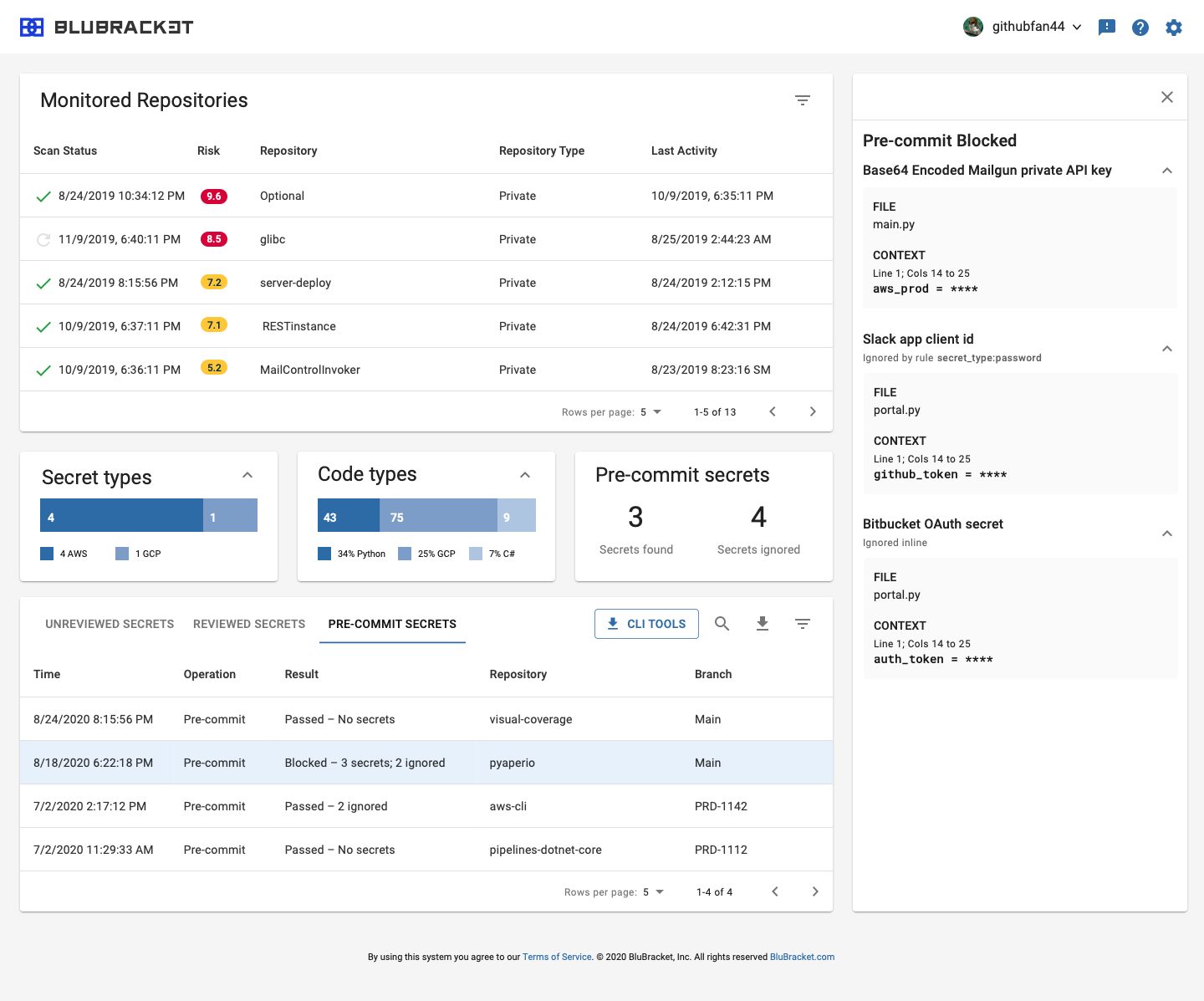
    BluBracket today announced general availability of a community edition of a tool that employs machine learning algorithms to discover passwords, tokens and other security vulnerabilities in code.

    Prakash Linga, BluBracket’s CEO, said application secrets stored in code enable cybercriminals to compromise applications in ways that can impact an entire software supply chain. The community edition of the company’s namesake tool scans commits to determine if any new risks were introduced, and will then block the staged files from being committed. It works with any continuous integration/continuous delivery (CI/CD) platform or integrated development environment (IDE) that supports pre-commit hooks, including VSCode, Jetbrains IntelliJ and PyCharm.

    Developers are then presented with a risk score based on the number of secrets discovered in their code. For example, an active token for Amazon Web Services (AWS) would receive a high score, while a a password in a test environment would be rated low.

    The Community Edition of BluBracket can be accessed via GitHub. The free version of BluBracket can be employed to scan up to 10 repositories and sharing reports in real-time, covering more than 50 types of secrets that might be employed using any programming language.

    Linga said BluBracket also cuts down on false positives by combining machine learning algorithms with a built-in rules engine. In contrast to open source tools, BlueBracket generates far fewer false positives, said Linga.

    Linga said the Community Edition is intended to help foster adoption of DevSecOps best practices among individual developers, in hopes that when those developers are hired, their organizations eventually license the full instance of BluBracket. The company views its tools as being complementary to both tools that surface vulnerabilities in code as well as secrets management platforms, which are often not employed as widely within an organization, Linga said.

    In the wake of recent high-profile breaches that embedded malware in widely-distributed applications, there’s increased focus on securing software supply chains. In some of those instances, Linga said, it’s probable cybercriminals discovered passwords and other secrets that were inadvertently exposed in code.

    However those breaches were enabled, it is apparent cybercriminals are becoming more adept at exploiting a weakness in one application to inflict maximum damage across an entire environment. It’s hard to say exactly what role secrets discovery is playing, but cybercriminals tend to prefer the path of least resistance when it comes to exploiting application vulnerabilities.

    Of course, the hope is that adoption of DevSecOps best processes will reduce the number of breaches by shifting responsibility for cybersecurity further left toward developers. However, that’s difficult to achieve without finding the simplest way possible of getting the security tools required into the hands of the developers that need them most.

  • Sauce Labs Acquires AutonomIQ to Advance App Testing

    Sauce Labs Acquires AutonomIQ to Advance App Testing

    Sauce Labs is acquiring AutonomIQ, a provider of a scriptless test automation platform based on machine learning (ML) algorithms.

    Matt Wyman, chief product officer for Sauce Labs, said the acquisition of AutonomIQ will play a critical role in enabling Sauce Labs to push testing further left toward developers and, ultimately, “citizen testers” that are becoming part of the DevOps testing tool chain.

    The acquisition of AutonomIQ comes on the heels of the company announcing its intent to acquire API Fortress, an application programming interface (API) testing platform provider. Terms of neither acquisition were disclosed.

    Wyman said the rise of DevOps coupled with an increase in the volume of applications being developed using low-code tools are the primary drivers of a need to shift testing further left. As more citizen developers are building applications, they require access to a testing platform that doesn’t require them to know how to write scripts to test applications, said Wyman.

    The AutonomIQ platform employs machine learning to understand, for example, natural language descriptions of test cases or captured mouse clicks. It then generates synthetic data and test cases that can self-heal when an application changes, said Wyman.

    That approach to testing is more feasible in software-as-a-service (SaaS) environments, where a custom application based on a platform such as Salesforce, ServiceNow, Workday, Oracle or SAP doesn’t tend to change as radically as an application being built from the ground up, Wyman said. Those classes of applications will still require either developers or a dedicated team of testers to build tests using scripts, said Wyman.

    In fact, Wyman said testing those applications is becoming more challenging in the age of microservices. The API Fortress acquisition addresses that issue, because microservices are dependent on APIs to communicate with other microservices, said Wyman. In general, Wyman said Sauce Labs is now moving beyond being focusing only on functional testing of user interfaces.

    It remains to be seen how quickly testing will move to the left. Developers are being held more accountable for the quality of their applications, so testing integration within the application development process has increased. This has led to application testing becoming more tightly integrated with continuous integration/continuous delivery (CI/CD) platforms. Less clear is to what degree those efforts might have reduced the burdens of a dedicated application testing team that typically evaluates applications after they have been constructed.

    Exactly where and how citizen testers are being incorporated into those processes is also unclear. In theory, citizen testers can bring more business process expertise to the testing process. Getting individuals with that level of expertise to make time to participate in application testing while an application is being built can be a challenge.

    Regardless of approach, however, it is already apparent that machine learning algorithms, along with other forms of artificial intelligence (AI), will play a much larger role in application testing in the coming months and years.

  • Plutora’s Bob Davis: Work From Home and Value Stream Management

    Plutora’s Bob Davis: Work From Home and Value Stream Management

    American writer Orison Swett Marden said, “Success is not measured by what you accomplish but by the opposition you have encountered and the courage with which you have maintained the struggle against overwhelming odds.” After the year that’s passed, with operations and development teams forced to scatter and work remotely, it’s a sentiment DevOps teams are currently all too familiar with.

    This demand to keep DevOps teams productive under the extraordinary circumstance of 2020 has placed an increased emphasis on effective management, including on value stream management tools, so leaders and team members can have greater visibility into delivery pipelines.

    To get a sense of the state of the value stream management market, I reached out to Bob Davis, chief marketing officer at value stream management platform provider Plutora. Below is an edited version of our conversation.

    George Hulme: Thanks for taking the time today, Bob. Could you tell us a little about Plutora?

    Bob Davis: We are a value stream management platform provider. When I first arrived here, we recognized that sales, marketing, financial and human resources teams all have their systems of record. They have Salesforce, ERP (enterprise resource management) systems, and various financial and HR platforms that enable people to practice their profession more easily. IT didn’t have anything like that at the time.

    We set out to provide that capability for the software development side of IT. Today, the market is caught up. Everybody is moving into value stream management as a platform to provide that visibility across an entire toolchain, from the idea to production. That’s where we play. We’ve been in this space since it began over two years ago. The market is just exploding with the work-from-home trend, and how the pandemic kicked digital transformation into high gear.

    Hulme: It appears that a significant percentage of the work-from-home trend is here to stay. I’m seeing surveys showing about 19% of people previously suspected that they’d be working from home in a year. That figure jumped now to near 50%.

    Davis: If you start to parse what work from home means, you’ll find it means many different things to different organizations. Some have a hybrid model with people working from home two to three days a week. I recently read a Gartner survey that said 74% of organizations were going to have some element of work from home. It’s not all or nothing.

    Some companies have decided that they are not going back to work until well into this year. All of these companies have to make sure they have governance compliance in place for this new workforce, and that they can successfully manage the complexities of software development. These challenges are at least an order of magnitude, if not more so, more difficult than typical office workers working from home.

    Hulme: Is one of the reasons behind those challenges struggling to maintain being on the same page across the organization?

    Davis: That’s a great point, George, because when we go out with our teams at many organizations, a lot of the effort helps people fast-track their processes. We are asked, “What is the best practice for automating builds? How often should I be automating builds? What KPIs do I establish to make sure that people are striving to accomplish what we need them to accomplish?”

    For example, one of the things that Lean and Agile methodologies promote are smaller work items, quicker check-ins, faster processes. They encourage cutting work down into smaller bundles to be done more quickly so that teams can iterate much more rapidly. We’ve seen that managers will often create a KPI for a performance management program to measure how often code gets checked.

    That’s horrible because now I can just check in code all the time. Yet, are people making actual progress? Are they actually delivering software, or are they just checking in small iterations of code all day?

    Organizations have to be very careful with how they manage people. They have to be cautious with what metrics they set up to keep their eye on delivering value and delivering software more quickly. This is something organizations struggle with. They want to know where to start and what metrics they need to implement. And how to make those metrics visible so people can see and understand them. That’s what provides the ability for product owners, managers, executives and other stakeholders to view the progress and status of what’s going on without disrupting people with calls and endless meetings.

    Hulme: That has to be tremendously more challenging with the work-from-home trend than years prior.

    Davis: I recently heard a great quote: “As people end up working from home, the need for human contact and human interaction, socialization, is peaking.” People are hungry for that. At the same time, the need for managers to not be in the face of the employees has never been higher. That is, the motivation and the productive nature of employees is proportional to how well they feel trusted. And it’s proportional to how well they understand where they’re headed and understand how to do their job and are left alone to do that job.

    It’s a leap of faith to leave people alone and simply trust them. You need systems that provide you the ability to collaborate; watch the progress. You need systems that will help you understand where people might be struggling, all without having to dig in and micromanage your people. Indeed, as we are learning, managers can effectively do this with Zoom, or Slack, or some other tool that provides good communication flow within a work-from-home environment. But in software, the handoffs and dependencies are so complicated that those tools are simply not enough. You need a collaboration tool that provides effective management in software development.

    Hulme: Do you believe remote development teams can communicate as collaboratively as they did in person, with modern software collaboration tools?

    Davis: Yes, I think they can. Especially when office collaboration tools, such as Zoom and Slack, and software collaboration tools work together. We can leverage Slack to communicate tasks. So we not only layer on top of the individual tools people have and integrate with them, the practitioners working within those tools can make it available to all of those stakeholders involved in that process. And when there are tasks or handoffs, the system can be configured to notify them how they prefer to work: email, Slack, instant messenger, task list on the dashboard. There’s a lot of different ways, depending on how people want to work.

    Not only that, but it can automatically alert people to what is happening and what’s needed. Fascinatingly, one of the interesting yet deceptively tricky questions to get an answer to is, “Where’s the status of a feature?” If a team is in the process of building something out, and they have a specific feature, such as check cashing in a banking app, it should be a pretty straightforward question to get answered.

    Yet, about seven or eight different teams are working on various aspects of that application. For instance, there’s a product owner who, without the right collaboration system, has to go and essentially track all of those teams down and find out where their status is.

    With a software collaboration system, you can make that query without bugging anybody. In some respects, you can collaborate more efficiently and more productively than you can when you’re all sitting in the same room. That’s because before, we would have walked over and interrupted somebody. Now you’re just looking at a dashboard, or you’ve gotten an alert on Slack, and you see what you need. Boom.

    Hulme: How important do you think it is to have useful data and that value stream knowing where things stand to keeping the system flowing and individuals knowing where they fit on deliverables?

    Davis: I think the ambiguity, unexplained delays and unforced errors are among the things that upset human beings the most. Just ask somebody that’s standing in a line that’s not moving, and it hasn’t moved in a while; how restless the crowd gets. The nature of software development is such that there are tremendous numbers of handoffs, no matter how you do your development.  It doesn’t, whether it’s an old fashioned waterfall or the most advanced development and deployment models in operations at places like Spotify — you have a lot of handoffs. And if you can’t see what you’re doing because you don’t have visibility into those parts, then you’re going to run into an incredibly frustrated team. And you are going to see a lot of finger-pointing when the question comes up, “Why didn’t this release go out?” And then there’ll be five or six different groups pointing to different reasons. You get a lot of anger, a lot of discontent.  And it’s something you have to avoid if you are going to succeed.

  • Rookout Tool now Debugs Third-Party Code

    Rookout Tool now Debugs Third-Party Code

    Rookout revealed today it has extended its eponymous debugging tools to include third-party applications.

    Shahar Fogel, Rookout’s CEO, says most organizations today are building applications that rely heavily on code or modules developed by a third party. Rookout now makes it possible to analyze and debug that code before it is incorporated within a larger application environment, Fogel said.

    That’s crucial, because many of the operational issues a DevOps team is likely to encounter can be traced to flawed code written by someone outside of the IT organization, Fogel said. This new capability will reduce the amount of time DevOps teams spend trying to deduce the root cause of an issue, he said.

    Many IT organizations erroneously assume that all the code running in their environments has passed through a continuous integration/continuous deployment (CI/CD) environment, Fogel said. In reality, it’s not uncommon for developers to deploy code directly into a production environment in the name of expediency. Not all of that code, however, may have been written by the developer. Many developers wrongly assume the code they download from a repository was properly vetted and debugged.

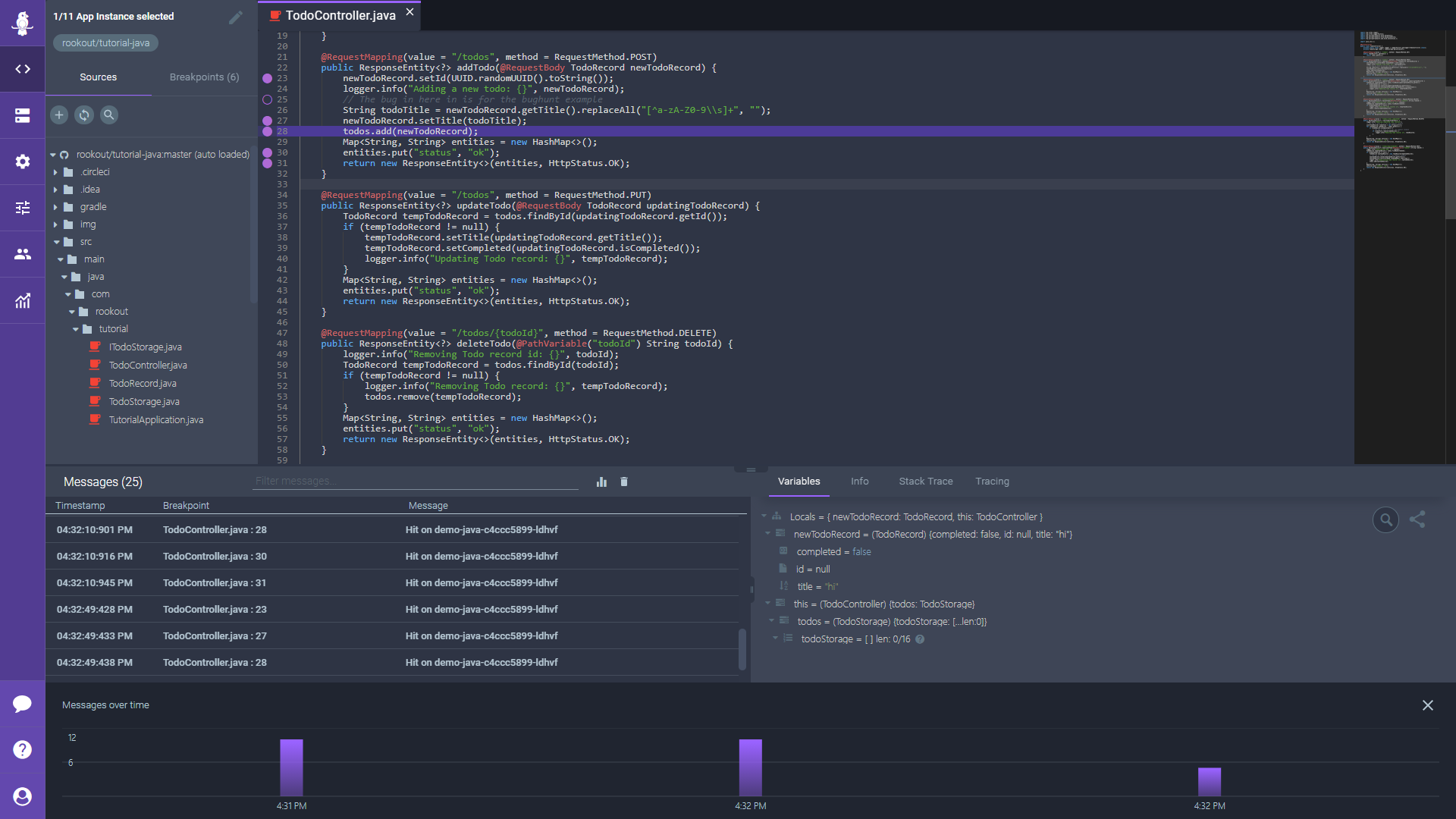
    Rookout now makes it possible to debug both open source code and proprietary code written by a third party or present on an application deployment platform, said Fogel. Rookout collects the local variables, function arguments, tracing data, call stack and other relevant data, and can identify issues down to specific lines of code. Support for third-party code has been extended to the call stack level to enable developers to see how code execution flows across their own and third-party code.

    As more responsibility for applications shifts left toward developers, organizations need to provide them with tools to analyze applications and the platforms they run on. Beside building applications faster, one of the primary theoretical benefits of DevOps is the notion that developers can build more resilient applications, because it’s ultimately their responsibility to remediate any issues that arise after an application is deployed in production. In practice, that’s difficult to achieve when developers have no visibility into code that they didn’t write themselves.

    Going forward, there’s going to be a lot more third-party code running in production, as developers reuse application code encapsulated in containers downloaded directly from registries, Fogel said.

    The degree of accountability developers have for their appliations’ code currently varies widely by organization. However, given the right tools, and enough time, most developers would prefer to debug both the code they write and any they have incorporated, even if it were written by someone else. That desire, however, requires more time to build and test applications. Of course, it’s worth the tradeoff if developers encounter fewer incidents that require developers to debug applications after they are deployed in a production environment.

  • What Does the Future Hold for DevOps and CI/CD?

    What Does the Future Hold for DevOps and CI/CD?

    After such a challenging year, we have finally made it to 2021. Although a new year has started, we are still trying to figure out what the “new normal” will look like once the COVID-19 pandemic is finally over.

    While the pandemic has affected many businesses and our daily lives in general, it also had a major impact on software development. This past year we have seen rapid innovation and acceleration of digital transformation as a result of the pandemic. So, what does 2021 have in store for DevOps? How can DevOps teams improve productivity and become high performers in 2021?

    In this interview, CircleCI CEO Jim Rose joins Rebecca Auguste to talk about what 2021 has in store for DevOps and CI/CD, how the pandemic impacted software teams and what they can do to succeed in this new year.

    Jim is one of the distinguished speakers that will be sharing his knowledge and predictions for 2021 at this year’s Predict Virtual Summit. During his session, Jim will discuss what’s in store for engineering teams in a post-pandemic world, backed by anonymized team data from millions of DevOps workflows. Attendees will leave with insights and benchmarks to help teams build better software faster.

    Jim has led category-defining companies through economic crises, with COVID-19 being no exception. He is on a mission to provide everyone the ability to build and deliver software at the speed of imagination.

    To find out what the future of software looks like, attend Jim’s session at Predict Virtual Summit on Jan. 21. To check out the full agenda or to register for free, visit the Predict 2021 website.

  • DevOps for the Development and Delivery of High-Performance Applications

    DevOps for the Development and Delivery of High-Performance Applications

    Engineering teams that successfully implement DevOps practices often deliver software with higher business value. These organizations can easily identify areas where problematic code exists, quickly eliminate issues and deliver high-performance applications more quickly than their competitors that use traditional delivery methodologies. DevOps practitioners understand that creating an efficient model for performance testing goes hand-in-hand with four key objectives of digital transformation: extending performance testing to new roles; integration into continuous integration/continuous delivery (CI/CD) processes; end-to-end performance monitoring; and continuous optimization.

    Reduce Cycle Time and Time to Market

    In order to meet the requirements of rapid, high-quality application delivery, modern software teams need an approach that goes beyond conventional performance testing. This is where DevOps-centric approaches can provide faster, more efficient development and help ensure the delivery of high-quality software. Building the components of an application using agile approaches and validating features as they are created ensures that applications can be tested and verified more quickly, with no increase in associated costs or resources.

    By adopting DevOps practices, individual steps within the application delivery process can be automated as part of a DevOps tool-chain. For example, automating quality assurance test runs can eliminate – or significantly reduce – time-consuming human or analog searches for defects in code. Test automation can lead to an increased volume and expanded scope of testing, which, in turn, leads to a reduction in the defect escape rate. That saves resources, time and money.

    Shift Left to Increase Agility

    To mitigate performance errors and to address issues as early as possible in the application delivery cycle, tests should be executed during the build stage of the development process. By shifting left – running the tests as early as possible, ideally as part of a code commit – enterprises reduce the risk of discovering defects or issues with the product after significant amounts of development work have been completed. It is widely accepted that addressing defects later in development cycles takes significantly more time and money versus identifying and remediating defects early in the development cycle.

    As developers perform rapid, high quality, incremental changes, business analysts or product owners can more easily share changes, concepts or suggestions with their development teams. This continuous flow of communication can significantly reduce feedback time, increasing an organization’s ability to react to changing market requirements and allowing a level of flexibility within the development process that drives competitive advantage.

    DevOps in a Hybrid Landscape

    By supporting a wide range of tools and technologies, organizations that adopt DevOps practices can support applications that run in a local network environment, in cloud-based environments or, more commonly, in hybrid IT environments. As companies continue cloud migrations and transformations, well-designed DevOps tools can help simplify this transition while continuing to provide support for the legacy applications that provide core capabilities and processing for many enterprises. These hybrid tools are fully integrated into existing application development processes, allowing all application delivery teams to successfully transition to DevOps-centric practices without leaving any teams behind.

    One particularly important DevOps practice is performance optimization through continuous analysis. By using a centralized store and a common approach for quality-centric data collation, this practice helps analyze, enforce and improve the connections between software developer, CI Build and end-to-end performance testing to ensure a “quality first” mentality and higher-value delivery outcomes. The application of data visualization techniques allows teams to access code – build – test results in real-time and make decisions based on up-to-date insights.

    If DevOps practices are successfully established within a team or organization, they not only support more efficient software development and delivery but also are cost-effective. However, in order to successfully implement DevOps practices, enterprises need to understand and implement both technological and cultural changes. Through a combination of process, tooling and cultural simplification, and aligning teams toward common business objectives, organizations can deliver their end goal of creating high-quality, high-value software that satisfies the needs of the end user. By focusing on the common goal, and understanding the journey necessary to get there, enterprises can do so more quickly and at less cost – a win-win!

  • The Top Benefits of a Scrum Certification

    The Top Benefits of a Scrum Certification

    The Scrum framework is a staple part of many businesses – and for good reason. The agile process is used to construct, deliver and iterate products and has proven to boost cross-functional teams’ productivity, as well as product quality. And, like most processes, Scrum can be mastered with the right training and commitment. Specifically, a Scrum certification teaches the fundamentals of the framework and serves as proof of qualification for a particular role within that framework.

    Scrum certifications vary, but are typically awarded for the roles of Professional Scrum Master, Product Owner and Scrum Developers. These positions have become increasingly more popular over the years; one report reveals that 24% of organizations have ten or more Scrum Masters or Agile Certified Practitioners, while in a sample of 500,000 certified people, 85% correspond to a Scrum certification program.

    Having a Scrum certification opens many doors, both professionally and personally, as it provides a competitive edge and demonstrates an in-depth understanding of contemporary workflows. Whether you’re considering taking a Scrum course through your company, or pursuing a class independently, here are a few of the top benefits.

    Adapt to Changing Conditions

    Throughout the COVID-19 pandemic and its significant disruption to businesses, organizations had to swiftly adapt to new ways of working. Operating remotely, adopting new digital tools, complications in supply chains, just to name a few, are all challenges met with patience and proactivity. People who work under the tenets of the Scrum mindset tend to be more resilient and better able to respond to unexpected events in a practical manner.

    Rapid fluctuation in personnel, technology and working practices have less of a negative impact on employees, and especially leaders, that are Scrum certified. In shifting environments, the larger organization can be confident that their teams are being guided by Scrum principles and constantly progressing.

    What’s more, people with a Scrum certification can help their teams better adapt to sudden changes without compromising business goals. Scrum emphasizes prioritization of tasks in order of importance; placing the task with the biggest impact on ROI at the top of the list. This method not only maintains productivity but can actually increase it, despite external disruptions.

    Master all Things Scrum

    A Scrum certification highlights that a person is dedicated and hardworking, and is committed to continuous learning and improvement. It is a reflection of the certificate holder’s expertise in helping others and meeting goals. On a more granular level, the certification can help people discover and become familiar with concepts like product backlog, sprint backlog and burndown charts – elements that are common across businesses and industries.

    A Scrum certification can also boost personal communication skills, as it forces people to regularly produce and share relevant reports, deadlines and calendars with their team. These exchanges demand clarity, timeliness and emotional intelligence, which are core soft skills that contribute to the collective success of a team.

    Certified Scrum holders also benefit from their inclusion in a network of qualified Scrum authorities where they can leverage others’ exclusive guidance and knowledge. They can subsequently bring innovative ideas from fellow Scrum experts to their workplace, and leave a powerful legacy through the changes they implement.

    Gain an Advantage in the Hiring Pool

    A Scrum certification also makes a person a much more appealing candidate in the recruitment process. In a competitive hiring landscape, a Scrum certification demonstrates that a candidate is willing to devote time to solving complex, adaptive problems – a quality that will always catch employers’ eyes.

    In fact, 87% of people agree that Scrum improves the quality of work life for teams, while 81% of people believe certifications improve their use of Scrum. A certification shows that someone knows how to manage dynamic priorities, how to deliver products to market in a short space of time and how to increase project visibility. The Scrum qualification is particularly useful for managing large, cross-functional teams. For these reasons, a person with a Scrum certification will be a prime applicant in any hiring pool.

    There can be financial benefits too. Possessing a Scrum certification can lead to higher salaries, because these credentials are so highly sought-after. Certified Scrum Managers tend to earn more, on average, than their non-certified peers, so Scrum candidates are in a stronger position when negotiating compensation.

    The COVID-19 pandemic has presented new opportunities for professionals to invest in their careers on a long-term basis. Scrum techniques and methods prepare workers to generate ideas that make sense in an uncertain sphere, and those who invest in Scrum are making themselves invaluable in today’s workplace.

    A Scrum certification is a way to develop business ideas, projects and services in a smarter, more agile manner. But more than that, a Scrum certification also leads to heightened personal skills, employment desirability and resilience.

  • Cloudflare Lays Out GitOps Ambitions for CDN Platform

    Cloudflare Lays Out GitOps Ambitions for CDN Platform

    Cloudflare’s acquisition of Linc is the latest move in the hosting provider’s move to better align its content delivery network (CDN) service with the tools and frameworks organizations rely on to build modern applications using GitOps processes, according to CEO Matthew Prince. Cloudflare also announced other updates and automation-related features, including a way to automatically deploy JavaScript applications using Linc’s technology.

    Prince said these latest moves are part of an ongoing effort to simplify integration of front-end applications with back-end services.

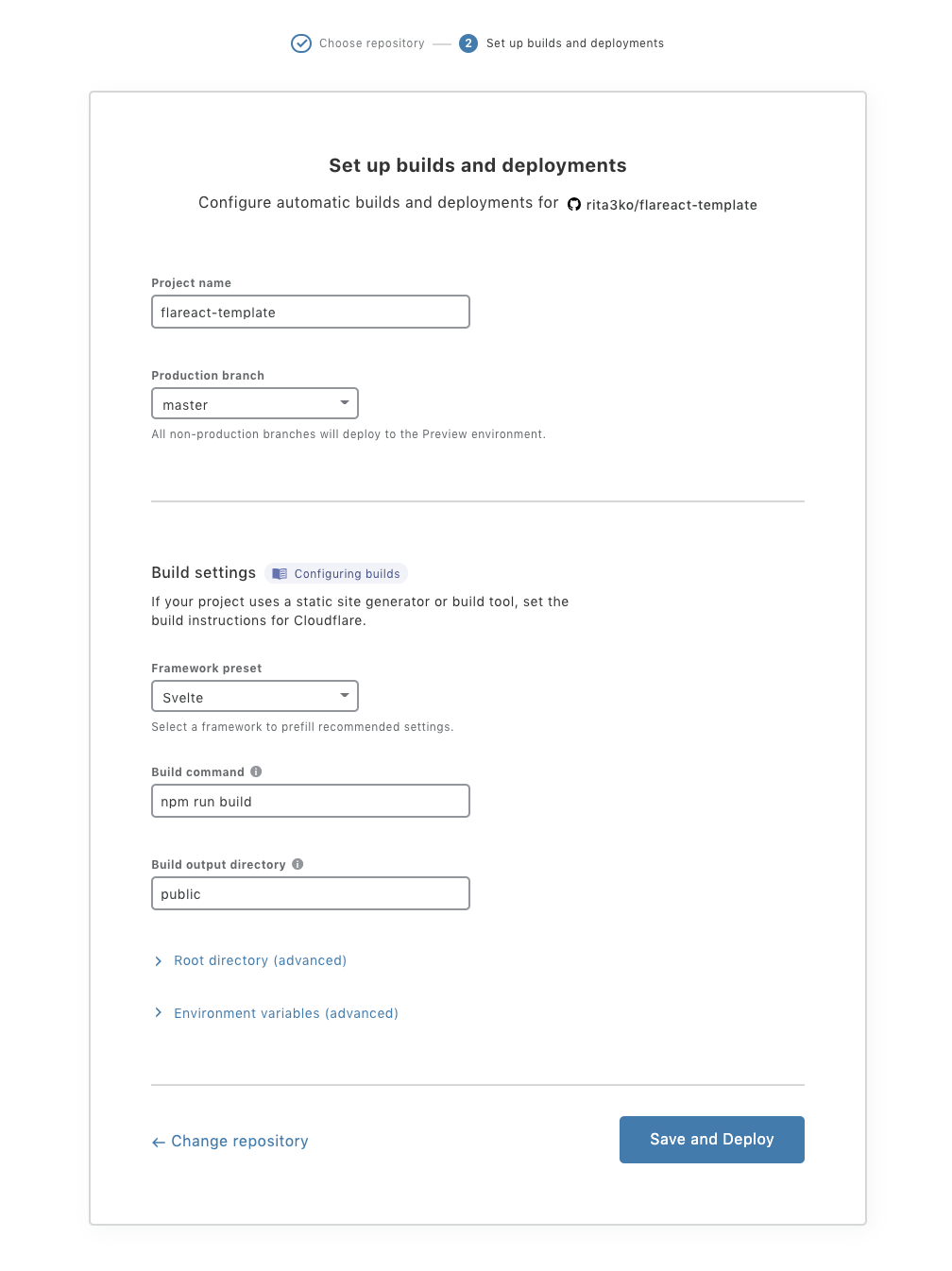
    Cloudflare Pages, for example, enables developers to select their preferred repository, identify what types of frameworks they are using, and then automatically deploy their applications on the Cloudflare CDN. The goal is to automate the continuous integration process in a way that enables developers to focus more of their time and effort on developing code, said Prince.

    Linc’s technology, meanwhile, will make back-end services more accessible to front-end applications using Front-end Application Bundles (FABs) that accelerate server-side rendering by combining front-end and back-end logic. The result is better performance across any type of application that relies on JavaScript, application programming interfaces (APIs) and markup languages, otherwise known as JAMstack, a framework for building complex applications.

    Prince said JAMstack adoption is accelerating because it allows developers to continuously modify the user experience (UX) without the need to modify back-end services. The CDN, meanwhile, has emerged as a platform for continuously deploying applications closer to the point where they are consumed by the end user, said Prince.

    That’s become especially critical at a time when digital business processes require data to be processed in near-time, and as closely as possible to the point where it is generated, said Prince. That’s not possible when application logic runs on a public cloud, Prince added.

    Cloudflare currently has points of presence in 200 cities worldwide, and is actively courting developers as part of an effort to usurp CDN rivals. Most recently, Cloudflare added a Durable Objects capability that makes it possible to run stateful applications across a distributed, serverless Cloudflare Workers service.

    Ultimately, Prince said the goal is to automate the majority of the DevOps process, as code moves from a Git repository to the network edge. A CDN will also provide the means to monitor and secure applications running at the network edge, Prince added.

    It’s not clear how much application logic will be pushed to the network edge via CDNs; however, it’s apparent CDNs are emerging as an important deployment platform that should be incorporated with DevOps processes. How providers achieve that goal is, in part, dictated by the framework used to build an application.

    Cloudflare’s moves are indicative of the larger trends of automating DevOps processes, a development that should make DevOps best practices more widely accessible to many more developers.

  • Armory Offers Framework to Extend Spinnaker

    Armory Offers Framework to Extend Spinnaker

    Armory, provider of a curated instance of open source Spinnaker continuous delivery (CD) software, is making generally available an open source plugin framework for any instance of Spinnaker.

    Announced this week at its online OPEN CORE SUMMIT, the framework has already been employed to create 15 plugins for Spinnaker, including an observability tool from Armory and a provisioning tool from Pulumi. The plugin framework creates extension points that provide standardized interfaces for creating plugins that invoke various microservice within the Spinnaker CD platform.

    Armory CTO Isaac Mosquera said the goal is to make a Spinnaker platform now being developed under the auspices of the Continuous Delivery (CD) Foundation more easily extensible. The relationship between the frameworks and Spinnaker is naturally symbiotic; more extensions are needed to increase the appeal of the platform. Organizations are unlikely to build those extensions unless Spinnaker achieves a critical mass of adoption.

    Originally developed by Netflix, Spinnaker is being advanced by CD Foundation, along with the Jenkins and Jenkins X continuous integration/continuous delivery (CI/CD) platforms. Organizations will employ different platforms under different circumstances, but the Spinnaker platform does enjoy the capability of being integrated with multiple CI platforms that DevOps teams already have in place, noted Mosquera.

    That ability to mix and match DevOps platforms is becoming more critical as IT environments become more hybrid, he said. The expectation is support for Tekton pipelines, which were originally developed by Google and now are part of the CD Foundation portfolio, will be added to various CI/CD platforms to make it easier to integrate DevOps pipelines.

    In the meantime, a debate surrounding how to implement best GitOps practices is starting to swirl. Thanks to the rise of Kubernetes, it is becoming easier to employ GitOps processes to automate the pulling of code from a Git repository onto any platform. In some cases, that approach might reduce or eliminate the need to rely on a dedicated CI/CD platform to manage that process. Conversely, Mosquera noted CD platforms such as Spinnaker also provide a range of capabilities that span everything from automating audit process to rolling back application code in event of a major deployment issue.

    In the meantime, the amount of code moving through DevOps pipelines continues to increase. Simultaneously, the code is arriving in form of microservices that, although are comparatively easier to build, are often more challenging to deploy, update and manage.

    It’s not clear how many organizations might be looking to replace existing DevOps platforms to manage those processes more effectively. However, more organizations are embracing DevOps processes more widely to deal with an ever-increasing volume of code. As such, the number of organizations adopting open source DevOps platforms in one form or another will continue to rise. Most of those organizations, however, are unlikely to want to download on their own the raw bits that make up those projects.