Category: Continuous Delivery

Continuous delivery is a software engineering discipline that allows organizations to consistently develop and release quality software at a rapid pace. It is achieved by automating the software development lifecycle, enabling tasks such as development, testing and release to occur concurrently and continuously.

  • Standardizing Federal Cybersecurity With DevSecOps

    Standardizing Federal Cybersecurity With DevSecOps

    DevSecOps is having a moment in the federal government. With President Biden’s Executive Order on Improving the Nation’s Cybersecurity and federal agencies’ issuance of DevSecOps best practices based on the Enduring Security Framework, government organizations are shoring up and standardizing their DevSecOps processes to meet today’s cybersecurity challenges head-on.

    Integrating security into the development process is particularly important for federal agencies that have invested significant time, effort and money in creating and running software development factories. These agencies are actively trying to balance security and innovation–and many are succeeding. The United States Air Force’s Kessel Run program is an example of a tightly run and innovative software factory.

    The question is: How can they continue this success as the calls for standardized cybersecurity grow increasingly louder?

    The Delicate Balance Between Security and Innovation

    It’s tough to balance security and innovation and wrap them both in a standardized process. It’s certainly not impossible, as Kessel Run proves. But it does require a high level of rigor to ensure that applications are being developed at speed while taking the necessary time to mitigate and minimize security risks and vulnerabilities. 

    Projects like Kessel Run and others work well in part because they bake security into the development process from the outset. That core tenet of DevSecOps allows teams to integrate and standardize security throughout their development cycles without losing momentum. 

    But, there are challenges to these standardization efforts that are inhibiting DevSecOps practices. 

    First, many government agencies are still working with legacy systems and toolsets rather than the modern technologies that many commercial companies that employ DevSecOps have access to. These technologies can include everything from collaboration platforms, to messaging applications, to underlying platforms that tie all the work being done together. 

    Second, despite the government’s commitment to innovation, old ways of thinking still persist in many pockets of the public sector. Some important people still think, “Why change when email has worked just fine for all these years?” Those people fail to immediately see the value of modernizing their toolsets and practices.

    But outdated technologies and processes won’t help government agencies balance security and innovation–and they won’t work with new cybersecurity policies and mandates. For instance, president Biden’s EO is filled with allusions to ensuring visibility into software development practices and the software supply chain. Doing both requires developers, security managers and operations managers to be on the same page and in constant communication at all levels of the development cycle. 

    Maintaining Situational Awareness Throughout the DevSecOps Process

    Yet even in the most mature DevSecOps environments, this isn’t always possible. Because while DevSecOps is driven by collaboration, that doesn’t mean that developers, security managers, and operations managers always know who’s working on what, or what the status of a particular project is at all times. This is particularly true in a government setting where old processes, technologies, and siloed teams are still present.

    But maintaining the balance between security and innovation is highly dependent on being able to have unfettered situational awareness throughout the development lifecycle. For example, a developer needs to know if a security operations teammate is working on fixing a vulnerability the developer discovered during testing. Likewise, an operations manager needs to know the status of the patch, as that might impact other factors important to the development process, including time to deployment.

    High-level dashboards help all team members quickly ascertain the status of projects in development and are useful in helping individuals understand where things exist in the pipeline. They can provide a quick, at-a-glance take that leaders can use to plan their projects, discover backlogs or potential roadblocks to deployment, and more.

    But even dashboards are not necessarily enough, because stakeholders need to be able to quickly and securely communicate status updates to each other.

    Collecting Communications, Facilitating Collaboration

    The problem is that not all of these individuals will necessarily be using the same tools. Some might be using one messaging service. Others might be holding impromptu video meetings. Others might be posting updates to project management boards. Software development is a living and agile process, and communication is happening all the time through different channels.

    That’s why it’s critical for agencies to pull all of these disparate threads together, especially if they are to properly manage security and maintain compliance with the EO. A single missed communication about a software vulnerability could end up becoming tomorrow’s SUNBURST attack. There must be a way for all DevSecOps stakeholders to interact with each other, regardless of their choice of tools or the channels they’re using.

    This is where the choice of modern toolsets and platforms comes into play. Pulling disparate threads together to facilitate better communication and collaboration requires technologies with the ability to connect various services, automate task management and alerts, and break down any lingering communication silos. It requires an underlying architecture that connects all key stakeholders so they can collaborate and ensure the security of the applications they’re working on. 

    Meeting the Cybersecurity Moment

    Older technologies and practices aren’t up to the moment government agencies are facing. They are unsuitable for today’s software development processes, and will not aid in the quest to stay ahead of today’s cyber threats.

    To meet the moment, government agencies must embrace new ways of communicating and collaborating. They must use the tools that are available to keep innovating even while standardizing according to cybersecurity regulations. They must provide their DevSecOps teams with the ability to work freely yet securely and set them up for success.

  • Cisco Adds Open Source Tool to Validate Serverless Functions

    Cisco Adds Open Source Tool to Validate Serverless Functions

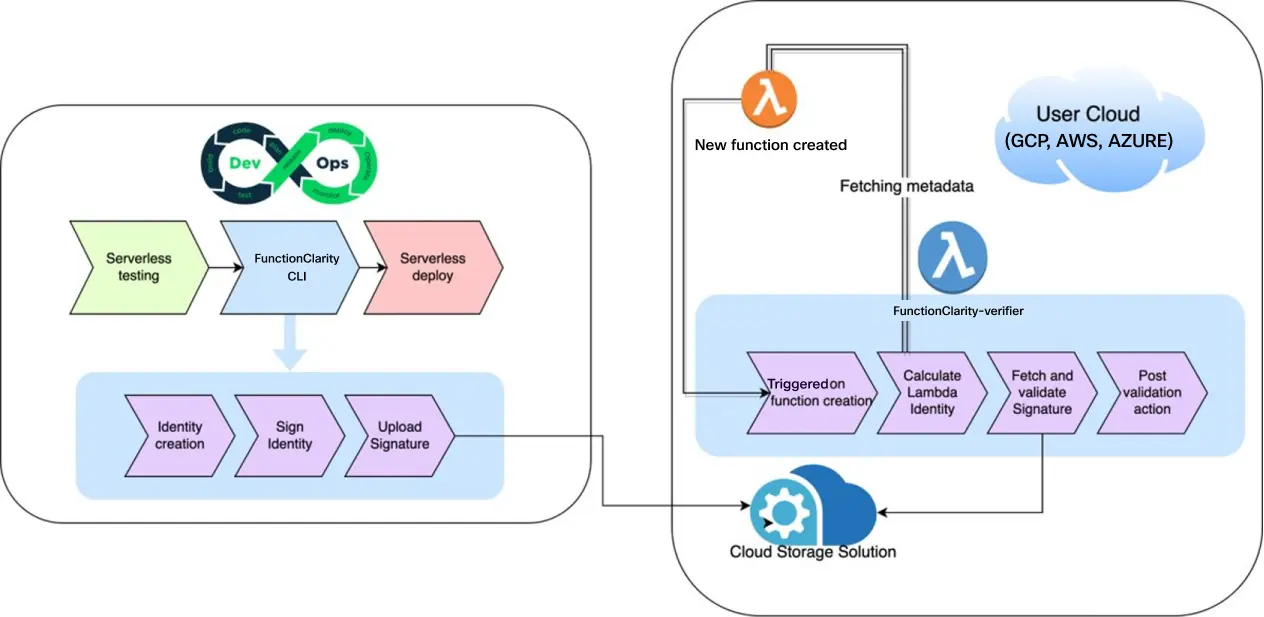
    Cisco has launched an open source project, dubbed FunctionClarity, that makes it possible to verify signatures before code is deployed in a serverless computing environment.

    Vijoy Pandey, vice president of emerging technologies and incubation at Cisco, said that one of the application security issues that has emerged in serverless computing environments is the lack of validation capability to verify code signatures prior to deployment. As more organizations employ serverless computing frameworks, the overall software supply chain becomes less secure, he noted.

    FunctionClarity includes a command line interface (CLI) tool to invoke a verification function that can be deployed on the Amazon Lambda serverless platform to address that issue; support for Microsoft Azure and Google Cloud serverless platforms is planned, he added.

    The FunctionClarity project aims to close that gap by employing either a keyless approach using open source sigstore tools or a traditional encryption key, noted Pandey.

    The FunctionClarity project is the latest extension of a Cisco OpenClarity initiative that includes an existing project for securing application programming interfaces (APIs) using a service mesh, dubbed APIClarity, and a tool for detecting and managing software bills of materials (SBOMs) and vulnerabilities in container images and filesystems dubbed KubeClarity. All three projects are part of an ongoing Cisco effort to contribute code to the open source community that, while essential, does not provide a lot of differentiated value for any one vendor, said Pandey.

    The FunctionClarity project arrives at a time when concerns over the security of software supply chains is on the rise. Many of the software security issues that organizations are encountering stem from the simple fact that developers can provision cloud infrastructure without any kind of meaningful cybersecurity review. Code signing, within the context of a larger set of DevSecOps workflows, is now starting to gain traction to better ensure secure software supply chains. The challenge is that as more code winds up running on serverless computing platforms, a need to extend the reach of whatever approach to code signing an organization adopts becomes more evident.

    In general, the open source community is collectively trying to respond to an executive order issued by the Biden administration that required federal agencies to implement a series of steps to better secure their software supply chains. One of those measures includes wider adoption of code signatures to ensure the authenticity of code being incorporated into applications. The challenge is that incorporating code signatures into DevOps workflows has historically not been a trivial process to implement. Most recently, a free sigstore cloud service launched that promised to make it easier to achieve that goal.

    It’s not clear how widely or even how rapidly code signing will be adopted, but enterprise IT organizations are paying close attention to how federal agencies are responding to the executive order. Many of the tools and processes defined by those agencies will inevitably be copied by enterprise IT organizations that have thus far made limited use of code signing to verify the authenticity of software components. The challenge now is finding a way to achieve that goal without slowing down the rate at which modern software is developed.

  • Developer’s Guide to Fuzz Testing

    Developer’s Guide to Fuzz Testing

    Fuzz testing continues to grow in popularity among developers within the open source community. Google’s open source security (OSS) team recently reported finding more than 40,000 bugs in 650 open source projects through the use of fuzz testing. But if you have no clue what fuzz testing is (yet), don’t worry. You’ve come to the right place.

    What is Fuzz Testing?

    Fuzz testing is a dynamic testing method for finding bugs and security issues in software. During a fuzz test, a program or a function under test gets executed with invalid, unexpected or random inputs to uncover unlikely or unexpected edge cases. 

    Value of Fuzzing for DevSecOps 

    As we know, DevSecOps extends the approaches of DevOps and Agile by adding suitable security testing methods alongside every phase of the software development life cycle (SDLC), creating a dynamic and continuous testing process. 

    Part of that testing process can and should involve fuzzing to detect security and stability issues at all phases of the SDLC and empower developers to ship software quickly and securely. For example, to prevent regressions from going live by running automated fuzz tests on every code change.

    Especially in the automotive industry and complex embedded projects, where a lot of untrusted and complicated data gets processed, fuzzing brings excellent benefits to DevSecOps. Indeed, developers can apply fuzzing similar to unit testing to automatically test their security-critical modules for potential vulnerabilities. But with fuzzing on an integration level, they can also cover all the complicated and dangerous edge cases that can occur in the interaction between different modules. 

    Fuzz Testing Benefits

    Fuzzing code generates thousands of automated test cases in a second, with the fuzzer receiving in-depth feedback on code coverage and the program states reached to simulate the interaction of different modules during the execution of the source code. The fuzzer can adapt and mute its inputs based on runtime feedback in the following iterations to maximize code coverage. Some of the benefits are:

    1. (Almost) no false positives: If you find a crash, fuzzing provides you with the error source and the malicious input that caused the issue. So, you can be sure that each finding is a real vulnerability.
    2. Debug reproducible findings: Modern fuzz testing tools will provide you with the input causing the issue, including the source of the error. With this, you already have a lot of helpful information to reproduce the bug and load it directly into the debugger. 
    3. Find issues in forgotten edge cases: Because fuzzing is executing a program with invalid or random input, it also uncovers unlikely and unexpected edge case errors that would not otherwise have been revealed.

    Who Uses Fuzz Testing?

    As cybersecurity regulations and standards continue to expand globally, more and more organizations are extending cybersecurity programs and running automated security testing before they ship software. Whole industries, especially those that involve advanced quality and security regulations, are setting standards for security testing that recommend fuzz testing, including automotive, aviation, finance, healthcare, telco and energy.

    Digging deeper into the automotive industry, for example, a variety of International Organization for Standardization (ISO) and other organizational standards now recommend fuzzing:

    Best Practices

    The most effective way to do security testing, fuzzing included, is to do so continuously. This means integrating fuzzing right into your CI/CD pipeline. Doing so creates quick feedback cycles so developers can fix security vulnerabilities before the code is shipped. Integrating fuzzing tools into code hosting systems like GitHub is also valuable. Doing so allows communication and alerts to be shared across your DevOps team as soon as a problem is uncovered, which helps to facilitate fixing vulnerabilities. 

    What Bugs Can I Find?

    While the practice remains relatively new, fuzzing has already discovered thousands of bugs across different use cases. Bug and vulnerability types discovered include:

    • Remote code executions
    • Injections, which can be triggered by untrusted inputs 
    • Memory leaks: Incorrect memory allocation 
    • Exposure of sensitive data: Accidental exposure of personal data
    • Functional bugs: Inputs that are not being responded to 

    and many more bugs, such as undefined behavior, uncaught exceptions and buffer overflow. Learn more.

    Getting Started

    You can try out an open source fuzzer, like Jazzer (for Java testing) or the CI Fuzz CLI (for C/C++ testing). When you’re comfortable with fuzzing and want to use this approach in more complex environments, enterprise solutions offer added features like API fuzzing, reporting and CI/CD integration. 

    So give it a shot and join the community of open source developers using fuzzing to quickly and securely ship their software. 

  • Introduction to SPIFFE/SPIRE

    Introduction to SPIFFE/SPIRE

    For a long time, people have been logging into the apps they use via passwords or password managers. And many open standards and identity providers on the market continue to evolve how users authenticate and authorize with websites and applications. The issue is that the same problem exists for software services—when applications talk to applications, how do we prove the credibility of service-to-service connections?

    Enter SPIFFE and SPIRE. SPIFFE is a specification for implementing identity for workloads, and SPIRE is the code that implements this specification in practice. Together, the projects create a standardized, secure way to identify software services and authenticate them. SPIFFE and SPIRE recently reached graduation status with the Cloud Native Computing Foundation (CNCF), solidifying the projects’ maturity as a top open-source standard mechanism to deliver cryptographic runtime identity for both cloud-native and legacy workloads.

    SPIFFE and SPIRE are already used across many major public deployments. Yet not all developers are familiar with their intricacies. Below, I’ll take a gander at both projects and how they operate to provide a bit more context. I also spoke with Evan Gilman, SPIFFE/SPIRE maintainer, to gather more insights on the history of the projects and their future goalposts.

    What is SPIFFE?

    The Secure Production Identity Framework For Everyone (SPIFFE) is a specification for workload identity. According to Gilman, the easiest way to think about SPIFFE is as a passport. Similar to how people are issued passports in a common shape with a barcode and standard information, SPIFFE dictates the standard methods to prove and validate the identity of a service. It’s like bringing the “Sign in with Google” experience to the software services themselves, he adds.

    There are three key components in SPIFFE. First, SPIFFE specifies that services shall identify themselves with what’s called a SPIFFE ID, which is defined as a URI in the format of spiffe://trust-domain-name/path. These IDs are then encoded into a SPIFFE Verifiable Identity Document or SVID. SVIDs aren’t so much a document type themselves — instead, they support either X.509 or JWT document types. Last but not least, SPIFFE specifies a workload API that issues and rotates these SVIDs, along with the keys needed to validate them.

    What is SPIRE?

    SPIRE is the code that implements the SPIFFE specification—you can think of it as a production-ready SPIFFE runtime environment. SPIRE, the “flagship SPIFFE implementation,” is a true end-to-end instantiation of SPIFFE that securely issues SVIDs, renews SVIDS and performs attestation, among other functions. If SPIFFE defines what a passport is, then SPIRE is the agency that issues the passports, said Gilman.

    The SPIRE agent runs on a node and exposes the workload API, which hooks into each workload. A workload, as defined by the SPIFFE documentation can be a web server, an instance of a MySQL database, a worker program or a web application composed of independently deployed systems. By communicating in this manner, SPIFFE/SPIRE can solve the issue of “secret zero,” which refers to the conundrum of proving the first credential to newfound systems.

    More Background on SPIFFE/SPIRE

    Joe Beda, a co-founder of Kubernetes, first proposed SPIFFE at GlueCon in 2016. At the time, Google was considering what internal technology it had that might prove helpful to the broader industry. It’s said that the technology that inspired SPIFFE/SPIRE can trace its roots to security and identity subsystems brought to Google from AT&T and Bell Labs.

    Nowadays, SPIFFE/SPIRE is actively maintained by many organizations, and we continue to see impressive production use cases. “SPIRE is deployed in some staggeringly large cases,” explained Gilman. SPIFFE/SPIRE adoption can be seen within GitHub, Netflix, Pinterest, Square, Transferwise, Uber and many other large technology companies. In terms of ownership, Gilman said that SPIRE is most used by platform engineers, infrastructure engineers or security engineers, depending on the organization’s roles.

    Future Outlook for SPIFFE and SPIRE

    SPIFFE/SPIRE appear to have the resources and backing to maintain a stable implementation, so the future looks bright for both projects. In terms of new features, in mid-2022, a first-class integration with SPIRE was merged into the Istio service mesh as a more flexible alternative to Istio’s built-in SPIFFE implementation. Another recent update is experimental support for SPIRE on Windows. Regarding future plans, SPIFFE/SPIRE maintainers will likely continue to iteratively improve the specification and implementation with frequent updates.

  • Gitpod Looks to Drive Application Development Into the Cloud

    Gitpod Looks to Drive Application Development Into the Cloud

    Gitpod today revealed it will add an application programming interface (API) to make cloud development environments (CDEs) more extensible. Gitpod also said Johannes Landgraf assumed the role of single CEO for Gitpod, as the previous co-CEO, Sven Efftinge, becomes the company’s first technical fellow.

    Fresh from raising an additional $25 million in funding, Gitpod’s Landgraf said that API will make it easier to build plug-ins for CDEs. In time, Landgraf said, CDEs will become as accessible as any development environment running on a local desktop.

    Software engineers typically waste five hours a week maintaining application environments, noted Landgraf. Via an open source development platform, Gitpod automates the provisioning of secure workspaces in the cloud that provide the added benefit of making it easier for multiple developers to collaborate, he added.

    Capabilities added to the GitPod product roadmap include dramatically faster startup times, improved resiliency and a Gitpod Cloud offering for larger companies as well as a preview environment and workflows that foster collaboration. Gitpod also announced it passed a SOC2 Type II security audit.

    Today, the Gitpod platform is being used by more than 750,000 developers at organizations such as Shopify, Stripe and Slack, noted Landgraf.

    One of the longstanding issues that has always been problematic when building software is that code that runs on a local desktop doesn’t always work when deployed in a production environment. The Gitpod API will make it simpler to spin up various platforms and tools whenever a developer accesses a CDE. The goal is to make it possible to more closely replicate the production environments on which developers will ultimately deploy their applications, noted Landgraf.

    In addition, a CDE should reduce the amount of data that developers routinely move between laptops and cloud computing environments as they build more complex applications, he added.

    In the wake of the economic downturn, there is a lot more focus on developer productivity these days, especially as organizations look to accelerate their of digital business transformations. DevOps teams are also keen to find ways to centrally manage developer experience at a time when many of those developers continue to work from home, said Landgraf.

    It’s not clear to what degree CDE will replace integrated development environments (IDEs) running on a local machine, but all the major cloud service providers are encouraging developers to build applications in the cloud where their applications will run. The challenge is that many of those offerings tend to lock developers into a specific cloud platform, noted Landgraf. Most developers today are building applications that need to be deployed across multiple clouds, he added.

    One way or another, software development is increasingly shifting to the cloud. Most organizations will likely try to find a balance between the amount of code developed on a local machine that developers can just fire up when the mood strikes and the amount of code developed in the cloud. The most immediate challenge is to make sure the CDE experience is every bit as good as the existing local IDE.

  • Solving the Culture Conundrum in Software Engineering

    Solving the Culture Conundrum in Software Engineering

    The one crucial ingredient underpinning our transition to a digital-first economy, more than any other, is software. That’s why software engineering has become one of the world’s most in-demand professions. In the UK alone, the median salary for the role has increased 13% year-over-year as businesses look to stay ahead of the competition and attract the very best IT talent. But the high salary often isn’t consistent with where software developers stand in the business; many organizations still view them as suppliers rather than as crucial players in their success. Based on the current speed of transformation, we know that demand for software engineering is only going to increase. So business and technology leaders need to urgently consider vital cultural changes to help better integrate software development teams within the wider organization. But what exactly should they be?

    The Development Dilemma

    Agility has quickly emerged as a competitive advantage as businesses strive to deliver on customer expectations quickly and effectively. That’s heralded the rise of DevOps, which aims to write high-quality digital solutions more efficiently and have the ability to continuously update in a secure and low-risk way.

    The practice is already accelerating feedback loops in the software development of digital solutions on a wide scale, meaning new software is brought into production as fast as possible and with reduced risk. As a result, today’s successful businesses are now releasing software updates multiple times a day. The figure even runs well into the tens of thousands for tech giants like Amazon and Netflix. However, other businesses are struggling to keep up with the speed the market demands, largely due to a lack of clear communication, ways of working and integration between software developers and the wider business. It’s a dilemma that needs immediate attention if businesses are to remain at the competitive edge.

    Developers are too often left to deal with huge monolithic pieces of work, which require them to write code for months on end without it being road-tested. This inevitably leads to mistakes that are found only once the updates have already been released to market creating a ripple effect throughout the organization. It’s an all-too-common scenario that demonstrates business leaders’ clear lack of clarity and understanding about the colossal value adopting a DevOps culture can deliver for the wider business, including its customers.

    Take financial institutions looking to introduce a new offering, for example, such as a new mortgage product. Without a collective approach to development, getting the backend systems up and running for a product can take up to six months. But modularising the options and breaking down the functionality can shorten timelines to weeks.

    Business leaders must look to create unified, cohesive and cross-functional teams that work together on projects that are broken down into simplified and localized components that can be easily integrated together without a negative impact on each other. It might seem like a small strategic change in working practices, but its impact on the speed and efficacy of software development can be enormous.

    Revisiting Personalities and Processes

    The role of the software engineer has changed; it is no longer about writing code in isolation without much regard for or knowledge of how it benefits the business. Developers work better when they have clarity about the direct impact their work will have on achieving business goals and on the bottom line. It’s down to business leaders to communicate these challenges and goals (in other words, understand the “why”) to help software developers understand what they’re trying to achieve. But doing so in a way that moves towards a better working culture requires a new approach to building and managing software development teams.

    The first step is casting aside the negative stereotypes many have of software engineers and celebrating the intellectual and cultural diversity within their teams. Diversity of personnel brings a diversity of personalities, which is crucial to creating more inclusive cultures that accept and welcome all characters with open arms. While this may seem obvious, what is often overlooked is the impact diversity can have on stimulating and increasing innovation.

    Improving the diversity of development teams helps unlock multiple ways of responding to and analyzing the challenges brought forward by business leaders. After all, each individual has an array of different soft and hard skills based on their learning, development and experience. So, encouraging individuals to bring their characters and personalities to their roles is crucial; it ensures each and every stakeholder in the development process is empowered to contribute, feels inherently valued, and is able to challenge existing assumptions, helping deliver a more robust end product.

    Recognizing and harnessing this spectrum of skills also helps bridge many of the barriers to development that exist within businesses. Some software engineers, for example, might struggle to communicate technical updates in a way the wider business can understand, but tapping into another individual’s strong communication skills can help unite teams–and entire businesses-around one, holistic digital strategy.

    Channeling Change to Deliver Better Outcomes

    Clearly, cultural change is needed to embed software engineering at the core of modern business. But revisiting project management practices is also imperative to continually deliver software that provides value to the business, the world of scientific management and Waterfall delivery methods is no longer appropriate for the development of digital solutions. With such a heavy reliance on digital services, businesses—and, consequently, developers—need to be able to make changes with minimal effect. So, eschewing monolithic projects and encouraging cross-functional teams is essential. Not only does it reduce the need for sweeping software updates, but it negates the risk of a project failing to meet the initial brief, which could ultimately impact the entire business.

    By reviewing organizational processes, and bringing the wider business and software developers together, we can create teams that deliver digital solutions effectively and quickly, so that every user, whether internal or external, reaps the benefits of a more sophisticated approach to software engineering.

  • Pulumi Adds Deployment Capability to IaC Platform

    Pulumi Adds Deployment Capability to IaC Platform

    At the Pulumi Cloud Engineering Days event, Pulumi announced today it has added a code deployment capability to its Pulumi Cloud platform for managing infrastructure-as-code (IaC).

    Pulumi CEO Joe Duffy said Pulumi Deployments will make it possible for DevOps teams to provision infrastructure and deploy applications via a single Git commit that can be invoked via an application programming interface (API) or graphical tool.

    A Git Push to Deploy capability allows DevOps teams to connect to any Git repository to drive deployments for a given project path, push to any given branch and set up GitOps workflows such as pull request reviews. Deployment actions include both updates and destroys in addition to providing drift detection and remediation capabilities.

    The Deployments and Automation API Pulumi developed also enables ephemeral code review environments, automatic cleanup and deployment orchestrations across multiple cloud platforms using a library of templates Pulumi provides. In effect, Pulumi is now providing a GitOps workflow out of the box, said Duffy.

    Pulumi has already integrated these capabilities with GitHub and plans to add support for GitLab, Atlassian Bitbucket and other DevOps platforms. The goal is to make it possible for DevOps teams to effectively manage ten times the amount of cloud infrastructure resources per engineer using GitOps workflows than is currently possible relying on IaC tools such as Terraform, said Duffy.

    As an alternative to Terraform, the Pulumi platform has been gaining traction because it makes it possible to more easily centralize the management and provisioning of infrastructure using a set of embedded guardrails. One of the major issues enterprise IT organizations are encountering these days is the number of misconfigurations created when developers use tools like Terraform to provision infrastructure on their own. Those misconfigurations often lead to, for example, ports being left open and cybercriminals exfiltrating data. In the wake of a series of high-profile breaches, more organizations are now reviewing the security of their software supply chains including how infrastructure is provisioned by embedding policy-as-code into DevOps workflows.

    At the same, organizations are also keenly interested in increasing the productivity of DevOps teams during an economic downturn that limits the number of IT professionals an organization can afford to hire, added Duffy.

    Pulumi claims there are now more than 5 million users of its platform spanning more than 1,000 organizations. Less clear is the degree to which organizations are embracing GitOps workflows to unify deployments on IaC and application code. As platforms make it easier to make that transition, the number of organizations using a more opinionated approach to DevOps should steadily increase.

    In the meantime, DevOps teams are going to be required to find ways to build and deploy safer applications faster. Much of the focus in recent years has been on accelerating application deployments with little regard for cybersecurity. Those days are clearly now coming to an end.

  • Octopus Deploy Tightens Integration With GitHub Actions

    Octopus Deploy Tightens Integration With GitHub Actions

    Octopus Deploy announced today it has tightened the integration between its automated deployment platform and GitHub Actions continuous integration/continuous deployment (CI/CD) platform.

    Harsh Sabikhi, senior vice president of revenue for Octopus Deploy, said GitHub Actions for Octopus Deploy v2 adds support for a push-build-information-action capability GitHub added to its platform that enables DevOps teams to track commits, builds and issues. That information is now also synchronized with a DevOps Insights tool from Octopus Deploy that surfaces metrics based on the DevOps Research and Assessment (DORA) metrics defined by Google.

    Other capabilities added to the integration include support for semantic versioning release tags within workflows, job summaries and a revamped user interface that makes GitHub easier to access from within Octopus Deploy.

    Sabikhi said that while GitHub Actions provides some deployment capabilities, the automation platform created by Octopus Deploy automates application release management across multiple clouds and on-premises IT environments. GitHub Actions is optimized for managing CI processes within the context of a Git-based workflow emanating from a cloud service managed by GitHub, he added.

    The integration with GitHub Actions makes it simpler to extend those Git-based workflows across multiple deployment platforms, noted Sabikhi.

    GitOps is, essentially, a more opinionated approach to DevOps that relies on an instance of the open source Git repository as the single source of truth about the environment rather than a set of application or server configuration files. GitHub views GitOps as a means of extending a code repository into the realm of DevOps workflows using the GitHub Actions platform.

    As organizations embrace GitOps, however, many are finding it advantageous to more loosely couple CI and CD platforms. Integrated CI/CD platforms have been around now for more than a decade, but few organizations have been able to truly automate the delivery of applications using those platforms. Platforms such as Octopus Deploy have been created from the ground up to specifically manage deployments of applications. In addition to GitHub Actions, Octopus Deploy also provides integrations with multiple other CI platforms to enable DevOps teams to mix and match CI platforms as they best see fit, said Sabikhi.

    It’s not clear how many DevOps teams are willing to acquire a separate CD platform, but as applications become more challenging to build and deploy in the cloud-native era many organizations are revisiting the DevOps processes they used to build and deploy monolithic applications. The challenge is many of them have spent years defining workflows based on legacy CI/CD platforms, so there is a lot of existing inertia that would need to be overcome when adopting a dedicated CD platform.

    It’s clear that CD is finally becoming more achievable using platforms that automate much of the process. Each DevOps team will need to decide how many staff they want to dedicate specifically to managing those CD platforms; the pace at which applications are being deployed should accelerate as application release management becomes more automated.

  • Opsera Brings DevOps Intelligence to GitHub Actions

    Opsera Brings DevOps Intelligence to GitHub Actions

    Opsera today announced it has extended its platform for collecting DevOps intelligence to include support for the GitHub Actions continuous integration/continuous delivery (CI/CD) platform.

    Opsera CEO Kumar Chivukula said as GitHub Actions is adopted more widely, there is a growing need to provide greater visibility into Git-based workflows in real-time. A GitHub Actions Insights module for the Opsera platform makes it possible to track key performance indicators (KPIs) across those workflows, he added.

    The goal is to make it simpler to make data-driven decisions about how best to optimize those workflows by identifying bottlenecks, noted Chivukula.

    The Opsera platform surfaces that intelligence by scanning all repositories and branches, including commit history, and generating alerts and notifications whenever KPI thresholds or compliance requirements are exceeded. DevOps teams can also use the platform to assess their overall DevOps maturity using a set of DevOps Research and Assessment (DORA) metrics defined by Google. Going forward, Opsera also plans to start surfacing metrics based on the Supply chain Levels for Software Artifacts (SLSA) framework for securing software supply chains also defined by Google.

    Platforms such as Opsera make it possible to apply analytics to DevOps workflows as they become more complex. The number of dependencies that exist between various application modules, for example, makes it exceedingly difficult for DevOps teams to manually identify the impact a delay in one project might have on any number of other downstream projects.

    In addition, many organizations are keen to discover what best practices should be adopted by other application development teams.

    Finally, many developers tend to use a repository as a dumping ground for all kinds of software artifacts, noted Chivukula. DevOps teams need an intelligence tool that makes it possible to identify which of those artifacts are the most essential to the business, he added. Otherwise, manually combing through a repository looking for artifacts becomes the DevOps equivalent of looking for a needle in a haystack, noted Chivukula.

    GitOps is essentially a more opinionated approach to DevOps that relies on an instance of the open source Git repository as the single source of truth about the environment rather than a set of application or server configuration files. GitHub views GitOps as a means of extending a code repository into the realm of DevOps workflows using the GitHub Actions platform. It’s not clear how much traction GitHub Actions is gaining at the expense of other CI/CD platforms, but for organizations that are relatively new to DevOps and already using GitHub as a code repository, it presents a path of least resistance.

    Regardless of why organizations adopt a DevOps intelligence platform, the need to optimize workflow across toolchains is becoming more pressing during an economic downturn. It’s becoming more clear that the cost of an application delivery delay directly impacts the level of revenue an organization generates in the age of digital business transformation.

  • Break Open the Black Box of Software Development

    Break Open the Black Box of Software Development

    If you asked an airline executive what their biggest expense was just a few decades ago, they would’ve easily answered, “Jet fuel.” These days, you’d be hard-pressed to find an executive in any industry that wouldn’t answer with, “Software.” But here’s the difference: With jet fuel, that executive would have told you that they can fly x number of seat miles per gallon/liter of fuel (or pounds of fuel, if we’re being technical). With software development, the expense is becoming more material–and far more variable–but the return on that investment is rarely clear. Over the past decade or more, software development has readily assumed its position as the fastest-growing (and often largest) expense line item in virtually every industry. All companies are adding software experiences to or around their products, and they need the people and tools to build, support and continuously optimize those experiences. And that costs money–a lot of money.

    The problem is that the language, the metrics and the world in which software development exists do not translate into operational or financial terms that business leaders can readily understand.

    “We invested X million dollars into software development last year,” a CFO might say. “And what do we have to show for it?”

    Meanwhile, a technology leader might respond with, “We’re doing X deploys a day!” or, “We wrote X thousand lines of code!”

    They might as well be speaking different languages because, in practical terms, they are.

    And the problem is, that you can’t manage what you can’t measure. To continue our airline theme, software development continues to be a ‘black box’—this hidden-in-plain-sight source of information—that financial executives can’t seem to peek into.

    Why the Black Box?

    It’s not likely that technology leaders are being purposefully elusive toward business leaders–it’s more likely that they simply are not aligned on what, fundamentally, they need to do to speak the same language.

    The question at hand is, actually, “Are these investments we’re making turning into our desired business outcomes?” But the question technology leaders feel compelled to answer is, “What do your people do all day?”

    These are questions that Agile and DevOps don’t solve–translating Agile or DevOps metrics (also known as DORA metrics) into actual, actionable metrics for business leaders to understand. Although these metrics are tremendously useful for teams, using them to steer the business is a mistake.

    Misaligned in purpose and using different language, business leaders and technology leaders talk past each other as software development costs continue to rise.

    But the cost of software development is too high for business leaders to continue to tolerate this ‘black box’ of ever-rising costs. It’s the fiduciary responsibility of financial leaders to understand the value of software investments and figure out how they are affecting business outcomes–or their jobs could be on the line.

    In case this seems like a distant threat, it isn’t: I saw a headline recently about a prominent automobile executive who lost their job because they weren’t able to gain the necessary insight into, and business outcomes out of, their significant software development costs and that was affecting the competitiveness of their entire company.

    It’s happening. And it’s on both business and technology leaders to break that black box open and start speaking the same language.

    The next question, of course, is, “How?”

    How to Bridge the Communication Gap Between Technology and Business Leaders

    For far too long, business leaders have made do with the activity metrics provided by technology leaders–they’ve tolerated this lack of visibility and found other ‘strategic’ ways to justify the rising software development costs. Perhaps they’ve been questioning how A leads to B–how an increase in funding for software development might result in greater customer retention or app usage, for example–but they have not had a tangible way to prove to themselves, much less to investors, whether this is actually happening.

    In order to understand and quantify software development costs, we have to start demanding more from our technology leaders: Working with them to establish realistic objectives and key results (OKRs), and holding them accountable to business metrics that actually relate to outcomes. That means insisting on business results–and not accepting activity metrics in their stead.

    Stable-Fund Products, Not Projects

    Here’s a hard pill for finance to swallow: When it comes to delivering software-enabled customer experiences, it’s not about optimizing costs. It’s much more nuanced than X dollars in equals X dollars out. Funding by projects might help make the numbers neat, but it doesn’t reflect the reality of the business.

    Project-based funding also tends to keep project leaders in a cost-center mentality: It makes it seem as though all resources are fungible; as if the work and the people performing it are interchangeable.

    One of the goals of Agile is to maximize value for the customer. But when we fund by project, we often stop funding a piece of work–declaring it done–before it actually starts generating value. We have this false end date that doesn’t reflect the actual ending of the value that we funded to create.

    Instead, finance organizations should move to the stable funding of products: Funding an outcome and giving teams the ability to stop, change or extend their work to achieve the business outcomes of the product.

    This is a shift that one prominent UK bank has been going through in recent years–from traditional portfolio management to lean portfolio management, including the shift to stable-funding projects. You can learn more about how NatWest Group (formerly Royal Bank of Scotland) has made this shift in this webinar.

    Visualize the Flow of Value with Flow Metrics

    Finally, we have to stop treating the collection of technology metrics and business metrics as two separate, unrelated efforts. Agile and DevOps are great at accelerating the throughput of your software development … but vanity metrics around how quickly teams are delivering are not enough to justify the growing and material investment in software development.

    Finance leaders have the opportunity to be the Babelfish between technology leaders and business leaders. As mentioned above, one way to encourage clearer communication between teams is to use OKRs to naturally tie software development objectives to tangible business results. The more we practice drawing connections between technology and business metrics–the closer we get to finally breaking open that elusive black box.

    A key part of this is communicating operational metrics differently: Developing a core set of metrics for tracking the flow of business value in software delivery, and providing a mechanism that correlates the investment in flow for each product’s value stream with the business results for that value stream.

    Visualizing the flow of value in a software development process may not be as easy as watching value flow on a manufacturing floor–but that doesn’t mean it’s impossible. Thanks to the vast number of data and visualization tools at our disposal, it is possible to make software products and their value streams just as visible as production lines.

    The Flow Framework, created by Dr. Mik Kersten, addresses the pivotal challenge of breaking open the black box of software development and bridging the gap between business and technology to optimize the flow of business value to customers.

    Break Open the Black Box with Value Stream Management

    The black box of software development is, at its core, a communication issue. It’s on both business and technology leaders to bridge this communication gap. Business leaders need to demand more from technology leaders and insist on translating activity into business metrics. Technology leaders need to practice tying their efforts to tangible business outcomes to help justify their growing expenses.

    Of course, it’s helpful to have tools purpose-built to facilitate this visibility and communication.