The company plans to make available in alpha a generative AI tool to create test cases and user stories via large language model (LLMs) access via a natural language interface. In addition, generative AI will also be used to identify high-risk changes to code and improve the overall governance of DevSecOps workflows.
At the same time, Digital.ai has extended the machine learning algorithms it already provides to provide predictions and scoring. Additional capabilities include flow acceleration recommendations, change risk predictions and service management process optimizations.
The goal is to safely break down the silos of data that today make it difficult to cost-effectively build and deploy secure software without compromising the rate at which it is developed, noted Holt.
It’s still early days as far as the infusion of AI in workflows is concerned, but it’s apparent that many of the manual tasks that prevent organizations from fully embracing best DevSecOps practices will be automated.
At the same time, increased reliance on digital processes, coupled with more stringent pending regulations, are reducing the overall tolerance organizations have for insecure software. The only way to address that rising sense of application security urgency—at a time when more complex cloud-native applications are being built and deployed—is to rely more on automation. In fact, the race is now on to secure software supply chains before regulations that will have stiff penalties for security lapses go into effect.
Most of the AI advances in software development that have been made thus far benefit developers. However, many of those same core AI advances will soon be applied to software engineering. Many of the DevSecOps bottlenecks that exist today will start to fade away as various classes of algorithms are able to both identify and make recommendations to eliminate them. As those capabilities evolve, it should also serve to help reduce the long-standing cultural divide between application development teams and cybersecurity professionals that is at the root of the software supply chain issues that organizations are still struggling to resolve.
In fact, many organizations would be well-advised to review their current workflows with an eye toward determining which processes can be automated. The days when AI was sparingly used are now giving way to a new era of software development that promises to dramatically accelerate the rate at which applications can be built, deployed and updated. The challenge, as always, is finding a way to incorporate these advances into workflows that were not created with AI in mind.
A survey of 404 IT professionals conducted by Snyk found the use of artificial intelligence (AI) to write code is creating a security paradox. On one hand, just over three-quarters of respondents (77%) said AI tools improve code security. At the same time, however, 59% are concerned that AI tools trained using general-purpose large language models (LLMs) will introduce security vulnerabilities that first appeared in the code used to train them.
The challenge with general-purpose LLMs is that they are trained using a combination of excellent, mediocre and flawed code. As a result, any recommendation surfaced has the potential to be a suboptimal security result.
Randall Degges, head of developer relations for Snyk, said that as AI tools increase the velocity at which applications can be constructed, it’s probable that DevOps teams will discover more vulnerabilities in their code.
In general, 61% of respondents also noted that automation has increased the number of false positives, with 62% of respondents reporting that at least one out of every four vulnerability alerts they received from automation tools were false positives. Well over a third (35%) said false positives represented over half of the vulnerability alerts.
On the plus side, however, more organizations are paying closer attention to application security issues in the wake of several high-profile breaches of software supply chains and disclosures of vulnerabilities. A full 96% reported their organizations are addressing supply chain security problems on an ad hoc basis, yet only half have a formalized supply chain security strategy in place.
The survey also finds 87% of respondents work for organizations impacted by a software supply chain security issue in the last year, with 61% having implemented new tools and processes as a result.
A total of 62% of respondents work for organizations that have a software life cycle assurance process in place, but only 42% of organizations are using software bills of materials (SBOMs). In addition, only 40% have formal security ratings for the open source packages that developers employ, and 31% ignore risks that arise from indirect dependencies.
However, only 40% of organizations have embedded security testing tools into their integrated development environments (IDEs), with 40% not using software composition analysis (SCA) or static application security testing (SAST) tools at all. In fact, even though 80% of respondents reported working for organizations that ship code daily, only 27% claim to continuously audit their code.
As a result, many vulnerabilities remain unpatched, with Java (42%) and JavaScript (31%) topping the list in terms of code with the most ignored vulnerabilities.
Finally, the survey also noted that vulnerabilities involving open source code are now being remediated faster than proprietary code. Maintainers of open source software are now paying more attention to cybersecurity issues thanks in part to the tools and best practices provided by the Open Source Security Foundation (OpenSSF), said Degges.
There will, of course, come a day when AI is more widely used to analyze vulnerabilities in code. In effect, AI will be used to solve some of the security issues general-purpose LLMs create. In the meantime, however, DevSecOps teams would be well-advised to proceed with caution.
Many organizations are experiencing deficits in technical skills and gaps in productivity that ultimately harm their bottom line. To overcome those obstacles and drive growth, businesses can use generative AI tools like ChatGPT and Bard to handle large volumes of data and increase the speed and output of basic tasks without draining valuable human capital. Already, businesses are finding that saving time is one of the most valuable benefits generative AI can deliver. However, there must be oversight of deployments to avoid recurring pitfalls, as the technology contains just as much risk as it does opportunity.
Generative AI provides developers with helpful task automation while simultaneously creating new challenges. Security, bias and IP questions have DevOps teams scratching their heads at how to best ethically and operationally implement generative AI. Developers must embrace these challenges to remain competitive in an increasingly automated and technologically-driven world.
Maintaining Confidentiality of Company Code
Generative AI’s ability to understand and solve code-related issues makes it an ideal tool to help software developers optimize code for faster feature development and quicker releases. By identifying where it can contribute to tasks, like legacy code conversion or automation of processes, companies can free up valuable developer time for building the tools that can grow the business or drive new initiatives. An added benefit is that development teams can automate the coding of new applications or systems by updating old code or re-using existing examples.
ChatGPT, for example, can also turbocharge development time by scouring swathes of information on GitHub and other forums to find examples of whatever a coder is trying to build. A 2022 study published in the Proceedings of the Association for Computing Machinery on Programming Languages (PACMPL) found that developers could code faster and work more efficiently thanks to generative AI. Tedious searches in tech forums and manual copy-and-paste procedures are replaced by simply asking the right questions (via prompts).
However, generative AI tools are not closed systems. As users enter data into ChatGPT, it is saved and aggregated to continuously train the language model, opening the door for potential leaks of sensitive company information. There is a serious, potential risk of employees using AI tools as sensitive data already makes up 11% of what employees paste into ChatGPT.
As a third-party system, AI tools absorb every query, comment and question without any privacy guardrails for users. If an AI bot’s security is compromised, businesses can unintentionally hand over data to bad actors. Even without a hacker’s involvement, sharing confidential customer or partner information may violate contractual agreements and create long legal battles. Developer teams must remain conscious of AI’s security risks.
Avoiding Bias Creeping Into Results
It is of utmost importance that businesses make reliable, fair and traceable decisions based on the latest facts. Currently, ChatGPT-4 hasn’t reached the maturity level necessary to be trusted by most companies without significant verification measures. Already, testers have persuaded ChatGPT to make statements that are either inaccurate, biased or both.
One key concern in generative AI is the ingrained and accidental bias in answers due to the human-generated content used to train large language models. ChatGPT works by searching for textual content relating to the question and recombining it for a distillation. In an almost democratic way, the majority opinion will dominate. For instance, if most people believe that the Swedish are hard drinkers, ChatGPT will say so. While the technology provides remarkably accurate responses in an alarmingly convincing way, it’s important to remember that it’s not always the most reliable or balanced source that wins.
Furthermore, OpenAI, the creator of ChatGPT, has explicitly stated that its goal is to create a system where queries can be pre-processed before they are fed to the neural net. Answers can then be post-processed before being shown to users. But this safeguard lacks clarity around its objectives and opens the door for ideological or political manipulation.
Companies considering implementing AI tools must carefully examine their potential applications to ensure they avoid scenarios where bias can result in insights and output that could end up harming the company and its reputation.
Minimizing Developer Function
Enterprises are looking for tools to integrate generative AI into existing business processes to enhance numerous functions and deliver greater value to their customers. While the technology still isn’t capable of replacing human developers responsible for updating and maintaining largescale software, updates to generative AI tools and integrations are occurring at a rapid pace, leaving businesses to determine which programs are most viable for developer function.
As the economy continues to tumble closer to a recession, companies seek ways to minimize costs. And those looking to use generative AI to work with the source code and technical documentation the company uses to run its own operations—rather than the open source code tools like ChatGPT provide—face budgetary decisions. Implementing generative AI programs into the business model can be extremely costly if done wrong, leaving executives to weigh the benefits of adopting the tech versus the cost of trying to hire a full team of developers.
Connecting the Enterprise to Avoid AI Pitfalls
For businesses looking to build the connected experiences their employees, partners and customers desire, generative AI is a great resource to accomplish this. However, it’s just one piece of the puzzle that is a modern enterprise. These tools can only deliver smart answers if they get smart questions and businesses connect their internal processes and applications to enable machine learning on accurate and holistic datasets.
Although AI poses many benefits for developers, such as increased efficiency, accuracy and the ability to handle large amounts of data, they must be wary of the potential security, ethical and budgetary concerns that impact employees, customers and the enterprise as a whole.
However, once the concerns are overcome or managed, the power of large language models will be leveraged in all kinds of technology and business use cases. Certainly a truly transformational shift and a step change towards a world where technology and software play an unprecedented role in business and society.
Steve Tack, senior vice president for product management at Dynatrace, said that hypermodal approach to AI will allow DevOps teams to take advantage of probabilistic AI capabilities provided by Davis CoPilot that are enabled by large language models (LLMs) originally developed by OpenAI.
The generative AI capabilities effectively provide DevOps teams with a tool that surfaces workflow recommendations via a natural language interface. The recommendations are based on historical data such as sales and customer experience trends, seasonality and cloud application health. It is also able to analyze dependencies across large sets of data while retaining context accessed via the Dynatrace Grail data lakehouse and the Dynatrace Smartscape application visualization and mapping framework.
Dynatrace is now making a case for a multimodal AI platform that uses a common set of metrics, traces, logs, user behavior and topology to enable machine learning algorithms to predict anomalies and causal-AI dependencies to determine the root cause of an IT issue and then leverage generative AI to provide recommendations to resolve it. The company is forecasting IT teams will achieve 10% to 20% productivity improvements year-over-year as a result.
It’s too early to determine the full extent to which a multimodal approach to AI will transform IT management, but it’s clear that as IT operation teams become more productive, more time will be freed up for innovation, noted Tack. Many of the manual tasks that IT teams still need to perform divert time away from building and deploying additional applications, he added.
Naturally, there’s a lot of speculation concerning the impact AI will have on DevOps. Some contend it’s only a matter of time before the entire software engineering process is automated. As those advances are made, the cost of building applications will effectively drop to zero. Others argue that AI will augment DevOps teams in a way that makes it simpler to manage IT at scale using either the same number or possibly even fewer engineers.
The one thing that is certain is that AI will soon be pervasive, which will drive the adoption of automation frameworks as organizations look to operationalize the insights surfaced by AI platforms. As rich as the insights any AI model surfaces might be, they only provide real value when integrated with an automation framework, noted Tack.
Ultimately, most DevOps professionals will not want to work for organizations that don’t provide them with AI tools that make it more likely for them to be successful. Organizations that embrace AI may not have a sustainable competitive advantage when every other organization is doing the same, but those that don’t will soon be left behind. Those that succeed will benefit from managing application environments at a previously unprecedented level of scale at minimal additional cost. The challenge is determining which tasks will be automated with an eye toward planning how DevOps roles will need to evolve.
Welcome to The Long View—where we peruse the news of the week and strip it to the essentials. Let’s work out what really matters.
This week, a conundrum: On the one hand, researchers say ChatGPT is losing the plot; and on the other, we hear outsourced coding jobs in India will be replaced by AI. (more…)
Webb.ai today opened an early access program access to a Continuous Automated Root Cause Analysis platform that uses artificial intelligence (AI) combined with a knowledge graph to dynamically keep track of and analyze changes to IT environments.
Manish Gupta, CEO of Webb.ai, said the platform uses a mix of machine learning algorithms and generative AI capabilities based on large language models (LLMs) to aggregate alerts into higher-order insights that are presented in natural language to members of a DevOps team.
That approach differs from legacy approaches because it tracks causal relationships between changes versus relying on probabilistic models that tend to create a lot of false positives, he noted.
Webb.ai is also taking advantage of Kubernetes clusters to enable its platform to scale up and down as needed when analyzing data, added Gupta. That platform is also more efficient than other approaches to observability that require IT teams to store massive amounts of data. In contrast, the Continuous Automated Root Cause Analysis automatically surfaces anomalous events that DevOps teams can choose to save rather than requiring them to save all the metrics, logs and traces that would otherwise need to be tracked, he noted.
Most IT incidents can be traced back to the most recent changes made to an IT environment. The challenge is as IT environments have become more complex, it’s not feasible for humans to keep track of those changes without relying on AI and a knowledge graph, said Gupta.
As businesses become more dependent on software to drive digital processes, the cost of downtime is exponentially increasing. The need to identify the root cause of an IT incident as fast as possible has become a critical requirement, he added.
Webb.ai doesn’t see AI technologies replacing the need for DevOps professionals and site reliability engineers (SREs) for at least another 10 to 15 years. In the meantime, many tasks that today are completed manually will be increasingly automated, said Gupta. A DevOps engineer dragged out of bed at 2:00 A.M. to address an issue does not want to have to sift through alerts. Instead, generative AI tools will summarize the issue at hand with recommendations on resolving it, noted Gupta. In effect, DevOps teams will be augmented by AI so they can manage IT environments at even higher levels of scale, he said.
There is always going to be some sense of fear and loathing when it comes to AI, but ultimately, AI should reduce the burnout rates that today adversely affects any organization’s ability to retain DevOps professionals. Far too much time is spent trying to identify the root cause of a slowdown in a cloud-native application’s performance that could be caused by any number of issues involving one dependency or another. The frustrating thing, of course, is that while it may take days to identify the root cause of an issue, it often takes just a few minutes to resolve.
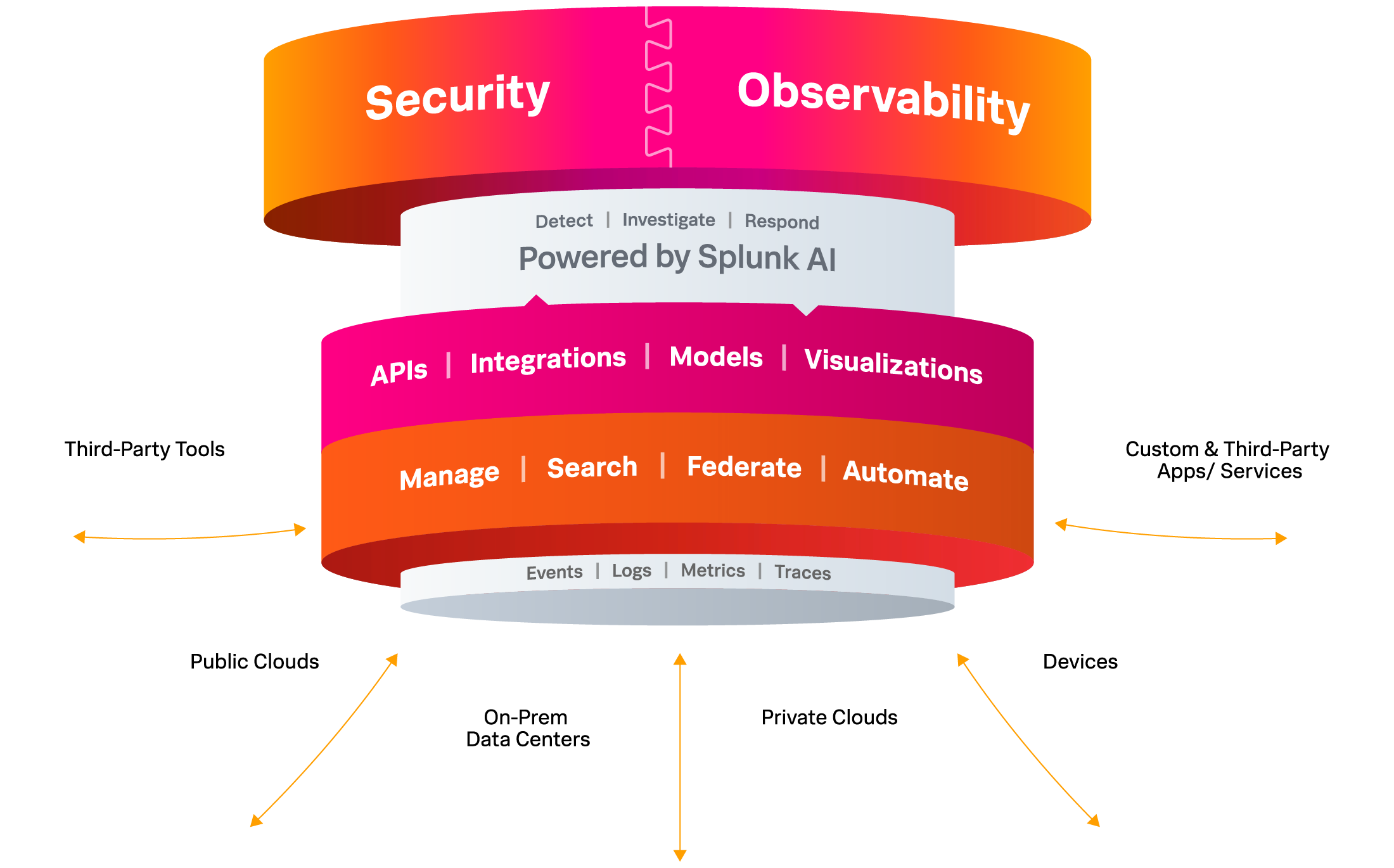
It’s not every day that a well-established technology provider announces they are building their solutions on a new cloud technology stack, but that’s what Splunk announced at its .conf23.
“…[O]ne of the most exciting [announcements] is Splunk’s new strategic partnership with Microsoft to build Splunk’s cloud solutions natively on Microsoft Azure. Together, our approach will enable our joint customers to migrate, modernize and grow their environments with end-to-end cloud and hybrid visibility at scale,” Splunk President and CEO Gary Steele said in a Splunk blog post this morning.
Why such a bold move, might you ask? “Splunk’s strategic partnership with Microsoft to build Splunk natively on Azure demonstrates our commitment to advancing digital resilience and meeting our customers where they are…” Well, indeed, a big, big draw is the vast landscape of customers building and operating applications in Azure. While Gary didn’t share too many details about specific new capabilities or offerings yet, customers will get to use their Azure credits for Splunk offerings. I suspect two other important underlying factors made such a tech marriage happen: Open source and AI.
First, Microsoft is far removed from the days of being viewed as a pariah by the open source community and is now a leader and contributor to well-known open source projects (OpenTelemetry, to name one); it abandoned its proprietary service mesh tech and got behind Istio (a recently-graduated CNCF project) and now owns the largest open source repository ecosystem with GitHub.
While Splunk is by no means a noob when it comes to incorporating AI into products, the company continues to announce new AI capabilities, including a generative AI chat interface with a preview of Splunk AI Assistant, an improved version of the former SPL Copilot. Other AI-related announcements include Splunk App for Data Science and Deep Learning (DSDL) 5.1, which allows customers to leverage LLMs to build and train models with their domain-specific data for text summarization and text classification use cases. Stay tuned for more from .conf 2023!
At its .conf23 conference, Splunk today revealed it added a slew of capabilities to its portfolio of operational analytics tools, including an assistant that leverages generative artificial intelligence (AI) capabilities that use large language models (LLMs) the company developed to enable IT teams to use natural language to invoke the Splunk Processing Language (SPL).
In addition, Splunk is also previewing OpenTelemetry Collector, an add-on that uses open source agent software being developed by the Cloud Native Computing Foundation (CNCF) to capture metrics and traces. It is designed to enable IT teams to use OpenTelemetry alongside existing agent software that Splunk uses to capture metrics.
Tom Casey, senior vice president for products and technology at Splunk, said the domain-specific LLMs that the company created enable Splunk Assistant to write or explain customized SPL queries in a way that augments rather than replaces the need for IT professionals. Splunk Assistant is designed to surface recommendations to optimize IT environments to reduce toil rather than automate entire processes, he noted.
Splunk is adding other tools infused with machine learning algorithms to its portfolio. These include the Splunk App for Anomaly Detection and an Outlier Exclusion for Adaptive Thresholding to detect and omit abnormal data points that has been added to version 4.17 of the Splunk IT Service Intelligence platform.
In addition, Splunk is previewing an ML-Assisted Thresholding tool for Splunk IT Service that uses historical data and patterns to create dynamic thresholds with a single click.
The company is making available a 5.4 update to the Splunk Machine Learning Toolkit (MLTK) 5.4 and a Splunk App for Data Science and Deep Learning (DSDL) 5.1 toolkit that provides access to additional data science tools that can extend MLTK to enable organizations to build their own custom LLMs and AI assistants.
Finally, Splunk added Unified Identity to make it simpler to access Splunk Cloud Platform and Splunk Observability Cloud along with an update to Splunk Cloud Platform and Splunk Enterprise that make it simpler to ingest, route, search and export data.
It’s still early days as far as the application of generative AI is concerned, but it’s already clear that the way IT is managed is about to be transformed. Coupled with tools such as OpenTelemetry that make it less expensive to collect massive amounts of data, the opportunity to train LLMs that streamline a wide range of processes is immense. Those capabilities won’t replace the need for humans to manage those processes, but they will most certainly cause staff realignments as many manual tasks become increasingly automated.
In fact, it’s hard to imagine an IT team that would not want to take advantage of AI capabilities to simplify the management of complex IT environments that now function at a level of scale that few IT professionals can successfully manage on their own. One way or another, AI is going to be broadly applied to IT workflows. The only thing left to be seen now is the ultimate impact.
In today’s software landscape, an API-first strategy is increasingly popular. It’s the bedrock of how applications are built and connected. APIs help promote internal tech reusability, helping developers do more with less. Due to this increasing API reliance, maintaining quality control is increasingly important for internal and partner integrations and ensuring the reliability and security of these connections remains a top priority.
Due to the rising API ubiquity, nearly half of the total development energy is spent working with APIs. And to continually improve these interfaces, taking a product mindset is proving helpful. In fact, 60% of API developers now view their APIs as products. Generative AI has also shown incredible promise and is now being used in tandem with traditional tools to increase API code quality.
Postman recently released its fifth annual State of the API Report. The 2023 edition, which surveyed thousands of developers and API professionals, found subtle changes in tooling preferences and styles. It also sheds light on the ongoing API productization movement and API developers’ use of generative AI. Below, I’ll focus on these two key areas and review the report for its other key takeaways.
API Productization is Hot
The majority of API developers now view their API as a product, and this figure rises to 68% in large companies. A full 65% of respondents said their API generates revenue, too. This news is significant, as it demonstrates the industry is maturing its view of APIs. They are no longer offshoot developer toys but fully functional services contributing to overall business growth.
But how much growth? Well, of those monetizing APIs, 43% now say APIs generate a quarter of company revenue. For some companies, APIs generated more than 75% of total revenue! There also appears to be a parallel between API revenue generation and large companies.
Do you view your APIs as products? Most developers say yes.
Other industry reports unearthed similar API productization potential. Rapid’s 2022 State of APIs report found that 42.6% of organizations are now monetizing APIs. And investment into API-first products remains strong even amidst a broader contracted tech investment climate. These findings come as social media giants like Reddit and Twitter attempt to monetize their APIs.
That said, for 28% of companies, API revenue still equates to less than 10% of total revenue. APIs still don’t get the lion’s share, perhaps because they’re packaged with an existing platform or because of the many other indirect ways APIs might benefit the business. Furthermore, consumers are becoming more cost-conscious, as 60% cite pricing as a factor before integrating with an API. Still, the numbers are significant firsts for the burgeoning economy.
Most API Developers are Using Generative AI
Generative AI interfaces like ChatGPT and Bard have certainly taken the tech industry by storm due to their ability to generate code snippets, debug code and more. And for the first time, the State of the API Report spotlighted generative AI and its use within the API economy.
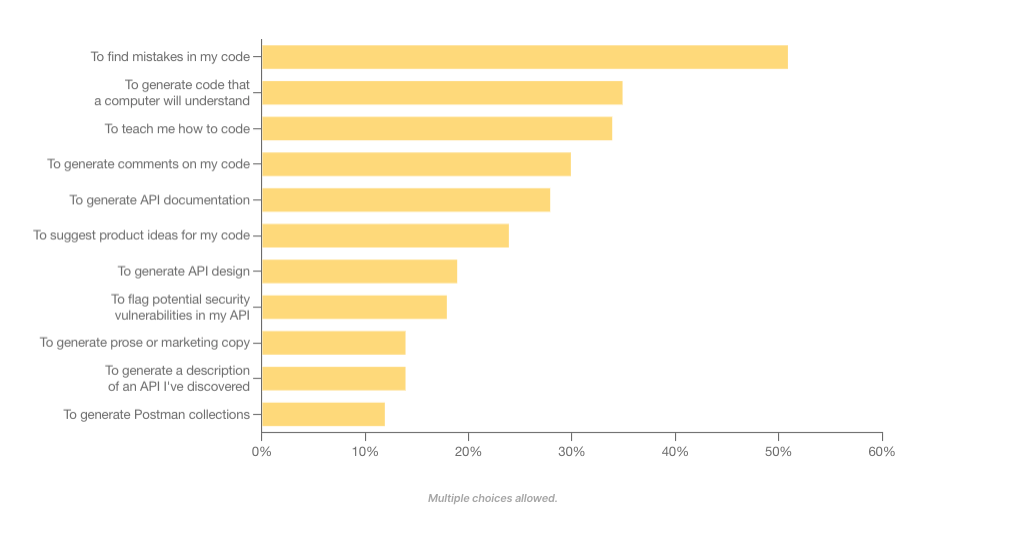
Today, 60% of API professionals are using generative AI on the job. API engineers commonly use generative AI to find mistakes in code, generate machine-readable code and increase learnability around their programs. Some even use generative AI to suggest potential security flaws in their APIs.
Compared with other app development endeavors, developers are by far most excited about building generative AI-powered applications in the year ahead. Yet, the efficiency gains are modest—many engineers forecast productivity improvements of 10% to 25%.
How are API developers using generative AI in their work?
Generative AI is set to accelerate many areas, including DevOps and API operations. Yet, contrary to some headlines, generative AI can’t automate all aspects of the software development life cycle. Rather, the technology is more likely to augment the API developer’s workflow than replace the need for seasoned professionals altogether.
Other Key Takeaways
Similar to last year’s report, integrating between internal applications, programs or systems remains a top concern for integrating an API or producing an API. The good news is that these integrations continue to increase in quality.
The report found that deployment failures and times-to-recovery are improving on average. More than half (56%) of respondents said API security incidents occur less than once a year within their organization. This shouldn’t overshadow the significant impact API security breaches can have but signals that DevSecOps is beginning to respond to persistent API vulnerabilities.
There are more API-first leaders than ever before. And API owners continue to evolve how their services are built and deployed. For example, REST is still by far the most common API style, used by 86% of developers. Webhooks made second place at 36%. However, GraphQL rose in usage, bumping SOAP into fourth position.
REST is still the dominant style, but GraphQL makes gains as SOAP slips.
Other Quick API Factoids
More non-developers are becoming interested in APIs, as evidenced by 53% of survey takers being non-developers.
Most APIs are private—61% percent of businesses’ APIs are for internal use only.
After the technology group, business/IT services, financial services and health care are the most common sectors to adopt APIs.
Microservices is still the dominant architectural style of APIs, at 42%.
Performance, security and reliability are the top factors evaluated when integrating with a new API.
Improper authentication, authorization or access control is the most commonly cited API risk.
Common API tools include Postman, SwaggerHub, Datadog, SoapUI and Insomnia. Top gateway and API management platforms include AWS API Gateway, Azure API Management, Apigee and Kong.
JSON Schema is by far the most popular API specification.
The financial industry is a leader in API-first strategies—32% of respondents spend more than 20 hours a week working with APIs.
Most developers deploy APIs to production once a week to once a month.
When developers leave a company, their departure can cause outdated documentation, zombie APIs and a loss of institutional memory.
API Obstacles Remain
Looking to the future, investment in APIs is projected to climb. In fact, 92% of developers said their organization plans to invest the same or more time and resources into APIs in the coming year. Yet, some obstacles remain—a lack of documentation and poor service discoverability are still prominent roadblocks to API consumption. Furthermore, a lack of time and talent are major concerns that might stunt API development.
The Postman State of API Report surveyed over 40,000 developers and API professionals, making it the largest study conducted on APIs to date. It should be noted that, given Postman’s specific focus in the market and its surveyed pool, figures may be skewed to represent increased API enthusiasm. For deeper insights, you can read the entire report here.