Author: Mike Vizard

  • DevSecOps Becomes a Higher Cloud-Native Priority

    DevSecOps Becomes a Higher Cloud-Native Priority

    At the Cloud Native Security Summit, Enterprise Strategy Group (ESG) today revealed the results of a survey of 600 senior IT leaders that finds organizations are looking at DevSecOps as a way to address the complexities of managing and securing cloud-native applications.

    According to the survey results, 43% of respondents said their biggest challenge with cloud-native applications is maintaining consistency across disparate infrastructures. As a result, the same number of respondents said DevSecOps automation as their highest cloud security priority.

    Commissioned by Capsule8, Obsidian and Signal Sciences, the survey also finds 90% of respondents are concerned about not having visibility into misconfigured cloud services, server workloads, network security or privileged accounts. Another 83% are worried about the misuse of privileged accounts by insiders.

    Two-thirds (66%) say IT is more complex than it was two years ago, with more than a third (35%) citing the need to manage multiple cybersecurity controls as a major source of that complexity.

    Doug Cahill, a senior analyst and group director at ESG, said it’s clear that as organizations embrace best DevOps practices to build and deploy cloud-native applications, those processes now are being extended to include security controls as part of the quality assurance process. Rather than bolting on security, Cahill said, more organizations are building cybersecurity controls into their software from the ground up.

    Capsule8 CEO John Viega noted much of that shift is being driven by necessity. When applications were deployed mainly in on-premises IT environments, it was easier to secure the environment by deploying appliances. Now organizations need to secure applications on infrastructure they don’t control as part of a shared responsibility model that often spans multiple cloud service providers. The cloud may be more agile and less expensive, but Viega noted it’s not uncommon for hundreds of cloud accounts to have been set up by individuals in the same organization, each with very different levels of cybersecurity expertise.

    Obsidian Security CTO Ben Johnson added the rate at which cloud-native applications are being deployed and updated is overwhelming the ability of cybersecurity teams to keep pace. In fact, many organizations are still underestimating the scope of the cloud-native cybersecurity challenge they face.

    Finally, Hala Al-Adwan, vice president of technology for Signal Sciences, observed as organizations embrace DevSecOps, cybersecurity professionals still will play a key role in terms of their consulting expertise. However, responsibility for implementing cybersecurity will continue to shift left toward DevOps teams. The challenge those teams will face is the need to replace legacy cybersecurity infrastructure designed for cybersecurity administrators with programmable tools that fit neatly within a continuous integration/continuous deployment environment, said Al-Adwan.

    It’s not clear precisely when a desire to embrace DevSecOps will result in more secure applications. In theory, cloud-native applications should be a lot more secure than legacy monolithic applications. However, the degree to which higher levels of security will motivate organizations to replace monolithic applications remains to be seen.

    In the meantime, cultural issues associated with embracing DevSecOps will abound. There are simply not enough cybersecurity professionals available to participate in every application development scrum session. The real issue now is finding a way to embed that knowledge into an application development process operating at industrial scale.

    — Mike Vizard

  • New Relic Extends Observability Reach and Scope

    New Relic Extends Observability Reach and Scope

    At its FUTURESTACK 2019 event in New York today, New Relic announced it has extended the New Relic One Observability Platform to add support for its new Logs, Traces, Metrics and AI module offerings.

    Ken Gavranovic, general manager and senior vice president of products for New Relic, said his company is committed to extending the breadth of a programmable platform to address DevOps requirements flexibly, rather than forcing IT teams to stitch together multiple tools to monitor their applications.

    As part of the effort, New Relic also is making it possible for customers to build applications using the data New Relic stores in its cloud platform using a framework based on React and GraphQL. The company is also making available a series of open source monitoring applications that organizations can customize in less than an hour using templates it provides.

    New Relic also announced the availability of New Relic Logs, a log management service intended to make it easier for operations teams to correlate log data across application and infrastructure sources. The module will enable teams to run ad hoc searches that return queries in milliseconds without having to switch to another tool.

    At the same time, New Relic announced the availability of New Relic Traces and New Relic Metrics, to help DevOps teams more easily identify dependencies across the IT environment. The goal is to make it possible for teams to understand all the upstream and downstream events occurring across a distributed IT environment using a single platform, said Gavranovic.

    For example, DevOps teams will be able to monitor a serverless computing framework from within New Relic in addition to turning on a feature flagging tool that has been integrated via application programming interfaces (APIs).

    Finally, New Relic AI, available in beta, will bring artificial intelligence (AI) to the platform in the form of machine learning algorithms and predictive analytics to correlate, aggregate and prioritize incident data automatically across multiple tools to reduce alert fatigue and improve mean time to resolution. New Relic AI is already integrated with PagerDuty, Slack and other tools to enable organizations to slipstream this capability into their existing workflows, said Gavranovic.

    By taking that approach, organizations can embrace New Relic as an open platform by organizations regardless of their current level of IT maturity, he added.

    New Relic is clearly betting a single integrated tool for monitoring the entire IT environment will be preferable to integrating a wide range of disparate tools. Gavranovic believes that approach will have even more appeal as organizations embrace microservices to build and deploy applications. Given all the dependencies that exist between all those microservices, monitoring tools will need to reach across applications and infrastructure to enable DevOps teams to discover and monitor all those dependencies in near real-time.

    Naturally, New Relic is not the only provider of monitoring tools with similar ambitions. It is, however, a lot further along in terms of turning monitoring tools into an actual platform.

    — Mike Vizard

  • GitLab Outlines Scope of DevOps Ambitions

    GitLab Outlines Scope of DevOps Ambitions

    At the GitLab Commit event in New York today, GitLab launched an ambitious effort to extend the scope of its DevOps platform to provide a view into the software development life cycle for not just developers but also designers, product managers and business leaders.

    Fresh off raising an additional $268 million in funding, GitLab now plans to create different ways to view a common pool of metadata and metrics generated by the GitLab DevOps platform.

    It may be a while before GitLab can deliver on that promise, but the core concept builds on the dashboards the company already has built for IT operations and cybersecurity teams. Rather than requiring each team participating in the software development process to acquire a separate platform, GitLab should be viewed as a DevOps platform delivered as a single application that can now be applied to everyone, said Mark Pundsack, vice president of product strategy for GitLab, in speaking with conference attendees.

    As part of that commitment, Pundsack noted GitLab is expanding its DevSecOps capabilities to include auto remediation. The scanning capabilities built into GitLab will be extended not only to detect issues based on the cybersecurity policies of an organization, but also, when allowed, automatically remediate routine issues, Pundsack said, adding GitLab also will automatically roll back applications if necessary. Once in place, GitLab will have pushed application cybersecurity much further left than anyone might have expected when DevSecOps was first broached as a concept, he said.

    At the conference, GitLab demonstrated a pipeline graph capability that will provide a foundation for many of these promised offerings. GitLab already can be employed to accomplish tasks such as code quality scanning, container scanning, dependency scanning and licensing dependencies.

    All these features are an extension of GitLab’s existing strategy that aims to rationalize the number of tools organizations need to stitch together to drive a set of best DevOps processes. However, other DevOps platform providers have similar ambitions.

    Thanks to its latest round of funding, GitLab—which also announced its plans to go public next year—is now valued at $2.75 billion. The company has not released any revenue results but does claim to support more than 100,000 organizations using its platform, including Ask Media Group, Charter Communications, Delta Air Lines, Goldman Sachs, Ticketmaster and Nvidia. GitLab also claims to have more than 4,800 active contributors to its open core platform. The company now has more than 800 employees in more than 55 countries across the globe, and there currently are 222 open GitLab jobs posted.

    It remains to be seen how much $268 million will enable GitLab to fend off rivals such as GitHub, which was acquired by Microsoft, and CloudBees, which has built a large DevOps community around the open source Jenkins continuous integration/continuous deployment (CI/CD) platform. Whatever the outcome of this arms race, the massive amount of funding pouring into the platforms soon should take DevOps platforms to places many might not have ever imagined possible.

    — Mike Vizard

  • Survey Sees Cloud Foundry Momentum Gains

    Survey Sees Cloud Foundry Momentum Gains

    At a time when many organizations are wondering to what degree they should rely on legacy application development and deployment platform versus emerging container-based platforms, the Cloud Foundry Foundation (CFF) today released the results of a survey that shows reliance on the organization’s namesake open source platform-as-a-service (PaaS) environment continues to grow.

    Announced at the European Cloud Foundry Summit, the annual survey of 306 IT professionals finds 45% of respondents describe their use of the PaaS as “broad,” compared to 30% a year ago. The same survey finds nearly 20% started using Cloud Foundry in just the last 12 months and 39% of developers are deploying applications now in less than one day. More than three-quarters (77%) report application development cycles of fewer than three weeks.

    Nearly half of survey respondents report they have at least 100 developers using the PaaS, a significant jump from just one-third last year, and the share of companies with more than 50 applications on Cloud Foundry grew to 43% in 2019.
    The future of the PaaS has been called into question ever since the rise of Docker containers and Kubernetes. The CFF has been slow to adopt Kubernetes as a more efficient foundation for deploying a PaaS environment. Most recently, the CFF has provided organizations that adopt the PaaS the option of replacing the Diego container orchestration engine developed by the CFF with Kubernetes. At the same time, the CFF is working toward replacing much of the foundation layer for Cloud Foundry with Kubernetes to provide a more efficient means of standing up a Cloud Foundry environment.

    The CFF has also made it possible to deploy applications built on Cloud Foundry on a Kubernetes runtime. CFF CTO Chip Childers says that no one should be surprised when the rise of Kubernetes leads to more adoption of Cloud Foundry. Most of the application development environment available for Kubernetes today are not as robust as the Cloud Foundry PaaS, with the notable exception of the Red Hat OpenShift PaaS. Following the acquisition of Red Hat, IBM is now promoting Red Hat OpenShift as the cornerstone of a hybrid cloud strategy that has Kubernetes at its core. Meanwhile, last month Pivotal Software, provider of a curated instance of a Cloud Foundry PaaS, told financial analysts it expected to see a $40 million to $50 million decline in revenue in fiscal 2020. Shortly after, VMware moved to acquire Pivotal, which, like VMware, is a unit of Dell Technologies.

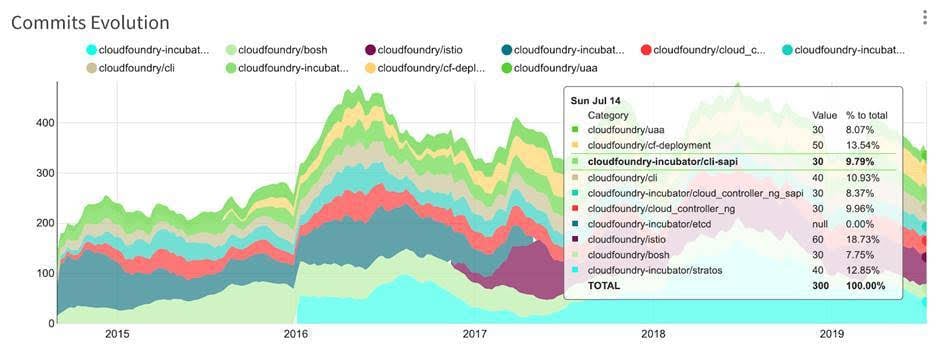
    An update to a previous report published today by source{d} shows there are now 879 repositories in the Cloud Foundry GitHub organization, with the total number of commits reaching approximately 50,000 per month. The report finds the highest levels of activity are centered around the Stratos UI project, Istio integrations and the core Cloud Foundry Application Runtime Cloud Controller.

    The CFF and Kubernetes, under the auspices the Cloud Native Computing Foundation (CNCF), fall under two separate arms of The Linux Foundation. It’s unclear if the Linux Foundation might one day merge these two arms or continue to keep them separate as a means of navigating conflicting vendor strategies. Whatever the outcome, Cloud Foundry is likely to remain a vibrant part of the open source community for many years to come.

    — Mike Vizard

  • Eclipse Foundation Delivers on Jakarta EE Promise

    Eclipse Foundation Delivers on Jakarta EE Promise

    The Eclipse Foundation today announced the general availability of Jakarta Enterprise Edition (EE) 8 Full Platform and Web Profile specifications and associated technology compatibility kits (TCKs).

    Announced during the JakartaOne Livestream virtual conference, Jakarta EE 8 is the follow-on open source platform to JavaEE that provides a foundation for building cloud-native applications using a familiar Java construct.

    Mike Milinkovich, executive director of the Eclipse Foundation, said the availability of Jakarta EE 8 represents a milestone in that it is the first official release of a full Jakarta platform since Oracle agreed to give up control of Java EE to the Eclipse Foundation.

    Its specifications are fully compatible with Java EE 8 specifications and include the same application programming interfaces (APIs) and an instance of Javadoc using the same javax namespace. Its TCKs are based on, and fully compatible with, all Java EE 8 TCKs. Jakarta EE 8 will not require any changes to Java EE 8 applications or their use of javax APIs. The specifications were developed under the Jakarta EE Specification Process, which replaces the Java Community Process (JCP) for Java EE.

    The Eclipse Foundation is announcing the certification of Eclipse GlassFish 5.1, an open source compatible implementation of the Jakarta EE 8 Platform. Eclipse GlassFish 5.1 is fully tested under the open source-licensed Jakarta EE 8 TCKs for the Full Platform and Web Profiles.

    IBM today also announced that Open Liberty, an open source implementation of the WebSphere Liberty application server, has been fully certified as being compatible with Jakarta EE 8 profiles. All vendors in the Jakarta EE Working Group, including Fujitsu, IBM, Oracle, Payara, Red Hat and Tomitribe, have committed to certifying their Java EE 8-compatible implementations.

    Milinkovich said Jakarta EE 8 should drive a wave of innovation as more than 10 million developers who already know Java employ the platform to build cloud-native microservices that can be deployed using containers on Kubernetes platforms. In fact, he said, the number of cloud-native applications based on microservices that will be built and deployed in the enterprise will soon accelerate. As that transition occurs, the number of organizations embracing best DevOps processes to manage those applications also should significantly increase because the rate at which Jakarta applications will be built will be faster than Java applications historically have been built.

    Collectively, Milinkovic also noted that despite the rise of rival programming languages, these and other forthcoming efforts will drive a resurgence in interest in Java programming languages that will ensure Java’s continued dominance of enterprise IT environments for many years to come.

    Of course, the primary reason IT vendors are excited is they no longer need to pay royalties to Oracle. It’s not clear how much of those savings might be passed on to IT organizations. What is apparent is that organizations that are required to employ open source technologies whenever possible are going to be a lot happier now that Jakarta EE 8 has finally arrived.

    — Mike Vizard

  • Cisco Extends Ansible Support to Advance DevOps

    Cisco Extends Ansible Support to Advance DevOps

    Cisco Systems announced today that it is further embracing the open source Ansible automation framework on its storage area network (SAN) platform as part of an effort to extend best DevOps practices to IT infrastructure. The latest version of the Cisco MDS 9700 platform modules automates tasks such as VSAN configuration, device-alias and zoning configuration.

    Adarsh Viswanathan, product manager for data center storage at Cisco, said the company has embraced the Ansible framework because it’s an open framework that is now being adopted by enterprise IT organizations to manage infrastructure in a more adroit fashion. The rise of cloud-native applications being developed with DevOps processes not only result in more applications accessing a common pool of data, but also require changes to be made dynamically to the underlying storage platform.

    Cisco is adding support for 64G-line cards when they become available along with support for non-volatile memory express (NVMe) and All-Flash arrays. Cisco has also extended its SAN Analytics software to add support for the NVMe/Fibre Channel protocol along with existing support for SCSI/Fibre channel.

    Viswanathan said support for Ansible will make it simpler for IT organizations to embrace automation at scale. Cisco has previously embraced open application programming interfaces (APIs), OpenStack and Python-based scripts. Ansible takes those efforts to a higher level by make available a declarative framework that doesn’t necessarily require IT operations teams to develop programming expertise, said Viswanathan.

    IT operations teams are coming under increased pressure to provide developers with an IT experience that rivals cloud service providers. Frameworks such as Ansible make it possible for IT operations teams to make IT resources available on-demand to developers using IT infrastructure residing in an on-premises environment.

    Friction between developers and IT operations teams is rising as DevOps processes are employed more widely within enterprise IT environments. Many of those developers have alternatively turned to cloud service providers to build and deploy their applications. However, many organizations still need to deploy applications once they move into a production environment hosted in a local data center. In fact, more than 70% of enterprise applications still run in a local data center a decade after the initial rise of cloud computing. IT operations teams that manage those on-premises IT environments need to provide developers with access to resources they can easily scale up and down as required.

    Cloud-native applications based on microservices will further challenge IT operations teams as the number of application services trying to share a limited set of IT infrastructure resources only increases. In the case of Cisco, those limited resources are rack-based servers attached to SANs such as the Cisco MDS 9700.

    Of course, not every IT operations team is going to embrace DevOps processes overnight. Instead, many of them will be exposed to frameworks such as Ansible as they upgrade servers and storage over time. The one thing that is certain is developers will continue to apply pressure to make that transition sooner than later as more organizations continue to appreciate the extent to which they now depend on software to innovate.

    — Mike Vizard

  • Atlassian Looks to the Cloud

    Atlassian Looks to the Cloud

    As part of an effort to accelerate migrations to the cloud, Atlassian is making instances of Jira Software, Confluence, Jira Service Desk and Jira Core running in the cloud available for free, as well as premium options that provide access to the same software with access to additional features and support.

    Harsh Jawharkar, head of go-to-market for Cloud Platform at Atlassian, said it’s apparent most organizations want to shift from on-premises to cloud versions of Atlassian platforms. However, they need control and more transparency into how much that shift will cost, said Jawharkar.

    At the same time, Atlassian views the cloud as an opportunity to expose more end users to its offerings by making them available for free. These editions of Jira Software, Confluence, Jira Service Desk and Jira Core will be available in the coming months alongside existing free editions of Trello, Bitbucket and Opsgenie.

    In addition, Atlassian is now extending its Cloud Premium service to now include Jira Software and Confluence, with a premium edition of the Jira Service Desk coming soon. Atlassian is also making 50% to 75% discounts available to eligible academic organizations and non-profit organizations.

    Atlassian is also moving to provide organizations with more control over where data gets stored. Customers now can choose where data in the Atlassian cloud will be stored to address regulatory compliance concerns. Atlassian also recently added a data encryption at rest and in-transit capability to ensure no data stored in its cloud is compromised by unauthorized access.

    In addition, Atlassian is updating Atlassian Access, a console for managing access to its various platforms, to include support for Google Cloud Identity and Microsoft Active Directory Federation Services (ADFS). Atlassian also committed to providing support for multiple cloud access brokers (CASBs) starting with an early access program involving McAfee and Bitglass before the end of this year.

    Atlassian is also promising enhancements to its audit log and early access to tools, which will help organizations better understand how Atlassian software is being consumed and their associated billing costs. The whole process of onboarding and offboarding users is becoming critical as organizations become more concerned about controlling their cloud application costs, noted Jawharkar.

    Finally, Atlassian is enabling customers to customize the URLs associated with Atlassian cloud service to reflect their own brands.

    Atlassian today has more than 150,000 customers consuming its software, including Costco, Delta Airlines, Office Depot and Visa. The most widely employed Atlassian application in DevOps environments is Jira, a project management application optimized for tracking software development projects. Atlassian is now trying to extend that base of customers to increase usage of OpsGenie, a set of tools for managing alerts.

    Obviously, each IT organization is going to transition to the cloud at its own pace. The issue most of them are wrestling with now is determining whether it makes more economic sense to move to the cloud or stick with the on-premises IT environment they already have in place.

    — Mike Vizard

  • Pulumi Deepens Cloud Ties to DevOps

    Pulumi Deepens Cloud Ties to DevOps

    Pulumi has made available a framework for automating the management of multiple cloud computing platforms using familiar programming languages such as JavaScript, TypeScript, Python and Go.

    Company CEO Joe Duffy said Pulumi 1.0 provides a framework that enables developers to automate the deployment of applications on public clouds in a way that eliminates having to learn another programming tool or manually employ YAML files that are often at the root of misconfiguration issues. Pulumi also provides access to a software development kit (SDK) through which scripts or code developed for Terraform, CloudFormation, Azure Resource Manager, Kubernetes or Helm can be imported into the Pulumi framework.

    Pulumi also has extended the reach of its automation framework to provide integration with a variety of continuous integration/continuous deployment (CI/CD) platforms including Azure DevOps, AWS Code Services, CircleCI, Codefresh, GitHub, GitLab, Google Cloud Build, Jenkins and Travis. Pulumi also can be embedded with integrated development environments (IDEs) to provide statement completion, interactive documentation and rich error-checking.

    Duffy noted Pulumi also now can be extended to further adoption of best DevSecOps practices. A Pulumi Key Management Service is integrated with the key management tools from Amazon Web Services, Microsoft Azure, Google and HashiCorp. Pulumi also provides role-based access controls and integration with identity management tools spanning GitHub, GitLab, Atlassian, Active Directory, Okta and Google G Suite, among others.

    Pulumi comes in three flavors: A free Community Edition enables individuals to manage their cloud environments, a commercial Team Edition adds support for organizations and an Enterprise Edition provides additional identity options, policies and controls, as well as self-hosting capabilities.

    Duffy said frameworks for automating application deployments on multiple clouds are necessary because enterprise IT organizations now routinely embrace multiple clouds. Rather than requiring IT operations teams to master programming environments, Pulumi makes it possible to shift deployment responsibilities on to the developer, he said, noting that approach should significantly increase the rate of speed at which applications can be deployed using cloud platforms such as AWS, Azure, Google Cloud Platform, Digital Ocean or others.

    While a lot of progress has been made in terms of continuous integration, organizations are finding continuous delivery to be a challenge. Pulumi is betting that by directly involving more developers in the deployment process, organizations will find it easier to extend their DevOps processes in a way that doesn’t require anyone to learn new programming tools.

    In the meantime, the rate at which new applications are being built is only going to accelerate. As development teams embrace a wide range of cloud-native technologies, it’s only a matter of time before the application deployment backlog increases significantly. IT leaders are going to be under a lot of pressure to solve that issue in a way that results in more applications not only being deployed on a timely basis but also deployed reliably. Having more applications running in a production environment that winds up having issues later isn’t necessarily progress. In fact, it’s likely most IT leaders would find themselves in even hotter water for exacerbating cloud security issues that already plague most organizations.

    — Mike Vizard

  • Splunk Adds Omnition to DevOps Portfolio

    Splunk Adds Omnition to DevOps Portfolio

    Splunk followed up on its pending acquisition of SignalFx, a provider of an application performance management (APM), by also acquiring Omnition, a startup building a distributed tracing tool accessed as a software-as-a-service (SaaS) application.

    Rick Fitz, senior vice president and general manager for the IT Markets Group at Splunk, said Omnition consists of a small team of developers who have been especially active in maintaining OpenCensus, an open source set of libraries for various languages that make it easier to collect application metrics and distributed traces and then transfer the data to a backend of choice in real-time; and OpenTelemetry, a project led by the Cloud Native Computing Foundation (CNCF) that merges OpenCensus and OpenTracing to standardize the instrumentation and telemetry data collection.

    Distributed tracing is emerging as a requirement for APM platforms because the IT environment is becoming both more complex and ephemeral. Serverless computing frameworks are especially challenging because the only way to know an event occurred involving, for example, cloud bursting is to employ distributed tracing. The challenge is, distributed tracing requires organizations to capture, store and analyze massive amounts of data to pinpoint the root cause of any application performance issue, noted Fitz. As such, distributed tracing tends to be employed only by the most elite DevOps practitioners, as implementing distributed tracing is nontrivial, he added. On the upside, distributed tracing reduces the need to deploy a large amount of agent software across the enterprise.

    Fitz said Omnition will provide a set of capabilities that over time will be added to the SignalFx platform. Long-term, Splunk hopes to reduce the costs associated with distributed tracing to the point where that capability becomes democratized, he added, noting that as organizations embrace microservices to build cloud-native applications that will run in hybrid computing environments, increased reliance on distributed tracing is now all but inevitable.

    In general, Fitz said Splunk is working toward combining the best elements of DevOps with traditional IT service management (ITSM). Most organizations will be employing both approaches for years to come simply because some applications don’t need to be updated regularly, so it doesn’t make any sense to apply DevOps processes to those applications, he noted. At the same time, as DevOps processes are embraced in enterprise IT environments, appreciation is growing for IT operational challenges that stem from multiple applications running at scale which need to share a limited amount of IT infrastructure resources.

    With the acquisitions of SignalFx and now Omnition, Splunk is betting that it will be able to combine IT operational analytics based on machine data generated by logs with an APM platform to correlate application performance against infrastructure events. It’s not clear how long it will be before Splunk can fully realize that vision. In the meantime, the rate at which application and infrastructure management platforms will converge will only accelerate as developers are held more accountable for applications long after they are deployed in a production environment.

    — Mike Vizard

  • CollabNet VersionOne Picks Up $500M to Fuel Value Stream Management

    CollabNet VersionOne Picks Up $500M to Fuel Value Stream Management

    CollabNet VersionOne today announced it has picked up an additional $500 million in funding to help fuel what is rapidly becoming an arms race to drive adoption of value stream management in DevOps environments. TPG Capital, the private equity arm of TPG, signed a definitive agreement to acquire CollabNet VersionOne. Terms of the acquisition were not disclosed, but TPG pledged to invest up to $500 million to take value stream management to the next level.

    CollabNet VersionOne CEO Flint Brenton said part of the funding will be used to fuel both organic and inorganic investments in value stream management, a rapidly growing segment of the IT market that is just now coming into its own. Value stream management represents a holistic effort to align application development and delivery with strategic business objectives. In effect, IT leaders are now looking to apply advanced analytics to determine how a delay to one aspect of a development project might impact the revenue goals of the business.

    Brenton said now that more organizations are viewing themselves as software companies that make a product or deliver a service, they need tools to manage application development projects in much the same way software companies operate. Rather than building those tools, many of those companies are looking to vendors such as CollabNet VersionOne to provide those tools within a unified platform.

    CollabNet VersionOne is, of course, not the only IT vendor pursuing that opportunity. However, rather than viewing value stream management as an extension of a specific development platform, CollabNet VersionOne is pursuing an approach that makes it possible for an organization to manage software investments across multiple platforms.

    Brenton said organizations should expect CollabNet VersionOne to focus on value stream management. As part of that focus, the company will look to fill in gaps in its portfolio by investing in product development, partnering with providers of complementary applications such as providers of business intelligence (BI) tools or acquiring smaller companies.

    In effect, there is now an arms race underway when it comes to building the next generation of value stream management platforms. Much of the investments in this area will be focused squarely on advanced analytics infused with machine and deep-learning algorithms that will enable organizations to begin applying artificial intelligence (AI) to the management of software delivery.

    It’s not clear to what degree CollabNet VersionOne may one day be a target for acquisition itself as the entire DevOps vendor community continues to consolidate. As DevOps processes increasingly are embraced by enterprise IT organizations, many vendors are concluding they need to “go big or go home.” In fact, Brenton noted the acquisition of CollabNet VersionOne was initiated by TPG Capital, which was looking to find an attractive investment in the DevOps sector.

    It may be a little while longer before every enterprise has mastered the nuances of value stream management, but the one thing that is clear is there will be no shortage of options as investment dollars continue to pour in.

    — Mike Vizard