Author: Mike Vizard

  • Survey Shows Accelerated Shift to Cloud, With Caveats

    Survey Shows Accelerated Shift to Cloud, With Caveats

    A survey of 250 IT leaders published by Snow Software, a provider of software asset management software, finds 91% are changing their cloud strategy in the wake of the economic downturn brought on by the COVID-19 pandemic.

    The survey also finds twice as many respondents report they are accelerating cloud migration (45%) and digital transformation (41%) projects versus those putting cloud migration (22%) or digital transformation (21%) initiatives on hold.

    At the same time, however, nearly a third of respondents (32%) said they are asking their cloud vendors for extended payment terms, while 31% are renegotiating their cloud contracts. Around 10% of respondents indicated that they would not be able to pay their cloud bills last month.

    More than three-quarters of respondents (76%) said they have increased their use of cloud platforms such as Amazon Web Services (AWS), Microsoft Azure and even private clouds.

    In addition, more than half of respondents (55%) noted an increase in the use of collaboration tools such as Slack, Teams or Google Chat, while 52% said they have seen an increase in the use of cloud-based videoconferencing software such as Zoom, Cisco WebEx or GoToMeeting.

    Overall, 60% of IT leaders said they are continuing to increase cloud use.

    Jesse Stockall, chief architect for cloud management for Snow Software, said the results show the cloud has played a critical role in enabling employees to work from home. In many cases, the first thing to be shifted to the cloud was application testing environments. With development teams working from home the only way to effectively set up a testing environment is in the cloud.

    At the same time, Stockall said entire applications have been lifted and shifted to the cloud using containers. Rather than refactoring these applications, IT teams decided to encapsulate entire applications in a container that could be deployed on any virtual machine. IT teams then will spend the next few months converting those monolithic applications into a series of microservices that can run natively on cloud computing platforms, he noted.

    Stockall expects that approach to lifting and shifting applications first and modernizing them second to accelerate as more organizations conclude working remotely is now part of the new normal. Employees may soon head back into the office, but many more of them increasingly will access applications from home. Business and IT leaders are also unsure whether a second wave of the pandemic might make local offices and data center once again inaccessible, he added.

    Many IT organizations will also be replacing legacy virtual private networks (VPNs) with software-defined wide area networks (SD-WANs) to make cloud applications more accessible, Stockall, noted.

    The COVID-19 pandemic may prove to be a seminal moment in the history of cloud computing; while cloud computing has been around more than a decade, the bulk of applications still run on-premises. However, once many local data centers became inaccessible overnight, strategies that called for either replacing or modernizing those applications are being accelerated.

    It’s not clear how many of those on-premises applications might be retired altogether. Whatever the outcome, there’s never been more focus on where application code is being built and deployed.

  • DataStax Brings AIOps to Cassandra Database Management

    DataStax Brings AIOps to Cassandra Database Management

    DataStax today unveiled a private beta release of artificial intelligence tool dubbed Vector that provides advice on how to optimize clusters running the open source Cassandra wide column store database.

    Vector analyzes individual nodes and then compares behavior to other nodes in the cluster to identify opportunities to improve deployments.

    Ed Anuff, chief product officer for DataStax, said the goal is to enable IT teams to take advantage of AIOps for things such as improving performance and query techniques.

    Available for both instances of Cassandra downloaded by IT teams as well as the curated instance of Cassandra that DataStax makes available as DataStax Enterprise, Vector is intended to augment rather than replace IT teams managing Cassandra databases, said Anuff.

    Anuff said by employing algorithms and heuristics, Vector provides IT teams with predictive guidance, which they can determine whether to implement or not.

    As IT becomes more complex the need to rely on AIOps tools such as Vector is becoming more pronounced. The number of variables that could adversely impact the performance of applications deployed on Cassandra or any other database exceeds the ability of most IT teams to monitor manually. AIOps tools such as Vector essentially provide IT teams with a digital assistant to help optimize database deployments.

    Anuff said there will always be a need for a human to be in the loop, but each IT organization will determine the degree it trusts the recommendations being surfaced by AIOps tools such as Vector. In some cases, IT teams will use those recommendations to inform frameworks to automate the management of databases.

    Given the commitment to ruthless automation by IT organizations that have embraced DevOps, Anuff said DataStax expects DevOps teams to be at the forefront of embracing AIOps. In many cases, those DevOps teams have already assumed management responsibilities for both applications and the underlying databases on which they depend.

    Of course, AIOps is still in its infancy. However, in the wake of the economic downturn brought on by the COVID-19 pandemic interest in AIOps as a means to reduce the total cost of IT is rising. Many IT teams are becoming smaller as organizations downsize, while others are limiting headcount. AIOps provides a way to manage IT at scale without necessarily having to expand the size of the current IT staff.

    Regardless of the motivation, AIOps is here to stay. Many of the rote tasks that conspire to turn IT into drudgery should soon be eliminated. That may reduce the number of entry-level jobs that historically have been available. However, as schools adjust to this new reality, it may also mean that new entrants into the field may be able to take on more complex challenges sooner than later.

    In the meantime, IT professionals might want to consider what part of their job might be better handled by a machine and plan the next step in their careers accordingly.

  • Eggplant Injects AI Into Application Testing

    Eggplant Injects AI Into Application Testing

    Eggplant has infused its automated testing platform with deep learning algorithms that automatically identify and classify user interface (UI) elements such as buttons and text fields across any platform and then generate all the automation assets needed to instantly run a test.

    In addition, Eggplant has made it easier to visualize the overlap between common application failure patterns that can be used to automatically optimize testing.

    Finally, Eggplant has also revamped its own user interface to make it easier to deploy its platform across multiple test machines.

    Company CTO Gareth Smith said in the months and years ahead it’s apparent AI will be playing a much larger role in application testing. There are simply too many platforms on which application code is now being deployed for testing teams to keep pace manually.

    Each platform requires tweaks to the user interface to optimize the customer experience. At a time when many organizations are accelerating digital business transformation initiatives, the user application experience has never been more critical, he noted.

    Eggplant’s Digital Automation Intelligence (DAI) platform is designed to automate the entire testing lifecycle process as part of a larger best DevOps practice. The rate at which application tests can be built and run can be a bottleneck as applications are being built. The DAI platform looks to first automate the creation of UI tests and then launch them against application code to eliminate as much testing friction as possible, said Smith.

    IT teams also can track user behavior to create journeys based on user interactions with applications and store tests created using modeling tools provides by Eggplant in its cloud service. That approach not only accelerates the application development process, but it also serves to reduce the total cost of application development, which is critical at a time when IT budgets are squeezed because of the economic downturn brought on by the COVID-19 pandemic.

    As part of that effort, Eggplant provides DevOps teams with access to an application programming interface (API) through which they can self-service their own tests. That may not eliminate the need for a separate testing function within the application development process, but Smith noted it does make it easier for developers to discover potential issues on their own versus having to wait on application testers to discover them.

    Regardless of who conducts the testing, the rise of DevOps means there’s more application code to be tested than ever. As such, testing backlogs within many IT organizations are growing. The challenge is finding a way to conduct application testing that doesn’t result in application deadlines being missed. After all, when deadlines are missed, typically the first thing that gets scaled back is testing. Many DevOps teams convince themselves that any issues that come up can be addressed in the next update.

    Of course, once end users reject an application because issues were never discovered during testing, it’s not uncommon for an application to be rolled back. Rather than having to choose between those two evils, it might be better for all concerned to rely more on automation and AI to accelerate the testing process as much as possible.

  • Report: SD-WAN Shift to the Cloud Accelerates

    Report: SD-WAN Shift to the Cloud Accelerates

    The rate at which software-defined wide area networks (SD-WANs) are being consumed as a cloud service appears to be accelerating in the wake of the COVID-19 pandemic.

    A global survey of 750 IT professionals conducted by the market research firm Vanson Bourne on behalf of Barracuda Networks finds over half of respondents (52%) are looking to acquire an SD-WAN solution via a cloud provider, with Microsoft Azure being cited as the most preferred option.

    Only 16% said they prefer an SD-WAN from an independent vendor, while 15% would opt for a telecommunications provider. Another 12% said they would rely on a reseller.

    Klaus Gheri, vice president of network security for Barracuda Networks, said the survey suggests that as application workloads move into the cloud, more IT organizations want to centralize acquisition of networking services alongside compute and storage. As such, he said, providers of SD-WAN appliances such as Barracuda Networks will need to evolve to extend the basic SD-WAN capabilities provided by cloud service providers.

    At the same time, Gheri noted that way applications are being accessed is also evolving as more employees are working from home. Rather than directly accessing applications running in a local data center or office, many organizations are routing access requests to those applications through their cloud service provider. That approach reduces costs by using a public internet connection to access to cloud service, which then routes that request over a virtual private network (VPN) to a local data center.

    Given the egress charges a cloud service provider requires, that approach may not reduce costs in the case of every workload. However, it may reduce costs by reducing the amount of network traffic moving across a leased MPLS line, he noted.

    Gheri said the rise of the cloud as a networking conduit illustrates how varied SD-WAN implementations have become. Organizations increasingly need some capability at the client level to automatically determine which network path makes the most sense for any request based on cost and latency requirements.

    In the meantime, frustrations with VPN clients continue to mount. Most VPN implementations were designed to support a small percentage of employees for occasional access. With more employees working from home more frequently, many organizations are reconsidering their SD-WAN strategies. In addition to being able to scale services more easily, Gheri noted SD-WANs also afford organizations the opportunity to implement zero-trust networking services to better isolate application environments in the event of a security breach.

    Over the last few years, SD-WANs have been one of the fastest-growing categories in IT. The Barracuda survey found 23% of respondents have already deployed SD-WAN, with another 51% either in the process of deploying or expecting to deploy one within the next 12 months.

    Clearly, competition between cloud service providers, telecommunication carriers and independent providers of SD-WAN services will intensify in the months ahead. The challenge facing IT teams now is determining to what degree they want to be directly involved in managing SD-WAN networks versus simply consuming SD-WAN services on an as-needed basis.

  • AWS Aligns With Slack to Foster Dev Team Collaboration

    AWS Aligns With Slack to Foster Dev Team Collaboration

    Amazon Web Services (AWS) and Slack Technologies have formed an alliance through which they are moving to transform the way development teams collaborate.

    Under the terms of the multi-year agreement, Slack will migrate voice and video calls to the Amazon Chime real-time communications service.

    In addition, AWS and Slack are integrating Amazon AppFlow integration with Slack, which enables data to be transferred securely between Slack and AWS services such as Amazon Simple Storage Service (Amazon S3) and Amazon Redshift. The two companies are also promising to make it possible to transfer data bi-directionally between multiple Slack channels and AWS services in a single flow.

    AWS and Slack have also integrated the AWS Key Management Service with Slack Enterprise Key Management (EKM) to distribute and control cryptographic keys. That capability builds on an instance of EKM for Slack’s Workflow Builder automation tool that was released last month.

    Finally, the two companies are committing to make the AWS Chatbot service accessible from directly within Slack.

    Slack, which already makes extensive use of the AWS cloud, has emerged as a de facto collaboration tool within many organizations that have embraced best DevOps practices. Eron Kelly, head of product marketing for AWS, said this alliance will make it easier for development teams to employ a wide range of communications tools at scale.

    Many DevOps teams already rely on Slack Calls to launch video and voice calls whenever a subject being discussed using text messages requires a deeper level of interaction. As reliance on Slack Calls increases, the software development kit (SDK) for the AWS Chime service that Slack will invoke will ensure the quality of the video and voice calls, said Kelly.

    In many ways, DevOps processes revolve around a mix of asynchronous and synchronous communications. The challenge has been to find a way to enable DevOps teams to use those tools in a way that enhances rather than detracts from productivity. Managing multiple Slack communications channels can easily become overwhelming, especially if developers are working on multiple projects at the same time.

    Ideally, DevOps teams will eventually become more adept at determining, for example, what messages, such as status updates, are best delivered asynchronously versus urgent requests that need to be made via a communications medium such as Slack.

    In the meantime, the COVID-19 pandemic has clearly increased reliance on communications services delivered via the cloud. With most members of DevOps teams working from home, tools such as Slack have become a virtual substitute for walking over to the next cube in an office to resolve an issue. Once development teams return to the office, it will be interesting to see to what degree tools such as Slack have become the default means of communication, even with fellow employees who may be only a few feet away. In fact, such tools may play a critical role in helping organizations adhere to social distancing policies even after employees return to the office.

    As philosopher Marshall McLuhan once observed, the medium is the message. Today, however, those messages increasingly are being delivered within a stream of real-time communications that is becoming more challenging to manage.

  • Appian Infuses Low-Code Platform With AI

    Appian Infuses Low-Code Platform With AI

    Appian this week released an update to its low-code application development and deployment platform that employs artificial intelligence (AI) to recommend best next steps, including how to address cybersecurity issues.

    In addition, the latest version of Appian also makes it easier to incorporate robotic process automation (RPA) modules to automate rote tasks in addition to adding support for Google Cloud Document AI, which makes extracting documents for use within an application that employs RPA easier.

    Malcom Ross, vice president of product strategy for Appian, said the machine learning algorithms embedded with the Appian cloud platform make it possible to embrace best DevSecOps practices to accelerate the development of secure applications. With the rise of automated machine learning (autoML) it’s also becoming easier to automate the process of applying machine learning algorithms to application development and deployment, he said.

    While low-code platforms go a long way toward simplifying application-building, Ross said not enough attention is being paid to the deployment process. The goal is not necessarily to roll out more applications faster but to ensure whatever applications are deployed achieve a level of quality that eliminates the need to address cybersecurity issues post-deployment.

    Appian achieves that goal by running automated tests for an application, which now also include Appian Plug-ins to detect potential mismatches in plug-in versions or plug-ins that are missing.

    Ross said that when it comes to AI there always will be some trepidation. However, there are many manual tasks that many developers would just as soon see automated using AI. As AI becomes more widely relied on to drive consumer application experiences, the more acceptance there will be among IT teams to automate internal processes, he noted, adding cybersecurity is one area in which most developers will appreciate whatever help AI can provide.

    AI is not likely to replace the need for a DevOps team or cybersecurity professionals anytime soon. However, at a time when many organizations are massive amounts of economic pressure, it’s clear AI has a significant role to play in reducing the total cost of IT. Despite advances in IT automation, the cost of labor remains one of the most expensive elements of any IT budget. As such, IT organizations have a keen interest in making sure DevOps teams and cybersecurity teams are not wasting time on tasks that might be better handled by a machine.

    Obviously, the way AI systems and IT teams will interact with one another is still being defined. However, the one thing that is certain is platforms such as Appian will be making more recommendations about what needs to be done when. It may take some time for IT professionals to have confidence in those AI recommendations; however, in terms of mistakes that are routinely made it’s also apparent IT teams will soon be running out of excuses.

  • SonicWall Adds Multi-Gigabit Switches to SD-Branch Portfolio

    SonicWall Adds Multi-Gigabit Switches to SD-Branch Portfolio

    SonicWall has added a line of multi-gigabit switches to its software-defined (SD)-branch offering that unifies the management of wireless access points and firewalls that include software-defined wide area network (SD-WAN) capabilities.

    Dmitriy Ayrapetov, vice president of platform architecture for SonicWall, said the switches will replace a series of switches that SonicWall had been reselling from Dell Technologies. SonicWall spun out of Dell at the end of 2018 after being acquired in 2012.

    SonicWall has been making a case for unifying the management of remote office networking via a central management console dubbed Capture Security Center. To achieve that goal, the company embedded SD-WAN capabilities in its firewalls while expanding its portfolio to include wireless access points and switches.

    Ayrapetov said in the wake of the COVID-19 pandemic, interest in centralizing the management of remote offices has increased for two reasons: First, IT teams are no longer inclined to travel to remote offices unless there is an absolute requirement; and second, following the economic downturn brought on by the pandemic, there’s more interest in reducing costs—an issue SonicWall addresses by consolidating the management of networking and security.

    As part of its SD-Branch offering, SonicWall also makes available client software in multiple forms, providing IT teams with capabilities such as URL filtering to block access to malicious websites that can be applied to any device on the network, including systems that employees are using to work from home. That capability makes it possible for IT organizations to enforce cybersecurity policies regardless of where employees are located or what network they are using to access IT resources in a branch office, said Ayrapetov.

    Longer-term, Ayrapetov said it’s clear organizations are moving toward zero-trust networking architecture to better ensure cybersecurity using SD-WANs and other technologies to access cloud applications. However, in the short-term, most organizations will continue to rely on virtual private networks (VPNs) to access IT resources located in a branch office, on-premises data center or public cloud.

    SonicWall has been making a case for its Boundless Cybersecurity platform, which can be broadly applied across a distributed computing environment. At the core of that platform is its Capture Advanced Threat Protection (ATP) cloud sandbox service that relies on deep memory inspection in real-time, machine learning and cyber threat intelligence to identify malware and other potential threats.

    As part of that architecture, SonicWall also provides zero-touch deployment capabilities, which eliminate the need for extensive cybersecurity expertise to deploy its appliances and services.

    It’s not clear to what degree organizations will be consolidating the management of networking and cybersecurity. However, the smaller the organization, the more likely one team is managing both networking and security. As the number of cybersecurity threats organizations face continues to rise at a time when IT budgets are under massive pressure, chances are high many larger IT organizations soon also will be consolidating the management of networking and security.

  • GitLab Adds Fuzz Testing to DevSecOps Toolbox

    GitLab Adds Fuzz Testing to DevSecOps Toolbox

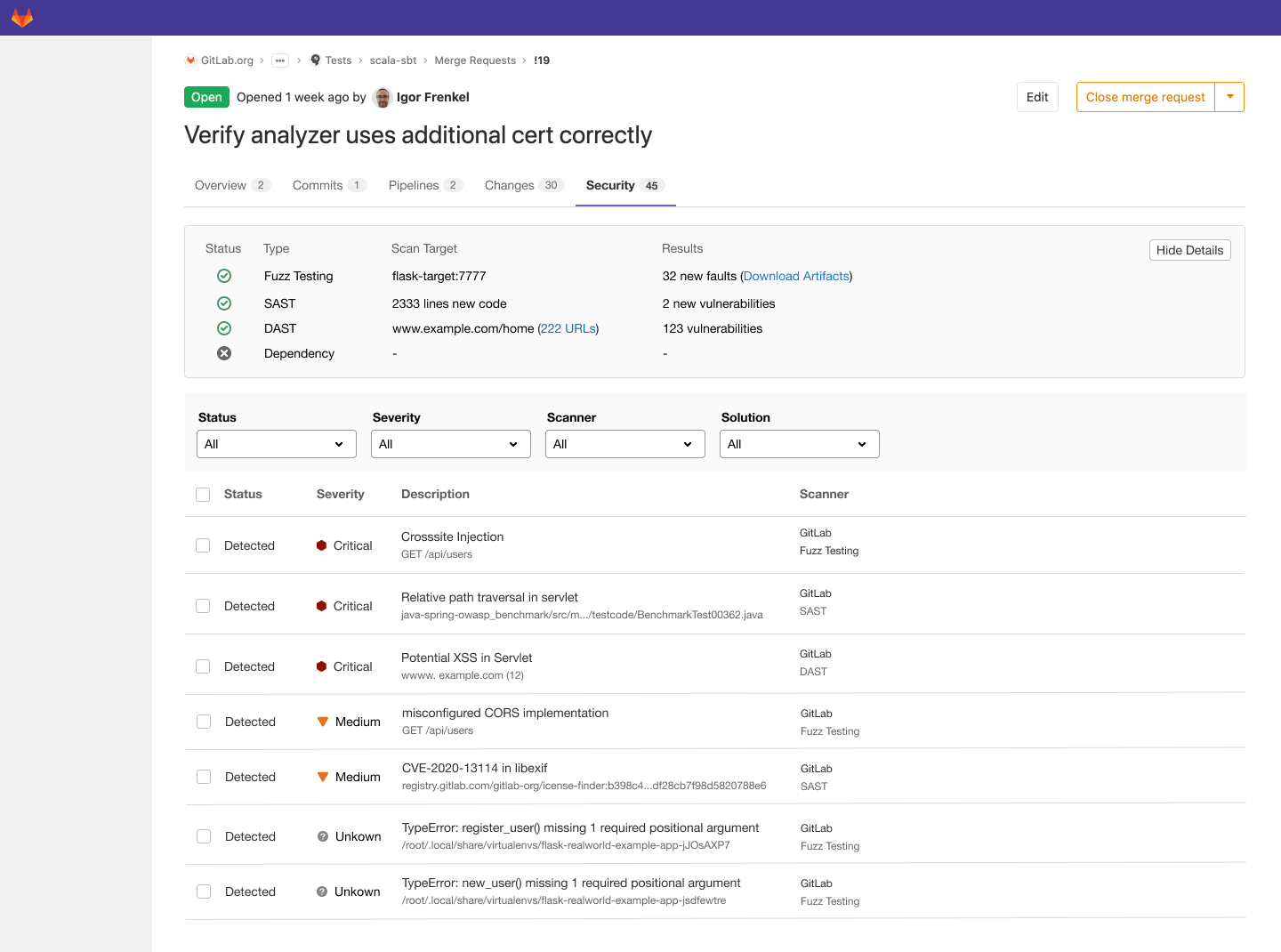
    GitLab today announced it has acquired Peach Tech, a provider of protocol fuzz testing and dynamic application security testing (DAST) API testing tools, and Fuzzit, a continuous fuzz testing tool, as part of its efforts to advance the adoption of best DevSecOps practices.

    David DeSanto, director of product for GitLab Secure & Defend, said the two acquisitions should make it easier for DevOps teams to incorporate both whitebox and blackbox fuzz testing techniques for security testing much earlier in the application development and deployment process.

    Fuzz testing is an automated technique that involves providing invalid, unexpected or random data as inputs to software, which is then monitored to see what happens—if it, for example, crashes or a memory leak is created.

    Peach Tech adds Peach Fuzzer, an automated security testing platform that employs definition files known as Peach Pits to generate the fuzzed data consumed by the test target along with a framework for automating the web application programming interface (API) security testing process.

    Fuzzit provides a service that enables DevOps teams to continuously generate fuzz tests and correlate crashes in a way that can be integrated within a continuous integration/continuous delivery (CI/CD) workflow.

    Once Peach Tech and Fuzzit technologies are fully integrated with each other and the GitLab platform, DeSanto said GitLab Secure customers will be able to automate myriad tasks, from security testing to vulnerability management and remediation.

    GitLab will also employ technologies from both companies to further its ambitions to drive the adoption of interactive application security testing (IAST). The goal is to not only make it easier for developers to employ DevSecOps tools but also understand what issues are being created as applications are developed, said DeSanto. That approach should reduce the number of instances where development teams are continuously making the same mistakes across multiple application development projects, he noted.

    The further left cybersecurity testing is shifted the less stress there will be on chronically short-staffed cybersecurity teams. The challenge is that while most organizations recognize the potential benefits of DevSecOps there hasn’t been much progress in educating developers on what issues to look for and providing them the tools needed to discover and remediate vulnerabilities.

    There is, of course, no silver bullet when it comes to cybersecurity. As long as humans write code there always will be potential issues. However, many more routine cybersecurity issues should be addressed long before an application is deployed within a production environment. To achieve that goal organizations are providing developers with tools that identify cybersecurity issues as they write code in addition to incorporating more security testing into their CI/CD workflows.

    Of course, GitLab is not the only provider of a CI/CD platform focusing on how to foster the adoption of best DevSecOps practices. There’s clearly a race to embed security testing tools within CI/CD platforms that should advance adoption for DevSecOps, if for no other reason than they are becoming easier for developers to discover and employ.

  • Logi Analytics Simplifies Dashboard Development

    Logi Analytics Simplifies Dashboard Development

    Logi Analytics launched a tool that promises to make it easier to design, build and embed interactive dashboards and data visualization within applications.

    Company CEO Steven Schneider said Logi Composer helps ease the task of creating data visualizations within the context of a DevOps workflow.

    Based on technology Logi Analytics gained via its acquisition of Zoomdata last year, Logi Composer enables DevOps teams to create interactive self-service dashboards for end users as part of a microservices architecture based on Docker containers, he said.

    To help achieve that goal, Logi Composer includes support for a range of Smart Data Connectors constructed as a set of microservices to access databases and other things.

    Schneider said as applications evolve developers increasingly are being required to embed business intelligence (BI) functionality within their application. However, he noted, most end users don’t want to move data into a separate BI application to analyze trends when they could be surfaced more easily within an application they are already using.

    The challenge has been finding a way to provide developers with a set of tools for building self-service visualizations in a modular fashion that makes them easier to build, maintain and update, he said.

    Of course, developers have been adding visualizations to applications for years. But most of those visualizations don’t let end users interrogate data—users now expect to be able to manipulate visualizations with a modern application at a much deeper level, said Schneider.

    A recent market study published by Dresner Advisory Services finds 62% of respondents consider self-service BI to be either “critical” or “very important.” A separate report published by Allied Market Research estimates the market for embedded analytics will generate revenues in excess of $60 billion by 2023.

    Data visualization is a critical aspect of every digital business transformation initiative. As organizations look to digitize more processes in the wake of the COVID-19 pandemic, the need for more robust data visualization capabilities within applications has become more acute. Most end users are unable to make sense of massive amounts of data without the aid of visualization tools.

    It’s unclear to what impact embedding BI capabilities within applications will have on standalone BI applications. There may always be analysts who want to pull data from multiple application sources to analyze trends. However, the bulk of users are likely to have their BI requirements met within an application that includes connectors to pull in external data when required. Applications that don’t include data visualization capabilities are not likely to be widely employed by users.

    Ultimately, embedded data visualization will reduce reliance on both spreadsheets and standalone BI applications. However, like most substantial changes to end user behavior, it may be a while before that cultural shift takes hold.

    In the meantime, DevOps teams should expect to see a lot more analytics functionality being embedded within applications. The challenge now is finding a way to streamline the development and deployment of those modules within the context of a larger application development project.

  • Aruba Injects AIOps Into Network Management

    Aruba Injects AIOps Into Network Management

    Aruba, a Hewlett Packard Enterprise (HPE) company, this week launched a platform that leverages artificial intelligence (AI) to identify and remediate networking issues before they have an impact on end users.

    Patrick LaPorte, senior director of cloud and software solutions marketing, said the Aruba Edge Services Platform (ESP) applies algorithms to data collected for customer networks and aggregated by Aruba in the cloud. That approach enables the company to apply AIOps to automate the management of both software-defined wide area networks (SD-WANs) and Wi-Fi access points.

    Aruba has been making a case for converging the management of SD-WANs and Wi-Fi access points in remote offices for a couple of years now. With the downturn in the economy brought on by the COVID-19 pandemic, the need to reduce the total cost of networking is even more pressing, LaPorte said.

    The Aruba ESP platform further reduces the total cost of networking by augmenting network administrators with AIOps capabilities that will enable a smaller team to centrally manage via the cloud a much larger number of network services being delivered to remote offices, he said.

    At the same time, Aruba enables IT organizations to implement zero-trust network security by providing built-in support for role-based access, dynamic segmentation of network services and identity-based intrusion detection to authenticate, authorize and control every user and device connected to the network, said LaPorte.

    The Aruba approach to AIOps revolves around Aruba Central, a cloud service based on Kubernetes the company relies on to manage networking equipment that runs ArubaOS services. Aruba claims to have more than 65,000 customers using Aruba Central to manage network services.

    Aruba Central has been enhanced to include AI Search, a data discovery service based on a natural language processing (NLP) engine that enables IT teams to employ English-language queries to extract user and device information from the data lake created by Aruba ESP. The company has also added user-centric analytics to better identify client, application and network performance issues.

    Aruba has also added a faster Aruba CX 6200 Switch Series that includes built-in analytics and automation capabilities.

    Finally, Aruba has launched Developer Hub, which provides access to its application programming interfaces (APIs) and documentation to applications that leverage the Aruba ESP platform.

    The way network services are being managed and delivered to remote offices is dramatically changing as applications become more distributed. At the same time, the entire definition of what constitutes a remote office in the age of COVID-19 is being transformed as more employees work from home. Aruba is addressing that challenge by making it easier to set up network tunnels between home offices and remote offices managed by Aruba Central, said LaPorte.

    As networking continues to evolve there is no doubt IT organizations will be relying more on automation and AI to deliver network services as scale. Less clear is the degree to which IT organizations will be willing to standardize on networking equipment from a single vendor to achieve that goal. In theory, IT organizations can reduce their total cost by standardizing on a single vendor. In practice, however, many IT environments are comprised of a dizzying array of networking equipment from multiple vendors.

    Regardless of what path forward is chosen, it’s already apparent the current networking status quo will not hold for much longer.