Author: Jens Eckels

  • The Software Extinction Event That Wasn’t

    The Software Extinction Event That Wasn’t

    The world may have just avoided a cybersecurity disaster, with potential impact of CrowdStrike x1000. 

    Imagine if the world’s most pervasive programming language, used in the majority of organizations, services, websites and infrastructure today, was itself made to be malicious?

    Cybersecurity researchers from JFrog recently discovered a GitHub Personal Access Token in a public Docker container… due to the popularity of Python, inserting malicious code that would eventually end up in Python’s distributables could mean spreading your backdoor to tens of millions of machines worldwide!

    – Bruce Schneier, Cybersecurity Guru, NY Times best-selling author

    Picture this: You wake up in the morning, and notice your mobile device has no connectivity. You check your wifi. It’s also out. You turn on the TV to see if there’s any big news – only a couple stations are even functioning and only over the air via antenna. Before you can get oriented, the power goes out.

    You feel like this is the beginning of every disaster movie, but dramatically it’s happening in real life. What’s to blame? An EMP? Terrorism? Nuclear war?

    No, but something potentially just as devastating. A widespread cyberattack that derails nearly every aspect of billions of lives – even digital services based in space are vulnerable.

    What Enabled this Unimaginable Disaster? 

    For the slightly more technical: One wayward Docker container hosted on a public hub, which contained an access token to provide administrator access to Python, PyPI and Python Foundation’s GitHub repos. In the wrong hands, this leaked token would have provided access to the entire Python infrastructure, allowing a nefarious actor to potentially – very sneakily and quietly – take control of systems running Python. 

    In even more simplistic terms: An engineer accidentally posted login/access information online that would allow someone to get a “back door” into many of the world’s computer systems.

    It’s not science fiction. It almost happened. 

    And it could have taken down some of the most critical systems in the developed world. At JFrog we are not prone to hyperbole, but this wasn’t an exaggerated risk. It was a very scary reality. In fact, if not for the dedicated work and investment from security researchers at JFrog, you may have tragically experienced it.

    What is Python?

    Python is a multi-purpose programming language that is designed to be flexible and easy to use. As such, it is a default language and framework for a wide variety of computing systems from website development to software applications to workflow automation to data analysis – even as the default language that enables many of the AI technologies used today. Due to its flexibility and simplicity, it is often one of the first languages used by developers as they learn to code. Software libraries and other packages written in Python are some of the most prevalent open source components used by modern developers.

    Who Relies on Python?

    To understand the potential scope of this attack, it’s important to point out the prevalence of Python in digital systems. It is not a niche use case. The vast majority of critical computing systems utilize Python in some form and could be targets for such an attack. This is where the potential for CrowdStrike’s update impact x1000 becomes a reality.

    • YouTube, Instagram, Facebook, Reddit, Pinterest and other popular sites and services are written in majority or whole in Python (NIT Academy, Probytes). Say goodbye to the majority of services that run and display social media as they black out in an attack.
    • Nearly all machine learning models and AI-enabling software utilize Python to execute. (NIT Academy) Imagine if suddenly everything that runs on AI is taken over by a nefarious actor and trained or retrained with any data they wish.
    • Amazon, Google, Microsoft – All the cloud services and infrastructure from the major cloud players could be blacked out, including all applications and services that run on them. This alone would bring global commerce and interactivity to a halt. (Learnenough, Manpreet Singh)
    • P2P financial services like Venmo, and traditional firms with TRILLIONS of dollars under management (such as JPMorganChase and Goldman Sachs) utilize Python heavily. This attack would have crashed global financial markets, as well as crippling most of the world’s major stock exchanges. (Planeks)
    • Governmental organizations and election systems rely on Python, creating a very real possibility of complete government shutdowns and democratic disruptions. (NIT Academy)
    • Space exploration, satellite-based networks and critical research missions (including NASA, space telescopes, SpaceX and more) all depend on Python, making it very likely all advances in these areas would be orphaned for an extended period (perhaps permanently), leaving a very lonely Mars Rover on the red planet, even dangerously trapping astronauts in space. (Builescu Daniel)

    In this disastrous case, the “end of the world” would come about not with a whimper, but a cyber-bang that crashed most global systems. Identities and information all stolen or missing. Companies destroyed, fortunes wiped out, records deleted, medical care unobtainable, workers unpaid or without access to funds. It could take decades to recover fully.

    Thankfully it didn’t happen. But it was a close call.

    How was the Potential Attack Prevented?

    JFrog is investing heavily not just in products and product development, but also takes our responsibilities to the community very seriously as part of our security research team’s efforts. Part of that ongoing reinvestment effort is to proactively download and examine some of the world’s most popular packages for potential vulnerabilities. Some discoveries – while important – may have a limited blast radius. Some may affect specific operating systems, such as the CrowdStrike issue or maybe certain solution sets such as with SolarWinds. In rare cases, issues are more prevalent, such as the Log4Shell instance. This Python takeover could have made them all look like child’s play.

    From our technical blog on the discovery, we find that JFrog’s secret scanning engines detected a “classic” GitHub token in a binary Docker container hosted in the public Docker Hub repository. The risk with “classic” GitHub tokens is that, unlike newer, more fine-grained tokens, they grant permissions across all repositories the user has access to. 

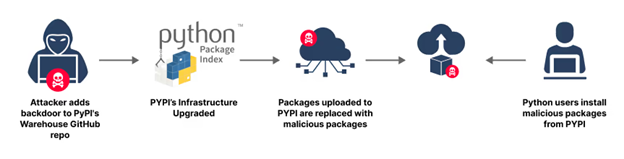
    PyPI Supply Chain Attack Vector

    The discovered token had permissions to change any piece of code related to Python, from the simple Python executable to any Python package that’s hosted on the official PyPI repository.

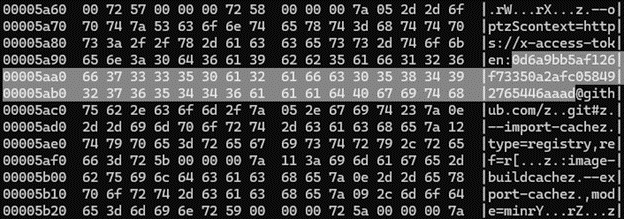
    The leaked Python admin token, inside a compiled binary file

    This showcases the “daisy chain” of consequences that could have come about, as an infection moves from one system to the next.

    Why Only Scanning Source Code Guarantees Blind Spots

    In the case of this secret leak, the token was found ONLY in the compiled binary file. It was not discovered to be in the source code for this Docker container, indicating the developer may have temporarily utilized the credentials to build the binary, then cleaned up the code before making it available alongside the binary in the Docker container, forgetting to scrub the artifact. 

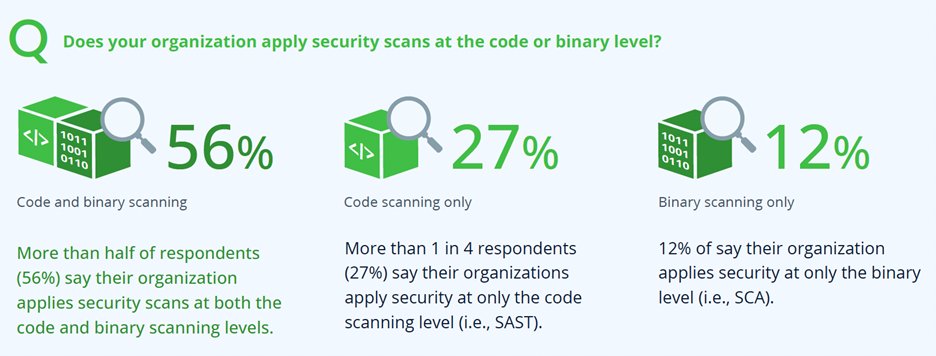
    Why does this matter? According to JFrog’s recently published Software Supply Chain State of the Union report, a staggering 27% of companies are utilizing ONLY code scanning to provide software supply chain security, and only 56% of companies are using both code and binary scanning together to secure their supply chain. This means more than half of companies have a glaring blind spot that may not have detected this vulnerability.

    Software Supply Chain State of the Union Report

    What is the Community Saying?

    Thankfully, the gravitas of this scenario has not been lost on the community, spurring all of us to not only provide even-better tools, but also to be more diligent in our approaches.

    What is most interesting, however, is how JFrog found the token. They discovered it in a compiled Python binary file! 🐸📂 It turns out that searching for secrets in the code itself may not be sufficient. Artifacts in the binaries themselves can also pose a serious threat to supply chains!

    Interestingly, this secret wasn’t exposed directly in the code base. That’s something developers, especially those mindful about security, are well aware of. But you might not have known that when .pyc files are generated, they can inadvertently store sensitive information, including secrets. Jfrog (sic) notes that many secrets they uncover are found within binary artifacts. FWIW, I’m not calling out the admin for this. It’s an honest mistake; they wrote an excellent summary and investigated what they could, identifying no indicators of malicious usage.

    The full blog post by the Python engineer who inadvertently made the error may be found here. As you see in his (very transparent and authentic) blog recapping the issue, it is very easy to make an honest mistake that has potentially devastating consequences. And with 20+ million developers globally, mistakes will inevitably happen and secrets will be leaked if proper guardrails are not applied.

    Key Takeaways

    The majority of industries and most digital infrastructure rely on Python in some way, making threats to this core framework highly consequential and possibly more devastating than recent software supply chain attacks.

    The digital world may have just avoided a landmark Python event thanks to researchers’ diligence. Many thanks to them for saving us from consequences we will hopefully never realize.

    Scanning both source AND binaries is essential to ensure your company doesn’t accidentally reveal secrets or introduce vulnerabilities. If you are not currently doing this practice, there is far too much risk to waste time (if you need a place to start, JFrog powers all of our security products with this approach, led by the same research team that found this secret).

    Supporting the community is key. There are earth-shaking discoveries that need to be shared with the community and fixed quietly before nefarious actors can take advantage. We should learn from the close calls to ensure none of us is next in the headlines, and build better tools and automation to safeguard our companies and posture.

    Huge thank you to the JFrog team for finding this before it could have been much much worse, and as always thank you to the volunteer team running Python’s infrastructure for handling this so well. These things can and do happen to anyone, and their response was world-class.

    Let’s find, fix and fortify together.

  • Guess Who’s Coming to JFrog swampUP?

    Guess Who’s Coming to JFrog swampUP?

    The annual DevOps gathering and JFrog user conference, swampUP 2019, is going to be here before we know it. It’s happening June 17-19 in San Francisco, providing easy access for everyone (it’s just 30 minutes away from SFO airport).

    What’s swampUP? For the thriving DevOps community, swampUP is the must-attend event where developers, engineers and business leaders from top companies and industries network and share best practices for software delivery success.

    While conference promotions can certainly be full of fluffy cheerleading at times, one thing I’m especially excited about is this year’s swampUP guest keynote speaker, Dr. Nicole Forsgren.

    Dr. Forsgren, described as “snarky” by Forbes—a label she readily owns, if you ask—is the co-founder of DevOps Research and Assessment (DORA), which was recently acquired by Google Cloud. DORA quantified customers’ unique needs and DevOps processes to deliver custom paths to DevOps growth.

    Coming to swampUP as herself—not that she could come any other way, but not as a representative of Google—to talk about her unique research and the overall landscape. She’s planning on covering many of today’s hot topics, including DevSecOps, cloud and hybrid, tooling trends and DevOps culture in a special keynote aptly titled, “DevOps: It Only Works When You Do it Right.”

    If you don’t know Forsgren or haven’t seen her speak, her style and unique perspective perfectly blend data and statistics with understanding of realities that companies face. A bit about her specifically: Forsgren is co-founder, CEO and chief scientist at DORA. She is best known for her work measuring the technology process and as the lead investigator on the largest DevOps studies to date. She has been a professor, sysadmin and performance engineer. Her work has been published in several peer-reviewed journals. Nicole earned her PhD in management information systems from the University of Arizona, and is a research affiliate at Clemson University and Florida International University.

    Once attendees get knowledge laid on them from Forsgren, there are some intriguing sessions available in the recently released full swampUP agenda around Cloud Native DevOps, Enterprise DevOps, DevSecOps and even some really cool-looking stuff around IoT. While this may be a JFrog user conference, there are some heavy hitters involved that make this a holistic DevOps gathering, including Andy Glover of Netflix, Aaron Schlesinger of Microsoft, Jayne Groll of the DevOps Institute, Carl Quinn of Zoox, Seth Vargo of Google, Jessica Deen of Azure and John Willis of Botchagalupe, among many other powerhouse speakers.

    Of course, you’ll also see the expected lineup of JFrog experts, staff and visionaries swampUP attendees have come to know, including JFrog co-founder and CEO Shlomi Ben Haim, co-founder and CTO Yoav Landman, co-founder and chief data scientist Fred Simon, CPO Dror Bereznitsky, VP of business development Kit Merker and many more. There will be a few special additions this year, including former CEO of recently acquired Shippable Avi Cavale and JFrog VP of technology Ido Green.

    From hands-on training to inspiring keynotes and practical technical breakout sessions, swampUp is seen by alums as a premier opportunity to learn about DevOps, DevSecOps and cloud-native delivery. There’s also a full day of training and certifications for practitioners of all levels to take advantage of!

    Click here to register and join JFrog and the DevOps community at swampUP 2019.

    — Jens Eckels