Author: Eran Kinsbruner

  • DevEx Got You This Far: What’s Next for True DevSecOps Maturity?

    DevEx Got You This Far: What’s Next for True DevSecOps Maturity?

    The journey toward integrating security into the fast-paced world of DevOps has seen significant strides, largely thanks to a much-needed focus on the developer experience (DevEx). 

    Collectively, the AppSec community and industry have moved mountains in making security tools less intrusive, integrating them into developer workflows, and acknowledging that developers need security as a help, not a hindrance. A focus on DevEx has been crucial, acting as the bridge to bring security considerations earlier into the development lifecycle while simultaneously enhancing the developers’ daily work.  

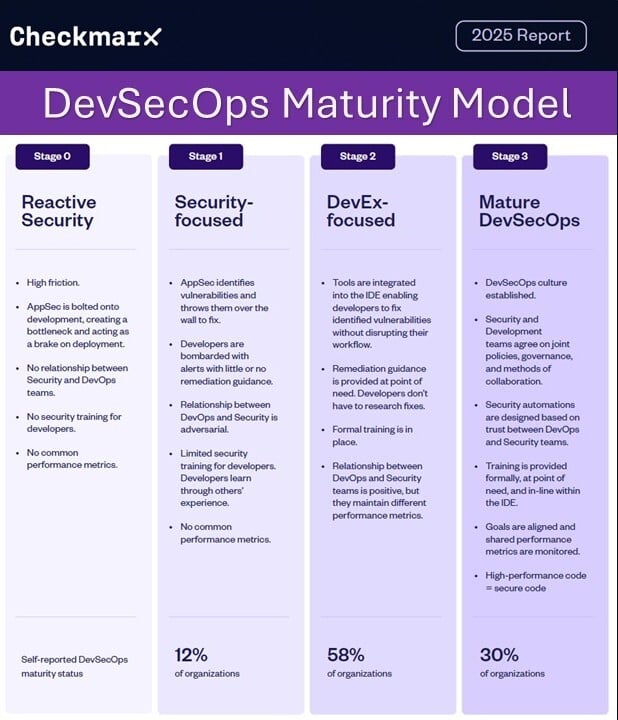
    The numbers don’t lie: Checkmarx’ recent DevSecOps Evolution 2025 report reveals that a majority of the organizations we surveyed—58% to be exact—are at Stage 2 maturity, a transition stage primarily focused on DevEx: They’ve integrated tools into IDEs, offer formal training, and the relationship between security and development teams is generally positive. While these developments signify important progress, this DevEx-focused stage represents a critical foundation rather than the ultimate destination in achieving mature DevSecOps.
    DevEx Isn’t the Destination

    Organizations haven’t yet achieved true DevSecOps maturity. They haven’t yet embedded security through shared culture, governance and aligned goals.

    And while developer experience is essential, it’s just one brick of the DevSecOps foundation. To achieve the ultimate goal—high-performing, secure code delivered at the pace of business—organizations need to move beyond DevEx to a true culture of shared responsibility and trust.

    Despite better tools and training, developers still report spending a significant chunk of their week—often over 17 hours—on security tasks. Trust in tool results is often hampered by false positives impacting velocity, and a lack of shared goals that align development and AppSec priorities means security can still feel like a separate concern rather than a shared objective. We’ve improved the experience; but haven’t fully embedded security seamlessly and at scale.

    The Scale – and Stakes – Are Growing

    The need to mature beyond DevEx is especially urgent given the accelerating complexity and scale of modern application development. Enterprises are managing sprawling codebases and adopting tools that increase both speed and risk. Checkmarx alone scans over 450 billion lines of code every month, and that figure is only rising. 

    At the same time, the software supply chain is expanding at an unprecedented pace: approximately 700,000 new NPM package versions are introduced monthly, each one a potential point of exposure.

    Add to this the growing adoption of AI-assisted coding tools and agentic AI systems that generate or modify code autonomously, and the attack surface multiplies further. 

    On the other hand, development productivity requirements have never been higher, with organizations tracking DORA metrics and looking for AppSec solutions like Checkmarx’ that deliver on security while optimizing MTTR and other DORA metrics.

    Achieving truly mature DevSecOps—Stage 3, where only 30% of organizations currently reside—requires moving beyond just making security palatable for developers. It demands a deeper, more strategic integration built on shared culture, robust governance, trusted automation, and aligned success metrics.  

    Checkmarx’ Five Pillars of DevSecOps Maturity

    At its heart, DevSecOps is a cultural evolution. It’s about merging the “move fast” ethos of development with the “protect everything” mandate of security to achieve a common goal of delivering secure, high-performance code at the speed the business requires. To progress from Stage 2 (DevEx-focused) to Stage 3 (Mature DevSecOps), organizations need to build on their DevEx foundation with five key elements:

    1. Shared Metrics

    You can’t improve what you don’t measure, yet our research shows a surprising lack of consensus on DevSecOps metrics. While many organizations we surveyed track top vulnerable applications (52.1%) and mean time to detect vulnerabilities (51%), only 28.3% measure mean time to remediate—arguably the most critical metric for balancing security and velocity.

    True DevSecOps maturity requires security and development teams to align shared metrics that measure how effectively they work together, not just how many vulnerabilities they find.

    2. Collaborative Governance

    In mature DevSecOps, security and development teams jointly establish policies, standards and processes. Our data shows this remains rare—when asked to describe the relationship between security and development in one word, respondents most frequently chose “trust,” “policy,” and “risk,” indicating an evolving but not yet fully collaborative relationship.

    For 88% of organizations, the absence of shared metrics, policies and governance suggests security and development teams are aligning but are still struggling to form a fully collaborative governance.

    3. Advanced Security Education

    While essentially all developers have access to training according to our study, the model needs to evolve. Traditional formal training programs still have value, but the premium on developer time makes standalone training challenging.

    Mature DevSecOps organizations are pivoting toward just-in-time training that delivers contextual guidance when and where developers need it. Providing a step further is in-the-moment training with inline feedback from within the IDE, allowing developers to learn while maintaining their workflow.

    4. Trusted Automation

    Our study showed that one in five (20%) of the organizations we surveyed have no AppSec automation in place. Even among the remaining 80%, adoption of key automation capabilities remains low—only 32% have automated security testing during change management, and just 30% auto-populate security tickets with remediation guidance.

    The far-from-optimal adoption rate of automation cannot be attributed to a lack of technological solutions but rather appears as a matter of trust and culture gaps between security and development teams. Without shared governance and metrics, attempts to “automate everything” typically fail because there’s no foundation of trust on which to build automations that both teams will embrace.

    5. Velocity-Security Balance

    The ultimate goal of DevSecOps is to deliver high-performing, secure code quickly. Yet 66% of developers report that false positives impede their velocity, and 28% say their AppSec teams lack the tools or resources to help them fix security issues efficiently.

    Mature DevSecOps organizations recognize that speed isn’t just about how quickly tools scan—it’s about how quickly developers can remediate issues without disrupting their workflow. This requires prioritized, actionable results with clear remediation guidance, not just faster scanning. 

    The Role of Leadership

    Making the transition to DevSecOps takes more than just good tooling—it requires strong leadership. Security leaders must be willing to trade control for collaboration and build systems based on partnership, not policing. Engineering leaders must recognize that security is essential to velocity, not an obstacle.

    This shift requires executive buy-in and strategic commitment. It means moving beyond budget conversations centered on compliance and instead investing in the long-term health of your codebase and your teams.

    The Road Ahead

    As the DevSecOps Evolution 2025 report shows, most organizations are still in the middle of the journey. That’s not a failure. It’s an opportunity. DevEx helped bridge the gap between developers and security, and now it’s time to build the foundation that inspires them to run together. By moving beyond DevEx as the sole focus and embracing these pillars of mature DevSecOps, we can finally embed security seamlessly at scale, achieving the ultimate objective of delivering high-performing, secure code without compromising speed.  

    The transformation won’t happen overnight. It requires sustained investment in building trust between security and development teams. But organizations that successfully make this journey will gain the significant competitive advantage of more secure and advanced applications built with less friction and lower costs.

    As we look to 2026 and beyond, the most successful organizations will be those that move beyond seeing security as just another feature of the development process. Instead, they’ll embrace it as an integral, collaborative aspect of delivering high-quality software in a digital world with ever-rising security risks.

    At Checkmarx, we believe the future of software development is secure by design—and it starts with mature DevSecOps. Let’s keep moving forward.


  • The Essential Toolbox for DevOps Analytics

    The Essential Toolbox for DevOps Analytics

    With DevOps teams under constant pressure to improve software delivery cycles while maintaining—and improving—quality, many have turned to continuous testing (CT), implementing it as part of their overall development strategy. CT offers a number of benefits to DevOps teams, but it also introduces new challenges, specifically infinite amounts of data that require analysis. As more teams integrate CT into their strategy, it is clear that analyzing, understanding and filtering the results data quickly is critical to preventing bottlenecks in the DevOps process. The problem is, teams simply don’t have the time needed to analyze data.

    Current research indicates that teams spend anywhere between 50 and 72 hours per regression cycle analyzing test results. This includes filtering out noise and assessing failures that may impact their software releases. However, the amount of time DevOps teams have to review and qualify test results has shrunk dramatically in recent years—from days to hours or even minutes, in some cases—leaving teams scrambling.

    With pressure to accelerate velocity and deliver consistent, high-quality experiences, DevOps team require new analytics solutions to help them manage large test-results datasets in a CI/DevOps environment.

    Let’s explore five essential tools that enable DevOps teams to quickly and efficiently analyze data, triage issues and act upon failures with the best possible insights.

    Executive Dashboards

    Dashboards have evolved immensely over the years, allowing dev managers and QA managers to easily examine the pipeline, see CI trends related to time, build health and more. When looking for the best solution, make sure it includes quality heat maps and CI dashboards, which make it easy to spot an anomaly in the CI pipeline and allow managers, DevOps teams and practitioners to quickly drill down into the single test report and the issue.

    Single Test Report Visibility With Advanced Reporting Artifacts

    With a single test report, practitioners have access to the entire flow of test steps, video, logs, screenshots and Jira–even the ability to drill down into the source code. This makes it quick and easy to locate an issue. For teams, these means more time fixing and less time searching.

    Cross-Platform Reports

    These analytics reports show the UI/UX simultaneously across multiple screen sizes, resolutions and platforms. Since the boundaries between the digital platforms need to be seamless, whether on desktop browsers or mobile devices, having the ability to see the UI/UX on multiple form factors (and layouts) at the same time is essential to assess overall quality.

    DevOps Noise Reduction Tools Powered by AI and Analytics 

    Today, finding which error classifications are true application bugs is critical to efficiency. Noise reduction tools that are powered by AI allow teams to filter out problems caused by various issues that are not software defects—for example, device connectivity issues and wrong scripting. Having a tool with the ability to locate each failed test execution, the root cause and the classification category is a huge productivity boost for both the test engineer and the developer.

    DevOps and Actionable Insights

    Analyzing data is one thing, knowing what to do it with it is another. Today, there are a number of analytics solutions on the market that provide teams with both capabilities. Once an issue is detected, classified and reported, having deep insight brings practitioners halfway toward the resolution of the issue.

    To succeed in software delivery, teams not only need better automation as part of their processes, test flows and CI/CD workflows, but also an analytics platform to manage all of their test results data. Since DevOps involves a collection of team members from all parts of the software delivery lifecycle (SDLC) process, the central platform needs to meet the needs of all team members. As you work to build your next test analysis toolbox, consider the five features above to efficiently evaluate the data, act upon it and deliver iterations and features with confidence.

    — Eran Kinsbruner

  • Spring Cleaning 101: Polishing Up Your DevOps Processes

    Spring Cleaning 101: Polishing Up Your DevOps Processes

    Dev teams should take time to tune up agile processes and continue advancing their shift toward DevOps

    Release cycles are accelerating, but not as fast as development teams want. Customers’ desired release rates are moving at an unimpressive pace; those looking to push out new updates on a weekly basis often find it looks more like a monthly basis—and that just isn’t going to cut it.

    As the frequency of execution increases, dev teams find themselves between a rock and a hard place. While the growing demand for faster turnarounds isn’t poised to slow down anytime soon, teams struggle to integrate a set of tools into an efficient pipeline to get the job done within the time allotted. With demand on the rise, how can teams work together to fast-track their release cycles?

    It’s time for dev teams to apply a little more elbow grease.

    With spring cleaning season upon us, dev teams across industries should take time this season to tune up agile processes and continue the work of advancing their shift toward DevOps.

    Dust Off Roles and Responsibilities

    A once very siloed practice, software development has since taken on a much more agile approach across teams as the need for faster release cycles rapidly grows. According to a recent VersionOne report, nearly 75 percent of respondents attribute the need to accelerate software delivery to their adoption of agile practices. While DevOps is meant to help dev teams deliver applications at a high velocity, managers encouraging the implementation of these processes often overlook the true meaning of DevOps and the effects these transformations will have on its current employees and their roles.

    At its very core, DevOps is the combination of development and operations, which covers a wide range of tasks once performed by developers, testers and operations at different stages throughout the software development life cycle (SDLC). However, a more agile approach means these different processes (building, testing, etc.) are in a more tightly coordinated execution, requiring each of the different silos to have a better understanding—and knowledge—of each process.

    Before jumping in to update any processes or technologies, it’s important to ensure all teams are aligned on their evolving roles and responsibilities. Sit down with individuals, teams and their managers to get everyone on the same page and provide guidance on best steps for moving forward this year.

    Shrink the Skills Gap

    Despite developers’ growing list of responsibilities, a 2018 report from LinkedIn found that there is a significant skills shortage when it comes to software engineers and other similar career trajectories. That gap shrinks even further when you consider the different roles within software engineering itself. For example, developers have recently taken on more responsibility as “full stack developers,” assuring high-quality outputs and confirming there are no bugs in their code, yet have very little knowledge of how to implement continuous testing.

    This spring, spend time with employees to brush up on their skills, refine their job responsibilities and uplevel their expertise. While this isn’t a task that can be performed and executed on overnight, some recommendations to kick start the process include:

    • Get leadership on board: To fund any of this, teams will need leadership buy-in. Be sure to sit down with those in senior positions to explain the benefits to teamwide training from both an organizational and economic perspective.
    • Try the buddy system: Pair up programmers of different skills and levels to mentor one another. Consider it as a coaching system in which team members can provide feedback and training in real time with real-world projects.
    • Consider augmenting software delivery practices to improve quality: acceptance test driven development (ATDD) is a proven accelerator and behavior-driven development (BDD) helps bridge varying skills and blind spots between the different personas across the SDLC.

    Pick up New and Improved Processes for Increased Productivity

    As release cycles accelerate, team leads need to take a close look at each of the stages throughout the SDLC to determine where the roadblocks occur and what exactly is holding employees back. Analyzing not only the quality of outputs, but also how quality assurance is embedded throughout continuous integration (CI) process is a good start.

    Throughout the DevOps journey, there are a number of developers across different feature teams adding to, editing, updating and continuously testing code at any given time. Establishing best practices and some basic ground rules can be a simple way to ensure visibility into each of the teams’ productivity. Everyone must constantly be aware of which teams are moving along and which are struggling a bit to make sure code is well-maintained (e.g. determining if your testing code blocking your CI integration) and that there are no memory leaks or poor code development practices throwing the process off. Continuous testing across different feature teams will also assure that every code component for different functionalities is working once they all finally merge.

    Getting everyone on the same page will also make it easier to simplify real-time decision making. Be sure to work with teams to define their dashboards, ensuring everyone is seeing the same actionable results at any given time.

    Revamp Your Tech

    While people and processes should be a main focus for spring cleaning, don’t forget about the tech. The different types of technologies utilized throughout the DevOps pipeline must integrate seamlessly with everything mentioned above.

    First, consider your lab environments. The lab is the glue that keeps the entire CI process together, supporting all platforms (whether mobile, desktop, web, etc.). If unstable or unavailable at any given moment, the entire process breaks.

    As more organizations begin to adopt these agile approaches to software development, it’s also important to remember that it’s nearly impossible to build a “one-size-fits-all” solution; every new process, tool or technology should integrate well within the existing toolchain, which will vary from business to business. For the most success, don’t jump to conclusions and totally overhaul your current stack. Today, there are very few vendors that offer solutions that address every step throughout the development process. Instead, develop new APIs or integration points that make it easier to diversify the set of tools you already have.

    Finally, consider your frameworks. When it comes down to it, there are material differences between the developer’s objectives around tests and the test engineers. Make sure the entire team has tools and access to different frameworks based on their needs. A developer, for example, would use a tool such as Espresso or XCUItest to run a small number of unit tests, whereas test engineers require end-to-end functional test frameworks, such as Appium or Selenium.

    Conclusion

    While it won’t always be easy, it’s important to take some time this spring to get your DevOps teams looking squeaky clean. Don’t forget to focus on polishing up your processes, training team members and sprucing up your stack to ensure release cycles are on time—and spotless—by the time the summer rolls around.

    — Eran Kinsbruner