Author: devopsy.kinsta.cloud

  • WaveMaker Launches Studio WorkSpace Sync Plugin

    Mountain View, CA – September 24, 2018 – WaveMaker, Inc., a leading low-code Rapid Application Development (RAD) platform, announced the launch of its Studio WorkSpace Sync Plugin. The new capability further streamlines the app coding process for developers, allowing them to easily synchronize WaveMaker’s open-standards platform with various integrated development environments (IDEs) on their personal devices.

    Rather than having to export and re-import projects between platforms, the Studio WorkSpace Sync Plugin provides a direct communication channel where changes can be instantly pushed between WaveMaker and an IDE. This also eliminates the need to copy and paste code, a time-intensive, tedious, and error-inducing method that can slow down the DevOps process.

    After a one-time setup configuration, developers can leverage the Studio WorkSpace Sync Plugin in three main ways:

    1. Pull the latest project changes from WaveMaker – This command can be used to ensure that the latest changes made to a project on the WaveMaker platform are applied to IDE code. This includes both committed and uncommitted changes to the project. 
    2. Push IDE changes to WaveMaker – All IDE changes are instantly pushed to the WaveMaker platform.
    3. Synchronize a project – This command works in two steps: first, the latest changes made to the project on the WaveMaker platform are applied to IDE code. After both the IDE and WaveMaker versions of the project are in the same state, the Studio WorkSpace Sync Plugin pushes any IDE changes back to WaveMaker.

    The Studio WorkSpace Sync Plugin is the latest component of WaveMaker’s ongoing commitment to providing developers the tools they need to efficiently develop and deploy applications while leveraging the benefits of granular customization capabilities and third-party platform integration. For more information, please visit https://www.wavemaker.com/.

  • Priority Announces 2018 North American Partner Conference

    Rockaway, NJ, October 4, 2018 – Priority Software Ltd., a leading global provider of business management solutions, today announced that its 2018 Partner Conference will be held at the Hyatt Regency hotel, October 18-20, in Morristown, New Jersey. This is Priority’s inaugural North American conference for partners and resellers of the company’s products, including Priority AccountEdge, accounting for small businesses, and the Priority ERP solution. Conference delegates will be sharing marketing and sales, implementation, and project management best practices, as well as taking a closer look at the company’s vision and product roadmap.

    Throughout the three-day conference, delegates will have opportunity to network with peers from across the Americas and take part in in-depth sessions and workshops. During the event, Priority management will present its product roadmap, new partner integrations and a case study from Priority customer, US-based Phillips Safety Products. Brian Struble, IT Architect at Phillips, will illustrate how Priority ERP’s open, flexible, and scalable business platform has been implemented to fuel their business growth.

    The US event is the first in a series of global conferences to support Priority’s fast-growing partner network. Priority is actively recruiting North American systems integrators and consulting firms to join its expanding partner community that spans over 40 countries. Priority is seeking organizations with a proven track record for selling and implementing IT software solutions, can offer local knowledge, vertical and technical expertise, and are driven by taking new products to market.

    “The recent rapid growth in demand for our business management solutions has triggered our campaign to recruit new partners and to establish the North American Partner Conference,” said Avi Troub, VP Sales & Channels, Priority Software. “This important gathering will provide us with a foundation to gain insights and build long-lasting relationships for our mutual business success and continued growth.”

    Learn more about the Priority Partner Club.

    About Priority Software

    Priority Software provides flexible, end-to-end business management solutions for organizations of all sizes – from accounting software for small businesses, to a full featured ERP platform serving multi-national corporations. Recognized by top industry analysts and professionals for its product innovation, Priority improves business efficiency and the customer experience, providing real time access to business data and insights in the cloud, on premise, and on-the-go. With offices in the US, UK and Israel and a global network of business partners, Priority enables 75,000 companies in 40 countries to manage and grow their business. For more information, visit www.priority-software.com.

  • Security Compass Announces Jenkins Plugin for its Policy-to-Procedure Platform Bringing Application Risk Policy and Compliance to DevOps

    Agile Development Teams Empowered to Continuously Deliver Applications without Risk from the Start

    TORONTO, Oct. 03, 2018 (GLOBE NEWSWIRE) — Security Compass, a software security company that provides organizations with the knowledge, training, and technology to make software secure, announced today that its leading policy-to-procedure platform, SD Elements, now features a Jenkins plugin which empowers agile development teams to build application risk management and compliance into the DevOps process. The new plugin informs the continuous integration/continuous delivery (CI/CD) pipeline with essential security and compliance guard rails in an automated environment, ensuring applications built using SD Elements fail to deploy if they don’t comply with risk policies.

    As application development teams are moving faster than ever to build applications and to embrace agile methodologies in DevOps environments, important security and compliance measures are being skipped. SD Elements is the only solution on the market that translates complex compliance requirements into something engineers and developers can actually use. It helps organizations go from policy to procedure in a highly automated fashion, without slowing down the development process or the continuous delivery of critical applications.

    Security Compass introduced risk dashboards and risk policy management functionality to the SD Elements platform in April 2018. The risk dashboards provide a quick and easy way for managers to view each application’s compliance with the assigned risk policy and to generate a report that clearly identifies any gaps. The risk compliance status feeds into Jenkins by way of the plugin to inform the CI/CD scripts. Fast-moving DevOps teams can then easily identify and address compliance problems in applications early on, and across business units, saving considerable time and resources.

    “To date, large organizations have relied on automated scanning to address risk in a DevOps environment which often results in the accidental deployment of applications with unmitigated risk and only captures 40 percent of an application’s potential risk,” said Ehsan Foroughi, VP of Product at Security Compass. “The SD Elements’ Jenkins plugin enables DevOps teams to move from highly manual security and risk-phase gates, to a more automated and accurate approach that doesn’t slow down development.”

    To learn more about the new Jenkins plug-in and risk dashboards, visit Security Compass at booth (#P8) at the AppSec USA Conference, Oct. 8-12 in San Jose, Calif.  More information can be found on the Jenkins community plugin page here. Beta versions of similar plugins are available for XebiaLabs XL Release and Microsoft Azure Pipelines (contact Security Compass).

    About Security Compass
    Security Compass is a leader in helping organizations proactively manage cybersecurity risk in their mission-critical software without slowing down business. Through its tailored DevSecOps solutions, its award-winning policy-to-procedure platform, SD Elements, and its verification services, which include penetration testing, threat modeling and red teaming, Security Compass helps organizations efficiently deliver software that’s secure by design. The company serves some of the world’s largest enterprises, including 16 of the largest financial institutions in North America, South America, and Asia, as well as four of the largest tech companies in the world. Security Compass is privately held and headquartered in Toronto, Canada with global offices in the United States and India. Follow Security Compass on Twitter @securitycompass or visit https://www.securitycompass.com/

    Media Contact:
    April H. Burghardt
    PR Consultant for Security Compass
    april@gabdata.com
    646-246-0484

  • Modernizing federal DevOps: CircleCI becomes first continuous integration tool with FedRAMP authorization

    CircleCI is now authorized by FedRAMP​(the federal government’s program for assessing and authorizing technology vendors), making CircleCI the first CI/CD tool to meet the rigorous security and privacy standards required by government agencies.

    Previously, government developers were forced to rely on cumbersome, legacy CI options that, while free, required too much overhead, were costly to maintain, and diminished productivity. Now, the government’s developer community can gain the same competitive advantage long available to the private sector, assured of the security and privacy controls that federal agencies require.

    “Federal managers need to start thinking about the total cost of ownership for their development tools. If your team is spending time troubleshooting a ‘free’ build tool, then it’s not free. We chose CircleCI after trying several different build tools, ranging from totally free open source tools to managed services. CircleCI just works, and that means our team only has to focus on building better government services. The total cost of ownership is much lower for a service like CircleCI.”

    – Ryan Hilliard, IT Specialist/Systems Developer, Small Business Administration

    Federal agencies like the Small Business Administration, General Services Administration, and the Department of Veterans Affairs are already leveraging CircleCI to automatically build, test, and deploy software every day. With this new authorization, the entire federal developer community now has access to the CI/CD tool trusted to run more than 12 million builds a month for some of the world’s most innovative companies, like Docker, GoPro, and Zenefits.

    What is FedRAMP?

    The Federal Risk and Authorization Management Program (FedRAMP) is an official U.S. government program that simplifies the purchase of cloud technologies to government agencies. The White House Office of Management and Budget developed​FedRAMP in early 2010 as a way to standardize the security vetting process for the shift to cloud-first initiatives. Prior to that, each agency had its own standards and guidelines which created difficult and long timelines for teams to get access to technology. FedRAMP has streamlined the security controls as a way to measure a company’s security and privacy posture against a common set of base guidelines. Whereas certifications like ISO27001 and SOC 2 are developed and assessed by private auditing firms, government officials developed FedRAMP using NIST security controls​ as the common baseline.

    Government agencies can manage risk by using the FedRAMP marketplace to identify tools that have already passed strict security and privacy requirements.

    “Traditional approaches to securing federal IT systems focus heavily on assessing and responding to security issues just before ‘go live’. This model is costly and burdensome because identified security issues can result in rework and do-overs. Using automated continuous integration and continuous deployment tools such as CircleCI, we’re able to move cybersecurity requirements ‘left’ in the process to achieve a true ‘build security in’ model.”

    – Beau Houser, Chief Information Security Officer at U.S. Small Business Administration

    What was involved?

    FedRAMP’s assessment of CircleCI in the low-impact SaaS (LI-SaaS) category included a complete inventory audit and assessment from network diagrams, to tables of third-party integrations, a master inventory of all infrastructure, and written responses to strict controls. The controls encompass a wide range of security protocols and examined CircleCI’s authorization of users, vulnerability scanning processes, and incident response. In essence, everything a federal Chief Information Security Officer should assess a new cloud vendor on.

    After successfully completing the initial vetting in June, FedRAMP officials hired a third-party auditor (a former federal employee with a top secret security clearance) to visit CircleCI’s San Francisco headquarters. The auditor spent four days in July with CircleCI employees and thoroughly reviewed how each control is handled. Their findings were reviewed by a federal security team for analysis, whereby CircleCI was granted authorization.

    CircleCI is now available on the FedRAMP Marketplace

    https://marketplace.fedramp.gov, and federal software teams can download a copy of the third-party assessment.

    To set up a demo or speak with our government team, please contact us at government@circleci.com.

  • Opportunity Knocks: Survey Highlights Substantial Cost Savings and Long-Term ROI from Test Environment Management Solutions

    Study finds that despite enterprises needing test environment management capabilities and the potential savings they bring, there is a staggering lack of adoption and maturity.

    SANTA CLARA, Calif.–(BUSINESS WIRE)–Plutora, leading provider of value stream management solutions for enterprise IT, today announced the full findings of a new EMA report, sponsored by Plutora, titled EMA 2018 Test Environment Management Survey. The study demonstrates the immediate cost savings that test environment management (TEM) tools provide, yet finds that only four percent of large enterprises have fully integrated TEM processes into organizational DNA.

    One of the most striking findings that emerged from the survey is the scale of test environments in enterprises. There is an average of 188 test environments per enterprise, with the highest total count at 685, and the average spend to support test environments is $682,000 per year. Test environments of this number sprawl and become complex, which directly impact the ability to manage them.

    Enterprises are missing out on the advantage of TEM tools

    Despite the scale at which enterprises are standing up and utilizing test environments, the adoption of tools to manage and maintain them is strikingly low. Nearly a quarter of respondents in the survey are not using a commercial TEM tool with two-thirds employing their own ad hoc TEM process. This has a significant impact because when the maturity of commercial TEM tools is compared to that of in-house, non-commercial tools, the difference is unmistakable: commercial TEM tools are more advanced and in-house tool users lag in all the measurements of TEM maturity.

    Of those utilizing TEM tools, key functionalities respondents are looking for include provisioning and deployment of test environments, integration with configuration management tools and integration with ITSM tools as their top three priorities.

    The study also shows that organizations already embracing TEM tools, and looking to mature, recognize the need to develop an even more automated and scalable approach to TEM. They also have a need to integrate the process with existing tools for development, testing and deployment in order to implement a more effective way to manage TEM activities. While those currently using in-house TEM tools are looking for automation, scalability and to transition away from the ad hoc TEM processes they are currently using.

    Payback on TEM investment occurs immediately and across the entire application lifecycle

    Whatever stage of maturity TEM tool integration is at in an organization, one of the key metrics to understand is the cost savings that can come from optimizing management and embracing the capabilities of commercial tools.

    Through faster provisioning, reduced number and cost of test environments, and improved quality, organizations can save between $600 and $4,000 per test environment and ultimately reduce the development and test time, saving close to $10,000 for each release.

    No matter what the total of overall production releases is, the payback on TEM investment will occur almost immediately. Also, if these savings are viewed as cost avoidance, ROI will be realized in one or two months.

    Additionally, the analysis finds that TEM technology users have not fully embraced the full range of capabilities that robust TEM tools provide. While users are seeing the benefits from many of the capabilities like the deployment of test environments and capacity planning, there is still opportunity for growth in adoption of other capabilities like verifying and maintaining the health of test environments and integrating with CI/CD tools.

    “TEM is a technology that every enterprise should be using to the fullest,” said Stephen Hendrick, research director, EMA. “At the core of TEM there is no inefficiency. Environments are spun up exactly as they need to be. Developers and testers can be productive immediately. And ultimately, there is less developer time wasted making for less ambiguity and inconsistency when it comes to what is actually being developed and released. This is reinforced when we totalled up the cost savings, and confirmed our suspicions – using TEM tools can save the average enterprise over a million dollars a year. Organizations, and developers, would jump at the chance to reallocate this budget to projects that move the business forward and it is within their reach through the advancements of TEM tools.”

    “This research demonstrates that any organization that isn’t making the effort to fully embrace the advantages of commercial TEM tools is missing out,” said Bob Davis, CMO, Plutora. “In today’s software-driven environment, enterprises that address any single inefficiency in its application lifecycle can gain competitive ground, but if you can bring about a series of time-saving, effort-reducing and quality-enhancing elements to the process that TEM tools provide, you can realize enormous benefits. It’s an easy lift with a huge payoff.”

    Resources

    About Plutora:

    Plutora, the market leader of value stream management solutions for enterprise IT, improves the speed and quality of software creation by capturing, visualizing and analyzing critical indicators of every aspect of the delivery process. Plutora orchestrates release pipelines across a diverse ecosystem of development methodologies, manages hybrid test environments, correlates data from existing toolchains, and incorporates test metrics gathered at every step. The Plutora Platform ensures organizational alignment of software development with business strategy and provides visibility, analytics and a system of insights into the entire value stream, guiding continuous improvement through the measured outcomes of each effort.

    For more information, visit us http://www.plutora.com/.

  • Targetprocess to Launch Program Increment (PI)

    Planning Support for Mid-Sized Enterprises at 2018 SAFe Summit

    Integration with Net Objectives’ PI planning support capabilities will automate manual processes, enabling collaboration during enterprise planning for Targetprocess customers

    BUFFALO, N.Y. — October 2, 2018—Targetprocess, a provider of a visual management platform for Agile teams and organizations, will demonstrate its support for enterprise Program Increment (PI) planning at the 2018 SAFe Summit by Scaled Agile, October 1-5 in Washington, DC.

    Targetprocess has integrated Net Objectives’ PI planning capabilities into its solution. The PI planning feature automates processes to enable better collaboration in planning. This removes the knowledge gaps often created in large teams by traditional planning methods, which often result in strategic leaders failing to pass along pertinent information, leaving middle managers to lead teams to execute without a shared knowledge of a company’s goals. Providing unparalleled ease of use, this support for PI planning improves on manual and other software-led methods as the first to enable new Lean-Agile capabilities. These capabilities efficiently organize and align large groups of people, and provide the clearest views into a program’s dependencies and related complexities and risks.

    “We are proud to add PI planning support to our platform’s unrivaled customization capabilities to address the needs of mid-sized enterprises,” said Andrey Mihailenko, co-founder of Targetprocess. “By supporting our customers’ recurring, sophisticated planning needs through dramatic improvement on age-old methods, we help them leverage the newest agile capabilities to not just scale, but evolve as they grow, with full visibility throughout their entire organizations.”

    “The planning event is one of the best parts of Agile, but it’s frenetic and cumbersome,” said Al Shalloway, CEO of Net Objectives. “PI planning with a program board builder saves customers time by automating processes and enabling collaboration in a way that isn’t possible without automation. We found we’re able to save a business thousands of dollars per event while improving processes for everyone involved.”

    The Targetprocess platform offers full visibility into the value stream of a program, portfolio or enterprise. Its new PI planning solution further enables this for any planning event by allowing a team’s participants a view into the goals of their program, while giving management a view into the challenges and tasks of each team. This clarity allows for more effective and efficient planning.

    For more information on Targetprocess’s PI planning capabilities, visit https://www.targetprocess.com/solutions/planning-and-tracking/. To schedule a briefing or demo with Targetprocess and Net Objectives at SAFe Summit, please contact Katie Pierini at 847-708-5600 / Katie@marketstreetgrp.com.

    About Targetprocess

    Targetprocess provides a visual Agile management solution that enables customers to scale Agile from a single team to the enterprise level. Teams can customize Targetprocess to match their ways of working, visualize work from multiple angles to understand the big picture, and present a unified view of progress up to the portfolio levels to drive smarter investment decisions. Founded in 2004, Targetprocess has been selected by more than 1,000 customers and 51,000 licensed users in 80 countries around the world. The company has offices in Buffalo, Toronto, Berlin and Minsk. For more information, visit www.targetprocess.com.

  • Redgate University launches, helping customers maximize their investment in award-winning SQL tools

    Cambridge UK, Wednesday 2 October 2018 – Redgate Software today announced the launch of  Redgate University, a new online resource designed to quickly train users on its tools and spread knowledge within customer teams. Covering everything from installation and configuration to ongoing operations, the range of free, video-based courses aims to help customers increase the value they get from working with Redgate’s products.

    Redgate’s tools have traditionally been used by database administrators (DBAs), but the growing importance of databases to DevOps, compliance and business operations mean that they are now central to operations across multiple teams. For example, according to the 2018 Redgate State of Database DevOps Survey, 76% of teams have developers who are responsible for both database and application development, while 75% say developers also build database deployment scripts.

    The new Redgate University enables businesses to give their development teams access to the knowledge and training they need, in a way that works for them. The self-paced modular videos, featuring a combination of presenters and step-by-step demonstrations can be watched online 24×7, enabling users to learn in a way that is convenient and straightforward.

    Importantly, each of the courses is divided into modules so users can self-select the learning they need to match the level of knowledge they already have. The classes in each module are also around five minutes or less in length, so the learning can be fitted into a busy day in bite-size segments.

    The SQL Source Control course, for example, has four modules so users can quickly choose from the basics like linking a database to the source control system already in place for applications to more advanced features like using object locking and setting up filters.

    The new courses join Redgate’s comprehensive range of support and training options, alongside existing webinars, its comprehensive Community Hub and a series of technical walk-through presentations.

    As Natali Stoeva, the Hub Marketing Manager for Redgate Software, explains. “We’re approaching one million users across the world, and a growing number of these are new to the database. That’s why we’ve launched Redgate University, providing everyone using our products with the skills and knowledge they need to succeed, whatever their job title or role. It’s part of our commitment to our users and customers, ensuring they can get a real return on investment from our tools, across the organization.”

    The initial range of courses on Redgate University can be accessed here, and include:

    • SQL Monitor
    • SQL Provision
    • SQL Source Control
    • SQL Change Automation (with SQL Source Control projects)

    The next batch of courses, expected to be available later this month, include other popular tools like SQL Prompt, SQL Data Compare and SQL Change Automation with migrations. Further courses are planned and users can also provide their own suggestions on tools and topics that should be covered via the Redgate University home page.

  • Enterprise Management Associates Names ScienceLogic as Top AI/ML Vendor for IT Operations

    ScienceLogic recognized for bringing context to data essential to AIOps


    RESTON, Va.–(BUSINESS WIRE)–ScienceLogic, a leader in context-infused Artificial Intelligence for IT Operations (AIOps) and using data to provide IT operations with actionable insights, today announced that the analyst firm, Enterprise Management Associates (EMA), has named ScienceLogic as a top vendor in its “EMA Top 3 Decision Guide for Artificial Intelligence (AI) and Machine Learning (ML) for Optimizing DevOps, IT Operations, and Business.” This recognition is the result of end-user research, market analysis, technical product reviews, and expert interviews to provide enterprise customers with guidance to optimally benefit from AI and ML.

    EMA recognized ScienceLogic’s SL1 platform, an AIOps automation engine designed to provide comprehensive, business service visibility across the entire application stack. With today’s ephemeral technological landscape, developers spend approximately 25 percent of their time investigating the root cause of application issues that are related to hybrid IT infrastructures.

    “The ability to connect to, ingest, contextualize, normalize, distribute and govern comprehensive IT operations data across data centers and clouds is by far the most important success factor in AIOps,” said Torsten Volk, industry analyst at Enterprise Management Associates. “ScienceLogic SL1 received the EMA Top 3 award for exhibiting the application of ML to create training data essential to AIOps. SL1 can ingest data from any source and establish context through advanced topological graphs across all layers of the application stack, which creates the actionable insights necessary to detect anomalies early, optimize predictive maintenance, and identify root causes without the typical ‘alert storms’.”

    Key benefits of SL1 identified by EMA include:

    • Comprehensive, real-time insights into full-stack IT operations data
    • Continuously updated topology maps provide the required context for AI/ML-driven event noise suppression and anomaly detection
    • Auto-discovery of almost any infrastructure component within its individual application and service context
    • API-accessible, normalized data lake for contextual data analysis through AI/ML solutions or for automatically updating the corporate CMDB

    “Alert floods remain the top pain point among Ops teams, which will only continue to grow with more than a third of enterprises using on average four public cloud providers. As service delivery expectations increase, it becomes far more critical for enterprises to manage and automate processes at machine speed, especially as each of those processes takes place in an increasingly complex, multi-cloud environment,” said Dave Link, founder and CEO at ScienceLogic. “This recognition from EMA is a testament that visibility and context around business service health are critical in solving the industry’s most pressing challenges around IT operations by leveraging the power of AI and ML.”

    EMA’s report provides guidance to enterprise influencers and decision makers on the types of AI and ML solutions they should invest in to optimize DevOps, data center operations, and business. It also awards recognition to the top three vendors EMA believes should be included in product evaluations.

    Additional Resources

    About ScienceLogic

    ScienceLogic is a leader in IT Operations Management, providing modern IT operations with actionable insights to predict and resolve problems faster in a digital, ephemeral world. Its solution sees everything across cloud and distributed architectures, contextualizes data through relationship mapping, and acts on this insight through integration and automation. Trusted by thousands of organizations, ScienceLogic’s technology was designed for the rigorous security requirements of United States Department of Defense, proven for scale by the world’s largest service providers, and optimized for the needs of large enterprises. https://sciencelogic.com/

    About EMA

    Founded in 1996, EMA is a leading industry analyst firm that specializes in providing deep insight across the full spectrum of IT and data management technologies. EMA analysts leverage a unique combination of practical experience, insight into industry best practices, and in-depth knowledge of current and planned vendor solutions to help clients achieve their goals. Learn more about EMA research, analysis, and consulting services for enterprise line of business users, IT professionals and IT vendors at http://www.enterprisemanagement.com

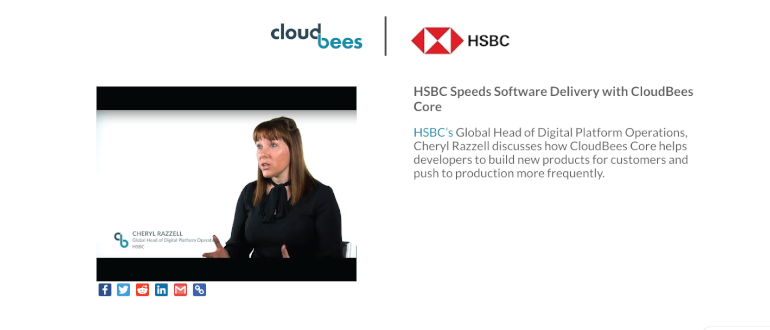
  • HSBC Speeds Software Delivery with CloudBees Core

    HSBC Speeds Software Delivery with CloudBees Core

    HSBC Speeds Software Delivery with CloudBees Core

    HSBC’s Global Head of Digital Platform Operations, Cheryl Razzell discusses how CloudBees Core helps developers to build new products for customers and push to production more frequently.

     I see total evolution of the HSBC environment to encompass CloudBees Core and aligning the roadmaps of CloudBees and HSBC to create a platform that we can use for the future within the bank that not just sits within HSBC digital, but is used by and encompassed by the entire bank. 
    Cheryl Razzell
    Global Head of Digital Platform Operations
    [su_youtube url=”https://www.youtube.com/watch?v=eHgwJAuTIgI”]
  • Illumio and Qualys Integrate Their Solutions to Deliver the Industry’s First Vulnerability-Based Micro-Segmentation

    Integration enables organizations to visualize vulnerabilities across data centers and clouds through a real-time global vulnerability map


    SUNNYVALE, Calif. — APRIL 12, 2018 — Illumio today announced new global vulnerability mapping capabilities on its Adaptive Security Platform®. For the first time, vulnerability and threat data from the Qualys Cloud Platform is integrated with Illumio application dependency mapping to show potential attack paths in real time. The integration between the Qualys Cloud Platform and Illumio delivers vulnerability maps,enabling organizations to see connections to vulnerabilities within and between applications. This new capability also includes an East-West exposure score that calculates how many workloads can potentially exploit vulnerabilities on applications. This integration can be used to generate micro-segmentation policies as compensating controls that reduce East-West exposure and to prioritize patching.

    “Digital transformation leads to an explosion of connected environments where perimeter protection is no longer enough. The focus now needs to shift from securing network perimeters to safeguarding data spread across applications, systems, devices, and the cloud,” said Philippe Courtot, CEO and Chairman of Qualys. “The new Illumio integration with Qualys helps enterprises get visibility across hybrid environments and implement appropriate controls to protect assets from cyber threats, whether on premises or in the cloud.”

    Software vulnerabilities in applications have been the cause of recent headline-grabbing attacks and data breaches around the world, including WannaCry, NotPetya, and Apache Struts. Meltdown and Spectre are among other recent examples of vulnerabilities where potential exploitation could give attackers access to an environment – or to move laterally within data centers and clouds. Due to the growing scale of infrastructure and software vulnerabilities, organizations are unable to patch every vulnerability and may be unable to patch many critical vulnerabilities due to production freezes or for fear of breaking their applications.

    “Vulnerability management is an invaluable tool in every security team’s arsenal. With our Qualys Cloud Platform integration, organizations can see a map of how active, exposed vulnerabilities can potentially be exploited by a bad actor,” said Andrew Rubin, CEO and co-founder of Illumio. “By adding vulnerability maps to our Adaptive Security Platform, security teams can see potential attack paths in real time and immediately implement micro-segmentation to prevent the spread of breaches.”

    New capabilities of the Illumio Adaptive Security Platform:

    • Vulnerability Maps: Enable application security teams, vulnerability management teams, and segmentation teams to understand the paths that bad actors can leverage within data center and cloud environments. Vulnerability maps:
      • Show in real time which applications are connecting into vulnerable ports.
      • Show the risk inherited by destination applications when the initiating connections are unpatched.
      • Eliminate unnecessary attack surface by showing vulnerabilities with no active or historic traffic.

    Vulnerability map: see vulnerabilities in the context of the application dependency map.

    • East-West Exposure Score: Using workload, application, and connectivity context, Illumio gives organizations an exposure score for their East-West traffic. The score is calculated based on how many workloads can potentially exploit the vulnerabilities on any given workload. The lower the score, the smaller the chance that a bad actor can exploit it. If patching is not available, the optimal way to reduce exposure is to use micro-segmentation to reduce the number of workloads that can connect to it.

    East-West exposure score: the number of workloads that can potentially exploit a vulnerability.

    • Automated Policy Recommendations Based on Vulnerabilities: Mitigates vulnerabilities through automatic policy recommendations. The Adaptive Security Platform now ties vulnerability data to application traffic in real time, providing organizations with the ability to use micro-segmentation to prevent the spread of breaches.

    Automated vulnerability-based policy recommendations: mitigate vulnerabilities without breaking your application.

    Illumio has maintained a track record of continuous innovation to meet the growing needs of the emerging micro-segmentation market. In 2017, Illumio achieved 300 percent year-over-year bookings growth. This rapid growth is being driven by organizations who are increasingly turning to Illumio to prevent the spread of breaches inside data center and cloud environments and to meet regulatory compliance standards such as SWIFT, PCI, GDPR, and HITRUST.

    Watch the demos to learn more about vulnerability maps and the Illumio Adaptive Security Platform.

    About Qualys Cloud Platform

    As a revolutionary unified architecture powering more than 15 Qualys security and compliance Cloud Apps, the Qualys Cloud Platform offers customers a streamlined solution for avoiding the cost and complexities of managing multiple security vendors. By automatically gathering and analyzing security and compliance data from IT assets anywhere in one single-pane view, the Qualys Cloud Platform gives customers the scalability, visibility, accuracy and breadth of capabilities to fight cyber attacks and build security into their digital transformation initiatives.

    About Qualys

    Qualys, Inc. (NASDAQ: QLYS) is a pioneer and leading provider of cloud-based security and compliance solutions with over 10,300 customers in more than 130 countries, including a majority of each of the Forbes Global 100 and Fortune 100. Qualys helps organizations streamline and consolidate their security and compliance solutions in a single platform and build security into digital transformation initiatives for greater agility, better business outcomes and substantial cost savings. The Qualys Cloud Platform and its integrated Cloud Apps deliver businesses critical security intelligence continuously, enabling them to automate the full spectrum of auditing, compliance and protection for IT systems and web applications on premises, on endpoints and elastic clouds. Founded in 1999 as one of the first SaaS security companies, Qualys has established strategic partnerships with leading managed service providers and consulting organizations including Accenture, BT, Cognizant Technology Solutions, Deutsche Telekom, Fujitsu, HCL Technologies, HP Enterprise, IBM, Infosys, NTT, Optiv, SecureWorks, Tata Communications, Verizon and Wipro. The company is also a founding member of the Cloud Security Alliance. For more information, please visitwww.qualys.com.

    Qualys and the Qualys logo are proprietary trademarks of Qualys, Inc. All other products or names may be trademarks of their respective companies.

    About Illumio

    Illumio, the leader in micro-segmentation, prevents the spread of breaches inside data center and cloud environments. Enterprises such as Morgan Stanley, BNP Paribas, Salesforce, and Oracle NetSuite use Illumio to reduce cyber risk and achieve regulatory compliance. The Illumio Adaptive Security Platform® uniquely protects critical information with real-time application dependency and vulnerability mapping coupled with micro-segmentation that works across any data center, public cloud, or hybrid cloud deployment on bare-metal, virtual machines, and containers. For more information, visit www.illumio.com/what-we-do or follow us @illumio.