Author: Derek E. Weeks

  • Rugged DevOps: Making Invisible Things Visible

    Rugged DevOps: Making Invisible Things Visible

    You might already know them from theagileadmin.com, but let me introduce you to two of the leading minds in the Rugged DevOps movement: James Wickett and Ernest Mueller. Both James and Ernest are active leaders in the DevOps space, in addition to helping organize events such as DevOpsDays Austin and LASCON. Our conversation covered a lot of bases from the founding of Rugged DevOps to aligning organizational silos to lessons learned from W. Edwards Demings.

    Wickett: Hi, I’m James Wickett. I work over at Signal Sciences. I’ve been doing stuff in the DevOps space for quite a while and am interested in security as well.

    Mueller: Hello, I’m Ernest Mueller. I work at AlienVault. I’ve also been in the DevOps world for a long time. James and I have worked together a lot in the past, and we blog together at the agile admin.com.

    Weeks: There is a lot of conversation going on around Rugged DevOps. Is this the end of traditional security as we know it, or is there a place for what security has been doing all along to coexist with some new ways?

    Mueller: Certainly. Every field has to continue to innovate to survive. And InfoSec is no exception. IT operations is no exception. The reason that we attend the RSA Conference and that there is a DevOps track is because IT infrastructure operations and systems professionals have the same issues. Right? The long lead times, bottlenecks, not being well-aligned with your customers. And we managed to find a way out of that using leading principles, using agile principles, to where we could improve the state of things.

    Can the old coexist with the new? It certainly can for a time. I think, though, there is an extent to which the new modes of thinking in the end have to be adopted or you die out, right. You’re still doing your core thing. You are providing IT operations or you are providing security, but the way you do that has to change and keep pace with business demands.

    ___

    Every field has to continue to innovate to survive. And InfoSec is no exception. IT operations is no exception.

    ___

    Wickett: We talk about this in our presentation on lean security here at the conference. It is not so much of a question of “replacement” or “is traditional security going to be around longer?” It is just going to look a lot different.

    The really cool thing (and what Ernest mentioned as well) is we both worked together in operations shops in the past. That was five or eight years ago when operations was then where security is now. Operations today looks dramatically different than it did 10 years ago. I think the same thing is going be true about security. (See slides from Ernest and James.)

    https://www.youtube.com/watch?v=D6TnKUWPqvg

    Weeks: When I talk to a security audience about how they interact with development, they are like, “Ah, we have no access to development.” When I speak to development communities about security they are like, “Ah, don’t let those guys in the room.”

    Part of the Rugged DevOps conversations is not only how do you bring security into development, but how do you bring it in early enough into the development life cycles. How have you been able to bring security in and bring it in early?

    ___

    Operations today looks dramatically different than it did 10 years ago. I think the same thing is going be true about security.

    ___

    Mueller: Again, this is one of the core problems that DevOps faced at its initiation, where that exact same dialog occurred between developers and operations.

    There are a number of techniques you can use. But what you have to understand is that you are looking at an underlying culture change. There is no silver bullet for that, and so it can take years. But aligning both the people that are trying to do the work and the management that is trying to organize it to understand—that sort of close collaboration throughout the entire pipeline is what’s important.

    And there are some times where you have to power through it. I remember early on in our DevOps implementation at National Instruments. We had started having design reviews with developers and operations personnel that were in the same room. The application architect approached me and said, “These guys keep asking us questions that we don’t really even understand or know the answers to about capacity or about reliability. Maybe we should just have separate reviews.” I said to him, “Well, you have two options. We can continue to do them separately, and we can continue to not understand each other. Or, we can do it together and power through it. And it really shouldn’t take all that long before we do start to understand each other because we all have the same goal, which is to ship these products.”

    ___

    I said to him, “Well you have two options. We can continue to do them separately, and we can continue to not understand each other. Or, we can do it together and power through it.”

    ___

    So we powered through it, and it really didn’t take that long for everybody to finally get to a good point where they could understand and collaborate with each other. But it took determination to get there.

    Wickett: I think that was really, really well said. We are having that conversation where we’re saying we do need to shift left. We are saying we do need to make it earlier. We’ve kind of seen the writing on the wall. How do we get there?

    I think there are some practical approaches. We are just taking small steps. I have seen people do this at different organizations. There have been a lot of talks on this. But when putting security into your continuous integration in your delivery chain, I think there is a huge gap.

    I work at Signal Sciences so it is one of the things we do. But there is a huge gap in the operations knowing whether we are under attack, why are they attacking and what are they trying to do. Right? And I am not saying you need to buy our product to get that done but there is …


    Weeks: I’ll say it. You do need to buy his product.

    Wickett: Good, please, say that.

    But it’s amazed me how often shops have no idea what’s actually going on. They don’t really know what parts are being attacked. They don’t know what’s happening on their site. They don’t have any sort of security operational telemetry coming back to developers or to management.

    As we’ve seen in lean, those are the invisible things. You’ve got to make them visible. I don’t know what that’s going to mean for people’s organizations. I could make a bunch of random recommendations, but take the principle of making those invisible things visible and start trying to apply it.

    ___

    Take the principle of making those invisible things visible and start trying to apply it.

    ___

    Weeks: Building on that: Part of the whole discussion around DevOps is rapid feedback loops. How do you get information from people as quickly as possible so that they can be informed and take action on that?

    Mueller: Absolutely. Well, I think we’ve seen a lot of fledgling successes in that area. James is the core contributor to an open source product called Gauntlet that introduces security testing into continuous integration processes. We’ve seen presentations at other conferences, from Twitter and from Etsy, where they’ve built these security warning systems very, very early on that notify the people that are actually creating the flaw as they are creating it.

    W. Edwards Deming said that we can’t ensure quality by mass inspection after the fact. We have to build integrity into the product as we create it. Unfortunately, a lot of security thinking today is built around mass inspection after all of the mistakes have already been made and then trying to go back and get somebody to do rework of a product that has already shipped, that’s already making money, that’s already out there in customer deployments, whatever. That’s always inherently going to be a much more difficult route at ensuring actual security.

    ___

    We can’t ensure quality by mass inspection after the fact. We have to build integrity into the product as we create it.

    ___

    Wickett: In some ways, we’ve built this problem ourselves. We do compliance on an annual basis. Compliance is built around the waterfall mechanism, and security is a function of compliance or something that they try to accomplish. It’s very antithetical to fast feedback loops. It’s very antithetical to rapid cycles. So we need to find ways to break that down into more discrete chunks that can happen on a daily or weekly or hourly or per-code-commit basis.

    Weeks: How did the rugged DevOps movement originate?

    Wickett: Rewind to 2009 or so, and there are the first signs of DevOps kind of coming through. There is the agile operations thing. People were talking about velocity that year. The first DevOpsDays by Patrick Dubois happened. Flickr says that we’re doing 10 deploys a day. And just everybody loses it.

    At the same time, Josh Corman came out with the Rugged Software Manifesto in 2010. I read that. And Ernest and I were both latching onto DevOps at that time, and we were trying to do some cloud-based implementations but really focused on the DevOps-centric vision around that.

    We told ourselves, “We can’t just stop at Dev and Ops. We have got to have security.” And this is while we were taking a lot of telemetry data from Internet of Things (IoT) types of devices and thinking that’s going to need to be secure if we ever wanted to get a customer on that. So we really started to try to put that together.

    ___

    We can’t just stop at Dev and Ops. We have got to have security.

    ___

    We stumbled across the rugged stuff, and at the same time, we just really felt like rugged and DevOps were two things that were moving in different tribes. They were both trying to accomplish very similar-type missions. In Austin, we run the DevOpsDays event there. We have a lot of security folks in the Austin area. It’s the capital of Texas, so there are a lot of folks related to that.

    It seems like the DevOpsDays we’ve had there have a very security-focused push every year, and the rugged language really struck more of a cord than security. To me, that’s a rough brief history of how that’s come about.

    Weeks: James, you also run LASCON in Austin, which is a great security conference. It has a DevOps track where security and development or DevOps come together.

    You are both thought leaders yourselves. But who else do you listen to? If you could tell someone reading this, “Here is someone that you should see at a conference or look for their video on YouTube,” who would you recommend?

    Mueller: Obviously, the list of presenters here at the Rugged DevOps Summit is a litany of many of the best-in-class people to hear speak, whether it’s Josh Corman, John Willis or Damon Edwards. I could list the entire set. People that aren’t here, like Pete Cheslock, have done a lot in merging both DevOps and security.

    Wickett: Throw in Nick Galbreath who I work with now. I really kind of saw him doing some of the same stuff, and I really dig that. Gene Kim, of course, would be a good fit.

    I love learning from Patrick Dubois. When he speaks on anything, I am really interested in what it is. He is doing more mobile stuff these days but always good stuff there. Anybody else?

    Zane Lackey, too. I also work with Zane.

    Weeks: That’s a great list. Thanks!

    Hey, DevOps Austin is coming up in the beginning of May. Is the call for papers still open?

    Mueller: That’s right, the 2nd and 3rd of May this year.

    The DevOpsDays Austin call for papers is open, call for sponsors is open, and tickets are being sold, although early birds are sold out already, so I recommend that people move quickly.

    We’re in our fifth year. The last couple of years, we have been filling up our venue at 500 people. We have actually moved venues to the University of Texas Darrell K. Royal-Texas Memorial Stadium this year, so we have a little bit more space, and we’re riding on more tracks. We’re riding on a hack-a-thon actually.

    It’s interesting. One of the things you have to be careful about in this whole thing is not losing the developers.

    ___

    One of the things you have to be careful about in this whole thing is not losing the developers.

    ___

    People that were very involved in OWASP for a long time saw that started off as a developers and security sort of thing. And over time, unfortunately, that relationship was lost a little bit, and they’ve had challenges as a result.

    Now we are like, “How do we get the developers back collaborating with security?” We’re trying to make really sure that there is a lot of interest in DevOps out of the operations space, and so that can sometimes start to push out the content the developers find compelling.

    We’ve added a content tract and a hack-a-thon to try to make it super compelling to developers this year.

    Weeks: Excellent. James, I think you guys just secured a Series A. Is that right? Should we tell people you are hiring at Signal Sciences? Is AlienVault hiring too?

    Wickett: Yes, I think Signal Sciences is hiring both in the L.A. area and across a lot of remote positions. The engineering team has a number of remote members.

    Mueller: Absolutely, we are hiring too. We have teams in Austin, out here on the West Coast and in Ireland. Our original office was in Madrid, Spain. So we have a lot of folks there if we have any international readers on the blog.

    Weeks: Excellent. Perfect. I appreciate you guys spending time with me. Absolutely enjoy the conference, and we’ll point people to the recording of your session as well.

    Wickett: Cool.

    Mueller: Super.

    Wickett: Thanks, Derek.

    Weeks: Thank you very much.

    If you loved this interview and are looking for more great stuff on Rugged DevOps, I invite you to download this awesome research paper from Amy DeMartine at Forrester, “The Seven Habits of Rugged DevOps.”

    Untitled2

    As Amy notes, “DevOps practices can only increase speed and quality up to a point without security and risk (S&R) pros’ expertise. Old application security practices hinder speedy releases, and security vulnerabilities represent defects that can leave a company open to cyberattacks. But DevOps practitioners can leap forward with both increased speed and quality by including S&R pros in DevOps feedback loops and including security practices in the automated life cycle. These new practices are called Rugged DevOps.”


  • Intuit’s DevSecOps: War Games and Culture Hacking

    Intuit’s DevSecOps: War Games and Culture Hacking

    If you ever wanted to learn about Rugged DevOps (some call it DevSecOps), sit down for a spell with Shannon Lietz, Ian Allison and Scott Kennedy from Intuit. We discussed a number of important topics including internal war games, culture hacking, gamification of Rugged DevOps and starting as a small team. There are 100 gold nuggets in this conversation for novices and experts alike.

    Derek Weeks: I have some of the Intuit DevSecOps team here with me today. We’re going to talk to them a little bit about Rugged DevOps and how things work over at Intuit. Let’s start with some introductions.

    Allison: I’m Ian Allison. I help run the Red Team at Intuit, which is, I guess you’d say, an interesting way of taking control of security at our company. We try to get ahead of the attackers by basically being the attackers. We’re essentially ethical hackers. We go after all of our own stuff to make sure we can find where the deficiencies lie in all of our software.

    Lietz: I’m Shannon Lietz. I’ve been working at Intuit 3 1/2 years and helped to found the 24×7 DevSecOps capability at Intuit, leading the Red Team, our security operations capability, our cyber SOC, and what we also consider “blue teaming”: being able to hunt for defects.

    The organization has really had to transform how we do software development because we’re a 30-year-old software company. We are now seeing the traditional way of putting together software really embracing DevOps. For us, it’s been exciting to really work in the industry with Rugged DevOps, trying to help build security into the DevOps movement.

    Kennedy: I’m Scott Kennedy. I run the forensics and threat intelligence part of cyber work.

    Weeks: Shannon (@devsecops), tell me a little bit about software supply chains and how that vision of software development has impacted the way you see things at Intuit.

    Lietz: That’s really a great question. It was interesting when Josh Corman and I first talked; we had a lot in common. One of those things was the software supply chain. What I really love about the concept is being able to have processes driven a certain way so that you can reduce defects.

    Having worked for Toyota in the past and understanding the supply chain mentality, you get a sense of how you could put something together better, incrementing on it, figuring out how to share that process, and then really figuring out what things are important. Having that notion of fewer, better suppliers was really a core concept.

    I love the idea of transparency, building things a certain way, and really getting into continuous improvement. You need to look at things from an opportunities perspective—making sure you’re not just looking to make things perfect. You’re looking for those opportunities to improve over time.

    https://www.youtube.com/watch?v=nRaURhaTH9o

    Weeks: As we think about Rugged DevOps within your security team, how do you measure the success of what you’re doing? What kind of metrics are you looking at that matter to the business?

    Lietz: We measure everything. For example, mean time to remediation (MTTR). Once somebody finds a defect, we analyze that defect from the time it got into the supply chain to when it actually gets resolved. We track everything from mean time to remediation to when the ticket was created, to being able to look at when the code actually got published, to when it actually got found, and then we work on those things over time. We really try to uplift.

    ____

    Once somebody finds a defect, we analyze that defect from the time it got into the supply chain to when it actually gets resolved.

    ____

    We leverage JIRA [Software] just like a software development team does. We register our defects and figure out how to get development teams to take responsibility for those ideas. It goes through their process of release and regression testing. As part of that, we look back to see where our opportunities are.

    As an example, we started out where things may have taken weeks. We then reduced it down to days and ultimately got it down to hours. We’ve seen defect resolution where it’s now minutes. When it’s something we’ve discovered that was just a mistake by an engineer, we realize “mistakes do happen.” We found that our cycle times also help us to find fault stack vulnerabilities in real time because we get to do end-to-end testing more aggressively utilizing this method.

    Weeks: How has consistency in your operations helped with Rugged DevOps and has it fragility within the organization?

    Allison: One of the things we do is to utilize a golden image for all of the AMIs (Amazon Machine Image) we use, for all of our customers, and we require everybody to use these AMIs. We’ve also built some really interesting automation around scanning these AMIs. So one thing we realized quickly when we first started native U.S., when we try to do full vulnerability scans against another system, if it’s set up to autoscale, we all of a sudden have 50 systems. Right? We can’t … it’s really hard to do a full vulnerability scan right against the system, so we came up with a way to share back all of the AMIs with a special account. Then we bring those up and we scan them. Then we grade them.

    Based upon the vulnerabilities that are found, you’ll get a letter grade, like A through F, based upon the system you have. While we always strive to have our base image be an A, people continue to run on older images. But they get graded, and those grades get pushed up, so everybody in their org structure gets to see what the grade is for their account. I think by being a little standardized, basically with these images, lets us know what’s in everything, and we have a grade for everyone. It helps everyone have a really good idea of where they stand when it comes to a security standpoint.

    ____

    Based upon the vulnerabilities that are found, you’ll get a letter grade, like A through F … so everybody in their org structure gets to see what the grade is for their account.

    ____

    Weeks: That’s not only a grading but a policy enforcement governance kind of role that grading plays. How rapid is the feedback loop in that grading system for the teams that you’re working with?

    Lietz: It’s really quick, and we’ve discovered through some science that having component-based resources like AMIs provides us with an advantage when doing things like remediating vulnerabilities. Using AMI-based resources, we have seen that when there’s a defect in it, we can find and remediate all of the defective AMIs quickly. That improves everyone’s security across the company.

    So if you’re just picking out really good components, keeping track of those components and adding security into them, then you’ll actually see a different effect across our pipeline. A single change can actually have a dramatic effect on reducing the problems within the pipeline.

    Allison: It’s really interesting. This morning I got an email from somebody that said, “Why did our baseline AMI go from an A to a C today?”

    We had just received notice of a new vulnerability. Our stuff caught it, we scanned it, and we pushed the grade out to our portal where all our customers go to look at the grades. Our customers were able to see that change quickly.

    They could now say, “Wow, it changed from an A to a C in less than 12 hours.” I think the feedback is really important. The other important thing is that we have people going and looking. I wouldn’t be getting emails about why has this changed if people aren’t actually looking and wanting to make their grades better.

    Weeks: You mentioned customers. Are these internal customers?

    Allison: Internal.

    Lietz: Yeah, for our development teams, we as a security team really have changed how we think about things. It used to be that the security team would go out and govern. Basically, you got the fear of the security team coming in, descending upon you.

    We’ve really changed how that happens within our organization. We grade our resource components, and we grade the way in which our applications come together. That changes how developers want to operate because they really want to figure out how to get better grades in security. And it creates a learning dynamic that incentivizes somebody to improve continuously.

    ___

    That changes how developers want to operate because they really want to figure out how to get better grades in security. And it creates a learning dynamic that incentivizes somebody to improve continuously.

    ___

    Weeks: Does it create a competitiveness or gamification of who has better grades?

    Lietz: Absolutely, which is why we did it in the first place. To your point there, gamification is something where when you start to grade components like that, you can actually start to leverage a leaderboard concept. We do have leaderboards as part of this. We have APIs where you can actually pull down your grades and include them in your automation. With these, you can make governance decisions.

    If you sort of have that “game afoot,” right, your leaders can then ask for specific grades within their pipeline. That up-levels the system, and you just see a continuous improvement lifecycle come to bear. Ultimately, you see fewer defects, and ultimately, you get to the notion of Six Sigma in our way of thinking. DevOps is really about continuous improvement and embracing automation. Embracing that concept allows us to get to fewer defects faster.

    ___

    DevOps is really about continuous improvement and embracing automation. Embracing that concept allows us to get to fewer defects faster.

    ___

    Weeks: As you embraced continuous practices and DevOps practices, were there points when you realized certain old ways of doing things weren’t going to enable you to move forward?

    Kennedy: In looking at the progression of what we’ve been doing, one of the decisions that was made in Intuit and one of the things that I saw was really unique was the way they decided we were going to migrate into AWS. Our idea was to have the chaos team be the first people out, and that’s the security team. So the security team was the one that was going out and finding out how to use each of the products that AWS has and creating the concept of whitelisting. Each product was rated as to whether or not it met security’s requirement.

    Therefore, no team can go ahead and pull down this new cool tool that AWS released yesterday and use it in production because it’s not been “whitelisted.” That can go into their scoring. Their scoring is not only used by the development teams but also is useful when reporting to the board. When the board asks, “How are we doing as a company across the entire organization?” we can say that product A got a lower score than product B, and then they turn to the VP in charge of it and say, “Well, why?”

    ___

    When the board asks, “How are we doing as a company across the entire organization?” we can say that product A got a lower score than product B, and then they turn to the VP in charge of it and say, “Well, why?”

    ___

    We decided to not rush into the cloud but to take a careful, considered approach and migrate in a very intelligent and well-thought-out way. At the same time, we gave the chaos team the ability to make the mistakes and grow and learn, so they can immediately turn around and share the mistakes with everyone else. They could say, “Hey, these are the things that didn’t work for us. We came across a lot of problems, especially when you look at things like accounts and account roles.”

    How do you control when you have thousands of accounts and you need to have some sort of administrative control?

    You can either have a gigantic effort to force your namespace and your Active Directory to be the source of control. Or you can use the vendor-specific tools like IAM and have each account have their own separate islands, but with the concept of cross-account roles, you can then do remote administration from a centralized account. You have it locked down. You have the capability to have a restricted group and be able to remotely go in and do the necessary actions.

    That also gives you an audit trail. That also gives you multifactor built in because the AWS products get those things added to them.

    Lietz: I think when it comes down to it, I think culture-hacking your environment can have a profound effect, especially when you’re going through a DevOps transformation.

    Weeks: What is culture hacking?

    Lietz: That’s a great question. We use it when really trying to figure out how we as a security team can change and transform. A lot of the things that take place in a company are really based on traditional processes: What has worked before, and why would we change something that is working, right? If you’re really going to go into an innovative frame; if you’re really going to get into that next-generation innovation; if you are trying to figure out what’s going to work in that … it’s never going to be the thing that is working. It’s going to be the thing that you’re going to learn as you go to that next step.

    Culture hacking is really about looking at the people who are operating right now and trying to figure out how you’re going to help them go from A to B, making that change. What is that the experience going to be like?

    What we have done, to Scott’s point, is we’ve forced our security team to have empathy for the DevOps teams. We go through the process of developing something in the cloud, utilizing it as a method of taking their paranoia and trying to balance the notion of getting something done within a specific time frame. We try to really wrangle what it takes to do those things securely and safely but, ultimately, still be able to deliver for the business.

    I think that culture hacking really comes into play when you’re trying to figure out how to move somebody from the rock they’re on to the rock you need them to be on and trying to figure out what those mechanisms are.

    ___

    Culture hacking really comes into play when you’re figuring out how to move somebody from the rock they’re on to the rock you need them to be on.

    ___

    Weeks: Part of your security practice is looking at open source and third-party components and your own binaries. Can you shed some light on how Intuit is using Sonatype solutions to better manage those vulnerabilities?

    Lietz: Yeah, Sonatype Nexus is a fantastic platform. We love the Nexus repositories. We love how you guys put together a community. We learn a lot.

    A lot of our DevOps practice is working together with it. We’ve put together our Nexus repositories to do code signing and figuring out how to really secure our pipelines a certain way. We are taking advantage of the fact that we can pick up components, track them and then scan them [for known vulnerabilities].

    That’s allowed us to reduce the defect count that goes to production. Actually scanning and looking for vulnerabilities within our components and our open source libraries allows us to make better decisions about what we’re including in our software.

    Weeks: When you govern what open source, third-party or proprietary components are being used by developers, is there any kind of feedback from the teams saying, “Hey, you’re restricting my behavior, not improving my innovation”?

    Lietz: What we’ve found is that the notion of security approvals, exceptions and gates really doesn’t work. Quite often, you just create a culture where developers are going to go out and do it, and then you’re going to find out about it. When it comes to really partnering and being boundary-less about how you think about security in your business, it’s all about transparency. It’s all about benefits. It’s creating things like a security markdown file within your repository manager. It’s about taking responsibility and accountability for the things that you’re doing from a security perspective in your development process. It’s ultimately having an attacks.md file, keeping track of what’s out there, keeping track of your open source, understanding what components you’re leveraging, and why you made the decisions that you made to bring those things into your project.

    ___

    It’s about taking responsibility and accountability for the things that you’re doing from a security perspective in your development process.

    ___

    At a top level, all of those things work. But really having tools that can help the decisions that were made by some of the other open source programmers that you’re getting contributions from is really necessary. All of the things that they might be deciding are also part of your decision tree, and ultimately, you’re rolling all of that and bundling it together. The attack surface is not just the decisions that your team is making, but the ones that you share across the code base that you’ve got.

    Weeks: Your practices are very mature. You’ve clearly developed them over a long time, and some people watching this might think, “Well, Intuit’s a huge organization,” and it may be daunting to them if they haven’t started down the path of Rugged DevOps. Can you be a small team and have success in these kind of practices?

    Lietz: We’re not exactly a huge organization, but we are relatively large in size now. When we got started, I believe I was one of maybe three people that started this, only a couple years ago. We have hired into our group pretty extensively to help grow it, and some of the things that we’ve done have really allowed us to operate differently, to bring in people and have them immediately be successful. Our practices allow someone “day one” to be able to work with the environment, to be able to develop code, to be able to contribute code that week.

    We do things like weekly demos, where we actually do video demos. A person has to come in, program something, secure something, operate it and create a demo, all within their first week. So having the right bar for those folks is really important, but more importantly, our Red Team leader here (points to Ian), he came in and just is amazing, has created a Red Team pretty much out of thin air. So is having somebody from forensics, who’s just done an incredible job to help us, to make it so that we have a life cycle where we can snapshot something and be able to learn from it when it’s actually offline.

    ___

    A person has to come in, program something, secure something, operate it and create a demo, all within their first week.

    ___

    Those are the types of practices where you start to extend yourself past the normal baseline practices of processes today and really think past that about how you’re going to support innovation. You get into it very quickly. You get a learning culture. You get people who know that making mistakes—and figuring out how to learn from them—is okay. That’s a really important part of that actual culture that you’re putting in place.

    Allison: Yeah, I was going to say, it’s all about iteration, right? We started small, and we just continually iterate on what we’re doing to try to get better and be better at what we all do.

    When I first started this journey, I was a security guy—a pen tester. It was always the developer’s fault. Developers always made the mistakes. I always had to clean up after them. But after six months of developing Ruby APIs and Ruby and working my butt off in code, the empathy was there.

    I really understand what the developers are going through and why they make the choices they do. But I think by allowing us to help them, by creating tooling that allows them to self-serve, to understand it without making them … helps them make themselves more secure without them having to become a security professional. I think that’s kind of our ultimate goal.

    Shannon: Being friendly hackers, right? Basically going out and attacking them so their applications don’t get attacked by external attackers is really part of that frame.

    Kennedy: The Red Team shift at the company has been profound because you see how people react. When the Red Team started, it was not as well shared, and a lot of people suddenly were very upset that they were attacked by the Red Team. But when it was pointed out, “Well, what would you rather have happen? Would you rather have somebody in China do this to you, that didn’t work with you, didn’t sit next to you and help you fix the product, or would you like to have a friend who, by the way, their job is to attack?”

    When we went through several drills and actually practiced the muscle of defending the company against an attack, people were upset. “Oh, I had to do all this work.”

    My response to them: “Well, you did the right work.”

    “You did the right thing. You saw something bad. You did it. You did good. You practiced the muscle. Now when it happens again and it’s not the Red Team, I know that you’ll know what to do. You know that the process works, and we can actually defend the company faster and more securely.”

    ___

    You know that the process works, and we can actually defend the company faster and more securely.

    ___

    Weeks: Yeah. That’s an incredible story. Thank you for sharing it.

    My final question: If you could pick a superpower in dev, security or ops that you would have in the organization, what would it be?

    Allison: To me, they’re all alike; they’re the same, right? That’s what we do, DevSecOps, right? We try not to actually separate them out because I think once you start to separate them out, you start to lose perspective.

    Kennedy: Yep.

    Allison: There’s a good thing about having them all be one thing, so I’d choose them all.

    Kennedy: It’s been pretty consistent. DevSecOps is the answer. What was the question? (Laughter)

    Lietz: I think the reason we went out and created DevSecOps was just simply to change how we thought about doing development and technology—and to really to get ahead of it, to realize that attackers weren’t setting up appointments or meetings to help you figure out how they were going to attack your software, and so then why were we? Why were we operating at a fragile level?

    I think that the superpower that I would like to have is DevSecOps because I know that we are going through the process of creating a less-fragile capability in security that will allow us to get ahead of attackers, make it much harder for them to go after the software that gets built, and we’re seeing those improvements. That’s actually a great thing.

    Weeks: It sounds really exciting, and it’s very cool, so thank you all very much. I really appreciate it.

    All: Thank you.

    If you loved this interview and are looking for more great stuff on Rugged DevOps, I invite you to download this awesome research paper from Amy DeMartine at Forrester, “The 7 Habits of Rugged DevOps.”

    Untitled2

    As Amy notes, “DevOps practices can only increase speed and quality up to a point without security and risk (S&R) pros’ expertise. Old application security practices hinder speedy releases, and security vulnerabilities represent defects that can leave a company open to cyberattacks. But DevOps practitioners can leap forward with both increased speed and quality by including S&R pros in DevOps feedback loops and including security practices in the automated life cycle. These new practices are called Rugged DevOps.”

  • The DevOps Equation: Agility + Empathy = Quality

    The DevOps Equation: Agility + Empathy = Quality

    I had the chance to catch up with Jeff Sussna (@JeffSussna), founder and principal of Ingineering.IT, ahead of his keynote address on continuous design, scheduled for DevOps Days Atlanta, April 26-27.  He discussed the importance of designing for service, responding to the unexpected, and the importance of building empathy across teams.  

    Derek Weeks (@weekstweets): Today I’m really happy that we have Jeff Sussna joining us for the latest in this series. Jeff, why don’t you introduce yourself?

    Sussna: Sure. Thanks for having me. I’m an independent consultant. I’ve been around, since rocks were young or the 80s, whichever is older. My particular background is that I have built systems and led organizations across the entire development, QA and operations spectrum. So, I’m a little unique in that respect.

    My current focus is on helping IT organizations and digital businesses really bring together their ops and design thinking so they can not only go faster and not only be more resilient, but provide more customer value at the same time.

    Weeks: Let’s talk about that a little. How is continuous design—a subject you have written a lot about—coming into play? How can it help us be more resilient.

    Sussna: Just to explain a little about what we mean by continuous design. It’s basically bringing together the entire organization and a unifying design in operations. It’s taking what we are doing in DevOps and expanding it to include product, design and support. It lets the whole organization really have an agile conversation with a market and with its customers.

    The issue that we face is that we live in a service world now. The point is no longer delivering products like cars coming off an assembly line. It’s much more about responding to our customers and having relationships with them. This is happening in a world that is more and more complex while less and less is in your control. We can’t figure everything out in advance. We have to have the ability to respond to the unexpected. We have to be able to do that at every level.


    “This is happening in a world that is more and more complex, while less and less is in your control.”


    I will give you a couple of examples of things that are perfect illustrations of this:

    I recently wished a friend of mine happy birthday. The reason I did that was that because there was a notice on my calendar that said it was her birthday. It was wrong. It wasn’t her birthday. I had no idea where that notice came from. Did it come from Skype? Did it come from LinkedIn? Did it come from email? I had no idea.

    We face that in IT, too. Systems are becoming more complex. We develop microservices. We use public and private clouds at multiple levels. We’re no longer in a situation where we can control things. We have to be able to respond and respond at all levels.


    When we make design and operations unified and continuous, we are able to say, “Where did we think we were going? Where would we need to go? and what do we do next?”


    What I talk about in my book, in my workshops, and all my work is that this needs to happen at every level. It’s not just a matter of designing for failure inside the data center or inside the infrastructure. We also have to do it at other levels.

    Here is another example:

    I was trying to get paid recently by a large enterprise client in Europe. They were trying to wire money internationally and my bank wasn’t really set up for it and they were having problems. They just kind of gave up. I kept getting these messages saying, “Sorry, we tried paying you and it didn’t work.” That was the end of it.

    I started to get frustrated and my client within the enterprise started to get frustrated to the point where they sent a scathing email to our AP department which they CC’d me on, saying, “Why can’t we take the lead to get his guy paid?”

    That’s an approach that is based on resilience in the sense of assuming that something can go wrong and figuring out what he can do to fix it when it can go wrong. As opposed to the traditional approach where we’ve been trained to push certain buttons and take certain actions. If those actions don’t work the way they are supposed to, well, I guess that is someone else’s problem.


    https://www.youtube.com/watch?v=ISSMHmwIMtA


    Weeks: This brings to light some recent conversations I was having with Paula Thrasher at CSRA. She was talking about developing systems and how to make them more resilient. She is using pictures as part of her conversations with people to help visual their work. What work steps are there? What work is flowing? What is communicating with what?

    Are you taking similar approaches with continuous design in how you work with clients to pursue it?

    Sussna: Well, I try to introduce them to the principles and I also try to introduce them to a set of practices which actually comes out of Mark Burgess‘s work on promise theory. It is really a conceptual model for how we think about success and failure and how do we think about service. For example, Amazon helps you get everything you need in your life from shaving cream to batteries to snow tires to books as quickly and easily as possible. In order to keep that promise they make a whole variety of other promises. Some of which filter all the way down to a promise to be able to go over and make a change to production as quickly as possible.

    Once you take that mindset. The interesting thing about a promise and the reason we use that word is because it is very intuitive. We all know what a promise is. We all make promises to each other every day. On the other hand, when we think about it in terms of service, IT, or whatever it may seem a little odd. The thing about promises is that on the one hand we are making commitments to do things and on the other hand promises sometimes get broken. That is actually good because it forces us to think. If I promised to pay my vendor. What do i do if I’m not succeeding in paying my vendor?


    The thing about promises is that on the one hand we are making commitments to do things and on the other hand promises sometimes get broken. That is actually good because it forces us to think.


    It’s sort of flipping our mind. Again, we are doing this in DevOps world where you start thinking about things like mean time to repair (MTTR) instead of mean time between failure (MTBF). We shift from how do we create a situation to how do we create a situation from where nothing will ever break—which becomes less and less possible. When then need to shift to a situation where we can respond more and more quickly.

    We go to executives and say, “We don’t want to worry about how often stuff breaks anymore,” and they freak out. We have to teach them and we have to teach ourselves that we can’t prevent things from breaking. Instead, let’s be able to fix them so quickly that maybe no one notices. My focus is on really helping people shift their mindset from thinking about ourselves to thinking about who we are helping. And from thinking about what we are doing to thinking about how well it succeeds and how well it overcomes problems.


    We have to teach them and we have to teach ourselves that we can’t prevent things from breaking. Instead let’s be able to fix them so quickly that maybe no one notices.


    Weeks: You talked about delivering on promises as quickly as possible. How does continuous design account for doing things as quickly as possible but making sure the quality is there at the same time?

    Sussna: In two ways—one way is that when you do things in small increments you are able to find problems more quickly. This is classic; it comes out of lean. It comes out of integration. It’s pretty basic stuff for our community now that it’s much easier to find and fix a bug five minutes after you change a code than five weeks after you change the code.

    When you put things like Linux, agile, DevOps, and design all together, they all focus on incremental feedback loops where you discover the gap between what you think you’re accomplishing and what you’re actually accomplishing very quickly. Secondly, when you take this all to the way to the marketplace and you make it part of the relationship with your customer, you can reduce a tremendous amount of waste.

    The way to think about continuous design is: it’s all about steering. Think about a boat and you’re trying to sail across a bay. You can’t just point the boat at the other side and say go because the winds are changing and you’re going to be able to respond to things that you can’t predict. If you sail for 20 minutes then discover you had pointed in the wrong direction, you’re going to be way off-course. You’re then going to generate a tremendous amount of energy getting back on course.

    What continuous design says is just an extension of continuous integration and continuous delivery taken all the way though the business. When we steer continuously we steer efficiently.


    What continuous design is really just an extension of continuous integration and continuous delivery taken all the way though the business. When we steer continuously we steer efficiently.


    Weeks: I know you’re going to be keynoting DevOps Days Atlanta coming up in April. Chris Corriere, one of the guys on the organizing committee, tells me that you’re leading a full day workshop on continuous design before that. Maybe you could tell some of the people that are attending DevOps Days Atlanta why they should be there a day earlier for your workshop and what things you’re going to address during that time.

    Sussna: To some degree what I am going to address is everything we have been talking about for the last 10 minutes or so—relative to DevOps. I think the key thing is, and we need to think about it. We need to think about more than just going fast. One of the big misunderstandings that I see with DevOps is this notion that it is primarily about delivering application changes to production faster. That’s only half of it. We really need to think about from the perspective of providing service.


     One of the big misunderstandings that I see with DevOps is this notion that it is primarily about delivering application changes to production faster. That’s only half of it. We really need to think about from the perspective of providing service.


    You know what we are talking about is essentially developers and operations people providing better service to each other. As a result, they can deliver better service to the business.

    Where we talk about microservices. You know that word service is in there for a reason. If all you do is you kind of shatter your organization and shatter your architecture into a bunch of little pieces, you still have to figure out how those pieces come back together into something coherent. The answer to that is taking a really deep service-oriented approach. That is very much what my workshop is about. What does that word even mean and how do we do it?

    Weeks: You mentioned thinking about interactions as delivering better service to one another within the organization. How does empathy come into your thinking around DevOps and Continuous Design?

    Sussna: I’d like to say agility plus empathy equals quality. What I mean by that, in particularly empathy, I think it’s important to take a minute and clarify. When we talk about empathy we are not talking about wallowing in someone else’s pain. We’re not even necessarily talking about things on an emotion or feeling level. It’s very simply the ability to see things as if from an other’s perspective. I will give you a prime example of where that comes into play and how it’s important and how it helps.


    Agility + Empathy = Quality


    When I work with clients, I tend to look at their process using their organization from the product beginning to the support end. Often times I see support getting the short end of the stick. I see places where they get phone calls from customers with features that they don’t even know exist yet. They sometimes get talked down to by development or product or even operations. They say things like, “Well you’re just supposed to support the stuff. You’re the young people. You’re the less experienced people.”

    When we have the ability to see things from their perspective, we can think about how support is actually experiencing our delivery process. If we don’t think about them when we go through the process of delivering new features, they will be lost. Them being lost will show when customers call for help. That will significantly affect customer satisfaction and then even beyond.

    The reason we need to empathize with support is so we can empathize with the customer. Often times when we build things and we don’t think about the notion that our customers might have trouble with it. On the one hand we have the illusion that if we design it and we build it really well, they won’t have trouble. We can’t perfectly predict who they are, what they need or what they will encounter. There’s an inevitability to the idea that they are going to need some amount of help.

    Weeks: I think that is probably the best description of empathy within a DevOps environment that I have heard anyone talk about. Jeff it has been a great conversation. Thank you very much. I really appreciate it and we look forward to seeing you at DevOps Days Atlanta coming up.

    Sussna: Thanks. It has been great talking to you and I am really looking forward to the conference. It will be fun.

    If you want to learn more about continuous design from Jeff, be sure to join us at DevOps Days Atlanta. I will also be at the event giving an Ignite Talk, titled, “Real Heroes Draw Pictures,” focusing on lessons learned from the 31 DevOps and continuous delivery reference architectures I assembled.

  • Rugged DevOps: Less Capture the Flag, More Teamwork

    Rugged DevOps: Less Capture the Flag, More Teamwork

    At the recent DEVNEXUS conference in Atlanta, I caught up with Chris Corriere to talk about his experiences in the realm of Rugged DevOps. Chris is a DevOps Engineer at AutoTrader and a contributor here at devopsy.kinsta.cloud. During our conversation, we discussed automation, culture and collaboration, and which thought leaders he is following. Chris also shared insights on the upcoming DevOps Days Atlanta conference where he serves on the organizing committee.

    Derek Weeks: What’s your definition of rugged DevOps?

    Corriere: Rugged DevOps to me is definitely manifested in the security sector but it’s a shifting quality and awareness left in doing the best we can with the tools we have, the constraints we’re given, and in the environment we’re in. It’s about being more experimental, understanding that we’re going to encounter failure, and learning to adapt accordingly. We’re very much having to make tough decisions in real time. If you’re running anything in production these days, you need to do that as safely and as consistently as you can.

    Weeks: Is rugged DevOps only about security?

    Corriere: No. Security is really about mitigating risks. I think a lot of this ties into situational awareness about understanding your company’s risk. Is it user data? Is it credit card transactions or do you have a Russian botnet running in your infrastructure that you’re not aware of? What’s the asset you need to protect? Are you trying to protect an asset that is not there?

    You can’t have security come in and become suffocating where it’s not needed. In other situations you can’t leave things wide open that really do need to be protected because you’re more concerned with moving quickly than moving safely.

    https://youtu.be/fgMPKkM1NdY

    At the end of the day when you’re mitigating risk, it doesn’t matter if it’s customer data or a broken build or a bad user experience, these are all risks we need to mitigate. That’s really what rugged DevOps is. It is about is tying that value back to the user. It’s knowing what problems we trying to solve and understanding what we doing effectively (or not). It can be locked down as tight as you please, but if you cannot use the tool to solve the problem you picked it up for, it might as well not be running.

    Weeks: Security teams have been one of the last parts of the organization to come into DevOps practices. What’s been your experience with engaging security teams at Auto Trader?

    Corriere: That’s a good question. I’ve had experience with more than just security teams at Auto Trader. I’ve been involved in security a few places and they’ve approached me first when they found out I was into the DevOps stuff. They often come looking for assistance. They want to know: How do we get this baked in? How do we make this a priority?

    It really ties back into multi-factor authentication. It’s a good way to frame it up where you want developers and operations (those people who aren’t permanently rooted in security) to be aware of these things, to have automated scans, to be aware of cross-site scripting, and to understand how to remediate those kinds of issues.

    We’ve been implementing open source tools earlier in the development lifecycle to give us quicker feedback loops in order to be able to triage these things. Security applauds that but they can’t trust us too much with it. They’ve got to verify that we’re doing a good job with this, right? It’s a give and take where I’ve seen security come and offer automated solutions to DevOps teams and those solutions get adopted. The DevOps teams then take that and really start to run with it. Then security wanted to slow down a little bit because they were concerned about the quality of the vulnerability remediation. There is some back and forth there that has to be anticipated.

    ________________________________

    “We’ve been implementing open source tools earlier in the development lifecycle to give us quicker feedback loops.”

    ________________________________

    For security to trust you you’ve got to trust security to a large extent. If you’re putting more automation into the left side of your process and doing things before they hit production should be making your job easier. One of the side effects of that security may start going through some systems with a finer tooth comb because they’re not doing as much fire fighting. That may result in another ask from security. Understanding that this isn’t a declaration of war—we are simply continuing with an incremental progression toward further improvements. Interactions are cyclic and will happen again.

    We need to help security understand our pipeline, determine what’s going to be a good fit, and keep that communication level high so the trust is there. In these symbiotic relationships, cooperation is dependent on that trust. If that trust goes away you end up in something more competitive.

    There’s always room to drop back to where it’s more commensal and knowing when the kitchen’s gotten too hot. At those times, everybody needs to take a cool down lap and come back to it at the beginning of the next month. It goes back to that situation awareness, knowing where you’re at right now before you try to get to where you’re going.

    Weeks: We talked earlier today about red teams, blue teams, purple teams. What are they and can you describe some of the practices you’ve used to end up with more purple teams?

    Corriere: Yeah. Red teams take an attacking, reactive posture. Red security teams are worried about internal compromise, and when they find gray areas—for example, things that haven’t been fully signed off and authorized—it can result in unplanned work cropping up for the DevOps team. Generally that kind of unplanned work is introduced because the “Red” team felt they were not able to accomplish their job another way.

    Then the blue team side of the equation is really trying to stomp all that out. Blue teams keep things standard and locked down. They make sure everything’s approved in triplicate before it gets implemented, which can be rigid and very frustrating for developers.

    Purple teams allow that experimentation in earlier in the development lifecycle where they’ve got a little bit more leash. They’re allowed to experiment and stand up new things and make those things work before they getting it approved. Again, it’s about being transparent. Teams first want to understand what change was introduced and what the advantages of it are. They may also acknowledge that you need more than one solution to some problems, and that one tool might not fit everybody. If they’re using tools to automate that’s good. We can’t box them all into one necessarily. That’s where you see this go from blue and red to more of a purple. There’s more communication. There’s more conversation. There’s less capture the flag, more teamwork.

    ________________________________

    “There’s more communication. There’s more conversation. There’s less capture the flag, more teamwork.”

    ________________________________

    Weeks: You’ve been involved in the conversations around rugged DevOps for awhile. Who are some of the other thought leaders you learn from?

    Corriere: Jamesha Fisher out of San Francisco is one. She’s done some neat security stuff and is starting to look more into the vulnerabilities around some of the automation tools. Where are those vulnerable and where can they be leveraged against us? Automation is great until it automatically starts doing things we didn’t want. Another aspect of that is really trying to think more like an attacker; we need to think about: how would I break into this thing instead of just thinking how do I protect it.

    Georgia Weidman is popular in a lot of security circles and I’ve missed her workshop once. I’d like to catch it. She’s got a book out on pen testing which covers a lot of operations and concepts from an attack perspective. I would say that can be a fault of some rugged DevOps practices; you’re so quick to get the thing working and provide business value that you don’t realize where you’ve left something vulnerable. Sometimes you’ve got questions about why that thing you work with frequently is always locked down. Perhaps you find you can’t use it the way you want to. At those moments, it’s time to read through Georgia’s book. You’ll get some information as to why that thing is not open the way you want and where someone might use it for reasons might not expect.

    ________________________________

    “You’re so quick to get the thing working to provide business value that you don’t realize where you’ve left something vulnerable.”

    ________________________________

    Weeks: As we wrap up I know you’re on the organizing committee for DevOpsDays Atlanta. Do you want to give us an insight on the dates of when that’s coming up and call for papers, et cetera or we can help you share that?

    Corriere: Our CFP is open through the first of March. Our event is going to be in April. It’s the 26th and 27th which is a Tuesday and Wednesday. Monday, the 25th of April, we have Jeff Sussna coming in to do a full day workshop on continuous design. He’s going to be giving the keynote on our first day. We’re excited to have Jeff in town and excited to have him as a keynote. John Willis is going to be giving our keynote on the second day.

    We’re looking for proposals from anything in progress, people learning in the field, or trying to drop that barrier of entry. We’ve got a lot of bright people in the space. We’ve got a lot of people learning as they go. We need to be more vocal about that learning process and how we find our way through it. There’s not always this instantaneous vision that strikes us. We understand how to convert a shop into continuous delivery every night. There are definitely steps in between that. We need to have more conversations about those step in our industry. Yeah, anywhere in the stack, any interesting projects going on, we’d love to hear from you if you’ve got something.

    If you are interested in learning more about this subject, I invite you to download Amy DeMartine’s Forrester research paper, “The 7 Habits of Rugged DevOps.”

    As Amy notes, “DevOps practices can only increase speed and quality up to a point without security and risk (S&R) pros’ expertise. Old application security practices hinder speedy releases, and security vulnerabilities represent defects that can leave a company open to cyberattacks. But DevOps practitioners can leap forward with both increased speed and quality by including S&R pros in DevOps feedback loops and including security practices in the automated life cycle. These new practices are called Rugged DevOps.”

  • Getting Rugged DevOps Right

    Getting Rugged DevOps Right

    Two Perspectives

    Jack, an accomplished application security pro, tells me, “The developers won’t talk to us.  It’s like we speak a different language.  They are releasing new builds so fast, how could they check each one for security vulnerabilities?  We can’t move as fast as they do.”

    Then in the next moment, Diane, a DevOps pro, let’s me know, “Our current security team’s tools and practices can’t keep up with the pace we have now established.  If it doesn’t fit, it doesn’t get done here.”

    I have heard this little ditty ‘bout Jack & Diane so often in the past two years, it could be a hit record. I imagine you have heard it too.

    The Slow Lane Won’t Lead to Rugged DevOps

    Let’s visit Jack’s world, first.

    When visiting a well-known bank last month, they shared insight on their current application security practice.  They have 10 full-time people employed (offshore where personnel costs are lower) to analyze a set of 100 applications.  The bank has over 2000 applications, but the security practice can’t scale to access their entire portfolio.  In 2.5 years, they had only been able to cover 5% of the application portfolio.

    The application security team employs an application security tool originally built for waterfall-centric development timelines.  As much as they want it and need it to move faster, it is not really for “continuous” velocity.

    Each scan of an application can require anywhere from four hours to two days to get an assessment report.  The reports average about 30,000 potential defects which then require further analysis.  That analysis may take up to two weeks in order to sift through thousands of false-positives and false-negatives.  While this security practice is critical to the bank, it cannot keep pace with development practices that are aiming to go much faster in order for the bank to remain competitive in their industry.

    The Continuous Gap

    Sound familiar?  It should.  This scenario is playing out all across the DevOps and Continuous Delivery landscape.  It is reflective of what I call “The Continuous Gap”.

    Leaders in Rugged DevOps practices aim to minimize the “Continuous Gap”.

    In Diane’s world, DevOps teams pursue “shift left” strategies in an effort to build quality in from the beginning.  Shifting left enables them to bake in the right code, components, configurations, and practices from the beginning.  When done right, velocity increases dramatically, while operating costs are minimized, and unplanned/unscheduled work is reduced.  Investments can then shift more in favor of innovation over upkeep and maintenance.

    The Old-School Rub

    Jack’s world of traditional application security practices often wait to check for security vulnerabilities at testing or release stages of the SDLC.  There are two reasons for this: (1) some security tests like static or dynamic analysis can take hours or days to perform and (2) security teams cannot embed themselves earlier in the SDLC (due to political, organizational, or operational obstacles) without dramatically slowing development in a high velocity world.

    If you are using old-school application security tools, you will continue to be blocked from getting more deeply entrenched in development.  New velocity requirements call for new approaches.

    The New-School Shifts Left

    A number of newer application security solutions and practices been introduced recently that are development and developer-centric.  For example, imagine if build managers could analyze every open source component used in every build for known security vulnerabilities.

    What if, developers could access information inside their IDE that would inform them if a component they were planning to use in an application was known to be vulnerable?  What if developers had access to spell-check like alerts of security issues as they were creating their code?

    Furthermore, imagine if information was available that not only told the developer of a known security defect, but directed them to an alternative safer version of that component to use.  Components would be automatically vetted against corporate security policies at the instant they were chosen by a developer.  When 90% of an application is composed of open source and third party components today, automatic analysis early in the lifecycle save millions of dollars.  This how Rugged DevOps rolls.  This is Diane’s world.

    The evolution of Rugged DevOps is forcing application security practices to shift left.

    But Diane’s world (and your’s for that matter) are not just about increasing velocity.  All organizations need to consider operational costs to both detect and remediate security vulnerabilities in their applications.  We all realize that the further along we are in the application development lifecycle the more costly fixes become.  Feel free to apply your own cost figures to the chart below, but you should also note that these calculations do not include breach cost, help desk calls, maintenance, time-to-market, reputation or stock price.

    Rugged DevOps
    Cost considerations for Rugged DevOps practices compared to waterfall approaches.

    Rugged DevOps: Shifting Gears…Quickly

    Shifting from old-school to new school approaches doesn’t take long.  On a recent visit to one of the largest insurance companies in North America, they shared their tale of transition.  Of five major applications that run their business, one in particular had 40,000 different files that needed to be analyzed.  Their old-school approach involved a lot of manual code investigation and required about two-and-a-half weeks to complete the analysis of that large application.  The new approach that used automated analysis of security vulnerabilities took two minutes — and produced identical results.

    A government tax office wanting to shift security analysis of applications from hours (outside of development – Jack’s world) to seconds (inside of development – Diane’s world) was able to complete the first pass analysis of their existing portfolio of 600 applications within two working days.  The security team was not only faster at identifying known security vulnerabilities in applications, but could also quickly identify alternative open source and third-party software components that were safer to use.  The security team was not simply discovering issues, but the new class of Rugged DevOps solutions were aiding in guided remediation.

    Questions to Ask About That Rugged DevOps Solution

    There are several companies and open source projects that now offer application security solutions that work at extremely high velocity.  When exploring solutions to match the velocity of your Rugged DevOps practices, consider asking the following questions:

    1. How long does it take to complete the analysis of a small, medium, and large application?
    2. Do developers use these tools, or are they only meant for security personnel?  Do you have members of development teams that act as positive references for your tool?
    3. Does the analysis require further investigation of the findings, or does it pinpoint the root cause of the issue?
    4. Does the solution only identify vulnerabilities or does it help guide remediation of issues?
    5. What is the balance of false positives to positive alerts generated by the solution?
    6. How many people are employed to support the solution in environments similar to ours?
  • DevOpsSec: Survival is Not Mandatory

    DevOpsSec: Survival is Not Mandatory

    Deming, the patron saint of DevOps once advised, “It is not necessary to change.  Survival is not mandatory.”

    To survive, application development teams are constantly pressured to deliver software even faster.  But fast is not enough.  The best organizations realize that security, quality and integrity at velocity are mandatory for survival. Hence, DevOpsSec

    My aim here is to leave you uncomfortably amazed.  While the pace of development has changed significantly, our processes to secure our applications has not changed enough.  It is as if a wildfire has raged uncontained for years now but we have failed to take notice.

    Maybe that sounds a bit crazy, but once I share a little background on what is happening, you’ll understand why innovation in this arena is critical for survival (when it comes to your applications).  If you are aiming to ramp up your own Rugged DevOps or DevOpsSec practices, this is critical reading material.

    Skyrocketing Usage, Plummeting Visibility

    Open source component use in development is skyrocketing, and for good reason.  Over 17 billion open source and third-party components — across the major development languages — were downloaded last year helping development teams accelerate release timelines and deliver more innovative solutions to market.  To better imagine the impact of this download volume, you need to understand that there are an estimated 11 million developers responsible for the billions of downloads.

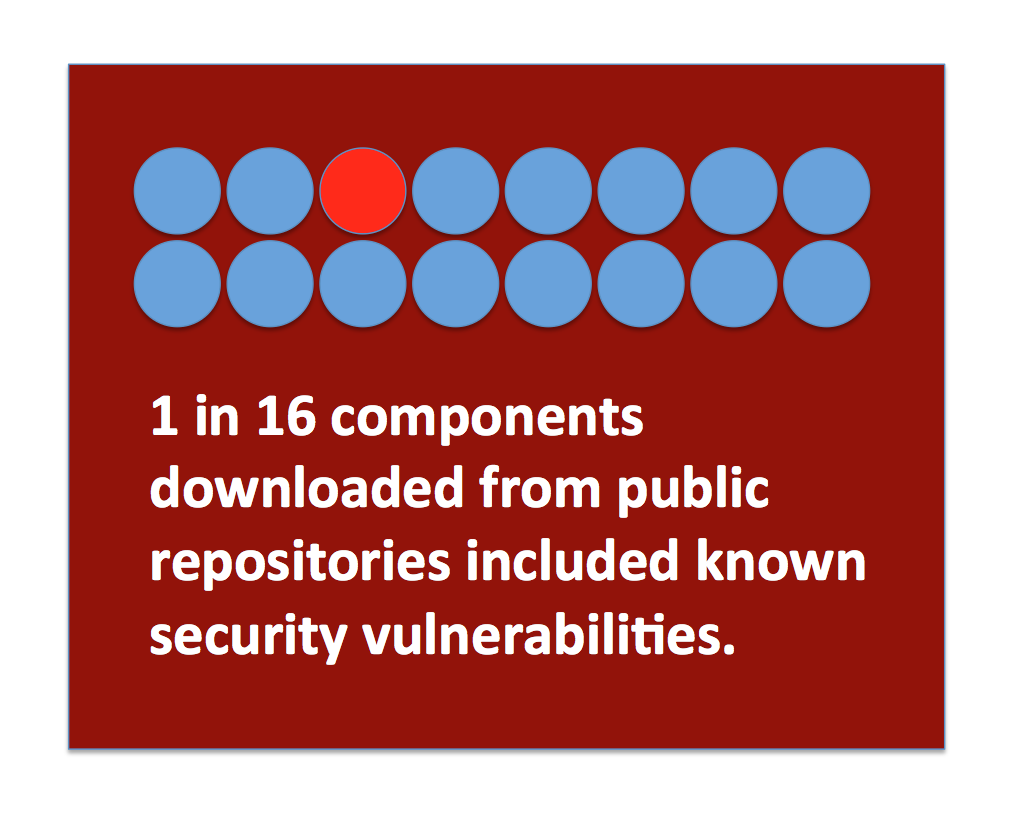
    While the magnitude of usage is amazing it has obscured a vast majority of the risks.  Of the billions of downloads recorded last year, 1 in 16 components downloaded had known security vulnerabilities.

    Screen Shot 2015-11-30 at 1.23.55 PM

    While we have seen 30x growth of download requests over the past seven years, we have also witnessed huge growth in the number of organizations improving the speed of consumption and efficiency of their downloads using repository managers.

    In the past 18 months since I joined Sonatype, we have seen active instances of repository managers like Nexus, Artifactory, and Archiva grow from 40,000 to over 70,000 installations, with users in the millions — also for good reason.  Development teams want to ensure faster, more reliable builds.  They also need a private and safe place to house and share their own proprietary components as well as assembled applications, images and other binary outputs.  The repository manager has established itself as a parts warehouse for software development.

    All is Not Moonlight and Roses

    1 in 16 may not sound like a lot until you recognize that many organizations are downloading over 250,000 components every year…some of the largest organizations consume millions of them.  If you have not calculated this in your head yet: 250,000 / 16 = 15,625.

    Screen Shot 2015-11-30 at 1.24.07 PM

    Couple this fact with the remarks in the 2015 Verizon Data Breach and Investigations Report stating that applications were the most often exploited attack vector by hackers.  As a developer community we are electively sourcing known vulnerable components for use in our applications and those applications are now more vulnerable to attack.  

    Your Repository Manager Should Serve and Protect

    If bad components are getting in, why not just stop them at the front door?

    Easier said than done.   Current approaches to preventing such behavior are ineffective.  For some, “golden repositories” are used to house approved components — but components approved once are rarely vetted again for newly discovered vulnerabilities.  For other organizations, OSS Review Boards mandate reviews and approval for all new components — but these organizations are poorly staffed to match the volume and velocity of consumption leading to workarounds by development teams.  And while developers themselves would much prefer to use the best quality, highest integrity components when designing an applications, they are never allocated sufficient time to investigate the vulnerability status of every component required for their latest build.

    Sparking Innovation

    When current approaches fail, inspiration often sparks innovation.  

    Enter, a new invention: a repository firewall.  Think of it as a repository manager with a guard at the front door.  Every component that gets downloaded by a proxy repository is automatically evaluated against the parameters development, governance and security teams establish.  Does it have an AGPL license, include a known security vulnerability, or is it incredibly outdated?  The repository firewall allows organizations to download “good” components while it blocks and quarantines “bad” component downloads.  Using a repository firewall can keep your repository manager and development lifecycle safe and secure – in an instant, automatically.

    The first repository firewall of its kind is called Nexus Firewall.  It couples software supply chain intelligence about component quality, security, and risks with automatic evaluations against personalized policies for approving or rejecting new downloads.  Evaluations can also be applied later in the development lifecycle where staging repositories are in use.

    Screen Shot 2015-11-30 at 1.12.58 PM

    Imagine the result: 16 out of 16 downloads, or 250,000 out of 250,000 downloads are now of the best quality.  Everything flowing into your application development lifecycle contains the highest quality components.  You are instantly compliant with established policies.  Your applications are less vulnerable to attacks.  You are automatically reducing risk.

    Next up in this series, I will share insights about Repository Health Check reports (free to use).  Used by over 15,000 organizations, they can offer organizations the first clue as to whether or not your team could benefit from a repository firewall.  


  • All Systems Fail*

    All Systems Fail*

    Vince Lombardi once said, “It’s not whether you get knocked down, it’s whether you get up.”  But in today’s world of high velocity development and release practices, it’s also about how fast you can get up.

    Today, we are seeing more news about sites from major online retailers and service providers like HP, Target, PayPal and Neiman Marcus going down.  High site traffic, poor configurations, scalable architectures, and well planned recovery practices all come into play.

    But the best organizations have been failing repeatedly for some time now…on purpose.  Organizations like Amazon, Google and Netflix practice regularly for application, system and site outages.  In fact, Netflix has baked continuous failures into its operations through an internally developed Simian Army.  While it might seem unconventional at first, failing all the time allows them to succeed.

    Our CTO here at Sonatype, Josh Corman, often reminds us that “All Systems Fail*”.  For those that take this to heart and prepare for the inevitable, they can be better prepared to recover.  In fact, for the best prepared, recovery can be so seamless, it is a continuous part of their operations.

  • DevOpsSec: 1 in 16 Chances

    DevOpsSec: 1 in 16 Chances

    The quantitative research summarized below, covering over 7,000 repositories across nearly 100 countries, highlights some of the challenges with quality at modern development velocities, especially important for DevOpsSec practices. By leveraging automation in your repository manager, you can improve application quality and reduce unplanned work while lowering exposure to risk. While this practice supports DevOpsSec initiatives, at its core, it is simply a focus on “building quality in”.

    (Written as a collaboration between me and Mike Hansen, Head of Products at Sonatype; Mike wrote the better parts.)

    Innovation and Risk

    Repository managers like Nexus, Artifactory and Archiva have been serving software components for development teams and their tooling for years now.  We can measure over 70,000 active repository manager installations across the globe today.  Use of a repository manager improves build performance and reliability while also providing a secure, private location to host open source, third party, and proprietary components needed across continuous delivery and DevOps tool chains.

    Industry averages show software development organizations electively downloading over 240,000 components a year from public internet repositories.  While these components accelerate development and increase innovation, the vast majority of components go through little to no vetting process to determine if known security vulnerabilities, risky license types, or outdated/unsupported are being used.

    DevOpsSec: tracking known vulnerabilities requires better hygiene.

    Earlier this year, researchers found that 1 in 16 downloads includes a known security vulnerability. That accounts for over 15,000 elective downloads of components with known security vulnerabilities per organization, per year.

    Why the Focus on Repository Managers?

    Repository managers like Archiva, Artifactory, and Nexus have become a critical piece of the DevOps toolchains and are commonly used across the entire application lifecycle. It is effectively a binary parts warehouse for your applications. Given how integral this warehouse has become, software supply chain intelligence and automation can be used to significantly reduce unplanned work and eliminate avoidable risk.

    To understand this opportunity, let’s take a quantitative look at the world’s software development ecosystem.

    Global Visibility

    Not long ago Sonatype introduced a free feature in its Nexus Repository Manager that is providing new data on the health of software supply chains.  This features, called Nexus RHC (Repository Health Check) – offers a simple way to get basic visibility into what OSS is flowing into development via your repository manager.  RHC provides a summary of components in the repository that have known security vulnerabilities and risky license types. Usage of this service is now significant, with over 30 million components across over 15,000 Nexus instances being analyzed every day across the globe.DevOpsSec: identifying known vulnerabilities.

    There are also around a million developers using those repositories. With the law of big numbers working for us, we can gain a statistically valid view into the behaviors of the modern software development ecosystem. The findings are quite telling.

    The Data

    We analyzed over 7,000 repositories containing 500 or more software components using the RHC service during the past 90 days. These repositories are representative of those used by development teams in medium to large organizations. The question was straightforward: To what extent are bad things flowing in, causing downstream rework and creating avoidable risk scenarios?

    In three months time, the average number of new vulnerabilities that flowed into the repositories analyzed was 69. That is an average of 23 vulnerabilities per month, which is a little more than one every weekday. If you only include higher risk vulnerabilities – those with a CVSS score of 5 or greater – the average number was 48, or about 16 per month. That is a little less than one every weekday. For a sense of the kind of vulnerabilities in this higher risk category, the Heartbleed bug had a score of 5, the lowest risk in this grouping.

    DevOpsSec: tracking known vulnerabilities.

    These are not isolated instances or outliers. In the set of repositories analyzed, 98.3% consumed at least 1 vulnerable component and 97.7% consumed at least 1 higher risk (CVSS >= 5) component. In a period of just three months, nearly every repository consumed something the organization running it would rather not have, and that is only with respect to known vulnerabilities. There are plenty of other attributes that are worthy of consideration given availability of the corresponding data.

    Whether or not security is of particular concern, the real point is that a lack of visibility and control combined with an abundance of supply has led to inferior quality parts routinely being used by the world’s development organizations, adding avoidable risk and slowing us down.

    Image title

    Going (Way) Beyond Security


    The consumption of vulnerable components is a quantifiable problem that we used to illustrate the current challenges that every organization has with open source component selection. However, security vulnerabilities are only one of the many dimensions.

    DevOpsSec: Surveys show the need for improved OSS governance.Others include architectural aspects such as rules covering component age and popularity, intellectual property coverage with rules related to open source licensing and technical debt controls associated with technology stack selection.  Introducing more formalized vetting processes coupled with software supply chain intelligence and automation will yield significant overall quality and efficiency benefits for an organization, allowing them to operate with a lower risk profile.
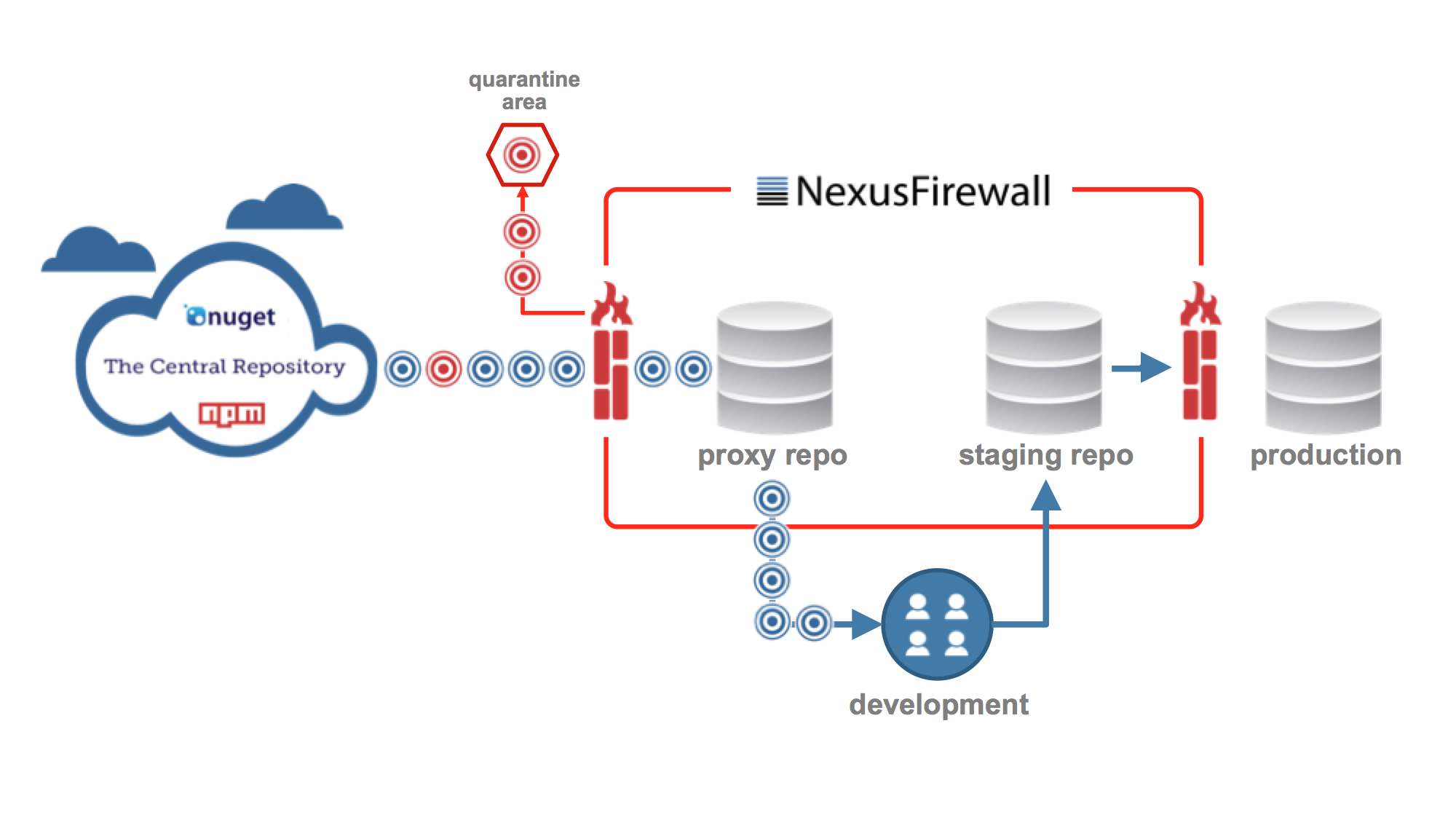
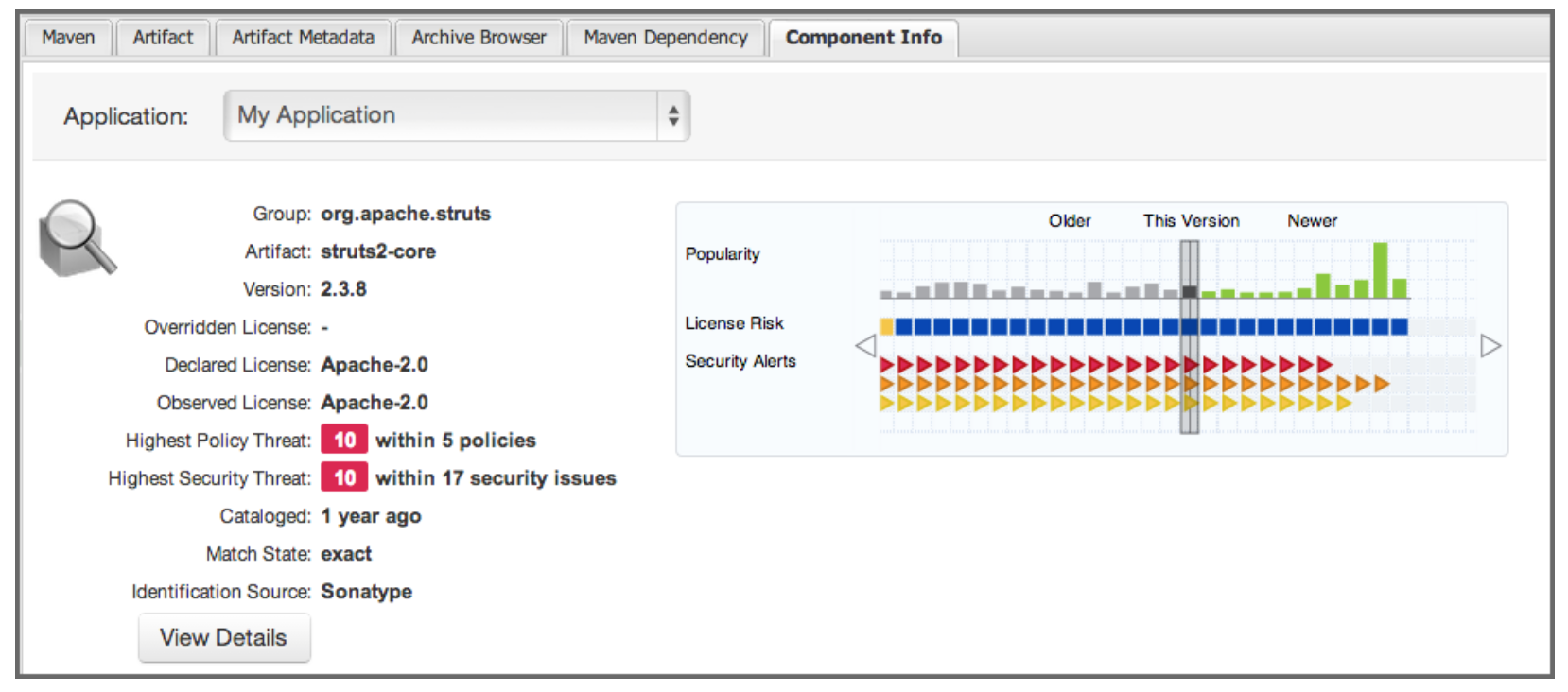
    Yes, A Firewall for Repository Managers

    In November, Sonatype became the first company to introduce a “firewall” for use with repository managers.  Called Nexus Firewall, the solution offers perimeter quality control for software development. Similar to a network firewall, it leverages rules you define that automatically shield an organization from unacceptable software components entering and another set for stopping them from exiting your application development. The basic concept looks like this:

    Nexus Firewall: shifting DevOpsSec further left than ever before.

    In order to build quality in from the beginning, this solution represents a “shift (far) left” innovation.  The Nexus Firewall improves speed and reduce risk through the quarantine of components with known vulnerabilities. With a repository firewall in place, organizations can shield your application development from waste and risk by automatically blocking unacceptable software components inbound and preventing release of applications containing such components outbound.  1 in 16 downloads with known security vulnerabilities could be reduced to zero in 16.

    The firewall also goes beyond blocking, providing organizations with the visibility and data needed to make ideal decisions for open source component selection early, significantly reducing waste related to rework and eliminating avoidable risk.

    For DevOpsSec, Shift (Far) Left to Build Quality In

    The consumption of these unacceptable or, at a minimum, inferior components is unnecessary.  For the vast majority of these vulnerable components, there are non-vulnerable alternatives ready to be used in their place. The challenge is that it has been historically difficult for developers to understand these risks and even harder to avoid them.  Few developers have countless hours to commit to researching vulnerabilities in the components they use and fewer more want to rely on colleagues in security, legal, or audit teams to spend hours or weeks to return with “go” or “no go” vetting decisions.

    The volumes and velocity of component consumption we see today validates that any form of manual review process or automated workflows outside of the development teams will be quickly outpaced.  DevOps and Continuous Delivery processes need to rely on automatic intelligence to help developers select the highest quality components and avoid those with known risks.  When known security vulnerabilities and other risks are identified, software supply chain intelligence will be required to guide developers through the identification and selection of safer, higher quality components.

    An example of the kind of information made available is shown below.

    DevOpsSec: Identify the best components that meet policy guidelines from the beginning.

    The information is divided into two areas. On the left side is component data, which includes details related to the component itself. To the right, there’s a graphical display of any security or license issues, as well as popularity data for each version of the component displayed. Selecting different versions updates this information accordingly, including whether or not a particular version passes the established criteria.

    A Must for DevOpsSec: Quality at Velocity

    Simply by enabling a repository firewall, organizations can immediately improve quality and reduce waste and exposure to risk. None of this comes at the expense of development speed.

    The repository firewall automatically quarantines components that do not pass your rules preventing quality issues from entering the software being developed, immediately reducing risk and avoiding wasteful rework at some later point. Quality is improved, efficiencies are gained and risk is reduced, all through automation and all at the speed of modern development.

    One of my favorite reference books is Continuous Delivery by Jez Humble and Dave Farley.  Let me share a few of their words to help remind us of the importance of innovations and practices that allow us to bring pain forward.  Jez and Dave remark:

    “The techniques that we describe in this book, such as continuous integration, comprehensive automated testing, and automated deployment, are designed to catch defects as early in the delivery process as possible (an application of the principle “Bring Pain Forward”).  The next step is to fix them  A fire alarm is useless if everyone ignores it.  Delivery teams must be disciplined about fixing defects are soon as they are found.”

    Well said Dave and Jez.  Well said.


  • DevOps Leadership Series 2015: Women & Diversity

    DevOps Leadership Series 2015: Women & Diversity

    Many of the leading minds and practitioners in the DevOps movement are women.  I hope that comes as no surprise to you.  DevOps has always embraced a diversity of thought and contribution.  Case in point, close to 50% of the presenters at this year’s DevOps Days Boston event were women.  

    In this episode of the DevOps Leadership Series, we caught up with Jennifer Davis, co-author of Effective DevOps (O’Reilly 2015, $31) and software engineer at Chef.  Jennifer discusses a greater diversification of what DevOps means.  She sees more explicit efforts to expand DevOps into QA, security, DBAs, and other functional teams across the organization.  Jennifer also discuss the benefit of re-setting one’s expectations on the meaning of certain words (e.g., agile, test driven development, audit driven development) to accelerate progress and remove roadblocks:


    https://www.youtube.com/watch?v=B-zONUI5KQ4


    We then sat down with James Meickle, Site Reliability Engineer at Harvard and member of the organizing committee for DevOps Days Boston.  James witnessed distinct growth over last year in the diversity of companies in attendance —  both from a size and industry perspective.  James also discusses the importance of diversity that the organizing committee insisted upon as they planned for the event.  If you are organizing your own DevOps Days event, be sure to have a listen:


    https://www.youtube.com/watch?v=BZZCjw9YEps


    If you missed part one of our series from DevOps Days Boston, be sure to watch these interviews from Beno Chapman of Constant Contact, Anthony Spring of Yieldbot, and Jeremiah Sullivan of Puppet Labs.

    Want learn more from the leading minds in DevOps?  You can find the entire library of 21 videos from this series on YouTube.

    Screen Shot 2015-09-30 at 5.40.06 PM

    Special thanks to my colleague, Mark Miller for capturing these videos for us at the event.

  • DevOps Leadership Series 2015: Women & Diversity –  a diversity of thought and contribution

    DevOps Leadership Series 2015: Women & Diversity – a diversity of thought and contribution

    Many of the leading minds and practitioners in the DevOps movement are women.  I hope that comes as no surprise to you.  DevOps has always embraced a diversity of thought and contribution.  Case in point, close to 50% of the presenters at this year’s DevOps Days Boston event were women.  

    In this episode of the DevOps Leadership Series, we caught up with Jennifer Davis, co-author of Effective DevOps (O’Reilly 2015, $31) and software engineer at Chef.  Jennifer discusses a greater diversification of what DevOps means.  She sees more explicit efforts to expand DevOps into QA, security, DBAs, and other functional teams across the organization.  Jennifer also discuss the benefit of re-setting one’s expectations on the meaning of certain words (e.g., agile, test driven development, audit driven development) to accelerate progress and remove roadblocks:


    https://www.youtube.com/watch?v=B-zONUI5KQ4


    We then sat down with James Meickle, Site Reliability Engineer at Harvard and member of the organizing committee for DevOps Days Boston.  James witnessed distinct growth over last year in the diversity of companies in attendance —  both from a size and industry perspective.  James also discusses the importance of diversity that the organizing committee insisted upon as they planned for the event.  If you are organizing your own DevOps Days event, be sure to have a listen:


    https://www.youtube.com/watch?v=BZZCjw9YEps


    If you missed part one of our series from DevOps Days Boston, be sure to watch these interviews from Beno Chapman of Constant Contact, Anthony Spring of Yieldbot, and Jeremiah Sullivan of Puppet Labs.

    Want learn more from the leading minds in DevOps?  You can find the entire library of 21 videos from this series on YouTube.

    Screen Shot 2015-09-30 at 5.40.06 PM

    Special thanks to my colleague, Mark Miller for capturing these videos for us at the event.