Author: Derek E. Weeks

  • All Day DevOps: Modern Infrastructure Automation

    All Day DevOps: Modern Infrastructure Automation

    “We’re no longer an airline. We’re a software company with wings,” claims Veresh Sita, CIO, Alaska Airlines. The success of today’s businesses rests on software. It is an integral part of infrastructure, so we need to always ask, “How can it be better? More reliable? More secure?”

    Nathen Harvey (@nathenharvey) is the VP of Community Development at Chef and the co-host of the Food Fight podcast. He is also an evangelist of automating software operations, which is what he presented on at the 2016 All Day DevOps conference.

    Nathen started his talk by stating that “automation at scale is required for high velocity IT,” making the point that in today’s environment, you can’t wait months between deployments. Enterprises are moving to continuous integration/continuous deployment, and he advocates for continuous automation.

    harvey pic1.png

    To implement automation at scale, you have to start with a dynamic infrastructure by:

    • Provisioning and setting up environments
    • Implementing dynamic scaling of compute resources
    • Migrating legacy workloads to the cloud
    • Deploy in multi-cloud and hybrid-cloud environments
    • Support heterogeneous environments

    harvey2.png

    Several speakers of All Day DevOps talked about automation, and all of them said a critical step is to treat infrastructure as code. According to Nathen, this means that to programmatically provision and configure components, such as servers, databases, firewalls, etc., you also have to treat it like any other code base. This includes version control and automated testing, but also:

    • Automated, full-stack application policies
    • Package and service installation
    • Versionable, testable and repeatable workflow
    • Scalable application policies
    • Management of interdependencies across nodes

    When you treat your infrastructure as code and deliver at scale, you can scale elegantly from one to tens of thousands of managed nodes across multiple complex environments.

    For software to be effective, users have to trust that it will do what they expect it to do. This is true from handheld calculators to self-driving cars, and it is also true when we automate our development and operations. Nathen advocates that we have to build a pipeline to production that creates faith in us that our code is ready for production.  This pipeline must:

    1. Test the code/verify locally
    2. Verify in pipeline with automated testing
    3. Approve with another engineer (aka code review or Nathen’s “four eye rule”)
    4. Build an artifact
    5. Deploy into acceptance environment to automatically test the artifact
    6. Ask someone else, “Do we want to ship this?”
    7. Ship the code with a click of a button
    8. Union (bring together dependencies and run tests)
    9. Rehearsal
    10. Delivered (ship to customers)

    What does the future hold?

    Infrastructure automation is NOT enough. Why? Auditors show up to audit your infrastructure and applications. The problem is, they use different tools—Excel spreadsheets, notebooks, PDFs, etc. This makes it very difficult to audit. Nathen advocates managing compliance documents as code, too. When we translate compliance into code, it can be executed as part of the pipeline so we can test for compliance throughout the entire life cycle.

    Finally, Nathen stresses the need to have application automation, too. Modern applications look like infrastructure as code.

    harvey3.png

    Developers can make applications that operations can deliver and run in production. This makes it easier to consume, run, and keep applications healty. Operable applications need to be:

    • Isolated
    • Immutable
    • Configurable
    • Built on a common interface for monitoring health
    • Rebuildable from sources
    • Reside in common packaging
    • Maintain runtime independence

    As enterprises implement infrastructure, application, and compliance automation, it creates a freedom for people to focus, and people are the key.

    Nathen notes that, “DevOps is a cultural revolution and professional movement, focused on how we build and operate high velocity organizations, born from the experiences of its practitioners.” He underscores that people are the future of automation. Automation places the priority on people, which enables great companies and great products.

    harvey4.png

    You can watch Nathen’s entire talk online here, where you can dig deeper into this subject. If you missed any of the other 30-minute long presentations from All Day DevOps, they are easy to find and available free of charge here.  Finally, be sure to register you and the rest of your team for the 2017 All Day DevOps conference here.  This year’s event will offer 96 practitioner-led sessions (no vendor pitches allowed).  It’s all free and online on Oct. 24.
    — Derek E. Weeks

  • From ‘Water-Scrum-Fall’ to DevSecOps

    From ‘Water-Scrum-Fall’ to DevSecOps

    As organizations abandon the waterfall method of software development for Agile, many are stuck in what Hasan Yasar terms Water-Scrum-Fall. That is, the organization has not effectively embraced Agile and DevOps principles and remains in silos with no links to business goals. Enter DevOps, an extension of Agile thinking. While Agile embraces constant change and embeds the customer into the process, DevOps embraces constant testing and delivery and embeds operations into the team to internalize expertise on deployment and maintenance.

    This is how Hasan started his talk, “Multi Security Checkpoints on DevOps Platform,” at the All Day DevOps conference.

    Picture5.png

    In his talk, Hasan lays out a plan to get organizations to DevSecOps. Really, DevOps is a risk mitigation strategy, built on situational awareness, automation, and repetition. But, security is where a lot of DevOps implementations fall down. The goals for each organization should be:

    • Protecting private user data
    • Restricting access to data/systems
    • Protecting company data/intellectual property
    • Standards compliance
    • Safeguarding disposition/transition

    But, how do organizations get there?

    First, integration and communication. Every point of the product development life cycle should be integrated and communicating, including among the tools. Once this is achieved, you can automate many, if not most, of the tasks. The automated steps are the ones that require less human actions/input to the software development process. This allows everyone to focus on innovation and better code and less on tasks that can be automated by autonomous systems. Also, tasks that can be automated are less susceptible to errors.

    Picture6.png

    Of course, it is the team that ultimately designs, develops and delivers the software. Your team consists of development, IT operations, quality assurance and security. Each has its own skill set and focus, and the overlap is Secure DevOps.

    Picture7.png

    The team is in place, processes are automated and development has started. Development in this day and age has evolved tremendously from even just a few years ago. Previously, software was limited to size, function and audience, and the supply chain was practically non-existent. Your team built each component. Now, development has grown beyond the ability of an organization to develop outside of its core competencies. The supply chain now involves many sources for the code. It is more like plug and play, and this creates lots of vulnerabilities.

    Hasan notes the software supply chain risk factors:

    • Supplier capability – Does the supplier follows practices that reduce supply chain risks?
    • Product security – Is the delivered or updated product acceptably secure?
    • Product distribution – Does the method of transmitting the product to the purchaser guard against tampering?
    • Operational product control – Is the product used in a secure manner?

    To reduce your supply chain risk, Hasan recommends:

    • Ensure supplier security commitment;
    • Evaluate a product’s threat resistance;
    • Create a centralized private repository of vetted third-party components for all developers;
    • Establish good product distribution practices; and
    • Minimize variation of components to make things easier.

    Finally, as you transition to DevSecOps, remember that security must be addressed without breaking the rapid delivery, continuous feedback model.

    Picture8.png

    You can watch Hasan’s entire talk online here for more details and other tips.

    If you missed any of the other 30-minute long presentations from All Day DevOps, they are easy to find and available free-of-charge here.  Finally, be sure to register you and the rest of your team for the 2017 All Day DevOps conference here.  This year’s event will offer 96 practitioner-led sessions (no vendor pitches allowed).  It’s all free and online Oct. 24.

    — Derek E. Weeks

  • How To Fully Automate CI/CD – Even Secrets

    How To Fully Automate CI/CD – Even Secrets

    Imagine a world where your continuous integration/continuous deployment environment is 100 percent automated, including the passing of credentials.

    Capital One, a leading U.S. bank, has achieved this, and Andrey Utis, director of Software Engineering at Capital One, outlined how the company achieved this in his talk, “Application Secret Management with KMS,” at the All Day DevOps conference.

    iStock-683716072-1.jpg

    Andrey started by stating what we all know: Security needs to be at the forefront. Additionally, a message we heard over and over at the All Day DevOps conference is to automate where you can automate. That combination can be daunting and seemingly impossible—how can we automate security when someone needs to enter credentials and we can’t store credentials where everyone can get to them? After all, credentials provide access to databases that often contain personally identifiable information and other protected information. A breach could devastate companies and people, whether intentional or accidental.

    Andrey’s team uses Amazon Web Services (AWS), so they give instances IAM roles that allow them access to other AWS resources. What is the key (pun intended)? On an AWS EC2 instance, there is a magic IP address to which you can make an HTTP call and it will return temporary AWS keys. Those keys then make the API calls to different database services.

    Here is the solution: AWS KMS is encryption as a service. KMS Context allows you to add “salt” to the encryption. You can only decrypt with the same “salt.” KMS Key Policies restricts which IAM role can decrypt with the key/salt. Master KMS keys can be used only to decrypt their own keys.

    Below is a code sample of a KMS policy:

    Picture9.png

    This allows multiple applications to be on one AWS account while limiting access of developers to the applications they are authorized for.

    Here is the actual protocol:

    1. Create a KMS master key (can be shared by multiple apps)
    2. Create an IAM role for your server
    3. Add KMS key policy that allows decrypt to your IAM role for a specific context
    4. Encrypt your secret with the key and context and store the value in GitHub
    5. At deployment or runtime, invoke KMS API to decrypt

    There is a broader issue with IAM roles because credentials are generated by calling the “magic” metadata IP address 169.254.169.254. Developers in production, even with “read only” access to the instance, could call the KMS API to decrypt the secret. Developers should not be able to generate production IAM credentials at all, so you block the magic IP address with this code:

    Picture10.png

    To automate it and make it reusable, the team created a Chef cookbook, which they call a “briefcase,” to abstract decryption of secrets. They also have the iptables cookbook to block the metadata IP address for all except a whitelist of user groups, such as root and any application-specific group that makes AWS API calls (see above code).

    Andrey mentioned that Vault may have a viable solution soon. It uses signed EC2 Identity Document to verify the caller. The current downsides are that it only supports authorization by AMI ID (but should support more soon) and secrets are not source-controlled/versioned. As Andrey noted, that is not ideal for “configuration secrets” such as database passwords.

    In a follow-up question, Andrey was asked, “What were the lessons that were most critical to learn?” He answered, “This is a new field. Most companies either don’t fully automate or don’t fully secure the entire pipeline. So, there is little information out there.”

    Well, there is some more information in Andrey’s complete talk, which you can watch online here. If you missed any of the other 30-minute long presentations from All Day DevOps, they are easy to find and available free of charge here.

    Finally, be sure to register you and the rest of your team for the 2017 All Day DevOps conference here. This year’s event will offer 96 practitioner-led sessions (no vendor pitches allowed).  It’s all free and online on Oct. 24.

    — Derek E. Weeks

  • Continuous Everyone: Engaging People Across the Deployment Pipeline

    Continuous Everyone: Engaging People Across the Deployment Pipeline

    We have continuous integration and we have continuous deployment, but what’s continuous across all of what we do is people. Even when tasks are automated, someone wrote the automation. So, Jayne Groll evangelizes about “continuous everyone.”

    Jayne is the CEO of the DevOps Institute and the author of “Agile Service Management Guide.” She talked about continuous everyone at the 2016 All Day DevOps conference. She describes it as “about people, culture and collaboration mapped into your value streams.”

    Picture1.png

    We all hear about the importance of people, culture and collaboration, but how well are they integrated into our organizations and processes? Is it in everything we do? Is it inherently continuous?

    It all starts with culture. The Business Dictionary defines culture as, “The values and behaviors that contribute to the unique social and psychological environment of an organization.” As Jayne points out, culture influences how people think, feel, interact and behave at work.

    Picture2.png

    We all have a vision of a euphoric culture. For most, that doesn’t reflect the reality of the current culture, which is generally Games of Thrones. Everyone wants to sit on the Iron Throne: ITIL/ITSM, DevOps, Security, Lean, Agile, Automation, and CI/CD. Traditionally, each of these functions has operated in isolation, convinced they are the most important cog in the machine. Now, DevOps has forced us to talk for the first time in 40 years.

    Picture3.png

    Once we acknowledge a problem, there are only 11 more steps. So, next, improving culture begins with addressing the root cause of cultural fails:

    • Language barriers (industry language)
    • Tribal knowledge
    • Poor communication
    • Thick silos
    • Disparate processes
    • Incompatible automation
    • Inadequate collaboration

    These cultural fails—both the cause and a symptom of thick organizational silos—must be broken down because they cage people’s creativity, and creativity is something you can’t automate.

    Now, people typically participate in the Continuous People Pipeline like this: Develop → Commit → Build → Test → Deploy and APIs built in between. Jayne advocates that we need to focus on Application People Interfaces between engineers and testers and ops teams. We need to let computers do the boring, repetitive tasks and let people solve problems and focus on high-value activities.

    Since not everything can be automated, continuous engagement is critical. While some advocated for “NoOps” (everything is automated), we should focus on “NewOps” to capture the talent and expertise in operations we need to leverage for tasks only people can do, such as:

    • Provide input and feedback
    • Design pipelines
    • Configure automation and APIs
    • Review test and other output
    • Design metrics
    • Facilitate feedback loops
    • Interface with the customer
    • Solve problems
    • Exchange ideas
    • Be innovative

    The bottom line is that this could be the beginning of a beautiful friendship. We need to reinvigorate the lost art of the dialogue. Actually talk to each other.

    Picture4.png

    This begins with trust. Every aspect of the Continuous People Pipeline is filled with expertise, integrity and people whot want to learn. There is a trust. You have to trust each other’s strengths and take the opportunity to engage on a continuous basis.

    It is only together that we can continuously improve.

    You can watch Jayne’s entire talk online here. If you missed any of the other 30-minute long presentations from All Day DevOps, they are easy to find and available free-of-charge here.

    Finally, be sure to register you and the rest of your team for the 2017 All Day DevOps conference here.  This year’s event will offer 96 practitioner-led sessions (no vendor pitches allowed).  It’s all free and online Oct. 24.

    — Derek E. Weeks

  • Embedding Ownership: A DevOps Best Practice

    Embedding Ownership: A DevOps Best Practice

    From where I sit in the DevOps community, there is often more focus on dev than on ops. Damon Edwards (@damonedwards) of SimplifyOps sought to change that with his talk, “Ops Happens: DevOps Beyond Deployment,” at the All Day DevOps conference.

    Damon dove right into the primary, systemic force behind most DevOps problems: silos. The product development process goes like this: Planning—>Dev—>Release—>Operate. The problem lies in the tendency of many enterprises to place similar functions together. Everyone ends up in a silo. Then walls build up between the silos. Eventually, people only know life in their silo, making handoffs even harder.

    We often find application knowledge and business intent are heavily emphasized on development side but light on the operations side. Likewise, operational knowledge is heavy on the ops side, but light on the development side. Furthermore, development has ownership but limited accountability, while operations has accountability but no ownership.

    While many enterprises are striving toward building cross-functional teams, the reality is that the transformations often stop short of truly integrating operations. The result?  Silos remain.

    So, one has to ask, why is this so hard?

    The reality is that enterprise operations are under tremendous pressure. One side is telling them to go faster and open it up, and the other side is telling them to be more secure and be more reliable. These are often seen as competing priorities.

    To solve this, enterprises need to “shift left” in the product development cycle operations activity as much as possible. They need to do as much as possible during development. For the deploy function, enterprises should be:

    1. Writing/running automated tests
    2. Writing/exercising deploy automation
    3. Running security scanning tools

    For the operate function, enterprises should be:

    1. Writing/exercising automated runbooks
    2. Writing/exercising monitoring/metrics
    3. Operational control (safely!)

    However, shifting operations to the left is much more difficult. How do you do it? Embed ownership.

    Let me repeat: embed ownership.

    First, those who build something define the procedures to fix it, and those who build something fix it when it breaks.

    That sounds simple, but raise questions:

    1. How do you safely and securely give out access?
    2. How do you enable the experts to contribute remediations?
    3. How do you give the experts visibility into operations?
    4. How do you do postmortems days/weeks/months later?

    Damon recommended four steps.

    Step 1: Establish a secure ops portal


    Step 2: Establish a software development life cycle (SDLC) for ops procedures

    Step 3: Connect with enterprise management systems

    Step 4: Make Compliance really happy

    Ticketmaster is a real-life of example of this working at a large, prominent scale. Ticketmaster calls its system, “Support at the Edge” and it involves:

    • Automated Ops procedures written/vetted by the delivery teams
    • Ops remained in full control of what can run and security policy
    • Empowered support teams with self-service ops tasks
    • Empowered developers with limited self-service operations
    • Combined with new incident response model

    Ticketmaster has seen transformative results. Before Support at the Edge, the average mean time to respond was 47 minutes. Now, support at the Edge has reduced that to just 3.8 minutes in addition to decreasing escalations 50 percent and overall support costs 55 percent. Ticketmaster has seen real results.

    Damon has more details in his talk, which you can watch online here. If you missed any of the other 30-minute long presentations from All Day DevOps, they are easy to find and available free of charge here.

    Finally, be sure to register you and the rest of your team for the 2017 All Day DevOps conference here. This year’s event will offer 96 practitioner-led sessions (no vendor pitches allowed).  It’s all free, online on Oct. 24.

    — Derek E. Weeks

  • All Day DevOps: Capital One Gives Credit Where It’s Due

    All Day DevOps: Capital One Gives Credit Where It’s Due

    Listening to his talk, it seems as though George Parris and his team at Capital One aren’t keeping “banker’s hours.” George is a Master Software Engineer, Retail Bank DevOps at Capital One. At the All Day DevOps conference, George gave a talk, titled “Meta Infrastructure as Code: How Capital One Automates our Automation Tools with an Immutable Jenkins,” describing how the team automated the DevOps pipeline for its online account opening project for Capital One, a major bank in the United States. Of course, there is a lot to learn from their experience.

    George started by pointing out that software development has evolved, coming a long way even in just the last few years. Developers now design, build, test and deploy, and they no longer build out physical infrastructure—they live in the cloud. Waterfall development is rapidly being replaced by Agile, infrastructure as code and DevOps practices.

    Where we see these technologies and methodologies implemented, IT operations teams are acting more like developers, designing how we launch our applications. At the same time, development teams are more responsible for uptime, performance and usability. And, Operations and Development work within the same tribe.

    George used the Capital One Online Account Opening project to discuss how they automate their automation tools, now a standard practices within their implementation methodology.

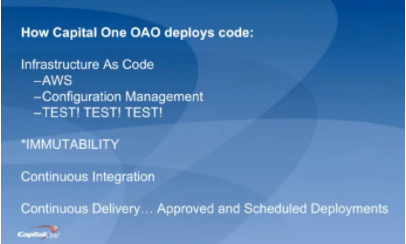
    For starters, George discussed how Capital One deploys code (hint: they aren’t building new data centers). They are primarily on AWS; they use configuration management systems to install and run their applications; and they “TEST, TEST, TEST, at all levels.” Pervasive throughout the system is immutability; that is, once created, the state of an object cannot change. As an example, if you need new server configurations, you create a new server and test it outside of production first.

    They use the continuous integration/continuous delivery model, so anyone working on code can contribute to the repositories that, in turn, initiate testing. Deployments are moved away from the scheduled release pattern. George noted that, because Capital One is a bank, regulations prevent its developers from initiating a production change. They use APIs with the product owners to automatically create tickets, and then product owners accept tickets, making the change in the production code. While this won’t apply to most environments, he brought it up to demonstrate how you can implement continuous delivery within these rules.

    Within all of this is the importance of automation. George outlined their four basic principles of automation and the key aspects of each:

    Principle #1 – Infrastructure as Code. They use AWS for hosting and everything is in a Cloud Formation Template, which is a way to describe your infrastructure using code. AWS now allows you to use CFTs to pass variable between stacks. Using code, every change can be tested first, and they can easily spin-up environments.

    Principle #2 – Configuration as Code. This is also known as configuration management systems (they use Chef and Ansible). There are no central servers, changes are version-controlled, and they use “innersourcing” for changes. For instance, if someone needs a change to a plugin, they can branch, update and create a pull request.

    Principle #3 – Immutability. Not allowing changes to servers once deployed prevents “special snowflakes” and regressions. Any changes are made in code and traverse a testing pipeline and code review before being deployed. This avoids what we all have experienced: the server that someone, who is no longer around, set up and tweaked differently than anything else and didn’t document what was done.

    Principle #4 – Backup and Restore Strategy. A backup is only as good as your restore strategy. You know the rest.

    George also dives into how they do continuous delivery/continuous integration in his talk, which you can watch online here.

    If you missed any of the other 30-minute long presentations from All Day DevOps, they are easy to find and available free of charge here.  Finally, be sure to register you and the rest of your team for the 2017 All Day DevOps conference here.  This year’s event will offer 96 practitioner-led sessions (no vendor pitches allowed).  It’s all free, online Oct. 24.

    — Derek E. Weeks

  • Container Considerations on Your DevOps Journey

    Container Considerations on Your DevOps Journey

    Containers are things for your things. That is true in the development world, too—containers are things for your software, and, like containers for your things, software containers can help you be organized, efficient and secure.

    Chris Morgan (@cmorgan_cloud), the Technical Director, OpenShift Partner Ecosystem at Red Hat, delivered a keynote at the 2016 All Day DevOps conference. Chris lives and breathes containers and recently discussed how they are transforming DevOps pipelines.

    Chris started with an encouraging figure: DevOps has a 74 percent adoption rate (at least on a path toward full adoption) at the enterprise level. The reason is that DevOps helps solve issues around:

    • Slow service delivery
    • Poor service quality
    • Frequent down times

    However, the needs of development and the desires of IT can often hamper full DevOps adoption, which is where containers can help. Containers allow apps to be easily shared and deployed with:

    • Consistent environment and tools
    • Predictable building tools
    • Faster deployment

    In short, containers can act as a common language between development and IT operations. And when configured properly, the operations team can utilize containers to assemble environments without compromising security.

    The survey that revealed a 74 percent adoption rate for DevOps in the enterprise also shows an 18 percent adoption rate of containers in the enterprise. Why the difference? Containers sometimes can be difficult to implement across multiple hosts.

    If you are gearing up to consider the use of containers across your IT environment, Chris offered up some things to consider:

    • Where do you store the container image?
    • Which container on which host? Which has enough capacity?
    • How do you monitor the health of the containers?
    • What do you do if a container crashes?
    • How can I address scale?

    When you have large apps that span multiple containers?

    • Which containers can access others?
    • Which containers should be deployed together?
    • How do I limit certain containers?
    • How do they find each other?
    • Is there malicious software on any containers?
    • How do I handle persistent storage?

    The bottom line is that you need more than just containers. You need a host, a platform, management and persistent storage.

    Is your organization ready to at least consider containers for DevOps? Chris reminded us, “Technology should not dictate the process. Identify the ideal process first, and then ensure the technology is flexible enough.” Start by finding some low-hanging fruit, assess skills and capabilities on your team and engage in a discovery session.

    Chris’ full keynote went into more detail, notably some solutions to implementing containers at the enterprise. You can watch Chris’ full All Day DevOps conference session (just 40 minutes) or you can view the other 56 presentations from the 2016 conference online and free of charge here.  This blog series is reviewing sessions from the 2016 All Day DevOps, which hosted over 13,500 registered attendees. Next week, look for “Ops Happens: DevOps Beyond Deployment” with Damon Edwards.

    Finally, be sure to register you and the rest of your team for the 2017 All Day DevOps conference here. This year’s event will offer 96 practitioner-led sessions (no vendor pitches allowed).  It’s all free, online Oct. 24.

    — Derek E. Weeks

  • DevOps: Trust, Obligations and Promises

    DevOps: Trust, Obligations and Promises

    Mark Burgess (@markburgess_osl) is a theoretical physicist, but in his keynote at the 2016 All Day DevOps conference, he talked more about economics and human interactives than physics. What does either have to do as the keynote for a conference on DevOps?

    Well, for a little more background, Mark Burgess is also the founder and former CTO of CFEngine, a configuration management and automation framework, and is the author of “Promise Theory.” While at CFEngine, Mark worked to apply a theory of how the autonomous agents in software interact with each other. Promise Theory was born.

    Exploring Promise Theory

    Promise Theory sits counter to obligation theories. Obligation theories view human interactions and behavior under the assumption that people (or agents, in the case of software) choose behavior based on their obligation to follow the rules. Agents are obligated to take a certain action. Promise theory contends the desire to follow the rules is voluntary and that agents can only be responsible for their own behavior, not the behavior of other agents.

    In his presentation, Mark started out looking at human behavior and trends in our society. For instance, with technological advances, our need for one another is decreasing, even as our interdependence through communication is increasing. For example, our smartphones enable us to do almost anything without the direct interaction of someone else.

    Looking at interactions in society, trust is the basis for our exchanges, working communities, and function as a society. He contends, “The promise is the source of intent by which all promises and observers may calibrate their expectations.” Money is an example of this. Money does not have intrinsic value, but we use it because we trust the backer will stand behind its value and it is more convenient than bartering goods. He explains that in the old monetary economy, banks and governments were the provider of trust; in the new service/IT economy, the service provider is the basis of trust.

    How Agents Make Promises

    How do you model this trust? Enter Promise Theory, which describes how agents make promises with each other and how this leads to trust between them. Mark outlines the “ingredients” of Promise Theory:

    1. Agents and super agents make promises in a scaling hierarchy.
    2. An agent can never make a promise about another agent’s behavior (only its own).
    3. An agent’s promise need not be accepted or used by its intended or unintended recipient!
    4. An agent makes its own valuations: what you have is only worth what another is willing to give you for it.
    5. Dependency invalidates promises.

    At the core of understanding this, you have to understand that collaboration is made up of semantics, what words mean and dynamics: all how things work.  And that our ever-increasing service economy is driving us to an explosion of semantics, because words matter so much more than the mechanics. As an example, Mark sketched the hierarchy of promise dependencies in the old and new economies. Looking at the old economy, where we have more dynamic money, the hierarchy is:

    Retail→ Money→ Banks→ Central Banks→ Government.

    In the new economy, where we have more semantic services, the hierarchy is:

    Client→ Network Availability→ Provider→ Internet Authorities→ Company/Service Organization.

    The Need for Cooperation

    None of these systems could work without cooperation at the bottom of it all. So, production is a cognitive process between the producer and the consumer, but also between the agents inside those organizations that have to interact. Often we create pipelines to describe these interactions, but the interdependencies within the systems are often much more complex than the pipeline can model.


    This is all just the tip of the iceberg. Mark has three books that dive into it in detail: “Thinking in Promises,” “In Search of Certainty,” and, “Promise Theory.”

    In the end, Mark made the point that technology does an excellent job of both binding us together and pulling us apart. We need to be careful that we don’t take ourselves out of the systems we create, or we could scale ourselves out of existence.

    devopsy.kinsta.cloud Supports the All Day DevOps Conference

    If this piqued your interest, you can watch Mark’s full All Day DevOps conference session (just 40 minutes).  When you do, you can view the other 56 presentations from the 2016 conference online and free of charge.  Finally, be sure to register you and the rest of your team for the 2017 All Day DevOps conference here.  This year’s event will offer 96 practitioner-led sessions (no vendor pitches allowed).  It’s free and online on Oct. 24.  devopsy.kinsta.cloud is a media sponsor for All Day DevOps 2017.

    — Derek E. Weeks

  • I Can’t Go to That DevOps Conference

    I Can’t Go to That DevOps Conference

    Last year, I was able to attend 18 DevOps conferences. I saw some awesome presentations, met incredible people and expanded my knowledge of the latest practices at each conference. While my role as the DevOps Advocate for Sonatype enables me to get out to all of these conferences, not everyone has the time, the budget, or the approval to get to even one event a year.

    DevOps for the Masses

    This is what led me and my colleague, Mark Miller, to found the All Day DevOps conference last year. Our dream was to build a DevOps conference for the masses. We decided to offer 57 online sessions over 15 hours and 15 times zones, and registration would be free. Our initial goal was to see if we could find 1,000 people to attend (because that sounded like a big number at the time), but the idea of a free online event caught a viral wind and we ended up having over 13,500 people register to attend.

    Every session delivered during the conference was shared by a DevOps practitioner. We had a simple rule for the conference and that was: no vendor pitches.

    Team Time

    People also told us that they valued having the chance to talk to other attendees they met at DevOps conferences, so we set up a free Slack channel for All Day DevOps. By the time conference was over, we recorded more than 10,000 conversations between the speakers, attendees and organizers.One of the things that fascinated us most about the conference was that organizations such as Accenture, Capital One, Ericsson, Oracle, Target, Telstra and many others had more than 20 employees attending the event. A few of these had hundreds. None of them needed to approve expenses for travel, hotels or conference fees. They just watched and joined in the conversations from their homes or offices.

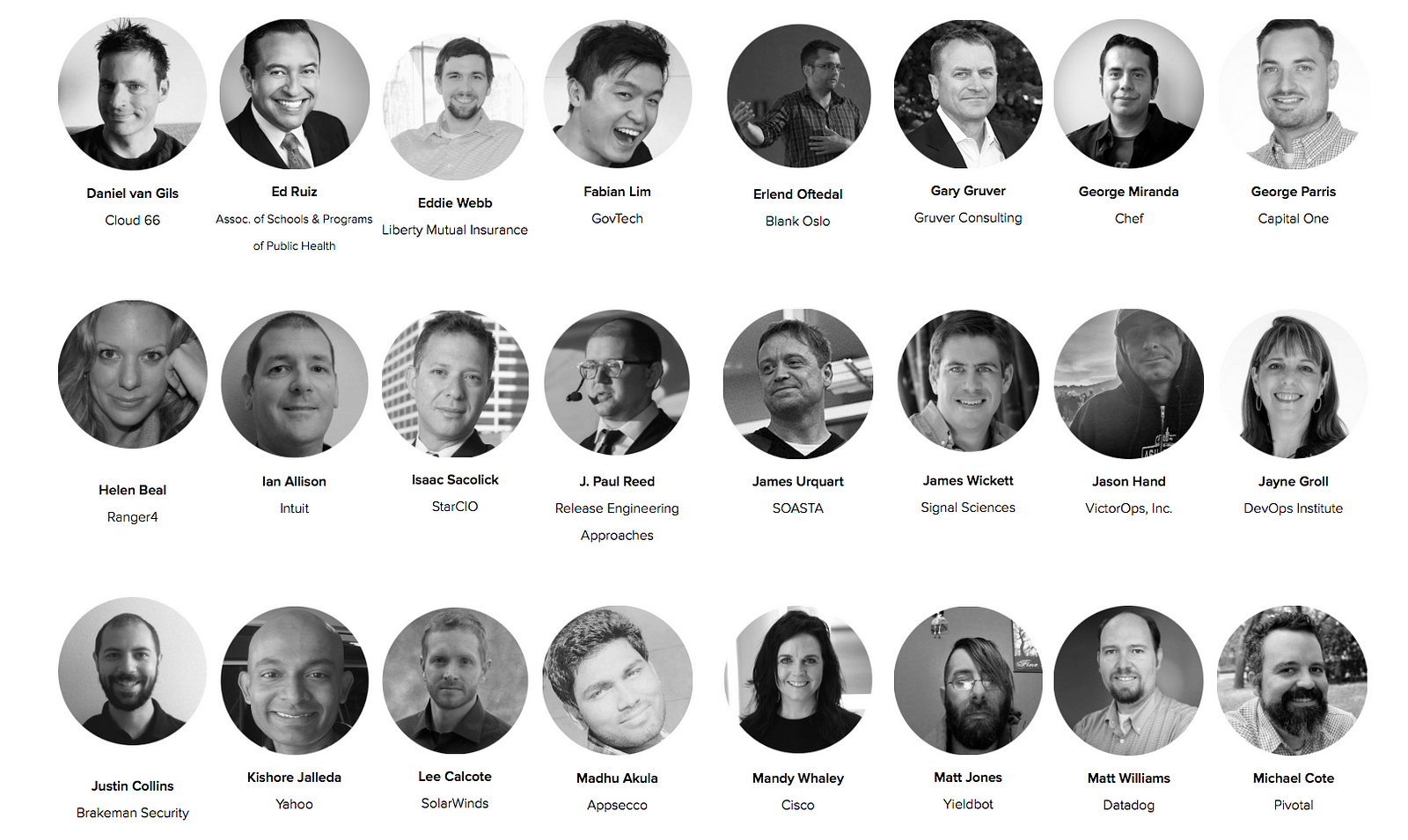
    Here are some of the folks who spoke at last year’s event across our CI/CD, Modern Infrastructure and Automated Security tracks. This year, we have also added a DevOps in Government track to the agenda.

    The event was so successful, we set it on the schedule again. All Day DevOps 2017 will take place Oct. 24. It’s online, it’s free and this year’s event will run for 24 hours. Therefore, no matter where you live, if you have an internet connection, you will be able to tune in to join us.

    A Few Things to Know

    1. You can register for free at www.AllDaydevopsy.kinsta.cloud. Invite your entire DevOps team to join. Everyone registering will have free access to all 57 recorded sessions from 2016.

    2. The CFP is open through May 31. If you have a story to share, we want to hear from you. Remember, no vendor pitches are permitted.

    3. All Day DevOps is a community event. Last year more than 40 DevOps meetups and software companies helped us spread the word. For those that helped, we added their logo to the site. Same applies to this year. Apply to be a supporter here.

    Please join us for this year’s event!

    Finally, a big thank you goes out to devopsy.kinsta.cloud, which helped us promote last year’s event to all of their readers. We are excited to have them helping us to promote the 2017 conference as well!

    — Derek E. Weeks

  • Securing Immutable Servers in a Serverless World

    Securing Immutable Servers in a Serverless World

    Snowflakes are beautiful, unique creations. But, let’s keep them in nature. They don’t belong in our server infrastructure. Snowflake servers, where every configuration is just a little different, can introduce unnecessary security vulnerabilities and complications. While common in IT infrastructure, in the DevOps realm, they are gradually becoming ancient history.

    At the recent All Day DevOps conference, Erlend Oftedal (@webtonull), with Blank and head of the OWASP Norway chapter, discussed the benefits of immutable infrastructure practices within serverless architectures. Erland walked us through the positive effects on security as well as offered insight on potential problems.

    Erlend outlined the progress from physical servers to immutable servers, discussing the benefits of each step and the concerns that lead to the next phase, ending with immutable servers—that is, they can’t be changed. Once set up, they are set. Automated processes coupled with immutability principles can eliminate snowflake servers.

    Immutability isn’t a new concept. Some classic examples include: live Linux CDs, internet cafes, schools, libraries, hotel business centers, etc. To set up immutable servers, Erlend outlines these steps:

    1. Find a suitable base image
    2. Build a specific image for the application (dependencies, application, secrets)
    3. Deploy image to server(s)
    4. Repeat steps 2-3 for new versions.

    Of course, this immediately raises questions.

    What about data? He notes that, because data inherently changes, data has to be stored externally.

    How do you deploy changes? Well, you don’t change the server. You take one out and put a new one in. If that one fails, roll back to the previous one.

    How do you manage secrets? You can build secrets in, leverage cloud key management or use third-party services.

    How do we apply security patches? If truly immutable, you deploy a new server with the patch. However, you can have a semi-immutable server that allows for automatically installing patches but still doesn’t allow for logins or manual changes.

    Speaking of security, what are the security advantages? For starters, if an attacker is in your server, it will be thrown out when you change servers, although it may come back if the vulnerability isn’t patched. It also allows for very specialized images by removing all unneeded packages. With these specialized images, you can more easily audit and monitor the system for unexpected file changes, logins and connections.

    Erlend discussed containers because they are a step closer to a serverless world. Containers isolate processes and all run on the same OS. Of course, you can make them immutable, but, whether they are or not, there are some key security best practices you’ll want to consider:

    • Don’t run as root inside container
    • Implement user namespaces so the root account within the container is separated from the root account outside the container
    • Utilize the least privileges necessary for capabilities and resources
    • Keep them up to date
    • Automate scanning using tools such as Sonatype Nexus, Twistlock, Clair or Aqua.
    • Separate untrusted and trusted containers

    Erlend also dove into serverless architecture. While there is debate over what exactly qualifies as serverless, there are five principles that Erlend highlighted:

    • Use a compute service to execute code on demand
    • Write single-purpose, stateless functions
    • Design push-based, event-driven pipelines
    • Create thicker, more powerful front ends
    • Embrace third-party services

    Migrating to immutable, serverless infrastructure is a topic to be discussed well beyond this blog post and even Erlend’s session. Whatever you do in the future, though, take his parting words to heart: “The cloud can solve many of your problems, but in the end you cannot transfer your responsibility for security.”

    Erlend’s session was packed with information. If this piqued your interest, you should watch his complete session in his full All Day DevOps conference session (just 30 minutes). The other 56 presentations from the All Day DevOps Conference are also available online, free of charge here.

    — Derek E. Weeks