Author: Charlene O’Hanlon

  • InfluxData Video Series: Dealing with Large Amounts of Data

    InfluxData Video Series: Dealing with Large Amounts of Data

    The data deluge is becoming a daily issue, as companies collect ever more data from ever more devices and endpoints. But collecting data is one thing; deriving value from it is another.

    In this video, InfluxData VP of Products Tim Hall discusses some of the considerations in dealing with large amounts of data and how a time series database can help.

    “The vast majority of data systems that exist today are not really set up to ingest and analyze that data at speed,” he said, which can pose a real issue for organizations looking for actionable insights from their data in real-time. Time series databases enable ingestion and analysis instantly, with an ingest pipeline that allows users to gather and shape data to be useful upstream.


    To learn more, watch the video and download the “Benefits of a Purpose-Built Platform” infographic here. Also, check out the first video in the series here, the second video here and the third video here.

    — Charlene O’Hanlon

  • Today: Predict 2019 Virtual Summit

    Today: Predict 2019 Virtual Summit

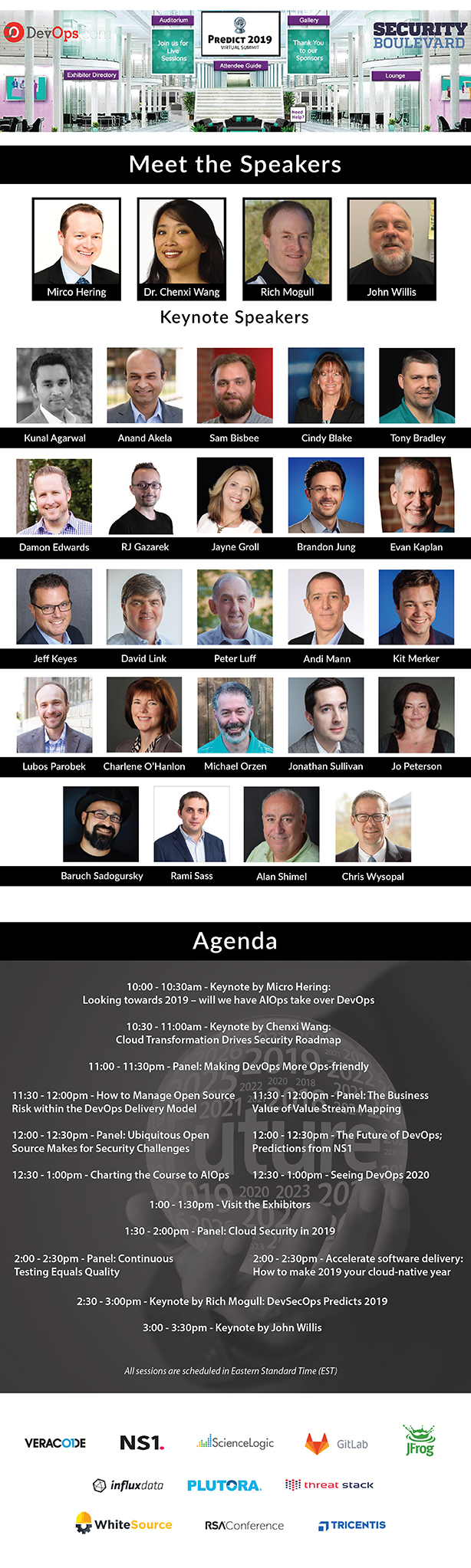
    Predict 2019 Virtual Summit is finally here! The summit is happening today, Tuesday, Dec. 18 at 10 a.m. Eastern. Don’t miss the opportunity to hear from Mirco Herring, Rich Mogull, John Willis, Chenxi Wang and other industry luminaries as they offer their DevOps and security predictions for 2019.

    If you have already registered, then go here to join livestream starting at 10 a.m. Can’t make the live event date? No worries! Register for the event, and we’ll send you the replay link after the event. Click here to download the program guide.

    Predict 2019 is a free virtual summit chock full of information and education for DevOps and security professionals presented in a virtual reality environment. It is a true virtual conference, replete with theaters to view the keynotes and presentations, a conference lobby to chat and socialize and a virtual trade show floor with virtual exhibitor stands equipped with video, downloads and even prizes for participation. And did I mention it’s free?

    This year’s event offers up presentations and sessions from the biggest names in DevOps and security, as well as speakers from well-known companies who’ll be sharing what they’ve gleaned from their DevOps and security initiatives.

    Here’s what the virtual format of Predict 2019 has to offer:

    • Complete control and access over every aspect of your digital experience.
    • Live and on-demand viewing from your home or office.
    • Attend and interact using the device of your choice (laptop, smartphone and tablet).
    • Digital downloads and presentations for all the sessions.

    And, perhaps most importantly, you will have unlimited playback post-event for six months! (This is for attendees who register by December 18 only!)

    Predict 2019 is here today, at a computer or mobile device near you. Visit the website for more information or to register for this daylong event. Registration—did we mention it’s free?—also includes access to the event on-demand. To register, click on the image below or this link.Predict 2019 will feature keynotes from a lineup of DevOps and Security IT executives and industry luminaries including:

    • Mirco Hering sharing his predictions for 2019—Will AIOps take over DevOps?
    • Dr. Chenxi Wang shares her predictions on future of cybersecurity in the cloud computing era.
    • Rich Mogull’s offers up DevSecOps Predictions for 2019.
    • John Willis speaks on the on Future of DevOps in 2019 and beyond.

    In addition, Predict 2019 will include a number of featured panels with topics designed to provide even greater value to attendees. Panels include:

    • Making DevOps More Ops-friendly – Charlene O’Hanlon (host), Damon Edwards, John Willis and Andi Mann
    • The Business Value of Value Stream Mapping – Jayne Groll (host), Michael Orzen and Jeff Keyes
    • Ubiquitous Open Source Makes for Security Challenges – Alan Shimel (host), Cindy Blake, Rami Sass and Baruch Sadogursky
    • Cloud Security in 2019 – Tony Bradley (host), Chris Wysopal, Sam Bisbee and Jo Peterson
    • Continuous Testing Equals Quality – Alan Shimel (host), Anand Akela and Lubos Parobek

    Register Today at https://predict2019.com/#join-us

    — saleem

  • The Benefits of a Purpose-Built Platform

    The Benefits of a Purpose-Built Platform

    When it comes to storing metrics and events, a time series database provides a number of benefits that general purposes databases don’t, including high velocity, range scans over large chunks of data, efficient data eviction and compression. But time series isn’t just about the database; it’s also about the ecosystem of tools built around it.

    In this video, InfluxData founder Paul Dix discusses how his company has created an ecosystem comprised of tools that developers can use to solve problems without having to do much coding or configuration to derive insight or value from the data. He also outlines the benefits of using a time series database over a relational database or a Postgres database, including lower cost and fewer tools targeted to real-time monitoring and alerting.

    In addition, Dix talks about Flux, the company’s latest scripting and query language, which was designed to be even more developer-friendly in every way. “It’s basically been years in the making, so it’s pretty exciting to finally get it out there,” he said.


    To learn more, watch the video and download the “Benefits of a Purpose-Built Platform” infographic here. Also, check out the first video in the series here and the second video here.

    — Charlene O’Hanlon

  • InfluxData Video Series: ‘Time to Awesome’ with Mark Herring

    InfluxData Video Series: ‘Time to Awesome’ with Mark Herring

    InfluxData firmly believes an awesome experience is fundamental in developing and curating its developer community. After all, the company’s platform is designed for developers, said CMO Mark Herring, and so delivering a great experience is in the company’s DNA. “We want them to have an awesome experience from the first download to the first interaction with the company to the first install, to first getting started, to first production database.”

    Part of that great experience includes an open source platform that takes only about five minutes to get up and running. “It comes down to one piece—the whole platform is there—and you can ingest the data, you can visualize you can query the data in literally about five minutes,” Herring said.

    In this video—the second in a series of four—Herring talks about the importance of “time to awesome” in every consideration InfluxData makes regarding its platform, its overwhelming acceptance by the developer community and how the company will continue to strive for an even better “time to awesome.”


    To learn more, watch the video and download the “Time to Awesome” infographic here. Also, check out the first video in the series here.

    — Charlene O’Hanlon

  • InfluxData Video Series: Time Series Data with Chris Churilo

    Time series data can bring value to organizations in many ways, beyond simply metrics to help them understand how their infrastructure is performing. It also can help illuminate other issues that can have an impact on performance, such as customer usage.

    In this video—the first in a series of four—Chris Churilo, director of Product Marketing at InfluxData, recounts how time series data was used to solve the issue of battery depletion with one of its customers, a solar energy panel provider with end user customers in Africa.


    “It’s a great way of being able to look at metrics that are actually going to give them insight into how people are using it, and they could expand their service to their customers and ultimately making their customers a lot happier with their service,” she said.


    To learn more, watch the video and download the “More Than Just Metrics” infographic here.

    — Charlene O’Hanlon

  • DOES18 Las Vegas: Video Interviews, Day 2

    DOES18 Las Vegas: Video Interviews, Day 2

    DevOps Enterprise Summit 2018 (DOES18) in Las Vegas was a three-day bonanza of all things DevOps, with conversations spanning the entire DevOps ecosystem, from processes to tools to culture. In my two days at the Broadcast Booth (aka “The Fishbowl”), I had the pleasure of meeting with some very smart people and having some highly insightful conversations, all of which  are available for viewing on DevOpsTV.

    The second day’s conversations at DOES18 were as interesting as the first day’s, with topics ranging from DevOps culture to managing DevOps in highly regulated environments. Below is a recap of the Day 2 video interviews at DOES18 (Day 1’s recap is available for viewing here):

    Organizational Change

    Carmen DeArdo of Tasktop and Jon Smart, formerly of Barclays Group, stopped by to discuss tactics in ways to make change efforts possible in the enterprise.

    Capital One’s DevOps Update

    Jamie Specter, Aimee Bechtle and Abbie Gray of Capital One offered the latest updates from legal, tech leadership and product management in its DevOps journey.

    Work Management Systems

    Scott Prugh of CSG, Keanen Wold of Delta Airlines and Rosalind Radcliffe of IBM discussed how to break down inefficiencies for enterprise practitioners and management leaders who have multiple work management systems that their teams deal with every day.

    Project Management

    Laura Fay of TSIA discussed a product-led growth strategy where the buyer and customer journey is actively engineered into the product experience to deliver value and outcomes. She also explained how DevOps can benefit from expanding the definition of lead time from ’code to cloud’ to ‘concept to customer consumption’ and become a more integrated part of the business value flow.

    The Importance of Culture

    J. Paul Reed of Release Engineering Approaches and Dominica DeGrandis of Tasktop discuss what’s important about culture as part of a DevOps transformation journey, and why a DevOps culture should foster an attitude of open-mindedness, cross-pollination of skills and stepping out of comfort zones.

    DevOps in Regulated Industries

    Robin Yeman of Lockheed Martin and Ken Moser and Melinda Solomon of the U.S. Citizenship and Immigration Services discussed how DevOps can be applied in highly regulated environments and highlighted industry best practices.

    Transformational Leadership – Making Change Happen

    Christophe De Boeck of Kiwibank Ltd. and Steve Mayner of Scaled Agile highlighted considerations for the different ways to lead transformation in large enterprises.

    DevOps Trends – What Does the Future Hold?

    In this forward-looking discussion Eric Robertsonof CollabNet VersionOne, Robert Reeves of Datical and Derek Langone of XebiaLabs chatted about what the future holds for DevOps in the enterprise and what to be on the lookout for in the coming year.

    — Charlene O’Hanlon

  • DOES18 Las Vegas: Video Interviews, Day 1

    DOES18 Las Vegas: Video Interviews, Day 1

    Despite what you may have heard to the contrary, not everything that happens in Vegas should stay there. Take the DevOps Enterprise Summit 2018 (DOES18), for example: The three-day event attracted the best and brightest in the DevOps world—and me—to discuss all things DevOps. Some of those great conversations were captured in a series of video interviews, which are now available on DevOps TV.

    During the two days of interviews in our glass-walled video booth, a variety of folks stopped by to chat about topics ranging from audits and compliance to NextGen Ops and the future of DevOps. Below is a recap of the Day 1 video interviews from DOES18 (Day 2’s recap will post next week):

    The Future of DevOps

    Wesley Pullen of Electric Cloud, Torsten Volk of EMA and Chris Nowak of FlowStates stopped by to discuss the latest DevOps trends, where DevOps is headed, and understand key emerging practices and technologies that are driving success.

    Venture Capital and DevOps

    Sid Sijbrandij of GitLab, CJ Napolitano of Electric Cloud and Ubaid Dhiyan of Union Square Advisors chatted about the current state of VC investment into DevOps, how this could evolve in the future and the impact this investment ecosystem has on the global economy.

    ITSM/DevOps Crossover

    IT Skeptic Rob England and his partner Dr. Cherry Vu discussed what holds ITIL back from more successful transformation of IT work, and how we can help it succeed, as DevOps and ITSM finally converge on each other in the common ground of service operations.

    ‘Dear Auditor’ — Compliance and DevOps

    Sam Guckenheimer of Microsoft, James Wickett of Signal Sciences and Topo Pal of Capital One talked about the current state of DevOps and audit/compliance. They are part of a team that wrote a love letter to auditors from DevOps, in which a promise was made to make life better. They also compiled a list of audit concerns and documented them in a DevOps Risk Control Matrix with lot of details around the controls, practices and evidences that are collected to support the control.

    NextGen Ops

    Damon Edwards of Rundeck, Cornelia Davis of Pivotal Software and Tom Limoncelli of Stack Overflow chatted about the next generation of IT Ops and what emerging patterns and practices teams should consider for the future of IT.

    Workplace Burnout

    John Willis (Botchagalupe) is passionate about so many topics around DevOps, cloud and technology. One of the areas he is really passionate about, though, is the topic of burnout and fatigue in the IT field. He and Dr. Christina Maslach discussed the concept of burnout and examined the causes and effects of this problem, and the most promising strategies for dealing effectively with it.

    Project to Product

    Dr. Mik Kersten, CEO of Tasktop, reviewed the transition from project-based work to product-based workflows—the most optimized and scalable DevOps environment will be a highly prized gem for any business only if the product management team is prioritizing the right capabilities into the DevOps process.

    Tech for Tech Leaders

    Anders Wallgren of Electric Cloud and Erica Morrison of CSG discussed the technology landscape and what things tech leaders need to not only understand from a tech and architecture perspective, but also what they need to know to help build technology and tech platforms for the future of software delivery.

    Banking on DevOps

    Mark Howell of Lloyds Banking Group, Shaun Norris of Standard Chartered Bank and John Rzeszotarski of KeyBank reviewed a few of the top DevOps journeys in banking and what other financial institutions should consider along their DevOps journeys.

    Well, there ya have it: An entire day’s worth of videos compiled for your viewing pleasure. Be sure to check back next week for a recap of our Day 2 video interviews from DOES18 Las Vegas.

    — Charlene O’Hanlon

  • Semaphore 2.0 Brings Continuous Delivery to Teams of All Sizes

    Semaphore 2.0 Brings Continuous Delivery to Teams of All Sizes

    Since its inception in 2012, Semaphore has been focused on making code testing and deployment a quick and easy process. The cloud-based CI/CD platform from Rendered Text enables users to get up and running within a matter of minutes—which the company claims is at least twice as fast as other offerings.

    The company is releasing Semaphore 2.0 Nov. 6, which will expand the platform to enable continuous delivery, for a product that allows teams of any size to automate any continuous integration or continuous delivery workflow with custom pipelines so users can model their CI/CD however they prefer. The latest version also better supports CI/CD for containers, giving users the ability to use Docker or Kubernetes tools in building within container environments. Other features of Semaphore 2.0 include support for YAML files and command line interfaces, so teams can manage a large number projects more easily.

    Marko Anastasov, founding partner at Rendered Text, spoke with me about the latest version of Semaphore and his thoughts on the continuous integration and continuous delivery space at large. Read on for his insights:

    Can we start with some background about Semaphore? What was the catalyst for creating it?

    Our company was an early adopter of agile software development practices, including test-driven development and continuous deployment. We relied on cloud-based products like GitHub, which were simple to use and made software development easier.

    However, when it came to implementing continuous integration, we were out of luck. I remember spending days setting up Jenkins for just one of our projects. We saw how expensive and time-consuming it would be to make it fast and scalable. It felt as if by continuously verifying our code, we were doing something wrong. Developers need to set up a fast and functional CI process in minutes, and not worry about how it works.

    What’s new in Version 2.0 that’s worth mentioning?

    Semaphore 2.0 is made to enable continuous delivery in organizations of any size. Previously, like other hosted CI/CD services, Semaphore focused on solving the integration process: building code and running tests. Delivery features were limited and tailored for classic web development.

    This time we asked ourselves, What would a continuous delivery product focused on speed and simplicity look like in the age of cloud-native computing? I’d highlight three things that stood out.

    First, for DevOps transformation to succeed, we need to automate, visualize and accelerate all software development processes in our organizations. So at the heart of Semaphore 2.0 are infinitely customizable code pipelines, configured as code, run as a service.

    Second, infrastructure should be ephemeral and scale in real time. When CI/CD capacity is limited, developers are blocked in busy times of the day. Semaphore adopts the “pay only what you use” cloud model, in which CI/CD resources scale automatically to support the team’s actual needs.

    And third, we can’t manage what we don’t measure. It doesn’t make sense to prescribe the same metrics for every project and organization. So Semaphore lets users choose their own metrics and define their own dashboards.

    What feature or features do you believe will have the most impact with users?

    In building Semaphore 2.0 we were very careful not to add any unnecessary features. All parts are designed to support each other and provide a harmonious user experience.

    For example, Kubernetes wasn’t the first solution to run software in the cloud, but it made vendor-neutral cloud computing as easy as describing what you need to run. Similarly, developers can now describe any CI/CD process they need, and Semaphore will run it immediately at any scale.

    In day-to-day use, I expect users to like how much control they have via command line and autoscaling resources. It’s the overall boost in productivity that will make the most impact.

    How important is Semaphore’s increased support for container environments?

    Containers are the biggest change in the development stack in recent history. In the transition to container-based software delivery, many teams needed to maintain their own CI/CD infrastructure, since none of the existing solutions were flexible or easy enough to use. This takes valuable time away from delivering value to customers. Semaphore 2.0 is built to support the next-generation of cloud architectures based on containers.

    What are some of your thoughts on the current state of the CI/CD market, and where do you see it heading?

    For the continuous integration part of the equation, there are many options to choose from. There’s a wide spectrum from managed to DIY solutions, and from specialized vendors to those who provide basic tools for every aspect of software development. I think the shift that’s going to happen is from basic automation to optimization. For example, Semaphore provides bare-metal performance at convenience of cloud. When a customer tells us that they’ve combined that with our test optimization features to reduce build time from hours to minutes, that makes us so happy because we know what tremendous difference that makes in their workplace.

    On the continuous delivery front, I think there’s less maturity and that the market is still developing. So far, developers have needed to build their own solutions based on complex open source tools and self-managed infrastructure. Cloud vendors have entered the space, not with complete products but low-level tools that leave a lot of complexity for the end user to manage. The next phase will be about making the entire CI/CD process easier and more accessible. At Semaphore, we’re committed to making that happen.

    — Charlene O’Hanlon

  • DevOps World | Jenkins World 2018 San Francisco: Video Interviews, Day 2

    DevOps World | Jenkins World 2018 San Francisco: Video Interviews, Day 2

    The recent DevOps World | Jenkins World 2018 San Francisco conference offered a bevy of interesting conversations with folks from all corners of the DevOps space, from testing to automation to security and beyond. All of those conversations are available for viewing on DevOpsTV.

    My two days in the Broadcast Booth on the show floor at the conference was busy, busy, as a number of attendees stopped by for a quick chat with Jayne Groll, CEO of DevOps Institute, or me. Topics ranged from the growing influence of artificial intelligence to the importance of testing and DevSecOps. Below is a recap of the Day 2 video interviews (Day 1’s recap is available for viewing here):

    Contrast Security Discusses DevSecOps

    Mahesh Babu of Contrast Security stopped by to discuss his company’s technology, which helps an app protect itself through agents that constantly monitor the code to see in real time any problems within the application.

    Smart Bear Talks AI and Testing

    Daniel Giordano of SmartBear chatted with us about how his company is using artificial intelligence technology in its testing products to test things beyond objects such as images and charts.

    Perfecto’s Kinsbruner Debuts Continuous Testing Book

    Eran Kinsbruner of Perfecto talked with us about the launch of his book, “Continuous Testing for DevOps,” which he wrote in conjunction with CloudBees.

    JFrog Offers Take on DevOps Culture

    Baruch Sadogursky of JFrog discussed the challenges in DevOps with respect to culture and ways companies are finding ways to make the cultural change.

    Electric Cloud Offers Technology Update

    Electric Cloud’s Sam Fell stopped by the Broadcast Booth and offered up an update on the company’s technology stack and its potential impact on the development environment.

    IT Methods Talks Cloud Adoption

    Paul Goldman of ITMethods talked with us about the evolution from on-premises to cloud deployments and the various reasons why organizations are making the change.

    Go2Group Offers Service Provider Perspective

    Mike Maheu of services provider Go2Group discussed the trends his company is seeing regarding organizations that are undergoing DevOps adoption, including the tooling and practices.

    Services Provider Zivra Talks DevOps’ Global Impact

    JJ Alvarez of Zivra, CloudBees’ Partner of the Year, talked with us about the global expansion of DevOps and the recent surge of Latin American and South American countries adopting DevOps principles.

    SauceLabs Talks Testing and Security

    Clint Sprauve from SauceLabs stopped by to discuss the correlation between testing and security in DevOps as companies struggle to maintain quality in their application development process.

    Releasing the Gitcracken

    James Quigley of Gitcracken talked with us about the role of his company in helping developers improve their coding performance and productivity and increase the comfort level of less-experienced developers.

    Twistlock Talks Kubernetes

    Matthew Barker of Twistlock discussed the impact of Kubernetes on application development and trends he’s seeing in the Kubernetes space as a whole.

    Pivotal’s Approach to DevOps

    Pivotal’s Nima Badiey schooled me on his title and chatted about how his organization approaches DevOps with its customers, especially large enterprise companies that have legacy systems and mindsets.

    NowSecure Talks Mobile Development

    NowSecure Chief Mobility Officer Brian Reed discussed trends in the mobility space, including the use of mobile app projects as a “gateway to DevOps.”

    — Charlene O’Hanlon

  • DevOps World | Jenkins World 2018 San Francisco: Video Interviews, Day 1

    DevOps World | Jenkins World 2018 San Francisco: Video Interviews, Day 1

    DevOps World | Jenkins World 2018 San Francisco has come and gone, but not without leaving a multitude of new connections and fascinating conversations in its wake. Case in point: the myriad video interviews now available on DevOps TV.

    During my two days at the conference, the broadcast booth in the exhibit hall was humming with folks from all over stopping in for a quick chat with Jayne Groll, CEO of DevOps Institute, or me. Topics ranged from the growing influence of artificial intelligence to the importance of testing and DevSecOps. Below is a recap of the Day 1 video interviews (Day 2’s recap will post next week):

    Twistlock Talks Container Security

    Keith Mokris of Twistlock kicked off the day’s conversations with a discussion about security in the DevOps and container space, including the challenges organizations have in creating and deploying cloud-native apps.

    Plutora Discusses Integration Challenges Among Companies

    Bob Davis of Plutora stopped by to talk about the struggles his company sees organizations having in integrating their legacy systems with newer technologies such as cloud, as well as scaling their DevOps initiatives enterprisewide.

    QA Symphony Recaps Tricentis Merger

    DJ Frank, sales engineer at QA Symphony, discusses his company’s recent merger with Tricentis and the role of automation in digital transformation, no matter how far along organizations are in their journey.

    AppliTools Talks Digital Transformation

    James Lamberti of AppliTools chatted with DevOps Institute’s Jayne Groll about the role his company plays in digital transformation, specifically how it solves the problem of broken UIs and their impact on the customer experience.

    KPMG Highlights Need for Right Toolchain in Transformation

    Mark Shank and Mike Wolf of KPMG discussed with Groll business transformation beyond tooling in determining the right approach to modern delivery and DevOps.

    American Express’ DevOps Journey

    Durga Dabberu of American Express and Groll discuss his company’s journey to DevOps and how Amex has transformed as a result.

    XebiaLabs Talks DevOps Beyond ‘Dev’

    Patrick Bishop of XebiaLabs chatted with Groll about trends in the DevOps space and cultural challenge many organizations face in adopting DevOps methodologies.

    WhiteSource Talks Security’s Role in Transformation

    Dan Gross of WhiteSource and Groll discussed his company’s role in helping organizations transform using open source technologies within the boundaries of security.

    Tricentis and the Evolution of Testing

    Wayne Ariola of Tricentis and Groll chatted about the transformation of testing as a competency across the DevOps spectrum.

    Red Hat Talks Cloud-Native, Kubernetes

    Red Hat’s Ari Livigni discussed with Groll the shift toward cloud-native Jenkins and using Kubernetes as their platform of choice and how Red Hat is adapting to this new paradigm.

    Infostretch and the Continuous Economy

    Infostretch CEO and co-founder Rutesh Shah discusses the “continuous economy” and his company’s role as a provider of continuous testing.

    DevOps from the Service Provider Perspective

    Harris Kirk of Walters Kluwer, a service provider focusing on the legal, tax, finance and healthcare industries, outlined how his company is using DevOps to help its clients work more effectively.

    So many conversations, so little time! Check back next week for a recap of the Day 2 video interviews.

    — Charlene O’Hanlon