I wanted to give a quick shout out to the large, vibrant and supportive London DevOps community. Later this month (June 23rd and 24th), there will be a joint conference at the Hilton Metropole, London. Combining the Jenkins User Conference and Cloudbees CD Summit, it is two days of CD/CI/DevOps learning.
Speakers include:
Kurt Bittner, Principal Analyst Forrester,
Martin Croker, Managing Director, DevOps, Accenture,
The Jenkins User Conference (JUC) features another great lineup of speakers as well. devopsy.kinsta.cloud as well as a host of others are sponsoring the event.
In speaking to my friends at Cloudbees they mentioned that there were tickets still available. I found that hard to believe as I know what the community is like here in London. So if you are going to be in town on the 23rd and 24th, don’t miss this event! I will be there hosting a great panel on the 23rd as well.
The Jenkins community is one of the most active that I have ever seen. I am looking forward to seeing many of you in London on the 23rd ad 24th.
There are still sponsorships for CD Summit as well. If interested you can contact Cloudbees for info.
Also this Thursday is DevOps Connect: Rugged DevOps @Infosecurity Europe all day. Registration is free, so come down for a great day of DevOps tracks!
Back in April we were proud to partner with RSA Conference, IT Revolution, Sonatype, TheNexus and RuggedSoftware.org to bring DevOps Connect: SecDevOps to the Moscone Center. It was a full day of great DevOps and Security presentations. For me personally it succeeded beyond my wildest dreams of highlighting the intersection of DevOps and Security.
The line up of speakers and topics that day was extraordinary. In no particular order:
Gene Kim/Josh Corman – Rugged DevOps: Going Even Faster With Software Supply Chains
Jez Humble – Continuous Delivery
David Mortman – DevOps Myths Versus Real World Realities
Constantine Aaron Cois – DevOpsSecFail: DevOps Security Anti Patterns
Terri Potts – Leading a Horse to Water and Enticing Him to Drink
Nick Galbreath – BYOD: Bring Your Own Dependencies
Jessica Devita – No White Boards Allowed
Rich Mogull – Building Your SecDevOps Toolkit
Dan Cornell and Kris Curylo – Blending the Automated and the Manual
Damon Edwards and Alex Honor – Coaches and Toolsmiths
Dan Cundiff – Why DevOps != the Wild West and How Embracing it Can Improve Security
Chris Corriere – Automating Enterprise Security
Chris Walsh – I’m the New Security lead, and I’m Here to Help
The good news is we had hired professional video crew to tape all of the presentations. Then through the efforts of Mark Miller and Derek Weeks of Sonatype the actual presentations were edited into the videos, creating a fantastic video recreation of the sessions. Here is a short preview of sessions:
In all there are over 10 hours of fantastic DevOps content here spread over the 14 presentations. Through TheNexus and devopsy.kinsta.cloud we are making them available to you free. The only obligation is your fill out a registration form.
Please note that the form submission will generate an email to verify your identity. You can access the entire video library via that email. We ask that you please not share the URL of the videos and instead direct viewers to this page or TheNexus to download for themselves.
Also, if you are attending InfoSecurity Europe this week, be sure to check out DevOps Connect: Rugged DevOps, Thursday, June 4 all day at the Olympia. Here is the lineup:
Agenda
8.30- 9.00 Meet and Greet
9.00-9.10 Introductions: Alan Shimel and Wai Man Yau
9.10-9.50 Keynote Presentation: Dr. StrangeOps: How I Came to Embrace Rugged DevOps & SW Supply Chains, Joshua Corman, CTO, Sonatype and Rugged
9.50-10.30 Maintaining Control While Letting Go, Gareth Rushgrove, Puppet Labs
10.30-11.00 Security at Speed; Best Practices for a Secure DevOps Implementation, Florin Coada, IBM
11.00-11.30 The DevOps Toolkit, Helen Beal, Head of DevOps, Ranger4 Limited
11.30-12.00 A Manifesto for High Velocity Compliance, Justin Arbuckle, Vice President, EMEA & Chief Enterprise Architect, Chef
12.00-13.00 Opportunity to visit the Infosecurity Europe Exhibition
13.00-13.30 Secrets Within Your Java-Based Software Supply Chain, Derek Weeks, VP, Sonatype & DevOps Advocate
13.30-14.00 Automating Security Tests for Continuous Integration, Stephen de Vries, CTO, Continuum Security
14.00-14.30 SecDevOps 2.0- Managing your Robot Army, Elizabeth Lawler, CEO and CoFounder, Co-Founder Conjur Inc
14.30-15.00 Case study: DevOps Cost-Effectively Secured Quality and Time-to-Market for a Complex Hardware/Software Network Product, Marc Hornbeek, Senior Solutions Architect, Spirent Communications
15.00-15.15 Afternoon break
15.15-15.45 DevOps: How the Industrial Revolution Got Us Here, Jonathan Fletcher, Enterprise Architect – Technology & Platform (DevOps) Lead
15.45-16.15 Transforming to Devops in the Enterprise, Benjamin Wootten, Co-Founder, Contino
16.15-16.45 SecDevOps: From Zero to $2.5B Revenue in 18 Months, Justin Lundy, CIO/CTO, Evident.io
16.45-16.50 Thank you and close, Alan Shimel and Wai Man Yau
What is DevOps to you? Now that is a loaded question. For so long DevOps has defied definition. How can then we quantify it? How do you know if it is working? What do you spend on it? What exactly do you do when you do it? What tools do you use?
While the folks over at Puppet Labs, Gene Kim and team have done a great job with their annual surveys showing DevOps adoption and its impact on high performing IT organizations, it is time to delve a little deeper into exactly what tools are we using, what works and what doesn’t work. Heck, even what we consider working or not is still to be defined.
So we are partnering with our friends at ElasticBox to conduct a survey to better understand what it is that you consider DevOps, what you are paying for it and do you consider it successful.
Oh wait there’s more. One in 50 respondents will win a $50 Amazon gift card (you need to supply contact info to win) and one grand prize winner will win a really nice 3DR IRIS+ Drone (pic below), again you must supply contact info to win)
We will publish the results and analysis in July. So take 10 minutes and help us help the community with this vital information.
One concept that seems to be universal across all IT departments is the admins lament of “how do I convince my boss that we should spend the money.” Whether it is security, QA or development tools, technical professionals have a difficult time talking the language of the business to justify the expenditure of always scarce dollars. So why should it be any different with DevOps?
The good news is that in DevOps unlike some other IT disciplines we can actually show some ROI (sometimes anyway). Nothing will convince a financial stakeholder that spending money is OK faster than if you can show it will allow the organization to either save money or make more money. But how do you show ROI with DevOps. There is more than one way to skin that cat.
This coming week I am hosting a webinar that will explore the various ways of showing ROI using DevOps. We will also be looking at some case studies where ROI was demonstrated successfully. One of these organizations is HM Health Solutions. One of the interesting things in this case is that as a health care related organizations the usual compliance issues such as HIPAA often make things like automation and continuous delivery more complex.
I will be joined by Valerie Scott, Manager of Shared Services Division, HM Health Solutions who is going to relay first hand what she and her team have done to show their executive team how DevOps delivers a real, tangible and measurable ROI. Valerie is a seasoned exec and I am sure she will have some great insights.
In addition to Valerie I will also be joined by Rick Slade of IBM who has lots of experience with different organizations in showing the ROI of DevOps. I expect this webinar to be very informative. If you are grappling with how to justify a shift to DevOps in your organization I invite you to join us next Tuesday, June 2nd.
This webinar is sponsored by IBM. It is the third in the series we are doing on Variable Speed DevOps. Our previous webinars in this series have all been very interesting. You can listen and follow along to those here and here. The series deals with how organizations can do more faster even though not parts of the stack run at different speeds. It is not how fast they run individually, but how well they work together is the key.
So join me Tuesday as we discuss DevOps ROI and Variable Speed DevOps.
We have assembled another top flight list of speakers for our DevOps Connect event @Infosecurity Europe. While pre-registration is sold out, if you are one of the 15,000+ attendees of Infosecurity Europe, you can still come to DevOps Connect on a first come, first serve basis. Details and schedule are below:
When: Thursday 4th June, Olympia London Time: 9.00 – 17.00
Agenda for DevOps Connect:Rugged DevOps
8:30am to 9:00am
Meet and Greet
9:00am to 9:10am
Introductions – Alan Shimel and Wai Man Yau
9:10am to 9:50am Joshua Corman, CTO, Sonatype and Rugged (Keynote)
Dr. StrangeOps: How I Came to Embrace Rugged DevOps & SW Supply Chains
9:50am to 10:30am Gareth Rushgrove, Puppet Labs
Maintaining Control While Letting Go
10:30am to 11:00am Florin Coada, Technical Specialist Graduate in Application Security at IBM
Security at Speed; Best Practices for a Secure DevOps Implementation
11:00am to 11:30am Helen Beal, Head of DevOps at Ranger4 Limited
The DevOps Toolkit
11:30am to 12:00pm Justin Arbuckle, Vice President, EMEA & Chief Enterprise Architect at Chef (formerly Opscode)
A Manifesto for high velocity compliance
12:00pm to 1:00pm
Lunch Break
1:00pm to 1:30pm Wai Man Yau, Sonatype EMEA
Real World Customer Stories from the Software Supply Chain
1:30pm to 2:00pm Stephen de Vries, CTO Continuum Security
Automating Security Tests for Continuous Integration
2:00pm to 2:30pm Elizabeth Lawler, CEO and CoFounder , Co-Founder Conjur Inc
SecDevOps 2.0- Managing your Robot Army
2:30pm to 3:00pm Marc Hornbeek, Senior Solutions Architect at Spirent Communications
Case study – DevOps Cost-Effectively Secured Quality and Time-to-Market for a Complex Hardware/Software Network Product
3:00pm to 3:30pm Jonathan Fletcher, Enterprise Architect – Technology & Platform (DevOps) Lead
DevOps: How the Industrial Revolution Got Us Here
3:30pm to 4:00pm Benjamin Wootten, Co-Founder at Contino
Transforming to Devops in the Enterprise
4:00pm to 4:10pm Thank you and closing – Alan Shimel and Wai Man Yau
If you are in London during these dates you can still register for Infosecurity Europe for free and attend DevOps Connect. Hope to see you there.
Is there any topic in IT hotter than containers today? Hard to make a case that there is. Whether it is Docker or Rocket, LHX or something else, it seems everyone is talking about them. But what are people actually doing with them? devopsy.kinsta.cloud and ClusterHQ are conducting a survey on actual and planned container usage. The results will be published just before DockerCon next month.
We need your help though to make the survey as insightful as possible. The more responses we have the better. So we are offering a $50 dollar Amazon gift card to one out of every 50 people who take the survey. The survey is only about 20 questions and shouldn’t take more than a few minutes to complete. We don’t ask for contact info unless you want to be eligible for the gift card giveaway. Either way taking the survey is a big help to us, ClusterHQ and everyone else as well.
One of the key areas of inquiry is how many people are actually using containers in production environment. How many have already used containers versus how many are planning to do so? What about data management in containers? These areas and more are explored in the survey. It should make for some excellent research.
Thanks for your help in making this a great survey!
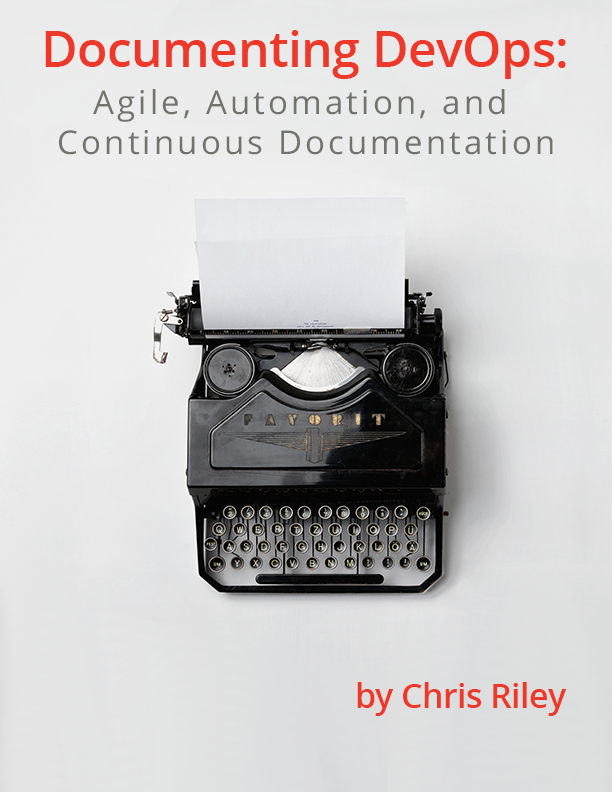
Chris Riley former GigaOm analyst, O’Reilly author, devopsy.kinsta.cloud featured writer and founder of Fixate I/O has written an outstanding report on the key role documentation must play in the modern software development lifecyle. Agile or DevOps, automated or not, we live in a continuous IT era. So why shouldn’t documentation be continuous as well? Riley’s analysis includes key findings including:
Even the definition of documentation is subjective. Despite several decades of implementation, the methods, drivers, and even language of documentation are nearly limitless. Standards such as ITSM help stabilize the look, feel, and process of documentation, but it does not help an organization understand how to use that documentation and integrate it into development.
The modern software delivery pipeline introduces new complexities in administration. New tooling in the DevOps space has improved application efficiency and quality, but in some cases, this has also reduced the manageability of the environment. This creates new challenges to knowing what you have, how it functions, and how to extend it into the future.
As the delivery pipeline moves to a continuous stream of releases, classic documentation processes become impossible. Documentation must happen automatically within the process, or not at all.
In order for documentation to be useful, it needs to be actionable.
Download the complete report on continuous documentation for an in depth analysis, conclusions and guidance:
Last week we kicked off our webinar series on Variable Speed DevOps. The discussion was lively and informative. For myself as moderator the webcast was as comfortable as an old pair of slippers. Two of the three panelists, Carme DeArdo of Nationwide and Sanjeev Sharma of IBM are both friends and people I have had the pleasure of appearing with before. Additionally, Lee Reid, fit right into the discussion, not missing a beat. You can listen to the recording or view the slides here.
We discussed Variable Speed IT from many different aspects and how Nationwide has successfully merged onto the DevOps highway. More than any of the other analogies we spoke about or I have heard, I really like the DevOps highway as a good way to explain Variable Speed IT and Variable Speed DevOps. The notion of multiple lanes with traffic moving at different rates in each lane is a good way to think about Variable Speed IT.
Of course if only things were that easy. In the variable speed DevOps world the traffic in each lane is directly connected to the traffic in the other lanes. This is where the expertise of Carmen and the rest of the panel comes into play. In an organization such as Nationwide (see the first two slides of the deck to get an idea of Nationwide’s scope) coordinating Systems of Records with Systems of Engagements, multiple dev and ops teams and doing it all successfully is orchestration worthy of a maestro.
Lee and Sanjeev in their positions at IBM have had the chance to work with several organizations like Nationwide so can take lessons learned across an even wider spectrum of experiences.
All of this added up to a great webinar that I was lucky to be part of in some small way.
Our deep dive into Variable Speed DevOps continues on May 19th with the Canada Mortgage Housing Corporation explaining how they were able to break down IT silos and in both their mainframe environments (yes even mainframes) and others. You can find out more about this one and register here: https://devopsy.kinsta.cloud/blogs/variable-speed-ibm2/?S_Tact=C34701GW.
Variable Speed DevOps, 2-Speed IT, Bi-Modal IT – we are seeing lots of different terms to describe a common fact pattern. We think this series of webinars will explore many of the facets of this subject.
In them meantime we are off to a fantastic start with our first in this series. I really encourage you to go have a listen. Many thanks to Carmen DeArdo, Sanjeev Sharma and Lee Reid for kicking us off with a great webinar.
My friends at JumpCloud asked me to contribute to an Ebook they wrote on “Doing More Faster now with IT control”. The idea was to take the concept made famous by David Cohen and Brad Feld in a book and as the mantra for Techstars and apply it specifically to IT. I was part of an all star team, each assigned to write a section. Gene Kim, Ben Kepes, Tony Bradley and Raj Bhargava each contributed. My section is on BYOD. Gene Kim writes about DevOps (no surprise there), Ben writes about hybrid organizations.
But I don’t write this article to blow my own horn about writing a chapter in a book (maybe just a little). Rather I read Brad Feld’s blog post on it today and as much of what Brad writes, it made me think. As Brad said doing more faster generally is a good thing. But as the saying goes, “speed kills”. Going faster can spawn a cascade of other issues. Dealing with them is often the key to success. On that note Brad calls out three things about organizations who successfully do more faster:
They decentralized decision making
They push the pace of their product development by more closely aligning with customers
They create a culture of action
In terms of DevOps, isn’t in many ways the idea of doing more faster core to it? So to me doing more faster is as much a mantra in DevOps as it is at Techstars. I don’t know the idea that IT wants to do more faster is just natural to me. But again on Brad’s blog I was reminded that is not the belief of everyone. There was one comment on the blog when I read it today:
Does IT matter? 🙂 IT has been outsourcing and offshoring itself for the past 15 years, and that trend is on-going. “Fast” and IT are oxymorons. But if there is hope, that’s great.
I read this comment and it occurred to me. This fellow is pretty sour on IT. While I think we are living in a golden age of IT and technology, there are some who believe that IT is slow non-responsive and “outsourcing and offshoring itself for the past 15 years.” My first reaction is do you still think we are off-shoring and outsourcing so much? To me that pendulum has already swung back. Then I thought even if didn’t what difference does it make? If you are having development done off shore or outsourced does that slow you down? Does it prevent you from doing more faster?
One of the benefits of trends like DevOps is that we are doing less outsourcing I think. But really is fast and IT an oxymoron? What IT team abused this poor fellow? I just don’t get it. Am I missing something or just living in a bubble? What do you think?
Yesterday I wrote about a session that I wanted to see by Michael Cote’ called The Coming Donkey Apocalypse. In my article I said on its face I didn’t agree with calling the mainstream adopters Donkeys. I also felt that their adoption would not result in an apocalypse. I also said that you can’t judge a book by its cover and you can’t judge a session by its title and abstract. I was really looking forward to see what Cote’ was getting at in this session.
So I eagerly grabbed a near front row seat when he took the stage right after Damon Edwards excellent opening keynote. One of the first things Michael addressed was his use of the term Donkey. Actually he started off with his conclusions which I thought was a very effective way of delivering a session as it focused the audience on what the takeaways are supposed to be. Anyway Michael says that donkeys are hard working beasts of burden, gets no respect, has to do more with less and represents the “rest of us”. The donkey as a jackass connection is not part of this. It is more that while Unicorns are magical, horses are actually regal but most of us are more like donkeys. Put better as one of Michael’s co-workers said “the donkey is real people with real problems”. DevOps Donkeys are what is coming as more mainstream adoption of DevOps takes place.
Michael had a lot of data showing that DevOps adoption is very much on the rise. Multiple sources showed a continuing further penetration by DevOps in the marketplace. Also the idea of what DevOps is understood enough to move on beyond that. The jist of the message was that the people attending the session had to do what they could to help these donkey’s in their adoption and journey to DevOps.
But what about the apocalypse? This is important. It is not that “bending DevOps to their will” is the apocalyptic event. Rather the apocalypse is the fact that according Ian Head of Gartner says that “by 2018 90% of I & O organizations attempting to use DevOps without specifically addressing their cultural foundations will fail.”
This is something I agree with. All too often the tendency is to “bag dive” into tools and features. While everyone gives lip service that DevOps has a strong cultural element which trumps tools, to too many people it is just lip service. They will talk about the cultural aspects then go run out and buy tools to implement. Then they wonder when their DevOps projects fail. That is apocalypse we need to avoid.
I spoke with Cote’ briefly after his session and clarified some of his message and thoughts. I am embedding a slide share of his presentation from slideshare. Though marked draft, it seems to be complete. I will update it when a later copy becomes available.
So the take away from me is something that I have seen time and time again. How do you help donkeys or anyone else implement a cultural foundation for DevOps in their organization. This is a different problem than picking the right tool. In talking with Michael he mentioned that transforming corporate culture is something that companies such as McKinsey and Bain literally wrote the book on.
The problem is can donkey’s afford McKinsey or Bain? Probably not. So how can they get practical, affordable counseling and advice on transforming their culture. I don’t know any companies offering that today. But if any of you do, leave a comment so perhaps others looking for this will be aware of them.
Anyway, it was a great session by Michael Cote’ in a day full of great sessions and DevOps learning in Austin today. I am looking forward to another great day tomorrow.