For the third year, devopsy.kinsta.cloud hosted a DevSecOps/Rugged DevOps event at RSA Conference. As with years before, we smashed attendance records. We had just shy of 900 people stop in on Monday of RSA Week to hear from the 11 presentations we hosted. Taken in total, the presentations presented a wide range of DevSecOps issues. I wanted to draw your attention, though, to two of the presentations that I really enjoyed.
First of my favorite presentations
The first was from someone I had not met before who came to our attention via our call for speakers. Duane Schleen presented, “Implementing DevOps in a Regulated Environment: The Aetna Experience.” His presentation is below:
Why did I love this presentation? Good question. First of all it is rare that we get such an open peak behind the kimono at the actual inner workings of an enterprise, especially in such a regulated industry as insurance.
More than that though I am telling you that Duane Schleen or DJ as he is called is going to be a DevSecOps rock star. Can’t wait for him to write a few articles for us here at devopsy.kinsta.cloud. If you get a chance to see him speak at a conference near you, jump at it. Can you tell I am a fan?
On top of this the look Schleen gives us into DevSecOps at Aetna shows that despite the naysayers, you can go faster, with higher quality and be more secure!
The Second Presentation I loved
The second presentation I wanted to bring to your attention was the opening keynote by John Willis. Most of you have probably seen John present before either live (if you are lucky) or on line. John is of course a co-author of the DevOps Handbook as well.
John’s presentation is entitled, “Breaking Bad Equilibrium”. It is about cooperation in DevOps, technical debt and uses some game theory to explain some of the John’s thoughts.
My favorite part is when John uses some clips from the UK game show “Golden Ball” to discuss Nash Equilibrium (or prisoners dilemma ) and game theory. Both clips really grab you and make you think (as many of John’s presentations do). I will let his presentation speak for itself though.
Beyond, these two excellent presentations, you can see the rest of the presentations from our DevSecOps event at RSA Conference this year on our DevOpsTV channel on YouTube. The link takes you to the playlist with all 11 presentations.
This years DevSecOps event at RSAC was a smashing success with almost 900 people stoping in to hear some of the excellent presentations. It did this authors heart good to see this great mixing of the DevOps and security tribes coming together.
While plenty of vendors tell us what they think is happening in the market, the only way to really learn is from you, our readers. So we are asking you to take a few minutes to take this important survey on the adoption of CI/CD, DevOps and job scheduling.
We will be giving a $50 Amazon gift card to one out of every 50 respondents. More importantly we will be publishing the results here on devopsy.kinsta.cloud to share with everyone. The survey is sponsored by BMC and co-produced with devopsy.kinsta.cloud.
As adult learners and leaders, we tend to glean less from theory and seem to derive more from people actually describing the real-world problems they are trying to solve. Ever since the DevOps Enterprise Summit began in 2014, we’ve been adamant about providing a unique venue for the technology leaders of large, complex organizations to come together and share their DevOps transformation experiences—from how they started and what they did, to what the outcomes were and what they learned.
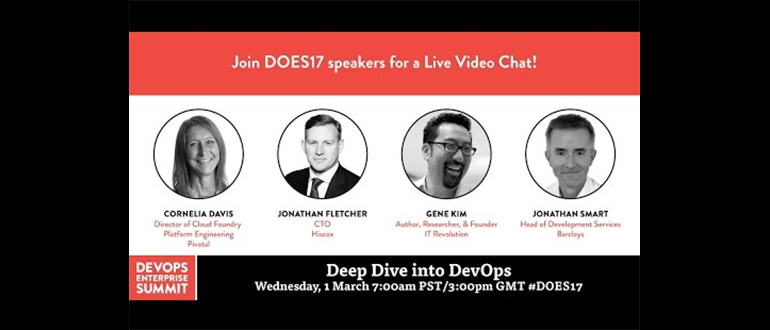
On the second video chat gearing up for DevOps Enterprise Summit London 2017, programming committee members Cornelia Davis (Pivotal), Jonathan Fletcher (Hiscox) and Jonathan Smart (Barclays) joined Gene Kim and spent an hour taking a “deep dive into DevOps,” to reflect on the first DevOps Enterprise Summit London last year. Panelists also shared some of their lessons learned and wisdom about their own DevOps transformation stories today and shared some of their favorite resources for leveraging best practices and principles while discussing the value of lifelong learning.
Just a reminder that Early Bird ticket pricing for DevOps Enterprise Summit London 2017 was extended to 22 March and the price is only £650+VAT. Register here >>>
All in all, it was an excellent conversation with Jonathan Smart, Cornelia Davis, Jonathan Fletcher, and Gene Kim as we all inch closer to the DevOps Enterprise Summit London this June. The goal (according to each of these people who are now on the programming committee for London) is to hopefully make the show even better than it was last year. We look forward to seeing all of you June 5-6 at the QEII Conference Centre.
Here is the video and a full transcript of the conversation below that. More links to DOES videos and interviews are down at the bottom. See you London June 5-6!
Gene: Summit 2017 in London. This conference is taking place on June 5th and June 6th. For more information on this, just go to events.itrevolution.com. I think what excites me so much about the DevOps Enterprise Summits is that there is just, no doubt in my mind, that the people who are presenting are the leaders and practitioners, who are pioneering how we’re managing and using technology in large, complex organizations. So on this Live Chat, we have Jon Smart from Barclays. We have Jonathan Fletcher from Hiscox, Cornelia Davis from Pivotal who’s also…In fact everybody is on the programming committee.
So my goal next hour is to have each one of you share what you’ve been working on, share some of your lessons learned and wisdom which is just, obviously, a fraction of what you’ll be presenting at the DevOps Enterprise Summit. So just one last reminder is that there’s an early bird ticket pricing that ends on the 8th of March, which is one week from today. So the next step is really to share what wonderful speakers that we have on the panel today. So let’s go around the table, and if each one of you could present your name, your role, company and, specifically what you presented on last year. Cornelia, why don’t we start with you?
Cornelia: Sure. Good morning, good afternoon, everyone, and, hi, Gene, and my fellow panelists. My name is Cornelia Davis. I am the Senior Director of Technology at Pivotal, and so Pivotal is a company that maybe is most well known for incubating the Open Source Cloud Foundry Project, and my role is that I work in the product organization. I work with clients and customers to take our products and use them effectively. Well, it turns out that our products are really disruptive.
It’s very different architecture and so they have to change everything. So that’s where DevOps and digital transformation comes in, is they actually have to in order to use our products effectively, they have to change organizational structures and you have to change processes. And I have this tremendous opportunity to work with very large enterprises across the globe, in then figuring out how that works for them.
Gene: It often can be very disruptive to the way we’ve done the thing for decades, absolutely.
Cornelia: Oh, yes.
Gene: Jonathan Fletcher, why don’t we start with you? I wanna go to you next and, by the way, congratulations. I hope you’re gonna tell us about your promotion, as well.
Jonathan: Yeah, so I’m Jon Fletcher. I am the interim CTO for Hiscox Insurance. Based out of offices around the world. I’ve been the CTO for a month, five minutes, it seems. So, it’s fairly new.
[Crosstalk]
Gene: Can we stand by a second? We’re having some audio issues. Let’s go to Jon Smart while we resolve that. Jon?
Jon: Hi, Jonathan Smart. So I work at Barclays. My role is Head of Development Services and I’m leading on better products faster, so better ways of working, adoption of agile dev ops, lean principles, and practices across Barclays.
Gene: Brilliant, and what did you present on last year?
Jon: Last year, I presented an Experience Report. So I gave an update of the Barclays journey across the whole organization. We started two years and two months ago, beginning in 2015, so last year, I gave an Experience Report, shared some of the lessons we’ve learned in terms of transforming a large organization. We are 130,000 people in 40 countries. We have 48 million customers.
We’ve got some main business lines such as the investment bank, retail bank, wealth, corporate. So we’re a very large organization, as I said. We’re 327-years-old, founded in 1690. Four years before the Bank of England existed so that’s a lot of legacy to change and it’s a large organization. So I shared our journey so far, and I’m looking forward to sharing an update this year, as well.
Gene: Brilliant. And I think one of the things that just left such an impression on me was just the scope of what you’ve been overseeing in terms of how many engineers and how many applications?
Jon: It’s 26,000 staff in technology and over 3000 applications.
Gene: That’s awesome, fantastic. Thank you, Jon. All right, Jonathan Fletcher, let’s go to you. Name, company role and what you presented last year, and you’re gonna to tell us about your promotion. And then we’ve gotta unmute.
Jonathan: I am the interim CTO of Hiscox Insurance. I’ve been in that position for about a month. So I’m not exactly seasoned, but I’m doing it so far. I’m really excited to be part of this and speaking in DOES in June. So I’m looking forward to that.
Gene: Awesome. And then you presented last year?
Jonathan: I did, yes. Sometimes it’s on our move to DevOps and a bit of my personal journey starting as a solution architect four or five years ago, and how I got involved, and how the whole thing started to happen, and I hope this year to carry on talking about that journey and where we are now.
Gene: Very good. Thank you. So why don’t we go to a little bit about the conference and your impressions on it? You know one of the things that many people have told me over the years is that DevOps Enterprise Summit is structured differently than most typical technology conferences that we go to. And I think many of us are, actually almost professional conference attendees. Would you mind sharing your impressions of your two days at the DevOps Enterprise Summit, London, last year? Jon, why don’t we start with you?
Jon: So what I really like about it is that it’s peer-based, so it’s people who are doing the job of transforming organizations and that’s what I like about it. It’s people sharing case studies, sharing their real experience so, you’re learning firsthand. It isn’t a series of sales pitches. It’s about people who are doing the job. Specifically in the horse is not the unicorns. I’m shy of horses, rather than the unicorns. People who are not born Agile, but are born Waterfall. So that’s what I like about it.
It has great networking opportunities, as well, with people who are going through the same journey. And also it’s interesting when you sit through a number of the case studies, you start to see the common themes emerging, and pretty much every single time, the main theme that emerges is it’s all about people. And often with DevOps people jump straight to the tooling and they don’t think about people and culture, often, but it’s all about people. So it’s great when you see these themes coming across from many different companies.
Gene: That’s awesome, and I’ll maybe just comment on that. I mean I think that’s one of the reasons that we choose very deliberately to have people share Experience Reports. Just because as adult learners, as leaders, we tend to learn less from theory. Instead, we learn from people actually describing the problem they’re trying to solve, what they did, where they started, what were the outcomes, and what did they learn. Jonathan, how about you?
Jonathan: I’d echo much of what Jon said, actually. So I like the fact that the very little of it is technical. So very people, focus, culture, process-based and I love being the least smartest person in the room. So it’s watching to learn from lots of other people. I think lots of DevOps conferences are very technical, although, they’re very at the beginning of the journey.
So being surrounded by other people that are at least where we are, if not further ahead. For me, it was a great learning opportunity and I can remember coming away reinvigorated about what we’re doing, and I guess hiring because you were pushing against people that, necessarily aren’t aligned to your way of thinking. So it’s just to get that we are doing the right thing, and we are going the right direction. That was really fantastic. So I really enjoyed those couple days.
Gene: Awesome. Cornelia.
Cornelia: Yeah, it’s all of those themes, but there’s some interesting…As you know, Gene, I work with you on the Programming Committee, have been in the U.S., and now this year in London, as well. I wasn’t at London last year, but we did something in the U.S. last year that we’re going to bring to London this year, and it’s really just an exemplar of what we’re talking about here. It’s a programmatic way of really fostering that peer-to-peer collaboration.
And so last year in the U.S., we did these lean coffees where we had this structured format where we got people together at round tables and had kind of a facilitated way of sharing ideas, and it was fantastic that the tables that I sat at, it was literally an hour-long period. And I think everybody at the table got three concrete takeaways of, “Oh, that’s a technique that I wanna try.” And so as you know, Gene, we’re talking about bringing that type of a format.
It’s not just conference sessions. It’s that type of a format to really foster that collaboration and that’s really very different from a lot of conferences these days.
Gene: Yeah, and I think both Jonathan and Jon will be joining the Program Committee starting this Friday. And I think one of our goals is, you know how do you create the conditions where those serendipitous interactions, how do you maximize the opportunities for the interactions that lead to learning, right? And part of that from a program perspective is we do both the talks, but also creating session formats like that. So one of the things that I’m just delighted about is that the conference will be featuring both Jonathan and Jon, again, sharing the continuation of the journey both at Hiscox and at Barclays.
What I love about this is it’s something that most conferences actually don’t…it’s actually quite unusual, right. But, for me, it seems like this incredible opportunity where we’re almost documentary filmmakers following these leaders, as they go through their own journey and we get to learn as they learn. So you’ll both be presenting for the second time. What can you tell us about what’s happened in your own respective journeys since you presented in 2016? Jonathan, why don’t we start with you about the Hiscox journey?
Jonathan: So last year, I talked about our starts with DevOps, and I guess the point of my talk was that I don’t think we’re really doing DevOps. We’re doing bits of Agile, and continuous delivery, but I think that’s really what DevOps is trying to solve. So there’s lots of stuff with testing in automation and application teams, but really I think the real nirvana is when we bring the Ops side into the equation. So in the last year, we’ve been doing a lot of stuff with cloud.
We’ve been doing a lot of stuff with talking around how we move to a more Agile operations team, rather than a sort of ticket-based system and doing projects in a Waterfall way. So trying to get some of those concepts that we’ve learned in an application mode into the operations teams, and the challenges of doing that, and how we get those two linked together so we can minimize and help the flow of feedback that goes through development into operations systems. This is the final bit of that journey, I guess.
Gene: And you could you talk a little bit about how the change in your role, maybe even going back, I mean how do you think the work that you did in terms of pioneering some of those practices at Hiscox, how did that lead to your change in responsibilities, and how does your change in responsibilities allow you to do more or less going forward?
Jonathan: So I started as a Solution Architect. So actually nothing to do with DevOps at all, and it was kind of just was born out of frustration. I was like, “We’ve gotta change the way we do stuff because this is daft.” So it’s coming in with a great new focus which, again, most DevOps translation started quite small which we got an application, and we did some automation around it, in terms of scale and CD and some automated testing. And then we saw these successes of that and went towards something else, and then it’s just kind of ballooned over the years. And, I guess, we’re really starting to see some of the business payback for that and that’s helped me.
I get more visibility to be seen as someone that’s trying to be more strategic, in terms of how as an insurance company we maintain a competitive advantage. And I think that this step to CTO is sort of the logical conclusion is to help to see that journey through. It’s helped me because now I’ve got a lot of guys rather than influencing up the chain over time, but other peers of mine are direct reports so that that’s gonna help…not that it’s a dictatorship. But it’s going to help my influence and ability to do that, as well as having own budgets and ability to spend some money on that.
Gene: By the way, conclusion sounds so terminal, Jonathan. Let’s not hope that’s the conclusion…haha!
[Crosstalk]
Gene: A continuation perhaps.
Jonathan: A continuation, yes!
Cornelia: I love what you said about Agile operations team instead of tickets. So instead of tickets, it’s so huge. It’s such an important part of DevOps, and it’s all about empowerment, right, but empowerment still in a safe environment.
Jonathan: Yeah, absolutely. I love that. And I think there’s a technology problem there as well. I think it’s very difficult to align the types of tooling that develop as you’re using along with the ops guys that also want to have things like, ITIL based processes and a change management database, and trying to get that transparency across the whole value stream is quite difficult. So that’s one thing I’m kind of wrestling with at the moment.
Gene: That’s great. Jon, how about you? Yeah, what has changed in your journey since you presented back in June?
Jon: So knowing why you’re doing this is important. So why is any company doing DevOps, adopting DevOps and why are active products faster with delighted customers and colleagues, better, faster, happier, safer? And so taking a broader definition of DevOps, in terms of better product, faster, safer, happier we’ve increased our adoption across the organization. As I said, we’ve been doing this across the whole firm for two years and two months.
If you go back two years and two months, it was a relatively small percentage of our change work was done with these practices and principles, and now we’ve got a fairly significant percentage of our change work now being done with Agile and DevOps and Lean principles. So in 2016, we’ve carried on that at-scale adoption, and we have done it apace. We have something like, rough order of magnitude, something like 15,000 people who are now working with Agile and Lean principles, and practices who weren’t two years ago and important to get the ball rolling.
It’s important that we do it with control in a highly regulated environment where as we know the impact of attitude is significant. And so we’ve also been focusing on control because we want both speed and control. Sometimes people might think that you can’t have both speed and control and people might think that speed is at the cost of control, but actually, it’s quite the opposite. You can do anything badly. You can do fragile or you can do Agile, and actually an Agile approach and a lean approach increases control. So we’ve been putting quite a lot of effort in 2016 into control, as to both we are balancing by speed and control.
Gene: Cornelia, you had a question for Jon.
Cornelia: Yeah, I do. So, I thought it was very interesting that you said it’s been two years and two months. So that’s a pretty specific date/time period. What was the catalyst? What was the starting point? What defines as two years, two months as opposed to roughly two years ago? Was there a specific event?
Jon: Well, maybe I’m speaking from my personal perspective. It’s roughly two years. It’s roughly two and a half years and, specifically, what any organization needs to do this successfully, it needs both top down and bottom up. So the specific event, this was a catalyst, in our case is with new leadership and new leadership saying, “Agile and lean is the way to go,” and then the natural champions in the organization, like myself, we put our hands up, “We volunteer to help move the needle.”
Gene: Okay. I mean so in other words, this signal of support from upper management is kinda what you mark as the real start of the journey, right, where it was now a sanctioned, important activity.
Jon: And it was articulated, formally as part of our strategy, yes.
Cornelia: And that is something that I see across, again because I get to see across a lot of different enterprises that are all on a similar journey and that’s not at all unusual. When we have new leadership that comes in, sometimes new leadership that’s brought in, specifically to shake things up, that is often kind of the defining moment where things start to change.
Jon: Yeah, and like I said, absolutely, mandatory criteria to be successful across and organization, you’ve got to have that top down support, as well as the bottom up community. You’re gotta have those two things.
Gene: By the way, I love the number that you put out, in terms of 15,000 engineers working with Agile principles, just to calibrate. That’s actually the size of the Google engineering organization in 2013. So it’s just amazing to see what happens when you can elevate the productivity of engineers that it’d impact that many people. Jonathan, you had a thought.
Jonathan: Yeah, Jon, I was really interested, you were talking about control. Barclays is a fairly massive beast. I was thinking with your move to Agile. How did you have that control at the scale that you’re operating in? I mean lots of Agile teams work very much, almost as a silo, themselves. They’re in back of their work how to orchestrate such a large transformation in such a large company.
Jon: The main principle has been to start with what we have now. So we clearly are operating in a highly regulated environment. We’re not starting from a clean sheet and working towards what we have. We’re starting with what we have and we’re iterating to improve control effectiveness. A starting point was a Waterfall lifecycle, and I’ve spoken about this at the last DevOps Enterprise Summit. We had NT8 mandatory artifacts, many hundreds of questions, and it was a very un-lean process, and it was evolved over time, multiple input, probably from multiple audits and multiple control findings, and so on.
But it became really catered to the lowest common denominator, but applied to everybody. So what we’ve been working on is improving the control effectiveness and leaning the process. So it’s more as a greater risk sensitivity now. So if you’re doing something which is, say, for example, an internal system, nothing to do with payments, no client data, it’s purely…I dunno…a seating map, for example, then it’s risk sensitive. So the controls that will apply to that are in line with our control framework.
Something that is to do with payments, some has client data, the control implications are much higher. The main thing is it isn’t a lowest common denominator for everybody. The thing is applying Agile principles, we’ve moved it to be more of an early and often conversation with our control professionals. So, previously in a traditional manner, you deliver something and we had a control engagement at the end, just before you’re about to put it into production.
And then that leads to another three months to six months of unplanned work, in a reactive manner is what we observed in some cases. So instead we’ve got long-lived controlled tribes, multi-disciplinary long-lived association with the customer value stream, and then you have a conversation at the beginning, and you have regular small conversations as you go, so there’s no surprise at the end. And there isn’t an end because it’s a long-lived product with regular deliverables.
Gene: That coincides with the regular audits that happened, right, the compliance reports. That makes a lot of sense.
Jon: Exactly, exactly. Exactly, the control effectiveness is stronger because you’ve got that regular interaction and the regular looking at an actual product that you’ve actually got something tangible to look at.
Gene: Just as a little side note that we have a group and, hopefully, you’ll be joining us, Jon, from MarkSoft, Capital One, and others, just really trying to help bridge that gap with compliance professionals using their terminology, using the design control effectiveness language, really to show that you know DevOps people aren’t crazy. In fact, you end up with better control effectiveness working all the time. So that’ll be a very fun interaction. I’m very excited about that deliverable.
Jonathan, one of the themes that have come up here is that wonderful things happen when you’re surrounded by fellow travelers who are facing the similar types of challenges and kind of the learning that can ensue. I actually had the privilege of observing one of those sessions that you and I were talking in, and you had a conversation with Scott Prugh who’s the VP of Development and Product Operations at CSG. They’re one of the largest bill printing companies in the United States, and the topic was how do you overcome some of the traditional challenges, how you get more traditional IT operations organizations on board. Can you share some of the challenges that you’re grappling with and some of the insights that came out of that conversation because it was absolutely amazing to observe?
Jonathan: Yeah. So in terms of our org structure, Hiscox a fairly federated business. So we have a number of British units aligned to countries around the world. Application testing teams tend to be aligned to their business units, but operations infrastructure is a group resource that delivers against all of those operations, all those departments. So what we’ve been wrestling with really is how do we or do we maintain that? Do we align infrastructure operation teams to a particular country or do we continue to measure out of a group resource? And if we do that, then how on earth do we have a backlog where we’ve got so many different stakeholders with different requirements, different projects?
And how do we prioritize amongst all those different business units and how do we still get projects done? How do we still get BAU done? I guess the questions that any Agile team has, it’s just on a much grander scale. So each business unit is operating independently. I don’t really care what some of the other business units are doing as much as it’s about their P&L. They want to first bust at the cherry. So does that mean then that BAU goes off to the side and we stop patching because there’s continued focus on projects? So there’s some of the sorta challenges we usually went over with Scott.
Gene: Yeah, mute button. And what was just some of the insights that you had or at least, maybe even validations of the problem? Specifically, how do they inform your thinking?
Jonathan: So I think what was quite interesting is listening to Scott’s talking about visibility of work in progress. And some of the frustrations there are between development operations is because both of them are almost black boxes. So a developer might say, “Look, I need an environment and it might go into a ticket system” and it goes from the server guy towards the SAN guy, and the storage guy, and it goes around in little circles.
How can we let the developers know what the ops guys are up to, and conversely, how do we let the ops guys know what developers are doing? So how do we get that work-in-progress highly visible and that, as a starting place, would be a good way of beginning to address some of the prioritization issues because they’re working off completely different backlogs. The left-hand does not know what the right hand’s doing. How do we start to make that happen? So that was a good sorta first head’s up from him, just to go and look at that problem.
Gene: All right, in fact, I think he’s spoken a lot about trying to get more and more of the ops work into the same work systems as development. So in their case, it would JIRA, and so forth, and less the remedy and so forth, right, just to have a single prioritized work unit.
Jonathan: Yes, but that’s pretty hard. And who’s gonna be a natural tendency for projects to trump everything else because that’s what a business is asking you to do and we’ve gotta change out the door? But you still need to make sure things are patched, and security’s done, and I really like that sort of conversation where you start to allocate points in a sprint, so that’s BAU and that’s projects. If you don’t do that it becomes a very difficult way to triage and prioritize stuff that’s coming because like BAU is gonna be on a loser.
Gene: Cornelia, as coming from a development background, I think you’ve observed something very similar in your journey.
Cornelia: Absolutely. And one of the things that’s really interesting that we found very effective is to take the same product-oriented mindset that the application teams have when they’re building and delivering their products, and actually have that same mindset at the operations and at the platform level. So that, instead of it being treated as just unplanned work, work that comes along, now it comes in, we have to prioritize it, they start to treat their offerings as products themselves. So that they do things like measure…they have a backlog of additional features that they wanna create.
They have release notes that say, “Hey. We’re patching the system on this day” or “You have the opportunity to apply your patches because the patches are queued up and ready to go.” And so really shifting that product mindset, all the way deep down into what’s kind of traditionally an infrastructure kind of role that tends to be a little bit more order cook-ish, and really transforming that into a menu-driven, “Here are the offerings that we have.” Of course, you can’t get rid of all of it, but that’s really, really powerful, is a product oriented mindset, even at that deep infrastructure level.
Jonathan: I think you’re entirely right. I think the mindset, yes, I think the practical application is more difficult. So if you build an environment, for example, you need a server person and a SAN person, and a storage person, and there are lots of techology-silos. So what isn’t very practical is go and take all of those resources, and go and stick them in a dev team because your Agile team’s gonna be 400-people strong all of a sudden which is not ideal. So I think I get the mindset implication or, I think, the technical implementation of that, I think is a bit harder.
Cornelia: Yep.
Gene: Jon, I can’t imagine that somehow Barclays is exempt from some of these issues, as well. I’m guessing that this has relevance, at least in some areas of the organization for you.
Jon: Yeah, absolutely. This really resonates. I think if you go back and my own personal experience, you go back about 20 years ago and, specifically, that’s when banking, we used to do all the roles. I was a developer. I did the analysis. I did the development. I did the support, and I sat next to the customer or the partner and we did everything, and over time, we’ve gone from a role specialization and the split between kinda ops, run, and build, dev. And so, yes, this absolutely resonates.
Generally, for Barclays, coming from a generally Waterfall approach prior to two years ago with islands of Agile, I’m looking at this topic, we’re looking at how we get closer to you build it, you run it. But still maintaining regulatory compliance around segregation of duties, Sarbanes-Oxley Compliance. But as we’ve discussed, the run specialists, the operational specialists, utter the feedback with the build and the dev specialists need to all be lined up behind the customer. And, obviously, what happens when you’ve got operations, you’ve got run who are working in their own world.
The feedback loop never gets back to the dev team, so developers need to feel the pain. I like the SRE Site Reliability engineering philosophy of hiring engineers into ops roles because when you put engineers into op roles, things tend to get fixed kind of at the root cause, rather than a band-aid, rather than a short-term fix. So we are absolutely this is a high priority for us, especially in 2017 to try to increase the feedback, and get more to being one team. But to Jonathan’s point here, we can’t do that with everybody in every role. So yeah, there’s going to be the product teams and there’s going to be secondary teams, and that’s absolutely something we’re trying to move the needle on.
Gene: Jonathan.
Jonathan: Yeah, I think when you start, I think, cloud for us changes that. When the infrastructure guys start to use the same processes, and tooling, and approaches that the developers do, then I think that becomes a lot easier. So I’m trying re-push infrastructure as code at the moment, and I think that is the way of really breaking it down. If infrastructure is just another software project, that becomes really easy to put into that Agile team with the application team. If you’ve got a mix of traditional, “I’ve gotta go and plug a server into a wall. Then I’ve gotta go and configure this” that doesn’t really fit in with a normal Agile team.
And you’ve got a guy was talking to me earlier, he wants to order new servers, six to eight weeks, and then we’ve gotta go and get finance approval for it and. “I think I’ll do this.” That’s not gonna fit in that tight feedback loop that Agile’s trying to work with. So, for me, it’s about transitioning some of the infrastructure skills into more software-led skills, and that’s where you’re gonna get that much closer alignment. That’s where you’re gonna get the DevOps cultural start. That’s where it is. I think trying to do in on-prem, in a manual way is kinda of a bit of a recipe for disaster.
Gene: I think the best people that really embody this is Jason Cox from Disney. His title is Senior Director of Systems Engineering at Disney and he’s talked tirelessly about how he’s tried to create, embed those ops, talent and engineers into the lines of business, into the dev teams, really helping them do things on-demand, and it’s been amazing to see his own journey over the last four years. Just a little joke here.
You talk about infrastructure is code, Jonathan, I love how Scott Prugh from CSG, he said, “The ops of that is infrastructure’s tickets” which is actually what we don’t want, right. We want those on demand. Let’s go to Jon, and one of the just tantalizing pieces that you had talked with us there at Prep Call, just before this panel was the Lean Portfolio Management work that you’ve been doing and how that’s become your newer areas of focus, and I think all our ears perked up about that.
Because of I think this realization that all of us have had over the years, is that you can have fast iteration loops within the dev test operations stream, but if you have an annual budgeting cycle and annual planning process, that really sets some very hard limits on how Agile you can be. Tell us about what you’ve been working on.
Jon: Yeah. So, as you say, we can have as much agility as we like. We can be practicing DevOps. We can have great continuance delivery, but it’s a local optimization when you look at the system, think a system’s thinking and a theory of constraints to deliver better products faster and with delighted customers and colleagues, it’s gotta be end-to-end agility. And so I think this is a natural evolutionary thing, having made some pretty progress, I think in the last couple of years, in terms of how we do what we do.
As we start to expand out in the theory of constraints, look at what the next constraint is. As a large, complex organization, we’re starting from the position of annual planning and annual budgeting, and that doesn’t give us enterprise flexibility as much as we would like. So this is a focus for 2017 for us, is to move to more of a courtly rolling wave type approach, more of a hypothesis-driven investment approach, more of a focus around outcomes, not a predictive plan. So once a quarter you said, “This investment should have achieved these outcomes. Has it?” And being able to build more agility into the system of work holistically.
Gene: Yeah, Jon, I’m dying to ask you. So I think the way I was trained there’s kind of two planning processes, right? You have the project budgets, right, which are owned by the business which tend to be…they can go up and down quite quickly. Whereas then you have the annual shared services budgets, right, where you tax every person, right, 2% of revenue or whatever, and then you a create work queue that’s prioritized, and maybe it’s not a good year now, maybe you’ll get it next year or the year after. So has your focus been primarily on the project on the business side? To what extent can you translate that to shared services?
Jon: So, that’s a good question and I think a caveat to what I said, as a public-listed company, we will still have an annual process. What we’re trying to do is we’re trying to push the courtly rolling wave, portfolio-management process as far…We’ll start at a certain point in the organization and then we’ll try to push it as far up the organization as we can. So that, basically, within our budgetary constraint whether it’s a business investment, you used the word project, whether it’s a business investment or whether it’s a shared service, irrespective of that, you treat it, your budgetary constraint, it is a constraint, and you wanna maximize the value on it.
So you would do it, you know my view is that we do it in both because, as well as about financial flexibility and being about to move money around, it’s also about de-risking delivery and getting away from the sum cost fallacy for a shared service. You know, “You said you’re gonna achieve this and, of course, this year, here’s this big chunk of money.” Naturally, “Have you achieved it? Are you going to slowly?” You know, “Can you cut the value chain? Have you delivered your value? Can you stop early? Can you pivot?” So it kinda serves multiple purposes.
Gene: Just a joke. I mean I was actually having a startling conversation with a friend of mine who was saying that they’re a publicly traded company and there was this sorta zombie operations project that they had depreciated over five years, and they couldn’t kill it because that would actually create a material change in the financial statements. But everybody knew that such a $7 million in a right world, we should just admit that it didn’t work. Kill it, so we don’t have to prop up this fallacy of a services actually running when it is not running at all. Does that resonate at all with you?
Jon: Yeah, it does. You know what we’re trying to avoid happening is exactly that kind of that sum cost fallacy and looking at a traditional approach, I’m sure we’ve all seen large initiatives which have that got multi-year sum cost fallacy that hasn’t delivered, but we’ve already spent so much money on it, we’re gonna carry on spending money on it.
Gene: Just to add color to that story. So they actually had this annual ritual where they’d have to run one transaction through it, just to prove to the compliance people that it is still operating, and so therefore, still eligible to be depreciated which is a shame. Jonathan Fletcher.
Jonathan: Jon, I love what you’re trying to do with that. It sounds fantastic. My question to you is are you forever stuck in writing businesses cases for return on investment? Does that slow the process down?
Jon: Hopefully not. You know we’re taking a lean canvas approach. So it’s not in the past in a traditional approach, you might have had to fill in a PID project initiation document which might be multiple pages long. We’re trying to keep it lean, so we’ve got a one-pager, lean canvas. You’ve got all of the information you need on that one-pager. Again, it’s conversation over contracts. That should be sufficient to have the conversation in terms of, “Do we feel this is the right way to go?” You know we might need to see more evidence. We might need to see more feedback from a proof of concept or experimentation or a customer focus group. We’re trying to keep it lean with this one-page lean canvas.
Jonathan: And is there a maximum budget that you would go with that project? Would you spend a $100 million on a one-pager?
Jon: We have a tiered approach and the tiering is the seniority of the people making the decision.
Gene: Conversations over contracts. I love it. So I’d love to know from each one of you, what are the favorite resources that you go to for finding your inspirations, practices, principles? I imagine this could be in the form of books, events, articles, research. Jonathan, would you mind sharing kinda what books are you reading these days that you’re finding most useful in your own daily work?
Jonathan: You looking for a plug, aren’t you Gene?
Gene: No.
Jonathan: All this here is homework. I think conversations of this kind of thing helps me immeasurably. So there’s this stuff you can get in theory, but it’s real world, practical, “I did this and it failed, and I could have approached it differently.” That’s where I get a load of value and I think just talking to people and getting out into the community. The DevOps community’s great at sharing information. Unlike like any other part of the [inaudible]. So I think people are always really generous with their time. So, for me, it’s not about reading papers. It’s about talking to like-minded individuals and the ones that are honest and go, “You know what? We tried that and it was a terrible mistake. Don’t go down that route.” That’s of much more benefit to me.
Gene: Great. Cornelia?
Cornelia: Yeah. I think a reason that Jonathan makes that point, and I can’t argue against that, is that we are still as an industry pretty early on in this journey. And somebody brought ITIL earlier and sometimes ITIL kinda gets a bad rap. But the reality is that ITIL is something that emerged over years, decades as kind of the codification of the best practices that we knew at the time. And when I was in college I learned about the Waterfall Methodology. That was the best practice at the time so, I’m dating myself, right?
Thirty years ago, in Computer Science Education, they taught us about the Waterfall Methodology and that was the state of the art. We created all sorts of practices around that. We created the books, the standards, and so on, and so we had a bunch of resources to go to. So when somebody was setting up an IT organization or evolving it, they had the manuals to go to and say, “Ah, here’s the codification of the best practices of the day.” Well, I think we’re still so early in the DevOps journey, not super early days because we’re seeing these fantastic success stories, but we don’t have the ITIL of the next generation yet.
So it’s hard to say that this is the go-to manual, this is the Bible. It is really about events like this, and it’s about, I, personally, I’m somebody who, when I’m on the treadmill in the morning, I watch videos, and I’m a propeller head, so I watch a lot of the tech videos, you know purely tech videos, but I watch the videos from previous events. Those things are incredibly insightful and really useful.
The DevOps Enterprise Summit, obviously, is just a fantastic event, but then there’s also what I consider more the grassroots events, like the DevOps Days which are not quite as focused on strategy, but definitely are focused on sometimes very pragmatic, very specific techniques and tools that are being leveraged. You need to bring that together with the high-level strategies. So it’s really still the community, but the good thing is that there’s lots of places to engage in that community.
Gene: Awesome. Jon, how about you?
Jon: So I think what Cornelia said that really resonates in terms of being early days, it’s not early days for Agile and Lean principles, at least in the 1980s, if not earlier, however, what we are learning is doing it to scale, and it’s been at the team level. It’s known at the team level. It’s not known at the enterprise level and so this is where a lot of the learning is. It’s, “How do you do this at scale?” And I’m not referring to scaling frameworks, necessarily. It’s more messy than that. It’s culture change. It’s behavior change. It’s involving everybody in the value stream. It’s not just technology.
Just technology is a local optimization. It’s everybody in the value stream, and we are learning, and this is a new way of working. This is a fundamentally new way of working for organizations with tech or without tech. I don’t know if this right term, but it’s like the fourth Industrial Revolution. We’re going from a tailor-ist way of working from the Industrial Revolution to not just a handful of firms working with multidisciplinary teams with long-lived products, and long-lived value chains, and fast feedback and fast learning, but entire organizations, and entire organizations trying to change how they do HR, how they audit, how they control, how they do portfolio management is a part of that, but it is a part of it.
So we’re absolutely early days. It’s a new way of working. It’s a more engaging way of working. It’s a happier way of working, and at things like the DevOps Enterprise Summit is where we come together to share on this learning. You know the question was, your question Gene was, “Favorite resources for learning…” so another really good forum which is quite similar which is around peers sharing is the SD Learning Consortium, sdlearningconsortium.org and it’s a community. It’s not commercial and we have a number of large companies sharing this journey and that’s where I get most of my learning from, as well as Twitter, as always lots of great content being tweeted.
Gene: It’s so true. I think six years ago I would have laughed at you, but just as a little side note, many people might not realize that one of my reasons for tweeting is actually too, is my mechanism recording things because, ultimately, of course, you’d actually write things down. Awesome. Jonathan Fletcher, you had a thought.
Jonathan: Just to add to exactly what you guys were saying. There’s next to where I work there’s a brand new building being put up, and I find it fascinating watching that process go on. So they’re damming in the foundations and from our floor, we can see right down to the foundations and see the guys that are working. And I often think of a parallel between a building and what we’re doing. You know IT is 20-30 years old. These guys who are building buildings since the pyramids, and they know what all the things are gonna happen, and they know the tolerances of the steel.
They know how much bricks they’ll need. They know the amount of concrete they need, and they know what order it has to go up. They know they need Planning Commission 1, 2, and 3. They don’t need to get halfway up the building, commonly knock it down and start again. And I think we should strive to get there in the future. We’re actually this is a common and understood journey and there are artifacts, and processes, and cultural norms that we can call upon, and I think this is the revolution that Jon was just talking about we’re going through now.
We’re trying to work out what these things are, and I guess I have one part which becomes routine. This is the university course of the future. I’m exactly the same as Cornelia. I can remember my sophomore engineering course and they’re talking about the silo model and Waterfall and this and that. That’s how you did it. So I think we go through that process now and I’m looking forward to that becoming more formalized and recognized, I think.
Gene: Fantastic. And love this, you know as you were reflecting on this, I was thinking about this quote that I think about all the time. As someone once said, “You’re only as smart as the average of the top five people you hang out with,” right, and so that is learning only happens when you’re hanging around people that you actually learn from, right? So that’s something I think about a lot. So we are all lifelong learners, now more than ever, at least for me.
I can’t tell you how many times, it’s difficult for me to overstate how much I’ve learned. I mean it’s just I’ve learned so much, even since the Phoenix Project came out 2013. I’d love it we’d just maybe go around the panel and just share one lesson that you’d like to share with everyone that you think it has significance and importance to everybody. Cornelia, let’s start with you.
Cornelia: Yeah, so one of the phrases that has really resonated with me as of late is this notion of radical curiosity and really just being continuously reminding myself that everything that I’ve seen so far is just what I’ve seen so far. And so I find my best days are the days where I get to talk with folks, where I get to ask the questions. I like to ask questions a whole lot more than I like to talk about things because it’s there where you get those insights. Even just this conversation for the last hour has just been the best part of my day and it’s only 8:00 o’clock in the morning for me.
So it’s really about asking questions and not falling into the trap of, “This is the way we’ve always done things.” I remember somebody asking somebody about how they do their firewall rules, how they determine what those are or how they secure something. And they said, “Well, we set the firewall rules.” And I was like, “No, no, no. I asked you how you secure things.” And it was all about the firewall rules. So it’s reminding ourselves and that we all fall into those traps of we have the solution, and we forget what the question is. I think that’s my answer.
[Crosstalk]
Gene: Yeah, that’s awesome. Jonathan Fletcher.
Jonathan: This is kind of a heavy thought for 4:00 o’clock in the afternoon. I think just that I’m really not the cleverest person in the room, and to keep an open mind about what others are telling you. Because as Cornelia says, this is a changing and evolving thing. People are reshaping IT and you know you don’t have to be the smartest person to pick up on some of this stuff. This is a movement and a cult of change that is happening, being able to set out some of these ideas and the Jez Humbles…All we’re doing is sort of following behind and listening, and picking the good bits and implement ourselves. So we’ll copy other people’s ideas, I guess, but that helps me get to where I want to get to. So just recognize that you’re not the smartest in the room, and just take the lessons that others have set out for you, and learn from them and move forward.
Gene: Perfect, love it. Yeah, one of the people I admire is Martin Fowler and I think he wrote kinda somewhere about his role, and he calls himself the best dumpster diver of other people’s ideas. I thought that was actually lovely beyond words. Jon Smart.
Jon: So in terms of a learning for me, I think in terms of culture change, an org change at scale, it’s going from, “I believe it when I see it” to “I’ll see it when I believe it.” So, you know I only really see it when I believe it and you to actuate new behaviors. So what I mean by this in terms of culture change, it isn’t about just going in there and saying, “Think this way” and trying to change the thinking. People need experience. People need to experience it, and actually you need to change the behaviors to change the thinking, to change the culture. I’ll see it when I believe it. That’s a learning for me.
Cornelia: Brilliant. That is brilliant. I love it.
Gene: I love it as kinda I’ll force it into being by sheer force of will. I love it, from Jonathan Smart. Fantastic. Well, to Jon Smart, Jonathan Fletcher, and Cornelia Davis, I’m so grateful that I spent an hour with us, and I know that your time is exceedingly valuable. You’re working on incredibly important things. I can’t tell you how much it means to me that you spent an hour with us, and for this hour, I hope that everybody else got as much value and delight as I did. So thank you, again. Now you’ll see more from us about the DevOps Enterprise Summit program as it shapes up.
Again, all three people here are part of the Programming Committee, and our goal is really to make that even better than it was last year. So I look forward to, hopefully, seeing all of you, on June 5th and 6th in London at the QEII Conference Centre. And, of course, an amazing venue in the center of Westminster and the center of London. You’ll see all the updates online at events.itrevolution.com, and again, early bird tickets end the 8th of March, so be sure to register as soon as possible. So with that, thank you so much and I look forward to seeing all of you on the Programming Committee calls or rather on the panel, and stay tuned for more updates. Thank you, again.
In this DevOps Chat we speak with Laurel Dixon-Bull of Urban Code and Frank Canihuante of Travelers about CI/CD. Frank explains to us how he improved the CI pipeline at Travelers and some of the challenges he faced with the scale of a large enterprise like Travelers. Good case study.
As usual, immediately below is the streaming audio of our conversation. Below that is the written record of our chat. Enjoy!
Alan Shimel: Hey, everyone. Alan Shimel, Editor in Chief, devopsy.kinsta.cloud. Here for another DevOps chat. Today we have two guests on DevOps Chat. First of all we have Laurel Dickson-Bull of IBM’s UrbanCode. Laurel, welcome to DevOps Chat.
Dickson-Bull: Hey, thanks Alan. I’ll just give you a quick introduction. I’m an offering manager for UrbanCode Deploy. And I started at IBM about 14 years ago, working on internationalization and localization. I spent a few years in release management and saw the agony of software delivery. And then now working very close with UrbanCode Deploy delivery team.
Shimel: Excellent. And our second guest is Frank Canihuante. If I mispronounce it I apologize Frank. We’ll give you a chance to correct. And Frank, you’re with Travelers. Welcome to DevOps chat.
Canihuante: Hi, Alan. That was close enough as far as pronunciation. Yes. So I’m a tech lead here at Travelers. I’ve been with the company for three years and was actually hired to lead the technical aspects of setting up a new pipeline actually. Been a developer for over two decades under various roles, different types of projects. And for the past 10 years or so, I’ve been very involved with things that relate to what we now call DevOps. And always thought of that as being just doing good software engineering.
Shimel: Absolutely.
Canihuante: So this is right up my alley.
Shimel: So we spoke a little off camera or off mic before we started today. And Frank, you mentioned that you’ve been doing sort of very DevOps like things for the last 10 years, way before they started calling it DevOps. And you know you’ve been riding this wave for a while. But Frank, I wanted to take a quick moment and talk about sort of the legacy that you had at Travelers. You mentioned you joined three years ago and you were brought in to really kind of update the pipeline, the CI process if you will. Right, continuous integration. Can you give us an idea of what it was like when you first came on board?
Canihuante: Sure. You know the interesting thing about this project that is now basically setting up a pipeline. That it wasn’t really stated as such. It was about replacing the old systems. And that right away told me that we weren’t quite sure of what the actual solution was. Now, these days we think of CI, CD, even three years ago, those two words weren’t all that popular as they are now. Of course now we understand that that is the way to go these days. You set up a continuous integration and a continuous delivery set of tools. So there was a lot of confusion. There was a lot of angst because everyone knew that if you were about to change, these tools are near and dear to your day to day activities as a developer, as a QA, as a DevOps professional. There’s some disruption that’s gonna happen. So lots, lots of expectations and a little bit of apprehension as well.
Shimel: Yep. Got it. And so Frank, you came in and you know tasked with updating this. For someone who’s listening out there and says geez, that’s just where I was. Where Frank was three years ago, that’s where I am today. Can you give ’em a little advice? Where do you start?
Canihuante: Sure. So I have put pipelines together before but at a smaller scale. So my biggest concern _____ at the same time what made it very exciting for me to take on the job was how am I gonna do this in a large enterprise. Travelers has 30,000 employees, 3,000 of which are in IT. So I knew this is directly or indirectly impacting hundreds of thousands of people. So there was a lot of responsibility to go with it. So one thing that I would recommend is you have to do your homework. You have to have a lot of experience in development to be familiar with the way developers think. Because at the end of the day they are your customers. And they’re very demanding. They have things that work now, however quirky they may be, it works. You’re about to change that. You have to be sure whatever you’re gonna replace the old tools with, it’s something that you as a developer feel comfortable with. This is where the Devs part of the DevOps part comes in. And the other part also is once you have the system put together, you have to run it like a product. And this is something that sometimes we in the rush of getting something out there, people don’t perhaps think of the operational aspects of a system. But it is something that we need to have.
Canihuante: I was just saying that you know putting it together requires a set of skills that basically call on all your development experience. But you cannot forget about how are you gonna run these tools, how are you gonna operationalize them. So trying to keep your customers happy is yet another challenge.
Shimel: Yeah. Absolutely. And so Frank, ultimately you and the Travelers team wound up partnering up with IBMs UrbanCode deploy on this project, correct?
Canihuante: Yes. So we looked at several tools. We had all the main vendors of CI and CD tools.
Shimel: I mean you don’t have to name names but —
Canihuante: Okay. Sure. So we had a process in which we brought in several vendors of CI and CD tools. And we really put UrbanCode Deploy through its paces as far as the deployment tool. We had in our RFP, which we did have a formal RFP process, many, many questions that related to how it actually worked and how it was actually operated. So we had a pretty good idea before we even brought the tool in for actual POC. But having the POC is what really made a big difference in realizing what it can do. It was very different from the old tool that we replaced. And actually once we had our users in, it brought the level of angst and anxiety that they had about the new system down to the normal levels. You know one thing is to see a demo, another thing is to actually put your hands on it and actually get an application be deployed through this new tool.
Shimel: Got it. So Laurel, let me turn to you a little bit. When did you become involved with Frank and the Travelers team?
Dickson-Bull: Well, I’ve been aware of Frank and Travelers team probably for the last couple of years. I think I visited you down you in Connecticut Frank, probably a year or two ago. I have to say though most of what I know about Frank and his team are things that I’ve heard. Really strong team. They’ve actually adopted UrbanCode very quickly and have you know made really fast progress. You know to some people, two or three years may seem like a long time. But to standardize on a deployment tool and in a large organization with ten thousand developers, that’s actually really, really good progress.
Shimel: I agree. So Frank, give us an idea you know first of all do you consider this project to be successful at this point?
Canihuante: Absolutely. There are many ways to measure how a project is successful. Projects of this type. In our case, we had over 2,000 applications in the old system. And one way to measure success is to say how many do we still have in the old system after a years’ time. So out of the 2,000 plus, we got about a hundred or so that are still in the old system. And they’re on track to be actually migrated to UCD in the next few weeks or months. But in addition to that, there are these other things that actually make it successful. Just having built something in collaboration with hundreds of other people and get their heads together as to putting together a pipeline that’s gonna make their life easier down the road. That’s another way to measure success. It’s kind of hard to measure it, but you see it in the way people talk. For example, we’re no longer talking about the way we need this tool or that tool. We’re talking about two different ways to solve a particular problem. Before, we didn’t even know how to solve it. Now we have multiple ways. And even the conversations are different. It’s not about particular problems that a group may have. But it’s always thinking how can we solve this problem for everyone. How can we come up with that pattern that solves how to build and deploy applications? Not just for my group or my division, but for the entire company.
Shimel: Got it. And Laurel, does that jive with you know I’m sure you’re speaking with other organizations using UrbanCode Deploy. Is that sort of measure of success the same you know across the board? The same type of thing?
Dickson-Bull: Yeah. Well, I would say that what Frank described as you know the challenge of standardizing on a tool for the enterprise and then going through that and it really opens up the conversations. Because once you have the visibility into the deployment automation and you start having success operationalizing your software delivery. People get excited about that. And they want to you know solve problems of automation. Dev and Ops are talking to each other. And the conversations become more collaborative. So I have definitely seen that with other large companies. And you know Travelers does represent a very large segment of our customers in the financial services. You know banks and insurance make up a good chunk of our customer base.
Shimel: And you know Frank, in talking again off mic a bit you know setting up your CI pipeline. UrbanCode Deploy’s obviously a tool that you use. But you guys are also using the integration with that and Jenkins. Correct?
Canihuante: Right. Yes, that’s correct. And Jenkins is interesting too because it was already in-house so _____ reasons why people wanted it. But it comes in two flavors. We have Jenkins ______ with various versions ______ also standardizing on a enterprise version of it. And we provide solutions that now encompass not just UrbanCode Deploy but also Jenkins. And we’re also providing a standard way of solving particular types of deployments. For example, how to deploy to WAS or JBoss. How to do .Net deployments. How to do database deployments. And it gets everyone really excited about having a standard way but sometimes even with flexibility to even tweak that a bit. Because we have some groups that only do say .Net, others do only JAVA or some do a mix of both. And now we have a menu of solutions that will span more than one tool. In addition that, there are other things that we have done that we are picking up these oddball applications. Like for example, telephone applications, voice applications. Even things that _____ not thought that we were actually going to install for but we have the ability to do that such as mainframe components, desktop components. We’re all bringing it together as a family of solutions on these tools in addition to integrations with other systems outside of the tools themselves. Such as the ticketing system for example or the monitoring system.
Shimel: Got it. And Laurel, you know I’ve known about UrbanCode having integration with Jenkins for some time. Actually at Interconnect I think it was last year or the year before, Eric Minick of UrbanCode actually did a joint session with Kohsuke Kawaguchi, the founder of Jenkins and CTO of CloudBees. And so I’m wondering have you run into a lot of UrbanCode customers who are also using Jenkins?
Dickson-Bull: Oh, yeah. For sure. I would say about half of our customers are using Jenkins. And UrbanCode is you know a great extensibility platform for Jenkins, right. So we’ve got over 300 plugins that will integrate with multiple technologies. And then like Frank was saying, multiple platforms from COS and even .Net, right. We have a lot of Microsoft integrations. So, yeah. I mean Jenkins is a great partner actually in the customer environment.
Shimel: Interesting. Guys, as I mentioned to you earlier, our time here goes so quick and we’re already coming up on 15 minutes. We’re gonna have to try to wrap up. But as I mentioned, I always like to ask our guests you know can you recommend a book to our audience that you know kind of a must read or should read. And Laurel, I’m gonna let you go first. Is there a particular book you’d recommend to our audience that they might find useful?
Dickson-Bull: So in the vein of DevOps, collaboration and teamwork that’s really important. Especially in agile development. There was a tool that I came across (that helps you) figure out your strengths. And then when you work with your _____.
Shimel: You know what Laurel —
Dickson-Bull: What?
Shimel: I think we missed you when you said the name of the book. Can you repeat it?
Dickson-Bull: Okay. It’s not a book.
Shimel: Oh, okay.
Dickson-Bull: It’s actually a survey or it’s a tool that you can use with your agile teams to figure out your various strengths. And it’s called Strengths Finder and it’s published by Gallup.
Shimel: Got it. Oh, very cool. We’ll see if we can get a link to that in the notes.
Dickson-Bull: Okay.
Shimel: Frank, how about you? Anything you could recommend to our audience?
Canihuante: Yeah. There’s so many books out there. But there’s one that I really like. It’s more of an author than a particular book. His name is Steve McConnell and he’s written the famous “Code Complete.” And I believe there’s a “Code Complete 2.” But there’s one other I really like. Actually two more. It’s called Rapid Development and the other book is called “Software Project Survival Guide.” These are from late 1990s. But if you read them it’s kind of like “The Phoenix Project” but 20 years ago. The same problems. The psychology of the software development world and how all that works. Really exciting stuff.
Shimel: Excellent. Well, Frank, before we close off and Laurel, I wanted to mention Frank, you are appearing at IBM Interconnect this year?
Canihuante: Yes. I am. I’ll be talking about our Travelers story at Interconnect.
Dickson-Bull: And we’ll be having you on a panel too, right Frank?
Canihuante: Oh, that’s correct. That’s gonna be on Wednesday. I forget the date.
Dickson-Bull: Yep. We have a few of our larger customers who have had success with DevOps joining us on a panel called, “DevOps-You’ve Got This.”
Shimel: Great. Sounds Great. We look forward to seeing it. I’m actually doing a panel there too called DevOps-It Takes a Village. So we could share notes Frank, while we’re out there. And Laurel, will you be attending Interconnect as well?
Canihuante: That’s awesome.
Dickson-Bull: I will be. I’ll be leaving that panel, DevOps-You’ve Got This. And then right before the conference, we have a full day workshop with customers from UrbanCode. So I’m organizing that now and we’ll be leading that on Sunday.
Shimel: Fantastic. All right. Well, Laurel Dickson-Bull of IBM UrbanCode. Frank Canihuante of Travelers, thank you for being our guests on this episode of DevOps Chat. Look forward to seeing you both out at IBM Interconnect the week of March 19th. And your panel Laurel that you’re organizing as well as Frank, you’re talking a little bit about your Travelers experience. And good luck as you continue to you know make the pipeline and DevOps happen at Travelers Frank. Thanks for telling us about it.
Dickson-Bull: Thanks Alan.
Canihuante: Thanks Alan.
Shimel: Thanks guys. This is Alan Shimel for devopsy.kinsta.cloud. Thanks for being our guests today and we’ll see you on a DevOps Chat soon.
Many of you may already know that Gene Kim, Jez Humble and Dr. Nicole Forsgren launched a new company called DORA. DORA stands for DevOps Research and Assessment.
Some of you probably also know that DORA and the individuals behind it have been providing a lot of the science and analysis behind the State of DevOps survey and report for a number of years now. But beyond the 3 rock star founders, what is DORA really about? What is the business model to generate revenue? I had a chance to sit down with DORA CEO Dr. Nicole Forsgren and find out for myself.
I actually caught up with Nicole when she made a pilgrimage to the DevOps Mecca of Miami. Well OK, Miami may not be a DevOps Mecca, but we do have good Cuban food. It was the Cuban food that got her. Over a delicious lunch on Calle Ocho in Little Havana, Nicole explained to me what DORA is all about.
Dr. Forsgren is CEO of the company and currently wearing multiple hats (you have to love the smell of startup in the morning). Jez Humble is now also full-time with DORA and is working away building out the backend here. Gene is also very involved, but as you can imagine, his time is pretty tight these days.
DevOps Assessments
While developing the annual State of DevOps Survey and then analyzing the data is a job in and of itself, that is really just the jumping off point for DORA. By taking the data from something like 25,000 responses over the past years, DORA has been able to create baselines and models from which they can compare how your organization compares to others who have taken the survey. They can pinpoint where you are lacking or not performing up to par, as well as where you are over performing. The entire process is built on rock solid statistical modeling and has already proven itself with several large enterprises.
DORA’s business is in providing assessments and surveys of organizations to see if you are a high performing IT organization or where you might need help and attention to become even better. When should you consider a DORA assessment?
Consider a DORA Assessment if you have problems:
• Improving technology and organizational performance
• Prioritizing improvement efforts
• Attracting and retaining talent
• Establishing your brand as a high-performing organization
How it works:
Running a DORA Assessment follows four stages:
Decompose an Organization
Identify the Lines of Business and teams to be assessed
Prepare for Assessment
Socialize the survey and prepare email distribution lists
Take the Assessment
Everyone takes a 15- to 20-min survey
Generate and Deliver Reports
Team capabilities and outcomes benchmarked against the organization
Team capabilities and outcomes benchmarked against the industry
Prioritization analysis, with capabilities arranged by impact to Technology Performance
As I mentioned earlier, the results have been pretty impressive to date. For good reason too. DORA is sitting on a treasure trove of data and Dr. Forsgren has the chops to perform the analysis that makes it invaluable. With Gene Kim and Jez Humble, this analysis can be and will be turned to helping others improve their business performance by utilizing the insights gleaned from all of that data.
It is only a matter of time until their benchmarks and modeling become the industry standard.
But wait. there’s more. Dr. Nicole also told me about some white paper and book projects on the boards at DORA. Again, analyzing the data of all of the State of DevOps reports they are going to shine a light on the ROI of DevOps (I can’t wait for that one), as well as a book by all three DORA co-founders due out this summer further explaining the science and findings behind their research.
Best of all, because Dr. Forsgren is a PHD professor, most of their work has been collaborated and peer reviewed by some of the leading people in our DevOps community.
Right now DORA maybe the best kept secret in DevOps, but I suspect before long it will be a household name for those who are striving to be part of high performing IT teams.
We are just about 2 weeks out from IBM InterConnect, which is shaping up to once again be heavy on DevOps and related technologies. Of course there are other things on the agenda besides DevOps (really?), like cognitive and Watson for instance. There will be plenty of cloud, IoT and more cutting edge technology subjects. But you could read about that on other sites. Lets stick to DevOps here.
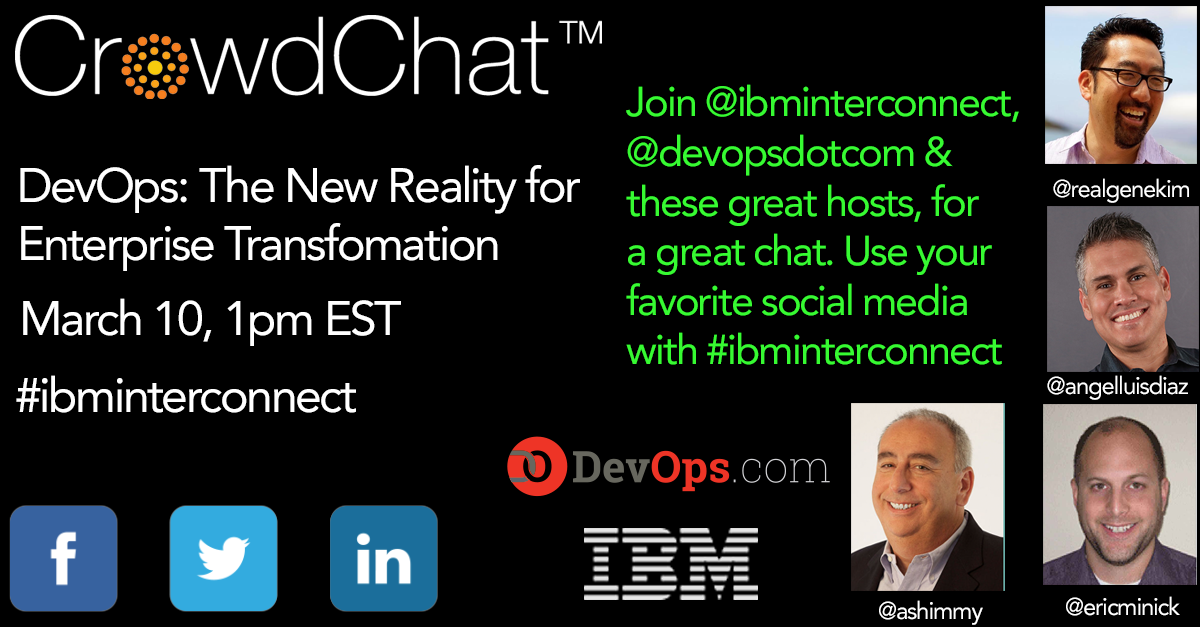
First things first is I want to invite you to participate in a CrowdChat we are holding on March 10th at 1pm EST. CrowdChats are one of my favorite social media activities. For the duration of the event it is controlled chaos, as multi-threaded discussions break out across Twitter, Facebook and Linkedin. You just have to use the hashtag #ibminterconnect to join in the discussion.
I will be one of the hosts of this event, but I will be joined by Gene Kim, IBM’s Angel Diaz and Erick Minick and some surprise hosts that I can’t mention right now. So join in the discussion and fun on the 10th.
At InterConnect itself, there are some great keynotes lined up and many outstanding speakers from diverse backgrounds. I want to call your attention though to one session in particular.
Enterprise DevOps: It Takes a Village
Wednesday, 9:00 AM – 9:45 AM | Mandalay Bay Ballroom A | Session ID: 1346A
When talking about enterprise DevOps transformation, many people look for a silver bullet—a magic wand that will convert an old, inefficient organization into a high-performing, DevOps-enabled IT team. But in truth there is no single silver bullet. DevOps takes a village. This DevOps village, like a real village, consists of physical infrastructure, as well as members. DevOps often needs a cultural transformation that builds a true community with the same aims and goals. No one vendor has all the tools and no one tool does it all. DevOps tools must work in unison. Finally, a methodology that recognizes the communal nature of DevOps is essential to bringing it all together.
I hear the moderator for this panel session is pretty good. Some guy named Shimel ;-). Seriously, we have a strong panel and it should be a great discussion.
Other speakers to catch are Gene Kim, Sanjeev Sharma (on his new book), IBM CEO Ginni Rometty, Wayne Brady and Reshma Saujani, founder and CEO of Girls Who Code. Check out the InterConnect site for full details.
We will be posting some more DevOps Chats and interviews of some of the scheduled speakers between now and March 20th as well. So stay tuned for those.
Tomorrow, we have a webinar with Carmen DeArdo of Nationwide, Donovan Stevens, South African Revenue Service and Rachel Reinitz, IBM Distinguished Engineer, CTO IBM Bluemix Garage. The webinar is on “Lesson Learned in Scaling Enterprise DevOps”, you can register here.
In this DevOps Chat episode our guest is DORA co-founder, Dr. Nicole Forsgren. Dr. Nicole talks to us about her upcoming appearance at the DevOps Virtual Summit on Tuesday, March 7th at 12:30PM EST.
Additionally, Dr. Forsgren gives us some news on upcoming activities and releases coming from the DORA team. It is always a pleasure speaking with Nicole and I am sure you will find this conversation useful and a good reason to hear her and Gene Kim at the DevOps Virtual Summit, along with several other former DevOps Chat guests!
In the meantime here is the streaming audio of our conversation. The written transcript will be available shortly.
Alan Shimel: Hey, everyone, this is Alan Shimel, devopsy.kinsta.cloud, here for another DevOps Chat. Today’s guest is a special guest for our DevOps Chat, it’s Dr. Nicole Forsgren of DORA. Dr. Nicole, welcome to DevOps Chat.
Nicole Forsgren: Thank you, and thanks so much for having me.
Alan Shimel: Thank you. Nicole, we’re gonna talk a little bit about a Virtual Summit that you’re a part of, but before we do, I wanted to give our audience a little background on DORA. No, we’re not talking about the explorer, but it is—
Nicole Forsgren:[Laughter] We do some exploring, though.
Alan Shimel: – yes, you do, you do. But seriously, for people in our—and you know, we have kind of a worldwide audience, only 38 percent of our listeners are in the U.S., and there may be people out here who aren’t familiar with DORA. So why don’t you give them a quick background?
Nicole Forsgren: Okay, sounds good. So, D ORA is a company that is myself, Nicole Forsgren, and Gene Kim, author of the famed Phoenix Project, and co-author of The Visible Ops Handbook and The DevOps Handbook, along with Jez Humble, co-author of The DevOps Handbook and Continuous Delivery and Lean Enterprise. And together, we are also the lead investigators and primary authors of the State of DevOps Reports going back a few years now—several years now.
So we have spent several years researching and understanding the key factors that drive excellence in software development and delivery across the industry, whether that’s, you know, the famed unicorns, but also enterprises. And so what DORA does is, we take everything that we’ve learned and everything that we know across our—you know, a decade each, really, so decades of understanding, and we help companies measure and assess and understand and drive improvement in their own technology transformations.
Alan Shimel: Great. And, you know, so when I always hear the DORA story, Nicole, I am—I’m a child of the ’80s and the ‘70s before that, and I think of sort of a rock super band like Asia or something.
Nicole Forsgren:[Laughter]
Alan Shimel: You know? Where we’ve got all of these great kind of musicians coming together to make great music, and that is somewhat what DORA is, where we have three great—you know, three leaders of the DevOps community kinda joining heads. But it wasn’t just as you mentioned, it’s not just with the formation of DORA that you guys are doing this. I mean, there’s—I think it’s six years of the DevOps Survey kind of, or maybe this is the sixth year now, in the [Cross talk].
Nicole Forsgren: Oh, so it’s—yeah, well, it’s four years since I’ve been involved, and then I think, like, rubbing science on things, right?
Alan Shimel: Mm-hmm.
Nicole Forsgren: And it’s been academically rigorous since that time. You know, it’s, the years of study have appeared in peer review, right? So we’ve got some fantastic data behind us. Gene and Jez have been involved, I think, five years, and then it goes back another year or two before that, right?
Alan Shimel: Yeah.
Nicole Forsgren: And then Gene and Jez have been studying the space, I think, going back a decade, right? And then I’ve been doing academic research in this space since ’07, so yeah, we’re going on at least a decade, each.
Alan Shimel: Wow. That’s a lot of time kind of studying the subject matter and a lot of expertise in there. And I think that’s why, you know, personally, why I get excited to see what comes out of this, right, and what insights come out of the survey, of course. But DORA is more than just about conducting the survey, making sure it’s academically rigorous, making sure the numbers are, you know, bear witness to what they are, that they are, in fact, reliable and show things.
Nicole Forsgren: Right.
Alan Shimel: You’re actually taking that data and helping organizations as a result of the analysis of the data. So it’s not just analysis for analysis’ sake, it’s, how do you make your organization better by taking what we’ve learned?
Nicole Forsgren: Right. Exactly. So we do have, you know, The State of DevOps Report that comes out every year, and we make that publicly available, we make that free. We partner up with the team at Puppet, right, and we do have a report that comes out free every year, and we’ve got an ROI white paper that’s gonna be coming out in the next few weeks. So we do everything we can to discover new information and make that free every year. But what DORA also does is, we have a product now that helps organizations measure where they are, benchmark where they are against the industry, understand what they should do, what levers they should turn to drive performance improvements and then prioritize those improvements and those capabilities so that they can really drive improvement most efficiently, and then track those improvements, so they can really see the value come out of that improvement.
I love it. It’s super exciting, it’s super fascinating, because like I said, we do this because we love it, and because we wanna make things better. You know, we wanna have an impact on the industry. We wanna see our peers, you know, get better. Who was it, I always forget who said this, but you know, survival isn’t mandatory. [Laughter]
Alan Shimel: Yeah.
Nicole Forsgren: You know what I mean? Companies—like, you don’t have to do this. You can die, right? You can fail. Companies can fail, but that’s not what we wanna see. It’s so enthralling and it’s so exciting to go to conferences like Velocity and DevOps Enterprise Summit and hear these amazing transformation stories and see what is possible. And to be able to help provide these insights—and really, that’s the genesis behind DORA. You know, we were sitting down—Jez and I, and Gene—we were sitting down and saying, “Every year, someone comes up to us, and dozens of people come up and they say, ‘Help me understand. The report’s come out, and we want to understand how to measure and how to benchmark, but what should I do? Help me understand what I should do next.’”
And it’s just, it’s so difficult to be able to say, “Well, the measures are out there,” but providing companies and organizations and teams with tooling that’s just going to be simple and easy and straightforward to use so that they can measure, they can benchmark, and then so they can prioritize and understand which levers they should be using to really optimize and maximize their investments and their improvements is really exciting, and really kind of fulfilling, honestly.
Alan Shimel: Got it. Absolutely. So, Nicole, let us kind of pivot into talking about this Virtual Summit you guys have coming up. I think it’s next week.
Nicole Forsgren: Yes! I’m so excited. It’s so fun
Alan Shimel: So, go ahead. Tell our audience—I love it when you’re excited. Tell our audience about it.
Nicole Forsgren:[Gasps] I nerd out so hard. I’ve got the best job.
Alan Shimel: Uh huh.
Nicole Forsgren:[Laughter]
Alan Shimel: So this is, I wanna say it’s UVM, or maybe it’s not, I forget which—I know CA is a sponsor of it, but tell our audience about this Virtual Summit.
Nicole Forsgren: So, you know what? I’m super excited about this. I think the Virtual Summit is fun because I know so many people that are like, “Ugh, I wanna go to these conferences, and I just, either I don’t have the budget” or most of the time, now, people just don’t have time, right? Going to conferences is tough because the travel is hard, taking a day off of work is hard. This Virtual Summit is fantastic, because you can log in, you can listen in, and you can hear from so many amazing, fantastic people, and you don’t have to leave, right? Even if you have budget, getting on a plane and leaving—like, it’s hard.
And the Virtual Summit is great, because CA has been able to line up so many fantastic people. Aruna did such a great job. I’m super excited. I’m excited, because I get to meet so many more people and hear all these fantastic transformation journeys.
Alan Shimel: Yeah. I mean—
Nicole Forsgren: I’m so excited.
Alan Shimel: – that’s kinda what makes a lot of what we do, you know, the world go around, when we hear more and more companies—
Nicole Forsgren: Yeah! This is why my job is the best! [Laughter]
Alan Shimel: Yeah, I hear ya. I’m gonna bring up another thing, though, to you, Dr. Nicole, and that is this whole idea of kind of virtual summits, right? We saw it with the All Day DevOps event that a bunch of people put on last year.
Nicole Forsgren: Uh huh.
Alan Shimel: We’re seeing it now in this virtual thing. You know, for a long time—I don’t wanna be negative, but these virtual conferences just didn’t do it for me. But I think the technology’s gotten a lot better. I think the, you know, bandwidth and mobility and cloud and all of the things that help drive DevOps as well have led us to have better experiences in things like a virtual summit where you really can meet people, right? Even though you may not be in the room with them, it’s virtual.
Nicole Forsgren: Right.
Alan Shimel: But it’s really a great experience.
Nicole Forsgren: Well, do you know what? I think it’s a combination of things. I think some of it’s the technology. Do you know what else I think it is? I think it’s also, like, the special magic sauce behind the DevOps community. It didn’t always work for me before, because the other communities just have a different underlying culture. DevOps is just a little bit different, right? I’ve been around tech forever, right? Before my Ph.D. I worked in hardware performance, where I, like, I’ve got a hardware patent, I—I worked in hardcore tech for a really long time. And those communities are, they just have a little bit different DNA.
DevOps is very, very different. And so for anyone who’s gonna tune into this summit—participate, pay attention, reach out. Add me on LinkedIn, right? Everybody say hi, wave—love you all. Add me on LinkedIn, add me on Twitter, follow me, send me a message. The thing I love about the DevOps community is that everyone is in it for the community. Everyone will reach out. So many people legitimately, honestly want to help everyone else get better. And it’s something that I just haven’t seen in very many other communities. It’s just so different.
Alan Shimel: You know, I was—
Nicole Forsgren: And I think that’s what makes so many of these virtual summits work so well.
Alan Shimel: I agree with you. Nicole, I just saw you, I guess it was two weeks ago now or last week—no, it was two weeks ago at the RSA event—
Nicole Forsgren: Oh, yeah, uh huh.
Alan Shimel: – where we did our, you know, we did our Dev SecOps show there. And what was funny is, I got an e-mail from RSA—do you know there were 43,000 people at RSA this week?
Alan Shimel: We—yeah.
Nicole Forsgren: My word.
Alan Shimel: We—that’s crazy.
Nicole Forsgren: And I didn’t get sick—it’s amazing. [Laughter]
Alan Shimel: Yeah! Well, I did, but—you know, we had about 900 people at the Dev SecOps event throughout the day on Monday, and then the cocktail party and all that. But what you said about the DevOps community so rang true for me. Even in this see of 43,000 lives out there, right, the DevOps people kinda gel. They were very into being together and sharing and talking. And it’s contagious to my security community friends, who, you know, they—I can’t tell you how, and I’ve been in security for 15 years—how many came over and they loved the vibe that we have in the DevOps team.
Nicole Forsgren: Oh, yeah!
Alan Shimel: And they wanna be part of it, and that’s very different, Nicole, than three to four years ago when I first started doing that at RSA conference, and it was very much a butting of heads, right?
So yeah, it is a testament. It’s a testament to, you know, we talk about culture all the time and a lot of people think we’re crazy, but it is a testament to that whole culture and vibe around the DevOps community.
So I’ve said my piece. I’ll step back off my soap box.
Nicole Forsgren:[Laughter]
Alan Shimel: So, Nicole, for people listening in on the Virtual Summit next week, I mean, Gene’s talking, obviously, I’m sure it’ll be interesting and he’ll give us some insight into some, maybe, new transformations he’s been studying and analysis. What do you—any previews of what you’re gonna talk about for our audience?
Nicole Forsgren: So I’m gonna be talking about some of the trends that we see, some of the promising things that are coming up. Some of the big—the levers that you can turn that I think are exciting, I’ll be speaking to some of the things that Ops teams, you know, can really contribute that are important.
Alan Shimel: Mm-hmm. Very cool.
Nicole Forsgren: And honestly, I’m also—you know, I’m super excited to hear from some of the other speakers. I’m really excited to hear from Sylvia at United, Kelly at Jewelers Mutual, John at CNN—super excited for that.
Alan Shimel: Yeah.
Nicole Forsgren: Right? They’ve got such a great slate.
Alan Shimel: They do, they have a nice slate and, you know, like you mentioned, Aruna from CA—I mean, CA has a great customer bench there.
Nicole Forsgren: Oh, God. I tell you what, man, Aruna has so many fantastic insights. Anything she comes up with, I just love—super excited to hear what she has to say.
Alan Shimel: She’s actually been a guest on our DevOps Chat regarding her book. So here’s—
Nicole Forsgren: Yeah! So great.
Alan Shimel: – between you and me, I always have a crush on Aruna, because I just, I really—I mean, she’s got it goin’ on, you know? She’s written her book, she’s an engineer, she’s done the business side, she’s full of energy, and I—you know, I just, I tell her all the time, man, if I had a daughter, I’d want her to grow up and be like her. Because she—
Nicole Forsgren: I know. I have a serious intellectual crush on her. She is a mover and a shaker, man. She is doin’ some good stuff.
Alan Shimel: Yeah, that’s good stuff. I’m really, really proud to call her a friend. Anyway—I’m really proud to call you a friend, though, too, because you’ve met my son, and I say, “You need to go talk to her. You wanna do statistics? There’s someone to grow up like.” But anyway.
Nicole Forsgren: That’s right.
Alan Shimel: Dr. Nicole, I’ll be listening, obviously. I hope our audience will be. We are all watching what DORA is doing, and I guess the new report—well, the survey’s closed now, right, so the new report is [Cross talk]?
Nicole Forsgren: Yep. So stay tuned, the report will be coming out early June.
Alan Shimel: Very cool. We’ll be looking forward to that. That’ll probably be around when DevOps Enterprise Summit is in London.
Nicole Forsgren: Close. DOSE—oh yeah, DOSE London is June 5th and 6th. Also, DORA’s coming out with an ROI white paper and then summer, fall, me and the guys, Gene and Jez, are coming out with a book, summarizing all of the research that we’ve done.
Alan Shimel: Ooh! You heard it here first.
Nicole Forsgren: Including—yes—including things that did not fit in the book, surprises, and more on the science [Cross talk].
Alan Shimel: Very cool. I’m looking forward to it. It’ll be an exciting summer.
Nicole Forsgren: Thank you.
Alan Shimel: I think we might be doing some book giveaways here. [Laughter] But until then—hey, check out Gene, Nicole, Aruna Ravichandran from CA and a bunch of other great practitioners at the DevOps Virtual Summit coming up. In the article on this, we’ll probably have links to the registration and so forth.
Dr. Nicole, it was so great speaking with you, and continued success with DORA and all of your endeavors. We wish you lots of success, and we’ll be watching it closely, and maybe we’ll have you back on.
Nicole Forsgren: Thank you so much.
Alan Shimel: Thank you. We’ll have you on to discuss some of this stuff again shortly.
Nicole Forsgren: Sounds good.
Alan Shimel: Alright. Dr. Nicole Forsgren, co-founder of DORA and guest on the DevOps Virtual Summit coming up just next week. Thank you for appearing.
This is Alan Shimel for devopsy.kinsta.cloud, and we’ll see you soon on another DevOps Chat.
This DevOps Chat is with Madhura Maskasky, co-founder and VP of product at Platform9. If you are not familiar, Platform9 offers an “open source as a service.” While that sounds pretty cool, think managed hybrid cloud and now managed Kubernetes in an infrastructure-agnostic service.
Madhura does a great job of explaining this, so have a listen for yourself. As usual, below the streaming audio player is a written transcript of our session.
Alan Shimel: Hey, everyone, this is Alan Shimel of devopsy.kinsta.cloud here for another DevOps Chat. Our guest on today’s DevOps Chat is Madhura Maskasky. Madhura, welcome and thanks for joining us.
Maskasky: Thanks for having me. I’m excited to be here.
Alan Shimel: Madhura, I didn’t mention in introducing you; you are with Platform9, an open source-as-a-service company. Correct?
Maskasky: Yeah. I’m VP of Product and co-founder at Platform 9 Systems. What Platform9 does is we pioneered a unique model, a SaaS-based model for deployment of complex open-source cloud-native frameworks such as OpenStack and Kubernetes.
Alan Shimel: Beyond sort of that tagline, Madhura, I believe—was it your co-founder or CEO that I might have interviewed at—I want to say it might have been the DevOps Enterprise Summit.
Maskasky: Yeah. It must be Sirish Raghuram.
Alan Shimel: Yeah. It was kind of my first introduction of Platform9 and I was kind of taken with the business model. I thought it was interesting and unlike anything I had seen to that point. As I mentioned, Madhura, beyond the tagline, can you give our audience really a sense of what it is that Platform9 is doing?
Maskasky: Absolutely. As we started, our roots come from VMware. That’s where myself and my co-founder spent about seven-plus years. A common theme that we saw working with mid to large-sized enterprise customers at that time was the amount of struggle they were going through trying to realize this vision of a private cloud, which was a concept that had started becoming popular for a about a year at that point.
The reason for it starting to become popular was because public cloud had set such an exceptionally high bar for how easy it can be to consume infrastructure. But yet, enterprises, customers of VMware or otherwise, were really failing to live up to that high bar and create an equal offering that utilized their internal resources that might be based on their data centers or in a hybrid way, but create a similar and seamless interface for their internal consumers to consume those resources.
So Platform9 started with the vision that it should be easy, fundamentally as easy as consuming a public cloud, for anyone to consume resources from any infrastructure endpoints, whether they’re private of pubic or hybrid. We wanted to do this using possibly an open source software that’s available, because we also felt strongly that open source is going to be the new norm of how cloud infrastructure is consumed.
So specifically what Platform9 does, our very first product offering was managed OpenStack, our OpenStack-as-a-service. What that model means is that we deploy the OpenStack control plane in a SaaS-hosted manner. The control plane is deployed outside of our customer’s data center, and then it integrates with their data center or their public cloud endpoint via a mechanism of an agent.
An agent, if you have a private infrastructure, the agents become the bridge between the private infrastructure and our cloud-hosted control plane. And if you have a public cloud, then we have drivers that interact directly with that pubic cloud endpoint. So, that’s really how the model works, and it lets you get up and running with OpenStack in a matter of minutes.
Now we’ve repeated the same model with Kubernetes, which is the most powerful container orchestration framework for building your applications using the microservices paradigm, where Kubernetes is also deployed as a SaaS-hosted service on the infrastructure endpoints of the device, so private or public endpoints.
Alan Shimel: Got it. Of course when I look at it, Madhura, I see, okay, so you had the OpenStack offering, OpenStack-as-a-service, and now you dig into the Kubernetes and containers. I have to assume that—and maybe I shouldn’t assume. Let me ask you: How quickly is that OpenStack market growing?
Maskasky: We’ve seen a pretty significant growth in our OpenStack customer base just year over year. In 2016 we were at about 50 customers strong. There have been multiple statistics that forecast a pretty strong overall growth in OpenStack revenue for 2017-plus as well. Just yesterday I think I was reading an article that was mentioning a multibmillion-dollar projected revenue growth in the overall OpenStack market, and the fact that Fortune 500s are going to be consuming increasingly OpenStack.
So even with containers, virtualized infrastructures are not going away any time soon, and the big challenge that enterprise customers face that we see is, on one hand, they are looking to save some money by converting part of their currently virtualized infrastructure into open-source Linux KVM and use OpenStack versus, say, going entirely the VMware route. Or, on the other hand, some customers start by being 100 percent public cloud consumers, but then realize that that’s a very expensive model at scale, and hence want to go to more of a hybrid deployment, where part of their infrastructure is hosted privately or in a service provider data center.
For both of those cases Platform9 is an extremely good fit because we support both VMware as well as KVM and because of our as-a-service model.
Alan Shimel: Got it. What about Kubernetes? Maybe it’s because I live in a DevOps bubble, but that seems to be kind of taking off, huh?
Maskasky: Kubernetes is taking off in a pretty significant way. We felt that Kubernetes was going to start building this level of momentum about a year or so ago, as we were looking at the different container orchestration frameworks and evaluating them for their pros and cons, and the other two optimal ones are Mesos and Docker Swarm.
Mesos and Docker was in its very early stages with its offering at that time, but the primary reason for Kubernetes being so popular is I would say three important factors associated with it. One is from project maturity. They were kind of the most mature projects—it was built inside Google and vetted inside Google before it became the open source project that it is today. It had a pretty significant community outside of simply Google developers, who are actively contributing to it.
A new version comes out every three to four months and the pace of iteration is just astounding. In 3 it has a number of enterprise customers publicly vouching for it by showcasing the use cases and examples of how they are leveraging it.
Alan Shimel: Got it. Madhura, now that we’ve got that straight, let’s talk a little bit about recent news from Platform9. Do you want to share with our audience?
Maskasky: Absolutely. We shared two pieces of news recently, actually just a week ago. The first one was that the managed Kubernetes offering, which has been in beta for about six months, is now generally available. They’ve had the opportunity to have the offering beta tested with a couple dozen customers since we announced it around June of 2016. So now we are excited to share with the world that it is generally available.
What it is again, pure Kubernetes deployed as a SaaS-managed service. We think it’s the industry’s first infrastructure agnostic Kubernetes-as-a-service offering, because it lets you consume both your private and public infrastructure, and it comes built-in with a number of enterprise readiness features like multi-tenancies, single sign-on, quota management, as well as being able to deploy highly available Kubernetes clusters.
Alan Shimel: That’s great. Definitely, again, I just think there’s something—I think the market desperately needs this kind of offering. I remember when OpenStack first came out. Actually, if you remember Cloud.com, Martin Nickens I think was involved in that one and several other companies. It was really at that point in the evolution of migration to the cloud; it was important that people were able to get all the pieces in one box, if you will—cloud-in-a-box, for lack of a better word.
But in today’s world even that paradigm doesn’t work. People want as-a-service. So if they can get a Kubernetes kind of infrastructure-as-a-service like this and agnostic, it’s fantastic. Also, something called Fission was introduced as well, yes?
Maskasky: That’s right. That was the second part of our announcement, which is we announced a new open-source framework called Fission. What it is, is it’s designed to be the de facto open-source alternative to AWS Lambda.
Alan Shimel: I’m sorry. I didn’t mean to cut you off. Go ahead.
Maskasky: No worries, Alan. So just some context behind it. When it comes to serverless, AWS has really made Lambda extremely popular and introduced this new paradigm of function as a service. But a problem with it that we see is the fact that it locks you into the AWS ecosystem, because Lambda is firmly designed to integrate with all the other Amazon services that are offered in their ecosystem, but it doesn’t necessarily provide built-in integrations for the most popular open-source tools and frameworks that your developers might want to use.
It kind of goes back to an important piece that we’ve always held, which is the development community loves to embrace the right sort of tools that let them do their job well. They like choice and they do not like being told or being scripted to go to a set of one tools only. So those are some of the motivations behind Fission.
Now Fission is also built off of Kubernetes, and by having that focus on Kubernetes it has an added advantage that it simplifies consumption of Kubernetes as well.
Alan Shimel: Got it. In my mind, the company has positioned these Kubernetes offerings to really take a leadership position as we see Kubernetes and containers really kind of explode onto the scene. What’s next for Platform9?
Maskasky: Kubernetes and containerization is a big part of our road map and our strategy for 2017-plus. We’re just getting started with managed Kubernetes going generally available. We have a ton of work ahead of us as part of our road map, and we’re looking for customer feedback as well, truly making the offering cloud-agnostic, enabling as many current points as our customers would like us to offer with built-in integrations, providing the ability to create federated clusters across these current point. So, in a nutshell, really realizing that true hybrid container-as-a-service vision through the managed Kubernetes offering.
That’s one. The second big part is, again, Fission. Fission has just gotten started as an open-source project. We’re looking to make it the de facto way of running function as a service within Kubernetes. So we’re looking to work with the CNCF, the Cloud Native Computing Foundation, and we are looking for the Kubernetes community to really start investing in it.
We’re seeing some grassroots early traction adoption. Someone in the community recently built a dot-net client for Fission and out-of-box support for Node.js and have been building support for Go. We’ve been hearing folks who started using Fission on top of their internal community’s deployment and they’re telling us about their use cases. So these are all some points of feedback, so we want to grow and build on that.
Alan Shimel: Got it. Madhura, as I promised you before we came on, the time goes so quickly. We’re already past 15 minutes, but it’s okay. I think we got a great—at least a taste of what Platform9 is all about, and perhaps we could find out more on another DevOps Chat or maybe an article here on devopsy.kinsta.cloud or Container Journal, as the Kubernetes stuff certainly lends itself to that.
Madhura, where can people find out more information?
Maskasky: The best way to find out more about everything happening on Platform9 is by going to our website, Platform9.com. You can also follow us on Twitter. The handle is @Platform9Sys. Fission has its own website, Fission.io, and you can also follow Fission on Twitter as well. The handle is @Fissionio. So that’s the best way to stay on top of all our news.
Alan Shimel: Fantastic. Madhura—and I’m still mispronouncing your name probably, I apologize—Maskasky, thank you for being this episode’s guest on DevOps Chat. Continued success of Platform9 and please keep us posted. I love the open-source angle. I love the Kubernetes sort of as a service, the serverless stuff with Fission, very, very exciting stuff you guys are doing over there. So please keep us posted and best of luck.
Maskasky: Thanks, Alan. Thank you for having me. This was a lot of fun chatting with you and absolutely I will keep you posted.
Alan Shimel: Absolutely. This is Alan Shimel for devopsy.kinsta.cloud on another DevOps Chat, and we hope to see you on another one, another chat hopefully soon. Have a great day, everyone.
In this DevOps Chat, we sit down with Dr. Mik Kersten, CEO and co-founder of Tasktop. Mik besides being the founder of Tasktop, is also the creator of the Eclipse Mylyn open source project. Tasktop continues to lead the way in value stream visualization and software delivery integration.
Mik gives us the latest on this and more in this conversation. Enjoy!
Alan Shimel: Hey, everyone, this is Alan Shimel, devopsy.kinsta.cloud editor-in-chief, and we’re here for another DevOps Chat. Our guest on this episode of DevOps Chat is Mik Kersten. Mik, for those of you who don’t know, he’s almost synonymous with Tasktop. Mik, welcome.
Mik Kersten: Thank you, Alan. It’s great to be talking to you again.
Alan Shimel: So how does it feel to almost be synonymous with your company?
Mik Kersten: Now that you mentioned it, it sounds good. It’s been an amazing journey with Tasktop. I think it’s just been a great now ten years of looking at how to bring those benefits of Agile and DevOps to large organizations. So it feels good is the short answer.
Alan Shimel: Another one of those ten year overnight success stories in the startup world. Mik, all kidding aside, there might be some people in our audience who aren’t familiar with Tasktop. So, if we can, just maybe a real quick 30 second sort of elevator pitch on what Tasktop is, what it does.
Mik Kersten: Yeah, absolutely. Most organizations now know that in order to get the up and coming productivity and efficiency that they’re after to be competitive in today’s world, they need to face an Agile toolchain and they need to deploy DevOps and continuous integration, and to do that you pick your issue tracking tools, your continuous integration tools, your release automation tools, and all of those bits and pieces. If you’re a large organization, you pick requirements management tools. If you’re doing any physical products, you need some additional tools for requirements and bills of materials and those kinds of things.
What’s interesting is that once organizations scale up there are DevOps transformations. They’re both hitting more tools and different kinds of partitioners. So the missing piece for making all of these benefits of DevOps work at scale is this piece of integration infrastructure. We can connect up all the tools to get an end-to-end flow, so to get the benefits of Agile and Lean, all the way from business idea to running software and the revenue results and delighted customers.
That’s what Tasktop has been doing. Over the last ten years, by release we’ve been connecting different stakeholders, processes and tools, so that you could have this end-to-end flow of information. So you could have the best of breed tools, the latest issue trackers or Agile planning tools, the latest continuous integration tools and so on, while getting this end-to-end flow, because really the problem that we’re addressing is that when you look under the covers in most transformations you’ll see that both DevOps and Agile have been deployed at these local optimizations. The team can do continuous integration or continuous delivery. Or the organization has continuous delivery, but has not optimized anything upstream, and that’s really the problem we’re trying to solve. Let’s get the entire IT organization to be Lean end-to-end.
Alan Shimel: Fantastic. Mik, in us talking before we started recording today, you said that the most recent release of Tasktop and the hub is probably the most important and meaningful thing you guys have done in ten years. Why don’t you share with our audience why you feel that way? What is this great functionality and great feature set that came out in this last release?
Mik Kersten: Absolutely. What we’ve noticed is that the way that – again, you take any large IT shop who has not yet deployed Tasktop and you look at how they support their transformation, and you’ll notice you’ll see all these point-to-point integrations. So you’ll see, let’s say, the Agile planning tool wired in through some APIs or Web hosts or some data integration technology into the requirements management tool, into the time tracking tool, into the quality management tool, into the automated test tool, into this _____ tool and so on.
What we noticed four years ago is that the slave connecting things point-to-point was going to blow up. Once you’re making point-to-point connections, you get this exponential factor. So it’s okay if you’ve got two or three tools. All of a sudden you’ve got four or five tools. Just the sheer number of API calls are bringing down your servers actually.
We know a lot of customers where they say their JIRA issue tracker is getting so many API calls from these integrations that it takes a minute to load an issue. So you get all these weird symptoms.
You also get this thing that’s very difficult to maintain, because as soon as one tool changes or someone adds some new fields to a project’s definition of a user story or something of that sort, multiple integrations break and you’ve got this spaghetti code of Web host and API integration madness.
So we realized four years ago we couldn’t even test all the integrations we’re supporting in that point-to-point way. It was already costing us hundreds of thousands of dollars of resources, of basically VM resources, just to test all the tools we support in a point-to-point based way. So we said four years ago, “We’ve got to stop doing things in a point-to-point way. It won’t scale. We need to support all the Agile and DevOps tools out there, and it won’t scale to supporting large scale DevOps transformations.”
So we started creating this notion of models. First you look to open standards. So we got our feet wet and we on the committee of OSLC, but to get everyone to adopt open standards just didn’t work. And these tools are so complex because the stakeholder tools right now have become very elegant, basically. The developer tools are very tuned to the developer process, and with that comes a lot of complexity specific to developers, to testers and so.
So we realized open standards won’t solve it. APIs alone don’t solve it, but are actually part of the problem. You need to take a different approach. So internally we made this integration factory so we could test everything, and we made these common models. The models are basically the currencies of Agile and DevOps and the ALM and SDLC systems, things like requirements, user stories, builds, releases, security, vulnerabilities, those kinds of things.
That’s how we started testing everything and then we said, “Okay. If you raise the slave abstraction, it actually makes it much easier to connect everything. With last week’s release of the Tasktop Integration Hub, we’re actually taking that model-based approach and exposing it to all of our users. So you simply define all of your models in your value stream, again, like user stories, requirements, builds, releases, chain sets and so on, and then you plug in however many tools you want into those models and you get this amazing thing. You get complete automation for your value stream.
So we’re calling that value stream integration, because end-to-end you can now have these flows and you can actually track things like cycle time, and you can basically get the benefits that a startup with 100 or 200 people is getting in terms of their speed of delivery at very large scales, at thousands or tens of thousands of IT staff. So you’ve got that value stream integration layer that we provide.
With that, you can also inspect what’s going on and you can basically support these large scale Agile and DevOps transformation, all because of the fact that we’ve raised the slave abstraction to make these models, have you map your different toolchain in your models and, as a result of that, what we’ve actually done is we’ve made the toolchain itself be modular. So you can plug in best-of-breed tools Here’s some dot-net. Here’s some Java. Here’s some JavaScript there, maybe some Python for your AI. You can plug all of those separate tool streams together into one end-to-end unified value stream. Really, the key thing that we’ve done here, the game changing thing is this notion of model-based integration.
Alan Shimel: Excellent. I agree, Mik. You know what? Obviously you work at Tasktop. You’re very excited by what they’ve done. But for our audience out here who are generally pretty sophisticated technologists, I hope they appreciate really the – I mean it’s making people’s lives easier, right. When you can make people’s jobs and lives easier like that, it’s a good thing and this sounds like it could be a real game changer that way.
Mik Kersten: Yeah. Alan, that’s a thing that’s absolutely near and dear to me. My whole background was from productivity tools, empowering developers and taking the waste out of their day with all the open source work on Mylyn and the dev tools that we’ve done. Our mission was to bring about that change in the way people work at scale, because it gets even worse.
You look at the large IT shops out there, the place where most of the world’s IT staff works, and we’ve measured what they do. Every developer or every tester, every business analyst, they’re spending at minimum 30 minutes, in some cases we’ve seen two hours per day of duplicate entering information for every code change they make, for example, because of all the governance and compliance and other rules which need to be there in large scale organizations, but all of that work is waste and it drives people crazy because they don’t like doing it, because it’s basically manual data entry.
When you think of what it actually is, they’re entering information and logging into different systems, all of which could have been done automatically if, again, we took this value stream-based approach. You make your code change. All that information propagates into however many tools the organization had to set up. You might have to track different kinds of requirements and changes differently. That’s okay.
So the most satisfying thing that we’ve seen with deployments of this, because we actually had customers in an early access program since April – the Tasktop Integration Hub is running in production at customer sites today – is that all of that waste gets taken out instantly. Basically our expectation is that the moment its deployed, and we’ve seen this, your employee engagement scores are going up that week or that month, that quarter, because you’ve taken out all that wasted work which drives the best people in their company crazy, the fact that you’re making them do it.
So that’s our whole goal. The person goal is just make the lives of all those people in IT better by removing all that waste. Then of course the organization economic goal is through that: make your organization more innovative, because you’re now able to deliver at the speed of a startup and get that promise of DevOps at scale.
Alan Shimel: Absolutely. Mik, we’re running short on time, as we always are on DevOps Chats, but let me quickly pivot to something else I wanted to touch on with you, and that is the idea of the bridge of that job to DevOps or bridge between that job and DevOps. When I first started with DevOps four years ago, maybe more, five years ago, there was, “Well, DevOps really picks up where Agile leaves off,” but they were clearly two separate things. Agile is for developers. DevOps is for everyone.
But what we’ve seen is that DevOps is borrowing more and more from Agile, more and more from Lean. Where do you see the connection between Agile and DevOps, if that makes sense?
Mik Kersten: It’s by different thought leaders, different vendors and so on. In the end, it’s all the same thing. It’s Lean for software and software at scale. So in terms of how organizations have aligned, I think what has happened is that so much of the bottleneck for software delivery for so many large organizations has been in deployment reliability and velocity and automation. DevOps has formed the big new movement and really picked up as a movement where Agile left off.
In the end, the technology is you need continuous delivery. You need to implement continuous delivery, but the DevOps movement has come from that side, from development and operations and said, “We need to deliver things faster, more reliably, and automate all the stuff that’s manual in their account.” That’s actually shifted and taking over where the Agile movement started, which is we need to track work and be responsive to change and bring customers into the feedback loop.
So there are two key components and I think the sheer velocity that we have right now behind organizations going to DevOps has made it the more important transformation agent. Everything that was going with Agile stays as a key part of the transformation. I think it’s very important for those leaders out there, putting together those DevOps transformations to not stop at code commit.
You have to actually take the Lean fast feedback loop, continual learning all the way into business analysis, design and so, because if you stop you’re going to have to solve the deployment bottleneck, but not the upstream bottleneck. For example, if you don’t have enough UI designers, it won’t matter how quickly you’re deploying. You’ll do bottlenecks on your UI design. You’ll need to higher there.
So I think we all need to take this end-to-end Lean view and DevOps is just a great transformation agent and a great movement to help us all do that.
Alan Shimel: Good stuff. Mik, we’re coming up to the end of our time. I want to ask you one last question, not a trick question, but I always like to ask if possible. For our audience out there, if you could recommend one book that they read, and not an obvious one, don’t tell us The Phoenix Project or even the DevOps Handbook. It doesn’t have to be DevOps related. What book would you recommend?
Mik Kersten: I’m holding it up right now. I know you can’t see it, but it’s the book Learning to See by Mike Rother and John Shook. If you even just flip through this book, you’ll see the value stream mapping and value stream integration and management approach that make the manufacturing work. As we go into this post-DevOps, post-Agile bigger picture world, it’s that same view of the value stream, focusing on the end-to-end value stream that I think need to inspire that next generation of leaders creating these transformation.
I think the DevOps Handbook contains a lot of this. It’s a great book. I’m nearly finished reading it. It has a lot of the right sources, but in terms of something that you might not have seen it’s this Learning to See book, which is really about learning to see production. We need to learn to see the flow of software across the value stream and most organizations have not done that yet, and that’s really – our mission is to help organizations do that, but the ideas are here. We’ve done them before. Again, it’s been done in manufacturing and now it needs to be applied to software delivery.
Alan Shimel: Fantastic. Mik Kersten, Tasktop, thanks for being this episode’s guest on DevOps Chat. Continued success and looking forward to more, and maybe seeing you at DevOps Enterprise Summit in London.
Mik Kersten: Absolutely. Thank you, Alan. Great chatting with you, as always.
Alan Shimel: All right, Mik. You be well.
Mik Kersten: Thank you.
Alan Shimel: This is Alan Shimel for devopsy.kinsta.cloud.
While culture is of the utmost importance to enable digital transformation, there are many other milestones in a successful DevOps journey. In this DevOps Chat, join Alan Shimel, Editor-in-Chief, devopsy.kinsta.cloud, as he hosts Bryson Koehler, GM, Distinguished Engineer and CTO of IBM Watson and Cloud Platform, and Shelbee Smith-Eigenbrode, Senior Software Engineer/IT Architect at IBM.
Learn about challenges that The Weather Company (TWC) faced during the transition from TWC, to being TWC: an IBM company. Koehler is CTO of IBM’s newly formed Watson and Cloud Platform, as well as GM and distinguished engineer for IBM. Prior to this role, he served as executive vice president, distinguished engineer and CIO/CTO of TWC. He has an extraordinary record of leading significant business transformations and underlying cultural shifts. To do so successfully, Koehler maintains cultural change must first be incited in tech companies at the developer level. While at TWC, Koehler built a DevOps culture and practice that encourages transparency, accountability and collaboration. It is his mission to replicate this model in the transformation of IBM’s culture from a legacy IT enterprise to a true cloud platform company.
As usual the streaming audio of our conversation is below with the written transcript below that:
Alan Shimel: Hi, everyone. This is Alan Shimel, Editor-in-Chief of devopsy.kinsta.cloud, here for another DevOps Chat. We have a special edition of DevOps Chat this time and we’re joined by two special guests. First of all, we have Bryson Koehler, GM and Distinguished Engineer and CTO of IBM Watson and Cloud Platform. Bryson, welcome.
Bryson Koehler: Thanks so much, great to be here.
Alan Shimel: Thank you. And we are lucky to be joined by a DevOps Dozen winner, Shelbee Smith-Eigenbrode of IBM, and also a devopsy.kinsta.cloud columnist. Shelbee, thank you for joining us along with Bryson.
Smith-Eigenbrode: Thank you for having us.
Alan Shimel: Of course when Shelbee is not writing for devopsy.kinsta.cloud, Shelbee is a Senior Software Engineer/IT Architect at IBM.
Bryson, let’s turn to you first, if it’s okay. First of all, you’re involved with IBM Watson, and I think everyone kind of feels a little bit about Watson like I did about the space program when I was young, which is that’s cool. Everybody wants to be an astronaut and I think everyone can’t wait to see how Watson changes our lives. How did you come to be involved in the Watson program?
Bryson Koehler: Well, I was the CTO of the Weather Company prior to the acquisition by IBM. If you think about the Weather Company, the Weather Company really at its core was a decision company. We helped people in businesses make smarter decisions, and we used a lot of machine learning techniques in our weather forecasting and how we looked at creating those inputs into our decision applications, whether those were businesses or consumers. So we’ve been doing that kind of work for quite some time, and if you look at Watson, Watson is a very revolutionary way to look at cognitive learning, machine learning, and augmented intelligence capabilities. So they’re very similar and they go hand-in-hand.
So when you look at how do we take Watson forward, Watson becomes smarter every day as it ingests more data and it learns more. So the more we can teach Watson and the more we can help Watson learn and become educated, the smarter it will become. So it becomes a data scaling problem, and that was a problem that we had been solving at the Weather Company.
So I think there was just a very natural marriage between the work that the Weather Company team had been doing, the work that we wanted to do with Watson as we continued to evolve it and its capabilities. So I’ve been honored to have a role with helping Watson move forward now in kind of its next stage of evolution.
Alan Shimel: Sure. If you don’t mind, let’s just stay on that one for a while, Bryson, and Shelbee, if you want to add in. This is a fairly new kind of not department, but a fairly new grouping of IBM Watson and Cloud platform. What exactly – I mean it kind of says it for itself, but, Bryson, is there anything special about it that our audience should know about?
Bryson Koehler: Yeah. I think it is amazing and really only someone like IBM has the breadth of capabilities to do what we are doing. Bringing together all of the groups around IBM that have been working on cloud native capability, whether it’s in our video team and our storage team, the infrastructure group, Watson, our analytics team, the Weather Company itself, all of these groups were working in and around cloud native capabilities.
What we have set forth to do is to bring all of those groups together and make sure that as we journey forward that we are building a single unified platform. The view of the Watson and Cloud group together is around a unified platform that’s very developer-friendly, focused on cloud native capabilities, that really enables us to bring to life not just a bunch of piece parts. Right?
You can go to our competition and you can find ways to get individual services. We offer those, too. But how do we do it in a much richer way? How do we make data less of a conversation around, “Hey, I have some data. I need to store it somewhere,” and how do we bring data to life? How do we take that data and actually treat it as a living, breathing part of the organization, where as we ingest it and as we enrich, and as we use that to create better and smarter signals and capabilities for our applications to learn from, we need to treat all of this as a unified platform, not a set of bespoke capabilities or service offerings.
So it’s really exciting when you think about bringing together video, for example, as well as then the image and video recognition capabilities that Watson has. So plumbing in the ability to ingest a stream of video or content from images, having Watson natively there to be able to recognize and manipulate and do things, do metadata tagging or additional enrichment of that content as part of literally a pipeline versus it being, “Oh, I’ve got to now reach out over – I’ve ingested the data. Now I’ve got to store the data. Now I need to reach out over here and make another service call. I’ve got to create another application that manages that service call.”
We’re trying to make the life of the developer easier, and by providing a native platform that is pre-built, pre-plumbed and really focused at incredible data analytics and data management capabilities, I think we have a real differentiator on our hands, and we’re really excited about bringing these teams together to do that.
Alan Shimel: Very cool. Shelbee, let me turn a little bit away from the Watson stuff and talk about you recently did a DevOps blog on culture transformation. Interestingly enough, you interviewed Bryson about it. We haven’t really spoken about DevOps and cultural transformation here. I’m interested in why. What made you think Bryson was a cultural transformation kind of dude, for lack of a better word?
Smith-Eigenbrode: First off, let me just say that at the time I reached out to Bryson he was not in my management chain. So it wasn’t a brown-nosing activity at all. I had the opportunity to work within the Weather Company and work with some of the Weather Company employees who are now of course IMB’ers, while working on a project to move an application to the Sun platform and utilize some of the Sun services.
During my time that I was there and able to work with some of the employees there, I was so impressed with the culture that they had. They had a great balance between agility and time to market, but also having that quality of operational readiness. Of course for me operational readiness has always been key, because I’ve always felt the pain of not having that included upfront.
Then this was a terrific collaboration with passionate people that were extremely skilled, one, but you could also tell that they actually enjoyed their jobs. They loved what they did. They were extremely willing to help others. It was always very quick to find who was the expert in this area, a very high degree of empowerment as well.
So being able to see that firsthand, I really wanted to reach out to Bryson, because I know he had led cultural change at the Weather Company, to get his views on how that transformation went, what he did to enable it, and then also how he’s planning to bring that forward into the broader IBM Watson today. He was very willing to help me and provide input. So that was why I reached out.
Alan Shimel: Excellent. So now, Bryson, Shelbee has put you on the spot. What are some of your secrets? What’s the secret sauce here? Because that’s probably the single biggest question we get from our audience, which is: how do you do this culture thing? How do you lead the transformation from a cultural perspective? What do you want to tell our audience?
Bryson Koehler: I would say, first of all, everybody that recognizes the cultural challenge, they’re definitely on the right track. All of the transformation that a company that I have had the privilege of leading over the years, they are not technical challenges. They’re all people challenges. They’re all cultural challenges. And fundamentally, at the end of the day, the technical success of your strategy, whilst you need a good architecture and you need a good plan, you more than anything need great people and great culture.
So first, you’ve got to focus on that and you’ve got to spend the time on it. It doesn’t just happen. Everybody spends a lot of time in front of a whiteboard working on their architecture. But how much time do the leaders really spend doing the same thing, but focusing on their people and culture?
So to me it starts with a very simple premise. I want people to love what they do. I want you to get out of your bed every morning and I want you to love what you do. I want you to be excited about coming into the office. And if you don’t love what you do, then I want to help you go find a different job. Life is too short for any of us not to love what we do.
We haven’t all won the lottery. We all have to get up and earn a living, so we might as well enjoy it. I think that it sounds simple, but you’ve got to create an environment where people are free to actually love what they do.
I think understanding the mission is important. Why are we building this? Why is this feature important? Why is this product important? You can find a great mission in just about any industry or any application or any part of the business as to why it’s critically important that the team excel at what they’re doing.
Then I think you have to allow decision making to be pushed down to people. You need to learn to make very fast decisions. I always tell my team, “If you walk into a meeting and you don’t know who’s making the decisions or what decisions need to be made, you should disband the meeting and just leave.” People get frustrated if there’s just too much time being spent discussing things and not enough action being taken.
So I look to create an environment where we have high velocity decision making, where we’re willing to take some risks together as a team, where we are passionate and love what we do. It starts with me, it starts with my leadership team, and it starts with the employees. Everybody has a piece and a role to play in bringing all of this together, and you have to work on it every day.
This is not a, “Hey, we had an offsite and we talked about culture. We had three PowerPoint slides and now we all feel loved.” This is something that every single day we have to lead by example. We have to reinforce the energy and the passion for what we’re doing. We have to enable our leaders to be able to make quick decisions. We have to have the courage to change, and the courage and the guts to admit mistakes and move on from that, and enable the team to feel like they’re in a safe place as long as they’re working hard and loving what they’re doing and passionate about their outcome, that they’re in a safe place.
I think it takes time to create that environment. It doesn’t happen overnight. I have to reinforce it every day. So you have to have the patience that you’re going through a technical transformation, have the patience to do the cultural transformation, too, realize you’re going to have to repeat the same message a thousand times, over and over again. Over time it begins to stick and over time, as the winds happen, it builds momentum and pretty soon you have a self-fulfilling prophecy, because the team kind of takes care of itself and now you’ve actually created a native culture, that as a new person joins the organization they’re converted to your way of working and they’re converted to a way that you’re proud of.
Startups have it easy because they start with employee one and then employee two, and the culture is kind of created organically over time. But when you start with large teams of people in a preexisting culture or workplace, or if you’ve brought two companies or teams together that each have their own cultures, you don’t have that luxury to start with a clean sheet of paper. So, honestly, there’s just no substitute to realizing that that is a key part of a leader’s job is to work at that every day.
Alan Shimel: Got it. Bryson, you described a situation and I guess your real-life situation is that to the umpteenth degree. Coming from a company like the Weather Company, I think that had under 1,000 employees, right?
Bryson Koehler: The Weather Company was just around 1,000 employees, yes.
Alan Shimel: And now working even just within a division of IBM, but nevertheless it’s IBM. I forgot – I think it’s 400,000 or some crazy number. How do you take that? How do you scale that? How do you take that philosophy, that cultural mantra and bring that to an organization the size of IBM?
Bryson Koehler: Ha. It takes time. There’s no substitute to that. I’m spending my time going around, meeting with as many teams as possible, and still hold to the town halls and still bring people together. Town halls are bigger now than they would have been at the Weather Company, but the Weather Company had offices in Atlanta and Boston and New York and San Francisco.
The town halls now, we still have them in different parts of the country and different parts of the world. They’re just bigger, but my style and my approach doesn’t change. It is continue to reinforce the journey we’re on, the vision that we have, the reason why our mission is so critically important, the role that each person plays, why we have to do this together as one team to create one platform, not an individual kind of bespoke set of capabilities that everybody has done independently, but how we have to do this together as one IBM Cloud approach.
I think it resonates with people, but I also don’t think for a second that just because I – last week I was in Germany, and I was in Ireland meeting with teams there. I can’t just check that off my list and say, “Okay, Ireland is good. Germany is good.” I have to continue to reinforce that, help and encourage the teams, get back out there, share the wins, showcase the challenges, and just be very visible and never disappear from those teams.
I look at is as kind of like a rollercoaster. As those cars are clickety-clacking up the track to get up to the top of the hill, if that chain that was pulling it up to the top broke before the car or the set of cars got enough over the top, it would just roll back down to the station. So if you’re thinking about the organizational change, you’ve got to get enough momentum over the top of the hill, so that if the chain broke the weight would actually carry it down the other side.
So my job is to continue to push and encourage that change every day, to ensure that, yeah, at the end I do want the momentum of the team to carry it forward on its own, but it doesn’t just happen because you went and had one meeting. This is an ongoing, every day, live this, breathe this and own this. It’s just going to be a constant reinforcement and encouragement to the team that we are serious. We are going to do what we said we were going to do. We are going to have fun and enjoy and love what we do.
People want to believe that, but I think a lot of times, “I’ve heard that. I’m not really sure if I believe it. Is he serious? Are we really actually going to do what we say we’re going to do? Are we going to follow through or will this too pass?” You have to stick with it, because you don’t want anybody ever doubting or believing that you’re not serious in the mission that you’re one.
Alan Shimel: Absolutely. You know, Bryson, you brought up another point earlier on in your last comment, which is I think fostering cultural change and change in general isn’t a hit and run exercise. You can’t stop in, in Ireland or Russia or wherever and say, “Okay. I talked to them and they’re good now. Let me move on. Maybe I’ll stop here next year or whenever.” It’s a constant tendering. It’s like a shepherd and their flock or a farmer and his crops. I think to do it right, these groups and so forth, they do need – not constant attention, but steady attention.
Bryson Koehler: I don’t view this as my employees. This is my family. It needs love and encouragement and coaching and guidance and feedback, positive or negative, every day.
Alan Shimel: Agreed.
Bryson Koehler: That’s why I was saying, to me, we spend so much time as technical leaders working on either architecture or budgets or contracts and all of these kind of gross behind closed doors things, although doing architecture is my fun. But do we spend the same amount of time being leaders to our people and encouraging and growing them? If we spent as much time doing that as we did all of the other things, I think more of our problems would take care of themselves.
Alan Shimel: Agreed. Guys, we went way over our 12 to 15 minute time allotment, so we’re going to need to wrap up. But before we do, Bryson, I wanted to ask you my famous closing question. That is: if you had to recommend one book for our audience to read that might help them in their careers or in their life in general, what book would that be?
Bryson Koehler: My answer to that might be a little bit old. The back out I think in 2003.
Alan Shimel: That’s not old.
Bryson Koehler: I’m just not the latest business book of the day. Bob Lutz, who was an executive at many of the auto companies over the years, wrote a book called Guts. It was around the guts and courage of leadership in transformational times in challenging business environments. I still to this day find that to be one of the best books around the type of culture I try to drive in the team. So I would recommend reading Guts by Bob Lutz.
Alan Shimel: Got it, excellent book. Well, Bryson Koehler, thank you so much for being this episode’s guest on DevOps Chat. Shelbee, always a pleasure to have you on here as well. We hope to have you both on again in the future.
You know, we didn’t even mention – Bryson, will you be at InterConnect, IBM InterConnect?
Bryson Koehler: I will absolutely be there and I hope that all of your podcast listeners sign up. It’s going to be a really great conference this year, a little bit different than we’ve done it in the past. You’re going to hear, I think, a lot of new messages from IBM and some really exciting positioning of where we’re headed, and how a lot of what we’ve been talking about here at the platform come to life. So you don’t want your audience to miss out on being there. Come to InterConnect in March; it’ll be great.
Alan Shimel: Absolutely. And I am doing a panel there on “DevOps: It Takes a Village,” which is very much in line with some of the concepts you’ve been talking about, Bryson.
Bryson Koehler: I will come and be in the room with you, and I’ll meet your fans and your audience there. It’ll be great.
Alan Shimel: All right. We may drag you onto the panel. Bryson, thanks very much for being with us here today on DevOps Chat. Shelbee, as I said, keep up the great work, and we look for more columns on devopsy.kinsta.cloud from you as well.
But until next time, this is Alan Shimel of devopsy.kinsta.cloud. Thanks for listening, everyone, and we’ll speak to you or listen to you all soon.