Author: Alan Shimel

  • DevOps Chat: Increasing Delivery Velocity, with Launchable

    DevOps Chat: Increasing Delivery Velocity, with Launchable

    Jenkins founder Kohsuke Kawaguchi (KK) and respected DevOps veteran Harpreet Singh have launched a new company called Launchable.

    Launchable aims to help you improve your delivery velocity by prioritizing and applying some ML and intelligence to testing. There is still much work to be done but with these two industry luminaries behind it, the expectations are high for something impactful.

    The VC community and a blue chip list of investors are already on board.

    Yes, this means KK is no longer at CloudBees (several CloudBees execs are investors in Launchable) and Jenkins, while he is still an advisory. But, with Jenkins now in the capable hands of the CDF and Linux Foundation, and CloudBees well established, he felt this was a good time to pursue an issue he thinks needs to be solved.

    Hear from KK and Harpreet themselves in this great podcast.

    Transcript

    Alan Shimel: Hey, everyone, this is Alan Shimel for devopsy.kinsta.cloud, and I am here, you’re listening to another DevOps Chat. We have some really great breaking news on this DevOps Chat. I’m really happy to have, snagged a dynamic duo of industry veterans in the DevOps space who have just started what promises to be perhaps a game changer in the DevOps industry. But they’re gonna tell us more about that, I don’t know.

    Let me introduce you to Harpreet Singh.

    Harpreet Singh: Hello.

    Shimel: Hi, Harpreet, how are you?

    Singh: Very well, thank you.

    Shimel: Thank you. And Harpreet is co-CEO of the new company, and his co-CEO is none other than my friend, Kohsuke, K.K., founder of Jenkins, CloudBees and all of that good stuff. K.K., welcome.

    Kohsuke Kawaguchi: Hello. Thanks.

    Shimel: Okay, so, let’s talk about the big news. We have a new company in the DevOps space called Launchable.

    Kawaguchi: Yeah.

    Shimel: Is that—and the both of you are co-CEOs?

    Singh: That’s right.

    Shimel: And, of course, with your track record, I’m sure, you know, it wasn’t as hard as it is for a first time entrepreneur, but Launchable’s already raised some venture capital to help it get off the ground, including some high profile angels.

    Kawaguchi: Yeah. We’ve been very lucky.

    Shimel: Talk a little bit about it—who’s involved, who’s put some money in?

    Kawaguchi: So, there are two big institutional investors. One is Barclays Ventures, and that comes from Harpreet’s long relationship with their partner, Gomesh. I think, in fact, your wives know each other. Like, it almost feels like an insider. [Laughter]

    And then another VC is the unusual ventures, and that’s started by Unusual Ventures, and that’s started by John Vrionis. And John actually has been also an investor at CloudBees, so his people have seen us in action and know us well enough so, you know, you get their validation and then you endeavor it. It’s been—I’ve been truly grateful.

    Shimel: Sure. Well, I’m familiar with Battery back in my day, it was a guy named Gerry Conlon out of Battery Ventures. I don’t know if either of you know Gerry, but he was instrumental early on in Battery. But yeah, they’re a great company. It sounds like two, you know, kind of blue blood venture capital firms in there.

    There’s also some high profile angels including Sacha—Sacha Labourey, CEO of CloudBees, right?

    Singh: Yeah, yeah. So, I think what was exciting for us as we were talking with people was just, you know, the phenomenal backing that we got from investors as well as—you know, these marquee investors as well as individual angels, right? So, we both have been at CloudBees.

    So, I don’t like to think of ourselves as first time entrepreneurs, because we built CloudBees from less than 10 people to whatever it is today.

    Shimel: Yep.

    Singh: I had a sojourn to Atlassian, where I spent about a year and a half really learning from that phenomenal company. So, we were very lucky when people from CloudBees like Sacha, Michel—Michel Goossens, who was the VP of sales there at some point came in and invested. Bob Bickel, who’s been an industry veteran invested in us. And on the Atlassian side where the CTO is Sri Viswanath and Noah, who’s the head of tech teams, which is Jira, Bitbucket, Opshimi and all these comfortable investing in our capabilities and our mission.

    Shimel: Absolutely. And make no mistake, you’re not first time entrepreneurs, because first time entrepreneurs don’t raise money that easily, guys.

    Singh: [Laughter]

    Kawaguchi: [Laughter]

    Shimel: I mean, I think there’ll be a lot of people who listen to this podcast who are first time entrepreneurs and say, “Man, if we only had their background and their resume and their experience, it wouldn’t be as hard as it is.” I think a lot of first time entrepreneurs struggle—struggle with doing that.

    But that’s great. It’s always good to have money in the bank when you start a venture, because it’s needed, but as we were talking about off camera a little bit, I’ve never met a successful startup entrepreneur who did not think what they were doing was in some way changing the world, making it better.

    And so, I wanted to ask each of you individually—what really got your juices flowing? What really got you excited about what you guys are doing at Launchable?

    Kawaguchi: Sure. Alright, so I’ll start. So, you know, one of the things I started—I created this sort of thinking and I felt like I put the state of the automation and the software development power to the next level in the world. And this automation, they produce a lot of data. And what I realized after a while was that, you know, in the rest of the world, in the rest of the business world, data is increasingly being used effectively to drive decisions and make people more efficient and so on.

    But whereas in the software development, I feel like that actually hasn’t really happened. And I felt like this was a great shame, one as somebody who, you know, helps people produce a lot of data with these automation systems, but also, you know, we are the number people, we are the data people, right? We are the pride of ____, at least I think of it that way.

    Shimel: Mm-hmm.

    Kawaguchi: Yet, everywhere I look, I feel like we are making decisions, engineering decisions based on gut and instincts, and this can’t continue. And so, that’s what I kind of started thinking about after a while, and then this idea kind of grew and grew on me. So, yeah—so, that’s probably where my, how my juices got flowing.

    Shimel: Excellent.

    Singh: Yeah, very similar. I think Kohsuke and me used to sit next to each other in the same office room at CloudBees and we used to talk about this all the time. We got the opportunity to see sales and marketing really be completely numbers driven, and we would come back and say, “Oh, if we could only do this on our engineering product side of the house, it would be so much better.” And the answer always was, “Well, it’s a craft.” And we think bringing data in there is important.

    Shimel: Right.

    Singh: And so, that’s sort of what got us both going. My personal anecdote was, after I left and moved to Atlassian, I was talking to somebody out in my customer base there who had this challenge where their delivery velocity was slow and, you know, their aim was to put a few engineers to go in and look at it and how to improve it. And having the DevOps background and you understand CI/CD, I felt like—there has to be a better way to do this than just, “let’s allocate a few engineers and see what comes out of it.”

    Shimel: Right.

    Singh: So, that’s sort of the problem space, and that’s what excited us.

    Shimel: Excellent. And it is, it’s almost ironic or oxymoronic, even, when  you think about it, right?

    Singh: Right.

    Shimel: Because—so, my background’s in information security, right? And one of the things we have seen in security is information overload, like data overload.

    Singh: Right.

    Shimel: The noise to signal ratio. But there have been—there have been a lot of security startups over the last, let’s say five years, seven years, who have really tried to fine tune that dial to get more signal to noise, to be able to automate going through the mounds and mounds of log data, for instance, right?

    Singh: Mm-hmm.

    Shimel: So, you get a company like a Splunk that can just suck a lot of data in from everywhere. And then try to figure out, in an automated way—because there’s just too much to go through by hand—

    Kawaguchi: Exactly.

    Shimel: What’s important from a security point of view or maybe even from a network operations point of view. But as you guys said it, I’m thinking—we don’t really do that with our software development, do we?

    Kawaguchi: Yeah. And I mean, when you describe it like, it might sound a little abstract program, but idealized, it’s actually connected in so many ways to frustrations that I have every day as a developer, right?

    Let me give you an example. You know, I was working on this Jenkins project, and it’s a sizable project with lots of test cases, which is great, but what that means is that every time when anybody wants to make, like, a ____ change, the first thing that happens is, the CI system comes in and they run the whole one hour test cycle before the code review happens, and then somebody makes some observations or a suggestion that, “Oh, you should change this part to something else.” And then you follow that and then another whole hour of testing. And then that’s basically, like—two hours is a long time to wait if you get some change in, actually. And that happens all day in that area.

    Shimel: No, no—I mean, so, let me be a half glass full kind of guy. It’s better than—the one hour is better than the one day it used to be before we automated some of this stuff, right?

    Kawaguchi: That’s true.

    Shimel: I remember back in my StillSecure days and we would—we didn’t even have a big enough infrastructure to do the testing, we would have to outsource, like, unit testing and all this stuff.

    Kawaguchi: Yeah, so, let’s talk about that one big thing, right? Because that’s actually probably an even bigger program. And you said that that’s before automation, but I’ve seen teams every single day that actually have tests that run for more than a day, you know, [Cross talk].

    Shimel: With automation?

    Kawaguchi: Yeah, like an auto maker company putting a car together, a lot of big software. If you test them all, it’s in that cycle for weeks. So, there are a lot of pieces of software getting assembled together into something big, and that test gets even bigger.

    So, what I started doing is, like—okay, so, every time you do this, it’s not like everything is changing all at the same time, right? There’s only small parts of the system it’s changing, and then when we re-run the whole test cycle. So, what if we could ____ the right subset for that test to run? They’re most likely detached programs, so they’ll not only finish quickly, but they also run cheap, and then you still get, like, a pretty sizable, meaningful feedback. You know, you’re not gonna get 100% coverage, but you might get 95%, and that’s plenty good, and that cuts the execution down in, let’s say, half.

    And so, these are the kind of things I thought the data would actually enable, and I’ve seen some prior work, I’ve talked with teams who seem to be on the cusp of doing these things, and I felt like—yeah, this clearly makes sense. More and more people need it, and I need it. And so, that sort of became the founding idea behind Launchable.

    Shimel: So, that was the itch you were looking to scratch here, as I say, right?

    Kawaguchi: Yeah, right.

    Singh: And you asked, like [Cross talk]—

    Shimel: I’m sorry, go ahead.

    Singh: Yeah, and as we were sort of thinking about this, right, we identified this problem and we’re thinking about, like—so, what’s the company’s mission, right? And we realized that every sort of software teams in the future or even today will drive every significant human achievement there. It’s really hard to think about anything that’s not being software delivered.

    And our mission now is to take this artisan teams and actually make them data driven scientists to drive their velocity, you know, and deliver software confidently. So, that’s sort of our big itch and our big mission.

    Shimel: Absolutely, got it. So, let me play devil’s advocate a little bit. You know, one of the things we always used to hear—I heard it in security, I heard it in QA—was, “Look, we don’t have enough time to do a full test, full testing. Let’s just test 80%, 70%, 90%”—take your pick, I don’t care what number you pick.

    You know, Murphy’s Law says whatever you don’t test, that’ll be the thing, somehow, that breaks, right, or that causes a problem. And when we say, “Oh, my God, because we didn’t test that”—why didn’t we test that?

    Kawaguchi: Right. So—

    Shimel: “Why shouldn’t it get done?” Right.

    Kawaguchi: Yeah. So, if you think of testing in isolation, then yes, that’s naturally a concern, because, you know, we need every help and every confidence we can get out of the test. So, like, why would you skip that? That doesn’t make sense.

    But I think where it does make sense is actually, if you think about it, the software development life cycle is composed of a lot of different tests at a lot of different points. So, collectively, they should be seen as a whole system, right? I mean, this is things like—so, the code review, right? If that’s the only point in which you are getting tests run, then you want to run them all. But what happened is, after the cold gets reviewed and merged, then another set of the same tests will come in. So, it is really important that you run all the tests before the code review and spend one hour, or are you okay with 80% of the confidence that happens in, like, five minutes, right? Then knowing that the rest of the 20% get code immediately after.

    I think there is an argument to be made that, overall, you’d be better off, even if some program slips down into the ____, so long as it gets eventually caught before the customer sees everything, so.

    Shimel: So, I guess then that that begs the question is—can that be accomplished? And, to accomplish that, what’s it going to take?

    Kawaguchi: Mm-hmm, yeah, and that’s what we are working on. I think, you know, the—so, I have some preliminary numbers, and they look good. Because if you think about it, the baseline that we are competing against is basically people running all the tests in a random order, and so, literally, you cannot do any worse than that. So, and instinctively as a developer, I know that certain tests are designed to catch certain programs in some specific things.

    So, really, the only question is how well a machine learning model can learn these things over what amount of data. And that, over time, I think I’m sure is gonna get better and whatnot. And I don’t know exactly what kind of impact we can create or what product, but overall, I’m feeling pretty confident. You know, it just needs to be good enough to start making an impact, and it’s only gonna go up from there.

    Shimel: Harpreet, what does success look like for you?

    Singh: Well, this has been a question that’s been asked to us while we were raising funds. I like to think in terms of—so, we’ve done this before. We’ve helped companies get successful. What’s in it for me is actually solving a problem for customers.

    So, if you are able to get and solve a software team’s problems everywhere, to get their products in the hands of customers first—that’s success for me. I know it’s not sort of putting the typical Silicon Valley 100 million to 200 million ARRs. That’s not where we are. That’s not where my head is at. It’s really helping people who are struggling with delivering software.

    Shimel: Got it. K.K.?

    Kawaguchi: So, you know—

    Shimel: What about you?

    Kawaguchi: One time I was working in San Francisco Airport, and then somebody was, you know, working behind me and she said, “Oh, you got a Jenkins thing. That’s nice. Where can I get it?” Right? And that, to me, is like a success. So, it’s gonna be a difficult one to beat once more, but you know, I feel like it’s worth giving it a shot.

    I mean, that’s the kind of—I guess I sort of think that the sign that you made a big enough impact in the world, and some people, and touched some people in pretty deep ways. And that, to me, is success. That’s what I’m itching for, yeah.

    Shimel: Okay. Let’s—let me hold both of your feet to the fire a little bit. So, you’re now launched, this is—you know, it’s out there, the website’s out at Launchable Inc, that’s L-A-U-N-C-H-A-B-L-E-I-N-C dot com, right? When can people hope, maybe, to see a beta? When do you think you’ll be out with something people can actually start using?

    Singh: You’re really holding our feet to the fire, right?

    Kawaguchi: [Laughter]

    Singh: You have a product manager and an engineer, here. I would like my engineering head to give me the dates on deliverables. [Laughter]

    Shimel: You know what? Classic. You’ll make a [Cross talk].

    Singh: Boy, you and me on the same side, here.

    Shimel: That was a great CEO move right there.

    Singh: [Laughter]

    Shimel: Alright, Mr. co-CEO, he threw you under the bus. What do you think?

    Singh: Jokes apart, I think one of the things that we are actually doing at the moment are, we are actively talking to prospects and customers. A lesson that we’ve learned over the years is not build a product in a vacuum and then hope that we’ve solved the problem.

    So, we are actually—there is actually a beta invite list button on our website. What we are looking for is actually partners who can come with us and tell us if we are solving the right problem and work with us to solve the right problem, right? So, that’s sort of where we are today. I’ll leave it at that and I’ll put the dates to you.

    Kawaguchi: Yeah, so, you know, we have preliminary numbers, like I mentioned. We made some models that made some impact, and now what I’m really hoping to find is event partners where we can apply the same technique on their system, their projects, and their source code to see what kind of impact does it produce. And then, so that’s—you know, that may be fundamental in these teams who are willing to work closely with us, and—

    Singh: Is that some number that you can share on preliminary numbers?

    Kawaguchi: Yeah. So, I mean, there is no guarantee that it’s gonna apply to your system. But, for example, while I was able to do this, select 10% of the subset for the best case use and it’s gonna catch like 40% of ____ right off the bat. So, I guess, you know, that’s—yeah, that, to me, is a pretty promising number, and you can only go up from here, so.

    Shimel: Excellent. So, look, both of you have garnered a ton of good will, not only among your peers as evidenced by the angel, you know, the investors’ list here, but also in the community at large, and K.K.—I mean, it goes without saying within the Jenkins community how well respected and, I don’t wanna use the term worshiped, that’ll go to your head, [Laughter] but you know, how honored you are in the community.

    What, people maybe from the community listening, what can they do to help, here?

    Kawaguchi: Yeah, I think giving us their feedback probably is the most. You know, we are working on something that we think is pretty exciting, and then we wanna hear that, or if that’s not the case, then that’s also great to hear. So, so far, the conversations we’ve had with people who are interested in this space who are thinking about this space have been incredibly valuable.

    So, if—you know, if you feel like some of what we discussed here is you and your challenges, we’d love to hear from you. And also, we are hiring—wink, wink. So, you know. [Laughter]

    Shimel: Everyone’s hiring.

    Kawaguchi: Yeah, so if you—

    Shimel: Alright. Is it on the website?

    Kawaguchi: It is. You know, one thing I got a lot more passionate at, you know, CloudBees and Jenkins is sort of passing back onto the next people, right? I felt like I got a lot more joy out of talking to the junior engineers and folks, we steer and mentor them. So, I feel like what we can offer—and I know it’s true with Harpreet, too, so I feel like what we have right here is an incredible opportunity to work, you know, sit side by side with these people, you know, people like us who, I think ____ creativity. We’re also passionate about mentoring other people. So, you know, I think if it sounds like your cup of tea, then…

    Singh: I’ll jump on that. So, I think, CloudBees was a fantastic company. You know Sacha, Alan—he’s just a great leader. He built a fantastic company. So, we learned a lot of good lessons on what it means to be a good company.

    Then I ended up at Atlassian where, you know, I learned the same things from Scott Farquhar and the other folks, and we’ve tried to bring in all the great points from these two companies into this company, right? We are sort of values driven. We’ve really thought hard about the kind of company we want to build, the kind of impact we want to have in the world, and we are looking for people who share that sense of mission, right, to come on our team, right? And if you find some of those guys on our team, that’s fantastic.

    On the former side of the house, again, we are looking to solve problems for customers. We are not looking to do this in a vacuum. So, there’s a general profile of people who are like, “Yeah, I hear this. I wish I could partner with someone and help you define what—go solve this problem for me.” If you’re that person, we would love to talk to you and we’d love to partner with you through those things.

    Shimel: Fantastic. Guys, we’re way over time. I promised you 15 minutes. We might be coming up on a half hour; I apologize.

    But let me close off by saying—you know what? Congratulations. Someone once told me new companies are like boats—the best days are the first day you get ‘em and the day you sell ‘em. [Laughter] But that being said, it’s also a lot of fun sailing ‘em. So, enjoy the sail, guys—change the world. If there’s anything, of course, we can do here at MediaOps, you know you can count on it. I couldn’t think of two nicer people for this new adventure and to take on this challenge.

    Harpreet Singh, K.K.—co-founders, co-CEO of Launchable, you can find out more at Launchable Inc. This is Alan Shimel for devopsy.kinsta.cloud. You’ve just listened to another DevOps Chat.


    — Alan Shimel

  • The Battle for End-to-End DevOps Champion Is On

    The Battle for End-to-End DevOps Champion Is On

    This past week’s CollabNet/Xebia Labs merger brings another challenger to the “end-to-end” DevOps market. There is a huge prize waiting for the winner. But which of the challengers has the right stuff to win this battle? Will any of the current pack even be around at the end of the day? Who will be the winners and losers? What will it take to win?

    The eventual dominant player in the end-t0-end DevOps provider market will be rewarded with what should be a great pot of gold. It is this promise of hegemony over DevOps and the rewards it commands that have so many chasing the prize.  CloudBees, JFrog and GitLab are some of the DevOps darlings in this market. Chef has a similar game plan, and now the new entity stemming from the CollabNet/Xebia Labs deal will also be a player. I believe GitHub/Microsoft will make a play in this market, too.

    At this point in time, who knows which company will be triumphant and which will be regulated to the trash heap of also-rans? One thing I learned from my friend Brad Feld is that if you are not in the top three in your category, get out. In the end-to-end DevOps or complete DevOps market, there will be some winners and there will be some losers.

    Sanjeev Sharma, principal analyst for ASG, had this to say about the market:
    As engineers strive to streamline their application delivery pipelines to be able to achieve true continuous delivery, a massive stumbling block becomes an end-to-end delivery pipeline with tools that are seamlessly integrated. At one end of this spectrum we have organizations that acquire best-of-breed tools and glue them together themselves, owning the resulting plumbing. At the other end there are organizations that want tools from a single vendor that ‘just work,’ integrated out of the box. The pendulum today has swung toward the single vendor, integrated out-of-the-box side. The growth of platform vendors like GitLab and the consolidation of CI/CD tool vendors with larger ones is the result of this swing.

    Right now, while several contenders have a great vision, none of them really have a bonafide end-to-end platform or suite with functionality all the way across. There are also other contenders that I have not mentioned, but here is my take on what is out there that I see:

                1. GitLab – The company recently won our DevOps Dozen DevOps solution provider of the year and it was well-deserved. Sid Sijbrandij and team have done a great job laying out a bold, ambitious vision of GitLab’s eventual full functionality. On top of this, they add almost 200 new features a month, every month. The company is growing by leaps and bounds, with almost 1,200 employees, and has raised hundreds of millions of dollars with a valuation of $2.75 billion. GitLab has the resources to go deep in this market and has built some tremendous momentum. On the other hand, the fact is today GitLab customers primarily use the Git repo functionality and the CI module. The other modules are still being built out to be market-competitive, including some good work in security. I suspect it may take a few acquisitions to give the company market-competitive solutions in some of the other areas it is building out. At the end of the day, you have to make GitLab a clear favorite to be one of the survivors/winners, especially with such a high valuation.
                2. CloudBees – The Jenkins train has pulled CloudBees to the top of the mountain, but to succeed in this race, the company is going to need more than that to stay there. Jenkins is a bit long in the tooth and Kubernetes has been a game-changer. Jenkins itself has been turned over to the Continuous Delivery Foundation (Linux Foundation) as has JenkinsX, which works very well in K8s environments. But CloudBees has shown it is more than Jenkins and made some key acquisitions including Electric Cloud, which have given the company great enterprise customers and added to its talent pool. Other, smaller acquisitions have given CloudBees some fresh new functionality such as feature flags, for instance, which are upgrading and refreshing the mix. At the end of the day, though, CloudBees’ potential in this market is based on its ability to execute on its vision of a dual-product lineup that features both software delivery management (SDM), which they have already announced, and upgrading their existing software, which helps people with their CI/CD pipelines. Having both working together could give CloudBees an unbeatable place in the market. This vision may not be as ambitious or broad as GitLab’s but could be more attainable, more quickly.
                3. JFrog – Shlomi Ben Haim and his “Frogs” have built a DevOps powerhouse by understanding developers’ needs and wants and using open source as a market-penetration weapon as well as or better than anyone else. The company’s community/customers are fanatical in their support and the “change the world with liquid software” culture it has built is contagious.
                  When you consider JFrog started with a repository for artifacts and what it built on top of it is pretty amazing. The company continues to add new repositories for many of the popular languages in use as well. The downside for JFrog is that it just added its JFrog pipelines via acquisition and is still working to make it a best-in-class solution. XRay is JFrog’s security product for testing artifacts and code prior to deployment, and I think it will probably make another acquisition to bolster its security chops. The Frogs have the energy and will to win this thing, but they have a lot of work ahead of them to compete with an end-to-end or complete DevOps vision. Rumor is a new version of the platform is on the way; we will have to see what this brings. The company may wind up being bought for billions by a larger player (GCP, Microsoft), which could make JFrog a winner in any event.
                4. GitHub – GitHub is just a repository, you say? Nonsense. Make no mistake about it, GitHub is going to be a player in this race. With the deep pockets and ambition to continue being a developer powerhouse at Microsoft, the company is determined to make sure GitHub is a complete DevOps solution. GitHub is adding functionality every day and has an amazing array of tools that plug into and extend GitHub. As the de facto standard—with something like 30 million developer accounts already and Microsoft’s Azure and war chest—don’t bet against GitHub being the last man or company standing here.
                5. CollabNet VersionOne/Xebia Labs entity. So, this is the new kid on the block—so new that we don’t even know its name yet. This merger was orchestrated by the private equity group TPG, which bought CollabNet last year and pledged $500 million to use to acquire and grow the CollabNet business into a complete DevOps platform. That $500 million probably represented a lot more than the firm paid for CollabNet, which was a 15 years-or-so-old company that had some good tools in the agile market. Since its merger with VersionOne, it has released a value stream management solution (it may not have been called that, but that’s what it is) and tried to market the whole thing as a suite. Obviously there was not a smooth path between the companies and some parts were missing; the street had the TPG transaction at less than $100 million. Some of its holes are getting filled with the Xebia Labs merger/acquisition. Rumor on the street was that TPG paid something like $226 million for Xebia—not a petty amount, but remember, Xebia raised about $100 million a while back. Again, the rumor is that a good chunk of that money was used to “buy” Xebia out of its ownership by the Dutch Xebia group. After paying that off, the current Xebia ownership used the remaining funds to try and keep Xebia competitive. You can do the math from there. In recent times we haven’t heard a lot from Xebia. It was assumed the company would either raise more money or look for a merger to gain enough girth to compete in this newly energized complete DevOps market. This deal seems to fit the bill.A real plus for this new entity is the addition of Ashok Reddy as CEO. Reddy is a seasoned player with large public company executive experience in the DevOps space, as well as GM of enterprise divisions. However, it is going to take more money and more functionality to create a market competitive entity in this space. There has to be a security module, for instance. The issue is with the inflated prices that companies in this space are garnering—what can be bought with the dollars left or what can be built holistically? Will TPG perhaps put more money on the table?  It’s too early to count this new player out, but as the new kid on the block, it has to play catchup against some of the other players.

    These are just five of the players. As I mentioned, Chef, one of the original DevOps darlings, also wants to play in the complete DevOps space. There are others lined up behind Chef, but we have to end this article somewhere. It is going to be an interesting few months as we see the winners in this space emerge.

    In the meantime, if you like this kind of analysis—no-holds-barred, tell it like it is, open and free—check out Accelerated Strategies Group at https://accelst.com. ASG is the new analyst firm MediaOps is working with, and it is doing to analysis what open source is doing to software. Knowledge wants to be free.

    — Alan Shimel

  • Launchable Aims To Improve Delivery Velocity, With Kohsuke Kawaguchi and Harpreet Singh

    Launchable Aims To Improve Delivery Velocity, With Kohsuke Kawaguchi and Harpreet Singh

    A new company, Launchable, aims to improve your delivery velocity by helping you be much smarter about which tests you run and when. By applying machine learning (ML) and better use of the data output by your software development work, the two co-founders think they can make a meaningful impact on development efforts.

    Sure, you say, lots of developers say they can change the world. But in this case, the co-founders have some very impressive résumés to give you confidence they just may do it. The dynamic duo is none other than Harpreet Singh, former GM of Atlassian BitBucket and VP of Product and Design at CloudBees, and the one and only Kohsuke Kawaguchi, founder of Jenkins and CloudBees Chief Scientist, most recently.

    Wait a second, you may be asking, you’re saying KK from Jenkins/CloudBees has started a new company? Yes, that’s what I am saying. In a podcast that will be available very soon, KK and Harpreet talk with us about Launchable’s why—and why now. Stay tuned for that.

    It’s worth noting that KK has been at CloudBees for 10 years and working on Jenkins for 15 years. In the tech business, that is nearly a lifetime. During our podcast, KK said he felt that with Jenkins being passed to the Continuous Delivery Foundation (CDF), coupled with a healthy group of leaders within the Jenkins community, now was a good time to move on to the next adventure.

    Beyond Jenkins, CloudBees has grown into its own next phase, with lots of exciting developments announced and more coming. The scientist in KK has led him to explore solutions to problems he sees in the way so many companies are doing development. His longtime friendship with Harpreet, dating back to their days at Sun, has energized them both to once again work together and tackle the real problems that development teams are facing.

    What will come out of Launchable? I don’t know. But the company has already attracted some blue-chip VC investment, as well as an impressive list of angels including Sacha Labourey, CEO and founder of CloudBees.

    They (like everyone else, it seems) are hiring development engineers and data scientists. So if working with KK is something that appeals to you, head over to the Launchable site and check out the Careers section.

    I am sure we will be hearing more about Launchable in the days, weeks and months ahead. In the meantime, best of luck to Harpreet and KK, and many thanks for a job well done with Jenkins.

    — Alan Shimel

  • DevOps Chats: Simplifying Digital Adoption, With WalkMe

    DevOps Chats: Simplifying Digital Adoption, With WalkMe

    WalkMe recently announced a funding round of $90 million, bringing its total raised to over $300 million. But according to President and Co-founder of WalkMe Raphael Sweary, the real measure of WalkMe’s success is its annual recurring revenue being more than $100 million (which it is) and whether the company is helping its customers.

    WalkMe’s customers are comprised of businesses undergoing digital transformations and looking to accelerate their digital platform adoption.

    In this DevOps Chat, Raphael and I discuss WalkMe’s plans for its latest funding, including plans for its SaaS-based digital platform. As usual, the streaming audio is immediately below, followed by the transcript of our conversation.

    Transcript

    Alan Shimel: Hey, everyone, it’s Alan Shimel for devopsy.kinsta.cloud and you’re listening to another DevOps Chat. You know what, we’re recording this—oh, December 23rd, here, getting near the end of the year. This is probably the last DevOps Chat of the year. So, what a great way to end our year of fantastic DevOps Chat with Rafael Sweary, president and co-founder of WalkMe. Rafael, welcome to DevOps Chats.

    Rafael Sweary: Thank you, Alan. I’m super excited being here. It’s one of the last days of selling in Q4, and you know how it is when you’re a B2B business. It’s a big quarter for us, so I’m actually feeling privileged that I can spend some time with you.

    Shimel: I appreciate you taking it, I know how crazy it is. You know, Rafael, just on the subject, that’s something I’ve noticed the last two, three years. Years and years ago, kinda the consensus was that especially here in the U.S., after Thanksgiving, things kind of shut down, people got in that holiday mode and business slowed up. But I don’t know whether it’s because we live in a more global economy now or just, things are that different. The last couple years, the last couple weeks of the year have been absolutely frenetic with people doing things and deals coming in and sales being done, right up to the last second, it seems.

    Sweary: Yeah. So, I’ve never felt the Thanksgiving effect. For us, it’s always, the last quarter of the year was strong. I think it’s because of budgets that companies have and they want to use it. And sometimes people have something on their desk that they want to come to closure with by the end of the year. So, next year, they can start building and start implementing the new software that they bought. So, I’ve never felt it, but I’ve definitely heard people talking about this phenomenon.

    Shimel: Yeah.

    Sweary: So, it might be, as you say, the globalization and everybody’s connected all the time. And so, we’re kind of hooked. We’re kind of—

    Shimel: Yeah. I agree, I agree. But Rafael, the big news is—well, the big news for WalkMe is, you guys have recently announced, what was it, a $90 million round?

    Sweary: Yeah, it’s a $90 million round. It brings the total that we raised to $307 million.

    Shimel: Wow.

    Sweary: We went into this funding, this funding we didn’t really thought about raising money, and we started entertaining with the idea—because we were very, very well-funded before and we’re selling a lot, so we are, we didn’t really, we’re not a startup that is in a dire need of cash. We weren’t in such a situation. We were very lucky there. And we were planning—we’re planning, we had, our hope is to go cash flow positive and start thinking about going public, et cetera.

    Now, what is happening is that, on one hand, we saw a huge opportunity to grow much faster than what we planned, because things were going really, really well with our larger accounts. And, on the other hand, there is a lot of uncertainty crippling into the market. So, you see some instability in the financial markets. Overall, it’s not—it’s not sustainable, but you keep seeing people are, you start seeing those articles about being, writing about the evaluations being too high, et cetera.

    And the second thing, you’re going into an election year. Now, uncertainty is not good for business, and those two things brought us into the option of possibly raising capital. We didn’t plan to raise so much money, but when you are dealing in such evaluations and when you’re raising money from later stage funds, they have a minimum that, below that minimum, they’re not interested in the deal, even if the deal is great. Just because they can’t, from a portfolio management, they gotta deploy a lot of money to every company. The minimum for Vitruvian, which is the fund we selected to work with, was 70 million, and then, you know, we have preempt rights, which was exercised by our existing investors, which made the round into 90 million.

    Shimel: Right. That’s crazy. So, you know, Rafael, as we were talking off mic, you know, we live in a bit of a crazy time—I don’t know if it’s crazy or if it’s just the new normal—but we live in a time where large numbers like this are not as unusual as it was when I was doing startups, you know, even 10, 20 years ago. And so, first of all, congratulations, alright, because I don’t care what anyone says. It’s hard raising money and it’s hard raising that kind of money, so obviously, you’re doing good stuff there.

    But I think the question for our audience is—okay, so now, we have another well financed startup here, raised 307 million, unicorn valuations. But what does it mean to them? How is this gonna change and affect their life, right? When we look at WalkMe, right, the digital adoption technology to help bridge the digital skills divide—

    Sweary: Yeah.

    Shimel: How are you helping people with that?

    Sweary: So, I want to first start with the unicorn. It’s a nickname I don’t like, I gotta say.

    Shimel: Fair enough.

    Sweary: And it’s overly inflated. So, when I get up in the morning, I’m not worried whether we’re a unicorn or not, right? [Laughter] What I’m concerned about is our stakeholders. Our stakeholders is our, first of all, our employees and our customers are in the number one place. And I wanna make sure that we’re providing a business for them and we’re working in such an environment where we make everything better for everyone, okay? So, this is my concern. My concern is not whether we’re a unicorn or not.

    By the way, speaking about that, I think that TechCrunch, I think it was TechCrunch, suggested to stop looking at whether you’re a unicorn or not, but over you over 100 million in ARR or not?

    Shimel: Right.

    Sweary: I’m glad to say that we are—

    Shimel: Good for you.

    Sweary: Well over 100 million in ARR. So, it’s not—now, let’s talk about, a little bit about digital adoption. So, for us as users, there is a lot of technology available, and we can use technology everywhere. The problem is that the technology is changing very, very fast, and for us as humans, we don’t change that fast. The common saying is that when practice makes perfect—but actually, practice makes a habit, and changing a habit is something that is very hard to do. You’re accustomed to do something in one way and to change how you adapt to these changes is something that takes very long.

    So, I don’t know if you ever moved from a Windows to a Mac machine or from—

    Shimel: Oh, I have. [Laughter]

    Sweary: You’ve been?

    Shimel: Oh, yeah.

    Sweary: So, you know that the first few days were painful, right?

    Shimel: Mm-hmm.

    Sweary: They were painful. They weren’t fun.

    Shimel: I know.

    Sweary: Right? It takes some time until you—so, Mac, I don’t know what the move you’ve done, but Mac might be much better than what you had before or Windows much better than what you had before. But when you make the change, those first few days, weeks are very tiring, you gotta focus very hard.

    Now, but this is a change you wanted to do. Nobody forced you to do this change, you wanted to do it. Now, when you go into an enterprise environment, what is happening is that you’re forced to make—you are forced by the company to make many, many changes to the way you work. Because the company implements a new software, because the company is, has a new process on an existing software, et cetera, et cetera.

    And what happens is that you find yourself overwhelmed with all those changes. You go to do your performance appraisal and the process changed or the application changed, and you find yourself learning it again and again and again.

    Now, this is where WalkMe comes in. WalkMe reverses the relationship between the user and technology. If today when a user uses technology, he has to focus and he has to think and understand what he needs to do in the software—we do the opposite. The software tries to understand the user and help him achieve what he came to do.

    Now, usually what he came to do is to do something specific. So, this is how we help on the user level. But the way we—so, when you are in a company and you’re an employee of a company, today you have many software packages and it’s very hard to track them and we help you to do that. But also important is what we do for the company itself.

    So, the general idea when you implement new software is to improve your business. Usually, companies don’t buy products for spite. Like, I might buy a jacket because I feel like it. But no company buys anything because they feel like it. They buy in order to do something.

    Now, usually the things that they’re looking to do is to sell more or to spend less or to reduce risk. Like, any expense that a business will do will fall into one, at least one of those buckets. Now, what companies buy most is technology. It’s the biggest expense after human resources. So, companies invest massive amounts of money in technology, but a lot of the times, they’re not gaining the benefits.

    So, let me dive a bit deeper, there. When a company buys or implements a CRM, what is their goal? Is their goal to replace the Excel file or the notebook that the salesperson was using? No. That’s not their goal.

    Shimel: [Laughter]

    Sweary: Their goal is to cell better, right?

    Shimel: Yeah.

    Sweary: Their idea is that if the salesperson will use the CRM correctly, they will be able to use AI to recommend which pipeline to focus on, on one hand. On the other hand, they would have better predictability so they can report to the market, and also the HR team will be able to look at it and understand if they need more employees or less, and the purchasing department will understand what supplies they need. So, the hope is that, with putting digital, the company will operate better.

    Now, what happens? What happens is that the salesperson, when he comes to the CRM, it’s not helping him. He’s struggling. And what happens is that he’s forced to use the CRM. So, what he does is documenting in the CRM. He actually continues to work on his Excel file, and he works on his notebook, okay? So, you’re not gaining all those benefits because it’s not predictable, it’s done retroactively, okay? It happened—once the action happened, okay, it’s a lagging indicator.

    And a lot of companies, a lot of time I talked to them and they say, “I have a great usage for my CRM.” And I said, “Look, if you wanna know if you have adoption for your CRM, go to a salesperson and ask him what he’s gonna close this quarter. If he opens the CRM, you have adoption. If he’s going into his notebook or his Excel file, he’s documenting, and you’re not gaining all the benefits.” And then it’s very easy to see that a lot of, for example, the pipe moves from stage two to stage eight, right? Because you’re not really keeping current.

    This is, of course, one example. The same thing is true about any type of professional applications that companies use, and even more on everything that is a digital workforce application. If it’s interesting, I can give you some more examples of what we see at our customers.

    Shimel: Agreed, agreed. You know, I’m sitting here listening to you talk, Rafael, and you know, you can’t help but put your own, how it fits in your—we went through this right here at MediaOps, right? We have a CRM tool, and I’m trying to break the people of using whiteboards and spreadsheets, you know? [Laughter].

    Sweary: Mm-hmm.

    Shimel: It’s just as you describe, right? All the reasons, all the motivations. But it’s also a process.

    Sweary: Yeah. How do you handle this process?

    Shimel: So, I’ve gotten older. I think I’ve become a better parent and a better supervisor. I used to try to force people and say, “You can’t use the spreadsheet, wipe the whiteboard, I want it all in the”—in our case, it’s HubSpot—“I want it all in HubSpot.”

    Sweary: Yeah.

    Shimel: And what I found is, you know, they would pay lip service to me and they would just move the wipe board out of the way or they’d have a spreadsheet that they didn’t show me, and then it would be like double work, Rafael. So, they would do it in a spreadsheet and then, to make me happy, they would kinda transfer that stuff into the CRM [Cross talk].

    Sweary: Right.

    Shimel: But a funny thing happened—as they transferred more and more into the CRM, the CRM became more and more valuable, right? So, you wanted, having things in there that you couldn’t put in there, just as you’re talking about.

    Sweary: Yeah.

    Shimel: You couldn’t put these things in a spreadsheet any more, right? Because there was more intelligence, if you will, built in there. And so, eventually, we started using it more. But—

    Sweary: Yeah. Now, think about this, about, with an enterprise that is global and has multi-branches and has a diverse workforce with different digital IQ. And no parents is there to tell them, “Put it into the Excel sheets and then—uh, put it into the CRM,” and then you start understanding the problem. Now, I assume that your CRM was stabilized.

    What is happening a lot of the times, it’s not stabilized, it keeps on changing because companies have new processes and then the process changes. So, for example, you keep learning from your business and you’re like, “Well, if it’s 30% discount, you need this approval process versus 15.” And now you add another complexity, and the salesperson is not able to work, right?

    So—and I think there is a solution. There is a solution. I think that what is stopping us from using technology to its fullest is the gap that happens between what the technology can do, what we can do as users, and how much, how long does it take until it gets better, right? So, anyone who’s ever used the GPS would never wanna go back to a map, right?

    Shimel: Right.

    Sweary: As soon as you experience it, it’s much better than anything you did in the past, do you agree?

    Shimel: I agree.

    Sweary: So, you don’t need to work—yeah.

    Shimel: I agree, I agree.

    Sweary: You don’t need to work—exactly. You don’t need to work on adoption. But when you’re talking about an enterprise application, there is a very big gap between the perceived value to the organization, and until you see the value and until it trickles down to the employees.

    So, let me take you through another example. So, a lot of companies are implementing HRMs, and they idea behind the HRMs is that the employee can self-task, right? You want vacation, you can take vacation. Now, in the past, let’s assume, let’s go back 20 years ago. An employee wanted vacation, he would fill out a form, it would go to his manager. His manager will scribble something, put it in his outbox, it will go into the HR department and then into the finance department and then back to the manager and then back to the employee.

    Now, all those people worked on something that didn’t add any value to the company. It’s just an employee taking vacation. So, the company has this great idea—we’ll put a ____ and when an employee wants to take vacation, he would see whether he has a balance or not. Once he asks for the vacation, if there is an issue and other people in his positions are already on vacation, he’s gonna get an alert, and if he doesn’t have the balance, he will get an alert, et cetera, et cetera. And you say, “Let’s automate this process.”

    Now, it comes down to the employee. The employee wants vacation. He doesn’t care about the process and how much time is spent, he wants vacation. He comes into this software, he doesn’t remember the log-in, because the last time he took vacation was a few months ago. And he goes in and he’s not sure how to ask for vacation and he gets stuck a few times and what does he do? He sends an e-mail to his boss. What does his boss do? Sends an e-mail to HR, that sends an e-mail to finance, that sends—and then you’re not gaining the benefits, right? Because you don’t see the value.

    Now, for the company, it’s super important that people use this application, because it makes sure that all the vacation days are deducted on time, and it really closes the loop, and less people are working on it. But you’re not gaining the benefits. Make sense?

    Shimel: Yeah, makes perfect sense to me.

    Sweary: Mm-hmm.

    Shimel: Perfect sense. Rafael, I wanna take a moment, because we’re running low on time—you know, we spoke about how much money and all of that and it’s all great. I wanted to give people a sense, though, of how many organizations you’re helping with WalkMe, right? And the amount, and how many applications you guys have done integrations.

    Sweary: Okay. So, customers, we have close to 2,000 customer logos, which means that when I say a logo, if—let’s say a company of ours, let’s say just as an example, Coca-Cola. So, we have, let’s say, Coca-Cola Greece and Coca-Cola U.S., it would be one logo, although there are two separate companies and that might be completely unrelated. So, we look at the logo level, and we have close to 2,000, including 30 percent of the Fortune 500.

    Regarding applications, WalkMe is platform agnostic. We really don’t care what application you use WalkMe on. We have some enhancements that are specific for the big and popular applications such as Salesforce, Dynamics, Workday, SuccessFactors, and those enhancements—again, they’re not about integration, it’s about, we already have a lot of data about what’s working in those systems and what is not, because we did hundreds of deployments over them. So, there is a lot of things you learn between customers.

    When we come to a new Workday implementation today, because we did a few hundred of them, we already know what the employees are gonna struggle with. We already know what the managers are gonna struggle with, and we built it into our system so it’s easier for our customers to create content, specific content. Make sense?

    Shimel: Mm-hmm. Got it—got it, got it, got it. Excellent. Rafael, I feel like you and I could talk about this stuff all day and lessons for people out there to learn to hopefully make their businesses better, but we’re out of time. I try to keep these, as I mentioned to you, to 15, 20 minutes. We might have gone over.

    Sweary: Sure.

    Shimel: But first of all—hey, congratulations on all of the success with WalkMe. And more than just the raising money—2,000 organizations using your product and really making a difference in trying to bridge the digital skills gap. It’s a great, great thing you’re doing, and keep it up. Secondly—love to have you back on again soon, maybe in the new year, and we’ll keep—

    Sweary: Sure. I would love to join and talk to you a little bit about what we do specifically for companies, how we help, and try to give some tips to some organizations that we see and what we learn from there, because we’re always humbled by what we learn from our customers. And it’s some of the best businesses in the world, and it’s really fascinating to see, when technology works, the competitive advantages that you’re able to gain.

    Shimel: Yeah. Agreed. You know what? You’ve got an open invitation, my friend, so when you’re ready, you’ll reach out to me and we’ll continue this.

    Sweary: Awesome. I hope Marissa hears that as well. So, Alan, thank you so much.

    Shimel: Thank you.

    Sweary: And I look forward to talking to you again.

    Shimel: Okay. Rafael Sweary, president and co-founder of WalkMe. This is Alan Shimel for devopsy.kinsta.cloud, and you’ve just listened to another DevOps Chat. Have a happy new year, a happy season’s greetings, merry Christmas, holidays, Hanukkah—whatever you’re celebrating, enjoy, folks.

    — Alan Shimel

  • 5th Annual DevOps Dozen Awards: And the Winner Is …

    5th Annual DevOps Dozen Awards: And the Winner Is …

    We are pleased to announce the 2019 DevOps Dozen honorees. I would say DevOps Dozen winners, but truth be told every single one of the finalists in this year’s DevOps Dozen was a winner.

    When I launched the DevOps Dozen in 2015, I hoped they would grow to reflect and recognize the best of the best in the maturing DevOps space. This year, there is no doubt in my mind that the winners are unsurpassed in the DevOps community. In fact, the whole process of nominations was open, from the public making the selections of finalists to the criteria the judges used, with the results showing they really do represent the best in the community.

    Congratulations to the honorees in the 12 categories—it is quite an accomplishment to be selected. Congratulations also to all of the finalists, who should be proud to be part of such an impressive list.

    Since the nomination process began, our team has gone through thousands of votes to pick out the finalists in each category. It was not an easy task, as we couldn’t automate (DevOps) it; we had to do it by hand. Also, many thanks to the judges—Jayne Groll of the DevOps Institute, Mitchell Ashley of Accelerated Strategies (more on that soon) and Charlene O’Hanlon, managing editor of MediaOps—for making the hard calls. Thanks also to everyone here at devopsy.kinsta.cloud for helping out. Technically, I was a judge this year as well but only voted in the case of a tie. With three other judges, I was spared from having to pick any of the winners this year.

    So, without further ado, here are the 2019 DevOps Dozen winners:

    Best DevOps Solution Provider

    The DevOps Dozen award for the Best DevOps Solution Provider for 2019 goes to GitLab. This year was a particularly hard year to pick a winner. There are so many truly great DevOps solution providers. But GitLab has really separated itself from the pack, from the breadth of its vision for an end-to-end solution to the many different ways that GitLab operates as a company. The venture community has certainly been impressed, investing more than $300 million in the company. The company is literally an open book, from its totally remote workforce and more.  But it is not just that GitLab is different; GitLab has captured a broad swath of the market who feel bought into the company.
    GitLab has fundamentally changed the way development, security and ops teams collaborate and build software—helping customers on their DevOps journey in ways no other company can—by providing a single application for the entire DevOps life cycle. The GitLab solution is the result of the collaboration between thousands of community contributors and feedback from the more than 100,000 organizations that have adopted GitLab to power their DevOps transformations. The GitLab community contributes code, documentation, translation, design and product ideas based on their real-world challenges, making GitLab more useful and valuable. Because of the community behind GitLab, in many cases, we see rapid adoption through better developer experience and collaboration.

    Best DevOps Practitioner of the Year

    Jasmine James is our winner for the DevOps Practitioner of the Year. Jasmine is the IT manager and head of Delta’s DevOps Center of Excellence at Delta Airlines, where she administers, documents and supports the development tools to enable the faster delivery of quality software.

    I met Jasmine at one of the many DevOps conferences I attended and had a chance to interview her. I remember telling some of our people how impressed I was with this young woman’s poise, intelligence, ability to communicate and enthusiasm. She embodies the term “star power.” I’ve seen Jasmine at several other events and she continues to impress. I am not surprised by her award for this category.

    Jasmine has been in IT for approximately eight years, a journey that has included numerous different roles ranging from Q.E. automation and engineering at a large telecom company to her current role as a DevOps leader at Delta Airlines. In 2019, Jasmine had the opportunity to share Delta’s DevOps and Cloud adoption journey on stage at several different events including DevOps Enterprise Summit Las Vegas, GitLab Commit London and the keynote at GitLab Commit Brooklyn. Jasmine’s work at Delta was also covered in quite a few articles that were recently published, including “Mayfield CIO Insights: The Journey to Cloud Native – 3 Key Concepts,” “Nexus Innovator: Jasmine James of Delta,” and “GitLab Commit Brooklyn: DevOps as a Single Application.” Also, check out her recent podcast at Software Engineering Daily as well as recent interviews with Digital Anarchist at GitLab Commit Brooklyn and DevOps Enterprise Summit Las Vegas, where she discusses the process of changing the developer culture within Delta, as well as what it is like to build software for an airline. Jasmine recently added an MBA to her professional portfolio from LSU Shreveport, and has been on the mission to empower developers and enable them to develop secure software: “I consider myself to be, like, an advocate for developers and just making sure that they’re enabled to deliver awesome stuff.”

    Best DevOps Solution Provider Executive

    Shlomi Ben Haim, co-founder and CEO of JFrog, is the winner of the Best DevOps Solution Executive of the Year.

    I consider Shlomi a close friend of mine and couldn’t be happier to see him win this award again. But my feelings for him and our friendship aren’t why Shlomi repeats as DevOps solution provider executive of the year. JFrog is a dynamic industry leader that continues to expand its offering in the DevOps space, but ask anyone what its real strength is and they will tell you it is the amazing culture of the “Frogs.” It is not just the employees themselves; the magic and enthusiasm for JFrog and Liquid Software are felt throughout its vast community.

    This best in the industry culture is directly attributable to Shlomi Ben Haim. The company and its culture are a direct reflection of his own outlook and what he brings to our community every day of the year. He is truly deserving of this honor.

    Shlomi brings more than 20 years of experience in building profitable, high-growth information technology companies. He is a recognized visionary in the DevOps space, having guided JFrog from its inception with just three co-founders (along with Yoav Landman and Fred Simon) to a privately held, global DevOps company with a valuation of more than $1 billion. With the releases of the JFrog Platform, JFrog Pipelines, JFrog Xray and the JFrog Container Registry in the last two years, Shlomi continues to foresee market dynamics and push JFrog forward to deliver next-generation solutions. His next maneuver is into the emerging concept of continuous updates and “leaping” into the DevOps for IoT space. Under his leadership, JFrog has grown revenue 500% in the past three years and the solution has expanded its reach to more than 6,000 customers, including more than 70% of the Fortune 500 as well as rapidly growing JFrog’s DevOps tooling usage to millions of developers worldwide. Shlomi’s efforts have guided JFrog and the DevOps tooling market into mainstream industry recognition, with 2019 awards from the Forbes Cloud 100, Deloitte 500, 451 Research, IDC, Bank of America and more.

    Best devopsy.kinsta.cloud Podcast of the Year

    DevOps Chat: CI/CD Scalability Lessons with CircleCI featuring Rob Zuber, CTO of CircleCI was the Best devopsy.kinsta.cloud Podcast of the Year.

    While I would have liked to see my podcast with Rob win this award, the podcast he and Mitchell Ashley did was truly worthy.

    Additionally, Rob and the entire CircleCI team are well-deserving of recognition. 2019 has been a watershed year for the team there. They have truly broken into the top tier of providers in the CI/CD space based on just about every criteria you could use. Rob’s leadership is a driving force behind that success.

    Rob Zuber is a 20-year veteran of software startups—a four-time founder and three-time CTO. CircleCI is now the largest build platform in the world, used by more than 600,000 developers and 30,000 companies worldwide. Rob leads a team of 100+ engineers distributed around the globe across 20 countries. Similar to what you heard in his podcast episode, Rob’s ethos of transparency pulls through in all his work. He regularly contributes to various industry sites with practical feedback for his peers and recently pioneered a video series called “Drawn Out Conversations,” in which he interviews other leaders who share their candid approaches to software development and teams.

    Best DevOps Book/eBook

    The winner for the Best DevOps Book/eBook for the year is “The Unicorn Project – A Novel about Developers, Digital Disruption, and Thriving in the Age of Data,” by Gene Kim.

    Some may not be surprised that DevOps legend Gene Kim’s follow-up to “The Phoenix Project” won this award. But make no mistake, there were a lot of great books on DevOps published in 2019, including several from Gene’s IT Revolution.

    At the end of the day, though, “The Unicorn Project” is a category-defining novel that takes a look at the world of the Phoenix Project from another angle, with a more developer-focused lens.

    I know firsthand how much effort Gene put into this book, including gathering feedback from so many leaders in the DevOps space to make sure the message, the methodologies and outcomes described were on target. In every sense, “The Unicorn Project” is a worthy follow-on to “The Phoenix Project.” It has sold roughly 50,000 copies worldwide and is rated 4.5 stars on Amazon with 74 customer reviews and 4.5 stars on GoodReads with 101 reviews. It is a Wall Street Journal Bestseller and is ranked #98 in USA Today‘s list of Best Selling Books.

    Top DevOps Evangelist

    Rosalind Radcliffe is our winner for the Top DevOps Evangelist for 2019. Rosalind is an IBM Distinguished Engineer, Chief Architect for CLM and DevOps and a member of the IBM Academy of Technology and the Academy Leadership team.

    Rosalind is perhaps best-known as the IBM Enterprise Systems Z DevOps expert. Some still don’t recognize what has been done to make today’s modern mainframes work so well in a DevOps environment, but that’s in spite of Rosalind’s tireless efforts: She has traveled the world evangelizing that there is very little you can’t do with an IBM Z system from a modern DevOps perspective.

    I have interviewed Rosalind many times over the past six years. I am always impressed first of all with her intelligence, but also with her enthusiasm and exuberance in bringing the DevOps-for-mainframes story to market. She is truly a bright light in the DevOps universe and so very deserving of this recognition.

    Rosalind is seen as the mainframe DevOps go-to person and as such her conference videos are used by clients as part of their internal DevOps events. Her focus is on much more than just the mainframe, but also bringing DevOps to large enterprises. She is a requested speaker for DevOps at IBM’s Executive Leadership training events to help senior leadership understand how to transform in support of DevOps. Rosalind works tirelessly with customers, analysts, colleagues and vendors to help them understand that DevOps on the mainframe is no different than DevOps in the cloud or on any other distributed platform. She has written several “DevOps for Dummies” books and works with the local chapter of Women in Technology to encourage women to be leaders in this competitive field.

    Best DevOps Transformation

    HSBC was the judges’ choice for Best DevOps Transformation for 2019. HSBC has done amazing new and innovative work to implement DevOps with Google Anthos. The company is also a very active partner in transforming DevOps not only in its own company but within the DevOps industry.

    HSBC has taken a lot of risks and moved boldly forward with its own DevOps digital transformation. The company has a number of new development projects underway to build new and improved applications for its customers, and has evolved from being a financial services organization to also being a leading IT organization. Much is said about the nimble startups that call themselves fintech companies, but HSBC is a nimble giant that deserves inclusion in that category also. Check out this interview with Darryl West, Group CIO, about how HSBC started its journey by simplifying its IT architecture, introducing DevOps and Agile ways of working and using the newest technologies to improve how the company interacts with its customers.

    HSBC was also recognized by CloudBees for the success of its DevOps transformation and use of the CloudBees products. The company truly represents a bright spot in a growing galaxy of successful DevOps transformations in the financial industry.

    Best DevOps Transformation Leader

    Courtney Kissler, vice president, Global Technology at Nike, is our winner for the Best DevOps Transformation Leader of the year.

    I have known Courtney for five-plus years as a result of her presenting at Gene Kim’s DevOps Enterprise Summit. During this time I have seen her lead groups bringing remarkable DevOps transformations at Nordstrom, Starbucks and Nike. In my humble opinion, she is one of the most accomplished and effective leaders of DevOps transformation in the world today.

    At Nike, Courtney is focusing on transforming the organization in alignment with a consumer-direct strategy, with some amazing results. She sponsored and hosted the first-ever Internal DevOps Day at Nike, and based on the feedback and success of the first event, she recently hosted a second event that included industry speakers and hosted workshops. She authored and published a Coursera course on DevOps practices, especially the mindset shift, highlighting her personal journey and experience. The course is currently rated at 4.8/5 stars and has received quite a bit of feedback, which has helped broaden her network and reach into the community. She also wrote a foreword for the Shingo Award-winning book “Accelerate.”

    She is also a member of the DevOps Enterprise Summit planning committee, where she focuses on senior leadership and demonstrating the partnership between technology and business, connecting key leaders to the community. She also contributes to the DOES conference through panels, facilitating lean coffee breaks and a new part of the program called “DevOps Confessions.” Courtney also contributes to the community through the DevOps Enterprise Forum papers, where she shares her expertise to give back to the community.

    Best New DevOps Solution Company

    The Best New DevOps Solution Company for 2019 is Armory. Armory seeks to become the enterprise Spinnaker company.

    I became aware of Armory at an Insight Ignite conference in early 2019. I met the CEO DROdio and instantly saw the “We want to change the world” attitude that I have seen in successful entrepreneurs for more 20 years.

    Since then, Armory has continued to evangelize bringing Spinnaker, which was developed by Netflix and Google, to market, helping large enterprises accelerate their CI/CD transformation and go-to-market.

    2019 was a big year for Armory as the company announced significant funding and customer wins and really established its presence in the market. This company is one that bears watching in the months and years to come—Armory has the ability to change the game.

    Best DevOps Conference of the Year

    DevOps World | Jenkins World was selected as the Best DevOps Conference of the year.

    This is quite an accomplishment, considering the quality and popularity of several of the other DevOps conferences including DevOps Enterprise Summit and KubeCon/CloudNativeCon, among others.

    The two DevOps World |Jenkins World events (one in San Francisco, one in Lisbon) won our judges’ votes, though. The DevOps World events represent a great balance of training/learning, great session material and a broad focus on all levels of the DevOps value stream. Whether you are a seasoned DevOps executive or a newbie DevOps engineer, there is something for nearly everyone at DevOps World/Jenkins World.

    Best DevOps Presentation of the Year

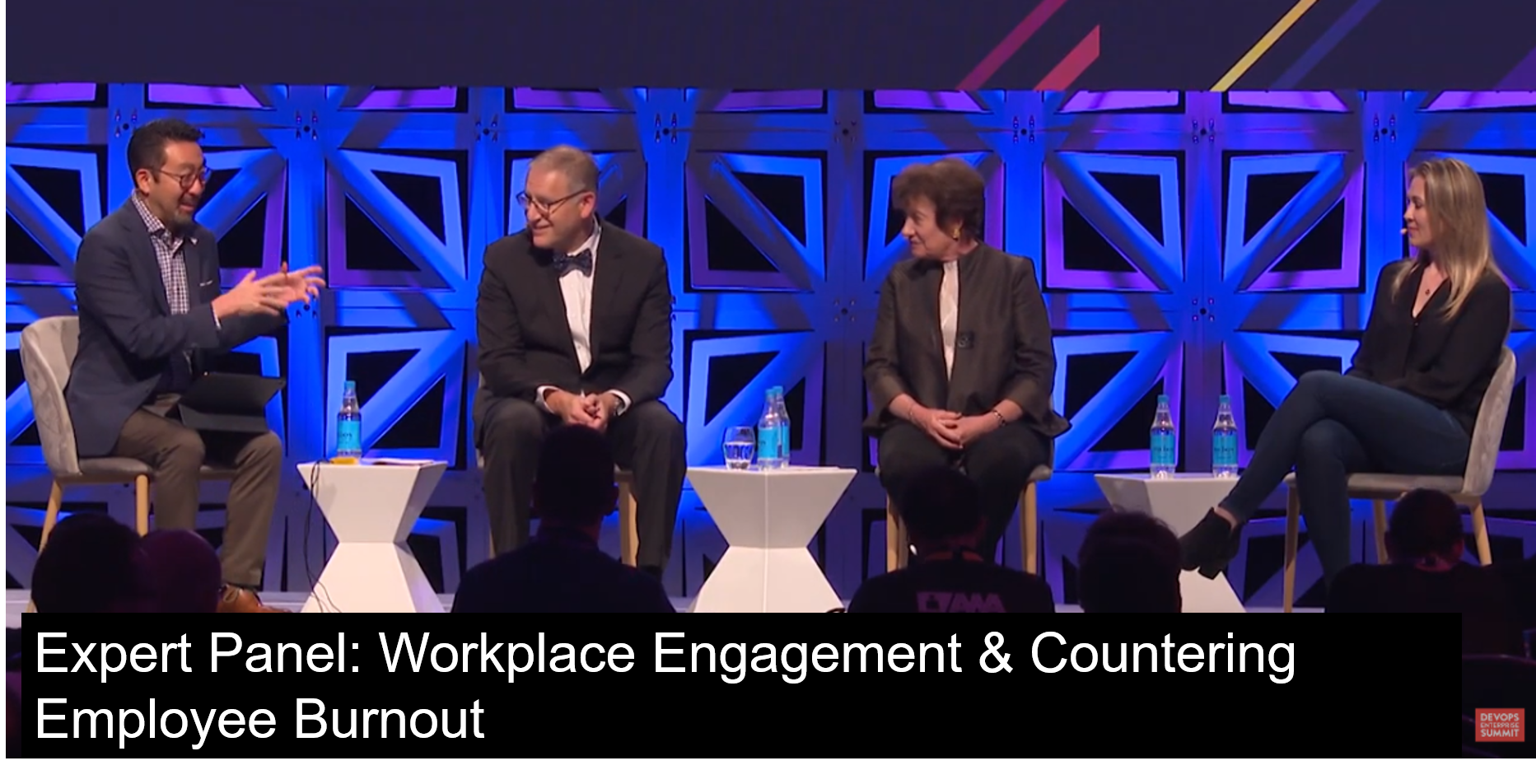
    “Workplace engagement and countering employee burnout,” a presentation at DevOps Enterprise Summit London 2019, is the winner of the Best DevOps Presentation for 2019.

    While there were many great presentations on various aspects of DevOps that were worthy of winning this award in 2019, this presentation and panel transcended DevOps and really touched on an important subject across all walks of life and careers.

    Employee burnout is recognized by the World Health Organization as a valid condition. At the very end of the spectrum, the results can be truly life-threatening. More often, this condition can sabotage the success of your team and organization.

    What made this presentation so powerful was the panel presenting it. Featuring three PhDs, including Dr. Nicole Forsgren, CEO and chief scientist, DevOps Research and Assessment LLC; Dr. Christina Maslach, professor of psychology, emerita, University of California, Berkeley, and a recognized leader in this space; Dr. Steve Spear, principal, HVE LLC; and Gene Kim, it as a great dive into the subject and one that I urge you to watch on the IT Revolution YouTube channel.

    Following this session, I had the honor of interviewing the panel members (minus Gene Kim) and it was also a fantastic dive into the subject. You can view that on Digital Anarchist.

    Best devopsy.kinsta.cloud Article of the Year

    devopsy.kinsta.cloud article “Mainframes: The Cloud Before the Cloud,” authored by Bob Reselman, is the winner for the Best devopsy.kinsta.cloud Article of the Year.

    In his article, Bob shares his insights on why the mainframe was the cloud before the cloud and why the mainframe is a perfect resource for today’s and tomorrow’s cloud computing infrastructure.

    You may know Bob also as the creative genius behind devopsy.kinsta.cloud’s RoelBob cartoons, but he is far from just a cartoonist. He has almost 40 years of experience in the tech space. He teaches at several universities and schools and is a sought-after speaker at conferences. He writes and speaks with the voice of experience and expertise.

    Bob is a nationally known software developer, system architect and technical writer/journalist. He has written four books on computer programming and dozens of articles about topics related to software development technologies and techniques, as well as the culture of software development.

    There you have them, the 12 winners of this year’s DevOps Dozen. Thanks to everyone who voted and nominated candidates. Stay tuned for 2020 DevOps Dozen and, as always, thanks for supporting devopsy.kinsta.cloud and the rest of the MediaOps family of communities. If you have questions, please write us DD@devops.com.

    — Alan Shimel

  • It’s Almost Here: Predict 2020 Virtual Summit

    It’s Almost Here: Predict 2020 Virtual Summit

    We’re a little less than two weeks away from Predict 2020 Virtual Summit, our annual online event during which we ponder the future of DevOps, serverless, cybersecurity, digital transformation and IT. This year’s event will be held Jan. 23, featuring an impressive lineup of industry luminaries offering up their visions for 2020 and beyond.

    Among the keynote speakers for this daylong event are analysts, practitioners, venture capitalists and thought leaders, each with their perspective on the trends, tools and technologies most likely to impact the IT space. Those scheduled to speak include:

    We also have a full slate of panel discussions featuring industry speakers on topics ranging from IoT security and continuous delivery in a Kubernetes world to the state of analytics and scaling enterprise DevOps. Each panel is sure to be chock-full of lively discussion and insight from those in the know.

    Similar to last year’s event, Predict 2020 also will feature a virtual environment with a conference lobby, presentation theater, expo hall and more. There will also be an exhibit hall where you can interact with other attendees and sponsors, watch videos and download more information. It is truly a conference experience from the comfort of your desk.

    Registration and Sponsor Info

    You can register now at https://predict2020.io. Attendance is free. Download the Program Guide here: https://bit.ly/predict2020ProgramGuide

    If you are curious about what the experts, pundits and luminaries think will be the big trends and stories of the coming year, mark your calendar and attend Predict 2020.

    Save Your Virtual Spot

    — Alan Shimel

  • DevOps Unbound: How DevOps has Changed Testing Forever

    DevOps Unbound: How DevOps has Changed Testing Forever

    DevOps has changed the game in almost every aspect of testing: who, what, when, where and even why. What’s working, what needs to change immediately, and what challenges—and opportunities—lie ahead? Hosts Alan Shimel and Mitch Ashley are joined by Abel Wang from Microsoft, Tracy Miranda from CDF, Caroline Wong from Cobalt, Kurt Chase and Ben Simo from Tricentis to share a variety of perspectives on how testing fits into the ever-evolving world of DevOps. The video is below, followed by a transcript.

    DevOps Unbound is sponsored by Tricentis, the world wide leader in automated testing. DevOps Unbound airs biweekly on TechStrong TV, with all episodes available on Digital Anarchist. There is also a live monthly roundtable open to audience participation.

    Alan Shimel: Hey, everyone. Thanks for joining us on this special edition of DevOps Unbound. You’re watching this, probably, at the Tricentis Virtual Event and we are happy to have you join us, happy that you’re attending the event, and we’ve got what we think is gonna be a great discussion on testing and all of its various facets and what does the future – or near future – hold. We’ve got a great lineup of speakers that I’d like to introduce you to who are on our panel today. Let me first start with – she’s on the top of my screen – is Caroline Wong. Caroline, why don’t you say, “Hello” and introduce yourself?

    Caroline Wong: Hello. My name is Caroline Wong. I’m the Chief Strategy Officer at Cobalt. So, at Cobalt, what we do is pen testing as a service. We build a security software platform – like a lot of DevOps companies.

    We have data-driven product-based teams. We have – we really value automation and failing fast. I’ve spent 15 years in the information security industry. I wrote a book called Security Metrics. I host a podcast called Humans of InfoSec, and I teach the OWASP Top 10 Learning Path on LinkedIn Learning, and super excited to be here with this group today. Thanks for having me.

    Shimel: Thank you, Caroline. Next up, we have Kurt Chase.

    Kurt Chase: Hey, everyone. I’m Kurt Chase. I’m currently Head of Release Management and Engineering Services at Tricentis. Engineering Services is a group that supports the engineering function so, we do our own type of testing – testing all the processes and everything we use – to deliver our software at Tricentis. So, prior to Tricentis, I spent some years at Splunk and at AutoDesk. It’s great to be here with all of you today.

    Shimel: Fantastic.

    Chase: Be here today with all of you.

    Shimel: We got what you meant, Kurt. It’s okay. Next up, we have Ben Simo. Ben, why don’t you introduce yourself?

    Ben Simo: Hi. I’m Ben Simo. I’m a software tester of 30 years and past president of the Association for Software Testing who has recently stepped into a product management and product research role at Tricentis trying to discover and develop our testing platform of the future and bring new things to Tricentis customers and hopefully introduce new people to Tricentis with new products that enable new ways of testing.

    Shimel: Okay. Happy to have you here. Next up, Tracy Miranda. Tracy – well, I’m gonna let you introduce yourself. Go ahead.

    Tracy Miranda: Hi, everybody. I’m Tracy Miranda. I’m the executive director at the Continuous Delivery Foundation. It’s an open source organization that’s part of the Linux Foundation, and also home to projects to like Jenkins and Spinnaker, and our members include companies like Netflix and Google. And I have over 20 years of experience in open source so, I love open source and I’ve worked in it as a developer – also in QA and all different facets. So, yeah. Big fan.

    Shimel: Thank you, Tracy. Last, but not least, is my co-host on DevOps Unbound – my partner in crime here, Mitchell Ashley. Mitchell, why don’t you introduce yourself?

    Mitch Ashley: Thanks, Alan. Yes. I’m CEO of Accelerated Strategies Group, which is an analyst firm that focuses on, in addition to cyber security, digitial transformation, DevOps, and cloud-native kinds of applications, which really matches my background very well. I’ve been both a product creator CEO/CTO as well as running IT, CIO, CSO – that kind of thing. So, currently, I’m also CTO with MediaOps – I guess CSO at MediaOps, too, so, I’m trying to collect as many three or four-letter titles as I can. So far so good.

    Shimel: Alrighty. So, first of all, thank you all for coming on today. Secondly, testing – what a wild, mixed-up world we have in testing, right? Just from looking at the folks on our panel today, we have security testing – pen testing, in particular. We have the world of open source and what a factor that is in testing.

    We have product testing, right? We have sort of new product testing – taking testing to new heights. And you know, that variety is sort of a double-edged sword, right? Because it’s like jack of all trades, master of none type of thing. There’s so many aspects of testing, right?

    Even in our audience here at this virtual event, we have testers who come from, you know, what’s called old line QA testing, right, to DevOps enabled testing to visual testing – testers who, if it’s not an open source testing platform, they won’t use it, to proprietary systems. Through it all, though, a lot of times, all of this testing becomes sort of a red-headed stepchild or a whipping boy, if you will, right, to the whole application development system operations teams. It’s like, at the same time, their best friend and their worst enemy, right? They want everything tested, but they don’t want to give you the time, the budget, or the resources to do it, and then, when something doesn’t work, they said, “Well, we should have tested more, right?” So, how – first of all, do we agree that testing has been sort of the whipping boy of a lot of what we’ve seen go down in app dev and operations? Anybody want to jump on that?

    Chase: Well, I think it’s certainly gotten a bad name. I think some of that comes from prior to the digital transformation. A lot of the engineering was waterfall, and testing was always that last stop before the software went out live, you know? Nowadays, I think everyone’s come to realize the speed and scale at which we develop things, you have to do the testing up front at the very beginning. You can’t wait till the end, you know?

    You’re gonna be too slow. So, I think, from that perspective, absolutely. I think that’s why testing has really, I think, gotten a bad name, because they’re kind of the blockers to getting anything out into the public domain, whereas nowadays, you have to enable that up front because you want to get it into the public domain yesterday.

    Shimel: Yeah. And so, in many ways, to me, that sounds like, well, DevOps has been the best thing that ever happened to testing, right? In many ways, DevOps has been the best thing that’s happened to security testing, right? We’ve certainly seen that shift left, if you will. But has that shift left helped – has that rising tide lifted all boats?

    Miranda: I still see –

    Shimel: Oh, okay, Tracy. Go ahead.

    Miranda: I’m gonna jump in and say one thing that strikes me as funny. Like, we have, in our industry, everybody has embraced the DevOps terms, and then, you start to see all these spinoffs to put emphasis on things like, for security, we have DevSecOps, and you’ve got every variant of something with ops. But when it comes to testing, you know, there’s no TestOps. There’s no new buzzwords and it kind of speaks to how much it’s being neglected. Like, we had a conference on continuous delivery, and we asked for talks of everything in the life cycle, and we got lots and lots of submissions except for testing.

    So, again, I think it still is really under-appreciated and just not given the due credit for what it stands for.

    Shimel: Very –

    Simo: Yeah. And I think some of this comes from, as Alan mentioned, that testing is a very broad and diverse subject, and I’ve often watched people argue about testing that each interpret it to their piece of what they do with testing. And things like CI and some of the DevOps practices have helped us improve with the checking that our software can work – you know, demonstrating that it can work – and there’s a lot of people – if you primarily wear a developer hat, you’d look at that’s what testing is. And we’ve automated that.

    There’s been huge improvements in tooling and technology to do that, but sometimes, along with that is we throw out that we need someone involved that’s looking at things from a critical perspective that’s concerned about the safety and efficacy of what we’re delivering that is the, I guess, the one questioning and searching for information that they raise issues that we need to deal with that are reasons to not push things out to production now – so that we can make informed decisions. So, often, I think just that critical side gets thrown out as we improve the other side of testing, which is being able to demonstrate that things can work.

    Shimel: Anyone else?

    Ashley: You know, Alan, one of the ways you can tell who drew a diagram is to look at what’s in the center. And so, if we think about CICD, we kind of surround testing, but we don’t talk about testing. So, in some ways, it’s elevated, and some ways, it still sort of abstracts it out of DevOps. But my experience has been not really, because most teams know that testing has to get automated as part of that process, ’cause you can’t have this automated checking and automated deployment, then let’s kind of let a bunch of manual things happen. And not that testing hasn’t been automated – it has been – but I think it has elevated, at least in part, I think a good deal.

    My experience has been. I haven’t worked in every environment, maybe, where test still isn’t thought of very highly. By the way, the thing that the – it isn’t the last thing in the chain. Documentation is the last thing.

    Chase: That’s true. That’s true.

    Ashley: Let’s give documentation –

    Chase: And release notes. It’s true. I have tech doc’s team, too. You’re right. [Laughs]

    Shimel: And that hasn’t really changed much either, though testing has. No. No. But you know what? Caroline, I’d like you to focus in specifically.

    I mean, I think about – you know, Mitchell and I co-founded a security company, and we came out with a product in 2003 of just a vulnerability assessment and manager – “VAM”, we called it – and at that point, look, we used to beg people to scan their infrastructure at least once a year, right, if not quarterly. We were really pushing for quarterly. And you know, the idea of scanning and testing applications before you deployed them – unheard of. It was unheard of, right? We didn’t have the security tools or people.

    We did that after the fact. Now, that’s not normal anymore, right? Today, at least 85 percent of applications are tested prior to deployment. I don’t know who those other 15 percent are, but that’s a whole nother story. But talk to us.

    You’ve lived through this, Caroline. What do you think?

    Wong: Sure. So, you know, I think there needs to be an acknowledgment. There’s sort of these like, first order priorities and these second order priorities. When I think about security – and I think some of these concepts apply to testing more broadly – there’s a saying that, “You don’t take a $200.00 fence to protect a $5.00 asset.” I think security is about you have something of value and so, you want to test it – rather, so, you want to secure it.

    Testing, I think, is like you made something new and so, you want to test it. You’re not gonna test something unless you have something new. You’re not gonna secure something unless you have something of value. So, it’s okay that security and testing are not sort of the number one thing, you know? Inherently, by their definition, it’s sort of a second order attribute, if you will.

    Now, I think, you know, each of us has been through a version of annual organizational budgeting. You know, each organization says, “Okay. Here are the goals for the years. We’ve got limited resources and budget to accomplish those goals. How are we gonna allocated those resources?”

    And there are some things that, for a lot of organizations, are very clear. You know, even if I take a step way back and I say, “Okay. Most organizations might think about budget allocations in three buckets. Number one – general and accounting; number two – sales and marketing; number three – research and development.” You know, nowhere in those words is either security or testing.

    And that’s okay, you know? I think, Alan, when you share your story about VAM, you know, Vulnerability Assessment and Management, I agree that over the last, I would say, decade-two decades – so, when I started my security career 15 years ago, we were almost trying to convince folks that breaches really happened – that this was really a thing to be worried about. You know, today, everyone knows because it’s on the media headlines every day. This is real. And so, that has been a shift in the perception, I think, in our industry.

    There’s also been a big compliance driver. So, the – in the area that I’m very familiar with, security pen testing, a lot of that pen testing is actually driven by external compliance requirements – things that say, “Because of compliance framework A, B, C, you must actually conduct manual pentest on your application, for example, once a year.” You know, doing it more often than that is often because of perhaps what a lot of this group might think of as a really good thing – trying to actually secure your software, trying to actually test your software to ensure it does what you think and what you intend for it to do, but that’s not necessarily the first thing that comes to an executive’s mind when they’re thinking about budgeting, and there’s a variety of reasons for that, right? There’s an external perception thing. I think there’s also a lot of learning, certainly, that the security industry can do to be more approachable and to really understand better what is the software development methodology that we’re engaging with.

    What is the specific methodology and behaviors of these individuals? And how can we actually collaborate with them most effectively?

    Shimel: Fair enough. I mean, look, I don’t want to be the pessimist in the group or the bluebird of happiness here, but we have had success over the last 5-10 years, Caroline. You’re right. Especially in security, but not just security. We’ve had success in testing across the board.

    Tracy, to your point, the fact that we don’t have DevTestOps, I think, is, you know, testament to the fact that we’ve recognized that testing is so critical to the CICD process that it’s part of it. I mean, you can’t have DevOps, you can’t have CICD without a level of continuous automated testing in there – in my mind, anyway. I mean, prove me wrong. But, you know, I think that has been probably one of the biggest successes that the DevOps movement has brought – has been responsible for.

    Miranda: Yeah. And I really like Caroline’s analogy with security because, you know, that’s something else we think of as fundamental to DevOps, but it’s sort of elevated itself and, in a relatively short space of time, went from being ignored to being, you know, headline news. And I think there’s a lot of lessons there. And I – like, I will say, I do think testing is going through that journey and we’re probably on the cusp of it kind of really exploding and watching a few players in the industry and companies starting to do really interesting work in testing. I think that’s gonna turn around very shortly.

    So, yeah, there’s an exciting space that I think its moment is coming – just like securities has.

    Chase: Yeah. I think it’s all about the testing now, quite honestly. I mean, when you look at the future with low-code/no-code, it all becomes question-question mark ops, you know? Any function in a company could actually put something together and run it, and they’re gonna have to test it, you know, and it becomes less about all the engineering and more about the test patterns and things like that that are needed as you get to these future states. So – and speed and scale is gonna continue, I think.

    That’s driven everything with the digital transformation. It’s speed and scale. Everything needs to come faster, and we want more of it, you know? And so, I think that really pushes the envelope, and that’s what DevOps has responded to and, I think, addressed very, very well, but it’s not over. We’re gonna continue to scale up and go even faster.

    So, we have to be prepared for that, and I think it becomes more about testing in the future, and less about, you know, we’re gonna have these pre-built components – APIs you can piece together however you want – then, testing becomes, I think, almost first order, to Caroline’s point. And security, especially. I think security, we’re seeing that change now. If you’re a SAS company especially, security has to be top in line, ’cause you just can’t put something out there and not have it tested from a security perspective. And, furthermore, with compliance, it’s not just ISO and GovCloud and those programs, but large corporations now are saying, “Hey, if you want software in my ecosystem, these are my rules and I want to see your pentest reports and I want to see this.”

    So, I think more and more people are realizing that if the software’s not tested, it’s not worth it. And so…

    Simo: And, in my experience, part of adopting a DevOps culture and not just tool set is putting testing at the forefront. Some of the most productive teams that I’ve worked with that deliver some of the highest quality software I’ve seen – testing was center to absolutely everything that everyone on those development teams did.

    Ashley: Hm-hmm.

    Chase: Yep.

    Shimel: Yeah.

    Miranda: Yeah. We think – go ahead.

    Ashley: I’m just gonna jump in and say – there’s another factor that actually works to our benefit and that is not only to speed through automation and DevOps process, but contemporary software architectures, containerized micro-services, service mesh – we’re releasing smaller bits of code in encapsulated forms, which means, you know, we’re not testing monolithic applications all the time anymore so, we’re not having to run two weeks’ worth of tests just to get one pass through.

    Chase: Yeah.

    Simo: Right. _____ container solved the “It works on my machine” problem because we can ship the developer’s machine.

    Chase: Yep.

    Shimel: Yeah. That was always a big problem, right? Tracy, you were gonna say something though.

    Miranda: Yeah. No. I think the direction we see it heading is we’ll start breaking the testing monolith to talk about what is unit test, what is system test, and appreciate that is a specialization in itself. And the other things I’m starting to see from some of the end user teams we talk to is this real focus on culture – you know, a continuous quality culture – and seeing that hand in hand as part of the testing movement and again, _____ back to security – you know, the security first culture went hand in hand with that whole emphasis on security so, similarly, the continuous quality culture is starting to be something that – like, the really high performing teas we see pay a lot of attention to.

    Shimel: Absolutely. You know, Kurt, you said something there about low-code/no-code and how that could be a game changer. You know, some people refer to that as the rise of the citizen developer, and I’m wondering if maybe what we need is the rise of the citizen tester, right? Is testing too hard?

    Chase: Yes. I waste gonna say – the one thing we haven’t touched upon – I think Caroline did – is testing is hard. Security testing is super hard. And when you look at today’s modern environment and a lot of the ISVs – at least the ones I’ve seen and been associated with – you have a legacy of monolithic applications that you have to support that are bringing in a ton of revenue, and, at the same time, you’re transitioning – you know, going through your own digital transformation. So, that adds complexity after complexity in testing, and I do think, in the future, testing – you know, a lot of us, like Ben said, to his point, we have to push testing up – you know, shift left, move it far left as we can.

    And that’s gonna continue. I think that has to be the norm. To Caroline’s point, it has to become first order. And I think it’s starting to right now. I really do. Especially the – all the SAS solutions that are out there – you know, shipping code daily, hourly. You need excellent testing to do that and do it with competence.

    Shimel: Yeah. I think you do. But we do have to – and it’s funny that we’re talking about making testing easier because – not security testing, right? Security testing, pentesters – they were always sort of the hired guns of the security space, right? There were SAS or – there weren’t companies like Cobalt, right?

    The pentesters that I knew growing up – growing up – you know, that I knew coming up in the security space were gun slingers. These were, you know, white hat/gray hat folks who would come in and they’d do a little social engineering and pen testing using some open source tools, and you know, they give you a report. But you know, these were folks who traveled around the world doing that kind of thing. You know, we didn’t have a company like Cobalt that did this as a service, so to speak. So, it’s very different.

    But here’s the underlying thing with like, QA kind of testing – and, you know, I don’t mean any disrespect to anyone in our audience today, but for too long, a lot of folks in testing were viewed as failed developers or people who couldn’t be really good developers did testing or maybe testing was a weigh station on the way to becoming a real developer – like a Pinocchio stop or something, right, where you’re not a real boy yet. But that’s not true. There’s also – there’s a whole cadre of professional testers. And you know, in their capable hands, you could do great things. But I guess the question is – does testing have to be so hard that we need professional testing – professional testers to do testing?

    Or can we make testing automated enough that you – I’m not saying it has to be the dunces who don’t become developers. That’s ridiculous. But can we broaden the base of people who do testing? And that includes security testing? I’ll throw it out. Ben, you were a big-time guy in the testing industry. Tell us – what do you think?

    Simo: So, I think we can expand who’s involved in testing and that more people than those currently doing testing can learn to do testing. I don’t know _____ developers learning to become better testers and test their stuff. But I will say that ultimately, the part of the work that is the testing cannot be automated. Tasks that we do in testing can be automated. So, whether – not matter what hat someone primarily wears, if it’s a developer, you know, writing tests to demonstrate their code works or someone’s using TDD and they’re building some tests and then, building some code that matches it, the testing is the critical evaluation that’s going on in their mind of solving the problem and demonstrating that it’s solved – or evaluating how something might go wrong and coming up with some approach to demonstrate that it may go wrong and check for that.

    So, those things, whether you’re doing it automated or the execution is automated or done manually, the actually testing work, I’d argue, is the cognitive work that people are doing. And there is some – that we can never automate away. There are some ways that I think AI can help us. There’s also some ways that may lead us astray. But ultimately, I think we need people to learn to be critical thinkers to understand the technology, to understand the domain of the users and the problems that are being solved, and applying that critical thinking is the testing.

    Of course, then, we want to use tools to help us with some of our tests so, when we come into DevOps and CI, executing those demonstrations of the software working is a key part of that. Now, whether we do it as part of our, you know, building to those tests or we create them afterwards, then they can, at the very minimum, act as changed detectors going forward. But there was some testing in people’s minds that was going on that created those.

    Shimel: Caroline, what about – okay.

    Wong: I agree with quite a lot that Ben is saying. You know, I can’t help but think to myself that – I actually have this sort of visual in my mind, and it’s actually at a circus of a trapeze artists, you know? I think about these people, and they’re sort of like, whirling in the air and they’re doing these like, really incredible feats, you know, and they just do whatever they do, you know? But there’s like, a safety net to catch them if something goes wrong. It also reminds me of a metaphor that is often used in security that says, “We put brakes on a car so that you can go fast.”

    You know, when Mitch said earlier, you know, “These days, we’re releasing smaller pieces of code, modules of code” and there’s a way in which, yes, each small piece of code – each module – can be tested and some of that can be automated. We should automate performance testing. We should automate unit testing. But, to Ben’s point, there’s a lot that can’t be automated. There’s a lot of testing that actually depends on things like human judgment and opinion and it actually requires a person’s decision, you know?

    So, I think there’s – I think there’s a couple of frameworks for us to consider, right? If the first order is about creating value and making something new and the second order is about testing to make sure it does what you wanted it to do and protecting the value created, there’s also this spectrum that says there’s smaller bite-size stuff that may be a good candidate for automated testing, but, I think it’s super important to recognize that these small pieces of code – these modules that Mitch was talking about – it’s also super important to test what happens when they come together. So, to the extent that security folks need to be able to test chained exploits and business logic flaws, you know, those are exactly the types of things that will never be automated – is what I think, anyway.

    Shimel: I don’t disagree. I think security in particular is just there’s some things you’re just not gonna automate. I don’t care what you say. But that’s okay. Anyone else?

    Chase: I do want to make a comment on something you said. This was a long time ago now, when I was a dev manager, that I used to sense that when my developers – you know, if you were on my team, if you wanted to really get me mad, treat your tester badly. Treat them, you know, a bit, like you said, like they’re not quite at the level you are. I would be incensed as a manager. You know, that was a long time ago.

    Fortunately, I don’t see that as much nowadays. I think that role has been elevated where I don’t feel that at all on my teams, and if I do, that is, again, to this day, I’ll get super mad about that because I think it takes all kinds to develop software today and ship software. Testing role is just as critical as an engineering role, just as critical as the ops’ role, the security role. So, yeah, that was one thing that would drive me nuts ’cause I did sense that and go through that, and this back in, you know, the late ’80s-’90s, if you will, before the year 2000 – I’m dating myself – but it definitely was palpable in some of the large ISVs, you know? And as a manager, that was something that would drive me nuts.

    Shimel: Agreed. Agreed. Tracy, open source – look, testing has been inexplicably wound up with open source for as long as I’ve been around, right? Whether it’s security – open source security testing and you know, things like Metasploit and Nessus and Nmap or you know, in QA testing kind of stuff, it’s a rich history of open source testing tools. How do – and part of your mission at CICD is – at the CICD Foundation – is to nurture that, I’m going to assume, correct?

    So, how do you guys nurture that? What are you – what do we do to maintain that rich, open source tradition here?

    Miranda: Yeah. No. Absolutely. And, as I say, we at the Continuous Delivery Foundation, we want to look across the entire software delivery life cycle, and I think it is safe to say, you know, that testing hasn’t risen to the top. We’re actively – like the board wants it to be a more focused-on topic, the technical committee wants to encourage folks to bring us more projects in open source and with testing, but we’re still having to kind of fight through all the noise around other projects.

    And one of the ways we’re approaching it is, for example, our technical oversight committee wants to set out a landscape of the types of projects in each kind of bucket and say, “Okay, look. We need to have something in security. We need to have something in testing that covers these different aspects.” Almost like a call to action to say, “Bring us your testing projects and –” like my favorite saying about testing is, “There’s two key problems in testing – not enough tests and too many tests.” And yeah, I think we’re starting to see some really good frameworks around test generation.

    I’d love to see more open source options for that. And Kohsuke Kawaguchi, the famous creator of Jenkins, move on to focus on testing so, that says a lot about the importance of this area getting more open source focused. So, yeah, I’m excited to see what could come out, but we do have to actively encourage folks to come join us and have those conversations and not to, you know, have it assumed it’s all focused on delivery of pipelines for delivering software.

    Chase: I think another thing you’re seeing today is a lot of people, when they start developing an app, when they start creating something new, that’s the question they ask up front. “How are we gonna test this? How are we gonna automate it? How are we gonna pentest it?” I think those things, at least, are starting to bubble up a lot stronger in the cycle – you know, early on. ‘Cause I know that’s something we recommend highly – is that if you’re developing something new or need to head down a digital transformation, think about the testing. How are you gonna test that up front, you know? And products are actually being developed with that mindset now.

    Simo: And with short iterations, it’s how are we going to test this tomorrow, next week? It can’t be left off for months later to be someone else’s problem. So, people, I think, are learning to deal with those questions about testing from the start of their discussions about what the requirements are.

    Chase: The other thing I love – and in Caroline’s world, has been very successful – I know it is specialized skill set, but trying to teach that throughout your troops – you know, throughout the engineering team. Show them what, you know, across _____ scripting errors. What does it look like in code? That’s super successful. That really, really helps make – ’cause security is difficult, you know, no matter how you slice it.

    Even when you’re looking at product development – if you want to invest in fixing security defects or add a cool new thing for your users, you know, a lot of times, the cool new thing is gonna win out. But that’s starting to change as well, too. I think people are starting to value security – especially in today’s modern world, you know? It has to be up front, really.

    Ashley: Yeah. It’s all about AppSec at the moment. That’s one of the hot topics as well. You know, someone mentioned AI earlier. I just want to offer a perspective about that because we always seem to focus on the shiny new object.

    I know I have. I often do. But I think what we’ll see with AI is select applications when it comes to testing. The sort of vertical place is where it’s really well suited. When we say, “Yeah, AI”, we really mean machine learning in most cases, which is machine learning algorithms, and there’s two types – there’s supervised/unsupervised.

    Supervised is, “That’s a car. That’s a car. That’s not a car, right? That’s a bug. That’s a bug.”

    And unsupervised takes massive amounts of data and intellectual patterns and learnings from that. So, I think that as we’re taking our test automation and our test tools, there may be some of that, and it might be really useful for AI. I wouldn’t get worried about people being replaced as testers. Not in my lifetime, that’s for sure. It is still a – there’s very much a craft to it, just like there is software design.

    There is a craft to testing and a skill and a mentality about it that’s unique, just like with security.

    Shimel: No doubt. Caroline – oh, go ahead, Ben. I’m sorry. No, no, Ben. Go.

    Simo: Yeah. I was gonna say – and with any other sorts of automation – even you know, not learning automation that’s come before AI and machine learning based things, is that it not only has potential, in some cases, to replace some of the mundane work we do, but to enable to the skilled people to focus their work and apply their brain power to the things that really matter. So, I think there’s great potential for AI to help direct people’s attention to the things that maybe should be of concern and help deal with that big question of testing out of infinite possibilities of PaaS and data variations. Which one’s gonna show me the problem? And I think there’s huge potential for AI to help us find that if we’re also aware it may guide our eyes away from something that we do want to see.

    Shimel: Caroline, how does that relate to security, though? I mean, is AI helping Cobalt with pen testing? Be honest.

    Caroline Wong: So, the type of software that we’re building today is actually workflow and collaboration software. So, what we’re trying to do, is we’re trying to bring security folks and developers and penetration testers all together sort of in one place where they can collaborate. The technology piece, for us, is not about automating defect discovery. It’s not – I mean, if we’re gonna us ML or AI in the future, honestly, what we’re gonna do is we’re gonna use it to say, “What are the characteristics of this organization that wants us to do a test on this particular type of asset? What are the attributes of that asset and how might we match that to our talent pool – something that we do totally manually today?”

    I think that’s the opportunity. I don’t think that we’re gonna get to a point where we’re using the AI and the ML for automating the defect discovery itself. Frankly, I think that even if I take a step away from pen testing and I look at the security scans that are in existence today, I think, you know, whether or not they’re referred to as using AI or ML techniques, they’re just simply imperfect, you know? And there’s a super important place for them, but there’s a lot of false positives. There’s a lot of interpretation of data.

    And I think that’s always gonna be the case. I think that no matter what, when it comes to humans and machines, the machines can add a lot of value, but I don’t know that when it comes to software development testing and security in particular that there’s every gonna be a complete substitution. I don’t think that – I don’t think that makes sense.

    Shimel: Absolutely. So, guys, we’re coming up on the end of our time. I need to wrap up. Tracy, let me say this for you, if you don’t mind – and if I’m wrong, correct me. For you testers out there, the CICD Foundation – or CD Foundation, actually; I keep – we always say “CI” like it’s attached at the hip – but the CD Foundation is looking to hear from the testing community.

    Probably some companies – including Tricentis – may want to look into becoming involved with CD Foundation because if you don’t have a seat at the table, you don’t have a right to complain about not being heard. And so, you know, when we look at foundations like Linux Foundation and the CD Foundation, CNCF, we need the testing community – vendors, professionals, folks in it, you know – to be involved and get involved. Be heard and be part of it. So, I’m gonna extend that out there to everyone. But, short of that, though, Caroline, Tracy, Kurt, Ben, and, of course, Mitch, thank you so much for joining us on this special edition of DevOps Unbound.

    We hope everyone enjoys the rest of their Tricentis Virtual Summit. This is Alan Shimel for MediaOps, devopsy.kinsta.cloud, Security Boulevard, Container Journal, Tech Strong TV. Have a great day, everyone, and thanks for joining us.

    [Musical outro]

    [End of Audio]

  • Predict 2020: What Will the New Year Bring?

    Predict 2020: What Will the New Year Bring?

    With the holiday season upon us, our thoughts naturally turn to the next year and what it has in store for us. Will we come into more money? Will we find true happiness? Will there be better integration between DevOps and security? Will there be more Kubernetes instances? The first two may be a little hazy, but it’s a good bet the second two will be discussed during Predict 2020 Virtual Summit, Jan. 23, 2020, where an all-star lineup of industry luminaries will offer up their visions for the future.

    Crystal ball? Check. Swami hat? Check. Insight relevant to the industry? Check. Very smart people who know what they’re talking about? Double check.

    Similar to last year’s event, Predict 2020 will feature a virtual environment with a conference lobby, presentation theater, expo hall and more. More than a series of YouTube live presentations, it is truly a conference experience from the comfort of your desk.

    Speakers

    Our keynote speakers for this daylong event include analysts, practitioners, venture capitalists and thought leaders from the realms of DevOps, cloud native, cybersecurity, digital transformation and IT. Each will share their best predictions for the year 2020 and beyond.

    Among those slated to speak are:

    There will also be an exhibit hall where you can interact with other attendees and sponsors, watch videos and download more information.

    It should be a great day of learning and networking right from the comfort of your own chair.

    Registration and Sponsor Info

    You can register now at https://predict2020.io. Attendance is free.

    If you are curious about what the experts, pundits and luminaries think will be the big trends and stories of the coming year, mark your calendar and attend Predict 2020.

    Save Your Virtual Spot

    — Alan Shimel

  • The Foundational Era of Open Source

    The Foundational Era of Open Source

    Contrary to popular belief, software is not eating the world. Open source software is eating the world. This was very apparent at the Linux Foundation’s KubeCon + CloudNativeCon event recently in San Diego. Driving this phenomenon is what I call the Foundational era of Open Source.

    This Foundational era of Open Source has replaced what I call the Big Brother era that came before it. The Big Brother era itself replaced what I call the Cathedral and Bazaar era of open source.

    The Cathedral and Bazaar Era

    I first became involved in open source software in the mid-90s. I might have dabbled and used open source software before that as I searched for free tools using WAIS and Gopher. But I really became aware when I founded TriStar Web, an early hosting company. Back then, web server software came in basically three flavors: 1. Netscape Web Server, from the people who brought us the Netscape browser (it was my choice); 2. Microsoft’s Internet Information Server (ISS), which was that era’s version of the Evil Empire; and 3. Apache (I don’t even think there was an Apache Foundation yet), the open source web server that was taking the web by storm. Besides being free, it was a lot more flexible and capable than the other two.

    During this time there was, of course, another open source software vying for dominance in the market. Something called Linux developed by a guy named Linus Torvalds was taking on all of the giants that had their own flavors of Unix, while Bill Gates’ Windows was fighting it out against IBM’s OS/2, which he also developed.

    Yes, those were heady days for open source software. I call those days the Cathedral and Bazaar days of open source. The Cathedral and Bazaar, of course, refers to the collected essays and then the book of the same name by Eric S Raymond. It, more than anything else, laid out for me the power of open source software and the tensions between the worlds of open source “free as in beer, free as in freedom” versus closed source software.

    Let’s be clear, the open source software world would not exist but for the lessons learned, battles fought and wins and losses of this era.

    Anarchy, Chaos or Freedom?

    In those days you had people such as Dr. Richard Stallman advocating for free, open software that you could use, distribute and modify as you wish. There were intellectual debates over the pros and cons of various open source licenses (Apache, GPL, etc). Most of all, it was very difficult to bring open source software into the enterprise. No support, no training, no SLAs … how was the enterprise to use open source?

    Nevertheless, open source prevailed—sometimes on sheer quality, other times on the love of developers who relished in the freedom of open source. It became a force in the tech world. Companies such as Red Hat, Suse and Canonical capitalized on Linux. Other companies tinkered and experimented with models to try and become commercially successful with other open source tools. By and large, it was a rough go, but some did succeed.

    In my own case in InfoSec, we had great open source tools including Snort, Nmap and Nessus. The folks at Tenable did stop developing an open source version of Nessus, but they still offered a free version of it. Yes, it was a great time in open source—or so I thought.

    The Big Brother Era of Open Source

    Sometime in the early 2000s, we passed into what I call the Big Brother era of open source. This was characterized by almost every open source project having a managing or controlling commercial entity dictating its direction and code. While this didn’t happen with Linux, it became the de facto standard.

    Companies were spun up by the founders of an open source project and while the project itself remained open, it was owned lock, stock and barrel by the commercial entity. The company would sell training and support and in some cases open core versions of the software with “freemium” modules available for a price. Eventually, SaaS-based, hosted versions of the open source software would be another business model companies used to monetize open source.

    Issues regarding who owned the code, who contributed to these projects and where the community fit in often caused conflicts. But by and large, the open source communities counted on the benevolence of the Big Brother to make sure the open source versions of the software remained viable.

    In retrospect, though, this era stifled contribution by other entities: Who would want to contribute code to an open source project for the benefit of the controlling entity? Many companies forked their project so they could control their own versions, resulting in the Balkanization of many of these projects, with the community being the big loser.

    The Foundational Era of Open Source

    Between 2012 and 2015, though, we passed into a new, modern era of open source software that I call the Foundational era of open source. Open source projects were given to community-owned, non-profit foundations to manage and nourish—organizations such as the Linux Foundation, the folks behind Cloud Native Computing Foundation and the Continuous Delivery Foundation; Cloud Foundry Foundation; The Apache Foundation; and the Eclipse Foundation (one of the early entrants, even if IBM did come to dominate it) took over the stewardship of many open source projects.

    This has ushered in a truly golden age of open source software that has seen open source become the dominant form of software in the world. The Foundational era of open source has flourished for several reasons. For one, now multiple commercial entities can contribute code without worrying that it is for the exclusive benefit of just one company. What’s more, these foundations have a mix of vendors, practitioners and large enterprise users that really do allow for the democratization of open source at levels not seen before. Also, there is a process of incubation to graduation that these projects are put through that help them evolve and grow.

    Not to be underestimated is the new generation of developers who have grown up with open source and only want to work in open software. They are putting their influence into practice. Instead of sneaking open source in the back door, they are knocking down the front door with it.

    There are other reasons, but the result is that open source today is now in use at well over 90% of enterprises and it is by far the dominant form of software. It is leading the way in the move to the cloud and in business transformation, and it is literally changing the world.

    Long live open source.

    — Alan Shimel

  • And the Builders Shall Inherit the Earth: The Democratization of IT

    And the Builders Shall Inherit the Earth: The Democratization of IT

    The democratization of IT is happening, and vendors need to recognize that if they want to survive

    Just back home from KubeCon/CloudNativeCon in San Diego, which can only be called a force of nature. I was joined there by more than 12,000 other folks to discuss, listen and learn about all things cloud-native and open. Once again, I was blown away by the passion of and buzz generated by this community. What is driving it? I think I figured it out: The developers and builders shall inherit the earth. It is the democratization of IT.

    What I mean is that a fundamental shift has taken place in the IT world. Developers, architects and builders are in such high demand and are now the alpha predators of the food chain. They are the ones demanding and deciding what tools they use, how they build and what infrastructure they use.

    Smart vendors are recognizing this and penetrating large organizations by giving these builders the tools they absolutely will love working with. In many cases, these tools are free and open to use in non-enterprise versions. The vendors also have DevRel teams and marketing that cater to these builders and developers, rather than traditional marketing and sales.

    The fundamental shift is that for the nearly 30 years I have been in IT, the mantra has been to talk to the “decision-makers”—the CTO, CIO, and VPs who approved and paid for purchases in IT. Entire marketing strategies and sales were built on this. Lead generation campaigns focused on reaching executives, while salespeople vied for position by taking these people to dinner or golf and shmoozing them. Content was created that spoke to the executive class. Very few folks tried to focus on the practitioner; after all, they didn’t make the decisions; they didn’t hold the purse strings.

    That way of doing business has all changed. Yes, there are some dinosaurs out there who don’t hear the meteor speeding down just yet. But by and large, companies that are thriving in this new era of open solutions, open core and free software are doing so by following a new way: They cater to the developer/builder class. They listen to what this group wants and provide it to them. After that, they make sure tools evolve to meet the needs and wants of the builders. They have figured out that when they deliver delight, these people will tell their organizations that these are the tools they want to use.

    I heard Shlomi Ben Haim, co-founder and CEO of JFrog, call this the “democratization of IT.” This, along with DevOps and the cloud, are the megatrends driving transformation. But I also spoke to dozens of other vendors at the show. Maybe they didn’t call it that, but they instinctually recognize it.

    The world wants software-based everything. The people who are building the infrastructure, writing the code, testing, deploying and securing this software are demanding that it be open, free and cloud-native. They want to use it for a while before they will invest in the paid, enterprise versions and functionality. But once they do, their organizations buy in.

    The buying cycle starts off with the use of free software—maybe an employee whips out a credit card for a small monthly fee to purchase the SaaS version. But it ends with an enterprise purchase.

    The democratization of IT is going to work its way through our entire ecosystem. Content is going to be catered not to the executive suite, but to the practitioner. Lead generation programs aren’t going to focus on CXOs, but on people who will actually use the product. Sales strategy and tactics will reflect this as, too. More dev relations, less golf.

    Another driving force of this market is the new generation of people who are building and deploying. They don’t have an allegiance to the whales of yesteryear. They are fresh and willing to try new things if it gives them the functionality they want. Don’t give me that millennial, “OK, Boomer” crap, either.

    These folks work hard, and they are passionate about what they are building. They want open. They are used to having free tools and they are the new boss.  Maybe not the same as the old boss, but they are not fickle and want to choose the tools they work with. They will not be dictated to by a generation of folks who built during a different time with a different way of doing things. Successful vendor organizations need to realize that and work with these people.

    Of course, executives still set budgets and have to sign off on larger or more expensive purchases. They will need to be satisfied. But increasingly, it is not going to be the vendor who does that. They will rely on their builders and their developers to choose their tools and products. If you are a vendor and are not operating this way, look up to the sky because you just may see a large fireball coming your way.

    I, for one, think this is a good thing. It is time for the democratization of IT. Let the builders inherit the earth.

    — Alan Shimel