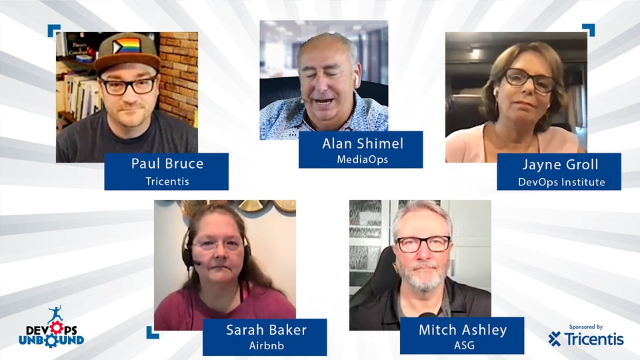
Author: Alan Shimel

  • EP 20: DevOps for Low-Code – Friend or Foe?

    EP 20: DevOps for Low-Code – Friend or Foe?

    Low-code development has become increasingly popular since the onset of the COVID-19 pandemic in 2020. Low-code technologies allow organizations to build and customize fully responsive, easy-to-deploy applications with little to no coding. It accelerates digital transformation and empowers citizens developers. In this episode of DevOps Unbound, hosts Alan Shimel and Mitch Ashley are joined by Derya Sousa (Kianda), Andrew Manby (HCL) and Brian van den Brink (Valori) to discuss the benefits of low code and how it is transforming software development. The video is below and a transcript of the conversation follows.

    Alan Shimel: Hey, everyone, welcome to another episode of DevOps Unbound. DevOps Unbound is a biweekly panel session on all things DevOps, of all things—hence the name, DevOps Unbound. It is sponsored by our good friends at Tricentis, and many thanks to Tricentis for sponsoring DevOps Unbound.

    For those of you who are catching DevOps Unbound for the first time, in addition to our biweekly panel sessions like this, which are pre-recorded, we also do a monthly live roundtable open to the audience, and you are one of the guests at the roundtable where you get to ask questions and steer the panel discussion yourself. So, if you go to DevOpsUnbound.com or check it out on Digital Anarchist, TechStrongGroup.com, or devopsy.kinsta.cloud, you’ll be able to see the schedule and maybe join in one of our live roundtables.

    Today, though, is one of our pre-recorded panels—and what a panel we have. Our topic today is low code/no code and many of its aspects and flavors, if you will.

    But before we jump into that, I want to introduce you to our panel today—and I thought we lost one there for a second, but we’re okay. Let me first introduce you to Brian van den Brink. Brian, welcome to DevOps Unbound.

    Brian van den Brink: Thank you, Alan. Yeah, I’m Brian, I work for Valori, it’s a company in the Netherlands. We completely focus on testing, so we don’t have any developers, it’s really all about testing for us, and I worked there for about eight years now. I started, really, as a tester of test automation, et cetera, but then I also noticed in the assignments I did that it was also important to learn something about requirements, how do you get them ready to be tested.

    So, I focused also a few years on business analysis to get going and know what I need for testing, up until, I think, approximately five years ago when I came into contact with OutSystems, and really focusing now on testing solutions specifically for the OutSystems platform and seeing how can you use a low code platform in your benefit as a tester. And yeah, it really opened a lot of opportunities for me, I think, but also for testers, like, how can you work with low code and use it for your testing strategy, so.

    Alan Shimel: Excellent, and thank you very much, Brian. Next, let me introduce you to Derya Sousa, and I’ve been trying all through our prelim to get it right, I hope I did, but if not, say it correctly, but please introduce yourself. Okay, three time’s the charm. I’m sorry—go ahead.

    Derya Sousa: It’s great to be here on this panel today. Thank you so much for having me, first of all. So, I’m Derya Sousa, I’m the Co-founder and COO of a company called Kianda Technologies, based in Ireland, helping companies across the globe. Kianda is a no code/low code application development platform, and we are the enablers of digital transformation and accelerators of digital transformation for companies.

    My background is in IT. I worked as a developer IT consultant across different companies, industries during my career, and I came across the fact of how difficult it is to deliver digital solutions for companies. That’s how the idea of Kianda was born in mid-2016, with the vision of helping people regardless of their technical skills to create the technology they need.

    Alan Shimel: Okay, thank you. Thank you for what you’re doing and thank you for joining us today. Our next panel member is Andrew—excuse me, it’s Andrew Manby, correct? Andrew, if you wouldn’t mind introducing yourself?

    Andrew Manby: Sure. My name’s Andrew Manby. I head up Product Management for our Digital Solutions Portfolio here at HCL Software. You know, in our portfolio, we have both professional developer low code platforms and also citizen developer low code platforms.

    A little bit about me, I’ve been involved in multiple successful software products. Some of them you may know about, a product called DataStage, which we created back in a former company that really, along with Informatica, lit the imagination of the data integration market and have also been involved in other market spaces as well, including bringing thought leadership to IBM around big data analytics.

    Alan Shimel: Excellent. And then, last but not least, not necessary a panel member, but a panel member, but he’s also my Co-host for DevOps Unbound, it’s TechStrong Group CTO and TechStrong Research Principal and Co-founder, Mitchell Ashley. Hey, Mitch, how are you?

    Mitch Ashley: Hey, Alan, always good to be doing a panel together and for the folks on the panel I know, good to see you again. Folks that I’ve met for the first time, like our audience—good to have you all here. I know we’ll have a great discussion.

    Alan Shimel: Absolutely. Thanks. So, guys and gal, let me kick this off. As I was talking about before we went live, I almost view the low code/no code discussion with a BC, Before COVID, time frame, right? Much like ADBC, we have DC and then pre-COVID. I think—and Derya, you’re living proof of this. Low code/no code was alive and well prior to COVID, right? You started in 2016. Low code/no code’s been around, obviously, much longer than that.

    But certainly, with the onset of COVID and the pandemic, never have we seen a need to do more, faster, to get apps out better, to expand the base of people who can develop like we have this past going on almost two years now, right, year and a half—well, more than a year and a half, two years. And so, we’ve seen sort of a rapid development in the state of low code/no code.

    And Derya, I don’t mean to pick on you, but I’m gonna ask you to kinda kick us off, here. I gotta assume that this is what you’ve seen at your company in particular over the last year and a half to two years.

    Derya Sousa: I think to start with, I could tell you, when we founded Kianda, when we would say low code/no code platform, our audience would say, “What do you mean?” Now, we came to a stage that anyone we talk to understands now, most of the people we are talking to, they understand what we do because of this trend and the movement that’s happening with the help of the unfortunate event of the pandemic. But low code/no code was always here, solutions that we had. It started long, long—years ago. You know, we were using Excel sheets, we were using Access, we were using WordPress back then to create our website. So, they are, I think, the initial solutions that we started to use.

    But it came to a stage that the surge of the remote working, the surge of the digitalization needs that are growing really dramatically now in the last two years, it’s going into more enterprises, it’s going into more organization level. And what we are seeing, this is a problem that’s not a new problem. Currently, only 0.5 percent of the work population is capable of coding.

    So, what was happening before was, you know, business users, anyone working in organizations, they were in need for technical solutions, and they were always waiting for IT teams to go in and create these systems for them. But it’s changing now, there is more inclusivity in creating technologies, empowering people, regardless of them knowing how to code or not. It’s giving an amazing world of opportunities for people who were not able to be part of it, be actively part of digital transformation are now becoming what we call citizen developers to create these technology companies, organizations are in need. And of course, we live in a digital first world now with everything that’s going on around us. Any company who doesn’t try to benefit leverage from these technologies that are rapid application development are gonna stay, unfortunately, behind when it comes to competitive advantages and improving or creating that economical value for the organizations.

    Alan Shimel: Agreed. Folks on my panel—thoughts, follow on to that?

    Andrew Manby: Yeah, I have a few thoughts. So, you know, as Mitch and I have discussed a couple of times, right—for me, low code or sort of no code has been around for a long period of time. In fact, my father-in-law was programming in dBase, you know, many years ago, right? [Laughter]

    Alan Shimel: That’s another name I haven’t heard in a while.

    Andrew Manby: Yeah, okay, let’s get Delphi, FoxPro, all of those things out on the table. Let’s do it.

    Mitch Ashley: I think I met your father-in-law, so. [Laughter] [Cross talk] dBase.

    Andrew Manby: [Laughter] Yeah. So, all of these things have been around for a long period of time, right? And if technology has taught us anything is, they evolve to serve a particular need and that’s because the business was trying to accomplish a particular outcome, right? So, they built something, they’ve effectively had it deployed.

    Now, what’s happened now is, you know, we have a lot more tech savvy people in the workforce and, you know, IT is taking a little bit more of a proactive approach. They want a bit more governance, they want a bit more standardization, they also want to be assured of the security and governance of what the business buys, and I think this generation of low code and also no code tools, which I think are two separate things, by the way—

    Alan Shimel: Absolutely.

    Andrew Manby: – help us to do that. And so, you know, I don’t think it’s new. You know, what’s actually interesting—and I hope we’re gonna get to this, Alan—is the type of things that we’re seeing that people are building with these individual products.

    So, I think it was always there beforehand. I think a lot of organizations like, for instance, we have one major airline and there’s a couple of hundred people who are business users building applications on it, right? But typically, you know, to be clear, a lot of them are employee-facing, and they fill the gap between some of those traditional enterprise applications or maybe to some of those SaaS franchises that we often hear about now to get the job done, right? So, I think it was alive and well before, and I think it’s continuing.

    Alan Shimel: Absolutely, it’s continuing, but I think it’s changing. And Brian, I think you might serve as a poster child.

    Brian van den Brink: I think, actually, if you look a few years ago, like maybe four or five years ago, a lot of companies were maybe starting to work with, for example, health systems with low code platforms, using them as smaller apps, basically, in their organization.

    For example, you know, logging hours of your work, whatever, and then starting to grow, like—hey, we can really get to a product really fast, and then other departments of the organization see, hey, they realized an app in a few months, and it’s interesting to maybe expand on it. And then you see, like, a center of excellence within a company start to build apps, and then it grows bigger, and now, I think, currently more and more organizations actually use low code for their core applications as well. So, actually, the most important processes are also done with low code nowadays, and it’s growing like that, because they see the benefits, I guess. And when I see—

    Alan Shimel: Well, why shouldn’t they?

    Brian van den Brink: – yeah. And what I see in my work as well is that, if you work in a high code environment, it might be difficult for a tester or for a business analyst to say, “Hey, this is how it works” and dive into the product, you know, dive into the code, then you need these technical skills. But I think with low code, it’s easier, for example, for a tester to say, “Is this really what we meant with this piece of software?” and you can really get the dialogue going with your developer, even with your product owner, for example, to see, is it really doing what we want it to do, and how can we improve it, for example? And that’s so much easier in a low code environment, I think, than in a high code environment.

    Mitch Ashley: You know, Alan, there’s some—Accelerated Strategies, now TechStrong Research did some research earlier this year on low code/no code and there were some interesting trends in that. And I think part of it was driven by, Derya was talking about the effect of the pandemic; you were, as well. That rose software to prominence in terms of business strategy must-have capabilities. And along with that, sort of low code/no code was sort of viewed by IT as something that happened outside of IT, we don’t really care about it, the business units are doing something, whatever, to it is a mainstream platform.

    And I’m not saying it wasn’t before, but I think the embracing of low code/no code as a strategy, I think that improved over the last 18 months, and you can also see it by the need to access data, what information people need to get to, because no application is truly an island. They eventually have to get security, they eventually have to get to data and other systems and the fact that, Andrew, you talk about citizen developers and professional developers both as IT viewing those as legitimate creators of applications.

    Are you seeing that trend as well? That certainly bore out in our research.

    Andrew Manby: Yeah, so, we have some of our own survey that’s coming out very shortly that we did with Forrester. You know, we actually found that, from a business decision making perspective for the people surveyed, 80 percent of them said that low code was one of the top three IT priorities for the organization, right?

    Mitch Ashley: Mm-hmm.

    Andrew Manby: You know, 77 percent of the respondents actually said that, you know, agility and velocity were the two most important things to their business in achieving that.

    So yeah, I think companies are realizing that. I do think that there’s a couple of other different phenomena, and I think, Mitch, you and I have talked about this when we’ve had a separate conversation. I do think there are the organically grown stuff that Brian was talking about, which is, you know, you provide a citizen development tool, you establish a center of excellence, right, and then you sort of start draining the desire of the organization to fill the gap with building these applications.

    But I think there’s also—and maybe you touched on it, Brian—you know, organizations are taking also a top down type approach, right? And they’re saying, what are the important digital touch points I have in my organization and, given the advent of COVID, what do I need to be able to fill the gap or continue my business, right? So, if I’m a retailer, through the early part of COVID, one of the biggest challenges I had was, how do I handle, you know, touchless commerce? How do I pick up the deliveries and still allow my retail department to function, right?

    Or say, for instance, I’m a tax office, right, and all of a sudden, you know, the tax function, there’s no people in the office, and what we want people to do is start filing an abeyance request to delay the delivery of the taxes—how are you gonna do that? Or, you know, families are looking for special support, family services support, right? So, those types of things have suddenly become very, very important and low code, whether it was built by the IT organization or it was built by the business has really helped to fill the void. Sometimes, there have been brand new things, and sometimes they’re just really about adapting the business to the new reality.

    Alan Shimel: Absolutely. Let me weigh in, here. You know, I think prior to the pandemic, there is a long history of low code as I think, Andrew, you pointed out, right, though it may not have been called low code then. But prior to the pandemic, low code/no code was around, but a lot of people viewed it as, “Look, if I’ve gotta get something done simply, it’s Minecraft, you know, for adults.” It’s easy, you know, for simple—as I think, Brian, you mentioned, it’s good if I wanna track my hours or something like that. It’s a glorified spreadsheet.

    And then I think what we’ve seen with the pandemic is, in my mind, we’ve seen three branches of low code/no code, and I think, Andrew and Mitchell, you both mentioned it. One is no code, and I gotta be really honest with you—I got a problem with that. I have the same problem with no code that I have with no ops. I think that’s pure marketing, and I don’t know what you can truly, truly do with just no code. And we can talk about that, feel free when I’m done if you guys wanna jump.

    Andrew Manby: I’m just thinking about your Excel spreadsheet, right?

    Alan Shimel: Uh huh.

    Andrew Manby: You know, Excel is no code until you type in that formula.

    Alan Shimel: Right, and then all of a sudden, you better—take it from me, I’m illiterate on Excel formulas, so I know there’s code there.

    Mitch Ashley: Because you put in an expression, you’re now coding, right?

    Andrew Manby: Yeah, exactly. [Laughter]

    Alan Shimel: But when we look at quote-unquote low code, here is the big takeaway with COVID for me is, we have low code for developer teams—and Brian, I’m gonna include testers in there, because testers were already scripting and doing some coding in order to write their test.

    So, we have low code for development teams—DevOps teams, whatever you wanna call them, developers—and then we have low code for the quote-unquote citizen developer. These are people who traditionally didn’t do any development other than maybe spreadsheets. And, you know, lo and behold, the business analyst, the person over in Sales or Marketing or in HR, they now have the capability of not having to wait or go through that whole IT process driven formula, but they could use some paint by numbers and relatively easily build a very functional application. Don’t equate citizen developer with simple app. There’s some sophisticated stuff we can do now.

    Brian van den Brink: Alan, I wanted to react to that is that, indeed, the citizen developers, but also the IT development teams working with low code.

    Alan Shimel: Yep.

    Brian van den Brink: But what I do see is that more and more companies choose low code to basically restructure their, how do you say, legacy applications, you know, rebuild it or rethink their software. And I think it’s really crucial to still have—maybe you can work with citizen developers as part of, okay, what are the business requirements we need and how are we gonna implement it, et cetera. But it’s super important, I think, to still have your development skills on par with what you need. Because even with low code, maybe it’s easier to make something, but you still need the same kind of skill set that the developer would have to know how do I structure things, you know, how do I set up my architecture around it. Those kinds of things are still development skills, maybe without coding, but it’s still development skills, I think.

    And that’s why I think you always need maybe a senior developer, whatever, in your team to be able to handle those kinds of questions and then supported, I think, of course, by juniors or citizen developers even, but the development skills that you need to build an application are still very much necessary, I think.

    Alan Shimel: Agreed. Derya, it looks like you wanted to—

    Derya Sousa: I would like to add something, a point to what you said, Alan, to your definitions. So, there are solutions in the market that low code solutions, they generate code for a developer to go in and speed up this process of delivery and make the changes as they receive them.

    Alan Shimel: Yeah.

    Derya Sousa: There are solutions like what we provide. We don’t generate code, so we call ourselves as our customers call a true no code platform. However, we allow developers to go in and create widgets, create rules and actions that can help them bring that end to end business application to life. And I think that’s important, because there is a good bit of differentiation between them, and from our experience, we work with IT teams as well as Business Departments.

    Alan Shimel: Yeah.

    Derya Sousa: But we start with IT Departments, because they’ve seen the benefits they can get—

    Alan Shimel: The strength, the power.

    Derya Sousa: – by using a platform like this—exactly, filling the gaps that they might have. And now, even since the pandemic, we are talking to more public entities for—public hospitals, for example, for government agencies. Even them, they tend to be slower to catch up with innovation and technologies. Even them are looking at low code/no code systems, how they can use their legacy systems, which they’ve been using maybe two decades, but they had no idea how, actually, they could bring a user-friendly interface on top of these systems.

    So, that’s where, I think, solutions like rapid application development solutions that come into place and bring a lot of benefits to organizations.

    Andrew Manby: Yeah, I would agree that certainly, you know, some of those you think are traditional sort of holdouts, right, typically on the laggards in the adoption curve are certainly doing that. You know, we’ve seen that in state government, we’ve seen that in large tax authorities. We’ve also seen that in the District of Columbia Motor Vehicle Registry. But I think also one of the things that I want to make sure that we add to the conversation, I sort of touched on it is, you know, I think organizations, I’m just thinking about actually the first private distribution only utility in North America is the Vermont Electric Company. And they, a lot of companies want to go through additional transformation, right? I know we’ve all heard that term, right? But they really set out a plan for a number of years to sort of think about how they could not only replace some of the legacy, but really sort of think about, you know, shifting the cheese on what does it mean to digitize the processes that they actually do.

    So, I think, for some of the organizations, you know, they’re not only thinking about—okay, how do I put a new front end on an existing system where, you know, it’s been particularly inflexible. But I think also, a lot of them are a lot more, you know, thinking about how do I, you know, move the cheese? So, in the case of the D.C. DMV, how do I, for instance, say, “I don’t want to have people go into a motor vehicle registry to register their vehicle, right? I don’t need them to go into a public office to pay a parking fine or a speeding ticket—what if we just actually changed our processes and put it on one of these things, right?

    So, I think a lot of organizations out there are actually thinking about low code in that way, and I think that’s where the conversation shifts from being an IT way and an enabler to also being—alright, you know, the CMO, the COO has a seat at the table and she is saying, “Look, how can we improve the engagement with our customers where our traditional ways of engagement with them have change significantly?” And I see probably equal amounts of companies coming to us and saying, “I’d like to do this,” right? You know, “I want to change the way people buy tires for their cars,” right?

    Mitch Ashley: You know, in thinking about this, it seems that sometimes the terms we create don’t always serve us well, right?

    Andrew Manby: Right, right.

    Mitch Ashley: And, you know, visual programming is what we would’ve called low code maybe 5 or 10 years ago and you know, is a macro low code or no code? And actually, I don’t really care, it’s a macro, it’s just like—you know, is Python a scripting language or a programming language? I really don’t care. It sort of doesn’t matter. I think the end result is, you know, you talked about, Derya, the rapid application development, and I don’t mean the RAD term, but creating applications quickly and expanding the universe of people who can do that across the business is all good. I mean, it’s to the benefit, to the end of the business. And we can create a mess for ourselves, or we can do it well, in a way that it works together.

    But I think, hopefully, we get to a point in a year or two where we don’t think about low code/no code, right, it’s just—it’s another way of, it’s an application platform for creating apps. And anybody can do it, because it’s—I mean, whether it’s no code, I don’t care if Trello’s a no code or a low code. I don’t care if Zapier is a low code or a no code, you know, just to pick a few commonly used things. I think we’re about the result we wanna get.

    Andrew Manby: Yeah, I agree, Mitch. I mean, I think at the end of the day, you know, we obviously know that technology goes in cycles. You know, certainly, in our portfolio, we have low code that we would sell to a customer for doing that specific task, right, and those are broad sort of use cases.

    But, you know, low code or that sort of no code citizen developer construct exists in our digital experience platform and it also exists in some technology we have specifically for the DevOps process, which is a low code version way of them to help orchestrate what they do in the DevOps process. And you think to yourself—well, are they a commercial low code tool? Well, no, but they’re bringing the, enshrining the value of a no code/low code tool to a specific challenge.

    You know, maybe that will be the way that this market will evolve over time, but definitely, I would say that where we are right now is, it’s permeating into lots of different places, right? You know, does that mean that, say, is Monday a no code tool? But probably what makes it stickier is the fact that it has some no code type capabilities to it, right? And maybe that’s okay, right, for customizing certain types of applications.

    Mitch Ashley: Well, it ventures into the whole workflow space, right? I mean, you know, Atlassian now is positioning themselves as a competitor to Monday and others as a workflow tool, and you could say that’s low code or no code, too. So, it’s really, when we talk about that as a segment of the market, it really is much bigger than just what we might narrowly define as low code.

    Alan Shimel: Yeah. So, to me, the definition goes back to something Brian was talking about earlier, and that is—what’s the involvement of IT, right? Even with this citizen developer thing, I see it bifurcating. There are some cases where traditional IT teams are calling in a non-traditional IT person to help with the building, architecting, sizing of an app. And that non-traditional IT person benefits from the team being, using low code/no code tools, right? So, that’s one scenario with the IT Department’s involvement.

    Then there’s sort of a shadow low code/no code development kinda operation without IT, right? Where—hey, man, it takes too long, I don’t wanna go through the whole change management process and the architecting, I just need this quickly. And I got the tool to do it and it’s cheap and it’s SaaS an it’s boom, boom, boom and I’m done. “Hey, where’d that come from?” “Eh, I built it.” “You built it?” “Yeah, I built it.” Right? And that’s powerful. I’m not gonna—let’s not kid ourselves. That’s a powerful enabler in an organization when the IT person says, “Hey, wait a second, where’d you get that?” “I built that.” Right?

    How do those two jibe? And I think that’s really where the friction, where the rubber meets the road, and what is low code, what is no code, who does it? I think the delineation is, is IT involved or not? And, you know, Derya, you were saying most of your engagements are going through the IT Department. Brian, you seem to be on the IT Department is involved side of the house as well. Andrew, I’ve heard you go both ways here a little bit. But, to me, that’s the key sort of indicator.

    Andrew Manby: Well, and Alan, can I ask you a question, then, right?

    Alan Shimel: Sure.

    Andrew Manby: You know, I tend to think about low code for citizen developers to be a bit like a sandbox, right? You know, I live—where I live, there’s a zoo a mile away, right, and there’s an area there and a kids’ playground, there’s a tent and there’s a sandbox underneath it, right? And it makes it very easy for the family to sit down and observe their kids, right?

    So, you know, I think the way that no code is developing from an IT perspective, it’s trust but verify. Can I see what they’re doing? If they get into trouble, I can help them out, or as Derya said, you know, if there’s something that they need, right, maybe they need a specific widget to do a payment or they need something to deliver a package or they need some very specific type of math problem and they build an algorithm in the math lab and they want to bring it in, that’s when IT does that, but also, again, it’s that oversight and governance, right? Trust but verify, but you know, who’s using the application? What data do they have access to? Are they doing Select Star from HR executive salaries, right? Is someone curating those data sources for them so they can do no harm in their developments?

    So, I think that’s the place where citizen development is going. I think that’s where organizations want to invest, that’s where they’ll put the COEs. I think the days of, say, my father-in-law building something in dBase will go away from an IT perspective.

    Alan Shimel: So, let me use your sandbox analogy. I’ll put forth the proposition to you that most parents, a lot of mommies, take their kids to the sandbox and leave them there because it’s a relatively safe environment and they can concentrate on other things, maybe doing some of their own work or speaking to the other moms or what have you, and they consider it a safe environment to leave their kids, and they only keep half an eye on them versus, you know, being on swings or something. Same thing, here.

    Andrew Manby: Exactly, Alan. So, I think, for me, you hit the nail on the head, right? If it’s about IT backlog, you’ve effectively given one strategy to halve or reduce your IT backlog because, with your supervision, right, the moms can go off and do something else which they focus on which really requires their skills.

    Alan Shimel: Mm-hmm.

    Andrew Manby: But then, you know, as citizen developers in the sandbox, I can get what I need done for the business faster. Isn’t it like a division of—

    Alan Shimel: Well, let’s go try it.

    Andrew Manby: – a division of labor?

    Alan Shimel: It is sort of a division of labor because we’re not talking about kids in sandboxes. But when you have testers doing low code/no code, you know, building quick, being able to testing faster, better—that, to me, is a very different low code/no code use, right? That’s a—

    Brian van den Brink: What we often see, for example, with Tricentis, Tricentis is a low code testing tool, and I think it’s important as a company if, for example, I choose low code development for my core applications. Then also, you have to probably think about what does that mean for the other roles within the IT Department like, do we have to think about then, also, a low code testing tool that fits our development platform, for example? Often, I think what I still see happening is that we choose low code for several reasons and the decisions that help that. Also, you can rely on—okay, that’s the same decisions we need for our test tooling, for example. And I think what’s important is that I think what the low code opens is that you can work with a low code platform and use those capabilities for a testing perspective as well.

    So, for example, if I test a process, it takes a lot of time to go through all the screens and to test a workflow, for example. And I’m testing a workflow and there’s all kinds of data I need to test specific outcomes of that workflow, try to find solutions in your platform to basically mock that data or to set that data up through a faster way than to going through all those screens, maybe you can use an API or you can leverage something out of the platform to make that faster. And I think that’s where low code testing comes in place is that it’s easier to shift left towards a developer and discuss those kinds of things. Like—okay, we have a requirement we want from this business perspective, what do we need to build that as a developer and what do we need as a tester to test that more efficiently? And I think that’s where the thing comes together is that if we discuss that within a team and then it’s really an IT thing, what do we need from a technology perspective to make everybody’s life easier, basically?

    And I think low code, companies use low code, for example, because they have a challenge in finding the technical people to be able to build their apps. And we have similar challenges in testing that it’s difficult to find the technical people to build the technical scripts. So, there, I think we need to make sure, as a company, that you match these challenges in the same way that—okay, low code platforms probably also need low code testers, because you have, you know, you make those decisions for a reason, I guess. And that’s what I see in my work.

    Yeah, it opens a lot of opportunities as a tester to be more efficient in your work and to make sure that you keep up the pace with your developers. Because low code development is a lot faster than traditional development, and if you don’t change as a tester as well, you will always be, like, a bottleneck in the process, because you’re not as fast anymore. And then that’s why you need to think of smarter solutions as well.

    Alan Shimel: Derya, low code apps need low code testers?

    Derya Sousa: Sorry?

    Alan Shimel: Brian said something that if you have low code apps, it makes sense to have low code testers.

    Derya Sousa: Low code testers—yeah, yeah, absolutely. Just to add to the original conversation about governance and security, I would like to maybe add a couple of points there. I think, again, the solution to what you mentioned, Alan, there is—yes, we deal with IT Departments and, you know, business users are being exposed to these solutions, low code/no code solutions—where is the security, who has access to what, and how we can implement governance. And it sounds like a broad concept, but you know, any organization would need to implement governance, you know, how they operate, what is moss, what is a shoot, what is a can for them to do and now to do things.

    And the same approach should be implemented when it comes to employing this type of low code/no code solutions. So, just because the platform is like a LEGO building block or sandbox, as you mentioned, it doesn’t mean that we should forget about everything, it’s too exciting, let’s build whatever we need and, you know, roll it out quickly. I think the same approach as the company would have had in their change management, change control, governance, they all should be now considered the same way for low code/no code approaches, whether it’s IT building it or whether it’s business users building it.

    And what we usually see that’s working is when IT and Business Departments work together. So, IT creates some kind of a controlled environment for these non-IT users to go in and create solutions while IT is shadowing them or supervising them, giving them tools they need. But at the end, it’s all a controlled environment where, I’m really the biggest fan of giving people free, innovative solutions that they can freely innovate and create solutions they need, but this should not come without a plan. So, a low code/no code system should not be implemented without a plan.

    So, that’s why we are seeing sometimes a struggle that companies go through, because they see the opportunities, they start with one solution and they want to implement so many more in a couple of months’ period, and it can be challenging if there is no plan. It can be challenging if there is no strategy, overarching strategy that looks to different kind of aspects of how to implement such a rapid application development system, yeah.

    Brian van den Brink: Yeah, when we have—

    Andrew Manby: I probably disagree, because I think there’s different modalities. I would say a lot of citizen developer low code is an either they develop it to prototype it and then hand it to IT once they’ve actually proven it, sometimes they’re there for a period of time so it’s literally like a pop-up booth or a food truck. You know, it arrives, it serves it purpose, and then it’s torn down, right? So, I don’t think you can necessarily have IT be involved in all of them.

    I mean, certainly, you have some sort of, you know, diamond team to do that, but I don’t think it all happens like that. I think there’s different ways that, yeah, some of it is definitely planned out through IT and Business to deliver something. Sometimes it’s a cross functional team and it’s driven by the business. But I think part of the attraction of low code, and we mustn’t forget about it is, it’s that organic nature and the empowerment of the people in the business to get their job done.

    And sometimes, you know, back to Alan’s point, it’s—you know, you don’t wanna get slowed down by what IT’s doing and as vendors, if we do our job correctly, we give them that safe space to be able to do that, right? Trust but verify.

    Brian van den Brink: I think it’s important to—I think, indeed, what it opens, and I agree there is, it allows you to prototype things from a business perspective, but I think what’s important then in the next space is that that prototype is not to go in our production environment, basically. So, you know, you have to make sure that sometimes what we say is that, if you look at old spaghetti code, with low code, it’s easy to make, like, fast-cooking spaghetti, basically. Because, you know, you can make your mistakes faster because it allows you to create things faster, as well.

    So, I think, indeed, you start with a prototype, you verify the basic concept, and then at some point, if you really wanna structurally have a core application out of it, it has to go through architecture principles and things like that. But I think that’s what Derya also means, maybe, with the plan is that, once it goes to that, after that first phase, it really goes into that planning phase and how are we gonna structurally broaden this application, for example?

    Derya Sousa: Absolutely. Just to add there, so, the applications we build, we deliver, or our customers are delivering are core applications, core business applications, and I don’t see them working well in terms of security and governance if they are just let and there’s no plan or there’s no cooperation with IT teams.

    So, from my experience, I’ve seen this and there are, really critical solutions are being built with low code/no code systems, and they are connecting to critical data as well, and especially with security in mind, that we all have to have nowadays. I don’t see this getting to the highest potential without IT being involved.

    Andrew Manby: Yeah, I will agree about that, but I would argue, continue to argue that there are a lot of things that need to be put in production in a safe space that have been curated by IT that we just allow the business to run with, right? That’s just the nature of the beast, right?

    Alan Shimel: Absolutely

    Andrew Manby: And to be honest, I don’t know why you would want to change that.

    Alan Shimel: Well, this is a great conversation, but we’re out of time, we’re over time. But, you know, obviously, if you couldn’t tell at home listening to this, there’s a lot more we could—we could’ve spent all day talking and still not cover it all. Maybe we’ll have to re-run it and bring it back for another low code/no code episode, soon.

    But we’re gonna need to wrap up this episode of DevOps Unbound. Brian, Andrew, Derya—thank you so much for joining in and contributing to this panel, it was great. Mitchell, as always—good job, man, you know? You’re doing this—

    Mitch Ashley: Enjoyed listening to the panel as well as participating. It’s a great group.

    Alan Shimel: Absolutely. Many thanks to Tricentis for sponsoring DevOps Unbound. We’ll be back in two weeks with a fresh topic related to DevOps. Hope to see you there and have you join us, but for now, this is Alan Shimel for DevOps Unbound. Have a great day, everyone.

    [End of Audio]

  • Open Source is the Engine for Observability at Scale – Observability at Scale TV EP 2

    Open Source is the Engine for Observability at Scale – Observability at Scale TV EP 2

    As today’s organizations seek advanced monitoring and observability to ensure the performance of their microservices and cloud native systems, issues of cost, complexity and tool sprawl have emerged as pervasive challenges. Join our hosts Alan Shimel and Mitch Ashley along with panelists Dotan Horovits (Logz) and Constance Caramanolis (Splunk) as they dive into the challenges that DevOps practitioners are frequently forced to compromise on and how they transform modern observability. The video and a transcript of the conversation are below. 

    Alan Shimel: Hey everyone, welcome to Observability At Scale, one of the latest video series or video show series, over here on TechStrong TV part of TechStrong Group. I’m your host, Alan Shimel. And let me just say that Observability At Scale is sponsored by our good friends at Logz.io, it’s L-O-G-Z and many thanks to them for sponsoring this. This is a great subject.  

    I recently in KubeCon about two weeks ago. And I will tell you, it was pretty much all Observability all the time. I did 40 interviews there in two days. And I wouldn’t be surprised if somewhere between a third and 40% of the people I interviewed were about Observability. And many of those being at KubeCon CNCF Cloud Native Con, many of them were about open-source Observability. 

    Whether we’re talking about Prometheus or OpenTelemetry or several of the other Observability-related open-source projects out there. That seems to be the subject of today’s episode: Observability and open source. And I think we’ve got a great panel to discuss this. Let me introduce you to them. First of all, we have Dotan Horovits. Dotan is with Logz. Actually Dotan, you introduce yourself. I don’t want to put words in your mouth. Go ahead.

    Dotan Horovits: Gladly. Glad to be here, Alan. And my name is Dotan Horovits, and I’m a developer advocate at Logz.io. Logz is a cloud-native platform for observability. And the nice thing that I love about Logz.io is that it’s all based on popular open-source tools that we’re going to talk about extensively today like the ELK Stack and Prometheus and OpenTelemetry and Jaeger and so on. So that’s about Logz and myself.

    Alan Shimel: Thank you, Dotan. Next up, we have Constance Caramanolis, and I hope I did that justice. Hey, Constance, how are you? Maybe a little bit about yourself for our audience?

    Constance C.: Good morning. I’m good. Hi, everyone. I’m Constance. I’m a principal software engineer at Splunk. Right now I’m on OpenTelemetry Governance Committee for I guess another five days until elections are over. But I’ve been involved in open source for about four or five years now, both on Envoy OpenTelemetry and on the product with Con community.

    Alan Shimel: Excellent. Thank you, Constance, for coming on today. We appreciate you having you here. And then last but not least, is my co-host of Observability At Scale. He’s also CTO here at TechStrong Group and a principal analyst at TechStrong Research. It’s Mitchell Ashley. Hey, Mitchell, how are you?

    Mitchell Ashley: Good, good, good. Great to be here and very thankful to Dotan and Constance for joining us. I look forward to a great conversation.

    Alan Shimel: Yep. Thank you. So guys, as I started the show off I was out in Los Angeles, I guess it was two weeks ago now for KubeCon Cloud Native Con. And first of all Linux Foundation did an amazing job creating as safe an environment as possible for us to do an in-person event. And it was great to be in-person they got. I don’t want to belabor it but this stuff is good on Zoom, it is better in-person. 

    One day maybe we’ll run this as a live panel from a KubeCon, and that would be just great. But it was all Observability all the time, it seemed. Several things with Observability. Number one, the hairs on the back of my neck stand up when I go to a major show. And there’s something that’s so hot, so hot, that I just feel I can never live up to its promise. And that is what I was afraid with you all. 

    Are we in a overhype cycle around Observability. And then secondly, so much of Observability is based on open-source underpinnings, if you will. Right. There’s a lot of great open-source programs. Maybe that’ll save us from the usual hype cycle that we get here, I don’t know. Anyway, I’m interested in your comments on that, is Observability being overhyped at this point?

    Dotan Horovits: If I may take the first pass on this one. I think that as many trends, and we’ve seen the quite a few of those thought out the years, you have so many vendors trying to piggyback on the trend and leverage that for the relevant offerings that it creates a bit of a blur and confusion about what exactly Observability is about.

    Is it about tooling or methodologies? Is login in its own right for vendors that just provide, let’s say, login of vendors just provide metrics is that Observability? And can you rebrand for Observability yes or no? You have two of these, is that enough? Is signals the whole story about Observability at all? Or is the discussion about Logz metrics traces do justice to Observability?

    I think these are the sorts of conflict and confusion that I see and sense in my conversations with the user community, with customers of ours, with partners of ours. And, again, lucky enough in my position as an evangelist, I use my time to try and clarify and try to separate between the tooling and the methodologies and the essence of things. But definitely, a lot of confusion around that.

    Alan Shimel: A lot of confusion. I did an interview or a panel discussion yesterday with some folks. And one of the things, there was a good line that came out of there was actually around the definition of DevOps, but it’s equally, I think, applicable here, which is, what is Observability? And all of these kinds of things you mentioned, Dotan is, where is the value? 

    Show me where the value is in and I’ll show you what it is, who’s using it, who’s doing it, who’s not. Where is the value? Constance, one might say you were into Observability before it was cool, before it was hyped.

    Constance C.: True. Yeah, right, because that was one of the selling points of Envoy, was making things transparent to the networking to everyone around. And one of the features that made people really love the project was that we would joke, there’s a staff for that. You would send a request, there would be staff for the connection, and everything related to it, and so that made things really easy to debug as a consumer of it. 

    Dotan, you’re definitely right in terms of so much confusion because observably can almost be like the block-chain. And no offense of block-chain, but that’s like the key word that gets thrown around in terms of getting really hip and cool. I think the nice thing about this attention is that it is forcing a lot of people to start thinking more about why they’re doing things.

    There’s a lot of just doing things because you’re either told to or your thought about and now sort of be like, hey, if you’re going to do something, we’ve always asked how do we know at work, but it’s like, oh, let me just write a test. Now it’s a little bit more like how do I systematically know it works by either adding instrumentation so I can consistently monitor it or observe it. 

    I think that is a really good thing that we need to start moving towards, because it’s a little bit more of a, we still check something in, throw it over our shoulders and be like, whoa, good day, everyone. And we’re starting to think a little bit more that sustainability. 

    And I also think there’s a second part too, especially when it comes to these projects that were mentioned earlier, we’re not just thinking about tools anymore, we’re sort of seeing them as products and starting to actually say why this could matter to you, why you should actually adopt them. 

    And that’s something that as engineers, it’s not in our normal toolset in how we think about things, we’re starting to get better at, because we need to start. We’re also selling things for open source, the currencies, commits and contributions and not necessarily money.

    Alan Shimel: I think that’s super important. To the question, is it overhyped? Will it be overhyped? Yes, yes. And whatever the next question is, yes. But I think what Observability has going forward is two big things. One is it started from open sources, it started from a community. Second was trying to solve a real problem around as we move to micro-services’ architecture containers.

    How do you manage this stuff? How do you understand what’s happening? I remember Constance, you’re on a podcast we did together, we were talking about how do you know what happened where, what’s doing what, and what do these things do, to use generic terms, but what is it? So we’ve created this flexible, malleable component containerized architecture. 

    Now how do we understand it? We operate it and improve it over time. I guess the other thing we were talking to, you said software engineers, developers, operations people, they’re not into marketing hype. They’re pretty real folks. They want to know, are you solving a real problem for me or is it a checkbox and you’re calling it monitoring observability?

    So we have a pretty healthy skepticism in the market too that will fair it out, I think in most cases, what’s real, what’s not. Where the value is, to your point, Dotan. Okay, go on.

    Dotan Horovits: If I may just add on that, one of the benefits of the open source tools that we’ll talk about and standards, by the way, it’s not just tools, it’s also standards, such as OpenMetrics and others, is that it’s usually driven by real needs of real companies. Actually, today, I had an episode with a gentleman, senior SRE, site reliability engineer, from Google in charge of the entire identity services package of Google. 

    So when you log into your Google account, it goes through their micro-services. And many of the tooling that they use, and they’ve been using for a couple of decades, is the predecessor of what we currently talk about at the CNCF and many others. So obviously, Kubernetes itself, the containerization is a successor of Borg, their internal containerization orchestration system. 

    And then you have Google sensors that evolved into open sensors that now is emerged into OpenTelemetry together with OpenTracing. And you have the Dapper project that very, very fascinating research paper about distributed tracing that was, I guess, the forefather of Zipkin open source and the Jaeger open source and many others in the industry. 

    The nice thing is that Google’s scale is such that where we are at today was where they used to be a couple of decades ago. So in a way, these are well rooted within realistic problems at scale in micro-service architecture, in containerized environment, cloud native environments and technology. 

    So I feel much more confident basing Observability standards, tools and practices on the open source rather than on some vendor initiatives that again, might be inspired by some strategy and might have some forecasting behind it. But much less solid ground around Observability practices hands on.

    Constance C.: Two things I want to add to that, one is like, I think, I guess this is one of the things I want to keep on advocating for, is that I think we should get more just for nitpicking by cognitive doesn’t actually mean containerization. I think it’s just —

    Alan Shimel: And it doesn’t mean Kubernetes necessarily either.

    Constance C.: Exactly. Yeah, that was actually one of the points I was trying to make is cognitive is like any of the things there. But it’s more just I want us to dump that because a lot of people when they think about, oh, let me modernize my stack, I’m going to go straight to containerization. But that might not be the problem that they actually dissolve. 

    And so that’s just one thing I want everyone to be aware of when people are talking about cloud native is like, what is the problem I need to solve when you’re upgrading your stack, remodeling your house, thinking about that problem there? And I guess, I don’t know, Alan, if you want to talk to us now, but the vendor influence. The vendor influence is really interesting.

    Alan Shimel: I was going to bring that up. Let me jump into that. So let me just also lead off with this stuff. Look, Gartner has been doing a hype cycle for as long as I’ve been in technology, 25, 30 years. And the hype cycle is real. That is the way our industry works. Things get really, really overly high, they do the trial, disillusionment, and then they become productive, or whatever that end stage is. 

    What’s a little different about Observability is it’s in this new foundational era of open source, where you have, as I said, several really good open source projects that are driving so much of the Observability innovation out there. None of those projects are controlled by a single vendor. 

    They’re owned and managed by Linux Foundation and maybe some other foundations, which creates this whole golden era of coopetition, to your point Constance, among all the vendors. And this is a very interesting thing. So everybody starts with that same base. When Mitchell and I were doing vulnerability scanners 20 years ago, you could use the open source that was Nessus.

    Nessus was still open source then. You could use the Nessus scanning engine but there were proprietary scanning engines that people were using, some of them really based on Nessus some not. Not the case here. Here, you got a company like Logz, and Dotan, I don’t mean this in a bad way. But you got a company like Logz, for instance, almost their entire value prop is built upon open source. 

    Built upon that open source. I spoke to the Splunk people, their observability stuff, built upon open source. I’m just made mentioning that because we’ve got the two of you here, but there’s a lot of observability vendors out there. And they’re all built upon the same open source foundational tools. 

    I don’t know if we’ve had this kind of coopetition in a market like this in years past and in times past where, look, everybody starts at that same level and what you do with it. Who makes the best observability solution? I don’t know, I guess it depends on really what your needs are. 

    But it’ll be very interesting to see how in the real world laboratory of market conditions, people all come from the same open-source base, and what the value add is on top of that.

    Dotan Horovits: I would challenge two points there. First of all, we started the discussion from the CNCF and from the Linux Foundation, and we can add on top of that, the Apache foundation and others. But let’s bear in mind that many popular tools out there still are controlled by vendors. We can talk about the ELK Stack, ElasticSearch —.

    We can talk about the Grafana that is highly popular, and it’s controlled by Grafana Lab that actually rebranded itself to Grafana to be synonymous with the open source. So there is another beast out there, open sources that are very popular and very well adopted and very mature, but then again, not controlled by a foundation and this various implications. 

    I guess the most prominent implications are when these open sources are then being relicensed to some degree. So users one day wake up to find that the open source on which they built the entire system around is suddenly being pulled of the open source [crosstalk].

    Alan Shimel: One day we woke up and Nusses was an open source anymore, it wasn’t like that. But that’s exactly the point that I was making with foundational open source and why CNCF and these kinds of foundations —, Apache, whatever, it’s so great. And I’m not picking on Grafana, I happen to like Grafana, I like Loki as well, which is another Grafana project. 

    But the very fact is, if you have one company that’s controlling an open-source project, other companies are very often hesitant to contribute. They may use it for now, but they’re hesitant to contribute. And so in the long run, and I’ve been in open source, Mitchell will tell you, we’ve been in open source 25 plus years. 

    Over the long run the foundational model where you can have coopetition among various vendors prove superior to what I call the big brother open-source model where you have one vendor who owns that, and can pull it at any time or calls the shot. If I’m a VC-funded company, a unicorn or a public entity, and I’m investing 10s of millions, hundreds of millions of dollars, I want to be very careful that I am not dependent on an open-source project that is controlled by a single company. 

    This may be getting off observability and I’m sorry for getting on my soapbox, but I think this goes to the reason why CNCF and that community is so vibrant. It’s so much vitality, why the projects coming out of there are so popular and really changing our game. I look at observability because companies feel like everyone gets dealt the same hand, what you do with it is up to you. 

    No one’s going to pull the rug out from under you. And Constance, you’re on these boards so I’m sure you probably feel that way, but I’m interested in what you all think?

    Constance C.: The vendor has such a dirty word in like CNCF like KubeCon, Cloud Native Con, and open source. Okay, I’m putting on my vendor hat. Well, I’m actually putting on both hats, the vendor hat and also the contributor hat. One thing that the vendors have is that there’s a little bit of superpower. 

    And maybe we don’t as vendors or as leverages, is that we actually get to see a broad spectrum of how things are used. And if we’re doing a good job in terms of like, hey, we’ve seen these things like 10 times over and over so that we think this is really important and bring this to the community that could really help the community. 

    I think sometimes the messaging gets lost, because we’re just like, hey, we need this thing here and not explaining why about there. I think that’s sometimes why vendors get a bad name. It’s such a dirty word within open source, because you feel like, oh, you’re controlling how we want to use things, you’re going to make us buy these things there. 

    If you look at our stats, I can’t remember what the stats are on top of my head, a lot of our talks come from vendor companies because a lot of things we use, they’ve contributed so much time into it. I’m only saying this because I’m trying to make it less of a forbidden word. Because they do have valuable insights, and they do contribute a lot. 

    Then there’s also the end user part who has a lot of different use cases that vendors wouldn’t necessarily see. I also think for like some of the examples you mentioned, it might just be a matter of time before they move over to more CNCF. Because a lot of like, OpenTelemetry is still new, two-ish years. I guess, everything within CNCF are about six, seven years, so really, really new. 

    I think it’s just more like continuation of time, as CNCF is, as you can still see, it’s so new that it’s like iron itself out. It’s starting to be, you could say, the de facto place where a lot of people look to, to donate their projects and be a part of that community. 

    KubeCon and Con keeps getting crazy, crazy numbers of attendees and participation, it’s going to become more and more projects start coming to it, because there’s more of that trust, and it’s a little bit more of a matter of time. I like your, what was it?

    Alan Shimel: Coopetition.

    Constance C.: Coopetition. I’m starting to see it less and less. My scope is OpenTelemetry, I will say I wanted OpenTelemetry be like, we’re all vendors, you’re little skeptical. And as I’m leaving the GC now is like, oh my goodness, just seeing so many different people’s, so many different companies’ perspectives on what customers are targeting, what problem we’re trying to solve.

    And start to view these people at first, I’m like, who are you? It’ll now be like, setting up one on one fairly regularly. Talk about careers and life. We go to open source to collaborate with others who are working on projects that are similar to us or probably they’re similar to us. And this was like another avenue to see the more people and get to know them.

    Dotan Horovits: It’s important to say I work for a vendor — that also contribute to OpenTelemetry and to Jaeger and to others. So definitely I agree with you entirely that the know-how within these companies and the broad perspective of different use cases across different verticals, industries, geographies, gives a very valuable perspective.

    It just requires the right mindset of the vendor, because even if you look at the evolution, specifically around observability, players such as Datadog, New Relic and even Splunk started off with a proprietary agent that did very intelligent things. 

    I agree entirely that the ability with a proprietary agent to fetch the right telemetry, to enrich it with the right metadata to do the right aggregations, to fine tune it to the backend tool, storage and analytics and visualization, that’s perfect. But then again, it is very vendor locked. You can’t correlate across different vendors across different signals, assuming that not the same vendor serves all signals. 

    And that’s what the driver that brought us to OpenTelemetry. And gladly is to say, and by the way, today OpenTelemetry is the second most active project under the CNCF according to the DevStats, CNCF DevStat. It’s really amazing to see. That essentially brought the vendor to their realization that the locking through agents is no longer the future path. 

    And they’re aligning with OpenTelemetry and even contributing know how around the agents back to OpenTelemetry. And now the differentiating factor is within the collector, doing intelligent processing, aggregation and the power of visualization based on that. And that’s the right play, and that’s the play that evens the playing field because everyone gets the same raw telemetry and the raw signals. Now, it is up to you to draw the most value out of that and bring it to the end.

    Alan Shimel: That’s exactly what I was trying to say.

    Mitchell Ashley: With your point, yeah.

    Alan Shimel: That was exactly. I’ll take it one step further. It’s not just the CNCF. We do another video show on here with the open mainframe project of all thanks. Another Linux Foundation project. And it’s really an umbrella for 26 different open mainframe-related projects. It’s the same thing. You got Broadcom and IBM and Rocket and BMC, and many others all working together to be able to do like DevOps on mainframes, project Zoe and stuff.

    The CDF, Continuous Delivery Foundation, same thing. You got all the CD vendors in there.  Yes, there are the Grafanas there. Are the big brother open source players left there? This is the foundational era of all, and mean no offense, why like foundation. 

    But this is the foundational era of open source. You just said, Dotan, that’s it. That’s it. You can’t beat that. And that is why the Splunk and the New Relics and the rest of the world have come around to recognize that as well.

    Mitchell Ashley: Maybe [crosstalk] Alan. May be just kind of fanboy for a minute. What’s really awesome about this conversation is that we’re coming to it from multiple points. It isn’t just about let’s start an open source project, and that grows up into its evolution and becomes popular, etc. That’s one point of entry. There’s other points of entry, the proprietary. 

    We started here, now this has sprung up and we need to, maybe in some cases, companies are forced to. You have to, to be competitive, because something like OpenTelemetry has really become so foundational, to use that word, Alan, that that’s critical. You have to be part of that community, and maybe even have to contribute to be able to do that. I’m referring into a genuine vendor here. 

    And of course, tomorrow, someone else will start. And they’re going to start from where we are today. So what’s cool about this open source, it isn’t one thing, it isn’t one way of starting and one place of starting. You may be, like you were contributing to some early projects when you were at Lyft Constance. 

    Or you may be starting the next company, Dotan, that you’re going to build on OpenTelemetry and maybe one or some other projects, you’re going to join Jaeger, whatever, starts something new. But my point is, it’s not one thread through it, it is multiple threads. 

    But having an underlying activity that is bigger than any one of us, that we are contributing to, that it sort of advances the scrum as we move down the field, so we’re heading in a direction that sort of the rising tide lifts all boats kinds of things, yes, we’re all going to compete. And some people are going to only be interested in sort of their pure open source work. 

    And that’s what I’m going to do. And that’s how kind of a developer I’m going to be or what I’m going to contribute to. Others are going to say, how do I productize? How do I commercialize? How do I build something on top of that? Because I have some great ideas too, to develop it. And that’s what’s cool, how far open source is come from, when Alan and I tried to build some products on earlier open source stuff and to where we are today.

    Dotan Horovits: And that’s the beauty. The beauty is that, many talk about open source in the context of community in the greater good and everything, but then it’s important to say it is also a viable business model. It’s [crosstalk] one that you can build a viable business model, unlike some that claim that they cannot sustain it going forward. 

    And use that as an excuse maybe to take it off the open source or things like that. Actually, just look now, last week, or this week that chromosphere became a unicorn raising 200 million with a one point something billion dollar valuation. And that’s all based on M3DB or M3 that spun out of an internal Uber project, Uber engineering that developed its own time series database, scalable Prometheus, if you’d like, database in terms of time series storage.

    And now it’s a company in its own right with its own open source, in addition to a commercial offering. Now they’re expanding from metrics to also distributed tracing, as far as I understand. So it is happening. It is accelerating, actually, innovation, including business innovation, including new startups. It has sprung up around observability. 

    And it’s a very exciting thing to see that as the open source by polar signals that there is now around a continuous profiling in observability. You see that from all angles, and you see startup and innovation. And I think it’s fueled by and facilitated by the open source. And that’s something that they think is great.

    Alan Shimel: Absolutely. So here for me was the key sort of switch that switched, that enabled this. There was a time when we used to talk about the only open source business model that ever succeeded was Red Hat. That was a common thing you used to hear. And why? Because you look at some of the early open source commercial models, and they were about what we offer support and training. 

    And that was like, how do I monetize open source? You do support and trainings really. Well, that’s not a great model. That’s been proven, not a very lucrative model. Then we started doing some open core, premium modules. So I’m going to give you bare bones and if you want the good stuff, you pay me for it. And that was the model. 

    And look, there’s still companies doing that sort of model, it’s viable. Some people have problems with it, is it really open source? I think it is, but another story. But today, what we have is, Dotan, what you’re talking about. And I think, frankly, SAS has been the great enabler of this. Because now, I can take this open source project, set it up as a SAS app that’s going to do it for you. 

    You know what? People understand that these things cost money to develop, maintain, and deliver. And if I’m getting it as a SAS app like that, and I’m paying monthly or subscription, whatever your subscription is, that’s the way business is done. That’s the way software is done today, whether it’s observability, or anything else in this cloud native world. That has been the enabler.

    Yeah, it’s open source, but I’m getting it as a SAS app, this is what it cost, and I’m good with that. I don’t feel like I’m getting something that I should be getting for free. Ron Gula, who started Tenable Network skewed. I don’t know if you guys know Ron. But Ron always used to say, look, with open source that’s free as in freedom and free as in beer. 

    We’ve concentrated on the free isn’t freedom with observability. It’s not necessarily free as in beer. And I think that’s a key mind view that we need that’s enabled, quite frankly, Logz success. Dotan, right? People say yeah, maybe built on open source, but I’m getting real value out of it. And they’re packaging it all up for me and building on top of that. I’m willing to pay for that.

    Dotan Horovits: I would like to even reiterate what Constance said before because when you look at the vendors, the vendors actually bring value here. The vendors, say, okay, I will make the open source accessible to you. But then again, open source projects, and Constance probably can say a lot about that from Envoy and others, very focused on the core functionality, the core value proposition.

    But for a much more mature organization, it needs an entire wrapping around it that provides DSSO and the authentication, the certifications and all the administrative aspects. The open source developers are not even bothered with that. Even a more powerful UI and an accessibility and user management control agents who are back whatever. 

    And this is the wrapping that vendor with again, vendor that serves enterprises and knows all these needs can augment the open source with these capabilities. I think Splunk is doing it magnificently with enterprises and Logz.io and many others.

    But the idea is that okay, you have the open source that you know and love but the open source beyond having it in a managed version also needs some additional layers to get it to be a commercial grade or enterprise grade. So it can actually be acquired that whatever you run is certified, meets the criteria that you need to run it within your organization at scale. 

    Constance C.: So I guess I’m going to say I’m very disappointed all three of you. I guess you didn’t watch my keynote.

    Alan Shimel: No, I didn’t. I apologize. But tell us.

    Constance C.: Okay, so I don’t necessarily know if it should be offered. Some things shouldn’t be offered as like the vendor implemented for you. But the main thing, one of the points I was trying to make that CNCF is more than Kubernetes. That’s why I was calling out the Cloud Native. We don’t think the — hold it. But the next thing for CNCF you have to keep.

    Actually let’s use it like the hype train. CNCF is on this hype train. And it’s great, because it’s celebrating all this hard work. I’m going to say as a community, we actually deserve quite a bit of attention, because we’ve done a lot of great work. But for us to keep on having celebrations like KubeCon Cloud Native Con, and community based, and just having these fun discussions, we need to make sure that we think of CNCF as a whole product. 

    And each project needs to think as a product. And we actually need to start thinking about integrations. Because as CNCF as a whole, we have great projects here. But there’s no glue between them. And so once you drop one project, sometimes you get some other project for free. But if you’re trying to integrate multiple things at once, you get a hard time.

    You don’t get any freebies once you implement, say Kubernetes and you’re trying to implement Envoy, both things there. No overlap, and so we need to start thinking about from a more together. I don’t honestly know that should be offered to SAS, I actually think that – I know, there’s a bit of debate about should there be CNCF Stack. 

    But I think that we should probably actually have something easily set up 10 projects that were really great together. All look great. And that can help things there. The thing that I really like about where observability space maybe for the value add as vendors, is like the key distinction. For OpenTelemetry, it’s about instrumentation data collection. That’s where our boundaries are specifically set. 

    We will never do anything about visualization. We’re trying to make you gather your data and then after, you can choose how you want to interact with that. There’s a little bit of that boundary that I think are being set around projects of where things go, because you can either try and almost be just kind of gobbling everything up, everything around you. Or you set your boundaries and then you have to let something else track there.

    Alan Shimel: Sorry, I think that’s a CNCF decision. They have to make, like for instance, how many service match projects do you are under CNCF.

    Constance C.: Well, so that’s a no kingmakers rule. Like we do have an explicit rule about there being no kingmakers, because we do want to offer things right. Because I’m biased that I love Envoy, but for some people Linkerd works great. And that’s amazing because there’s all these things there. Some people really love Prometheus, I think open source is great. 

    Metrics is not necessarily equal there. There should be different option because things work better for other there. But it doesn’t mean that we can’t maybe say have like, I don’t know, a few CNCF Stacks. Like these 10 things work great here, these 10 things work there. And this is actually going to be more on the engineers, because CNCF does have more of the model of the open governance so you choose your own adventure. 

    But then you see a little more of, it’s this great thing about open source, you choose your own adventure but we also need to think a little bit more like PMS, because marketers and salespeople are thinking about what the future will be. Because if we just implement the next thing, like go faster build all those things there, you’re not going to have sustainability to project.

    Because I think the thing that we’re taught, everyone’s like, okay. This is almost sold as this is the last big project you’ll ever adopt. 

    Alan Shimel: Agree.

    Constance C.: But we’re not. And if we don’t think about the future, sorry, everyone, you’re going to have another rewrite in 5 to 10 years.

    Alan Shimel: Guys, we’re about out of time, I got to ring the bell here as I said in the beginning of our talk. But you know what, look. I didn’t take the prerogative of taking the last word because I’m the host. We are in a golden age of open source innovation right now. And we have been for the last couple years. And I think CNCF in similar kind of foundations have ushered this golden aged. 

    And there’s a lot of companies including Logz and Splunk, and many, many others who are constantly innovating and pushing what we can do off of this foundation, and I mean foundation of open source. And I don’t know how long it’ll last until we go into a post-cloud native world, I don’t know. I may not be here, but I do think when we look back on this, it is a golden age.

    And it’s going to be very interesting to see what the next short-term, because who knows long-term, what the next short-term future holds and especially for observability. Observability is kind of the poster child right now for what we can do. That’s my poster post right there. Anyway, on that note, I think we’re going to close this one out. 

    Constance, thank you so, so, so much for joining with us today, this was great. I apologize, I had that little network outage there and I don’t have you guys up on my usual monitor. So I keep looking over here to my computer. But thank you for joining us. Dotan, as always, a pleasure to have you on my friend. I look forward to being able to see you soon. Yep. And then of course, Mitchell. You want to take the last word, Mitchell, and we’ll wrap it up.

    Mitchell Ashley: I’m going to leave it right where you said it. You just said it perfectly. Let’s end there.

    Alan Shimel: Okay, then. Hey, we’ll be back in just a couple of weeks, two weeks I think, with our next Observability At Scale. It’s a great series if you’re interested in observability. Check it out. But for now, this is Alan Shimel, TechStrong Group. Have a great day.

    [End of Audio]


  • EP 19: How AI/ML are Used in DevOps Today

    EP 19: How AI/ML are Used in DevOps Today

    Artificial intelligence (AI) and machine learning (ML) help improve the performance of DevOps teams by automating repetitive tasks and eliminating inefficiencies across the SDLC. By using AI, teams can test, code and check software faster and more efficiently. In this episode of DevOps Unbound, Brian Dawson, Judith Hurwitz, Alan Shimel and Mitch Ashley discuss how AI and ML are transforming DevOps and what new use cases await AI and ML in 2021 and beyond. The video is below, followed by a transcript of the conversation.

    [Intro Music]

    Alan Shimel: Hey, everyone. I’m Alan Shimel, CEO of MediaOps, devopsy.kinsta.cloud, Container Journal, Security Boulevard, and you’re watching DevOps Unbound. DevOps Unbound is sponsored by our friends at Tricentis, so many thanks to them. And DevOps Unbound is a biweekly show where we cover topics of interest to the DevOps audience.

    I am the host. My cohost is our CTO and CEO of Accelerated Strategies Group, my friend Mitchell Ashley. Mitchell, welcome.

    Mitch Ashley: Thank you. Good to be here as always, and with this illustrious panel.

    Shimel: Absolutely. And an illustrious panel it is. We have two panel members joining Mitchell and I today. Let me introduce you to both of them. They’re both great folks in their own right and I’m going to let them introduce themselves.

    Let’s start with our friend Judith Hurwitz. Judith, welcome to DevOps Unbound.

    Judith Hurwitz: Thank you so much, Alan. It’s a pleasure and an honor to be here.

    Shimel: It’s our pleasure.

    Hurwitz: So I’m Judith Hurwitz. I’m the coauthor of 10 books. Have been in the industry for 30-plus years. Focus on everything from DevOps, security, manageability in cloud, hybrid cloud, and really looking at how you take technology to transform organization. It’s a complex topic, not easy, but it’s what we’re in the middle of.

    Shimel: Absolutely. Then last but certainly not least, our friend Brian Dawson. Hey, Brian. Welcome.

    Brian Dawson: Hey, Alan. Thank you. Good to be on with you again. To tell the audience a bit about myself, as I’ve told you before, Alan, I’ve been in software development and delivery for about 30 years. I consider myself a technologist. And even prior to focusing on DevOps I’ve had a focus on optimizing software development and delivery.

    Excited to talk about AI. I kind of dabbled and dipped my toes in the space in my time that I spent at the company that is now PlayStation. Things have come a long way since. And during that time, I’ve spent the past 10 years of my career focused on identifying, applying, and spreading DevOps practices, so I’m excited to discuss the two together here with this group.

    Shimel: Absolutely. Brian, I’m not sure if you mentioned your present position with the Linux Foundation.

    Dawson: I did not actually, because also this organization I’m at today has a big footprint in the AI and ML space. So today I’m with the Linux Foundation. I oversee our developer relations and ecosystem development. And of note, within that is the LF AI & Data Foundation, which houses a number of impactful projects in this space.

    Shimel: Thank you. I just thought the folks at LF would welcome that, a little plug for them.

    Dawson: Well I appreciate it, thank you.

    Shimel: Yep. Alright. So the topic for today’s DevOps Unbound is artificial intelligence and machine learning. How can they help improve performance of DevOps teams? In other words, what’s their role in the DevOps world? Right? And let me preface our conversation by giving you sort of my view of it. DevOps for many people was all about automation.

    What can we automate? Let’s automate everything we can. Automate, automate, automate. And obviously in discussions around automation topics such as artificial intelligence and machine learning you would tend to think help with automation, and therefore anything that helps with automation is good for DevOps. And I should also say that we lump AI and ML together like they’re Siamese twins joined at the hip, and they’re not necessarily cojoined.

    You can have AI without ML and you can have ML without AI. At least I think so. I’d be interested in your thoughts. But has it lived up to the hype? Will it ever live up to the hype? Was the hype unfounded? Was it unrealistic?

    What role has AI and/or ML to this point played on DevOps and what will it play going forward? I think that’s our topic today. Any one of you, if you want to kick it off with your own feelings or respond, go right ahead.

    Dawson: Well I’d like to jump in as a troublemaker early on and say I challenge Alan that DevOps is really about automation as kind of the basis for the tie-in. If we look at it, DevOps is really a set of cultural practices and tenets that align DevOps and other software delivery stakeholders around the shared objective of delivering quality software reliably, rapidly, and repeatedly. Now the reliably, rapidly, and repeatedly component absolutely lends itself to some of the benefits that we could mine from AI, but I actually think it’s a great opportunity. If we don’t say DevOps equals automation equals AI, or rather we say DevOps equals a culture aligned around a shared objective and how can AI and ML help support those shared objectives.

    Hurwitz: I think you make a great point, Brian. I think one of the most important issues, and you mentioned culture. We have been for, what, 50 years through this development and operations perspective on how we get things done, and the promise of AI is, okay, I can push a button and it will take care of everything, and this promise has been there for, what, 20 years. The reality is it’s just not that simple. There are definitely things that we are doing today and we’re seeing evolve that is definitely helping the developers and the operational professionals.

    For example, if you have repeatable functions that happen all of the time, that, for example, if you press a button and a certain task should happen you can probably use a model and collecting massive amounts of data to do that automatically. And that’s a very good use of AI. We’ll work today – they call it MLOps or AIOps, and there’s a good reason why that’s what we’re focused on today, is because you’re looking for predictable patterns and predictable anomalies so you can avoid making stupid mistakes that, oh my god, why did I do that? I knew what the right answer was.

    But AI is not a panacea. And I think if we look back even two or three years ago, you had companies that all were saying, “Okay, we have automated, we’ve put AI into DevOps, and all you have to do is press a button and all of your problems are over.” That’s just not reality.

    Ashley: There’s the marketing AI and ML and then there’s real AI and ML. Marketing meaning everybody gloms onto the term and uses it in, let’s say, a case statement or an if statement in people’s logic and their software. Yeah, I started doing some work in AI in ’80s and ’90s programming in LISP and PROLOG and doing some corporate education in that area, some expert systems with triage, things like that. So I dabbled in a little bit there and then I was exposed to more recently about five or six years ago, worked with a gentleman named Dr. Bernard _____ who’s one of the experts in the field. And I asked him, “Help me understand why has machine learning taken off as a service.”

    He described it as a subset of AI, so that was his model anyway. What he told me really made sense and it kind of helps me understand where can we apply machine learning, and being kind of the most popular part of AI. He said machine learning takes massive amounts of data, and the fact that we have the cloud and all these applications creating data, a lot of the data exhaust, now people are going back and mining that data. So Judith, in your writing, in your books about data analysis and leading up to AI, machine learning is great for that because you can have supervised or unsupervised algorithms, supervised meaning that’s a cat, that’s a cat, that’s not a cat, or unsupervised which is just going to pour through the data and start to look for those patterns and trends and anomalies that you were talking ab out, Judith.

    So when people talk about using AI or ML, in our industry I always think about where’s there’s lots of data and can we leverage it in some impactful way? So as I look at products or technologies that claim they’re doing that, that’s at least one sort of criteria to sort of ferret out. Is it real there? Is there something real there? Or is it more spin and fluff to help us – you know, we all have case statements in our spot, right?

    Shimel: Absolutely. Actually, Brian, it looked like you were going to say something. I didn’t want to jump on you.

    Dawson: Alan, of course I have a lot to say, but nothing in particular. Since I’m off mute, I’ll say I absolutely agree with Mitch and Judith and underscore the points that they made.

    Shimel: Yep. You know what? I want to take a moment though and explore. Brian, you disagreed; DevOps isn’t about automation. And I get the whole cultural aspects of DevOps and all of that, but certainly automating as a way to be more efficient, to get more done faster, I think is part and parcel of the DevOps mindset.

    Dawson: Yeah. And if I may, without waiting to see where you wanted to go with that, I’d say it is absolutely important, but there’s a line Jez Humble would use in talking about CD. And frankly, I think the book that Dave Farley, Jez Humble and team wrote around continuous delivery is undercelebrated and under referenced. And in talking about that, one of the things he said is continuous delivery, and I’m going to say by extension some aspect of DevOps, don’t require any tools. I can do continuous delivery with a Bash script. The catch is is it’s not the most efficient in pursuit of effective collaboration, of delivery velocity so you can iterate.

    And as we’ve talked about in this past established, that controlled feedback loop, that requires things like automation to achieve those goals. Right? I just think sometimes when we talk about what we see going on with AI and ML and those terms we overload a principle or practice with expectations that aren’t core to it, and I worry a bit about that so I wanted to call it out. And sorry, Alan, I don’t know if that’s where you wanted to go with the commentary.

    Shimel: No, no, no. I want to go wherever you want to go, Brian.

    Dawson: Okay. [Laughs]

    Shimel: This is a collective. Judith, what about – I’m sorry, go ahead.

    Hurwitz: Oh, yeah. So Alan, I think one of the key issues is the whole area of continuous delivery. In previous generations, you would build an application and it would live pretty much as it was written, could be for 10 years. Today, applications are constantly having to be revised because customers change, partners change, the sources of data change. So unless you have the ability to constantly update and change and modify, you lose out. One of the values of using automation and using AI and machine learning models with lots of data is to support the ability to do this.

    You don’t have enough hands and enough brains to anticipate where problems may occur because you’ve changed things. How many times have we seen problems occur because somebody has added a new service to their environment and somebody forgot to change a configuration file? Now that’s not something that you need a massive brain to be able to do, but people get busy and they forget to do simple things.

    Ashley: I think, Judith, that’s a really good point, because I wanted to ask you about this in the software creation process. Given things are so dynamic now and constantly changing, understanding just the environment, the infrastructure-as-code all the way up through the application and how much all of that is changing, it seems like stepping in for humans in certain conditions in that environment is a great application of AI. For someone to synthesize all the factors that might go into where a problem exists or what might be causing a problem seems to be where some of those algorithms might be helpful. Do you agree with that? Has that been your experience of what people are thinking about for AI?

    Hurwitz: Yeah, definitely. I think what we’re seeing is this is where sort of the human factor comes in. You set it up so that if the printer is turned off don’t send me an alarm, fast, emergency, there’s a problem with the printer. We all have gotten used to that. But when there are problems that you’ve never seen before, that you don’t have data on and the model doesn’t take into account, then the AIOps or MLOps then gives you a message there’s something strange going on. I don’t know how to fix it.

    What do you want to do here? And so over time when that appears again, well now you had data this occurred once before. Maybe it was an anomaly twice. But then when you have enough data and enough experience over time then you build that into the model, so the next time that occurs you make a fix. On the other hand, you don’t want the system to say, “Oh, I know what that is,” make a fix, when it turns out no, no, no, you don’t understand the context of what’s going on here. And just because there’s a correlation doesn’t mean that there’s a cause for that.

    Shimel: That’s a good point.

    Ashley: It’s not always about automating a response to it, right? Everyone in the security world are very cautious or skeptical about those things happening, blocking legitimate traffic. In the financial world that’s a huge issue that we run into. So you point out a good scenario, whereas we see repetitive patterns over time and that can help machine learning algorithms now understand, okay, that’s what that pattern looks like. So you can identify what it is next time instead of it’s just an anomaly.

    Dawson: Yeah, it’s interesting, Mitch, that you say that. And going back to the starting topic about AI and ML not really achieving its promise yet, and as you called out getting data as an issue, it’s not necessarily applicable to every space. You need a level of determinism and predictable patterns that you can learn from and build on. And I have for a long time been excited that when we look at CI and CD, when we look at, Alan, the automated workflow of software development and delivery, or even if it’s not automated kind of the standard, there’s a couple of things that you do have.

    You’re doing builds, sometimes thousands a day, builds and deployment, getting that out into prop. You could be generating a ton of data. And also in its nature, you’re striving to achieve a level of consistency and repeatability in how you deliver software. And I’ll say I’m not an expert to the level some of the people on this episode are, but I get at a very top level get really excited about the opportunity for AI and ML to help better CI and CD and align with the principles of DevOps. What I see it really helping is reducing cognitive load so developers can focus on coding, innovating, and solving problems while helping ensure that quality and stability that’s difficult to maintain while you’re moving fast.

    So just thought I’d call out, and I am curious to see when vendors and others really start to do like what our friend Kohsuke has done with Launchable, and really apply AI and ML to the left-hand side or Dev side of the process to reduce the load and ensure quality and stability.

    Shimel: Guys, we’re all lumping AI and ML, AI and ML, AI and ML. Does it have to be AI and ML? In my experience, a lot of what we call AI and ML is a lot more on the ML than it is on the AI. Right? So it is fair to call it truly AI? Is it really ML? And maybe ML is for today and AI is a tomorrow thing. I don’t know.

    Hurwitz: So I think there’s definitely a problem of nomenclature here. What we’re really dealing with primarily now is models and modeling data and creating models from data. That’s the reality of today. I think that there is a lot of misuse of the term AI. There have been some absolutely wild predictions. I can’t remember the name of the computer scientist who predicted that he would be able to replicate the human brain –

    Ashley: Marvin Minsky.

    Hurwitz: – with AI. No, this was past Minsky.

    Ashley: Oh, was it after? Okay.

    Hurwitz: Yeah. This was like in the last five years.

    Ashley: Oh, okay, okay.

    Hurwitz: So over time, you’re always going to be dealing with models. You’re never going to get rid of the models. AI is sort of the next – models are a subset of what you eventually achieve with AI. But AI is really a concept that will probably take decades to evolve, and I think one of the problems we have right now is where you have vendors, and I’ve talked to hundreds of them over the years, where they say, “We have an AI application,” because it’s a hot buzz word.

    And you can look back and in the history over the last 30 to 40 years and see whatever the hot topic is all of the vendors say we do that. So I think that that’s one of the problems that businesses are facing right now. What is the difference? What does it really do? How does it make your company better? How do you use this technology to be prepared for change?

    Ashley: I think that’s a good way to break it down, Judith, too, because early days of AI were about emulating human thinking. We’re still long from – I’m not sure – all my intelligence is artificial, by the way. I acquired all of it. I don’t think I was born with any of it. But that was kind of where it started, and then AI became about expert systems largely. And then algorithmic learning, machine learning algorithms, was really where I think most of the activity is today because of that prevalence of data.

    It seems like most organizations are faced with sort of one of three strategies. What do we look for from our vendors and how they may use AI in a meaningful way or machine learning in a meaningful way that’s going to help my business? Do I build models myself from the data, like you were talking about, Judith, to apply to like a financial analysis kind of situation? More of an expert system. Or do I use machine learning algorithms in my own software to do interesting and valuable things that my software can do? And maybe you play in all three of those or a subset of those, but that seems to be the question I think most individuals or organizations are at.

    We’re not at a place where we can go build models, but we’re looking for these capabilities either in our own code or in third party products.

    Hurwitz: So I heard an interesting story from one of my clients a few years ago, maybe five years ago. He had a client that was very gung-ho about AI. So he went out and he hired five data scientists, paid them $1 million each, gave them their own space, and left them alone. These are the smartest people on the planet. Came back in six months.

    He didn’t want to bother them, they’re so smart. Alright. What have you found out? Have you written this application? And they said, “Well, we’ve been discussing this for six months and we have determined that algorithm we’re going to use.” The point is that they worked in isolation, they thought they were the smartest people on the planet, they did not talk to people on the business side about what business problems they had, they didn’t talk to the people who understand corporate data, they didn’t ask them what data do you actually have, what data do you need, they didn’t talk to people who knew the business strategy or the business processes that were in place or needed to change.

    So it really is a team sport, and I like Brian’s discussion in the beginning about culture because it really is about sort of hybrid organizations where you have leaders that know a little bit about all of these areas and then a team that’s brought together that can work across these areas.

    Shimel: Fair.

    Dawson: Judith, can I ask do you have any recommendations for DevOps teams on how to evaluate or investigate where ML is a solution? And I ask this based on observation – we’ll see if we agree – that oftentimes people are looking for a problem to apply the solution to as opposed to for ML as a solution to a problem they’ve identified. I’m just curious if you –

    Hurwitz: I violently agree with you. So I think a lot of times people get so enamored with new technology that they look at it as a way to solve all problems. And for a DevOps team I think we’re finally getting to the stage where there’s really reality in DevOps. It’s not the developers who are saying, “That’s not my problem; the operations people have to make this work.” There’s really beginning to be this collaboration between development and operations, and this shift left is definitely becoming real.

    So that’s definitely true, but for these teams to be successful they have to have a holistic view of where is your business going? What do they actually need? Why have they come to you and say we’ve go to do something? Is it just because it would be cool to do something and spend money or is there a real rationale behind this that they need? What’s the pain that’s out there that they can solve.

    So they have to start with that. They have to start not only collaborating between developers and the operations team but with the business leaders, with the people who understand all of the data, people who understand security. So all of this comes together in very much a holistic pattern.

    Shimel: Fair. Fair. Hey, guys, we’re way past halfway through here and I wanted to kind of turn our conversation to the future. We’ve had a discussion on sort of the history of AI and ML and lessons learned, et cetera, but when we look forward, Brian, you mentioned the Linux Foundation has, I don’t know if it’s a daughter foundation or a subgroup dedicated to AI and like technologies. What do we see when we look sort of near-term future? Forget, yes, one day we’ll mimic human brain patterns. Who knows if we’ll be alive by then. But near term, what do you see? What is Linux Foundation planning for?

    Dawson: Well, so looking forward, and it’s funny because you brought me in and I started to think about dream the impossible dream of what’s going to happen in the future, I will call out and will mention again I said at the start the Linux Foundation is a parent foundation of what we call a Linux Foundation open source project that hosts other projects. So LF AI & Data, you can call it a sub foundation of Linux Foundation because they host, I believe at this point, 12 graduated projects with about 20 to 30 projects in incubation. So we’re talking 30 to 50 projects under the LF AI & Data umbrella that are all working on various aspects of shared efforts, multiple large commercial organizations as well as standards bodies coming together to drive the future of AI and ML.

    What I do see coming out of LF AI & Data Foundation in the short term is standards and foundational implementations, i.e. moving sort of beyond the rudimentary discovery around AI, building packaged or gray box implementations that everybody agrees and collaborates on, which I think will help unlock the less initiated, less expert vendors to begin to deliver truly AI-based differentiating capabilities. So to put that in short, because it was a lot of words, is I think it’s about establishing a foundation for us to start to build on and accelerate our progress within the AI and data space applied to DevOps.

    Hurwitz: And so Brian, I think that you’re 100 percent right, and that’s when commercialization really happens is when we have those standards and when everybody agrees to use those foundational services. I think the challenges that we face are how to get the commercial vendors who don’t necessarily want to – they want to give lip service to these standards but they really want you to only use their version of the quote/unquote standard so that customers never leave. So it’s that stickiness factor that they are looking for. So I think it’s a hard journey.

    Dawson: Yeah. Well I think, Judith, you actually nailed the reason the Linux Foundation exists frankly, and if we look at Kubernetes as a model, it was hard pressed. Google could’ve easily said, “We’re not going to hand this over to the Linux Foundation. We’re going to dominate this space. We are going to be the modern cloud OS.” But they understood for it to gain traction, for it to grow and truly offer benefit industrywide, they had to hand it over to the Linux Foundation to grow and manage.

    They had to bring in Microsoft, they had to bring in Amazon to play in that space. And I see LF AI & Data serving that same role, what I tend to call in some language unlocking innovation, or as our tagline is, decentralized innovation. I would beg to say that that is – we didn’t call that out directly, but that’s one of the challenges that we’re seeing in the AI and data space. If there’s not short-term monetization we’re not going to do it, and if there is then we want to own it. So can we create an impartial playing field for everybody to come in and innovate together, and then build commercial solutions off of that.

    Hurwitz: Yeah, it’s a challenge. It really is. I think Kubernetes is a great example. I think data in some ways is more complicated because data is really the crunch.

    Dawson: Yeah. Well I know everybody wants to own it. Everybody wants to own the data.

    Shimel: No doubt about it.

    Ashley: There’s also discussion about AI needs to become an engineering discipline as opposed to this sort of edge specialty. It doesn’t mean that it necessarily is going to be applying everywhere, but I think how we apply AI to certain kinds of problems. It seems to me the two most ripe areas are that highly complex environment. So with more and more infrastructure that’s automated, more things have gone to digital, how do you manage the infrastructure or manage the triage problem solving? And then of course the other areas, people will find _____, continue to find _____ where AI can be applied to gain competitive advantage in a certain domain or space.

    And it seems like that’s the trajectory we’re on for quite a while. I don’t think it’s ever going to be AI takes over everything and it’s the thing that replaces DevOps or whatever. But it seems to me kind of a tool. Sorry. Go ahead, Judith.

    Hurwitz: No, what I was going to say is very interesting. If you look at healthcare, for example, if you look at the spectrum from I can automate certain DevOps functions that are repeatable, where I can identify patterns, and as I collect more data I can automate more things, you have something like healthcare, which in terms of orders of magnitude of complexity are just huge. And what I’m seeing is a lot of the vendors who think that I’m going to tackle healthcare with AI and we’re going to own the industry, a lot of them are getting out of the business because right now it’s just too hard and it will be too hard for quite a while.

    Ashley: That’s true. The medical industry in many ways [laughs] is a hard nut to crack.

    Dawson: Yeah. If I may start to dream a little and chime in based on something you said, Mitch, I do see that in the near term we are at a point where we talk about modern software development and delivery, the rapid pace with which we’re delivering change. We’re building on inventions and progress made over decades. Library reuse is very heavy. We are getting to a point where as we build more complex systems we have to figure out how can we outsource sort of maintenance and management, for want of a better word, to use it kind of grossly to solutions like ML?

    How can ML help us continue to improve, grow, and build on what we’ve done but manage the scale and complexity? And I think we’ll move from some standardization, foundational blocks, we’ll apply more ML in both the operations and development space to help manage that complexity to maintain stability, but then I also eventually see the next stage being now how do we apply ML and surface it to a developer at the time of a commit? Here’s the expected outcome of this change is, to help provide guardrails to the developer, the end state – or I wouldn’t even say the end state.

    I think we’d agree existentially there’s never an end state. We’re at a point where we don’t even have explicit CI/CD pipelines. We can commit code to a repository, the language can be inferred, we can give cues or signals to infer where we want it deployed, how we want it deployed, and I actually see ML and to an extent layers of AI just figuring out what to do with code at rest. So if you flash forward in 10 years and we’re truly applying these to technologies at scale in the cloud, I’d just change a line of code.

    That change automatically is delivered to production and AI and ML is helping us do that. So that’s sort of my dream. I don’t hit compile, I don’t hit build, I don’t build out stages and workflows. I just change code and that’s running in a system somewhere.

    Hurwitz: So don’t you also want to have the ability to say before you say – you look at what’s happening, and don’t you want to sort of at least at this stage say are you sure you want to do that? Are you sure you want to delete that pile?

    Dawson: Yes.

    Hurwitz: So until we get to the point – because you have to be able to trust that the system is smart enough to understand if I make this change what cause will that unleash? Because we’re not dealing with a perfect world in DevOps by a long shot.

    Dawson: Yeah. I do want that. I want protection. I want it to know where the vulnerabilities are and warn me, and I do think, Judith, that would be a prerequisite into this deploying code at rest or truly applying Dev AI.

    Shimel: Fair enough. Hey, guys, we are just about out of time. I think this was a great discussion. If there’s one thing I could take out of it though is that the crystal ball remains cloudy in terms of how this is all going to play out, and we’re going to have to wait for it to kind of come into focus. But it certainly will be an important part of software development, of operations going forward, and it’s an increasingly important part. But for now though we’re –

    Ashley: I think the crystal ball is a Magic 8 Ball. Ask again later.

    [Laughter]

    Shimel: Right, ask again – that’s a good one, Mitch. But for now, we’re going to call an end to this episode of DevOps Unbound. Again, thanks very much to Tricentis for their sponsorship. Thank you so much, Judith, thank you so much, Brian, for appearing here and we hope to see you on a future episode. Mitch, as always, great job riding shotgun with me.

    Ashley: Good to partner with you. Absolutely.

    Shimel: Absolutely. But this is it for this episode of DevOps Unbound. This is Alan Shimel. Have a great day, and we hope to see you soon on another DevOps Unbound as well as don’t forget every month we do a live roundtable open to you, our audience, with questions. So stay tuned for that as well. Take care, everyone. Bye-bye.

    [Outro Music]

    [End of Audio]

  • Software Design Patterns – Gary Gruver, Gruver Consulting & Dave Farley, Continuous Delivery Ltd.

    Software Design Patterns – Gary Gruver, Gruver Consulting & Dave Farley, Continuous Delivery Ltd.

    Gary Gruver has partnered with Dave Farley, co-author of “Continuous Delivery,” to supply trainees with key software design patterns and an understanding of how to avoid common mistakes along the way. This curated, wiki-style content library is based on Farley’s breadth of knowledge and decades of experience; Alan, Gary and Dave discuss. The video and a transcript of the conversation are below. 

    Intro: This is Digital anarchist.

    Alan Shimel: Hey, everyone, it’s Alan Shimel. Welcome to another TechStrong TV segment, here. I’m joined by an old friend a new friend, today, that I wanna introduce you to. Both of them are actually very well known in the dev ops world and to our dev ops audience, but let me introduce them to you. First, I wanna introduce you to Mr. Dave Farley. Hey, Dave, welcome to TechStrong TV.

    Dave Farley: Thanks. Nice to be here. 

    Alan Shimel: Pleasure to have you on. Dave, for those who may not be familiar with who you are and kind of, you know, where you are in the world, why don’t you share, if you can, a little bit of your background.

    Dave Farley: Sure. My background is as a professional software developer, for many, many years. Mostly, at probably the more difficult end of the spectrum in terms of the kinds of systems I was involved in building up. I led a team that built one of the highest performance financial exchanges in the world. But I’m probably best known for as being one of the authors of the continuous delivery book, which introduced dev ops and continuous delivery to many people. And I’ve got a new book coming out, soon, on software engineering, as well. So, I think and talk about continuous delivery, software engineering, those kinds of things. These days, I run a consultancy advising big companies on how to do this kind of stuff better.

    Alan Shimel: Fantastic, and welcome, and thank you. Next up is one of my older friends, not that he’s old, but I know him for as long as I’ve been doing devopsy.kinsta.cloud, and that’s going on eight years now. He’s well-known dev ops author, dev ops practitioner, leader, Gary Gruver. Hey, Gary, how are you?

    Gary Gruver: I’m doing great, Alan. It’s good to see you again.

    Alan Shimel: Yup, I did my best to embarrass you, but why don’t you give people a little bit of your background.

    Gary Gruver: [Laughs] Well, you said I’m old, and I am kinda old, and I’ve been in this space for a while, and I’m not any smarter than anybody else, I just think I’ve been making mistakes in this space longer than anybody else. So, you know, probably where you hear the most about me is the transformation that led at HP, where we got a 2x to 3x improvement productivity leading a group of 800 developers around the world. And where Dave comes into this starting at the keyboard and working his way up, I start at the leadership level and working my way down towards the keyboard, but never quite on the keyboard type of thing. And, you know, really started doing things that later became dev ops, not to do dev ops or not to do CD. We were just trying to make the organization more productive and figure out what worked. So, years of trying to figure out how to help people realize the types of benefits that we got at HP with that type of transformation.

    Alan Shimel: Sure. And then, I mean, not to be your agent here, but from HP, you also went to macys.com and helped build that out from a dev ops perspective, and you’ve written several books around your experiences at HP and Macy’s and others, on leading the transformation and, you know, making the transformation. And I should note that that was before Covid, B.C., right, it was B.C., and before digital transformation became the buzzword that it has, you know, since Covid.

    Anyway, gentlemen, welcome, both of you, here. You guys have an announcement, some news we’re gonna break. Which one of you wants to go first?

    Gary Gruver: Well, let me give it a try, since I kind of started this.

    Alan Shimel: Okay.

    Gary Gruver: You know, [crosstalk] all of my time, whether it’s books or webinars or keynotes or whatever, I’ve been trying to help as many people as I can on this journey, because of the benefits that we realized. And, you know, I came up – what I realized is people weren’t making the progress that I felt like they needed to be. And what I realized is, I started looking at other industries, whether it was the manufacturing industry or organizational change management. One of the things that was out there was I realized that, in the 1980s, the automobile companies in the US started getting attacked by Japan and really losing out on quality, and they came to the conclusion that, you know, we really needed to copy what Toyota was doing. And they spent years doing that, and it didn’t work, which feels a lot similar to what we’re doing in software. We’re going and looking at the people who are doing it well and trying to copy what they did.

    Eventually, manufacturing realized the key to success was not copying, but coming up with a systematic approach to continuous improvement. So I’ve been really focused on that, and trying to do it in a way that overcomes the resistance to change, and coming up with a systematic approach and getting people excited about it. And then once people get excited about it, we really want’em to be able to be successful implementing these changes. A lot of them are new, and I’m looking for somebody that understands more, at the technology level, how to make all this stuff happen. And I ran across Dave and started reaching out to him, and what we realized is we started in different times and different places, but we ended up in a similar place, because they were the things that worked.

    And so, we’ve come together to create a training program to help people, and we’re both at a similar point in our career where we wanna help as many people as we can, and we continued to do that through traditional engagements. But we realized if we digitized this content and made it accessible to everybody, we could help more people and it would be more affordable for them, if they could learn how to do it for themselves instead of needing the hands-on engagement.

    Alan Shimel: Very cool, very cool. Dave, you wanna kind of fill in some of the gaps, here, or a little color to this?

    Dave Farley: Yeah, sure, so as Gary said, we kind of come at this from slightly different angles, but tend to have coevolved similar approaches. I’m a technologist and I think in technical terms, and I think that some of the ideas that underpin the approaches that Gary and I talk about have some fairly deep reasons why they work. I think that continuous delivery, in particular, and the kind of engineering approach to dev ops that I talk about is genuinely, defensively an application of scientific-style rationalism to solving problems in software, which is something that I would call proper software engineering. And if that were the truth, then we’d expect to get better results by doing that, because that’s how engineering works

    the disciplines. And I think we’ve got that.

    I think that if you followed our advice, we can’t guarantee you success, but we can guarantee you that you’ll have a better chance of success if you follow our advice. Because I think that’s the kind of input that we can deliver, with the approach to software development that we describe. It’s the approach that underpins many of the organizations that we think of as exemplary at software development. This is how the best organizations in the world practice software development. And Gary and I have been doing this for a long time and advising people for a long time, and as he said, we came to the conclusion that we’d be able to help more people by trying to digitize some of our understanding and knowledge in a way that can help more people, you know, than we can just do talking to them as consultants.

    Alan Shimel: Sure. You know, interestingly, you know, we’ve recently gone through a whole rebranding here, and we’re now the TechStrong Group and part of TechStrong TV, and we have TechStrong Media, TechStrong Associations, TechStrong Education. And as part of that exercise, we’ve been talking about just the whole way people learn today, right? I grew up where you wrote a whitepaper, right? A company wanted to tell you about their product, I wrote a whitepaper, or a series of whitepapers. When was the last time any of us read a whitepaper? You know, when was the last time someone wrote a whitepaper? But anyway, forget whitepapers for a second, just education in general, right?

    We went from, you know, in-person being the only way to do education. You know, we always understood people learn, you know, via vision, via hearing, or tactile via touching. We went from that in-person education to online education, we went from formal certification to informal learning as you go, we have virtual reality, augmented reality education, anything goes, love is love. But, so, I gotta ask you guys, how are you packaging this? How does our audience consume this? And why did you choose that particular methodology or method?

    Gary Gruver: Well, it starts with the white belt training, which is computer-based. And what I realized, when I was writing books, is I was hoping people would get’em and engage and then start reading them as an organization. And what I realized is, people would buy the books, and they’d sit around and gather dust. And one of the challenges is, how do you get people to absorb the content as it’s a computer-based system that can be integrated into your learning management systems, and there are large organizations that have integrated it into their employee development. So they buy an enterprise package and they’re having everybody take the training, and that’s a process that doesn’t tell them what to do, but it teaches them how to make their processes visible, and make the waste and the opportunities for improvement visible for everybody so they can align on those improvement ideas.

    And that includes videos and texts, and more importantly, it’s scenario-based assessments: “If you are this person in this role and you saw this data, what would you prioritize doing?” And I came up with a lot of those scenarios based on things that I saw customers doing in the industry that I interacted with. So it shows how to use the views of trying to identify it, but it also shows some of the things that people are doing wrong. So it helps to highlight those types of things, and we put that together, and then, you know, we leveraged a little bit off of Lean Six Sigma and manufacturing, not in exactly what to do, but with the idea that, to get higher levels of certification, you really need to do an improvement project.

    It’s more than just understanding the concepts and repeating them back. You’ve gotta go do a four- to six-month improvement project where you identify the issues, you highlight the problems, and you go to fix something, and you have metrics that quantify it. And the initial green belts were coming out with they’re saving, you know, over $50,000.00 in annual savings a year of waste _____ from the organizations. So we’re trying to motivate as many people to do that. And then, as we get’em motivated, we pulled in Dave to help’em avoid common mistakes and struggles along the way, and I’ll let him talk to that.

    Dave Farley: Yeah, so you were talking, a little bit earlier, Alan, about the start of the pandemic, and the start of the pandemic triggered me into starting a YouTube channel. And I started recording videos, short videos on different aspects of software engineering, continuous delivery, dev ops, software development, those kinds of things. And that kind of led me to kind of thinking more seriously and taking more seriously the ideas of education and the ways in which I can help more people do more stuff. And Gary reached out and started explaining his ideas about the white belt training, and so on. And so, I started working on that material that can help with those separate improvement projects, to allow people to solve problems. So, we’ve come up with a bunch of tools that will allow people to explore different ideas.

    So, my part of the offering is a multimedia wiki that will allow you to explore ideas as a wiki normally will and kind of jump around randomly. But also a bit like, when you’re going to visit the hospital and you follow the yellow track to get to x-ray, there are paths through the information that, if you follow those paths, they will guide you and give you advice on different ways of solving different parts of the problem. And that’s gonna be growing, over time, as we add more and more stuff, but already there’s a lot of useful information that can help people do things, like do more effective approaches to automated testing beyond deployment pipelines. And adopt the approaches of dev ops and continuous delivery into their discipline, and start to think about this engineering approach that we’ve both been talking about.

    Gary Gruver: And what I really like about it is there’s specific design patterns, but there’s actually code you can look at. So you can see why Dave coded it a way, and the implications of not coding it that way. ‘Cause we don’t want people to get excited about making improvements and go forward and to get frustrated and get stopped, and we don’t want’em to create something that’s really hard to maintain and brittle. So we wanna try to – we can’t answer all the technology and we can’t tell them how to do it, but if – you know, Dave’s been doing this for a lot of years and has done it wrong a lot of times, and so, if he can help people avoid those mistakes, they’re gonna be more successful and more likely to continue along their journey.

    Alan Shimel: Fair, fair. Guys, is this available now?

    Gary Gruver: Yes, and there’s another thing that I’ve struggled with. One is, how do you get leadership engagement? Right? For leadership engagement, they’ll say, “Yeah, go do safe, or go do this, or go do that, copy what they did, and I’m gonna measure you and I’m gonna drive you on metrics,” but the leaders don’t really take the time to engage and truly understand the problems. And it’s so important to do, because, you know, because the same team does product development and improvement of the process, the process improvements always get traded off. And we call that technical debt. In manufacturing you have different groups, but you have a group very focused on the process.

    If we can’t get the leaders to understand the opportunities for doing the process improvements, we’re not gonna get’em to champion that and put it in perspective with what they’re being demanded from the product standpoint. So we wanna get the leadership engaged, and we’ve tried to prototype processes working in a few large companies where they’ve had a lot of success. Well, we let the executives take the training together as a team, and we don’t say, “Go do the training,” ’cause it’s eight to ten hours and they’ll never get it done. We’ll say, “Can we put one more meeting on our agenda and we’ll do the training together, every week, for an hour. And then, it’s not just the training. We have somebody take the training ahead of them and bring examples from their organization.

    So it’s not just training for training’s sake. It’s, like, “Okay, here’s a way of thinking about it and viewing the problem, and here’s that applied to our organization,” and then we leave’em time to debate. And it takes a little longer for’em to get through the training, but the alignment across the executives goes much quicker. And this, having done a lot of these transformations, this executive alignment is so important that I’m willing to offer a free prototype of the training to any organization that can get a group of executives committed to it, and has a change management person who’s willing to lead it and start to collect the data to facilitate those conversations.

    And that’s available now, and you could just send the e-mail at garygruver.com, and I’ll help you get set up with the prototype. And the training’s available at garygruver.com, or you can go directly to engineering the digital transformation, and get all this training and certification that is available and is being used successfully at large companies today.

    Alan Shimel: Very cool. So it’s garygruver.com for the information, here.

    Gary Gruver: Yeah.

    Alan Shimel: Cool. Guys, we’re almost out of time, but I gotta tell ya, I’m really stoked to have the both of you together on this. I think it’s a powerful testament, right, that this is gonna be something that’s worthwhile, if the both of you are the folks behind it. So best of luck with it. Guys, you gotta come back on and give us a progress report, maybe in a month or so, what do you think?

    Gary Gruver: Yeah, sounds good to me.

    Alan Shimel: All right. All right, go check out, look, if you’re interested in learning and learning right, about continuous delivery, about dev ops, about, you know, leading the transformation, engineering the transformation, check out this series of questions. I think you’ll find it worthwhile. Gary, Dave, thanks for being on TechStrong TV. We’ll talk to you soon.

    Gary Gruver: Sounds great. Thanks for having us, Alan.

    Dave Farley: Thank you. Bye.

    Alan Shimel: Bye-bye.

    [End of Audio]


  • What Does Observability Mean to You and How Does it Scale? – Observability at Scale TV EP 1

    What Does Observability Mean to You and How Does it Scale? – Observability at Scale TV EP 1

    Observability is evolving quickly as a concept and practice, but what does observability really mean to you and your organization? For many DevOps teams it’s all about speeding MTTR across complex infrastructure and applications. For others, the notion of observability-driven development is being embraced as a strategic business initiative tied to customer success. Where does your team stand in this process, and what are the keys to successfully scaling observability to meet your specific requirements? Join us for this thought leadership discussion. What does observability mean to you, and how does it scale? Alan Shimel is joined by Mitch Ashley, Tomer Levy, co-founder and CEO of Logz.io, Helen Beal of DevOps Institute and Brian Dawson of Linux Foundation. The video and a transcript of the conversation are below.

    Alan Shimel: Hey, everyone, I’m Alan Shimel, CEO of MediaOps, devopsy.kinsta.cloud, Security Boulevard, Container Journal, and TechStrong TV. Welcome to a new series that we’re launching here on TechStrong called “Observability at Scale.” I’m really excited to launch this particular series, because to me, it deals with one of the, you know, one of the biggest issues, I think, facing dev ops, SREs, development teams, IT teams, in general, today. And that is what we call observability. Now, yes, ten different people, you’re gonna get ten different definitions of what observability is, and that’s kind of a double-edged sword, it’s a good thing and a bad thing, much like, there was no official definition of dev ops. However, it’s too big, no pun intended, too big an issue, too big a topic for us not to really be able to put our finger on.

    And especially as it continues to scale, because scale is probably the biggest issue around observability. But before we jump into all of this, we’ve assembled what I think is an amazing panel for this first show, and I’m gonna introduce them to you here in just a moment. Before we do, I wanted to give a big shout-out to our friends at Logz.io who are sponsoring this series and making it happen. You know, we need to pay the bills, here, and we can’t do it without sponsors, so many thanks to our friends at Logz.io. Let me now introduce you to our panel. I’m gonna start off with my friend Brian Dawson. Brian’s a frequent contributor to TechStrong TV, has been for years, but I’m gonna let him kind of introduce himself. Brian, say hello.

    Brian Dawson: Hello, Alan. Thanks for having me on. I’m Brian Dawson. I currently am the vice-president of developer relations and ecosystem development at the Linux Foundation. I came here by way of, ah, god, I hate to say _____, a multidecade career in software, as a software professional. Starting with Console Game Development, where we launched the PlayStation, but I spent about the past decade with a focus on optimizing software development and delivery via CICD and dev ops practices.

    Alan Shimel: Fantastic. Thanks, Brian. Next up is our friend, the chief ambassador of the DevOps Institute [laughs], Helen Beal. Helen, welcome.

    Helen Beal: It’s lovely to be here. Thank you, as always for the invitation. As you just said, I am chief ambassador of DevOps Institute. I’m also chair of the Value Stream Management Consortium. I came to all of this via many, many years of being in dev ops in ways of working culture, mainly, in Europe, as you can probably tell from the accent. I’m also, bizarrely, quite a lot in the Middle East, as well. And, yeah, delighted to be here amongst lots of people _____ _____ _____.

    Alan Shimel: Very good, pleasure to have you, Helen. I didn’t recognize any accent. [Laughs] Our third panel member is Tomer Levy – if I mispronounced it, I know it’s Levy, Tomer? Or how do you pronounce Levy? Levy?

    Tomer Levy: Levy, Levy, anything goes, Alan, for you, whatever you want.

    Alan Shimel: Well, no, in New York, we say Levy, but I know in other parts of the world, it’s Levy, so. Anyway, Tomer is CEO, right, of Logz.io, but why don’t you give’em your background, Tomer.

    Tomer Levy: No, absolutely, Alan, thank you, this is an exciting show. I’m Tomer Levy – that’s how I say it. You have to guess where the accent is from, but I’ll leave it to you guys to guess. If you say which accent [crosstalk].

    Alan Shimel: Mm-hmm, what accent?

    Tomer Levy: Exactly, what accent, exactly. Good, so I’m Tomer, I’m the CEO, one of the founders of Logz.io. We’re a cloud observability company, you know, hence the discussion and hence why we’re so excited about this topic. For me personally, I live in Israel, so that’s the accent. I am a second-time founder; I built a company before Logz.io. This company was around containers and, you know, a little bit before _____, we built a really cool container technology, and observability was a huge challenge. And when I moved to my next role, I said, you know, “How am I going to solve this?” and one day I saw this amazing opensource and I said, “I am going to make sure every developer in the world can use this opensource the same way I wanted to use it but could never do it. I had to use other tools _____ _____ which I didn’t like so much. So this is where I’m coming from, this is why I’m passionate about it, and I’m looking forward to this discussion.

    Alan Shimel: Fantastic and welcome, and thank you for the sponsorship. Last but not least is my cohost of the show along with me, and it’s my friend Mitchell Ashley. Mitch, why don’t you introduce yourself.

    Mitchell Ashley: Always good to be here and always good to be amongst friends. Thank you, everyone, for joining. My name is Mitch Ashley. I’m CEO of Accelerated Strategies Group, which is _____ _____ firm that’s focused on dev ops, cloud-native, cybersecurity, digital transformation. And I’m also CTO of MediaOps, where I work very closely with Alan and team, and appear on TechStrong TV on a number of areas. I’m both a product creator as well as a practitioner, CIO, kinda lived with it, so, implemented dev ops on IT teams and on product teams. So, I know the observability challenges well. [Laughs]

    Alan Shimel: Absolutely. Thanks, and thanks for joining us, Mitchell. So, guys, as I mentioned, this is our first show in this series, and I think though we wanna get to the issue of scale, I think before we get to the issue of scale, we need to first define observability. We were talking off-camera, and Helen mentioned that they were chopping down a tree in front of her house out there in the UK, and was it interfering, did anyone hear it, was it a lot of noise. None of us heard it. So of course the issue raised, if no one hears the tree being chopped down at Helen’s house, has it really been chopped down. And, you know, I guess it’s a question of what we observe and what does observability show us.

    But that’s not a great definition of observability. I’d like to – who wants to take a first crack and kind of saying, “Well, what exactly do we mean when we say ‘observability’?” Now, Tomer, I don’t wanna put any pressure on you, but you’re the CEO of the observability company, here, so, I’m gonna ask you to kick us off on that, and then Brian and Helen and Mitchell and I can jump in.

    Tomer Levy: No, for sure, I mean, you know, it’s a good question, how do you define, because people define it as signals, they tell you what the software is doing, and it’s all true. For me, it’s Mitch without glasses is when you don’t observability, right? You take your glasses off and you’re half-blind, right? So, I know you can see well, but for me, it’s these new glasses that you look into software, right, software is there to run a business. It’s e-commerce, it’s gaming, whatever it is, if you have glasses which are really, really good, I imagine, like, you put it on and you see these, you know, especially with _____ architecture, like, hundreds of different cogs moving around. And just to find this one place where the cog is stuck or something in your business is failing, these are the glasses.

    And people need these glasses today more than ever, right, with microservices, with modern architecture, with cloud, there are so many moving cogs, and observability, for me, is just a way to understand how is your business performing on a technical level. And because if some tree fell down inside your, you know, operation, no one cares, but if it impacts the business, then it’s important. That would be my definition.

    Alan Shimel: I think that’s a good one. Helen, Brian, interested in [crosstalk]?

    Helen Beal: [Crosstalk], for me, it’s a characteristic of a system that needs to be instrumented into a system, so I kind of go back to the mechanical engineering roots of it and the control theory. Also, with my dev ops background _____ _____ _____ it’s telemetry everywhere, so, this idea that everything is emitting lots of data, but with observability, I think it’s a more conscious effort in terms of what we’re instrumenting, what data we’re looking to emit. And then, the monitoring part is what we do when we observe our observable system. So, slightly different view, but I think we’re all trying to achieve the goals with this. Brian?

    Brian Dawson: Yeah, well, and I think a key part of the sort of traditional control theory around observability is this concept that I can derive or identify the state of a system based on observing outputs. And I was thinking about it earlier, and seeing it as akin to these Ring cameras that everybody has, right. And, you know, initially, it’s just put up a video camera, see what’s going on around my home. That itself does not provide me, necessarily, with observability. I can observe an aspect, but now imagine, as I start to get 360 cameras around my house, and water sensors, and a smart thermostat, right, I’m establishing a number of outputs that allow me to observe the state of my home: is it empty, is somebody approaching it, what is the temperature. Then I think another layer is when we talk about integrating and extending it to provide for action, right? So when we look at another layer of observability that we get with modern smart home systems is I can not only observe that it’s too hot, but I can respond and quickly resolve that issue to bring my home, the system, into a state that I’d like it to be in.

    Alan Shimel: Fair, good stuff. So, here’s my issue, right, I consider myself a businessperson, right? I know a lot about technology, but I’m not a developer, I’m not an SRE. Truth be told, I’m a half-assed security person, even. [Laughs] But I know enough about this stuff to be dangerous, right? And if I can’t understand what it is that something’s supposed to do and put my finger on it, it’s very hard for me. For our audience out here, guys, right, where does the rubber meet the road on observability?

    Helen Beal: [Crosstalk] start with a crack on that one. 

    Alan Shimel: Go ahead, go ahead. [Laughter]

    Helen Beal: So, we are in a digitally disrupted world, so most organizations are trying to transform to take advantage of the opportunities that the Internet provides us, and that means that they need to leverage a couple of things. They need to leverage dev ops and they need to leverage cloud. Once they start leveraging cloud, they create distributed systems, so we’re moving _____ _____ to microservices to a much more complex environment. So this is one of the issues of scale. I think we’re gonna talk about a different issue of scale, as well. But once we’ve got those microservices environments, we can then apply dev ops principles, because we’re able to build, test, and deploy in very small pieces, so we can go much faster. But there’s always a tradeoff, right, and the tradeoff here is that we’ve now got thousands, maybe even more than thousands, tens of thousands, millions, perhaps, of little bits of things, microservices that we need to manage.

    And therein lies the problem, that now all our traditional monitoring systems don’t really work, because we’ve got all this other stuff to look at. And then, from the business perspective, okay, it’s complicated, but why is it a real problem? Well, it’s a problem when something breaks, ’cause if something breaks, it’s unplanned work, and if we’re doing unplanned work, that means we’re not doing the planned work we want to do, so we’re not innovating. So if we can fix the problems around unplanned work, we are able to become a higher-performing organization, because we are able to deliver more value to our customers. We can, you know, spend more time on technical _____, we can spend more time learning, and become a dynamic learning organization and take that way.

    There’s a whole other bunch of use cases, by the way, around observability, that aren’t about debugging and instant management, which we’ll probably come to, as well. But that’s my view on why this is important and people should be trying to invest in building an observability culture and figuring out what tools they need to implement to support that goal.

    Mitchell Ashley: And I’m gonna really build on that. Helen, I very much agree that it’s, our software architecture is cloud-native, that initially sort of kicked off the observability, how do I manage thousands, maybe millions of bits _____ objects containers with code in it. I think it’s, observability, to me, is sort of an onion, and, yes, it’s managing the complexity of our software architectures like cloud-native, but it’s a lot more than that, ’cause we have infrastructures code, we have multi-cloud, we have distributed applications, we have dynamic environments where software is ephemeral. Those clusters may be running containers _____ _____ now gone, and another five seconds later, how do we know what happened. _____ _____ _____ to get back to Brian’s point about what was the state of something that might have caused an error, so we can get to root cause analysis very quickly. I think, ultimately, to Helen’s point, also, is it’s our ability to operate at speed, just like we can develop software at speed. ‘Cause if we can’t operate it at speed, you know, all we’re doing is building really fast cars and smashing into brick walls. That’s not fun for anybody. [Laughs] So I think that’s what really, you know, if I had to kind of say, I think the most important thing that observability has to do is match and support the pace of the business, and at the _____ _____ rate, as well as the rate we create software.

    Tomer Levy: Yeah, Mitch, I completely agree. If I can piggyback on that, you know, companies today cannot compete if you’re not delivering code fast to production, if you’re not delivering changes, you’re just gonna lose. So there is this tension of, “I have to deploy fast, I need to make my engineering team independent, not fearful of making changes,” whether I’m a Pizza Hut or I’m a Walmart, I have to go [snaps] really fast. And on the other side of it, more and more portions of your business relies, you know, on online to work well. So if you deploy really fast [snaps], you might break the entire business. So there’s enormous risk and enormous opportunity, and I think, in a way, observability is that bridge that connects the risk and the opportunity, right? Because if you have an amazing level of visibility with these glasses, that see the microservices, that see all this complexity, and tell you, “Hey, you just broke something, but you can fix it in 60 seconds before anyone knows.”

    And then, it’s amazing, and this is where it works amazingly well and it’s really hard to get there, it’s an ongoing challenge, because the complexity explodes, Helen, as you said, microservices, serverless, this enormous amount of data and telemetry is just, it becomes a huge data problem rather than – you know, and someone really smart comes and tries to search the metrics _____ _____ _____ it’s really, it’s more of a machine problem than a human problem, and this is where I think the world is going to.

    Brian Dawson: Well, you know, and I’d love to add, I really actually see observability, and speaking as somebody that has asked people, oftentime, “What’s the difference between observability and monitoring?” you know, that said, as my understanding progressed, which I’d love for somebody to comment on, I’ve really started to get bought into the fact that observability is a key manifestation of the contract between dev and ops that a dev ops culture looks to drive or speak to, right. We have tooling technology, at another level process and practice, and also maybe we can talk about kind of the culture around observability. But effectively, building a real communication stream to manifest the construct between developer and operations, that enables us to move fast, right, and all have sort of a shared set of data.

    Helen Beal: I think that’s a really important point that you’re making, as well, that the observability isn’t just for IT ops. It’s for everybody in the value stream, so we have ODD for developers, we have the concept we’re testing, that testability is equivalent _____ _____ to observability. We have people like product owners that will understand about the value, which is a slightly use case that I kind of alluded to earlier, and that observability allows us to understand whether our system’s working, but it also allows us to understand customer behavior, which is a very kind of interesting value realization use case. So, yeah, I completely agree, observability is a culture for everybody to be involved in.

    Alan Shimel: Agreed. So, Brian, you opened a can of worms for me [crosstalk].

    Brian Dawson: Good, I like to do that, you’re welcome.

    Alan Shimel: Yeah, again, you know, we look at it from a business point of view, when I first started devopsy.kinsta.cloud, right, one of the important things was APM, right? App Dynamics was a big dev ops company, and they were all about APM. And then, good friend of mine, Dave Link, the CEO at Science Logic said, “Nah, APM – ” he told me, one day, “Alan, APM’s done. It’s AI ops. AI ops is what it’s about, right, and that’s replacing APM.” And, you know, and we’ve had this evolution of names and, you know, three-letter acronyms to describe, as Brian says, that intersection of dev and ops, to describe what to me is to observe, right? To observe and then to act on the data that, you know, the data stream that I’m getting from my applications, from the software I’m developing.

    So to me, at a very elementary level, that’s observability. I’m not sure where it fits in, though, to monitoring and performance management, and AI ops, and all of these things. Is observability the replacement term and the replacement for all of these things [crosstalk] something different? Yeah, is it an umbrella or is it –

    Brian Dawson: I think that’s a good discussion, you know, what is it, is it a component of it? Is it now an umbrella term, for all of the types of monitoring kind of activities, data [crosstalk]?

    Helen Beal: [Crosstalk] I was just gonna say, so one of our other work family, if you like, Eveline Oehrlich, who’s actually the research officer at DevOps Institute, she also does research and research in action. She recently delivered a new vendor matrix to the market, which was virtually an AI ops matrix, and it became an AIPA, so, a predictive analytics. So she’s looking to rename this whole market. And if you take a close look at the report, you’ll see she’s got an evolution curve. She goes from APM through AI ops and up into observability, so, she’s definitely heading in that direction. And some of the reasons that she wanted to move from AI ops to AIPA is that she sees these other use cases. So she’s seeing that there isn’t just instant management; _____ is customer experience and lots of other things, that aren’t just to do whether a system is performing properly.

    I think some of the movement from APM is that, when we think about observability, it isn’t just about the application; it is about the infrastructure and the network, as well. So it’s kind of like everything in the observability bucket, if you like. Just one more note on the predictive analytics that might be worth chatting about, as well. I do quite a lot of work in the AIOps space, and that was, of course, named Will Cappelli, then at Gartner, back in 2015. And that kind of really put it into the instant management slot. And when we talk about that, we then kind of end up talking about higher levels of capability around things like self-healing and predictability. And we always have this conversation about predictability, about whether we should be able to predict, because if we can predict, then we should’ve known about it and fixed it already.

    And I think this is gonna lead us further into the AI conversation, because part of what we’re doing with observability is trying to get to our unknown unknowns. So, in traditional monitoring, we had a pretty good idea about what was going on in our monolith, but in our distributed environment, there are lots of things happening that we just haven’t got a clue about. And this is where observability, particularly, the AI part of observability really helps. I don’t particularly like the term “AI ops,” ’cause I think it really narrows us into the ops side of the house, which for me isn’t very inclusive of everybody in the technology and business team. I’ll stop there.

    Alan Shimel: Tomer?

    Tomer Levy: No, for me it’s, you know, terminology is secondary, and personally, I’m not actually such an expert in that. For me, you mentioned the contract between dev and ops and – and the contract is not just, you know, what measures are you going to use, but this should be a part of this, this should work. What you’re building is gonna work, it’s gonna perform, it’s gonna be, of course, traceable, and it’s gonna generate the right metrics, it’s gonna generate the laws. So, someone on the other side, or you, preferably, can understand how your software works. For me, observability is about accountability, it’s about independence, it’s about unleashing engineering team to be – just to run forward and do things and without kind of, “Okay, I’m gonna take this piece of software, I’m gonna give it to someone else, and I’m gonna wish him all the best and have a great night supporting this software.”

    No, no, no, you own it, you build it, you run it, and you generate everything you need to run. I can give an example: our engineering team, they cannot push anything to production without metrics and laws and _____ without _____ _____ _____ before they write the code. As they write, before they deploy, it has to be read, right? Then you push it and then you’re done. You know, it’s gonna be reported, you know how it’s gonna perform, you know, the business impact of it. It’s pretty amazing the impact of that.

    Alan Shimel: [Crosstalk] I’m sorry, go ahead, Brian.

    Brian Dawson: Well, no, I was just gonna say, you know, an opportunity to disagree, but I think it’s an important topic. I know we often, you know, talk about terminology and how we name things doesn’t matter. I’ve actually found, if you look at our industry and what we invest in it, oftentimes, where we go in and we play to own given terms in the market and we create word soup, there’s a real dollar cost behind that. As people, I’d say, sort of chase red herrings, right? “Well, AI ops is what I need to do to have successful development and stable systems. I’m gonna go figure out what that is and tackle it.” Tomer, I agree, it’s not the end all, be all. At the end of the day, it’s the core principle in practice, but I do think discussions like these that we’re having, “What is APM versus observability? Where does it fit?” enables us to establish a common language, so we can start to share and propagate these practices, you know, across different companies, industries, departments, and teams within our orgs. Anyway, sorry, Mitch, I stepped on you.

    Alan Shimel: No, Brian, that was excellent. I’m sorry, go ahead, Mitch.

    Mitchell Ashley: I think you were spot on, ’cause you were playing into what I was gonna say, and kind of speaking as an analyst. Analysts love to create categories and have people _____ _____ the defined categories, so, you know, there’s the person who created whatever category. And so, to early entrance of companies in those markets, I think there’s a bit of the conqueror writes history, right, as the dominant players tend to help establish what those terms are. But what I would say is I think the fluidity of these terms represents both the pace of innovation and just how much innovation is happening, as we get more and more cloud-native applications into production, as we do more and more cloud, multi-cloud, hybrid cloud, all of that, software, infrastructures, code, I think that’s what’s driving these questions of how do we manage all of this, how do we operate all of this, how do we use this information to inform the business about what’s happening. So we can know that we’re achieving our objectives for the customer, for revenue, for whatever it might be.

    But I think this sort of word soup is gonna be with us for a while, while we still kind of sort out getting more cloud-native types of applications into the cloud.

    Brian Dawson: By the way, I’m trying to stake a miners claim, what is that bad analogy, to DevNL. That’ll be the opposite side of, the counter to AIO.

    Mitchell Ashley: Oh, that means you registered the domain, is that what that – [Laughs]

    Brian Dawson: Yeah, I’m squatting, baby, I’m squatting [laughter] [crosstalk].

    Alan Shimel: Right, you know, and it’s all good [crosstalk]. Interesting stuff, folks. We’re way more than halfway past, you know, our time limit, here. And there was another, on the abstract, for those watching, you maybe read the abstract for this show and said, “Oh, I wanted to talk about scale, I wanted to hear about scale.” Let us talk a little bit about scale, but before we do, folks watching this, look, this is gonna be a series, we’re gonna do this I think it’s every-other-week or so. And, I mean, I want to explore the topics of how opensource really has been driving, the driving force behind observability. How some of the opensource foundations, you know, Brian’s with Linux Foundation, how they’ve fostered this growth and helped create this market and opportunity.

    And also, finally, you know, what it means for you out here, right? Observability can be your best friend or your worst enemy, in some cases, and, you know, we want to help you make sense of that, as well. But let’s talk about scale, now. So, guys, and gals, in my mind, you know, what’s the single-biggest inhibitor to successful observability scale, right? The datasets we’re talking about, just the sheer mass of bits and bytes that we need to wrap our heads and hands and programs around, in order to at least, you know, to have that data feed of which then we have to, you know, do analysis and hopefully come up with something actionable. I think that’s what’s held, you know, up to this point, it’s been a real issue. Tomer, I have to assume that it’s one of the reasons you said, “Hey, we need a solution, here.”

    Tomer Levy: Absolutely. I think scale has so many different factors. There’s obviously the scale of the amount of data, right? If you take a monolithic application, you know, line by line, and it’s creating, you generate some logs, and maybe pick up some metrics. Or you take a monolithic application and move it into 50 microservices, now they all need to report where they are, what do they do. It’s almost 50 times more data, so the amount of data is enormous. Now, we used to be fine with just logs. Then, you know, the app D came to the world and said, “Hey, let’s do some tracing.” Now, you multiply this traceability by 50, so you have _____ data, and you have traces, and you have metrics to report kind of meaningful events, and now you have to collect all this telemetry into one place, and the sheer volumes are just ridiculous.

    I see customers and they’re telling us, “Hey, I’m connecting, you know, 300 terabytes, a day, of telemetry data,” and you know it’s 99.9 percent useless. But there is, like the tree that makes noise, there is a bit of signal there that is important, and they really need it. How do you get to it? So there’s the scale of data, there’s the scale of the types of data, used to be only logs, and then it goes to different types of data that need to be merged together. I think there was a scale of human capacity, right, how can humans actually understand machine-generated data. _____ so much data, so much volatility, you know, so many different messages and types, just, they’re so smart, these engineers, but it’s really impossible to process trillions of messages.

    So, this is where you’re trying to solve that with, you know, AI, machine learning, and _____ _____ _____ technologies, and we do the same. We solve the scale problem, we solve the different types of data problem, and try to solve the intelligence with predictive technologies. And I think there is one that people don’t talk a lot about, which is the scale of teams and people within the organization. Now, you go to an organization and it’s not 1 company; it’s like 50 different organizations within the same company. They do app number one, app number two, they do, you know, PI, they do whatever. Certainly, every one of them need observability, and someone needs a whole enterprise observability.

    So, this is a huge _____ that we have actually _____ focused a lot beyond the normal, “How do we level an enterprise?” to really take all these pieces and _____ continue to work together, independently, unleashing productivity, and then the entire organization working collaboratively. So these are the kind of scale that I’m thinking about.

    Brian Dawson: And if I may quickly, Tomer, just, you know, when we talk about the scale of teams in organizations, right, now you look within that as we look at the scale at which we’re delivering cloud-native applications across multiple containers, across multiple sort of agile pizza-size teams, more and more sort of supporting the micro-architecture approach, right. We have multiple teams delivering at speed to their component or their area of an overall system, which oftentimes a customer, the end user experiencing it views it as one system, right? And that sort of underscores the need, as you said, Logz.io is providing the ability for those multiple teams, those multiple areas of an organization to have a shared view, so they can quickly observe, earn, and respond, to provide a unified customer experience, right? So just, as we scale across teams, it gets harder and harder to provide a holistic experience to those end users. Observability helps enable that.

    Mitch Ashley: Yeah, I think it’s also, another way to look at this is, who is working on this problem? And to be able to scale. And I think one of the healthy things about this part of our industry is there’s a number of opensource projects that are part of consortiums like the Linux Foundation and elsewhere. But I know, you know, that Logz.io is involved with Prometheus, as a number of companies are, and there’s a lot of ecosystem of other opensource projects that have split up kind of alongside Prometheus. There’s also, of course, Jaeger and OpenTelemetry, so, different folks are working on this problem in different ways. And what I like about – one of the main things I like about opensource is it brings people together, and that’s what Linux Foundation obviously does, and CNCF, and folks like that.

    This is a problem that no one person, no one company alone can solve. You could take a leadership role in solving it, you know, like Tomer and Logz.io _____, but that, to me, that’s a positive indicator of where we’re headed. And which one of those or multiple of those or win or lose, it’s not necessarily the questions; it’s, we will figure it out and it will come to fruition. And it’ll be able to be something that can be shared across the industry, at least in the opensource form.

    Brian Dawson: Yeah, and I’m sorry to jump back in, Mitch, but I love what you called out, there, in regards to opensource and Linux Foundation. And what we talk about a lot is, you know, we talked about this word soup, which is oftentimes not only analysts looking to define markets, but vendors. There’s revenue attached to defining market and owning terms, and I know while at the end of the day we’re all going into this with good intention, kind of the natural economics of business risks, someone trying to stake claim or ownership to a shared and important concept in their space. So, what I do think is important, whether it’s Prometheus, Linux Foundation, or other foundations, is that we ensure kind of some unbiased, an unbiased impartial playing field, right? For people to align around and establish sort of the concepts and frameworks, which we can all then go build on as end users, practitioners, vendors, et cetera. So I love the fact that I get to be in an organization that is playing a hand in building those impartial playing fields around spaces like observability.

    Tomer Levy: If I can say one more word, here, which I agree, solving such a huge problem as one company, it’s almost impossible. You know, there are some giants who are able to do it, but we’re true believers in opensource, we’re, you know, contributing to Jaeger, we’re working a lot with Prometheus, it’s part of our offering, we’re contributing to OpenTelemetry, to OpenSearch, and other projects. And this is what we – we literally embraced opensource to say, “Hey, this is the way the community’s going to solve it. We’re, you know, as a commercial organization going to contribute and make it better and more accessible.” And I believe forward, just the sheer power of the community will help bring it to becoming much more common technology that hopefully _____ will be able to adopt more easily.

    Alan Shimel: I hope so. Helen, we haven’t heard from you in a little bit. Thoughts on this?observa

    Helen Beal: _____ just making me remember a presentation I did _____ about a year ago now, about community looking at things like the [crosstalk] _____ _____ talk about industrial revolutions and where we are. So, we’re on the precipice of this golden age and moving into this very sustainable way of work, and I think there is a mind shift _____ _____ it’s like a global human mind shift, that we’re moving away from thinking about shareholder value and really understanding that we’re working together for the good of the planet. And maybe that’s a little bit too highfaluting, but I do think, you know, I’m doing work as a consultant _____ _____ _____ _____ Foundation. I think there’s, increasingly, this understanding that we need to cooperate in order to do the best work.

    Alan Shimel: I agree, I mean, I think that’s been one of the catalyst or gatekeepers of this if you wanna call it golden age of software development and digital adoption has been the coopetition, right? The coopetition aspect of industry joining hands with potential competitors, for the common good, of the whole world, and in the industry itself. And I think you’re dead on, Helen, we could look at value stream management, for instance, right, where we are measuring the flow, we’re examining and analyzing the flow. And based upon the flow of that data, you know, based upon the data that we get from this flow, we make decisions on how to do better. You know, contrast that or compare it to observability, right? Where does one leave off and the other pick up?

    Helen Beal: Yeah, I mean, they’re very much together. Actually, in the value stream management foundation _____ consortium is gonna be releasing _____ _____ partnership _____ _____ _____ _____ towards the end of the month. There is a whole article from I think it’s _____ Nelson, which is about observability being the BSM superpower. ‘Cause it is about _____ to look into our invisible pipeline, and this is – it feels like we’re in some kind of like _____, ’cause value stream management’s been around for a really long time, and, you know, it comes from the 1950s _____ _____. And yet, here we are again, but there’s a big difference, because we’re now talking about digital value streams. And they’ve always been particularly challenging, because we make them out of code, which is pretty much invisible, and we can put some _____ on top and things, and dashboards, but there’s a lot of stuff we can’t see in software.

    So, observability really helps us, not just _____ _____ when something’s broken, to fix it, but we can apply it to our whole value stream, look at our entire dev ops tool chain, and understand how _____ _____ and how well that’s flowing. I keep on talking about the use case, which is about customer experience, which, to me, there’s a duality in value stream management. It is about flow, but it’s also about value realization. So we wanna know how fast we’re getting that value to our customer, but we also want to know how they’re experiencing it. Is it good? Is it bad? Do they like it? Do they want more of it? And that’s another thing that observability can really help us with.

    _____ _____ as we talked about, there’s so much data out there that we have a limited _____ _____ ’cause _____ _____ it’s human, so we do need to use our machines against our machines or with our machines, so turning them in on themselves, so using our AI machines to understand our data, and observability machines. And, yeah, I’ve made it sound very simple, so, why isn’t everyone doing it? [Crosstalk]

    Mitchell Ashley: [Crosstalk] [Laughter]

    Alan Shimel: Guys, we’re coming up on the end of our time. You know, I feel like for every one topic we are broaching, it’s revealing two, three, four topics that we need to dive deeper in on our future episodes in this series. So we have a lot, a lot to cover in this observability area, but we’re gonna need to wrap up today. I wanted to give each of you a chance, you know, maybe your final thoughts on today’s episode, you know, on topic. And, you know, give someone, people watching, out here, a reason why they wanna come back and get more of this. Tomer, you went last, I believe, so I’m gonna ask you to go first. You went last in the beginning of the show; we’re gonna ask you to go first.

    Tomer Levy: Sure, yes, you’re so generous, thank you. So, maybe I’ll start with a quick – because I didn’t really say what Logz.io is doing, so I have to do it, otherwise, my boss is gonna be upset with me. 

    Alan Shimel: Okay. [Laughs]

    Tomer Levy: We’re a cloud observability company. We help companies monitor cloud. We offer metrics tracing and log management in one solution, includes _____ and includes everything for observability. The way we _____ differentiate _____ _____ opensource, actually, as I mentioned, our solutions are based on Grafana, on ELK, on Jaeger, so it’s a fully opensource-compatible solution, delivered from the cloud. One of the biggest advantages is, around AI machine learning, we’ve built some really cool technologies, crowdsourcing, machine learning, and bringing together. This is why we’re excited about observability. We have more than 1,000 paying customers, some of the largest companies in the world. And I’m excited for the rest of this series, so I think we covered a lot. I think scale is just a big problem, but there are other aspects of observability I’m excited to talk about. So thank you for having me, Alan, and it was nice to spend time [crosstalk].

    Alan Shimel: My pleasure, it’s my pleasure to have you on, Tomer. Thank you. It’s good to even see you. Helen, you’re the lady in the middle, it seems, so, why don’t you go next.

    Helen Beal: [Crosstalk] the rose between thorns or something. Yeah, so I’m gonna perform the sin of talking about word soup. I do think, my entire career, that the IT industry has its own jargon, but I think most industries do. If you went and looked in healthcare, I think you’d find a lot of TNAs and things, there, as well. But as Brian said, without language, we can’t communicate, so we do need to name things. But one of the things we didn’t really talk about today, which I’ve been thinking about a lot, lately, is TDD, BDD, HDD, IDD, ODD. So we’ve got all these DDs, so I started calling them XDD. So just to try and make sense of what I’ve just said, we’ve got task-driven development, behavior-driven development, hypothesis-driven development, impact-driven development emerging, and of course observability-driven development emerging, as well.

    And I don’t think they’re mutually exclusive, but I’d love to have a chat, in the future, with all of you in this type of forum or separate, about how to connect all these XDDs and make sense of them, to help that contract between development and operations that we were talking about, earlier. And thank you [crosstalk], as always.

    Alan Shimel: Thank you, and there’s always an invite here for you, Helen, you know that. Brian, do you have anything to say?

    Brian Dawson: Yeah,

    being facetious. [Laughter] [Crosstalk] it’s early, went completely over my head, hm. No, you know, I think an interesting topic to explore, as we kind of hit on here, is gonna be the common lineage between some of these things that become part of word soup: agile, continuous integration, continuous delivery, dev ops, observability. Which, you know, at the core, they really all are about control loops and feedback systems, right? In order to manage, state, and achieve a certain level of determinism for the systems that we’re delivering, I think it would be really interesting to talk about where those overlap and where we could uncover common best practices, as we sort of strive to implement these things. And then lastly, you know, a big of a plug is, look, I think as we embark, as we identify these new spaces, these new practices, and we embark on growing and adopting them, it is important that we find a place to meet on common ground, and if we – what did you call it, competitors?

    [Crosstalk] Coopetition, excuse me, it’s still early. Right? So, do take a chance to look into the opensource solutions that Tomer spoke about, do take a chance to engage with the community around those spaces, so you can not only learn about what these things are, but so you can contribute. And Alan, hopefully, we’ll do some of that here, on this channel, in incoming weeks.

    Alan Shimel: Absolutely, Brian, and the same as I said to Helen, always an open invite to come join us and contribute and help out on this. Mitchell, you wanna bring it home?

    Mitchell Ashley: Yeah, happy to, Alan. You know, it’s such an emerging and fast-moving field, what it makes me think of is, I think what we can do on this show, on this series, is help bring some clarity, as well as kind of tease things apart. I kind of go back to the goal, constraint-based management, you know, what’s the constraint? Where do we need to focus on to help move this forward? What’s the signal? _____ I’m thinking Gary Gruver, he’s always talking about the signal, right? Getting clarity about the things that we’re talking about. And so, I think with the brain power here, the experience, and I know the other guests that we’ll have on over time, I think this is something that we can really strive for is let’s, in addition to explore, let’s see if we can elevate a few areas maybe with some clarity. So it’s a good goal to shoot for.

    Alan Shimel: Absolutely. Well, panel, thank you so much for kicking off our series on observability. You guys have been great. Thanks so much to Logz.io for sponsoring and enabling this. This is needed in our community. We need to explore this. We need to shine a light, here, on maybe some of the dark corners around observability and how it fits into the whole process. So thank you all. Thank you, out here, for watching this. As I said, this will be a reoccurring series, every episode delving into another aspect of observability, so, stay tuned for it. You could always catch it on TechStrong TV, techstrong.tv, or at digitalanarchist.com, as well as on probably devopsy.kinsta.cloud and Container Journal, et cetera. For now, though, this is it.

    This is Alan Shimel. I hope you’ve enjoyed our first episode of observability at scale. We’ll see you on the next one, but we’re out. Bye-bye.

    [End of Audio]

  • Techstrong TV: Applications of AI in the Real World

    Techstrong TV: Applications of AI in the Real World

    Alan and Christelle talk about the “hello, Human” podcast series from FortressIQ where they discuss the latest topics in artificial intelligence and how it’s being applied in the real world. The video and a transcript of the conversation are below.

    Intro:  This is Digital Anarchist.


    Alan Shimel: Hey, everyone, welcome to another segment here on TechStrong TV. I’ve got a new guest who’s never been on TechStrong TV with us today. Her name is Christelle Flahaux – Flahaux – did I pronounce it right?


    Christelle Flahaux: You did, yeah, Flahaux, perfect.


    Shimel:                Okay. Hi, Christelle. Welcome.


    Flahaux:                Hi, Alan.


    Shimel:                Thanks for coming on our show, today. Christelle is the VP marketing over at Fortress, and she is gonna tell us about some – well, she’s gonna tell us about the company, number one, and then we’re gonna talk about some interesting podcasting she’s been doing. Christelle, we haven’t had anyone from Fortress, here, in a long, long time, so it falls on you, I’m afraid, to –


    Flahaux:                [Laughs] Give the update.


    Shimel:                Yeah, you’re gonna have to – well, before we even do an update, not everyone out here may be familiar. Let’s get’em familiar.


    Flahaux:                Sure, yeah, so I have actually been with FortressIQ for about a year-and-a-half, now; company’s been around for about four years. And we are in the business of delivering process intelligence. And what that means is, basically, helping large enterprises, large companies, find all the blind spots in their processes, right? Like, processes, the minute you deploy them, they go awry, right? Whether it’s human intervention, or outdated technologies, and so, we help folks kind of figure out what those processes are, and where there’s the ability for transformation. So, whether that be automation, whether that be retraining employees, process reengineering, but we do it from the human perspective, so we follow the human, not just the log file.

    Because not all processes happen just in Oracle or just in, you know, your ERP system. So, we connect all those pieces together, so we can figure out what the human’s actually doing.


    Shimel:                Love it. Love it, love it, love it. All right, and as we mentioned, you are CMO, there?


    Flahaux:                yes, correct.


    Shimel:                And you have been doing some podcasts – well, let me not put words in your mouth.


    Flahaux:                [Laughs] Well, so, yeah, so –


    Shimel:                What have you been up to, lately?


    Flahaux:                What have we been doing. Yeah, so when I started, you know, one of the things, because the company was so new and it’s a relatively new space, that is adjacent to a very hot automation space, right? Like, everyone’s heard of automation anywhere, UI path. So my big challenge was just getting the brand out there, right? Letting people understand what FortressIQ was about. And the other thing, too, was just education around artificial intelligence. I mean, I’ve been in tech for most of my career, but I think, you know, this new wave of artificial intelligence, computer vision, machine learning, I think a lot of people, especially over the age of 40, are afraid, right? Like, “Well, what is AI gonna do? Is it gonna replace my job? Is – ”


    Shimel:                Skynet.


    Flahaux:                Yeah, exactly, Skynet, Terminator, you know, the Borg, right? Like, what is this actually gonna do? And the whole concept of the brand came from, humans and technology are supposed to work together. And they can work together to take away all of those menial tasks, and all those things that get people down and, you know, that are mundane, and let the humans actually use their brains, right? Like what we’re supposed to be, and be the creators and be the innovators, and not getting bogged down in the tasks. So, it really was around creating this brand affinity to a company that’s gonna help you get comfortable with AI, right? And it was Covid, right? I joined the company middle of Covid, and podcasts seemed like a normal thing, right?

    We didn’t have events, anymore, we needed to get the brand out there in a way that would resonate, and so, we created this podcast with the idea of educating people around how AI is actually being used in everyday life, and how AI is being used for good. So that’s why we started it.


    Shimel:                Excellent. You know, I will tell you, not that I’m over 40 – well, I am, but – you know, AI’s gotten a bad rap, right? I think there is the Skynet Terminator people; there are other people who thin AI is like Steven Spielberg’s kid in the movie, you know, the AI movie. And, you know, maybe one day, but that’s not the AI that you’re talking about, that’s not the AI that we deal with a lot in our tech worlds. Most of the AI we do is a lot of machine learning, and then applying what we learned or from what patterns we see, and applying some intelligence to that.


    Flahaux:                Yeah, totally, totally agree, yeah. And that’s, I think, you know, digital transformation, everybody talks about it and, you know, people are going at it very different ways, and a lot of it’s failing, right? I think there was a stat out by McKenzie, you know, 80 to 90 percent of transformation projects fail, because I do think people aren’t looking at it as a big data problem, right? And big data, that’s where you start talking about the machine learning and everything, that it would take humans just years to go do versus a machine can be trained to go do it in weeks or even days. So, I think that’s the crux of it is people want to transform and they wanna embrace, you know, being digital. But, you know, this big data problem and how to attack it, you need things like machine learning and AI to go get it done.


    Shimel:                I agree, I agree with you. You know, I was at a KubeCon in LA, last week, Cloud Native Con, whatever you wanna call it, it’s the first conference I went to [crosstalk].


    Flahaux:                How was it?


    Shimel:                It was good. You know, the Linux Foundation did an amazing job of trying to make you feel safe. You had to have a vaccine to get in, right? No kidding, no BSing, if you didn’t have proof of vaccination, you did not get in. And then, once you were in, I felt like they made the space three times larger than it would’ve been normally, ’cause whether it’s the keynote room or the expo hall floor, everything was really spread out, really spread out. And you had to wear a mask inside. All. Everywhere. You didn’t wear a mask, security came over and said, “Put a mask on or leave.” And, you know, honestly, I thought they did the best they could do, and it was semi-safe.

    But the important thing was, the big buzzword, there, I mean, there had to be 80 vendors, there, you know, they have a lot of vendors. A lot of observability vendors, as they call themselves now. And really, observability is a big data machine learning kind of issue, right? Because observability doesn’t really get good until you have enough data to learn from, to see patterns, you know, to understand what the heck’s going on. And it just reminded me, again, that, really, at the end of the day, it’s always about the data, right? We’re seeing it in security, for instance, people who are getting wise say, “We gotta secure the data. We’ve been securing the applications, we’ve been securing the endpoint, we’ve been – we gotta secure the data.”

    Our data – who told me – one of the interviews I did, out there, the amount of data that’s generated daily, like, you know, petaflops or whatever, it’s just [crosstalk].


    Flahaux:                It’s insanity, yeah.


    Shimel:                Yeah, so without some AI machine learning, some – you know, and then, like, okay, this is data that’s near and dear, and we need to keep it in a very high premium kind of storage area. Other data, we need to do our analysis and we could offload that data to somewhere that’s cheaper. Other data, we can analyze and we don’t necessarily have to keep it. Who makes those decisions, right? How do we make those decisions? All of these things kind of go in there and it’s a crazy world, you know, it’s just – it’s not that it’s crazy. It’s a changing dynamic that we’ve gotta learn to manage and make actionable intelligence out of. ‘Cause at the end of the day, that’s what AI’s about, right? Analysis and taking action.


    Flahaux:                Yup, and making the decision. I always remember, so, I spent two, almost three years at MAPAR .


    Shimel:                Mm-hmm, sure, I remember that.


    Flahaux:                Yep, _____ _____ and lots of data scientists, right, on staff. And, you know, we had a database issue from a marketing perspective, and I wanted to clean out – talk about, like, a very small problem, right? – clean out a bunch of old contacts, ’cause I was, you know, they weren’t responding, it was old, and I didn’t wanna, you know, be on a blacklist. And I remember the head data science was, like, “But we have to save all that data.” And I’m, like, “No, we don’t, ’cause it’s changed,” right, half these people probably –


    Shimel:                It’s useless.


    Flahaux:                Yeah, it’s useless, like, they’re at a different company now, and it’s a wrong e-mail address, wrong address, and – and it was just this argument, right, kind of this philosophical argument about, “You have to keep the data.” [Laughs]


    Shimel:                [Crosstalk] it’s sacrosanct, right, like, it came down from the word of God and it should’ve been included in the Bible, you know, and – but, no, it didn’t, it wasn’t included in the Bible for a reason. It’s not, you know, it’s not the US constitution, either. We can get rid of it. These are people who’ve moved on from their jobs and those e-mail addresses don’t work, anymore.


    Flahaux:                Yeah.


    Shimel:                But let’s talk a little bit about running – is this the first time you’ve kind of hosted a podcast and got that all up and running?


    Flahaux:                Yes, no, it is the first time that we’ve started a podcast. I do remember, back in the early days, though, when I was at Arriba, and we had talked about starting a spend management podcast. And we did, and I don’t think it was very successful, I mean, I don’t think podcasts were that exciting, back then, or people were adopting it. But we actually sent out, you know, actual, you know, the old iPods.


    Shimel:                [Crosstalk], yeah, yeah, [crosstalk] people to listen.


    Flahaux:                The old iPods, and we loaded it with a bunch of episodes and, you know, engraved the back of the iPod. So, I still remember that campaign.


    Shimel:                And a little expensive to do that, kind of defeats the purpose.


    Flahaux:                Yeah, well, Arriba had deep pockets, back then, so it was okay for them to –


    Shimel:                I remember those days, Arriba – who was the flipside of Arriba _____ – yeah, crazy times [crosstalk] dot-coms.


    Flahaux:                Yeah, yeah, they’ve done well.


    Shimel:                Yeah, no, they have. Let’s talk about, like, how do you determine guests and stuff for your podcasts?


    Flahaux:                Yeah, so, you know, we didn’t think this was going to be a big podcast, right? We set out with a goal of having maybe 1,000 listeners, right, like, to start. And so, when we did the first initial list of who we wanted to go after, it was just people in our networks, right? Like, I know Kamal at Eightfold AI who’s doing some really great stuff with HR and talent management, and applying AI to it. You know, the podcast host, John, had a couple of friends, you know, that he knew that were in this space, from his time at the DoD, and obviously, _____, our CEO, was one of’em.

    So it was kind of a small list to start with, and we finished the first season and I looked at everybody who was on the first season and I was, like, “Wow, we have no women. None of these people on here are females.”


    Shimel:                [Crosstalk], yeah.


    Flahaux:                And it’s not like we did it on purpose, right? Like, we literally [crosstalk].


    Shimel:                No, quite the contrary, it’s on purpose, almost, that you have to go get women or other underrepresented communities. I mean, I run into it, frankly, all the time on our video shows, right? [Crosstalk]


    Flahaux:                Yeah, until you make it a priority and – so we wanted to do something for March, for International Day of the Woman, and I had an intern, who actually converted to a fulltime employee, and she’s passionate about this stuff. And so I just told her, I said, “Look, I wanna get four women, for March, right, like, you know, quick little month-long miniseries. Go get us four women.” And we ended up getting eight. People wanted to do it. And that’s the thing, from a podcast perspective, I’m sure you know this, if you ask, people are often [crosstalk].


    Shimel:                There are plenty of people out there, oh, absolutely. You gotta know who to ask is the issue, right? We, you know, we do – so we do a series of – besides this TechStrong TV kind of interview like this, we do 45-minute kind of longform video where we dive in, right, there’s Dev Ops Unbound, CISO Talk, the SRE Show, very nerdy geeky stuff, but it’s who our audience is and what we’re into. And our biggest thing is, once we identify someone, they almost always will do it. It’s just identifying. Go find me some women who talk about SRE stuff, right? Go find me some female CISOs. Well, there actually are a decent amount of female CISOs, now, that you can go to, but, you know, some of the other stuff, female QA testing and stuff like that, you know, it’s hard. It’s constantly a challenge for us.


    Flahaux:                Yeah, it’s hard, and I think now that, you know, we identified that we didn’t do it the first season, and we did this little miniseries and, you know, now I think, when we planned for this next season that just launched last week, it was, you know, “Let’s go cast a wider net and see what we get, and then prioritize.” We put on the show and we can always record and, you know, if we end up having – there’s no rules in podcasting, right, like, how many episodes need to be in a series, right, or how often you do it. And I think that’s the biggest lesson learned is there are no rules to this, right? So just generate content and get it out there and see how people consume it.


    Shimel:                Yeah, I try to do them on a consistent basis. Like, our cadence for a lot of the longform video – ’cause we do more video than audio, now, right, [crosstalk].


    Flahaux:                Okay, yeah.


    Shimel:                And we try to do every-other-week, right, I think that’s a good cadence. I mean, think about how you stream TV, like, you know, this is perfect. When streaming TV first came out, you could binge the whole season in a weekend, right, Netflix and chill. And now, most of the streaming channels don’t do that, they don’t let you do that, right?


    Flahaux:                No.


    Shimel:                They release a new episode every Friday [crosstalk] back to when we were one network TV and, you know, Happy Days was Thursday night, or whenever that was.


    Flahaux:                Yeah, and TGIF, right, you sat in front of the TV or – you know.


    Shimel:                Right, because you knew that was it. We’re almost coming back to that, I think. People, I don’t know if it’s a Covid thing, but people want that kind of regularity.


    Flahaux:                It’s something to look forward to.


    Shimel:                Yeah. Well, that’s totally right, you can schedule around, it’s not, “What do you wanna do?” “Oh, let’s just binge out, you know, and watch 20 episodes of this.”


    Flahaux:                Yeah.


    Shimel:                Anyway, _____ I wish you a ton of luck with this.


    Flahaux:                Thank you.


    Shimel:                It’s always good to see more podcast folks out there. Maybe this is something we could get – you know, we’re doing more and more distribution through TechStrong TV, so, that would be a pretty cool thing –


    Flahaux:                Yeah, no, I think that would be great.


    Shimel:                – we can talk.


    Flahaux:                Yeah, no, that sounds awesome.


    Shimel:                Well, welcome to the ranks, and continued success with it.


    Flahaux:                Thank you. Yeah.


    Shimel:                More importantly is, well, success with FortressIQ, right, it’s important stuff.


    Flahaux:                Yeah, it is, it’s fun, it’s definitely an exciting space to be in, so.


    Shimel:                Very cool. Alrighty – oh, wait, we didn’t tell people, where do they go listen to the podcast?


    Flahaux:                You can go to fortressiq.com/hellohuman, you can find us there, all of our episodes are up there. And if anybody watching wants to be on it as an AI and has an opinion, find me on LinkedIn, Christelle Flahaux, or on Twitter @mktgstella, marketing Stella, and we’ll get you on the show.


    Shimel:                Love it. Thank you, Christelle.


    Flahaux:                Thanks, Alan, I appreciate it.


    Shimel:                Alrighty. Hey, we’re gonna take a break, here, on TechStrong TV. We’ll be right back with another guest.


    [End of Audio]

  • Welcome to Techstrong Group

    Welcome to Techstrong Group

    Today is a big day in the neighborhood. What neighborhood, you ask? If you are involved in DevOps, cloud-native, cybersecurity or digital transformation, you are in that neighborhood. Today we launch Techstrong Group. Techstrong Group is a combination of all the companies I have been involved in within this neighborhood. It represents the greatest breadth of brands, services, content and tools to help those in our neighborhood. It is the power source for people and technology.

    The combination of MediaOps—the people behind devopsy.kinsta.cloud, Security Boulevard, Container Journal, Techstrong TV and more—along with the DevOps Institute, Accelerated Strategies Group and Prospera Events makes Techstrong Group the most comprehensive provider of thought leadership and information to people and companies in our field.

    Techstrong Group also represents the coming together of everything I have worked on over the last eight years. When I launched devopsy.kinsta.cloud back in 2013, I knew we were at a pivotal point in technology adoption. The internet had changed the world, but another transformation was coming. This digital transformation didn’t start with the COVID-19 pandemic, but it illuminated the fact that if you weren’t transforming digitally, it would be difficult—if not impossible—to thrive in this new normal.

    This belief that DevOps would be a catalyst in changing the world was shared with me by Jayne Groll, one of my co-founders at DevOps Institute and now my co-founder at Techstrong Group. Over the last six or seven years, Jayne has worked tirelessly to help the “Humans of DevOps” and now will continue that mission as Chief Strategy Officer at Techstrong Group.

    Along the way, I have had a chance to meet and work with some tremendous people. My longtime friend Mitchell Ashley, who was a co-founder at StillSecure with me (along with Rajat Bhargava, who founded StillSecure), founded Accelerated Strategies Group. He is now CTO of Techstrong Group, as well as principal at Techstrong Research, which is where the Accelerated Strategies Group business will operate (more about that in a moment).

    Sean Lowery, another friend who founded and runs Prospera Events, the people behind the InnoTech conferences for more than a dozen years, has also joined Techstrong Group, in our Techstrong Live events business unit. We are excited to have Sean and the whole Prospera team as part of Techstrong Group and officially welcome them to the family.

    I would be remiss if I didn’t mention some other important people in the Techstrong Group team. Parker Yates, our Chief Revenue Officer, has been in this adventure with me since day one. Andre Pino, who joined us from CloudBees, heads up our marketing and operations team as Chief Marketing Officer. He is assisted by Heidi Gilmore who as VP of Marketing has really cranked up our marketing efforts. Charlene O’Hanlon, who started with me at MediaOps more than five years ago as a contract editor, is now Chief Content Officer. Marc Halcrow, who has helped Jayne make DevOps Institute the market leader it is, is now our SVP of Corporate Development and Strategic Partnerships. Finally, our newest executive member, Jason Baum, heads up our Techstrong Association and membership efforts.

    Of course, these are just the executive team members. Techstrong Group is more than 50 people strong with dozens of other contributors. We are grateful for every one of them, who have made what we do possible.

    But none of this would be possible without you. We believe we serve today’s “Masters of the Universe,” the people who are making our digital world possible. The worlds of DevOps, cloud-native, cybersecurity, which are all part of digital transformation, are remaking the world before our eyes. We know you; we believe we know what you want and how we can help.

    It is critical for technology professionals at all levels to understand how technology can improve business processes, revenue, profitability and customer satisfaction. Techstrong Group’s goal is to create a place where technology leaders and practitioners gather to exchange ideas and continually learn, grow and succeed.

    To help with this mission, we have organized into several distinct business units:

    •     Techstrong Media: The business unit with most of the existing MediaOps brands—devopsy.kinsta.cloud, Container Journal, Security Boulevard and Techstrong TV.
    •     Techstrong Associations: The business unit comprised of DevOps Institute and the Humans of DevOps association.
    •     Techstrong Research: Our analyst and research business, which includes Accelerated Strategies Group.
    •     Techstrong Live: Our events-focused business unit, which produces both in-person and virtual events.
    •     Techstrong Education: You will be hearing more about Techstrong Education in the coming weeks and months.

    Over the coming weeks and months, you will see more of the full Techstrong Group vision roll out. I hope you find it compelling and will entrust us with the greatest gift you can give: your time. We value you and your time; we know our mission and will continue to try and make sure we live up to our tagline, “The power source for people and technology.”

    So, welcome to Techstrong Group. We don’t view today as the culmination of our story; rather, it is the end of our prologue. Now the true adventure begins. Strap in: The world is an exciting place right now and we want to help you get the most out of it.

  • EP 18: Does Standardization Disrupt Innovation?

    EP 18: Does Standardization Disrupt Innovation?

    Although everyone has their own definition of DevOps, it all comes down to creating better software faster, empowering development and operations teams and delivering value to customers. However, there really isn’t a standard approach to DevOps.

    Should we standardize DevOps to introduce automation, avoid confusion and speed up the process? Will standardizing DevOps foster or disrupt innovation?

    In this episode of DevOps Unbound, hosts Alan Shimel and Mitch Ashley are joined by Jayne Groll from the DevOps Institute, Paul Bruce from Tricentis and Sarah Baker from Airbnb to discuss the pros and cons of standardizing DevOps, the challenges of standardization and possible solutions. The video is below, followed by a transcript of the converstation.

    Alan Shimel: Hey, everyone, welcome to another DevOps Unbound. If this is your first time catching a DevOps Unbound, welcome. DevOps Unbound is a biweekly video series where we talk about relevant topics in DevOps. In addition to the biweekly show, we do, it’s every four to six weeks, a live roundtable show where we invite the audience to participate and drive the discussion with online questions and comments and so forth, so we open it up to a live audience. Unfortunately, this show is not one of our live roundtables, it is prerecorded, but we have a great panel and I think you’re gonna enjoy it.

    I’m gonna get into today’s topic in a second, but before we do, let me introduce you to today’s panel. First of all, I wanna introduce a business partner of mine and my friend, Jayne Groll. Jayne, why don’t you introduce yourself to the audience, if you don’t mind?

    Jayne Groll: Thanks, Alan. Hi, everyone. I’m Jayne Groll, I’m CEO of The DevOps Institute, we’re a global member association and a certification body around topics related to DevOps. I’m really, really excited to be here and I’m hope everyone listening joins us at DevOps Institute and becomes a member.

    Shimel: Fantastic. Welcome, Jayne. Joining Jayne, I’m happy to have Paul Bruce. Hey, Paul, welcome, and if you wouldn’t mind, you know, introducing yourself?

    Paul Bruce: Yeah, hey, Alan. Good to be back. My name is Paul. In my full time job, I work with Tricentis in a number of different areas. I’m historically a performance and reliability nerd. In my off time, I organize a number of events, help to co-organize volunteer things like DevOps Days Boston, just did o11yfest this year about observability, we had that conversation, I think, with Christine Yen a couple months ago.

    Shimel: Good stuff. Mm-hmm.

    Bruce: And generally, I’m a people advocate. I had to pull DevOps out of my LinkedIn title because there were too many recruiters that I don’t need, because I’ve got a pretty good job. But also, because people advocate really describes what I care the most about, right? People are some of the hardest part of the DevOps people, process, and technology, really, software. So, I really focus my time on that.

    Shimel: That’s great to have you back on, too, Paul—good stuff. Next, we have a first time guest on DevOps Unbound today, a new member of the band, Sarah Baker. Sarah, welcome to DevOps Unbound, if you wouldn’t mind introducing yourself?

    Sarah Baker: Thank you. Wonderful. Welcome. My name is Sarah Baker, my pronouns are she and her. I’ve been working in Operations my entire career and I’ve moved into DevOps as something I always—I needed a name for it. I always wanted the people part of Ops and technology and DevOps was that. And I’ve been doing that as soon as I learned the term. And I’ve been moved and started working with Paul Bruce in the IEEE work group 2675, who is trying to create a standard for DevOps.

    Shimel: Fantastic.

    Baker: I work for—and today, I work as the Manager of Biztech in Airbnb.

    Shimel: Thank you, and thanks for joining us. That sounds like a great place for you to do this. And then the last member of our panel today is my co-host and another business partner, a long-time friend as well, Mitch Ashley. Mitch, if you wouldn’t mind introducing yourself?

    Mitch Ashley: You bet. Always good to have a good panel on with you, Alan. Mitch Ashley, I’m CEO of Accelerated Strategies, an analyst firm that’s focused on DevOps, and also on cloud native, cyber security, and digital transformation. I come to DevOps both as a practitioner and a vendor leveraging it, so very interested in hearing the perspective of folks on our topic today. So, thanks for joining us, everybody, too.

    And by the way, our DevOps Unbound is sponsored by Tricentis. I think you may have mentioned that, right, Alan?

    Shimel: No, I think I didn’t, Mitch, but thanks for picking it up for me. [Laughter]

    Groll: [Laughter]

    Ashley: I was trying to give you credit where credit may not be due.

    Shimel: Yeah, no, I don’t wanna take credit when I messed up. Yeah, DevOps Unbound is sponsored by Tricentis, and many thanks to them for their sponsorship. It makes all of this happen.

    So, let’s turn to the topic at hand today, guys. You know, when I first started devopsy.kinsta.cloud eight years ago, I met Jayne maybe a year, within a year of that or a year and a half of that. One of the interesting things about DevOps is, there was no manifesto. There was no hard definition of what is DevOps and what is not DevOps, you know, contrary.

    And ever since then, it’s been a double-edged sword. In some ways, it’s helped DevOps grow, it’s helped DevOps stay current over the last 8 to 10 years as the world has changed, DevOps has changed along with it. On the other hand, though, we’re still dealing with the, “So, what is DevOps?” Right? “What exactly is DevOps and what exactly is not DevOps?” which is sometimes harder than what is DevOps.

    And as we sit here now, August, 2021, there really still is not a quote-unquote standard for DevOps. There is no standard DevOps. It is what you want it to be, right? As I think Andrew Clay Shafer said, “The DevOps you get is the DevOps you deserve,” right? But have we outgrown that stage? You know, that seems like a terrible twos stage of DevOps to some; to others, it’s what kept it cool. Has DevOps matured? Do we need standardization? Will it be something that kills the goose that lays the golden eggs?

    We’re gonna discuss that today, and I’m interested in all of your views. Jayne, as the CEO of DevOps Institute, how many people have taken certified DevOps classes and certifications with DevOps Institute? It’s gotta be tens of thousands.

    Groll: Yeah, about 25,000 so far. So, it’s a pretty large community.

    Shimel: Mm-hmm.

    Groll: And if you don’t mind, I wanna kind of just lay the stage, because I’m really interested in the standardization initiative. So, you know, I had a privilege of seeing, going to DevOps Days in 2012 in California. So, if you can imagine, it was in an old, dusty data warehouse, right, and it was at the very, very early stages. And so, one of the reasons DevOps Institute emerged was because there was a lot of really cool things here culturally, from an automation perspective, right, doing things faster, collaboration.

    And so, we started up DevOps Institute because we wanted to make sure the humans were represented. And I love that Paul and Sarah in particular both represented people. The problem with that is, at that point, it was very, very open, it was very kind of organic. You know, it was really a group of passionate people that were trying to just change the way IT operates, right, from a people, process, and technology perspective.

    What happened after that, though, is that there’s so much noise about DevOps that if I were an enterprise CIO right now, my head would explode, right? Now, is there one right way to do DevOps? No. Is it only gonna get you there with automation? No. You know, is there a very, very strong human element—absolutely.

    So, it’s a double-edged sword, Alan, as you said, is that we wanna be able to kind of scale down, right, some of the common language, some of the common definitions. I always say I’m married to a CPA, they have generally accepted accounting principles; maybe someday, we have generally accepted IT principles. But how do we distill the noise, right, and everyone having a different interpretation of how to do DevOps and what it is compared to, let’s get past the, “what is it?” We’ve spent, what, 10 years trying to figure out what it is, to, “how do we do this?” Right?

    Bruce: Mm-hmm.

    Groll: And it isn’t just one roadway that takes you there. So, I think it’s a challenge. I mean, we introduced foundational certifications around DevSecOps and SRE and DevOps Foundation and DevOps Engineering, really, to create kind of a common vocabulary more than the, “here’s the single way to introduce CI/CD.”

    So, I don’t know if that helps kinda set the stage, but I think it’s a really big challenge right now that, if we standardize it, we run into the risk of what happened with ITIL where it couldn’t keep pace, right, and it became religious. I come from the ITIL space, right, so it’s like, open chapter 1, verse 3 and sing a hymn before you introduce change management to how do we then, on the other end of the spectrum, it’s so open and so undefined that it’s really complicated for legacy, I call them heritage organizations, to be able to move from this step to this step.

    Bruce: Mm-hmm.

    Shimel: The church of ITIL. Paul, what’s your feeling on that?

    Bruce: Well, everybody’s on a journey, right? Your personal journey, your professional career, whatever, maybe you go do a walkabout on a particular topic to learn more about that. And so, we started this venture, there was an early round of, “Who wants to be involved in something like this?” in 2016. I answered a call from Bob Aiello and Lynn Carter, who were kind of forming this idea of, there’s a bunch of people who really care deeply who have practitioner practical experience in the field. And the early part of this process was just learning, kinda level setting on what we have done, right?

    Jayne mentioned that it’s hard, maybe, to have accepted IT standards, even though there are standards, right, that not every organization applies the same way. I don’t think that invalidates some of the general principles that we know to be true, which is, you know, you ship broken software, you hurt people, you hurt yourself, right? But those are high level. How do we break this apart and start to make sense of the world, as you said, the heritage, Jayne, you said the heritage organizations—what is so wrong, what’s going on that we have these kind of security problems, these performance problems, this inability to be competitive in terms of acceleration and stuff.

    And so, I think the purpose of a standard is not necessarily to force people to do something a certain way. I think it’s simply just kind of like, if you’ve ever had the Christmas ornaments or just ornaments box that has the insert that allows for things to be put in careful places and also work together as a unit, right, to provide a normative, not a prescriptive standard, but a normative standard to say, “Look, these processes that you already know? Well, you already followed these from, let’s say, 12207, right?” These processes around supply acquisition, knowledge management, human resources? Right, human resourcing in DevOps is a big problem, at least in the Boston area. Try to hire an SRE—there’s only about 15,000 to 20,000 in the United States, legitimately. There’s a reason for that demand.

    So, how do we think about the processes we already know and start to say, how are these things different because there are some accepted principles and practices around DevOps? Now, the practices are not things that you would ever wanna dictate in a standard. This is not the same granularity level as some other standards that dictate how to encode time formats. That’s very important at that level. But the level that we were working on was how to level set across the things that, especially organizations in high compliance and high risk industries, right, risk-averse industries—how do they take the practices and processes that they know from a process standard and start to go, “I understand how to plug, now, what the DevOps principles are into the standard to encourage both of those practices in a more predictable manner?”

    So, when we did all this work—it’s taken years, right, of a lot of learning collaboration between a whole host of people I don’t have even time to list out, but a lot of people from a lot of various different aspects of software have a lot of experience in those aspects. You know, it took synthesis and refactoring, and I was up nights and weekends just rewriting some of the statements, you know? And each of these, it’s a line to 12207, so there’s multiple processes, process declarations like quality management, quality assurance, verification and validation.

    Like I said, these project enabling processes and then these technical processes, and each of those process sections have outcomes, activities, and tasks. Things that are likely to occur in this area, right, as well as, regardless of how you do this, right, not dictating what the DevOps looks like, it’s outcomes of these things that are auditable, that not compliance but conformance. That you can confirm at various levels to these outcomes to say, if it’s important to get this right, when you hit the piñata, what comes out should be candy, not garbage, right?

    So, I’ll pause there, because I wanna give Sarah a chance to kinda provide perspective, because she’s also been working a lot with us, for all those years. [Laughter]

    Baker: I think I counted 27 people on the final author list for the IEEE.

    Bruce: Yeah.

    Baker: And it was many, many weeks of arguing, reading together the exact language. And I agree very much with some parts of what Paul says, and I wanna step back and talk a little bit about how I see, you know, what, to me, was the big shifts. And so, the way we wrote the doc was to kinda look at the 12207 and say, “How does DevOps change it? How has it changed the game? What are the perspectives that you need to have in mind in order to get the outcomes that Paul’s talking about, there?”

    And so, when we were writing it, we were writing it to that. How is this different, and to what extent do you wanna consider these areas? It’s a framework of thinking. At its largest level, it’s a framework of, for me, the value chain of delivery of software. And it’s not—and it uses many of the concepts that come out of learnings of industrial engineering, way back in the ‘40s, ‘50s, ‘60s. But it had never really come into a lot of the thinking of software, because software is different. And the more I was working and kind of digging into what are the concepts underneath DevOps, I came quite aligned with a lot of industrial engineering concepts about how things flow and how things move back and what the peaceful aspects are in that.

    And so, that—actually, if you read through the standard, you’ll see a lot of those flow pieces and all of the pieces that you then say, “Oh, it’s the feedback loops, yeah, lots of feedback. Collaboration, it’s all there.” And it’s just applying a lot of those learnings into software engineering, to me. And it was stuff I was like, “Oh, it’s so wonderful to have this.”

    And the other thing, one of the big learnings that I think I brought into the conversation is how—and Paul will back me up on this—how security for a lot of us changed slightly as we started walking our way through the 2675 work. The terms of risk became a very interesting concept that flowed through the document more than I would have expected.

    Bruce: Mm-hmm.

    Baker: And so, there was some learning within the totality of our team as we wrote this. It was quite fascinating.

    Ashley: I’m really fascinated to hear from both of you that have been working on this, because it’s not something I’ve been involved in. I sorta have a mixed history with standards, because I’ve worked in areas like networking and things like that where standards are very beneficial or really fundamental, but I’ve also learned standards are kind of what you’re gonna do, not how you’re gonna do it. Because we ran a test lab that, even though it says we’re gonna do least cost routing in a network device this way, people implement it differently and they don’t always work together. So, it’s not a nirvana, but it’s also not a pariah, either.

    Bruce: Mm-hmm.

    Ashley: So, what I wrestle with here is that, I think some of the thinking—and Jayne can speak to this, but innovation happens so quickly now. So many things are created without standards; maybe they evolve into standards, maybe they don’t. And it doesn’t bother me that there’s lots of noise around DevOps, because we’ve all seen the cycles, the hype cycles, right? If it’s worthwhile, everyone and their brother, sister, cousin, uncle will all jump on the bandwidth and call what they’re doing fill in the blank—it’s AI, it’s DevOps, it’s whatever. That’s just part of our industry. And it’ll either fizzle—you know, value stream management, is it a real thing? We’ll see. It’ll fizzle or it’ll happen, right, if it’s a real thing. And DevOps has proven itself not only is it a real thing, but other parts of the organization now see an opportunity to play, to participate, to become part of the software creation process.

    Bruce: Mm-hmm.

    Ashley: And I think that’s what’s so powerful about DevOps—it’s not about a technology, it’s about how we create software. And if you were gonna start out, you know, Jayne, when you went to that meeting in 2012 when you said, “We’re gonna go create a standard for completely doing software differently because we have cloud and we have the ability to automate and we were gonna change the software architecture,” you couldn’t have known how to do that. But being the industry would’ve, you know, the antibodies would’ve crawled all over all of us and stopped it. So, I think there’s a lot of power in the innovative, organic nature of it.

    And I don’t want DevOps to turn into ITIL, [Laughter] because that’s sort of taken on a life of its own, and now it’s trying to catch up and it’s done some good things, too. So, I wrestle with trying to constrain it when I think it’s real power is the innovation behind what we’re doing.

    Bruce: Yeah, so, before I—

    Baker: If I could take a moment—

    Bruce: – yeah, go ahead.

    Baker: – I’d like to take a moment and call out something. Part of the problem with ITIL is like, it’s ITIL. And, you know, a gazillion managers said, “ITIL, let us get a hammer and hit you over the head with it.” And DevOps, fortunately doesn’t have that problem. It has, you know, a little fuzzier in its definition, but the great thing about DevOps is that it has that sort of fuzzy edges. You can’t, it’s really hard to beat someone over the head with it. You can try. I’ve seen it happen, you know? Everybody’s a DevOps engineer now, but it’s not necessary.

    And what people talk about is not that, but the work, you know? It’s not, “We’re conforming with ITIL,” it’s like, “We’re doing DevOps.” The doing part is the important part, not the compliance part. So, when you say, when you hear people talk about it, they talk about it differently, and that’s the good thing.

    I use ITIL, I just don’t tell anybody the word.

    Jayne Groll: Which is a shame. It’s such a shame because, you know, I come from the ITIL space, and in the early days, this was not what the intent was to be. It was very much like DevOps in terms of, “Let’s help IT grow up,” right, in terms of some things.

    And, you know, to what you’re all saying, you’re absolutely right. A framework, whether it’s a standard, is a guideline, right? It helps you with the journey, as Paul said. And so, if I wanna kinda check, check, check—you know, I’ve worked with some of the ISO standards, right? So, in the ITSM space, there was ISO 20,000, 27,000 for security, right? And it basically, like, in the one or service management says, “You should record all your changes.” It doesn’t say how to record it, it doesn’t—it’s a really great practice, you should do this.

    The problem, sometimes, with standards—and I’m sure you know this and it’s a risk—the pure intention is pure. The ability to weaponize it, right, from the auditors and from others is a real risk, right? Because we’ve seen that with other standards as well, where it becomes more about the compliance than it is about how having it being a guiding light. So, I think there’s always a risk there.

    And then the other risk is, you know, think about observability, right? So, observability has been trending, what, for a year, maybe two, right? Four—okay, but really mainstreaming, like, talking about observability as kind of a mainstream practice, right? And I will share with you, Mitch, to your point, when we launched DevOps Institute in 2015, we were not welcomed with open arms, right? We were vilified for trying to put some boundaries around this.

    Now, you know, move forward seven years and I think we’ve overcome a lot of those and we have some that were detractors or really great supporters. But I think they were concerned that it would become weaponized or commoditized or whatever.

    So, I’m just gonna say one last thing because I think it’s important. Commoditization of knowledge, which, this is kind of in support of the standard, right? Commoditization of knowledge where we make sure it’s available to everyone, some people see that as a negative—it’s not. What would happen if the whole world, right—every IT organization, every IT professional decided to take this standard and use it as a guiding light, according to the needs of their organization? They weren’t worried about the audit, they got trained, they shared knowledge—wouldn’t that be amazing? But that’s commoditization.

    So, I think the risk of good versus evil on initiatives like this is real, but I also think that distilling it to everybody, kind of like accountants have done, right, is important because IT needs to grow up.

    Bruce: Yeah, well—

    Ashley: Well, and if you look at the accounting standards, they don’t tell you how to do it, they tell you what to do.

    Groll: Right.

    Ashley: It isn’t prescriptive in the how very much, so it’s very much like an IEEE standard or whatever.

    Bruce: Yep. Well, first off, I forgot to mention when we first started—I speak as an individual contributor. If it isn’t abundantly clear, [Laughter] I don’t speak for the IEEE, and I don’t speak for the other people who have spent years contributing to this meaningfully.

    So, when I say certification processes inherit all the exact same things you just mentioned as problems—weaponizing, actually low ROI maybe in some cases—we see these deficiencies and these outcomes that aren’t so great. And if you’re somebody who’s just gonna sit back and say, “I’m not willing to hold myself accountable” to stand up and say, “What does this thing actually mean like a real engineer should, you know, to start to break apart the problem and see what are the components, how does this thing work and how do I want it to work? How does it work best for the people around me as well?” If you’re not willing to do that, then I would call you the nay-sayer, you know what I mean? Like, not any one in particular, but that would be a nay-saying, like, let’s avoid accountability, let’s avoid doing what we know needs to be improved?

    Continuous improvement is a huge element that is all throughout the entire standard. It’s one of the things that’s identified as some of the core principles in an ISO study that was done before we started in on this standard to see what are the common themes of people, when they’re really feeling like there is this DevOps mindset, this culture, these practices—what do they mean by it?

    And a number of things came out. One was a high degree of automation, right? Okay, well, that’s very tactical. No matter how you do it, right—high degree of automation. Duh, right? How about effective communication and collaboration? How about shifting things and continuous everything? The notion of, that these things are not this one time and then three years later, you get to come back. No, no, no. If it’s a good idea now, maybe don’t bite off a three-year apple. Maybe take a bite, but know that you started in, there’s a continuous improvement process.

    I can say, we mentioned earlier about a holy war that might exist when you start getting into what is DevOps and what is not DevOps. Like, I started—the best way I can describe to people, because like I say, half of my day is spent on and off of Slack with people who are actually doing, working this out in a highly statistical, large distribution across the country, you know, and sometimes outside the U.S., too, just time zone supply.

    But I can say, for sure, after seeing the complete garbage Dumpster fire where nobody is willing to stand up and say, “Hey, aren’t these things common and standard?” And oh, by the way, not vendors that have something to push, right? I mean, that’s, I think, Jayne, where you were talking about maybe observability is now a thing. You know, the only reason why it’s a thing for the most part is because it’s in our face now because all the vendors are hash tagging the crap out of it.

    Same thing happened with DevOps five, six years ago—everybody had to get on the bandwagon. I remember CEOs way back then going, “What is this DevOps thing?” Oh, man. You know, just talk to some of your engineers.

    And what I can say, right, I have developed at least an internal personal perspective on what is not DevOps. So, if I can borrow the last 30 seconds of the mic for a second, here are some things I wrote as notes as I’m going back over the standard, re-reading it, going what I violently agree with from both others and myself, we did not have a chance to see this before it went live many times, right?

    So, what I got from one of the higher order sections in Section 5 was this feeling of, like, what is not DevOps. And those things are burnout. DevOps is not burnout. You know, you’ve probably been burnt out if you’ve worked in DevOps before, so where is this coming from? Why is this the case? It’s not burnout, it’s not no help. You don’t get any help, go do this thing, you know? It’s not heroics. It’s not superheroes in capes, right? Single points of failure, as I call them. It’s not cliques—which, by cliques, I mean power silos. Huh-uh, there is no such thing as The DevOps Department, people. There’s no rogue decisions. There’s traceability in decisions. There’s accountability in decisions.

    Leadership thrash—not easy to, if you’re really adopting this DevOps mindset and way of thinking about how to do things better, leadership thrash doesn’t really fit in. Toil and debt, right? One of my biggest things is, you know, I seek to eradicate toil, which is not easy. [Laughter] Just reducing it a little is nice, but it’s, and it’s probably pragmatic to say so, but really eradicating toil from other people’s plates and from your own, that’s a challenge, right? That’s kind of a life goal. And if we do this stuff together, right, if we say these are not the things we want, the question is how do we move towards something that isn’t those things, right, and that is closer to where we all align and agree, like, this is a better way of delivering software and doing it faster, right?

    So, anyway, I’ll pause there.

    Ashley: You know, one of the things I’d love to hear from both Sarah and Paul is, there’s always sort of that, “So what?” answer—question, right? “If we did this, what is the result? What’s the impact of it?” And I mean that in a positive way, I’m not being critical.

    Bruce: Yep.

    Ashley: If this standard was widely adopted, how would it improve? How would it—what things are we wanting to improve and change from where we are today? Can you describe that in any way to kinda give myself and others maybe an idea about that?

    Bruce: I just did. People already implemented it.

    Baker: Well, at the base, there’s the vocabulary, yeah.

    Bruce: Sorry, people are—

    Baker: At the base, that is part of it. Sorry. Paul and I always get [Cross talk].

    Shimel: Sarah, go ahead. Paul spoke—you go.

    Bruce: Yeah, yeah.

    Baker: Vocabulary is that first piece, making sure we’re all talking about the same framework. And so that, when we’re exchanging ideas, how did you do it, how did you do it—you know, not any one way to do it is gonna it, but knowing what your options are and talking about it with others and trying something out and figuring out if it works or not in your environment is one way to get everybody on the same playing field. But if you’re not talking about the same thing, you can’t do that.

    So, it’s having the ability for a large corpus of options to apply to your situation. To me, that’s one of the biggest things that it provides, and it also gives you ways of interacting with the rest of the business that is not IT, and kind of, “Oh, this isn’t—it’s not just IT. You’re a stakeholder, you’re a customer.” And it includes all of those pieces for the collaboration and really helps support it.

    So, to me, that’s what the standard brings. It widens the organization’s perspective a lot, and allows that cooperation to seep into the organization across all of these different pieces. Because to me, that’s how it started as DevOps, DevSecOps, DevOps Observation Ops. I mean, it grows because that’s part of its DNA is to include.

    Bruce: Yeah.

    Baker: And so, it’s very natural that it has done that and it includes other parts of the organization into that basic thought processes. I totally could see DevOps marketing security—I mean, you see all that. That’s what’s, to me, the real advantage of thinking this way is that it includes the entire org.

    Groll: Well, and first of all, utmost respect to Paul, Sarah, and the other 25 people that are working on this, because this is a gargantuan task, right? Trying to encapsulate something that creates a common framework, that has the purest intention and also, you know, if you think about the heart of why DevOps emerged in the first place, it emerged because we were not collaborating together, right?

    So, you know, in the early days of IT—I always say I’ve been in IT longer than I really want to admit to—you know, there were 25 people that sat on the same floor, in the same office building, and we all knew each other and we went to happy hour. And then, you know, the tree grew and there were lots of branches and other things. So, you know, giving a central source of truth that everybody can kind of internalize, process, speak the same language—you know, IT, we have so many different languages, we’re like countries that are butt up right next to each other.

    And I said, I have so much respect, because this is a gargantuan task. And Sarah, I agree with what you said, the purpose is really to take this need for collaboration and optimizing automation, right, so making automation essentially members of your team, right, and then taking that out into the business because every business is a technology organization, it’s—I’m sure you’re aware of the risks. You know, we’re not telling you anything that you’re not aware of, but as I said, I just have so much respect. Because it’s not gonna be an easy road, right? There are so many different opinions from vendors and from everyone who’s involved in this space that are going to have an opinion or whatever. And I think, you know, that’s something that everybody’s gonna have to deal with.

    Again, the only thing I would suggest is build it in a way that it’s nimble—dare I use the word agile, so that—

    Bruce: So, this is already done, right?

    Groll: Yeah.

    Bruce: Like, this is not a draft, this is not an initiative. This has already been done for the past four years and is now an official standard. So, the good news is, to your point, I think, about suggestions about how to do this, we are working on the second version of this draft already.

    As soon as it was out, even before it was out, we knew there were things that we just couldn’t—we couldn’t spend the time properly addressing. Like I said before, there was a lot of refactoring, but there was a lot of careful avoidance of not already repeating what was already in a good security standard over here, or in a good risk management thing, or one of the folks that worked with us, Tafline Ramos, works at the ISO, right? And what is it, 29119, right, verification and validation, the processes—that was already stuff that’s already been, and great thinking and not slow, you know? Can fully be put into a modern, unicorn sneeze rainbows and fart sprinkles type approach as well as the large Fortune 100.

    So, just to say, this is already—we’ve already put a ton of, it’s already out there, and the easiest way is, I mean, some people might be wondering, “Oh, yeah, but it’s a standard, so now I gotta pay for it?” Some standards, you do; some standards, you don’t. This one, IEEE, they cover their costs with the standards. The easiest way, if you wanted to get a free copy, become part of the new, the next version of this, right? See what we’ve done, poke holes in it, have collaboration, let’s work on it together, because that’s the point of this is to bring a framework of how we are working together in a more effective manner.

    Jayne, I’m really sorry I cut you off.

    Groll: No, no, you didn’t cut me off. Just a cautionary tale. One of the reasons ITIL kind of lost a lot of its momentum—and I’ll be very frank, I owned an ITIL training company for 15 years and I was a chief evangelist, but it took 8 years between version 3 and version 4. And so, it wasn’t built, it was a monolith.

    Bruce: Mm-hmm.

    Groll: And I think that was—you know, in the meantime, lots of other things happened, and I think there’s a cautionary tale. I’m not suggesting you’re looking at eight years, please don’t misunderstand, but this market is so—

    Bruce: No, it’s probably about three, right?

    Groll: Yeah, this market’s pretty fast. Sorry.

    Bruce: Our target is about three, between where we officially started and now it’s out and the next revision, at most, would be another three, right, that’s our target. It could be earlier or later than that.

    Think about, we’re all citizens of the United States here, right? Or anybody in Canada?

    Shimel: Is that a HIPAA violation to answer?

    Bruce: Yeah, right.

    Shimel: Just kidding, just kidding, just kidding.

    Groll: [Laughter]

    Ashley: I’m not showing you my vaccine card.

    Bruce: I ask because, I ask because—

    Shimel: I didn’t wanna go there, but go ahead.

    Bruce: – we all know what the U.S. Constitution is and where it came from.

    Shimel: Mm-hmm.

    Bruce: Do we think that it was perfect and never has to be revised? Absolutely not. That’s what the Amendments are for. And arguably, I people wanna go back to the original version, there are some serious problems with that original version. Same thing with ITIL, same thing—remember with, I think you might have heard about The Agile Manifesto. You know, that was a drunken party with a bunch of white dudes, okay?

    Groll: I know. [Laughter]

    Bruce: So, yeah, there were some good ideas that were encoded in there, but do they not have to be revised and worked out? Even Dave Thomas says agile is dead, long live agile. Like, what people have taken it to is not the point.

    So, the goal of this is to really get a full perspective. To what Sarah was saying, it’s not just—I’ve talked with a lot of the DevOps Days, various different people from DevOps Days, from a number of different, like, The DevOps Enterprise Summit and stuff, and there are some people out there that are like, “No, DevOps is just about developers and operations and it’s about just these things, and if you start getting biz in there—no, no.” And it’s like, what a narrow perspective, because you know what, you had a good idea and then you screwed it up by not including other people, by not realizing there are meta learnings that come out of what you locally did—maybe, arguably, you did well—that apply broadly. And when they do apply broadly, they bring us back to the same premise, which is, we’re all in this together, right? We all win when we all win. As Tim O’Reilly might say, provide more value than you consume, right?

    So, that’s where we intend on taking this. It’s not to turn into a bunch of agile consultants again or ITIL consultants, right?

    Ashley: [Laughter]

    Groll: Framework growers, that’s what we call it.

    Shimel: Yep. Guys, I gotta pull the plug on ya, I’m sorry, guys, and ladies. We are out of time. I think a great way to end this, though, is—Sarah, Paul, where can people get more information on the standard from the IEEE?

    Bruce: Sure. Google it, Google IEEE 2675, you’ll get to that page if you wanna buy a copy.

    Shimel: 2675.

    Bruce: I think without being a member, it’s like 99 bucks—so, look, you know, if you wanna buy it for yourself—

    Shimel: It’s not breaking the bank.

    Bruce: You probably also have, in your organization already somebody’s a member, your Risk and Compliance are probably already members to IEEE.

    Baker: Yeah.

    Bruce: And again, like I said, the best way to get a free copy is to come work with us on what does the next standard mean. It’s not a huge effort and commitment like Sarah and I have put in. [Laughter]

    Baker: [Laughter]

    Bruce: You can dip your toes in, see what makes sense, what works for you, and we love to—we include people in that effort.

    Shimel: Great. Well, Paul, Sarah, Jayne—thanks for joining us on our panel today. Mitchell, as usual, great job. This is another edition of DevOps Unbound in the books, check it out. Go check out the IEEE standard. We’ll be back in two weeks with a fresh show and a fresh topic. Until then, this is Alan Shimel, be strong, be well—Tech Strong. Take care, everyone. Bye bye.

    [End of Audio]

  • MongoDB’s Atlas Turns Five

    MongoDB’s Atlas Turns Five

    In June 2021, Andrew Davidson, VP of cloud products at MongoDB, talked with Alan Shimel about MongoDB and the fifth anniversary of launching Atlas, the company’s database-as-a-service offering. The video is below, followed by a transcript of the conversation.

    Announcer: This is Digital Anarchist.

    Alan Shimel: Hi, everyone. Welcome to another segment here on TechStrong TV. Our guest for this segment is Andrew Davidson. Andrew, welcome to TechStrong TV.

    Andrew Davidson: Thanks, Alan. Good to be here.

    Shimel: It’s great to have you on. Andrew, I purposely didn’t say a lot about – I just said Andrew Davidson. I didn’t give your company, your title, or anything. I’m gonna let you do that, if you don’t mind.

    Davidson: Well, thank you very much. Yeah, so I’m Andrew Davidson. I’m VP of cloud products here at MongoDB. I’ve been here nearly nine years. I’m a Silicon Valley native originally, but I moved to New York City and found this amazing opportunity here. MongoDB, for those who don’t know, is actually headquartered in New York City. And it’s been an amazing journey since that time, just seeing this incredible explosive growth out there over this time.

    Shimel: Absolutely. Y’know, if you couldn’t tell from my funny French accent, I’m from New York originally. So I got into tech around 1995, 1996. And at the time, I think the mayor of New York was Mayor David Dinkins, and he had started a project that they were calling Silicon Alley. Right?

    Davidson: There you go.

    Shimel: It was downtown. And I actually had an office – first company I sold – on John Street, 55 John Street. But it was shortly after that – eh, shortly; it was probably seven or eight years after that at least, I bet, that Mongo started in that Silicon Alley, New York kind of cauldron of tech stuff.

    Davidson: That’s exactly right.

    Shimel: Yeah. Oh, I remember. I was in New York then. And it was a point of pride, actually, right? I mean, it wasn’t Oracle. We didn’t wanna be Oracle, right? It was the new guys, the new sequel guys, and they made a name for themselves and did well, right? And so I’m glad to hear you made that move from Silicon Valley –

    Davidson: Totally.

    Shimel: – to New York, and it’s a pretty cool thing. Of course that, as I said, was 15, 17 years ago, right? We’re here to celebrate a birthday/anniversary today, too, and that’s the – If I’m wrong, Andrew, correct me. It’s the fifth anniversary of Atlas from MongoDB, right?

    Davidson: That’s exactly right. We launched MongoDB Atlas, which is our global cloud database service, five years ago this month, and we’re just so excited. We’ve come so far. We’ve reached the psychological milestone this same month of 51 percent of our company revenue growing more than 70 percent year over year. We all know that this is the future of the platform. This is the foundation on which we can deliver really the world’s preeminent application data platform. And the value –

    Compared to where we were, y’know, when you mentioned when MongoDB was coming out of Silicon Alley so many years ago, it’s just a completely different universe today. At that time when MondoDB was first created, I think it was largely about timing. There was this combination of factors, giving developers this document model that was totally native for them, and also democratizing a distributed system right at the time in which cloud was democratizing commodity hardware.

    That combination led MongoDB to explode. But this idea of self-managing databases that we realized six, seven years ago, that was gonna go away. People are gonna move up a whole level of abstraction. It’s gonna be all declarative. An end-point in the cloud you can read and write from, and build wonderful applications – that’s what MongoDB Atlas was all about. And five years in, over 25,000 customers, over 100,000 developers signing up every month, it’s just unbelievable.

    Shimel: It really is. Y’know, I mean, look. Again, having been there, the original attraction with MongoDB was “no SQL,” right? It was a no sequel database. Everybody was using SQL scripts, and whether you were using MySQL or MS SQL, it was – And then the idea of no SQL was really huge. But why was it huge? I think you hit it, Andrew. Number one, it was easier for developers to do what they wanted to do, how they wanted to do it. Number two, it was just lighter and easier and more fungible, if you will, especially as we were moving to cloud in 2005 and 2006, right?

    Cloud burst on the scene. And it lent itself. It lent itself to multi-nodes and all of these things much better than relational SQL database.

    Davidson: Totally.

    Shimel: But of course Atlas comes in as a service.

    Davidson: Absolutely.

    Shimel: And I think that – it’s more than just a service. A database is a service, or data is a service. But fundamentally I think that is the next leap forward, right? We went from like 2001: An Odyssey, right? Someone _____ to throw a rock, and that was a big leap forward. But it was the next leap forward with fire, that defined it.

    Davidson: That’s right. The obelisk, I suppose you could say.

    Shimel: Right, the obelisk, no, totally.

    Davidson: ‘Cause I mean, like you were saying a second ago, why is it so important for developers to have a data model that’s so native for them? Well, it’s because every company today has that incredible sense of urgency that they must be come software companies. In every vertical, every part of the world, everyone’s either fighting to keep what they’ve got or being challenged by upstarts. And you can’t buy this off the shelf any longer.

    You have to bring that DNA in house and really reflect your company’s unique value propositions and users and internal logistics and all of the above for software, and data is the heart and soul of software. It’s always been the hardest part of, frankly, building software. We change how we build software. We layer in microservice as next-gen frameworks, et cetera. But if the data model hasn’t kept up, and if the data model continues to be this sort of tabular model that goes back to the ’70s, a time in which storage was the key bottleneck in computing because it was expensive to have storage then –

    We flash forward to today. The bottleneck is actually our technical people’s ability to understand and build that software. And so MongoDB flips this whole thing on its head and allows those people to be kind of these artisans of the business today, unlocking their ability to really make those businesses competitive. And that’s why I think the strategic value of this is rising. And then when you deliver it in a service, you get so far away from this kind of plumbing of dealing with infrastructure management, operating systems –

    Who wants to be talking about that stuff? It’s non-differentiating, right? You have to move to your custom software, and you have to be able to utilize the best-in-class capabilities. Best in class database as a service globally on the Big Three public cloud, like MongoDB Atlas. Use that with best-in-class other capabilities, and really weave together your unique business, your unique company. That’s what’s happening out there.

    Shimel: Agreed. You said something earlier, too, that wasn’t lost on me, and I wanna make sure it wasn’t lost on the audience. Here on the first anniversary of MongoDB Atlas, it now accounts for more than 50 percent of revenue for the company, which means it’s the dominant revenue-maker for the company. And how long are you working on the Atlas project now, Andrew?

    Davidson: Since the beginning. I mean, really five, six years on Atlas, but at MongoDB almost nine.

    Shimel: Yep. So I guess the question is, and be honest –

    Davidson: Yeah.

    Shimel: – don’t fudge it – did you imagine five years ago that this would be the dominant revenue source for Mongo? Or did you always think it was?

    Davidson: That’s a great question. I think part of me thought, “Y’know, it’s gonna be so hard to get to the point where you can be trusted to power the back end of these mission-critical applications all over the world. This is gonna be such a massive mountain to climb!” I think I had doubts at times, but on the flip side I knew: this is the future of databases. The only way we’re really gonna get to that next level, the only way we truly can disrupt this massive database market, is if we nail it with this service.

    So we knew, and I think we had pretty solid buy-in at every level of the company, that we had to make Atlas successful. In the early days, y’know, as is always difficult, we were kind of a start-up in the company, a whole new go-to-market model, largely self-service led, credit card customers coming in, long tail. We weren’t ready yet to go out to the enterprises on year one. And kind of earning that right, getting battle tested, getting all the security controls, the regulatory capabilities, the sort of the reference wins.

    Y’know, those early customers like 7-11, and Liberty Mutual, and NBCUniversal. Doing great big things on the platform, really showing that you could do it at scale, you could do it safely and securely. And just validating the value prop that we always knew was gonna be there – it just got easier and easier. The flywheel starts moving, and you started feeling like, “Y’know, we really have a shot, here.” And we started doing more and more deals – SMB, corporate, kind of mid-market segment.

    And then probably year three, we started really going big in the enterprise, and you just kinda knew, “It’s gonna happen. We’re gonna do this.” The growth rate was so high. And now, boom. Yeah, you get to that point. The 50 percent chasm is crossed, growing twice as fast as the traditional software, and it’s like, “What a feeling!” I talked to so many customers, even, who are transitioning from kind of being open-source software companies to SAS companies.

    It is a very hard DNA shift to go through. You go from really just writing software that other people run on their own, to being responsible for the business of your customer. And it’s a whole different trust dynamic that’s really important.

    Shimel: Absolutely. Look, congratulations to you and to the whole team with that. It’s an accomplishment, for sure, right? ‘Cause it’s easy to go from zero to one; it’s easy to go from one to two. Two to four is harder. Four to eight is harder. Eight to 16 is yet harder. When you’re talking about 50 percent of the revenue of a company like Mongo, it’s not a zero to one, right? Five years ago, Mongo was already – I guess it was public. Was it public five – ? I don’t know. How long – ?

    Davidson: I think we went public more – no, I think it was more like three and a half years ago, if I’m not mistaken.

    Shimel: It was still a sizeable amount of revenue, right? It wasn’t just _____, y’know –

    [Crosstalk]

    Davidson: Oh, yeah, absolutely. Yeah, yeah, totally. Yeah, yeah.

    Shimel: So that is a mountain to climb. All right. I’m gonna ask you – We’re running low on time. I got a few other things. I’m gonna ask you to put on your visionary goggles now.

    Davidson: Sure.

    Shimel: Here we are, Andrew, talking to Alan five years from now. I hope not. I hope I’m somewhere in Maui or something. But five years from now we’re talking, celebrating the tenth year of Atlas. It’s now 80 percent of Mongo’s revenue, unless something new came up to disrupt it – who knows?

    Davidson: Totally.

    Shimel: But what does Atlas look like five years from now?

    Davidson: Yeah, look. I mean, the whole philosophy of our platform in many ways is it’s fundamentally about user experience. It’s about making it possible for these application developers and operators and enterprises and start-ups, everyone in between – make it easier for them to build modern applications on a modern application data platform. And what we think makes us really unique is, it all starts with this document data model. The document data model is very much the superset data model.

    You can express key value inside a document. That’s just, y’know, a document with a single index. You can express relational inside a document; it’s essentially a flat document. Y’know, spatial, graph – it’s all expressible in this unified interface. So you can do all these data models and all these use cases, which makes it very widely applicable, very multimodal. But then the important step beyond that is to drive multiple workloads behind the scenes.

    The workloads are kind of how you store the data behind the scenes, the algorithms you use to analyze it. Our philosophy is, behind that same unified, elegant interface, you should be able to express all of the wide array of workloads that power modern applications – operational, transactional, the most mission-critical applications; search, which is about human-powered experiences; mobile experiences on iOS and Android devices, synchronizing data back up and down from the cloud to the mobile device –

    real-time analytics; data-like use cases, with object storage economics. All of that should be accessible at your fingertips through this superset data model. And when we think about kind of wrapping all of that up, continuing to deliver it at scale, secure, highly available, highly scalable, multi-cloud service on the Big Three public cloud, we’re just gonna keep taking this vision to the next level. Be laser focused on the user and on delivering what they need to build the next-generation applications of tomorrow.

    Shimel: I love it, man. Good stuff. Andrew, we’re about out of time. For people who wanna get more information on MongoDB Atlas, where do they go?

    Davidson: Well, you can absolutely go to mongodb.com, but you should also check out our upcoming developer conference, mongodb.live, on July 13. Look forward to seeing you there.

    Shimel: Is that virtual only?

    Davidson: Virtual. Absolutely. Virtual conference this year. Next year I’m hopeful, very hopeful, we’ll be back with the real deal, what we used to call MongoDB World, in New York City.

    Shimel: Absolutely. I’ve been there, been there more than a few times.

    Davidson: There you go.

    Shimel: I’m looking forward to it.

    Davidson: Absolutely.

    Shimel: Y’know, I’m gonna be in New York that week of July 13th. I wish you guys were doing it in person. But –

    Davidson: Well –

    Shimel: Next year. We’ll wait.

    Davidson: Yeah, yeah. Look forward to seeing you _____.

    [Crosstalk]

    Shimel: Andrew, congrat – Absolutely. Andrew, congratulations on your fifth anniversary with Atlas, and great work. It’s something to be proud of, man.

    Davidson: Thank you, Alan.

    Shimel: It’s good stuff. Big stuff.

    Davidson: My final comment is, this community’s growing like crazy. Like I said, 100,000 people sign up for Atlas every month. You should sign up today if you haven’t experienced a free forever sandbox cluster, build your Hello World application. We’ve got courses for you to learn from, documentation up the wazoo, because this is big tent community. Thank you, Alan.

    Shimel: Absolutely. Talk to you soon, Andrew. A pleasure. Andrew Davidson, MongoDB. Fifth year anniversary of Atlas – check it out. We’re gonna take a break here on TechStrong TV, and we’re gonna be right back with another guest.

    [End of Audio]

  • DevOps Dozen² Awards 2021 Nominations Now Open

    DevOps Dozen² Awards 2021 Nominations Now Open

    The DevOps Dozen² Awards are back and open for nominations. This past year has been quite a journey and we are very proud of the DevOps community in their ability to pivot, innovate, adapt and think ahead in these challenging times. Some outstanding leaders and vendors have worked nonstop to reach their goals and achieve the highest level of success. We are thrilled to celebrate their hard work and achievements.

    The DevOps Dozen² Awards honor the most dedicated and inspiring thought leaders and innovators who have made significant contributions to the community. For the second year, we have expanded our awards program to include two different DevOps Dozen sections: DevOps Dozen Tools and Services Awards and the DevOps Dozen Community Awards.

    There are 12 awards for each section:

    • DevOps Dozen Tools and Services Awards — Recognizing the companies that develop and deliver outstanding solutions to empower developers, DevOps and IT operations teams.
    • DevOps Dozen Community Awards — Honoring the leaders who have made a positive impact in the DevOps community.

    Nominations are made by the audience. Anyone can nominate a tool or service, although there is a $250 entry fee for the Tools and Services Awards nominations. We implemented this fee last year to cut down on spam and superfluous nominations. However, there is no fee for Community Awards nominations. Please note that commercial tools and services are not eligible for the Community Awards and will not make it through to the finals.

    Finalists will be selected and winners will be chosen from among the finalists. The finalists will be determined by general public voting (weighted for 40% of the final total) and our judges’ selections (weighted for 60% of the final total).

    The last day to submit your nominations is October 22. To vote, follow the steps outlined on the DevOps Dozen² website.

    Who Are the DevOps Dozen² Judges?

    The following DevOps experts make up the DevOps Dozen² Awards 2021 panel of judges, and will review the submissions made by the public and choose the winners:

    • Alan Shimel, founder, CEO and editor-in-chief at MediaOps
    • Jayne Groll, co-founder and CEO at the DevOps Institute
    • Mitch Ashley, founder and CEO at Accelerated Strategies Group
    • John Willis, senior director of the Global Transformation Office at Red Hat
    • Helen Beal, chief ambassador at DevOps Institute and ambassador at Continuous Delivery Foundation

    The 2021 DevOps Dozen² Categories

    DevOps Dozen Tools and Services Awards

    • Best End-to-End DevOps Tool/Service

    Consolidation in the DevOps space has led to a greater selection of platforms offering end-to-end solutions. This award honors the platform with the most diverse and robust solution for DevOps teams.

    • Best DevOps Repo/GitOps Tool/Service

    Git has led to GitOps and it has become an integral part of the DevOps toolbox. This award is presented to the most outstanding Repo/Git/GitOps tool.

    • Best CI/CD Tool

    This award recognizes the best CI/CD tool that helps teams to deliver quality code better.

    • Best Value Stream Management Tool

    Value stream management has come into its own as an important tool for measuring the business value of DevOps and application development. This award recognizes the value stream management tool that most effectively helps visualize the value stream, track metrics and measure improvement.

    • Best Observability Solution

    This award recognizes the best observability solution for observing and monitoring to understand the performance of individual components and systems and entire applications.

    • Best DevSecOps Solution

    This award honors the best DevSecOps solution, which enables security to be included earlier and continuously throughout the SDLC.

    • Best Testing Service/Tool

    Testing is a mainstay in the DevOps toolchain. This award recognizes the best testing tool for ensuring the quality of code.

    • Best Kubernetes Platform/Service

    The adoption of containers has paved the way for an entire solutions ecosystem supporting and enhancing the container technology. Kubernetes is perhaps the most widely recognized and utilized tool in the space. There are many platforms and services that offer Kubernetes-based solutions. This award honors the best Kubernetes platform/service available.

    • Best Cloud-Native Security Solution/Service

    The cloud-native movement has taken the IT world by storm due to the depth and breadth of the solutions available and the benefits of building applications and services specifically for cloud-native environments. This award recognizes the best tools, solutions and services considered cloud-native.

    • Best DevOps for Mainframe Solution
      Mainframes are far from being the dinosaur of the IT world, and a variety of solutions are available for enabling DevOps practices in mainframe environments and hybrid environments. This award recognizes the best of them.
    • Best DevOps for DataOps/Database Solution
      Databases often have been left out of the DevOps conversation, but that is changing. The whole concept of DataOps is gaining greater traction. This award recognizes the best solution in the database for DevOps and DataOps categories.
    • Best New DevOps Tool/Service Provider
      This award recognizes the best new service provider or tool that has brought innovation to the DevOps space in the past year (must be less than 24 months old).

    DevOps Dozen Community Awards

    • Best DevOps Industry Implementation
      This award honors organizations that have successfully adopted and implemented DevOps principles and practices.
    • Best DevOps Survey/Analysis/Research
      This award recognizes research that has significantly and positively impacted the DevOps community.
    • Best DevOps-Related Video Series (video)
      This category highlights the most entertaining, educational and inspirational DevOps video series—those with the most engaging and highest-quality content.
    • Best DevOps-Related Audio Podcast Series
      Which is your favorite DevOps podcast from this year? This category celebrates the many great DevOps podcasts sparking some interesting discussions on a multitude of topics from CI/CD and testing to DevSecOps, Kubernetes, containers and more.
    • Best DevOps Book/eBook of the Year
      Each year sees a plethora of well-crafted DevOps-related books and ebooks. This category highlights the most popular and best read of the year.
    • Top DevOps Evangelist
      This category is one of our favorites. There are so many great evangelists who spread the DevOps gospel and we want to know who does it best. Nominees can work within the DevOps space or outside of it.
    • Best DevOps Transformation (non-vendor)
      In a year in which digital transformation became a must-have for survival, we want to know which organizations stood out in their efforts to transform their business through DevOps.
    • Best DevOps Virtual Event of the Year
      COVID-19 has changed the game when it comes to hosting events. In 2021, virtual events remain the norm, reaching a global audience while everyone stays safe at home. Which DevOps virtual event stands out from the others?
    • Most Innovative DevOps Open Source Project
      Open source projects are meant to promote innovation and increase efficiency, velocity and quality. While there are many great open source projects out there, the best ones are those that create a community of people who work on and with the technology and support each other.
    • DevOps Executive of the Year (non-vendor) This category celebrates excellence among DevOps leaders at the C-suite (or equivalent) levels.
    • Best DevOps Presentation of the Year
      This category recognizes the best DevOps-themed presentation from the many (virtual) conferences during the year.
    • Best devopsy.kinsta.cloud Article of the Year
      devopsy.kinsta.cloud publishes multiple new articles every day. Which was the best article from 2021? Let us know so we can recognize the author.

    All the solutions nominated to the Tools and Services Awards will automatically be registered into the DevOps Tools Guide authored by MediaOps and Accelerated Strategies Group. This initiative is our effort to create a comprehensive listing of tools and tools vendors to help end users better understand the DevOps market landscape.

    Choosing a winner is difficult when there are so many talented and inspiring leaders doing an incredible job to empower and support our community. Although not everyone can win an award, being nominated says a lot about each and every one of you. We greatly appreciate your dedication and service to the DevOps community.

    For more information, please visit the DevOps Dozen² website. If you have any questions regarding entry process, awards, timing or any technical issues regarding the website, please contact us at DD@devops.com.

    Alan Shimel

    CEO, MediaOps