Author: Alan Shimel

  • Drumroll, Please! The Winners of the 2021 DevOps Dozen² Awards Are …

    Drumroll, Please! The Winners of the 2021 DevOps Dozen² Awards Are …

    We are very proud to announce the winners of the DevOps Dozen² Awards for 2021. For the past seven years, the DevOps Dozen² Awards have recognized the stars of the DevOps community. Over the years, we have expanded the scope of the awards to honor a dozen DevOps tools and services as well as a dozen of the DevOps community’s best and brightest.

    Every year it gets harder to pick just one winner in each category. There are so many worthy contenders that even whittling down each category to six or seven finalists is difficult.

    Once the finalists are selected in each category, things become even more challenging. My fellow judges (Mitchell Ashley, Jayne Groll, Helen Beal and John Willis) and I try to look at the popular vote and use that to guide us. But we are also very familiar with the space and try to make these awards more than just a popularity contest.

    I know that might sound like a cliche, but it really is true—every one of the finalists in this year’s DevOps Dozen² Awards would have been a worthy recipient of the award in their category. Congratulations to all of them. You can see the complete list of finalists here.

    However, as they said in the movie Highlander, “There can be only one.” Without further ado, I am pleased to announce the 2021 DevOps Dozen² Awards honorees:

    DevOps Dozen Community Awards

    Best DevOps Industry Implementation

    City of Gainesville/Gainesville Regional Utilities

    Best DevOps Survey/Analysis/Research

    2021 State of DevOps Report

    Best DevOps Related Video Series (Video)

    DevOps Series (DevOps for IBM Z Media Center)

    Best DevOps Related Podcast of the Year (Audio Only)

    The POPcast, hosted by Dan “Pop” Papandrea

    Best DevOps Books / eBook of the Year

    A Beginner’s Guide to Observability by Splunk

    Top DevOps Evangelist

    Abel Wang

    Best DevOps Transformation (Non-Vendor)

    FedEx

    Best DevOps Virtual Event of the Year

    DevOps World 2021

    Most Innovative DevOps Open Source Project

    Prometheus

    DevOps Executive of the Year

    Shlomi Ben Haim, JFrog

    Best DevOps Presentation of the Year

    The Value of DevOps Transformation in the Digital Enterprise by Rosalind Radcliffe (IBM) and Mark Howell (Lloyds Banking Group)

    Best devopsy.kinsta.cloud Article of the Year

    Measuring Value Streams by Analyzing Flow Metrics by Jeff Keyes

    DevOps Dozen Tools and Services Awards

    Best End to End DevOps Tool/Service

    GitLab 14

    Best DevOps Repo/GitOps Tool/Service

    Red Hat OpenShift GitOps

    Best CI/CD Tool

    CircleCI

    Best Value Stream Management Tool

    CloudBees Platform

    Best Observability Solution

    Honeycomb

    Best DevSecOps Solution

    JFrog XRay

    Best Testing Service/Tool

    Applitools

    Best Kubernetes Platform/Service

    SUSE Rancher 2.6

    Best Cloud Native Security Solution/Service

    Traceable AI

    Best DevOps for Mainframe Solution

    Zowe

    Best DevOps for DataOps/Database Solution

    The BMC AMI SQL Performance for Db2® Solution

    Best New DevOps Tool/Service Provider

    Nobl9

    Winners will receive both digital and physical trophies and badges celebrating their achievements.

    Many thanks to our panel of judges for making the hard calls and thank you to everyone who nominated candidates and cast votes. Thank you for supporting devopsy.kinsta.cloud and the DevOps community.

    For more information, please visit the 2021 DevOps Dozen² Awards website and stay tuned for the 2022 DevOps Dozen Awards which will begin nominations in late August 2022.

  • Best of 2021 – The ‘Great Resignation’ in DevOps? Bah, Humbug

    Best of 2021 – The ‘Great Resignation’ in DevOps? Bah, Humbug

    As we close out 2021, we at devopsy.kinsta.cloud wanted to highlight the most popular articles of the year. Following is the tenth in our series of the Best of 2021.

    Like me, you have probably heard a lot about the “Great Resignation” lately. I’ll admit—at first I did not think it had anything to with tech jobs, especially not DevOps or cybersecurity jobs. After all, there aren’t many workers in those fields who aren’t well-paid (though, of course, when it comes to pay, it’s all relative). 

    When I first heard about the Great Resignation, I assumed it referred specifically to fast food workers or, perhaps, other restaurant, hospitality and retail industry jobs. You know—the kind in which people struggle to make $15 an hour. But then I began to hear it applied to better-paying tech jobs. Finally, I interviewed several executives who cited the Great Resignation as one reason that they were undermanned in key development, DevOps and cybersecurity positions.

    I know what you are thinking: Tech execs will latch on to any excuse to explain why they are short-handed in these skilled positions. I agree with you, to a point. But I have had the chance to speak with several folks at some in-person conferences I’ve attended recently (It’s just not the same online!) and I began to see a trend. The almost mythical work-life balance/quality of life trend was back with a vengeance.

    During the COVID-19 pandemic, many workers—even in highly compensated, challenging jobs like software development, DevOps, QA and cybersecurity—had actually changed their perspective as a result of working from home all those months. True, many of them had already been working from home. But they still had a “mothership” that they went to; however occasionally. They still gathered with coworkers at conferences or off-site meetings; they still were part of the “culture”.  With COVID-19, despite the best efforts of HR teams and managers to foster and nourish that “culture”, it just wasn’t the same. Much the same way we fooled ourselves into thinking Zoom and Teams were as good as in-person, we thought that we could keep our teams tightly bound and drinking the company culture Kool-Aid. 

    In place of that corporate culture, when workers weren’t working (and it did take some time for many of them to learn how to use the on/off switch), they began to actually do other things. They spent time with their immediate families. They tried new hobbies, they started (and completed!) DIY projects and more. Lo and behold, they found there was life beyond code. 

    This radical notion of doing things that were not work-related was not solely due to a failure to pay these people enough money. It was not about letting them work with the tools of their choice. It wasn’t even about who they worked with. At the end of the day, it was because they discovered they had a life, and that they enjoyed that life.

    I welcome this trend. I think it will mean less burnout and more productive humans, at the end of the day. Heck, we may even see birth rates rise and divorce rates fall. We may all live happily ever after. 

    When it comes to the Great Resignation, in the immortal words of John Belushi, “Bu-uut nooo.” Notwithstanding all of the above being true, I don’t think this is what’s leading developers, DevOps or cybersecurity folks to leave their jobs in droves. They are setting boundaries, yes, but they aren’t quitting just because of pay. No—they are leaving for the same reasons they did before. No sooner do they settle into their new jobs than they are being contacted by the ever-present recruiters offering them more money, more benefits and now more work-life balance. Add to this the growth in demand for these positions worsening an already understaffed market and there you have it. A shortage of workers to fill open positions. This convergence of circumstances makes it easier for them to hop from one job to the next, as well.

    At the end of the day, we still don’t have enough software developers, DevOps folks, QA or cybersecurity talent. This is driving the market. But Great Resignation? Bah, humbug!

  • Log4j: It’s All About the Supply Chain, Baby!

    Log4j: It’s All About the Supply Chain, Baby!

    In 2021, the security story in DevOps and DevSecOps has been the supply chain. So, it’s only fitting that we are currently experiencing the mother of all supply chain issues with the Log4j Log4Shell RCE vulnerability to close out the year.

    I won’t waste your time rehashing what Log4j is, why it’s so dangerous and warning you to test all of your own and third-party apps to make sure you’re insulated against this. I will say, though, that I don’t think Log4j is a bug—I think it is a defect in design. Worse, as we are seeing, there are multiple defects in design. All of you Java haters out there—back in the box. Java is no worse or better than any other language that we regularly use to build applications.

    So, what exactly is so special about supply chain security? Why do DevSecOps teams, developers and our security incident management teams have to interpret this as a warning and stay at the top of their game from now on? It’s simple. In the age of SaaSOps; in a world where we Frankenstein applications by cobbling and stitching together numerous third-party components (some open source, some not), we are increasingly reliant on code, even in our own applications, that we did not write. We probably didn’t test it, either. We rely more than ever on the “community” and on unknown third-party suppliers. It has always been a leap of faith with these apps and components, and this year some of those chickens have come home to roost.

    The White House executive order on improving the nation’s cybersecurity calls for a software bill of materials (SBOM) for applications; that is, as they say at the tables in Las Vegas, a fine start, but we need more. If we really had a BOM included with the apps we use (and that includes SaaS apps), how many of you are actually going to read it and act on that information? And besides including all these components in a BOM, what further obligations do suppliers have to ensure that they are replacing and updating vulnerable code?

    This issue becomes increasingly acute with open source. My partner and colleague Mitchell Ashley recently asked if too much open source was a bad thing. I don’t know if I would go that far; the more the better, as far as I am concerned. But we do need better monitoring and management of the open source code that’s out there. More testing before it goes GA, maybe? Yeah, the Cadillac open source projects might have the money and time to do that, maybe, but take Log4j as a perfect example: It’s two guys maintaining it in their free time and trying to do right by the community. How can they possibly keep up?

    I used to think that the answer was in the repos. My friends at Sonatype had a component firewall that would not let you download an old or vulnerable version of code without warning. That was fine if you were downloading it for the first time. But if it was already embedded—then what? Can we scan for older components in an app? My friends at JFrog can do something similar and more with Xray. And Sonatype’s Nexus platform also allows current and prospective users to scan older apps for vulnerabilities—including scanning for Log4j, absolutely free. But is that enough?

    All of these questions involve open source components. What about third-party SaaS apps? Often, we don’t even know what components or code are in those SaaS apps. Again, it is a leap of faith we are making when using them. 

    These supply chain security issues are a problem that we are just beginning to grasp. And while 2021 has been the year the stuff hit the fan and Log4j may be remembered as the biggest of the first, I, for one, am afraid to think about what else is coming. 

    I do know that the only way to tackle this and any future supply chain issues is if developers, DevSecOps, DevOps, SREs and our security incident response teams all work together. Just like most security issues, supply chain security is all of our responsibility.  I hope Log4j hasn’t bitten you too hard, and that you are on top of your exposure. But let’s start thinking about the next one and how we can better prepare for it.

  • Reflections: A DevOps Christmas Carol

    Reflections: A DevOps Christmas Carol

    “Marley was dead, to begin with.” So begins my DevOps Christmas Carol. In this reflection, I am visited by the ghosts of DevOps past, present and future. I hope that, after hearing my story, you will have a better understanding of where DevOps is going based upon where it came from and where it is now.

    The Ghost of DevOps Past

    The ghost of DevOps past took me back to Las Vegas, 2012. I shared a bottle (or two) of wine with Gene Kim, Gene was talking about a manuscript for a book he was working on based on The Goal by Eliyahu Goldratt. It was a digital story of resource constraints and the way forward based on something called DevOps. I was fascinated by this new way of thinking about development and operations while musing about what a great thing that could be for security, which was my thing then. A whole new world opened up to me as I met and learned about the work of people like Patrick Dubois, John Willis, Jez Humble, Damon Edwards and more.

    I was taken to Boulder, Colorado where Foundry Group and Techstars were putting on a symposium to make sure their portfolio companies were smart about DevOps. The CTO of Rally software did a presentation on Agile and DevOps and, again, it was like looking at the IT world from a whole new vantage point. It was after speaking to some of my friends, Rajat Bhargava and Brad Feld, that the idea for what became devopsy.kinsta.cloud was born.

    What a golden time that was. DevOps was an elusive thing. No manifesto, no official definition. Some people said it was mythical and not real. Others said it was just for startups born in the cloud. Still others said it was just for large enterprises. DevOps, it seemed, could be everywhere and nowhere, all at once.

    Looking back, it was an exhilarating time, with philosophical arguments vigorously debated. And over the weeks, months and years that followed, the idea of DevOps became a real thing, the benefits it provided revealed themselves and a set of best practices emerged. My partners at the DevOps Institute and I tried to capture these emerging best practices and build courseware and certifications around them. Oh, my—what a sh*tstorm that created. The idea of being certified in DevOps was scoffed at, derided, spit on and ridiculed. But that, too, eventually passed. Looking back at this part of my trip, I realized that while it all seemed idealistic and exciting and despite the ups and downs and bumpy road, we were always moving forward.

    The Ghost of DevOps Present

    Next, the ghost of DevOps present visited me. In this dream, DevOps had begun to blend into the woodwork. For the most part, it was an accepted way of developing and operating software. Many principles such as CI/CD, continuous testing, SRE and DevSecOps were mainstream. While not 100% fully adopted, the majority of organizations used some DevOps patterns in their business.

    It had become so mundane, in fact, that people began to ask, “Has DevOps hit the wall?” “Has DevOps passed its peak?” and “What’s next for DevOps?” While this may sound ominous, it is actually par for the course in the adoption cycles of new technologies. As certain as the Gartner hype cycle, technology that has settled into the stack seems to be the way of things. So as much as the ghost of DevOps present tried to frighten me, I was unafraid. Adoption was proceeding just as expected. It was firmly entrenched as part of digital transformation initiatives. Cloud-native and DevSecOps also were becoming more and more accepted.

    The Ghost of DevOps Future

    Next, I was visited by the ghost of DevOps future. She showed me a glimpse of what the future held. In this future version, SREs worked side-by-side with DevOps teams. There was a smooth handoff at the time of deployment ensuring that apps behaved the way they were intended. Automated feedback loops allowed developers to incorporate lessons learned into future versions. 

    Low-code/no-code solutions designed for developers allowed for even faster, automated deployments. AI-enabled applications let testing keep pace with development, more automation enabled even faster deployments. 

    AI also made observability more than just a spectator sport. Actionable intelligence that was wisely acted upon was the norm in this future. Of course, security was still an issue. There were even more regulations and compliance requirements. The bad guys were as notorious as ever. It seems even a DevOps future where security was everyone’s responsibility could not fully solve our security issues. But, overall, progress had been made.

    DevOps teams were deploying directly from Git onto cloud-native stacks that started with Kubernetes but didn’t end there. There were service meshes and APIs connecting everything. Serverless platforms were offered by most vendors. Overall, no one wanted to be locked into one cloud provider and picked the right cloud for each project. Indeed, DevOps in the future seemed on the verge of recognizing and achieving many of its aspirations.

    I awoke and felt good about everything that was happening with DevOps. In the words of Tiny Tim from that other Christmas carol, “God bless us, every one!”

  • CI/CD Is Still All About Open Source

    CI/CD Is Still All About Open Source

    One of the lessons I’ve learned in my years at the helm of devopsy.kinsta.cloud is that the heart of DevOps is CI/CD. And at the heart of CI/CD is open source. While the names have been changed to protect the innocent (and the obsolete), these lessons are as true today as they ever were. CI/CD is still all about open source.

    When we first started devopsy.kinsta.cloud, folks said that DevOps was just a symptom; CI/CD was the cure. For many of you, that cure was delivered via open source—probably using Jenkins. Jenkins, which itself was a fork of the open source Hudson project, was created by Kohsuke Kawaguchi.

    Jenkins was a CI tool at heart and later morphed into a CI/CD tool. Many people think that this fork in the road may have hurt the continued evolution of continuous delivery in the long term. But that is an argument for another devopsy.kinsta.cloud article (or maybe even a panel discussion at an upcoming DevOps live event).

    Regardless of where you stand on that issue, as an open source project, it is hard to argue with the success of Jenkins. Driving a lot of that success is the Jenkins plug-in architecture. There are literally thousands of plugins that allow Jenkins to work with just about anything. That is the engine that powered Jenkins, yes; but its secret superpower was and is open source.

    That said, Jenkins has grown a bit long in the tooth over the years. It’s not that it doesn’t do what it always did, it’s that what we do and how we do it has changed. Microservices, Kubernetes and even cloud have changed the very fabric of the tapestry in front of which Jenkins sits. The open source community that supports Jenkins should receive enormous credit here: It has tried mightily to keep up with the many changes. 

    Jenkins X sought to bring Jenkins to Kubernetes, for instance. But ultimately, nothing lasts forever and, as it says in the Bible, “For everything there is a season, and a time for every purpose under heaven: A time to be born, and a time to die.” Now, I am not saying Jenkins is dying, but I think its time as the leader of the pack is behind it.

    The good news is there are a host of new CI/CD tools that have risen to fill the vacuum left by Jenkins. Some of them are entirely open source; some are based on open source. Solutions such as Buildkite, Harness, Codefresh, GitLab, GitHub, CircleCI, JFrog and Tekton to name but a few. 

    Another major development has been the rise of GitOps. Weaveworks has led the way in adoption, not to mention coining of the term GitOps itself, but clearly, they are not alone. What these solutions all have in common, though, is open source.

    I used to think it was sort of a chicken-or-the-egg question when it came to CI/CD and open source. But I realize now that it is not. I firmly believe that, if not for open source, CI/CD would not be the force it is today. Make no mistake, it is truly a force. CI/CD has become the dominant method for software development.

    Of course, you could say “Why stop at CI/CD? Open source has become the dominant software development foundation in observability, OS, cloud and so much more!” Yes, I agree—we are living in the open source age. This rising tide may in fact lift all boats, including CI/CD.

    This wave is forcing all vendors to either go entirely open source or at least support open source. What’s more, for the foreseeable future, I don’t see that changing. Open source has also wrought other changes in the market. How software tools, including CI/CD, are distributed and consumed. Who is hiring enterprise software salespeople anymore? Doing large POCs? No, open source has resulted in getting software into the hands of developers and DevOps teams directly and delivering delight. If your product works, they buy it. If it doesn’t work, they won’t, either—and they will let you know, too!

    This meritocracy is another benefit of open source and is helping to speed the development of better, next-gen CI/CD tools in the market. And at the end of the day, we are all better off for that.

  • DevOps Dozen² 2021 Finalists Announced

    DevOps Dozen² 2021 Finalists Announced

    Today, we are delighted to announce the finalists of the DevOps Dozen² Awards 2021, celebrating the greatest innovators and their achievements in the DevOps space. Despite the many challenges of the past year, these individuals and companies have taken an active role in the DevOps community, demonstrating their leadership and commitment to the improvement of our industry. We had a record number of nominations this year which was terrific to see. It means even through the challenges of the last two years, the DevOps community has remained robust and active.

    Congratulations to every one of the finalists—it is quite an honor to make it this far. All of your hard work and dedication is greatly appreciated.

    Without further ado, here are the finalists for the DevOps Dozen² Awards 2021:

    DevOps Dozen Community Awards

    1. Best DevOps Industry Implementation

    2. Best DevOps Survey/Analysis/Research

    3. Best DevOps-Related Video Series (video)

    4. Best DevOps-Related Audio Podcast Series

    5. Best DevOps Book/eBook of the Year

    6. Top DevOps Evangelist

    7. Best DevOps Transformation (non-vendor)

    8. Best DevOps Virtual Event of the Year

    9. Most Innovative DevOps Open Source Project

    10. DevOps Executive of the Year (non-vendor)

    11. Best DevOps Presentation of the Year

    12. Best devopsy.kinsta.cloud Article of the Year

    DevOps Dozen Tools and Services Awards

    1. Best End-to-End DevOps Tool/Service

    2. Best DevOps Repo/GitOps Tool/Service

    3. Best CI/CD Tool

    4. Best Value Stream Management Tool

    5. Best Observability Solution

    6. Best DevSecOps Solution

    7. Best Testing Service/Tool

    8. Best Kubernetes Platform/Service

    9. Best Cloud-Native Security Solution/Service

    10. Best DevOps for Mainframe Solution

    11. Best DevOps for DataOps/Database Solution

    12. Best New DevOps Tool/Service Provider

    Finalists were picked by the judges and also based on which entry had the most nominations. Every single finalist will receive a badge to display on their website and social media with a link to the voting/survey site.

    Voting for the winners in all 24 categories is now open to the public. To vote for the leaders, tools and companies you think are truly deserving of an award for their exceptional service to the DevOps community, please visit the DevOps Dozen² website.

    Winners will be chosen from among the finalists, with general public voting weighted for 40% of the final score and our judges’ selections for 60% of the final score. The deadline for public voting is Dec. 31 and the judges’ determinations will follow shortly thereafter.

    The winners will be announced at the Predict 2022 Virtual Summit Jan. 20 and will receive both digital badges and physical trophies celebrating their achievements.

    Thanks to everyone who has supported the DevOps Dozen² Awards by nominating candidates and voting. Good luck to all the finalists!

  • Automated Refactoring with Moderne

    Automated Refactoring with Moderne

    Jonathan Schneider and Olga Kundzich are co-founders of Moderne, a Seattle-based startup. Moderne received $4.7 million in seed funding in July 2021 to commercialize OpenRewrite, an open source automated refactoring tool for code (initially Java) that Schneider started while at Netflix. Moderne’s technology reduces the tedium and time it takes for software remediation; a big problem in today’s world of cloud-native development. The video is below, followed by a transcript of the conversation.

    Announcer: This is Digital Anarchist.

    Alan Shimel: Hey, everyone. Welcome to another segment of TechStrong TV. We have a new company to detail for you, and we have two cofounders here to tell you all about it. It’s a great open source story as well. Let me introduce you to – and I’m gonna do my best not to mess it up – Olga Kundzich, Kundzich, Kundzich – three times the charm – and Jonathan Schneider. I think I got that one on the first try. Olga, Jonathan, welcome to TechStrong TV. 

    Olga Kundzich: Great to be here. 

    Jonathan Schneider: Thanks. It’s good to be here. 

    Alan Shimel: Thank you. So the only rules is only one of you can talk at a time, but both of you can talk as much as you’d like. But why don’t we start off with maybe a little bit about each of you. Olga, if you don’t mind, why don’t you go first and maybe share with the audience a little bit of your background and how you came to be here today. 

    Olga Kundzich: Great. So my background, I was working at Pivotal on a Spinnaker continuous delivery solution, and that’s where Jonathan and I had met. We worked together there for about a year and a half. Prior to that, I worked at EMC in engineering for, in different functions for a number of years. So when we were working together on Spinnaker, we talked to a lot of people in the industry. There was a lot of interest around that product, and kind of we realized that everyone had sort of the same problem. We would start a conversation about some old feature, and it will come back to, well, all my application is still stuck on this old, aging framework, and let me talk to you in a year when I migrate all of this back.

    So and the problems were highly repeatable and kind of same framework, same third-party vulnerabilities, same libraries, APIs, so after reflecting on this we realized that this is really not a coincidence. It’s a consequence of modern application development practices. Our software right now is 90 percent third-party dependencies, open source, APIs, so the problem’s kind of highly repeatable. And that’s kind of led, what led us to, back to technology that Jonathan developed earlier at his time with Netflix and kind of take it, develop a lot of more functionality into that sort of large-scale distributive factoring that will help us solve these type of problems, the framework migrations, API migrations, CVE patching that cross all of these open-source and third-party dependencies. 

    And I will let Jonathan speak about his background and a little bit on the open-source framework.

    Jonathan Schneider: Yeah, so Netflix had this engineering culture called freedom and responsibility, so product engineers were sort of, had the freedom to do whatever they wanted really. They could use their, a different build tool, they could use their particular Java style, they could use whatever libraries they wanted, and so forth. And so as a central team, if you’re on an engineering productivity team or you’re on a platform team and you’re trying to effect some change inside the organization, we couldn’t put up gates in front of product engineers that would, say, break their build if they didn’t comply with a certain thing. Instead, you tried to build tools that would help bring them along on a journey with you, and I kept hearing the same thing over and over again from engineers which is, hey, I got a lot on my plate. Happy to move forward to this new pattern that you want to see, if you do it for me. If you just do the work for me, I’m happy to commit it. 

    Alan Shimel: Nice of them. 

    Jonathan Schneider: And of course, you know, you think there’s two of us and 700 of them, and that doesn’t scale super well. Right? So that’s where we started working on a way of actually automating the source code transformation. When we developed that technology, one of the consequences of that freedom and responsibility is that there was not a consistent style of the code or consistent patterns, necessarily. So that refactorization we built had to make transformations that were, looked like they were a developer writing in that code base stylistically consistent, hundred percent accurate changes. And so we got some interesting results out of that, so when Olga and I were working together and you would hear, “Oh, I’m still stuck on Spring Boot 1 and I’m trying to get to Spring Boot 2,” or, “I’m stuck on JUnit 4. I’m trying to get to 5,” we just found another application of this at a larger level in a highly repeatable problem space. 

    Alan Shimel: Fair enough. You know what, I’ve spent the last 20 plus years talking to founders. I’ve founded my own companies. This is what happens. You see a real problem. Right? See a real-world problem. There’s got to be a better way we could solve it. Sometimes you find out solving that problem is not as easy as you thought. Sometimes it is, very rarely. But you work through it and that’s what startups are all about. In your case, though, I mean, look, Spinnaker, which is now part of CDF, right, was managed by CDF, but Google, Netflix were instrumental in the development of Spinnaker. But Spinnaker is an open source tool, and you guys went with an open source route in what you’ve developed. Why don’t we talk about that a little bit? 

    Jonathan Schneider: Sure, yeah. There’s really two parts to our product offering. There’s OpenRewrite, which is GitHub slash OpenRewrite. OpenRewrite is that core refactoring technology we’ve been talking about that can make stylistic automatic and consistent changes to a code base. On OpenRewrite we built recipes, so we have a recipe to migrate you from Spring Boot 1 to 2, from JUnit 4 to 5, to do code cleanup things, to do security vulnerability fixes. We want those recipes to always be Apache licensed and open source. Framework authors are going to develop the recipe, so the Spring team will develop the recipe that will move you from Spring Boot 2 to 3, or the Quarkus team at IBM or Red Hat would develop the recipe that’d move you from one version to another.

    What Moderne does commercially is we take those recipes and we run them at massive scale, so I could take that recipe and run them against tens or hundreds of millions of lines of code, and you can see that, the impact of that recipe running against your whole organization’s code base. 

    Alan Shimel: Fair. And so you mention – how did – it’s not Modern. It’s Moderne. Correct? 

    Jonathan Schneider: Yeah, we call it Moderne. Yeah.

    Alan Shimel: Moderne. So that’s the name of the company.

    Jonathan Schneider: It’s the name of the company, yeah. 

    Alan Shimel: And OpenRewrite is the open source aspect of it or –

    Jonathan Schneider: That’s right. 

    Alan Shimel: – owner of the solution. So let’s get into the mind of the entrepreneur here a little bit, Olga. Having worked at Pivotal and EMC for years before this, you saw this issue. You saw this problem. There’s got to be a solution. When did you say, you know what, this is something worthy of starting a company, right? When I was starting companies, one of the big questions is, is this a feature or a product? Right? Is it just a feature of someone else’s product, or is it truly a product in and of itself? And that makes a big difference in, obviously in what you’re building and what your aims and all of that. Olga, I’d like to hear from you. Feature, product, how did – what was kind of your thought process in saying, you know what, this could be its own company?

    Olga Kundzich: I think this, something like this is essential for managing modern cloud-native applications. These are becoming, the applications sort of become a glue code teaching all of these third-party components. They evolve and change at their own pace, and developers really right now are just restitching those things back together, upgrading CVs, upgrading versions, and it takes a really significant amount of time just to – sort of anecdotally we hear from people that 20 to 30 percent of their time, engineering time, is just now dedicated to these tedious migrations. So if we can automate this, we can unlock innovation, productivity of engineering organizations, and help a lot of businesses actually innovate.

    Alan Shimel: Got it. Jonathan, what about from your end? Well, let me ask you both. Is this your first time starting a company? 

    Jonathan Schneider: It’s first time starting a company, yeah. I think it’s real special to me. I think one thing I love about this business is that we’re really after helping organizations fix their code, and our outcome and our future success is tied directly to how much code we’re able to fix, how much help we’re able to provide. We’re not about reporting and saying like, you know, here’s the problems that you, engineering team, need to fix. When we partner with an organization, we’re kind of in the trenches with them getting these issues off their plate.

    We talked to one organization recently – and this is why I think it’s a product and not a feature. We talked to one organization recently and they say we just look at our top ten issues reported by a series of static analysis tools they have in-house, and it says, well, it’s gonna, these tools estimate it’ll take 1,700 developer days to fix these top ten issues. So that’s like 4.8 years’ worth of developer time to fix those top ten issues that they have, and those aren’t false positives. Those are just literally top ten critical problems they have right now. So we developed recipes for a lot of those, and their engineers said, you know, “We estimate it would take us five days with these recipes to apply that change and be done with it.”

    When I think about 1,700 developer days or 4.8 years of time, what that really means to me is infinity, or like it means that the engineering team is never going to get through that backlog of issues. Five days seems like it is possible, and that’s, there’s this line we have, the, basically software grows until it can no longer be maintained, and I think our business is in keeping that software in a maintainable state so that the business can continue to innovate and thrive. 

    Alan Shimel: Absolutely. So companies launch now – we didn’t even mention the website. Shame on –

    Jonathan Schneider: Yeah.

    Alan Shimel: What’s the website? 

    Jonathan Schneider: Yeah, so the website is moderne.io, so it’s modern with an E.

    Alan Shimel: Can you spell that, Jonathan? M-O- –

    Jonathan Schneider: Yeah, it’s M-O-D-E-R-N-E, so modern with an E, dot I-O.

    Alan Shimel: Dot I-O.

    Jonathan Schneider: Yep, that’s right. We do have a restricted beta going on right now that you can just sign up for that on that website, and we’ll do an invite to you and you can see how we can apply these recipes across tens of millions of lines of code. 

    Alan Shimel: Absolutely. Are you working with CDF and the Spinnaker community?

    Jonathan Schneider: We’re really in an adjacent product space now. I think there’s a lot of value to operational automation, what Spinnaker is doing, what different APM vendors are doing. I think we were working in that and we saw just an adjacent pain point that we just decided to go after instead. 

    Alan Shimel: Good stuff. Well, guys, I want to wish you nothing but a lot of success with this. It’s always, you know, I gotta be honest with you. I always enjoy interviewing new companies coming out of stealth and beta, first-time entrepreneurs, ’cause you make the world go around. And good luck. Keep us posted. Come back on and tell us more as you, as the story continues to unfold here. 

    Jonathan Schneider: Yeah, look forward to talking again soon. 

    Alan Shimel: All right. 

    Olga Kundzich: Thank you.

    Alan Shimel: Jonathan and Olga from Moderne, M-O-D-E-R-N-E, dot I-O, here on TechStrong TV. We’re gonna take a break. We’ll be right back.

    [End of Audio] 

  • EP 21:  Leading a DevOps Transformation – Lessons Learned

    EP 21: Leading a DevOps Transformation – Lessons Learned

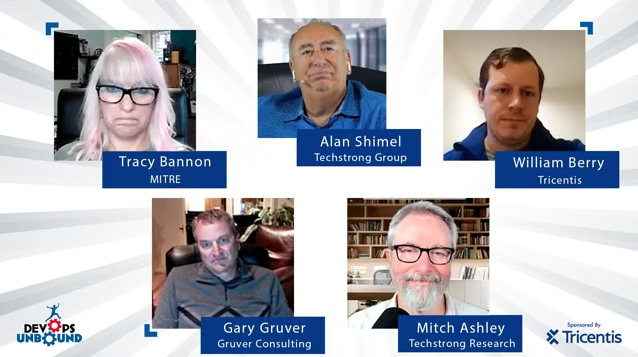
    Alan: Hey everyone. Welcome to another edition of Devops Unbound. Devops Unbound is a biweekly video series featuring relevant topics in devops. We go wherever we think develops is going and what we need to shine a light on. Devops Unbound is sponsored by our good friends at Tricentis and we thank them for their sponsorship. In addition to the biweekly Devops Unbound show of which you’re going to watch one right now hopefully every month or so we also do a devops live roundtable with an expanded panel that’s live and open to the general public for questions as well. This episode of course is a recorded one, not a live roundtable. But if you go to Devops Unbound on or devopsy.kinsta.cloud you can see the schedule if you’d like to perhaps attend a live roundtable in the future.

    But with that out of the way let me jump into this episode’s topic, leading a devops transformations, lessons learned. And I couldn’t think of a better panel to have us do this. For me devops, leading a devops transformation has always been kind of synonymous with my friend Gary Groover who wrote a book leading the transformation which early on in my in devopsy.kinsta.cloud when we first launched was a big staple of what we were preaching then. Gary, welcome to Devops Unbound. Maybe a little introduction about you, your company and your background.

    Gary: Great to be here. I’m Gary Groover. I led several large transformations. Probably the most one you’ve heard of most is the one at HP where we transformed and got a two to three X improvement in productivity. I’ve written four books in this space and I spend my time now trying to do everything I possibly can to help organizations transform how they do software development because it had such an impact on me and the businesses that I was part of.

    Alan: Fantastic. Ok. Next is a woman who is also no stranger to devops transformations herself, a lot of them in the government and government contractor world where she lives a lot now. It’s Tracey Banon. Hi Tracey.

    Tracy: Hey. Hi there. Thank you for the invite. My background is as a software architect and engineer so I’ve been living devops for a long time because I needed to get software into the hands of the end users and I needed to do it efficiently. Part of that required us to get that transformational thinking going. So I do spend time like Gary does in the middle of my client and my sponsor’s spaces helping them to understand, really talking straight with them about the differences that they’re going – the different thought mental model that they have to bring forward ‘cause it’s not easy. But I know we’re going to get into that today. Really excited. I work currently with the Mitre Corporation. They’re a federally funded research and development. And what that means is that I don’t compete with industry. Congress chartered us specifically to provide the expert leadership to the government to help them move in the right direction. So a little bit different perspective. Really happy to be here.

    Alan: Thank you Tracy. Last but not least is William Berry. Hey William. Welcome to Devops Unbound and maybe a little introduction.

    William: Yeah. Absolutely. Thanks Allen. It’s great to be here and great to be here with this panel. So I’m Will Berry. I lead our business engagement at Tricentis. I help our customers with aligning our initiative or their initiatives to continuous testing so that they’re able to derisk that aspect of delivery, be able to make those timeframes deliver faster and being able to achieve those goals that they have set forth.

    Alan: Great. And thank you for joining us. So guys the topic is devops transformation. When I first started devopsy.kinsta.cloud I was excited to see all these companies undergoing devops transformation and I really relished talking to as many practitioners, representatives of other, of organizations as I could to see patterns, to see what was emerging as what was the best way to do this. Right? ‘Cause there was the cultural aspects and the tools and the people and the processes. Right? But what was the best way to bring it together? And also remember when I started devopsy.kinsta.cloud there was this silly in retrospect silly argument of whether devops was something just for startups and Silicon Valley unicorns or as Gene Kim would say was it just for horses as well, right, the enterprise. Were large enterprises able to adopt a devops kind of mindset.

    And there were believe it or not – Gary I’m sure you remember this. There were fights raging on the Twitter sphere and the blogger sphere about was devops an enterprise thing. To me I always thought so and the consensus was yeah, of course. Stage two was ok, so all these companies started saying ok, we’re going to do a devops transformation. And you know what? A lot of them didn’t get the results they were expecting and there was this loser tech.  Devops stuff don’t work. So Gary I’m going to ask you to kick it off. I’ve given a little historical perspective. Do you think I’m crazy? Is that –

    Gary: No.

    Alan: Or your thoughts?

    Gary: No. But the debate that I’ve had with Gene over years is if you’ve got a large system of people that need to work together the things that you’re going to do are different than you do with a small team.

    Tracy: Exactly.

    Gary: And a lot of the debate that I get in with Gene is Gene saying no, no. This is how the small teams do it so now we need to make the large teams do it like the small teams do it. And that just doesn’t work and fundamentally I think that’s why a lot of devops things struggled and failed.

    Tracy: But small companies don’t necessarily succeed either because – so first of all it’s not about doing devops. Allen you’ve heard me say this before. I get so peeved when people say we need to do devops. They’ll bring me in and say help us. We need to do devops. We need to start to transform so we can do devops. And I’ll push back and I’ll say why. What exactly are you trying to accomplish? Right. Let’s get back to brass tacks. Let’s have a reason that we’re doing something and then we’ll track towards it. We’ll adopt the principles that are appropriate for you. But I’ve seen small organizations fail because it is pursuant to your context. And I think that’s where you’re going Gary.

    You’ve got to know the context of that organization. You’ve got to understand what its business objectives are, its engineering objectives are and its people. And then you figure out which pattern might apply to them because it’s not going to be – there’s no lather, rinse, repeat recipe. There’s not a singular playbook for this. And that unfortunately is what everybody is looking for. They’re looking for that playbook. I just – I need the checklist of what I need to do. Can you give me a book ‘cause I’ll just follow that?

    Mitch: Tracey I’ve seen many an organization where they will spin off a group sort of a skunk work project like back in the ‘40s and ‘50s, right with the X1 things. And those can work. They can work as a start but oftentimes they become a thing themselves and then they hit the corporate the white corpuscles, right, that come out and attack the foreign object. So I think it’s all in the context of the organization. If you’re savvy about what makes an organization tick. We’re all about data.

    We’re all about measurement. We’re all about whatever it is, finance, whatever it might be and know how they adopt change or don’t. You’ve got to sort of build in the psychology of ok, great. How do things get adopted here? How do people get on board? And it’s never easy but it can be a lot harder if you sort of walk in with the bright shiny knight and sword and we’re the new savior of the day and poof, you’re the first one to get skewered and taken out to the back.

    William: Yeah. And I think you hit it. I mean it’s an organizational mindset and you can kind of see it today. I mean you can see the responsiveness of what companies do in the market and what their competitors do. And you can see who has that mindset and who doesn’t based on whether or not I release like a new phone type strategy. Can T-Mobile respond? Can AT&T respond? And who responds the quickest to be able to address that?

    Tracy: I was having a conversation yesterday with a fellow by the name of Steven Spear. He’s a professor at MIT Sloan. He’s done a lot of –

    Mitch: Yeah. I know him well.

    Tracy: Had a lot of really good thought leadership. And we were talking about the cultural overlay and how that makes a difference because we keep looking for that recipe. We keep not understanding what the culture is. Now I don’t push for culture change. I never push for culture change because if you came into my house and said you need to change your culture the first thing I’m going to do is put my hand up and say no, I don’t. But I am into culture building and culture understanding because we build a culture together. So the cultural part means a lot. And I’ll go back to what Mitch said about context, understanding the context, the cultural context of that organization.

    When you think about government specifically that’s where I’m living a lot right now especially on the DOD side of the house. They are in a zero defect like low risk tolerance. Right? They need to make sure that it’s right the first time. Well that adds another level of complexity to the mix. So yeah, I want to go fast but how fast is appropriate? I want to adopt these principles and how many of those principles do I apply that allow me to get there in a cyber secure safe way. Right? How do I make sure the missile hits the target? How do I make sure that the plane is flying the right way? I mean Willian you brought up about the continuous testing and what Tricentis does in that realm. It’s interesting that the transformation has to include testing in a way that it hasn’t done. And it’s not just that automated unit test. Just automate the unit tests and we’ll be fine. Get some high code coverage. Hey. Hit 90 percent code coverage. It’s not that, right? There’s a bigger, broader set of this.

    And I want to bring myself back though. Something that you all said earlier is that it matters the understanding the context of the organization matters. But where do you start? So if you’re walking in the very first time to meet somebody new Gary how do you approach counseling – I’ll use that term, counseling a new organization that you’re meeting whether they’ve been in the government space, whether they are international, whether they are a small US startup. Where do you start with that exchange of knowledge to figure out how to help them?

    Gary: I tend to start by trying to understand what their problem is and trying to figure out what they’re doing. If I can get the leaders to engage not just in empowering the team and getting out of the way but really trying to take the time to understand how their current processes work and work with them to try to figure out how to make the waste in their current processes visible and then spend the time to let them pick the ideas that they think will help the most. I don’t ever go in and do devops.

    I think that’s the most – I think it’s the most disservice we’ve done to the industry. It went to – it’s kind of like trying the automobile industry trying to copy Toyota in the ‘80s. Eventually they figured out that wasn’t working and it was stupid. The software industry stuck trying to copy what worked for other people instead of trying to create a culture of continuous improvement and letting the organization pick the ideas that they will champion, the ideas that they will embrace and the ideas that they will invest in making those improvements. And if we can’t get the leaders to do that you’re never going to see the organization transform.

    Alan: So let me comment on that. You can’t change human nature. And there are certain – in the technology industry we emulate success. We emulate – if you succeed, right? How many business plans did we see seven, eight, nine years ago that said I want to be the Uber of? Right? I want to be the Uber of testing. I want to be the Uber of name a business model. Because what Uber did, I want to be the Uber of. I want to be the Twitter of. Right? In the technology industries this is what VCs whip out their checkbooks for. Right? And so you’re going to get that. I don’t know how you avoid that.

    Gary: But if you go into one of Tracey’s clients that’s developing a missile launch type system and you go let me tell you what Netflix did and how they made it work and how they had these teams they are going to check out. Never mind checking out. They’re going to dig their heels in so hard that they’re going to shoot down any idea that you ever had and you’re never going to make a bit of progress.

    Mitch: You become the new missile target I think.

    Tracy: Well hold on. It’s actually in between.

    Mitch: Ok.

    Tracy: There are. So Gary is right. Depending on the audience some of them will just, they’ll get ashen. They’ll look down and then they’ll put their hand up and they’ll say go away. But there is a growing body of folks who have come into this they’ve grown up as those developers. They’ve been hitting up against this and they are now becoming those leaders. So there is an amazing undercurrent that’s out there and I’m getting to work with them firsthand. They are looking for that air cover so to speak. Right? They are looking for those most – they want to go the whole way up to the Pentagon. They want to go to congress. They want people weighing in.

    And here’s where it tracks back to the problem that you talked about Allen. We’re not talking straight and we’re not getting the messages out that it’s not about copy catting but it’s about learning from. If we go into it and say I don’t want to use the Netflix model. I don’t want to use the Uber model. I want to look at it and I want to be informed by it. And I was to juxtapose it against my unique context. That’s where we help to get real success, incremental improvement. But we also have to come back to learning fast, failing small, failing cheap is ok. That’s a mindset shift regardless of to the industry. We always say fail fast but people react to that so say learn fast but fail small. And if you can start to fail small, surface it, allow it to be seen, allow there to be transparency into the failure, discuss it openly. That in my mind and in my observation that’s actually transformational in nature because people start to look at that and glom onto it.

    Now Mitch you mentioned something which is when you spin off this group and you say ok. You guys go be that new devops group. Can you guys go establish how devops work and you guys be a pilot project. The problem is when they succeed and come back and try to scale it. Well they’ve been partitioned off as though they’re a dot com. Right? They’re over here. They do this amazingness. And what they did isn’t necessarily scalable as is. And there’s another failure point that happens because now you’re in an organization, an enterprise that’s got a unicorn team that did great things. How do I scale that? Well I don’t just pick it up and copy it. Now I have to look at how information flows, how I go about teamification when I have lots of different folks coming from different consultancies and contractors. Not all software is written by developers and by organizational resources that are owned by one company. It’s actually getting to be kind of rare.

    William: So I mean that’s it. That’s what I see as the biggest challenge a lot of times when it comes to speed is the management layer is ready for it. The management teams they want to be able to do it but the executive layer still operates in a very project based initiative based thought process. And so you see this like this was supposed to play into this larger role of how I roll out devops across my enterprise so I went to this team and I did this. But it was still in this big initiative.

    It wasn’t allowing teams to fail fast. It wasn’t creating that environment where these managers can really dive into what they know and figure it out and drive it and then have somebody else consolidate all that at the same time, that larger level. We’re still very much when we sit in a board room we talk years and we talk plans and we execute against in that manner. We don’t always necessarily break it into these tidbits that we need to be able to empower our managers.

    Gary: And it’s a big bang transformation. And I’ve spent a lot more time recently looking at organizational change management. And they say one of the biggest barriers to people adopting new ways of doing things is risk. Any risk and when you do these big bang transformation there’s huge risk and that’s a barrier. If you do a bunch of incremental large, small changes and you create a culture of continuous improvement that’s a smaller risk. It’s reversible. It’s kind of like Tracey says. You can fail or learn quick and you can adjust and you can learn along the way. And I think what we’re missing is we’re trying to tell people what to do.

    And I’ve done this whole shift to teaching people the principles and the approaches of making their process visible, letting them pick things that they’ll champion and they’ll make work and doing it in small incremental bits that they’ll get excited and they can reverse and they can learn and adjust. And it seems to be getting a lot more success in terms of teaching people how to analyze their processes and letting them pick instead of telling them what to do and seeing them resist the changes.

    Mitch: And Gary I think we have made this repeated mistake over and over every time we introduce a change. It’s about telling people that they’re wrong and what they’ve been doing is wrong and it’s bad. And people have learned through some hard knocks of the folks that come in and do that, they come and go. Right? The last person that did that got fired, right, ‘cause they ran up against this or their project failed or whatever. And so it’s more about like let’s take the things that we do really well and let’s figure out how to do those even better. And as you were talking about let’s find the places where we’re either creating waste or there’s a bottleneck there. Give people a common problem to work on, not a common enemy, you, the change agent. You’re the person with the arrows in your back. Right? You’re running away from the last change project.

    But I think that’s – and it’s always the shiny object, right, the next great thing that’s going to solve all our problems. Well if we just went all to Cloud native. If we just all went to devops. If we just all went to agile. It’s never that simple. It’s how do we take the ideas that this has and adopt it in our way and our style and to match what our objectives are. Because as soon as you create computing objectives like the skunk works team is this to show everybody they’re wrong and this is the right way to do it. Well poof. You’ve automatically, you’ve failed already before you even get out of the gate.

    William: Yeah. And I think there’s a bit of a misnomer in the term devops because as soon as we say dev we lean towards developers and we think oh it’s a coding initiative. But really in business we’re all capable of developing something whether we’re developing a strategy or initiative or some way that we’re going to take our business to market. You’re doing something that would create a change in your organization. So then it’s about how do I make sure that that change is quality and how do I measure the impact of that change and so that I can know that I fail fast? Because that’s what I see is that we sometimes get too far into well it’s more about the initiative and not about the measures and we have to have them both together. And we have to have this be a mentality that everybody is developing something for the organization.

    Tracy: There’s so much fodder with what you just said. I was jotting down a couple of different things. I wish I loved the term devops anymore. I don’t anymore because it’s another label. It’s an overloaded term. You’re right that we are hyper focused on dev. We leave the ops out of this. Yes, I know we’re focusing on this and we’re getting smart about ops. But we put so much pressure on the developers to go fast. Right? That’s what people say. Developers have to go faster. We’ve been so hyper focused on enabling that to happen and that doesn’t help transformation. And so then we say well, what we’ll do is we’ll give you a maturity model which if you have a maturity model then you can just figure out how devops-able you are. How devopsy are you because I’ve got a maturity model? So hater on the models. I do agree that it’s great to have a metric or a measurement that matters as long as you know how to change it. Right? You know what it means and you don’t weaponize it.

    And a buddy of mine, _____. You guys know him. He’ll talk about the weaponizing of metrics. But I want to come back to something that you all said about not trying to change a culture but rather helping them to grow that culture by teaching them. One of the things that I’m running into is depending on the organization the individuals have muscle memory. And I’m talking incredible muscle memory. So I’m finding that if I have that same pod and I don’t insert some additional change agents, just mix up the group a little bit, I can’t get the change that I want.

    And there have been some interesting studies about exactly that in the organizational change management area. If you have a group of ten people and you say ok guys, suddenly we’re all going to start behaving differently because somebody has come in and they’ve given us help and they’ve given us some guidance. What’s the likelihood that that nine or ten person group suddenly manifests without amazing amount of coaching and rigor and over the shoulder help.

    But imagine or maybe you’ve been in that position where somebody joins. Somebody new joins and they have an energy and they have a different perspective and they have a diverse way of coming at it. Well then transformation starts. It’s no different than a blended family. Family unit as it is. You bring somebody new in. Somebody marries in and they have a different way of cooking and they have a different way of talking and they have a different way of doing something. Then suddenly its catching on and its becoming part of the fabric of that family. I see devops transformation as kind of putting some additional spice in. We’ve got to have the scaffolding around it. We have to have that education that’s out there.

    But we’ve got to have those catalysts, those humans that bring that energy to help propagate and to help the people around them, the developer who really gets it, that quality engineer who is really excited about things, the leader, right, who is out there, able to fail publicly about something that they’ve done and really foot stomp when their team fails about how great it was that they’re moving forward quickly to resolve that. So Gary I’d be interested in your thoughts on especially on I saw you grimace when I said maturity model. Interested to see what your thoughts are about measuring transformation. How do we start to measure transformation?

    Gary: So I’ve gotten to the point where I’m like you. I’ve quit using the word devops. It’s not that the principles don’t work and aren’t effective. But it’s just so balled up in a wrapped up image that I think in a lot of cases it’s doing almost more harm than good. Two, I’ve gotten to the point where I don’t want to measure whether a team is doing devops and I don’t want to do this ‘cause that assumes everybody is going on the same path. What I’ve tried to do is we’re trying to make organizations more productive and more effective and we’re trying to get them to improve on a continuous basis. And we can’t really measure throughput and some of the different things.

    But what I think I’ve gotten really good at doing is measuring the waste that slows down organizations. And so we make the waste visible. We teach people how to make their process visible, how to make the waste visible. And then we give them key metrics that show when I made this change I removed this waste and inefficiencies. As much as I fought the certification thing I’m finally on board. I tried to emulate what was done in the manufacturing where you’ve got a white belt where you get a basic knowledge but to get a green belt or black belt you’ve got to do an improvement project. And in that improvement project what I’m trying to do is motivate people to make a change, make an improvement. And when you do that I’m trying to quantify the waste that they’ve removed from the organizations.

    And most of the improvements that I’ve seen so far they’re removing like $50,000.00 – $60,000.00 of annual waste a year in the improvement project. And they’re able to go to the company and the organization and say look at the waste that I removed. Can I go do another one? And people are going yeah, yeah, yeah. Let’s go do another one. That made sense. Let’s go do some more of those. And we’re creating that culture of little changes one by one. And if I can get the executives to engage the magnitude of the improvements that they’re going after are just orders of magnitude higher because they’re in a position to have a higher impact on the organization just because of where they sit and how they work across teams.

    Tracy: The surfacing of waste is so important. One of the air force groups that I’m working with, massive PMO or should I say massive joint – it’s actually a JAPO, a joint PMO with six massive PMOs underneath it. And we strategically went through and we did I call it rapid value streaming. It’s not lean six sigma official value stream mapping. But it was getting together and we had to be remote but using mural and talking through their processes at a very high level just to surface it. It was about two 90 minute sessions, just enough that people were like huh, look at that and allowing their own stories to hit them in the face in a very open and engaging way. We didn’t want to indite anybody but it was having them tell that story together and it was surprising just that three hours how much that meant. And we did that with each one of these PMOs. How much they learned from that to help them directionally.

    Now there’s a lot of other massive challenges with acquisition and policy and other things that they have to deal with. But your point of identify where the waste was. Seeing something go into an inbox as an attachment, a Word doc attachment and knowing that it was sitting there for 18 to 25 days because there weren’t enough humans to even look in the inbox. Those are some of the things that you don’t even think about as impacting a value stream or the delivery of a flow. There’s so many amazing twists and turns that you get into. Gary do you – and I guess I should ask everybody. Are you, when you’re looking to identify waste what are some of the techniques that you’re using to identify waste?

    Gary: I tend to map the deployment pipeline. And some people will call it value stream mapping. But value stream mapping assumes you’re doing one thing at a time. But in software when you get into the build release process you’re doing it as a group.

    Tracy: Yeah.

    Gary: Right? And so I think there’s a lot of errors that a lot of people make when they value stream map that don’t highlight the types of things that slow software organizations down. So I do value stream mapping kind of but I map the deployment pipeline and I kind of put some metrics on the requirements process. And I use that to make it visible. If you can do what you did and get the executives to take the time to understand their processes and make it visible you’re like orders of magnitude ahead of anybody else who is going to do this type of stuff. To me it’s so important that if I’ve got a company that’s willing to do a prototype and they can get the executives to sit down and go through my training I’ll give them the white belt training in a way just so that they can get a line and see it.

    And I had an organization come in the other day that Brian Fenster sent me to them and they came up and they sort of said we’re thinking about surveying our culture and doing a cultural survey as the start of our devops. It’s like what do you want to do? I finally stopped. I said here. Take this free training and go off and do it. And they had three executives go off and do it and they came back together and said I can’t believe how well it aligned our thinking. We had this disconnect and we were all seeing it from our own personal view. And as we took this training it aligned our thinking. If you can get the executives to do that I think you’re going to be – the probability of success for seeing results is going to be orders of magnitude higher.

    And I’m at this point of the career where yeah, I do it for a living. But I’m trying to help as many people as I possibly can. And I worked with David Farley to help with the technical side. And we’re trying to figure out how do we – now that we’re in this point in our career if we can digitize our knowledge we can help a lot more people. We can help them more cheaply and they can go off and do these things. And then they can do it for themselves and if they do it for themselves they’ll embrace their ideas and make their ideas successful.

    Tracy: Right. Teach a man to fish. Teach a man to fish.

    Mitch: I’m curious. Let me throw a little wrinkle in this. This sounds like a very kind of well thought out methodical process and I think a lot of it is. What about organizations that are under great threat? We have a lot of companies who their supply chain is a total mess. Right? And they’re scrambling to get new suppliers in place, new transportation if you’re up on that part of it. There’s a lot of organizations who are dealing with either market threats, just even operational threats. And so they can’t do back and let’s look at the next piece of waste. Or maybe that is a method –

    Tracy: I was going to say I think we’re talking about exactly the same thing Mitch.

    Mitch: How do you do that when you know what’s hitting the wall and you’ve got to like make something happen right now? At least that’s what management’s going to come to you and say. We might not have jobs tomorrow. Go fix this.

    William: Yeah. I think it goes to what Gary is saying. Like look at your release pipeline. And what I see a lot of is this idea of what I call an avocado release which is you have all these people do this work and then it gets to this decision about whether we go or no go and people hold onto it like an avocado. They’re like is it ready, is it read, is it ready, oh it went bad. We’ve got to get it out there. And you don’t have this confidence in your organization and that’s where a lot of this waste comes in to make that decision, to have that go, no go to be something that’s almost automated to a sense of here’s the report. Here’s the impact. Make the decision and move. And that’s where these companies are struggling from supply chain perspective. If I’m going to hire a new vendor and I have to get 10 – 12 sign offs and it takes two months those transportation vendors are in high demand right now so by the time I get my signatures on paper they might be gone.

    Mitch: They’re gone. They’re busy.

    Tracy: But at the end of the day doesn’t it all track back to identifying what your set of whys are? You’ve got an imperative. You’ve got to solve it. It’s not going to be lather, rinse, repeat for everybody. If you have a supply chain issue, software supply chain or firm goods it doesn’t matter. If that is your issue and your challenge then you’re going to gaze at that and you’re going to turn it fast and you’re going to say what’s the waste. Right? To Gary’s point looking at that it might not be a devops pipeline. But if I’m looking at how fast it takes to get information in to me, how fast does it take for us to sign that off, we’re going to apply the same type of thinking Mitch so I don’t see that imperative as being any different than the software is failing in production or I can’t get a new user onto it. It’s another risk or challenge and it gets prioritized at the top of the list and all eyes are on that to solve it together.

    Gary something that you and William both said really resonates with me and it comes back to that education piece. I’m at that same point where my goal is to share experience stories, get the information out there so that people are educated. When the taxonomy is not shared, when we don’t have a common lexicon. I mean why do certifications matter? Well the reason the certifications matter often is so we’re speaking the same language. Why sometimes will I look for particular certifications? Not that I know that the person can actually do the particular type of task coding but at least I know they know the words.

    And in there I think that there’s merit in us thinking about getting to those lexicons, common lexicons that what is devops – oh I’m not even getting down in that path. But if we can in our own sphere of influence get to some more common terminology, augment that with the right types of education so that people can consume this and they can get on a level playing field we’re going to see continued growth and transformation. That’s at the end of the day and that’s what we’re trying to do.

    Gary: And I want to go back to a little bit what Mitch said. I think that the habit that the executives get into is I’ve got this burning fire and I’m just going to beat up the teams and I’m going to beat the teams until they work harder. I had a group of executives go through this training and the senior vice president stepped back and said I had no idea of what people were dealing with on a day to day basis was getting in their way of delivering. And if they don’t have any idea of what’s getting in the way of the organization delivering they’re going to continue to focus in on we’ve got to put this fire out. We’ve got to put this fire out. We’ve got to put this. And so a big part is getting them to step back and get visibility to the things that are slowing them down.

    And if they’re driving the dev team like crazy they continue to create more stuff and they’re doing manual testing they’re got an unsustainable process because dev writes 100 lines of code and test has to test 100 lines of code. That’s iteration one. Iteration two you’ve got 100 more lines of code and then QA has to test 200 lines. Right? It just doesn’t work. Right? You’ve got to get past that. But if they don’t see that and they don’t have appreciation for what the teams are going though and what’s slowing the organization down, they’re going to do nothing but what you said Mitch which was beat on what the business is beating on to get delivered. And the key is how do we get these executives to slow down and take the time to understand what’s getting in the way of getting what they really want.

    Mitch: There’s nothing like a crisis to get people to rally around at times. Now if it’s manufactured crisis and it’s the 52nd crisis this year of the week that’s only what you’re describing too. I think one of the things whether it’s a crisis or not when you can rally people around a set of challenges, set of problems. We’re really ok. Our objective, let me give you a real example. I’ve gone through two transformations both involving Cloud and devops and they were both because the conditions had changed and what we were targeting, what we were shooting for wasn’t the same target anymore. And one of them was we had moved to a much more cash sensitive company, changed the structure of the company. So we couldn’t invest in hardware, etcetera.

    And so we said ok, this isn’t really 100 percent true but let’s pretend for a moment we don’t have cash. I mean we don’t have money to go buy lots of hardware and we want to figure out could we leverage the Cloud. And it wasn’t a gun to our head but it was a let’s do that scenario and figure out what we do or we need to change how we’re developing software because while we have a monolith application there’s part of it that we really would like to be able to change more quickly and iterate on and do some services around. So you can use and sometimes it is a gun to your head. Everybody is going to be working from home next Monday so figure it out. But you can use those kind of rallying cries to say ok, this is the problem we want to work on. What could we do?

    Tracy: Well it’s pushed by circumstances or pulled by a drain. Right? Like carrot or stick, circumstance or drain. Tracking back to something Gary said and Mitch that you brought up the education part of this is important. There’s a group of us that go across industry, government, academia who have been meeting and talking about how do we very rapidly expose the leaders to a day in the life in their organization because it’s not going to be lather, rinse, repeat. And Gary I know you have some really incredible training and education that are coming up that you’ve been working on with Dave. And I’m excited to see if that’s something that I can leverage in this space.

    But that is becoming one of our rallying cries is exposure. Simply walk a mile in the moccasins. They don’t have to do hands on all day development but I want them to see what it’s like to get those, their priorities changed. You have a sprint but now you’re telling me that I have to change up everything that I’m doing. You’re forcing me to go faster and faster and you’re only worried about my velocity and my burn down and you’re not thinking about sustainability. You’re not thinking about the quality of – you’ve not thinking about the fact that you want me to dev sec ops and I’m a hobbyist. I haven’t been trained as a cyber expert. I don’t know secure coding standards.

    I mean there’s a lot that we’re putting onto them and we need to educate those leaders, a day in the life. I think a day in the life the other way might be helpful as well. So how do the developers, how do the design teams, how do folks who are delivering, how do they understand the stresses, the pressures and the strategies that the leaders have to undertake? Because I think that there’s both sides of it need a little bit of that cross understanding. But it is going to have to start with the leaders who have the bigger stick and making sure that they understand.

    Alan: By the way so Tracey I don’t think it’s just two sides. This was a technique I forgot who I heard it from with people who do devops consultations and consulting which is have someone from the ops side spend a week as a dev, have someone as a dev go over to the cyber team for a couple days. Right? Have a leader do the managers role or have the leader do a non-leader role. Have the single contributor do – like empathy. Right? It’s one of the cornerstones of whether you want to call it devops or not. It’s one of the cornerstones here was empathy. And can you – I don’t know if you could really empathize until you’ve walked a mile as Tracey said in those moccasins.

    And I think it goes across all of these kind of – I don’t want to use the word silos but all these kinds of roles that we’re talking about because I think you need empathy for respect and you’ve got to respect what every single person, human on that team does. I grabbed the last word ‘cause it’s my prerogative. We’re way over time guys but I didn’t want to stop you. Shocking. Anyway Tracey, Gary, William thank you so much for being our guest panel on this Devops Unbound. We probably cold have done three shows today and still not covered everything. But it was a great show. Mitchell I’ll give you the last word if you want to wrap it up and we’ll sign off.

    Mitch: Well I just am in awe of the wisdom and experience that everyone on the panel is bringing to this and there’s a lot of good lessons here. If I walked away with one nugget it’s stop for just a moment and think. Take in, let’s take in what we’re doing and make sure we’re focusing on the right things or make sure that we’re learning what we can do to work on the next set of right things. And I think that’s if I had to summarize in a just general way I think that’s a lot of what William, Gary and Tracy have said today. So thank you all for that very much.

    Alan: Ok. We’ll be back in two weeks with another Devops Unbound episode. Until then good luck. Be well. Thanks for joining us. Have a great day everyone. Bye bye.

    [Music plays]

    [End of Audio]

  • Neo4j Will Use Funds to Expand Managed Cloud Database

    Neo4j Will Use Funds to Expand Managed Cloud Database

    In July 2021, Neo4j announced a large round of fundraising—its largest to date. Philip Rathle talked with Alan Shimel about how the capital will be used to further Neo4j’s go-to-market strategy and what that means for DevOps professionals. The video of the conversation is below, followed by a transcript.


    Announcer: This is Digital Anarchist.

    Alan Shimel: Hey, everyone, welcome to another Tech Strong TV segment. My guest right now is Philip Rathle. Philip is with Neo4j, VP Product. Hey, Philip, welcome to Tech Strong TV.

    Philip Rathle: Thanks, Alan. Pleasure to be here.

    Alan Shimel: Absolutely. Philip, we’ve interviewed folks from Neo4j before, but I don’t know if everyone in our audience is familiar with the company. So, why don’t we start there? Why don’t you give us a little company background, maybe a little bit of your own background as well?

    Philip Rathle: Sure. Let me start with the second and tie it in. The thing that really attracted me to this company when I joined a bit over nine years ago was the idea that the most valuable thing in data, in my opinion, has always been the model and what’s built into the model. It’s how things are related, and what this company was doing was leaning into that some more at a time where the data space—and you look at everything that happened in NoSQL was about really simplifying the data model so that you could do this very, very high level volume and scale, but very simple data problems, store and retrieve. And in order to do that, you can lighten up on certain of the more technically complex requirements like, you don’t need acid if you’re not doing complex relationships and store and retrieve of shopping cart data at a massive scale.

    And so, what Neo4j’s been doing for more than a decade now is solving the problem of how to understand context and causality in your data through looking at how things are related. So, if you look at my relationship with—I don’t know, let’s look at an insurance scenario—with my car, other people who drive my car, other vehicles I might own, other things that I might own like a house and then line on that, and a business and lines on that and then bringing that together, suddenly, you’re into these complex kinds of enterprise data scenarios that have always been a challenge, persistently. And I lived through a lot of those as a consultant trying to fix those, kind of on a one-off basis.

    And so, what Neo4j did was something that, in the database space at the time was a bit crazy is build an engine ground up that assumed that you could do random I/O really well. Because if I’m going to understand relationships, a query can go any which way through the data, potentially very, very deep if I’m in a 20-level deep supply chain, for instance, following an item or a big payment network and looking for fraud detection, the fraud patterns or money launderings so that I can catch those. Those are all about patterns in the data, so Neo4j is a company that’s built a database from the ground up, looking to help users understand the relationships and the data so that they could understand context, causality, second order, third order, fourth order effects more deeply.

    Alan Shimel: Got it, got it. What about a little of your own background?

    Philip Rathle: I did consulting for the first half or third of my career, and a lot of that culminated in ending up as the person between the business and the IT problem. I really liked understanding what problems were being solved and then using new technology and seeing what we could bring to bear to solve the business problems.

    And I ended up working a lot with data and databases and a lot of large systems. I started at Accenture back when it was Anderson Consulting, then went into kind of a boutique company that worked on high end, large database deployments called Tanning Technology. And there, I realized I was doing—I later realized this was a step towards product management or I guess today you would call it product management. And ultimately, co-founded a startup, tried that for a few years around master data management, customer data integration; wrong market, wrong time—that’s maybe a story for another day. And then got into Embarcadero Technologies, which makes database tools.

    Alan Shimel: Mm-hmm.

    Philip Rathle: So, I worked there for about seven years, ended up heading up the database product portfolio, about a dozen tools for managing databases as well as a database interface database. Then learned about Neo4j, so, all of the cool stuff that was happening in data about 10 years ago, and thought, “I wanna be a part of this, kind of ground up, creating new ways of managing data.” And yeah, the rest is history. I’ve been heading up Product Management since then. I was employee number 30, and we’re at 550 growing way past 600 this year.

    Alan Shimel: Excellent. Very cool. So, I think we’ve laid a lot of the ground work, here. Phil, recently Neo4j announced a rather large raise. Why don’t you give us—a capital raise—why don’t you give us some information on that?

    Philip Rathle: Yeah, we did. So, as a company, you know, those of you who, probably every listener knows how it works with startups, right? You raise money, you put that money into primarily R&D, improving the product, and other areas of the business, and then you grow and, you know, at some point, there’s some kind of exit for us. We’re looking to be a big, independent company, and for that, databases are highly capital intensive, very complex technologies. It’s not enough to have just the database, you need tooling around it, especially when it’s a new kind of model.

    So, we just made a massive fundraise. We had already raised over $100,000,000.00 over the course of the years. This single fundraising event is $325,000,000.00, it’s the biggest fundraise ever for any database company in history. So, we’re pretty excited about it.

    Alan Shimel: For good reason—congratulations. You know, I’ve been involved in companies that have raised money, significant money over the years—that’s a lot of money, man. [Laughter] That’s a really big raise.

    Now, of course, you know, our audience says, “Whew, another big number.” We’re hearing a lot of big numbers lately. What does it mean for them? What does it mean for them, what does it mean for Neo4j to have that kinda capital? What’s the payoff, here?

    Philip Rathle: Yeah, I mean, it’s pretty much product, product, product with a little bit of a dash of regional expansion. So, on the product side, Neo4j recently launched—so, late 2019, we launched a self-serve version of the database as a service. So, it starts at $65.00 a month, credit card swipe. You can get a fully managed Neo4j database in the cloud and turn it on, it runs. You don’t need to worry about managing the database. And we launched an enterprise tier last year. Right now, it runs on, you can choose between GCP, AWS, of course, Azure and others are coming, and Work in Progress. 

    So, one area is to really keep improving the cloud product since the preferred way of consuming databases these days has flipped to cloud very, very fast over—you know, whereas just in the last couple years. Another one is graph data science. So, last—a bit over a year ago, we entered the, we expanded what Neo4j can do, which typically has been a developer oriented database with database drivers and more for transactional operational applications. 

    What we’ve been seeing over the last few years is that a lot of the kind of next step in machine learning and data science and AI is getting information about the connections in the data and in the network into your machine learning algorithm. And that whole art and science is graph data science, and we have a graph data science for a Neo4j offering, which is a graph data science library, together with a database, together with Bloom, which is a visualization and exploration tool. And that offering has really taken off in the last year, both in terms of demand, customers, and also, it’s become really mature in a short time. But there’s still a long way to go; it’s a brand-new space. 

    So, those are the two primary areas, and then I’ll add the third is just continuing to mature the database, continuing to make it scale, handling larger and larger amounts of data. By the way, as part of our announcement at our annual conference, we also a trillion-relationship graph.

    Alan Shimel: Wow.

    Philip Rathle: Just showing how, across 1,000 machines like—actually, trying to spin up this many machines on AWS, Amazon couldn’t provision the machines fast enough. [Laughter] We’ve never seen this kind of error.

    Alan Shimel: Right.

    Philip Rathle: But there’s no end to performance, scalability, security, more features, more richness, et cetera. So, those are the main areas, and like I said, a dash of regional expansion, really growing beyond—our primary markets have been U.S. and Europe with some customers in other parts of the world, but this will help us expand more in other parts of the world.

    Alan Shimel: Excellent. You know, I think one lesson that I learned during my career, and I think it’d be wise to share with the audience is—you know, there’s a latency time between the time you raise money and the time that money finds its way into products that are released, right?

    Philip Rathle: Yeah, that’s very true.

    Alan Shimel: Because, okay, now we’ve raised money, we gotta go hire people. We have the idea of what we wanna do, right? But, you know, we gotta flesh out those plans, we gotta get the people power, the technology process in place.

    When do you think we’ll see some of these great things that you’re talking about that, you know, this money raise has enabled actually come out to market?

    Philip Rathle: That’s a great question. So, prior to the fundraise, we were close to maxed out in hiring. And when I say close to maxed out, there’s a certain rate at which you can efficiently hire, and then beyond that, you kind of need to have people on their own off in the background, but that can’t contribute to the code base, because it’s not even structured to be able to have more than a certain number of people contribute. So, we’re—and that’s less true with new areas that we’re growing out. So, we’ve seen this one coming now for a few months, and so, we—that, plus just early in COVID, like, last April, we actually froze hiring for a bit and said we don’t know where things are going and we don’t wanna be in a position where we have to lay people off, that would just be horrible. Let’s just pause hiring.

    And then our business kept, you know, fortunately, doing well. And so, we started to wrap up, but I’d say—so, two answers, maybe. One answer is, you’re already starting to see the results of a really aggressive ramp in product and engineering. My team is doubling this year, and it’s close to doubled already. The engineering team is growing by about 50 percent. But what this also means is, we can keep hiring and we can keep—and whenever we have new products, new areas, we can form entirely new teams there. 

    So, I’d say the answer is now, but it also means that, on a steady state, continued basis, you’re gonna continue to see some really significant product releases from quarter to quarter, year to year.

    Alan Shimel: I would imagine. I would imagine—and beyond, with raising that kinda money, beyond. Anyway, Philip, we’re running out of time. You know what, did we mention the website?

    Philip Rathle: The website is Neo4j.com.

    Alan Shimel: That’s N-E-O—

    Philip Rathle: The number 4 and the letter J.

    Alan Shimel: Letter J—dot com.

    Philip Rathle: And you’ve got all kinds of info, resources for getting started. We’re huge on open source, we’re huge on education. And I should mention that our vocation has been not just making our own company successful—first of all, it’s about making users successful and making an impact in the world. But then not just making an impact in the world by making our product succeed, but making the category succeed. Because this is something that our founder penciled out on a napkin once upon a time. 

    So, we see ourselves in some ways as helping to grow the graph database space and just, you know, we celebrate when other companies go launch graph databases, because that means it’s good for the world. We’ve done a lot of work in the standards area and so on to make it more mature and better. So, you’ll see an open source version, there’s a free sandbox you can get started with, there’s a free version of our cloud product. Or, both on the developer side, on the data science side, lots of docs, good community out there, a Discord group, questions, QA on ________, you name it, it’s all out there. We’d welcome any and all of you listeners to check it out.

    Alan Shimel: Cool. Alright, we’re out. Philip Rathle, Neo4j—thanks for joining us on Tech Strong TV here today. Congratulations to you and the whole team on an outstanding raise, and now, let’s see you put it to work.

    Philip Rathle: Thank you.

    Alan Shimel: Alrighty. Be well. This is Alan. We’re gonna take a break here on Tech Strong TV. We’ll be right back with our next guest.

    [End of Audio]

  • Digital CxOs Have a Home, as Digital CxO Joins the Techstrong Group Family

    Digital CxOs Have a Home, as Digital CxO Joins the Techstrong Group Family

    Hello, and welcome to the launch of Digital CxO, the premier destination site and community dedicated to fostering collaboration among business and IT leaders driving digital transformation initiatives.

    As part of Techstrong Group, which also includes devopsy.kinsta.cloud, Container Journal, DevOps Institute, Security Boulevard, Techstrong TV and the newly formed TechStrong Research Group, Digital CxO creates an environment in which members of the CxO community can engage with one another and industry experts to better understand how to get the most out of IT investments that today drive the business.

    We’d like to encourage you to visit Digital CxO even if you haven’t taken a seat at the table but aspire to be a C-level executive. We are as invested in advancing your career as you are. Many IT professionals today aspire to one day become a senior leader of an organization—hopefully sooner than later. Digital CxO can help you fulfill that ambition by providing content in many formats including:

    I’d also like to ask you to encourage you to make the business and IT leaders within your organization aware of Digital CxO. The more they come to appreciate how much of the business resolves around IT these days, the better off everyone in your organization will be.

    Digital transformation isn’t just a buzzword. It’s a way of thinking about IT as an integral part of the business. There has been a divide between IT and the rest of the business that, thank goodness, is finally coming to an end. In the wake of the COVID-19 pandemic, more business and IT leaders realize how dependent they are on IT to drive digital processes. Every organization is now a technology company.

    At the Techstrong Group, we’ve been working toward enabling that transition since the founding of devopsy.kinsta.cloud in 2013. Digital CxO takes that mission to the next level. The digital transformation currently underway didn’t start with the COVID-19 pandemic, but it does illuminate the fact that if your business wasn’t transforming digitally, it would be difficult—if not impossible—to thrive, much less survive.

    None of this would be possible without you. We strive to serve the people who are making our digital world possible. A raft of IT platforms that make digital transformation possible are reshaping the world before our eyes. We know you—we believe we know what you want and how we can help. It is more critical than ever for technology professionals at all levels to understand how technology can improve business processes, revenue, profitability and customer satisfaction.

    Our goal is to create a place where business and technology leaders and practitioners gather to exchange ideas and continually learn, grow and succeed. Digital CxO is our latest humble contribution to realizing that vision.