Tag: WhiteSource

  • WhiteSource Rebrands as Mend, Introduces Industry-First Automated Remediation with the Mend Application Security Platform

    Company focuses on automation to dramatically reduce the software attack surface and the application security burden for developers

    Tel Aviv, ISRAEL and Boston, USA – May 25, 2022 – WhiteSource, a leader in application security, today announced the change of its name to Mend. The company is also launching the industry’s first automated remediation for custom code security issues as well as integration of Mend Supply Chain Defender (formerly WhiteSource Diffend) in its JFrog Artifactory plugin, all within the Mend Application Security Platform. Mend secures all aspects of your software, providing automated remediation, prevention, and protection from problem to solution versus only detection and suggested fixes.

    With revenue up 800% over the past three years and enterprise net retention at 127% in 2021, the company added 350 new customers in the last year. Mend has over 1,000 customers including more than 25% of the Fortune 100 and is focused on investing its latest round ($75 million series D announced in April 2021) into its overall growth as it expands beyond the Software Composition Analysis (SCA) market. This includes the move into supply chain security through its acquisition of Diffend in April 2021 and the acquisitions of SAST startups Xanitizer and DefenseCode in February this year. The company’s strategic acquisitions and its unique automated remediation technologies have enabled it to deliver the Mend Application Security Platform. Combining automated remediation for static application security testing (SAST) with Mend’s existing ability to do this for software composition analysis (SCA), the platform is the first to automatically find and fix application security holes involving both open source and custom code.

    “Attackers are increasingly targeting applications as the weakest link to go after organizations, and at the same time, pressure to deliver software faster has never been higher. Organizations face undeniable tension to do both, better,” said Rami Sass, Co-founder and CEO of Mend. “Mend breaks the tradeoff between security and development delivery timelines by providing a solution that automates the reduction of the software attack surface while removing most of the burden of application security, allowing development teams to deliver quality, secure code, faster.”

    Mend’s Automated Remediation for SAST

    Offering automated remediation for both open source and custom code, providing exact fixes for each line of code, the Mend Application Security Platform enables any level of developer to easily write quality, secure code. Prior to this advancement, leading application security products could, at best, provide training materials and examples to support developers with researching fixes for each security issue they encountered. This inefficient process forced developers to choose between security and meeting deadlines. The Mend platform delivers automated remediation for both SCA and SAST, presented directly in the developer’s repository, for easy integration into the developer workflow. With Mend, developers don’t have to sacrifice security for speed.

    Mend Supply Chain Defender Integration with Artifactory Plug-In

    Integration of the Mend Supply Chain Defender — a solution that detects and blocks malicious open source software — into the Mend platform plugin for the Artifactory registry allows enterprise customers using JFrog Artifactory as a private repository manager to prevent malicious open source software from entering their code base. Using a single installation of Supply Chain Defender, enterprises can protect all projects involving JavaScript or Ruby with a centralized policy enforcement and auditing point. All results are displayed for open source and custom code in a custom or third-party code repository for a single view inside the developers’ native environment.

    “Whether open-source or proprietary code, the application security industry has mostly focused on vulnerability detection and management. Mend has an interesting approach of automating the remediation of code vulnerabilities,” said Josh Johnson, Manager of Solutions Architecture, Defy Security. “While the company is announcing this new name, as a partner of Mend, we are excited for it to further its commitment to solving code-based security challenges with automated-remediation. Defy Security looks forward to seeing Mend extend automation for closing security gaps.”

    Learn more about automated remediation for SAST and the Mend Supply Chain Defender and more details on the story behind the company’s new name, Mend, on our blog.

    About Mend

    Mend, formerly known as WhiteSource, effortlessly secures what developers create. Mend uniquely removes the burden of application security, allowing development teams to deliver quality, secure code faster. With a proven track record of successfully meeting complex and large-scale application security needs, the world’s most demanding software developers rely on Mend. The company has more than 1,000 customers, including 25 percent of the Fortune 100, and manages Renovate, the open source automated dependency update project. For more information, visit www.mend.io, the Mend blog, and Mend on LinkedIn and Twitter.


  • WhiteSource Becomes Mend, Launches Automated Remediation Platform

    WhiteSource Becomes Mend, Launches Automated Remediation Platform

    WhiteSource rechristened itself Mend today and launched a remediation platform that automatically resolves security issues for application developers.

    Rami Sass, co-founder and CEO of Mend, said now the company is going beyond just identifying vulnerabilities in open source software using software composition analysis (SCA) tools and is also fixing them. The overall goal is to make it simpler for developers to address security issues without taking time away from writing code or slowing down the rate at which applications are developed, he added.

    To further that effort, Mend also announced today it is making available a plug-in for JFrog Artifactory that enables Mend Supply Chain Defender, formerly WhiteSource Diffend, to enable detection of malicious open source code. Last year the company acquired Diffend followed by the acquisition of two startup providers of static analysis security testing (SAST) tools.

    Collectively, those applications enabled the company to build the Mend Application Security Platform, a software-as-a-service (SaaS) offering that combines SCA and SAST tools to create an automated remediation framework that can be applied to both open source and proprietary code residing in a repository.

    Mend claimed it added more than 350 customers in the last year to bring its total to more than 1,000 organizations. Most recently, the company raised an additional $75 million in financing to continue investing in a platform specifically designed to address application security issues. In the wake of a series of high-profile security breaches involving software supply chains, Sass noted there is now a much greater appreciation for securing applications and that demand for application security solutions is growing. That demand, in turn, is fueling a wave of consolidation that is, in part, enabled by the convergence of application security tools made available via a SaaS platform, he added.

    Historically, much of the focus on application security focused on discovering vulnerabilities that developers are asked to patch. The issue is that developers are being asked to patch the same modules repeatedly. The Mend Application Security Platform keeps track of what modules have been successfully updated to give developers higher confidence in the updates being applied, said Sass.

    Those recommendations are not being surfaced using machine learning algorithms but rather by the data analytics capabilities that have been added to the company’s portfolio of tools over time, he noted.

    While there may never be such a thing as perfect security it’s apparent that most application security issues can be traced back to relatively common mistakes that developers routinely make. The more those issues are surfaced within a developer workflow, the less dependent organizations will need to be on embedding guardrails within DevSecOps workflows to prevent vulnerabilities from finding their way into production environment. The Mend Application Security Platform doesn’t eliminate the need for those guardrails as much as it reduces the sheer volume of security issues that might otherwise need to be addressed.

    It may be a while before these more advanced developer security tools achieve that result, but it’s clear from how quickly advances are being made that such tools should have a material impact on the overall state of application security.

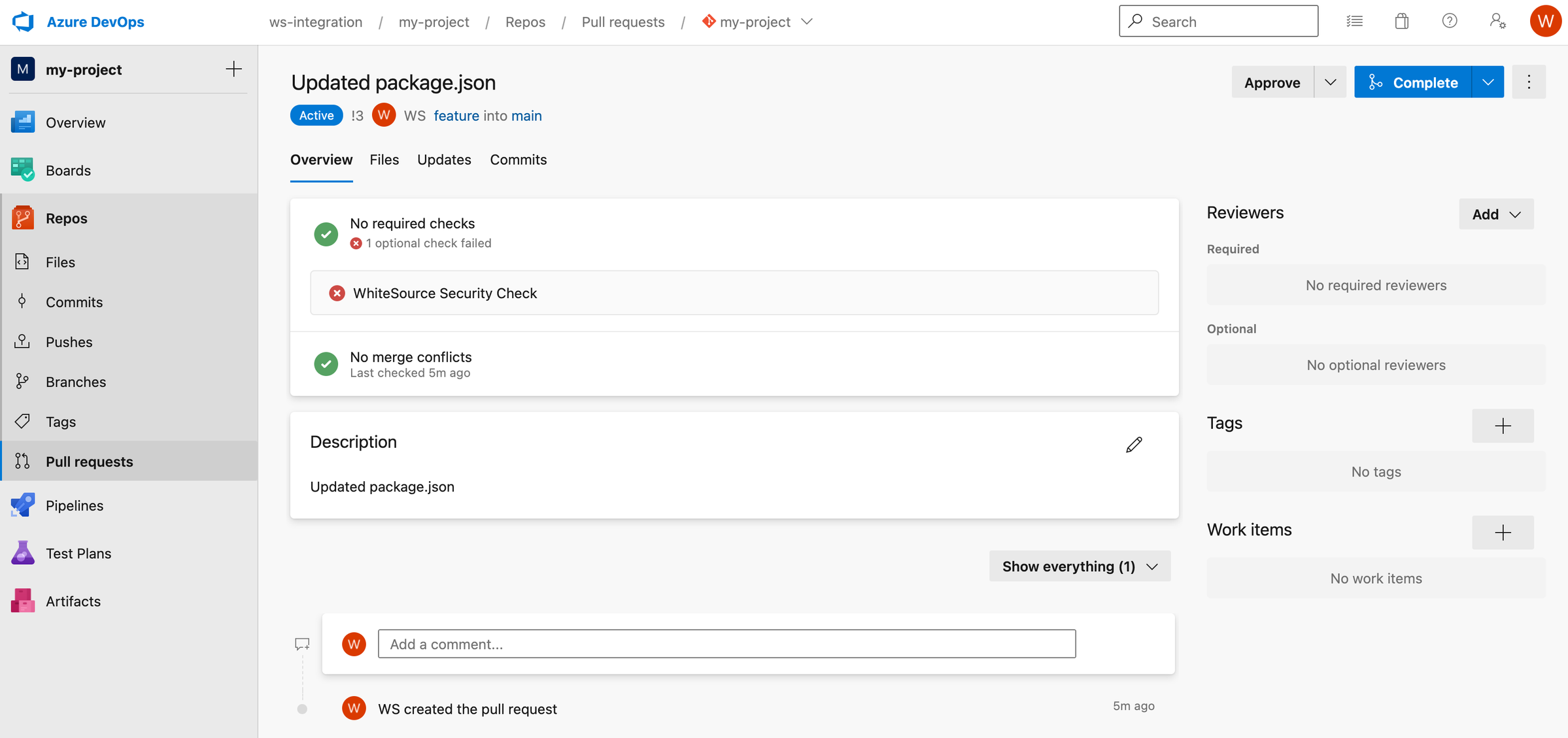
  • WhiteSource Tightens Code Scanning Tool Integration with Azure DevOps

    WhiteSource Tightens Code Scanning Tool Integration with Azure DevOps

    WhiteSource has added the Microsoft Azure DevOps platform to the list of continuous integration/continuous delivery (CI/CD) platforms its open source vulnerability scanning tools natively supports.

    Susan St. Clair, director of product management for WhiteSource, said while developers are always encouraged to scan for vulnerabilities, it’s more effective if organizations implement scanning by default every time there is a merge request. That approach reduces friction because organizations become much less dependent on developers to scan for vulnerabilities within the context of a larger DevSecOps workflow, she added.

    WhiteSource also provides a merge confidence feature that uses crowdsourced data to show how likely it is that an open source component can be updated without breaking the build. Merge confidence includes data on upgrade age, adoption and compatibility to create a confidence score.

    The WhiteSource integrations make it possible for DevOps teams to detect all open source components being used and automatically enforce security policies directly from their repository. DevOps teams are provided with vulnerability and misconfiguration alerts and license violations along with detailed remediation guidance, including suggested fixes and prioritization advice, within an existing workflow versus being required to switch to a tool that has a separate user interface (UI) they need to learn.

    Should a merge request introduce a new error, the developer is given immediate feedback to resolve any newly introduced vulnerabilities before the request is completed. That approach to separating feature branches and mainline branches prevents interruptions to workflows. The enterprise edition of the WhiteSource tool also automatically generates pull requests in the repository to update vulnerable open source components to the lowest non-vulnerable version.

    WhiteSource also supports code repositories such as GitHub, GitHub Packages, JFrog, Bitbucket and GitLab. The Azure DevOps platform is gaining traction as more application development projects are being managed via the cloud following the onset of the COVID-19 pandemic, noted St. Clair.

    As more organizations begin to embrace DevSecOps workflows each of them will need to decide how far left they want to shift responsibility for application security. In theory, each developer is now being held more accountable for every one of their applications that gets deployed in a production environment. In practice, most developers lack the expertise required to ensure applications are secure.

    There are, of course, more concerns being raised about the security of software supply chains that include open source software in the wake of the recent disclosure of zero-day vulnerabilities in the widely-used Log4j logging tool. Many of the maintainers of smaller open source projects lack the resources required to ensure there are no inadvertent vulnerabilities that could be exploited by cybercriminals. More challenging still, many developers may have used an older version of that software that has known vulnerabilities.

    It’s not clear how open source software will ultimately be made more secure. In the meantime, however, it’s clear the onus for ensuring the security of that software is on the DevOps teams that employ it.

  • WhiteSource Report Finds NPM Vulnerabilities Fixed Fast

    WhiteSource Report Finds NPM Vulnerabilities Fixed Fast

    WhiteSource today published a report that found most of the vulnerabilities that affect node package managers (NPMs), widely employed to deploy JavaScript applications, are addressed long before they are assigned a Common Vulnerabilities and Exposure (CVE) in the National Vulnerability Database (NVD).

    The report, based on an analysis of the vulnerabilities that WhiteSource tracks in its own vulnerability database and revealed at the AWS re:Invent conference, found more than 90% of vulnerabilities in NPM packages are fixed before the vulnerability is published in the NVD.

    Susan St. Clair, director of product management for WhiteSource, said that fact suggests that, overall, the open source community is staying on top of vulnerabilities as they are disclosed rather than waiting for them to be assigned a CVE number.

    The WhiteSource report comes on the heels of a breach of UA-parser.js, a widely employed NPM based on a JavaScript library that detects browser, engine, OS, CPU and device type/model from User-Agent data. Unknown malicious actors found a way to inject malware into the NPM that modified the library. That vulnerability has since been remediated.

    In fact, the WhiteSource report noted 83% of the CVEs assigned to the most widely used versions of vulnerable NPMs could be remediated before the publication of the CVE.

    In the wake of a series of high-profile breaches of software supply chains, there is a lot more focus on how open source software is actually secured. Commercial software products have a distribution list that they typically notify of a security patch. Open source updates, on the other hand, need to be tracked by developers that use that software. The level of attention individual developers might pay to any number of open source updates can vary widely.

    Many developers are also hesitant to immediately update their applications because they are not sure what impact that additional code may have on their application, said St. Clair. For example, their application may have dependencies that are no longer backward compatible with the updated code, she noted.

    Developers also need to determine the degree to which that vulnerability may affect their applications because they often don’t use every component of an open source library, so the fix being offered may not be required.

    Open source project maintainers often depend on their community to help uncover vulnerabilities and create the fixes as quickly as possible. When a vulnerability is detected in an open source library, the more common practice is to report it to the NVD even after the fix for that issue has been made available.

    In general, St. Clair noted the most important thing for the open source community to remember is to remain proactive when it comes to tracking vulnerabilities and then implementing DevSecOps best practices. The one thing that is certain is that a wide range of malicious actors also are tracking those vulnerabilities closely. It’s not uncommon to see a wave of exploits being created once a vulnerability is disclosed via the NVD.

    The challenge, of course, is that the more open source software that is employed, the more difficult it becomes for individual developers to stay on top of every vulnerability in an application portfolio that only continues to grow. On the plus side, vendors have pledged more than $10 million to help better secure open source software. Hopefully, the return on that investment will become apparent sooner than later.

  • WhiteSource Adds SBOM Tool That Lists Vulnerabilities

    WhiteSource Adds SBOM Tool That Lists Vulnerabilities

    WhiteSource has added a software bill of materials (SBOM) tool to its portfolio that, in addition to capturing the components of an application, also surfaces vulnerabilities that should be addressed.

    Many organizations are becoming more rigorous about making sure SBOM are attached to every software development initiative in the wake of an executive order issued by the Biden administration that requires federal agencies to employ them. While not every organization builds applications for federal agencies, the fact that the federal government is requiring them in the wake of a series of high-profile breaches has led other organizations to review their software supply chain processes.

    An SBOM facilitates those reviews by making available a formal, machine-readable inventory of software components and dependencies that can be used to track their supply chain relationships and identify dependencies and hierarchical relationships.

    Ori Bach, executive vice president for product at WhiteSource, said WhiteSource SBOM takes the concept a step further by also identifying open source libraries. It will also automatically update the SBOM when changes are made to make it easier to identify unintentional or malicious content being installed during application builds.

    Finally, WhiteSource SBOM also provides remediation guidance that ensures updates won’t break the build.

    Bach said it’s already apparent cybercriminals have significantly increased their effort to compromise supply chains as part of an effort to compromise as many downstream applications as possible. In many cases, cybercriminals are now specifically targeting open source projects that create software that tends to be employed across a wide range of use cases.

    An SBOM in and of itself doesn’t make applications more secure. However, it can provide visibility into the components of an application that can then be used to inform DevSecOps best practices, which organizations are implementing more broadly as responsibility for application security continues to shift left toward developers.

    There are two primary specifications that organizations can use to create an SBOM. The Software Package Data Exchange (SPDX) specification is an open standard for communicating SBOM information including components, licenses, copyrights, and security references. Defined by the Linux Foundation, SPDX is now recognized as the ISO/IEC 5962:2021 international standard. The second is the Software Identification (SWID) format that is today widely used by publishers of commercial software.

    Regardless of the format used to construct the SBOM, Bach said there’s an opportunity to more closely align the increased visibility it enables with the application security goals of the organization building the application.

    The primary reason SBOMs are not as widely used as they might be by now has as much to do with inertia as it does with technology. However, as organizations start to expect an SBOM to be made available, it’s clear application developers and builders will need to find a way to automate the SBOM process as applications are continuously updated. The challenge, of course, is that applications are now being updated with greater frequency—thanks mainly to widespread adoption of DevOps best practices—that now need to be integrated with any tool for creating and maintaining an SBOM.

  • WhiteSource Tool Automatically Fixes Code Vulnerabilities

    WhiteSource Tool Automatically Fixes Code Vulnerabilities

    WhiteSource today announced that it has developed the first-ever tool that automatically remediates vulnerabilities discovered in custom code.

    Rami Sass, WhiteSource CEO, said WhiteSource Cure surfaces recommendations for fixing security vulnerabilities in code that developers can then apply with a click of a button. WhiteSource has a long history of providing tools that discover vulnerabilities in open source software that it tracks via a database it manages, but Sass said customers are making it clear they need a way to automatically remediate those issues in a way that doesn’t adversely impact developer productivity.

    The average developer spends, on average, half a day fixing a single vulnerability, so the impact security issues are having on the rate applications are being developed is significant, added Sass. WhiteSource Cure gives each developer the equivalent of their own personal security expert, noted Sass.

    Developers can either apply the remediation suggested by WhiteSource Cure—that manifests itself as a pull request in a DevOps pipeline—or they can fine-tune it as they see fit, said Sass.

    WhiteSource

    WhiteSource Cure arrived as friction and tensions between developers and cybersecurity teams rise in the wake of a series of high-profile attacks against software supply chains. As a result, organizations are instituting more thorough security reviews of application development projects. The concern is those reviews will dramatically reduce the rate at which applications are being delivered.

    Of course, many organizations are looking to shift responsibility for application security further left toward developers to minimize the number of vulnerabilities that might need to be remediated either just before an application is deployed in an on-premises IT environment or, worse yet, after it is deployed. Trying to achieve that goal within the context of DevSecOps best practices, however, is challenging. Organizations first have to acquire vulnerability scanning tools that developers will actually use, and then provide developers with the training required to identify various classes of vulnerabilities.

    The other big challenge is the time it takes to train developers to recognize vulnerabilities. WhiteSource Cure eliminates the need for developers to become security experts, said Sass. In addition to a commercial offering, WhiteSource is also making available a Community Edition of WhiteSource Cure for open source projects that will forever be available for free to developers working on those projects.

    Sass said that rather than relying on machine learning algorithms and other forms of artificial intelligence (AI) to build WhiteSource Cure, the team that developed the tool found that more traditional approaches to software composition analysis (SCA) provided more reliable results.

    It’s unclear whether the ability to automatically remediate known vulnerabilities in code will render much of the DevSecOps debate moot. However, it’s clear that the simplest path forward toward achieving DevSecOps is, as always, to automate as much of the remediation process as possible. The challenge will be waiting to see how much confidence developers and cybersecurity teams will have in the recommendations generated.

  • WhiteSource Acquires Diffend to Secure Open Source Supply Chains

    WhiteSource Acquires Diffend to Secure Open Source Supply Chains

    WhiteSource this week announced it has acquired Diffend as part of an expended effort to discover malware that has been deliberately injected into open source software by a contributor acting in bad faith.

    Company CEO Rami Sass said cybercriminals are increasingly trying to compromise software supply chains that today depend heavily on open source projects. The Diffend platform surfaces anomalous contributor behavior that would be indicative of someone trying to compromise the integrity of a project, said Sass.

    Previously, WhiteSource provided a tool that would discover malware that had been inadvertently included in open source software. WhiteSource now plans to add the Diffend tools, now known as WhiteSource Diffend, for free to a portfolio of security tools that many organizations have already incorporated into DevSecOps workflows. Earlier this month, the company raised an additional $75 million in financing that, in part, was used to fund this acquisition.

    As cybercriminals begin to target software supply chains, many of them are taking aim at open source software that is likely to be adopted by a broad spectrum of organizations, noted Sass. The challenge is that bad actors have become adept at embedding malware in software components in ways that are difficult to detect, he said. However, spikes in activity from, for example, a new contributor to the project might warrant additional investigation, Saas added.

    These type of attacks, unfortunately, will require the maintainers of open source software to vet more closely who is allowed to contribute to the project, added SaaS. New contributors that might have once been greeted with open arms need to now be initially met with a modicum of paranoia, Saas said.

    That level of suspicion will be considerably higher if that contributor is located in a country that has a reputation for trying to compromise the security of both adversaries and companies that have intellectual property they might want to surreptitiously acquire.

    In the wake of some recent high-profile breaches involving software supply chain compromises, organizations are revisiting their application development processes. Cybersecurity teams are now asking developers to vet any external code that is incorporated within an application. Most applications regularly incorporate both open source and commercial components that developers assume have been vetted for malware when, in most cases, they have not. The Diffend platform, for example, aided in the detecting of 60 suspicious packages found in Rubygems, an open source platform that makes it easier to package software built using Ruby programming tools.

    It’s unclear how increased inspection of software components may impact application developer productivity. However, given how dependent organizations are on software today, the discovery of malware downstream that compromises the security of the application is potentially catastrophic.

    Sass said it’s doubtful these security concerns will lead to decreased reliance on open source software in general. There is no real alternative for efficiently driving software innovation, he said. The challenge now is finding a way to make sure all that innovation continues to occur as securely as possible.

  • WhiteSource Enhances GitLab Integration with Support for GitLab Ultimate

    Adding to WhiteSource’s existing GitLab integration, the enhancement will help programmers detect and remediate vulnerable code earlier without leaving the GitLab CI/CD pipeline  

    San Francisco – January 14, 2020 – WhiteSource, the leader in open source security and license compliance management, announced today enhanced GitLab integration for the company’s developer-focused offering, WhiteSource for Developers. This enhancement adds to WhiteSource’s existing GitLab integration, giving developers alerts on open source components with known vulnerabilities earlier in the software development lifecycle, and providing clear, actionable remediation suggestions before the code ever leaves their hands. With support for the GitLab Security Dashboard, a capability available for GitLab Ultimate users, security pros can gain visibility into unresolved vulnerabilities earlier than ever and GitLab users can gain additional insight from WhiteSource.

    “With this new integration, developers can more easily find and fix vulnerable code without leaving the GitLab CI/CD pipeline,” said David Habusha, VP Product Management at WhiteSource, “while security professionals can leverage their WhiteSource investment to advance their shift left and further automate risk policies within the Software Development Lifecycle (SDLC).”

    “We are excited to have WhiteSource as a part of GitLab’s partner program to complement our security capabilities,” said Brandon Jung, VP of Alliances at GitLab. “GitLab gives customers earlier visibility to software vulnerabilities and actionable remediation. This integration furthers our commitment to provide our customers a seamless DevSecOps experience.”

    WhiteSource integration with GitLab is available with WhiteSource for Developers. Additional information regarding this integration can be found here.

    About WhiteSource

    WhiteSource is the leader in continuous open source security and license compliance management. Its vision is to empower businesses to develop better software by harnessing the power of open source. Industry leaders like Microsoft, IBM, and hundreds more trust WhiteSource to secure and manage the open source components in their software. For more information, please visit www.whitesourcesoftware.com

  • WhiteSource and Codefresh Combine Forces to Offer Built-in Open Source Management in CI/CD Pipelines

    The collaboration will allow Codefresh customers to detect and fix issues earlier in the development process


    TEL AVIV, Israel, Dec. 4, 2019 /PRNewswire/ — WhiteSource, the leader in open source security and license compliance management, announced today a new integration with Codefresh, the Kubernetes-native CI/CD solution. The new integration offers customers to build-in open source security and license management within their native Codefresh CI/CD pipeline.

    CI/CD pipeline efficiency has become a critical parameter in today’s software development processes, allowing teams to create and ship high-quality software more quickly. Unfortunately, many choose to compromise on pipeline security, seeing it as a hindrance to swift deployment.

    This integration enables Codefresh customers to continuously secure and manage their applications’ dependencies and Docker images as part of their native Codefresh CI/CD workflow.

    Teams will be able to quickly and seamlessly integrate open source security tracking into their Codefresh pipeline, keeping up with the pace of development and deployment without slowing down for the sake of security.

    “We are always working to provide development teams with the tools that allow them to easily fuse security into their DevOps pipelines,” said David Habusha, WhiteSource VP of Product. “We’re happy to partner with Codefresh to provide all of our customers with an integration that provides an open source security scan in one simple click. Now, even more development teams and organizations can harness the power of open source and be confident that their CI/CD processes remain swift and secure.”

    An upcoming webinar will discuss this integration on December 6th.

    About WhiteSource 

    WhiteSource is the pioneer of open source security and license compliance management. Founded in 2011, its vision is to empower businesses to develop better software by harnessing the power of open source. WhiteSource is used by more than 800 customers worldwide, from all verticals, and sizes, including 23% of Fortune 100 companies, as well as industry leaders such as Microsoft, IBM, Comcast and many more. For more information, please visit www.WhiteSourceSoftware.com

  • WhiteSource Acquires Renovate to Automate Dependency Updates

    WhiteSource Acquires Renovate to Automate Dependency Updates

    WhiteSource has acquired Renovate, a provider of an open source automated dependency update platform that the company plans to make available for free.

    Rhys Arkins, co-founder of Renovate who is now director of product for WhiteSource, said that as software projects become more complicated, there’s an increased need for a mechanism to identify and track dependencies and automatically update them as changes and updates are made.

    That requirement is becoming especially acute with the rise of microservices-based applications, which substantially increase the number of dependencies that exist within and between applications, added Arkins. Microservices make it possible for DevOps teams to build and deploy applications faster, but the dependencies between the microservices often result in an application environment that becomes too complex to manage. Most recently, Renovate added support for Helm Charts used to package applications in Kubernetes environments, on which many microservices are now being deployed.

    In addition, WhiteSource plans to add support for Cocoapods, a dependency manager for Swift and Objective-C Cocoa projects.

    Prior to the acquisition, WhiteSource was reselling the Renovate platform, which has more than 150 contributors. Now that WhiteSource owns the Renovate platform, including a hosted GitHub application and self-hosted GitHub and GitLab applications, the company has decided to make it available for free under the WhiteSource Renovate brand name.

    In the future, The WhiteSource Renovate app will add support for Bitbucket Cloud and Azure DevOps, thereby expanding the sources of dependency data that can be employed to make updates less risky and time-consuming, said Arkins. In effect, WhiteSource wants its automated dependency platform to become a natural extension of any continuous integration/continuous delivery (CI/CD) platform, he added.

    Arkins said that when it comes to managing dependencies, the biggest challenge is getting developers to identify them. In the absence of a platform for managing that process, developers will either not declare dependencies at all or, more commonly, not provide the right version number for a specific release of software on which their application is dependent. The more automated that process becomes, the less likely it is DevOps teams will find applications breaking because of a dependency that they were unaware of or lost track of at some point during the project.

    With the rise of DevOps, many organizations are now employing a more structured approach to dependencies. However, Arkins noted, many organizations are unaware that an open source platform is available that automatically updates all dependencies.

    WhiteSource is best known for helping organizations discover vulnerabilities in open source code. With the acquisition of Renovate, the company is furthering its ambitions to become a provider of software composition analysis tools.

    It remains to be seen just how many organizations will incorporate an automated dependency update platform into their DevOps processes. While many organizations have embraced DevOps, the level of maturity in terms of DevOps sophistication is uneven. The more software projects an organization launches, however, the more likely it becomes apparent there is a need for a better way to manage software dependencies.

    — Mike Vizard