
Tag: web server

  • Automatic Right-Sizing is Magical Thinking

    Automatic Right-Sizing is Magical Thinking

    Some months ago, AWS evangelist Corey Quinn wrote a short blog post titled “Right Sizing Your Instances Is Nonsense.” As usual, Corey was spot-on in his takedown of cost-reduction-magic-AI industry hype. But his piece only scratches the surface. I would take the argument a step farther and say that anyone who tells you they can automatically and generally “right-size” compute instances simply doesn’t understand how software works.

    Does that strike you as overly aggressive? Stay with me. Even if you don’t wind up agreeing, there’s a lot to be learned about AIOps from a discussion of “automatic instance right-sizing.”

    What is Right-Sizing?

    Quoting directly from the website of one of the many services that claim to provide “right-sizing” for cloud instances:

    “The Recommendations Engine leverages the time series data of relevant utilization metrics for your resources, then creates a statistical model around average and peak utilization periods. The tool leverages historical utilization data to identify performance characteristics across instance types, families and zones to provide valid recommendations for your workload.”

    The idea behind this “right-sizing” is quite simple, really: track a bunch of cloud service metrics (and maybe a bunch of OS metrics, too, if they are available), use some statistical model—commonly called “AI” on VC decks—and magically deliver recommendations for a more cost-effective cloud instance type.

    There’s just one problem: creating a useful statistical model from generic metrics is practically impossible unless your software is purpose-built to support it, and that is never a software design goal. In fact, software is almost always built in a way that is completely contrary to this goal, and for very good reasons. To understand why, let’s go over the assumptions behind “right-sizing”:

    1. The software will be able to use all given resources
    2. Performance will improve (or degrade) predictably and uniformly with added resources
    3. Metrics accurately describe application load
    4. Scaling dimensions are independent
    5. There will be no side effects on connected systems

    It turns out, none of these assumptions behind right-sizing are generally true.

    A Crash Course in Software Scaling

    In theory, software is bottlenecked on resources, be they CPU, disk, RAM, network, what have you. In practice, however, it is extremely difficult to build software that can fully utilize resources.

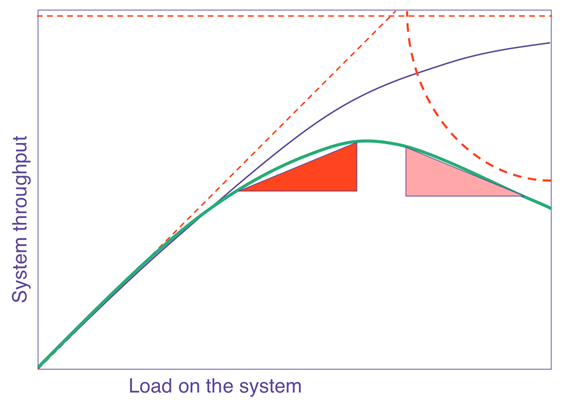
    The general curve that describes how software scales with resources or load is known as the Universal Scalability Law (USL). In a nutshell, it says that on any chart showing scale versus performance, you will see a region of linear scaling where adding resources (say, CPU cores) proportionally increases performance; however, you will then see where performance continues to increase on a nonlinear basis, with smaller and smaller gains with every additional resource until, at some point, the benefit is so marginal as to be completely negligible. This is known as Amdahl’s law, which states that the performance of every program is limited by the serial part.

    Beyond Amdahl lies the issue of retrograde scaling, the existence of which people often forget about until the consequences hit them smack in the face. In this issue, adding resources actually slows down the system. That’s right. From this point onward, larger servers will make your software slower.

    The reason this happens is that, to scale linearly, the workload and resources must be completely isolated and decoupled from each other, which isn’t realistically possible. There are always shared components, e.g. the kernel scheduler, the memory controller, the main PCI bus, perhaps the algorithm requires locking. In any case, the net result is queueing on the shared resource, which might also become a bottleneck when overloaded. Think of a supermarket checkout: you can admit more and more shoppers into the store, but they will still end up waiting at the checkout, eventually, no matter how many registers you open and staff. Performance is limited by the number of checkout counters, not by the number of shoppers or clerks. Worse yet, if the queue gets out of control (maybe people got tired of waiting and shopping carts are literally abandoned in front of remaining shoppers, blocking the path to checkout — think of this as the contention of retries and timeouts), the throughput of checkout will decrease as counters are starved for shoppers.
    right-sizing

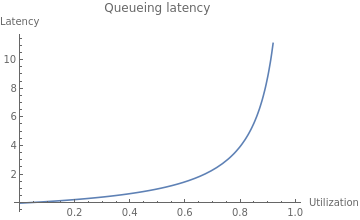
    The USL shows us what happens to throughput as we scale, but what about latency?
    right-sizing

    As resource utilization approaches 100%, the wait time for the resource will approach infinity in a nonlinear fashion. This is why systems are designed to run at low utilization, so that quality of service does not degrade too much. You might see a server running at 50% utilization and think, “We can use a server with half the resources and save money!” but if you actually try to do that, you will degrade latency and quality of service to an unacceptable level, most likely causing an outage.

    The Dark Arts of Configuration

    Even if your software is able to take advantage of available resources in theory, it needs to be properly configured to use them. Buffer sizes, thread pool sizes, memory heap size, number of connections—most software has numerous options to tune it for resources and specific workload. You can’t just change the box size and expect it to work! Not to mention, it’s quite possible your current configuration is far from optimal. I’ve substantially reduced cluster sizes on several occasions by making a one-line configuration change.

    For example, a common web server configuration is the number of concurrent requests the server can handle (often expressed as number of threads), which relates to the number of CPU cores available, the amount of memory available to the specific workload and the average time it takes to handle a request. The problem you are solving isn’t “What instance size will have the best ROI?” but rather “What combination of instance size and configuration will have the best ROI?” That is a totally different question that requires specific knowledge of the application to answer.

    Let Them Eat Cache

    In the old days, when you tried to allocate memory beyond what was currently available, the operating system would simply refuse your request. Ah, the good old days were simple! Alas, in our quest to simplify programming and resource management, and to allow software to efficiently adapt to a changing environment, we made common use of resource tradeoffs. For example, a complicated computation can be calculated again and again using the CPU, or the results can be saved and reused, saving CPU time and trading it for the use of RAM or disk. This pattern is quite common; when you overallocate memory, the operating system may trade off CPU to free memory by compressing memory objects, or it may trade off disk space by paging out RAM to swap. Java, Node.js and Go each have a similar tradeoff where they spend CPU time on garbage collecting to free RAM. Modern software makes numerous tradeoffs between CPU, RAM, disk and network in multiple dimensions. The end result is that different resources are coupled in many unexpected and obscure ways.

    Lies, Damned Lies! (And Metrics)

    Speaking of that server running at 50% CPU utilization, it is quite possible that server is also maxed out on CPU at the same time. How can this be? It’s because the metrics you see are not raw data but aggregates—in many cases, averages—and aggregates hide certain behaviors that can be very important; for example, peaks and bursts, such as the ones you get from compaction, garbage collection and other periodic processes that routinely run in modern software. There are billions of events happening every second on a modern server, and only a few data points of metrics emitted every minute. All metrics are loss-y; it’s simple math, really. But machine learning (ML) models are only as good as the data they work on, so if the metrics weren’t specifically created to show the relevant behaviors—and they weren’t—the model would be completely blind to their existence.

    What is “Performance,” Exactly?

    Whenever we deal with resource allocation, we are interested in its impact on performance, which raises the obvious yet rather uncomfortable question: what’s your definition of “performance?” Is it throughput? Latency? Mean or the 99th percentile? Of which transaction? Or, perhaps you are mostly interested in the rate of purchases executed on the website? These are all different things, and often, optimizing one might degrade the others.

    This kind of discussion is the first step in any performance engineering session—but completely absent from the scope of “right-sizing” services, and the last thing you want is the generic cost function of the ML model costing you money.

    This wouldn’t be so bad if all performance goals could be achieved at once, but, sadly, some of them are in opposition: e.g., higher throughput causes higher latency due to queueing effects. When making changes to software systems, we have to know what performance metrics are important to us.

    The Curse of Local Optimization

    It is very tempting to look at a cluster of machines as an independent system. But if that system is doing something meaningful, it is part of some bigger system, and changing the configuration will likely have an effect on the larger system it is a part of. When we make changes to subsystems, it is with the intent of improving the system as a whole, to make the customer happy and make more money. But when a change to a subsystem is motivated by a desire to reduce the cost of the subsystem, the result is often an increase in the overall cost of the system! This is because the local cost of subsystems is relatively small compared to the cost of the entire system, not to mention the possible reduction in the income of the system. For example, you could save lots of money by using older, slower servers, but your customers won’t be very happy with a slow application and your profits will suffer—which will probably cost you much more than whatever you saved.

    To take this ad absurdum, you could save 100% of the subsystem cost by turning it off completely. Of course, the assumption is that changing server sizes will not have any side effects, which, as discussed, is highly unlikely. There will be side effects on connected systems as well, some of which will not appear immediately. Load is variant, and operational overprovisioning and buffers were often put in place for a reason. It’s quite likely the reason for low utilization is safety margins.

    The Problem With “Right-Sizing”

    The basic problem with “right-sizing” is the rather obvious, yet implicit, assumption that there is such a thing as “the right” size. Software engineering is all about tradeoffs, precisely because it’s very rare (if it happens at all) that one thing can be improved without making another thing worse. Tradeoffs mean business decisions to make, and you really don’t want a generic ML heuristic to make those for you. ML is very good at dealing with problems where a lot of data is available, the data is high quality, the data is predictive of behaviors (which isn’t the case for complex systems!) and most important, the problem is well defined. Most problems in AIOps are very far from this. Don’t take it from me, take it from the people who excel at both high-scale ops and ML.

    Even if it was feasible to make such ML models work, software is unable to automatically adapt to different machine sizes and fully utilize server resources. If it were, companies like ScyllaDB and Azul Systems wouldn’t need to exist. Creating software that is scalable and resource-efficient on modern hardware is a very difficult problem, and without those building blocks, ML models are constructing very shaky structures.

    It’s worth emphasizing that I’m not arguing against adapting the size and configuration of servers, only that doing so automatically and blindly for some local “cost-saving” goal isn’t the solution you might think. The goal of such changes should be to raise the overall quality and performance of the larger system guided by a theory of how that system works. ML is not a replacement for human thought and learning. There might certainly be an “optimal” instance type, or even a few, but “optimal” implies a target metric that certainly isn’t cost reduction. No system exists for the sole purpose of being inexpensive. All systems exist to serve business requirements first, and to be low-cost second.

  • DevOps Chat: F5’s NGINX Acquisition, with F5’s Lori MacVittie

    DevOps Chat: F5’s NGINX Acquisition, with F5’s Lori MacVittie

    F5 Networks has acquired NGINX, the leading open source web server player. The move clearly puts F5 in the DevOps space, as well as the open source market.

    In this DevOps Chat, we speak with Lori MacVittie of F5 along with Sidney Rabsatt of NGINX. Some great insights into why this acquisition makes sense for both parties.

    As usual, the streaming audio is immediately below, followed by the transcript of our conversation.

    Transcript

    Alan Shimel: Hey everyone, it’s Alan Shimel, devopsy.kinsta.cloud, DevOps Chat, and you’re listening to another chat. Today’s chat features two folks from an acquisition announced yesterday. In case you haven’t heard, F5 Networks has acquired NGINX. We’re going to hear more about it from two folks. Number one is our friend, Lori MacVittie from F5 Networks. Lori, welcome. Glad to have you here.

    Lori MacVittie: Thanks, happy to be here.

    Shimel: Fantastic. Joining Lori and I is Sidney Rabsatt. Sidney is VP of product at NGINX. Correct, Sidney?

    Sidney Rabsatt: That’s right, and I’m happy to be here too.

    Shimel: Well, everyone’s happy to be here. That’s not a bad thing. Are you happy to be here at the DevOps Chat or are we happy to be here talking about F5’s acquisition of NGINX? Let’s hope it’s both. Lori, give us a little background here. When I saw the deal yesterday. I said, “Wow, that’s a big deal.” I’m not sure – it’s certainly an expansion, up the stack, if you will, for F5.

    MacVittie: Up the stack, deeper into the app. It’s all about application delivery. One of the – Sidney mentioned earlier when we were chatting, building on NGINX’s vision, which as I read it, is flawless application delivery. That’s certainly something that F5 has always aspired to achieve as well, but there’s just pieces in the application stack that we don’t play in, or haven’t played in until yesterday with the acquisition. NGINX is the leading webserver. They’ve got an app server. They do some app delivery. They’re very prevalent in many, many places. So we’re very excited to have them on board to see how we can bridge the gap between those two worlds.

    Shimel: Absolutely. What about the perspective of NGINX? Money is always nice. Don’t get me wrong. What’s the attraction to F5 here?

    Rabsatt: I think there’s at least two sides of it. Working with the folks on this early on, we got to get a sense of the culture of the organization. It felt very compatible. The people we met were great. We had a great time talking, hanging out, sharing ideas. There’s some real optimism about what can be done together. The thing that really gets folks excited, especially on my side of the house, on the NGINX side of the house is the opportunity to do even more faster. We’re a startup. It’s grown to a good size. The set of resources that we have, but looking at F5 and talking to those folks, understanding that they have a shared vision. They see the world very similarly and bringing more resources to bear to execute on the vision that we’re always working towards. It’s something that’s very exciting for us.

    Shimel: I can’t disagree with you. I think we’re in violent agreement on it. It is a great opportunity. I guess the next question is how do we integrate, Lori or Sidney, how do we integrate the NGINX webserver, appserver, and the rest of the toolset into the F5 family? Or do we not?

    Rabsatt: Do you mind if I take a stab at it?

    MacVittie: Go ahead, Sidney, please.

    Rabsatt: Sure. Look, I think on the surface of things it might seem as if there’s a ton of integration that needs to happen, and a lot of overlap needs to be addressed, but quite frankly, I’ve been pleased to see how much complementary capabilities we actually have. Oftentimes, in the marketplace, folks will actually deploy both solutions side by side. It’s because we do slightly different things, both super important to folks. When we think about integration, there’s opportunity for F5 customers to be able to leverage NGINX solutions in places where they couldn’t necessarily before. That should be a net benefit to them.

    There’s the ability for folks that leverage NGINX solutions to take advantage of things that F5 does, that we don’t particularly do. I think that’s going to be another win for them as well. The integration is really focused on making sure we have the right extensions to the product line identified so we can really give customers the things they need to succeed in delivering those end to end applications, and yes, of course, we’re going to be looking to bring the best of both sets of technologies together in the places where it makes sense, but we’ve been pleased to see it’s not as many overlapping things as we might have found in some situations. We’re very optimistic about the path forward here.

    Shimel: So crystallize for me, where do you see things that overlap versus things that play well together? Can you give us some specifics?

    Rabsatt: Sure. Things that play well together fall into the category of “Hey, can I bring better scrutiny, better analytics, to the types of solutions that I might already have with NGINX?” On the NGINX side, I’m sorry – on the F5 side, “Hey, can I leverage solutions to give me a little bit more freedom and flexibility to build my apps wherever or however I might choose to?” So I think there’s some goodness there that folks will definitely get access to.

    On the integration side, you’ll find most of it is just around making sure that the products work seamlessly together. So to the extent of I have multiple devices in my environment. How do I have a single solution that gives me the ability to manage it the way that I need to? We still need to go through the work of understanding exactly how the different buyers are going to need to interact with the different solutions that we use going forward, but all that work is in progress and again, the overlap tends to be the little stuff. Oh, do you draw a report? Oh yeah, we draw a report. Do you guys do that too? Sure. So how do we bring the best of those technologies together? It’s that kind of thing.

    Shimel: Got it. Lori, interested to hear, you heard Sidney here. What do you add to that? What are your feelings on it?

    MacVittie: I think he encompassed everything well. We already – you already see both of us in F5 and NGINX together in a lot of environments. From our perspective, I think we’re looking at – one, continuing to invest and amplify the NGINX vision and what they’re trying to execute on, but also where can we add security? Security is a big deal that has to extend from end to end. Right now, that’s a very disjoint process sometimes. That’s why we keep telling security to shift let. I think this is an opportunity that we’re going to be looking for to be able to do those kinds of things and shift that security even lefter with NGINX.

    Shimel: Absolutely. It’s funny when you think about security being a driving force behind this acquisition. With NGINX being a webserver, that’s been an area and app server, that’s been an area where security has been required and important forever, even going back to IIS in the day, Internet Information Server and stuff. Here’s an area though I was thinking about. So many people in the public cloud use NGINX as their webserver of choice, whether we’re talking about Amazon or even Microsoft Google or any of them. Lori, does F5 maybe view this acquisition as a way to expand your footprint in public cloud? If so, how?

    MacVittie:  I don’t think we looked at exactly how that’s going to play out, and what we’re going to do with that. The webserver is something different from the proxy technology that most of our products are built on. So there’s some differences there in how that works. We’re still looking at roadmaps and trying to figure that out. For right now, we’re just going to keep going ahead with both sets of road maps and moving forward. As we continue to explore what we can do together, we’ll figure out where it makes sense.

    Shimel: Sidney, same – flip side of that coin – of that question to you around public cloud. Do you see an angle where F5 helps there?

    Rabsatt: Yeah, I think F5 already had strong relationships with quite a few of the cloud vendors as do we, and we expect that – we ultimately want to give folks a choice. This all boils down to organizations are trying to build the applications that make sense for them. They want to be able to leverage the best tools and capabilities that help them deliver those applications while giving them the freedom to build the application they want. So whether that is on one cloud, on multicloud, across clouds, and on prem locations, they need that flexibility to do what makes sense for them. A big part of what we’re trying to accomplish here is making sure that F5’s large customer base has the capabilities that NGINX large user base has, which is again, that freedom of flexibility. That means that whether it’s on Amazon Google, Microsoft, any cloud, or any on prem solution, they get to deliver their applications with the security, controls, the visibility that they desire.

    Shimel: Excellent. I’m just – in hybrid situation, what about – one of the hottest topics certainly in technology today is the whole Kubernetes container thing. I know both F5 and NGINX had Kubernetes-related solutions and playing in that market. What, if any, does this acquisition, what if anything does this acquisition bring to that? Either one?

    Rabsatt: I would say it should be a net benefit. NGINX, there was a recent report I saw. It’s in the public domain. NGINX is the most commonly used ingress controller for Kubernetes environments today. If you think about what Kubernetes means for organizations that are building these modern applications, it’s giving them an environment that allows them to build typically microservices-based applications. So getting those applications exposed to the outside world requires the first thing, the foundational element, the hierarchy of need. It’s getting traffic in and out of that Kubernetes environment. How do you do that? Through the ingress capability.

    Our ingress controller is pretty much the number one solution out there for doing that today. That’s the first place people have to start before they get into some of the more complex or exotic things they’d like to be able to do. So our customers, our users are already benefitting from that. It’s allowing them to do what they need to do when it comes to adopting or testing Kubernetes for their own uses.

    Shimel: Sure. Lori, even independent of NGINX, what effect is this whole move to Kubernetes and container-ized environment having on F5’s business?

    MacVittie: Wow. On the business? Don’t really know. No. There is – we see a lot of customers asking. One, they want guidance on how to do this at scale and safely. A lot of our customers are very concerned about security, about performance. How do they bridge those two worlds, coming out of Kubernetes and trying to get into an environment where there’s a lot more traditional apps and infrastructure still supported? It’s trying to bridge those two worlds.

    Our customers are looking at it and they’re bringing it in and they’re adopting it, but they’re also having challenges with the deployment side where NetOps traditionally sit that they don’t have the skills to do the automation. They have problems with integration of the toolsets to build those pipelines. So one of the things that this kind of an acquisition does is bridge that gap. Hopefully we’ll see better integration and easier in and out, both actually in the flow of traffic, but also just between the teams in the businesses, so we think this will help address some of the pains at the people level in organizations by having this end to end delivery chain with both F5 and NGINX.

    Shimel: Sure. Sidney, maybe you would know. What are the plans with some sort of common interface or more integration between the two lines?

    Rabsatt: I’d say it’s still very early on. We have some good ideas, but we’re not really in a position to preview too much. I will say there’s going to be a focus on again, making sure we’re bringing the best of both solutions together. Again, not nearly as much overlap as you might have expected, or we – I should say as we might have expected. Yeah, what we’re looking at is really the opportunity to bring more features to the things we already have, more so than trying to get rid of things. We’re looking forward to getting this innovation stuff underway. We’ve had some very early conversations, but over the next days and weeks, we’re going to be digging into it very deeply.

    Shimel: Makes sense. Lori, so this was as we said right from the outset, what we’re turning to is a move up the application stack. What – is F5 done with that? Will we see more F5 potential either via the acquisition or holistically – organically moving up this stack here in the application world?

    MacVittie: I can’t obviously comment on any kind of [laughter] –

    Shimel: Can’t tell _____ acquisition is. I get that one.

    MacVittie: That’s right. With any company, that’s always a possibility. We have been transforming ourselves in the past year really moving forward with a lot more innovation in terms of exploring things and looking at – we’ve got Aspen mesh going, which is service mesh trying to bring some sanity to Kubernetes inside for scaling. Cloud services, we’ve made a lot of our services as a service. You just hook them up. We’ve been moving deeper into the application stack for a while. This is just going to accelerate that transformation from ADC to application services company.

    Shimel: Understood. Understood. Well, guys it really is exciting. One of the things I sit here at devopsy.kinsta.cloud and Security Boulevard and we go to all of the conferences and we cover all the news, and you hear so much “What’s bleeding edge, bleeding edge, bleeding edge?” We tend to forget, or we overlook what are the nuts and bolts, the bread and butter that keeps the internet and these applications going? It is things like the NGINX web server that is the dominant web server in the world today. It is things like the F5 lineup of software and of _____ actually that have been delivering the internet to the public since 2002 or whatever it is. Lori, you probably know, but so it’s good to see innovation continuing to happen. It’s good to see new combinations taking place.

    I’m excited to see what comes out of – Sidney, as you said, it’s very early on. It’s a day after the acquisition was announced. Maybe we could check back in six months and see how things are progressing along these lines. In the meantime though, just the usual questions. Everyone from NGINX is staying on? There’s not going to be layoffs as part of the consolidations and stuff, or again too early to tell?

    Rabsatt: I mean what we know is F5 is interested in our organization and not just products. They’ve made it very clear they want the vast majority of folks to stay and we expect that to continue to be the case. We look forward to what the future holds together.

    Shimel: Yep, understood. Look, I wish you a lot of success, both you guys individually, as well as F5 and NGINX. It’s an exciting combination. Congratulations to both organizations and Lori, I think congratulations on especially to F5 for really making a real great addition to the family there.

    MacVittie: Thank you. I know there’s a lot of us. We’re just really excited about this and about the future and what we can do together.

    Shimel: Cool, cool, cool. All right, congratulations, guys. We’re going to call it a rap on this edition of DevOps Chat. Lori MacVittie for F5 networks. Sidney Rabsatt for NGINX, soon to be F5 Networks. Thanks for being our guest today on DevOps Chat. Thank you everyone for listening. You’ve just listened to another chat. Bye bye.


    — Alan Shimel