Tag: VSM

  • It Is Time for DevOps to Focus on Ops

    It Is Time for DevOps to Focus on Ops

    The advent of both Agile development and DevOps were great steps in improving an IT process that had become ossified, with policies that alternated between resistance to change and trying to do things better/faster. Between them, Agile and DevOps broke the cycle of resistance … but only for development.

    The confusion around CI/CD is a great example. CD is both continuous delivery and continuous deployment. Do you know why? Because up to that point (and even recently), DevOps included Ops in the name but did little with or for operations. I have no doubt that it was originally intended to include everything from build testing to full-on deployment, and we are finally getting there.

    You have no doubt noticed that both operations and security are finally getting DevOps’ attention at critical points. I have been chatting with coworkers about value stream mapping and, if you map the value stream of a software delivery process, you will find that all of the weak points have shifted right. Thankfully, we are also paying attention to them these days.

    From GitOps to infrastructure-as-code (IaC); from cloud-first to policy-as-code (PaC), we are finally approaching the operations side with some level of seriousness. And it is generating results for those involved.

    My two areas of attention these days are DevOps and application security (AppSec). As I’ve written elsewhere, both are benefitting massively from things like policy-as-code. The ability to apply corporate deployment policies, security policies and compliance policies from a centralized location is massive. It is early days, but community contributions to PaC libraries are already massive, making it easier to deploy without recreating that big old list of generally useful policies.

    Given a project, a set of tools and a timeline, you could fully automate the process from the first line of code to running in production, with stops for approval and the specialized steps that still require human interaction (no matter how many public policies are out there, someone with knowledge of your network still has to set up IPs or ranges, for example. Or someone still needs to write the code). Someday, it may be possible to say, “We need a phone app that targets both major platforms and is hosted on Linux that does X, Y, Z,” and it just happens … but we are not there yet, and, IMO, the domain knowledge will be a roadblock for a while. But you can take advantage of what we have to work smarter, not harder. And the organization will be better off for your efforts.

    So keep at it, start to evaluate your processes and consider placing any of the great new DevOps technologies into your path. Let them do some of the grunt work so you can focus on adding value. And for all those coworkers that still don’t get it, thank you. You are keeping them in a job, whether they admit it or not.

  • Broadcom Survey Reveals Spike in VSM Adoption

    Broadcom Survey Reveals Spike in VSM Adoption

    Value stream management (VSM) is gaining traction as organizations look to find ways to engage customers more efficiently via digital business transformation initiatives.

    A survey of 500 executives, IT and business leaders conducted by Dimensional Research on behalf of Broadcom published this week found 39% of respondents implemented a VSM platform with another 16% having some equivalent capability. Another 31% said their organizations is moving in the direction of adopting a VSM platform. A total of 60% of respondents indicated that they will be using VSM to deliver products in 2023, with 95% of organizations that have adopted VSM also engaged in digital transformation.

    Laureen Knudsen, chief transformation officer for Broadcom, said the primary goal is to close the divide that has emerged over the years between software development teams and the rest of the business. More than two-thirds of respondents (68%) reported there are disconnects between the business and software development.

    Overall, the Broadcom survey identified increasing customer value (58%), improving product quality (55%), reducing costs (51%), adding more customers (50%, increasing profits (49%) and increasing speed to market (45%) as the top strategic issues organizations face in 2023.

    The top benefits derived from investing in VSM were increased transparency (42%), improved organizational alignment (39%), faster solutions to customers (38%), data-driven decision-making (37%) and improved access to data (36%).

    VSM traces its lineage back to lean manufacturing methods, which called for each step of a manufacturing process to be continuously measured. As software development has evolved and organizations realize how dependent they are on software, there is a growing appreciation for the value of monitoring things such as the impact of missed software development deadlines on the business. At their core, VSM platforms aggregate DevOps metrics and then match them to a set of key performance indicators (KPIs) defined by business leaders. Once those metrics are gathered and correlated, organizations can apply advanced analytics. The goal is to apply algorithms and other forms of predictive analytics that will enable organizations to more easily identify the precise impact software development processes have on the business.

    Knudsen said the survey makes it clear a lack of discipline when it comes to software engineering now needs to be addressed as organizations realize how dependent they are on applications to engage customers. Many organizations have, for example, adopted flawed approaches to agile development that wind up creating chaos across the software development life cycle, she noted.

    Many organizations, for example, are unsure how much time development teams are spending on retiring the technical debt accrued within legacy applications versus actually working on developing new applications, Knudsen added.

    Business conditions tend to change rapidly, so aligning software development with corporate goals is difficult. Nearly three-quarters (72%) of respondents said they are frustrated by the state of the business and constant changes to strategy. Digital business transformation initiatives, however, will require organizations to adopt a more structured approach to software engineering, said Knudsen.

    The issue, of course, is the pace at which businesses are already being digitally transformed. The accelerated pace requires almost immediately re-engineering software development processes for them to succeed.

  • CloudBees Survey Sees VSM Driving Digital Transformation

    CloudBees Survey Sees VSM Driving Digital Transformation

    A global survey of 600 senior executives conducted by CloudBees suggested a high correlation between investments made in value stream management (VSM) and digital business transformation success.

    The survey found 90% of respondents agreed that organizations that committed to VSM are likely to be further ahead in terms of achieving their digital business transformation goals, with 92% noting VSM also creates more time to focus on innovation.

    Hope Lynch, senior director for platform at CloudBees, said the challenge is that too many executives equate VSM with legacy Six Sigma processes rather than application development and deployment processes that advance digital business transformation initiatives. The survey found that while 90% of senior executives claimed they were familiar with the VSM concept, only half could select the correct answer when asked. In fact, two in five respondents confused the concepts of value stream management and value stream mapping. Nearly two-thirds (72%) of respondents admitted there is still confusion about what VSM is.

    VSM traces its lineage back to lean manufacturing methods, which called for each step of a manufacturing process to be continuously measured. As software development has evolved and organizations realize how dependent they are on software, there is a growing appreciation for the value of monitoring things such as the impact of missed software development deadlines on the business. At their core, VSM platforms aggregate DevOps metrics and then match them to a set of key performance indicators (KPIs) defined by business leaders. Once those metrics are gathered and correlated, organizations can apply advanced analytics.

    Eventually, the goal is to apply algorithms and other forms of predictive analytics that will enable organizations to more easily identify the precise impact software development processes have on the business, noted Lynch.

    In the meantime, the CloudBees survey identified manager commitment as the main roadblock to VSM adoption, with 35% of respondents saying getting mid-level employees committed and 31% saying getting senior leadership committed are the biggest roadblocks. That’s a significant issue because more than half of respondents (56%) said C-level executives make VSM investment decisions.

    Survey respondents also reported that scaling VSM efforts throughout the organization is a significant issue for a third (33%) of respondents.

    In general, many VSM initiatives were sidetracked by the COVID-19 pandemic, noted Lynch. However, organizations will now be looking to evaluate the results of those efforts, she added. Digital transformation plans are in place and going well, according to 96% of survey respondents, with only 18% reporting that they are moving, but not fast enough.

    However, all software development processes could be improved by surfacing real-time insights, added Lynch. Most senior executives today don’t have a lot of visibility into the software development processes that are driving multiple digital transformation initiatives, she added.

    In theory, VSM platforms should one day help narrow the divide that has long existed between IT and the rest of the business, as dashboards make it simpler for everyone involved to appreciate the cascading impact a software development decision has across the entire business.

  • Allstacks Adds Alert Capability to VSM Platform

    Allstacks Adds Alert Capability to VSM Platform

    Allstacks has added an alert capability to its software-as-a-service (SaaS) value stream management platform that automatically notifies DevOps teams when software project goals and deadlines are likely to be missed.

    The core Allstacks platform employs machine learning algorithms and artificial intelligence (AI) models to keep track of pull requests, commits and card changes via a set of dashboards that are designed to be accessible to anyone in an organization.

    The Allstacks Alerts capability makes it possible to notify those stakeholders via email or Slack any time a specific indicator, such as a pull request, has been open for four days, which would suggest risks of delays have increased. Support for Microsoft Teams will be added early next year.

    Adam Dahlgren, senior vice president of product for Allstacks, said the goal is to leverage the advanced analytics built into the platform to surface thoughtful observability insights versus simply firing off a series of generic alerts that lack any context.

    Value stream management (VSM) platforms such as Allstacks automatically take technical metrics collected via DevOps tools and correlate them to key performance indicators (KPIs) defined by business leaders. The concept of value stream management traces its lineage back to lean manufacturing methods, which called for each step of a manufacturing process to be continuously measured. As software development has evolved from being a craft to a highly-automated process using DevOps best practices, an appreciation for the value of monitoring the impact of missed software development deadlines on the business has grown as organizations realize how dependent they are on software.

    In fact, many organizations are discovering there is a clear disconnect between their business goals and software development processes. Business leaders are especially anxious to understand how a software development project delay might impact future revenue projections at a time when economic conditions are the most uncertain they’ve been in recent memory.

    VSM platforms also make it possible to track KPIs spanning multiple software development projects; the hope is that doing so will make it easier to see where resources should be reassigned as various bottlenecks are encountered. In the long term, Allstacks is also working toward adding scenario planning tools to make it easier for IT and business leaders to model “what-if” scenarios, added Dahlgren.

    It’s not clear how much organizations are willing to invest in VSM platforms, but the need for them is becoming more acute. The challenge many organizations still face is making sure they have the tools in place to collect the appropriate technical metrics. A SaaS-based platform should make it simpler to achieve that goal and to apply algorithms to what can quickly become a large corpus of data.

    Of course, it’s still early days as far as the adoption of VSM platforms are concerned. But there’s no doubt the divide between application development teams and the rest of the business is continuing to narrow. Less clear is to what degree that increased visibility will lead to a higher degree of empathy between dev teams and the business.

  • Why You Should Rip Up Your Org Chart and Reorganize Around Value Streams 

    Why You Should Rip Up Your Org Chart and Reorganize Around Value Streams 

    To compete in the digital economy, teams must optimize both efficiency and effectiveness–it’s a tough ask. The traditional dominator hierarchy is a problem because organizations that use command and control create silos and handoffs that stifle innovation at the team level. Coordinated autonomy releases the creative spirit of individuals–but how can leaders assure alignment with their vision?

    One way to eliminate the delays and waste associated with silos and foster autonomy is to arrange around value streams. A value stream is anything that has a customer or anything that delivers a product or a service. All value streams begin with ideas and end when a change is delivered. Or, even better, when our cherished customers realize the intended value outcome. The original intent of Agile was to provide “value” to our customers faster … but we hardly ever talk about what this value is or measure its existence.

    Traditional organizational charts arrange resources according to expertise. This means that work is handed off to different teams as it progresses through the value stream. Value streams exist whether or not people call them that and whether or not they actively manage them. Every time a hand-off occurs, it creates an opportunity for delays or errors. It also means it’s hard for people to understand the end-to-end system. Instead, they do as they are told to optimize their piece of the puzzle without really understanding how their actions impact work that’s upstream or downstream.

    More progressive ways of working, like Agile and DevOps, do promote cross-functional, autonomous teams, but they typically leave a big gap between planning and delivery and are not always smart at connecting feedback from customer experience back into planning. Value stream orientation promotes team diversity by recognizing the individual background (cross-functionally) into the value delivered to the customer.

    Organizing around value streams is the foundation for nurturing the value stream-centric ways of thinking and working that drive both efficiency and effectiveness. Then, customer experience is improved and higher levels of organizational performance are achieved. This is because:

    • Putting customer experience front and center brings higher retention and referral rates
    • Elevating the concept of flow (see below) gives teams permission to prioritize removing waste
    • Balancing innovation with improvements reduces technical debt, toil and unplanned work so employee experience is better, too
    • Connecting planning to delivery to feedback in a continuous loop aligns teams and helps with decision-making

    Flow is about how fast ideas can move through a value stream and be made available to the people they’re designed for. It’s about outputs and efficiency. Customer experience tells teams about the outcomes of their work and their effectiveness. Used together, these measures ensure the teams are doing the right things right and moving in the right direction.

    In this model, leaders share their authority and empower their teams. They support teams’ self-discovery of improvements and make sure those local learnings go global. They help their teams understand how much time they spend innovating compared to reacting or improving. Then the leaders can help their teams reduce distracting and stressful unplanned work and instead invest in increasing capacity for innovation in the future.

    Follow these steps to become a value stream-centric organization:

    1. Identify your value streams
    2. Identify who is involved in each step of your value stream
    3. Make your value stream visible by visually collaborating with your value stream team
    4. Use tooling to gather value stream data and generate insights for your team
    5. Meet regularly to inspect and adapt your value stream

    All organizations are composed of value streams, regardless of whether they have been made visible, and most large organizations have complex networks of interconnecting value streams. These dependencies are not easily decoupled. They’re not easily visible, either. But once you’ve mapped them, you can start seeing where they connect and manage the dependencies. Ultimately the goal is to break these dependencies since they cause delays and risk, but it’s hard to do that when they can’t be seen.

    Connecting the organizational vision with the value streams becomes much easier with this model. Organizational structures are flattened. Leaders understand which value streams they are accountable for and how they work. The time between having an idea and getting feedback on how it’s received is shorter and amplified. They can see the work being done, measure what impact it’s having and make better decisions about what to innovate or invest in next.

  • Planview Outlines VSM Strategy After Acquiring Tasktop

    Planview Outlines VSM Strategy After Acquiring Tasktop

    Planview this week announced it completed its acquisition of Tasktop, a provider of a value stream management (VSM) platform that enables DevOps teams to align their efforts more closely with strategic business goals.

    Louise Allen, chief product officer for Planview, said the goal is to tighten integration between the Tasktop VSM platform and the project management applications that Planview already provides to software development teams and business executives.

    It’s still early days as far as adoption of VSM within DevOps workflows is concerned, but as more organizations realize how dependent they are on software, they need to better align application development projects with their strategic business goals, said Allen. VSM platforms make it possible to analyze data collected from various DevOps tools and enable business and IT leaders to, for example, visualize how a delay to one project might impact revenue goals for an upcoming quarter.

    Given the current weakness in the overall economy, organizations are looking to more precisely understand the impact software development decisions will have on the business, she added. As part of an effort to address that requirement, Planview will also make it easier for its applications to consume data that was originally created in Tasktop, she explained.

    VSM enables more organizations to function like a software company—aligning application updates with revenue goals. As the number of digital business transformation initiatives being launched increases, organizations are finding they need to operate more like a software company that either manufactures something or provides a service.

    The concept of value stream management traces its lineage back to lean manufacturing methods, which called for each step of a manufacturing process to be continuously measured. As software development has evolved from being a craft to an automated process using DevOps best practices, there is growing appreciation for the value of monitoring things such as the impact of missed software development deadlines on the business.

    At its core, a VSM platform will automatically convert metrics collected from a DevOps workflow to track a set of key performance indicators (KPIs) defined by the business. Once those metrics are gathered and KPIs established, organizations are then able to apply advanced analytics to align the resources needed to achieve a strategic goal by, for example, devoting more developers to a specific project. The data collected via a VSM platform can also then be shared with business intelligence (BI) applications that business leaders typically use to manage the business.

    It’s not clear just how hard business leaders are looking for deeper insights into how software development initiatives are progressing, but at the very least, DevOps leaders need a simpler way to understand all the dependencies that exist between initiatives. Otherwise, they risk missing deadlines simply because no one realized a delay that occurred in one project had a cascading impact across multiple other initiatives. Regardless of who consumes the data generated by a VSM platform, the need to increase visibility across the software development life cycle had never been greater.

  • Allstacks Adds Free Dashboard to Track Software Dev Benchmarks

    Allstacks Adds Free Dashboard to Track Software Dev Benchmarks

    Value stream intelligence platform provider Allstacks today added a free live dashboard populated with anonymized data that DevOps teams can use to benchmark their own progress.

    Hersh Tapadia, Allstacks co-founder and CEO, said the company is making this data available to make it easier for DevOps teams to uncover bottlenecks in their software development processes.

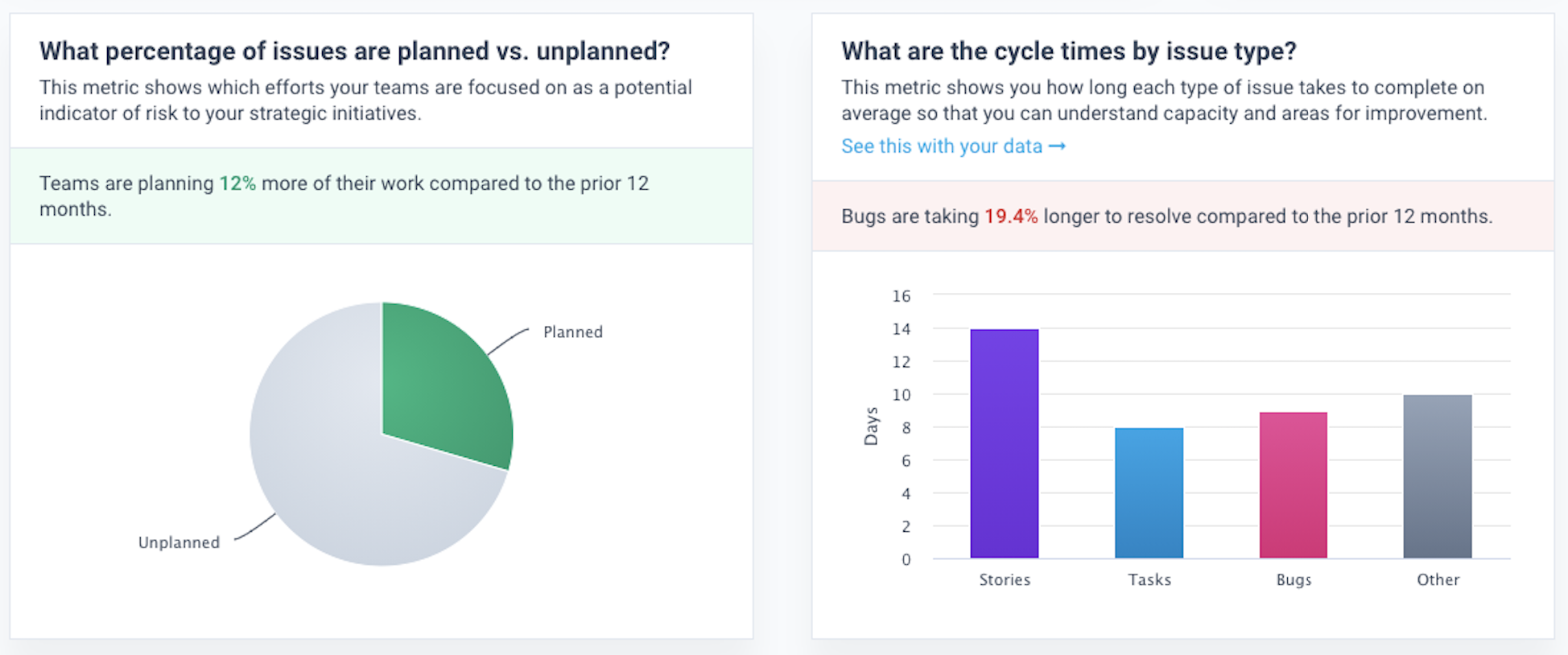
    As part of that effort, the dashboard includes pre-configured benchmarks for the following:

    How many days per week do benchmark teams write code?
    What percentage of issues are planned versus unplanned for benchmark teams?
    What are the cycle times per issue type for benchmark teams?
    What types of code do benchmark companies produce?
    What is the average commit size for benchmark customers?

    Allstacks

    Allstacks has committed to making 12 months of data publicly available on the dashboard and said it will update that data on an ongoing basis. Allstacks customers, however, can also access five years of data to compare historical trends.

    Tapadia said Allstacks plans to add additional benchmarks to a dashboard that can collect data via the various application programming interfaces (APIs) that most DevOps tools now routinely provide. The overall goal is to increase transparency into software development processes, he said.

    Allstacks’ value stream intelligence platform uses machine learning algorithms and artificial intelligence (AI) models to identify projects that are at risk of not meeting delivery goals. That data is then used to analyze the impact those missed deadlines are likely to have on various business objectives.

    Value stream management platforms automatically take technical metrics, gathered via a DevOps process, and match them to a set of key performance indicators (KPIs) defined by business leaders. The challenge many organizations still face is making sure they have the tools in place to collect the appropriate technical metrics and then define the KPIs that truly matter to the business. Once those metrics are gathered and KPIs established, organizations are then able to apply advanced analytics to the massive amounts of DevOps data they collect.

    The concept of value stream management traces its lineage back to lean manufacturing methods, which called for each step of a manufacturing process to be continuously measured. As software development has evolved from being a craft to a process that is highly automated using DevOps best practices, an appreciation for the value of monitoring the impact of missed software development deadlines on the business has grown as organizations realize how dependent they are on software.

    As a result, more organizations realize there is a clear disconnect between their business goals and development processes, noted Tapadia. Business leaders are especially anxious to understand how a software development project delay might impact future revenue projections. Rather than being a set of tools employed mainly by IT leaders to track software development projects, value stream management platforms make it possible for other stakeholders to track KPIs spanning multiple software development projects. It then becomes easier to make informed decisions about how to reassign resources across various projects as different bottlenecks are encountered.

    It may be a while before organizations achieve that level of transparency into their software development processes, but as software continues to ‘eat the world,’ it’s only a matter of time before value stream management becomes a required set of DevOps tools for every organization.

  • Maximizing Capabilities and the Importance of Value Stream Management

    Maximizing Capabilities and the Importance of Value Stream Management

    Even if we don’t use them  to the full extent, applications shape our entire lives. And more than half the time we have no idea what our applications are capable of. On a daily basis, the average person uses seven to eight apps on their mobile phone. Throughout the week, the average person uses 30 applications. But, how many of those applications do we thoroughly know how to use? That’s where Eric Robertson, SVP strategic advisor and Tim Stiling, manager of product marketing from ConnectALL come in. Both are speakers and will be holding sessions at TechStrong Con 2021.

    Tell us more about ConnectALL and what you’ve been up to lately.

    Tim: We really want to try to figure out how we can best deliver value to our customers’ businesses. On a very basic level, ConnectALL helps customers connect their tools! Now once your tools are connected—what you do with it—that’s where the fun can begin. I know Lance Knight, our president and COO, he has a fun saying where he talks about how it’s almost like electricity. So the electricity itself—kind of like the connecting of tools—it’s cool, but in and of itself doesn’t do anything. It’s what you can do with the electricity.

    To answer the second part of your question about what we’re up to lately, it’s really trying to find and figure out all those possibilities (synchronizing records, facilitating communication, triggering different actions, etc.) and making sure that our customers in the market are aware of it.

    Digital transformation is at the top of the mind for every organization and as consumer consumer demands are changing, in what ways has this affected the value stream management (VSM) industry?

    Eric: Companies are organizing their entire businesses around delivery of business goals that are essential to customers and are leveraging value streams as an essential part of their digital transformation mission. Basically this allows them to improve business IT integration and better manage changing priorities across different organizations. This is happening because we are seeing that organizational teams, the processes, the tools and tech platforms are constantly changing because they need to adapt to different conditions in the marketplace. As a result, value stream management is quickly being seen as essential for building, transforming, and optimizing those organizations’ technology enabled business models and that’s why it’s critical right now.

    Value stream management has kind of been a buzz word in the tech industry recently. Can you share the true business value behind utilizing value stream management?

    Tim: Ultimately with value stream management, it’s hard to say that this will lead to business value because business value could be different for every company. When it comes to value stream management, it’s more about the methodology and the mindset behind it. It’s all about this idea of continuous improvement. It helps you and your organization constantly drive toward your business goal by continuously improving and being better today than you were yesterday and better tomorrow than you are today. 

    Is VSM for every business? And if so, how can these businesses effectively start incorporating this solution into their overall business strategy and operations?

    Tim: Value stream management is absolutely for every business because whether they know it or not, every business has value streams. In fact, everything we do has a value stream, even something as simple as making a cup of coffee.

    One of the prevailing myths when it comes to value stream management is that it’s synonymous with DevOps or that you have to be in a DevOps transformation in order to be able to do it. Some organizations might be in an agile transformation or DevOps transformation—which is great, we aren’t saying don’t do that and do value stream management instead—VSM is a way to make that transformation more effective.

    You might already have all you need on your desktop right now, but there’s a chance you’re missing that link between your applications. It’s important to understand your applications—how they can maximize your workflow and cut down on time. So if you’re feeling disconnected, reach out to ConnectALL to connect all of your apps and don’t miss TechStrong Con 2021.

    Register today and tune in to Eric and Tim’s sessions on value stream management happening Wednesday, July 14 and Thursday, July 15. The clock is ticking!