
Tag: visual studio online

  • How to Secure Online Coding Platforms

    How to Secure Online Coding Platforms

    Threat Modeling for Online Coding Platforms

    The evolution of DevOps teams and a greater reliance on cloud-based computing has completely changed the coding process. Now, with Integrated Development Environments (IDEs), coding can be done entirely online. This is convenient, but are online IDEs secure? To answer this, we will focus on two popular cloud-based IDEs: AWS Cloud9 and Visual Studio Online.

    In online coding, the IDE is rendered inside your browser, the browser JavaScript engine uses WebSockets to initiate an Secure Shell (SSH) connection to your linked device in the background—e.g. virtual private server (VPS)—providing you with the familiar terminal interface to execute commands. The environment—meaning the linked cloud VM/VPS or SSH-accessible device—includes tool configurations (like which tokens are included, or cloud configuration files), a copy of the source code, compilers and other tools that you want to use.
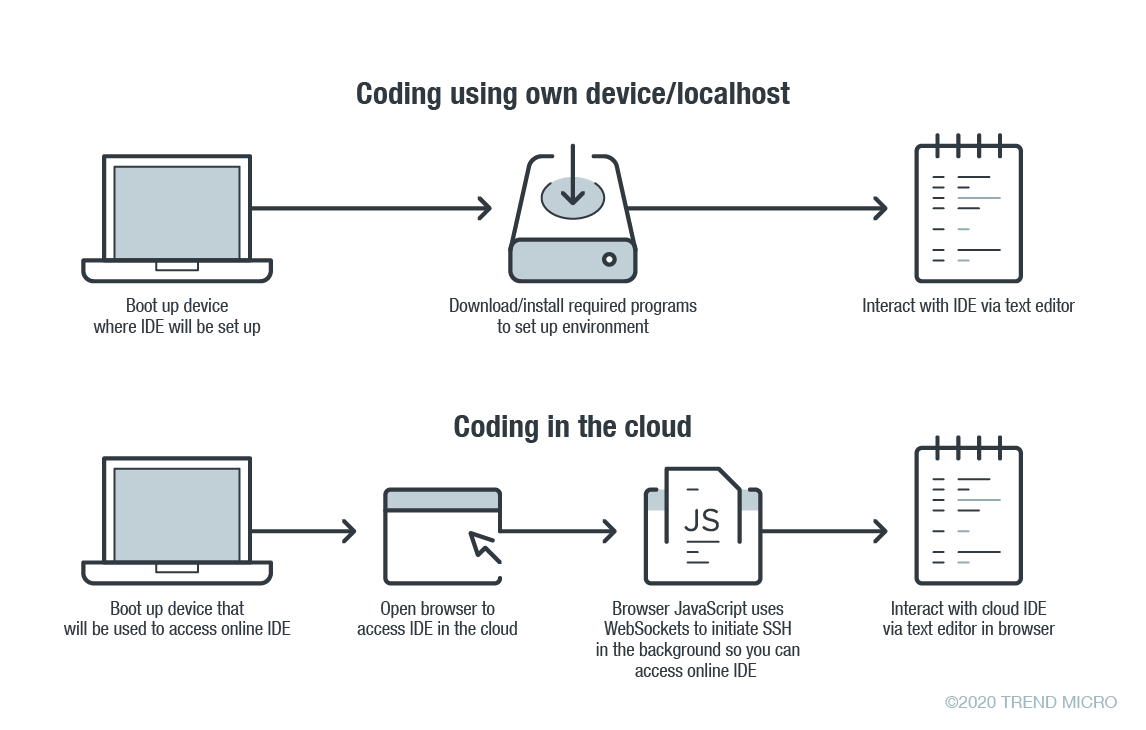
    Figure 1. Local versus cloud-based IDE. Source: Trend Micro.

    The main difference between local and cloud-based coding platforms is where the bulk of the environment resides. In cloud IDEs, the environment is a virtual machine instance inside your cloud provider. In terms of security, this means you are delegating trust to the cloud provider, but you are responsible for preventing any backdoors from opening or introducing misconfiguration issues to the VM. In the case of using your own device with AWS Cloud9, you are responsible for configuring the device securely.

    Linked Devices/VMs Are Not Always Secure

    What is running on the backend often dictates whether linked devices and VMs are secure. As previously described, an SSH-linked device is necessary to use these online coding platforms. In the case of Visual Studio Online (still in preview mode as of this writing), we can find a Visual Studio (VS) Code server running on the machine.

    The code server itself is a Node.js application to which your browser will connect. You can also download the whole ~/.vscode-remote folder and run the server inside your local environment.

    As the owner of the linked device, you have permission to promote yourself to root and install or configure whatever you think you will need. You also have, by default, both Docker and Git pre-installed.

    In the case of AWS-hosted Cloud9, the situation is a little more complicated. The backend necessary for platform communication is located inside the linked device while the frontend remains hosted on a different location. But, like in VS, you can also promote yourself to root.

    This brings us to our first security concern: How secure or private are linked devices/VMs?

    The linked device contains confidential information—access tokens, application configurations, source code, etc., which should be protected against unauthorized access.

    By default, the platform is secured by the provider. However, you should keep in mind that, together with your root access availability, you are also responsible for preventing misconfiguration issues, especially when using third-party plugins. AWS does not provide plugin support for plugins not developed by them.

    There are possible misconfigurations you might make that can lead to security issues. For example, if you set your IDE to be accessible from outside, either intentionally for ease of sharing, or unintentionally, that change can have major consequences.

    In addition, it is not common for access tokens to be stored in encrypted token vaults. A lot of them can be viewed via plaintext configuration files. Without additional security measures, your access tokens can end up exposed to outsiders.

    Once unauthorized access is acquired by cybercriminals, they can compromise your code for their own gain. An example would be the supply chain attack against a software company that modified software updates with malware.

    Browsers Can Introduce Malicious Extensions or Vulnerabilities

    The next security concern is the browser itself. As online coding platforms are accessed from web browsers, you should be very careful when accessing these sites from public, non-domain, shared or unprotected computers.

    Malicious browser extensions are a well-known phenomenon. While an untrusted computer possibly infected with malware presents an obvious risk, it is also possible for an attacker to steal code using a malicious web browser extension.

    Code Extensions and Plugins Can Also Contain Malware

    The main advantage of Visual Studio Online and, generally, the VS Code platform, is the number of extensions available. This in and of itself is yet another possible attack surface.

    Let’s imagine a malicious VS Code extension—a useful-looking extension with an embedded backdoor. The lack of permission checking (such as disk access, network access, process access, etc.) for extensions during installation or use, becomes a security problem. The extent of security checks during extension publishing is limited to having a valid publisher ID and a few image-related restrictions. This means you have to trust the extension developer entirely.

    No Software Application Is Error-Free

    The ever-present possibility of vulnerabilities in any kind of software must be considered as well. In the case of online coding platforms, they can be affected by web-class vulnerabilities since IDEs are web applications. For example, a vulnerability that allows an attacker to execute their own JavaScript code can have control of the IDE or remote linked devices.

    A recent vulnerability affecting the Visual Studio Live Share extension, which is also available for VS Code, shows that we can expect to see another vulnerability affecting online coding platforms in the near future.

    Securing Cloud IDEs Is a Must for DevOps

    Threat modeling allows us to understand the different factors at play that can affect the overall security of a computing environment. Cloud IDEs should be no different from other software, if not more critical to secure.

    Here are some recommendations for each of the security issues we raised:

    • For linked device security — Install trustworthy software. Keep that software updated. Don’t indiscriminately open ports to the internet.
    • For browsers — Work inside trusted and secured environments. Try to avoid using shared computers. Install browser extensions from trusted vendors only.
    • For VS Code extensions — Avoid installing extensions from unknown sources or authors.
    • For vulnerabilities in general — Make sure your environment is updated to the most recent version.

    — David Fiser

  • DevOps Chat: 7 habits of successful DevOps

    DevOps Chat: 7 habits of successful DevOps

    I recently had a chance to speak again with Sam Guckenheimer of Microsoft about his experience in leading the transition for Microsoft Visual Studio to Visual Studio online. In doing so, Sam and his team developed the 7 habits of successful DevOps.  You can listen to my interview below or read along below that. Also if you want to download the Microsoft paper on the 7 habits of successful DevOps you can do so here.
    [soundcloud url=”https://api.soundcloud.com/tracks/234949072″ params=”color=ff5500&auto_play=false&hide_related=false&show_comments=true&show_user=true&show_reposts=false” width=”100%” height=”166″ iframe=”true” /]

    Hi, everyone—Alan Shimel, devopsy.kinsta.cloud, here for another DevOps Leadership Chat, and I’m joined today by Sam Guckenheimer of Microsoft. Sam, welcome.

    Interviewee:                 Hey, Alan. How are you doing?

    Interviewer:                 I’m doing well. It’s good to speak to you again. The last time we spoke was at the DevOps Enterprise Summit out in San Francisco.

    Interviewee:                 Yep, that was a lot of fun. That was a great conference.

    Interviewer:                 Yes, and you know what? I think—well, you contributed to making it great, Sam. It was a great presentation you made, talking about, kind of documenting the journey of Visual Studio from a COTS, you know, traditional kind of software model to a SaaS based program, Visual Studio Online. And, you know, I think that’s something that a lot of our listeners may be interested in, and how do they turn their current software offerings into SaaS based. And along the way, of course, you’ve come up with a, I guess you call it the Seven Successful Habits of DevOps?

    Interviewee:                 Yeah, so we think about the seven habits that we’ve applied as we’ve done our transformation. We started around 2010, we were in the, if you will, the pinnacle or the leader’s quadrants on all the analyst assessments as a provider of software for on-prem use in what was then called ALM—application life cycle management. And we said, “Hey, we need to become a great SaaS provider as well.”

    So we think of things in terms of these seven habits that we need to provide. Three of them you can think of as sort of Agile on steroids or second decade Agile. That’s team autonomy and enterprise alignment, is number one. We work in scrum teams or feature crews, think about 8 to 10 engineers and a product owner. They autonomously pull items from a common product backlog, and at the same time, they align to enterprise goals on a six month planning cycle, we call this a semester or a season, where we know, in that time frame, what are the needles we’re trying to move for the business? What are the things we’re trying to do at the epic level that count, and Sprintly we measure, how are we doing against that, and the things that each feature crew is doing are counting against that. They may move forward, they may move backward, they may decide, based on the data they’re collecting to do more or do something else. But you know, that’s in their control based on the things we’ve agreed for the six months.

    The second habit we have is a rigorous management of technical debt. We’ve known about technical debt for a long time, but when you’re running a service, you really can’t afford to let any debt creep in, and you have to stay clean all the time. So we make sure that we’re constantly monitoring both what’s happening in the production service and what’s happening in the development process. So if, for example, there is anything on the live site going wrong, we attend to it immediately. If there’s anything happening in the development process, like a feature crew is letting its bug count start to ride up, they have to stop immediately, fix the bugs, and can’t do any new work until they get them down to zero, so we stay clean on tech debt as we’re going.

    The third habit is a focus on the flow of customer value. We’ve talked about this since early days of Agile. Now, with SaaS, we can measure it. So we have great telemetry in the service, and we look at how people use our software, both quantitatively as we’re going forward; that is, we actually observe what gets used, what doesn’t get used, what the scenarios are, and we reach out to customers qualitatively, where we engage with the high usage accounts and we say, you know, “Let’s talk to them.” And we encourage our engineers to buddy up and reach out and say, you know, what’s gone well, what’s gone not so well, what would you like us to do that you don’t see? Are there things you wish for that we could be doing for you, and so on.

    So we reach out to customers, we listen to them through things like UserVoice and we observe their behavior through telemetry on a continual basis. That’s all kind of Agile on steroids.

    Interviewer:                 Mm-hmm.

    Interviewee:                 You know, those are the first three. Then you get to the stuff that’s really new with devops. The first is, of those, number four is what I’d call hypothesis driven development or a backlog that gets groomed with learning. This is what Eric Ries, in Lean Startup, calls “build, measure, learn.” So, in other words, the idea is that the backlog, instead of being the just, you know, what an omniscient product owner things is right, it’s—we recognize that it’s a set of hypotheses or beliefs. We think that these things will improve our service, but we’re gonna treat them as hypotheses and we’re gonna turn those hypotheses into experiments, and we’re gonna collect data against those experiments so that we can substantiate or diminish the hypothesis, and that data will be evidence gathered in production. That’s the fifth practice—everything is evidence that we need in order to build up or draw down against those hypotheses. We look, we use instrumentation on everything, we use telemetry on everything, and we measure it against what’s important.

    So, for example, if we think something’s gonna be a better sign of experience, we will run the new against the old in parallel, and we may, if we have multiple front doors, like in our case we have a web experience and an experience through the IDE, the integrated development environment, we’ll run those in parallel. So that would be a four cell test, you know? New and old, web and IDE, and we’ll see what the evidence shows us about how much better the new is than the old, and hopefully the new is better; it might not be. Hopefully we’re right, but sometimes we’re wrong. In any event, it’s the data that will tell us, and it’s a “bring your data” world.

    So, evidence gathered in production is our fifth habit, and that is made possible by our sixth, which is what we call a production first mindset, or what Satya, our CEO, calls a live site culture. The idea of a live site culture is that the site status is always first priority, and with site status, you have two goals. If there is a live site incident, you want to, as quickly as possible, remediate so that customers aren’t affected, and you want to drive to a root cause analysis. Practice the 5 Whys like Toyota, get to the root cause, and identify the actions that you need to take in order to prevent a recurrence of such an incident or something similar, and those root cause actions that you take, you need to complete in one or two sprints so that you’re hardening the service as you go learning from the live site incidents so that you’re always getting better.

    That’s number six, and finally, number seven is that we manage infrastructure as a flexible resource. We can do this because we use the public cloud—of course, in our case, that’s Azure. We work as a customer of Azure just like our external customers would. We take things a little earlier, but otherwise, we’re a customer when we need more resources for development or for load testing or to spin up more labs, we just do it.

    And we continue to expand the number of data centers we run, and we now run our Visual Studio Team Services in eight data centers around the world; that’s out of 24 regions that are currently active in Azure, and we fully automate the deployment, but we start each Sprintly deployment with a canary instance, which is where we work. It’s our own one of those stamps, and the one where our closest early adopter customers are so that we know from the canary if there’s anything wrong with the deployment, and if there is, we then restart at the canary before we roll out to the subsequent deployment rings. And that practice of canary-ing, going big with load testing is part of the deployment pipeline, and then using the automation to roll out in subsequent rings is something that we’ve used to harden the service and let us get to a global scale on a regular basis.

    Interviewer:                 Got it. So, Sam, these are obviously lessons learned the hard way, right, [Laughter] by doing and paying the idiot tax and doing that.

    Interviewee:                 Yes.

    Interviewer:                 For our leaders who are listening to you now, where to begin? Where to start? Obviously you can’t do all seven at once. Some of them are dependent on others. Where do they begin?

    Interviewee:                 Well, I think that the first thing is to make sure you have Agility down. I think you cannot do this if you are a command and control organization that doesn’t really let teams learn, and to recognize that you do need to measure your time to learning along with your other measurements, you also need to totally automate your release pipeline.

    So, the notion that you can have manual steps somehow between a development pushing code or checking in and the release of that is a thing of the past. You know, start with continuous integration and then quickly go to continuous deployment and put the telemetry in place so that you can see the evidence from production that gives you the feedback on everything that’s getting deployed.

                                        If you don’t have those things in place, the rest will crumble.

    Interviewer:                 Yeah, agreed.

    Interviewee:                 Sam, we unfortunately are coming up near the end of our time. I want to ask one more question of you, though, and it’s along the same vein. So, you’ve laid out the steps here for us. How did you get your team’s buy-in on this—or did you?

    Interviewer:                 Well, we certainly did. I don’t think it was very hard. I think that we all wanted to move to this world. I think that there was a broad recognition that we needed to become a first class SaaS provider. I think that there were some additional quirks in our case of being a great SaaS provider while we continue to be a great provider on-prem software, and maintaining that engineering discipline.

    The teams were all for it. I think the leadership needed to recognize that we were investing in new practices and that we needed to maintain the investment in engineering systems and engineering practices so we have a rule of thumb that about 20 percent of our investment goes toward non-customer visible engineering, things like live site work, and we don’t quarrel about that. If we need to do live site improvements, we do them.

    So I would say there was a little bit more work on management to accept the change in practices than there was on the ground with the engineering teams who were sort of chomping at the bit to get going.

    Interviewer:                 Well, there often is in devops, right? You have that “from the bottom up” and getting true top down sponsorship and cover is a problem, right? Not a problem that cannot be overcome, but an issue that we’ve explored previously in our leadership suite here.

    Interviewee:                 Yeah. Yeah, it helps that our, right now, our CEO comes from this world, Satya Nadella, so he is pushing everyone in the company to make the change and to learn the new practices. There were some folks in the middle who were not comfortable, necessary, but you know, they’ve come around.

    Interviewer:                 As they often do.


    Interviewer:                 Sam, anyway, we are probably over our time and I apologize, but thank you very much for sharing your Seven Habits for Successful DevOps. Continued success with your Microsoft Visual Online and the rest of your endeavors at Microsoft, and we hope to have you on again some time in the future and we can talk more about leading the transformation at companies around the globe with these new ways of doing things.

    Interviewee:                 Thanks, Alan. I’ll do one commercial, which, which is that there’s a URL, microsoft.com/devops, where you can download an e-book about our journey and a devops self-assessment if you want to read more.

    Interviewer:                 You know what, we’ll include that link in the article, too, in the transcript so people can get that. Sam Guckenheimer, Microsoft—thank you so much for being our guest today.

    Interviewee:                 Thank you very much, Alan.

    Interviewer:                 Okay, this is Alan Shimel for devopsy.kinsta.cloud. Thanks, and have a great day.

  • Does Microsoft really have a DevOps story?

    Does Microsoft really have a DevOps story?

    I normally am not a fan of Microsoft conferences. But i’ve always loved the Build Conference. Not just because there is usually an awesome show giveaway. Like this years HP spectre x360, currently my Windows 10 testing machine. But also because the vibe, format, and topic matter is always interesting. I attended this year for the third time, and I wanted to answer the same question I have every year. What, if anything, does Microsoft have for DevOps?

    (more…)

  • Microsoft’s DevOps Gambit and devopsy.kinsta.cloud’s Business Directory

    Microsoft’s DevOps Gambit and devopsy.kinsta.cloud’s Business Directory

    Last week was a big one for Microsoft in DevOps. At the Build conference they unveiled several new features and functionality in both Azure and Visual Studio Online to make give them more DevOps chops and DevOps friendly.

    At just about the same time they announced partnerships and integrations with both Chef and Puppet Labs to bring even more DevOps to Azure.  That is an awful lot of DevOps functionality in a short period of time.

    Frankly it is to be expected though. In doing my research for devopsy.kinsta.cloud prior to launch, I had a chance to speak to some folks at Microsoft about DevOps. Frankly they were frustrated. They thought they had a great story around DevOps and had not been able to attract the DevOps community to what they had available.  Microsoft, much like IBM at one time owned the developer market.  In fact the sheer number of developers who still develop in Visual Studio and code for .Net and other Microsoft platforms, is pretty amazing.

    Now you don’t just have .net folks on Azure anymore.  The platform now supports Node.js. Java. PHP and more. It blends both IaaS and PaaS, allowing users to slide between them almost seamlessly.

    In the meantime DBMaestro announced it was bringing DevOps for database to MS SQL server. This is the same teamwork functionality that DBMaestro already delivered to Oracle users.

    In addition to these announcements Microsoft also released some metrics that show just how scalable and quick the uptake has been on Azure and Visual Studio Online.  Ultimately the answer will be do enough developers think Microsoft gives them what they need to build great applications on a great platform. This will determine whether Microsoft becomes a competitor to Amazon and Open Stack in the public Cloud.

    But they are making their play. Whether you love them or hate them, it is never smart to bet against Microsoft. The numbers they announced last week show they can gain critical mass pretty quickly.

    There are some good background stories on this at Redmond Mag, eWeek and TechWeek Europe. We will have a full feature story here on devopsy.kinsta.cloud shortly.

    On another note, here at devopsy.kinsta.cloud we have put up our DevOps business directory in beta. Over the next few weeks we will pretty it up, but right now we are testing the functionality. We have populated the directory with some companies, but need more. Listing a company is free and if you list your company this week, we will upgrade you to the deluxe listing free ($99 value).

    You can add long and short descriptions, logos, files to download, contact info and more. The directory over time will we hope become the source for finding DevOps related companies.

    Look for more devopsy.kinsta.cloud features and events over the coming days and weeks.