
Tag: virtual machine
-

Oracle Includes GraalVM Support in Java SE Subscription
Oracle announced today it is adding a GraalVM Enterprise virtual machine for building Java applications to Java SE Subscription at no additional cost.
Donald Smith, senior director of product management from the Java Platform Group at Oracle, said GraalVM Enterprise provides developers with a high-performance application runtime, built on Oracle Java SE, that includes a compiler that accelerates Java application execution. That’s critical as developers look to build microservices-based applications employing microservices that tend to be latency sensitive, Smith said.
The first stable release of GraalVM arrived last fall. It consumes less memory, and enables Java applications to spin up faster by taking advantage of capabilities such as a just-in-time compiler. GraalVM Enterprise adds a native image utility that compiles Java and JVM-based applications ahead-of-time (AOT) into self-contained native executables. That approach only includes the classes and libraries needed to run the application, which reduces the size of the binary that gets generated.
Including GraalVM Enterprise in the Java SE Subscription make it easier for Java developers to switch to that Java virtual machine (JVM) to build microservices rather than having to learn another language, Smith said.Smith said most organizations will continue to build monolithic applications at the same time they’re attempting to construct microservices. The Java SE Subscription makes it possible for developers to employ different JVMs depending on the type of application being constructed or updated, Smith said. A survey of 560 developers conducted by Oracle last month finds nearly half (48%) are already employing GraalVM to build microservices using Java.
How much will organizations rely on Java to build microservices, given all the other programming language options available? That’s up for debate. However, being employed in the enterprise for more than 25 years, the number of developers that know Java well is substantial. Rather than waiting for those developers to become proficient in another programming language, there’s a natural tendency for organizations to want to stick with a familiar language. Each additional language introduced to build applications also tends to complicate DevOps processes in a way that can increase the total cost of IT.
At the same time, however, the number of developers that know how to develop applications using everything from JavaScript to Go is also increasing. Oracle, via ongoing investments made in the OpenJDK project, is moving to make sure Java stays relevant at a time when the number of programming languages being employed has never been greater. For what it’s worth, GraalVM is designed to support multiple programming languages, including JavaScript.

It’s unlikely Java will fade into obscurity any time soon. IT organizations have a vested interest in embracing next-generation JVMs, if for no other reason than making Java applications more efficient, regardless of how they are built.
It’s also worth mentioning that frameworks – such as Quarkus from Red Hat – that enable Java-based microservices to run natively on Kubernetes clusters already rely on GraalVM. In some cases, developers may wind up employing such a framework without realizing it relies on GraalVM. In other cases, the challenge will be getting developers to opt for GraalVM as their JVM of choice when so many of them have routinely used the same JVM for more years than they care to admit.
-

RackN Transforms Bare-Metal Servers Into a Cloud
RackN is making available an update to the RackN Digital Rebar Platform that will make it easier to employ tools such as Terraform to configure bare-metal servers.
Company CEO Rob Hirschfeld said version 4.4 of the platform adds an application programming interface (API) that enables bare-metal servers to be abstracted into resource groups. IT administrators can request a machine based on an attribute map to provision a collection of bare-metal servers as if they were a cloud platform, he said, noting RackN is also making available workflows to enable IT teams to automate the allocation and reallocation processes more easily.
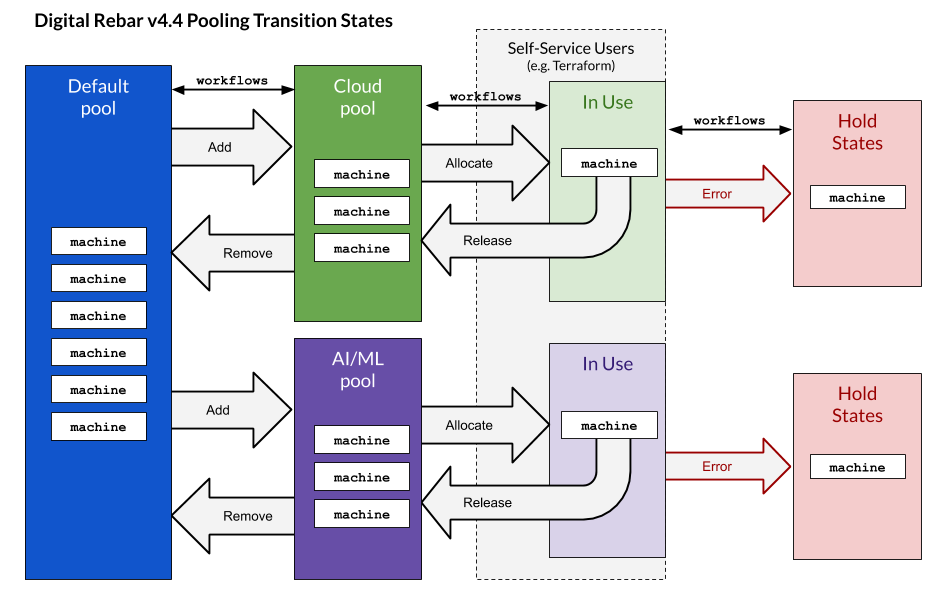
At the same time, the latest release of RackN Digital Rebar Platform adds support for Trusted Platform Module (TPM) Secure Boot, an industry standard that ensures only software that is trusted can be loaded onto a machine. Most automation platforms don’t support TPM Secure Boot, which forces IT teams to choose between the benefits of automation and having a secure platform. RackN Digital Rebar Platform is the only automation framework to support (TPM) Secure Boot in VMware environments, Hirschfeld claimed.
Out-of-band management passwords, TLS certificates and VLANs will also be secure by default with this latest release, he said.
Hirschfeld said IT teams want to be able to provision bare-metal servers as if they were code in much the same way they provision virtual machines. Just as importantly, they require an automation tool that enables them to just as easily de-provision those machines when it comes time to reallocate them to another workload.
Achieving that goal, however, should not require IT organizations to hire a site reliability engineer (SRE), he said, noting the RackN Digital Rebar Platform is designed to be employed by the average IT administrator. An SRE could define workflows within the RackN Digital Rebar Platform that are reused by IT administrators; in fact, RackN plans to add support for Git repositories that will make it easier to share workflows, Hirschfeld added.
While the reasons for deploying workloads in the cloud versus on-premises IT environments are varied, the automation advantage cloud platforms historically have enjoyed over on-premises IT environments is narrowing at a time when interest in deploying Kubernetes clusters on bare-metal servers is rising. It may be a while before most IT teams are able to manage bare-metal servers as if they were just another cloud resource. The main obstacle for achieving that goal now, however, is likely to be a lot more cultural than it is technical.
In the meantime, IT teams should expect to see bare-metal servers employed more widely in the age of containers. There will, of course, always be a need for virtual machines, at least in the foreseeable future. The challenge is the IT infrastructure environment itself is becoming more diverse as new classes of cloud-native application workloads emerge.
-
VMware Looks to Accelerate App Migration to the Cloud
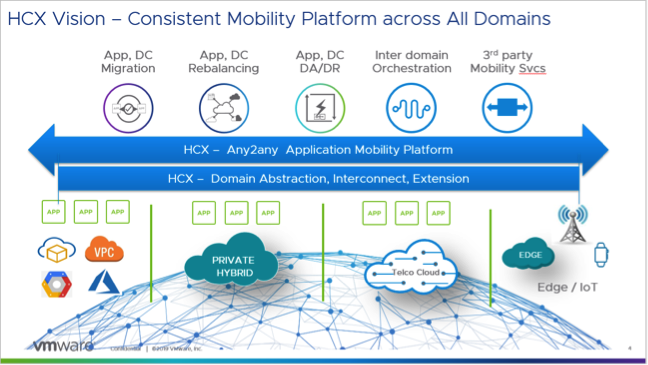
VMware this week expanded the scope of its cloud migration efforts to include workloads that aren’t running on its virtual machine. VMware HCX leverages replication and virtual machine mobility technology to make it easier to automate the migration of either VMware-based workloads or those running on rival platforms to the latest generation of VMware platforms.
Previously, VMware only offered this migration capability as part of larger services offerings that were focused on only migrating workloads running on VMware platforms. Allwyn Sequeira, senior vice president and general manager of the Hybrid Services Business Unit at VMware, said VMware HCX not only extends that capability to orphaned platforms such as Open Stack and Kernel-based Virtual Machines (KVM), it also marks the first time VMware has offered this migration tool as a separate, standalone offering.
Sequeira said VMware HCX provides an opportunity for organizations that have committed to a platform other than VMware to reconsider their options. VMware HCX provides a way to migrate thousands of virtual machines at a level of scale that significantly reduces the amount of time to make that transition, he said.
In some cases, Sequeira said customers have already employed VMware application migration tools to lift and shift thousands of virtual machines into cloud computing environments such as Amazon Web Services (AWS) in a few weeks. Overall, the rate at which those migrations are occurring has doubled every quarter for the last six quarters, he added.
VMware HCX is based on virtual machine mobility technology developed by VMware combined with a similar cross-platform workload migration technology the company gained in its acquisition of CloudVelox early last year. VMware HCX now provides organizations with the option of migrating virtual machines programmatically via an application programming interface (API) or via a graphical user interface (GUI).
There exist multiple tools for migrating workloads into any number of cloud computing platforms. Many organizations are also taking advantage of Docker containers to encapsulate entire workloads so they can run on any platform. Deciding which path to pursue most often comes down to the level of integration required with the various services available on the targeted cloud migration platform.
In the meantime, as workload migration tools become more sophisticated, decisions regarding where workloads need to run are becoming less concrete. Competition for new workloads between platform vendors has always been especially fierce, and it used to be that once an IT organization made its decision, it was unlikely it would change its mind, given the effort needed to swap one platform out for another. Now, however, as application workloads become more portable, competition among platform vendors will only increase as they seek to convince IT organizations to shift existing workloads onto a different platform.
In general, that increased level of competition bodes well for DevOps teams, who are usually among the strongest advocates for change within any IT environment. The issue now is deciding which platforms within those already-cluttered IT environments make the best candidates for rationalization.