Tag: Virtana

  • Too Many Organizations Get Public Cloud Wrong

    Too Many Organizations Get Public Cloud Wrong

    The cloud has been getting a lot of press in the past few years—and with good reason. The elasticity and flexibility of resources are transformational for businesses. However, there are also drawbacks. For most enterprises, it’s a significant undertaking to migrate on-premises applications into a public cloud environment.

    Modern applications today are rarely self-contained entities. Application dependencies occur when software components, applications and servers rely on one another to deliver a service. The typical enterprise manages hundreds, or even thousands, of interconnected components and services, forming a complex web of dependencies.

    If an application is migrated to the public cloud without understanding the dependent services, severe performance degradation can occur with applications that are still on-premises. For example, moving an e-commerce shopping application to the public cloud but leaving a key database on-premises will result in consumers experiencing a slower response.

    The Repatriation Problem

    IDC research shows that fewer than 20% of enterprise applications have been moved from onsite data centers to the public cloud, not because companies do not see value in the cloud, but because the process of getting those applications to the cloud is complicated.

    A survey of 350 cloud decision-makers in the United States and UK commissioned by Virtana and fielded by Arlington Research in November 2020 confirmed this. More than two-thirds (68%) of respondents have already migrated 25% or more of their applications to public clouds, supporting the IDC finding.

    Clearly, businesses recognize the value of the cloud. But another surprising result confirms that the migration process may be problematic. A whopping 72% of respondents said they have moved one or more applications from the public cloud back on-premises. Considering the time and effort cloud migrations require, this is a striking result. While there may be cases where repatriation is undertaken strategically to support evolving business needs, the reasons cited by respondents show most were rollbacks required because of unanticipated problems.

    There Is No Single Reason Why

    Almost half (41%) of respondents said they repatriated applications that should have stayed on-premises. The reality is that not all workloads are a good fit for the public cloud environment. You need a solid understanding of the various attributes of different workloads, such as data, back end, privacy and security requirements, to determine their inherent suitability for a public cloud environment.

    Technical provisioning issues challenged 36% of respondents. The sheer number of configuration options available—combined with the variety of computing dimensions that you have to take into account—means there are a lot of puzzle pieces that have to fit together, or you could run into problems.

    Almost one-third (29%) of respondents reported application performance degradation in the public cloud. The public cloud is a fundamentally different environment than an on-premises data center, and creating a hybrid environment further alters the nature of the infrastructure, so you cannot simply expect workloads to attain the same performance levels as you migrate them. And if performance slows to an unacceptable level, any benefits you gain by moving applications to the cloud are overshadowed.

    Around one-fifth (21%) admitted that they selected the wrong public cloud provider. Cloud providers are not all the same, and picking the wrong one, for any reason, can be an expensive and disruptive mistake.

    Finally, one-fifth (20%) of respondents repatriated applications because of unexpected costs in the public cloud. The public cloud’s pay-for-what-you-use model is appealing compared to the on-premises capex model, where you pay for capacity regardless of whether you use it. But there is a dark side; you have to pay for what you use in the cloud even when that usage is unexpected. Whether that is due to poor planning, an unanticipated surge or workload drifts over time, getting a nasty surprise in your end-of-month bill can put a big dent in your cloud budget.

    Eliminate Repatriation With Better Planning and Observability

    Any one of these reasons alone reflects a challenging setback to overcome. Unfortunately, many organizations run into more than one of these problems. In fact, one-third of respondents cited two or more of these reasons for repatriation, and 12% experienced three or more of these issues. This seems to indicate that organizations’ migration planning efforts are inadequate. It is not for lack of investment—78% of survey respondents said that even during the current challenging economic climate, they are continuing their migration to the public cloud at the same or an accelerated pace, signaling they believe public cloud deployments to be a strategic investment.

    The real problem is a lack of precision in observability—of workload characteristics in the data center pre-migration and of workload utilization and performance in the public cloud post-migration. The better you understand your applications, in minute detail, within the context of the environments they are moving from and to—a ‘know before you go’ approach—the less likely you will have to hit the “undo” button on your public cloud migration.

  • Virtana Expands Monitoring Coverage and Enhances Infrastructure Capacity Planning with Latest Version of VirtualWisdom

    Hybrid Infrastructure Management and AIOps Platform Builds on Customer Requirements to Deepen Infrastructure Visibility, Simplify Capacity Management, and Better Control Infrastructure Costs

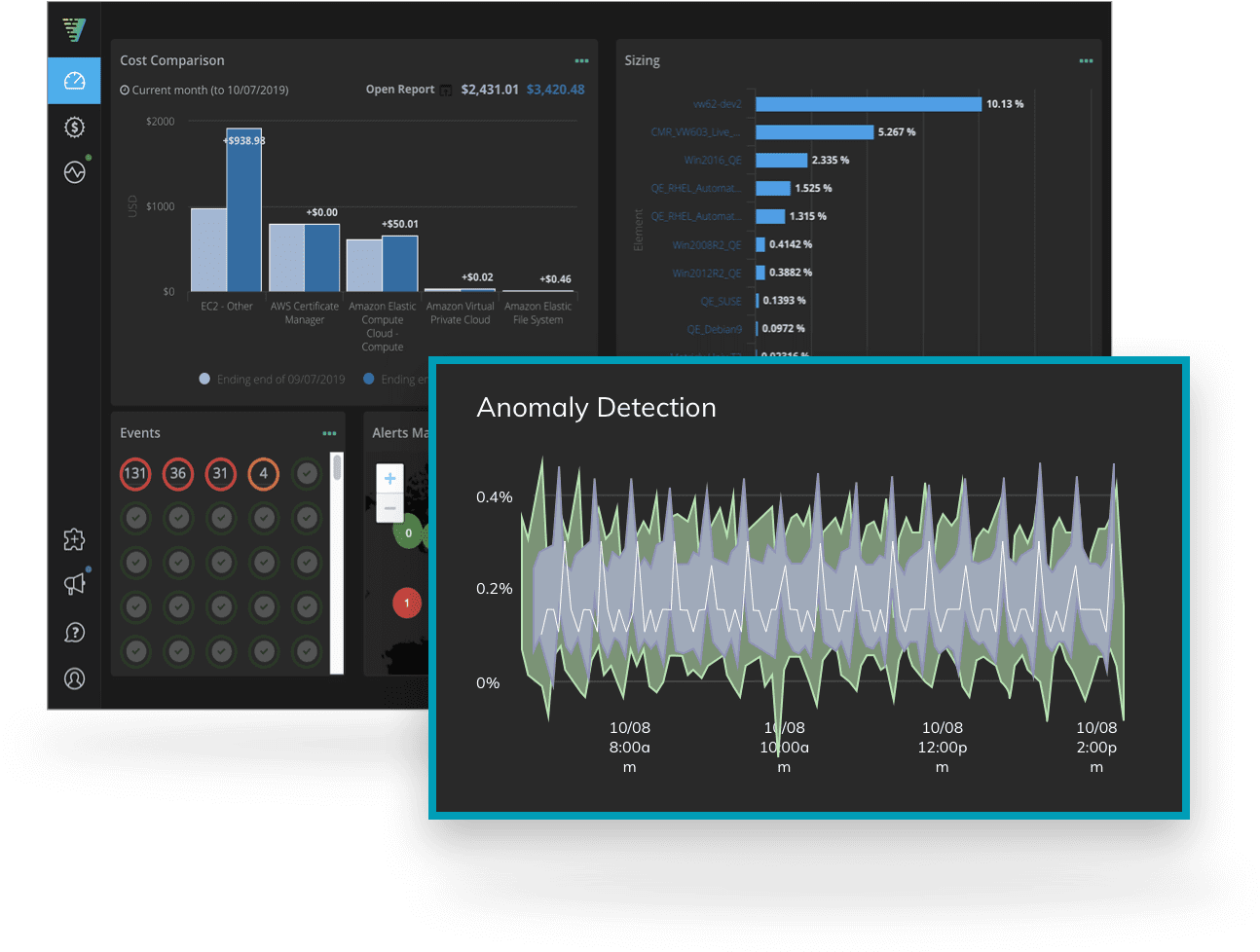
    San Jose, Calif., December 10, 2019 – Today Virtana, the leader in hybrid infrastructure management for mission-critical workloads, introduced the latest version of VirtualWisdom, the premier hybrid IT infrastructure management and AIOps platform for mission-critical workloads. VirtualWisdom 6.3 is the first product launch since Virtana’s rebrand in October 2019 and continues the company’s push into capacity management with global storage array analytics, an expanded range of integrations, and new portable reports and dashboards.

    Today’s mission-critical hybrid applications combine resources in public clouds, with physical or virtual resources residing in private data centers. For these crucially important workloads, operating at web-scale, managing cost, performance, and capacity has never been more complex or important. To gain the insights and operational control that deliver efficient, cost-effective operation, organizations need real-time visibility, automated discovery, AI-powered analytics, and immediate access to best-practice solutions that proactively solve infrastructure-related performance and capacity issues for critical applications.

    VirtualWisdom provides real-time, data-driven lifecycle recommendations to assure performance, speed problem resolution, automate workload optimization, free-up capacity, and ensure resource availability. AI-powered capacity forecasting helps organizations avoid capacity-driven problems before they can happen, and AI-powered workload optimization keeps applications operating within SLAs.

    “To provide organizations with a competitive advantage, IT needs to use and manage their resources efficiently. IT professionals need tools to enable them to quickly resolve problems, even as the infrastructure becomes increasingly more complex. They also need to automate as many of the mundane IT tasks as possible,” said George Crump, President and Founder of Storage Switzerland. “Powered by AI/ML capabilities, VirtualWisdom offers recommendations and automated problem resolution, providing customers with deep infrastructure visibility.”

    The new VirtualWisdom release features the new Capacity Auditor, a global storage array analytic that offers a unique approach to global capacity management designed to provide app-centric insights and intelligence across hybrid infrastructure and multi-vendor data storage environments. With Capacity Auditor, organizations have a broad view of storage usage and trends across all storage arrays, applications, locations, physical storage assets, and effective capacity.

    Other key features of the new VirtualWisdom 6.3 release include:

    • New infrastructure integrations: Support for Oracle’s Solaris, Red Hat KVM, and Pure Storage solutions that provide all the power of the VirtualWisdom platform to applications using infrastructure within these environments, and management of infrastructure elements that live within them.
    • Dynamic entity insights: Enhances VirtualWisdom’s continuous real-time infrastructure discovery with simple, intuitive dashboards and reports for servers, storage, and networks. Enabling immediate insights into critical relationships between infrastructure elements, visibility into vital statistics, and the capability to automatically apply customizable information sets for identification and cost.
    • Portable reports: Empowers users to share collective insights, dashboards and reports across the VirtualWisdom community. Customers and partners can easily exchange best-practice monitoring reports and visualizations unique to specific environments and applications.
    • Hybrid Application Definition: Hybrid, real-time application views make it easy to visualize hybrid applications that cross multiple technology boundaries in one view – including applications that span multiple clouds (AWS, Azure), virtual environments (VMware, KVM, HyperV, PowerVM) as well as physical systems.

    “The Virtana VirtualWisdom platform has been a fundamental enabler of our mission-critical manufacturing technology solutions and services for many years now,” said Todd Weeks, Plex Systems Global VP of Cloud Operations. “Our ability to offer our customers nearly 100% business continuity in a highly efficient cloud infrastructure relies on the real-time infrastructure visibility and AI-powered analytics that are unique to the VirtualWisdom platform.”

    “Digital transformation is driving exponential data growth as today’s enterprises must have global visibility into all storage resources to continuously meet these ever-growing demands. Point solutions to managing data sets across multiple vendor storage environments result in highly fragmented, manual and wasteful practices and resources – and can put entire applications at risk,” said Tim Van Ash, SVP of Products at Virtana. “With application aware, predictive insight into the underlying digital infrastructure, VirtualWisdom offers the industry’s first and only global infrastructure capacity auditor and forecaster that can providing real-time visibility into mission-critical digital workload infrastructure.”

    The latest version of VirtualWisdom is currently being showcased at the Gartner Infrastructure Operations and Cloud Summit in Las Vegas. Todd Weeks, Plex Systems Global VP of Cloud Operations will be speaking on December 11th at 11:15am on “How Virtana Empowers Peak Performance for the Plex Manufacturing Cloud”.

    To learn more about Virtana’s award-winning hybrid infrastructure management platforms, please visit: www.virtana.com/whyvirtana. To experience the free VirtualWisdom trial version, visit: www.virtana.com/try-now/

    About Virtana

    Virtana is a leader in hybrid infrastructure management for mission-critical workloads, providing comprehensive hybrid IT infrastructure monitoring and real-time, AI-powered analytics for the modern enterprise data center. The company’s solutions give IT operations teams deep workload visibility and actionable insights into their end-to-end systems that support mission-critical applications. Virtana customers include leaders in enterprise IT, cloud service providers and federal agencies, that are leveraging the company’s platforms to maximize the performance, health and utilization of their hybrid IT infrastructure. The privately-held company is headquartered in San Jose, Calif. For more information, please visit www.virtana.com.

    ###

  • Virtual Instruments Changes Name to Virtana to Drive AIOps

    Virtual Instruments Changes Name to Virtana to Drive AIOps

    With the formal launch of a software-as-a-service (SaaS) to monitor cloud platforms and optimize cloud, Virtual Instruments today renamed itself Virtana.

    The company’s CloudWisdom platform is based on technology Virtana gained via the acquisition of Metricly earlier this year. In addition to being integrated with existing on-premises offerings from Virtana, CloudWisdom has been expanded to include a self-service option. Downloadable trial versions are also available.

    Virtana CEO Philippe Vincent said the name change reflects a transformation from being simply a provider of storage I/O performance testing tools to becoming a provider of an IT operations management platform infused with artificial intelligence (AIOps). As part of that effort, the CloudWisdom offering represents the first time Virtana has extended the reach of its offerings beyond on-premises IT environments, he said.

    CloudWisdom will differentiate itself, Vincent said, because it combines cloud monitoring with built-in tools for optimizing cloud costs. Rival offerings require IT organizations to acquire two separate services, he noted. The CloudWisdom platform monitoring capabilities span databases, messaging platforms and containers, as well as cloud infrastructure services from Amazon Web Services (AWS) and Microsoft.

    In general, Vincent said IT organizations are moving away from a reactive approach to managing IT to a more proactive approach that will require increased reliance on automation. As IT environments become more complex, too many IT organizations are trying to compensate by overprovisioning IT infrastructure resources to make sure application performance doesn’t deteriorate or applications crash. That approach not only drives IT costs higher, he said, but it also makes those costs unpredictable.

    To address that issue, Virtana is combining CloudWisdom with an AIOps platform designed to be equally applicable in legacy IT service management (ITSM) and emerging DevOps environments. Organizations that have adopted DevOps will be at the forefront of the transition to AIOps because of the inherent fluidity and velocity of those environments, Vincent noted. Machine learning algorithms coupled with real-time monitoring, big data analytics, workflow engines and automation frameworks will enable IT teams to streamline ITSM and DevOps processes to become more efficient. The opportunity for Virtana is to disrupt a highly fractured monitoring category by leveraging AIOps to unify monitoring at an unprecedented level of scale and scope, he added.

    Virtana is not the only IT management platform provider that has identified the same opportunity; much larger incumbent providers of these platforms and a raft of startups are moving in the same AIOps direction. Vincent said Virtana will differentiate itself by pursuing a more application-centric approach to delivering on the promise of AIOps.

    It’s too early to say to what degree IT operations can be automated using AI. There’s general agreement that AI will play a significant role in automating IT, and the more standardized the IT environment is, the easier it is to accomplish. The challenge is, most IT environments today are still anything but standardized.

    — Mike Vizard