Tag: vertical markets

  • Wind River Launches CD Platform for Embedded Systems

    Wind River Launches CD Platform for Embedded Systems

    Wind River is fostering the adoption of DevOps processes for embedded systems by making available a continuous delivery (CD) platform that its customers can download.

    Glenn Seiler, vice president for open source strategy for Wind River, said the CD platform is based on an open source instance of the Jenkins continuous integration/continuous delivery (CI/CD) platform. The company envisions organizations downloading the platform as source code that Wind River will update regularly for use on top of the Wind River Linux platform, he said.

    Wind River is taking advantage of containers, Kubernetes, the Puppet IT automation framework and a repository to ease deployment of its CD platform, added Seiler. The company is committed to providing updates to that platform, which Wind River uses internally, at least every three weeks, said Seiler.

    Wind River expects most organizations will already have some form of a CI process in place. The CD platform provided by Wind River will focus on accelerating the delivery of applications built using whatever CI process organizations have in place today, said Seiler.

    In the embedded systems space, Seiler said the adoption of best DevOps practices is still in its very early days. However, with the rise of edge computing and the internet of things (IoT), organizations will need to find a way to securely deploy and update highly distributed application environments. To achieve that goal, many organizations will apply the same DevOps principles enterprise companies have been applying to their embedded systems, he said.

    To ensure the integrity of the software supply chain on which the Wind River CD platform is delivered, Wind River has also been certified under the ISO 9001:2015 specification for management processes, as well as the OpenChain specification for open source compliance.

    Wind River also has the Wind River Workbench for Linux LTS, based on the Eclipse integrated development environment (IDE), along with various system analysis tools including a trace visualization tool from Percepio AB to identify the root cause of anomalies.

    While it’s taken more than 10 years to drive the adoption of best DevOps practices in the enterprise, adoption in embedded systems environments should be faster now that the journey has begun. Organizations of all sizes are pushing more application workloads to the edge at faster rates. Traditional approaches to building and deploying applications on standalone embedded systems will not be able to keep pace. Organizations that build applications for embedded systems will be challenged by first acquiring the right tools and then adapting their internal culture to the complexities that arise when they need to build and deploy applications faster.

    Wind River is making the case for a curated open source CD platform that should enable organizations to spend less time on managing the underlying DevOps platform in favor of focusing more time and energy on changing their internal culture.

    — Mike Vizard

  • Report Finds Faster DevOps Adoption in Retail

    Report Finds Faster DevOps Adoption in Retail

    Conventional wisdom holds that when it comes to any IT advancement, technology companies lead the way followed by the financial service sector. However, Puppet has made available an industry scorecard based on the company’s 8th annual “State of DevOps” survey that suggests that when it comes to DevOps adoption, it’s the retail sector that is now the most advanced.

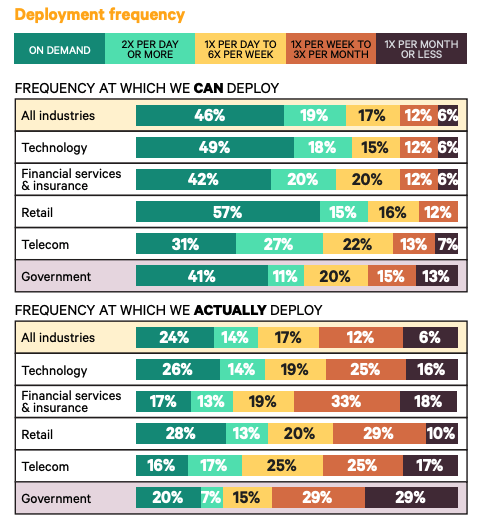
    The survey finds 28% of respondents working in the retail sector said they are deploying on-demand, while 57% said they can deploy on-demand. That compares to 26% doing so in the technology sector and 49% that are capable. In contrast, only 17% of the respondents working in the financial services/insurance sector said they are deploying on-demand, versus 42% who said they are capable.

    DevOps adoptionThe retail sector is also able to resolve critical vulnerabilities the fastest, with 53% reporting they can remediate a vulnerability in less than one day. However, the retail sector also ranks dead last in terms of reported “significant” or “full” security integration (32%).

    Alanna Brown, director of product marketing at Puppet, said the retail sector is embracing DevOps more aggressively largely because of the increased focus on digital transformation. Companies are differentiating themselves more by the quality of the application experience, she said.

    It’s also fair to note that application environments in the financial/life insurance sector tend to be more complex, she noted.

    Of course, DevOps expertise of any one organization in an industry sector is likely to vary widely. However, the Puppet survey makes it clear that the adoption of DevOps is becoming broader.

    In fact, in terms of year-over-year growth, the survey finds the media/telecommunications sector has made the second most progress after retail. The percentage of highly evolved telecom organizations increased by nine points from 8% to 17%. The number of organizations that scored in the low category dropped to 5% from 13%. A large proportion of telecom organizations are embedding a designated security expert in teams while maintaining a centralized security function (41%). However, in terms of DevOps adoption, only 16% said they do deploy on-demand, while 31% said they can. At that rate, that’s even slower than government agencies. A fifth of government agencies (20%) said they deploy on-demand, while 41% said they can. However, only 3% said they are able to remediate vulnerabilities in less than one hour and 24% are able to remediate in less than one day.

    Brown noted that while there is still a lot of room for improvement across all vertical industry sectors, when it comes to DevSecOps there is a definite shift to the left occurring. Many development teams are now designating a cybersecurity expert that advises the rest of the team on security issues versus waiting to engage with a cybersecurity expert from within the central IT organization who has little to no programming expertise.

    It may still be a while before DevOps is adopted pervasively across all vertical industry sectors. In the meantime, however, it’s clear that DevOps progress is finally starting to accelerate.

    — Mike Vizard

  • Simplifying Through DevOps in Banking

    Simplifying Through DevOps in Banking

    There are a great many assets available on the internet that talk about what DevOps is and how far DevOps adoption has come. So we will not repeat the “what” and the “how far.” Instead, we will focus on the road ahead and future of simplification and transformation at banking organizations and the role DevOps is likely to play in the same—in all three areas of “Run the Bank (RTB),” “Change the Bank (CTB)” and “Transform the Bank (TTB).”

    Figure 1: Change-Run-Transform Bank – POA with DevOps Maturity

    In this article, we take a look at what shape we think DevOps-driven simplification in financial organizations can take in the near future and also some opportunities for such simplification. As depicted in Figure 1, with DevOps maturity, the siloed processes of CTB, RTB and TTB will come closer together, allowing common activities and processes to be carried out in one place. The others will get simplified and automated thereby reducing elapsed time of cycle from ideation to production and application management drastically. This will yield benefits not only in terms of cost and time, but also in terms of feature availability to business.

    Banking Focus

    In banking, the early adopters are leading the march with a lot of good practices such as standardized tooling for specific technology areas, orchestration, feedback loop setup, process and technology rationalization, etc. The focus needs to continue on the same.

    We think that the challenge that DevOps architects need to now focus on is to be able to use DevOps to help financial organizations bring down the non-discretionary spend by simplifying the previously ignored maintenance, operations and infrastructure realms. The core of this DevOps driven simplification is needs to be move cost of maintenance to its lowest possible and hence releasing funds to discretionary areas in “Change the Bank” and “Transform the Bank.”

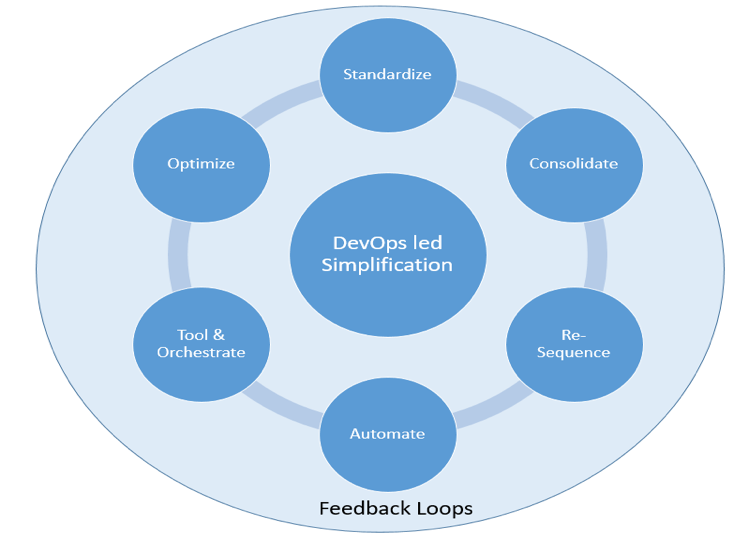
    While the point of arrival for DevOps-led transformation should be “full automation” and “zero maintenance” but they are a bit far in the future because the return on investment (ROI) on the monies and effort required to make that happen needs to justify the same. We see the focus shifting to value delivered to business by transformation of an application or suite of applications. Figure 2 depicts the core repeatable activities of a DevOps-led simplification exercise while keeping in mind these improvement cycles need the setup of feedback loops at each stage.

    Figure 2: Repeatable activities for DevOps-led simplification

    This brings us to our next idea, that the road map to DevOps-enabled simplification needs to be paved with metrics and measures and these metrics cannot be randomly chosen. These metrics have to be actually measurable and be divided into two areas of business metrics and IT metrics as we explain below and need to be diligently tracked to aid course correction.

    For example, release orchestration processes for applications are mostly complicated, need a lot of manual effort, have strict compliance requirements as well as security mandates, need to be carried out more frequently nowadays because of shorter deployment cycles and have to manage ever-increasing complexity of component interaction (upstream and downstream). Now, release orchestration is also a very important step in the entire CI/CD pipeline. So standardization and simplification of release orchestration process makes immense sense. But how does one measure success and quantify improvement?

    As already stated, intelligent insights (metrics and measures) are important in this process for both business and technical team members so that everyone has single source of truth for current status and distance from end goal. This kind of automation also helps focus on the continuous improvement pillar of DevOps adoption by logging everything that matters, have frame-by-frame data for everything that helps. This collection of metrics aids analysis of success as well as failure thereby furthering the cause of continuous improvement.

    Continuing with the example of release orchestration, there are many important best practices that help ensure that wheel is not reinvented. Some of the important learnings that only practitioners will be able to let you in on are as follows:

    1. Tools that need scripting will not be able to help you scale and create low-maintenance solutions.
    2. You need to invest in tools/orchestration solutions that help you visualize, get intelligent insights in a jiffy and can report in a variety of forms and shapes.
    3. Tools need to be able to capture and track business metrics, too.
    4. You need to spend effort on organization level compliance and security.
    5. Strive to automate your most effort-intensive and/or lengthy processes.

    Each step on DevOps maturity scale will have many such learnings and best practices that must get shared across the length and breadth of the organization.

    DevOps and Banking: Future Trends Prediction

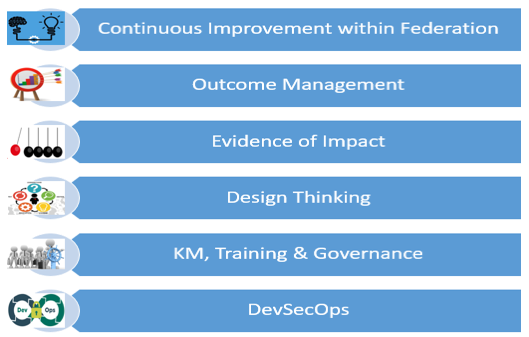
    Based on our understanding & knowledge of financial organizations, we believe that the following areas will see focus in the next few years:

    Figure 3: Trends in short-medium term in DevOps adoption


    Continuous Improvement within Federation

    • Technology teams will need to enable and encourage localized innovation within a federated boundary of toolsets that will, in time, bring Dev and Ops toolsets to near mirror images of each other.
    • By federation, we mean a detailed homogeneous blueprint that gives flexibility but within an overarching boundary of tools and procedures while encouraging continuous improvement.
    • This must also inform relevant stakeholders about areas for continuous improvement that make the most evolutionary impact to business and use metrics suitably to track and reward improvement.

    Outcome Management

    • We also think that DevOps adoption needs to be driven by outcome management with evidence of impact taking the driving seat for road map management.
    • Focus will be on point of arrival (POA) and continuous measurement of business and IT metrics for outcome management.
    • We also believe that Culture-Automation-Lean-Measurement-Sharing (CALMS) model of DevOps will find more believers.

    Evidence of Impact

    • Metrics and metrics-based course correction will become the Holy Grail in the simplification exercise. The metrics collection will need to focus on areas of both business and IT. The metrics and measures will need to be redefined as:
      • Business Metrics for business value delivered or improved such as new products / services launched, conversion rate, net promoter score (NPS), customer retention rate, CSAT, ESAT, etc.
      • IT Metrics for value improvement and value management such as cost performance index, reduction in defect debt, reduction in lead time to change, etc.

    Design Thinking

    • We believe that the next big disruptor in this space will be bringing design thinking into the mix to ensure that DevOps-led automation is more customer-centric and iterative.
    • We see focusing on test data management (TDM) across the organization as an important step to ensure continuous delivery.
    • In our opinion, the testing process will undergo complete rethink with support of processes such as risk based priority and risk based test case design, test bed splits, TDM and so on.

    KM, Training and Governance

    • Tools and processes for knowledge management, training and governance need to ably support the DevOps-led simplification.
    • These processes will need systemic focus to create and nurture self-learning technology teams.
    • Transformation of the way of working to rationalize processes such as collaboration for lean and improved handover of work packages.

    DevSecOps

    • Security will be extremely crucial in the process of DevOps-led simplification. All the automation, cloud adoption, pipeline creation, IoT adoption and more is throwing up many new security concerns, thereby leading to a focus on DevSecOps.
    • Security processes will potentially need to move their execution points up in the CI/CD pipeline and be divided into stages based on iterations sizes and deployment cycles.
    • Focus on shifting left application security and role-based security.

    Conclusion

    The next wave of simplification of IT spaces in banking organizations will be aided by DevOps. To look for opportunities, a systematic approach toward DevOps will help—it will be perilous to ignore detailed assessment of existing spaces that will detail the current state, point of arrival simplified state, road map for simplification and the key guiding principles for the transformation.

    Carrying out pilots and proof of concepts in DevOps is not a problem; the challenge is with scaling—in all areas: tooling, training and processes. The key is to manage the horizontal and vertical spread of same/similar toolsets that also help drive efficiency associated with scale and standardization. DevOps-led simplification will need changes to processes, technology and people management (culture). The current role structures might need to be demolished to ensure there are no fiefdoms and cross-functional teams handle all requirements of Dev-Test-Ops. Finally, all the changes need to be able to define the new way of working  so that Change-Run-Transform organizations can be brought together.

    This article was co-authored by Babu Unnikrishnan, Head, Banking & Insurance Technology Group at Tata Consultancy Services.

    — Anshu Premchand

  • The Role of DevOps in the Financial Services Industry

    The Role of DevOps in the Financial Services Industry

    We are living in a fast-changing environment where unexpected technological, economic and political changes can be expected and where it is necessary to adapt quickly to these changes. This statement is especially true in the financial services sector, where there is a greater need to exceed the expectations of customers and provide uninterrupted service.

    From small trading firms to the financial industry players—big banks and exchanges—all are racing to deliver features and content to customers more quickly, and opting for DevOps tools, practices and ideas to solve the problems arising in financial systems.

    In DevOps methodology, the development and operations engineers work together in the entire service life cycle, starting from design via the process of development to production operations, maintenance and support. A DevOps approach is helpful for the adoption of various technologies such as blockchain, which is the technology behind cryptocurrencies such as bitcoin wallet. In this article, I will discuss the applications of DevOps methodology in the finance industry.

    How DevOps is Transforming Financial Services

    As said earlier, financial services companies face new challenges in their day-to-day operations in meeting the standards laid down by the unicorns. To support today’s digital age, many financial services companies are modernizing their back-end systems and processes.

    In addition to using legacy systems and code, they can face difficulties in meeting governance requirements, complying with regulations and alleviating risk for better security. These concerns make the software innovation a slow and complex process.

    But, over the past few years, the financial services sector is leading the transformation when it comes to adopting latest technologies and modern software delivery practices including DevOps, continuous delivery (CD) and Agile.

    Finance executives view DevOps as a way to bring value to the market in a more safer and efficient way. DevOps allows financial services to enhance the quality and cadence of application releases while addressing compliance, security, risk and governance strategies. Now, let’s dig deeper into the ways in which is transforming the finance landscape.

    Mitigating Potential Security Threats

    In the financial services industry, compliance and security are major concerns and have been the major setbacks in replacing legacy practices of software development and delivery. In the initial days, DevOps practices were seen as major risk to security and the enhanced velocity of software releases it allows was viewed as a threat to security, governance and regulatory controls.

    In spite of the initial setback, some enterprises that adopted DevOps have shown consistently that these practices actually reduce potential security problems and help companies locate issues and tackle threats more quickly.

    Due to this many companies have embraced the automation practices that enable and enforce compliance, security and audit requirements. Today, financial services companies view DevOps as a resource for security.

    Automating all the Processes

    Automating the processes all through the software delivery pipeline is another essential to enhancing resource utilization, product quality and developer productivity, and allow cross-project and enterprise-scale management and visibility in financial services. For any continuous delivery or DevOps initiative, automating all the processes is becoming a major requirement for enabling scalability and speed, ensuring compliance and achieving higher product quality.

    DevOps offers enterprises with an efficient approach to alleviate risk from software releases and aid the ever-evolving demand for frequent application updates. By managing all the release processes in a single centralized platform and automating the complete end-to-end pipeline, these companies gain visibility into the progress of all DevOps processes and releases and make sure they can optimize, govern and control their delivery pipelines even as they evolve.

    Driving Cultural Transformation

    DevOps focuses on creating an environment and a culture where the business, operations, quality assurance, development and other stakeholders work collaboratively toward a shared goal. While optimizing the technology and tools to scale DevOps adoption, embedding security practices and automating the life cycle are the major steps. DevOps is a mindset and any change in culture takes time.

    This change takes time and even the financial services industry that is regulated heavily is implementing DevOps and leading the change from both the cultural and technology standpoint. Thus, the financial services companies have what they need to keep pace with the unicorns, modernize their benefits and completely harness the benefits of DevOps.

    Orchestration

    For many financial services companies, the four basic software delivery pipeline stages (release, deploy, test and build) consist of numerous processes that hold within them millions of jobs and thousands of tasks executed by a large number of people. These toolsets, processes and the people are often present in silos, making things even more challenging.

    While existing in silos, these people may become skillful at understanding and enhancing their part of finding the solution, but from an organizational perspective, there is no end-to-end visibility and orchestrating the complete pathway is impossible. This leads to a lack of governance, errors, delays, manual handoffs and fragmented processes.

    As the IT operations and development teams are often geographically distributed in these large organizations, it is important to enable shared visibility and control into the different processes, tool chains and infrastructures. Optimizing the process of software delivery shouldn’t be attacked as a separate set of problems but viewed as utilizing a system-level approach, much as the manufacturers of cars apply lean manufacturing principles all through their production lines.

    The implementation of DevOps is spreading rapidly in financial services sector due to the value that this global, systems-level approach enables. DevOps accomplishes this by scaling the latest IT process across the entire organization in order to enable an end-to-end, robust pathway to production.

    Eliminating friction between teams and breaking down functional silos by orchestrating every aspect of the software delivery pipeline to create repeatable, predictable processes that can operate frequently with minimal human intervention prevents many of the challenges distributed companies face.

    Conclusion

    Even facing strong opposition in the beginning, many organizations took a risk implementing DevOps and have benefited substantially. Today, many technologies such as big data analytics are evolving rapidly and are implemented by many organizations around the world. According to a Peoplehr post, data analytics is used to enhance various organizational activities. Those companies that embraced analytics as part of their activities have gained huge benefits from it. In the same way, any new technology such as DevOps has to be embraced by organizations in an effective manner to enhance their overall productivity.

    DevOps implementation eliminates the security problems before they become a major threat and scales the IT processes across the whole enterprise, thus allowing an end-to-end and vigorous pathway to production. Every day, more organizations are switching to DevOps and not looking back. The change to DevOps culture may take time, but it will revolutionize the activities of an organization, including financial services.

    — Sujata Rani