Tag: use case

  • Citizen Development Program: Selecting the Right Use Cases

    Citizen Development Program: Selecting the Right Use Cases

    The COVID-19 pandemic forced us into new ways of working that demanded a truly digital enterprise. Digital enterprises require we deliver applications for our everyday tasks and processes with unprecedented speed. Our traditional development resources – our professional developers – and traditional, professional code development environments simply cannot meet the demands from our lines of business.

    Citizen development

    The rapid adoption of low-code application platforms and the ability to use more readily available “low-code developers” partially closes the demand-supply gap by improving app delivery velocity for IT organizations. But velocity is only half the battle. Because our app development teams (pro and/or low code) can be so focused on the application itself, they may not fully understand the larger context around that application, the business processes they are attempting to digitize or how to connect with the process owners to gain that understanding. We become faster at app delivery, but not necessarily more agile. True business agility comes when we push app development to the edge; out into our lines of business and into the hands of “citizen developers.”
    citizen development

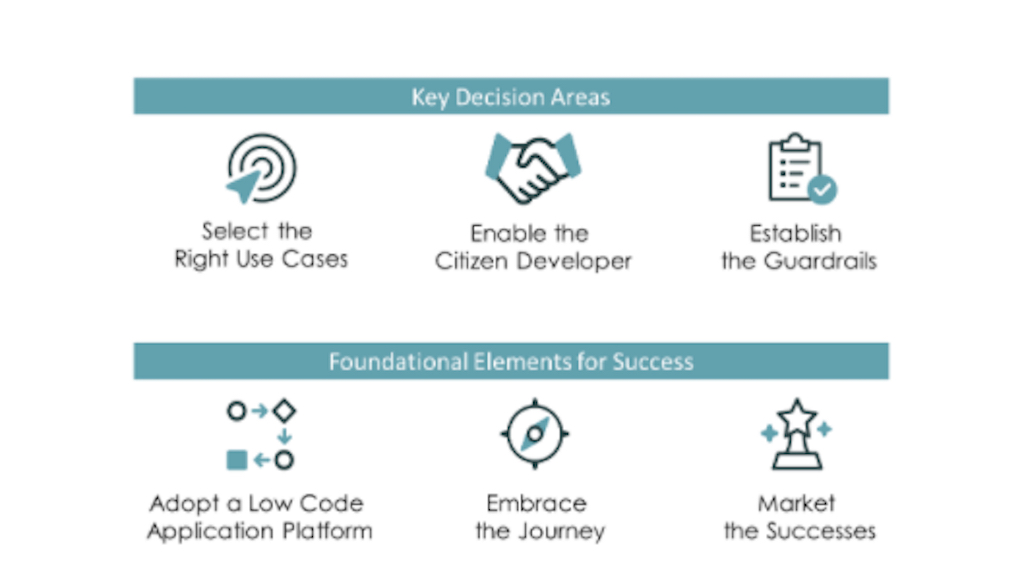
    Now let’s all take a deep breath, pause for a moment, and accept that citizen development is not the panacea for all our digitization needs – nor is it the beginning of application anarchy. A well-executed citizen development program can dramatically improve delivery velocity and business agility if organizations make good decisions in three key areas: 1) selecting the right use cases for citizen development; 2) enabling and empowering our citizen developers; and, 3) establishing citizen development guardrails that protect our organization.

    Before exploring the key decisions, it is important to note a few elements that are consistent across successful citizen development programs:

    • Adopting a Low-Code Application Platform (LCAP) – LCAPs benefit IT developers (both professional and low-code) but are critical to citizen developers. Teaching Java to your lines of business is what’s called a distributed development model – and that’s a whole different article.
    • Embracing the Journey – A citizen development program is a learning process for both the IT organization and the lines of business. Start focused, learn from the experience, adjust the approach and expand the reach.
    • Marketing Success – It is important to raise awareness of the program by telling the company about both the successes and the lessons learned – be candid and clear. People feel good about successful programs and rally around them.

    Selecting the Right Use Cases for Citizen Development

    We want to set up citizen developers, and the citizen developer program, for success, which means matching the business need to the citizen developer skillset.
    We need answer the following questions regarding line of business needs.

    • What business use cases are a good fit for our LCAP?
    • What technical requirements are a good fit for our LCAP? What technical requirements are not?
    • What types of applications in our enterprise are a good fit for citizen development?
    • Are there lines of business / departments that could benefit more than others from empowering citizen developers?
    • Are there specific risk, compliance, security and legal (RSCL) mandates that need to be addressed?
    • Are there other core enterprise systems that need to be considered for certain use cases?
    • Are there legacy technologies and/or is there technical debt that should be targeted?
    • What is the potential return on investment? How quickly can we start achieving that ROI?

    The answers to these questions are not binary. These questions, and others unique to each company, provide a filter to vet – and possibly score – use cases to determine suitability for a citizen development program.

    Just as important as selecting the right use cases is finding the right citizen developers. We need to answer the following questions about any potential citizen developers.

    • Will we have different categories of distributed / citizen developers? Are those categories based on skill level, organization and/or access?
    • Have we identified the aptitude and attitude characteristics of a good citizen developer?
    • How will we recruit and incentivize developers to join the program?
    • What is our value proposition to the citizen developer’s manager? Why would they support allocating some portion of their resource(s) building apps?

    In the early stages of a citizen development program, the most successful programs tend to prioritize the right developer over the right use case. A “high fit” developer delivering a “medium value” use case is a better bet than a “low fit” developer attempting a “high value” use case. Early wins matter.

    In part two of this series, we will explore enabling and empowering our citizen developers. We have now identified the right use cases and the right citizen developers, so let’s set them up for success.


    This post is the first of a three-part series offering real-world insights on delivering business value from citizen development initiatives.

  • Where’s the Heat? Talking DevOps, Use Cases and More

    Where’s the Heat? Talking DevOps, Use Cases and More

    Transitioning your organization from a traditional IT infrastructure into the world of DevOps is certainly a journey. Sometimes a long one, with many obstacles, but undoubtedly a voyage with a worthwhile prize at the end. Many organizations just embarking on their DevOps journey find themselves wondering, what use cases should they attack first? And who is driving these initiatives?

    Recently, Amy DeMartine, senior analyst at research leader Forrester, and Wesley Pullen, general manager and vice president of Deployment Solutions at Electric Cloud, participated in a discussion to answer these questions and discuss how to orchestrate the DevOps tool chain, how to approach application release automation, and how DevOps fits in the greater scheme of compliance and auditability. For folks just beginning their DevOps journey—and IT pros who have been walking the walk for years—there were some great takeaways from their discussion.

    DeMartine started off the discussion with something so basic that many folks often forget to consider it before starting their journey. But it is one of the most fundamental and important steps before beginning to explore DevOps; that is, answering the question, “What is DevOps?”

    Here’s a great definition used by Forrester:

    DevOps provides a set of practices and cultural changes—supported by complementary tools—that automates the software delivery pipeline, enabling organizations to win, serve, and retain consumers better and faster than ever before.

    Part of this is the idea of taking the huge monolithic releases of the past and breaking them up into smaller and smaller pieces—at least on the agile development side of things. Then infrastructure and operations folks get involved and complete the continuous delivery life cycle by automating builds and testing and making sure releases are consistent and fast. Finally, there is collaboration among development, operations and security to make the product even more successful than before—and in all of this, you are creating feedback loops and building quality as well as consistency.

    So now that you’ve got an established idea of the fundamentals of DevOps, let’s dive right into use cases. One of the most often-cited use cases is the idea of governance. People venturing into DevOps love the idea of moving faster and delivering more quickly than ever before, but find themselves asking, “How do you do that safely?”

    It’s helpful to look at this using the visual of an upside-down triangle, with governance at the top. It applies to all companies and gives them the ability to control their releases all the way from development to production. Part of the benefit of using DevOps is that all of these tools you are using are creating log files, which essentially are breadcrumbs that give you an easy way to follow an audit trail. If you’re using a standard technology stack across a single application and apply it to multiple applications throughout your organization, you have the ability to look at governance across all of these various applications through the same lens.

    On the next level of the triangle is compliance, which, depending on your industry, can mean a variety of things, but they are usually predefined and concrete. Finally, the bottom of the triangle is the audit aspect, which is where the best practices of DevOps become the most important.

    DevOps Drivers

    Ultimately, there are three different drivers of use cases that we see in DevOps, each with unique needs and perspectives. The first of these drivers are folks involved with infrastructure and operations. We often see projects and initiatives coming down from CEOs, CIOs and other senior executives in which the operations staff is driving the initiative and ultimately is responsible, so the initiative gets the budget. This is very hot in financial services.

    Another driver are members of IT ops, DevOps and enterprise architects. These members often are focused on cross-team, cross-project initiatives. These are the senior architects, developers and operations staff that all are working together on a single solution. They already have the tools in place, but want to drive and orchestrate an end-to-end solution. Whether they are doing a build or need to make a quick change to provision a server, their goal is to consolidate and have a seamless pipeline.

    Finally, the development-driven initiatives are coming from senior architects, development leads and QA who are pushing all kinds of different automation aspects, including continuous integration, continuous testing and continuous delivery.

    Diving deeper into these heat zones and specific drivers, it’s helpful to look at what these groups are really focusing on. The top automation initiatives within the subgroups of infrastructure and operations folks start with the need to do deployments faster. They need to drive deployment automation faster. They also are interested in release management, or coordination across a release stream for different teams. When an organization has a series of activities across multiple teams, there is a distinct need to release everything at once to make sure it works. This group also is focusing on compliance and audit—particularly in highly regulated industries such as health care, financial services and insurance—and is always driving initiatives in which it’s trying to build out auditing packages.

    In cross-team-driven initiatives, members include IT ops, DevOps and enterprise architects who are focused on cross-teams, and the cross-project initiatives primarily focus on end-to-end orchestration. They also are concerned with cloud resource management. When teams are paying for tools, they want to make sure they are maximizing their value and getting the most use possible out of those resources. That can mean scaling up or down in strategic ways to get the biggest “bang for their buck.”  Finally, this group also focuses on configuration management orchestration.

    Lastly, developer team-driven initiatives are focused not only on items such as continuous delivery, continuous integration and continuous testing, but also on container orchestration. As there is a greater awareness of potential security holes in Docker, it is necessary to place an increased emphasis on container orchestration, particularly with more and more individuals moving to containers. There also is an increased focus on QA lab provisioning. With the incredible growth in the realms of the Internet of Things (IoT) and embedded, these areas are correspondingly heating up for developer team-driven initiatives. One example put forth in the discussion between DeMartine and Pullen was a recent issue around one of the most well-known IoT devices on the planet—the Nest smart thermostat. In January, Nest went down, leaving many people without heat. This is a great example of why development teams want to focus on IoT use cases: DevOps enables rapid fixes for the massive demands of the IoT world.

    Ultimately, you can see from these use cases and initiative drivers that DevOps offers an incredibly dynamic opportunity, ideal for meeting the needs and perspectives of organizations from top to bottom—and the incredible growth of DevOps, as the organizational structure for IT organizations across multiple industries proves that out. In fact, DeMartine and Pullen polled the audience during their discussion and found that 61 percent of attendees planned to adopt DevOps practices in the next 12 months, while 83 percent of attendees planned to adopt deployment automation/ARA in the next 12 months.

    If you aren’t already considering DevOps for your organization, whether you are and CEO or a developer on the front line, it is worth investigating to see how it can answer your most pressing challenges and use cases.

    The full conversation between Amy and Wesley is available here.

    About the Author / Sam Fell

    sam-fellSam Fell is the Head of Marketing at Electric Cloud, responsible for driving awareness and demand for our DevOps Release Automation and Acceleration solutions. For 20 years, Sam has helped companies achieve success by marketing, selling, and implementing DevOps Release Automation, IT Change Management and Application Performance Management solutions. Prior to joining Electric Cloud, Sam held leadership roles at BMC, CA, Marimba and Nimsoft.

    Sam holds a Bachelor of Arts degree from Illinois Wesleyan University.