Tag: Upskilling: Enterprise DevOps Skills Report

  • DevOps Institute Upskilling the Enterprise

    DevOps Institute Upskilling the Enterprise

    DevOps Institute released its annual Upskilling the Enterprise survey and the results are as interesting as last year. The organization of DevOps teams and its interaction with speed/success was one area that intrigued me, and sent me off looking for more information on the topic. This led me to this interesting site that does a great job of delving deeper than “We’ve all heard of Conway’s law.”  Good descriptions there on what works and why that will be useful to many organizations. The only true weakness in the content that I found was the “vacuum syndrome” that doesn’t delve deeply enough into what’s right for your organization, which certainly impacts your choices.

    DevOps Institute’s discussion of soft skills and DevOps roles being hybrid is also interesting. It creates a bit of a conundrum. We all wish the technical genius was also a charming personality, but often that is not the case. In the end, our job is technical, and we need to deliver technical solutions. There is a balance between making the genius more personable and finding personable people capable of achieving the goals. Considering that hiring is currently a struggle, we often do not get to choose. Training can help a lot, and in the end, finding a balance that works for a given organization is going to be a bit of work for management.

    What comes as no surprise is the finding that CI/CD are the entry level required skills for DevOps. No matter how far along on your DevOps journey you are, CI and CD are core to the job at this point. Expect that to change over time as deployment and security become more core and commonplace. In the end, great CI/CD is not much help if deployment and monitoring are weak, so the tools that win these battles will rise in importance over time without taking away from CI/CD.

    Their idea of the E-shaped human is interesting, but in diagramming, some detail is lost in the abstraction.

    I once worked with a super-genius DBA that could do anything with the database. We (managers) met with him on issues and let him tell us how impossible it was and that we were destroying the enterprise’s data integrity. Then gave him a day and let him tell us how it would get done effectively without major disruptions. Only after we’d met with him the second time did we move forward with the project, talking to business owners. Essentially, we became the wall between him and anyone who would be put-off by his face going red and his angered declarations. It was an acceptable arrangement, and he never let us down. I worked with him on dozens of projects, and only once did I see him exposed to outside consultants (against the wishes of several of us), it was ugly, and they pegged him as a stone-waller. He wasn’t, just needed to vent first.

    This person was responsible for the stability of our data, for upping the volume of throughput when needed and for making sure SQL didn’t get past DBAs without being safe. Would we have liked him but with a sunny disposition? Sure, but given a choice, I for one was happy with him and an angry disposition. I worked other places I wished I had someone with his unparalleled skills on the DBA side. So, all of IT needs to get better at interpersonal communications in a DevOps world, but “better” is relative. I’d still keep him in the back, making sure our systems got what they needed.

    The survey head-nods to this reality where soft-skills came in third as important skills. Still high on the list because it is important, but it shows that technical skills are why we have the job. Soft skills are how we do the job with less friction.

    Considering that I am the communicator/negotiator, it might sound strange for me to stand for tech skills first, but that is who we are–technicians. Highly skilled and highly compensated, but technicians. There are few (as a percentage) people who can handle both technical and communications, but by the same token, there are few people who can be an absolute boss at their technical responsibilities and see each unexpected event as a challenge to be overcome. I love to learn new things, and at that job I learned a ton of Oracle stuff from our tech genius. But I would be foolish to believe I’d ever match him in both domain and tech knowledge when it came to databases and our employers’ needs.

    Anyway, I picked three of the points that interested me to expound upon. The entirety of the report is definitely worth a read to get a feel for where others are on their DevOps journey and offer some ideas for yours.

    Meanwhile, keep kicking it. We’re in the midst of COVID-19, and I hear you, some of you are simply buried in organizations that weren’t prepared, others are suddenly looking for work because your previous employer is suddenly not a viable business. Here’s hoping it gets better for each of you, while the rest of us struggle on.

    — Don Macvittie

  • Digital Transformation Efforts Hindered by Lack of Upskilling

    Digital Transformation Efforts Hindered by Lack of Upskilling

    There’s no digital transformation without a staff transformation. The people skills that helped bring successful enterprises to where they are today won’t be the skills that will make them successful tomorrow. Fortunately, Leadership Suite readers are well aware at how important it is for the success of their organizations to close the gaps between the skills their employees have today and the skills they need to carry the enterprise forward.

    According to the Upskilling 2020: Enterprise DevOps Skills Report from the DevOps Institute, based on 1,300 respondents, more than 50% of enterprises find challenges with all aspects associated with managing the people, processes and technologies that make DevOps possible.

    The report found 58% of enterprises have a tough time actually finding those with the right DevOps skills and 48% said it’s difficult to retain skilled DevOps professionals.

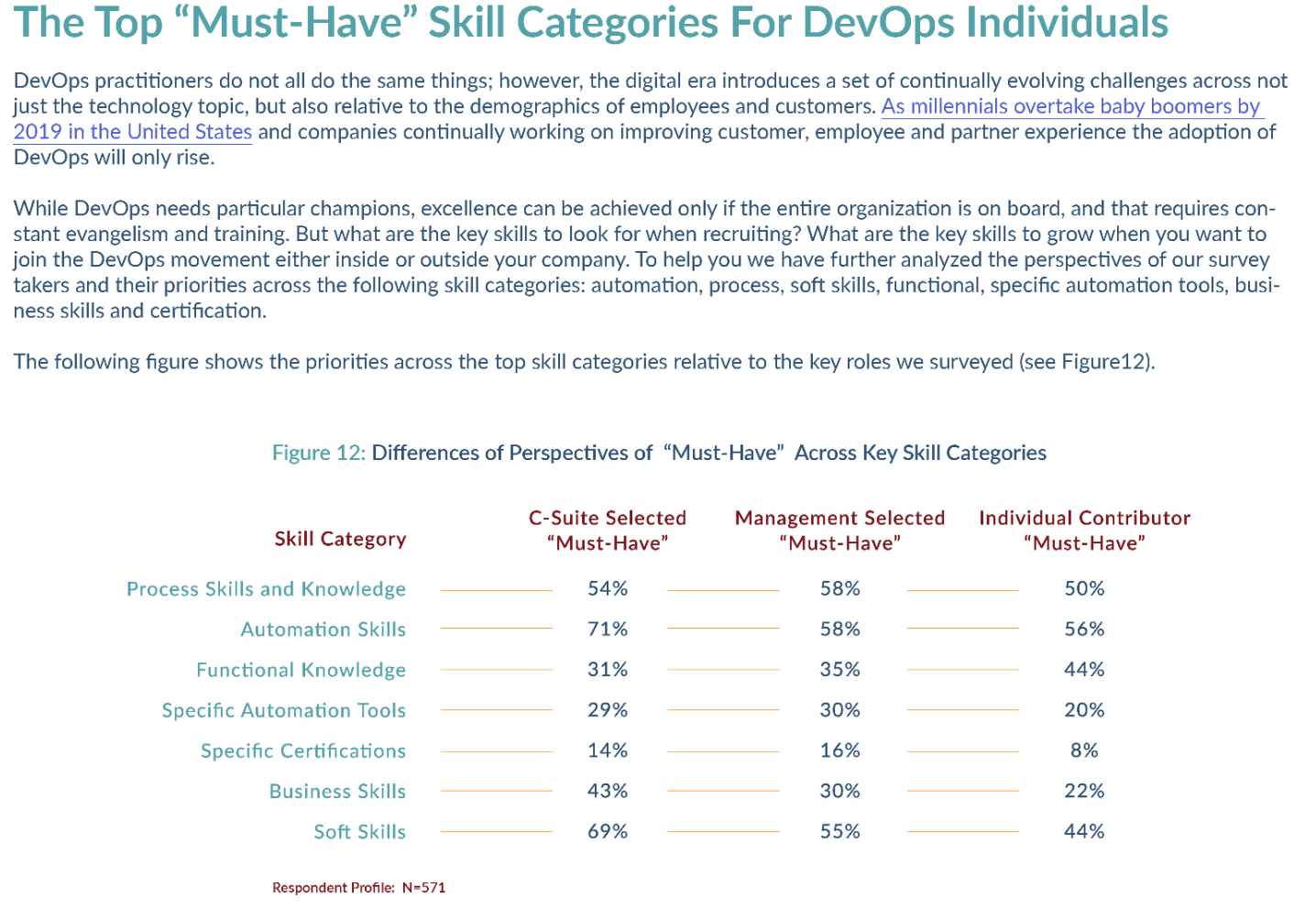
    With that in mind, it’s no surprise the report found DevOps salaries on the rise. According to the Robert Half Technology 2020 Salary Guide, salaries for experienced DevOps engineers can reach beyond $179,250. Survey respondents said that the skillsets necessary for DevOps practitioners skillsets should be multifaceted, including process skills and knowledge (69% of respondents), automation skills (67%) and interpersonal skills (61%). The 2019 survey found automation skills to be the top skill, followed by process skills and knowledge.

    The survey contends that successful DevOps professionals will have expertise that consists of both breadth and depth of knowledge, along with tangible and intangible skills that help them both dive into the details of a situation while also understanding the big picture. The 2020 Upskilling survey cited three highly sought horizontal skill categories: automation, functional knowledge and technical skills.

    A second grouping of skills—process and framework skills—is a vertical skillset which focuses on flow and understanding of different practices and methods such as scrum, agile development and value stream mapping. Another vertical skill category focuses on human skills such as collaboration and interpersonal skills.

    “People, process and technology have always been the trifecta needed to execute DevOps successfully,” stated Shawn Ahmed, senior vice president and general manager of the Software Delivery Automation business at CloudBees. “As we strive to enhance the culture needed to predictably deliver better software faster at CloudBees, it’s been important for us to identify which skills are considered ‘must-haves,’ which are ‘nice-to-haves’ and which are ‘not important’ across teams, roles and regions.”

    “As the report underscores, upskilling is now more important than ever to enable meaningful collaboration between all teams to truly deliver software at an elite level,” said Ahmed.

    The survey also found that adoption for Agile is at 81%, DevOps 75% and ITIL is at 25%. Organizations that employ SRE rose to 15% this year from 10% in 2018.

    — George V. Hulme

  • Human Transformation Breeds DevOps Skills and Success

    Human Transformation Breeds DevOps Skills and Success

    As part of its mission to advance the human elements of DevOps, DevOps Institute has released its 2020 Upskilling: Enterprise DevOps Skills Report. The year-over-year data builds on the inaugural 2019 project but it’s more insightful and more regional than last year. DevOps Institute is grateful to the 1,300 respondents this past year who took the time to share their insights that allowed us to present this important research to the community.

    One thing that is abundantly clear is that human transformation is the single most critical success factor to enable DevOps practices and patterns for enterprise IT organizations. Traditional upskilling and talent development approaches won’t soon be enough for large enterprises to remain competitive. This is because the increasing demand for IT professionals with core human skills is escalating to a point that business leaders have not yet seen in their lifetime. If there is but one call to action from the report this year is that we must update our humans through new skill sets as often—and with the same focus—as our technology.

    Thoughts on Skills

    What we continue to see is a well-recognized gap between the skills needed for digital transformation and the skills available in new and existing talent. According to 58% of the Upskilling report respondents, finding skilled DevOps individuals is a huge challenge, whereas 48% of respondents say the retention of skilled DevOps individuals is a challenge.  

    Unfortunately, the term “skill” is so broadly generic, which fuels the belief that there is a single stack of competencies that will guarantee enterprise success. That’s simply not true. The modern IT professional has to possess a set of skills across at least four categories: process, function, automation and core/human skills. Within each category, individuals must know which skills are considered must-have, nice-to-have or not as important—which leads to the question: How do you know? Seeking the answer to that question is the genesis of DevOps Institute’s Upskilling: Enterprise DevOps Skills Report project.

    Additional Takeaways from the 2020 Upskilling: Enterprise DevOps Skills Report

    • The DevOps journey is difficult for at least 50% of respondents since it changes the traditional structure of IT.
    • The DevOps human must have a hybrid set of skills since process skills and knowledge (69%), automation skills (67%) and human skills (61%) are the top three must-have skill categories in 2020.
    • Upskilling needs attention now since only 31% of respondents had a formal upskilling program while 38% do not,  21% said they were working on standing up a program.
    • Agile, DevOps and ITIL are getting strong competition from Site Reliability Engineering (SRE) which grew by 5% from 2019.  Value Stream Management and Systems Thinking are also gaining traction.

    To learn more, download the Upskilling 2020: Enterprise Skills Report.  The data is very granular and can serve as a waypoint for individuals and enterprises trying to plan their upskilling initiatives.

    — Jayne Groll

  • DevOps Institute Opens ‘2020 Upskilling: Enterprise DevOps Skills Report’ Survey

    The second annual survey and resulting report are designed to help companies better understand both the current and future state of DevOps skilling and cross-skilling across the global IT community.

    Boca Raton, FL – August 20, 2019 – DevOps Institute, a global member-based association for advancing the human elements of DevOps, today announced the launch of the 2020 Upskilling: Enterprise DevOps Skills Report community survey. In collaboration with Gold Sponsor CloudBees and Community Sponsor Continuous Delivery (CD) Foundation, the 2020 Upskilling Report will measure trends and progress of DevOps skillset development building upon the 1,600-plus survey responses from the 2019 benchmark report.

    “In 2019 we found that all roles, from leaders to individual contributors, agreed that automation skills, process skills and soft skills are the most important must-have skill categories for a DevOps human,” said Eveline Oehrlich, former vice president and research director at Forrester and now chief research analyst at DevOps Institute. “Top must-have process skills were: familiarity with software development life cycle; understanding of process flow and analysis; Agile; experience with test-driven deployment concepts and methods and system thinking. The top three must-have soft skills included collaboration and cooperation, problem-solving, interpersonal skills and sharing and knowledge transfer. This second survey round will include the same skill categories, but we have added a few more next-level skill questions.”

    Click here to participate in the “2020 Upskilling: Enterprise DevOps Skills Report” survey. From DevOps practitioners and IT leaders to business and HR team members, and service provider team members, every role should have a voice in the survey.

    “The Upskilling Report is meant to help empower and advance human transformation by identifying the skills and knowledge that lead to ideas and learning for DevOps success,” said Jayne Groll, CEO of DevOps Institute. “DevOps Institute looks forward to building on the SKIL Framework (Skill, Knowledge, Ideas, Learning) and the success of the 2019 benchmark report to offer new and updated insights on the trends in DevOps skills sets from a year-over-year perspective.”

    The 2019 Upskilling Report provided a benchmark upon which to measure future patterns and trends by identifying which skills are considered “must-have”, “nice to have” and “not important” across roles, region and perspectives. The 2019 Upskilling Report also demonstrated that the categories of process, automation and soft/human skills are equal in importance.

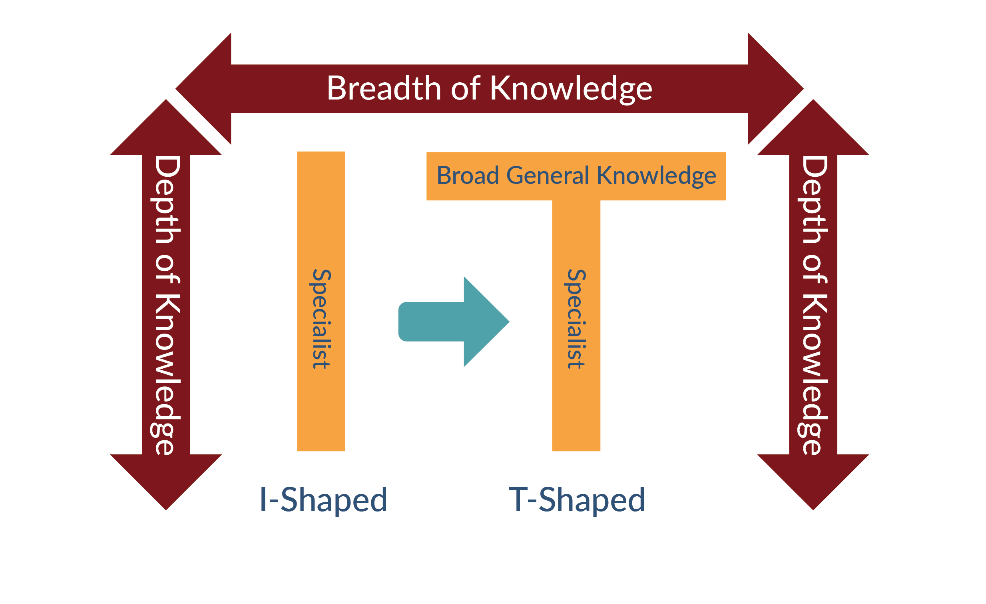
    The 2020 Upskilling: Enterprise DevOps Skills Report survey is active through December 20, 2019 and the second annual report will be published in early 2020. The new survey builds upon the 2019 report to help IT professionals understand the skills they need to become more T-shaped, by supplementing their depth of specific knowledge with a range of general knowledge. Further, it helps IT professionals understand the specific disciplines that will best fill the top of their “T.”

    To access the 2019 Upskilling: Enterprise DevOps Skills Report, download it here for free.

    “Last year’s Upskilling Report was instrumental in identifying the IT skills that are most needed for successful business transformation,” said Andre Pino, vice president of marketing at CloudBees. “This year’s report is invaluable to the IT community because it provides insight into the status of skills and practices that will ensure the Humans of DevOps advance alongside technology. We are honored to partner with DevOps Institute and sponsor the report for a second year to highlight the human DevOps skills that are critical to Enterprise IT organizations of all sizes.”

    “The DevOps community has a hunger for knowledge and a commitment to continuous learning that is unmatched,” said Tracy Miranda, director of open source community at CloudBees and member of the Governing Board of CD Foundation. “CD Foundation is thrilled to sponsor DevOps Institute’s Upskilling Report and is committed to advancing the state of the industry and particularly the human element. The report is an essential resource for up-and-coming DevOps professionals who want to understand the skills they need in order to play an irreplaceable role in business transformation. This year’s report is especially important because it will be compared to last year’s benchmarks to measure global DevOps skills progress.”

    ###

    About the DevOps Institute
    DevOps Institute is dedicated to advancing the human elements of DevOps success. As a global member-based association, DevOps Institute is the go-to learning hub connecting IT practitioners, education partners, consultants, talent acquisition and business executives to help pave the way to support digital transformation and the New IT.

    We help advance careers and support emerging practices within the DevOps community based on a human-centered SKIL Framework, consisting of Skills, Knowledge, Ideas, and Learning. All of our work, including accreditations, research, events, and continuous learning programs–is focused on providing the “human know-how” to modernize IT and make DevOps succeed.

    — Veronica Haggar

  • Got DevOps Skills? A Look at the Upskilling: Enterprise DevOps Skills Report

    Got DevOps Skills? A Look at the Upskilling: Enterprise DevOps Skills Report

    IT recruiting is at an all-time high and organizations want T-shaped professionals with cross-functional skill sets to join their teams. While “T” represents an individual’s core competency, and the top of the T represents a broad range of related knowledge, there has been little clarity on which skills are the most important across a wide spectrum of possibilities—until now.

    DevOps Institute launched the Upskilling: Enterprise DevOps Skills survey in 2018 to focus on the human element of skilling. The feedback from more than 1,600 individual responses echoed the notion that regardless of vertical, organizational size, geography or role, DevOps practitioners need data-backed skilling statistics. As the focus within the enterprise, DevOps community shifts from “What is DevOps?” to “How do we do DevOps,” this demand is more crucial than ever. After all, “how to” requires “know-how” and “know how” requires a new set of skills. But which skills?

    According to DevOps Institute’s Upskilling: Enterprise DevOps Skills Report:

    • Soft skills and technical skills are equally important
    • IT operations knowledge received the most “must-have” votes as a functional skill in DevOps
    • Cloud and analytical knowledge are the top technical skills
    • DevOps Engineer emerged as the most popular job title (see below for figure N=812)
    N=812

    The report was developed in partnership with veteran research analyst Eveline Oehrlich, formerly of Forrester Research. This comprehensive data provides indications of which functional, process, technical and automation skills are “must-have,” “nice to have” and “not important.”

    This is particularly significant for IT professionals who are confused about where to focus their personal skills transformations in their journey toward the “T.”

    Should developers work on upskilling their testing, automation, process and/or security skills? Should operations professionals learn to code, test or explore more about machine learning and AI? What about project management and systems administration? The Upskilling: Enterprise DevOps Skills Report can be used as a snapshot of critical enterprise skills that are important to successful digital transformation.

    The Upskilling: Enterprise DevOps Skills Report was released March 4 and is now available for download. On behalf of Platinum Sponsor Electric Cloud, Gold Sponsor CloudBees and Silver Sponsor Lenovo, industry influencers and international DevOps community, we hope this data will help shrink the skills gap and support the transformational goals of both individuals and organizations. We’re already looking forward to the launch of DevOps Institute’s Upskilling: Enterprise DevOps Skills Survey 2020 to continue meeting the demand for ever-evolving skilling trends in the DevOps community—stay tuned!

    — Jayne Groll