Tag: twitter

  • Will MariaDB Soon Replace MySQL?

    Will MariaDB Soon Replace MySQL?

    MariaDB is a database growing in popularity. Its lead developer is Michael “Monty” Widenius, who was part of the team that created MySQL. When MySQL was acquired by Oracle, Widenius and some of the other original MySQL developers decided to launch MariaDB as a fork of MySQL and keep it as open source to mitigate any issues around Oracle’s ownership of MySQL.

    MySQL-vs-MariaDB

    In 2009, Sun Microsystems acquired MySQL. Sun’s subsequent acquisition by Oracle brought about a movement headed by Widenius to “save MySQL.” Widenius and many others in the open source community felt Oracle’s ownership might be a conflict of interest, since Oracle already had a competing closed source commercial database. They believed Oracle would be slow to further develop the MySQL database, given the potentially greater focus on the commercial Oracle database.

    In response to this, Widenius began working on MariaDB and helped form the MariaDB Foundation, which uses a community governance model. Because of the separation between the open source and commercial sides of the foundation, its governance generally is seen by the open source community as positive. This is in contrast to Oracle, which has both its commercial Oracle database and the open source MySQL both under the same governance. Often this is perceived as a conflict of interest, especially when it comes to keeping MySQL up to date.

    MariaDB vs. MySQL

    While MariaDB isn’t yet replacing MySQL, it has brought about good competition between the two, which can be good for innovation. With its backing of Oracle, MySQL may reign supreme for at least the near future; however, technically speaking, MariaDB could replace MySQL if a company decides it wants to make the switch.

    The developers designed it as a drop-in replacement of MySQL. Since it was forked from MySQL, basically all of the structures MariaDB uses are the same. This means switching from MySQL almost surely won’t require a company to alter its application in any way, since the data and data structures won’t need to be adjusted.

    In fact, the command-line tools such as mysqladmin, mysqldump, the daemon and others all keep their original names, so MariaDB is very much a drop-in replacement for database administrators as well. Indeed, many organizations have already either switched to it or simply began using it on its own: It replaced MySQL as the default database in Fedora and Red Hat. It is also used by Booking.com, CraigsList and Wikipedia, among others.

    What Else Does MariaDB Offer?

    Community improvements to MariaDB have been made by notable organizations such as Facebook, Twitter and Google. For example, Google contributed data-at-rest encryption to release 10.1.3, which is quite helpful given the security issues that can arise quickly in this ever-changing environment. In addition, it offers performance improvements such as subquery optimization and faster joins. It also has added row-based replication.

    While MariaDB may not replace MySQL immediately, it is worth watching: It is gaining traction as a potentially serious contender in the marketplace.
  • DevOps Twitter Fun and a Free T-shirt

    DevOps Twitter Fun and a Free T-shirt

    After the holidays and New Year, the team here at devopsy.kinsta.cloud decided to shake things up a bit and  have fun some fun with on social media. Starting today we are going to run what we think are three pretty cool contests to post some DevOps fun through Twitter. We will select the best to win a devopsy.kinsta.cloud t-shirt and other cool swag.

    These opportunities will be pushed out via Twitter; to win you must follow us @DevOpsDotCom, follow instructions, tweet out your submission using applicable hashtags (#) and answer emails asking for required information (such as address to send materials).

    The promotions are:

    Meme Monday: Today we introduce #DevOpsMemeMonday. Below is an example of our meme for the week, the infamous “Be Like Bob,” or in this instance, don’t be like Bob. We will supply a meme with no text writing on it, with a description of any rules that could be applied to the contest. It is then up to you, our followers to create a meme that best follows the rules. Up to five winners will be selected based on humor, cleverness and the best incorporation of DevOps. Submissions will be accepted through Twitter by tweeting @DevOpsDotcom and using the hashtag #DevOpsMM.

    Example:

    belikebob

    We have also courteously provided a blank canvas for you to create your meme here, which you can download by right-clicking and selecting “save as.”  You can then use https://imgflip.com/memegenerator to create your meme, or simply do it in photoshop.  Once you create your meme, don’t forget to submit it to us by tweeting @DevOpsDotCom with the hashtag #DevOpsMM.

    Throwback Thursday: This will be an open contest with no picture or text provided; however, these can be done through picture, text or whatever means you choose to express your creativity. The only instructions are to represent how DevOps has changed over the years, as well as how DevOps has changed IT over the years—hence, “Throwback Thursday.” Submissions will be accepted through Twitter by tweeting @DevOpsDotcom and using the hashtag #DevOpsTBT.

    Example: Remember when a computer was the size of a house #DevOpsTBT

    Freestyle Friday: This also will be an open contest with no picture or text provided; however, these can be done through picture, text or whatever means you choose too express your creativity. The only instructions are to create a short rhyme or rap about DevOps—hence, “Freestyle Friday.” Submissions will be accepted through Twitter by tweeting @DevOpsDotcom and using the hashtag #DevOpsFreestyleFriday.

    Example: Bob is stuck in his old ways, he doesn’t like to continuously deliver. He’ll be rethinking his outdated behavior when he’s sent downriver. #DevOpsFF

  • #ChuckNorrisDevOps Winners

    #ChuckNorrisDevOps Winners

    In January we decided to kick the year off by running a contest asking readers to come up with the reasons why Chuck Norris doesn’t need DevOps. We had a lot of fun with this, thanks to everyone who participated!

    Here are the winners we picked:

    Most ReTweeted – @tknerr_de


    Most Humorous – @JerDoug


    Most Original – @devopscouts


    Honorable Mentions


  • Chuck Norris doesn’t need DevOps Contest

    Chuck Norris doesn’t need DevOps Contest

    I think just about everyone on the Internet knows that Chuck Norris is one bad ass dude. But did you know he is so bad ass that he doesn’t need DevOps? Why doesn’t Chuck Norris need DevOps?

    In doing our year end review of our metrics we discovered that due to an article I wrote back in March of 2014 one of the most popular search terms that brought people to our site was … wait for it, that’s right, Chuck Norris.  Well as long as we are attracting the Chuck Norris crowd we might as well have some fun with it.  So we are going to run a contest asking readers to come up with the best reason why Chuck Norris doesn’t need DevOps.

    We will have several categories with prizes in each category:

    Most Original 
    Most Humorous 
    Most ReTweeted 
    Most Favorited 

    The top winner in each category will receive a $50 Amazon.com gift card plus a Chuck Norris DVD collection. Other winners will receive a copy of The Phoenix Project, devopsy.kinsta.cloud t-shirts and more.  In order to enter you must tweet your reason why Chuck Norris doesn’t need DevOps and you must include the #ChuckNorrisDevOps hash tag. You can also use the Chuck Norris meme generator at http://memegenerator.net/Chuck-Norris/caption to generate your image and caption, then retweet it. The contest will be open until the end of January.

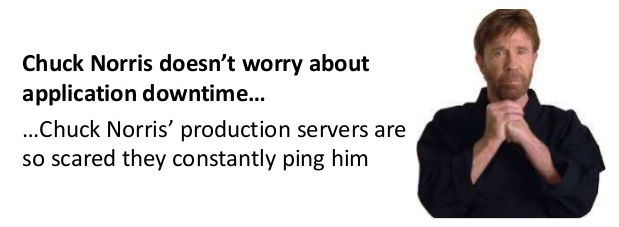
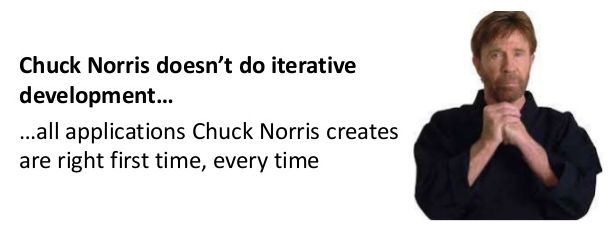
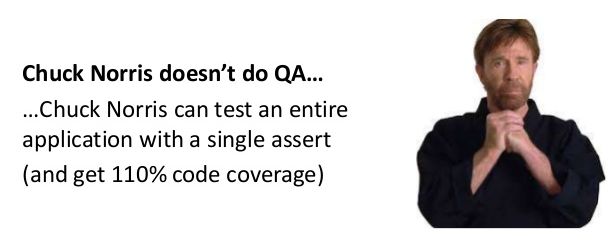
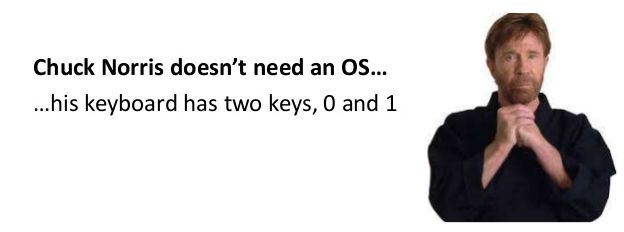
    My original article noted a great presentation by Daniel Bryant of  the tai-dev blog titled Chuck Norris doesn’t need DevOps. Daniel has some great reasons why Chuck doesn’t need DevOps in his slides.  Of course any reasons that Daniel has already published are not eligible for this contest.   Among them are:

    Image1

    Image5

    Image2

    Image3

    Image4

  • DevOps Frequent Friday Follow on Twitter

    DevOps Frequent Friday Follow on Twitter

    Continuing our Friday practice of highlighting people to follow in the DevOps space, here are this weeks entries:

    @jpmorgenthal @lmacvittie @AndiMann  @mongodbinc @kevinbehr @devopscloud @amyl_bishop @kristiancarter

    Already on the list:

     @patrickdebois , @realgenekim  @botchagalupe  @jezhumble  @garethr 

    @kartar  @krisbuytaert  @jordansissel  @agentdero  @allspaw  @monkchips 

    @devops_borat @lnxchk  @damonedwards   @lusis  @obfuscurity @shanley 

     @adrianco  @scriptrock @jumpcloud  @sd_architect  @govictorops @softlayer 

    @docker @chef  @hullsean @champagnie @planetdevops @krishnan 

    @tarunbhatti @wickett @nathenharvey @andimann @byron_miller

    You can find all of these people on a Twitter list I have started at: https://twitter.com/devopsdotcom/lists/devops-twitters-to-folow

    If you think you should be on the list, drop me a line here.  Have a good weekend and change those passwords if you haven’t already thanks to Heartbleed


  • DevOps Needs a Tsunami To Jump The Chasm

    DevOps Needs a Tsunami To Jump The Chasm

    All start up business endeavors must go through the phase of crossing the chasm.  Most of those business endeavors usually fall prey to the chasm. The chasm is this black hole that everyone claims to understand but no one truly does. We have all seen businesses cross the chasm or fail to cross the chasm and fall into the black hole. But no one seems to understand why and how that crossing happens. The bestselling book by Geoffrey A. Moore titled “Crossing the Chasm,” is all about the heart and soul required to get early stage technology across the chasm, from early adopters to mainstream customers.

    There is a big difference between people who are enthusiastic to try leading edge technologies and the rest of the inhabitants, who tend to be much more conservative. The reasons that people spend time trying to figure out how to cross or jump, if you will, the chasm is because that black hole is what stands between them and making their fortune. The early adopters are just a small sample of the market and there is no money in building a business or technology around them. To make real money, you need to cross over into the mainstream.

    In Geoff’s model, the innovators are all about technology.  You know those people, when a new iphone is released, they spend days standing on line to get latest and greatest new technology.  The early adopters are the visionaries that are always on the bleeding edge. The mainstream are the pragmatists, the people who practice risk avoidance. These pragmatists are the key to jumping the black hole, they move the needle.

    DevOps first order of business was getting on the curve and to that end DevOps has evangelists. But, understand that what worked in converting these early adopters probably won’t work for the pragmatists. These DevOps evangelists and visionaries want DevOps power tools, as opposed to the pragmatists who simply want to push the button and say “that was easy”.

    By all appearances DevOps has been accepted by the early adoption set. Just how does DevOps cross the chasm? Jumping the black hole after all can be quite a daunting task. To do so DevOps has to create what I refer to as the tsunami effect.

    The Tsunami effect is where DevOps gains acceptance in multiple industries or markets in what seems like a gold rush, it’s here that fortunes are made. More accurately, it’s where cult communities transform overnight into mainstream communities.  Many technologies simply create a single tornado which remains in a silo forever never gaining enough momentum to really emerge. Another common path what I call an earthquake, there is a lot of hype but it tends to fizzle out quickly, if not tended to properly. Right now DevOps has all the appearances of an earthquake, Devops evangelists have created a lot of buzz, but acceptance beyond a set of power tools is still a huge question.

    Considering DevOps is in the earthquake phase, as opposed to the tornado phase, DevOps cannot be successful converting one group at a time. The strategy in the tornado phase is convert industries and markets one at a time, via tornados forming within industries or markets. The tactical execution is to get smaller industries or markets committed and therefore the larger industries or markets will then embrace the movement. That is simply crossing the chasm. DevOps has too many cultural implications to convert believers over a long period of time; DevOps requires reorganization, not a subtle shift.

    Since I consider DevOps to be in the earthquake phase, crossing the chasm is not an option. DevOps must jump the chasm in a surge of overwhelming momentum, hence creating a tsunami. DevOps has created a very closely knit culture, DevOps needs to push hard to create a tsunami and flood the pragmatic population. But, be advised, DevOps has to be all but universally accepted, there is no almost in bringing together Dev and Ops. But if DevOps wins, it wins big, DevOps will go from being a niche culture to a truly mainstream practice.

    So what’s the strategy to create a tsunami? And more importantly, how do you move beyond the earthquake phase? Here’s how I see it according to Geoff, with my DevOps spin: First, DevOps must clearly establish that the mission-critical software development process is broken and is causing management enough pain that it would gamble on unproven methodology that is populated with a bunch of prima donnas. I am not convinced the DevOps cult has clearly established this as fact. Is the development and operations process broken or have just new power tools been created to improve speed and accuracy? Second, DevOps needs to present the total solution, not just tools. Overwhelm the community; each new DevOps tool should leverage the success and technology of the last hence creating a methodology. Even more importantly, because the DevOps tools are closely related, credibility can cross industries and markets and create the momentum required for a tsunami.  Once Devops has reached critical mass by providing the total solution in a few industries or markets simultaneously the tsunami is created and DevOps has jumped the chasm.

    The tsunami will emerge suddenly with everyone seeming to adopt DevOps all at once.  This will result in explosive growth and will pull, willingly or unwillingly, everyone into its path. It’s driven and sustained by the pragmatists.  Here, everybody has to get the latest thing all at once; the masses have been converted to DevOps. DevOps needs mass-market success, DevOps needs to become a tsunami and everyone will want to play DevOps.

    Now that you know the formula, go forward and create the perfect storm.

    If you would like to say something; email parker@devops.com and don’t forget to comment here.


  • Follow Friday, DevOps To Follow on Twitter and DevOps Podcasts

    Follow Friday, DevOps To Follow on Twitter and DevOps Podcasts

    As I wrote last week, in doing my research for this blog I have been looking around for a good list of DevOps people to follow. I have found a small list here and there, but unlike in the infosec community where we had the @securitytwits, there is no analogue to that in DevOps. So with a tip of the hat to Bill Brenner of Akamai (and formerly of cso.com) I have stareted a new tradition here on devopsy.kinsta.cloud.  Our own Follow Friday: DevOps Peeps to follow on Twitter.  New for this week:

    @hullsean @champagnie @planetdevops @krishnan @tarunbhatti @wickett @nathenharvey @andimann @byron_miller

    From last week:  @patrickdebois: @realgenekim: @botchagalupe: @jezhumble; @garethr; @kartar; @krisbuytaert; @jordansissel; @agentdero;@allspaw; @monkchips: @devops_borat; @lnxchk: @damonedwards;  @lusis; @obfuscurity; @shanley: @adrianco; @scriptrock;@jumpcloud; @sd_architect; @govictorops @softlayer @docker; @chef

    You can find all of these people on a Twitter list I have started at: https://twitter.com/devopsdotcom/lists/devops-twitters-to-folow

    Also as a bonus this week a list of some of the great DevOps podcasts to listen to:

    DevOps Cafe

    Arrested DevOps Podcast

    FoodFight

    The Ship Show

    Do you have any twitter names to add to the list or DevOps podcasts to list?  Mail me at ashimmy@devops.com or leave it in the comments.  Have a great weekend!


  • How to laugh at DevOps

    How to laugh at DevOps

    Talking about DevOps is all the rage these days. But with that conversation, it’s easy to become inundated with the amount of serious discussion around the topic. I do agree that DevOps is not something we should joke around about, but since humor is an inherent part of our culture at VictorOps, it makes sense that we would be drawn to the humor of the situation.

    Below are the ten of the funniest Twitter accounts that make light of the DevOps movement. Some are obviously one-joke wonders while others continue to make us laugh. Either way, the list below is proof that you can’t take DevOps too seriously:

    DevOpsBane

    DevOpsYakov

    • @UncleDevOps – Everyone’s favorite continuously-deploying uncle. Also a little crazy.

    UncleDevOps

    • @DevOps_Jesus – Continuously delivering from evil since 4 BC.

    DevOpsJesus

    • @DevOpsGrouch – I complain. I swear. I automate. Deal with it.

    DevOpsGrouch

    DevOpsTourettes

    • @DevOpsBorat – Cultural Learnings of DevOps for Make Benefit Glorious Teams of Devs and Ops.

    DevOpsBorat

    • @DevOpsX – Always fighting the good fight for DevOps equality.

    DevOpsX

    DothrakiDevOps

    DevTylerDurden


    Feel free to add any that I might have missed to the comments below. And remember to laugh…it’s just DevOps after all.

  • Follow Friday, DevOps Twitter Accounts to Follow

    Follow Friday, DevOps Twitter Accounts to Follow

    twitterdevopsAs part of doing my research for this blog I have been looking around for a good list of DevOps people to follow. I have found a small list here and there, but unlike in the infosec community where we had the @securitytwits, there is no analogue to that in DevOps.

    So with a tip of the hat to Bill Brenner of Akamai (and formerly of CSO.com) I am going to start a new tradition here on devopsy.kinsta.cloud.  We will have our own Follow Friday: DevOps Peeps to follow on Twitter.

    I am starting with a small list that I actually found on a Puppet Labs blog. I will add to this list every week and also start a Twitter list of them.  You are already following most of these folks, but you have to start somewhere.

    If you would like to be added to the list or have a suggestion for the list please leave it in a comment or email me at parker@devops.com.

     @patrickdebois: @RealGeneKim: @botchagalupe: @jezhumble; @garethr; @kartar; @KrisBuytaert; @jordansissel; @agentdero; @allspaw; @monkchips: @DEVOPS_BORAT; @lnxchk: @damonedwards;  @lusis; @obfuscurity; @shanley: @adrianco; @scriptrock; @jumpcloud; @sd_architect; @govictorops @SoftLayer @docker; @chef;