Tag: Topaz

  • Compuware Takes Mainframe Software Delivery Quality, Velocity and Efficiency to the Next Level with Topaz Advancements and OpenLegacy Integration

    Advanced Topaz for Total Test Reporting and Direct Access to OpenLegacy Platform from Topaz Workbench Speeds Software Delivery, Improves Application Quality, and De-risks Modernization Efforts

    – Improved Topaz for Total Test reporting, zAdviser dashboards and new support for complex programs that simplify test result analysis and improve software quality.

    – OpenLegacy integration with Topaz provides an end-to-end framework for modernizing cross-platform applications, speeding software delivery and enabling more accurate microservices-based API creation and comprehensive application analysis, debugging and testing.

    – Previously announced Day One support of the IBM z15, IBM z/OS V2.4, IBM Enterprise COBOL for z/OS V6.3 and PL/I for z/OS V5.3.

    – These improvements enable large enterprises to overcome mainframe resource constraints, keep up with Agile software delivery requirements and build a mainframe-inclusive DevOps toolchain.

    DETROIT, Oct. 1, 2019 /PRNewswire/ — Compuware today announced enhancements to Topaz for Total Test and a partnership with OpenLegacy to help large enterprises speed mainframe software development and delivery while improving quality.

    This quarter also marks Compuware’s 20th consecutive delivery of new software, as well as enhancements to classic offerings and/or integrations every quarter since January 2015. During that time, Compuware has:

    • Evolved Topaz from an enterprise data management product to a full suite of force- multiplying solutions widely adopted by software developers
    • Forged collaborations with 18 state-of-the-art DevOps partners, including SonarSource, XebiaLabs, CloudBees (Jenkins) and BMC to enable customers to build mainframe-inclusive DevOps toolchains with their preferred tools of choice
    • Successfully integrated and advanced five acquisitions, further enabling customers’ ability to enhance their mainframe assets with cutting-edge solutions designed for today’s digital economy

    Ease, Speed and Improve Testing with Advanced Reporting, Dashboards and Complex Program Support

    Topaz for Total Test provides unit, functional, integration and regression testing, enabling application leaders to adopt a “shift left” approach to testing to improve application quality and development velocity and efficiency. When testing large, complex applications, the job of reviewing test results can be arduous and time-consuming. A new Eclipse-based report summarizes only the errors and failures so developers and testers can focus on understanding and resolving specific problems.

    zAdviser, a free service for Compuware customers, now provides advanced analytics for Topaz for Total Test users. A new dashboard provides a macro view of mainframe testing efforts. Development managers can quickly see what is being tested, if the tests are being leveraged within a DevOps pipeline, and success and failure rates—enabling teams to identify risks and continuously improve mainframe software development and delivery outcomes.

    The new release of Topaz for Total Test also includes improvements that enable unit testing to be applied to a larger range of programs. New support is included for complex programs that make advanced use of pointers, as well as virtualization for CICS APIs, return-codes, and accept statements.

    Speed On-platform Modernization with Topaz and OpenLegacy Integration

    OpenLegacy automates and accelerates microservices-based API creation, deployment, testing and maintenance for core systems. The OpenLegacy platform can now be accessed directly from Topaz Workbench, a familiar Eclipse-based IDE, providing developers with a common framework to create the API and to visualize, understand, debug and maintain their mainframe-connected applications.

    Using OpenLegacy and its microservices-based approach to create REST APIs on top of existing mainframe systems improves the reusability of an organization’s mainframe applications, allowing them to be used natively in modern architectures without complex intermediate layers of technology.

    Using the Topaz suite of products in conjunction with the OpenLegacy platform, developers can see exactly what mainframe code and data is available, understand code structure and logic, and visualize data relationships, so that the OpenLegacy-created REST API can be more precisely defined. Once created, developers can seamlessly debug and analyze the modernized code and data using Compuware’s full suite of Topaz products.

    “OpenLegacy’s microservices-based API platform provides more than a façade, as developers can work directly with the microservices in Compuware Topaz,” said Jason Bloomberg, president of analyst firm Intellyx. “The combination of the two vendors’ offerings thus gives mainframe developers unprecedented control and flexibility into their API implementations. This partnership empowers mainframe customers to incorporate mainframe applications into the modern, cloud-native world.”

    “The Compuware partnership is an example of the rapid expansion of OpenLegacy through horizontal, vertical, partner, and ISV channels, demonstrating how we can open doors for any company whose clients suffer legacy innovation issues,” said Zeev Avidan, Chief Product Officer, OpenLegacy.

    Day One Support for IBM Enterprise Software, Hardware and New Operating System

    Compuware previously announced Day One support for IBM Enterprise COBOL for z/OS V6.3 and PL/I for z/OS V5.3 as well as the IBM z15 and IBM z/OS V2.4.

    Compuware collaborated with IBM to ensure that its solutions—including Abend-AID, File-AID, ISPW, Strobe, ThruPut Manager, Topaz and Xpediter—work for customers installing or upgrading to the new releases and hardware.

    “Compuware‘s Product Management and Engineering teams leverage Agile, DevOps, Lean and Value-Stream methods to create a continuous stream of value and integrations our customers care about,” said Chris O’Malley, CEO of Compuware. “We are 100 percent focused on helping our customers mainstream the mainframe. After an unprecedented 20 consecutive quarters of keeping our bold promises to customers, it should be clear we are and always will be The Mainframe Software Partner for the Next 50 Years.”

    OpenLegacy
    OpenLegacy accelerates delivery of innovative digital services from legacy systems in days or weeks versus months. Our microservices-based API integration and management software reduces manual effort by automating API creation, simplifies the process by avoiding layers of complexity, and improves staff efficiency and API performance. Our software directly accesses and extends business logic to web, mobile or cloud innovations in the form of java objects, or as Rest APIs or SOAP. Most importantly, this process is not only fast, easy and secure, but also does not require special staff skills or changes to existing systems or architecture. Together, business and IT teams can quickly, easily and securely meet consumer, partner or employee demands for digital services without modernizing or replacing core systems. Learn why leading companies choose OpenLegacy at http://www.openlegacy.com.

    Compuware Corporation
    Compuware empowers the world’s largest companies to excel in the digital economy by fully leveraging their high-value mainframe investments. We do this by delivering highly innovative solutions that uniquely enable IT professionals with mainstream skills to manage mainframe applications, data, and platform operations. Learn more at compuware.com.
     

  • Compuware Advances DevOps on Mainframes

    Compuware Advances DevOps on Mainframes

    Compuware has updated its Topaz for Total Test suite to enable organizations applying best DevOps practices to the development of mainframe applications to combine unit, functional, integration and regression testing within a single test scenario.

    In addition, Compuware is making it easier to test multiple applications simultaneously. The latest update to Topaz for Total Test adds the ability to not only orchestrate a sequence of steps, but also design tests to measure how programs interact with each other and various data sets.

    Also added is the ability to automate several testing functions, including the ability to launch functional tests within a browser and execute unit, functional and integration tests without having to manually create their own Job Control Language (JCL). According to Compuware, testers now can design test cases upfront based on program specifications before developing a program. What’s more, Topaz for Total Test has been integrated with the DevOps pipeline management platform developed by XebiaLabs.
    Finally, Compuware announced that the Topaz 3270 Emulator now makes it possible complete one-off “green screen” tasks without leaving Topaz. Initiating a CICS transaction or accessing REXX utilities through the Emulator within Topaz, for example, makes it simple for developers to quickly resume Eclipse-based tasks without having to exit its testing environment or toggle between tools.

    Compuware CEO Chris O’Malley said the pace at which IT teams in mainframe environments have been adopting DevOps practices has accelerated considerably in the past year. Not only are applications being developed and deployed faster, the quality of those applications has increased because DevOps tools provided by Compuware make it easier to both visualize a complex application development process and then test those applications as they are being developed. Given the often mission-critical nature of mainframe applications, it’s crucial that any increase in development velocity doesn’t have a negative impact on application quality, he noted.

    DevOps has become a greater imperative in mainframe environments, O’Malley added, as organizations look to leverage investments in existing mainframe applications rather than try replicating functionality that already exists on a mainframe in a distributed computing environment. That approach helps to reduce sharply the amount of technical debt an organization needs to service when they duplicate functionality across two or more platforms. Mainframe teams that historically have relied on waterfall developments process have been challenged by keeping pace with the rate of change. As applications that are deployed on a distributed system look to invoke a mainframe application function, organizations that have deployed those applications need to keep pace with a much faster rate of development, especially when it comes to application programing interfaces (APIs).

    It may take a while longer for DevOps practices on mainframes to become adopted widely. But as the rate of innovation continues to increase, thanks to the rise of various digital business transformation initiatives, it’s apparent that mainframe application development will need to become more agile. The challenge at this point is not so much the availability of DevOps tools for the mainframe, but rather training the teams that build and deploy those applications on when and how to implement DevOps practices.

    — Mike Vizard

  • Compuware Announces New Mainframe Knowledge Sharing and Advanced DevOps Pipeline Integration

    Topaz Empowers Teams to Better Leverage Core Mainframe Resources While Achieving Application Development Excellence

    • Topaz Team Profiles enable top mainframe professionals to share their methods, techniques, and assets, quickly onboarding less-experienced peers and bringing familiarity to unfamiliar mainframe code and data.
    • New Jenkins plugin accelerates fast, secure use of JCL in cross-platform DevOps pipelines.
    • As a result, enterprises can more quickly and successfully adopt Agile and DevOps on their mainframes, despite the generational loss of mainframe expertise.

    DETROIT—January 3, 2019—Compuware today announced significant enhancements to Topaz, the leading mainframe DevOps solution for empowering next-gen developers to bring modern development best practices and third-party tools-of-choice to the mainframe. With these enhancements, organizations can quickly get new developers up to speed and build seamless mainframe-inclusive DevOps pipelines.

    Quickly on-board new developers

    Developers and testers can now easily group both mainframe and Java projects, preferences, configurations and/or working sets into Topaz Team Profiles and share them with other individuals and teams. This sharing provides access to high-value knowledge that can be used to jump-start common tasks such as editing data, debugging programs, or running unit tests. Topaz’s use of Eclipse projects has also been enhanced so the mainframe developer experience is even more like that of a Java developer.

    This knowledge sharing empowers new staff to become dramatically more productive in less time, while eliminating redundant work. It also ensures that mainframe teams consistently embrace best practices honed by more experienced developers.

    “We are hiring a lot of bright and talented developers, and we need to get them productive as quickly as possible,” said Raju Debroy, Director of IT, Cloud & Digital Operation at Pekin Insurance. “Topaz’s Eclipse interface and the new ability to share the work of more experienced developers will help us achieve our onboarding goals, while also accelerating our adoption of DevOps on the mainframe.”

    Build better DevOps pipelines  

    A new Jenkins plugin for Topaz makes it easier to automate and integrate mainframe processes into a cross-platform DevOps pipeline. The plugin enables DevOps professionals and Release Managers to execute Job Control Language (JCL), an essential scripting language that controls mainframe tasks such as setting up test data and directing programs to run, in their DevOps pipelines.

    The Compuware Topaz Utilities plugin accesses the mainframe using a technology that is faster and more reliable than conventional FTP—which many consider an unacceptable security risk.

    Expand automated testing

    Compuware has also enhanced Topaz for Total Test, the premier automated unit testing solution for the mainframe, to support CICS—the mainframe’s dominant transaction processing technology. The patent-pending technology creates virtual CICS commands, eliminating the need to access active CICS test regions. The CICS test cases can be automatically executed through a Jenkins plugin.

    These Topaz innovations mark the 17th consecutive quarter that Compuware has delivered significant innovations that empower enterprises to modernize and mainstream their mainframes, so they can better leverage their mainframe intellectual property—as well as the platform’s unmatched performance, scalability, reliability, efficiency and security.

    “The next generation of developers can deliver extraordinary business value by applying their skills to mainframe applications,” said Chris O’Malley, CEO of Compuware. “Topaz gives these development artisans the familiar, intuitive, automated and richly functional environment they need—and prefer—to fulfill this critical mission and continuously improve in the measures of velocity, quality and efficiency.

    Compuware Corporation

    Compuware empowers the world’s largest companies to excel in the digital economy by fully leveraging their high-value mainframe investments. We do this by delivering highly innovative solutions that uniquely enable IT professionals with mainstream skills to manage mainframe applications, data, and platform operations. Learn more at compuware.com.

    ###


    Copyright © 2019, Compuware Corporation. All rights reserved. The Compuware products and services listed within this release are trademarks or registered trademarks of Compuware Corporation.

  • Compuware Extends DevOps Push for Mainframes

    Compuware Extends DevOps Push for Mainframes

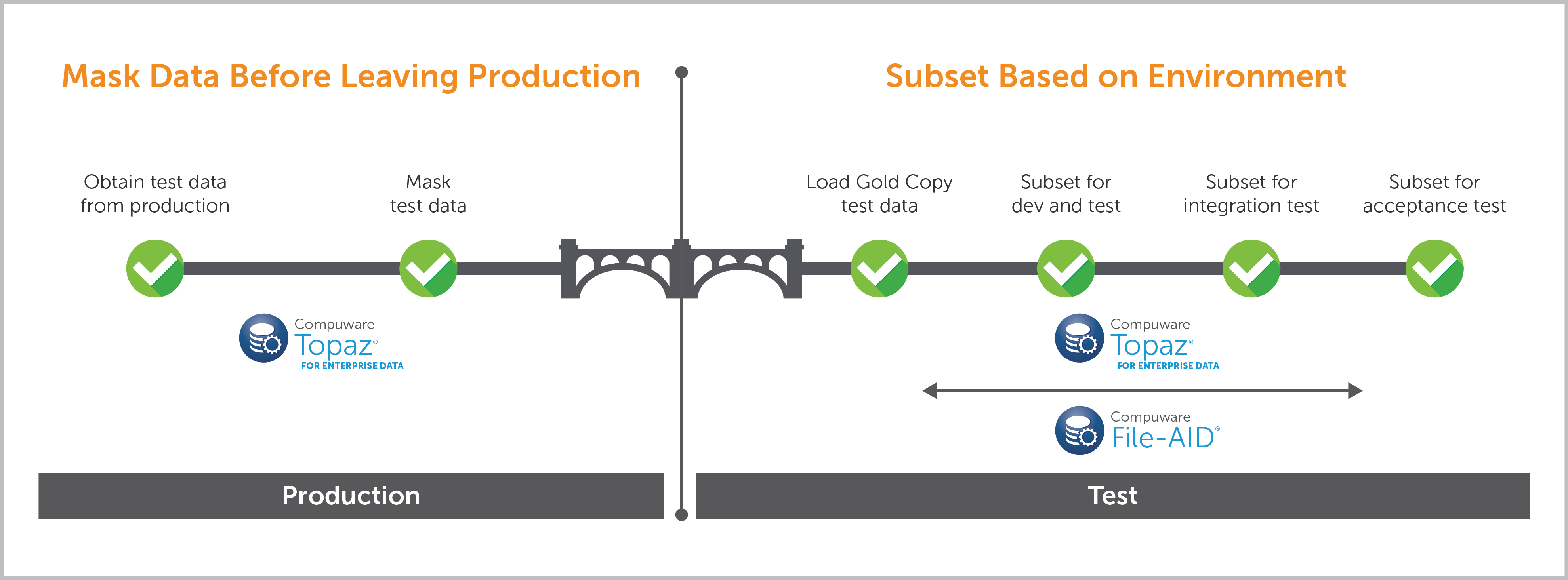
    Compuware has advanced its campaign to erase the DevOps divide between mainframes and distributed systems via an update to Topaz for Enterprise Data that makes it easier to generate data from mainframe applications for testing purposes without compromising the security of some of the most sensitive data in the enterprise.

    Company CEO Chris O’Malley said Topaz for Enterprise Data now includes a data masking capability that preserves essential data relationships and characteristics without letting developers see the data being copied.

    Designed to be compatible with Eclipse integrated development environments (IDEs), Topaz for Enterprise Data also automates the extract, transform and load (ETL) process by enabling developers to convert file types.

    O’Malley noted that, at a time when compliance regulations such as the European Union’s General Data Protection Rule (GDPR) are becoming more stringent, it has become more important for organizations to be able to demonstrate that personally identifiable information (PII) has not been exposed during any point in the application development cycle. That’s especially important when it comes to mainframe data, which typically is used to drive transaction processing applications.

    In general, O’Malley said the historic divide between mainframes and distributed systems is narrowing as organizations embrace DevOps processes. Instead of proponents of these platforms battling within organizations for control over specific classes of workloads, there’s more awareness of the need to leverage both platforms to drive a new generation of digital business applications, O’Malley said.

    The challenge is that most mainframe applications are built and updated using waterfall methodologies. Compuware has been developing a series of DevOps tools for mainframe environments that are intended to modernize those processes. As the IT organizations that have mainframes adopt those tools, it becomes easier to federate application development and deployment across mainframes and distributed systems, O’Malley said.

    Of course, this all assumes various teams within the IT organization can lay aside historic animosities. The shift to DevOps has always required as much process and cultural change as it does new technologies. But in the case of IT organizations that have mainframe teams, that shift may take years. The good news is a that a new generation of IT professionals doesn’t have much history with infighting within internal IT organizations. The simple fact is there are classes of workloads that run better on mainframes, O’Malley noted, but that doesn’t mean every workload running on mainframe is ideally suited for that platform—or conversely, that every workload running on a distributed system is ideally suited for that platform.

    Arguably, the rise of DevOps processes might create an opportunity to revisit many platform decisions that were made in the heat of a larger argument. In the meantime, it’s clear that applications integration spanning multiple platforms is the new order of the day. The question now is how best to go about achieving that goal in a way that erases the divide existing between all the platforms that now make up the extended enterprise.

    — Mike Vizard