Tag: TechStrong TV

  • MediaOps Video Productions Wins 2020 dotCOMM Awards

    MediaOps Video Productions Wins 2020 dotCOMM Awards

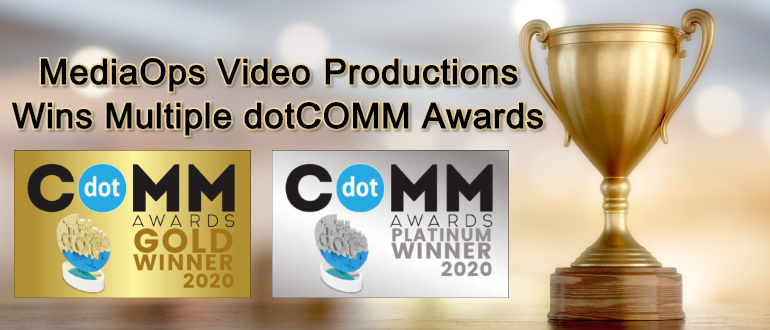
    We are pleased to announce that MediaOps is the recipient of not one, not two, but three 2020 dotCOMM Awards for excellence, in multiple video categories: TechStrong TV in the category of video series, DevOps Unbound for video podcast and CISO Talk in video news and information.

    The dotCOMM Awards are an international competition honoring excellence in web creativity and digital communication. They are administered and judged by the Association of Marketing and Communication Professionals (AMCP), an international organization that oversees awards and recognition programs and honors outstanding achievement and service to the profession. AMCP judges are industry professionals who look for companies and individuals whose talent exceeds a high standard of excellence and whose work serves as a benchmark for the industry.

    At MediaOps we are committed to creating and producing high-quality content to tell your story in the most powerful way, pushing the bounds of broadcast technology and creativity—and having fun while doing it.

    We are proud of everything we have accomplished so far, and these awards reflect the hard work and dedication of our talented and skilled team members, who strive for perfection to exceed the expectations of our audience.

    MediaOps Productions Take Top Awards

    Platinum Award for Video Series:

    TechStrong TV, a streamed broadcast featuring fresh video news and information three days a week and replays of prior shows two days a week, on the Digital Anarchist network. Covering DevOps, cybersecurity, cloud native and digital transformation, TechStrong TV keeps its viewers up to date on the latest news and features  interviews with thought leaders and education in the hottest IT areas.

    Gold Award for Video News and Information:

    CISO Talks, a bi-weekly series that explores the latest in cyberspace, featuring industry experts and newsmakers in the field. Hosted by MediaOps editor in chief Alan Shimel and Unisys CISO Matthew Newfield.

    Gold Award for Video Podcast:

    DevOps Unbound, a bi-weekly/monthly roundtable sponsored by Tricentis, which provides a deep dive into DevOps, with an emphasis on automation, continuous delivery, accelerating transformation, testing and quality.

    The MediaOps team would like to thank the dotCOMM Awards for recognizing the content we publish and the hard work that goes into it. Most of all, we would like to thank you, our audience, for all the support you have given us throughout the years.

    These three series, along with more than 1,500 other videos, podcasts and webinars, are available on MediaOps’ Digital Anarchist video platform and streamed via TechStrong TV.

  • TechStrong TV: How strongDM Helps mParticle in Secure Remote Access

    TechStrong TV: How strongDM Helps mParticle in Secure Remote Access

    In this interview for TechStrong TV, I am joined by strongDM CEO Elizabeth Zalman and mParticle CISO Dave Anderson. Dave shares with us how mParticle uses strongDM proxy services to rapidly enable the expanding mParticle team to access infrastructure, assets and applications necessary for mParticle to fulfill its mission to its customers.

    With the rapid growth of mParticle, the company needed a solution that would allow it to onboard its new employees and locations seamlessly. strongDM gives mParticle this capability. Have a watch of the video and follow along with the transcript to find out more.


    Transcript

    Alan Shimel: Hey, everyone—back here for another segment on TechStrong TV. I am joined once again by my friend Liz Zalman at strongDM. Hey, Liz, how are you?

    Elizabeth Zalman: Hi, Alan. I’m well, thank you.

    Shimel: Good to have you back on. And joining Liz and I today, another guest, is Dave Anderson. Dave is the CISO at mParticle. Hey, Dave—welcome to TechStrong TV.

    Dave Anderson: How’s it going?

    Shimel: Going great. Not as great as you are. Dave’s coming at us from a sailboat today and we’re all stuck in our homes and offices, but hey, the life of a CISO—and you guys complain.

    Anderson: [Laughter]

    Shimel: Anyway. You know what, we—yeah, I don’t know, it’s hard to make that less glamorous, Dave, but we’ll give you the pass. Liz, for those who haven’t seen some of our previous interviews with you and the strongDM team and some of the customers, why don’t we start off, give our audience a quick background, who’s strongDM, what you guys do?

    Zalman: Sure. Strong is a proxy and it lets people manage and audit access to any firewalled infrastructure—servers, databases, Kubernetes clusters, RDP, firewalled web apps, HTTP endpoints. So, essentially, instead of managing keys and creds, you give people access to strong, and then it talks to the target systems on your behalf, so you get access control and then auditing through the proxy itself.

    Shimel: Everything you expect from your proxy—great.

    Zalman: [Laughter]

    Shimel: And it’s sort of proxy as a service, if you will, yeah?

    Zalman: Yeah, there’s a portion of it that is hosted, the control plan itself, and then the rest goes through your own hardware.

    Shimel: Got it. And Dave—

    Zalman: Or whatever your virtual hardware is these days.

    Shimel: Well, yeah—no one uses hardware. Through your own infrastructure, how’s that?

    Dave, talk to us about mParticle.

    Anderson: Yeah, so, mParticle is a customer data platform. So, what that means is, our customers are able to use our platform to ingest pretty much anything, any data about their customers, about the activity that’s going on on their websites and mobile apps into the mParticle platform, and then we’re able to give our customers the full control of being able to fan that out to any of our different integration partners. So, there’s that, as well as being able to do things like data quality, match identity resolution, figure out where a particular user is, what sort of ways you want—like, how they’re interacting with their particular application or whatnot.

    To be honest, we have customers, like, in a bunch of different verticals, and they all use the product a little differently, and it’s—we’re continuing to grow and innovate and figure out different ways of kind of helping our customers along with their data journey.

    Shimel: Excellent. And, you know, that kinda mission is just so attuned with what I think companies are looking for today, right, which is—you know, there’s so much data out there. There’s so much—you know, do you want it all, what are you gonna do with it all, what makes sense, what doesn’t make sense? But the idea of being able to access that, analyze it—hopefully, with as much automation as possible—is what it’s all about.

    Of course, it also creates—as a CISO, you know this—it creates tremendous responsibilities and potential pitfalls from a security, data, access, compliance point of view. But it also, you know, to the strongDM mission of proxying through firewall to assets, whether those assets are remote workers who have to access, you know, data in the cloud or on-prem or wherever or just whether they’re remote or not, access incorporate assets, which, in your case are, in some cases, I’m gonna assume, a lot of PII kind of data.

    data
    Dave Anderson, mParticle

    Anderson: Exactly.

    Shimel: This is a potential security nightmare. This is what keeps CISOs up at night on their boats. So, talk to us, Dave, what is—you know, how does strongDM help you sleep better?

    Anderson: So, naturally, we’re a data collection—data collection and distribution company. So, we have a lot of data, a lot of data split up into a lot of different databases, and we have to have very tight access controls for those databases. So, one of the things that strongDM gives us the capability of doing for—when any sort of support people or operations people need access to a particular database or data set within the kinda mParticle back-end, we’re able to utilize strongDM to give us the ability to have secure access to that, that is able to be tied back to the individual who’s doing the work, everything is audited, everything’s logged, we’re able to generate reports for compliance.

    So, it gives us the capabilities of not having to give our, like a support person, for example, give them a direct access to the database. They have, like, a nice tool they can use, everything is integrated nicely on the desktop, and everything is integrated well with all of our identity management platforms as well.

    Shimel: Excellent, excellent. So, Dave, I think we—you know, we get what you’re doing there, we get what the potential risk is. And we’ve done a few interviews—in full disclosure, we’ve done a few interviews with some of the strongDM clients in fintech and other verticals. What we haven’t done is kinda peeled back what was—I mean, using a proxy, I think a lot of our audience has probably used a proxy one way or another.

    But I want to peel back now, in the case of mParticle, walk us through how you guys sort of say, “Okay, we’re gonna use strongDM.” How did you set it up? How did you deploy? How do you manage it, right? How does it give you the warm fuzzy feeling you need to know that you can sleep well at night?

    Anderson: Well, to be perfectly transparent, I was—I’m pretty new at mParticle, so, I wasn’t here when—

    Shimel: So, you inherited it?

    Anderson: Yeah, so, I inherited it. But I actually am a pretty early strongDM customer from my last job at Greenhouse Software, and so, I’m very familiar with that aspect of it. We used it for similar purposes back then. Back at Greenhouse, we had a lot of support personnel that were—and kinda data quality engineers that were using the strongDM platform to access our databases within AWS. And similar here, we want to have—we try to keep as much, the access as restricted as possible. We believe in the principle to release privilege, and separation of duties.

    Shimel: Sure.

    Anderson: So, with that, we need to have our networks deeply, deeply isolated. The databases live kinda deep into the network, not even having access to the outside world. And with that, the only way to give somebody in support access to that database traditionally would have been giving them VPN into that environment and then them having to actually install the different tools and having to manage authentication and access control. And even then, what would happen is, we would also lose visibility into what they did on that database. Like, what queries did they run, what data did they see? Because it’s not even necessarily a kinda everyday type of thing for someone to have access to the data itself. We tightly, tightly control who has access to what data, and using a tool like strongDM is pretty much a requirement for that.

    Shimel: Yeah. I mean, look—and I’ll try to put it in layman’s terms for our audience who maybe aren’t as familiar with this stuff. When you’re using a VPN, they call it a tunnel, right, a tunneling tool. Because really, what you’re doing is, you’re punching a tunnel through, whether it’s your firewall in your infrastructure, and it’s an encrypted tunnel at that, right? So, everything that takes place within that tunnel is encrypted.

    And so, when I connected to a database via a VPN, you may see that I did connect—oh, yeah, that’s Alan’s client and he connected to the database. But in terms of what data was in that tunnel and what—you know, you really don’t, you don’t have visibility there, by its very definition, right? On purpose. It’s not a byproduct, that’s how it’s supposed to be. And you don’t—you know, you can…it’s just, that’s how it was designed.

    And so, that doesn’t really play well, you know, in the areas of DLP and you wanna make sure data’s not ________, you know, taken out. It’s a problem. So, now, strongDM helps you solve that, is what you’re telling me, because now we can see, you know, it’s a proxy, but on the backside of the proxy, that goes into the firewall and into the trusted network as we used to call it 100 years ago when I was in security, right? When you go through that into the trusted network, you can still see where Liz went or Alan went or Dave went, because it’s not that tunneled, right? It’s not that encrypted tunnel through there, it’s more of the proxy. I remember when we were NAT-ing firewalls, right, a long time ago, and it was that same thing—at least I could match up this IP to that IP, the behind the firewall versus the public IP, you know, private IP, public IP. And so, you had some of that then.

    Then, on top of it—look, giving people a VPN, with everything going on in COVID and remote workers, you know, and all we’re hitting, and of course they’re not just hitting your database, there’s also SaaS apps that they need to hit and everything. A VPN is—I’m not a big fan of VPNs in today’s world, if you can’t tell, okay? I just—it don’t make sense. I mean, and then, and the whole idea of VPN-ing back into a central kinda office to go back into the cloud also kinda, I mean… You know, a friend of mine, I know a guy named Jay Chaudhry who is, of course, the CEO and Founder of Zscaler—he used to rail from the very time the cloud-first started coming on the scene big, 2006-’07, he was saying back then that VPNs were, you know, the time has come, but here we are, 2020—same thing.

    But, Dave, how easy was it to set up the strongDM proxy, and what kind of visibility is it giving you?

    Anderson: I mean, setting up strongDM is really easy. There’s a couple of pieces of infrastructure that you put into your environment, and that would all depend on how you deploy your infrastructure. So, there’s—I’m trying to remember the exact terminology. Like, a gateway and a—what was that?

    Shimel: Liz, can you help him here?

    Anderson: Yeah.

    Zalman: What?

    Shimel: Can you help him out, here?

    Zalman: I ________. I would never leave my friend hanging—never. [Cross talk]

    Anderson: [Laughter] Yeah, so, you deploy that infrastructure that, basically, that sits in your network and you have, and then it talks back to the strongDM portal and so, the strongDM clients actually know who to talk to, like, what IP addresses and what databases it has access to. You go through the strongDM UI or you can use their API, depending on your preference to set up different databases and set up the credentials in there and all the users and what users have access to what databases and what roles within those databases they have access to. And then there’s a client that runs on the person’s laptop, and that client, they’re like, you’re talking locally to that client and it’s magically on the strongDM back end, like, routing everything around to the right place and makes it extremely streamlined for the end user, because they just have this little control panel down there, like, in the bottom of their screen that lets them connect to the particular database, and it’s really, really ridiculously easy to use.

    Shimel: Very cool. Now, as part of the role in CISO, you’ve always gotta be thinking not if, but when we have an incident, right? I’ve gotta be able to do forensics, I’ve gotta have an audit trail, right, I’ve gotta be able to figure out, what the heck—I have to show people what happened here, did we take reasonable steps, right, and stuff like that.

    What is it, in terms of audit trail and forensics, how does strongDM help you there?

    Anderson: So, it shows us who connected to what resource when, how long they were connected, what they did, what sort of careers they were in, what sort of other kinda SQL comments or whatever the database may be, and be able to produce that in near real-time, as well as have logs to go back to if there was an incident that we would know what data was accessed by a particular individual.

    Shimel: So, that’s kinda the control plane that sits in the cloud, Liz, or that’s local to the client?

    Zalman: The auditing happens through the gateway. So, when the request hits the gateway, it actually deconstructs it in order to provide the audit trail—so, that stays resident in Dave’s network, yeah.

    Shimel: Excellent. So, we don’t have to worry about access to strangers to that.

    Zalman: Yeah, no, it’s his data. We don’t wanna touch it. [Laughter]

    Anderson: Yeah, that’s one of the most attractive things, actually, was the fact that the data stays in our network. strongDM operates the, how things actually get connected, but as far as, like, once you’re in that network, it’s, everything stays within there.

    Zalman: Cool. Alright, sounds great. Dave, one other question. With COVID and everybody working remote, I know—look, I mean, strongDM, from what I’ve seen, has built a…not built, but while there are plenty of people, obviously, suffering as a result of COVID and my heart goes out, I’m sure as you guys, too, to people who have lost loved ones and are sick and have lost jobs and money and all of the bad things that are happening with this. The fact is, you know, with remote workers being more and more common, solutions like a strongDM are thriving, right? Are being rapidly adopted. Not because they’re nice to have, because you gotta have something like that, right? So, I’m wondering, what are you guys seeing at mParticle and a similar kind of thing as you’re going remote?

    Anderson: Yeah. I mean, thankfully, we were really well-equipped for going remote. A lot of the engineering team is distributed to begin with. We had people in Seattle, Florida, Texas, and New York, of course. But we were able to transition to it pretty seamlessly. We just spend a lot more time on Zoom.

    Shimel: Don’t we all?

    Anderson: Yeah. [Laughter] Yes, but having the technology in place for being able to securely connect to remote networks, remote resources is definitely, it’s a requirement nowadays. I mean, especially with—you can’t, you don’t have a perimeter anymore. There isn’t that network, the whole concept of having that network firewall that was sitting there and protecting everything is kinda dead now, especially with, since everybody’s working from home. I mean, and VPNs, as we were talking about before, only give you so much. There’s only so much flexibility you have with how you can protect your network and segment your network to make a VPN be as flexible as a platform like strongDM.

    Shimel: Look, I thought network firewalls were dead in 2007, right? I remember the first time I saw a Jericho—I don’t know if you remember this, Dave, but do you remember the Jericho project? Did you ever hear of that? That, you know, they were the first ones to talk about the de-perimeterization of security and micro-perimeters and personal perimeter and all that stuff. That whole moat and castle setup that the network firewall played in and the VPN was sort of a bastardized child of, you know, that disappeared when we got mobile devices and people started going mobile. Sounds like a Who song—“Going mobile, mobile”—anyway. But yeah, I don’t disagree with you.

    Liz, let me ask you. I mean, mParticle, is this sort of the—it seems like it’s right in the sweet spot for what you guys are doing, then, right? This is the mission.

    Zalman: This is the mission, yeah, and it’s, and actually, Dave, shifting from—I mean, what do you call Greenhouse, ATS?

    Anderson: Yeah.

    Zalman: It’s a form of data management, actually, shifting into customer data. It’s a vertical that I hold dear, because I actually started my career in ad tech, and what he’s describing is what I wanted a decade ago. So, like, I personally love the fact that mParticle is a customer. [Laughter] There is simply no place to store that stuff and then to link it across various touchpoints—it never came to fruition.

    But yeah, a company that is distributed, that isn’t hyper-growth, it has large corporate clients who have, I’m guessing—Dave, tell me if I’m wrong—contractual requirements with respect to security and pen testing in various attestations.

    Anderson: Of course, yeah.

    Zalman: Yeah. [Laughter] Yeah, we do a good business in that area, and it hits all those things.

    Shimel: Very cool. Guys, we’re about out of time. Dave, I appreciate you taking time out of your busy day on the boat to join us here. [Laughter] All kidding aside, man, it actually is a very great socially distanced way to get work done.

    Anderson: Yeah.

    Shimel: Truth be told, I’m supposed to be on a boat tomorrow and I canceled, because I had some stuff come up, and [Cross talk].

    Zalman: Alan, it’s not that strongDM helps Dave sleep better at night, it’s those waves in the harbor, too. [Laughter]

    Anderson: [Laughter]

    Shimel: Yeah, well, that—right, they’ll help you sleep, either way. They’ll help you sleep well, as well.

    Anderson: Yeah.

    Shimel: I’m not gonna go there, though, Liz. You know, leave Dave alone.

    Anderson: It’s also my alarm clock in the morning. [Laughter]

    Zalman: [Laughter]

    Shimel: Yeah, that’s exactly it. You know what, alright, the guy’s on a boat, there’s worse things. It doesn’t make him a spoiled person. I don’t wanna get—you know what, but for all those people who say CISOs are underworked and overpaid, as Dave’s living here on the boat, that’s not true. CISOs are overworked and underpaid.

    But anyway—Liz, thanks for joining us.

    Zalman: Thanks, Alan.

    Shimel: We’ll hopefully have another interview with you soon, maybe.

    Zalman: I think we have one on Friday.

    Shimel: Very cool. Dave, thank you for joining us—great, continued success with mParticle. Sounds like a great business and a great use case here for strongDM, and enjoy—enjoy your time. Stay safe and stay well.

    Zalman: Thank you for having me.

    Shimel: Thank you. Hey, this is Alan Shimel. You just watched another TechStrong TV segment. We’re gonna be right back with another guest.

  • TechStrong TV: ‘The Startup Community Way,’ With Brad Feld

    TechStrong TV: ‘The Startup Community Way,’ With Brad Feld

    Brad Feld, co-founder of Foundry Group and Tech Stars, recently joined us on TechStrong TV to talk about his new book, co-authored by Ian Hathaway, “The Startup Community Way.” Brad is one of my oldest friends and has a lot of great insight into the tech community and the shift in the balance of power in many organizations, and his latest book discusses that at length and more.

    The video is immediately below, followed by the transcript of our conversation. Enjoy!

    Transcript

    Alan Shimel: Hey, everyone, thanks for joining us on this segment for TechStrong TV. I am, like, thrilled beyond thrilled to be joined by an old friend of mine—not that he’s old, but we’ve known each other a very, very long time—my friend, Brad Feld, who really needs no introduction in any kinda tech kinda discussion. Hey, Brad—welcome.

    Brad Feld: Alan, it’s great to be here. Awesome to see you.

    Shimel: It’s awesome to see you, my friend. I haven’t seen you in too long, and I don’t know when I’m gonna see you in person again with the current state of affairs, but I hope it’s soon.

    Feld: I get virtual Alan and you get virtual Brad.

    Shimel: That’s the best that we’re gonna have to do. So, Brad, we have you on here today because your book came out, I guess it was last week it came out officially, right? And it’s called “The Startup Community Way.” It is a sequel or follow on to “The Startup Community” book that you originally authored how long ago? That had to be, what, seven years ago was the first book?

    Feld: Yeah, “Startup Communities” came out in 2012, and along with the publication of “The Startup Community Way,” we came out with a second edition of “Startup Communities” that has some updates to it and some things that I got wrong the first time around fixed. So, it’s nice to freshen up.

    Shimel: Well, we’re gonna talk about those. Yep, and we should mention, Brad, that you have a coauthor in this “The Startup Community Way” book, and that’s Ian Hathaway. And Ian may be less entrepreneurial or less experienced in the VC entrepreneur world, but very experienced in research and kind of doing, you know, looking at this scientifically, if you will.

    Feld: Yeah, he was a really good coauthor, he’s become a close friend, and part of the thing that was good about it was, we do have different frames of reference. So, as we talk through and work through the book and work through different ideas around the book, you know, pressing against each other from different frames of reference really generated, I think, much better ideas and much better writing.

    Shimel: Excellent. So, Brad, I’m gonna make some assumptions, here. First of all, our audience is a very geeky, techy audience, right? We cater to digital transformation, DevOps, cloud-native, open source kinda stuff, and of course, cyber. They know who Brad Feld is. They’re familiar with tech stars, they’re familiar with startups, they’re probably even familiar with the term startup community, which you kinda initially coined with the book, right? So, I don’t want to spend all of our time sort of laying that foundation. They’re familiar with who Brad Feld is as well.

    And if you’re not, I’m gonna tell you really quick. I sold my first company to Brad in 1997. He’ll tell you I was wearing a stupid sports jacket, but we’re not even gonna talk about it. [Laughter] He’s been at SoftBank Venture Capital, Mobius, Foundry Group, started Techstars, one of the kind of forces behind—how do you pronounce it? National Nitwit is—what does it stand for, Brad?

    Feld: NCWIT, National Center for Women in Information Technology.

    Shimel: Yep, and, you know, one of my favorite things you’ve done. But, I mean, beyond—we could go on and on, but let’s not. Brad, I started reading “The Startup Community Way,” and I have some issues, questions, areas I want to jump in on with you if it’s okay.

    Feld: Sure. So, obviously, with your initial “Startup Community,” you had what you coined the Boulder Thesis, and there were four main points in the Boulder Thesis. Number one, though, and sort of primal to me was that, for startup communities to thrive, they need to be led by entrepreneurs, right? These entrepreneurs had to have a long-range kinda commitment to the community, and let’s stop right there for a second.

    Shimel: I noticed in this, in the new book, you kind of made a realization that, in informing that, we set the entrepreneurs up as sort of the alpha predators, as the top dogs on the food chain, right? But in doing so, it might have created a little bit of us versus them between entrepreneurs and the other, I’m not gonna say equal participants, but vital participants in this equation of a startup community. The workers of these companies who go to work at entrepreneurs, universities, government agencies—the community, right? It’s not just entrepreneurs.

    And I think one of the things you’re seeking to address in the book is to kinda ease that tension, the us-versus-them tension, correct?

    Feld: Yeah, that was a mistake I made in the first book, and it was a mistake of language, not of intent or description. So, in the first book, I made the strong assertion that the leaders of a startup community have to be entrepreneurs and, in the absence of a critical mass of entrepreneurs playing leadership roles, your startup community won’t grow and evolve.

    I then labeled everyone else a feeder, and my intention was not to have leaders be one up on feeders—you know, one up, one down relationship—but just different. And I tried to categorize them differently and spent a fair amount of time in the book describing what leaders do and what feeders do. And the miss was, there’s a lot of people who play leadership roles in startup communities who are not entrepreneurs, and in the new book—and I also went back and updated the second edition of the old book—I now call them instigators. And the idea of an instigator is that they are playing a leadership role in the startup community, and that’s a very powerful notion.

    So, essentially, people now are classified as leaders and instigators, and the organizations are feeders, and that’s really important, because the organizations tend to be hierarchical. They tend to have their own agenda in addition to the agenda of the startup community. And the fundamental goal of a startup community, pure and simple, is to help entrepreneurs succeed. And the feeder organizations, part of their goal as organizations are to help entrepreneurs succeed, but that’s not their only goal.

    We also distinguish now between the notion of a startup community and an entrepreneurial ecosystem. A startup community, at its core, exists to help entrepreneurs succeed, and an entrepreneurial ecosystem has, at its core, a startup community, but it’s a much bigger thing, and it engaged all of these other organizations around their goals and how they engaged with entrepreneurship.

    So, I think we’ve done a better job in “The Startup Community Way” of talking about leadership and who provides leadership and the people providing the leadership in the startup community being both the leaders, the entrepreneurs, and the instigators, people who aren’t entrepreneurs, but who are playing a leadership role. And then the organizations, the other actors who contribute to the startup community but don’t control it, don’t try to organize it, don’t try to run it, just participate in it.

    Shimel: Excellent. You know, Brad, there’s a lot of analogies there to what we see in the DevOps world, right? The developers have become the entrepreneurs of the first edition of startup community, where it seems the rest of the DevOps ecosystem revolves around these developers, and look, developers are impossible to hire. They’re, as you know from your companies, they demand a lot of money, they want a lot of say over their environments, their culture, and everything else. They’re kinda calling the shots, and the rest of the world kind of revolves around it.

    But also, a lot more is thrown on these developers’ shoulders in terms of what—they’re no longer responsible just for code, they’re responsible for deployment, they’re responsible to make sure the testing is right, you know, for that whole software factory. They, in essence, run the factory. And a similar kinda thing has happened in DevOps where we say, “Hold on—yes, the developers’ role is a very important role, but so is that of the cyber person, so is that of the SRE, so is that of the tester. And literally, it does take a community, and it’s caused a bit of a realignment, if you will, within how we look at DevOps and cloud native and continuous deployment.

    I wonder, you know, carrying that analogy out, Brad, though, I think a lot of our audience out here, they tend to interchange entrepreneur with technical entrepreneur, and I wanted to talk to you about the role of the business entrepreneur for my own selfish reasons, but you know—and you have a ton of experience on this. When we talk about entrepreneurs, Brad, how much of it is, you know, so a technical entrepreneur, the kind of person who goes on to be the CTO in their startup or in their company versus people who come from the business side of things, right? And what’s the right mix, or what’s a—I don’t know if there is a right mix, but what’s the right formula for when we look at the entrepreneurs within the greater entrepreneurial ecosystem, within the startup community, between technical entrepreneurs and, let’s call them, business-orientated entrepreneurs? Make sense?

    Feld: Well, they’re both—it makes total sense. They’re both essential. And when I talk about entrepreneur, I don’t really distinguish between the two. I think there are many different roles that founders or entrepreneurs play. And, for a lot of people, the word entrepreneur tends to be triggering. Like, it used to be something that was very well understood.

    Today, the word entrepreneur gets used, I would say, almost indiscriminately in a lot of different contexts. And, to your question, I would come back to the notion specifically of a founder. A founder of a company, somebody who is one of the people who helps create the company from the very beginning, and you need a combination. You need technical founders, technical entrepreneurs. You need business founders, business entrepreneurs. Most companies generally have more than one co-founder, but there are definitely successful companies with one founder.

    But generally speaking, if you have more than one founder, especially if you have a combination of a business founder and a technical founder, you can make a lot more progress a lot quicker in many cases. And if you have three or four founders, I generally try to encourage people to have at least an equal number of technical founders to non-technical founders, and preferably, more technical founders than non-technical founders. And, you know, Alan, you’re humble. I mean, you talk about yourself as the business guy, but you have very, very deep technical experience at this point. Even when I met you when you were running your first company in the late 1990s, you had deep technical experience.

    So, the technical founder doesn’t necessarily mean just somebody who writes code, and I like to shift the language to be product-oriented instead of technical. So, if you think about three founders, three co-founders, the idea that two of them are focused on product and one of them is focused on the business, and the product and the business obviously overlap with the customer, and so, all three of the founders are paying attention to the customer, the evolution of what you’re trying to do from the very beginning can move a lot quicker.

    By the way, there are a lot of very, very good technical founders who also have strong business sense in the same way that you’re a strong business person that also has strong technical sense. So, it’s not cut and dried, and you’re not like, “Oh, I’m in this box and you’re in this box.” I try to encourage entrepreneurs to think more broadly about what they’re doing and how they’re doing it.

    Shimel: Excellent. Hey, I’d like to shift a little bit away from the entrepreneur because they get all the press, anyway. I want to talk about something that was really highlighted in your book, and that is the role of, within the community, within the ecosystem, the role of universities and the role of government, the role of these hierarchical groups as you referred to them.

    Let’s talk a little—and I’m gonna bring it home to what I see here in South Florida, for instance, but Brad, you know, (a) it’s an important role they played in this big picture, but what optimally, what can the government do optimally, for instance, to help you—there’s federal, there’s state, there’s local—you know, where do you see it?

    Feld: You have to be somewhat granular, and you also have to be focused on the specific place that you’re at, whether it is local, state, or federal or national governments. Interestingly, in the first book in 2012, I basically punted on this issue. I said, “The best government can do is do no harm to the startup community.” And, you know, I would say that was a combination of me not really having a particularly clear view of what government could have along with me kinda punting and being lazy about digging into it—based on my own experience, my own experience in Boulder, for example, is that the local government basically pays no attention to entrepreneurship and doesn’t really understand how to engage it in an effective way.

    The state of Colorado government, actually, has done a pretty good job, and there have been a number of things over the years that the state of Colorado has done around this and then, you know, our federal government in the U.S. ebbs and flows. Sometimes there are some programs that are incredibly helpful and oftentimes, there are things that either get in the way or are counterproductive.

    So, I’ve come to a place where what I think is important for government at any level to start with is to understand what their goal is. And I’m gonna come back to this statement I said earlier, which is, the goal of a startup community is to help entrepreneurs succeed. So, if government wants to engage in the startup community, their goal should be to help entrepreneurs succeed.

    Now, at a local level, that often means that the best way to do it is an instigator—gonna use that word again—who is a person who works for a local government who actively engages as a leader in the startup community. So, they’re not actually bringing government so much to the startup community, but they’re, in their role in government, they may have a full-time job to help with economic development or developing the entrepreneurial ecosystem or whatever it is. Like, their first step should be to become part of the startup community as an instigator rather than show up as government and say, “Hi, I’m from the government, I’m here to help.”

    Shimel: Mm-hmm.

    Feld: One of the things the government really struggles with is allocating capital. Government has a lot of capital, as we’ve just learned from the COVID crisis. You know, overnight, the federal government allocated or deployed $2 trillion, and it looks like it’s gonna allocate another $1 trillion across their society. And a lot of that money went towards helping, quote, small business, where government thinks of small businesses and entrepreneurial businesses as the same.

    If you use that lens, though, and you look at how that money was allocated, it was primarily allocated through two vehicles, PPP loans and EIDL loans. It was incredibly inefficiently allocated, and as a result, some companies got financial support, others didn’t. And it was done in this very, very sort of explosive way that may have had some very powerful short-term impacts, but it’s unclear on whether it has medium or longer-term impacts.

    One last sort of comment on governments, state [Audio skips] governments over and over again. We need more venture capital here, we need more capital here, and we need to do things to get more capital here. In “The Startup Community Way,” we actually defined capital as having seven different flavors, where financial capital was one. Because generally when people talk about capital, they’re talking about money, and this is another place where governments can really help is to think about what capital the startup community already has that’s not financial capital—what kind of intellectual capital, what kind of network capital, what kind of infrastructure capital exists and what more is needed. And then try to figure out how to use the resources of local or state government to amplify those types of capital that ultimately then is a positive reinforcing loop to attract other sources of capital.

    So, unfortunately, it’s—I think, for government, it’s nuanced, and a lot of times government is looking for a playbook and a solution, like, “I just need to do the following four things and then good things will happen.” And this is essential to “The Startup Community Way” where we talk about startup communities now as complex systems.

    Shimel: Yeah.

    Feld: And one of the things that many organizations have a lot of trouble interacting with—especially government, but not exclusively government—is complex systems.

    Shimel: So, let me talk a little bit about complex systems here in South Florida. I know you’ve been down in Miami a few times, you’ve had a chance to see sort of the Miami startup scene and, you know what, in four or five short years, it’s actually come a long way. You know, it’s the gateway to Latin America and they talk about all that, but more importantly, there are some really concrete programs, the Knight Foundation, a few other organizations as well as local government has instituted it, and we’re beginning to see a startup community take hold there, in my opinion. It’s not bolder, it’s not awesome, but it doesn’t have to be, it’s Miami, and it does it in its own unique Miami way.

    But South Florida is more than Miami, right? You basically have a tri-county or three city sort of metro area of Miami, Fort Lauderdale, and West Palm Beach. Taken together, I forget if it’s the six or seventh largest metropolitan area in the U.S., right, between these three counties—Miami-Dade, Fort Broward, and Palm Beach County. A tremendous amount of universities, we haven’t even talked about universities yet, but we have University of Miami and FIU and FAU here. Lots of universities—universities that are, you know, in your first book when you talked about the role, you know, they do serve as anchors.

    I think what holds us back in the South Florida area, though, Brad, is that we have shoguns, right? I remember when your business card used to shogun, remember those days? [Laughter] But we have shoguns here every 10 or 15 miles, each little town or incorporated village is afraid that the next one is gonna do more, better than them.

    Here in my little neck of the woods, Boca Raton and Delray Beach constantly—they’re right next to each other—constantly banging heads. Boca has the universities, maybe a little more capital. Delray has a great sort of startup scene brewing and they do have local economic development and a number of co-working places and stuff like that. But they can’t seem to get their act together to work—and these are just two little, piddling towns, to tell you the truth, right? If they would put it together, they might have something—but they can’t, they’re too busy competing. And it’s the same thing up and down this coast, right?

    So, you have an area with a lot of universities, a lot of capital, a decent amount of tech talent—I mean, not deep enough, by any means—and certainly, many entrepreneurs. But they’re at loggerheads. How do you—in creating this entrepreneurial ecosystem, how do you overcome this sort of petty jealousy, these shoguns fighting for supremacy?

    Feld: Well, you have to start from a perspective of playing a positive-sum game, and what you’re describing is a classic zero-sum game, where there’s winners or losers.

    Shimel: Yep.

    Feld: And, you know, the ones that we’re used to in terms of zero-sum game and election is a zero-sum game, somebody wins, somebody loses. Sports of events, most of them, zero-sum game—winner, loser, sometimes you tie if you play soccer. But, you know, for most games, there’s a definitive winner or loser. You don’t wanna play a zero-sum game

    You wanna play the opposite of that, which is a positive-sum game where the cliché would be a rising tide lifts all boats, right? You’re helping each other over time sort of building something that’s more and more successful. And, in defining startup community, you can define startup community however you want in terms of geography. You can define it in a little town like Boca or Delray. You can draw a bigger circle around it and call it the Greater Miami Metro Area or whatever you wanna call it.

    By the way, you said something earlier that’s really important is that you don’t need to create or emulate somebody else. Boulder is Boulder, Miami is Miami, Greater Miami is Greater Miami, Boca is Boca—like, you already have an identity as a city. But the key is to try to work with the people who are close to you to build a broader and more robust startup community. And, interestingly, if you’re taking this approach and playing a positive-sum game where you help each other versus you compete for resources and you compete to win or lose in sort of an inappropriate way or an unhelpful way, it doesn’t really matter.

    The very specific example I’d give you is that, does it cost anything to travel from Delray to Boca? Do you have to pay—

    Shimel: You could walk.

    Feld: – you could walk, right? You don’t have to pay a tax, you don’t have to have somebody, you know, stamp your passport to get from one place to another. I mean, you really are part of a—

    Shimel: Not yet.

    Feld: – not yet. You’re part of a collaborative collection of people, and the goal should be that you wanna encourage cross-fertilization between these communities and you wanna encourage amplification of what’s going on and get critical mass around it.

    Now, there’s nothing wrong with local pride, and I can use Boulder and Denver as really good examples of that. Boulder and Denver are both very, very vibrant cities. Boulder is 100,000 people, Denver is 2,000,000 people. They’re about a 30- to 45-minute drive apart from each other. They have independent identities, but there’s an enormous amount of collaboration between the two, and that’s very, very, very powerful.

    Shimel: I mean, so, I’ve done Meetup groups in Denver and Boulder. You know, we started one with the Jump Cloud folks called IT as Code. The first meeting was down in LoDo. But we had people from all over, from Boulder and everyone else drive in, and we had a great meeting at one of the breweries there—good times.

    I’ve started a bunch of Meetup groups here in South Florida, and we’re constantly, “Jeez, we have to do this one in Miami for the Miami people. We need to be down near Fort Lauderdale-Hollywood this time, or out at the university out West there to attract that Broward crowd.” There isn’t that sense of community that the rising tide lifts all boats, and I’m hoping that books like “The Startup Community Way” kind of make their way into the stream here, the mainstream of what these people are thinking about.

    We even see it, Brad, with—so, we have the South Florida Technology Association, then we have the Palm Beach Technology Association. There’s several counterparts in Miami. They even compete at such a—and it’s a petty competition, frankly.

    Feld: Well, they could really change the game in the region by deciding to collaborate, and they can have separate organizations with separate memberships and separate goals even if they’re in the same place because there’s no need for there to be one monolithic thing. In fact, you probably want a bunch of different things. But instead of viewing it as an, “I win, you lose,” they’re all trying to help entrepreneurs succeed. And in the context of that—again, the instigators, the leaders of those organizations, right, those organizations, even if they’re comprised of entrepreneurs, they’re still feeder organizations, right? The organization themselves is a feeder supporting entrepreneurs. The people in those organizations who are playing leadership roles can play a leadership role in the startup community, which is separate from their organization. Their organization is not the thing that’s organizing, managing, running the startup community. It’s just another participant in this.

    And so, changing that frame of reference for humans is hard, because we’re used to competing, and you know, we’re—

    Shimel: No, it’s like “The Highlander”—there can be only one. [Laughter] Right? And it’s a problem—I get it.

    Feld: Well, and changing that is important and, you know, it’s one thing to say it’s important to change; it’s another thing for a bunch of leaders in a startup community to say, “You know what? Enough of this. We don’t need the segmentation, we don’t need the competition. Let’s all pull together even though we’re addressing different things, and we have some overlap. We’re trying to do something together that makes our place better.”

    Shimel: Fantastic. Brad, we’re almost out of time. I wanted to leave you a couple minutes at the end here for our audience watching. If you had the three biggest takeaways from the book that you want people to go home with, what would you say they are?

    Feld: The first is the distinction between a startup community and an entrepreneurial ecosystem and the reinforcement that the goal of the startup is to help entrepreneurs succeed, and you can define everything from there.

    The second is that a startup community is a complex system, and in a complex system, there is no deterministic outcome. There is no playbook. There is no set of rules to get from Point A to Point B. A simple system would be making a cup of coffee. You put beans into the machine, you get coffee out. It might not be a good cup of coffee, but it’s a cup of coffee.

    Shimel: Coffee it is.

    Feld: Coffee it is. A complicated system would be manufacturing a Boeing 787 airplane. Once it’s designed, the rule book’s now really big, but you put parts at the beginning and at the end comes out a Boeing 787.

    A complex system would be raising a child—and you’ve raised two. And you know that on day one of the child, what you tell the child to do and what you aspire for the child to do at age 21 is not what’s gonna happen. Every little thing you do, the child evolves and changes and grows and develops and all that stimuli is positive and negative along the way. And at the end, the child is whatever the child is. But it evolves in a way that you can’t predict. That’s what a startup community is—you cannot predict what that outcome is and you can’t control the outcome.

    The last—and we cover this in the book and there’s several examples. I gave one which was the notion of capital not just being money and defining it as the seven capitals instead of just financial capital. Another would be something we could call the measurement trap. Everyone in a startup community feels the need to measure things, and this is especially true for government, this is especially true for nonprofits like the different associations that you probably described.

    They’re measuring constantly—number of companies created, number of unicorns, dollars raised, number of jobs. These are things to measure, but they’re not the important things, they’re the easy things. And the really important thing that happens in the growth and development of a startup community and complex system is not the parts, not creating more pieces, it’s the interaction between the pieces, interaction between the parts. And measuring that interaction is really, really difficult, but that’s where all the power comes from.

    Shimel: Got it. Love it. Hey, Brad, first of all, thank you so much. I know you’re crazy busy with promo-ings on the book and everything, so thanks for taking the time to come join us here on TechStrong TV. Best of luck with the book. We should mention it’s available on Amazon, it’s on all the usual places where one buys books today. Not going to book stores very much, unfortunately, but yes. So, it’s “The Startup Community Way,” Ian Hathaway, Brad Feld—check it out. It’s available in Kindle and hardcover at this point. I don’t think a paperback is out yet, right?

    Feld: No paperback yet, just Kindle.

    Shimel: Yep, hard book and Kindle. I have it on my Kindle here, I was all ready with my notes—but Brad Feld, author, “The Startup Community Way,” Foundry Group, Techstars, tech entrepreneur extraordinaire, and one of my best friends for a long time.

    Feld: Thanks for doing this, it’s so awesome to see you, and congrats on everything you’re doing with your business now. It’s wonderful to see it.

    Shimel: Thank you.
  • DevOps Unbound: Exploring Acceleration and Automation, Setting DevOps Free

    DevOps Unbound: Exploring Acceleration and Automation, Setting DevOps Free

    We are launching a new video series Thursday, Aug. 6, called DevOps Unbound. DevOps Unbound will focus on DevOps, automation, CI/CD and testing, featuring leaders in these areas as we explore the challenges and issues software delivery and IT teams face every day. How do we go faster, smarter with better quality? DevOps Unbound!

    The series will premier on our TechStrong.tv streaming network and should start around 10:40 a.m. Eastern tomorrow, August 6th. It will be available on Linkedin Live (on the devopsy.kinsta.cloud page), Facebook Live (devopsy.kinsta.cloud, Container Journal or Security Boulevard pages), YouTube on the DevOpsTV channel and the MediaOps sites. Additionally, the show is available on-demand on our devopsy.kinsta.cloud mobile app and our devopsy.kinsta.cloud OTT channels on Roku, Apple TV and Amazon Fire TV. Finally, all episodes will be available on-demand on Digital Anarchist, our streaming video platform. The series is sponsored by our friends at Tricentis.

    New episodes will run every other week. Also planned is a monthly DevOps Unbound roundtable, open to the public and featuring a revolving panel of experts around a given theme. The first live monthly roundtable will be Aug. 18, around the theme “DevEverythingOps.” Roundtable discussions do require registration; you can register for the first event here.

    Premier Episode August 6th

    The premiere episode features Dr. Grigori Melnik, CPO of Tricentis, and James Bach, the developer of session-based testing and a highly respected expert in testing. We will explore the history of testing and how it has adapted over the years to allow for more automation, help testers and developers be more efficient and accelerate the software release process.

    These are two people renowned in their fields who arrived here from very different paths. Bach is a high school dropout who was bitten fiercely by the computer bug. He was a game developer and then a coder who became one of Apple’s first test engineers in 1987. Dr. Grigori Melnik has a Ph.D. in testing and is a respected authority in both the academic and business worlds.  Though they come from different backgrounds, they have more in common than you might think. It was a great discussion and one I think you will really enjoy.

    Future episodes of the bi-weekly show will feature topics including DevSecOps, open source, cloud-native, CI/CD, SDM, DataOps, observability and more. We think DevOps Unbound will quickly become an essential part of your DevOps information arsenal.

    We are always on the lookout for future topics and guests. If you think you would like to take a giant leap with DevOps Unbound, reach out to me at unbound@devops.com with your idea and we can follow up.

    BTW, DevOps Unbound is just one of several new shows we are premiering on TechStrong TV and Digital Anarchist. Another is CISO Talk, featuring Unisys CISO Mathew Newfield and me. That will be on TechStrong TV this coming Monday. More announcements to come about new, recurring shows.

    We recognize that people want to see video content and at MediaOps/devopsy.kinsta.cloud we are producing lots of exciting new video content. Stay tuned.

  • Digital Anarchist – Watch What’s Next in Tech

    Digital Anarchist – Watch What’s Next in Tech

    Today, we announce the launch of the next version of Digital Anarchist, our next-generation video platform, at digitalanarchist.com. The content is also available on the devopsy.kinsta.cloud mobile app and OTT channels on Apple TV, Roku and Amazon Fire TV.

    Boasting more than 1,400 videos and featuring 1,000-plus guests, the Digital Anarchist library may be the single largest collection of videos covering topics related to DevOps, cyber, cloud-native and digital transformation. It includes webinars from across the MediaOps properties, virtual event sessions, interviews from conferences around the world, DevOps Chats and more.

    The new interface, video recommendations and searchable guest and video index are more closely aligned with the original vision of Digital Anarchist that John Willis and I had when we came up with the concept. Providing a consistent user experience across different platforms and applications has proven to be a challenge. We continue to work at it.

    The No. 1 Source for IT News and Entertainment

    Digital Anarchist is a hub with thousands of hours of information, serving as a catalyst for digital transformation that disrupts the outdated and inefficient, providing the information organizations need for a faster, higher-quality and more secure future.

    Visitors and subscribers will have access to exclusive live and on-demand content from a variety of channels:

    • Virtual Events – Catch up on sessions and one-on-one interviews with industry leaders from more than a dozen conferences and virtual events hosted in the last 12 months. 
    • Analyst Corner – View weekly segments hosted by Accelerated Strategies Group’s analysts and seasoned industry veterans, covering the latest trends and opportunities for businesses during these unprecedented times.
    • TechStrong TV – Live-stream TechStrong TV on Digital Anarchist three days a week or access previous episodes to hear honest and open dialogues with tech leaders and executives covering the latest news. 
    • DevOps Chats – Hear the latest episodes of “fireside” podcasts featuring devopsy.kinsta.cloud and Security Boulevard Editor in Chief Alan Shimel and Accelerated Strategies Group CEO Mitch Ashley, as they chat with luminaries and thought leaders in DevOps and security.
    • On-Demand Webinars – Replay webinars from devopsy.kinsta.cloud, Security Boulevard and Container Journal 30 days after the live event.
    • CISO Talks – Join MediaOps CEO Alan Shimel and Unisys CISO Mathew Newfield in a bi-weekly series to explore the latest in cyberspace, featuring other experts and newsmakers in the field.
    • DevOps Unbound – This bi-weekly/monthly roundtable, sponsored by Tricentis, provides a deep-dive into DevOps, with an emphasis on continuous testing and automation. Roundtables will be open to audience interaction as well.

    State-of-the-Art Studio and Video Production

    Digital Anarchist features both original and third-party content. The streaming service also provides video production, distribution and sponsorship, offering opportunities for both branding and lead generation campaigns.

    Using state-of-the-art digital HD equipment and dynamic post-production video editing, the Digital Anarchist team is highly qualified to create custom videos to tell your story and reach a global audience. Some of Digital Anarchist’s services include:

    • Educational series.
    • Case studies.
    • Brand marketing videos.
    • Storytelling testimonials.
    • Sponsored ads.

    If you would like to have your video content featured on Digital Anarchist, reach out to us at sales@mediaops.com.

    In the meantime, please check out the new site and subscribe if you’d like to be the first to see the 15 to 20 new videos we add on a weekly basis. And, as always, your feedback is welcome.

  • TechStrong TV: Celebrating the Strength of the Tech Community

    TechStrong TV: Celebrating the Strength of the Tech Community

    I wanted to tell you about two important initiatives we have been working on around here, TechStrong TV and TechStrong Con. They are a big part of our COVID-19 response. The past four weeks (has it been just four weeks?) have been a blur. The MediaOps team has shifted into overdrive to keep all of our sites up and running and our webinars, virtual conferences and other activities on track, all while working from home. But that wasn’t enough—we wanted to do more.

    TechStrong TV and TechStrong Con are the things we have chosen to do. Communication and collaboration are so core to the tech industry, and we wanted to help show it is #TechStrong. So let me explain what TechStrong TV and TechStrong Con are.

    This first of two articles focuses on TechStrong TV. TechStrong Con will be the focus of the second article.

    TechStrong TV

    TechStrong TV is a streamed broadcast for two to three hours daily Monday to Friday. Each episode features a fresh set of news, interviews and other content.

    The broadcast streams here on devopsy.kinsta.cloud, as well as on Container Journal and Security Boulevard. It also streams on our Facebook pages via Facebook Live and our devopsy.kinsta.cloud pages on LinkedIn via LinkedIn Live, as well as on Digital Anarchist and TechStrong TV. Select interviews from the daily shows are available standalone on the Digital Anarchist site.

    Perhaps the best way to view TechStrong TV, however, is actually on your TV. Through our devopsy.kinsta.cloud app on AppleTV, Roku and Amazon Fire you can view episodes on-demand on your TV. You can also view on your phone or on tablets on the devopsy.kinsta.cloud mobile app.

    TechStrong TV Content

    You know for the last year and a half and even before that we have been traveling around the world streaming video interviews from conferences near and far. We have a full media studio in our offices. We wanted to keep that stream of interviews going.

    With so much bad news on the mainstream news shows, our thought was, Let’s concentrate on the tech industry. What are people doing? What are vendors doing? What are you experiencing while you’re working from home? We explore all of this and more on TechStrong TV. We also mix in from the Digital Anarchist archives and our YouTube DevOpsTV channel some of the best interviews we have done on-site over the years.

    We shoot the show with one video person and me in our office. Mitchell Ashley, principal analyst at Accelerated Strategies Group, and MediaOps Managing Editor Charlene O’Hanlon are my co-hosts, recording segments from Colorado and Virginia, respectively. Additionally, we feature weekly segments by John Willis and Jayne Groll and twice-weekly segments on the channel by Mike Vizard.

    We hope to add more regular segments by some of the Accelerated Strategy Group team and other tech leaders.

    More Than Just Tech Segments

    We recently added WFH Fitness with Jeremy Jones to the TechStrong TV lineup. Jeremy is on our sales team but is also a certified personal trainer, having worked as a personal and group fitness trainer for years before joining MediaOps. He brings his knowledge of fitness to the TechStrong TV airwaves two or three times a week, recording a 20-minute workout circuit for those at home without access to gym equipment. The exercises are good for any level of fitness, from beginner to advanced, and using equipment you have around the house (think water jugs and canned goods).  These workouts are available as standalone, on-demand segments on TechStrong TV and the OTT channels (Roku, AppleTV and Amazon).

    In addition, we created a community Slack channel, which you can grab an invite to when you visit the TechStrong TV website. This way you can interact with the guests and our team in real-time.

    The New Normal

    Personally, this is the longest I have been home with no business trips in probably 15 or 20 years. Being a road warrior was a big part of my life in technology. For those like me, this new normal has taken some getting used to. But TechStrong TV gives me the communication and connection to the industry I crave. I hope it does for you as well.

    If you or someone you know would like to be featured on a TechStrong TV segment, reach out to us at techstrong@devops.com. We are also looking for sponsors if any tech vendors are reading this (I would bet there are). In just a few weeks, we are already entertaining 5,000 to 6,000 people each day.

    We are going to keep TechStrong TV going even when we return to normal (or whatever the new normal is). It is improving every day and I hope it will continue to do so.  I invite you to check it out and give your feedback so we can continue to make it better.

    Again, I will detail TechStrong Con in my next article. But until then, during these surreal times, the whole MediaOps team and I hope you stay safe, stay well and stay strong. #TechStrong