Tag: Styra

  • Styra Makes Source Code Available for Enterprise Edition of OPA

    Styra Makes Source Code Available for Enterprise Edition of OPA

    Styra is now making the enterprise edition of the Open Policy Agent (OPA) available under a source license that enables IT teams to modify or change the underlying code as they see fit when integrating it with other applications.

    Enterprise OPA is a drop-in replacement for OPA, agent software for implementing policy-as-code that is already available under an open source license. Styra’s enterprise edition provides access to a version that provides better performance, native integrations for a suite of data sources and additional capabilities such as policy decision analysis.

    Previously, Enterprise OPA was only available in either a binary or container format. While these formats enable Enterprise OPA to be widely used, they limited it from being built directly into applications for performance optimization because no access was provided to source code.

    Chris Hendrix, director of product management for Styra, said the source license also provides organizations with an assurance that they will be able to continue to modify Enterprise OPA in much the same way as they modify the open source edition.

    It’s not clear how many DevOps teams are managing policy-as-code within their pipelines, but as application security regulations become more stringent, it’s only a matter of time before most of them do so in one way or another. Styra’s approach relies on a Rego programming language that some DevOps teams have found challenging, however. To make it simpler, the company is working on a low-code approach that would help make Enterprise OPA more accessible, said Hendrix.

    In addition to encouraging more DevOps teams to use Enterprise OPA under a source license, Syra is clearly moving to make it more attractive to replace existing instances of OPA with a more robust implementation licensed from the company. No one knows how many instances of the open source edition of OPA advanced under the auspices of the Cloud Native Computing Foundation (CNCF) are running in production environments. But as those applications become more complex, the need for deeper levels of integration enabled by a faster version of OPA becomes more apparent.

    OPA enables developers to programmatically embed compliance controls without waiting for a compliance team to make them available. That ultimately makes it simpler to ensure that the proper controls have been implemented before an application is deployed in an on-premises IT environment. That capability also makes it easier to document which controls have been applied to make any audit less time-consuming.

    Shifting responsibility for compliance controls to the left also enables DevOps teams to better understand which controls address specific regulatory mandates incorporated into most applications versus which controls might be specific to a specific regulation. Armed with those insights, it then becomes simpler to incorporate policy-as-code within a DevSecOps workflow.

    Hopefully, more applications running in production environments will soon be secure by default. Naturally, one of the first places to start is by making sure the compliance controls needed to achieve a baseline level of security have been pervasively implemented.

  • Techstrong TV: Styra Declarative Authorization Service

    Techstrong TV: Styra Declarative Authorization Service

    Styra’s new launch of Styra Declarative Authorization Service (DAS) for Cloud-Native Entitlements. With this solution, IAM teams can move to cloud-native technologies while still using existing systems-of-record as well as scale to the level that their organization requires. The video is below followed by a transcript of the conversation.

    Alan Shimel: Hello, everyone. Thanks for joining us on another TechStrong TV segment. Oh, I’m happy to have back on TechStrong TV today our friend, Tim Hinrichs, from Styra.

    Hey, Tim, welcome. How are you? 

    Tim Hinrichs: I’m doing great, Alan. Thanks for having me back on.

    Shimel: Yeah, it’s a pleasure to have you here. Tim, we always enjoy actually having the Styra folks on, whether it’s Bill, or you, or anyone else. Of course, Styra is a company that in the cloud native space has really kind of made a name for themselves. But though our audience is a cloud native audience and technical, they may or may not know Styra. They probably maybe have heard of Styra. They probably heard of OPA, but why don’t we kind of make sure everyone’s level set, Tim, and give them a little background?

    Hinrichs: For sure. Yeah, great. So, yeah, what Styra does is we help enterprises by providing them a unified solution to authorization. And so for folks that don’t know and don’t work on authorization every day like I do, just remember that authorization is this problem of controlling what actions that people and maybe software can take within a piece of software.

    So let me give you an example or two here. Every time I log onto my bank online, I can see all my bank accounts, but I may not be able to see my wife’s bank accounts. I may not be able to move money between her bank account and mine, and so that’s an authorization problem. It’s controlling what actions I can take. Can I withdraw money? Can I deposit money? So on and so forth. And so that’s one kind of authorization that we work on at Styra.

    But another good example is sort of at the developer level. So those websites that we all use every day, those are built by developers and developers are also taking action. And so one kind of action that they might want to take is they’re upgrading the software, or they’re deploying a database, or they’re changing some network configurations. Again, all of those are actions and there needs to be authorization controls in place to make sure that the right actions are being taken by the right people at the right time.

    And at Styra, we provide software that helps an organization sort of manage all of those permissions, all of those authorization policies across all those different kinds of decent software.

    Shimel: Excellent. Love it. And we might as well get it out of the way while we’re here, Tim. People who want to get more information on Styra, it’s Styra, S-T-Y-R-A, and it’s styra.com, correct?

    Hinrichs: Absolutely, yeah. Definitely check that one out.

    Shimel: Cool. All right, we’ve gotten that. Oh, you know what else, Tim? We didn’t even tell them about what your position at Styra is. We should give them that, too.

    Hinrichs: For sure, yeah. So my name’s Tim Hinrichs. I’m the CTO and co-founder at Styra and I spend part of my time working on our commercial product offerings, but then I spend the other part of my time on our open source efforts. And one of the things that we do in open source is we started the Open Policy Agent project, or OPA, as we like to call it, and then we donate it to the CNCF. So I’ve got a foot in both of those areas of work.

    Shimel: Love it. Hey, Tim, are you gonna be out at KubeCon in Spain in May, or planning it, not sure yet?

    Hinrichs: Not sure yet, but yeah, it would be great. I’d love to get back out, and start going back on that conference circuit, and seeing people, chatting with them about policy and authorization, and just seeing folks, again. I think it would be great.

    Shimel: We are currently planning on being there. We’re going to hopefully try to do some videos but a different sort of setup. I forgot what they’re calling it, something topist talks or something, so short, little, smaller segments. Again, assuming the world is right, we’ll be there.

    Anyway, but Tim, let’s focus in on what we want to talk about today, which is you guys recently announced a new offering. Tell us.

    Hinrichs: Yeah, for sure. So the new offering that we just released a little while ago, we call it the Entitlements Offering as part of our normal product called the Declarative Authorization Service. And so the idea behind this new offering is that it’s really designed to help organizations take custom applications and migrate them from on-premise data centers into the cloud more effectively, more quickly.

    And so the problem we kind of saw happening over and over was that if you’ve got one of these on-prem applications, especially an application that’s focused around helping your employees interact with each other or the organization as a whole, these employee-focused applications, a lot of those apps are dependent on what folks will call an on-premise entitlement service. So that entitlement service is often backed by LDAP, or Active Directory, or something, and it’s sort of just those applications sort of need to know which groups that employees are a member of in order to sort of grant permissions within the application.

    And so the challenge when you’re mind reading those kinds of applications into the cloud is that the cloud, what you don’t want to be doing is having an application running on the other side of the world and having to make a request all the way back to your on-premise LDAP or AD. The roundtrip time, the availability, the performance and availability, are just too poor. It’s sort of an anti-pattern in the cloud. And so these folks that we’re talking to are struggling because they want to migrate these applications in the cloud, but in order to do that, they also have to migrate those on-prem entitlement services to the cloud.

    And so this new offering from Styra really makes that easy. You sort of just hook it up to your LDAP or AD and then you can deploy that thing in as many cloud regions as you like.

    Shimel: Excellent, excellent. Back at the end of last year, I told our team here and I think we said it on our predictive that I thought IAM was going to be the battleground, the most important thing for us to be focusing on, especially as it relates to cloud native, and security, and stuff like this. Of course, this was before the software supply chain builder management, and the ransomware, and a lot of the stuff that we’ve seen come down.

    But I still believe that IAM is the kind of the soft, white underbelly. It’s where cloud security gets down in a lot of ways, right? You have cloud providers who are investing billions, literally billions of dollars, into their infrastructure and their security, and we count on them to deliver the security to a certain level of that stack. The rest of that stack, through a good chunk of it, is protected by our IAM.

    I mean, I’m not blaming anyone, but just this week, we’ve seen Okta with a problem, and I’m not blaming Okta. Any one of us can be the next Okta, or the next Solar Winds, or the next take your pick. We’re all vulnerable, at some point. But it goes to show you how vulnerable we really are through the IAM stuff.

    Tim, what made you guys kind of go down this path? I mean, obviously with what you do, it was kind of adjacent and it wasn’t out of left field, but what made you say, hey, we need to do this?

    Hinrichs: Yeah, there are a couple of things. You mentioned a whole bunch of things and one in which I want to respond to before I get to your question.

    Shimel: I’m sorry.

    Hinrichs: I think that the recent stuff around Okta was interesting because I think one of the things that should remind all of us of is just this idea that there are two kinds of companies in the world, those that have been compromised and those that don’t know they’ve been compromised, to your point.

    Shimel: Exactly, yeah.

    Hinrichs: And so this thing with Okta just I can highlight this idea that once you sort of understand and sort of internalize this idea that you’re gonna be compromised, the only sort of thing you can do is put defensive in depth in place. And so authentication, proving that you are who you say you are, which single sign-on vendors have done a tremendously good job of, is that first level of defense. But then authorization is that second level where what you want to do is sort of control the amount of damage that is done once one of those user accounts is compromised and that’s the notion of authorization. You limit the amount of permissions that every one of those accounts have.

    And so that’s, to your point, one of the foundational principles of security, that you layer levels of security in place so that when any one of them gets compromised, you have several others to put in place.

    Shimel: Absolutely. We hear the term zero trust getting thrown around and it’s funny, with zero trust, to a lot of people’s idea, I do my single sign on, so now I know Tim is Tim. And now, Tim, here’s the keys to the castle. Have at it. But I think what people miss is with zero trust, is just because Tim is Tim, Tim doesn’t get the keys to the castle. Tim should get just what Tim needs, not what Tim may want. He doesn’t get everything. So if Tim is compromised, I still limited my exposure.

    And, again, to me, that’s really when we start getting into the permutations of zero trust and how we do IAM, it’s so important that we have that. Not everybody’s access is created equal.

    Hinrichs: Right. I totally agree and I think, well, one of the more interesting things that we’ve seen is that part of why I think a lot of folks end up with maybe more permissions than they need is just that these authorization systems today traditionally have been hard to use. Every product, every project, every service on the planet has a unique way of solving authorization.

    So if somebody needs additional permissions for some small period of time and I’m the admin, well, I’ve got to go poke around and figure out how to give them additional permissions and then there’s this back and forth. “Okay, I gave you more permissions. Did that work? No, okay, I’ll give you more permission. Did that work? No.” And at some point, you just say, “Forget it, you’re an admin.”

    [Crosstalk]

    Shimel: You know what? I’ll give you everything.

    Hinrichs: “You’re an admin.” And then what happens is you’re supposed to pull those permissions back a week later, but then you forget because you get busy. And so I think there’s this very real notion of permissions creep where people just have more and more permissions over time. Because everybody’s definitely gonna ask for more permissions when they need them to do their job. Very few people are gonna say, “Oh, you know what? I’ve got too many. I don’t need those, anymore.”

    And so I think one of the things that we do at Styra, by trying to provide a unified solution, a foundational solution for authorization, is help with this. Because we say, look, there’s one collection of tools and technologies you need to learn in order to deal with permissions. If you can apply those to all your 57 different products and services, well, you just are more conversant with being able to give rights correctly and being able to revoke them. And so I think that speaks well to why in part we’re doing what we’re doing at Styra.

    Shimel: Absolutely. So if you don’t mind, Tim, let’s talk a little bit about kind of the business aspect of this new offering. How’s it packaged? How’s it offered? How’s it priced? Is there a free open source version, that kind of thing?

    Hinrichs: Yeah, and maybe I’ll also offer the answer to the question about why did we end up doing this ’cause I didn’t get to that.

    Shimel: Yeah, please.

    Hinrichs: Yeah, so it’s one of these nice things that because we have an active user base in the open source world and because we have active customers on the commercial world, we can just watch what they do all the time and then when we see a pattern emerge where we see the same people having to address the same kinds of authorization problems, then we realize, well, that’s a systemic problem throughout our community and organizations. And so then we can go ahead and put the energy into building a new offering, and that was exactly what happened with this entitlements solution.

    We just saw a number of our open source and commercial customers and users having to solve this problem and using OPA and DAS to do that. And so then we just realized, well, hey, if they’re kind of piece-mealing things together, why don’t we just put forth a real offering around this design specifically to solve this entitlements problem. So that’s how it came about.

    To answer your second question, how’s it packaged, and priced, and all that good stuff. Well, so typically what we do is this is another feature, so to speak, or a solution, or sometimes we call it a use case, for our product, our declarative authorization service. So that declarative authorization service was designed to provide a unified solution to authorization. It helps you with Kubernetes authorization, with microservice authorization service mesh. It helps you with public cloud through terraform, and now entitlements. And so in that sense, it’s yet another feature, so to speak, in the product that exists.

    And so in that sense, if you’re just using DAS, then you can kind of just pick that out of a list and put it in place. DAS is available as a SAS offering so everybody can run it and you can sign up for free, as well, so I definitely suggest if you want to try it out, go log in and do that. We do, for the enterprise version, also offer an on-prem solution. And so if folks want to actually run DAS on prem, it doesn’t have to be on prem. It could be in their private cloud accounts, then they can do that, as well.

    Shimel: Excellent. Once again, proving the old axiom, it’s not a product, it’s a feature, and it’s good when you can have a product, whether people can’t decide, well, it’s a platform, not a product, but you have a product that has multiple features like that that handle this kind of thing.

    Tim, it’s available now? So I assume it’s been beta tested, hardened, gotten the feedback, and it’s ready to rock and roll.

    Hinrichs: Yeah, it’s one of our earlier releases, for sure, but yeah, we definitely want people out there trying it and giving us feedback, for sure.

    Shimel: How do people go sign up and give it a whirl?

    Hinrichs: Yeah, just go to styra.com. There’s a signup link, and then when it drops you into the product, you’ll get to pick from one of several quick starts that help you sort of walk through putting stuff in place, and you can kind of kick the tires.

    Shimel: I love it. Tim, thanks for coming on and telling us about this exciting new feature in the Styra product line. Looking forward to hearing more. I do hope we get to see you at KubeCon in May in Valencia, hopefully, fingers crossed.

    Hinrichs: That would be absolutely fantastic, and thanks. It’s been a pleasure chatting with you, again, Alan.

    Shimel: All right. Say hello to all our friends at Styra. Tim Hinrichs, CTO co-founder at Styra here on TechStrong TV. We’re gonna take a break. We’ll be right back.

  • Styra Unfurls Cloud Service for Implementing Compliance-as-Code

    Styra Unfurls Cloud Service for Implementing Compliance-as-Code

    Styra, Inc. today launched an authorization service based on the Open Policy Agent (OPA) software that can be invoked via an application programming interface (API).

    Torin Sandall, vice president of open source for Styra, said the Styra Run cloud service will make it much simpler to embed enterprise-grade authorization capabilities within applications. Today, developers spend too much time building, maintaining and operating their own authorization platforms to manage permissions across multiple applications.

    In addition to enabling developers to access pre-built OPA logic, Sandall noted the service also offloads storage and global replication of end-user permissions data to a cloud service.

    The service itself currently runs on Amazon Web Services (AWS), but Styra plans to make the service available on other cloud platforms in the future, he added.

    OPA makes use of a general-purpose policy enforcement engine that developers can embed within applications using the Rego language. OPA is now being advanced under the auspices of the Cloud Native Computing Foundation (CNCF) and is gaining traction among cloud-native application developers. OPA provides a means to enforce compliance-as-code across a wide range of microservices that now routinely access a wide range of distributed data.

    However, Styra Run should make OPA more accessible to a wider range of organizations, especially those that are looking to shift responsibility for security and compliance further left toward developers as part of a set of DevSecOps processes, noted Sandall. Developers that don’t have a lot of compliance expertise can now rely on a cloud service that enables them to focus more of their time and effort on writing code, he added.

    The arrival of Styra Run also comes at a time when more organizations are reviewing their software supply chain processes in the wake of a series of high-profile security breaches. It’s not clear to what degree compliance and cybersecurity teams have developed an appreciation for OPA, but as more organizations embrace compliance-as-code, the pressure on those teams should decrease as those applications are inherently more secure than legacy applications.

    There will, of course, be some developers that prefer to embed OPA into applications themselves, but a cloud service accessed via API will be the path of least resistance for most developers building software-as-a-service (SaaS) applications, said Sandall. The issue may simply be making developers aware that another low-latency option exists; one that doesn’t require them to deeply master the Rego programming language for the sole purpose of achieving compliance, he added.

    Regardless of approach, the general expectation going forward is that applications will more easily be able to meet a wide range of compliance mandates without requiring IT teams to deploy and maintain dedicated compliance infrastructure. As such, there may soon come a day when any application that doesn’t use some type of compliance-as-code framework will simply be rejected out of hand.

  • Styra Pioneers Context-Rich Entitlements for Modern Application Authorization

    Creators and maintainers of Open Policy Agent solve the authorization gap between IAM and application teams with policy-as-code

    Redwood City, CA, Feb. 22, 2022 — Styra, Inc., the founders and maintainers of Open Policy Agent (OPA) and leader of cloud-native authorization, today announced Styra Declarative Authorization Service (DAS) for Cloud-Native Entitlements. Solving the gap between legacy and modern application authorization, this new capability enables Identity-and-Access Management (IAM) teams to take full advantage of existing systems-of-record while providing developer teams what they need—cloud-native, context-rich authorization, replicated across clouds, regions, availability zones and clusters. With Styra DAS, organizations can use their existing centralized IAM systems to seamlessly move applications to the cloud and accelerate their cloud migration with unified authorization.

    As organizations continue their digital transformation, they discover their homegrown entitlement solutions impede progress because their functionality also must be migrated to the cloud. These services are built on top of LDAP, AD, SCIM, etc., and if left on-premises would create a high-latency, single-point-of-failure for a modern application—a clear anti-pattern for cloud applications.

    “For IAM teams that previously had to pull together their own homegrown entitlements band aid, our technology is a game changer,” said Tim Hinrichs, co-founder and chief technology officer of Styra. “Now, with Styra DAS for Cloud-Native Entitlements, IAM teams can finally move to cloud-native technologies and scale to the level their organizations require. We’re the first and only organization to support this for enterprise environments.”

    Styra DAS for Cloud-Native Entitlements

    Styra DAS for Cloud-Native Entitlements allows organizations to decouple rules, regulations and policies from an application and use existing data sources, which:

    • Improves Time-to-Market: seamlessly provide application teams a stateless, easy-to-run cloud-native entitlements service that can be deployed alongside their app.
    • Avoids Costs: use existing centralized IAM systems, avoid costly overhauls and understand the impact a policy will have on the application.
    • Provides Audit-Ready Authorization: access to pre-built policy packs that align to decision logs—the proof of authorization implementation is clear and exportable.

    “Styra DAS for Cloud-Native Entitlements is addressing a difficult problem that many enterprise IAM teams are facing as they move to cloud-native environments,” said Martin Kuppinger, Founder and Principal Analyst at KuppingerCole. “There is a strong need for policy-based management of these entitlements. Styra is launching an innovative solution to address these challenges.”

    Styra has experienced substantial growth and recently secured $40 million in a Series B funding round in May 2021. In 2022, Styra will add to its turnkey control plane for OPA to provide unified authorization across the cloud-native stack. With the open source project growing 300% YoY to hit over 125M downloads to date, OPA has become the de facto standard for authorization in the cloud-native environment. Styra DAS provides a unified policy-as-code platform, built on OPA, to ensure that cloud infrastructure, Kubernetes, application and service mesh deployments are secure and compliant. Together, OPA and Styra DAS provide security, operations and compliance guardrails across the entire cloud-native stack.

    To learn more about Styra DAS for Cloud-Native Entitlements, download our whitepaper or visit our website.

    About Styra

    Styra enables enterprises to define, enforce and monitor policy across their cloud-native environments. With a combination of open source (Open Policy Agent) and commercial products (Declarative Authorization Service), Styra provides security, operations and compliance guardrails to protect applications, as well as the infrastructure they run on. Styra policy-as-code approach lets developers, DevOps, and security teams mitigate risks, reduce human error and accelerate application development. Learn more at Styra.

  • Styra Raises $40 Million in Series B Funding to Drive Access, Security and Compliance in Cloud-Native Applications

    Led by Battery Ventures, the funding cements Styra, the creators of OPA, as the leader in cloud-native authorization

    Redwood City, CA, May 18, 2021 — Styra, Inc., the founder of Open Policy Agent (OPA) and leader in cloud-native authorization, has raised a $40 million Series B funding round to continue driving the reinvention of policy and authorization for cloud-native applications. The round was led by Battery Ventures with participation from previous investors, A. Capital, Unusual Ventures, and Accel, as well as new investors at Capital One Ventures and Citi Ventures. With this funding, Dharmesh Thakker, General Partner at Battery Ventures, will be joining the Styra board. The round further solidifies its market leadership and provides capital to accelerate its founders’ vision—to create the standard for authorization—which started with OPA.

    OPA, initially proven out at scale by the likes of Netflix, Capital One, Atlassian, Pinterest and others, has now reached the point of over one million downloads per week. Styra has also seen exponential business traction in 2020, achieving 300% customer and commercial growth year-over-year, and 90% headcount increase.

    OPA and Styra Declarative Authorization Service (DAS), the commercial control plane for OPA, address two related but separate inflection points—cloud migration/digital transformation, and the need to rethink authorization. Accelerated by the new requirements for remote work, legacy apps are being migrated to the cloud in earnest and new apps are cloud-native from the start. In both cases that means apps are shifting to a containerized model, are running on Kubernetes and utilize DevOps/CICD processes.

    “Our vision has always been to create the standard for authorization—the control over what a user or service can do—and our OPA project has become just that,” said Bill Mann, CEO of Styra. “It’s exciting for OPA and Styra to be at the forefront of cloud-native, shift left, zero trust, and developer-centric architectures. This funding proves the validity of the authorization market for cloud-native applications and solidifies Styra as the leader in this critical market space.”

    With this funding, Styra will double its current team by the end of 2021, initially in its product management, customer success, open source and go-to-market departments. The team will support enterprise deployments as well as ramp up business development and ecosystem partnerships. Additionally, the company plans to invest in employee career growth, people operations and diversity—ensuring it is bringing both cultural diversity and broad industry experience into the organization.

    From a product perspective, the company plans to utilize this funding to enhance Styra DAS with new policy-as-code use cases across the cloud-native stack, and expand integrations with key technology partners. Additionally, Styra will expand its open source and developer advocacy team, ensuring OPA users find success at every stage of their journey. Styra will also continue to foster the community culture of collaboration and innovation that has made OPA so successful.

    Intersection of digital transformation and cloud-native authorization

    Digital transformation has become a top priority for enterprises in the wake of a global pandemic. The unprecedented demand for remote work requires a shift to cloud-native application development, in order to provide better uptime, reliability and efficiency. However, new cloud-native architectures and an “everything-as-code” landscape means that authorization is more critical than ever before. This includes what parts of the app can talk to each other, who/what can access certain components of the app, what can exist in production and more. Given the possibilities are far more complex than on legacy monolithic applications, a new method for performing authorization is required.

    “We are extremely impressed with the Styra team and the progress they’ve made in this dynamic market to date,” said Battery’s Thakker. “Everyone who is moving to the cloud, and adopting containerized applications, needs Styra for authorization—and in the light of today’s new, remote-first work environment, every enterprise is now moving to the cloud.”

    Added René Bonvanie, a former Palo Alto Networks executive who is now an executive in residence at Battery and was involved in the deal: “In 11 years working at one of the largest public cybersecurity companies, I saw no one who had managed to solve authorization for the cloud-first world. Styra is filling that void, and we are very excited about what’s ahead.”

    OPA has been proven in production with over 75 million downloads—which increased nearly 600% in 2020 alone—and is deployed in some of the largest cloud-native environments in the world. On top of this, the Cloud Native Computing Foundation announced that OPA met the criteria to achieve graduated status in February 2021, making it the only graduated project to solve for authorization. Styra DAS enables enterprises to deploy, monitor and manage OPA at scale. The combination of OPA and Styra DAS ensures that authorization and access in today’s complex environments can be controlled and audited across teams, clusters and clouds.

    Learn more about securing your cloud-native solutions with Styra.

    About Styra

    Styra, the founders of Open Policy Agent (OPA), provides open source and commercial solutions that enable enterprises to define, enforce and monitor authorization policy across their cloud-native applications, as well as the infrastructure they run on. Styra policy-as-code solutions let developers, DevOps and security teams mitigate risks, reduce human error and accelerate application development. Learn more at styra.com.

  • CNCF Graduates Open Policy Agent Project to Manage Compliance as Code

    CNCF Graduates Open Policy Agent Project to Manage Compliance as Code

    The Cloud Native Computing Foundation (CNCF) announced this week that the Open Policy Agent (OPA) project, which many IT teams are employing to manage compliance as code, has officially graduated.

    Torin Sandall, co-founder of the OPA project and vice president of open source at Styra, whose compliance management platform is based on OPA, said formal recognition of OPA alongside other CNCF projects, such as Kubernetes, should help further adoption of the open source project that first took shape in 2016.

    Now being advanced under the auspices of the CNCF, the open source agent created by the OPA project is increasingly being incorporated into a wider range of compliance and security platforms. At the same time, more developers are starting to manage compliance as code across a wider range of applications. The ultimate goal is to make it easier to meet compliance requirements using a declarative framework so that responsibility for implementing compliance policies shifts further left toward developers.

    OPA uses a general purpose engine for enforcing policies that uses a set of rules that developers embed within applications using the Rego language. OPA has gained traction among cloud native application developers because it provides a means to enforce policies across a wide range of microservices.

    Sandall said going forward, the primary focus of the OPA project should be to develop and share as many integrations as possible. There are many instances where a use case for OPA has been created, but development teams simply don’t know that use case exists. As a result, many IT teams are attempting to employ compliance as code to address an issue that others have already solved, Sandall said.

    During its time as an incubation project managed by the CNCF, the security special interest group (SIG) within the CNCF conducted two external OPA security audits. The OPA project has also defined a security vulnerability disclosure process and a security response team.

    It’s not clear whether chief compliance officers within enterprise IT organizations have developed an appreciation for OPA. In theory, many compliance issues could be avoided if organizations mandated using OPA – or another approach to managing compliance as code – within their applications. Those compliance issues, of course, are multiplying as the number of compliance mandates expand globally. The challenge is that most compliance teams don’t have much visibility into the application development process.

    In the meantime, as DevSecOps processes continue to mature, it seems almost inevitable they would expand to include compliance mandates, most of which only exist to ensure some base level of security is present. Of course, developers may not want to be responsible for compliance mandates. However, the sooner compliance issues are addressed in the development process, the less likely they are to become DevOps’ problem when deployed in a production environment.

  • Styra Introduces Rego Policy Builder for Declarative Authorization Service Making Open Policy Agent Accessible to More Teams

    Furthers the Open Policy Agent and Styra vision of unified authorization by democratizing the creation, implementation and understanding of policy-as-code solutions

    REDWOOD CITY, Calif. — July 28, 2020 — Styra, Inc., the founders of Open Policy Agent (OPA) and leaders in cloud-native authorization, today announced Rego Policy Builder for the Styra Declarative Authorization Service (DAS). With Rego Policy Builder, DevOps/platform teams can more easily build authorization policy in Styra DAS, with a point-and-click interface that speeds development of new rules and provides a policy interface that is easy to read. Continuing the vision of the OPA founders, this latest enhancement to the OPA control plane empowers more teams to take advantage of the speed and security of policy-as-code for unified authorization.
    The Styra DAS Rego Policy Builder provides a streamlined, graphical, purpose-built, point and click policy interface for OPA authorization rules. This visualization of policy-as-code enables DevOps, security and compliance teams to:

    • Take advantage of the speed and security of OPA, without investing up-front time to learn all the details of its custom policy language.
    • Speed development of sophisticated security, compliance and operational rules for modern cloud-native applications.
    • More easily communicate across teams to prove that security is in place, and built as intended.

    Styra DAS is the company’s turnkey control plane for OPA, which provides a unified toolset and framework for policy across the cloud native stack. Styra DAS helps enterprises set up policy-as-code guardrails for two crucial layers of the new software stack, Kubernetes and microservices, to help customers mitigate risk, reduce errors and accelerate software development. Purpose-built to deploy and manage OPA at scale, Styra DAS is a single control plane for authorization both within applications and for the infrastructure they run on.

    Accelerate Deployment of Open Policy Agent and Styra DAS Without Learning Custom Coding

    Traditional cybersecurity solutions have been implemented by infrastructure and operations (I&O) teams. These teams are skilled at systems interoperability, network communication, as well as identifying and mitigating key risks to businesses, but coding and development aren’t typically a core part of their job. However, as network, storage and compute moves to software-defined delivery methods common to cloud-native application development, IT, I&O, security, compliance, governance and general line-of-business teams can become increasingly isolated from new technologies such as Kubernetes, microservices and other code-centric solutions.

    The Styra DAS Rego Policy Builder is the latest step in bridging this gap. Styra solutions are all 100 percent policy-as-code and built on OPA, which provides developers, DevOps and platform teams the flexibility and control they need to implement guardrails in modern app environments.

    Development and platform teams can still build policy directly in Rego, the OPA policy language, but this new graphical solution speeds deployment for teams less familiar with Rego’s specific syntax and eases communication with security, audit and compliance teams.

    “From the first day we started building OPA, our vision was to provide unified authorization across the cloud-native stack. With this news today, we are further simplifying the on-boarding process of our policy-as-code solutions by giving teams a visual way to build authorization policy,” said Tim Hinrichs, co-creator of OPA and co-founder and CTO of Styra. “Rego Policy Builder is just the latest step in our journey towards our vision, and by democratizing policy, with a point and click interface, our customers save time, break down silos and build bridges to non development teams.”

    Availability 

    Styra DAS Rego Policy Builder is available now to all customers. Learn more about Styra here.

    About Styra

    Styra enables enterprises to define, enforce and monitor policy across their cloud-native environments. With a combination of open source (Open Policy Agent) and commercial solutions (Declarative Authorization Service), Styra provides security, operations and compliance guardrails to protect applications, as well as the infrastructure they run on. Styra policy-as-code solutions lets developers, DevOps and security teams mitigate risks, reduce human error and accelerate application development. Learn more at styra.com.

    …
  • DevOps Chat: OPA and the CNCF, With Torin Sandall

    DevOps Chat: OPA and the CNCF, With Torin Sandall

    The Open Policy Agent (OPA) was accepted for incubation by the Cloud Native Computing Foundation. In this DevOps Chat we spoke with one of the founders of the project, Torin Sandall, about OPA and why the CNCF is the right place for OPA. We also discuss the company he works for, Styra, which works with OPA.

    As usual, the streaming audio is immediately below, followed by the transcript of our conversation. Enjoy!


    Transcript

    Alan Shimel: Hey, everyone. This is Alan Shimel, MediaOps, the people behind devopsy.kinsta.cloud, Container Journal, Security Boulevard and DevOps Chat, and you’re listening to another DevOps Chat.

    I’m really happy to have as a guest for this DevOps Chat, Torin Sandall, and Torin is actually one of the co-founders of the Open Policy Agent (OPA) open source project, which recently came under the guidance management of Cloud Native Computing.

    So, let’s welcome Torin. Torin, you there?

    Torin Sandall: Hey, Alan. Yeah, great to talk to you.

    Shimel: Great to have you here, and a pleasure to have you joining us on this podcast. Torin, let’s first start off with, maybe there are people out here who don’t know what OPA is—what Open Policy Agent is, right? There’s some great, if you go to—actually, if you go to CNCF.io, there’s a blog article all about it and I’ll put it in our show notes. But for those who are following along or listening to this in their car or what have you, talk to us—what’s Open Policy Agent?

    Sandall: Yeah, that’s a great question, and it’s a good way to get started.

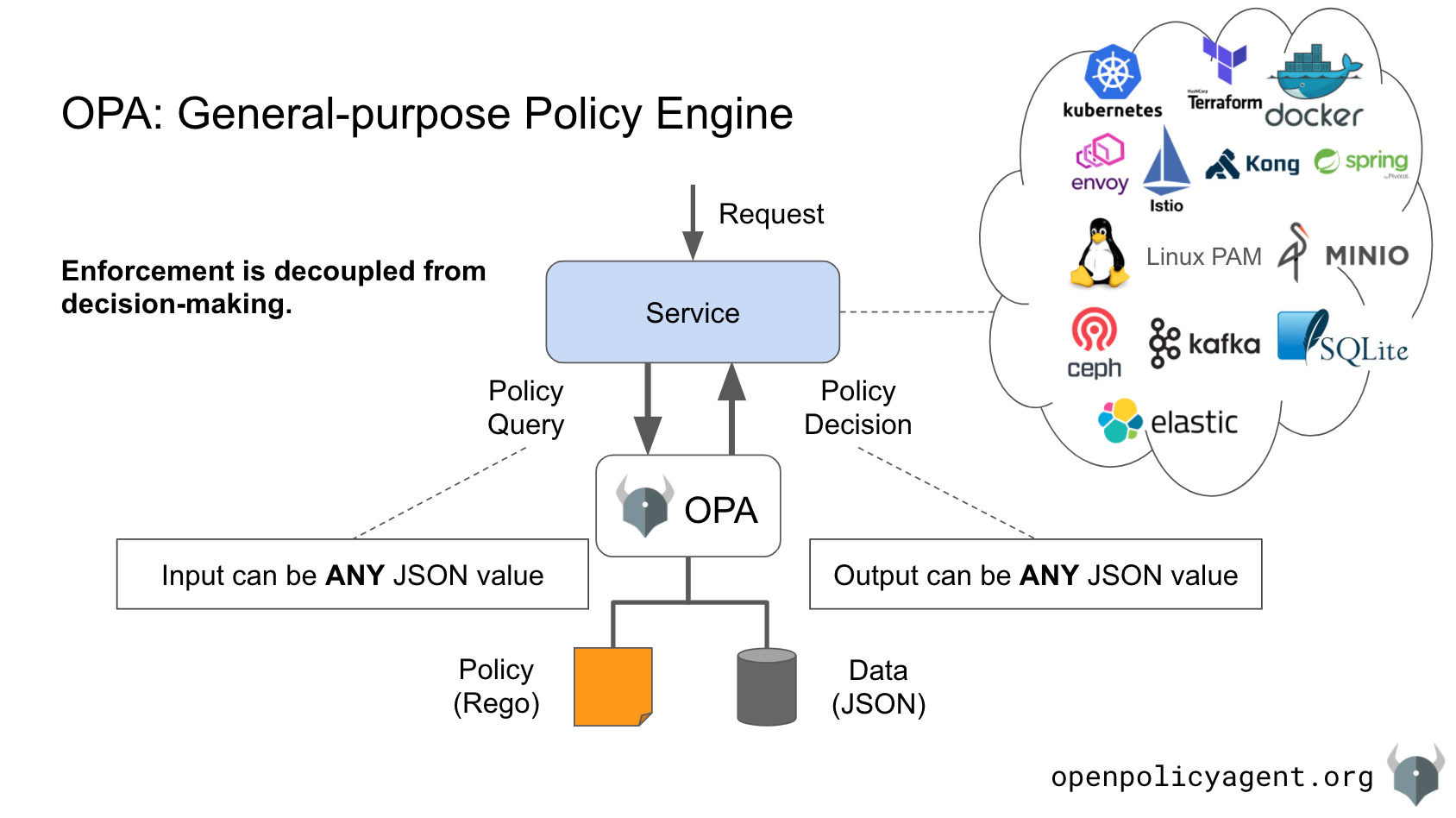
    So, Open Policy Agent is a domain agnostic policy engine, okay? So, it’s general purpose, meaning that you can kind of take it and use it to enforce all kinds of policies and governance regimes across a wide range of technology.

    So, for example, if you want to say that, you know, all of your containers have to be sourced from an internal image registry, you can express that kind of a policy with OPA, or the Open Policy Agent. If you want to do something like say that certain users can only see certain pieces of data served by a micro service, you can also do that with the Open Policy Agent. And if you want to restrict who can SSH into a server or run a pseudo command on a server, you can also do that with the Open Policy Agent.

    So, the idea is that we give people this engine that allows them to unify policy control across various pieces of their stack.

    Shimel: Excellent. And you know what’s interesting? I was talking to someone the other day and we were talking about, you know, how does Kubernetes fit into this whole Cloud Native thing? Because Cloud Native and the CNCF is bigger than just Kubernetes. And they gave me a really good analogy. They said, “Think of it as like, you know, a fleet of warships or, you know, a U.S. Navy fleet and maybe Kubernetes is the aircraft carrier. But there’s more to the Navy than the aircraft carrier. There’s more to a fleet than an aircraft carrier. There’s battleships and cruisers and destroyers and subs and frigates and amphibious landing ships,” and you know, I’m not a Navy expert. [Laughter] But there’s all these different elements that make up the fleet—and it’s a huge fleet.

    And so, you know, when I look at OPA, you know, Open Policy Agent—and we’re gonna talk about joining Cloud Native Computing Foundation—it’s a necessary ship in the fleet, right? That really makes it easier and more practical to use a lot of the tools that are not only in the fleet, but a lot of the commercial tools that kind of exist on the periphery as well. Fair?

    Sandall: Absolutely, yeah. The CNCF is a collection of projects that provide a lot of value within the overall ecosystem, and there are a few things that kind of bind them together, and those are kind of high level principles. So, you know, they’re all open source, they are all, you know, they’re oriented around containers. They’re oriented around very dynamic systems that you need to manage at scale.

    And so, one of the interesting things about a lot of the projects within the CNCF is that they are kind of building blocks. You can think of them as libraries or building blocks for the overall system, right? And so, you know, they integrate together, you can plug them into other systems and so on. And so, that’s how we kind of look at OPA. That’s how we think about OPA, is as a building block or as a library for enabling rich, fine grain control across a variety of parts of your environment.

    Shimel: Absolutely.

    Sandall: And, yeah, and so, policy is particularly important when you start to talk about adoption of technology within large organizations, right? As Kubernetes has matured and enterprises have really started to run with it and deploy real production workloads on top of it, they’ve recognized the need for not just simple best practice kind of security measures, but much more sophisticated and rich and fine grained rules and constraints that need to be enforced in a system in order to keep everybody safe. And so, that’s where OPA fits into Kubernetes.

    Shimel: Yeah, absolutely. You know what? I realized, and I apologize, I really didn’t do a good job of letting you introduce yourself to our audience on top of [Cross talk].

    Sandall: [Laughter] That’s okay.

    Shimel: So, Torin, I apologize. In addition to you being one of the co-founders of the project, why don’t you share a little bit about what you do in your day job and the rest of your life?

    Sandall: For sure, yeah. So, I think what’s relevant here is that I’m the co-founder of the Open Policy Agent project. I’m also a software engineer at a startup called Styra. We’re the makers of the Open Policy Agent. We founded the project about three years ago—a little over three years ago, actually, and yeah, so we’re kind of like the stewards of the project today. That said, we’re starting to see a lot more people from the community kind of come in and start contributing to Open Policy Agent and related kind of projects in the ecosystem.

    So, that’s sort of what I do. My focus is kind of on Open Policy Agent, but I’m super interested in the overall Cloud Native ecosystem and security and policy and all that kinda stuff.

    Shimel: So, you know, and I should also mention—I did a terrible job laying this one out, Torin, I apologize. We should also mention that the big news coming out—I guess it was this week, or maybe late last week—was that OPA, Open Policy Agent, has now become or come under the auspices of Cloud Native Computing Foundation (CNCF).

    Sandall: That’s right, yeah. So, we actually, we joined the CNCF as a sandbox to your project last year, in 2018. OPA was added into the CNCF sandbox. So, the CNCF has multiple tiers, and right now there’s sandbox, incubation and graduated.

    And so, this year, basically, they do a review of projects, you know, every year, and they check in on how the projects are doing and how they’re growing and how their communities are evolving. And that’s just useful, right? To kind of maintain, kind of, you know, good hygiene within the ecosystem. But this time around, we felt that—everybody kinda felt that OPA was growing quite a bit and it kind of deserved to move up to the next level incubation within the CNCF.

    And so, the move from sandbox to incubation is really a reflection of the progress that we’ve made over the last year in terms of both production users as well as proof of concepts and integrations, and new external contributors joining the project.

    Shimel: Got it. And, you know, I will just mention that, you know, CNCF has really done an amazing job of shepherding these projects, from sandbox into incubation, and then from incubation into graduation. I forgot the number, if it was five or six projects they’ve graduated now.

    Sandall: Yeah, I think there’s about five graduated projects today. You know, Kubernetes is one of them, it’s kind of one of the flagship projects, and there are others. And so, yeah, so, they’re really doing a good job of curating a very important set of building blocks, like I said, that are gonna help organizations get to cloud native.

    Shimel: So, let me ask you a question—and I think this is something our audience would really enjoy. How did you, as a co-founder of the OPA project, right, what was your sort of motivation for, you know, bringing it under the CNCF?

    Sandall: So, yeah, that’s a great question. What we found was that after, you know, the project had been around for over a year, or rather over almost two years, I guess. And what we found with talking to users and potential users was that they wanted to see OPA as part of a kind of vendor neutral organization, right? So, Styra, the company that I work for, had kind of built OPA, and it’s been open source since day one, but people really like to see these kinds of projects, these kinds of core infrastructure components a little bit decoupled from, like say, any particular organization.

    Shimel: Mm-hmm.

    Sandall: And so—

    Shimel: Well, not decoupled from any particular organization. Decoupled from any one particular vendor.

    Sandall: One vendor—yeah, sorry. One vendor.

    Shimel: There’s not a single vendor.

    Sandall: Yes. And so, you know, we looked around and we looked at the CNCF and we really liked what they were doing and we figured that that was the right place for OPA to be.

    So, you know, the CNCF basically provides us with this kind of vendor-neutral home for the project, and it allows us to kinda create a rallying point around policy in the cloud native ecosystem. So, that was the main, high level motivation for joining CNCF.

    Shimel: Got it. And it makes perfect sense. I mean, I’ve gotta tell you, you know, I don’t know if you’re familiar, but recently, the CNCF launched—not the CNCF, excuse me—the Linux Foundation, right, which is kinda the parent of the CNCF, right?—

    Sandall: Right, yes. Yes.

    Shimel: —launched another foundation called the CD Foundation, Continuous Delivery.

    Sandall: Yes, yes.

    Shimel: And CloudBees, the folks at CloudBees and the Jenkins project was given under to the CD Foundation. Jenkins had Jenkins X, Netflix put in Spinnaker and Google put in—I forget its name now, with a T.

    Sandall: Tekton?

    Shimel: Tekton. They put, you know, put Tekton into the thing. And I had a good chance to interview some of the CloudBees folks with this, and I asked them the same kinda question I just asked you. You know, and it was a very similar answer, that not only do end users perhaps shy away from a single vendor supported project, but it’s very hard for a project to break out of that mold and get other vendors or talent at other vendors to contribute, because they think they’re doing it for the benefit of one of their competitors.

    So, by putting it under a neutral party like this, you know, not only is it more palatable to your end users and to the community as a whole, but it’s especially more attractive to that segment of the community that are made up of vendors. And whether you hate vendors and you think they’re all commercial slime who sold out to the man or not, the fact of the matter is, those are the people who have the resources to put into these projects and to move the needle and to keep that ball moving forward and push the rope up the hill and all of that. So, can’t live with ‘em, can’t live without ‘em, and this is a great kinda middle ground.

    Sandall: That’s a good point, and I think that, you know, what we’re starting to see are more and more security vendors getting interested in OPA or Open Policy Agent. I like to call it OPA. It’s hard to call it O-P-A when you’ve got that OPA word that you can use, but anyway—

    Shimel: Yeah, yeah, yeah. [Laughter]

    Sandall: [Laughter] But yeah, so, we’re seeing more and more security vendors get interested in OPA and, you know, that is gonna be instrumental in the long run to achieving the goal of unifying policy control across a number of different systems, right? There’s never gonna be one vendor that rules everything and there’s always gonna be an amalgamation of different technologies. And so, you know, the best that we can do, I think, is provide this building block that can be embedded all over the place and that has, like, the fundamental kind of groundwork that enables unification. So, very exciting times.

    Shimel: Absolutely. So, I’m gonna ask you now to put on your entrepreneur’s hat, right? As a co-founder of your company as well, and let’s look at it Torin from that point of view. How is this helping—and I’m not familiar with your company, so I’m gonna apologize in advance. Say the name for us, again?

    Sandall: Sorry, the name of the company is Styra.

    Shimel: How do you spell that?

    Sandall: S-T-Y-R-A.

    Shimel: Got it. So, how does this help Styra?

    Sandall: That’s a great question. So, yeah, when the founders—I’m not a founder of Styra, I’m an employee at Styra.

    Shimel: Oh, I’m sorry. Okay.

    Sandall: But anyway, when the founders of Styra started the company, one of the things that they observed was that, in order to unify enforcement of policies across a wide range of technology, there would need to be kind of like a language based approach applied to the problem domain.

    And so, that’s one of the things that the Open Policy Agent provides—it gives people this high level declarative language that they can use to codify policies. And so, that was kind of recognized as something that would be needed, and what you quickly kind of—the conclusion you quickly arrive to is that, this was in 2016, 2015, and even more so today, it’s true, but what you quickly arrive at is the realization that that kind of a technology needs to be open source, right? It’s unlikely that organizations are going to want to adopt a proprietary, closed source language. It’s just not going to happen.

    And so, right from the very beginning of the company, it was recognized that an important part of the technology was going to be open source. And so, that’s how the kind of project sort of got started.

    Shimel: Got it. Got it, got it, got it. You know, I don’t wanna put you on the spot, but a little Styra background—Styra’s venture backed or bootstrapped, or?

    Sandall: Yeah, we’re venture-backed, and we recently did a bit of a launch at the RSA Conference a few weeks ago.

    Shimel: Really?

    Sandall: And so, that was very exciting, yeah. And so, you know, you can think of Styra as a control plane for policies. So, OPA kind of acts as the data plane, right? It’s this thing that you can embed into applications, you can embed it into Kubernetes, you can put it all over the place. But, what you need is also the ability to kind of manage those OPAs that are running all over the place.

    And this is what we see within the OPA community—the people that are using OPA building it into their systems. Companies like Netflix that have built an internal security platform around OPA, what they’ve ended up doing is creating a centralized management plane for policy and for security.

    And so, that’s what we’re doing at Styra is, we’re helping people kind of think about distributed enforcement of policy and centralized management of policy.

    Shimel: Got it.

    Sandall: So, we’re focusing today on Kubernetes and you can check out the website, we’ve got a bunch of information on there, but yeah, that’s the high level.

    Shimel: Excellent stuff. As a matter of fact, just looking at the website, I didn’t realize this but Styra is Bill Mann’s company.

    Sandall: That’s correct, yeah, he’s the CEO.

    Shimel: So—just to show you how old I am. I’ve known Bill Mann a really, really long time, like, I remember the day he joined CA.

    Sandall: Bill knows a lot of folks, yeah. [Laughter]

    Shimel: Yeah, he gets around. Bill’s been around, and so have I.

    Sandall: Yeah.

    Shimel: I don’t know if that’s a good or a bad thing, you know? But hey, we’re still kickin’. So, tell Bill I said hello, he’ll get a chuckle out of it.

    Sandall: Yeah. I will do that, yeah. And we’ve got a great founding team. They are some of the folks that did Nicira, which is one of the very, you know, basically, the first SDN kind of company, right? They [Cross talk]—

    Shimel: Yep, I remember that one as well.

    Sandall: Yeah. So, we’ve got a deep background within the security and policy space, and we’re kinda taking that and really bringing it into the cloud native ecosystem.

    Shimel: Very cool. You know, I don’t wanna make this about Styra because we really wanted to concentrate on OPA and CNCF, but maybe we’ll still, maybe we’ll schedule something, a second one, and we’ll talk—we’ll dive more into Styra.

    Sandall: Yeah, that would be great.

    Shimel: You guys are gonna be at KubeCon in Madrid—or I mean, in Barcelona?

    Sandall: We are gonna be in KubeCon, yes, in Barcelona in May. There are going to be a bunch of talks about Open Policy Agent. There’s gonna be, I think there’s at least three or four sessions that are happening. There’s also a little thing called Cloud Native Rejects the weekend before. [Laughter] These are the talks—like, the BSides Talks, basically for—

    Shimel: Yes. Well, that’s how Security BSides started.

    Sandall: Yeah, exactly. And so, there’s gonna be a session there with OPA content in it. So, yeah, it’s gonna be a great event.

    Shimel: Excellent.

    Sandall: And, of course, we’re gonna have a Styra booth at the event, so.

    Shimel: So, we will have a, you know, Digital Anarchist is our video platform, and we’ll have a Digital Anarchist set there where we’ll be doing videos. So, be sure—we’ll talk offline, but we’ll get you guys in for a video. We’ll follow up more on that.

    Sandall: Perfect! Yeah, looking forward to it.

    Shimel: So, is there a timeline for graduation from incubation at CNCF, or that’s kinda open?

    Sandall: It’s open. So, you know, they do a yearly review of the project, and it’s kind of up to, you know, the community and CNCF and everybody to kind of decide when that’s right. And so—yeah, so right now, one of the main criteria for graduation is around external contribution. And so, you know, over the next year, we’ll see how external contribution around OPA evolves and if it’s in the right place, then we’ll go ahead with that.

    But we’re really happy right now just with the move to incubation because it brings more visibility to the project, it lends more credibility to the project—you know, in addition to all the people that are using it in production, having it more prominently represented within the CNCF is great. So, we’re really happy with where we are today.

    Shimel: Fantastic, man. Hey, Torin, I had promised you we’ll do this in 15 minutes, and that was 25 minutes ago.

    Sandall: [Laughter]

    Shimel: So, I apologize for running over, but I thought we had a good conversation here.

    Sandall: Yeah, yeah. Thanks a lot, Alan. Yeah, I appreciate the time to talk about OPA and Styra and I look forward to—

    Shimel: Oh, it was really my pleasure. I’d like to—we’ll continue this at maybe KubeCon in May. But before we sign off—so, Styra is Styra.com, S-T-Y-R-A.com. The OPA project, right, is—

    Sandall: Yep.

    Shimel: —OpenPolicyAgent.org?

    Sandall: That’s correct, yep.

    Shimel: And, of course, you can find more information on it at the CNCF.io site, right?—

    Sandall: Absolutely, yeah, and it’s on GitHub and we also have a blog if you go to blog.OpenPolicyAgent.org, you can find out more there. So, yeah, check it out, and—yeah.

    Shimel: [Cross talk] It’s all good. Hey, Torin Sandall, co-founder of the OPA, Open Policy Agent project, which is now being incubated by Cloud Native Computing Foundation, as well as an employee at Styra—for my friend Bill Mann.

    Sandall: [Laughter]

    Shimel: So, good to have you on there. Say hello to Bill for me. Best of luck with OPA.

    Sandall: Will do.

    Shimel: And look forward to seeing you in May at KubeCon.

    Sandall: Looking forward to it. Talk to you later. Bye.

    Shimel: Alright Torin, thanks. Hey, this is Alan Shimel for devopsy.kinsta.cloud, Container Journal and Security Boulevard. You’ve just listened to another DevOps Chat.

    — Alan Shimel